EP0667376B1 - Phthalimidyl-Azofarbstoffe, Verfahren zu deren Herstellung und deren Verwendung - Google Patents
Phthalimidyl-Azofarbstoffe, Verfahren zu deren Herstellung und deren Verwendung Download PDFInfo
- Publication number
- EP0667376B1 EP0667376B1 EP95810071A EP95810071A EP0667376B1 EP 0667376 B1 EP0667376 B1 EP 0667376B1 EP 95810071 A EP95810071 A EP 95810071A EP 95810071 A EP95810071 A EP 95810071A EP 0667376 B1 EP0667376 B1 EP 0667376B1
- Authority
- EP
- European Patent Office
- Prior art keywords
- alkyl
- substituted
- phenyl
- cyano
- halogen
- Prior art date
- Legal status (The legal status is an assumption and is not a legal conclusion. Google has not performed a legal analysis and makes no representation as to the accuracy of the status listed.)
- Expired - Lifetime
Links
- 239000000987 azo dye Substances 0.000 title claims description 19
- 238000000034 method Methods 0.000 title claims description 18
- 238000002360 preparation method Methods 0.000 title claims description 7
- -1 cyano, phenyl Chemical group 0.000 claims description 44
- 229910052736 halogen Inorganic materials 0.000 claims description 26
- 150000002367 halogens Chemical class 0.000 claims description 23
- 239000000463 material Substances 0.000 claims description 23
- 125000004093 cyano group Chemical group *C#N 0.000 claims description 22
- 125000002496 methyl group Chemical group [H]C([H])([H])* 0.000 claims description 21
- 125000001997 phenyl group Chemical group [H]C1=C([H])C([H])=C(*)C([H])=C1[H] 0.000 claims description 18
- 239000004753 textile Substances 0.000 claims description 14
- 229920000728 polyester Polymers 0.000 claims description 13
- 125000004178 (C1-C4) alkyl group Chemical group 0.000 claims description 12
- 229910052739 hydrogen Inorganic materials 0.000 claims description 12
- 239000001257 hydrogen Substances 0.000 claims description 12
- 125000001495 ethyl group Chemical group [H]C([H])([H])C([H])([H])* 0.000 claims description 11
- 238000004043 dyeing Methods 0.000 claims description 10
- 230000008878 coupling Effects 0.000 claims description 9
- 238000010168 coupling process Methods 0.000 claims description 9
- 238000005859 coupling reaction Methods 0.000 claims description 9
- 230000002209 hydrophobic effect Effects 0.000 claims description 9
- 150000002431 hydrogen Chemical class 0.000 claims description 8
- 238000007639 printing Methods 0.000 claims description 8
- UFHFLCQGNIYNRP-UHFFFAOYSA-N Hydrogen Chemical compound [H][H] UFHFLCQGNIYNRP-UHFFFAOYSA-N 0.000 claims description 7
- 125000001309 chloro group Chemical group Cl* 0.000 claims description 7
- 150000001875 compounds Chemical class 0.000 claims description 7
- 239000000835 fiber Substances 0.000 claims description 6
- 125000000956 methoxy group Chemical group [H]C([H])([H])O* 0.000 claims description 5
- 125000000229 (C1-C4)alkoxy group Chemical group 0.000 claims description 4
- 229910052757 nitrogen Inorganic materials 0.000 claims description 4
- 125000004433 nitrogen atom Chemical group N* 0.000 claims description 4
- 125000001436 propyl group Chemical group [H]C([*])([H])C([H])([H])C([H])([H])[H] 0.000 claims description 4
- 125000003903 2-propenyl group Chemical group [H]C([*])([H])C([H])=C([H])[H] 0.000 claims description 2
- XKJCHHZQLQNZHY-UHFFFAOYSA-N phthalimide Chemical compound C1=CC=C2C(=O)NC(=O)C2=C1 XKJCHHZQLQNZHY-UHFFFAOYSA-N 0.000 claims description 2
- 125000005843 halogen group Chemical group 0.000 claims 3
- 125000000954 2-hydroxyethyl group Chemical group [H]C([*])([H])C([H])([H])O[H] 0.000 claims 2
- 125000002887 hydroxy group Chemical group [H]O* 0.000 claims 2
- 125000005647 linker group Chemical group 0.000 claims 2
- 125000000738 acetamido group Chemical group [H]C([H])([H])C(=O)N([H])[*] 0.000 claims 1
- 150000001989 diazonium salts Chemical class 0.000 claims 1
- 239000000986 disperse dye Substances 0.000 claims 1
- 125000004435 hydrogen atom Chemical group [H]* 0.000 claims 1
- 239000000975 dye Substances 0.000 description 27
- 239000000460 chlorine Substances 0.000 description 11
- QTBSBXVTEAMEQO-UHFFFAOYSA-N Acetic acid Chemical compound CC(O)=O QTBSBXVTEAMEQO-UHFFFAOYSA-N 0.000 description 9
- 229910052801 chlorine Inorganic materials 0.000 description 7
- 239000006185 dispersion Substances 0.000 description 7
- 239000000203 mixture Substances 0.000 description 7
- 150000003254 radicals Chemical class 0.000 description 7
- ZAMOUSCENKQFHK-UHFFFAOYSA-N Chlorine atom Chemical compound [Cl] ZAMOUSCENKQFHK-UHFFFAOYSA-N 0.000 description 6
- XBDQKXXYIPTUBI-UHFFFAOYSA-N dimethylselenoniopropionate Natural products CCC(O)=O XBDQKXXYIPTUBI-UHFFFAOYSA-N 0.000 description 6
- PAYRUJLWNCNPSJ-UHFFFAOYSA-N Aniline Chemical compound NC1=CC=CC=C1 PAYRUJLWNCNPSJ-UHFFFAOYSA-N 0.000 description 5
- 239000002270 dispersing agent Substances 0.000 description 5
- 239000004744 fabric Substances 0.000 description 5
- 239000002657 fibrous material Substances 0.000 description 5
- XLYOFNOQVPJJNP-UHFFFAOYSA-N water Substances O XLYOFNOQVPJJNP-UHFFFAOYSA-N 0.000 description 5
- LFQSCWFLJHTTHZ-UHFFFAOYSA-N Ethanol Chemical compound CCO LFQSCWFLJHTTHZ-UHFFFAOYSA-N 0.000 description 4
- KKEYFWRCBNTPAC-UHFFFAOYSA-N Terephthalic acid Chemical compound OC(=O)C1=CC=C(C(O)=O)C=C1 KKEYFWRCBNTPAC-UHFFFAOYSA-N 0.000 description 4
- QWPPOHNGKGFGJK-UHFFFAOYSA-N hypochlorous acid Chemical group ClO QWPPOHNGKGFGJK-UHFFFAOYSA-N 0.000 description 4
- 125000001731 2-cyanoethyl group Chemical group [H]C([H])(*)C([H])([H])C#N 0.000 description 3
- LYCAIKOWRPUZTN-UHFFFAOYSA-N Ethylene glycol Chemical compound OCCO LYCAIKOWRPUZTN-UHFFFAOYSA-N 0.000 description 3
- RWRDLPDLKQPQOW-UHFFFAOYSA-N Pyrrolidine Chemical compound C1CCNC1 RWRDLPDLKQPQOW-UHFFFAOYSA-N 0.000 description 3
- HEMHJVSKTPXQMS-UHFFFAOYSA-M Sodium hydroxide Chemical compound [OH-].[Na+] HEMHJVSKTPXQMS-UHFFFAOYSA-M 0.000 description 3
- 239000002253 acid Substances 0.000 description 3
- 125000000217 alkyl group Chemical group 0.000 description 3
- 125000002603 chloroethyl group Chemical group [H]C([*])([H])C([H])([H])Cl 0.000 description 3
- 238000006193 diazotization reaction Methods 0.000 description 3
- 235000019260 propionic acid Nutrition 0.000 description 3
- IUVKMZGDUIUOCP-BTNSXGMBSA-N quinbolone Chemical compound O([C@H]1CC[C@H]2[C@H]3[C@@H]([C@]4(C=CC(=O)C=C4CC3)C)CC[C@@]21C)C1=CCCC1 IUVKMZGDUIUOCP-BTNSXGMBSA-N 0.000 description 3
- 125000006273 (C1-C3) alkyl group Chemical group 0.000 description 2
- 229920002284 Cellulose triacetate Polymers 0.000 description 2
- YNAVUWVOSKDBBP-UHFFFAOYSA-N Morpholine Chemical compound C1COCCN1 YNAVUWVOSKDBBP-UHFFFAOYSA-N 0.000 description 2
- NQRYJNQNLNOLGT-UHFFFAOYSA-N Piperidine Chemical compound C1CCNCC1 NQRYJNQNLNOLGT-UHFFFAOYSA-N 0.000 description 2
- QAOWNCQODCNURD-UHFFFAOYSA-N Sulfuric acid Chemical compound OS(O)(=O)=O QAOWNCQODCNURD-UHFFFAOYSA-N 0.000 description 2
- NNLVGZFZQQXQNW-ADJNRHBOSA-N [(2r,3r,4s,5r,6s)-4,5-diacetyloxy-3-[(2s,3r,4s,5r,6r)-3,4,5-triacetyloxy-6-(acetyloxymethyl)oxan-2-yl]oxy-6-[(2r,3r,4s,5r,6s)-4,5,6-triacetyloxy-2-(acetyloxymethyl)oxan-3-yl]oxyoxan-2-yl]methyl acetate Chemical compound O([C@@H]1O[C@@H]([C@H]([C@H](OC(C)=O)[C@H]1OC(C)=O)O[C@H]1[C@@H]([C@@H](OC(C)=O)[C@H](OC(C)=O)[C@@H](COC(C)=O)O1)OC(C)=O)COC(=O)C)[C@@H]1[C@@H](COC(C)=O)O[C@@H](OC(C)=O)[C@H](OC(C)=O)[C@H]1OC(C)=O NNLVGZFZQQXQNW-ADJNRHBOSA-N 0.000 description 2
- VJMAITQRABEEKP-UHFFFAOYSA-N [6-(phenylmethoxymethyl)-1,4-dioxan-2-yl]methyl acetate Chemical compound O1C(COC(=O)C)COCC1COCC1=CC=CC=C1 VJMAITQRABEEKP-UHFFFAOYSA-N 0.000 description 2
- 125000004432 carbon atom Chemical group C* 0.000 description 2
- 238000000605 extraction Methods 0.000 description 2
- 125000003187 heptyl group Chemical group [H]C([*])([H])C([H])([H])C([H])([H])C([H])([H])C([H])([H])C([H])([H])C([H])([H])[H] 0.000 description 2
- 125000004051 hexyl group Chemical group [H]C([H])([H])C([H])([H])C([H])([H])C([H])([H])C([H])([H])C([H])([H])* 0.000 description 2
- 125000000959 isobutyl group Chemical group [H]C([H])([H])C([H])(C([H])([H])[H])C([H])([H])* 0.000 description 2
- 125000001449 isopropyl group Chemical group [H]C([H])([H])C([H])(*)C([H])([H])[H] 0.000 description 2
- 238000013508 migration Methods 0.000 description 2
- 230000005012 migration Effects 0.000 description 2
- WHILCEOUZRONTD-UHFFFAOYSA-N n-[3-[benzyl(ethyl)amino]phenyl]acetamide Chemical compound C=1C=CC(NC(C)=O)=CC=1N(CC)CC1=CC=CC=C1 WHILCEOUZRONTD-UHFFFAOYSA-N 0.000 description 2
- 125000004108 n-butyl group Chemical group [H]C([H])([H])C([H])([H])C([H])([H])C([H])([H])* 0.000 description 2
- 125000004123 n-propyl group Chemical group [H]C([H])([H])C([H])([H])C([H])([H])* 0.000 description 2
- 125000002347 octyl group Chemical group [H]C([*])([H])C([H])([H])C([H])([H])C([H])([H])C([H])([H])C([H])([H])C([H])([H])C([H])([H])[H] 0.000 description 2
- 125000001147 pentyl group Chemical group C(CCCC)* 0.000 description 2
- 125000002914 sec-butyl group Chemical group [H]C([H])([H])C([H])([H])C([H])(*)C([H])([H])[H] 0.000 description 2
- 239000000758 substrate Substances 0.000 description 2
- 125000000999 tert-butyl group Chemical group [H]C([H])([H])C(*)(C([H])([H])[H])C([H])([H])[H] 0.000 description 2
- 210000002268 wool Anatomy 0.000 description 2
- 125000004209 (C1-C8) alkyl group Chemical group 0.000 description 1
- 0 *c1ccc(*)c(N(*)*)c1 Chemical compound *c1ccc(*)c(N(*)*)c1 0.000 description 1
- ZMESHQOXZMOOQQ-UHFFFAOYSA-N 1-(naphthalen-1-ylmethyl)naphthalene Chemical compound C1=CC=C2C(CC=3C4=CC=CC=C4C=CC=3)=CC=CC2=C1 ZMESHQOXZMOOQQ-UHFFFAOYSA-N 0.000 description 1
- FPZWZCWUIYYYBU-UHFFFAOYSA-N 2-(2-ethoxyethoxy)ethyl acetate Chemical group CCOCCOCCOC(C)=O FPZWZCWUIYYYBU-UHFFFAOYSA-N 0.000 description 1
- KMEBUNSLFRQSEM-UHFFFAOYSA-N 5-amino-2-methylisoindole-1,3-dione Chemical compound C1=C(N)C=C2C(=O)N(C)C(=O)C2=C1 KMEBUNSLFRQSEM-UHFFFAOYSA-N 0.000 description 1
- RXQNKKRGJJRMKD-UHFFFAOYSA-N 5-bromo-2-methylaniline Chemical compound CC1=CC=C(Br)C=C1N RXQNKKRGJJRMKD-UHFFFAOYSA-N 0.000 description 1
- 244000215068 Acacia senegal Species 0.000 description 1
- 241000416162 Astragalus gummifer Species 0.000 description 1
- WKBOTKDWSSQWDR-UHFFFAOYSA-N Bromine atom Chemical compound [Br] WKBOTKDWSSQWDR-UHFFFAOYSA-N 0.000 description 1
- GAWIXWVDTYZWAW-UHFFFAOYSA-N C[CH]O Chemical group C[CH]O GAWIXWVDTYZWAW-UHFFFAOYSA-N 0.000 description 1
- 229920002134 Carboxymethyl cellulose Polymers 0.000 description 1
- 229920003043 Cellulose fiber Polymers 0.000 description 1
- 229920000742 Cotton Polymers 0.000 description 1
- PXGOKWXKJXAPGV-UHFFFAOYSA-N Fluorine Chemical compound FF PXGOKWXKJXAPGV-UHFFFAOYSA-N 0.000 description 1
- 229920000084 Gum arabic Polymers 0.000 description 1
- 229920000663 Hydroxyethyl cellulose Polymers 0.000 description 1
- 239000004354 Hydroxyethyl cellulose Substances 0.000 description 1
- 229920001612 Hydroxyethyl starch Polymers 0.000 description 1
- 229920000161 Locust bean gum Polymers 0.000 description 1
- YGYAWVDWMABLBF-UHFFFAOYSA-N Phosgene Chemical compound ClC(Cl)=O YGYAWVDWMABLBF-UHFFFAOYSA-N 0.000 description 1
- 239000004952 Polyamide Substances 0.000 description 1
- 229920002125 Sokalan® Polymers 0.000 description 1
- 229920001615 Tragacanth Polymers 0.000 description 1
- XSQUKJJJFZCRTK-UHFFFAOYSA-N Urea Chemical compound NC(N)=O XSQUKJJJFZCRTK-UHFFFAOYSA-N 0.000 description 1
- YIMQCDZDWXUDCA-UHFFFAOYSA-N [4-(hydroxymethyl)cyclohexyl]methanol Chemical compound OCC1CCC(CO)CC1 YIMQCDZDWXUDCA-UHFFFAOYSA-N 0.000 description 1
- 238000010521 absorption reaction Methods 0.000 description 1
- 235000010489 acacia gum Nutrition 0.000 description 1
- 239000000205 acacia gum Substances 0.000 description 1
- 235000010443 alginic acid Nutrition 0.000 description 1
- 229920000615 alginic acid Polymers 0.000 description 1
- 150000001448 anilines Chemical class 0.000 description 1
- 125000000129 anionic group Chemical group 0.000 description 1
- 125000003118 aryl group Chemical group 0.000 description 1
- 238000000889 atomisation Methods 0.000 description 1
- 125000001797 benzyl group Chemical group [H]C1=C([H])C([H])=C(C([H])=C1[H])C([H])([H])* 0.000 description 1
- GDTBXPJZTBHREO-UHFFFAOYSA-N bromine Substances BrBr GDTBXPJZTBHREO-UHFFFAOYSA-N 0.000 description 1
- 229910052794 bromium Inorganic materials 0.000 description 1
- 239000004202 carbamide Substances 0.000 description 1
- 239000001768 carboxy methyl cellulose Substances 0.000 description 1
- 235000010948 carboxy methyl cellulose Nutrition 0.000 description 1
- 239000008112 carboxymethyl-cellulose Substances 0.000 description 1
- 229940105329 carboxymethylcellulose Drugs 0.000 description 1
- 239000000969 carrier Substances 0.000 description 1
- 239000001913 cellulose Substances 0.000 description 1
- 229920002678 cellulose Polymers 0.000 description 1
- 239000003795 chemical substances by application Substances 0.000 description 1
- 239000007859 condensation product Substances 0.000 description 1
- 229920001577 copolymer Polymers 0.000 description 1
- 239000013078 crystal Substances 0.000 description 1
- GLUUGHFHXGJENI-UHFFFAOYSA-N diethylenediamine Natural products C1CNCCN1 GLUUGHFHXGJENI-UHFFFAOYSA-N 0.000 description 1
- 125000006232 ethoxy propyl group Chemical group [H]C([H])([H])C([H])([H])OC([H])([H])C([H])([H])C([H])([H])* 0.000 description 1
- 239000002979 fabric softener Substances 0.000 description 1
- 229910052731 fluorine Inorganic materials 0.000 description 1
- 239000011737 fluorine Substances 0.000 description 1
- 238000009472 formulation Methods 0.000 description 1
- 150000002334 glycols Chemical class 0.000 description 1
- 238000000227 grinding Methods 0.000 description 1
- 229920000591 gum Polymers 0.000 description 1
- 238000009998 heat setting Methods 0.000 description 1
- 125000002768 hydroxyalkyl group Chemical group 0.000 description 1
- 235000019447 hydroxyethyl cellulose Nutrition 0.000 description 1
- 229940071826 hydroxyethyl cellulose Drugs 0.000 description 1
- 229940050526 hydroxyethylstarch Drugs 0.000 description 1
- 235000010420 locust bean gum Nutrition 0.000 description 1
- 239000000711 locust bean gum Substances 0.000 description 1
- UQYMPAFTBYDYCN-UHFFFAOYSA-N n'-[2-(dioctadecylamino)ethyl]ethane-1,2-diamine Chemical compound CCCCCCCCCCCCCCCCCCN(CCNCCN)CCCCCCCCCCCCCCCCCC UQYMPAFTBYDYCN-UHFFFAOYSA-N 0.000 description 1
- 229930014626 natural product Natural products 0.000 description 1
- 239000002245 particle Substances 0.000 description 1
- 239000000049 pigment Substances 0.000 description 1
- 229920002401 polyacrylamide Polymers 0.000 description 1
- 239000004584 polyacrylic acid Substances 0.000 description 1
- 229920002647 polyamide Polymers 0.000 description 1
- 229920000515 polycarbonate Polymers 0.000 description 1
- 239000004417 polycarbonate Substances 0.000 description 1
- 229920002451 polyvinyl alcohol Polymers 0.000 description 1
- 235000019422 polyvinyl alcohol Nutrition 0.000 description 1
- 229920000915 polyvinyl chloride Polymers 0.000 description 1
- 239000004800 polyvinyl chloride Substances 0.000 description 1
- 239000002243 precursor Substances 0.000 description 1
- 239000000047 product Substances 0.000 description 1
- 239000011541 reaction mixture Substances 0.000 description 1
- 239000005060 rubber Substances 0.000 description 1
- 239000004576 sand Substances 0.000 description 1
- 238000010186 staining Methods 0.000 description 1
- 239000008107 starch Substances 0.000 description 1
- 235000019698 starch Nutrition 0.000 description 1
- 238000003756 stirring Methods 0.000 description 1
- 125000001424 substituent group Chemical group 0.000 description 1
- 210000004243 sweat Anatomy 0.000 description 1
- 230000008961 swelling Effects 0.000 description 1
- 229920002994 synthetic fiber Polymers 0.000 description 1
- 239000004758 synthetic textile Substances 0.000 description 1
- 239000002562 thickening agent Substances 0.000 description 1
- 235000010487 tragacanth Nutrition 0.000 description 1
- 239000000196 tragacanth Substances 0.000 description 1
- 229940116362 tragacanth Drugs 0.000 description 1
- 238000010023 transfer printing Methods 0.000 description 1
Classifications
-
- C—CHEMISTRY; METALLURGY
- C09—DYES; PAINTS; POLISHES; NATURAL RESINS; ADHESIVES; COMPOSITIONS NOT OTHERWISE PROVIDED FOR; APPLICATIONS OF MATERIALS NOT OTHERWISE PROVIDED FOR
- C09B—ORGANIC DYES OR CLOSELY-RELATED COMPOUNDS FOR PRODUCING DYES, e.g. PIGMENTS; MORDANTS; LAKES
- C09B29/00—Monoazo dyes prepared by diazotising and coupling
- C09B29/06—Monoazo dyes prepared by diazotising and coupling from coupling components containing amino as the only directing group
- C09B29/08—Amino benzenes
- C09B29/0805—Amino benzenes free of acid groups
- C09B29/0807—Amino benzenes free of acid groups characterised by the amino group
- C09B29/0809—Amino benzenes free of acid groups characterised by the amino group substituted amino group
-
- C—CHEMISTRY; METALLURGY
- C09—DYES; PAINTS; POLISHES; NATURAL RESINS; ADHESIVES; COMPOSITIONS NOT OTHERWISE PROVIDED FOR; APPLICATIONS OF MATERIALS NOT OTHERWISE PROVIDED FOR
- C09B—ORGANIC DYES OR CLOSELY-RELATED COMPOUNDS FOR PRODUCING DYES, e.g. PIGMENTS; MORDANTS; LAKES
- C09B29/00—Monoazo dyes prepared by diazotising and coupling
- C09B29/0025—Monoazo dyes prepared by diazotising and coupling from diazotized amino heterocyclic compounds
- C09B29/0029—Monoazo dyes prepared by diazotising and coupling from diazotized amino heterocyclic compounds the heterocyclic ring containing only nitrogen as heteroatom
- C09B29/0033—Monoazo dyes prepared by diazotising and coupling from diazotized amino heterocyclic compounds the heterocyclic ring containing only nitrogen as heteroatom containing a five-membered heterocyclic ring with one nitrogen atom
-
- C—CHEMISTRY; METALLURGY
- C09—DYES; PAINTS; POLISHES; NATURAL RESINS; ADHESIVES; COMPOSITIONS NOT OTHERWISE PROVIDED FOR; APPLICATIONS OF MATERIALS NOT OTHERWISE PROVIDED FOR
- C09B—ORGANIC DYES OR CLOSELY-RELATED COMPOUNDS FOR PRODUCING DYES, e.g. PIGMENTS; MORDANTS; LAKES
- C09B67/00—Influencing the physical, e.g. the dyeing or printing properties of dyestuffs without chemical reactions, e.g. by treating with solvents grinding or grinding assistants, coating of pigments or dyes; Process features in the making of dyestuff preparations; Dyestuff preparations of a special physical nature, e.g. tablets, films
- C09B67/0071—Process features in the making of dyestuff preparations; Dehydrating agents; Dispersing agents; Dustfree compositions
- C09B67/008—Preparations of disperse dyes or solvent dyes
Definitions
- the present invention relates to dispersion azo dyes with a N-methyl-phthalimide diazo component and an aniline coupling component, Process for the preparation of these dyes and their use for dyeing Textile materials, especially polyester.
- Dispersion azo dyes with an N-alkyl-phthalimide diazo component and an aniline coupling component are known in some cases.
- phthalimidylazo dyes with an unsubstituted aniline coupling component are known from the Journal of the Society of Dyers and Colorists, 97 (2) , pp. 72-75 and 97 (8) , pp. 358-362.
- US-A-4,039,522 describes specific dyes which do not carry a methyl substituent on the nitrogen atom of the phthalimidyldiazo component. However, these dyes do not always meet today's needs, such as thermal migration, light or wash fastness.
- the object of the present invention is to find dispersion azo dyes which meet today's needs.
- the dispersion azo dyes according to the invention meet the Formula (1) the requirements mentioned.
- R 2 , R 3 , R 5 or R 6 represent an unsubstituted alkyl radical, this can be straight-chain or branched from C 3 .
- R 2 , R 3 , R 5 or R 6 represent an unsubstituted alkyl radical, this can be straight-chain or branched from C 3 .
- methyl, ethyl, n- or iso-propyl, n-, iso-, sec- or tert-butyl, straight-chain or branched pentyl, hexyl, heptyl or octyl are suitable.
- R 2 represents a C 1 -C 8 alkoxy radical substituted by halogen, cyano, phenyl, -YC 1 -C 8 alkyl or -Y-phenyl, then this C 1 -C 8 alkoxy radical, like the -YC 1 -C 8 alkyl radical straight-chain, or branched from C 3 .
- alkyl radicals are, for example, methyl, ethyl, n- or iso-propyl, n-, iso-, sec- or tert-butyl, straight-chain or branched pentyl, hexyl, heptyl or octyl and for the alkoxy radicals methoxy, ethoxy, straight-chain or branched propoxy, butoxy, pentoxy, hexoxy, heptoxy or octoxy.
- R 3 or R 4 are a C 1 -C 8 -alkyl radical substituted by hydroxy, cyano, vinyl, phenyl, halogen, -XC 1 -C 8 -alkyl or -X-phenyl
- this C 1 -C 8 - Alkyl radical as well as the -XC 1 -C 8 alkyl radical can be straight-chain or branched from C 3 .
- the alkyl radicals listed above come into question.
- R 3 and R 4 together with the nitrogen atom connecting them can also represent a heterocyclic radical, for example a pyrrolidine, piperidine, morpholine or piperazine radical.
- R 5 represents a C 1 -C 3 -alkyl radical substituted by chlorine or cyano
- this C 1 -C 3 -alkyl radical can be straight-chain or branched at C 3 .
- the alkyl radicals listed above come into question.
- R 6 represents a C 1 -C 4 -alkyl radical substituted by halogen, cyano or phenyl
- this C 1 -C 4 -alkyl radical can be straight-chain or branched from C 3 .
- the alkyl radicals listed above come into question.
- Halogen means e.g. Fluorine, bromine or especially chlorine.
- radicals R 2 , R 3 , R 4 , R 5 and R 6 can be substituted one or more times by the stated substituents.
- substituted R 2 radicals are chloroethoxy, cyanoethoxy or 2-ethoxyethoxy.
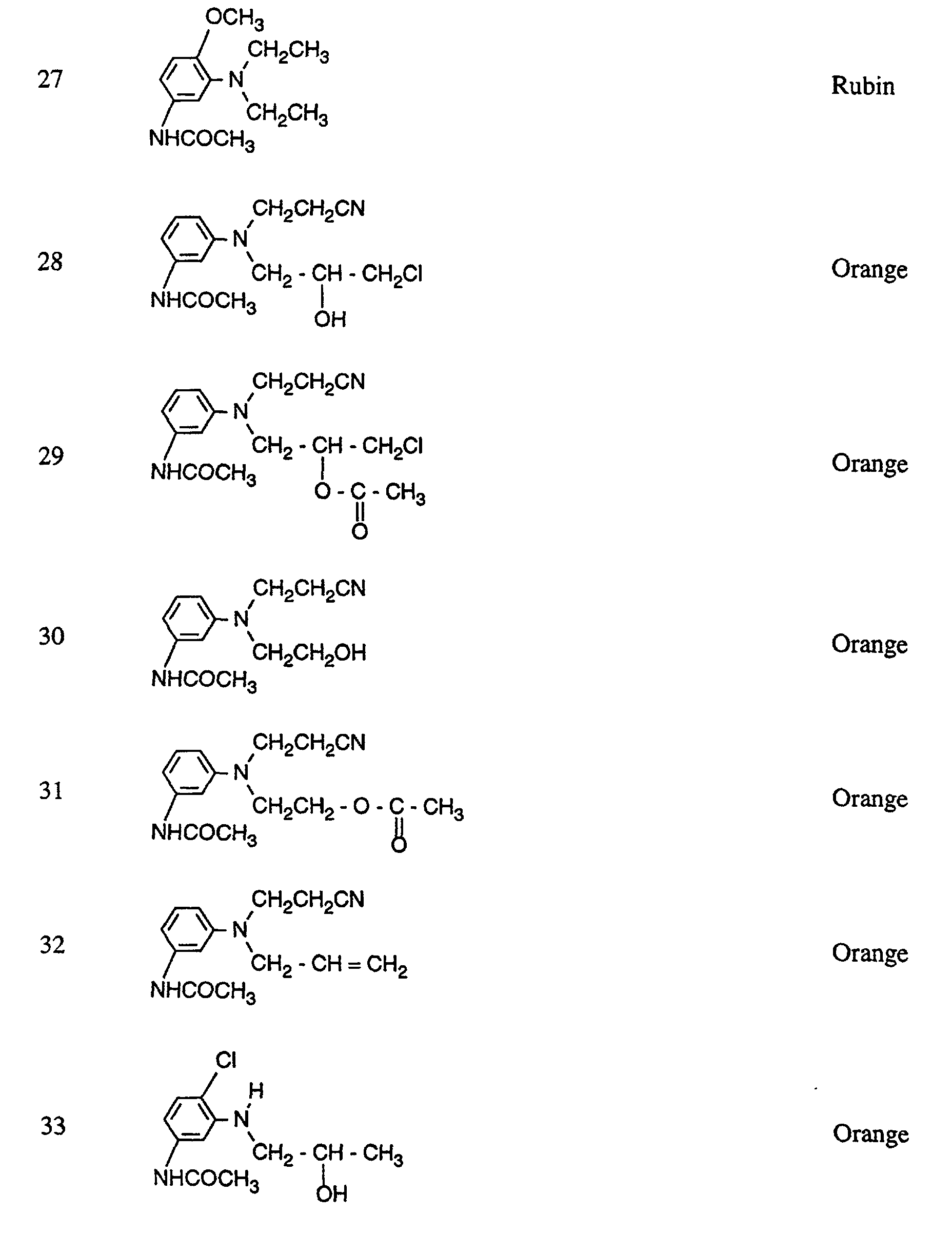
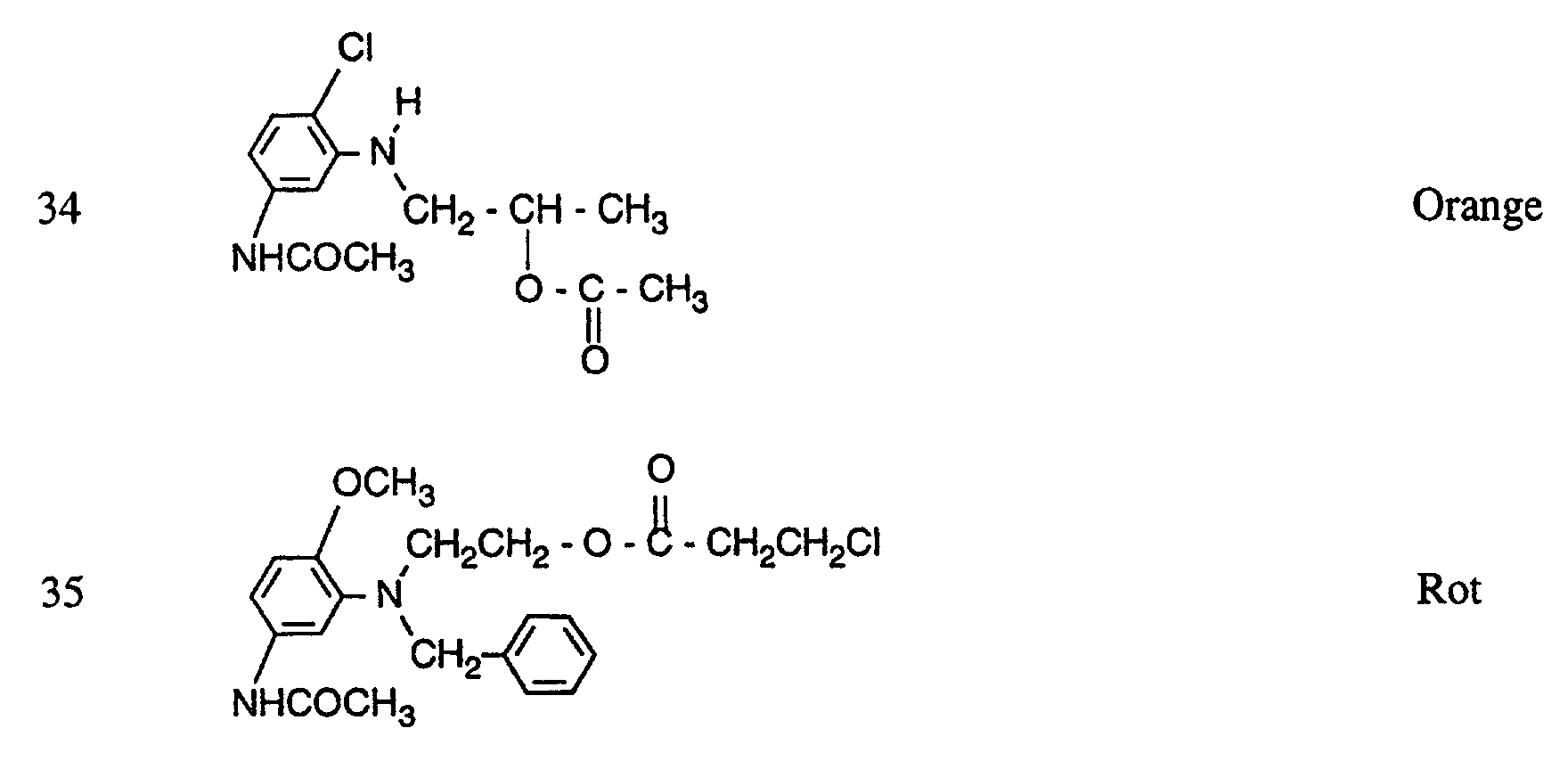
- substituted R 3 or R 4 radicals are hydroxyethyl, hydroxypropyl, chloroethyl, 2-hydroxy-3-chloropropyl, allyl, cyanoethyl, chloroethylcarbonyloxyethyl, methoxyethyl, ethoxypropyl, methoxycarbonylethyl, ethoxycarbonylethyl, acetoxyethyl, propionyloxyethyl, methoxycarbonyloxyethyl, butoxyylaminocarbonoxyethyl, ethoxycarbonaminoxyoxyoxy, or ethyloxycarbonyloxyethyl Chloroethylaminocarbonyloxyethyl.
- substituted R 5 'radicals are chloroethyl or cyanoethyl.
- substituted R 6 radicals are chloroethyl, cyanoethyl or benzyl.
- R 1 is methyl, NH-CO-CH 3 , NH-CO-CH 2 -CH 3 or NH-CO-CH 2 -CH 2 Cl
- R 2 is hydrogen, methyl, methoxy or chlorine
- Methyl, ethyl or C 1 -C 4 -alkyl substituted by cyano or phenyl are particularly preferred for R 3 .
- Methyl, ethyl or C 1 -C 4 alkyl substituted by cyano or phenyl are particularly preferred for R 4 .
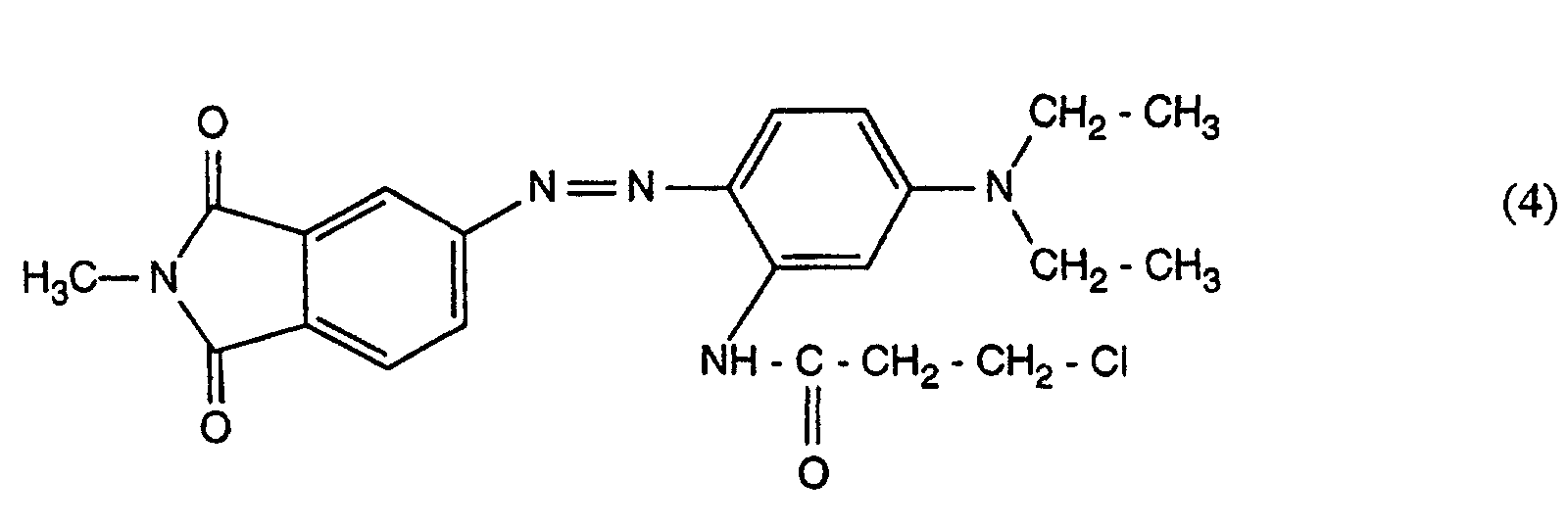
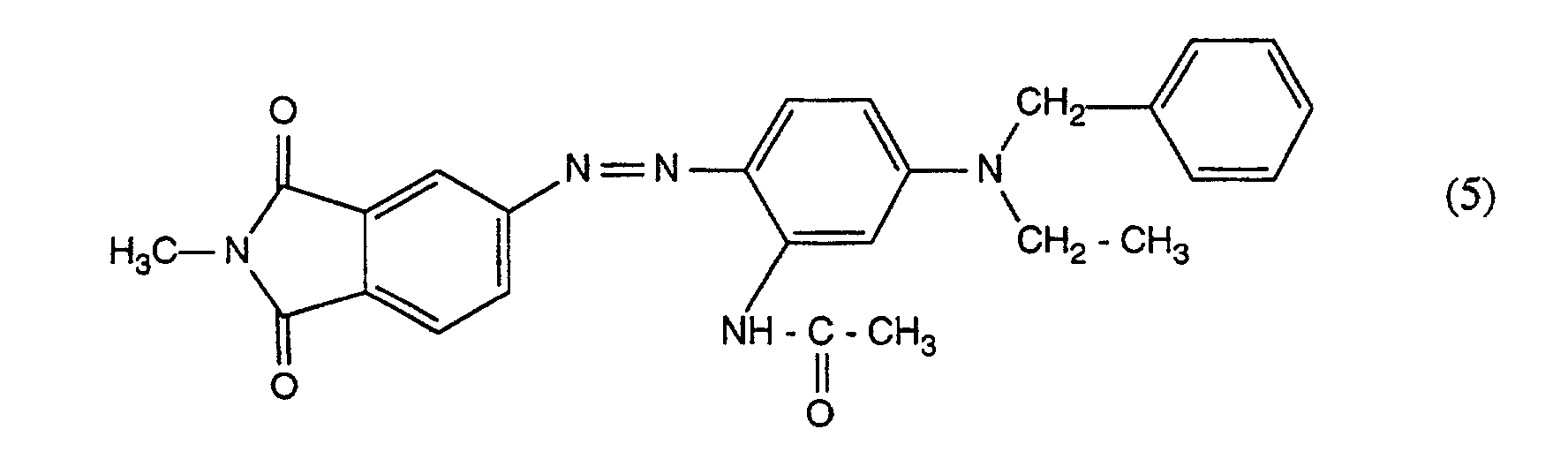
- a particularly preferred embodiment of the invention are azo dyes of the formulas and represents.
- the present application also relates to a process for the preparation of the dyes according to the invention.
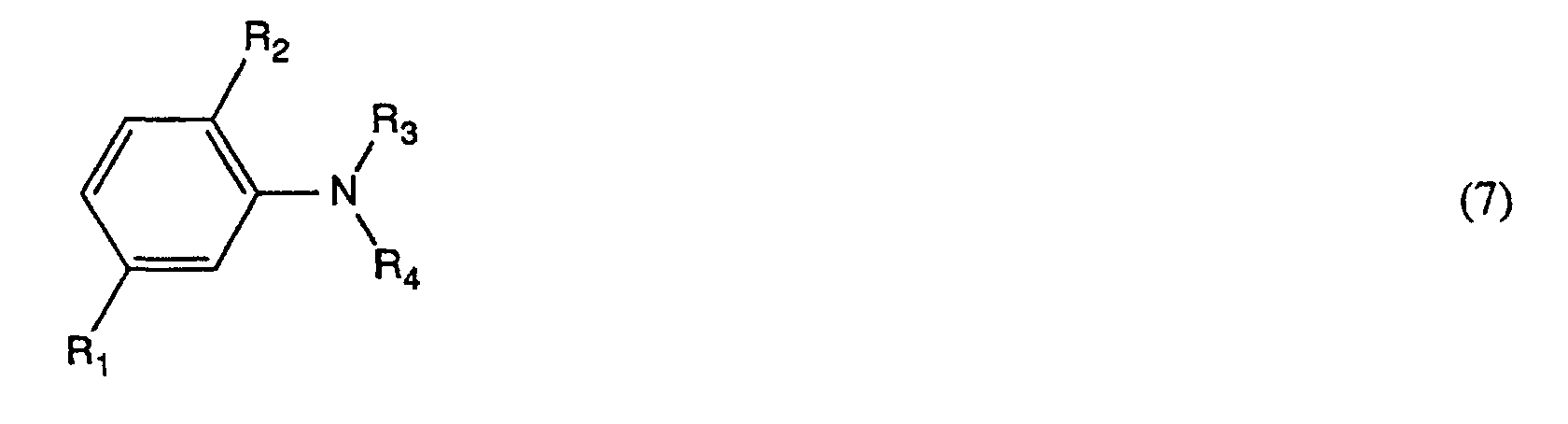
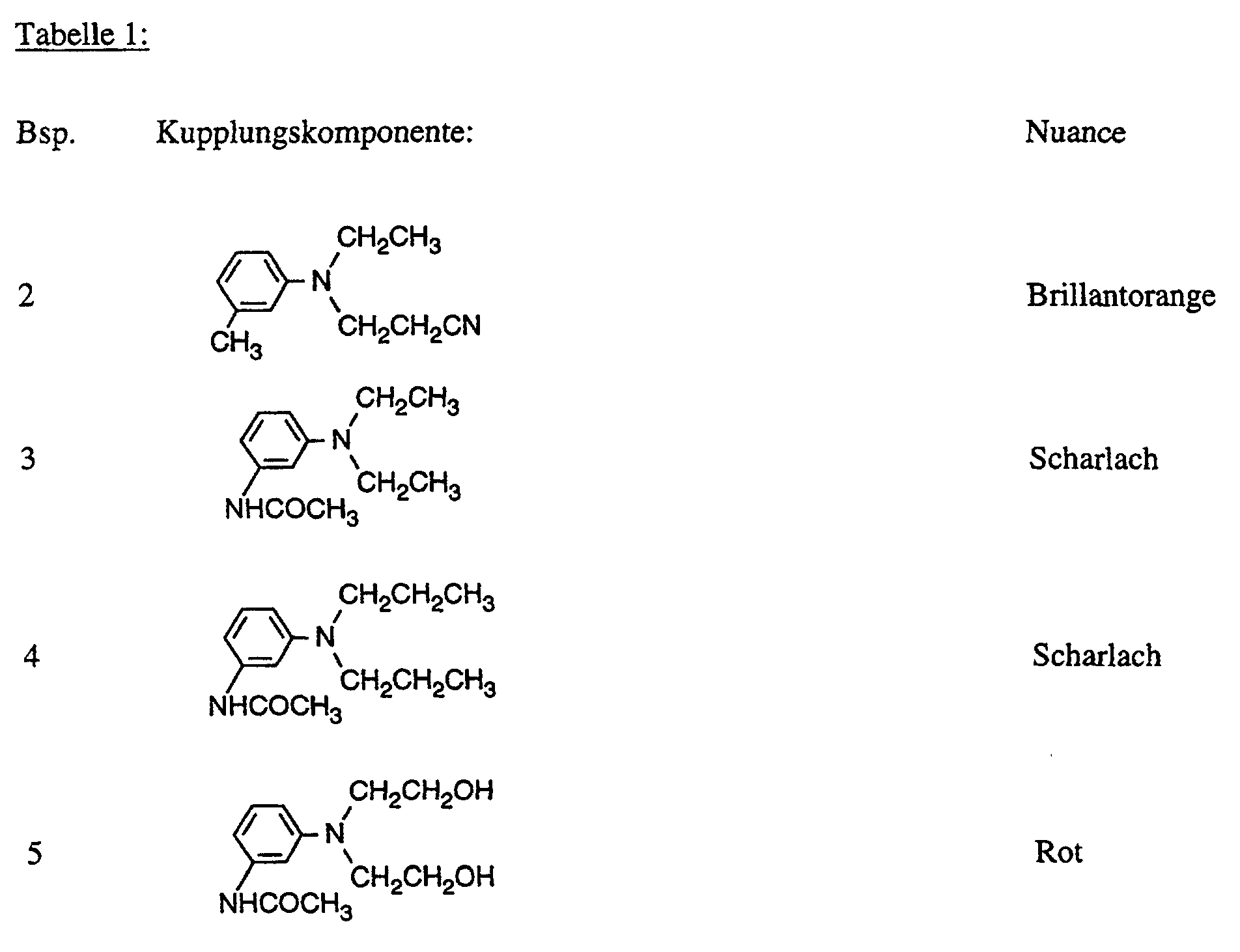
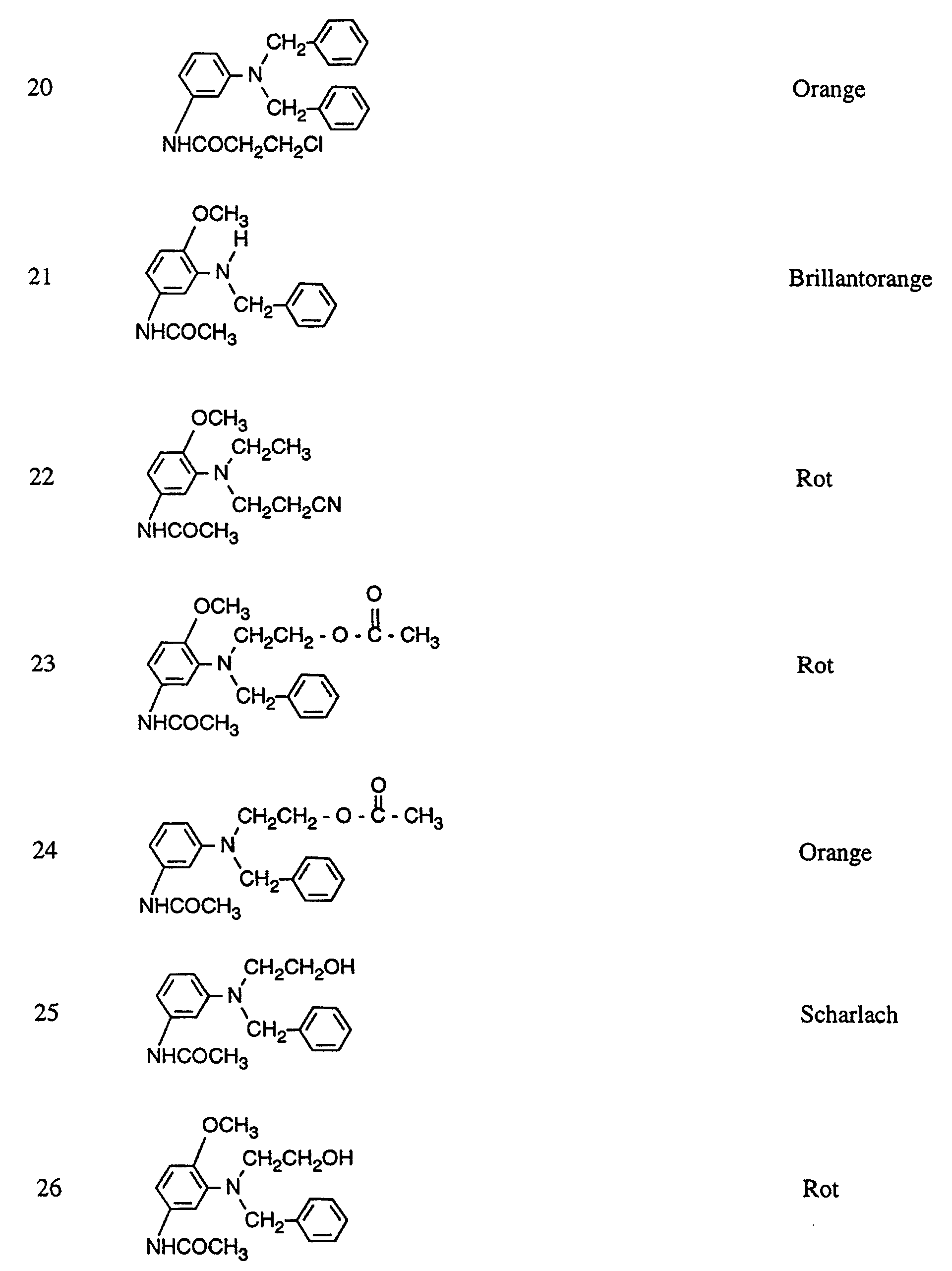
- the process is characterized in that a phthalimide of the formula diazotized and then on a coupling component of the formula couples, wherein R 1 , R 2 , R 3 and R 4 have the meaning given under the formula (1).
- the compounds of formula (6) and (7) are known or can be known per se Type are prepared, and the diazotization and coupling are carried out in the usual way.
- Dyes of the formula (1) in which R 2 or R 3 is a radical of the formula -alkylene-X-alkyl can also be prepared by first preparing a dye containing a precursor of these radicals, for example a hydroxyalkyl group, and then this group is converted into a radical of the formula -alkylene-X-alkyl.
- the compounds of formula (1) according to the invention can be used as dyes for dyeing and printing of semi-synthetic and especially synthetic hydrophobic Fiber materials, especially textile materials, are used.
- Textile materials Blended fabrics, such semi-synthetic or synthetic hydrophobic textile materials can also contain the compounds of the invention dyed or printed.
- Synthetic hydrophobic textile materials consist mainly of linear, aromatic Polyesters, for example those made from terephthalic acid and glycols, especially ethylene glycol or condensation products from terephthalic acid and 1,4-bis (hydroxymethyl) cyclohexane; from polycarbonates, e.g. those from ⁇ , ⁇ -dimethyl-4,4'-dihydroxy-diphenylmethane and phosgene, from fibers based on polyvinyl chloride and polyamide.
- polyesters for example those made from terephthalic acid and glycols, especially ethylene glycol or condensation products from terephthalic acid and 1,4-bis (hydroxymethyl) cyclohexane; from polycarbonates, e.g. those from ⁇ , ⁇ -dimethyl-4,4'-dihydroxy-diphenylmethane and phosgene, from fibers based on polyvinyl chloride and polyamide.
- polyester fiber materials are dyed Extraction process from aqueous dispersion in the presence of conventional anionic or non-ionic dispersants and optionally conventional swelling agents (carriers) Temperatures between 80 and 140 ° C.
- Cellulose-21 ⁇ 2-acetate is preferably dyed between about 65 to 85 ° C and cellulose triacetate at temperatures up to 115 ° C.
- the dyes according to the invention are suitable for dyeing by the thermosol process, in the extraction process and for printing processes.
- the textile material mentioned can be in the various processing forms, such as. as fiber, thread or fleece, as woven or knitted fabric.
- the dyes according to the invention are ground so that its Average particle size is between 0.1 and 10 microns. Grinding can be done in In the presence of dispersants. For example, the dried dye ground with a dispersant or in paste form with a dispersant kneaded and then dried in vacuo or by atomization. With the so obtained Preparations can be made with printing pastes and dyebaths after adding water.
- the usual thickeners will be used for printing, e.g. modified or unmodified natural products, e.g. alginates, British rubber, Gum arabic, crystal gum, locust bean gum, tragacanth, carboxymethyl cellulose, Hydroxyethyl cellulose, starch or synthetic products, for example polyacrylamides, Polyacrylic acid or its copolymers or polyvinyl alcohols.
- modified or unmodified natural products e.g. alginates, British rubber, Gum arabic, crystal gum, locust bean gum, tragacanth, carboxymethyl cellulose, Hydroxyethyl cellulose, starch or synthetic products, for example polyacrylamides, Polyacrylic acid or its copolymers or polyvinyl alcohols.
- the dyes according to the invention give the materials mentioned, especially that Polyester material, level yellow to violet shades of very good fastness to use, such as, above all, good light fastness, heat setting, pleating, chlorine and wet fastness like Water, sweat and wash fastness; the colorations are also marked due to very good rub fastness.
- the good thermomigration fastness is particularly noteworthy of the dyeings obtained.
- the dyes according to the invention can also be used well for the preparation of mixed shades together with other dyes. Of course you can too Mixtures of the dyes according to the invention can be used with one another.
- the above-mentioned use of the azo compounds according to the invention Formula (1) is as much an object of the present invention as a method for dyeing or printing semi-synthetic or synthetic hydrophobic Fiber material, in particular textile material, which consists of one or more Apply compounds of formula (1) to the material mentioned or in it to incorporate.
- the hydrophobic fiber material mentioned is preferably textile polyester material.
- Other substrates treated by the method according to the invention can be as well as preferred process conditions are above in the closer Find explanation of the use of the compounds according to the invention.
- Another object of the invention is that colored by said method or printed hydrophobic fiber material, preferably polyester textile material.
- the dyes of the formula (1) according to the invention are also suitable for modern ones Recording methods such as Thermal transfer printing.
- the diazotization mass is then run into this solution. After 30 minutes it will stir adjusted to pH 1 with NaOH 30%. After a further 60 minutes to pH 4.5. The azo dye is then completely precipitated with water, filtered off, with water washed and dried.
- the dye can, for example, by slurrying in hot ethanol, cool, filter and wash further with ethanol.
- Example 1 1 g of the dye described in Example 1 is combined with 17 g of water and 2 g of a commercial dispersant of the type dinaphthylmethane disulfonate in one Sand mill ground and converted into a 5% aqueous dispersion.
- the scarlet color obtained in this way is very good Fastness to use and in particular excellent fastness to thermal migration on.
- polyester fabric is used Thermosol process is colored (10 g / l dye, liquor absorption 50%, Fixing temperature 210 ° C).
- the dyed fabric is checked with a fabric softener to check the thermomigration fastness Distearyl-diethylenetriamine type and then during Heated to 165 ° C for 40 seconds. Then rub fastness and wash fastness (60 ° C) of the sample checked.
Landscapes
- Chemical & Material Sciences (AREA)
- Organic Chemistry (AREA)
- Chemical Kinetics & Catalysis (AREA)
- Coloring (AREA)
Description
So sind aus dem Journal of the Society of Dyers and Colourists, 97(2), S. 72-75 und 97(8), S. 358-362 Phthalimidylazofarbstoffe mit einer unsubstituierten Anilinkupplungskomponente bekannt.
US-A-4,039,522 beschreibt spezifische Farbstoffe, welche an dem Stickstoffatom der Phthalimidyldiazokomponente kein Methylsubstituent tragen.
Diese Farbstoffe erfüllen jedoch nicht in allen Fällen die heutige Bedürfnisse, wie z.B. Thermomigrier-, Licht- oder Waschechtheiten.
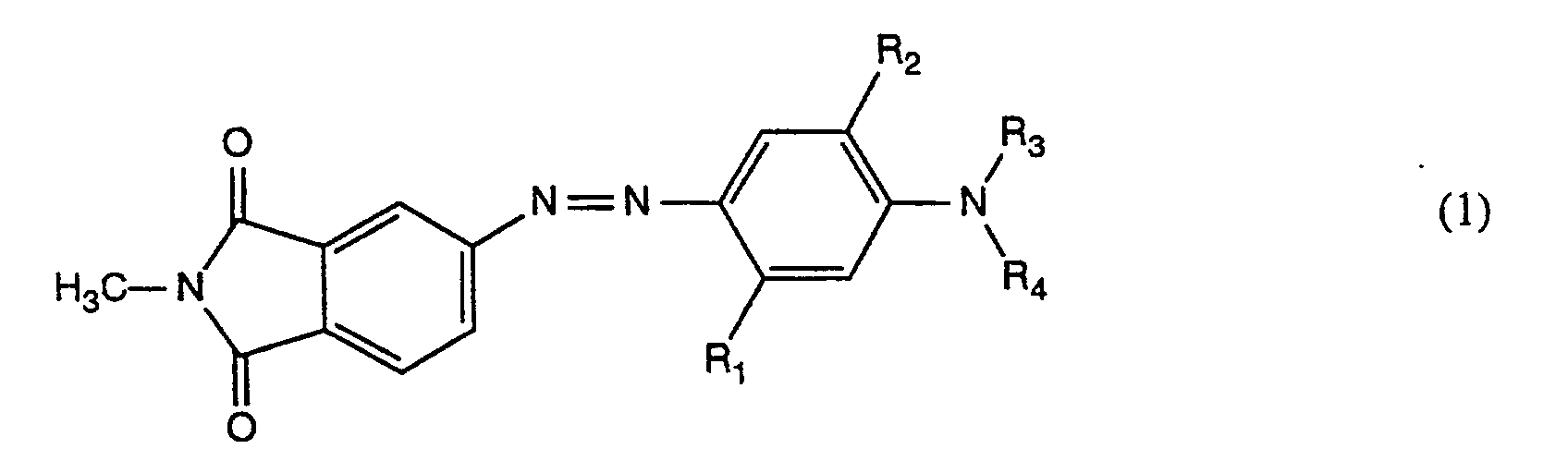
- R1
- Methyl oder NH-CO-R5';
- R2
- Wasserstoff, Halogen, C1-C4-Alkyl, gegebenenfalls durch Halogen, Cyano, Phenyl, -Y-C1-C8-Alkyl oder -Y-Phenyl substituiertes C1-C8-Alkoxy;
- R3
- gegebenenfalls durch Hydroxy, Cyano, Vinyl, Phenyl, Halogen, -X-Phenyl oder -X-C1-C8-Alkyl substituiertes C1-C8-Alkyl, wobei -X-C1-C8-Alkyl durch Halogen oder Cyano substituiert sein kann und -X-Phenyl durch C1-C4-Alkyl, C1-C4-Alkoxy oder Halogen substituiert sein kann;
- R4
- Wasserstoff oder unabhängig von R3 die Bedeutung von R3, wobei R3 und R4 zusammen mit dem sie verbindenden Stickstoffatom auch einen heterocyclischen Rest darstellen können;
- R5'
- C1-C3-Alkyl oder C1-C3-Alkyl das durch Chlor oder Cyano substituiert ist;
- R6
- gegebenenfalls durch Halogen, Cyano oder Phenyl substituiertes C1-C4-Alkyl, wobei Phenyl gegebenenfalls durch C1-C4-Alkyl, C1-C4-Alkoxy oder Halogen substituiert sein kann;
- Y
- ein Brückenglied der Formel -O-, -S- oder -SO2-; und
- X
- ein Brückenglied der Formel -O-,

Bevorzugt sind Alkylreste mit 1 bis 4 C-Atomen, insbesondere Methyl oder Ethyl.

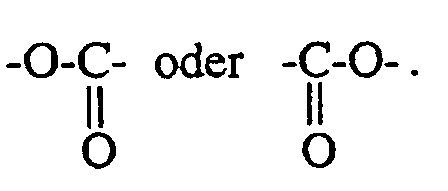
oder
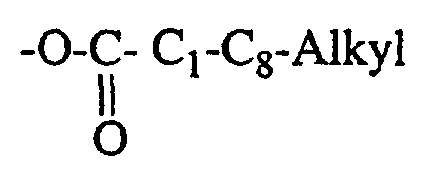

oder


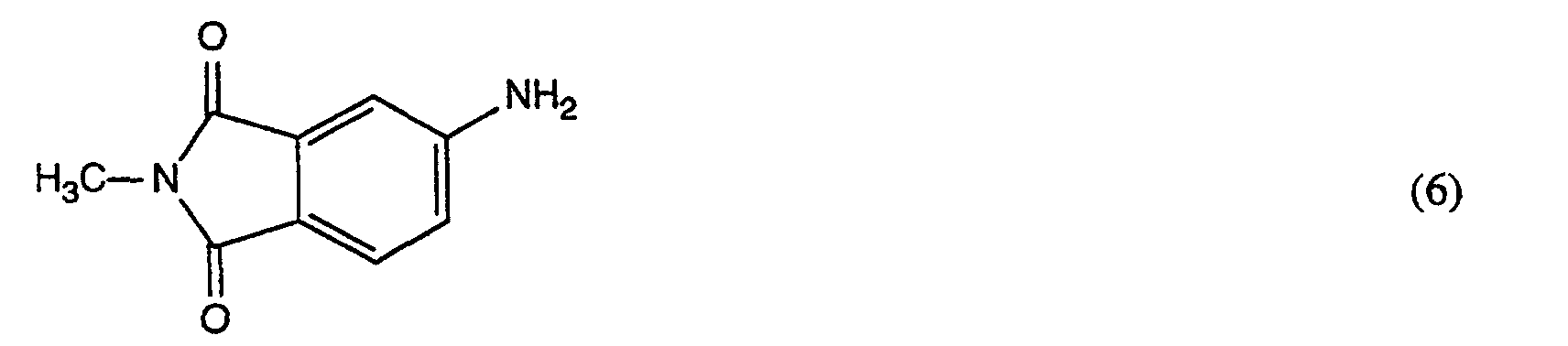
Nun werden innerhalb 30 Min. 8,8 Teile 4-Amino-N-methyl-phthalimid eingetragen. Daraufhin gibt man nochmals 50 Teile eines Säuregemisches bestehend aus einem Volumenteil Propionsäure und 5 Volumenteilen Essigsäure zu. Die Reaktionsmischung wird 2 Std. bei 0-5° C verrührt. Nach beendeter Diazotierung gibt man 1 Teil Harnstoff zu und verrührt nochmals 15 Minuten.



Claims (15)
- Dispersionsazofarbstoffe der Formelworin
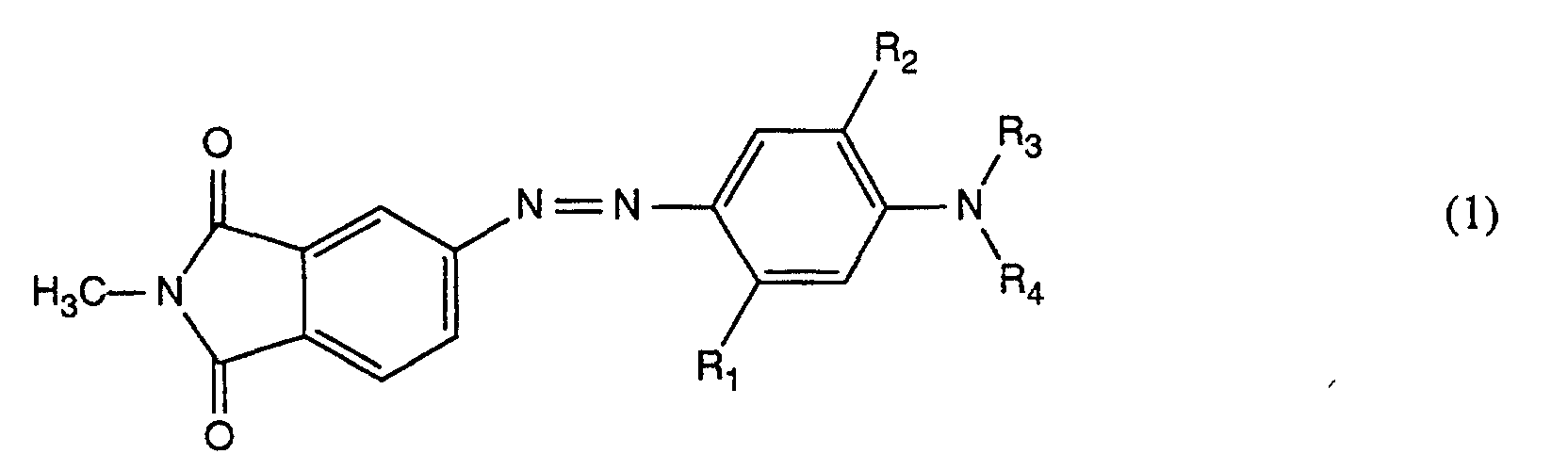
- R1
- Methyl oder NH-CO-R5';
- R2
- Wasserstoff, Halogen, C1-C4-Alkyl, gegebenenfalls durch Halogen, Cyano, Phenyl, -Y-C1-C8-Alkyl oder -Y-Phenyl substituiertes C1-C8-Alkoxy;
- R3
- gegebenenfalls durch Hydroxy, Cyano, Vinyl, Phenyl, Halogen, -X-Phenyl oder -X-C1-C8-Alkyl substituiertes C1-C8-Alkyl, wobei -X-C1-C8-Alkyl durch Halogen oder Cyano substituiert sein kann und -X-Phenyl durch C1-C4-Alkyl, C1-C4-Alkoxy oder Halogen substituiert sein kann;
- R4
- Wasserstoff oder unabhängig von R3 die Bedeutung von R3, wobei R3 und R4 zusammen mit dem sie verbindenden Stickstoffatom auch einen heterocyclischen Rest darstellen können;
- R5'
- ' C1-C3-Alkyl oder C1-C3-Alkyl das durch Chlor oder Cyano substituiert ist;
- R6
- gegebenenfalls durch Halogen, Cyano oder Phenyl substituiertes C1-C4-Alkyl, wobei Phenyl gegebenenfalls durch C1-C4-Alkyl, C1-C4-Alkoxy oder Halogen substituiert sein kann;
- Y
- ein Brückenglied der Formel -O-, -S- oder -SO2-; und
- X
- ein Brückenglied der Formel -O-,

- Dispersionsazofarbstoffe gemäss Anspruch 1, worin R2 Wasserstoff, Chlor, Methyl oder Methoxy ist.
- Dispersionsazofarbstoffe gemäss einem der Ansprüche 1 und 2, worin R3 einen gegebenenfalls durch Hydroxy, Halogen, Cyano, Phenyl odersubstituiertes C1-C4-Alkylrest bedeutet, wobei
 durch Chlor substituiert ist.

- Dispersionsazofarbstoffe gemäss einem der Ansprüche 1 bis 3, worin R4 Wasserstoff oder einen gegebenenfalls durch Hydroxy, Chlor, Cyano,oder Phenyl substituiertes C1-C4-Alkylrest bedeutet.

- Dispersionsazofarbstoffe gemäss einem der Ansprüche 1 bis 4, worin R3 Methyl, Ethyl, oder C1-C4-Alkyl bedeutet, das durch Cyano oder Phenyl substituiert ist.
- Dispersionsazofarbstoffe gemäss einem der Ansprüche 1 bis 5, worin R4 Methyl, Ethyl oder C1-C4-Alkyl bedeutet, das durch Cyano oder Phenyl substituiert ist.
- Dispersionsazofarbstoffe gemäss Anspruch 1, worin R1 Methyl, NH-CO-CH3, NH-CO-CH2-CH3 oder NH-CO-CH2-CH2Cl ist; R2 Wasserstoff, Methyl, Methoxy oder Chlor ist; R3 Methyl, Ethyl, Propyl, CH2-CH2-CN, CH2-CH2-OH, CH2-CH2Cl, CH2-C6H5, CH2-CH(OH)-CH3, CH2-CH=CH2, CH2-CH(OH)-CH2Cl, CH2-CH2-O-CO-CH3, CH2-CH2-O-CO-CH2-CH2Cl,ist; und R4 Wasserstoff, Ethyl, Propyl, CH2-CH2-CN, CH2-CH2-OH, CH2-CH2-O-CO-CH3 oder CH2-C6H5 ist.

- Dispersionsazofarbstoff gemäss einem der Ansprüche 1 bis 7 der Formel

- Dispersionsazofarbstoff gemäss einem der Ansprüche 1 bis 7 der Formel
- Verfahren zur Herstellung der Dispersionsazofarbstoffe der Formel (1) gemäss Anspruch 1, dadurch gekennzeichnet, dass man ein Phthalimid der Formeldiazotiert und anschliessend auf eine Kupplungskomponente der Formel
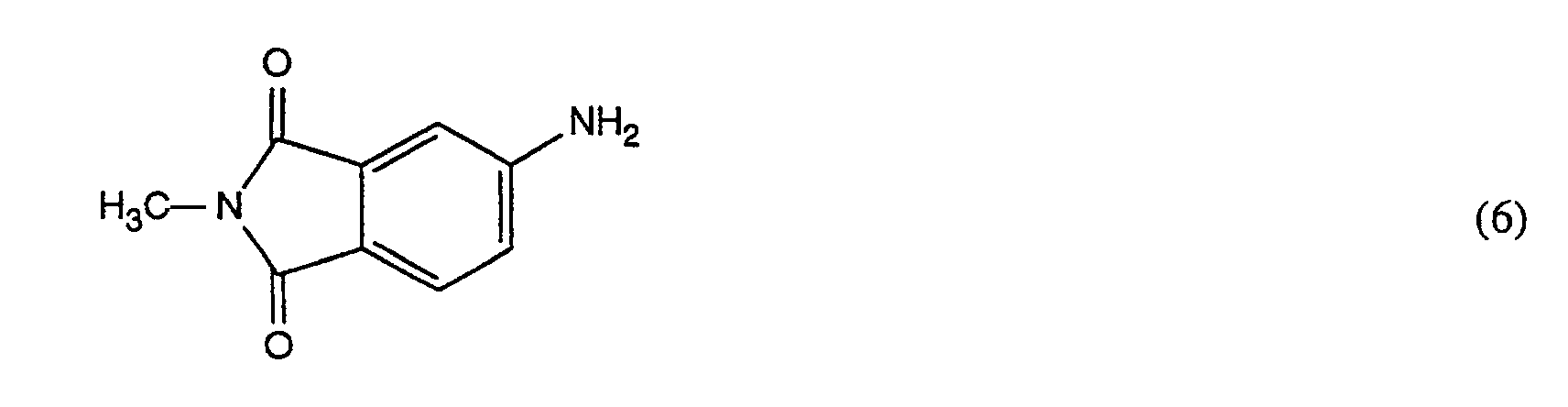 kuppelt, wobei
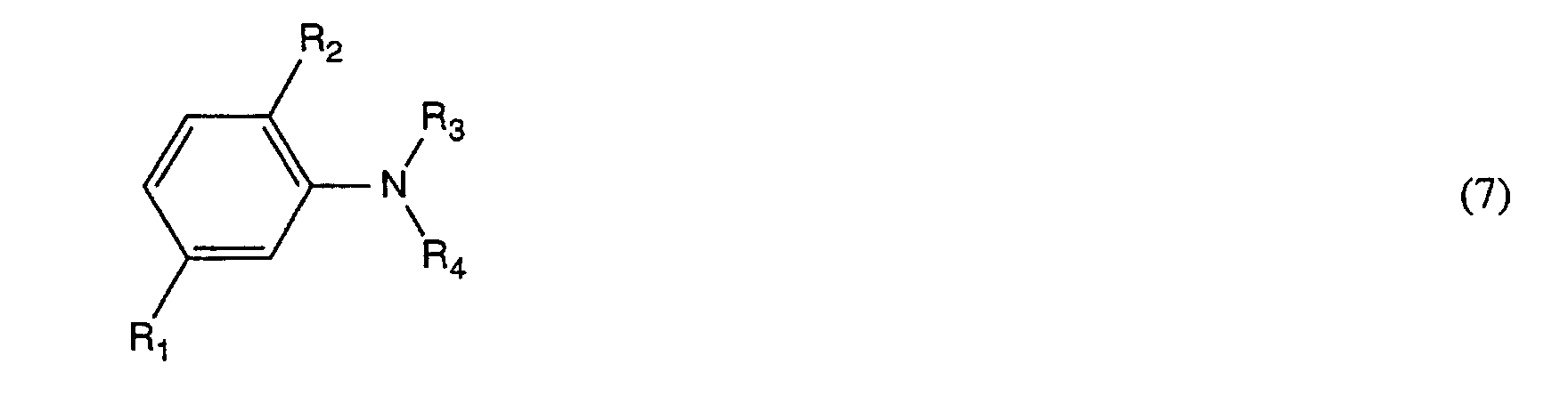
R1, R2, R3 und R4 die in Anspruch 1 angegebene Bedeutungen haben. - Verwendung der Dispersionsfarbstoffe gemäss Anspruch 1 zum Färben oder Bedrucken von halbsynthetischem oder synthetischem hydrophobem Fasermaterial, insbesondere Textilmaterial.
- Verwendung nach Anspruch 11 zum Färben oder Bedrucken von Textilmaterial aus Polyesterfasern.
- Verfahren zum Färben oder Bedrucken von halbsynthetischem oder synthetischem hydrophobem Fasermaterial, insbesondere Textilmaterial, dadurch gekennzeichnet, dass man eine oder mehrere der im Anspruch 1 definierten Verbindungen auf das genannte Material aufbringt oder diesem einverleibt.
- Verfahren nach Anspruch 13, worin das hydrophobe Fasermaterial, vorzugsweise Textilmaterial, aus Polyesterfasern besteht.
- Das gemäss Anspruch 13 oder 14 gefärbte oder bedruckte Material.
Applications Claiming Priority (3)
| Application Number | Priority Date | Filing Date | Title |
|---|---|---|---|
| CH41394 | 1994-02-11 | ||
| CH41394 | 1994-02-11 | ||
| CH413/94 | 1994-02-11 |
Publications (2)
| Publication Number | Publication Date |
|---|---|
| EP0667376A1 EP0667376A1 (de) | 1995-08-16 |
| EP0667376B1 true EP0667376B1 (de) | 2001-11-14 |
Family
ID=4186468
Family Applications (1)
| Application Number | Title | Priority Date | Filing Date |
|---|---|---|---|
| EP95810071A Expired - Lifetime EP0667376B1 (de) | 1994-02-11 | 1995-02-02 | Phthalimidyl-Azofarbstoffe, Verfahren zu deren Herstellung und deren Verwendung |
Country Status (7)
| Country | Link |
|---|---|
| EP (1) | EP0667376B1 (de) |
| JP (1) | JPH07228791A (de) |
| KR (1) | KR100343053B1 (de) |
| CN (1) | CN1069670C (de) |
| DE (1) | DE59509817D1 (de) |
| ES (1) | ES2165903T3 (de) |
| TW (1) | TW328094B (de) |
Families Citing this family (14)
| Publication number | Priority date | Publication date | Assignee | Title |
|---|---|---|---|---|
| EP0906986A3 (de) * | 1997-10-01 | 1999-12-22 | Ciba SC Holding AG | Färbeverfahren für polyesterhaltige Fasermaterialien |
| JPH11152691A (ja) * | 1997-10-01 | 1999-06-08 | Ciba Specialty Chem Holding Inc | ポリエステル−含有繊維材料のための染色方法 |
| US6087480A (en) * | 1998-01-13 | 2000-07-11 | Ciba Specialty Chemcals Corporation | Process for preparing sparingly soluble aromatic amines |
| CN1088454C (zh) * | 1998-05-22 | 2002-07-31 | 吉林大学 | 电活性大单体的合成 |
| TWI243192B (en) * | 1998-12-31 | 2005-11-11 | Ciba Sc Holding Ag | Phthalimidyl azo pigments, method for producing same and utilization thereof |
| KR100572257B1 (ko) * | 2002-06-20 | 2006-04-25 | 재단법인서울대학교산학협력재단 | 프탈이미드 구조를 가지는 아조계 알칼리 세정성 분산염료를 이용한 폴리에스테르 섬유재료의 염색 방법 |
| US20060101594A1 (en) * | 2002-11-11 | 2006-05-18 | Antoine Clement | Phthalimidyl-azo dyes, process for their preparation and their use |
| KR100893064B1 (ko) * | 2007-06-05 | 2009-04-15 | 경북대학교 산학협력단 | 폴리락트산 섬유 및 폴리프로필렌 섬유용 프탈이미드계분산 염료 및 이의 제조방법 |
| CN103012245B (zh) * | 2012-09-28 | 2015-01-28 | 杭州福莱蒽特精细化工有限公司 | 含邻苯二甲酰亚胺结构的偶合组分及分散染料的化学合成方法 |
| EP2754698A1 (de) | 2013-01-14 | 2014-07-16 | DyStar Colours Distribution GmbH | Hoch nassechte Dispersionsfarbstoffmischungen |
| EP2754696A1 (de) | 2013-01-15 | 2014-07-16 | DyStar Colours Distribution GmbH | AOX-freie marineblaue und schwarze Dispersionsfarbstoffmischungen |
| EP2754697A1 (de) | 2013-01-14 | 2014-07-16 | DyStar Colours Distribution GmbH | Hoch nassechte Dispersionsfarbstoffmischungen |
| BR112015016526B1 (pt) | 2013-01-14 | 2021-12-28 | Dystar Colours Distribution Gmbh | Misturas de corantes, seus processos de produção, solução aquosa para tingimento, processos para tingir ou imprimir material, tinta para impressão têxtil digital, e fibras e combinações contendo tais fibras |
| ES2814375T3 (es) | 2017-10-02 | 2021-03-26 | Dystar Colours Distrib Gmbh | Mezclas de colorantes de dispersión rápida con alta humedad |
Family Cites Families (4)
| Publication number | Priority date | Publication date | Assignee | Title |
|---|---|---|---|---|
| US4039522A (en) * | 1974-02-01 | 1977-08-02 | Eastman Kodak Company | Phthalimidyl-azo-m-acylamido-n-substituted aniline compounds and polyester fibers dyed therewith |
| US4324719A (en) * | 1980-06-13 | 1982-04-13 | Eastman Kodak Company | Azo dyes from aminophthalimides and aniline, tetrahydroquinoline, and benzomorpholine couplers having thiosulfate groups |
| EP0443984B1 (de) * | 1990-02-19 | 1995-01-18 | Ciba-Geigy Ag | Phthalimidyl-Azofarbstoffe |
| JPH06329930A (ja) * | 1993-05-06 | 1994-11-29 | Ciba Geigy Ag | アゾ染料 |
-
1995
- 1995-01-25 TW TW084100637A patent/TW328094B/zh active
- 1995-02-01 JP JP7015019A patent/JPH07228791A/ja active Pending
- 1995-02-02 ES ES95810071T patent/ES2165903T3/es not_active Expired - Lifetime
- 1995-02-02 EP EP95810071A patent/EP0667376B1/de not_active Expired - Lifetime
- 1995-02-02 DE DE59509817T patent/DE59509817D1/de not_active Expired - Fee Related
- 1995-02-10 CN CN95101944A patent/CN1069670C/zh not_active Expired - Fee Related
- 1995-02-10 KR KR1019950002445A patent/KR100343053B1/ko not_active Expired - Fee Related
Also Published As
| Publication number | Publication date |
|---|---|
| ES2165903T3 (es) | 2002-04-01 |
| KR950032474A (ko) | 1995-12-20 |
| TW328094B (en) | 1998-03-11 |
| CN1111664A (zh) | 1995-11-15 |
| KR100343053B1 (ko) | 2002-12-16 |
| JPH07228791A (ja) | 1995-08-29 |
| DE59509817D1 (de) | 2001-12-20 |
| CN1069670C (zh) | 2001-08-15 |
| EP0667376A1 (de) | 1995-08-16 |
Similar Documents
| Publication | Publication Date | Title |
|---|---|---|
| EP0623654B1 (de) | Azofarbstoffe | |
| EP0555179B1 (de) | Azofarbstoffe | |
| DE1544446B2 (de) | Von Sulfon- und Carbonsäuregruppen freie wasserunlösliche Monoazofarbstoffe und Verfahren zu ihrer Herstellung | |
| EP1141138B1 (de) | Phthalimidyl-azofarbstoffe, verfahren zu deren herstellung und deren verwendung | |
| DE60312384T2 (de) | Farbstoffmischungen zum färben oder drucken von fasermaterialien die celluloseacetat enthalten | |
| EP0667376A1 (de) | Phthalimidyl-Azofarbstoffe, Verfahren zu deren Herstellung und deren Verwendung | |
| DE1644328C3 (de) | Verfahren zur Herstellung von Monoazofarbstoffen | |
| EP0864615B1 (de) | Azofarbstoffmischungen | |
| EP0443984B1 (de) | Phthalimidyl-Azofarbstoffe | |
| EP0894830A2 (de) | Dispersionsfarbstoffe | |
| EP0463995B1 (de) | Azofarbstoffe mit 2-Alkylamino-3-cyan-4,6-diaminopyridinen als Kupplungskomponenten | |
| EP0826741B1 (de) | Dispersionsfarbstoffe | |
| EP0776948B1 (de) | Mischungen von Monoazopyridonfarbstoffen | |
| CH689980A5 (de) | Mischungen von Monoazopyridonfarbstoffen. | |
| EP0009191B1 (de) | Wasserunlösliche Disazofarbstoffe, ihre Herstellung und Verwendung | |
| EP0083313B1 (de) | Farbstoffmischung, Verfahren zu ihrer Herstellung und Verwendung zum Färben und Bedrucken von hydrophobem Fasermaterial | |
| DE1644373A1 (de) | Monoazofarbstoffe,ihre Herstellung und Verwendung | |
| EP1085055B1 (de) | Azofarbstoff, Verfahren zu dessen Herstellung und dessen Verwendung zum Färben oder Bedrucken von hydrophoben Fasermaterialien | |
| EP0284560A2 (de) | Dispersionsfarbstoffe, enthaltend eine Tricyanovinylgruppierung | |
| DE3133355A1 (de) | Neue marineblaue dispersionsfarbstoffe, verfahren zu deren herstellung und deren verwendung zum faerben oder bedrucken von synthetischen fasermaterialien | |
| DE4121754B4 (de) | Azo-Dispersionsfarbstoffe | |
| EP0041042A1 (de) | Azoverbindungen | |
| DE19646430A1 (de) | Mischungen von Monoazopyridonfarbstoffen | |
| EP0271444B1 (de) | Dispersionsfarbstoffe | |
| DE2935011A1 (de) | Disperse monoazofarbstoffe und verfahren zu ihrer herstellung sowie ihre verwendung zum faerben von synthetischen textilmaterialien |
Legal Events
| Date | Code | Title | Description |
|---|---|---|---|
| PUAI | Public reference made under article 153(3) epc to a published international application that has entered the european phase |
Free format text: ORIGINAL CODE: 0009012 |
|
| AK | Designated contracting states |
Kind code of ref document: A1 Designated state(s): BE CH DE ES FR GB IT LI |
|
| 17P | Request for examination filed |
Effective date: 19960110 |
|
| RAP1 | Party data changed (applicant data changed or rights of an application transferred) |
Owner name: CIBA SC HOLDING AG |
|
| RAP3 | Party data changed (applicant data changed or rights of an application transferred) |
Owner name: CIBA SPECIALTY CHEMICALS HOLDING INC. |
|
| 17Q | First examination report despatched |
Effective date: 19990401 |
|
| GRAG | Despatch of communication of intention to grant |
Free format text: ORIGINAL CODE: EPIDOS AGRA |
|
| GRAG | Despatch of communication of intention to grant |
Free format text: ORIGINAL CODE: EPIDOS AGRA |
|
| GRAH | Despatch of communication of intention to grant a patent |
Free format text: ORIGINAL CODE: EPIDOS IGRA |
|
| GRAH | Despatch of communication of intention to grant a patent |
Free format text: ORIGINAL CODE: EPIDOS IGRA |
|
| GRAA | (expected) grant |
Free format text: ORIGINAL CODE: 0009210 |
|
| AK | Designated contracting states |
Kind code of ref document: B1 Designated state(s): BE CH DE ES FR GB IT LI |
|
| REG | Reference to a national code |
Ref country code: CH Ref legal event code: EP |
|
| GBT | Gb: translation of ep patent filed (gb section 77(6)(a)/1977) |
Effective date: 20011114 |
|
| REF | Corresponds to: |
Ref document number: 59509817 Country of ref document: DE Date of ref document: 20011220 |
|
| REG | Reference to a national code |
Ref country code: GB Ref legal event code: IF02 |
|
| REG | Reference to a national code |
Ref country code: ES Ref legal event code: FG2A Ref document number: 2165903 Country of ref document: ES Kind code of ref document: T3 |
|
| PLBE | No opposition filed within time limit |
Free format text: ORIGINAL CODE: 0009261 |
|
| STAA | Information on the status of an ep patent application or granted ep patent |
Free format text: STATUS: NO OPPOSITION FILED WITHIN TIME LIMIT |
|
| 26N | No opposition filed | ||
| PGFP | Annual fee paid to national office [announced via postgrant information from national office to epo] |
Ref country code: FR Payment date: 20030122 Year of fee payment: 9 Ref country code: CH Payment date: 20030122 Year of fee payment: 9 |
|
| PGFP | Annual fee paid to national office [announced via postgrant information from national office to epo] |
Ref country code: ES Payment date: 20030211 Year of fee payment: 9 |
|
| PG25 | Lapsed in a contracting state [announced via postgrant information from national office to epo] |
Ref country code: ES Free format text: LAPSE BECAUSE OF NON-PAYMENT OF DUE FEES Effective date: 20040203 |
|
| PG25 | Lapsed in a contracting state [announced via postgrant information from national office to epo] |
Ref country code: LI Free format text: LAPSE BECAUSE OF NON-PAYMENT OF DUE FEES Effective date: 20040229 Ref country code: CH Free format text: LAPSE BECAUSE OF NON-PAYMENT OF DUE FEES Effective date: 20040229 |
|
| REG | Reference to a national code |
Ref country code: CH Ref legal event code: PL |
|
| PG25 | Lapsed in a contracting state [announced via postgrant information from national office to epo] |
Ref country code: FR Free format text: LAPSE BECAUSE OF NON-PAYMENT OF DUE FEES Effective date: 20041029 |
|
| REG | Reference to a national code |
Ref country code: FR Ref legal event code: ST |
|
| PG25 | Lapsed in a contracting state [announced via postgrant information from national office to epo] |
Ref country code: IT Free format text: LAPSE BECAUSE OF NON-PAYMENT OF DUE FEES;WARNING: LAPSES OF ITALIAN PATENTS WITH EFFECTIVE DATE BEFORE 2007 MAY HAVE OCCURRED AT ANY TIME BEFORE 2007. THE CORRECT EFFECTIVE DATE MAY BE DIFFERENT FROM THE ONE RECORDED. Effective date: 20050202 |
|
| REG | Reference to a national code |
Ref country code: ES Ref legal event code: FD2A Effective date: 20040203 |
|
| PGFP | Annual fee paid to national office [announced via postgrant information from national office to epo] |
Ref country code: GB Payment date: 20060124 Year of fee payment: 12 |
|
| PGFP | Annual fee paid to national office [announced via postgrant information from national office to epo] |
Ref country code: DE Payment date: 20060126 Year of fee payment: 12 |
|
| PGFP | Annual fee paid to national office [announced via postgrant information from national office to epo] |
Ref country code: BE Payment date: 20060315 Year of fee payment: 12 |
|
| GBPC | Gb: european patent ceased through non-payment of renewal fee |
Effective date: 20070202 |
|
| BERE | Be: lapsed |
Owner name: *CIBA SPECIALTY CHEMICALS HOLDING INC. Effective date: 20070228 |
|
| PG25 | Lapsed in a contracting state [announced via postgrant information from national office to epo] |
Ref country code: BE Free format text: LAPSE BECAUSE OF NON-PAYMENT OF DUE FEES Effective date: 20070228 |
|
| PG25 | Lapsed in a contracting state [announced via postgrant information from national office to epo] |
Ref country code: DE Free format text: LAPSE BECAUSE OF NON-PAYMENT OF DUE FEES Effective date: 20070901 |
|
| PG25 | Lapsed in a contracting state [announced via postgrant information from national office to epo] |
Ref country code: GB Free format text: LAPSE BECAUSE OF NON-PAYMENT OF DUE FEES Effective date: 20070202 |