EP0284560A2 - Dispersionsfarbstoffe, enthaltend eine Tricyanovinylgruppierung - Google Patents
Dispersionsfarbstoffe, enthaltend eine Tricyanovinylgruppierung Download PDFInfo
- Publication number
- EP0284560A2 EP0284560A2 EP88810156A EP88810156A EP0284560A2 EP 0284560 A2 EP0284560 A2 EP 0284560A2 EP 88810156 A EP88810156 A EP 88810156A EP 88810156 A EP88810156 A EP 88810156A EP 0284560 A2 EP0284560 A2 EP 0284560A2
- Authority
- EP
- European Patent Office
- Prior art keywords
- formula
- dyes
- hydrogen
- alkoxy
- alkyl
- Prior art date
- Legal status (The legal status is an assumption and is not a legal conclusion. Google has not performed a legal analysis and makes no representation as to the accuracy of the status listed.)
- Granted
Links
- 239000000986 disperse dye Substances 0.000 title claims abstract description 11
- 239000000463 material Substances 0.000 claims abstract description 20
- 239000004753 textile Substances 0.000 claims abstract description 15
- 238000004043 dyeing Methods 0.000 claims abstract description 14
- 229920000728 polyester Polymers 0.000 claims abstract description 11
- 239000000835 fiber Substances 0.000 claims abstract description 5
- 239000000975 dye Substances 0.000 claims description 43
- 150000001875 compounds Chemical class 0.000 claims description 37
- -1 methoxy, methoxyethyl Chemical group 0.000 claims description 34
- 125000002496 methyl group Chemical group [H]C([H])([H])* 0.000 claims description 16
- 239000001257 hydrogen Substances 0.000 claims description 15
- 229910052739 hydrogen Inorganic materials 0.000 claims description 15
- 238000002360 preparation method Methods 0.000 claims description 12
- 238000000034 method Methods 0.000 claims description 11
- 229910052736 halogen Inorganic materials 0.000 claims description 10
- 150000002367 halogens Chemical class 0.000 claims description 10
- 125000004432 carbon atom Chemical group C* 0.000 claims description 9
- 239000002657 fibrous material Substances 0.000 claims description 9
- 150000002431 hydrogen Chemical group 0.000 claims description 9
- 230000002209 hydrophobic effect Effects 0.000 claims description 9
- UFHFLCQGNIYNRP-UHFFFAOYSA-N Hydrogen Chemical compound [H][H] UFHFLCQGNIYNRP-UHFFFAOYSA-N 0.000 claims description 8
- 125000001997 phenyl group Chemical group [H]C1=C([H])C([H])=C(*)C([H])=C1[H] 0.000 claims description 8
- WKBOTKDWSSQWDR-UHFFFAOYSA-N Bromine atom Chemical group [Br] WKBOTKDWSSQWDR-UHFFFAOYSA-N 0.000 claims description 7
- ZAMOUSCENKQFHK-UHFFFAOYSA-N Chlorine atom Chemical group [Cl] ZAMOUSCENKQFHK-UHFFFAOYSA-N 0.000 claims description 7
- GDTBXPJZTBHREO-UHFFFAOYSA-N bromine Chemical group BrBr GDTBXPJZTBHREO-UHFFFAOYSA-N 0.000 claims description 7
- 229910052794 bromium Chemical group 0.000 claims description 7
- 239000000460 chlorine Chemical group 0.000 claims description 7
- 229910052801 chlorine Inorganic materials 0.000 claims description 7
- 125000001424 substituent group Chemical group 0.000 claims description 6
- XFXPMWWXUTWYJX-UHFFFAOYSA-N Cyanide Chemical compound N#[C-] XFXPMWWXUTWYJX-UHFFFAOYSA-N 0.000 claims description 5
- 125000001797 benzyl group Chemical group [H]C1=C([H])C([H])=C(C([H])=C1[H])C([H])([H])* 0.000 claims description 5
- 125000001495 ethyl group Chemical group [H]C([H])([H])C([H])([H])* 0.000 claims description 5
- 125000002887 hydroxy group Chemical group [H]O* 0.000 claims description 5
- 229910052757 nitrogen Inorganic materials 0.000 claims description 5
- 125000004433 nitrogen atom Chemical group N* 0.000 claims description 5
- 239000007800 oxidant agent Substances 0.000 claims description 5
- 125000006710 (C2-C12) alkenyl group Chemical group 0.000 claims description 3
- 125000000217 alkyl group Chemical group 0.000 claims description 3
- UCFFGYASXIPWPD-UHFFFAOYSA-N methyl hypochlorite Chemical group COCl UCFFGYASXIPWPD-UHFFFAOYSA-N 0.000 claims description 3
- 125000000449 nitro group Chemical group [O-][N+](*)=O 0.000 claims description 3
- VGGSQFUCUMXWEO-UHFFFAOYSA-N Ethene Chemical group C=C VGGSQFUCUMXWEO-UHFFFAOYSA-N 0.000 claims description 2
- 239000005977 Ethylene Substances 0.000 claims description 2
- 125000004435 hydrogen atom Chemical group [H]* 0.000 claims 2
- 239000000654 additive Substances 0.000 claims 1
- XLYOFNOQVPJJNP-UHFFFAOYSA-N water Substances O XLYOFNOQVPJJNP-UHFFFAOYSA-N 0.000 description 15
- 238000006243 chemical reaction Methods 0.000 description 14
- ZMXDDKWLCZADIW-UHFFFAOYSA-N N,N-Dimethylformamide Chemical compound CN(C)C=O ZMXDDKWLCZADIW-UHFFFAOYSA-N 0.000 description 12
- 150000003254 radicals Chemical class 0.000 description 8
- YXFVVABEGXRONW-UHFFFAOYSA-N Toluene Chemical compound CC1=CC=CC=C1 YXFVVABEGXRONW-UHFFFAOYSA-N 0.000 description 6
- 239000000203 mixture Substances 0.000 description 6
- 239000000243 solution Substances 0.000 description 6
- 239000002270 dispersing agent Substances 0.000 description 5
- OJGMBLNIHDZDGS-UHFFFAOYSA-N N-Ethylaniline Chemical compound CCNC1=CC=CC=C1 OJGMBLNIHDZDGS-UHFFFAOYSA-N 0.000 description 4
- KKEYFWRCBNTPAC-UHFFFAOYSA-N Terephthalic acid Chemical compound OC(=O)C1=CC=C(C(O)=O)C=C1 KKEYFWRCBNTPAC-UHFFFAOYSA-N 0.000 description 4
- 239000004744 fabric Substances 0.000 description 4
- CDBYLPFSWZWCQE-UHFFFAOYSA-L sodium carbonate Substances [Na+].[Na+].[O-]C([O-])=O CDBYLPFSWZWCQE-UHFFFAOYSA-L 0.000 description 4
- 159000000000 sodium salts Chemical class 0.000 description 4
- ZMESHQOXZMOOQQ-UHFFFAOYSA-N 1-(naphthalen-1-ylmethyl)naphthalene Chemical compound C1=CC=C2C(CC=3C4=CC=CC=C4C=CC=3)=CC=CC2=C1 ZMESHQOXZMOOQQ-UHFFFAOYSA-N 0.000 description 3
- QTBSBXVTEAMEQO-UHFFFAOYSA-N Acetic acid Chemical compound CC(O)=O QTBSBXVTEAMEQO-UHFFFAOYSA-N 0.000 description 3
- UHOVQNZJYSORNB-UHFFFAOYSA-N Benzene Chemical compound C1=CC=CC=C1 UHOVQNZJYSORNB-UHFFFAOYSA-N 0.000 description 3
- LYCAIKOWRPUZTN-UHFFFAOYSA-N Ethylene glycol Chemical compound OCCO LYCAIKOWRPUZTN-UHFFFAOYSA-N 0.000 description 3
- VYPSYNLAJGMNEJ-UHFFFAOYSA-N Silicium dioxide Chemical compound O=[Si]=O VYPSYNLAJGMNEJ-UHFFFAOYSA-N 0.000 description 3
- HEMHJVSKTPXQMS-UHFFFAOYSA-M Sodium hydroxide Chemical compound [OH-].[Na+] HEMHJVSKTPXQMS-UHFFFAOYSA-M 0.000 description 3
- ZMANZCXQSJIPKH-UHFFFAOYSA-N Triethylamine Chemical compound CCN(CC)CC ZMANZCXQSJIPKH-UHFFFAOYSA-N 0.000 description 3
- 150000001448 anilines Chemical class 0.000 description 3
- 150000002170 ethers Chemical class 0.000 description 3
- 239000012442 inert solvent Substances 0.000 description 3
- 238000002844 melting Methods 0.000 description 3
- 230000008018 melting Effects 0.000 description 3
- 239000000843 powder Substances 0.000 description 3
- 239000002904 solvent Substances 0.000 description 3
- 239000000725 suspension Substances 0.000 description 3
- 125000000229 (C1-C4)alkoxy group Chemical group 0.000 description 2
- CSCPPACGZOOCGX-UHFFFAOYSA-N Acetone Chemical compound CC(C)=O CSCPPACGZOOCGX-UHFFFAOYSA-N 0.000 description 2
- 0 CC1=C*C=S1 Chemical compound CC1=C*C=S1 0.000 description 2
- 229920002284 Cellulose triacetate Polymers 0.000 description 2
- HEDRZPFGACZZDS-UHFFFAOYSA-N Chloroform Chemical compound ClC(Cl)Cl HEDRZPFGACZZDS-UHFFFAOYSA-N 0.000 description 2
- PXGOKWXKJXAPGV-UHFFFAOYSA-N Fluorine Chemical compound FF PXGOKWXKJXAPGV-UHFFFAOYSA-N 0.000 description 2
- YGYAWVDWMABLBF-UHFFFAOYSA-N Phosgene Chemical compound ClC(Cl)=O YGYAWVDWMABLBF-UHFFFAOYSA-N 0.000 description 2
- NQRYJNQNLNOLGT-UHFFFAOYSA-N Piperidine Chemical compound C1CCNCC1 NQRYJNQNLNOLGT-UHFFFAOYSA-N 0.000 description 2
- 239000002202 Polyethylene glycol Substances 0.000 description 2
- JUJWROOIHBZHMG-UHFFFAOYSA-N Pyridine Chemical compound C1=CC=NC=C1 JUJWROOIHBZHMG-UHFFFAOYSA-N 0.000 description 2
- DKGAVHZHDRPRBM-UHFFFAOYSA-N Tert-Butanol Chemical compound CC(C)(C)O DKGAVHZHDRPRBM-UHFFFAOYSA-N 0.000 description 2
- WYURNTSHIVDZCO-UHFFFAOYSA-N Tetrahydrofuran Chemical compound C1CCOC1 WYURNTSHIVDZCO-UHFFFAOYSA-N 0.000 description 2
- NNLVGZFZQQXQNW-ADJNRHBOSA-N [(2r,3r,4s,5r,6s)-4,5-diacetyloxy-3-[(2s,3r,4s,5r,6r)-3,4,5-triacetyloxy-6-(acetyloxymethyl)oxan-2-yl]oxy-6-[(2r,3r,4s,5r,6s)-4,5,6-triacetyloxy-2-(acetyloxymethyl)oxan-3-yl]oxyoxan-2-yl]methyl acetate Chemical compound O([C@@H]1O[C@@H]([C@H]([C@H](OC(C)=O)[C@H]1OC(C)=O)O[C@H]1[C@@H]([C@@H](OC(C)=O)[C@H](OC(C)=O)[C@@H](COC(C)=O)O1)OC(C)=O)COC(=O)C)[C@@H]1[C@@H](COC(C)=O)O[C@@H](OC(C)=O)[C@H](OC(C)=O)[C@H]1OC(C)=O NNLVGZFZQQXQNW-ADJNRHBOSA-N 0.000 description 2
- VJMAITQRABEEKP-UHFFFAOYSA-N [6-(phenylmethoxymethyl)-1,4-dioxan-2-yl]methyl acetate Chemical compound O1C(COC(=O)C)COCC1COCC1=CC=CC=C1 VJMAITQRABEEKP-UHFFFAOYSA-N 0.000 description 2
- 239000002253 acid Substances 0.000 description 2
- 150000001298 alcohols Chemical class 0.000 description 2
- 239000007864 aqueous solution Substances 0.000 description 2
- LLEMOWNGBBNAJR-UHFFFAOYSA-N biphenyl-2-ol Chemical compound OC1=CC=CC=C1C1=CC=CC=C1 LLEMOWNGBBNAJR-UHFFFAOYSA-N 0.000 description 2
- 238000009835 boiling Methods 0.000 description 2
- 229910052799 carbon Inorganic materials 0.000 description 2
- 239000001913 cellulose Substances 0.000 description 2
- 229920002678 cellulose Polymers 0.000 description 2
- MVPPADPHJFYWMZ-UHFFFAOYSA-N chlorobenzene Chemical compound ClC1=CC=CC=C1 MVPPADPHJFYWMZ-UHFFFAOYSA-N 0.000 description 2
- XXJWXESWEXIICW-UHFFFAOYSA-N diethylene glycol monoethyl ether Chemical compound CCOCCOCCO XXJWXESWEXIICW-UHFFFAOYSA-N 0.000 description 2
- 229940075557 diethylene glycol monoethyl ether Drugs 0.000 description 2
- 238000001035 drying Methods 0.000 description 2
- 229910052731 fluorine Inorganic materials 0.000 description 2
- 239000011737 fluorine Substances 0.000 description 2
- 229920000591 gum Polymers 0.000 description 2
- 125000005842 heteroatom Chemical group 0.000 description 2
- 239000005457 ice water Substances 0.000 description 2
- 239000000543 intermediate Substances 0.000 description 2
- 238000002955 isolation Methods 0.000 description 2
- LQNUZADURLCDLV-UHFFFAOYSA-N nitrobenzene Chemical compound [O-][N+](=O)C1=CC=CC=C1 LQNUZADURLCDLV-UHFFFAOYSA-N 0.000 description 2
- 239000003921 oil Substances 0.000 description 2
- 238000005580 one pot reaction Methods 0.000 description 2
- 239000003960 organic solvent Substances 0.000 description 2
- 239000002245 particle Substances 0.000 description 2
- 229920001223 polyethylene glycol Polymers 0.000 description 2
- BWHMMNNQKKPAPP-UHFFFAOYSA-L potassium carbonate Chemical compound [K+].[K+].[O-]C([O-])=O BWHMMNNQKKPAPP-UHFFFAOYSA-L 0.000 description 2
- 239000011541 reaction mixture Substances 0.000 description 2
- 239000004576 sand Substances 0.000 description 2
- 229910000029 sodium carbonate Inorganic materials 0.000 description 2
- GEHJYWRUCIMESM-UHFFFAOYSA-L sodium sulfite Chemical compound [Na+].[Na+].[O-]S([O-])=O GEHJYWRUCIMESM-UHFFFAOYSA-L 0.000 description 2
- 239000007858 starting material Substances 0.000 description 2
- 238000001256 steam distillation Methods 0.000 description 2
- 238000000859 sublimation Methods 0.000 description 2
- 230000008022 sublimation Effects 0.000 description 2
- KKEYFWRCBNTPAC-UHFFFAOYSA-L terephthalate(2-) Chemical compound [O-]C(=O)C1=CC=C(C([O-])=O)C=C1 KKEYFWRCBNTPAC-UHFFFAOYSA-L 0.000 description 2
- 210000002268 wool Anatomy 0.000 description 2
- 239000008096 xylene Substances 0.000 description 2
- APQIUTYORBAGEZ-UHFFFAOYSA-N 1,1-dibromoethane Chemical compound CC(Br)Br APQIUTYORBAGEZ-UHFFFAOYSA-N 0.000 description 1
- PAAZPARNPHGIKF-UHFFFAOYSA-N 1,2-dibromoethane Chemical compound BrCCBr PAAZPARNPHGIKF-UHFFFAOYSA-N 0.000 description 1
- XISUNQFYAWKYSI-UHFFFAOYSA-N 1-(18-phenyloctadecyl)benzimidazole-2,4-disulfonic acid Chemical compound OS(=O)(=O)C1=NC2=C(S(O)(=O)=O)C=CC=C2N1CCCCCCCCCCCCCCCCCCC1=CC=CC=C1 XISUNQFYAWKYSI-UHFFFAOYSA-N 0.000 description 1
- IXPNQXFRVYWDDI-UHFFFAOYSA-N 1-methyl-2,4-dioxo-1,3-diazinane-5-carboximidamide Chemical compound CN1CC(C(N)=N)C(=O)NC1=O IXPNQXFRVYWDDI-UHFFFAOYSA-N 0.000 description 1
- FFRBMBIXVSCUFS-UHFFFAOYSA-N 2,4-dinitro-1-naphthol Chemical compound C1=CC=C2C(O)=C([N+]([O-])=O)C=C([N+]([O-])=O)C2=C1 FFRBMBIXVSCUFS-UHFFFAOYSA-N 0.000 description 1
- HIXDQWDOVZUNNA-UHFFFAOYSA-N 2-(3,4-dimethoxyphenyl)-5-hydroxy-7-methoxychromen-4-one Chemical compound C=1C(OC)=CC(O)=C(C(C=2)=O)C=1OC=2C1=CC=C(OC)C(OC)=C1 HIXDQWDOVZUNNA-UHFFFAOYSA-N 0.000 description 1
- 125000001731 2-cyanoethyl group Chemical group [H]C([H])(*)C([H])([H])C#N 0.000 description 1
- 125000003229 2-methylhexyl group Chemical group [H]C([H])([H])C([H])([H])C([H])([H])C([H])([H])C([H])(C([H])([H])[H])C([H])([H])* 0.000 description 1
- 125000003469 3-methylhexyl group Chemical group [H]C([H])([H])C([H])([H])C([H])([H])C([H])(C([H])([H])[H])C([H])([H])C([H])([H])* 0.000 description 1
- BEYOBVMPDRKTNR-BUHFOSPRSA-N 4-Hydroxyazobenzene Chemical compound C1=CC(O)=CC=C1\N=N\C1=CC=CC=C1 BEYOBVMPDRKTNR-BUHFOSPRSA-N 0.000 description 1
- YLNDNABNWASMFD-UHFFFAOYSA-N 4-[(1,3-dimethylimidazol-1-ium-2-yl)diazenyl]-n,n-dimethylaniline Chemical compound C1=CC(N(C)C)=CC=C1N=NC1=[N+](C)C=CN1C YLNDNABNWASMFD-UHFFFAOYSA-N 0.000 description 1
- 244000215068 Acacia senegal Species 0.000 description 1
- 241000416162 Astragalus gummifer Species 0.000 description 1
- BVKZGUZCCUSVTD-UHFFFAOYSA-M Bicarbonate Chemical compound OC([O-])=O BVKZGUZCCUSVTD-UHFFFAOYSA-M 0.000 description 1
- 125000003830 C1- C4 alkylcarbonylamino group Chemical group 0.000 description 1
- GAWIXWVDTYZWAW-UHFFFAOYSA-N C[CH]O Chemical group C[CH]O GAWIXWVDTYZWAW-UHFFFAOYSA-N 0.000 description 1
- 229920002134 Carboxymethyl cellulose Polymers 0.000 description 1
- 229920003043 Cellulose fiber Polymers 0.000 description 1
- 229920000742 Cotton Polymers 0.000 description 1
- LCGLNKUTAGEVQW-UHFFFAOYSA-N Dimethyl ether Chemical compound COC LCGLNKUTAGEVQW-UHFFFAOYSA-N 0.000 description 1
- SNRUBQQJIBEYMU-UHFFFAOYSA-N Dodecane Natural products CCCCCCCCCCCC SNRUBQQJIBEYMU-UHFFFAOYSA-N 0.000 description 1
- 229920000084 Gum arabic Polymers 0.000 description 1
- 229920000663 Hydroxyethyl cellulose Polymers 0.000 description 1
- 239000004354 Hydroxyethyl cellulose Substances 0.000 description 1
- 229920001612 Hydroxyethyl starch Polymers 0.000 description 1
- DGAQECJNVWCQMB-PUAWFVPOSA-M Ilexoside XXIX Chemical compound C[C@@H]1CC[C@@]2(CC[C@@]3(C(=CC[C@H]4[C@]3(CC[C@@H]5[C@@]4(CC[C@@H](C5(C)C)OS(=O)(=O)[O-])C)C)[C@@H]2[C@]1(C)O)C)C(=O)O[C@H]6[C@@H]([C@H]([C@@H]([C@H](O6)CO)O)O)O.[Na+] DGAQECJNVWCQMB-PUAWFVPOSA-M 0.000 description 1
- 229920000161 Locust bean gum Polymers 0.000 description 1
- CTQNGGLPUBDAKN-UHFFFAOYSA-N O-Xylene Chemical compound CC1=CC=CC=C1C CTQNGGLPUBDAKN-UHFFFAOYSA-N 0.000 description 1
- 239000004952 Polyamide Substances 0.000 description 1
- ZLMJMSJWJFRBEC-UHFFFAOYSA-N Potassium Chemical compound [K] ZLMJMSJWJFRBEC-UHFFFAOYSA-N 0.000 description 1
- 239000006004 Quartz sand Substances 0.000 description 1
- 229920002125 Sokalan® Polymers 0.000 description 1
- 229920001615 Tragacanth Polymers 0.000 description 1
- 238000005874 Vilsmeier-Haack formylation reaction Methods 0.000 description 1
- YIMQCDZDWXUDCA-UHFFFAOYSA-N [4-(hydroxymethyl)cyclohexyl]methanol Chemical compound OCC1CCC(CO)CC1 YIMQCDZDWXUDCA-UHFFFAOYSA-N 0.000 description 1
- 235000010489 acacia gum Nutrition 0.000 description 1
- 239000000205 acacia gum Substances 0.000 description 1
- 235000010443 alginic acid Nutrition 0.000 description 1
- 229920000615 alginic acid Polymers 0.000 description 1
- 125000003545 alkoxy group Chemical group 0.000 description 1
- BFNBIHQBYMNNAN-UHFFFAOYSA-N ammonium sulfate Chemical compound N.N.OS(O)(=O)=O BFNBIHQBYMNNAN-UHFFFAOYSA-N 0.000 description 1
- 229910052921 ammonium sulfate Inorganic materials 0.000 description 1
- 235000011130 ammonium sulphate Nutrition 0.000 description 1
- 125000000129 anionic group Chemical group 0.000 description 1
- 150000001491 aromatic compounds Chemical class 0.000 description 1
- 125000003118 aryl group Chemical group 0.000 description 1
- 238000000889 atomisation Methods 0.000 description 1
- 125000006226 butoxyethyl group Chemical group 0.000 description 1
- 125000000484 butyl group Chemical group [H]C([*])([H])C([H])([H])C([H])([H])C([H])([H])[H] 0.000 description 1
- 239000001768 carboxy methyl cellulose Substances 0.000 description 1
- 235000010948 carboxy methyl cellulose Nutrition 0.000 description 1
- 239000008112 carboxymethyl-cellulose Substances 0.000 description 1
- 229940105329 carboxymethylcellulose Drugs 0.000 description 1
- 239000000969 carrier Substances 0.000 description 1
- KXZJHVJKXJLBKO-UHFFFAOYSA-N chembl1408157 Chemical compound N=1C2=CC=CC=C2C(C(=O)O)=CC=1C1=CC=C(O)C=C1 KXZJHVJKXJLBKO-UHFFFAOYSA-N 0.000 description 1
- 239000003795 chemical substances by application Substances 0.000 description 1
- 238000004140 cleaning Methods 0.000 description 1
- 238000004040 coloring Methods 0.000 description 1
- 239000007859 condensation product Substances 0.000 description 1
- 238000001816 cooling Methods 0.000 description 1
- 229920001577 copolymer Polymers 0.000 description 1
- 239000013078 crystal Substances 0.000 description 1
- 125000004093 cyano group Chemical group *C#N 0.000 description 1
- 125000006165 cyclic alkyl group Chemical group 0.000 description 1
- 125000000113 cyclohexyl group Chemical group [H]C1([H])C([H])([H])C([H])([H])C([H])(*)C([H])([H])C1([H])[H] 0.000 description 1
- 125000001511 cyclopentyl group Chemical group [H]C1([H])C([H])([H])C([H])([H])C([H])(*)C1([H])[H] 0.000 description 1
- 125000002704 decyl group Chemical group [H]C([H])([H])C([H])([H])C([H])([H])C([H])([H])C([H])([H])C([H])([H])C([H])([H])C([H])([H])C([H])([H])C([H])([H])* 0.000 description 1
- 238000010790 dilution Methods 0.000 description 1
- 239000012895 dilution Substances 0.000 description 1
- 239000006185 dispersion Substances 0.000 description 1
- 238000004821 distillation Methods 0.000 description 1
- 125000003438 dodecyl group Chemical group [H]C([H])([H])C([H])([H])C([H])([H])C([H])([H])C([H])([H])C([H])([H])C([H])([H])C([H])([H])C([H])([H])C([H])([H])C([H])([H])C([H])([H])* 0.000 description 1
- 150000002148 esters Chemical class 0.000 description 1
- RTZKZFJDLAIYFH-UHFFFAOYSA-N ether Substances CCOCC RTZKZFJDLAIYFH-UHFFFAOYSA-N 0.000 description 1
- 125000006232 ethoxy propyl group Chemical group [H]C([H])([H])C([H])([H])OC([H])([H])C([H])([H])C([H])([H])* 0.000 description 1
- 125000005448 ethoxyethyl group Chemical group [H]C([H])([H])C([H])([H])OC([H])([H])C([H])([H])* 0.000 description 1
- 125000005745 ethoxymethyl group Chemical group [H]C([H])([H])C([H])([H])OC([H])([H])* 0.000 description 1
- 230000002349 favourable effect Effects 0.000 description 1
- 239000000706 filtrate Substances 0.000 description 1
- 238000001914 filtration Methods 0.000 description 1
- 150000002334 glycols Chemical class 0.000 description 1
- 238000000227 grinding Methods 0.000 description 1
- 150000002366 halogen compounds Chemical class 0.000 description 1
- 125000005843 halogen group Chemical group 0.000 description 1
- 125000003187 heptyl group Chemical group [H]C([*])([H])C([H])([H])C([H])([H])C([H])([H])C([H])([H])C([H])([H])C([H])([H])[H] 0.000 description 1
- 125000004051 hexyl group Chemical group [H]C([H])([H])C([H])([H])C([H])([H])C([H])([H])C([H])([H])C([H])([H])* 0.000 description 1
- 235000019447 hydroxyethyl cellulose Nutrition 0.000 description 1
- 229940071826 hydroxyethyl cellulose Drugs 0.000 description 1
- 229940050526 hydroxyethylstarch Drugs 0.000 description 1
- 150000007529 inorganic bases Chemical class 0.000 description 1
- 125000000959 isobutyl group Chemical group [H]C([H])([H])C([H])(C([H])([H])[H])C([H])([H])* 0.000 description 1
- 125000001449 isopropyl group Chemical group [H]C([H])([H])C([H])(*)C([H])([H])[H] 0.000 description 1
- 239000007788 liquid Substances 0.000 description 1
- 239000012669 liquid formulation Substances 0.000 description 1
- 235000010420 locust bean gum Nutrition 0.000 description 1
- 239000000711 locust bean gum Substances 0.000 description 1
- 239000000155 melt Substances 0.000 description 1
- 125000000956 methoxy group Chemical group [H]C([H])([H])O* 0.000 description 1
- 125000004184 methoxymethyl group Chemical group [H]C([H])([H])OC([H])([H])* 0.000 description 1
- 125000001280 n-hexyl group Chemical group C(CCCCC)* 0.000 description 1
- 125000000740 n-pentyl group Chemical group [H]C([H])([H])C([H])([H])C([H])([H])C([H])([H])C([H])([H])* 0.000 description 1
- 229930014626 natural product Natural products 0.000 description 1
- 125000001971 neopentyl group Chemical group [H]C([*])([H])C(C([H])([H])[H])(C([H])([H])[H])C([H])([H])[H] 0.000 description 1
- 125000002347 octyl group Chemical group [H]C([*])([H])C([H])([H])C([H])([H])C([H])([H])C([H])([H])C([H])([H])C([H])([H])C([H])([H])[H] 0.000 description 1
- 150000007530 organic bases Chemical class 0.000 description 1
- 239000011368 organic material Substances 0.000 description 1
- 235000010292 orthophenyl phenol Nutrition 0.000 description 1
- 125000004430 oxygen atom Chemical group O* 0.000 description 1
- 229920002401 polyacrylamide Polymers 0.000 description 1
- 239000004584 polyacrylic acid Substances 0.000 description 1
- 229920002647 polyamide Polymers 0.000 description 1
- 229920000515 polycarbonate Polymers 0.000 description 1
- 239000004417 polycarbonate Substances 0.000 description 1
- 229920000151 polyglycol Polymers 0.000 description 1
- 239000010695 polyglycol Substances 0.000 description 1
- 229920002451 polyvinyl alcohol Polymers 0.000 description 1
- 235000019422 polyvinyl alcohol Nutrition 0.000 description 1
- 239000004800 polyvinyl chloride Substances 0.000 description 1
- 229920000915 polyvinyl chloride Polymers 0.000 description 1
- 229960003975 potassium Drugs 0.000 description 1
- 239000011591 potassium Substances 0.000 description 1
- 229910052700 potassium Inorganic materials 0.000 description 1
- 235000015497 potassium bicarbonate Nutrition 0.000 description 1
- 229910000027 potassium carbonate Inorganic materials 0.000 description 1
- 235000011181 potassium carbonates Nutrition 0.000 description 1
- 229940086066 potassium hydrogencarbonate Drugs 0.000 description 1
- 239000002244 precipitate Substances 0.000 description 1
- 239000000047 product Substances 0.000 description 1
- 125000004368 propenyl group Chemical group C(=CC)* 0.000 description 1
- 125000001436 propyl group Chemical group [H]C([*])([H])C([H])([H])C([H])([H])[H] 0.000 description 1
- UMJSCPRVCHMLSP-UHFFFAOYSA-N pyridine Natural products COC1=CC=CN=C1 UMJSCPRVCHMLSP-UHFFFAOYSA-N 0.000 description 1
- 239000000376 reactant Substances 0.000 description 1
- 230000035484 reaction time Effects 0.000 description 1
- 238000001953 recrystallisation Methods 0.000 description 1
- 235000015424 sodium Nutrition 0.000 description 1
- 235000010413 sodium alginate Nutrition 0.000 description 1
- 239000000661 sodium alginate Substances 0.000 description 1
- 229940005550 sodium alginate Drugs 0.000 description 1
- 235000010265 sodium sulphite Nutrition 0.000 description 1
- RPACBEVZENYWOL-XFULWGLBSA-M sodium;(2r)-2-[6-(4-chlorophenoxy)hexyl]oxirane-2-carboxylate Chemical compound [Na+].C=1C=C(Cl)C=CC=1OCCCCCC[C@]1(C(=O)[O-])CO1 RPACBEVZENYWOL-XFULWGLBSA-M 0.000 description 1
- 230000003595 spectral effect Effects 0.000 description 1
- 238000001694 spray drying Methods 0.000 description 1
- 239000008107 starch Substances 0.000 description 1
- 235000019698 starch Nutrition 0.000 description 1
- 239000000758 substrate Substances 0.000 description 1
- 150000005846 sugar alcohols Polymers 0.000 description 1
- 210000004243 sweat Anatomy 0.000 description 1
- 230000008961 swelling Effects 0.000 description 1
- 125000004213 tert-butoxy group Chemical group [H]C([H])([H])C(O*)(C([H])([H])[H])C([H])([H])[H] 0.000 description 1
- 125000000999 tert-butyl group Chemical group [H]C([H])([H])C(*)(C([H])([H])[H])C([H])([H])[H] 0.000 description 1
- YLQBMQCUIZJEEH-UHFFFAOYSA-N tetrahydrofuran Natural products C=1C=COC=1 YLQBMQCUIZJEEH-UHFFFAOYSA-N 0.000 description 1
- 229920001187 thermosetting polymer Polymers 0.000 description 1
- 239000002562 thickening agent Substances 0.000 description 1
- 235000010487 tragacanth Nutrition 0.000 description 1
- 239000000196 tragacanth Substances 0.000 description 1
- 229940116362 tragacanth Drugs 0.000 description 1
- 125000000391 vinyl group Chemical group [H]C([*])=C([H])[H] 0.000 description 1
- 238000005406 washing Methods 0.000 description 1
- 150000003738 xylenes Chemical class 0.000 description 1
Classifications
-
- C—CHEMISTRY; METALLURGY
- C09—DYES; PAINTS; POLISHES; NATURAL RESINS; ADHESIVES; COMPOSITIONS NOT OTHERWISE PROVIDED FOR; APPLICATIONS OF MATERIALS NOT OTHERWISE PROVIDED FOR
- C09B—ORGANIC DYES OR CLOSELY-RELATED COMPOUNDS FOR PRODUCING DYES, e.g. PIGMENTS; MORDANTS; LAKES
- C09B67/00—Influencing the physical, e.g. the dyeing or printing properties of dyestuffs without chemical reactions, e.g. by treating with solvents grinding or grinding assistants, coating of pigments or dyes; Process features in the making of dyestuff preparations; Dyestuff preparations of a special physical nature, e.g. tablets, films
- C09B67/0071—Process features in the making of dyestuff preparations; Dehydrating agents; Dispersing agents; Dustfree compositions
- C09B67/008—Preparations of disperse dyes or solvent dyes
-
- C—CHEMISTRY; METALLURGY
- C09—DYES; PAINTS; POLISHES; NATURAL RESINS; ADHESIVES; COMPOSITIONS NOT OTHERWISE PROVIDED FOR; APPLICATIONS OF MATERIALS NOT OTHERWISE PROVIDED FOR
- C09B—ORGANIC DYES OR CLOSELY-RELATED COMPOUNDS FOR PRODUCING DYES, e.g. PIGMENTS; MORDANTS; LAKES
- C09B23/00—Methine or polymethine dyes, e.g. cyanine dyes
- C09B23/14—Styryl dyes
- C09B23/143—Styryl dyes the ethylene chain carrying a COOH or a functionally modified derivative, e.g.-CN, -COR, -COOR, -CON=, C6H5-CH=C-CN
-
- C—CHEMISTRY; METALLURGY
- C09—DYES; PAINTS; POLISHES; NATURAL RESINS; ADHESIVES; COMPOSITIONS NOT OTHERWISE PROVIDED FOR; APPLICATIONS OF MATERIALS NOT OTHERWISE PROVIDED FOR
- C09B—ORGANIC DYES OR CLOSELY-RELATED COMPOUNDS FOR PRODUCING DYES, e.g. PIGMENTS; MORDANTS; LAKES
- C09B56/00—Azo dyes containing other chromophoric systems
- C09B56/08—Styryl-azo dyes
Definitions
- the present invention relates to disperse dyes, processes for their preparation and their use for dyeing synthetic organic material.
- alkyl groups are generally understood to mean straight-chain, branched or cyclic alkyl groups. It is, for example, methyl, ethyl, propyl, i-propyl, butyl, i-butyl, tert-butyl, Amyl, tert-amyl (1,1-dimethylpropyl), 1,1,3,3-tetramethylbutyl, hexyl, 1-methylpentyl, neopentyl, 1-, 2- or 3-methylhexyl, heptyl, n-octyl, tert.
- alkyl radicals can be substituted, e.g. by hydroxy, alkoxy, with 1 to 4 carbon atoms, especially methoxy, cyano or phenyl.
- Halogen such as fluorine, chlorine or bromine, or -CO-U, where U is alkyl having 1 to 6 carbon atoms or phenyl, are suitable as further substituents.
- Suitable alkenyl radicals are those radicals which are derived from the alkyl radicals listed above by replacing at least one single bond with a double bond.
- Suitable residues are e.g. Ethenyl or propenyl.
- Suitable alkoxy radicals are e.g. Methoxy, ethoxy, propoxy, iso-propoxy, n-butoxy, i-butoxy or tert-butoxy.
- Suitable substituted alkyl radicals are: methoxymethyl, ethoxymethyl, ethoxyethyl, ethoxypropyl, n-propoxymethyl, iso-propoxymethyl, butoxymethyl, butoxyethyl, butoxypropyl, ethoxypentyl, methoxybutyl, ethoxypentyl, 2-hydroxyethoxypentyl, cyanoethyl, hydroxyethyl.
- the alkylene radicals B can also be straight-chain or branched or else substituted.
- phenyl radicals are generally to be understood as meaning unsubstituted or substituted phenyl radicals.
- suitable substituents are C 1 -C 4 alkyl, C 1 -C 4 alkoxy, bromine, chlorine, nitro or C 1 -C 4 alkylcarbonylamino.
- Halogen in this application generally means fluorine, bromine or especially chlorine.
- Z means a direct link or a bridge song from the -O- series. -S-. -NH- are preferred if the bond to the radical A takes place via a carbon atom of this radical. If the radical A has a heteroatom, via which the bond with the remaining dye molecule of the formula (1) takes place, then Z preferably represents a direct bond.
- Preferred radicals A are the radicals of the formulas These radicals can also carry the substituents customary in disperse dyes, for example C 1 -C 4 alkyl, C 1 -C 4 alkoxy, halogen or nitro.
- X are hydrogen, methyl, methoxy, chlorine or bromine, with hydrogen and methyl being particularly preferred.
- Y is preferably chlorine, methyl, methoxy, methoxyethyl or methoxyethoxy or especially hydrogen.
- R is C 1 -C 4 alkyl, which is optionally substituted by hydroxy, Ci-C 4 alkoxy or phenyl. In particularly preferred compounds of formula (1), R is methyl, ethyl or benzyl.
- R and Y together with the nitrogen atom and the two carbon atoms connecting them form a 5-membered or 6-membered ring, which may optionally contain an oxygen atom as a further heteroatom.
- Suitable substituents for these rings are e.g. Hydroxy, methyl, methoxy, chlorine or phenyl.
- B preferably represents a straight-chain or branched alkylene radical having 2 to 4 carbon atoms, which is optionally substituted by hydroxy.
- the disperse dyes of the formula (1) in which B is ethylene or 1,3-propylene are particularly preferred.
- the compounds of the formula (1) are prepared in a manner known per se, for example by using a compound of the formula with tetracyanethylene, or by using a compound of formula with a cyanide and then with an oxidizing agent.
- the compounds of the formulas (3) and (4) are known or can be obtained in a manner known per se.
- the compounds of the formula (3) can be obtained, for example, by reacting a compound of the formula with an aniline derivative of the formula wherein the compounds of formula (5), for example, by reacting a compound of formula with a compound of the formula receives.
- A, Z, B, X, Y and R have the meaning given under the formula (1) and Hal means chlorine or bromine, where the two halogen atoms can be the same or different.
- the compounds of the formulas (7) and (8) are known or can be prepared in a known manner.
- the reaction of the compound (7) with the compound (8) is preferably carried out in an inert organic solvent and in the presence of a base.
- Suitable inert organic solvents are, for example, compounds with a boiling point above 100 ° C., such as alcohols, ethers, esters, nitrobenzene, halogenobenzene, toluene, xylenes etc.
- High-boiling alcohols such as tert-butanol and ethers of are particularly suitable polyhydric alcohols, for example diethylene glycol monoethyl ether or monomethyl ether and the corresponding diethers.
- the components (7) and (8) can be used in a stoichiometric ratio, but an excess of one of the components, preferably the compound (8), often proves to be more favorable.
- the reaction temperature is approximately between 80 and 150 ° C, preferably between 100 and 130 ° C and the reaction time is, depending on the temperature and reactants, about 1 to 20 hours.
- any component (8) which may be used in excess is removed and the compound of the formula (5) obtained is then reacted with an aniline derivative of the formula (6).
- This reaction is also preferably carried out in one of the abovementioned solvents.
- the temperature is usually above 100 ° C, in particular between 120 and 200 ° C and especially between 140 and 180 ° C.
- the components (5) and (6) can be used in a stoichiometric ratio, but normally the more accessible component, usually the aniline derivative (6), is used in excess, for example in a 100% excess.
- the mixture is worked up in the customary manner, for example by removing the excess of component (6) and the solvent and, if appropriate, cleaning the residue, for example by recrystallization.
- Both in the reaction of the compounds (7) and (8) and in the reaction of the compounds (5) and (6) one works in the presence of a base, both organic and inorganic bases are suitable, for example pyridine, piperidine, triethylamine, sodium or potassium carbonate or hydrogen carbonate. This base is generally used in a slight excess, for example in a 100% excess.
- the entire preparation of the compound (3) can also be carried out as a so-called one-pot reaction by using the same solvent for the two reaction steps and not isolating the compound (5).
- the compounds of formula (4) are obtained, for example, by first reacting a compound of formula (3) under the known conditions of Vilsmeier synthesis with, for example, POCI 3 and dimethylformamide or phosgene and dimethylformamide and then reacting it with malodinitrile.
- the compounds of the formula (3) are reacted with tetracyanethylene in a manner known per se, preferably in an inert solvent at a temperature between about 20 and 100 ° C., the reaction components being used in approximately equivalent amounts.
- the compounds of the formula (4) are also reacted with a cyanide and then with an oxidizing agent in a manner known per se.
- the reaction is preferably carried out as a one-pot reaction, i.e. without isolation of the intermediate, and also in an inert solvent.
- Potassium or sodium cyanide is primarily used as the cyanide and bromine in particular as the oxidizing agent.
- the reaction with the cyanide is preferably carried out at about 20 to 100 ° C and the reaction with the oxidizing agent at about 0 to 20 ° C.
- Halogen compounds such as chloroform or chlorobenzene, ethers, aromatic compounds such as benzene, toluene or xylene, but especially tetrahydrofuran or dimethylformamide.
- the isolation of the dyes of formula (1) takes place e.g. by pouring the reaction solutions into ice water, filtering off the excreted dye, possibly washing and drying.
- the compounds of formula (1) according to the invention can be used as dyes for dyeing and printing semi-synthetic and in particular synthetic hydrophobic fiber materials, especially textile materials. Textile materials from blended fabrics which contain such semi-synthetic or synthetic hydrophobic textile materials can also be dyed or printed with the aid of the compounds according to the invention.
- cellulose 2 1/2 acetate and cellulose triacetate are particularly suitable.
- Synthetic hydrophobic textile materials consist primarily of linear, aromatic polyesters, for example those made of terephthalic acid and glycols, especially ethylene glycol or condensation products made of terephthalic acid and 1,4-bis (hydroxymethyl) cyclohexane; from polycarbonates, e.g. those of a, a-dimethyl-4,4'-dihydroxy-diphenylmethane and phosgene, of fibers based on polyvinyl chloride and polyamide.
- polyester fiber materials are dyed in the exhaust process from aqueous dispersion in the presence of customary anionic or nonionic dispersants and, if appropriate, customary swelling agents (carriers) at temperatures between 80 and 140 ° C.
- Cellulose -2 1/2-acetate is preferably dyed between about 65 to 85 ° C and cellulose triacetate at temperatures up to 115 ° C.
- the new dyes do not or only slightly stain the wool and cotton present in the dyebath (very good reserve), so that they can also be used well for dyeing polyester / wool and polyester / cellulose fiber blended fabrics.
- the dyes according to the invention are particularly suitable for dyeing by the thermosol process.
- the textile material mentioned can be in a wide variety of processing forms, such as as fiber, thread or fleece, as woven or knitted fabric.
- the dyes according to the invention are converted into a dye preparation before they are used.
- the dye is ground so that its average particle size is between 0.01 and 10 microns.
- the grinding can take place in the presence of dispersants.
- the dried dye is ground with a dispersant or kneaded in paste form with a dispersant and then dried in vacuo or by atomization. With the preparations so preserved, you can dye and print after adding water.
- the usual thickeners will be used for printing, e.g. modified or unmodified natural products, for example alginates, British gum, gum arabic, crystal gum, locust bean gum, tragacanth, carboxymethyl cellulose, hydroxyethyl cellulose, starch or synthetic products, for example polyacrylamides, polyacrylic acid or their copolymers or polyvinyl alcohols.
- modified or unmodified natural products for example alginates, British gum, gum arabic, crystal gum, locust bean gum, tragacanth, carboxymethyl cellulose, hydroxyethyl cellulose, starch or synthetic products, for example polyacrylamides, polyacrylic acid or their copolymers or polyvinyl alcohols.
- the dyes according to the invention give the materials mentioned, above all the polyester material, level orange or red shades of very good fastness to use, such as, above all, good lightfastness, thermosetting, pleating, chlorine and wet fastness such as water, sweat and washfastness; the colorations are also characterized by good pH stability and very good fastness to rubbing. Very strong colorations are also achieved. Of particular note is the good thermomigration fastness of the dyeings obtained.
- the dyes according to the invention can also be used well to produce mixed shades together with other dyes. Mixtures of the dyes according to the invention can of course also be used with one another.
- the abovementioned use of the azo compounds of the formula (1) according to the invention is also an object of the present invention, as is a process for dyeing or printing semi-synthetic or synthetic hydrophobic fiber material, in particular textile material, which consists in one or more compounds of the formula ( 1) to apply to the material mentioned or to incorporate it into it.
- the hydrophobic fiber material mentioned is preferably textile polyester material.
- Another object of the invention is the hydrophobic fiber material, preferably polyester textile material, dyed or printed by the method mentioned.
- the starting compound is prepared as follows: 19.8 g of 4-hydroxyazobenzene are dissolved in 100 ml of diethylene glycol monoethyl ether and mixed with 12.8 g of soda and 52.5 ml of 1,2-dibromoethane. The mixture is heated to about 116 ° C. and stirred at this temperature for 2 hours. Then you remove the excess dibromoethane by steam distillation and then by distillation at about 110 ° C in a vacuum the water. A suspension is obtained containing about 26 g of an orange-red powder of the formula
- the dyed goods are rinsed with water, soaped or reductively cleaned and dried. A brilliant, lightfast red coloration is obtained, which is characterized above all by good thermomigration fastness.
- the dyeing is then rinsed and aftertreated with aqueous sodium hydroxide solution and a dispersant. This gives a light and sublimation-resistant red color.
- Example 5 1 part of the dye obtained in Example 5 is wet-ground with 2 parts of a 500% aqueous solution of the sodium salt of dinaphthylmethane disulfonic acid and dried.
- This dye preparation is stirred with 40 parts of a 100% aqueous solution of the sodium salt of N-benzylheptadecylbenzimidazole disulfonic acid and 4 parts of a 400% acetic acid solution are added.
- a dye bath of 4000 parts is prepared from this by dilution with water. One enters this bath at 50 ° with 100 parts of a polyester fiber material, raises the temperature to 120 to 130 ° within half an hour and dyes in a closed vessel at this temperature. It is then rinsed well. A ruby-red dyeing with good fastness properties, in particular good fastness to sublimation and thermomigration, is obtained.
Landscapes
- Chemical & Material Sciences (AREA)
- Organic Chemistry (AREA)
- Chemical Kinetics & Catalysis (AREA)
- Coloring (AREA)
- Addition Polymer Or Copolymer, Post-Treatments, Or Chemical Modifications (AREA)
- Inks, Pencil-Leads, Or Crayons (AREA)
- Optical Filters (AREA)
Abstract
Description
- Die vorliegende Erfindung bezieht sich auf Dispersionsfarbstoffe, Verfahren zu deren Herstellung sowie deren Verwendung zum Färben von synthetischem organischem Material.
- Die erfindungsgemässen Farbstoffe entsprechen der Formel

- X Wasserstoff, Ci-C4-Alkyl, C1-C4-Alkoxy oder Halogen
- Y Wasserstoff, Halogen, Ci-C4-Alkyl, C1-C4-Alkoxy, C1-C4-Amkoxy-C1-C4-alkyl oder Ci-C4-AIKOXy-C1-C¢-aI- koxy,
- R Wasserstoff, Ci-C12-Alkyl, C2-C12-Alkenyl oder Phenyl bedeutet, oder Y und R, zusammen mit dem Stickstoffatom und den beiden sie verbindenden C-Atomen, einen 5- oder 6-Ring bilden,
- B einen geradkettigen oder verzweigten C2-C6-Alkylenrest,
- Z ein Brückenglied der Formel -O-, -S-, -NH-,

- A einen Rest der Formel


- Unter Alkylgruppen sind in dieser Anmeldung generell geradkettige, verzweigte oder cyclische Alkylgruppen zu verstehen. Es handelt sich z.B. um Methyl, Ethyl, Propyl, i-Propyl, Butyl, i-Butyl, tert.-Butyl, Amyl, tert.-Amyl (1,1-Diemthylpropyl), 1,1,3,3-Tetramethylbutyl, Hexyl, 1-Methylpentyl, Neopentyl, 1-,2- oder 3-Methylhexyl, Heptyl, n-Octyl, tert. Octyl, 2-Ethylhexyl, n-Nonyl, Isononyl, Decyl, Dodecyl, Cyclopentyl, Cyclohexyl, Methylcyclohexyl sowie die dazugehörenden Isomeren.
- Diese Alkylreste können substituiert sein, z.B. durch Hydroxy, Alkoxy, mit 1 bis 4 Kohlenstoffatomen, insbesondere Methoxy, Cyano oder Phenyl. Als weitere Substituenten sind geeignet Halogen, wie Fluor, Chlor oder Brom, oder -CO-U, worin U Alkyl mit 1 bis 6 Kohlenstoffatomen oder Phenyl ist.
- Als Alkenylreste kommen solche Reste in Betracht, welche sich von den oben aufgeführten Alkylresten durch Ersatz mindestens einer Einfachbindung durch eine Doppelbindung ableiten. Geeignete Reste sind z.B. Ethenyl oder Propenyl.
- Geeignete Alkoxyreste sind z.B. Methoxy, Ethoxy, Propoxy, iso-Propoxy, n-Butoxy, i-Butoxy oder tert.-Butoxy.
- Beispiele für geeignete substituierte Alkylreste sind: Methoxymethyl, Ethoxymethyl, Ethoxyethyl, Ethoxypropyl, n-Propoxymethyl, iso-Propoxymethyl, Butoxymethyl, Butoxyethyl, Butoxypropyl, Ethoxypentyl, Methoxybutyl, Ethoxypentyl, 2-Hydroxyethoxypentyl, Cyanethyl, Hydroxyethyl.
- Auch die Alkylenreste B können geradkettig oder verzweigt oder auch substituiert sein. Es kommen z.B. Ethylen, 1,3-Propylen, 1,2-Propylen, 1 ,2-Butylen, 1,6-Hexylen, 2-Hydroxy-1,3-propyien oder2-Chior-1,-propylen in Frage.
- Unter Phenylresten sind in dieser Anmeldung generell unsubstituierte oder substituierte Phenylreste zu verstehen. Als Substituenten kommen z.B. C1-C4-Alkyl, C1-C4-Alkoxy, Brom, Chlor, Nitro oder C1-C4-Alkyl- carbonylamino in Betracht.
- Halogen bedeutet in dieser Anmeldung generell Fluor, Brom oder vor allem Chlor.
- Z bedeutet eine direkte Bindunq oder ein Brückenalied aus der Reihe -O-. -S-. -NH-


- Bevorzugte Reste A sind die Reste der Formeln


- Die bevorzugten Bedeutungen von X sind Wasserstoff, Methyl, Methoxy, Chlor oder Brom, wobei Wasserstoff und Methyl besonders bevorzugt sind. Y bedeutet vorzugsweise Chlor, Methyl, Methoxy, Methoxyethyl oder Methoxyethoxy oder vor allem Wasserstoff.
Die bevorzugte Bedeutung von R ist C1-C4-Alkyl, welches gegebenenfalls substituiert ist durch Hydroxy, Ci-C4-Alkoxy oder Phenyl. In besonders bevorzugten Verbindungen der Formel (1) ist R Methyl, Ethyl oder Benzyl. - R und Y können zusammen mit dem Stickstoffatom und den beiden sie verbindenden C-Atomen einen 5-oder 6-gliedrigen Ring bilden, welcher gegebenenfalls ein Sauerstoffatom als weiteres Heteroatom enthalten kann. Geeignete Substituenten für diese Ringe sind z.B. Hydroxy, Methyl, Methoxy, Chlor oder Phenyl. Vorzugsweise bilden R und Y zusammen mit dem Stickstoffatom und den beiden sie verbindenden C-Atomen einen 6-Ring, welcher unsubstituiert ist oder 1 bis 3 Methylgruppen trägt.
- B stellt vorzugsweise einen geradkettigen oder verzweigten Alkylenrest mit 2 bis 4 Kohlenstoffatomen dar, welcher gegebenenfalls durch Hydroxy substituiert ist. Insbesondere bevorzugt sind die Dispersionsfarbstoffe der Formel (1), bei denen B Ethylen oder 1,3-Propylen ist.
- Wegen ihrer guten färberischen Eigenschaften sind vor allen Dingen die Farbstoffe der Formel

- Xi Wasserstoff oder Methyl
- R1 Methyl, Ethyl oder Benzyl
- Z1 die direkte Bindung, -O-, -S- oder

- A1 ein Rest der Formel


- Die Verbindungen der Formel (1) werden auf an sich bekannte Art und Weise hergestellt, beispielsweise indem man eine Verbindung der Formel

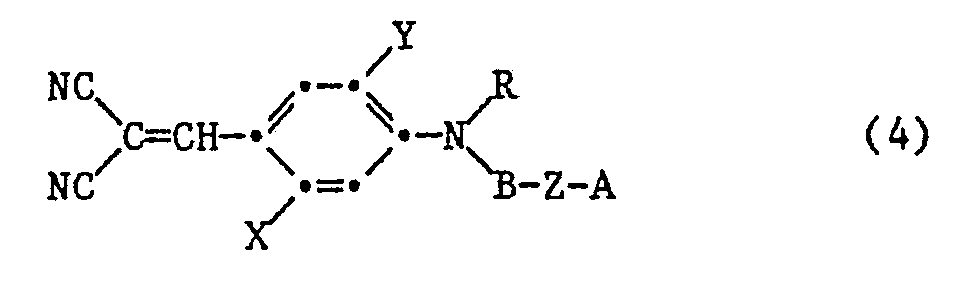
- Die Verbindungen der Formeln (3) und (4) sind bekannt oder können auf an sich bekannte Art und Weise erhalten werden.
- Die Verbindungen der Formel (3) können z.B. erhalten werden durch Umsetzung einer Verbindung der Formel


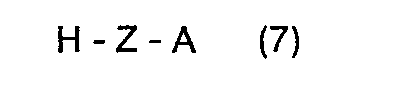

- Verbindungen der Formel (3), worin Z ein Brückenglied der Formel

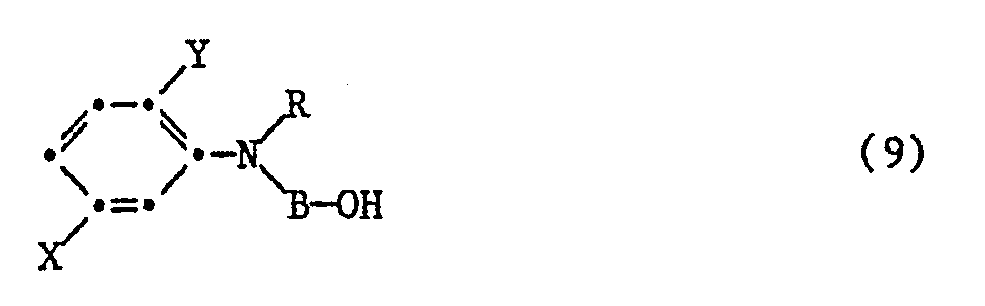

- Die Verbindungen der Formeln (9) und (10) sind bekannt.
- Bei den Formeln (3) bis (10) weisen A, Z, B, X, Y und R die unter der Formel (1) angegebene Bedeutung auf und Hal bedeutet Chlor oder Brom, wobei die beiden Halogenatome gleich oder verschieden sein können.
- Die Verbindungen der Formel (7) und (8) sind bekannt oder lassen sich auf bekannte Art und Weise herstellen.
Bei der Umsetzung der Verbindung (7) mit der Verbindung (8) arbeitet man vorzugsweise in einem inerten organischen Lösungsmittel und in Gegenwart einer Base. Als inerte organische Lösungsmittel kommen z.B. Verbindungen mit einem Siedepunkt oberhalb 100°C in Frage, wie Alkohole, Ether, Ester, Nitrobenzol, Halogenbenzol, Toluol, Xylole etc. Vor allem geeignet sind höher siedende Alkohole, wie tert.-Butanol, sowie Ether von mehrwertigen Alkoholen, z.B. Diethylenglykolmonoethylether oder -monomethylether sowie die enstprechenden Diether.
Die Komponenten (7) und (8) können in stöchiometrischem Verhältnis eingesetzt werden, ein Ueberschuss an einer der Komponenten, vorzugsweise der Verbindung (8), erweist sich jedoch oft als günstiger. - Die Reaktionstemperatur liegt etwa zwischen 80 und 150° C, vorzugsweise zwischen 100 und 130° C und die Reaktionsdauer beträgt, je nach Temperatur und Reaktionspartnern etwa 1 bis 20 Stunden. Nach Beendigung der Umsetzung wird die evtl. im Ueberschuss eingesetzte Komponente (8) entfernt und anschliessend die erhaltene Verbindung der Formel (5) mit einem Anilinderivat der Formel (6) umgesetzt.
Auch diese Umsetzung wird vorzugsweise in einem der obengenannten Lösungsmittel durchgeführt. Die Temperatur liegt normalerweise oberhalb 100°C, insbesondere zwischen 120 und 200°C und vor allem zwischen 140 und 180°C. - Die Komponenten (5) und (6) können in stöchiometrischem Verhältnis eingesetzt werden, normalerweise setzt man jedoch die leichter zugängliche Komponente, meist das Anilinderivat (6), im Ueberschuss ein, z.B. in 100/o-igem Ueberschuss.
Nach Beendigung der Reaktion wird auf übliche Weise aufgearbeitet, z.B. indem man den Ueberschuss an der Komponente (6) und das Lösungsmittel entfernt und den Rückstand gegebenenfalls reinigt, z.B. durch Umkristallisation.
Sowohl bei der Umsetzung der Verbindungen (7) und (8) als auch bei der Umsetzung der Verbindungen (5) und (6) arbeitet man in Gegenwart einer Base, wobei sowohl organische als auch anorganische Basen geeignet sind, z.B. Pyridin, Piperidin, Triethylamin, Natrium- oder Kaliumcarbonat oder -hydrogencarbonat. Diese Base wird im allgemeinen in geringem Ueberschuss, z.B. in 100/o-igem Ueberschuss, eingesetzt.
Die gesamte Herstellung der Verbindung (3) lässt sich auch als sogenannte Eintopfreaktion durchführen, indem man für die beiden Reaktionsschritte das gleiche Lösungsmittel einsetzt und die Verbindung (5) nicht isoliert. - Die Verbindungen der Formel (4) werden z.B. erhalten, indem man eine Verbindung der Formel (3) zunächst unter den bekannten Bedingungen der Vilsmeier-Synthese mit z.B. POCI3 und Dimethylformamid oder Phosgen und Dimethylformamid umsetzt und danach mit Malodinitril zur Reaktion bringt.
- Die Umsetzung der Verbindungen der Formel (3) mit Tetracyanethylen erfolgt auf an sich bekannte Art und Weise, vorzugsweise in einem inerten Lösungsmittel bei einer Temperatur zwischen etwa 20 und 100° C, wobei die Reaktionskomponenten in etwa äquivalenten Mengen eingesetzt werden.
- Auch die Umsetzung der Verbindungen der Formel (4) mit einem Cyanid und anschliessend mit einem Oxidationsmittel erfolgt auf an sich bekannte Art und Weise. Vorzugsweise führt man die Reaktion als Eintopfreaktion, d.h. ohne Isolierung der Zwischenstufe, und ebenfalls in einem inerten Lösungsmittel durch. Als Cyanid setzt man vor allem Kalium- oder Natriumcyanid ein und als Oxidationsmittel insbesondere Brom. Die Umsetzung mit dem Cyanid erfolgt bevorzugt bei etwa 20 bis 100°C und die Umsetzung mit dem Oxidationsmittel bei etwa 0 bis 20°C.
- Als inertes Lösungsmittel für die vorstehenden Reaktionen kommen z.B. Halogenverbindungen wie Chloroform oder Chlorbenzol, Ether, aromatische Verbindungen, wie Benzol, Toluol oder Xylol, insbesondere jedoch Tetrahydrofuran oder Dimethylformamid in Frage.
- Die Isolierung der Farbstoffe der Formel (1) erfolgt z.B. indem man die Reaktionslösungen in Eiswasser giesst, den ausgeschiedenen Farbstoff abfiltriert, eventuell wäscht und trocknet.
- Die erfindungsgemässen Verbindungen der Formel (1) können als Farbstoffe zum Färben und Bedrucken von halbsynthetischen und insbesondere synthetischen hydrophoben Fasermaterialien, vor allem Textilmaterialien, verwendet werden. Textilmaterialien aus Mischgeweben, die derartige halbsynthetische bzw. synthetische hydrophobe Textilmaterialien enthalten, können ebenfalls mit Hilfe der erfindungsgemässen Verbindungen gefärbt oder bedruckt werden.
- Als halbsynthetische Textilmaterialien kommen vor allem Cellulose 2 1/2-Acetat und Cellulosetriacetat in Frage.
- Synthetische hydrophobe Textilmaterialien bestehen vor allem aus linearen, aromatischen Polyestern, beispielsweise solchen aus Terephthalsäure und Glykolen, besonders Ethylenglykol oder Kondensationsprodukten aus Terephthalsäure und 1,4-Bis-(hydroxymethyl)-cyclohexan; aus Polycarbonaten, z.B. solchen aus a,a-Dimethyl-4,4'-dihydroxy-diphenylmethan und Phosgen, aus Fasern auf Polyvinylchlorid- sowie Polyamid-Basis.
- Die Applikation der erfindungsgemässen Verbindungen auf die Textilmaterialien erfolgt nach bekannten Färbeverfahren. Beispielsweise färbt man Polyesterfasermaterialien im Ausziehverfahren aus wässriger Dispersion in Gegenwart von üblichen anionischen oder nicht-ionischen Dispergiermitteln und gegebenenfalls üblichen Quellmitteln (Carrier) bei Temperaturen zwischen 80 und 140°C. Cellulose -2 1/2-acetat färbt man vorzugsweise zwischen ungefähr 65 bis 85°C und Cellulosetriacetat bei Temperaturen bis zu 115°C. Die neuen Farbstoffe färben im Färbebad gleichzeitig anwesende Wolle und Baumwolle nicht oder nur wenig an (sehr gute Reserve), so dass sie auch gut zum Färben von Polyester/Wolle- und Polyester/Cellulosefaser-Mischgeweben verwendet werden können.
- Die erfindungsgemässen Farbstoffe eignen sich aber insbesonders zum Färben nach dem Thermosol-Verfahren.
- Das genannte Textilmaterial kann dabei in den verschiedensten Verarbeitungsformen vorliegen, wie z.B. als Faser, Faden oder Vlies, als Gewebe oder Gewirke.
- Es ist vorteilhaft, die erfindungsgemässen Farbstoffe vor ihrer Verwendung in ein Farbstoffpräparat überzuführen. Hierzu wird der Farbstoff vermahlen, so dass seine Teilchengrösse in Mittel zwischen 0,01 und 10 Mikron beträgt. Das Vermahlen kann in Gegenwart von Dispergiermitteln erfolgen. Beispielsweise wird der getrocknete Farbstoff mit einem Dispergiermittel gemahlen oder in Pastenform mit einem Dispergiermittel geknetet und hierauf im Vakuum oder durch Zerstäuben getrocknet. Mit den so ehaltenen Präparaten kann man nach Zugabe von Wasser färben und bedrucken.
- Beim Bedrucken wird man die üblichen Verdickungsmittel verwenden, z.B. modifizierte oder nichtmodifizierte natürliche Produkte, beispielsweise Alginate, British-Gummi, Gummi arabicum, Kristallgummi, Johannisbrotkernmehl, Tragant, Carboxymethylcellulose, Hydroxyethylcellulose, Stärke oder synthetische Produkte, beispielsweise Polyacrylamide, Polyacrylsäure oder deren Copolymere oder Polyvinylalkohole.
- Die erfindungsgemässen Farbstoffe verleihen den genannten Materialien, vor allem dem Polyestermaterial, egale orangefarbene oder rote Farbtöne von sehr guten Gebrauchs-Echtheiten, wie vor allem guter Lichtechtheit, Thermofixier-, Plissier-, Chlor- und Nassechtheit wie Wasser-, Schweiss-und Waschechtheit; die Ausfärbungen sind ferner gekennziechnet durch eine gute pH-Stabilität und sehr gute Reibechtheit. Es werden ausserdem sehr farbstarke Färbungen erzielt. Besonders hervorzuheben ist die gute Thermomigrierechtheit der erhaltenen Färbungen.
- Die erfindungsgemässen Farbstoffe können auch gut verwendet werden zur Herstellung von Mischnuancen zusammen mit anderen Farbstoffen. Selbstverständlich können auch Mischungen der erfindungsgemässen Farbstoffe untereinander verwendet werden.
- Die vorstehend genannte Verwendung der erfindungsgemässen Azoverbindungen der Formel (1) stellt ebenso einen Gegenstand der vorliegenden Erfindung dar wie ein Verfahren zum Färben oder Bedrucken von halb-synthetischem oder synthetischem hydrophobem Fasermaterial, insbesondere Textilmaterial, das darin besteht, eine oder mehrere Verbindungen der Formel (1) auf das genannte Material aufzubringen oder es diesem einzuverleiben. Das genannte hydrophobe Fasermaterial ist vorzugsweise textiles Polyestermaterial. Weitere Substrate, die durch das erfindungsgemässe Verfahren behandelt werden können sowie bevorzugte Verfahrensbedingungen sind vorstehend bei der näheren Erläuterung der Verwendung der erfindungsgemässen Verbindungen zu finden.
- Ein weiterer Gegenstand der Erfindung ist das durch das genannte Verfahren gefärbte bzw. bedruckte hydrophobe Fasermaterial, vorzugsweise Polyester-Textilmaterial.
- Die folgenden Beispiele veranschaulichen die Erfindung weiter, ohne sie darauf zu beschränken. Teile und Prozente beziehen sich sofern nicht anders angegeben, auf das Gewicht.
- Zu einer Lösung von 17,2 g der Verbindung der Formel

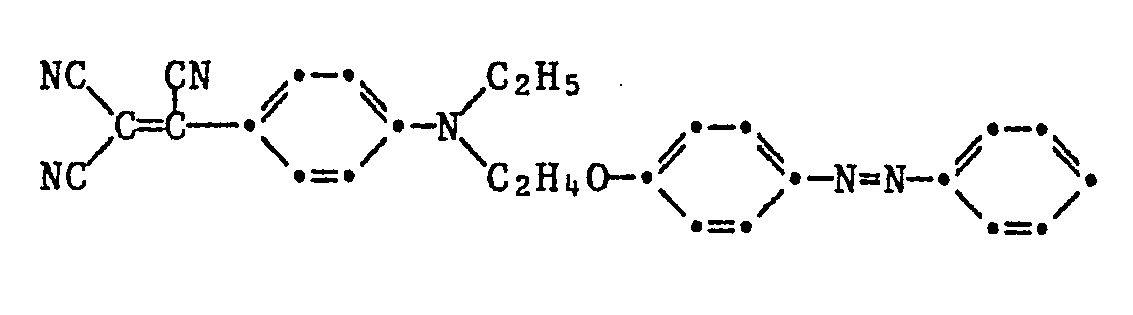
- Die Ausgangsverbindung wird folgendermassen hergestellt: 19,8 g 4-Hydroxyazobenzol werden in 100 ml Diethylenglykolmonoethylether gelöst und mit 12,8 g Soda und 52,5 ml 1,2-Dibromethan versetzt. Man erwärmt auf ca. 116°C und rührt 2 Stunden bei dieser Temperatur. Dann entfernt man das überschüssige Dibromethan durch Wasserdampfdestillation und anschliessend durch Destillation bei ca. 110° C im Vakuum das Wasser. Man erhält eine Suspension, enthaltend ca. 26 g eines orangeroten Pulvers der Formel

- Zu dieser Suspension gibt man 10,8 g Soda und 11,3 ml N-Ethylanilin, erwärmt auf 120 bis 125°C und rührt 12 Stunden bei dieser Temperatur. Dann wird der Ueberschuss an N-Ethylanilin durch Wasserdampfdestillation entfernt. Das Reaktionsgemisch wird auf Raumtemperatur abgekühlt, wobei sich ein hellbraunes, zähflüssiges Oel abscheidet. Das Wasser wird abdekantiert, das Oel In Aceton gelöst und der geringe unlösliche Rückstand abfiltriert. Dann wird das Filtrat mit Eis und Wasser versetzt, der sich abscheidende Niederschlag abgesaugt und mit Wasser gewaschen. Man erhält ca. 23 g eines goldgelben Pulvers der Formel
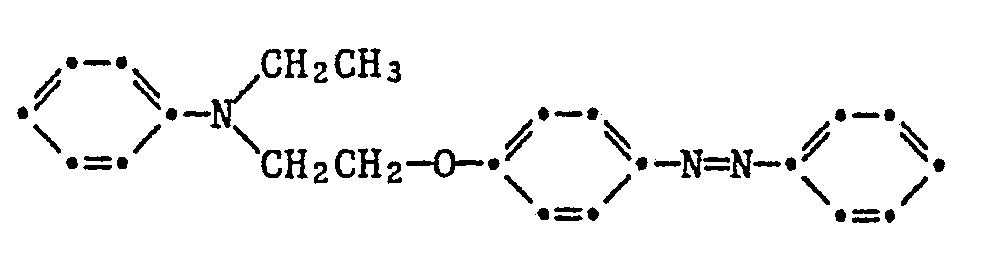
- In analoger Weise wie im Beispiel 1 beschrieben erhält man aus den entsprechenden Zwischenprodukten die folgenden Farbstoffe:


- Man mischt 1 Teil des trockenen, coupagefreien Farbstoffs gemäss Beispiel 1 in einer Sandmühle zusammen mit 2 Teilen Dinaphthylmethandisulfonat (Na-Salz), 34 Teilen Quarzsand und 17 Teilen Wasser und mahlt das Gemisch so lange, bis eine Korngrösse von etwa 2 µ oder kleiner erreicht ist. Die entstehende Suspension wird vom Sand getrennt stellt dann eine stabile Flüssigformulierung dar. Sie kann aber auch der Sprühtrocknung unterworfen werden, wobei ein pulverförmiges Färbepräparat erhalten wird. Auf die gleiche Weise kann man auch stabile flüssige, und bei genügend hohem Schmelzpunkt der Farbstoffe auch feste Präparate der Farbstoffe der Beispiele 2-13 herstellen.
- Polyethylenglykolterephthalatgewebe wird auf einem Foulard bei 40° mit einer Flotte folgender Zusammensetzung imprägniert:
- 20 Teile des gemäss Beispiel 14 erhaltenen Farbstoffpräparates fein dispergiert in
- 10 Teilen Natriumalginat,
- 20 Teilen Octylphenolpolyglykoläther und
- 930 Teilen Wasser.
- Das auf ca. 60% abgequetschte Gewebe wird bei 100° getrocknet und anschliessend während 60 Sekunden bei einer Temperatur von 210° fixiert. Die gefärbte Ware wird mit Wasser gespült, geseift oder reduktiv gereinigt und getrocknet. Man erhält eine brillante, lichtechte rote Färbung, welche sich vor allem durch eine gute Thermomigrationsechtheit auszeichnet.
- 2 Teile des gemäss Beispiel 14 erhaltenen Farbstoffpräparates werden in 4000 Teilen Wasser, enthaltend 12 Teile des Natriumsalzes von o-Phenylphenol, 2 Teile Ammoniumsulfat sowie 2 Teile des Natriumsalzes der Dinaphthylmethandisulfonsäure, dispergiert. Dann färbt man 100 Teile Garn aus Polyethylenglykolterephthalat 90 Minuten lang bei 95 bis 98° in dieser Flotte.
- Die Färbung wird anschliessend gespült und mit wässriger Natronlauge und einem Dispergator nachbehandelt. Man erhält so eine licht- und sublimierechte rote Färbung.
- 1 Teil des gemäss Beispiel 5 erhaltenen Farbstoffs wird mit 2 Teilen einer 500/oigen wässerigen Lösung des Natriumsalzes der Dinaphthylmethandisulfonsäure nass vermahlen und getrocknet.
- Dieses Farbstoffpräparat wird mit 40 Teilen einer 100/oigen wässerigen Lösung des Natriumsalzes der N-Benzylheptadecyl-benzimidazoldisulfonsäure verrührt und 4 Teile einer 400/oigen Essigsäurelösung zugegeben. Durch Verdünnen mit Wasser wird daraus ein Färbebad von 4000 Teilen bereitet. In dieses Bad geht man bei 50° mit 100 Teilen eines Polyesterfaserstoffes ein, steigert die Temperatur innert einer halben Stunde auf 120 bis 130° und färbt eine Stunde in geschlossenem Gefäss bei dieser Temperatur. Anschliessend wird gut gespült. Man erhält eine rubinrote Färbung mit guten Echtheiten, insbesondere guter Sublimations- und Thermomigrationsechtheit.
Claims (20)





Applications Claiming Priority (4)
| Application Number | Priority Date | Filing Date | Title |
|---|---|---|---|
| CH105087 | 1987-03-19 | ||
| CH1050/87 | 1987-03-19 | ||
| CH509187 | 1987-12-29 | ||
| CH5091/87 | 1987-12-29 |
Publications (3)
| Publication Number | Publication Date |
|---|---|
| EP0284560A2 true EP0284560A2 (de) | 1988-09-28 |
| EP0284560A3 EP0284560A3 (en) | 1989-01-04 |
| EP0284560B1 EP0284560B1 (de) | 1992-03-04 |
Family
ID=25686486
Family Applications (1)
| Application Number | Title | Priority Date | Filing Date |
|---|---|---|---|
| EP88810156A Expired - Lifetime EP0284560B1 (de) | 1987-03-19 | 1988-03-14 | Dispersionsfarbstoffe, enthaltend eine Tricyanovinylgruppierung |
Country Status (5)
| Country | Link |
|---|---|
| US (1) | US4914190A (de) |
| EP (1) | EP0284560B1 (de) |
| JP (1) | JPS63254168A (de) |
| KR (1) | KR880011287A (de) |
| DE (1) | DE3868656D1 (de) |
Cited By (3)
| Publication number | Priority date | Publication date | Assignee | Title |
|---|---|---|---|---|
| US4992558A (en) * | 1988-07-11 | 1991-02-12 | Ciba-Geigy Corporation | Disperse dyes containing a tricyanovinyl grouping bonded to a N,N-disubstituted aniline |
| EP0437282A3 (en) * | 1990-02-15 | 1991-09-18 | Basf Aktiengesellschaft | Bichromophore methine dyes containing cyano groups and a process for their transfer |
| EP0378510A3 (de) * | 1989-01-13 | 1991-10-30 | Ciba-Geigy Ag | Dispersionsfarbstoffe |
Families Citing this family (3)
| Publication number | Priority date | Publication date | Assignee | Title |
|---|---|---|---|---|
| US5218136A (en) * | 1987-12-28 | 1993-06-08 | Sumitomo Chemical Company, Limited | Styryl compounds, process for preparing the same and photoresist compositions comprising the same |
| DE68922062T2 (de) * | 1988-10-11 | 1995-08-24 | Sumitomo Chemical Co | Dispersionsmonoazofarbstoffe, deren Herstellung und Verwendung. |
| DE4042194A1 (de) * | 1990-12-29 | 1992-07-02 | Basf Ag | Styrolderivate |
Family Cites Families (18)
| Publication number | Priority date | Publication date | Assignee | Title |
|---|---|---|---|---|
| US2733258A (en) * | 1956-01-31 | Preparation of isomeric | ||
| US2749229A (en) * | 1952-05-06 | 1956-06-05 | Ethyl Corp | Plant growth regulation with chlorophenyl cyanoacrylic acids and derivatives |
| US2762833A (en) * | 1953-09-28 | 1956-09-11 | Du Pont | Process for preparing tricyanovinylphenols |
| US2889335A (en) * | 1955-01-14 | 1959-06-02 | Du Pont | Process for preparing c-tricyanovinyl compounds and a new class of tricyanovinyl aromatic compounds adapted for use as dyes |
| US2849447A (en) * | 1955-09-19 | 1958-08-26 | Gen Aniline & Film Corp | Nitro diarylamine methine dyes |
| US3240783A (en) * | 1963-01-18 | 1966-03-15 | Eastman Kodak Co | Cyanomethylidene quinolines |
| GB1110714A (en) * | 1966-04-13 | 1968-04-24 | Ici Ltd | New styryl dyestuffs |
| US4035380A (en) * | 1966-08-29 | 1977-07-12 | Ciba-Geigy Ag | Certain benzazol-2-ylthio compounds |
| DE2059291A1 (de) * | 1970-12-02 | 1972-06-08 | Basf Ag | Styrylfarbstoffe |
| US3890367A (en) * | 1971-10-18 | 1975-06-17 | Gulf Research Development Co | 3,5-Tert. butyl-4-(2,4-dichlorophenylcarbamyloxy) benzylidenemalonitrile |
| US3926945A (en) * | 1972-05-16 | 1975-12-16 | Gaf Corp | 2,4-Dicyano butylamino-substituted monoazo dyestuffs |
| DD111920A5 (de) * | 1973-04-04 | 1975-03-12 | ||
| FR2280672A1 (fr) * | 1974-08-02 | 1976-02-27 | Ugine Kuhlmann | Copolymeres structurellement colores a base de colorants cyanovinyl-azoiques |
| DE2542376C2 (de) * | 1974-10-04 | 1984-05-17 | Sandoz-Patent-GmbH, 7850 Lörrach | Organische Verbindungen |
| DE2714653C3 (de) * | 1977-04-01 | 1980-10-30 | Bayer Ag, 5090 Leverkusen | Kationische Styrylfarbstoffe und Verfahren zum Färben mit diesen Farbstoffen |
| JPS59129264A (ja) * | 1983-01-12 | 1984-07-25 | Sumitomo Chem Co Ltd | トリシアノスチリル化合物およびそれを用いる染色または着色法 |
| JPS59129263A (ja) * | 1983-01-12 | 1984-07-25 | Sumitomo Chem Co Ltd | トリシアノスチリル化合物およびそれを用いる染色または着色方法 |
| DE3417840A1 (de) * | 1983-05-17 | 1984-11-22 | Ciba-Geigy Ag, Basel | Tetrazolverbindungen |
-
1988
- 1988-03-11 US US07/166,944 patent/US4914190A/en not_active Expired - Fee Related
- 1988-03-14 DE DE8888810156T patent/DE3868656D1/de not_active Expired - Lifetime
- 1988-03-14 EP EP88810156A patent/EP0284560B1/de not_active Expired - Lifetime
- 1988-03-17 JP JP63062076A patent/JPS63254168A/ja active Pending
- 1988-03-18 KR KR1019880002859A patent/KR880011287A/ko not_active Withdrawn
Cited By (4)
| Publication number | Priority date | Publication date | Assignee | Title |
|---|---|---|---|---|
| US4992558A (en) * | 1988-07-11 | 1991-02-12 | Ciba-Geigy Corporation | Disperse dyes containing a tricyanovinyl grouping bonded to a N,N-disubstituted aniline |
| EP0378510A3 (de) * | 1989-01-13 | 1991-10-30 | Ciba-Geigy Ag | Dispersionsfarbstoffe |
| EP0437282A3 (en) * | 1990-02-15 | 1991-09-18 | Basf Aktiengesellschaft | Bichromophore methine dyes containing cyano groups and a process for their transfer |
| US5371266A (en) * | 1990-02-15 | 1994-12-06 | Basf Aktiengesellschaft | Bichromophoric cyano-containing methine dyes and transfer thereof |
Also Published As
| Publication number | Publication date |
|---|---|
| KR880011287A (ko) | 1988-10-27 |
| US4914190A (en) | 1990-04-03 |
| EP0284560A3 (en) | 1989-01-04 |
| JPS63254168A (ja) | 1988-10-20 |
| EP0284560B1 (de) | 1992-03-04 |
| DE3868656D1 (de) | 1992-04-09 |
Similar Documents
| Publication | Publication Date | Title |
|---|---|---|
| EP0555179A1 (de) | Azofarbstoffe | |
| EP0667376B1 (de) | Phthalimidyl-Azofarbstoffe, Verfahren zu deren Herstellung und deren Verwendung | |
| EP0894830B1 (de) | Dispersionsfarbstoffe | |
| EP0284560B1 (de) | Dispersionsfarbstoffe, enthaltend eine Tricyanovinylgruppierung | |
| EP0699718A2 (de) | Azothiophenfarbstoffe mit einer 2,4,6-Triamino-3-cyanpyridin Kupplungskomponente | |
| EP0443984B1 (de) | Phthalimidyl-Azofarbstoffe | |
| EP0378510B1 (de) | Dispersionsfarbstoffe | |
| EP0463995B1 (de) | Azofarbstoffe mit 2-Alkylamino-3-cyan-4,6-diaminopyridinen als Kupplungskomponenten | |
| CH689980A5 (de) | Mischungen von Monoazopyridonfarbstoffen. | |
| EP0776948B1 (de) | Mischungen von Monoazopyridonfarbstoffen | |
| EP0083313B1 (de) | Farbstoffmischung, Verfahren zu ihrer Herstellung und Verwendung zum Färben und Bedrucken von hydrophobem Fasermaterial | |
| EP0826741A1 (de) | Dispersionsfarbstoffe | |
| EP0041042B1 (de) | Azoverbindungen | |
| EP0271444B1 (de) | Dispersionsfarbstoffe | |
| EP0335834A2 (de) | Heteroaromatische Azofarbstoffe | |
| EP0351367A2 (de) | Dispersionsfarbstoffe, enthaltend eine Tricyanovinylgruppierung | |
| EP0337948A1 (de) | Dispersionsfarbstoffe | |
| EP1085055B1 (de) | Azofarbstoff, Verfahren zu dessen Herstellung und dessen Verwendung zum Färben oder Bedrucken von hydrophoben Fasermaterialien | |
| EP0346280B1 (de) | Dicyanobenzanthronverbindungen | |
| EP0040582B1 (de) | Azoverbindungen | |
| EP0258180A2 (de) | Dispersionsfarbstoffe | |
| CH654589A5 (de) | Farbstoffmischungen. | |
| DE19646430A1 (de) | Mischungen von Monoazopyridonfarbstoffen | |
| EP0952190B1 (de) | Dispersionsfarbstoffe | |
| DE1644252C (de) | In Wasser schwerlösliche Farbstoffe der Anthrachinon Azoreihe, Verfahren zu ihrer Herstellung und ihre Verwendung |
Legal Events
| Date | Code | Title | Description |
|---|---|---|---|
| PUAI | Public reference made under article 153(3) epc to a published international application that has entered the european phase |
Free format text: ORIGINAL CODE: 0009012 |
|
| 17P | Request for examination filed |
Effective date: 19880316 |
|
| AK | Designated contracting states |
Kind code of ref document: A2 Designated state(s): BE CH DE FR GB IT LI |
|
| PUAL | Search report despatched |
Free format text: ORIGINAL CODE: 0009013 |
|
| AK | Designated contracting states |
Kind code of ref document: A3 Designated state(s): BE CH DE FR GB IT LI |
|
| 17Q | First examination report despatched |
Effective date: 19900920 |
|
| GRAA | (expected) grant |
Free format text: ORIGINAL CODE: 0009210 |
|
| PGFP | Annual fee paid to national office [announced via postgrant information from national office to epo] |
Ref country code: FR Payment date: 19920204 Year of fee payment: 5 |
|
| PGFP | Annual fee paid to national office [announced via postgrant information from national office to epo] |
Ref country code: DE Payment date: 19920217 Year of fee payment: 5 |
|
| AK | Designated contracting states |
Kind code of ref document: B1 Designated state(s): BE CH DE FR GB IT LI |
|
| PG25 | Lapsed in a contracting state [announced via postgrant information from national office to epo] |
Ref country code: IT Free format text: LAPSE BECAUSE OF FAILURE TO SUBMIT A TRANSLATION OF THE DESCRIPTION OR TO PAY THE FEE WITHIN THE PRESCRIBED TIME-LIMIT;WARNING: LAPSES OF ITALIAN PATENTS WITH EFFECTIVE DATE BEFORE 2007 MAY HAVE OCCURRED AT ANY TIME BEFORE 2007. THE CORRECT EFFECTIVE DATE MAY BE DIFFERENT FROM THE ONE RECORDED. Effective date: 19920304 |
|
| PGFP | Annual fee paid to national office [announced via postgrant information from national office to epo] |
Ref country code: GB Payment date: 19920304 Year of fee payment: 5 |
|
| PGFP | Annual fee paid to national office [announced via postgrant information from national office to epo] |
Ref country code: BE Payment date: 19920313 Year of fee payment: 5 |
|
| ET | Fr: translation filed | ||
| PGFP | Annual fee paid to national office [announced via postgrant information from national office to epo] |
Ref country code: CH Payment date: 19920406 Year of fee payment: 5 |
|
| REF | Corresponds to: |
Ref document number: 3868656 Country of ref document: DE Date of ref document: 19920409 |
|
| GBT | Gb: translation of ep patent filed (gb section 77(6)(a)/1977) | ||
| PLBE | No opposition filed within time limit |
Free format text: ORIGINAL CODE: 0009261 |
|
| STAA | Information on the status of an ep patent application or granted ep patent |
Free format text: STATUS: NO OPPOSITION FILED WITHIN TIME LIMIT |
|
| 26N | No opposition filed | ||
| PG25 | Lapsed in a contracting state [announced via postgrant information from national office to epo] |
Ref country code: GB Effective date: 19930314 |
|
| PG25 | Lapsed in a contracting state [announced via postgrant information from national office to epo] |
Ref country code: BE Effective date: 19930331 Ref country code: CH Effective date: 19930331 Ref country code: LI Effective date: 19930331 |
|
| BERE | Be: lapsed |
Owner name: CIBA-GEIGY A.G. Effective date: 19930331 |
|
| GBPC | Gb: european patent ceased through non-payment of renewal fee |
Effective date: 19930314 |
|
| PG25 | Lapsed in a contracting state [announced via postgrant information from national office to epo] |
Ref country code: FR Effective date: 19931130 |
|
| REG | Reference to a national code |
Ref country code: CH Ref legal event code: PL |
|
| PG25 | Lapsed in a contracting state [announced via postgrant information from national office to epo] |
Ref country code: DE Effective date: 19931201 |
|
| REG | Reference to a national code |
Ref country code: FR Ref legal event code: ST |