EP0668060A2 - Interdentalkeil mit Formanpassungsvermögen - Google Patents
Interdentalkeil mit Formanpassungsvermögen Download PDFInfo
- Publication number
- EP0668060A2 EP0668060A2 EP95102253A EP95102253A EP0668060A2 EP 0668060 A2 EP0668060 A2 EP 0668060A2 EP 95102253 A EP95102253 A EP 95102253A EP 95102253 A EP95102253 A EP 95102253A EP 0668060 A2 EP0668060 A2 EP 0668060A2
- Authority
- EP
- European Patent Office
- Prior art keywords
- wedge
- outer component
- dental wedge
- core
- dental
- Prior art date
- Legal status (The legal status is an assumption and is not a legal conclusion. Google has not performed a legal analysis and makes no representation as to the accuracy of the status listed.)
- Granted
Links
Images


Classifications
-
- A—HUMAN NECESSITIES
- A61—MEDICAL OR VETERINARY SCIENCE; HYGIENE
- A61C—DENTISTRY; APPARATUS OR METHODS FOR ORAL OR DENTAL HYGIENE
- A61C5/00—Filling or capping teeth
- A61C5/80—Dental aids fixed to teeth during treatment, e.g. tooth clamps
- A61C5/88—Wedges
Definitions
- the present invention relates generally to the field of dental instruments and more particularly to dental wedges.
- Dental wedges are well known in the art and have been used in restorative dentistry for over a century. Generally, dental wedges are used to separate the teeth and hold a matrix band against the side of the tooth while a restoration is being placed. These functions are important for the successful restoration of the form and function of the tooth being restored. Unless adequate separation of the teeth is achieved, the adjacent teeth, once restored, will not contact one another or will do so only very lightly. Without adequate contact between the teeth, food will pack and otherwise accumulate in between the teeth, leading to decay and periodontal (gum) problems. And, unless the matrix band conforms adequately to the side of the tooth, filling material can be forced below the gum line or leave the tooth with unnatural and irregular contours known as ledges, overhangs and underhangs. These flaws aid and cause plaque accumulation, leading to decay and periodontal problems.
- the ideal dental wedge should be relatively hard in order to drive the teeth apart at least the thickness of the average matrix band (approximately 0.002 inch).
- the restored teeth should rebound to their normal physiologic position in order to maintain physiologic contact and prevent food debris from packing between the teeth during chewing.
- the wedge should also provide resistance against the matrix band so as to prevent deformation or dislodgment due to the outward pressure the dentist applies when packing restorative materials in the matrix-confined cavity space.
- Most dental wedges are of a basic tetrahedral shape and taper to a point. In use, a wedge is inserted into the space between the adjacent teeth at the gum line and forced into the space to force separation of the teeth so that they may be restored.
- the amount of separation achievable with a wedge depends upon several factors. The interdental space present between the adjacent teeth and the size of the wedge are probably the most important of those factors.
- Dental wedges generally have been made of various hard materials and have focused on the tooth separation function of the dental wedge. Indeed, virtually all of the wedges of the prior art have focused on separating the teeth to be restored. These wedges have generally achieved tooth separation, but most of them have also had a tendency to "back out.”
- a dental wedge Another basic requirement of a dental wedge is that it be able to cause the matrix band to intimately conform to the anatomical surfaces of the tooth to be restored.
- the interproximal surface of a tooth will be concave.
- a dental wedge does not intimately contact the flexible matrix band and force it against the concave surface of the tooth, the band is unsupported.
- a gap or opening will develop in response to the pressure of packing the restorative material into the matrix-confined cavity preparation.
- These gaps allow the filing material to push past the matrix and create a ledge, overhang, or an otherwise unacceptable contour of the tooth in the interdental space.
- rigid, fixed-shape wedges or wedge-type devices cannot adapt well to the variable contours of the interproximal spaces.
- Plastics in general are unacceptable materials for a wedge meeting both of the above criteria because of their tendency to flow with resulting permanent, non-recoverable deformation.
- the wedge is deformed and does not have the memory to "rebound" into the concave surface of the side of the tooth.
- the present invention provides a on-piece dental wedge which is capable of both separating adjacent teeth and conforming a matrix band to the irregular surfaces of a tooth being restored, and doing so without “backing out.”
- the wedge of the invention possesses elastic properties which enable it not only to recover from deformation but also "rebound” into the irregular contours of the side of the tooth. The elasticity enables the wedge to be forced between two teeth and then expand into a concave, interproximal defect in one of the teeth with enough force to cause a matrix band to adapt to the interproximal contours.
- the present invention in a general aspect comprises a one-piece dental wedge which includes a rigid core and an outer layer of an elastic material which is bonded or otherwise coupled or joined to the core.
- the elastic material must be firm enough to provide resistance to compression when wedged between two teeth, but also capable of rebounding from compression to conform to the contours of tooth surfaces.
- the invention is comprised of a rigid core having a tetrahedral shape and an elastic component fused over the rigid core. The elastic component of the wedge is selected to deform when forced between teeth, but then rebound into the irregular contours of the sides of the teeth.
- FIG. 1 A dental wedge of the present invention is illustrated in FIG. 1.
- the dental wedge has an overall tetrahedral shape tapering from a butt end portion 10 to a pointed tip portion 12 at the opposite end.
- the dental wedge of the present invention is comprised of two principal components: a rigid core component 14 and an elastic outer component 16.
- the outer component is fused, cemented, frictionally fitted or otherwise fixed to the core to form a unitary structure.
- the rigid core and the overall wedge preferably have similar cross-sections.
- the core of FIG. 1 forms a butt end portion 10, a body portion 18 to which the elastic outer component 16 is fused, and a pointed tip portion 12.
- the butt end portion of the core 10 has a transverse flat surface 20 which is designed to be engaged by a suitable tool for easy placement of the dental wedge into the interproximal space.
- the core component of the invention is preferably hard and large enough to support the elastic outer component 16 and thus achieve adequate tooth separation. Further, the core is sufficiently rigid to aid in placement of the wedge when force is applied to the butt end of the wedge during placement. A flexible core may not allow an operator to achieve necessary separation.
- the material comprising the core component of the invention should be compatible with the material comprising the elastic outer component such that the two components will not separate during use. Further, both the core component and the elastic outer component must be biocompatible, i.e., compatible with human oral tissues.
- An especially preferred material for the core component has been found to be polymethyl methacrylate resin.
- Other biocompatible materials may also be suitable, for example other plastics, wood, metal, or other synthetic materials.
- Plastics that are not suitable to use for the outer surface of dental wedges are often sufficiently strong and rigid enough to serve as the core components of the wedges of the invention.
- the outer component is preferably a synthetic elastomer which is capable of being fused or otherwise fixed to the core. It is preferably sufficiently hard enough to cause separation of the teeth; however, it must also be sufficiently soft and elastic to expand and conform to the side wall surfaces of the tooth.
- a key feature of the present invention is the use of elastomers as the elastic, deformable component of the wedge.
- elastomer is used to mean materials having elastic properties, thus having an elastic memory to return the material to its original shape after being deformed.
- Elastomers generally have rubber-like properties and for purposes of the present invention may be classified as “gel” or “non-gel” type.
- a gel is a colloidal solution in which the disperse phase has combined with the continuous phase to produce a swollen, viscous, jelly-like structure.
- An elastomer of the gel type thus may comprise a disperse phase, which may be some form of filler, generally a collodial silica quartz or amorphous silica glass, and a continuous phase, which may be a liquid solvent, for example water.
- Gels may be further classified by the solvent used to form the gel.
- Hydrogels are gels wherein the solvent is water. Alcohols or other organic solvents may also be used as swelling agents to form a gel useful in the present invention.
- Elastomers of the non-gel type are primarily natural or synthetic polymers such as the rubbers of polyisoprene, polybutadiene, polyethers, polysiloxanes, silicones and polysulfides.
- the rigidity of these polymers varies with the degree of cross-linking of the polymer chains. The higher the degree of cross-linking the more rigid the resulting polymeric structure.
- hydrogel comprises a polymer such as a copolymer of hydroxyethyl methacrylate (“HEMA”) and hydroxypropyl methacrylate (“HPMA”) or a copolymer of HEMA and triethylamino ethyl methacrylate chloride (“TMAEM-CI”) with triethylene glycol dimethacrylate (“TEGDMA”) as a cross-linker, together with an aqueous solvent.
- HEMA hydroxyethyl methacrylate
- HPMA hydroxypropyl methacrylate
- TMAEM-CI triethylamino ethyl methacrylate chloride
- TEGDMA triethylene glycol dimethacrylate
- elastomers possessing a hardness in the range of a hard rubber are preferred.
- the performance of the dental wedge of the present invention is dependent upon both the hardness (resistance to indentation) and the resilience (ability to recover from indentation) of the elastomer.
- the function of the core cannot be overlooked.
- the core must be rigid enough to support the deformable component and to force the section of the teeth. Without the rigid core, the wedge, as a unit, may not achieve proper separation.
- a wedge of the present invention may be made entirely of elastomeric materials.
- the core and outer component may be made from the same material but with different filler loadings (of, for example, collodial silica quartz, amorphous silica glass, graphite, carbon black, titania, or the like) or different degrees of cross-linking in the synthetic polymers.
- the core may be comprised of an elastomer highly loaded with filler or highly cross-linked and thus hard and stiff.
- the outer component may be comprised of the same elastomer but with a much lower filler loading or lower degree of cross-linking and thus be more pliable and elastic than the core.
- a particular advantage of such a wedge is anticipated to be in ease of manufacture. Additionally, it is anticipated that problems noted with separation of the outer component from the core when different materials are used would be resolved as the core and outer component would form a continuum of the same material.
- a dental wedge In use, a dental wedge is first placed between adjacent teeth, pointed end in first, and positioned to provide adequate separation. As is well known, the separation between the teeth is necessary to compensate for the thickness of a matrix band used in restorative dentistry.
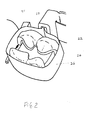
- FIG. 2 This use of a dental wedge is illustrated in FIG. 2.
- a molar tooth 22 has been prepared for a class II restoration 24.
- a matrix band 26 is placed around the tooth, and a dental wedge 28 is inserted in between the tooth and an adjacent tooth 32 to separate the teeth and conform and hold the matrix band against the tooth to be restored.
- a concave defect 30 exists on the side of the tooth.
- Concavities are common in the interproximal root surfaces of posterior teeth. Irregularities of the interproximal surfaces of teeth may also exist due to decay or trauma to the tooth. Restoring these surfaces to proper form tends to be difficult or impossible with a fixed-geometry, hard wedge.
- the dental wedge of the present invention makes restoring these surfaces much more practicable and predictable. After a wedge of the invention is forced into place, achieving desired tooth separation, the elastic outer component rebounds to conform to the concave defect in the side of the tooth. Thus, the two primary criteria for a dental wedge, adequate separation and conforming to the tooth's irregularities, are met. Further, because the outer component is elastic and can rebound into the tooth's irregularities, it will not tend to "back out.” It appears that the elastic outer component offers greater traction against gum tissue as well.
- the wedges of the present invention work excellently as an aid to placing silver amalgam fillings ("amalgams")
- the wedges are contemplated to be especially valuable in restoring posterior teeth with tooth-colored composite filling materials ("composites”).
- Achieving proper interproximal contacts has long been a problem when placing composites. This is because composite filling material is relatively fluid, especially when compared with silver amalgam. Consequently, the dentist cannot forcibly "pack" the composite filling material into the matrix-confined cavity space and achieve any further separation of the teeth as he may be able to with amalgam.
- the matrix band must be properly supported by the wedge; otherwise, the filling material may flow into irregularities and create ledges and overhangs. Because composites are tooth colored, it is much more difficult for a dentist to detect an overhang and correct it than when amalgam is used. Thus, with the aid of the dental wedge of the present invention, the dentist is able to more predictably place composite restorations, especially in posterior teeth, with proper interproximal contacts and anatomic contours.
- the dental wedges of the present invention may be embodied in various ways to be most helpful to the dentist.
- Both the core and the elastic component of the wedge of the invention may be made radiopaque by incorporating x-ray absorbing elements (i.e., high atomic number elements such as Ba, Bi, Ta, Sr, Zn, Zr or the like) into them.
- both the core and the elastic component may contain coloring or identifying components.
- the core may be made with transparent materials and it may also contain a reflecting surface, if desired.
- both the core and elastic outer component can be made of transparent materials.
- light cured composites can be predictably placed and cured with the wedge in place, something that cannot be done with an opaque wedge.
- wedges of the present invention may find extensive use for the delivery of various medications to the gingiva in between teeth.
- gel-clad wedges may be soaked in a hemostatic, antibiotic, or anti-inflammatory solution or a mixture thereof before use or when manufactured. It is contemplated that the medication-containing solution in which the wedges are soaked would be at least partially absorbed into the solvent phase of the gel and thus the gel would act as a depot for the medication.
- a gel-clad wedge carrying a hemostatic agent appears to be an excellent adjunct to procedures requiring a dry field, for instance, when preparing and seating porcelain and other bonded restorations, or preparing and seating metal restorations. Often the interproximal gingiva is traumatized during such procedures and bloods. The use of a hemostatic agent carrying, gel-clad wedge would help to reduce or stop the resulting bleeding and provide a dry field.
- the dental wedge of the present invention typically has an enlarged cross-section in the body portion of the wedge due to the presence of the elastic outer component.
- the cross-section of the elastic outer component will generally reflect the shape of the underlying core because the outer component extends outward about 1 mm from the core. Because the outer component is compressible and elastic, it is not necessary for its cross-section to have a well-defined geometry.
- the elastic outer component of the dental wedge of the invention is firm but compressible, the wedges may be made slightly larger in cross-section than presently available commercial wedges and fewer sizes of wedges of the invention will be required in the dentist's restorative armamentarium, That is, fewer sizes of the dental wedge of the present invention should be required to perform the same range of restorative tasks that presently require a wide variety of sizes of current commercially available wedges.
- wedges of the present invention may be fabricated on a commercial scale by bulk molding, injection molding, action injection molding, or extrusion methods.
- the elastic outer component may be comprised of either thermosetting of thermoplastic elastomeric materials.
- the first prototype wedges made with hydrogel exteriors tended to be fragile due to imperfect adhesion of the hydrogel to the Cure-ThruTMwedge core.
- rigid cores were then fabricated from polymethyl methacrylate resin; and a hydrogel formulation [HPT-13: (HEMA 37.90% (w/w), HPMA 10.11%, TEGDMA 7.07%, dimethyl sulfoxide 44.47%, N,N-dihydroxyethyl-p-toluidine 0.61%, and benzoyl peroxide 0.61%)] cured over the core.
- HPT-13 HEMA 37.90% (w/w), HPMA 10.11%, TEGDMA 7.07%, dimethyl sulfoxide 44.47%, N,N-dihydroxyethyl-p-toluidine 0.61%, and benzoyl peroxide 0.61%
- Tests were performed using a fixture that directly measures a wedge's ability to conform to concave defects at the interproximal, gingival margin.
- the fixture consists of a maxillary first molar tooth embedded in acrylic and a maxillary premolar tooth embedded in an elastomer.
- the premolar is affixed to a sliding acrylic piece such that the premolar can repeatedly be brought to the exact location against the molar and held in place with a screw.
- the premolar was prepared with a class 2 cavity preparation and a small concavity was cut in the distal side to represent a convex defect.
- the test wedges were placed between these two teeth with a dead-soft, 0.02mm metal band placed around the prepared tooth. The gap remaining between the matrix band and the distal surface at the defect was measured from photographic images.
- FIG. 3 shows that while the polysiloxane/polymethyl methacrylate core wedge completely closed a 0.28mm gap, anatomically-carved wooden wedges failed to close this gap and are predicted to close only gaps smaller than about 0.05mm. Similarly, a tetrahedral wooden wedge also did not close a 0.28mm gap and is predicted to close only gaps smaller than about 0.18mm.
Landscapes
- Health & Medical Sciences (AREA)
- Oral & Maxillofacial Surgery (AREA)
- Dentistry (AREA)
- Epidemiology (AREA)
- Life Sciences & Earth Sciences (AREA)
- Animal Behavior & Ethology (AREA)
- General Health & Medical Sciences (AREA)
- Public Health (AREA)
- Veterinary Medicine (AREA)
- Dental Tools And Instruments Or Auxiliary Dental Instruments (AREA)
- Dental Preparations (AREA)
Applications Claiming Priority (2)
| Application Number | Priority Date | Filing Date | Title |
|---|---|---|---|
| US08/199,629 US5527181A (en) | 1994-02-22 | 1994-02-22 | Shape-conforming dental wedges |
| US199629 | 1994-02-22 |
Publications (3)
| Publication Number | Publication Date |
|---|---|
| EP0668060A2 true EP0668060A2 (de) | 1995-08-23 |
| EP0668060A3 EP0668060A3 (de) | 1995-11-02 |
| EP0668060B1 EP0668060B1 (de) | 2001-05-30 |
Family
ID=22738369
Family Applications (1)
| Application Number | Title | Priority Date | Filing Date |
|---|---|---|---|
| EP95102253A Expired - Lifetime EP0668060B1 (de) | 1994-02-22 | 1995-02-18 | Interdentalkeil mit Formanpassungsvermögen |
Country Status (3)
| Country | Link |
|---|---|
| US (1) | US5527181A (de) |
| EP (1) | EP0668060B1 (de) |
| DE (1) | DE69521071T2 (de) |
Cited By (11)
| Publication number | Priority date | Publication date | Assignee | Title |
|---|---|---|---|---|
| WO1996018353A1 (de) * | 1994-12-13 | 1996-06-20 | Pavel Kriz | Retinierbarer interdentalkeil |
| EP0754438A1 (de) * | 1995-06-28 | 1997-01-22 | HAWE NEOS DENTAL Dr. H. V. WEISSENFLUH AG | Interdental-Keil |
| WO1998022036A1 (en) * | 1996-11-18 | 1998-05-28 | Munn Charles S | Rubbery products that shrink due to the application of energy and hypo-allergenic rubbery products |
| EP0860149A1 (de) * | 1997-02-25 | 1998-08-26 | Schneider (Europe) GmbH | Zahnmedizinische Vorrichtung |
| US6016125A (en) * | 1996-08-29 | 2000-01-18 | Telefonaktiebolaget Lm Ericsson | Antenna device and method for portable radio equipment |
| WO2003077788A1 (en) * | 2002-02-18 | 2003-09-25 | 3M Innovative Properties Company | Orthodontic separators |
| EP1437979A4 (de) * | 2001-09-04 | 2004-11-24 | Ultradent Products Inc | Dentalkeil mit mechanisch flexiblen merkmalen |
| US6881062B2 (en) | 2000-01-12 | 2005-04-19 | Stick Tech Oy | Method and product for shaping a fibre product for dental use |
| US7175432B2 (en) | 2001-11-19 | 2007-02-13 | Tri-Dent Innovations Limited | Dental contact matrix limited |
| US7425130B2 (en) | 2004-05-08 | 2008-09-16 | Alfred Schaffner | Dental wedges |
| WO2013104017A1 (en) * | 2012-01-13 | 2013-07-18 | Erskine Products Pty Ltd | A dental wedge |
Families Citing this family (33)
| Publication number | Priority date | Publication date | Assignee | Title |
|---|---|---|---|---|
| US5927972A (en) * | 1997-07-22 | 1999-07-27 | Humboldt; Geoff | Crown cementation seating |
| EP0910996B1 (de) * | 1997-10-27 | 2003-09-10 | Geno Know-How Sarnen AG | Vorrichtung zur Fixierung und Anpassung einer Matrize für die Zahnbehandlung |
| US6375463B1 (en) * | 1998-04-22 | 2002-04-23 | Ultradent Products, Inc. | Dental wedges having proximal ends with gritty top layers |
| DE60039691D1 (de) * | 1999-04-29 | 2008-09-11 | Dentsply Canada Ltd | Beschichtungsapplikator für zahnzwischenräume |
| US6293796B1 (en) | 1999-10-27 | 2001-09-25 | 3M Innovative Properties Company | Dental matrix clamp for tooth restoration procedures |
| CA2311278A1 (fr) * | 2000-06-09 | 2001-12-09 | Neks Recherche & Developpement Inc. | Applicateur et methode pour l'application d'un agent de scellement sur surfaces dentaires lisses |
| US6439886B1 (en) | 2000-08-23 | 2002-08-27 | Mark G. Thoreson | Inflatable dental device |
| ATE300248T1 (de) * | 2000-09-29 | 2005-08-15 | Kerrhawe Sa | Interdental-keil |
| US6435874B1 (en) | 2001-07-05 | 2002-08-20 | Thomas E. Hughes | Elastic dental device |
| AU2003206471A1 (en) * | 2002-02-07 | 2003-09-02 | Tri-Dent Innovations Limited | Dental wedge |
| US7223101B2 (en) * | 2002-06-28 | 2007-05-29 | Tom Garrison | Wedge for use in dental restoration |
| GB0309317D0 (en) * | 2003-04-24 | 2003-06-04 | Dental Root Filling Products L | Composition |
| JP5179761B2 (ja) | 2006-02-07 | 2013-04-10 | ポール マクドナルド シモン | 歯科用ウェッジ |
| US8272868B2 (en) * | 2006-09-13 | 2012-09-25 | Clark David J | Dental curing lights and a seamless, single load cavity preparation and filling technique |
| US20080113315A1 (en) * | 2006-10-06 | 2008-05-15 | Danville Materials, Inc. | Elastic dental device |
| US8393897B2 (en) * | 2007-11-07 | 2013-03-12 | David J. Clark | Methods and devices for diastema closure |
| US20090191506A1 (en) * | 2008-01-29 | 2009-07-30 | Clark David J | Dental Composite Dispenser For Injection Molded Filling Techniques |
| US20110171596A1 (en) | 2010-01-14 | 2011-07-14 | Clark David J | Dental Wedge |
| US20120045734A1 (en) * | 2010-08-23 | 2012-02-23 | Thai Hung M | Dental Wedge Device With Guiding Wire |
| DE102010040414A1 (de) * | 2010-09-08 | 2011-01-13 | Voco Gmbh | Interdentalkeil |
| US20130149665A1 (en) * | 2011-12-12 | 2013-06-13 | William B. Dragan | Dental wedge with coatng |
| US9358080B2 (en) | 2012-03-26 | 2016-06-07 | David J. Clark | Dental separator ring |
| USD720455S1 (en) * | 2012-10-31 | 2014-12-30 | Colldent Y.A Ltd | Dental wedge |
| DE202012011299U1 (de) * | 2012-11-26 | 2014-02-27 | Ernst Mühlbauer Gmbh & Co. Kg | Interdentalkeil |
| USD721812S1 (en) | 2013-10-23 | 2015-01-27 | Pinkband Dental Solutions, Inc. | Dental matrix band |
| USD721813S1 (en) | 2013-10-23 | 2015-01-27 | Pinkband Dental Solutions, Inc. | Dental matrix band |
| PL2829253T3 (pl) | 2014-03-06 | 2017-02-28 | Tepe Munhygienprodukter Ab | Szczoteczka międzyzębowa |
| WO2015187927A1 (en) | 2014-06-04 | 2015-12-10 | Clark, David, J. | Dental wedge |
| US9888981B2 (en) | 2016-04-01 | 2018-02-13 | Larry Travis Haws | Interdental laterally expansive wedge |
| DE202016103050U1 (de) * | 2016-06-08 | 2016-06-29 | Reinhold Grabosch | Interdentalkeil |
| US10327871B2 (en) * | 2016-08-26 | 2019-06-25 | King Abdulaziz University | Reinforced gingival retraction cord |
| USD838910S1 (en) | 2017-04-04 | 2019-01-22 | Dentek Oral Care, Inc. | Interdental pick set with frame |
| USD838909S1 (en) | 2017-04-04 | 2019-01-22 | Dentek Oral Care, Inc. | Interdental pick |
Family Cites Families (14)
| Publication number | Priority date | Publication date | Assignee | Title |
|---|---|---|---|---|
| US309709A (en) * | 1884-12-23 | genese | ||
| US2867905A (en) * | 1953-06-01 | 1959-01-13 | Douglas G Meacham | Dental wedge |
| US2782503A (en) * | 1953-08-21 | 1957-02-26 | Lyman F Thompson | Interproximal stops for preventing filling overhang into the interproximal space between teeth |
| SE325990B (de) * | 1967-03-31 | 1970-07-13 | S Arlers | |
| US3890714A (en) * | 1973-11-29 | 1975-06-24 | Kenneth W Gores | Dental wedge |
| FR2278317A1 (fr) * | 1974-07-19 | 1976-02-13 | Commissariat Energie Atomique | Implant buccal pour administrer des produits solubilisables |
| US4175326A (en) * | 1977-10-26 | 1979-11-27 | Forsyth Dental Infirmary For Children | Hollow-fiber devices for and a method of the treament and diagnosis of oral diseases |
| US4259070A (en) * | 1979-11-26 | 1981-03-31 | Marvin M. Stark Research Foundation | Dental wedge system |
| US4337041A (en) * | 1980-09-29 | 1982-06-29 | Harsany John D | Dental wedge |
| US4764377A (en) * | 1983-10-07 | 1988-08-16 | The Forsyth Dental Infirmary For Children | Intra-pocket drug delivery devices for treatment of periodontal diseases |
| US4696646A (en) * | 1985-12-23 | 1987-09-29 | Maitland Ronald I | Dental wedge and method of using same |
| US4715816A (en) * | 1986-08-25 | 1987-12-29 | Andrew Mogelof | Adjustable dental wedging system |
| US4986752A (en) * | 1987-12-16 | 1991-01-22 | Graves R Garry | Cushioned clamp for securing a dental dam |
| DE8912620U1 (de) * | 1989-10-25 | 1989-12-07 | Schmidt, Tilo, 6380 Bad Homburg | Flexibler, elastischer Interdentalkeil |
-
1994
- 1994-02-22 US US08/199,629 patent/US5527181A/en not_active Expired - Fee Related
-
1995
- 1995-02-18 EP EP95102253A patent/EP0668060B1/de not_active Expired - Lifetime
- 1995-02-18 DE DE69521071T patent/DE69521071T2/de not_active Expired - Fee Related
Cited By (24)
| Publication number | Priority date | Publication date | Assignee | Title |
|---|---|---|---|---|
| WO1996018353A1 (de) * | 1994-12-13 | 1996-06-20 | Pavel Kriz | Retinierbarer interdentalkeil |
| EP0754438A1 (de) * | 1995-06-28 | 1997-01-22 | HAWE NEOS DENTAL Dr. H. V. WEISSENFLUH AG | Interdental-Keil |
| US5743738A (en) * | 1995-06-28 | 1998-04-28 | Hawe Neos Dental | Interdental wedge |
| US6016125A (en) * | 1996-08-29 | 2000-01-18 | Telefonaktiebolaget Lm Ericsson | Antenna device and method for portable radio equipment |
| US6946172B2 (en) | 1996-11-18 | 2005-09-20 | Charles S. Munn | Rubbery products that shrink due to the application of energy and hypo-allergic rubbery products |
| US6221447B1 (en) | 1996-11-18 | 2001-04-24 | Charles S. Munn | Rubber products that shrink due to the application of energy and hypo-allergenic rubbery products |
| WO1998022036A1 (en) * | 1996-11-18 | 1998-05-28 | Munn Charles S | Rubbery products that shrink due to the application of energy and hypo-allergenic rubbery products |
| EP0860149A1 (de) * | 1997-02-25 | 1998-08-26 | Schneider (Europe) GmbH | Zahnmedizinische Vorrichtung |
| AU729710B2 (en) * | 1997-02-25 | 2001-02-08 | Jouko Suhonen | Dental medicine device |
| US6007334A (en) * | 1997-02-25 | 1999-12-28 | Schneider (Europe) Gmbh | Interdental balloon |
| US6881062B2 (en) | 2000-01-12 | 2005-04-19 | Stick Tech Oy | Method and product for shaping a fibre product for dental use |
| EP1437979A4 (de) * | 2001-09-04 | 2004-11-24 | Ultradent Products Inc | Dentalkeil mit mechanisch flexiblen merkmalen |
| US7175432B2 (en) | 2001-11-19 | 2007-02-13 | Tri-Dent Innovations Limited | Dental contact matrix limited |
| USRE46553E1 (en) | 2001-11-19 | 2017-09-19 | Dentsply Sirona Inc. | Dental contact matrix limited |
| US6988887B2 (en) | 2002-02-18 | 2006-01-24 | 3M Innovative Properties Company | Orthodontic separators |
| WO2003077788A1 (en) * | 2002-02-18 | 2003-09-25 | 3M Innovative Properties Company | Orthodontic separators |
| US7425130B2 (en) | 2004-05-08 | 2008-09-16 | Alfred Schaffner | Dental wedges |
| WO2013104017A1 (en) * | 2012-01-13 | 2013-07-18 | Erskine Products Pty Ltd | A dental wedge |
| CN104053413A (zh) * | 2012-01-13 | 2014-09-17 | 埃尔斯盖恩产品私人有限公司 | 牙楔 |
| EP2802284A4 (de) * | 2012-01-13 | 2016-03-30 | Erskine Products Pty Ltd | Zahnkeil |
| AU2013209270B2 (en) * | 2012-01-13 | 2017-01-05 | Erskine Products Pty Ltd | A dental wedge |
| US9572635B2 (en) | 2012-01-13 | 2017-02-21 | Erksine Products Pty Ltd | Dental wedge |
| CN104053413B (zh) * | 2012-01-13 | 2017-09-15 | 埃尔斯盖恩产品私人有限公司 | 牙楔 |
| US10299890B2 (en) | 2012-01-13 | 2019-05-28 | Erskine Products Pty Ltd | Dental wedge |
Also Published As
| Publication number | Publication date |
|---|---|
| DE69521071D1 (de) | 2001-07-05 |
| EP0668060B1 (de) | 2001-05-30 |
| US5527181A (en) | 1996-06-18 |
| DE69521071T2 (de) | 2002-06-13 |
| EP0668060A3 (de) | 1995-11-02 |
Similar Documents
| Publication | Publication Date | Title |
|---|---|---|
| EP0668060B1 (de) | Interdentalkeil mit Formanpassungsvermögen | |
| US11382717B2 (en) | Devices and a seamless, single load cavity preparation and filing technique | |
| US5975906A (en) | Soft polymer dental strip and process therefor | |
| US4468202A (en) | Method for making dental impressions | |
| US8393897B2 (en) | Methods and devices for diastema closure | |
| US7942669B2 (en) | Gingival tissue retraction device and method | |
| JP3881016B2 (ja) | 歯肉組織圧排装置および方法 | |
| US4543063A (en) | Elastomeric impression material for tooth and supporting structure duplication | |
| AU2007235497B2 (en) | Preloaded dental dam and method for gingival tissue retraction | |
| CA2750593C (en) | Dental separator and matrix system for producing dental restorations | |
| Mack | Denture soft linings: materials available | |
| US20110281233A1 (en) | Cosmetic Prosthesis and Methods for Making the Same | |
| WO1995019150A1 (en) | Preformed posterior palatal seal for dentures and method | |
| US8033828B2 (en) | Custom impression coping and methods of manufacture and use thereof | |
| US20060172262A1 (en) | Cosmetic prosthesis and methods for making the same | |
| BRPI0815734B1 (pt) | Moldeira de tratamento dental não personalizada para uso na aplicação de uma composição de tratamento dental aos dentes de um indivíduo e dispositivo de tratamento dental | |
| US20040152039A1 (en) | Dental adhesive strip | |
| McCracken | Contemporary partial denture designs | |
| Hayakawa et al. | Impressions for complete dentures using new silicone impression materials. | |
| Madhok et al. | NON-SURGICAL GINGIVAL RETRACTION PAST AND CURRENT TRENDS. | |
| JPH04105648A (ja) | 歯科補綴用人工歯およびその調製する方法 | |
| Hameed et al. | The Desirable Impression Material and Technique Used For partial Dentures among Prosthodontist: Impression Material Technique and partial Dentures among Prosthodontist | |
| Antonelli et al. | A modified indirect working die technique for fabricating provisional restorations for multiple teeth. | |
| Hamilton | Composites: Better, Faster and Easier | |
| JPH05155732A (ja) | 加圧印象材及び加圧印象採得方法 |
Legal Events
| Date | Code | Title | Description |
|---|---|---|---|
| PUAI | Public reference made under article 153(3) epc to a published international application that has entered the european phase |
Free format text: ORIGINAL CODE: 0009012 |
|
| AK | Designated contracting states |
Kind code of ref document: A2 Designated state(s): DE FR IT |
|
| PUAL | Search report despatched |
Free format text: ORIGINAL CODE: 0009013 |
|
| AK | Designated contracting states |
Kind code of ref document: A3 Designated state(s): DE FR IT |
|
| 17P | Request for examination filed |
Effective date: 19960417 |
|
| 17Q | First examination report despatched |
Effective date: 19981020 |
|
| GRAG | Despatch of communication of intention to grant |
Free format text: ORIGINAL CODE: EPIDOS AGRA |
|
| GRAG | Despatch of communication of intention to grant |
Free format text: ORIGINAL CODE: EPIDOS AGRA |
|
| GRAH | Despatch of communication of intention to grant a patent |
Free format text: ORIGINAL CODE: EPIDOS IGRA |
|
| GRAH | Despatch of communication of intention to grant a patent |
Free format text: ORIGINAL CODE: EPIDOS IGRA |
|
| GRAA | (expected) grant |
Free format text: ORIGINAL CODE: 0009210 |
|
| AK | Designated contracting states |
Kind code of ref document: B1 Designated state(s): DE FR IT |
|
| REF | Corresponds to: |
Ref document number: 69521071 Country of ref document: DE Date of ref document: 20010705 |
|
| RAP2 | Party data changed (patent owner data changed or rights of a patent transferred) |
Owner name: HAWE NEOS DENTAL DR.H.VON WEISSENFLUH AG |
|
| ITF | It: translation for a ep patent filed | ||
| ET | Fr: translation filed | ||
| PLBE | No opposition filed within time limit |
Free format text: ORIGINAL CODE: 0009261 |
|
| STAA | Information on the status of an ep patent application or granted ep patent |
Free format text: STATUS: NO OPPOSITION FILED WITHIN TIME LIMIT |
|
| 26N | No opposition filed | ||
| PGFP | Annual fee paid to national office [announced via postgrant information from national office to epo] |
Ref country code: FR Payment date: 20040129 Year of fee payment: 10 |
|
| PGFP | Annual fee paid to national office [announced via postgrant information from national office to epo] |
Ref country code: DE Payment date: 20040324 Year of fee payment: 10 |
|
| PG25 | Lapsed in a contracting state [announced via postgrant information from national office to epo] |
Ref country code: IT Free format text: LAPSE BECAUSE OF NON-PAYMENT OF DUE FEES;WARNING: LAPSES OF ITALIAN PATENTS WITH EFFECTIVE DATE BEFORE 2007 MAY HAVE OCCURRED AT ANY TIME BEFORE 2007. THE CORRECT EFFECTIVE DATE MAY BE DIFFERENT FROM THE ONE RECORDED. Effective date: 20050218 |
|
| PG25 | Lapsed in a contracting state [announced via postgrant information from national office to epo] |
Ref country code: DE Free format text: LAPSE BECAUSE OF NON-PAYMENT OF DUE FEES Effective date: 20050901 |
|
| PG25 | Lapsed in a contracting state [announced via postgrant information from national office to epo] |
Ref country code: FR Free format text: LAPSE BECAUSE OF NON-PAYMENT OF DUE FEES Effective date: 20051031 |
|
| REG | Reference to a national code |
Ref country code: FR Ref legal event code: ST Effective date: 20051031 |