EP0668363A1 - Renforcement pour matériau composite et matériau composite utilisant ce renforcement - Google Patents
Renforcement pour matériau composite et matériau composite utilisant ce renforcement Download PDFInfo
- Publication number
- EP0668363A1 EP0668363A1 EP19950100722 EP95100722A EP0668363A1 EP 0668363 A1 EP0668363 A1 EP 0668363A1 EP 19950100722 EP19950100722 EP 19950100722 EP 95100722 A EP95100722 A EP 95100722A EP 0668363 A1 EP0668363 A1 EP 0668363A1
- Authority
- EP
- European Patent Office
- Prior art keywords
- reinforcement
- fiber
- composite material
- reinforcements
- ceramic
- Prior art date
- Legal status (The legal status is an assumption and is not a legal conclusion. Google has not performed a legal analysis and makes no representation as to the accuracy of the status listed.)
- Granted
Links
- 230000002787 reinforcement Effects 0.000 title claims abstract description 224
- 239000002131 composite material Substances 0.000 title claims abstract description 209
- 239000000835 fiber Substances 0.000 claims abstract description 206
- 239000000919 ceramic Substances 0.000 claims abstract description 78
- 239000002241 glass-ceramic Substances 0.000 claims abstract description 65
- 229910000765 intermetallic Inorganic materials 0.000 claims abstract description 37
- 239000011521 glass Substances 0.000 claims abstract description 35
- 239000002184 metal Substances 0.000 claims abstract description 28
- 229910052799 carbon Inorganic materials 0.000 claims description 60
- VYPSYNLAJGMNEJ-UHFFFAOYSA-N Silicium dioxide Chemical compound O=[Si]=O VYPSYNLAJGMNEJ-UHFFFAOYSA-N 0.000 claims description 54
- PNEYBMLMFCGWSK-UHFFFAOYSA-N Alumina Chemical compound [O-2].[O-2].[O-2].[Al+3].[Al+3] PNEYBMLMFCGWSK-UHFFFAOYSA-N 0.000 claims description 42
- OKTJSMMVPCPJKN-UHFFFAOYSA-N Carbon Chemical compound [C] OKTJSMMVPCPJKN-UHFFFAOYSA-N 0.000 claims description 38
- 239000000126 substance Substances 0.000 claims description 37
- 229910052681 coesite Inorganic materials 0.000 claims description 31
- 229910052906 cristobalite Inorganic materials 0.000 claims description 31
- 229910052682 stishovite Inorganic materials 0.000 claims description 31
- 229910052905 tridymite Inorganic materials 0.000 claims description 31
- 229910052710 silicon Inorganic materials 0.000 claims description 27
- 239000000203 mixture Substances 0.000 claims description 25
- 229910052760 oxygen Inorganic materials 0.000 claims description 24
- 229910001069 Ti alloy Inorganic materials 0.000 claims description 21
- 229910052751 metal Inorganic materials 0.000 claims description 18
- 239000010936 titanium Substances 0.000 claims description 18
- 229910052782 aluminium Inorganic materials 0.000 claims description 12
- 229910052739 hydrogen Inorganic materials 0.000 claims description 12
- 229910052757 nitrogen Inorganic materials 0.000 claims description 12
- 229910052719 titanium Inorganic materials 0.000 claims description 10
- 229910000838 Al alloy Inorganic materials 0.000 claims description 9
- 229910052796 boron Inorganic materials 0.000 claims description 6
- 229910000861 Mg alloy Inorganic materials 0.000 claims description 5
- KZHJGOXRZJKJNY-UHFFFAOYSA-N dioxosilane;oxo(oxoalumanyloxy)alumane Chemical compound O=[Si]=O.O=[Si]=O.O=[Al]O[Al]=O.O=[Al]O[Al]=O.O=[Al]O[Al]=O KZHJGOXRZJKJNY-UHFFFAOYSA-N 0.000 claims description 4
- 229910052863 mullite Inorganic materials 0.000 claims description 4
- 229910052726 zirconium Inorganic materials 0.000 claims description 4
- 230000000737 periodic effect Effects 0.000 claims description 3
- 229910003087 TiOx Inorganic materials 0.000 claims description 2
- 229910003134 ZrOx Inorganic materials 0.000 claims description 2
- 150000004767 nitrides Chemical class 0.000 claims description 2
- 229910021332 silicide Inorganic materials 0.000 claims description 2
- 229910052814 silicon oxide Inorganic materials 0.000 claims description 2
- HLLICFJUWSZHRJ-UHFFFAOYSA-N tioxidazole Chemical compound CCCOC1=CC=C2N=C(NC(=O)OC)SC2=C1 HLLICFJUWSZHRJ-UHFFFAOYSA-N 0.000 claims description 2
- UIEFEKHUTQUKHQ-UHFFFAOYSA-N [Al].[Al].[Al].[Al].[Al].[Nb+5].[Nb+5].[Nb+5] Chemical compound [Al].[Al].[Al].[Al].[Al].[Nb+5].[Nb+5].[Nb+5] UIEFEKHUTQUKHQ-UHFFFAOYSA-N 0.000 claims 1
- OQPDWFJSZHWILH-UHFFFAOYSA-N [Al].[Al].[Al].[Ti] Chemical compound [Al].[Al].[Al].[Ti] OQPDWFJSZHWILH-UHFFFAOYSA-N 0.000 claims 1
- FVBUAEGBCNSCDD-UHFFFAOYSA-N silicide(4-) Chemical compound [Si-4] FVBUAEGBCNSCDD-UHFFFAOYSA-N 0.000 claims 1
- 229910021324 titanium aluminide Inorganic materials 0.000 claims 1
- HBMJWWWQQXIZIP-UHFFFAOYSA-N silicon carbide Chemical compound [Si+]#[C-] HBMJWWWQQXIZIP-UHFFFAOYSA-N 0.000 description 53
- 229910010271 silicon carbide Inorganic materials 0.000 description 52
- 229910052593 corundum Inorganic materials 0.000 description 40
- 229910001845 yogo sapphire Inorganic materials 0.000 description 40
- 239000011159 matrix material Substances 0.000 description 31
- 239000000843 powder Substances 0.000 description 25
- 238000006243 chemical reaction Methods 0.000 description 24
- 239000010410 layer Substances 0.000 description 24
- 239000000377 silicon dioxide Substances 0.000 description 21
- 229920003171 Poly (ethylene oxide) Polymers 0.000 description 20
- 239000011153 ceramic matrix composite Substances 0.000 description 20
- 229910052581 Si3N4 Inorganic materials 0.000 description 18
- 239000011156 metal matrix composite Substances 0.000 description 18
- 238000004513 sizing Methods 0.000 description 18
- IJGRMHOSHXDMSA-UHFFFAOYSA-N Atomic nitrogen Chemical compound N#N IJGRMHOSHXDMSA-UHFFFAOYSA-N 0.000 description 17
- 238000000034 method Methods 0.000 description 17
- 239000002245 particle Substances 0.000 description 17
- 230000006866 deterioration Effects 0.000 description 16
- 238000000465 moulding Methods 0.000 description 16
- 239000003795 chemical substances by application Substances 0.000 description 15
- 230000002040 relaxant effect Effects 0.000 description 15
- 238000005452 bending Methods 0.000 description 14
- 239000011230 binding agent Substances 0.000 description 14
- 239000002002 slurry Substances 0.000 description 12
- 238000010290 vacuum plasma spraying Methods 0.000 description 12
- 238000007731 hot pressing Methods 0.000 description 11
- 238000005245 sintering Methods 0.000 description 11
- 238000009864 tensile test Methods 0.000 description 11
- 238000005229 chemical vapour deposition Methods 0.000 description 10
- 230000007797 corrosion Effects 0.000 description 10
- 238000005260 corrosion Methods 0.000 description 10
- 210000001170 unmyelinated nerve fiber Anatomy 0.000 description 10
- 239000002202 Polyethylene glycol Substances 0.000 description 9
- 239000004744 fabric Substances 0.000 description 9
- 239000012784 inorganic fiber Substances 0.000 description 9
- 238000013001 point bending Methods 0.000 description 9
- 229920001223 polyethylene glycol Polymers 0.000 description 9
- 238000002360 preparation method Methods 0.000 description 9
- 238000009716 squeeze casting Methods 0.000 description 9
- 238000012360 testing method Methods 0.000 description 9
- LFQSCWFLJHTTHZ-UHFFFAOYSA-N Ethanol Chemical compound CCO LFQSCWFLJHTTHZ-UHFFFAOYSA-N 0.000 description 8
- MCMNRKCIXSYSNV-UHFFFAOYSA-N ZrO2 Inorganic materials O=[Zr]=O MCMNRKCIXSYSNV-UHFFFAOYSA-N 0.000 description 8
- XAGFODPZIPBFFR-UHFFFAOYSA-N aluminium Chemical compound [Al] XAGFODPZIPBFFR-UHFFFAOYSA-N 0.000 description 8
- 239000012300 argon atmosphere Substances 0.000 description 8
- 239000010419 fine particle Substances 0.000 description 8
- VNWKTOKETHGBQD-UHFFFAOYSA-N methane Chemical group C VNWKTOKETHGBQD-UHFFFAOYSA-N 0.000 description 8
- ZKATWMILCYLAPD-UHFFFAOYSA-N niobium pentoxide Chemical compound O=[Nb](=O)O[Nb](=O)=O ZKATWMILCYLAPD-UHFFFAOYSA-N 0.000 description 8
- 238000001132 ultrasonic dispersion Methods 0.000 description 8
- 229920001795 coordination polymer Polymers 0.000 description 7
- 230000003014 reinforcing effect Effects 0.000 description 7
- 239000004372 Polyvinyl alcohol Substances 0.000 description 6
- 239000000463 material Substances 0.000 description 6
- 229920002451 polyvinyl alcohol Polymers 0.000 description 6
- 238000000197 pyrolysis Methods 0.000 description 6
- 239000011226 reinforced ceramic Substances 0.000 description 6
- QYEXBYZXHDUPRC-UHFFFAOYSA-N B#[Ti]#B Chemical compound B#[Ti]#B QYEXBYZXHDUPRC-UHFFFAOYSA-N 0.000 description 5
- FUJCRWPEOMXPAD-UHFFFAOYSA-N Li2O Inorganic materials [Li+].[Li+].[O-2] FUJCRWPEOMXPAD-UHFFFAOYSA-N 0.000 description 5
- 229910033181 TiB2 Inorganic materials 0.000 description 5
- XUCJHNOBJLKZNU-UHFFFAOYSA-M dilithium;hydroxide Chemical compound [Li+].[Li+].[OH-] XUCJHNOBJLKZNU-UHFFFAOYSA-M 0.000 description 5
- -1 for example Substances 0.000 description 5
- 238000005259 measurement Methods 0.000 description 5
- 150000004706 metal oxides Chemical class 0.000 description 5
- 150000002739 metals Chemical class 0.000 description 5
- 229910003465 moissanite Inorganic materials 0.000 description 5
- 239000012299 nitrogen atmosphere Substances 0.000 description 5
- 229910052718 tin Inorganic materials 0.000 description 5
- 229920000049 Carbon (fiber) Polymers 0.000 description 4
- CTQNGGLPUBDAKN-UHFFFAOYSA-N O-Xylene Chemical compound CC1=CC=CC=C1C CTQNGGLPUBDAKN-UHFFFAOYSA-N 0.000 description 4
- XUIMIQQOPSSXEZ-UHFFFAOYSA-N Silicon Chemical compound [Si] XUIMIQQOPSSXEZ-UHFFFAOYSA-N 0.000 description 4
- ATJFFYVFTNAWJD-UHFFFAOYSA-N Tin Chemical compound [Sn] ATJFFYVFTNAWJD-UHFFFAOYSA-N 0.000 description 4
- 239000004917 carbon fiber Substances 0.000 description 4
- 238000005520 cutting process Methods 0.000 description 4
- 238000013461 design Methods 0.000 description 4
- 235000019441 ethanol Nutrition 0.000 description 4
- 239000007789 gas Substances 0.000 description 4
- 238000004519 manufacturing process Methods 0.000 description 4
- 238000002844 melting Methods 0.000 description 4
- 229910044991 metal oxide Inorganic materials 0.000 description 4
- 230000003647 oxidation Effects 0.000 description 4
- 238000007254 oxidation reaction Methods 0.000 description 4
- 239000010703 silicon Substances 0.000 description 4
- 239000008096 xylene Substances 0.000 description 4
- QGZKDVFQNNGYKY-UHFFFAOYSA-N Ammonia Chemical compound N QGZKDVFQNNGYKY-UHFFFAOYSA-N 0.000 description 3
- 229910034327 TiC Inorganic materials 0.000 description 3
- CNLWCVNCHLKFHK-UHFFFAOYSA-N aluminum;lithium;dioxido(oxo)silane Chemical compound [Li+].[Al+3].[O-][Si]([O-])=O.[O-][Si]([O-])=O CNLWCVNCHLKFHK-UHFFFAOYSA-N 0.000 description 3
- QVGXLLKOCUKJST-UHFFFAOYSA-N atomic oxygen Chemical compound [O] QVGXLLKOCUKJST-UHFFFAOYSA-N 0.000 description 3
- 229910052788 barium Inorganic materials 0.000 description 3
- DSAJWYNOEDNPEQ-UHFFFAOYSA-N barium atom Chemical compound [Ba] DSAJWYNOEDNPEQ-UHFFFAOYSA-N 0.000 description 3
- 239000000470 constituent Substances 0.000 description 3
- 238000005470 impregnation Methods 0.000 description 3
- 229910001732 osumilite Inorganic materials 0.000 description 3
- 239000001301 oxygen Substances 0.000 description 3
- ZOXJGFHDIHLPTG-UHFFFAOYSA-N Boron Chemical compound [B] ZOXJGFHDIHLPTG-UHFFFAOYSA-N 0.000 description 2
- UFHFLCQGNIYNRP-UHFFFAOYSA-N Hydrogen Chemical compound [H][H] UFHFLCQGNIYNRP-UHFFFAOYSA-N 0.000 description 2
- 229910007277 Si3 N4 Inorganic materials 0.000 description 2
- 229910021330 Ti3Al Inorganic materials 0.000 description 2
- XTXRWKRVRITETP-UHFFFAOYSA-N Vinyl acetate Chemical compound CC(=O)OC=C XTXRWKRVRITETP-UHFFFAOYSA-N 0.000 description 2
- 229910052661 anorthite Inorganic materials 0.000 description 2
- 239000003125 aqueous solvent Substances 0.000 description 2
- UORVGPXVDQYIDP-UHFFFAOYSA-N borane Chemical compound B UORVGPXVDQYIDP-UHFFFAOYSA-N 0.000 description 2
- 238000001354 calcination Methods 0.000 description 2
- 229910052878 cordierite Inorganic materials 0.000 description 2
- GWWPLLOVYSCJIO-UHFFFAOYSA-N dialuminum;calcium;disilicate Chemical compound [Al+3].[Al+3].[Ca+2].[O-][Si]([O-])([O-])[O-].[O-][Si]([O-])([O-])[O-] GWWPLLOVYSCJIO-UHFFFAOYSA-N 0.000 description 2
- JSKIRARMQDRGJZ-UHFFFAOYSA-N dimagnesium dioxido-bis[(1-oxido-3-oxo-2,4,6,8,9-pentaoxa-1,3-disila-5,7-dialuminabicyclo[3.3.1]nonan-7-yl)oxy]silane Chemical compound [Mg++].[Mg++].[O-][Si]([O-])(O[Al]1O[Al]2O[Si](=O)O[Si]([O-])(O1)O2)O[Al]1O[Al]2O[Si](=O)O[Si]([O-])(O1)O2 JSKIRARMQDRGJZ-UHFFFAOYSA-N 0.000 description 2
- 230000001747 exhibiting effect Effects 0.000 description 2
- 229910052735 hafnium Inorganic materials 0.000 description 2
- 239000001257 hydrogen Substances 0.000 description 2
- 238000010030 laminating Methods 0.000 description 2
- 239000003960 organic solvent Substances 0.000 description 2
- 229920001558 organosilicon polymer Polymers 0.000 description 2
- 229920003257 polycarbosilane Polymers 0.000 description 2
- 229920001709 polysilazane Polymers 0.000 description 2
- 230000009257 reactivity Effects 0.000 description 2
- 229910052642 spodumene Inorganic materials 0.000 description 2
- 239000007921 spray Substances 0.000 description 2
- 229910052715 tantalum Inorganic materials 0.000 description 2
- 229910052644 β-spodumene Inorganic materials 0.000 description 2
- VXEGSRKPIUDPQT-UHFFFAOYSA-N 4-[4-(4-methoxyphenyl)piperazin-1-yl]aniline Chemical compound C1=CC(OC)=CC=C1N1CCN(C=2C=CC(N)=CC=2)CC1 VXEGSRKPIUDPQT-UHFFFAOYSA-N 0.000 description 1
- 229910052580 B4C Inorganic materials 0.000 description 1
- 239000004215 Carbon black (E152) Substances 0.000 description 1
- 229910003112 MgO-Al2O3 Inorganic materials 0.000 description 1
- 229910020968 MoSi2 Inorganic materials 0.000 description 1
- 229910019714 Nb2O3 Inorganic materials 0.000 description 1
- BLRPTPMANUNPDV-UHFFFAOYSA-N Silane Chemical compound [SiH4] BLRPTPMANUNPDV-UHFFFAOYSA-N 0.000 description 1
- 229910000831 Steel Inorganic materials 0.000 description 1
- RTAQQCXQSZGOHL-UHFFFAOYSA-N Titanium Chemical compound [Ti] RTAQQCXQSZGOHL-UHFFFAOYSA-N 0.000 description 1
- 229910052784 alkaline earth metal Inorganic materials 0.000 description 1
- 229910021529 ammonia Inorganic materials 0.000 description 1
- 239000012298 atmosphere Substances 0.000 description 1
- 229910000085 borane Inorganic materials 0.000 description 1
- 244000309464 bull Species 0.000 description 1
- 229910001597 celsian Inorganic materials 0.000 description 1
- 229910010293 ceramic material Inorganic materials 0.000 description 1
- 238000000576 coating method Methods 0.000 description 1
- 239000013078 crystal Substances 0.000 description 1
- 238000011161 development Methods 0.000 description 1
- 238000004512 die casting Methods 0.000 description 1
- 238000009792 diffusion process Methods 0.000 description 1
- 229910001873 dinitrogen Inorganic materials 0.000 description 1
- 238000003618 dip coating Methods 0.000 description 1
- 239000006185 dispersion Substances 0.000 description 1
- 239000003822 epoxy resin Substances 0.000 description 1
- 239000006023 eutectic alloy Substances 0.000 description 1
- 239000011888 foil Substances 0.000 description 1
- 238000010438 heat treatment Methods 0.000 description 1
- 239000012210 heat-resistant fiber Substances 0.000 description 1
- 229930195733 hydrocarbon Natural products 0.000 description 1
- 150000002430 hydrocarbons Chemical class 0.000 description 1
- 150000002431 hydrogen Chemical class 0.000 description 1
- 230000008018 melting Effects 0.000 description 1
- 150000001247 metal acetylides Chemical class 0.000 description 1
- 150000002736 metal compounds Chemical class 0.000 description 1
- 229910001507 metal halide Inorganic materials 0.000 description 1
- 150000005309 metal halides Chemical class 0.000 description 1
- 125000002524 organometallic group Chemical group 0.000 description 1
- 230000035515 penetration Effects 0.000 description 1
- 229920003023 plastic Polymers 0.000 description 1
- 239000004033 plastic Substances 0.000 description 1
- 229920000647 polyepoxide Polymers 0.000 description 1
- 239000012783 reinforcing fiber Substances 0.000 description 1
- 239000012779 reinforcing material Substances 0.000 description 1
- 230000000717 retained effect Effects 0.000 description 1
- 239000005060 rubber Substances 0.000 description 1
- VSZWPYCFIRKVQL-UHFFFAOYSA-N selanylidenegallium;selenium Chemical compound [Se].[Se]=[Ga].[Se]=[Ga] VSZWPYCFIRKVQL-UHFFFAOYSA-N 0.000 description 1
- 229910000077 silane Inorganic materials 0.000 description 1
- 235000012239 silicon dioxide Nutrition 0.000 description 1
- HQVNEWCFYHHQES-UHFFFAOYSA-N silicon nitride Chemical compound N12[Si]34N5[Si]62N3[Si]51N64 HQVNEWCFYHHQES-UHFFFAOYSA-N 0.000 description 1
- 239000005049 silicon tetrachloride Substances 0.000 description 1
- 238000002791 soaking Methods 0.000 description 1
- 238000007711 solidification Methods 0.000 description 1
- 230000008023 solidification Effects 0.000 description 1
- 239000002904 solvent Substances 0.000 description 1
- 239000010959 steel Substances 0.000 description 1
- 229910000601 superalloy Inorganic materials 0.000 description 1
- 239000002344 surface layer Substances 0.000 description 1
- 239000000725 suspension Substances 0.000 description 1
- 239000011882 ultra-fine particle Substances 0.000 description 1
- XLYOFNOQVPJJNP-UHFFFAOYSA-N water Substances O XLYOFNOQVPJJNP-UHFFFAOYSA-N 0.000 description 1
Images
Classifications
-
- C—CHEMISTRY; METALLURGY
- C04—CEMENTS; CONCRETE; ARTIFICIAL STONE; CERAMICS; REFRACTORIES
- C04B—LIME, MAGNESIA; SLAG; CEMENTS; COMPOSITIONS THEREOF, e.g. MORTARS, CONCRETE OR LIKE BUILDING MATERIALS; ARTIFICIAL STONE; CERAMICS; REFRACTORIES; TREATMENT OF NATURAL STONE
- C04B35/00—Shaped ceramic products characterised by their composition; Ceramics compositions; Processing powders of inorganic compounds preparatory to the manufacturing of ceramic products
- C04B35/71—Ceramic products containing macroscopic reinforcing agents
- C04B35/78—Ceramic products containing macroscopic reinforcing agents containing non-metallic materials
- C04B35/80—Fibres, filaments, whiskers, platelets, or the like
-
- B—PERFORMING OPERATIONS; TRANSPORTING
- B32—LAYERED PRODUCTS
- B32B—LAYERED PRODUCTS, i.e. PRODUCTS BUILT-UP OF STRATA OF FLAT OR NON-FLAT, e.g. CELLULAR OR HONEYCOMB, FORM
- B32B18/00—Layered products essentially comprising ceramics, e.g. refractory products
-
- C—CHEMISTRY; METALLURGY
- C04—CEMENTS; CONCRETE; ARTIFICIAL STONE; CERAMICS; REFRACTORIES
- C04B—LIME, MAGNESIA; SLAG; CEMENTS; COMPOSITIONS THEREOF, e.g. MORTARS, CONCRETE OR LIKE BUILDING MATERIALS; ARTIFICIAL STONE; CERAMICS; REFRACTORIES; TREATMENT OF NATURAL STONE
- C04B35/00—Shaped ceramic products characterised by their composition; Ceramics compositions; Processing powders of inorganic compounds preparatory to the manufacturing of ceramic products
- C04B35/01—Shaped ceramic products characterised by their composition; Ceramics compositions; Processing powders of inorganic compounds preparatory to the manufacturing of ceramic products based on oxide ceramics
- C04B35/10—Shaped ceramic products characterised by their composition; Ceramics compositions; Processing powders of inorganic compounds preparatory to the manufacturing of ceramic products based on oxide ceramics based on aluminium oxide
- C04B35/111—Fine ceramics
- C04B35/117—Composites
-
- C—CHEMISTRY; METALLURGY
- C04—CEMENTS; CONCRETE; ARTIFICIAL STONE; CERAMICS; REFRACTORIES
- C04B—LIME, MAGNESIA; SLAG; CEMENTS; COMPOSITIONS THEREOF, e.g. MORTARS, CONCRETE OR LIKE BUILDING MATERIALS; ARTIFICIAL STONE; CERAMICS; REFRACTORIES; TREATMENT OF NATURAL STONE
- C04B35/00—Shaped ceramic products characterised by their composition; Ceramics compositions; Processing powders of inorganic compounds preparatory to the manufacturing of ceramic products
- C04B35/01—Shaped ceramic products characterised by their composition; Ceramics compositions; Processing powders of inorganic compounds preparatory to the manufacturing of ceramic products based on oxide ceramics
- C04B35/16—Shaped ceramic products characterised by their composition; Ceramics compositions; Processing powders of inorganic compounds preparatory to the manufacturing of ceramic products based on oxide ceramics based on silicates other than clay
- C04B35/18—Shaped ceramic products characterised by their composition; Ceramics compositions; Processing powders of inorganic compounds preparatory to the manufacturing of ceramic products based on oxide ceramics based on silicates other than clay rich in aluminium oxide
- C04B35/195—Alkaline earth aluminosilicates, e.g. cordierite or anorthite
-
- C—CHEMISTRY; METALLURGY
- C04—CEMENTS; CONCRETE; ARTIFICIAL STONE; CERAMICS; REFRACTORIES
- C04B—LIME, MAGNESIA; SLAG; CEMENTS; COMPOSITIONS THEREOF, e.g. MORTARS, CONCRETE OR LIKE BUILDING MATERIALS; ARTIFICIAL STONE; CERAMICS; REFRACTORIES; TREATMENT OF NATURAL STONE
- C04B35/00—Shaped ceramic products characterised by their composition; Ceramics compositions; Processing powders of inorganic compounds preparatory to the manufacturing of ceramic products
- C04B35/515—Shaped ceramic products characterised by their composition; Ceramics compositions; Processing powders of inorganic compounds preparatory to the manufacturing of ceramic products based on non-oxide ceramics
- C04B35/56—Shaped ceramic products characterised by their composition; Ceramics compositions; Processing powders of inorganic compounds preparatory to the manufacturing of ceramic products based on non-oxide ceramics based on carbides or oxycarbides
- C04B35/565—Shaped ceramic products characterised by their composition; Ceramics compositions; Processing powders of inorganic compounds preparatory to the manufacturing of ceramic products based on non-oxide ceramics based on carbides or oxycarbides based on silicon carbide
- C04B35/571—Shaped ceramic products characterised by their composition; Ceramics compositions; Processing powders of inorganic compounds preparatory to the manufacturing of ceramic products based on non-oxide ceramics based on carbides or oxycarbides based on silicon carbide obtained from Si-containing polymer precursors or organosilicon monomers
-
- C—CHEMISTRY; METALLURGY
- C04—CEMENTS; CONCRETE; ARTIFICIAL STONE; CERAMICS; REFRACTORIES
- C04B—LIME, MAGNESIA; SLAG; CEMENTS; COMPOSITIONS THEREOF, e.g. MORTARS, CONCRETE OR LIKE BUILDING MATERIALS; ARTIFICIAL STONE; CERAMICS; REFRACTORIES; TREATMENT OF NATURAL STONE
- C04B35/00—Shaped ceramic products characterised by their composition; Ceramics compositions; Processing powders of inorganic compounds preparatory to the manufacturing of ceramic products
- C04B35/515—Shaped ceramic products characterised by their composition; Ceramics compositions; Processing powders of inorganic compounds preparatory to the manufacturing of ceramic products based on non-oxide ceramics
- C04B35/56—Shaped ceramic products characterised by their composition; Ceramics compositions; Processing powders of inorganic compounds preparatory to the manufacturing of ceramic products based on non-oxide ceramics based on carbides or oxycarbides
- C04B35/565—Shaped ceramic products characterised by their composition; Ceramics compositions; Processing powders of inorganic compounds preparatory to the manufacturing of ceramic products based on non-oxide ceramics based on carbides or oxycarbides based on silicon carbide
- C04B35/575—Shaped ceramic products characterised by their composition; Ceramics compositions; Processing powders of inorganic compounds preparatory to the manufacturing of ceramic products based on non-oxide ceramics based on carbides or oxycarbides based on silicon carbide obtained by pressure sintering
-
- C—CHEMISTRY; METALLURGY
- C04—CEMENTS; CONCRETE; ARTIFICIAL STONE; CERAMICS; REFRACTORIES
- C04B—LIME, MAGNESIA; SLAG; CEMENTS; COMPOSITIONS THEREOF, e.g. MORTARS, CONCRETE OR LIKE BUILDING MATERIALS; ARTIFICIAL STONE; CERAMICS; REFRACTORIES; TREATMENT OF NATURAL STONE
- C04B35/00—Shaped ceramic products characterised by their composition; Ceramics compositions; Processing powders of inorganic compounds preparatory to the manufacturing of ceramic products
- C04B35/515—Shaped ceramic products characterised by their composition; Ceramics compositions; Processing powders of inorganic compounds preparatory to the manufacturing of ceramic products based on non-oxide ceramics
- C04B35/58—Shaped ceramic products characterised by their composition; Ceramics compositions; Processing powders of inorganic compounds preparatory to the manufacturing of ceramic products based on non-oxide ceramics based on borides, nitrides, i.e. nitrides, oxynitrides, carbonitrides or oxycarbonitrides or silicides
- C04B35/584—Shaped ceramic products characterised by their composition; Ceramics compositions; Processing powders of inorganic compounds preparatory to the manufacturing of ceramic products based on non-oxide ceramics based on borides, nitrides, i.e. nitrides, oxynitrides, carbonitrides or oxycarbonitrides or silicides based on silicon nitride
- C04B35/593—Shaped ceramic products characterised by their composition; Ceramics compositions; Processing powders of inorganic compounds preparatory to the manufacturing of ceramic products based on non-oxide ceramics based on borides, nitrides, i.e. nitrides, oxynitrides, carbonitrides or oxycarbonitrides or silicides based on silicon nitride obtained by pressure sintering
-
- C—CHEMISTRY; METALLURGY
- C04—CEMENTS; CONCRETE; ARTIFICIAL STONE; CERAMICS; REFRACTORIES
- C04B—LIME, MAGNESIA; SLAG; CEMENTS; COMPOSITIONS THEREOF, e.g. MORTARS, CONCRETE OR LIKE BUILDING MATERIALS; ARTIFICIAL STONE; CERAMICS; REFRACTORIES; TREATMENT OF NATURAL STONE
- C04B35/00—Shaped ceramic products characterised by their composition; Ceramics compositions; Processing powders of inorganic compounds preparatory to the manufacturing of ceramic products
- C04B35/622—Forming processes; Processing powders of inorganic compounds preparatory to the manufacturing of ceramic products
- C04B35/626—Preparing or treating the powders individually or as batches ; preparing or treating macroscopic reinforcing agents for ceramic products, e.g. fibres; mechanical aspects section B
- C04B35/628—Coating the powders or the macroscopic reinforcing agents
- C04B35/62844—Coating fibres
-
- C—CHEMISTRY; METALLURGY
- C04—CEMENTS; CONCRETE; ARTIFICIAL STONE; CERAMICS; REFRACTORIES
- C04B—LIME, MAGNESIA; SLAG; CEMENTS; COMPOSITIONS THEREOF, e.g. MORTARS, CONCRETE OR LIKE BUILDING MATERIALS; ARTIFICIAL STONE; CERAMICS; REFRACTORIES; TREATMENT OF NATURAL STONE
- C04B35/00—Shaped ceramic products characterised by their composition; Ceramics compositions; Processing powders of inorganic compounds preparatory to the manufacturing of ceramic products
- C04B35/622—Forming processes; Processing powders of inorganic compounds preparatory to the manufacturing of ceramic products
- C04B35/626—Preparing or treating the powders individually or as batches ; preparing or treating macroscopic reinforcing agents for ceramic products, e.g. fibres; mechanical aspects section B
- C04B35/628—Coating the powders or the macroscopic reinforcing agents
- C04B35/62844—Coating fibres
- C04B35/62857—Coating fibres with non-oxide ceramics
- C04B35/6286—Carbides
- C04B35/62863—Silicon carbide
-
- C—CHEMISTRY; METALLURGY
- C04—CEMENTS; CONCRETE; ARTIFICIAL STONE; CERAMICS; REFRACTORIES
- C04B—LIME, MAGNESIA; SLAG; CEMENTS; COMPOSITIONS THEREOF, e.g. MORTARS, CONCRETE OR LIKE BUILDING MATERIALS; ARTIFICIAL STONE; CERAMICS; REFRACTORIES; TREATMENT OF NATURAL STONE
- C04B35/00—Shaped ceramic products characterised by their composition; Ceramics compositions; Processing powders of inorganic compounds preparatory to the manufacturing of ceramic products
- C04B35/622—Forming processes; Processing powders of inorganic compounds preparatory to the manufacturing of ceramic products
- C04B35/626—Preparing or treating the powders individually or as batches ; preparing or treating macroscopic reinforcing agents for ceramic products, e.g. fibres; mechanical aspects section B
- C04B35/628—Coating the powders or the macroscopic reinforcing agents
- C04B35/62844—Coating fibres
- C04B35/62857—Coating fibres with non-oxide ceramics
- C04B35/62865—Nitrides
- C04B35/62868—Boron nitride
-
- C—CHEMISTRY; METALLURGY
- C04—CEMENTS; CONCRETE; ARTIFICIAL STONE; CERAMICS; REFRACTORIES
- C04B—LIME, MAGNESIA; SLAG; CEMENTS; COMPOSITIONS THEREOF, e.g. MORTARS, CONCRETE OR LIKE BUILDING MATERIALS; ARTIFICIAL STONE; CERAMICS; REFRACTORIES; TREATMENT OF NATURAL STONE
- C04B35/00—Shaped ceramic products characterised by their composition; Ceramics compositions; Processing powders of inorganic compounds preparatory to the manufacturing of ceramic products
- C04B35/622—Forming processes; Processing powders of inorganic compounds preparatory to the manufacturing of ceramic products
- C04B35/626—Preparing or treating the powders individually or as batches ; preparing or treating macroscopic reinforcing agents for ceramic products, e.g. fibres; mechanical aspects section B
- C04B35/628—Coating the powders or the macroscopic reinforcing agents
- C04B35/62844—Coating fibres
- C04B35/62857—Coating fibres with non-oxide ceramics
- C04B35/62873—Carbon
-
- C—CHEMISTRY; METALLURGY
- C04—CEMENTS; CONCRETE; ARTIFICIAL STONE; CERAMICS; REFRACTORIES
- C04B—LIME, MAGNESIA; SLAG; CEMENTS; COMPOSITIONS THEREOF, e.g. MORTARS, CONCRETE OR LIKE BUILDING MATERIALS; ARTIFICIAL STONE; CERAMICS; REFRACTORIES; TREATMENT OF NATURAL STONE
- C04B35/00—Shaped ceramic products characterised by their composition; Ceramics compositions; Processing powders of inorganic compounds preparatory to the manufacturing of ceramic products
- C04B35/622—Forming processes; Processing powders of inorganic compounds preparatory to the manufacturing of ceramic products
- C04B35/626—Preparing or treating the powders individually or as batches ; preparing or treating macroscopic reinforcing agents for ceramic products, e.g. fibres; mechanical aspects section B
- C04B35/628—Coating the powders or the macroscopic reinforcing agents
- C04B35/62894—Coating the powders or the macroscopic reinforcing agents with more than one coating layer
-
- C—CHEMISTRY; METALLURGY
- C04—CEMENTS; CONCRETE; ARTIFICIAL STONE; CERAMICS; REFRACTORIES
- C04B—LIME, MAGNESIA; SLAG; CEMENTS; COMPOSITIONS THEREOF, e.g. MORTARS, CONCRETE OR LIKE BUILDING MATERIALS; ARTIFICIAL STONE; CERAMICS; REFRACTORIES; TREATMENT OF NATURAL STONE
- C04B35/00—Shaped ceramic products characterised by their composition; Ceramics compositions; Processing powders of inorganic compounds preparatory to the manufacturing of ceramic products
- C04B35/622—Forming processes; Processing powders of inorganic compounds preparatory to the manufacturing of ceramic products
- C04B35/626—Preparing or treating the powders individually or as batches ; preparing or treating macroscopic reinforcing agents for ceramic products, e.g. fibres; mechanical aspects section B
- C04B35/628—Coating the powders or the macroscopic reinforcing agents
- C04B35/62897—Coatings characterised by their thickness
-
- C—CHEMISTRY; METALLURGY
- C22—METALLURGY; FERROUS OR NON-FERROUS ALLOYS; TREATMENT OF ALLOYS OR NON-FERROUS METALS
- C22C—ALLOYS
- C22C49/00—Alloys containing metallic or non-metallic fibres or filaments
-
- C—CHEMISTRY; METALLURGY
- C22—METALLURGY; FERROUS OR NON-FERROUS ALLOYS; TREATMENT OF ALLOYS OR NON-FERROUS METALS
- C22C—ALLOYS
- C22C49/00—Alloys containing metallic or non-metallic fibres or filaments
- C22C49/14—Alloys containing metallic or non-metallic fibres or filaments characterised by the fibres or filaments
-
- C—CHEMISTRY; METALLURGY
- C04—CEMENTS; CONCRETE; ARTIFICIAL STONE; CERAMICS; REFRACTORIES
- C04B—LIME, MAGNESIA; SLAG; CEMENTS; COMPOSITIONS THEREOF, e.g. MORTARS, CONCRETE OR LIKE BUILDING MATERIALS; ARTIFICIAL STONE; CERAMICS; REFRACTORIES; TREATMENT OF NATURAL STONE
- C04B2235/00—Aspects relating to ceramic starting mixtures or sintered ceramic products
- C04B2235/02—Composition of constituents of the starting material or of secondary phases of the final product
- C04B2235/30—Constituents and secondary phases not being of a fibrous nature
- C04B2235/32—Metal oxides, mixed metal oxides, or oxide-forming salts thereof, e.g. carbonates, nitrates, (oxy)hydroxides, chlorides
- C04B2235/3217—Aluminum oxide or oxide forming salts thereof, e.g. bauxite, alpha-alumina
-
- C—CHEMISTRY; METALLURGY
- C04—CEMENTS; CONCRETE; ARTIFICIAL STONE; CERAMICS; REFRACTORIES
- C04B—LIME, MAGNESIA; SLAG; CEMENTS; COMPOSITIONS THEREOF, e.g. MORTARS, CONCRETE OR LIKE BUILDING MATERIALS; ARTIFICIAL STONE; CERAMICS; REFRACTORIES; TREATMENT OF NATURAL STONE
- C04B2235/00—Aspects relating to ceramic starting mixtures or sintered ceramic products
- C04B2235/02—Composition of constituents of the starting material or of secondary phases of the final product
- C04B2235/30—Constituents and secondary phases not being of a fibrous nature
- C04B2235/32—Metal oxides, mixed metal oxides, or oxide-forming salts thereof, e.g. carbonates, nitrates, (oxy)hydroxides, chlorides
- C04B2235/3224—Rare earth oxide or oxide forming salts thereof, e.g. scandium oxide
- C04B2235/3225—Yttrium oxide or oxide-forming salts thereof
-
- C—CHEMISTRY; METALLURGY
- C04—CEMENTS; CONCRETE; ARTIFICIAL STONE; CERAMICS; REFRACTORIES
- C04B—LIME, MAGNESIA; SLAG; CEMENTS; COMPOSITIONS THEREOF, e.g. MORTARS, CONCRETE OR LIKE BUILDING MATERIALS; ARTIFICIAL STONE; CERAMICS; REFRACTORIES; TREATMENT OF NATURAL STONE
- C04B2235/00—Aspects relating to ceramic starting mixtures or sintered ceramic products
- C04B2235/02—Composition of constituents of the starting material or of secondary phases of the final product
- C04B2235/30—Constituents and secondary phases not being of a fibrous nature
- C04B2235/32—Metal oxides, mixed metal oxides, or oxide-forming salts thereof, e.g. carbonates, nitrates, (oxy)hydroxides, chlorides
- C04B2235/3231—Refractory metal oxides, their mixed metal oxides, or oxide-forming salts thereof
- C04B2235/3232—Titanium oxides or titanates, e.g. rutile or anatase
-
- C—CHEMISTRY; METALLURGY
- C04—CEMENTS; CONCRETE; ARTIFICIAL STONE; CERAMICS; REFRACTORIES
- C04B—LIME, MAGNESIA; SLAG; CEMENTS; COMPOSITIONS THEREOF, e.g. MORTARS, CONCRETE OR LIKE BUILDING MATERIALS; ARTIFICIAL STONE; CERAMICS; REFRACTORIES; TREATMENT OF NATURAL STONE
- C04B2235/00—Aspects relating to ceramic starting mixtures or sintered ceramic products
- C04B2235/02—Composition of constituents of the starting material or of secondary phases of the final product
- C04B2235/30—Constituents and secondary phases not being of a fibrous nature
- C04B2235/38—Non-oxide ceramic constituents or additives
- C04B2235/3852—Nitrides, e.g. oxynitrides, carbonitrides, oxycarbonitrides, lithium nitride, magnesium nitride
- C04B2235/3873—Silicon nitrides, e.g. silicon carbonitride, silicon oxynitride
-
- C—CHEMISTRY; METALLURGY
- C04—CEMENTS; CONCRETE; ARTIFICIAL STONE; CERAMICS; REFRACTORIES
- C04B—LIME, MAGNESIA; SLAG; CEMENTS; COMPOSITIONS THEREOF, e.g. MORTARS, CONCRETE OR LIKE BUILDING MATERIALS; ARTIFICIAL STONE; CERAMICS; REFRACTORIES; TREATMENT OF NATURAL STONE
- C04B2235/00—Aspects relating to ceramic starting mixtures or sintered ceramic products
- C04B2235/02—Composition of constituents of the starting material or of secondary phases of the final product
- C04B2235/50—Constituents or additives of the starting mixture chosen for their shape or used because of their shape or their physical appearance
- C04B2235/52—Constituents or additives characterised by their shapes
- C04B2235/5208—Fibers
- C04B2235/5216—Inorganic
- C04B2235/524—Non-oxidic, e.g. borides, carbides, silicides or nitrides
-
- C—CHEMISTRY; METALLURGY
- C04—CEMENTS; CONCRETE; ARTIFICIAL STONE; CERAMICS; REFRACTORIES
- C04B—LIME, MAGNESIA; SLAG; CEMENTS; COMPOSITIONS THEREOF, e.g. MORTARS, CONCRETE OR LIKE BUILDING MATERIALS; ARTIFICIAL STONE; CERAMICS; REFRACTORIES; TREATMENT OF NATURAL STONE
- C04B2235/00—Aspects relating to ceramic starting mixtures or sintered ceramic products
- C04B2235/02—Composition of constituents of the starting material or of secondary phases of the final product
- C04B2235/50—Constituents or additives of the starting mixture chosen for their shape or used because of their shape or their physical appearance
- C04B2235/52—Constituents or additives characterised by their shapes
- C04B2235/5208—Fibers
- C04B2235/5216—Inorganic
- C04B2235/524—Non-oxidic, e.g. borides, carbides, silicides or nitrides
- C04B2235/5244—Silicon carbide
-
- C—CHEMISTRY; METALLURGY
- C04—CEMENTS; CONCRETE; ARTIFICIAL STONE; CERAMICS; REFRACTORIES
- C04B—LIME, MAGNESIA; SLAG; CEMENTS; COMPOSITIONS THEREOF, e.g. MORTARS, CONCRETE OR LIKE BUILDING MATERIALS; ARTIFICIAL STONE; CERAMICS; REFRACTORIES; TREATMENT OF NATURAL STONE
- C04B2235/00—Aspects relating to ceramic starting mixtures or sintered ceramic products
- C04B2235/02—Composition of constituents of the starting material or of secondary phases of the final product
- C04B2235/50—Constituents or additives of the starting mixture chosen for their shape or used because of their shape or their physical appearance
- C04B2235/52—Constituents or additives characterised by their shapes
- C04B2235/5208—Fibers
- C04B2235/5264—Fibers characterised by the diameter of the fibers
-
- C—CHEMISTRY; METALLURGY
- C04—CEMENTS; CONCRETE; ARTIFICIAL STONE; CERAMICS; REFRACTORIES
- C04B—LIME, MAGNESIA; SLAG; CEMENTS; COMPOSITIONS THEREOF, e.g. MORTARS, CONCRETE OR LIKE BUILDING MATERIALS; ARTIFICIAL STONE; CERAMICS; REFRACTORIES; TREATMENT OF NATURAL STONE
- C04B2235/00—Aspects relating to ceramic starting mixtures or sintered ceramic products
- C04B2235/02—Composition of constituents of the starting material or of secondary phases of the final product
- C04B2235/50—Constituents or additives of the starting mixture chosen for their shape or used because of their shape or their physical appearance
- C04B2235/54—Particle size related information
- C04B2235/5418—Particle size related information expressed by the size of the particles or aggregates thereof
- C04B2235/5445—Particle size related information expressed by the size of the particles or aggregates thereof submicron sized, i.e. from 0,1 to 1 micron
-
- C—CHEMISTRY; METALLURGY
- C04—CEMENTS; CONCRETE; ARTIFICIAL STONE; CERAMICS; REFRACTORIES
- C04B—LIME, MAGNESIA; SLAG; CEMENTS; COMPOSITIONS THEREOF, e.g. MORTARS, CONCRETE OR LIKE BUILDING MATERIALS; ARTIFICIAL STONE; CERAMICS; REFRACTORIES; TREATMENT OF NATURAL STONE
- C04B2235/00—Aspects relating to ceramic starting mixtures or sintered ceramic products
- C04B2235/70—Aspects relating to sintered or melt-casted ceramic products
- C04B2235/74—Physical characteristics
- C04B2235/75—Products with a concentration gradient
-
- C—CHEMISTRY; METALLURGY
- C04—CEMENTS; CONCRETE; ARTIFICIAL STONE; CERAMICS; REFRACTORIES
- C04B—LIME, MAGNESIA; SLAG; CEMENTS; COMPOSITIONS THEREOF, e.g. MORTARS, CONCRETE OR LIKE BUILDING MATERIALS; ARTIFICIAL STONE; CERAMICS; REFRACTORIES; TREATMENT OF NATURAL STONE
- C04B2235/00—Aspects relating to ceramic starting mixtures or sintered ceramic products
- C04B2235/70—Aspects relating to sintered or melt-casted ceramic products
- C04B2235/95—Products characterised by their size, e.g. microceramics
-
- C—CHEMISTRY; METALLURGY
- C04—CEMENTS; CONCRETE; ARTIFICIAL STONE; CERAMICS; REFRACTORIES
- C04B—LIME, MAGNESIA; SLAG; CEMENTS; COMPOSITIONS THEREOF, e.g. MORTARS, CONCRETE OR LIKE BUILDING MATERIALS; ARTIFICIAL STONE; CERAMICS; REFRACTORIES; TREATMENT OF NATURAL STONE
- C04B2235/00—Aspects relating to ceramic starting mixtures or sintered ceramic products
- C04B2235/70—Aspects relating to sintered or melt-casted ceramic products
- C04B2235/96—Properties of ceramic products, e.g. mechanical properties such as strength, toughness, wear resistance
-
- C—CHEMISTRY; METALLURGY
- C04—CEMENTS; CONCRETE; ARTIFICIAL STONE; CERAMICS; REFRACTORIES
- C04B—LIME, MAGNESIA; SLAG; CEMENTS; COMPOSITIONS THEREOF, e.g. MORTARS, CONCRETE OR LIKE BUILDING MATERIALS; ARTIFICIAL STONE; CERAMICS; REFRACTORIES; TREATMENT OF NATURAL STONE
- C04B2237/00—Aspects relating to ceramic laminates or to joining of ceramic articles with other articles by heating
- C04B2237/30—Composition of layers of ceramic laminates or of ceramic or metallic articles to be joined by heating, e.g. Si substrates
- C04B2237/32—Ceramic
- C04B2237/34—Oxidic
- C04B2237/341—Silica or silicates
-
- C—CHEMISTRY; METALLURGY
- C04—CEMENTS; CONCRETE; ARTIFICIAL STONE; CERAMICS; REFRACTORIES
- C04B—LIME, MAGNESIA; SLAG; CEMENTS; COMPOSITIONS THEREOF, e.g. MORTARS, CONCRETE OR LIKE BUILDING MATERIALS; ARTIFICIAL STONE; CERAMICS; REFRACTORIES; TREATMENT OF NATURAL STONE
- C04B2237/00—Aspects relating to ceramic laminates or to joining of ceramic articles with other articles by heating
- C04B2237/30—Composition of layers of ceramic laminates or of ceramic or metallic articles to be joined by heating, e.g. Si substrates
- C04B2237/32—Ceramic
- C04B2237/34—Oxidic
- C04B2237/343—Alumina or aluminates
-
- C—CHEMISTRY; METALLURGY
- C04—CEMENTS; CONCRETE; ARTIFICIAL STONE; CERAMICS; REFRACTORIES
- C04B—LIME, MAGNESIA; SLAG; CEMENTS; COMPOSITIONS THEREOF, e.g. MORTARS, CONCRETE OR LIKE BUILDING MATERIALS; ARTIFICIAL STONE; CERAMICS; REFRACTORIES; TREATMENT OF NATURAL STONE
- C04B2237/00—Aspects relating to ceramic laminates or to joining of ceramic articles with other articles by heating
- C04B2237/30—Composition of layers of ceramic laminates or of ceramic or metallic articles to be joined by heating, e.g. Si substrates
- C04B2237/32—Ceramic
- C04B2237/36—Non-oxidic
- C04B2237/365—Silicon carbide
-
- C—CHEMISTRY; METALLURGY
- C04—CEMENTS; CONCRETE; ARTIFICIAL STONE; CERAMICS; REFRACTORIES
- C04B—LIME, MAGNESIA; SLAG; CEMENTS; COMPOSITIONS THEREOF, e.g. MORTARS, CONCRETE OR LIKE BUILDING MATERIALS; ARTIFICIAL STONE; CERAMICS; REFRACTORIES; TREATMENT OF NATURAL STONE
- C04B2237/00—Aspects relating to ceramic laminates or to joining of ceramic articles with other articles by heating
- C04B2237/30—Composition of layers of ceramic laminates or of ceramic or metallic articles to be joined by heating, e.g. Si substrates
- C04B2237/32—Ceramic
- C04B2237/36—Non-oxidic
- C04B2237/368—Silicon nitride
-
- C—CHEMISTRY; METALLURGY
- C04—CEMENTS; CONCRETE; ARTIFICIAL STONE; CERAMICS; REFRACTORIES
- C04B—LIME, MAGNESIA; SLAG; CEMENTS; COMPOSITIONS THEREOF, e.g. MORTARS, CONCRETE OR LIKE BUILDING MATERIALS; ARTIFICIAL STONE; CERAMICS; REFRACTORIES; TREATMENT OF NATURAL STONE
- C04B2237/00—Aspects relating to ceramic laminates or to joining of ceramic articles with other articles by heating
- C04B2237/30—Composition of layers of ceramic laminates or of ceramic or metallic articles to be joined by heating, e.g. Si substrates
- C04B2237/32—Ceramic
- C04B2237/38—Fiber or whisker reinforced
-
- Y—GENERAL TAGGING OF NEW TECHNOLOGICAL DEVELOPMENTS; GENERAL TAGGING OF CROSS-SECTIONAL TECHNOLOGIES SPANNING OVER SEVERAL SECTIONS OF THE IPC; TECHNICAL SUBJECTS COVERED BY FORMER USPC CROSS-REFERENCE ART COLLECTIONS [XRACs] AND DIGESTS
- Y10—TECHNICAL SUBJECTS COVERED BY FORMER USPC
- Y10S—TECHNICAL SUBJECTS COVERED BY FORMER USPC CROSS-REFERENCE ART COLLECTIONS [XRACs] AND DIGESTS
- Y10S428/00—Stock material or miscellaneous articles
- Y10S428/902—High modulus filament or fiber
-
- Y—GENERAL TAGGING OF NEW TECHNOLOGICAL DEVELOPMENTS; GENERAL TAGGING OF CROSS-SECTIONAL TECHNOLOGIES SPANNING OVER SEVERAL SECTIONS OF THE IPC; TECHNICAL SUBJECTS COVERED BY FORMER USPC CROSS-REFERENCE ART COLLECTIONS [XRACs] AND DIGESTS
- Y10—TECHNICAL SUBJECTS COVERED BY FORMER USPC
- Y10T—TECHNICAL SUBJECTS COVERED BY FORMER US CLASSIFICATION
- Y10T428/00—Stock material or miscellaneous articles
- Y10T428/24—Structurally defined web or sheet [e.g., overall dimension, etc.]
-
- Y—GENERAL TAGGING OF NEW TECHNOLOGICAL DEVELOPMENTS; GENERAL TAGGING OF CROSS-SECTIONAL TECHNOLOGIES SPANNING OVER SEVERAL SECTIONS OF THE IPC; TECHNICAL SUBJECTS COVERED BY FORMER USPC CROSS-REFERENCE ART COLLECTIONS [XRACs] AND DIGESTS
- Y10—TECHNICAL SUBJECTS COVERED BY FORMER USPC
- Y10T—TECHNICAL SUBJECTS COVERED BY FORMER US CLASSIFICATION
- Y10T428/00—Stock material or miscellaneous articles
- Y10T428/24—Structurally defined web or sheet [e.g., overall dimension, etc.]
- Y10T428/24058—Structurally defined web or sheet [e.g., overall dimension, etc.] including grain, strips, or filamentary elements in respective layers or components in angular relation
-
- Y—GENERAL TAGGING OF NEW TECHNOLOGICAL DEVELOPMENTS; GENERAL TAGGING OF CROSS-SECTIONAL TECHNOLOGIES SPANNING OVER SEVERAL SECTIONS OF THE IPC; TECHNICAL SUBJECTS COVERED BY FORMER USPC CROSS-REFERENCE ART COLLECTIONS [XRACs] AND DIGESTS
- Y10—TECHNICAL SUBJECTS COVERED BY FORMER USPC
- Y10T—TECHNICAL SUBJECTS COVERED BY FORMER US CLASSIFICATION
- Y10T428/00—Stock material or miscellaneous articles
- Y10T428/24—Structurally defined web or sheet [e.g., overall dimension, etc.]
- Y10T428/24058—Structurally defined web or sheet [e.g., overall dimension, etc.] including grain, strips, or filamentary elements in respective layers or components in angular relation
- Y10T428/24124—Fibers
-
- Y—GENERAL TAGGING OF NEW TECHNOLOGICAL DEVELOPMENTS; GENERAL TAGGING OF CROSS-SECTIONAL TECHNOLOGIES SPANNING OVER SEVERAL SECTIONS OF THE IPC; TECHNICAL SUBJECTS COVERED BY FORMER USPC CROSS-REFERENCE ART COLLECTIONS [XRACs] AND DIGESTS
- Y10—TECHNICAL SUBJECTS COVERED BY FORMER USPC
- Y10T—TECHNICAL SUBJECTS COVERED BY FORMER US CLASSIFICATION
- Y10T428/00—Stock material or miscellaneous articles
- Y10T428/249921—Web or sheet containing structurally defined element or component
-
- Y—GENERAL TAGGING OF NEW TECHNOLOGICAL DEVELOPMENTS; GENERAL TAGGING OF CROSS-SECTIONAL TECHNOLOGIES SPANNING OVER SEVERAL SECTIONS OF THE IPC; TECHNICAL SUBJECTS COVERED BY FORMER USPC CROSS-REFERENCE ART COLLECTIONS [XRACs] AND DIGESTS
- Y10—TECHNICAL SUBJECTS COVERED BY FORMER USPC
- Y10T—TECHNICAL SUBJECTS COVERED BY FORMER US CLASSIFICATION
- Y10T428/00—Stock material or miscellaneous articles
- Y10T428/249921—Web or sheet containing structurally defined element or component
- Y10T428/249924—Noninterengaged fiber-containing paper-free web or sheet which is not of specified porosity
- Y10T428/249927—Fiber embedded in a metal matrix
-
- Y—GENERAL TAGGING OF NEW TECHNOLOGICAL DEVELOPMENTS; GENERAL TAGGING OF CROSS-SECTIONAL TECHNOLOGIES SPANNING OVER SEVERAL SECTIONS OF THE IPC; TECHNICAL SUBJECTS COVERED BY FORMER USPC CROSS-REFERENCE ART COLLECTIONS [XRACs] AND DIGESTS
- Y10—TECHNICAL SUBJECTS COVERED BY FORMER USPC
- Y10T—TECHNICAL SUBJECTS COVERED BY FORMER US CLASSIFICATION
- Y10T428/00—Stock material or miscellaneous articles
- Y10T428/249921—Web or sheet containing structurally defined element or component
- Y10T428/249924—Noninterengaged fiber-containing paper-free web or sheet which is not of specified porosity
- Y10T428/249928—Fiber embedded in a ceramic, glass, or carbon matrix
-
- Y—GENERAL TAGGING OF NEW TECHNOLOGICAL DEVELOPMENTS; GENERAL TAGGING OF CROSS-SECTIONAL TECHNOLOGIES SPANNING OVER SEVERAL SECTIONS OF THE IPC; TECHNICAL SUBJECTS COVERED BY FORMER USPC CROSS-REFERENCE ART COLLECTIONS [XRACs] AND DIGESTS
- Y10—TECHNICAL SUBJECTS COVERED BY FORMER USPC
- Y10T—TECHNICAL SUBJECTS COVERED BY FORMER US CLASSIFICATION
- Y10T428/00—Stock material or miscellaneous articles
- Y10T428/249921—Web or sheet containing structurally defined element or component
- Y10T428/249924—Noninterengaged fiber-containing paper-free web or sheet which is not of specified porosity
- Y10T428/249928—Fiber embedded in a ceramic, glass, or carbon matrix
- Y10T428/249929—Fibers are aligned substantially parallel
-
- Y—GENERAL TAGGING OF NEW TECHNOLOGICAL DEVELOPMENTS; GENERAL TAGGING OF CROSS-SECTIONAL TECHNOLOGIES SPANNING OVER SEVERAL SECTIONS OF THE IPC; TECHNICAL SUBJECTS COVERED BY FORMER USPC CROSS-REFERENCE ART COLLECTIONS [XRACs] AND DIGESTS
- Y10—TECHNICAL SUBJECTS COVERED BY FORMER USPC
- Y10T—TECHNICAL SUBJECTS COVERED BY FORMER US CLASSIFICATION
- Y10T428/00—Stock material or miscellaneous articles
- Y10T428/249921—Web or sheet containing structurally defined element or component
- Y10T428/249924—Noninterengaged fiber-containing paper-free web or sheet which is not of specified porosity
- Y10T428/249928—Fiber embedded in a ceramic, glass, or carbon matrix
- Y10T428/249929—Fibers are aligned substantially parallel
- Y10T428/24993—Fiber is precoated
-
- Y—GENERAL TAGGING OF NEW TECHNOLOGICAL DEVELOPMENTS; GENERAL TAGGING OF CROSS-SECTIONAL TECHNOLOGIES SPANNING OVER SEVERAL SECTIONS OF THE IPC; TECHNICAL SUBJECTS COVERED BY FORMER USPC CROSS-REFERENCE ART COLLECTIONS [XRACs] AND DIGESTS
- Y10—TECHNICAL SUBJECTS COVERED BY FORMER USPC
- Y10T—TECHNICAL SUBJECTS COVERED BY FORMER US CLASSIFICATION
- Y10T428/00—Stock material or miscellaneous articles
- Y10T428/25—Web or sheet containing structurally defined element or component and including a second component containing structurally defined particles
- Y10T428/252—Glass or ceramic [i.e., fired or glazed clay, cement, etc.] [porcelain, quartz, etc.]
-
- Y—GENERAL TAGGING OF NEW TECHNOLOGICAL DEVELOPMENTS; GENERAL TAGGING OF CROSS-SECTIONAL TECHNOLOGIES SPANNING OVER SEVERAL SECTIONS OF THE IPC; TECHNICAL SUBJECTS COVERED BY FORMER USPC CROSS-REFERENCE ART COLLECTIONS [XRACs] AND DIGESTS
- Y10—TECHNICAL SUBJECTS COVERED BY FORMER USPC
- Y10T—TECHNICAL SUBJECTS COVERED BY FORMER US CLASSIFICATION
- Y10T428/00—Stock material or miscellaneous articles
- Y10T428/29—Coated or structually defined flake, particle, cell, strand, strand portion, rod, filament, macroscopic fiber or mass thereof
- Y10T428/2913—Rod, strand, filament or fiber
-
- Y—GENERAL TAGGING OF NEW TECHNOLOGICAL DEVELOPMENTS; GENERAL TAGGING OF CROSS-SECTIONAL TECHNOLOGIES SPANNING OVER SEVERAL SECTIONS OF THE IPC; TECHNICAL SUBJECTS COVERED BY FORMER USPC CROSS-REFERENCE ART COLLECTIONS [XRACs] AND DIGESTS
- Y10—TECHNICAL SUBJECTS COVERED BY FORMER USPC
- Y10T—TECHNICAL SUBJECTS COVERED BY FORMER US CLASSIFICATION
- Y10T428/00—Stock material or miscellaneous articles
- Y10T428/29—Coated or structually defined flake, particle, cell, strand, strand portion, rod, filament, macroscopic fiber or mass thereof
- Y10T428/2913—Rod, strand, filament or fiber
- Y10T428/2918—Rod, strand, filament or fiber including free carbon or carbide or therewith [not as steel]
-
- Y—GENERAL TAGGING OF NEW TECHNOLOGICAL DEVELOPMENTS; GENERAL TAGGING OF CROSS-SECTIONAL TECHNOLOGIES SPANNING OVER SEVERAL SECTIONS OF THE IPC; TECHNICAL SUBJECTS COVERED BY FORMER USPC CROSS-REFERENCE ART COLLECTIONS [XRACs] AND DIGESTS
- Y10—TECHNICAL SUBJECTS COVERED BY FORMER USPC
- Y10T—TECHNICAL SUBJECTS COVERED BY FORMER US CLASSIFICATION
- Y10T428/00—Stock material or miscellaneous articles
- Y10T428/29—Coated or structually defined flake, particle, cell, strand, strand portion, rod, filament, macroscopic fiber or mass thereof
- Y10T428/2913—Rod, strand, filament or fiber
- Y10T428/2918—Rod, strand, filament or fiber including free carbon or carbide or therewith [not as steel]
- Y10T428/292—In coating or impregnation
-
- Y—GENERAL TAGGING OF NEW TECHNOLOGICAL DEVELOPMENTS; GENERAL TAGGING OF CROSS-SECTIONAL TECHNOLOGIES SPANNING OVER SEVERAL SECTIONS OF THE IPC; TECHNICAL SUBJECTS COVERED BY FORMER USPC CROSS-REFERENCE ART COLLECTIONS [XRACs] AND DIGESTS
- Y10—TECHNICAL SUBJECTS COVERED BY FORMER USPC
- Y10T—TECHNICAL SUBJECTS COVERED BY FORMER US CLASSIFICATION
- Y10T428/00—Stock material or miscellaneous articles
- Y10T428/29—Coated or structually defined flake, particle, cell, strand, strand portion, rod, filament, macroscopic fiber or mass thereof
- Y10T428/2913—Rod, strand, filament or fiber
- Y10T428/2922—Nonlinear [e.g., crimped, coiled, etc.]
-
- Y—GENERAL TAGGING OF NEW TECHNOLOGICAL DEVELOPMENTS; GENERAL TAGGING OF CROSS-SECTIONAL TECHNOLOGIES SPANNING OVER SEVERAL SECTIONS OF THE IPC; TECHNICAL SUBJECTS COVERED BY FORMER USPC CROSS-REFERENCE ART COLLECTIONS [XRACs] AND DIGESTS
- Y10—TECHNICAL SUBJECTS COVERED BY FORMER USPC
- Y10T—TECHNICAL SUBJECTS COVERED BY FORMER US CLASSIFICATION
- Y10T428/00—Stock material or miscellaneous articles
- Y10T428/29—Coated or structually defined flake, particle, cell, strand, strand portion, rod, filament, macroscopic fiber or mass thereof
- Y10T428/2913—Rod, strand, filament or fiber
- Y10T428/2927—Rod, strand, filament or fiber including structurally defined particulate matter
-
- Y—GENERAL TAGGING OF NEW TECHNOLOGICAL DEVELOPMENTS; GENERAL TAGGING OF CROSS-SECTIONAL TECHNOLOGIES SPANNING OVER SEVERAL SECTIONS OF THE IPC; TECHNICAL SUBJECTS COVERED BY FORMER USPC CROSS-REFERENCE ART COLLECTIONS [XRACs] AND DIGESTS
- Y10—TECHNICAL SUBJECTS COVERED BY FORMER USPC
- Y10T—TECHNICAL SUBJECTS COVERED BY FORMER US CLASSIFICATION
- Y10T428/00—Stock material or miscellaneous articles
- Y10T428/29—Coated or structually defined flake, particle, cell, strand, strand portion, rod, filament, macroscopic fiber or mass thereof
- Y10T428/2913—Rod, strand, filament or fiber
- Y10T428/2933—Coated or with bond, impregnation or core
-
- Y—GENERAL TAGGING OF NEW TECHNOLOGICAL DEVELOPMENTS; GENERAL TAGGING OF CROSS-SECTIONAL TECHNOLOGIES SPANNING OVER SEVERAL SECTIONS OF THE IPC; TECHNICAL SUBJECTS COVERED BY FORMER USPC CROSS-REFERENCE ART COLLECTIONS [XRACs] AND DIGESTS
- Y10—TECHNICAL SUBJECTS COVERED BY FORMER USPC
- Y10T—TECHNICAL SUBJECTS COVERED BY FORMER US CLASSIFICATION
- Y10T428/00—Stock material or miscellaneous articles
- Y10T428/30—Self-sustaining carbon mass or layer with impregnant or other layer
Definitions
- This invention relates to a reinforcement for composite materials, metallic composite materials, and ceramic composite materials. More particularly, it relates to a reinforcement for composite materials which is useful as a reinforcing material combined with high-temperature-melting titanium alloys or various ceramics to provide metal matrix composites (hereinafter abbreviated as MMC) or ceramic matrix composites (hereinafter abbreviated as CMC), metallic composite materials excellent in heat resistance, corrosion resistance and mechanical properties, and ceramic composite materials excellent in heat resistance, corrosion resistance and mechanical properties.
- MMC metal matrix composites
- CMC ceramic matrix composites
- MMC metal matrix composites
- CMC ceramic matrix composites
- the above-mentioned titanium alloys are superior to steel, superalloys or heat-resistant eutectic alloys in specific strength, specific modulus and corrosion resistance and also have a higher working temperature limit (e.g., 723K) than aluminum alloys.
- the SiC/C composite fiber as referred to above comprises a carbon fiber core having deposited thereon SiC by chemical vapor deposition (CVD).
- CVD chemical vapor deposition
- the SiC/C composite fiber produced by Textron Co. is most widely used.
- composite (1) exhibits high performance owing to the use of SiC/C composite fiber which exerts its full performance as a reinforcement when combined with the above-mentioned titanium alloy (see The Journal of the Japan Society of Composite Materials, Vol. 17, No. 1, p. 25 in pp. 24-31 (1991)).
- any other heat-resistant fiber for example, carbon fiber (e.g., PAN-based or pitch-based carbon fiber), A1 2 0 3 fiber (e.g., products produced by E.I. du Pont de Nemours & Co., Inc., 3M Co., and Sumitomo Chemical Co., Ltd.), SiC fiber (e.g., "Nicalon", produced by Nippon Carbon Co., Ltd.), Si-Ti-C-O fiber (e.g., "Tyranno Fiber”, produced by Ube Industries, Ltd.), Si-C-N-based fiber (e.g., "HPZ Fiber", produced by Dow Corning Corp.) or Sb N4 fiber (e.g., a product produced by Tonen K.K.) is used as a reinforcement in place of SiC/C composite fiber, it undergoes considerable reaction with the above-described titanium alloy upon composite molding to a degree varying according to the kind of the fiber.
- SiC fiber e.g., "Nicalon", produced by
- composite (1) involves drawbacks (a) and (b) as follows.
- MMC also includes composite (2) formed by using, as a matrix, an intermetallic compound which is more heat resistant than the titanium alloys used in (1) above, such as Ti 3 Al, TiAI or Nb 3 AI, and, as a reinforcement, SiC/C fiber, taking deterioration by reaction on composite molding into consideration as in (1) above.
- an intermetallic compound which is more heat resistant than the titanium alloys used in (1) above, such as Ti 3 Al, TiAI or Nb 3 AI, and, as a reinforcement, SiC/C fiber, taking deterioration by reaction on composite molding into consideration as in (1) above.
- the SiC/C fiber in composite (2) still involves the problem of deterioration by reaction at the time of preparing a composite, failing to manifest its performance to the degree displayed in composite (1).
- MMC so far proposed further includes composites (3) and (4) described below.
- SiC fiber e.g., "Nicalon", produced by Nippon Carbon Co., Ltd.
- Kobunshi Gakkai ed.
- Kobunshi Shinsozai Binran p. 472, Maruzen (1989)
- composite (3) using SiC/C fiber is disadvantageous in that the reinforcing fiber is expensive and considerably inferior in thermal fatigue characteristics, although high strength in low temperature is obtained.
- the composite using carbon fiber is disadvantageous in that it does not withstand an oxidising atmosphere at 200 C or higher for a long time and has insufficient corrosion resistance due to the conductivity of the fiber.
- Al 2 O 3 fiber or SiC fiber reacts with an aluminum alloy, e.g., A6061 or A2024, which is the most practical as a matrix, upon MMC molding and thus suffers from deterioration, failing to exhibit sufficient reinforcing effects.
- the mechanical properties of the composite using these fibers are far below the theoretical values (ROM values).
- composite (4) is notably inferior in thermal fatigue characteristics while exhibiting high performance in low temperatures.
- MMC composed of a magnesium alloy and inorganic fiber other than SiC/C fiber, such as Al 2 O 3 fiber or SiC fiber, has also been proposed.
- SiC/C fiber such as Al 2 O 3 fiber or SiC fiber
- CMC which has been proposed to date include composites (5) to (8) shown below.
- Si-Ti-C-O fiber e.g., "Tyranno Fiber”, produced by Ube Industries, Ltd.
- SiC fiber e.g., "Nicalon”, produced by Nippon Carbon Co., Ltd.
- Composites (5) to (8) above described have the following characteristics.
- Composite (5) as a unidirectionally (0° ) reinforced composite has a maximum bending strength of 900 MPa and an extremely high K lc -(fracture toughness value) in the range of from 17 to 25 MPa ⁇ m (the Kc of general SiC moldings is 3 to 5 MPa ⁇ m and that of general SiaN 4 moldings is 7 to 9 MPa ⁇ m).
- Composite (6) has an extremely high Kc of about 27 MPa ⁇ m.
- the Kc of composite (7) is still higher than that of composite (6) and is estimated to be 50 MPa m or higher from the stress strain curve in tensile strength measurement.
- Composite (8) exhibits markedly improved strength as compared with composite (1).
- composites (5) to (8) have the following disadvantages.
- the fiber is embrittled due to too strong bonding between Nicalon and SiC so that the composite has a bending strength of 300 to 400 MPa and a tensile strength of 200 MPa, which are fairly lower than the theoretical values (max. 1200 MPa).
- the oxidation-resistant temperature of composites (5) and (6) is from 1000 to 1200 ° C and that of composites (7) and (8) is from 1200 to 1300 °C.
- Composites (5) to (8) are therefore unsatisfactory in terms of heat resistance and oxidation resistance demanded as an advanced material withstanding the extreme conditions in the future aerospace and aircraft industry.
- CMC using a matrix other than the glass ceramics or SiC formed by CVI with having a high porosity as used in composites (5) to (8), i.e., Sb N4 excellent in corrosion resistance or highly heat-resistant SiC formed by ordinary sintering has been awaited.
- production of CMC using Si 3 N 4 or SiC as a matrix needs a high temperature (e.g., 1600 to 2100 °C) in sintering, and that causes remarkable deterioration of inorganic fiber due to the induced reaction.
- Nicalon used as a reinforcement loses its fiber shape completely during molding in the production of the above-described CMC.
- the conventionally proposed MMC and CMC do not satisfy the conditions of heat resistance, corrosion resistance, mechanical properties, and the like which are required in the field of aerospace aircraft industries because the fiber reinforcement reacts with the matrix in the production of these composite materials and also the composites themselves are inferior in thermal fatigue characteristics, heat resistance, and oxidation resistance. It has therefore been demanded to develop a reinforcement which is free from the above-mentioned disadvantages and sufficiently exhibits heat resistance, mechanical properties, or the like performance.
- the conventional reinforcement when used at a low Vf, tends to be hard to disperse in a matrix uniformly,causing dispersion unevenness, to provide a composite with uneven strength. Such being the case, the reinforcement cannot help but be used in an amount over the specification, resulting in increased production cost. If the Vf is high, cases are sometimes met with, in which individual fibers come into contact with each other, failing to provide a composite having desired properties, such as mechanical strength.
- an object of the present invention is to provide a novel reinforcement for composite materials which is suitable as a reinforcement for MMC comprising a titanium alloy, an intermetallic compound, etc. as a matrix or CMC comprising highly heat-resistant and high-performance Sb N4 or SiC obtained by high temperature sintering as a matrix; metallic composite materials excellent in heat resistance, corrosion resistance and mechanical properties; and ceramic composite materials excellent in heat resistance, corrosion resistance and mechanical properties.
- the inventors of the present invention have extensively studied in order to solve the aforesaid problems and, as a result, found that the above object of the present invention is accomplished by a reinforcement comprising inorganic long fiber and glass and/or glass ceramic; a metallic composite material using the reinforcement; and a ceramic composite material using the reinforcement.
- the present invention has been reached based on this finding, and provides a reinforcement for composite materials, which is characterized by being composed of a bunch of filaments of inorganic long fiber and glass and/or glass ceramic which is present in the gaps among individual filaments is also characterized by having a wire or tape form.
- the present invention further provides a metallic composite material composed of a plurality of reinforcements and a metal or intermetallic compound which is present in the gaps among the individual reinforcements, the reinforcements being characterized by each comprising a number of filaments of inorganic long fiber and glass and/or glass ceramic which is present in the gaps among individual filaments and is also characterized by having a wire or tape form.
- the present invention furthermore provides a ceramic composite material composed of a plurality of reinforcements and a ceramic which is present in the gaps among the individual reinforcements, the reinforcement being characterized by comprising a number of filaments of inorganic long fiber and glass and/or glass ceramic which is present in the gaps among individual filaments and is also characterized by having a wire or tape form.
- the reinforcements for composite materials according to the present invention are suitable for MMC using a titanium alloy, an intermetallic compound, etc. as a matrix and CMC using highly heat-resistant and high-performance Sb N4 or SiC obtained by high temperature sintering as a matrix.
- the reinforcement Since the inorganic fiber in the reinforcement is protected by glass and/or glass ceramic serving as a matrix in the reinforcement, the reinforcement shows excellent performance when combined with a high-melting titanium alloy or various ceramics in the preparation of metal matrix composites (MMC) or ceramic matrix composites (CMC).
- MMC metal matrix composites
- CMC ceramic matrix composites
- the inorganic fiber is prevented from deterioration due to reaction with a metal when combined with a high- melting metal matrix to thereby obtain MMC having desired mechanical properties.
- inorganic fiber-reinforced ceramics typically silicon nitride or silicon carbide
- the preparation of inorganic fiber-reinforced ceramics involves heating at 1500 ° C or higher for sintering of the ceramic. Since the reinforcing inorganic fiber of the reinforcement of the present invention is previously buried in glass ceramic, etc., it does not suffer from deterioration by such a high temperature to thereby provide CMC with excellent mechanical properties.
- the reinforcement of the present invention provides composite materials exhibiting mechanical properties approximate to the ROM values. Compared with SiC/C composite fiber, the reinforcement of the present invention involves virtually no difference in thermal expansion coefficient among its constituent components so that it is free from fatigue of heat cycle and it can be produced at a markedly reduced cost.
- the reinforcement for composite materials according to the present invention achieves strength approximate to the ROM values even with the fiber volume fraction varying over a broad range. Since the filament volume fraction in the reinforcement can be controlled arbitrarily, composite materials endowed with desired characteristics can be obtained irrespective of whether the fiber volume fraction may be low or high, which has given rise to a problem in the conventional reinforcements.
- the metallic composite materials according to the present invention are excellent in heat resistance, corrosion resistance and mechanical properties.
- the inorganic fiber of the reinforcement is protected by glass ceramic, etc. having low reactivity with a metal and thereby prevented from deterioration by reaction with a metal.
- the metallic composite material of the present invention using the reinforcement possesses desired mechanical properties.
- the metallic composite shows mechanical properties approximate to the ROM values.
- the reinforcement used in the metallic composite material involves virtually no difference in thermal expansion coefficient among its constituent components so that the composite material is free from fatigue of heat cycle and it can be produced at a markedly reduced cost.
- the reinforcement achieves strength approximate to the ROM values even with the fiber volume fraction varying over a broad range, and the filament volume fraction in the reinforcement can be controlled arbitrarily, the composite material endowed with desired characteristics can be obtained irrespective of whether the fiber volume fraction may be low or high, which has given rise to a problem in the case of using conventional reinforcements.
- the composite material of the present invention is useful as a material in the field of aerospace and aircraft industries.
- the ceramic composite material according to the present invention is excellent in heat resistance, corrosion resistance, and mechanical properties.
- the ceramic composite material of the present invention exhibits excellent mechanical properties.
- the ceramic composite shows mechanical properties approximate to the ROM values.
- the reinforcement used in the ceramic composite material involves virtually no difference in thermal expansion coefficient among its constituent components so that the composite material is free from fatigue of heat cycle and it can be produced at a markedly reduced cost.
- the reinforcement achieves strength approximate to the ROM values even with the fiber volume fraction varying over a broad range, and the filament volume fraction in the reinforcement can be controlled arbitrarily, the composite material endowed with desired characteristics can be obtained irrespective of whether the fiber volume fraction may be low or high, which has given rise to a problem in the case of using conventional reinforcements.
- the ceramic composite material of the present invention is useful as a material in the field of aerospace and aircraft industries.
- the reinforcement for composite materials (hereinafter simply referred to as a "reinforcement") of the present invention is characterized by being composed of a number of inorganic long fiber filaments and glass and/or glass ceramic existing in the gaps among the filaments and also characterized by having a specific shape.
- the inorganic long fiber which can be used in the present invention includes (1) inorganic long fibers comprising silicon (Si), titanium (Ti) and/or zirconium (Zr), carbon (C) and oxygen (O).
- preferred examples of inorganic long fibers (1) are (a) an amorphous substance substantially comprising Si, Ti and/or Zr, C, and O, (b) an aggregate of the above-mentioned amorphous substance and a crystalline substance having a size of not more than 10000 A and comprising ⁇ -SiC and TiC and/or ZrC, and (c) a mixed system of the above-mentioned crystalline substance and an amorphous substance which is present in the vicinities of the crystalline substance and comprises SiOx and TiOx and/or ZrOx (0 ⁇ x ⁇ 2).
- in the vicinities of as used in (c) above preferably means the area not more than 1000A away from the boundary of the crystalline substance.
- the above-illustrated inorganic long fibers (1) -preferably have an elemental composition of Si: 30 to 80 wt%; Ti and/or Zr: 0.05 to 8 wt%; C: 15 to 69 wt%; and O: 0.1 to 20.0 wt%.
- the inorganic long fiber which can be used also includes (2) inorganic long fibers comprising silicon (Si) and carbon (C).
- Preferred examples of inorganic long fibers (2) are (a) an amorphous substance substantially comprising Si and C, (b) a crystalline substance of ⁇ -SiC having a size of not more than 10000A, (c) a mixed system of the above-mentioned amorphous substance and the above-mentioned crystalline substance, and (d) a mixed system of the above- mentioned amorphous substance and/or the above-mentioned crystalline substance and a carbon aggregate.
- the above-illustrated inorganic long fibers (2) preferably have an elemental composition of Si: 30 to 80 wt%; C: 20 to 70 wt%; and H: not more than 2 wt%.
- the inorganic long fiber further includes (3) inorganic long fibers comprising silicon (Si), carbon (C), and oxygen (O).
- Preferred examples of inorganic long fibers (3) are (a) an amorphous substance substantially comprising Si, C, and O and (b) an aggregate comprising an aggregate of a crystalline substance of ⁇ -SiC and amorphous Si0 2 , the crystalline substance of ⁇ -SiC having a size of not more than 10000 ⁇ .
- the above-illustrated inorganic long fibers (3) -preferably have an elemental composition of Si: 30 to 80 wt%; C: 10 to 65 wt%; O: 0.05 to 25 wt%; and H: not more than 2 wt%.
- the inorganic long fiber furthermore includes (4) inorganic long fibers comprising silicon (Si), nitrogen (N), oxygen (O), carbon (C), hydrogen (H), and at least one metal (M) selected from the group consisting of the elements belonging to Groups II to VIII of the Periodic Table.
- Preferred examples of inorganic long fibers (4) are those comprising Si, N, O, C, H, and at least one metal (M) selected from the group consisting of the elements belonging to Groups II to VIII of the Periodic Table and having an X-ray small angle scattering intensity ratio of from 1 to 20 at a scattering angle of either 1 ° or 0.5°.
- the above-illustrated inorganic long fibers (4) preferably have an N/Si atomic ratio of 0.3 to 3, an O/Si atomic ratio of not more than 15, a C/Si atomic ratio of not more than 7, an H/Si atomic ratio of not more than 1, and an M/Si atomic ratio of not more than 5.
- the inorganic long fiber additionally includes (a) an aggregate of crystallines of mullite substantially comprising Al, Si, B, and O and/or (b) an aggregate of crystallites of ⁇ - and ⁇ - and alumina and amorphous Si0 2 .
- the individual inorganic long fibers preferably have a structure with a gradient composition in such a manner that the outermost layer comprises 35 to 100 wt% of C, 0 to 60 wt% of Si, 0 to 4 wt% of Ti, and 0 to 19 wt% of O and the composition of C, Si, Ti, and O continuously changes from the outermost layer to the inside 20 to 20000 A deep from the surface layer.
- the gradient of the composition in such a structure may draw a straight line or a curved line or a mixed line thereof as long as the change of the composition is continuous.
- the inorganic long fiber filament preferably has an average diameter of from 5 to 200 ⁇ m, and the number of the filaments in one reinforcement is preferably at least 5 and 6000 at the most.
- the shape of the filament includes a column, a hollow column, a prism, a hollow prism and the like.
- the filament can easily be obtained by forming the above-described inorganic long fiber in a known manner.
- the filament usually has a density of from 1.9 to 4.0 g/ cm 3.
- the glass which can preferably be used in the present invention includes B 2 O 3 ⁇ SiO 2 -based glass and MgO ⁇ CaO ⁇ Al 2 O 3 ⁇ SiO 2 -based glass.
- the glass ceramic which can preferably be used in the present invention include Li 2 O ⁇ Al 2 O 3 MgO. Si02 . Nb 2 O 5 -based ceramics, MgO ⁇ Al 2 O 3 ⁇ SiO 2 -based ceramics, BaO ⁇ Al 2 O 3 ⁇ SiO 2 -based ceramics, BaO ⁇ MgO ⁇ Al 2 O 3 ⁇ SiO 2 -based ceramics, and CaO ⁇ Al 2 O 3 ⁇ SiO 2 -based ceramics.
- the above-mentioned glass or glass ceramics may further contain a Group II metal oxide, a Group III metal oxide, a group IV metal oxide and/or a group V metal oxide.
- the glass or glass ceramics usually has a density of from 2.0 to 3.8 g/cm 3 .
- the glass ceramics preferably comprises an amorphous substance having the above-mentioned composition and/or a crystalline substance the main crystal phase of which comprises Anorthite, ⁇ 3-Spodumene, Cordierite, Barium Osumilite, Mullite or celsian.
- the volume fractions of the inorganic long fiber filament and the glass and/or qlass ceramics in the reinforcement of the present invention are from 20 to 90 vol% and from 10 to 80 vol%, respectively.
- the reinforcement of the present invention has a relaxing layer for various impacts (hereinafter referred to as an impact relaxing layer) on the interface between each filament and the metal compound oxide.
- the impact relaxing layer preferably comprises at least one of carbon and carbide-, nitride- or boride-based ceramics, e.g., carbon, SiC, SiaN 4 , TiB 2 , TiN, TiC, BN, TiC-TiN, etc., and has a thickness of from 5 to 20000 A.
- carbon and carbide-, nitride- or boride-based ceramics e.g., carbon, SiC, SiaN 4 , TiB 2 , TiN, TiC, BN, TiC-TiN, etc.
- the volume fraction of the impact relaxing layer is preferably not more than 10 vol%.
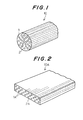
- Fig. 1 is a partial perspective view of an example of the reinforcement according to the present invention
- Fig. 2 is a partial perspective view of an another example of the reinforcement according to the present invention.
- Reinforcement 10 shown in Fig. 1 is composed of a number of column-shaped inorganic long fiber filaments 1 and glass and/or glass ceramics 2 existing among filaments 1 and has a form of wire.
- filaments 1 form a bunch with the gaps among individual filaments 1 being filled with glass and/or glass ceramics 2, and glass and/or glass ceramics 2 also forms the outer shape of reinforcement 10 to provide a wire shape.
- Reinforcement 10A shown in Fig. 2 is composed of a number of column-shaped inorganic long fiber filaments 1A and glass and/or glass ceramics 2a which is present in the gaps among individual filaments and has a form of tape.
- Filaments 1A form a bunch with the gaps among themselves being filled with glass and/or glass ceramics 2A, and glass and/or glass ceramics 2A also forms the outer shape of reinforcement 10A to provide a tape shape.
- the reinforcement of the present invention itself is formed of a composite material composed of inorganic fiber and a glass and/or glass ceramics matrix and has a form of wire or tape.
- the wire-shaped reinforcement preferably has a diameter of 20 ⁇ m to 5 mm, and the tape-shaped one preferably has a width of 20 ⁇ m to 10 cm and a thickness of 10 ⁇ m to 1 cm.
- the reinforcement of the present invention can be obtained by, for example, conducting the following steps 1 to 6 successively.
- the organic sizing agent to be removed in step 1 includes polyethylene oxide and vinyl acetate.
- the filamentation in step 2 can be carried out by, for example, utilizing an air flow.
- the air flow preferably has a flow rate of 1 cm/sec to 100 cm/sec and an air pressure of 0.1 to 5 kg/cm2.
- the slurry may contain a binder for fiber sizing so as to enhance the adhesion of glass and/or glass ceramic to the fibers.
- the binder for fiber sizing to be used includes polyethylene oxide and vinyl acetate.
- the glass and/or glass ceramic concentration in the aqueous and/or organic solvent slurry preferably ranges from 1 to 80 wt%, and the concentration of the binder for fiber sizing is preferably from 0.1 to 50 wt%.
- the slit which may be used in step 4 preferably has a diameter of 20 ⁇ m to 5 mm and a width of 8 ⁇ m to 1 cm.
- the rollers which may be used in step 4 preferably include those made of materials to which the glass and/or glass ceramic slurry hardly adheres, such as metals, plastics, rubber or ceramics.
- a wire- or tape-shaped reinforcement is obtained.
- a tape-shaped reinforcement is obtained.
- the calcination in step 5 is preferably effected at a temperature of from 500 to 1700 °C for a period of from 30 seconds to 3 hours.
- the calcination in step 6 is preferably performed at a temperature of from 700 to 1900 ° C for a period of from 10 minutes to 500 hours.
- the reinforcement having the aforesaid impact relaxing layer can be obtained by using inorganic long fiber having been previously coated with the above-described impact relaxing layer in step 1.
- the reinforcement according to the present invention can be used in various composites, such as metal matrix composites (MMC) or ceramic matrix composites (CMC).
- MMC metal matrix composites
- CMC ceramic matrix composites
- the composites using the reinforcement of the present invention can be produced in a conventional manner.
- the metal or intermetallic compound which can be used in the metallic composite material of the present invention forms a matrix of the composite material.
- Useful metals include titanium alloys, such as Ti-6AI-4V (a + type) and Ti-15V-3Cr-3Sn-3AI ( ⁇ type), aluminum alloys, such as A6061 and A2024, and magnesium alloys, such as AZ91 and ZE41.
- Useful inter-metallic compounds include Ti a Al, TiAI and Nb 3 AI.
- Titanium alloys such as Ti 3 Al, TiAl, and Ti-6AI-4V (a + ⁇ type) are particularly preferred in the present invention.
- the metal or intermetallic compound may have a powder form, a foil form, a plate form or a mass form. Those commercially available may be used, or they may be prepared in a conventional manner.
- the volume fractions of the reinforcement and the matrix, i.e., metal or inter- metallic compound, in the metallic composite material are 20 to 80 vol% and 80 to 20 vol%, respectively.
- the volume fractions of these components are selected appropriately according to performance requirements based on the structural design of the product or part to which the composite material is applied.
- the densities of the reinforcement and the metal or intermetallic compound in the metallic composite material are from 1.9 to 4.0 g/cm 3 and from 1.7 to 7.3 g/cm 3 , respectively.
- a mode of reinforcement (a mode of orientation) in the metallic composite material includes unidirectional reinforcement, bi- or polydirectional reinforcement at an angle of 0 ° , 90° , etc., and reinforcement using fabric made of small diameter reinforcements containing a small number of filaments into various structures, such as plane weave, satin weave, cord fabric, planar triaxial weave, three-dimensional fabric, and braid.
- the above-mentioned modes of orientation are preferably adopted according to the performance requirements on the basis of design.
- the volume fractions of the reinforcement and the metal or intermetallic compound are preferably from 40 to 70 vol% and from 30 to 60 vol%, respectively.
- the metallic composite material of the present invention may have an impact relaxing layer resistant to various impacts on the interface between the reinforcement and the metal or intermetallic compound matrix.
- the impact relaxing layer preferably comprises at least one of carbon, carbide-, oxide-, nitride- or boride-based ceramics, and metals, e.g., carbon, SiC, Zr0 2 , Si 3 N 4 , BN, TiN, TiC, TiB 2 , Ta, Zr, and Hf, and preferably has a thickness of from 5 to 10000 ⁇ .
- the volume fraction of the impact relaxing layer is preferably not more than 10 vol%.
- the metallic composite material of the present invention can be obtained from the above-mentioned reinforcement and metal or intermetallic compound in accordance with well-known methods. While not limiting, useful methods include a plasma spray coating-hot press method, a plasma spray coating-diffusion coating method, a squeeze casting method, a die casting method, a powder solidification method, and a dip coating method.
- the metallic composite material having the aforesaid impact relaxing layer can be obtained by using a reinforcement having been previously coated with the above- described impact relaxing layer.
- the ceramic which can be used in the ceramic composite material of the present invention forms a matrix of the composite material.
- Useful ceramics include carbides, such as SiC, TiC, B 4 C, TaC, and WC; nitrides, such as Si 3 N 4 , BN, TiN, and AIN; borides, such as TiB 2 and MoB; silicides, such as MoSi 2 ; and oxides different from the glass and/or glass ceramic, such as A1 2 0 3 , Zr0 2 , and MgO. These ceramics may be used either individually or as a combination thereof.
- SiC, TiC, B 4 C, Si 3 N 4 ,BN, TiB 2 , A1 2 0 3 , Zr0 2 , and MgO are preferred.
- the ceramic to be used may be selected from ceramic powder usually having a diameter of not more than 1 ⁇ m and those prepared in a conventional manner.
- a commercially available organometallic polymer capable of being converted to ceramic on pyrolysis may also be used after being converted to ceramic by pyrolysis.
- Such an organometallic polymer includes polysilazane, polycarbosilane, polytitanocarbosilane, and boron-containing organosilicon polymers.
- ceramics obtained by conversion of a commercially available starting gas such as an organometallic gas, a metal halide, a hydrocarbon gas, ammonia gas, nitrogen gas or hydrogen gas, by chemical vapor deposition, chemical vapor impregnation or chemical vapor penetration can also be employed.
- a commercially available starting gas such as an organometallic gas, a metal halide, a hydrocarbon gas, ammonia gas, nitrogen gas or hydrogen gas, by chemical vapor deposition, chemical vapor impregnation or chemical vapor penetration
- useful starting gas includes methane, ammonia, hydrogen, silane, borane, and silicon tetrachloride.
- volume fractions of the reinforcement and the ceramic matrix in the ceramic composite material are 5 to 80 vol% and 20 to 95 vol%, respectively.
- the volume fractions of these components are selected appropriately according to performance requirements based on the structural design of the product or part to which the composite material is applied.
- the densities of the reinforcement and the ceramic matrix in the ceramic composite material are from 1.9 to 3.8 g/cm 3 and from 2.2 to 7.2 g/cm 3 , respectively.
- a mode of reinforcement (a mode of orientation) in the ceramic composite material includes unidirectional reinforcement, bi- or polydirectional reinforcement at an angle of 0 ° , 90 ° , etc., and reinforcement using fabric made of small diameter reinforcements containing a small number of filaments into various structures, such as plane weave, satin weave, cord fabric, planar triaxial weave, three-dimensional fabric, and braid.
- the above-mentioned modes of orientation are preferably adopted according to the performance requirements on the basis of design.
- the volume fractions of the reinforcement and the ceramic are preferably from 40 to 70 vol% and from 30 to 60 vol%, respectively.
- the ceramic composite material of the present invention may have an impact relaxing layer resistant to various impacts on the interface between the reinforcement and the ceramic matrix.
- the impact relaxing layer preferably comprises at least one of carbon, carbide-, oxide- or nitride- based ceramics, and metals, e.g., carbon, SiC, Zr0 2 , Si 3 N 4 , BN, TiN, TiC, TiB 2 , Ta, Zr, and Hf, and preferably has a thickness of from 5 to 20000 ⁇ .
- the volume fraction of the impact relaxing layer is preferably not more than 30 vol%.
- the ceramic composite material of the present invention can be obtained from the above-mentioned reinforcement and ceramic matrix in a conventional manner, for example, the following methods (1) to (3):
- the optimum temperature for the ceramic material to form a ceramic matrix is usually in the range of from 900 to 2100 °C, and the optimum molding pressure is usually from 50 to 1000 kgf/cm 2 .
- steps 1 to 6 were carried out in the order described by using inorganic long fiber filaments shown below to obtain a wire-shaped reinforcement for composite materials consisting of 10 vol% of amorphous BaO ⁇ MgO ⁇ Al 2 O 3 ⁇ SiO2 partly comprising Barium Osumilite crystallites as glass ceramics and 90 vol% of the inorganic long fiber.
- Inorganic long fiber An aggregate of 1600 fila- ments/yarn of amorphous inorganic long fiber comprising Si, Ti, C and O. Each filament had a diameter of 11 ⁇ m and an elemental composition of Si: 50 wt%; Ti: 2 wt%; C: 30 wt%; and O: 18 wt% in the inside thereof and Si: 0 wt%; Ti: 0 wt%; C: 100 wt%; and O: 0 wt% in the outermost layer thereof, the composition of the outermost layer being continuously changing to that of the inside in the region from the outermost layer up to the depth of 700 ⁇ .
- the fiber had been sized with 0.5 to 1 wt% of polyethylene oxide.
- the resulting wire-shaped reinforcement for composite materials had a tensile strength of 2.5 GPa and an elongation at break of 0.20% as measured by a tensile test at 1200 °C in air.
- inorganic long fiber An aggregate of 3200 fila- ments/yarn of inorganic long fiber comprising an amorphous substances containing Si, Ti, C and O and ultra fine particles of ⁇ -SiC and TiC having a particle size of 20 ⁇ .
- Each filament had a diameter of 11 ⁇ m and an elemental composition of Si: 54 wt%; Ti: 2 wt%; C: 32 wt%; and O: 12 wt% in the inside thereof and Si: 42 wt%; Ti: 3 wt%; C: 47 wt%; and O: 8 wt% in the outermost layer thereof, the composition of the outermost layer being continuously changing to that of the inside in the region from the outermost layer up to the depth of 80 ⁇ .
- the outermost layer of each filament had provided thereon an impact relaxing layer comprising BN by chemical vapor deposition (CVD) to a thickness of 8000 ⁇ .
- the fiber had been sized with 0.5 to 1 wt% of an epoxy resin.
- the resulting tape-shaped reinforcement for composite materials had a tensile strength of 1.4 GPa and an elongation at break of 0.35% as measured by a tensile test at room temperature.
- steps 1 to 5 were carried out in the order described by using filaments of inorganic long fiber shown below to obtain a wire-shaped reinforcement consisting of 10 vol% of glass ceramic comprising amorphous CaO ⁇ MgO ⁇ Al 2 O 3 ⁇ SiO 2 partly containing anorthite crystallites and 90 vol% of that fiber.
- Inorganic long fiber An aggregate of 500A fila- ments/yarn of inorganic long fiber containing Si, C, O, and H, comprising an aggregate of crystalline-SiC having a size of not more than 500 A and amorphous Si0 2 .
- Each filament had a diameter of 14 ⁇ m and an elemental composition of Si: 58.3 wt%; C: 30.4 wt%; O: 11.1 wt%; and H: 0.2 wt% in the inside thereof and had a carbon coat on the surface thereof to a thickness of 130 nm.
- the fiber had been sized with 0.5 to 1 wt% of polyvinyl alcohol.
- steps 1 to 5 were carried out in the order described by using filaments of inorganic long fiber shown below to obtain a tape-shaped reinforcement consisting of 60 vol% of amorphous glass ceramic having a composition shown below and partly containing ⁇ -spodumenecrystallites and 40 vol% of that fiber.
- Inorganic long fiber An aggregate of 500 fila- ments/yarn of inorganic long fiber containing Si, C, O, and H and comprising an aggregate of ⁇ -SiC crystalline having a size of not more than 100 A and amorphous Si0 2 .
- Each filament had an inside elemental composition of Si: 58.3 wt%; C: 30.4 wt%; O: 11.1 wt%; and H: 0.2 wt%, a diameter of 12 to 14 ⁇ m, and a carbon coat on the surface thereof to a thickness of 130 nm.
- the fiber had been sized with 0.5 to 1 wt% of polyvinyl alcohol.
- the resulting tape-shaped reinforcement had a tensile strength of 1.2 GPa and an elongation at break of 0.30% as measured by a tensile test at room temperature.
- steps 1 to 5 were carried out in the order described by using filaments of inorganic long fiber shown below to obtain a wire-shaped reinforcement consisting of 10 vol% of glass ceramic comprising amorphous MgO ⁇ Al 2 O 3 ⁇ SiO 2 partly containing cordierite and 90 vol% of that fiber.
- Inorganic long fiber An aggregate of 200 fila- ments/yarn of inorganic long fiber containing Si, N, C, O, and H and mainly comprising an aggregate of Si 3 N 4 crystallines having a size of not more than 2000 ⁇ .
- Each filament had a diameter of 10 to 20 ⁇ m and an elemental composition of Si: 59.2 wt%; N: 37.5 wt%; C: 1.5 wt%; O: 1.5 wt%; and H: 0.3 wt% in the inside thereof.
- the fiber had been sized with 0.5 to 1 wt% of polyvinyl alcohol.
- the resulting wire-shaped reinforcement had a tensile strength of 1.7 GPa and an elongation at break of 0.16% as measured by a tensile test at 1200 ° C in air.
- steps 1 to 5 were carried out in the order described by using filaments of inorganic long fiber shown below to obtain a tape-shaped reinforcement consisting of 60 vol% of amorphous glass ceramic having a composition shown below and partly containing glass ⁇ -spodumene crystallines and 40 vol% of that fiber.
- Inorganic long fiber An aggregate of 200 fila- ments/yarn of inorganic long fiber containing Si, N, C, O, and H and mainly comprising an aggregate of Si 3 N 4 crystallines having a size of not more than 2000 ⁇ .
- Each filament had a diameter of 10 to 20 ⁇ m and an inside elemental composition of Si: 59.2 wt%; N: 37.5 wt%; C: 1.5 wt%; O: 1.5 wt%; and H:0.3 wt%.
- the fiber had been sized with 0.5 to 1 wt% of polyvinyl alcohol.
- the resulting tape-shaped reinforcement had a tensile strength of 1.0 GPa and an elongation at break of 0.29% as measured by a tensile test at room temperature.
- inorganic long fiber An aggregate of 1800 fila- ments/yarn of inorganic long fiber containing Al, Si, B, and O and comprising an aggregate of mullite crystallines and amorphous Si0 2 .
- Each filament had a diameter of 10 to 20 ⁇ m and had an elemental composition of Al: 37.1 wt%; Si: 18.1 wt%; B: 0.6 wt%; and O: 44.2 wt% in the inside thereof.
- Each filament had a 100 nm thick BN coat on the surface thereof.
- the fiber had been sized with 0.5 to 1 wt% of polyvinyl alcohol.
- the resulting wire-shaped reinforcement had a tensile strength of 1.3 GPa and an elongation at break of 0.10% as measured by a tensile test at 1200 °C in air.
- steps 1 to 5 were carried out in the order described by using filaments of inorganic long fiber shown below to obtain a tape-shaped reinforcement consisting of 60 vol% of amorphous glass ceramic having a composition shown below and partly containing glass ⁇ -spodumene crystallines 40 vol% of that fiber.
- Inorganic long fiber An aggregate of 1800 fila- ments/yarn of inorganic long fiber containing Al, Si, B and O and comprising an aggregate of y- or - ⁇ alumina crystallines and amorphous Si0 2 .
- Each filament had a diameter of 10 to 20 ⁇ m and an inside elemental composition of Al: 37.1 wt%; Si: 18.1 wt%; B: 0.6 wt%; and O: 44.2 wt%.
- Each filament had a 100 nm thick BN coat on the surface thereof.
- the fiber had been sized with 0.5 to 1 wt% of polyvinyl alcohol.
- the resulting tape-shaped reinforcement had a tensile strength of 0.7 GPa and an elongation at break of 0.18% as measured by a tensile test at room temperature.
- the wire-shaped reinforcement for composite materials obtained in Example 1 was cut to lengths of 90 mm and unidirectionally arrayed on an aluminum foil-clad carbon plate to a width of 50 mm.
- Atomized TiAI (intermetallic compound) powder having a particle size of 90 to 150 ⁇ m was deposited on and between the unidirectionally arrayed wire-shaped reinforcements by vacuum plasma spraying in an argon atmosphere at 20 Torr to obtain a prepreg sheet comprising 65 vol% of the wire-shaped reinforcements and 35 vol% of TiAl.
- the resulting prepreg sheets were laminated and hot pressed at 950 ° C and 10 MPa for 1 minute to obtain a wire-shaped reinforcement-reinforced intermetallic compound (TiAl) composite material having a length of 90 mm, a width of 50 mm, and a thickness of 6 mm.
- TiAl reinforcement-reinforced intermetallic compound
- the resulting intermetallic compound composite material showed substantially no change in strength from room temperature up to 900 ° C in a bending test, giving an average of three-point bending strength of 1.6 GPa.
- prepregs and a composite material were prepared in the same manner as described above, except for using the inorganic long fiber filaments used in Example 1 in place of the above obtained reinforcements.
- the three-point bending strength at room temperature was as low as 0.1 to 0.2 GPa. This is due to the reaction between the fiber and TiAI or fiber cutting during the preparation of prepregs by vacuum plasma spraying or the reaction between the fiber and TiAI during hot pressing.
- the wire-shaped reinforcement obtained in Example 1 was cut to lengths of 120 mm and unidirectionally arranged in a rectangular carbon die of split type composed of a top force and a bottom force.
- the upper, lower and side walls of the die each had several holes through which a molten metal might be injected.
- the carbon die containing the reinforcements was preheated at 700 ° C for 30 minutes, mounted on a squeeze casting machine, and rapidly set in a mold kept at 400 °C.
- the mold was closed, and a molten aluminum alloy A6061 at 700 °C was pressed into the carbon die by means of a plunger under a pressure of 100 MPa and allowed to spontaneously cool while maintaining that pressure for 40 seconds (squeeze casting method) to obtain a 40 mm wide, 120 mm long and 5 mm thick metallic composite material consisting of 40 vol% of wire-shaped reinforcements and 60 vol% of A6061 matrix.
- the tape-shaped reinforcement obtained in Example 2 was cut to lengths of 60 mm and unidirectionally arranged on an aluminum foil-clad carbon plate to a width of 60 mm.
- Atomized powder of an a + type titanium alloy, Ti-6AI-4V, having a particle size of 60 to 90 ⁇ m was deposited on and between the unidirectionally arranged tape-shaped reinforcements by vacuum plasma spraying in an argon atmosphere at 20 Torr to obtain a metallic composite material prepreg sheet comprising 50 vol% of the tape-shaped reinforcements and 50 vol% of the titanium alloy.
- the resulting prepreg sheets were laminated at alternate angles of 0 ° and 90 °and hot pressed at 700 °C and 20 MPa for 1 minute to obtain a tape-shaped reinforcement-reinforced metallic composite material having a length of 90 mm, a width of 60 mm, and a thickness of 4 mm.
- the resulting metallic composite material had a tensile strength of 0.6 GPa in average at 500 °C in the air.
- the wire-shaped reinforcement obtained in Example 3 was cut to lengths of 90 mm and unidirectionally arranged on an aluminum foil-clad carbon plate to a width of 50 mm.
- Atomized TiAI (intermetallic compound) powder having a particle size of 90 to 150 ⁇ m was deposited on and between the unidirectionally arranged wire-shaped reinforcements by vacuum plasma spraying in an argon atmosphere at 20 Torr to obtain a metallic composite material prepreg sheet consisting of 65 vol% of the wire-shaped reinforcements and 35 vol% of TiAl.
- the resulting prepreg sheets were unidirectionally laminated and hot pressed at 950 °C and 10 MPa for 1 minute to obtain a wire-shaped reinforcement-reinforced metallic composite material having a length of 90 mm, a width of 50 mm, and a thickness of 6 mm.
- the resulting intermetallic compound composite material showed substantially no change in strength from room temperature up to 900 ° C in a tensile test, giving an average of tensile strength of 1.3 GPa.
- prepregs and a composite material were prepared in the same manner as described above (the fiber volume fraction was the same), except for using the inorganic long fiber filaments used in Example 3 in place of the above obtained reinforcements.
- the tensile strength at room temperature was as low as 0.1 to 0.2 GPa. This is due to the reaction between the fiber and TiAI or fiber cutting during the preparation of prepregs by vacuum plasma spraying or the reaction between the fiber and TiAI during hot pressing.
- the wire-shaped reinforcement obtained in Example 3 was cut to lengths of 120 mm and unidirectionally arranged in a rectangular carbon die of split type composed of a top force and a bottom force.
- the upper, lower and side walls of the die each had several holes through which a molten metal might be injected.
- the carbon die containing the reinforcements was preheated at 700 ° C for 30 minutes, mounted on a squeeze casting machine, and rapidly set in a mold kept at 400 °C.
- the mold was closed, and a molten aluminum alloy A6061 at 700 °C was pressed into the carbon die by means of a plunger under a pressure of 100 MPa and allowed to spontaneously cool while maintaining that pressure for 40 seconds (squeeze casting method) to obtain a 40 mm wide, 120 mm long and 5 mm thick metallic composite material consisting of 40 vol% of wire-shaped reinforcements and 60 vol% of A6061.
- the tape-shaped reinforcement obtained in Example 4 was cut to lengths of 60 mm and unidirectionally arranged on an aluminum foil-clad carbon plate to a width of 60 mm.
- Atomized powder of an a + type titanium alloy, Ti-6AI-4V, having a particle size of 60 to 90 ⁇ m was deposited on and between the unidirectionally arranged tape-shaped reinforcements by vacuum plasma spraying in an argon atmosphere at 20 Torr to obtain a metallic composite material prepreg sheet consisting of 50 vol% of the tape-shaped reinforcements and 50 vol% of the titanium alloy.
- the resulting prepreg sheets were laminated at alternate angles of 0 ° and 90 ° and hot pressed at 700 ° C and 20 MPa for 1 minute to obtain a tape-shaped reinforcement-reinforced metallic composite material having a length of 90 mm, a width of 60 mm, and a thickness of 4 mm.
- the resulting metallic composite material had a tensile strength of 0.5 GPa in average at 500 °C in the air.
- the wire-shaped reinforcement obtained in Example 5 was cut to lengths of 90 mm and unidirectionally arranged on an aluminum foil-clad carbon plate to a width of 50 mm.
- Atomized TiAI (intermetallic compound) powder having a particle size of 90 to 150 ⁇ m was deposited on and between the unidirectionally arranged wire-shaped reinforcements by vacuum plasma spraying in an argon atmosphere at 20 Torr to obtain a metallic composite material prepreg sheet consisting of 65 vol% of the wire-shaped reinforcements and 35 vol% of TiAl.
- the resulting prepreg sheets were unidirectionally laminated and hot pressed at 950 °C and 10 MPa for 1 minute to obtain a wire-shaped reinforcement-reinforced metallic composite material having a length of 90 mm, a width of 50 mm, and a thickness of 6 mm.
- the resulting intermetallic compound composite material showed substantially no change in strength from room temperature up to 900 ° C in a tensile test, giving an average of tensile strength of 1.3 GPa.
- prepregs and a composite material were prepared in the same manner as described above (the fiber volume fraction was the same), except for using the inorganic long fiber filaments used in Example 5 in place of the reinforcements.
- the tensile strength at room temperature was as low as 0.1 to 0.2 GPa. This is due to the reaction between the fiber and TiAI or fiber cutting during the preparation of prepregs by vacuum plasma spraying or the reaction between the fiber and TiAI during hot pressing.
- the wire-shaped reinforcement obtained in Example 5 was cut to lengths of 120 mm and unidirectionally arranged in a rectangular carbon die of split type composed of a top force and a bottom force.
- the upper, lower and side walls of the die each had several holes through which a molten metal might be injected.
- the carbon die containing the reinforcements was preheated at 700 °C for 30 minutes, mounted on a squeeze casting machine, and rapidly set in a mold kept at 400 °C.
- the mold was closed, and a molten aluminum alloy A6061 at 700 °C was pressed into the carbon die by means of a plunger under a pressure of 100 MPa and allowed to spontaneously cool while maintaining that pressure for 40 seconds (squeeze casting method) to obtain a 40 mm wide, 120 mm long and 5 mm thick metallic composite material consisting of 40 vol% of wire-shaped reinforcements and 60 vol% of A6061.
- the tape-shaped reinforcement obtained in Example 6 was cut to lengths of 60 mm and unidirectionally arranged on an aluminum foil-clad carbon plate to a width of 60 mm.
- Atomized powder of an a + type titanium alloy, Ti-6AI-4V, having a particle size of 60 to 90 ⁇ m was deposited on and between the unidirectionally arranged tape-shaped reinforcements by vacuum plasma spraying in an argon atmosphere at 20 Torr to obtain a metallic composite material prepreg sheet consisting of 50 vol% of the tape-shaped reinforcements and 50 vol% of the titanium alloy.
- the resulting prepreg sheets were laminated at alternate angles of 0 °C and 90 °C and hot pressed at 700 ° C and 20 MPa for 1 minute to obtain a tape-shaped reinforcement-reinforced metallic composite material having a length of 90 mm, a width of 60 mm, and a thickness of 4 mm.
- the resulting metallic composite material had a tensile strength of 0.3 GPa in average at 500 ° C in the air.
- the wire-shaped reinforcement obtained in Example 7 was cut to lengths of 90 mm and unidirectionally arranged on an aluminum foil-clad carbon plate to a width of 50 mm.
- Atomized TiAI (intermetallic compound) powder having a particle size of 90 to 150 ⁇ m was deposited on and between the unidirectionally arranged wire-shaped reinforcements by vacuum plasma spraying in an argon atmosphere at 20 Torr to obtain a reinforced metallic composite material prepreg sheet consisting of 65 vol% of the wire-shaped reinforcements and 35 vol% of TiAl.
- the resulting prepreg sheets were unidirectionally laminated and hot pressed at 950 ° C and 10 MPa for 1 minute to obtain a wire-shaped reinforcement-reinforced metallic composite material having a length of 90 mm, a width of 50 mm, and a thickness of 6 mm.
- the resulting intermetallic compound composite material showed substantially no change in strength from room temperature up to 900 ° C in a tensile test, giving an average of tensile strength of 0.9 GPa.
- prepregs and a composite material were prepared in the same manner as described above (the fiber volume fraction was the same), except for using the inorganic long fiber filaments used in Example 7 in place of the reinforcements.
- the tensile strength at room temperature was as low as 0.1 to 0.2 GPa. This is due to the reaction between the fiber and TiAI or fiber cutting during the preparation of prepregs by vacuum plasma spraying or the reaction between the fiber and TiAI during hot pressing.
- the wire-shaped reinforcement obtained in Example 7 was cut to lengths of 120 mm and unidirectionally arranged in a rectangular carbon die of split type composed of a top force and a bottom force.
- the upper, lower and side walls of the die each had several holes through which a molten metal might be injected.
- the carbon die containing the reinforcements was preheated at 700 ° C for 30 minutes, mounted on a squeeze casting machine, and rapidly set in a mold kept at 400 °C.
- the mold was closed, and a molten aluminum alloy A6061 at 700 °C was pressed into the carbon die by means of a plunger under a pressure of 100 MPa and allowed to spontaneously cool while maintaining that pressure for 40 seconds (squeeze casting method) to obtain a 40 mm wide, 120 mm long and 5 mm thick metallic composite material consisting of 40 vol% of wire-shaped reinforcements and 60 vol% of A6061.
- the tape-shaped reinforcement obtained in Example 8 was cut to lengths of 60 mm and unidirectionally arranged on an aluminum foil-clad carbon plate to a width of 60 mm.
- Atomized powder of an a + type titanium alloy, Ti-6AI-4V, having a particle size of 60 to 90 ⁇ m was deposited on and between the unidirectionally arranged tape-shaped reinforcements by vacuum plasma spraying in an argon atmosphere at 20 Torr to obtain a metallic composite material prepreg sheet consisting of 50 vol% of the tape-shaped reinforcements and 50 vol% of the titanium alloy.
- the resulting prepreg sheets were laminated at alternate angles of 0 ° and 90 ° and hot pressed at 700 °C and 20 MPa for 1 minute to obtain a tape-shaped reinforcement- reinforced metallic composite material having a length of 90 mm, a width of 60 mm, and a thickness of 4 mm.
- the resulting metallic composite material had a tensile strength of 0.3 GPa in average at 500 °C in the air.
- the wire-shaped reinforcement obtained in Example 1 was cut to lengths of 6 cm and unidirectionally arranged using polyethylene oxide as a binder to prepare a prepreg sheet having a polyethylene oxide/reinforcement volume ratio of 1/10.
- the prepreg sheets and Si 3 N 4 powder having an average particle size of 0.5 ⁇ m and containing 4 wt% of Y 2 0 3 and 4 wt% of A1 2 0 3 were alternately laminated in a carbon die, and the laminate was hot pressed at 1750 ° C and 500 kgf/cm 2 for 30 minutes to obtain a 60 mm long, 30 mm wide and 5 mm thick ceramic composite material consisting of 60 vol% of the reinforcements and 40 vol% of Si 3 N 4 /Y 2 O 3 ⁇ Al 2 O 3 .
- the resulting ceramic composite material showed substantially no change in strength in a tensile strength test at room temperature up to 1200 °C, giving an average tensile strength of 1.5 GPa and an average elongation at break of 0.15%.
- prepregs and a composite material were prepared in the same manner as described above (the fiber volume fraction was the same), except for using the inorganic long fiber filaments used in Example 1 in place of the reinforcements.
- the tensile strength of the resulting composite material as measured at room temperature was as low as about 0.3 GPa due to deterioration by the reaction between the fiber and Si 3 N 4 during hot pressing.
- the elongation at break was as low as 0.07%.
- the tape-shaped reinforcement prepared in Example 2 was passed through an ethyl alcohol solution of polyethylene glycol having dispersed therein Al 2 0 3 powder having an average particle size of not greater than 1 ⁇ m and dried, whereby the Al 2 O 3 powder was adsorbed on and between the reinforcements with polyethylene glycol as a binder to obtain a preform sheet.
- the preform sheet was cut to size of 50 mm in width and 100 mm in length.
- the cut sheets were laminated and pressed at room temperature under a pressure of 300 kgf/cm 2 and then sintered at 1600 ° C to obtain a 100 mm long, 50 mm wide and 6 mm thick unidirectionally reinforced ceramic composite material consisting of 30 vol% of the reinforcement and 70 vol% of Al 2 O 3 .
- the resulting ceramic composite material had a bending strength of 0.6 GPa at 1000 °C in air and a fracture toughness of 15 MPa ⁇ m at that temperature.
- the reinforcements were arranged unidirectionally and dried at 140 °C in a nitrogen atmosphere to obtain a 500 mm wide preform sheet having polytitanocarbosilane adsorbed on the reinforcements.
- the resulting preform sheet was cut to size of 100 mm in width and 100 mm in length, and the cut sheets were laminated at angles of 0 ° , +45°, 90°, and -45°
- the laminate was hot pressed at 1600 °C under a pressure of 400 kgf/cm 2 for 1 hour to obtain a 100 mm long, 100 mm wide and 2 mm thick ceramic composite material composed of 70 vol% of the reinforcements and 30 vol% of Si-Ti-C ceramic (a pyrolysis product of polytitanocarbosilane).
- the resulting composite material had a tensile strength of 0.75 GPa at 1200 ° C in air.
- the wire-shaped reinforcement prepared in Example 3 was cut to lengths of 6 cm, and the cut pieces were unidirectionally arranged using polyethylene oxide as a binder to prepare a prepreg sheet having a polyethylene oxide/reinforcement volume ratio of 1/10.
- the prepreg sheets and Si 3 N 4 powder having an average particle size of 0.5 ⁇ m and containing 4 wt% of Y 2 0 3 and 4 wt% of Al 2 O 3 were alternately laminated in a carbon die and hot pressed at 1750 ° C and 500 kgf/cm 2 for 30 minutes to obtain a 60 mm long, 30 mm wide and 5 mm thick ceramic composite material consisting of 60 vol% of the reinforcement and 40 vol% of Si 3 N 4 /Y 2 O 3 ⁇ Al 2 O 3 .
- the resulting ceramic composite material showed substantially no change in strength in a tensile strength test at room temperature up to 1200 °C, giving an average tensile strength of 1.4 GPa and an average elongation at break of 0.13%.
- prepregs and a composite material were prepared in the same manner as described above (the fiber volume fraction was the same), except for using the inorganic long fiber filaments used in Example 3 in place of the reinforcements.
- the bending strength of the resulting composite material was as low as about 0.3 GPa due to deterioration by the reaction between the fiber and Si 3 N 4 during hot pressing.
- the elongation at break was as low as 0.07%.
- the tape-shaped reinforcement prepared in Example 4 was passed through an ethyl alcohol solution of polyethylene glycol having dispersed therein Al 2 O 3 powder having an average particle size of not greater than 1 ⁇ m and dried, whereby the Al 2 O 3 powder was adsorbed on and between the reinforcements with polyethylene glycol as a binder to obtain a preform sheet.
- the preform sheet was cut to size of 50 mm in width and 100 mm in length.
- the cut sheets were laminated and pressed at room temperature under a pressure of 300 kgf/cm 2 and then sintered at 1600 °C to obtain a 100 mm long, 50 mm wide and 6 mm thick unidirectionally reinforced ceramic composite material consisting of 30 vol% of the reinforcements and 70 vol% of Al 2 O 3 .
- the resulting ceramic composite material had an average bending strength of 0.5 GPa at 1000 °C in the air and a fracture toughness of 13 MPa ⁇ m at that temperature.
- the reinforcements were arranged unidirectionally and dried at 140 °C in a nitrogen atmosphere to obtain a 500 mm wide preform sheet having polytitanocarbosilane adsorbed on the reinforcements.
- the resulting preform sheet was cut to size of 100 mm in width and 100 mm in length, and the cut sheets were laminated at angles of 0 ° , + 45 ° , 90 and -45° .
- the laminate was hot pressed at 1600 ° C under a pressure of 400 kgf/cm 2 for 1 hour to obtain a 100 mm long, 100 mm wide and 2 mm thick ceramic composite material composed of 70 vol% of the reinforcements and 30 vol% of Si-Ti-C ceramic (a pyrolysis product of polytitanocarbosilane).
- the resulting composite material had a tensile strength of 0.6 GPa at 1200 °C in the air.
- the wire-shaped reinforcement prepared in Example 5 was cut to lengths of 6 cm, and the cut pieces were unidirectionally arranged using polyethylene oxide as a binder to prepare a prepreg sheet having a polyethylene oxide/reinforcement volume ratio of 1/10.
- the prepreg sheets and Si 3 N 4 powder having an average particle size of 0.5 ⁇ m and containing 4 wt% of Y 2 0 3 and 4 wt% of Al 2 O 3 were alternately laminated in a carbon die and hot pressed at 1750 ° C and 500 kgf/cm 2 for 30 minutes to obtain a 60 mm long, 30 mm wide and 5 mm thick ceramic composite material consisting of 60 vol% of the reinforcements and 40 vol% of Si 3 N 4 /Y 2 O 3 ⁇ Al 2 O 3 .
- the resulting ceramic composite material showed substantially no change in strength in a tensile strength test at room temperature up to 1200 °C, giving an average tensile strength of 1.2 GPa and an average elongation at break of 0.11%.
- prepregs and a composite material were prepared in the same manner as described above (the fiber volume fraction was the same), except for using the inorganic long fiber filaments used in Example 5 in place of the reinforcements.
- the bending strength of the resulting composite material was as low as about 0.3 GPa due to deterioration by the reaction between the fiber and Si 3 N 4 during hot pressing.
- the elongation at break was as low as 0.07%.
- the tape-shaped reinforcements prepared in Example 6 were passed through an ethyl alcohol solution of polyethylene glycol having dispersed therein Al 2 O 3 powder having an average particle size of not greater than 1 ⁇ m and dried, whereby the Al 2 O 3 powder was adsorbed on and between the reinforcements with polyethylene glycol as a binder to obtain a preform sheet.
- the preform sheet was cut to size of 50 mm in width and 100 mm in length.
- the cut sheets were laminated and pressed at room temperature under a pressure of 300 kgf/cm 2 and then sintered at 1600 °C to obtain a 100 mm long, 50 mm wide and 6 mm thick unidirectionally reinforced ceramic composite material consisting of 30 vol% of the reinforcements and 70 vol% of Al 2 O 3 .
- the resulting ceramic composite material had an average bending strength of 0.5 GPa at 1000 ° C in the air and a fracture toughness of 13 MPa m at that temperature.
- the reinforcements were arranged unidirectionally and dried at 140 °C in a nitrogen atmosphere to obtain a 500 mm wide preform sheet having polytitanocarbosilane adsorbed on the reinforcements.
- the resulting preform sheet was cut to size of 100 mm in width and 100 mm in length, and the cut sheets were laminated at angles of 0° , + 45 ° , 90 and -45° .
- the laminate was hot pressed at 1600 ° C under a pressure of 400 kgf/cm 2 for 1 hour to obtain a 100 mm long, 100 mm wide and 2 mm thick ceramic composite material composed of 70 vol% of the reinforcements and 30 vol% of Si-Ti-C ceramic (a pyrolysis product of polytitanocarbosilane).
- the resulting composite material had a tensile strength of 0.75 GPa at 1200 ° C in the air.
- the wire-shaped reinforcement prepared in Example 7 was cut to lengths of 6 cm, and the cut pieces were unidirectionally arranged using polyethylene oxide as a binder to prepare a prepreg sheet having a polyethylene oxide/reinforcement volume ratio of 1/10.
- the prepreg sheet and Si 3 N 4 powder having an average particle size of 0.5 ⁇ m and containing 4 wt% of Y 2 0 3 and 4 wt% of Al 2 O 3 were alternately laminated in a carbon die and hot pressed at 1750 ° C and 500 kgf/cm 2 for 30 minutes to obtain a 60 mm long, 30 mm wide and 5 mm thick ceramic composite material consisting of 60 vol% of the reinforcements and 40 vol% of Si 3 N 4 /Y 2 O3 ⁇ Al 2 O 3 .
- the resulting ceramic composite material showed substantially no change in strength in a tensile strength test at room temperature up to 1200 °C, giving an average tensile strength of 1.0 GPa and an average elongation at break of 0.08%.
- prepregs and a composite material were prepared in the same manner as described above (the fiber volume fraction was the same), except for using the inorganic long fiber filaments used in Example 7 in place of the reinforcements.
- the bending strength of the resulting composite material was as low as about 0.3 GPa due to deterioration by the reaction between the fiber and Si 3 N 4 during hot pressing.
- the elongation at break was as low as 0.07%.
- the tape-shaped reinforcements prepared in Example 8 were passed through a bath of an ethyl alcohol solution of polyethylene glycol having dispersed therein Al 2 O 3 powder having an average particle size of not greater than 1 ⁇ m and dried, whereby the Al 2 O 3 powder was adsorbed on and between the reinforcements with polyethylene glycol as a binder to obtain a preform sheet.
- the preform sheet was cut to size of 50 mm in width and 100 mm in length.
- the cut sheets were laminated and pressed at room temperature under a pressure of 300 kgf/cm 2 and then sintered at 1600 ° C to obtain a 100 mm long, 50 mm wide, and 6 mm thick unidirectionally reinforced ceramic composite material consisting of 30 vol% of the reinforcements and 70 vol% of Al 2 O 3 .
- the resulting ceramic composite material had an average bending strength of 0.4 GPa at 1000 ° C in the air and a fracture toughness of 13 MPa ⁇ m at that temperature.
- the reinforcements were arranged unidirectionally and dried at 140 °C in a nitrogen atmosphere to obtain a 500 mm wide preform sheet having polytitanocarbosilane adsorbed on the reinforcements.
- the resulting preform sheet was cut to size of 100 mmin width and 100 mm in length, and the cut sheets were laminated at angles of 0° , +45° , 90 and -45 °
- the laminate was hot pressed at 1600 C under a pressure of 400 kgf/cm 2 for 1 hour to obtain a 100 mm long, 100 mm wide and 2 mm thick ceramic composite material composed of 70 vol% of the reinforcements and 30 vol% of Si-Ti-C ceramic (a pyrolysis product of polytitanocarbosilane).
- the resulting composite material had a tensile strength of 0.5 GPa at 1200 ° C in the air.
Landscapes
- Chemical & Material Sciences (AREA)
- Engineering & Computer Science (AREA)
- Ceramic Engineering (AREA)
- Manufacturing & Machinery (AREA)
- Organic Chemistry (AREA)
- Materials Engineering (AREA)
- Structural Engineering (AREA)
- Inorganic Chemistry (AREA)
- Mechanical Engineering (AREA)
- Metallurgy (AREA)
- Chemical Kinetics & Catalysis (AREA)
- Composite Materials (AREA)
- Manufacture Of Alloys Or Alloy Compounds (AREA)
- Ceramic Products (AREA)
Applications Claiming Priority (9)
| Application Number | Priority Date | Filing Date | Title |
|---|---|---|---|
| JP467394 | 1994-01-20 | ||
| JP4673/94 | 1994-01-20 | ||
| JP467394 | 1994-01-20 | ||
| JP5635894 | 1994-03-25 | ||
| JP56358/94 | 1994-03-25 | ||
| JP5635894 | 1994-03-25 | ||
| JP59489/94 | 1994-03-29 | ||
| JP5948994 | 1994-03-29 | ||
| JP5948994 | 1994-03-29 |
Publications (2)
| Publication Number | Publication Date |
|---|---|
| EP0668363A1 true EP0668363A1 (fr) | 1995-08-23 |
| EP0668363B1 EP0668363B1 (fr) | 1999-12-22 |
Family
ID=27276398
Family Applications (1)
| Application Number | Title | Priority Date | Filing Date |
|---|---|---|---|
| EP19950100722 Expired - Lifetime EP0668363B1 (fr) | 1994-01-20 | 1995-01-19 | Renforcement pour matériau composite et matériau composite utilisant ce renforcement |
Country Status (4)
| Country | Link |
|---|---|
| US (2) | US6004671A (fr) |
| EP (1) | EP0668363B1 (fr) |
| CA (1) | CA2140397A1 (fr) |
| DE (1) | DE69514013T2 (fr) |
Cited By (2)
| Publication number | Priority date | Publication date | Assignee | Title |
|---|---|---|---|---|
| DE202008013541U1 (de) | 2008-10-11 | 2009-01-08 | Böttcher, Peter, Dr.-Ing. | Längsfester textiler Träger für Klebebänder |
| WO2022012753A1 (fr) | 2020-07-17 | 2022-01-20 | Technitex Sachsen GmbH | Matériau de support textile pour des bandes adhésives présentant un bord de déchirure formé |
Families Citing this family (15)
| Publication number | Priority date | Publication date | Assignee | Title |
|---|---|---|---|---|
| US6506483B1 (en) * | 2000-04-28 | 2003-01-14 | Technology Assessment & Transfer, Inc. | Ceramic fiber debond coatings |
| US6460754B1 (en) * | 2000-08-02 | 2002-10-08 | Gen Electric | Prevention of braze alloy flow and stopoff material therefor |
| EP1342623A1 (fr) * | 2002-03-08 | 2003-09-10 | N.V. Bekaert S.A. | Poutre de choc renforcé |
| US7111882B2 (en) * | 2002-03-08 | 2006-09-26 | N. V. Bekaert S.A. | Reinforced impact beam with woven fabric |
| US20030173715A1 (en) * | 2002-03-13 | 2003-09-18 | Grutta James T. | Resistive-heated composite structural members and methods and apparatus for making the same |
| DE10242566A1 (de) * | 2002-09-13 | 2004-03-25 | Sgl Carbon Ag | Faserverstärkte Verbundkeramik und Verfahren zu deren Herstellung |
| JP4119770B2 (ja) * | 2003-02-20 | 2008-07-16 | 中央精機株式会社 | 複合材用プリフォームの製造方法 |
| DE102004042407A1 (de) * | 2004-09-02 | 2006-03-23 | Forschungszentrum Karlsruhe Gmbh | Schichtverbund mit kubischen Bornitrid |
| WO2006101799A2 (fr) * | 2005-03-16 | 2006-09-28 | Honeywell International Inc. | Fibre de carbone contenant des particules de ceramique |
| US8647536B2 (en) * | 2010-08-10 | 2014-02-11 | Iowa State University Research Foundation, Inc. | Aluminum/alkaline earth metal composites and method for producing |
| FR2998295B1 (fr) * | 2012-11-20 | 2015-01-30 | Commissariat Energie Atomique | Materiau composite a matrice en aluminosilicate, notamment en aluminosilicate de baryum " bas " renforcee par des renforts en oxyde de metal, et son procede de preparation. |
| RU2568407C1 (ru) * | 2014-07-01 | 2015-11-20 | Федеральное государственное унитарное предприятие "Всероссийский научно-исследовательский институт авиационных материалов" (ФГУП "ВИАМ") | Волокнистый композиционный материал с матрицей на основе ниобия |
| US10336006B1 (en) * | 2015-05-19 | 2019-07-02 | Southern Methodist University | Methods and apparatus for additive manufacturing |
| US12352173B2 (en) * | 2022-11-25 | 2025-07-08 | Rtx Corporation | Gas turbine engine with carbon/carbon composite piston seal |
| CN119615107B (zh) * | 2024-11-19 | 2025-11-25 | 北京科技大学 | 一种SiC包覆Cu85Sn15合金复合纤维及其制备方法 |
Citations (8)
| Publication number | Priority date | Publication date | Assignee | Title |
|---|---|---|---|---|
| EP0290146A1 (fr) * | 1987-05-08 | 1988-11-09 | Corning Glass Works | Composites à matrice céramique |
| EP0291905A2 (fr) * | 1987-05-20 | 1988-11-23 | Corning Glass Works | Procédé de fabrication des composés en verre renforcés |
| EP0417526A2 (fr) * | 1989-08-24 | 1991-03-20 | Shin-Etsu Chemical Co., Ltd. | Procédé de préparation de polymères polytitanocarbosilazane et matériaux céramiques |
| EP0434300A1 (fr) * | 1989-12-20 | 1991-06-26 | The Standard Oil Company | Renforcements enrobés, utilisés dans les composites à haute température, et composites ainsi obtenus |
| EP0496137A1 (fr) * | 1990-01-19 | 1992-07-29 | The Carborundum Company | Revêtement de protection pour les fibres non-oxydes en céramique frittée, préparé par réaction chimique in situ |
| US5139871A (en) * | 1988-01-13 | 1992-08-18 | The United States Of America As Represented By The Secretary Of The Navy | Thermochemically treated oligomeric and/or polymeric derived silicon carbide fibers |
| US5198282A (en) * | 1984-11-02 | 1993-03-30 | The Boeing Company | Tandem ceramic composite |
| EP0538108A1 (fr) * | 1991-10-18 | 1993-04-21 | AEROSPATIALE Société Nationale Industrielle | Matériau composite à matrice vitro-céramique ou céramique obtenue par la voie sol-gel et renforcée par des fibres de type carbure de silicium, sa fabrication et ses applications |
Family Cites Families (1)
| Publication number | Priority date | Publication date | Assignee | Title |
|---|---|---|---|---|
| US4399232A (en) * | 1979-06-28 | 1983-08-16 | Ube Industries, Ltd. | Continuous inorganic fibers and process for production thereof |
-
1995
- 1995-01-13 US US08/372,128 patent/US6004671A/en not_active Expired - Fee Related
- 1995-01-17 CA CA 2140397 patent/CA2140397A1/fr not_active Abandoned
- 1995-01-19 DE DE69514013T patent/DE69514013T2/de not_active Expired - Fee Related
- 1995-01-19 EP EP19950100722 patent/EP0668363B1/fr not_active Expired - Lifetime
-
1999
- 1999-10-01 US US09/409,906 patent/US6117534A/en not_active Expired - Fee Related
Patent Citations (8)
| Publication number | Priority date | Publication date | Assignee | Title |
|---|---|---|---|---|
| US5198282A (en) * | 1984-11-02 | 1993-03-30 | The Boeing Company | Tandem ceramic composite |
| EP0290146A1 (fr) * | 1987-05-08 | 1988-11-09 | Corning Glass Works | Composites à matrice céramique |
| EP0291905A2 (fr) * | 1987-05-20 | 1988-11-23 | Corning Glass Works | Procédé de fabrication des composés en verre renforcés |
| US5139871A (en) * | 1988-01-13 | 1992-08-18 | The United States Of America As Represented By The Secretary Of The Navy | Thermochemically treated oligomeric and/or polymeric derived silicon carbide fibers |
| EP0417526A2 (fr) * | 1989-08-24 | 1991-03-20 | Shin-Etsu Chemical Co., Ltd. | Procédé de préparation de polymères polytitanocarbosilazane et matériaux céramiques |
| EP0434300A1 (fr) * | 1989-12-20 | 1991-06-26 | The Standard Oil Company | Renforcements enrobés, utilisés dans les composites à haute température, et composites ainsi obtenus |
| EP0496137A1 (fr) * | 1990-01-19 | 1992-07-29 | The Carborundum Company | Revêtement de protection pour les fibres non-oxydes en céramique frittée, préparé par réaction chimique in situ |
| EP0538108A1 (fr) * | 1991-10-18 | 1993-04-21 | AEROSPATIALE Société Nationale Industrielle | Matériau composite à matrice vitro-céramique ou céramique obtenue par la voie sol-gel et renforcée par des fibres de type carbure de silicium, sa fabrication et ses applications |
Cited By (2)
| Publication number | Priority date | Publication date | Assignee | Title |
|---|---|---|---|---|
| DE202008013541U1 (de) | 2008-10-11 | 2009-01-08 | Böttcher, Peter, Dr.-Ing. | Längsfester textiler Träger für Klebebänder |
| WO2022012753A1 (fr) | 2020-07-17 | 2022-01-20 | Technitex Sachsen GmbH | Matériau de support textile pour des bandes adhésives présentant un bord de déchirure formé |
Also Published As
| Publication number | Publication date |
|---|---|
| DE69514013T2 (de) | 2000-05-25 |
| DE69514013D1 (de) | 2000-01-27 |
| EP0668363B1 (fr) | 1999-12-22 |
| CA2140397A1 (fr) | 1995-07-21 |
| US6004671A (en) | 1999-12-21 |
| US6117534A (en) | 2000-09-12 |
Similar Documents
| Publication | Publication Date | Title |
|---|---|---|
| EP0668363B1 (fr) | Renforcement pour matériau composite et matériau composite utilisant ce renforcement | |
| Chawla | Ceramic matrix composites | |
| US5876659A (en) | Process for producing fiber reinforced composite | |
| Naslain | Materials design and processing of high temperature ceramic matrix composites: state of the art and future trends | |
| US5077243A (en) | Fiber-reinforced and particle-dispersion reinforced mullite composite material and method of producing the same | |
| Chawla | Ceramic matrix composites | |
| CA2053742A1 (fr) | Piece en materiau composite contenant du carbone protege contre l'oxydation et procede de production connexe | |
| EP0678083B1 (fr) | Articles composites thermostructuraux et leur procede de fabrication | |
| JPH03152270A (ja) | BーN―Cx混成コーティングを施した無機繊維強化材料およびその製造方法 | |
| EP0351113B1 (fr) | Matériau en mullite renforcé par des fibres et des particules dispersés; procédé pour la production de celui-ci | |
| US5240888A (en) | Inorganic fiber and process for the production thereof | |
| JP3588962B2 (ja) | 繊維強化セラミックス複合材料の製造方法 | |
| JP3258843B2 (ja) | セラミック複合材料 | |
| D'Angio | Microwave enhanced chemical vapour infiltration of silicon carbide fibre preforms | |
| JP4616442B2 (ja) | 耐酸化保護層を有する炭素質材料およびその製造方法 | |
| EP0718249A1 (fr) | Matériau composite à matrice vitreuse ayant une résistance et une tenacité élevée, poudre composite vitreuse, et procédés pour leur production | |
| Desmaison et al. | Boride/nitride composites: synthesis and properties | |
| JP2000154066A (ja) | 高性能セラミックス基複合材料用マトリックス | |
| LEHMAN | Ceramic matrix fiber composites | |
| JP2001181046A (ja) | 無機繊維結合セラミックス及びその製造方法並びにそれを用いた高表面精度部材 | |
| JP3193911B2 (ja) | 高温耐久性に優れたセラミックス基複合材料 | |
| LEWIS III | Ceramic fiber composites based upon refractory polycrystalline ceramic matrices | |
| JP2898314B2 (ja) | 繊維強化サイアロン複合材及びその製法 | |
| JPH0582344B2 (fr) | ||
| Shanmugham | Processing and mechanical behavior of Nicalon/SiC and Nextel/SiC composites with sol-gel derived oxide interfacial coatings |
Legal Events
| Date | Code | Title | Description |
|---|---|---|---|
| PUAI | Public reference made under article 153(3) epc to a published international application that has entered the european phase |
Free format text: ORIGINAL CODE: 0009012 |
|
| AK | Designated contracting states |
Kind code of ref document: A1 Designated state(s): DE FR GB SE |
|
| 17P | Request for examination filed |
Effective date: 19960111 |
|
| 17Q | First examination report despatched |
Effective date: 19961029 |
|
| GRAG | Despatch of communication of intention to grant |
Free format text: ORIGINAL CODE: EPIDOS AGRA |
|
| GRAG | Despatch of communication of intention to grant |
Free format text: ORIGINAL CODE: EPIDOS AGRA |
|
| GRAH | Despatch of communication of intention to grant a patent |
Free format text: ORIGINAL CODE: EPIDOS IGRA |
|
| GRAH | Despatch of communication of intention to grant a patent |
Free format text: ORIGINAL CODE: EPIDOS IGRA |
|
| GRAA | (expected) grant |
Free format text: ORIGINAL CODE: 0009210 |
|
| AK | Designated contracting states |
Kind code of ref document: B1 Designated state(s): DE FR GB SE |
|
| REF | Corresponds to: |
Ref document number: 69514013 Country of ref document: DE Date of ref document: 20000127 |
|
| ET | Fr: translation filed | ||
| PLBE | No opposition filed within time limit |
Free format text: ORIGINAL CODE: 0009261 |
|
| STAA | Information on the status of an ep patent application or granted ep patent |
Free format text: STATUS: NO OPPOSITION FILED WITHIN TIME LIMIT |
|
| 26N | No opposition filed | ||
| REG | Reference to a national code |
Ref country code: GB Ref legal event code: IF02 |
|
| PGFP | Annual fee paid to national office [announced via postgrant information from national office to epo] |
Ref country code: GB Payment date: 20020121 Year of fee payment: 8 |
|
| PGFP | Annual fee paid to national office [announced via postgrant information from national office to epo] |
Ref country code: FR Payment date: 20020125 Year of fee payment: 8 |
|
| PGFP | Annual fee paid to national office [announced via postgrant information from national office to epo] |
Ref country code: SE Payment date: 20020128 Year of fee payment: 8 |
|
| PGFP | Annual fee paid to national office [announced via postgrant information from national office to epo] |
Ref country code: DE Payment date: 20020228 Year of fee payment: 8 |
|
| PG25 | Lapsed in a contracting state [announced via postgrant information from national office to epo] |
Ref country code: GB Free format text: LAPSE BECAUSE OF NON-PAYMENT OF DUE FEES Effective date: 20030119 |
|
| PG25 | Lapsed in a contracting state [announced via postgrant information from national office to epo] |
Ref country code: SE Free format text: LAPSE BECAUSE OF NON-PAYMENT OF DUE FEES Effective date: 20030120 |
|
| PG25 | Lapsed in a contracting state [announced via postgrant information from national office to epo] |
Ref country code: DE Free format text: LAPSE BECAUSE OF NON-PAYMENT OF DUE FEES Effective date: 20030801 |
|
| EUG | Se: european patent has lapsed | ||
| GBPC | Gb: european patent ceased through non-payment of renewal fee | ||
| PG25 | Lapsed in a contracting state [announced via postgrant information from national office to epo] |
Ref country code: FR Free format text: LAPSE BECAUSE OF NON-PAYMENT OF DUE FEES Effective date: 20030930 |
|
| REG | Reference to a national code |
Ref country code: FR Ref legal event code: ST |