EP0417526A2 - Procédé de préparation de polymères polytitanocarbosilazane et matériaux céramiques - Google Patents
Procédé de préparation de polymères polytitanocarbosilazane et matériaux céramiques Download PDFInfo
- Publication number
- EP0417526A2 EP0417526A2 EP90116190A EP90116190A EP0417526A2 EP 0417526 A2 EP0417526 A2 EP 0417526A2 EP 90116190 A EP90116190 A EP 90116190A EP 90116190 A EP90116190 A EP 90116190A EP 0417526 A2 EP0417526 A2 EP 0417526A2
- Authority
- EP
- European Patent Office
- Prior art keywords
- polymer
- ceramic
- grams
- mol
- temperature
- Prior art date
- Legal status (The legal status is an assumption and is not a legal conclusion. Google has not performed a legal analysis and makes no representation as to the accuracy of the status listed.)
- Granted
Links
- 229920000642 polymer Polymers 0.000 title claims abstract description 65
- 239000000919 ceramic Substances 0.000 title claims abstract description 37
- 238000000034 method Methods 0.000 title claims description 35
- 150000003377 silicon compounds Chemical class 0.000 claims abstract description 20
- 150000003609 titanium compounds Chemical class 0.000 claims abstract description 13
- 238000002844 melting Methods 0.000 claims description 22
- 230000008018 melting Effects 0.000 claims description 22
- UHOVQNZJYSORNB-UHFFFAOYSA-N Benzene Chemical compound C1=CC=CC=C1 UHOVQNZJYSORNB-UHFFFAOYSA-N 0.000 claims description 15
- -1 chloro, bromo, methyl Chemical group 0.000 claims description 15
- 125000004435 hydrogen atom Chemical group [H]* 0.000 claims description 10
- 239000001257 hydrogen Substances 0.000 claims description 9
- 229910052739 hydrogen Inorganic materials 0.000 claims description 9
- 125000001997 phenyl group Chemical group [H]C1=C([H])C([H])=C(*)C([H])=C1[H] 0.000 claims description 9
- 125000001495 ethyl group Chemical group [H]C([H])([H])C([H])([H])* 0.000 claims description 6
- 229920002554 vinyl polymer Polymers 0.000 claims description 6
- 125000001246 bromo group Chemical group Br* 0.000 claims description 4
- 125000001309 chloro group Chemical group Cl* 0.000 claims description 4
- 150000001875 compounds Chemical class 0.000 claims description 4
- 125000002496 methyl group Chemical group [H]C([H])([H])* 0.000 claims description 3
- WCYWZMWISLQXQU-UHFFFAOYSA-N methyl Chemical group [CH3] WCYWZMWISLQXQU-UHFFFAOYSA-N 0.000 claims description 2
- 239000000835 fiber Substances 0.000 abstract description 58
- 239000012700 ceramic precursor Substances 0.000 abstract description 10
- 238000002074 melt spinning Methods 0.000 abstract description 5
- 238000000197 pyrolysis Methods 0.000 abstract description 5
- 238000006243 chemical reaction Methods 0.000 description 25
- 238000006116 polymerization reaction Methods 0.000 description 23
- QGZKDVFQNNGYKY-UHFFFAOYSA-N Ammonia Chemical compound N QGZKDVFQNNGYKY-UHFFFAOYSA-N 0.000 description 21
- IJGRMHOSHXDMSA-UHFFFAOYSA-N Atomic nitrogen Chemical compound N#N IJGRMHOSHXDMSA-UHFFFAOYSA-N 0.000 description 21
- 229910052757 nitrogen Inorganic materials 0.000 description 19
- 239000007789 gas Substances 0.000 description 18
- VLKZOEOYAKHREP-UHFFFAOYSA-N n-Hexane Chemical compound CCCCCC VLKZOEOYAKHREP-UHFFFAOYSA-N 0.000 description 18
- 229910010293 ceramic material Inorganic materials 0.000 description 15
- 239000000203 mixture Substances 0.000 description 14
- 239000011541 reaction mixture Substances 0.000 description 13
- 238000010304 firing Methods 0.000 description 11
- FFUAGWLWBBFQJT-UHFFFAOYSA-N hexamethyldisilazane Chemical compound C[Si](C)(C)N[Si](C)(C)C FFUAGWLWBBFQJT-UHFFFAOYSA-N 0.000 description 11
- 230000015572 biosynthetic process Effects 0.000 description 10
- 239000003795 chemical substances by application Substances 0.000 description 10
- 238000009987 spinning Methods 0.000 description 10
- 239000010936 titanium Substances 0.000 description 10
- YXFVVABEGXRONW-UHFFFAOYSA-N Toluene Chemical compound CC1=CC=CC=C1 YXFVVABEGXRONW-UHFFFAOYSA-N 0.000 description 9
- 239000011261 inert gas Substances 0.000 description 9
- JLUFWMXJHAVVNN-UHFFFAOYSA-N methyltrichlorosilane Chemical compound C[Si](Cl)(Cl)Cl JLUFWMXJHAVVNN-UHFFFAOYSA-N 0.000 description 9
- 239000007787 solid Substances 0.000 description 9
- XKRFYHLGVUSROY-UHFFFAOYSA-N Argon Chemical compound [Ar] XKRFYHLGVUSROY-UHFFFAOYSA-N 0.000 description 8
- 229910003074 TiCl4 Inorganic materials 0.000 description 8
- 238000002441 X-ray diffraction Methods 0.000 description 8
- 229910052719 titanium Inorganic materials 0.000 description 8
- XJDNKRIXUMDJCW-UHFFFAOYSA-J titanium tetrachloride Chemical compound Cl[Ti](Cl)(Cl)Cl XJDNKRIXUMDJCW-UHFFFAOYSA-J 0.000 description 8
- ZDHXKXAHOVTTAH-UHFFFAOYSA-N trichlorosilane Chemical compound Cl[SiH](Cl)Cl ZDHXKXAHOVTTAH-UHFFFAOYSA-N 0.000 description 8
- VFURVLVRHAMJKG-UHFFFAOYSA-N dichloro-[2-[dichloro(methyl)silyl]ethyl]-methylsilane Chemical compound C[Si](Cl)(Cl)CC[Si](C)(Cl)Cl VFURVLVRHAMJKG-UHFFFAOYSA-N 0.000 description 7
- 238000004519 manufacturing process Methods 0.000 description 7
- 239000005055 methyl trichlorosilane Substances 0.000 description 7
- 229910052760 oxygen Inorganic materials 0.000 description 7
- 239000002243 precursor Substances 0.000 description 7
- XLYOFNOQVPJJNP-UHFFFAOYSA-N water Substances O XLYOFNOQVPJJNP-UHFFFAOYSA-N 0.000 description 7
- 229910052799 carbon Inorganic materials 0.000 description 6
- KZBUYRJDOAKODT-UHFFFAOYSA-N Chlorine Chemical compound ClCl KZBUYRJDOAKODT-UHFFFAOYSA-N 0.000 description 5
- 239000000460 chlorine Substances 0.000 description 5
- 238000000921 elemental analysis Methods 0.000 description 5
- 238000010438 heat treatment Methods 0.000 description 5
- 230000003647 oxidation Effects 0.000 description 5
- 238000007254 oxidation reaction Methods 0.000 description 5
- 229910052710 silicon Inorganic materials 0.000 description 5
- 238000005245 sintering Methods 0.000 description 5
- 239000005052 trichlorosilane Substances 0.000 description 5
- 229910052581 Si3N4 Inorganic materials 0.000 description 4
- WYURNTSHIVDZCO-UHFFFAOYSA-N Tetrahydrofuran Chemical compound C1CCOC1 WYURNTSHIVDZCO-UHFFFAOYSA-N 0.000 description 4
- 229910021529 ammonia Inorganic materials 0.000 description 4
- 229910052786 argon Inorganic materials 0.000 description 4
- QVGXLLKOCUKJST-UHFFFAOYSA-N atomic oxygen Chemical compound [O] QVGXLLKOCUKJST-UHFFFAOYSA-N 0.000 description 4
- 239000012159 carrier gas Substances 0.000 description 4
- IJOOHPMOJXWVHK-UHFFFAOYSA-N chlorotrimethylsilane Chemical compound C[Si](C)(C)Cl IJOOHPMOJXWVHK-UHFFFAOYSA-N 0.000 description 4
- 238000001914 filtration Methods 0.000 description 4
- 239000001301 oxygen Substances 0.000 description 4
- 230000000704 physical effect Effects 0.000 description 4
- 239000000843 powder Substances 0.000 description 4
- HBMJWWWQQXIZIP-UHFFFAOYSA-N silicon carbide Chemical compound [Si+]#[C-] HBMJWWWQQXIZIP-UHFFFAOYSA-N 0.000 description 4
- 229910010271 silicon carbide Inorganic materials 0.000 description 4
- 239000002904 solvent Substances 0.000 description 4
- 229910004721 HSiCl3 Inorganic materials 0.000 description 3
- 229910003910 SiCl4 Inorganic materials 0.000 description 3
- 239000012298 atmosphere Substances 0.000 description 3
- 229910052801 chlorine Inorganic materials 0.000 description 3
- 230000000052 comparative effect Effects 0.000 description 3
- 238000002425 crystallisation Methods 0.000 description 3
- 230000008025 crystallization Effects 0.000 description 3
- BUMGIEFFCMBQDG-UHFFFAOYSA-N dichlorosilicon Chemical compound Cl[Si]Cl BUMGIEFFCMBQDG-UHFFFAOYSA-N 0.000 description 3
- LIKFHECYJZWXFJ-UHFFFAOYSA-N dimethyldichlorosilane Chemical compound C[Si](C)(Cl)Cl LIKFHECYJZWXFJ-UHFFFAOYSA-N 0.000 description 3
- 238000004821 distillation Methods 0.000 description 3
- 238000002329 infrared spectrum Methods 0.000 description 3
- 229920005594 polymer fiber Polymers 0.000 description 3
- FDNAPBUWERUEDA-UHFFFAOYSA-N silicon tetrachloride Chemical compound Cl[Si](Cl)(Cl)Cl FDNAPBUWERUEDA-UHFFFAOYSA-N 0.000 description 3
- WDVUXWDZTPZIIE-UHFFFAOYSA-N trichloro(2-trichlorosilylethyl)silane Chemical compound Cl[Si](Cl)(Cl)CC[Si](Cl)(Cl)Cl WDVUXWDZTPZIIE-UHFFFAOYSA-N 0.000 description 3
- ZAMOUSCENKQFHK-UHFFFAOYSA-N Chlorine atom Chemical compound [Cl] ZAMOUSCENKQFHK-UHFFFAOYSA-N 0.000 description 2
- 238000010521 absorption reaction Methods 0.000 description 2
- 239000011230 binding agent Substances 0.000 description 2
- GDTBXPJZTBHREO-UHFFFAOYSA-N bromine Chemical compound BrBr GDTBXPJZTBHREO-UHFFFAOYSA-N 0.000 description 2
- 239000001307 helium Substances 0.000 description 2
- 229910052734 helium Inorganic materials 0.000 description 2
- SWQJXJOGLNCZEY-UHFFFAOYSA-N helium atom Chemical compound [He] SWQJXJOGLNCZEY-UHFFFAOYSA-N 0.000 description 2
- 239000000155 melt Substances 0.000 description 2
- 229910052751 metal Inorganic materials 0.000 description 2
- 239000002184 metal Substances 0.000 description 2
- 229910003465 moissanite Inorganic materials 0.000 description 2
- 239000012299 nitrogen atmosphere Substances 0.000 description 2
- 238000002360 preparation method Methods 0.000 description 2
- 238000010992 reflux Methods 0.000 description 2
- 239000007858 starting material Substances 0.000 description 2
- 239000000126 substance Substances 0.000 description 2
- YLQBMQCUIZJEEH-UHFFFAOYSA-N tetrahydrofuran Natural products C=1C=COC=1 YLQBMQCUIZJEEH-UHFFFAOYSA-N 0.000 description 2
- GQIUQDDJKHLHTB-UHFFFAOYSA-N trichloro(ethenyl)silane Chemical compound Cl[Si](Cl)(Cl)C=C GQIUQDDJKHLHTB-UHFFFAOYSA-N 0.000 description 2
- 239000005051 trimethylchlorosilane Substances 0.000 description 2
- ZCYVEMRRCGMTRW-UHFFFAOYSA-N 7553-56-2 Chemical group [I] ZCYVEMRRCGMTRW-UHFFFAOYSA-N 0.000 description 1
- 229910052582 BN Inorganic materials 0.000 description 1
- PZNSFCLAULLKQX-UHFFFAOYSA-N Boron nitride Chemical compound N#B PZNSFCLAULLKQX-UHFFFAOYSA-N 0.000 description 1
- OKTJSMMVPCPJKN-UHFFFAOYSA-N Carbon Chemical compound [C] OKTJSMMVPCPJKN-UHFFFAOYSA-N 0.000 description 1
- 229910003946 H3Si Inorganic materials 0.000 description 1
- CTQNGGLPUBDAKN-UHFFFAOYSA-N O-Xylene Chemical compound CC1=CC=CC=C1C CTQNGGLPUBDAKN-UHFFFAOYSA-N 0.000 description 1
- ATJFFYVFTNAWJD-UHFFFAOYSA-N Tin Chemical compound [Sn] ATJFFYVFTNAWJD-UHFFFAOYSA-N 0.000 description 1
- RTAQQCXQSZGOHL-UHFFFAOYSA-N Titanium Chemical compound [Ti] RTAQQCXQSZGOHL-UHFFFAOYSA-N 0.000 description 1
- 230000001154 acute effect Effects 0.000 description 1
- 239000000853 adhesive Substances 0.000 description 1
- 230000001070 adhesive effect Effects 0.000 description 1
- PNEYBMLMFCGWSK-UHFFFAOYSA-N aluminium oxide Inorganic materials [O-2].[O-2].[O-2].[Al+3].[Al+3] PNEYBMLMFCGWSK-UHFFFAOYSA-N 0.000 description 1
- 150000005840 aryl radicals Chemical class 0.000 description 1
- 229910052794 bromium Inorganic materials 0.000 description 1
- 230000005587 bubbling Effects 0.000 description 1
- 239000006227 byproduct Substances 0.000 description 1
- VGQOKOYKFDUPPJ-UHFFFAOYSA-N chloro-[2-[chloro(dimethyl)silyl]ethyl]-dimethylsilane Chemical compound C[Si](C)(Cl)CC[Si](C)(C)Cl VGQOKOYKFDUPPJ-UHFFFAOYSA-N 0.000 description 1
- 238000006482 condensation reaction Methods 0.000 description 1
- 239000003085 diluting agent Substances 0.000 description 1
- 229910001873 dinitrogen Inorganic materials 0.000 description 1
- KZHJGOXRZJKJNY-UHFFFAOYSA-N dioxosilane;oxo(oxoalumanyloxy)alumane Chemical compound O=[Si]=O.O=[Si]=O.O=[Al]O[Al]=O.O=[Al]O[Al]=O.O=[Al]O[Al]=O KZHJGOXRZJKJNY-UHFFFAOYSA-N 0.000 description 1
- 230000008014 freezing Effects 0.000 description 1
- 238000007710 freezing Methods 0.000 description 1
- 229910052736 halogen Inorganic materials 0.000 description 1
- 150000002367 halogens Chemical class 0.000 description 1
- NEXSMEBSBIABKL-UHFFFAOYSA-N hexamethyldisilane Chemical compound C[Si](C)(C)[Si](C)(C)C NEXSMEBSBIABKL-UHFFFAOYSA-N 0.000 description 1
- 229910052740 iodine Inorganic materials 0.000 description 1
- 150000002739 metals Chemical class 0.000 description 1
- 238000002156 mixing Methods 0.000 description 1
- 238000012986 modification Methods 0.000 description 1
- 230000004048 modification Effects 0.000 description 1
- 229910052863 mullite Inorganic materials 0.000 description 1
- 239000003921 oil Substances 0.000 description 1
- 229920000620 organic polymer Polymers 0.000 description 1
- 239000003960 organic solvent Substances 0.000 description 1
- 238000003918 potentiometric titration Methods 0.000 description 1
- 238000003825 pressing Methods 0.000 description 1
- 150000003254 radicals Chemical class 0.000 description 1
- 239000000376 reactant Substances 0.000 description 1
- 230000035939 shock Effects 0.000 description 1
- HQVNEWCFYHHQES-UHFFFAOYSA-N silicon nitride Chemical compound N12[Si]34N5[Si]62N3[Si]51N64 HQVNEWCFYHHQES-UHFFFAOYSA-N 0.000 description 1
- 125000003808 silyl group Chemical group [H][Si]([H])([H])[*] 0.000 description 1
- 150000003384 small molecules Chemical class 0.000 description 1
- UBZYKBZMAMTNKW-UHFFFAOYSA-J titanium tetrabromide Chemical compound Br[Ti](Br)(Br)Br UBZYKBZMAMTNKW-UHFFFAOYSA-J 0.000 description 1
- PPDADIYYMSXQJK-UHFFFAOYSA-N trichlorosilicon Chemical compound Cl[Si](Cl)Cl PPDADIYYMSXQJK-UHFFFAOYSA-N 0.000 description 1
- 238000005292 vacuum distillation Methods 0.000 description 1
- 238000004804 winding Methods 0.000 description 1
- 238000010626 work up procedure Methods 0.000 description 1
- 239000008096 xylene Substances 0.000 description 1
Images

Classifications
-
- C—CHEMISTRY; METALLURGY
- C08—ORGANIC MACROMOLECULAR COMPOUNDS; THEIR PREPARATION OR CHEMICAL WORKING-UP; COMPOSITIONS BASED THEREON
- C08G—MACROMOLECULAR COMPOUNDS OBTAINED OTHERWISE THAN BY REACTIONS ONLY INVOLVING UNSATURATED CARBON-TO-CARBON BONDS
- C08G79/00—Macromolecular compounds obtained by reactions forming a linkage containing atoms other than silicon, sulfur, nitrogen, oxygen, and carbon with or without the latter elements in the main chain of the macromolecule
-
- C—CHEMISTRY; METALLURGY
- C04—CEMENTS; CONCRETE; ARTIFICIAL STONE; CERAMICS; REFRACTORIES
- C04B—LIME, MAGNESIA; SLAG; CEMENTS; COMPOSITIONS THEREOF, e.g. MORTARS, CONCRETE OR LIKE BUILDING MATERIALS; ARTIFICIAL STONE; CERAMICS; REFRACTORIES; TREATMENT OF NATURAL STONE
- C04B35/00—Shaped ceramic products characterised by their composition; Ceramics compositions; Processing powders of inorganic compounds preparatory to the manufacturing of ceramic products
- C04B35/515—Shaped ceramic products characterised by their composition; Ceramics compositions; Processing powders of inorganic compounds preparatory to the manufacturing of ceramic products based on non-oxide ceramics
- C04B35/56—Shaped ceramic products characterised by their composition; Ceramics compositions; Processing powders of inorganic compounds preparatory to the manufacturing of ceramic products based on non-oxide ceramics based on carbides or oxycarbides
- C04B35/565—Shaped ceramic products characterised by their composition; Ceramics compositions; Processing powders of inorganic compounds preparatory to the manufacturing of ceramic products based on non-oxide ceramics based on carbides or oxycarbides based on silicon carbide
- C04B35/571—Shaped ceramic products characterised by their composition; Ceramics compositions; Processing powders of inorganic compounds preparatory to the manufacturing of ceramic products based on non-oxide ceramics based on carbides or oxycarbides based on silicon carbide obtained from Si-containing polymer precursors or organosilicon monomers
-
- C—CHEMISTRY; METALLURGY
- C04—CEMENTS; CONCRETE; ARTIFICIAL STONE; CERAMICS; REFRACTORIES
- C04B—LIME, MAGNESIA; SLAG; CEMENTS; COMPOSITIONS THEREOF, e.g. MORTARS, CONCRETE OR LIKE BUILDING MATERIALS; ARTIFICIAL STONE; CERAMICS; REFRACTORIES; TREATMENT OF NATURAL STONE
- C04B35/00—Shaped ceramic products characterised by their composition; Ceramics compositions; Processing powders of inorganic compounds preparatory to the manufacturing of ceramic products
- C04B35/515—Shaped ceramic products characterised by their composition; Ceramics compositions; Processing powders of inorganic compounds preparatory to the manufacturing of ceramic products based on non-oxide ceramics
- C04B35/58—Shaped ceramic products characterised by their composition; Ceramics compositions; Processing powders of inorganic compounds preparatory to the manufacturing of ceramic products based on non-oxide ceramics based on borides, nitrides, i.e. nitrides, oxynitrides, carbonitrides or oxycarbonitrides or silicides
- C04B35/583—Shaped ceramic products characterised by their composition; Ceramics compositions; Processing powders of inorganic compounds preparatory to the manufacturing of ceramic products based on non-oxide ceramics based on borides, nitrides, i.e. nitrides, oxynitrides, carbonitrides or oxycarbonitrides or silicides based on boron nitride
-
- C—CHEMISTRY; METALLURGY
- C04—CEMENTS; CONCRETE; ARTIFICIAL STONE; CERAMICS; REFRACTORIES
- C04B—LIME, MAGNESIA; SLAG; CEMENTS; COMPOSITIONS THEREOF, e.g. MORTARS, CONCRETE OR LIKE BUILDING MATERIALS; ARTIFICIAL STONE; CERAMICS; REFRACTORIES; TREATMENT OF NATURAL STONE
- C04B35/00—Shaped ceramic products characterised by their composition; Ceramics compositions; Processing powders of inorganic compounds preparatory to the manufacturing of ceramic products
- C04B35/515—Shaped ceramic products characterised by their composition; Ceramics compositions; Processing powders of inorganic compounds preparatory to the manufacturing of ceramic products based on non-oxide ceramics
- C04B35/58—Shaped ceramic products characterised by their composition; Ceramics compositions; Processing powders of inorganic compounds preparatory to the manufacturing of ceramic products based on non-oxide ceramics based on borides, nitrides, i.e. nitrides, oxynitrides, carbonitrides or oxycarbonitrides or silicides
- C04B35/584—Shaped ceramic products characterised by their composition; Ceramics compositions; Processing powders of inorganic compounds preparatory to the manufacturing of ceramic products based on non-oxide ceramics based on borides, nitrides, i.e. nitrides, oxynitrides, carbonitrides or oxycarbonitrides or silicides based on silicon nitride
- C04B35/589—Shaped ceramic products characterised by their composition; Ceramics compositions; Processing powders of inorganic compounds preparatory to the manufacturing of ceramic products based on non-oxide ceramics based on borides, nitrides, i.e. nitrides, oxynitrides, carbonitrides or oxycarbonitrides or silicides based on silicon nitride obtained from Si-containing polymer precursors or organosilicon monomers
-
- C—CHEMISTRY; METALLURGY
- C04—CEMENTS; CONCRETE; ARTIFICIAL STONE; CERAMICS; REFRACTORIES
- C04B—LIME, MAGNESIA; SLAG; CEMENTS; COMPOSITIONS THEREOF, e.g. MORTARS, CONCRETE OR LIKE BUILDING MATERIALS; ARTIFICIAL STONE; CERAMICS; REFRACTORIES; TREATMENT OF NATURAL STONE
- C04B35/00—Shaped ceramic products characterised by their composition; Ceramics compositions; Processing powders of inorganic compounds preparatory to the manufacturing of ceramic products
- C04B35/622—Forming processes; Processing powders of inorganic compounds preparatory to the manufacturing of ceramic products
- C04B35/62227—Forming processes; Processing powders of inorganic compounds preparatory to the manufacturing of ceramic products obtaining fibres
-
- C—CHEMISTRY; METALLURGY
- C04—CEMENTS; CONCRETE; ARTIFICIAL STONE; CERAMICS; REFRACTORIES
- C04B—LIME, MAGNESIA; SLAG; CEMENTS; COMPOSITIONS THEREOF, e.g. MORTARS, CONCRETE OR LIKE BUILDING MATERIALS; ARTIFICIAL STONE; CERAMICS; REFRACTORIES; TREATMENT OF NATURAL STONE
- C04B35/00—Shaped ceramic products characterised by their composition; Ceramics compositions; Processing powders of inorganic compounds preparatory to the manufacturing of ceramic products
- C04B35/622—Forming processes; Processing powders of inorganic compounds preparatory to the manufacturing of ceramic products
- C04B35/626—Preparing or treating the powders individually or as batches ; preparing or treating macroscopic reinforcing agents for ceramic products, e.g. fibres; mechanical aspects section B
- C04B35/63—Preparing or treating the powders individually or as batches ; preparing or treating macroscopic reinforcing agents for ceramic products, e.g. fibres; mechanical aspects section B using additives specially adapted for forming the products, e.g.. binder binders
- C04B35/6303—Inorganic additives
- C04B35/6316—Binders based on silicon compounds
-
- C—CHEMISTRY; METALLURGY
- C08—ORGANIC MACROMOLECULAR COMPOUNDS; THEIR PREPARATION OR CHEMICAL WORKING-UP; COMPOSITIONS BASED THEREON
- C08G—MACROMOLECULAR COMPOUNDS OBTAINED OTHERWISE THAN BY REACTIONS ONLY INVOLVING UNSATURATED CARBON-TO-CARBON BONDS
- C08G77/00—Macromolecular compounds obtained by reactions forming a linkage containing silicon with or without sulfur, nitrogen, oxygen or carbon in the main chain of the macromolecule
- C08G77/60—Macromolecular compounds obtained by reactions forming a linkage containing silicon with or without sulfur, nitrogen, oxygen or carbon in the main chain of the macromolecule in which all the silicon atoms are connected by linkages other than oxygen atoms
-
- C—CHEMISTRY; METALLURGY
- C08—ORGANIC MACROMOLECULAR COMPOUNDS; THEIR PREPARATION OR CHEMICAL WORKING-UP; COMPOSITIONS BASED THEREON
- C08G—MACROMOLECULAR COMPOUNDS OBTAINED OTHERWISE THAN BY REACTIONS ONLY INVOLVING UNSATURATED CARBON-TO-CARBON BONDS
- C08G77/00—Macromolecular compounds obtained by reactions forming a linkage containing silicon with or without sulfur, nitrogen, oxygen or carbon in the main chain of the macromolecule
- C08G77/60—Macromolecular compounds obtained by reactions forming a linkage containing silicon with or without sulfur, nitrogen, oxygen or carbon in the main chain of the macromolecule in which all the silicon atoms are connected by linkages other than oxygen atoms
- C08G77/62—Nitrogen atoms
Definitions
- This invention relates to a method for preparing polytitanocarbosilazane polymers useful as ceramic precursors and a method for preparing ceramics from the polymers.
- the sintering method involves the step of pressing or otherwise forming a ceramic material in powder form into a desired shape followed by firing.
- the precursor method is by melting an organic polymer as a ceramic precursor or dissolving it in a suitable solvent, forming the melt or solution into a desired shape, and then firing for converting the polymer into inorganic form.
- the precursor method is characterized by the potential manufacture of ceramic articles to a configuration which cannot be achieved with the powder sintering method, and especially adapted for the manufacture of fibers.
- SiC and Si3N4 are of great interest for high-temperature performance, more particularly because of heat resistance and high-temperature strength for the former and thermal shock resistance and fracture toughness for the latter. Extensive research works have been made on their precursors.
- Ceramic materials prepared by prior art well-known ceramic precursor methods are of Si-C-O, Si-C-N and Si-C-N-O systems although some ceramics are known to have metals such as Ti and Zr incorporated therein.
- a typical polymer having such a metal incorporated therein is a polytitanocarbosilane prepared by reaction of polytitanocarbosilane with titano-alkoxide as disclosed in U.S. Patent No. 4,359,559 or Japanese Patent Application Kokai No. 74126/1981. Firing of polytitanocarbosilane, however, results in a Si-Ti-O-C ceramic system which suggests the presence of much oxygen in the ceramic. These oxygen rich ceramic materials undesirably experience an acute loss of strength at temperatures higher than 1,300°C due to promoted crystallization.
- U.S. Patent No. 4,312,970 or Japanese Patent Application Kokai No. 139124/1982 discloses Si-C-N and Si-C-N-O ceramic systems.
- the present inventors examined the strength and crystallization of these ceramic materials to find that crystallization proceeded at temperatures higher than 1,300°C resulting in a sudden loss of strength.
- the present invention is to eliminate the above-mentioned drawbacks of the prior art, and its object is to provide a method for preparing a ceramic precursor having forming and working flexibility and ensuring high ceramic production yields as well as a method for preparing a ceramic material having practical heat resistance at temperatures of higher than 1,300°C using the ceramic precursor.
- the present invention provides a method for preparing a polytitanocarbosilazane polymer comprising the step of reacting (A) an organic silicon compound of formula (I), (B) an organic silicon compound of formula (II), (C) a titanium compound, and (D) a disilazane of formula (III).
- the present invention also provides a method for preparing a ceramic comprising the steps of melting, forming, infusibilizing, and pyrolyzing a polytitanocarbosilazane polymer prepared by the above-defined method.
- a polytitanocarbosilazane polymer is prepared by reacting (A) an organic silicon compound of formula (I), (B) an organic silicon compound of formula (II), (C) a titanium compound, and (D) a disilazane of formula (III).
- A an organic silicon compound of formula (I)
- B an organic silicon compound of formula (II)
- C a titanium compound
- D a disilazane of formula (III).
- a mixture of an organic silicon compound of formula (I), an organic silicon compound of formula (II), and a titanium compound is used as a starting material.
- preferred are 1,2-bis(chlorodimethylsilyl) -ethane, 1,2-bis(dichloromethylsilyl)ethane, and 1,2-bis(trichlorosilyl)ethane.
- titanium compound examples include titanium halides such as TiCl4 and TiBr4.
- the compounds of formulae (I) and (II) are mixed such that the ratio of (I) to (II) is 10-40 mol% to 90-60 mol%. If the compound of formula (I) is less than 10 mol%, there would be formed a less strong or flexible silazane polymer which is thereafter melted and spun into a filament which often breaks during winding or subsequent handling steps, resulting in final articles being obtained in low yields for the overall procedure from the initial to final step and sometimes showing poor strength properties. If the compound of formula (I) is more than 40 mol%, the resulting polytitanocarbosilazane is converted into a ceramic material having an increased content of free carbon and less oxidation resistance.
- a mixture of an organic silicon compound of formula (I), an organic silicon compound of formula (II), and a titanium compound is preferably used as a starting material.
- Mixture M preferably contains the titanium compound in an amount of 1 to 10 mol%, more preferably 2 to 5 mol% based on the total of the organic silicon compounds of formulae (I) and (II).
- the titanium compound in excess of 10 mol%, there would be formed an insoluble titanium compound so that substantially no titanium can be introduced into the polymer while unreacted halogen (e.g., chlorine) can be left in the polymer.
- the resulting polymer is less thermally stable. Less than 1 mol% of the titanium compound is ineffective to render the resulting ceramic to be fully resistant against heat.
- the disilazane of formula (III) is added to mixture M for reaction, preferably in at least an equimolar amount to mixture M, more preferab ly in a molar amount of 1.0 to 1.1 times the mol of mixture M.
- Reaction of the disilazane of formula (III) with mixture M is preferably effected in a solventless system although they may be dissolved in a suitable solvent such as toluene and xylene.
- the reaction favors an anhydrous atmosphere and a temperature of 25 to 350°C, especially 150 to 300°C. Reaction does not proceed at temperatures lower than 25°C whereas it is too much accelerated at temperatures higher than 350°C.
- Preferred reaction conditions under which ceramic fiber-forming precursors are produced include a temperature of 150 to 300°C and a time of 1/2 to 5 hours, especially 1 to 3 hours.
- volatile by-products are distilled out of the reaction system, leaving the polytitanocarbosilazane polymer in different forms varying from oil to solid forms.
- reaction according to scheme A takes place first.
- condensation reaction according to scheme B initiates, producing the end polytitanocarbosilazane polymer having a high molecular weight.
- low molecular weight compounds which are by-produced together with the polytitanocarbosilazane polymer can be taken out of the reaction system for reuse by distillation under atmospheric or reduced pressure.
- the degree of polymerization and melting point of the polytitanocarbosilazane polymer can be controlled by changing the mixing ratio of organic silicon compounds, reaction temperature and time, and other parameters. Molecular weight and melting point can also be controlled by stripping off relatively low molecular weight oligomers in a reduced pressure while the reaction mixture is hot.
- the thus obtained polytitanocarbosilazane polymer as a ceramic precursor can be formed into any desired shape, especially a fiber or sheet shape by taking advantage of improved formability and workability.
- the polymer can also be utilized as a binder or adhesive.
- the method for preparing a ceramic according to the invention involves the steps of melting, forming, infusibilizing, and pyrolyzing a polytitanocarbosilazane polymer prepared as above. Those polymers having a melting point of 60 to 250°C and a molecular weight of 800 to 5,000 as measured by benzene cryoscopy are preferred.
- the polytitanocarbosilazane polymer resulting from the above-mentioned reaction may be melted and formed directly although it is preferred to remove insolubles prior to forming by dissolving the silazane polymer in an organic solvent such as hexane, benzene, toluene, and tetrahydrofuran followed by filtration and vacuum distillation of the solvent or by filtering the melt while hot.
- an organic solvent such as hexane, benzene, toluene, and tetrahydrofuran
- the steps of melting, forming, infusibilizing, and pyrolyzing polytitanocarbosilazane polymers are not particularly limited.
- the silazane polymers are melted, formed into articles of desired shape, rendered infusible, and finally fired or pyrolyzed to produce ceramic articles of the desired shape.
- the polytitanocarbosilazane polymer is first melted by heating to above the melting point of the polymer and then spun into a filament by melt spinning methods.
- the spinning temperature depends on the melting point of the polymer, it is preferred to spin the polymer at a temperature of from 100 to 300°C.
- the formed article may be rendered infusible by heating in air, preferably to a temperature of 50 to 250°C. Temperatures of lower than 50°C are insufficient for infusibilizing purposes whereas heating temperatures of higher than 250°C cause the polymer to melt again or introduce more oxygen in the resulting ceramic with a loss of strength.
- This infusibilizing method involves treating a silazane polymer with a gas containing at least one silicon compound of the formula: R′ a SiZ 4-a (IV) wherein R′ is a hydrogen atom, a lower alkyl radical, an alkenyl radical, or an aryl radical, Z is a chlorine, bromine or iodine atom, and letter a has a value of from 0 to 2, R radicals may be the same or different when a is equal to 2, in vapor form, and then treating with humid air or an ammonia-containing gas.
- R′ is a hydrogen atom, a lower alkyl radical, an alkenyl radical, or an aryl radical
- Z is a chlorine, bromine or iodine atom
- letter a has a value of from 0 to 2
- R radicals may be the same or different when a is equal to 2, in vapor form, and then treating with humid air or an ammonia-containing gas.
- a green filament resulting from melt spinning is subjected to a first infusibilizing step using a gas containing at least one silicon compound of formula (IV) in vapor form as an infusibilizing agent and then to a second infusibilizing step using humid air or an ammonia-containing gas.
- the fibers may be treated with a gas containing the infusibilizing agent in any desired manner.
- a gas containing the infusibilizing agent such as nitrogen (N2), argon (Ar), and helium (He) may be used as a carrier gas.
- N2 nitrogen
- Ar argon
- He helium
- the carrier gas is passed into the infusibilizing agent and then to a region where the fibers are placed whereupon the fibers are contacted with the carrier gas having the vapor of the agent carried thereon.
- the concentration of the infusibilizing agent in the gas may be controlled to a desired level by adjusting the temperature of the infusibilizing agent source so as to give an appropriate vapor pressure. If the concentration of the agent in the gas is too high, the gas may be diluted with an inert gas.
- the concentration of infusibilizing agent vapor is preferably controlled to 0.001 to 0.1 mol of the agent per liter of the carrier gas.
- the treating temperature and time vary with a particular type of polytitanocarbosilazane polymer used. Usually, the treating temperature is a sufficiently low temperature to maintain the polymer infusible, that is, a temperature sufficiently lower than the melting point of the polymer.
- the treating time is a sufficient time to render the fibers substantially infusible, typically about 5 to about 240 minutes.
- the polymer fibers become insoluble in commonly used solvents, for example, benzene, hexane, toluene, and tetrahydrofuran.
- the polymer fibers resulting from only the first infusibilizing step are not fully infusible and will melt during subsequent pyrolysis.
- the second step of treating with a water vapor-containing gas or ammonia-containing gas is essential to enhance the infusibility of polymer fibers.
- the manner of treatment in the second step is not particularly limited.
- the fibers resulting from the first infusibilizing step may be simply exposed in air for a predetermined time to render the fibers completely infusible.
- the air exposure is simple, but somewhat difficult to consistently yield ceramic fibers having high strength and modulus because the humidity in air is not always constant. Due to varying humidity, subsequent pyrolysis will result in fibers having a varying oxygen content or fused fibers.
- the second step is preferably carried out by passing air or an inert gas such as nitrogen and argon into water at a controlled temperature, more preferably bubbling air or inert gas through water at a predetermined rate, thereby forming air or inert gas containing saturated water vapor at the temperature.
- the resulting gas with saturated water vapor is passed over the fibers for a sufficient time to complete infusibilization.
- the temperature of water into which air or inert gas is bubbled at the predetermined rate preferably varies over the range of 0 to 100°C, more preferably 0 to 70°C, most preferably 0 to 30°C.
- infusibilizing may be completed by exposing the fibers resulting from the first infusibilizing step to ammonia gas or ammonia gas diluted with an inert gas.
- the ammonia gas concentration preferably ranges from 0.01 to 100% by volume, more preferably from 0.2 to 50% by volume, most preferably from 0.5 to 10% by volume. If the ammonia concentration is too high, the ammonia gas is diluted with a rare gas such as argon and helium or an inert gas such as nitrogen gas.
- the ammonia gas with or without a diluent gas may be passed over the fibers for a sufficient time to complete infusibilization.
- the treating temperature and time in the second step will vary with a particular type of polytitanocarbosilazane polymer used as in the first step.
- the treating temperature is a temperature sufficiently lower than the melting point of the polymer.
- the treating time is a sufficient time to complete infusibilization, typically about 5 to about 240 minutes.
- the formed polymer articles thus made infusible at their surface are then fired for pyrolysis in a conventional manner, yielding ceramic articles.
- surface-infusible fibers are sintered at high temperatures under tension or in free state, resulting in ceramic fibers of Si-Ti-C-N system and having high strength, modulus of elasticity, heat resistance and oxidation resistance.
- Sintering is preferably carried out in vacuum or in an inert gas such as argon or in an atmosphere of nitrogen (N2), hydrogen (H2) or ammonia (NH3) gas at a temperature of about 700 to about 2,000°C, more preferably about 700 to about 1,500°C.
- the surface-infusible fibers are sintered under tension because there are produced ceramic fibers of quality as typified by a tensile strength of 200 to 300 kg/mm2 and a modulus of elasticity of 14 to 25 t/mm2.
- the polytitanocarbosilazane polymer may be added as a binder to a ceramic-forming powder of at least one member selected from alumina, silicon carbide, silicon nitride, and boron nitride.
- a ceramic-forming powder of at least one member selected from alumina, silicon carbide, silicon nitride, and boron nitride.
- the mixture is then molded and fired into a ceramic article of quality.
- 2 to 10 parts, preferably 3 to 5 parts by weight of the poly titanocarbosilazane polymer is added to 100 parts by weight of the ceramic-forming powder.
- the ceramic preparing method according to the present invention permits easy formation of the silazane polymer into a desired shape including fiber and sheet shapes and sintering thereof into a Si-Ti-C-N or Si-Ti-C-N-O ceramic material of quality having high strength, modulus of elasticity, heat resistance, and oxidation resistance in high yields.
- a dry 500-ml, four-necked flask equipped with a stirrer, thermometer, gas inlet tube, dropping funnel, and distillation unit was charged with 12.8 grams (0.05 mol) of 1,2-bis(methyldichlorosilyl)ethane, 62.3 grams (0.45 mol) of methyltrichlorosilane, and 4.7 grams (0.025 mol) of TiCl4. Then, 291 grams (1.81 mol) of [(CH3)3Si]2NH was added dropwise to the flask through the dropping funnel. The reaction solution turned yellow.
- the mixture was gradually heated in a nitrogen atmosphere (when the reactor temperature reached 70°C, reflux began with a vapor temperature of 59°C) until a reaction temperature of 300°C was reached while distilling off volatile components (trimethylchlorosilane and hexamethyldisilazane) as produced by reaction.
- the reaction mixture was kept at the temperature for two hours and then cooled down to room temperature.
- the reaction mixture was worked up by adding 150 ml of dry hexane to the reaction mixture to form a solution and removing the insolubles by filtration, and then stripped of the hexane and low molecular weight substances at 250°C and 10 mmHg.
- the residue was 39 grams of a polymer in the form of a glassy yellow solid.
- the silazane polymer obtained in the foregoing polymerization step 10 grams, was melted at 220°C and spun into a filament by means of a mono-hole spinning machine with an orifice of 0.5 mm in diameter. Spinning was smooth at a take-up speed of 250 m/min. The green filament was unexpectedly strong as demonstrated by a tensile strength of 7 kg/mm2.
- the green filament was rendered infusible by heating it from 100°C to 220°C in air at a rate of 10°C/hour.
- the filament under light tension was then heated to 1,350°C at a rate of 200°C/hour in a nitrogen stream and sintered at the temperature for 30 minutes.
- the ceramic fiber yield was 70%.
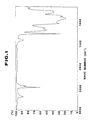
- the fiber had a diameter of 12 ⁇ m, a tensile strength of 200 kg/mm2, and a modulus of elasticity of 14 t/mm2. Elemental analysis showed that the fiber was of a Si-Ti-C-N-O system consisting of 53.9% Si, 19.0% C, 15.0% N, 9.5% O, and 2.6% Ti.
- An X-ray diffraction chart is shown in FIG. 2 which reveals that the fiber is of amorphous ceramic.
- Example 2 As in the polymerization step of Example 1, a 500-ml, four-necked flask was charged with 25.6 grams (0.1 mol) of 1,2-bis(methyldichlorosilyl)ethane, 59.8 grams (0.4 mol) of methyltrichlorosilane, and 3.8 grams (0.02 mol) of TiCl4, 270.5 grams (1.68 mol) of [(CH3)3Si]2NH was added dropwise through a dropping funnel, and reaction was continued for three hours at a temperature of 300°C. The reaction mixture was cooled down and similarly worked up, obtaining 50 grams of a blackish yellow solid. The polymer had a molecular weight of 2620 and a melting point of 175°C.
- the silazane polymer obtained in the foregoing polymerization step 10 grams, was melted at 230°C and spun into a filament by means of the same spinning machine as in Example 1.
- the green filaments were suspended in a mullite column furnace of 50 mm in diameter and 1 m in length which was heated at a temperature of 40°C.
- the filaments were rendered infusible by treating with trichlorosilane gas (concentration 0.7% by volume) for one hour and then with ammonia gas (concentration 6% by volume) for 30 minutes. Thereafter, the column was purged with nitrogen and the filaments were heated at a rate of 240°C/hour in a nitrogen stream and fired at 1,300°C for 30 minutes. There were obtained black lustrous fibers.
- the ceramic fiber yield was 63%.
- the fibers had a diameter of 10 ⁇ m, a tensile strength of 250 kg/mm2, and a modulus of elasticity of 18 t/mm2.
- reaction was effected for two hours at a temperature of 315°C using 51.2 grams (0.2 mol) of 1,2-bis(methyldichlorosilyl)ethane, 44.9 grams (0.3 mol) of methyltrichlorosilane, 3.8 grams (0.02 mol) of TiCl4, and 330 grams (1.86 mol) of [(CH3)3Si]2NH.
- the reaction mixture was similarly worked up, obtaining 53 grams of a black solid. It had a molecular weight of 2418 and a melting point of 150°C.
- the silazane polymer obtained in the foregoing polymerization step 10 grams, was melted at 200°C and spun into a filament by means of the same spinning machine as in Example 1.
- the green filament was infusibilized by heating in air from 100°C to 180°C at a rate of 10°C/hour and then fired for 30 minutes at 1,350°C in a nitrogen stream.
- the ceramic yield was 72%.
- the fiber had a diameter of 13 ⁇ m, a tensile strength of 225 kg/mm2, and a modulus of elasticity of 16 t/mm2. Elemental analysis showed that the fiber was of a Si-Ti-C-N-O system consisting of 54.0% Si, 20.5% C, 15.0% N, 2.0% Ti, and 8.5% O.
- X-ray diffraction analysis showed that the fiber was amorphous.
- reaction was effected for one hour at a temperature of 300°C using 25.6 grams (0.1 mol) of 1,2-bis(methyldichlorosilyl)ethane, 59.8 grams (0.4 mol) of methyltrichlorosilane, 7.6 grams (0.04 mol) of TiCl4, and 312 grams (1.94 mol) of [(CH3)3Si]2NH.
- the reaction mixture was similarly worked up, obtaining 48 grams of a black solid. It had a molecular weight of 2540 and a melting point of 139°C.
- the silazane polymer obtained in the foregoing polymerization step 10 grams, was melted at 180°C and spun into a filament by means of the same spinning machine as in Example 1.
- the green filament was infusibilized through two steps using trichlorosilane and ammonia gas as in Example 2 and then fired for 30 minutes at 1,400°C in a nitrogen stream.
- the ceramic yield was 75%.
- the fiber had a diameter of 12 ⁇ m, a tensile strength of 231 kg/mm2, and a modulus of elasticity of 17.8 t/mm2. Elemental analysis showed that the fiber was of a Si-Ti-C-N system consisting of 60.2% Si, 19.5% C, 16.0% N, and 4.3% Ti.
- X-ray diffraction analysis showed that the fiber was amorphous.
- reaction was effected for two hours at a temperature of 300°C using 25.6 grams (0.1 mol) of 1,2-bis(methyldichlorosilyl)ethane, 59.8 grams (0.4 mol) of methyltrichlorosilane, 0.95 grams (5x10 ⁇ 3 mol) of TiCl4, and 287 grams (1.78 mol) of [(CH3)3Si]2NH.
- the reaction mixture was similarly worked up, obtaining 42 grams of a brown solid. It had a molecular weight of 2420 and a melting point of 146°C.
- the silazane polymer obtained in the foregoing polymerization step 10 grams, was melted at 200°C and spun into a filament by means of the same spinning machine as in Example 1.
- the green filament was infusibilized through two steps using trichlorosilane and ammonia gas as in Example 2 and then fired for 30 minutes at 1,400°C in a nitrogen stream.
- the ceramic yield was 68%.
- the fiber had a diameter of 11 ⁇ m, a tensile strength of 240 kg/mm2, and a modulus of elasticity of 18 t/mm2. Elemental analysis showed that the fiber was of a Si-Ti-C-N system consisting of 64.55% Si, 19.0% C, 15.8% N, and 0.65% Ti.
- X-ray diffraction analysis showed that the fiber was amorphous.
- reaction was effected for one hour at a temperature of 280°C using 59.4 grams (0.2 mol) of 1,2-bis(trichlorosilyl)ethane, 38.7 grams (0.3 mol) of dimethyldichlorosilane, 3.8 grams (0.02 mol) of TiCl4, and 333 grams (2.07 mol) of [(CH3)3Si]2NH.
- the reaction mixture was similarly worked up, obtaining 53 grams of a blackish brown solid. It had a molecular weight of 1900 and a melting point of 102°C.
- the silazane polymer obtained in the foregoing polymerization step 15 grams, was melt spun into filaments as in Example 1.
- the green filaments were infusibilized with trichlorosilane and ammonia gas as in Example 2 and then fired at different temperatures of 1200, 1300, 1400, 1500 and 1600°C in a nitrogen stream.
- the physical properties of sintered fibers are reported in Table 1.
- Table 1 Fiber diameter ( ⁇ m) Tensile strength (kg/mm2) Modulus of elasticity (t/mm2) Fired @ 1200°C, 30 min. 12 220 18 Fired @ 1300°C, 30 min. 12 235 19 Fired @ 1400°C, 30 min. 12 220 18.5 Fired @ 1500°C, 30 min. 12 140 13 Fired @ 1600°C, 30 min. 12 50 12
- a dry 500-ml, four-necked flask equipped with a stirrer, thermometer, gas inlet tube, dropping funnel, and distillation unit was charged with 74.8 grams (0.5 mol) of methyltrichlorosilane. Then, 241 grams (1.5 mol) of [(CH3)3Si]2NH was added dropwise to the flask through the dropping funnel. The mixture was gradually heated in a nitrogen atmosphere. When the reactor temperature reached 67°C, reflux began with a vapor temperature of 59°C. The reaction temperature was slowly raised to 310°C while distilling off trimethylchlorosilane and hexamethyldisilane as produced by reaction. The reaction mixture was kept at the temperature for 3-1/2 hours and then cooled down to room temperature.
- the reaction mixture was worked up by adding 150 ml of dry hexane to the reaction mixture to form a solution and removing the insolubles by filtration, and then stripped of the hexane and low molecular weight substances at 250°C and 10 mmHg. There was obtained 31 grams of a colorless solid. It had a molecular weight of 1926 and a melting point of 178°C. An IR spectrum showed absorption peaks at 3400 cm ⁇ 1 for NH, 2980 cm ⁇ 1 for CH and 1250 cm ⁇ 1 for SiCH3.
- the polymer obtained in the foregoing polymerization step was melted at 230°C and spun into a filament by means of the same mono-hole spinning machine as in Example 1.
- the filament snapped frequently during melt spinning and was very brittle as demonstrated by a tensile strength of 500 g/mm2, which was one fourteenth of the strength of the green filament obtained in Example 1.
- the green filaments were infusibilized with trichlorosilane and ammonia gas as in Example 2 and then fired, under light tension, at different temperatures of 1200, 1300, 1350, 1400, and 1500°C in a nitrogen stream.
- the physical properties of sintered fibers are reported in Table 2.
- Reaction was effected for one hour at 300°C by the same procedure as in Example 1 except that the flask was charged with 6.4 grams (0.025 mol) of 1,2-bis(methyldichlorosilyl)- ethane, 71.0 grams (0.474 mol) of methyltrichlorosilane, and 270 grams (1.68 mol) of [(CH3)3Si]2NH while TiCl4 was omitted.
- the reaction mixture was similarly worked up, obtaining 37 grams of a pale yellow solid. It had a molecular weight of 2370 and a melting point of 145°C.
- the polymer obtained in the foregoing polymerization step was melted at 200°C and spun into a filament as in Example 1.
- the filament snapped sometimes during melt spinning. It was difficult to handle as demonstrated by a tensile strength of 1 kg/mm2, which was one seventh of the strength of the green filament obtained in Example 1.
Landscapes
- Chemical & Material Sciences (AREA)
- Engineering & Computer Science (AREA)
- Ceramic Engineering (AREA)
- Organic Chemistry (AREA)
- Manufacturing & Machinery (AREA)
- Materials Engineering (AREA)
- Structural Engineering (AREA)
- Medicinal Chemistry (AREA)
- Polymers & Plastics (AREA)
- Chemical Kinetics & Catalysis (AREA)
- Inorganic Chemistry (AREA)
- Health & Medical Sciences (AREA)
- Ceramic Products (AREA)
- Inorganic Fibers (AREA)
- Polymers With Sulfur, Phosphorus Or Metals In The Main Chain (AREA)
Applications Claiming Priority (2)
| Application Number | Priority Date | Filing Date | Title |
|---|---|---|---|
| JP216093/89 | 1989-08-24 | ||
| JP1216093A JPH0662776B2 (ja) | 1989-08-24 | 1989-08-24 | ポリチタノカルボシラザン重合体及び該重合体を用いたセラミックスの製造方法 |
Publications (3)
| Publication Number | Publication Date |
|---|---|
| EP0417526A2 true EP0417526A2 (fr) | 1991-03-20 |
| EP0417526A3 EP0417526A3 (en) | 1992-02-26 |
| EP0417526B1 EP0417526B1 (fr) | 1995-01-25 |
Family
ID=16683140
Family Applications (1)
| Application Number | Title | Priority Date | Filing Date |
|---|---|---|---|
| EP90116190A Expired - Lifetime EP0417526B1 (fr) | 1989-08-24 | 1990-08-23 | Procédé de préparation de polymères polytitanocarbosilazane et matériaux céramiques |
Country Status (4)
| Country | Link |
|---|---|
| US (1) | US5041515A (fr) |
| EP (1) | EP0417526B1 (fr) |
| JP (1) | JPH0662776B2 (fr) |
| DE (1) | DE69016319T2 (fr) |
Cited By (5)
| Publication number | Priority date | Publication date | Assignee | Title |
|---|---|---|---|---|
| EP0616972A1 (fr) * | 1993-03-23 | 1994-09-28 | Elf Atochem S.A. | Procédé de préparation de poudre pour céramique en nitrure et/ou carbure métallique et/ou métalloidique par pyrolise-flash et la poudre ainsi obtenue |
| EP0623643A3 (fr) * | 1993-05-03 | 1995-07-05 | Bayer Ag | Azanes multinaires polymériques, procédé pour les préparer et leur utilisation. |
| EP0668363A1 (fr) * | 1994-01-20 | 1995-08-23 | Research Institute Of Advanced Material Gas-Generator, Ltd. | Renforcement pour matériau composite et matériau composite utilisant ce renforcement |
| EP0619280A3 (fr) * | 1993-04-08 | 1995-11-29 | Tonen Corp | Polymetalosilazane, procédé de sa fabrication, céramique à base de nitrure de silicium et procédé de sa fabrication. |
| EP0490614B1 (fr) * | 1990-12-10 | 1996-02-07 | Ford Motor Company Limited | Préparation de nitrure de titane à partir des précurseurs organométalliques |
Families Citing this family (5)
| Publication number | Priority date | Publication date | Assignee | Title |
|---|---|---|---|---|
| JPH03190933A (ja) * | 1989-12-20 | 1991-08-20 | Shin Etsu Chem Co Ltd | 有機シラザン重合体の製造方法及び該重合体を用いたセラミックスの製造方法 |
| CA2138489A1 (fr) * | 1993-12-17 | 1995-06-18 | Masanori Okabe | Poudre de composite a base d'yttrium, corps fritte composite, et methode pour l'obtenir. |
| US7128850B2 (en) * | 2003-06-02 | 2006-10-31 | The Regents Of The University Of California | Electrically conductive Si-Ti-C-N ceramics |
| US10508056B1 (en) * | 2015-05-19 | 2019-12-17 | General Electric Company | Method to form silicon carbide fibers by single stage pyrolysis of polysilazane precursors |
| CN115746308B (zh) * | 2022-10-10 | 2024-04-02 | 宁波杭州湾新材料研究院 | 一种液态富碳型金属基SiCN陶瓷先驱体的制备方法 |
Family Cites Families (13)
| Publication number | Priority date | Publication date | Assignee | Title |
|---|---|---|---|---|
| DE2218960A1 (de) * | 1972-04-19 | 1973-11-08 | Bayer Ag | Formkoerper aus mogenen mischungen von siliciumcarbid und siliciumnitrid und verfahren zu ihrer erstellung |
| US4097294A (en) * | 1976-08-23 | 1978-06-27 | The United States Of America As Represented By The Secretary Of The Navy | Preparation of ceramics |
| CA1154032A (fr) * | 1979-11-21 | 1983-09-20 | Seishi Yajima | Polymetallocarbosilane et methode d'obtention |
| US4404153A (en) * | 1981-01-15 | 1983-09-13 | Dow Corning Corporation | Process for the preparation of poly(disilyl)silazane polymers and the polymers therefrom |
| US4312970A (en) * | 1981-02-20 | 1982-01-26 | Dow Corning Corporation | Silazane polymers from {R'3 Si}2 NH and organochlorosilanes |
| US4395460A (en) * | 1981-09-21 | 1983-07-26 | Dow Corning Corporation | Preparation of polysilazane polymers and the polymers therefrom |
| US4540803A (en) * | 1983-11-28 | 1985-09-10 | Dow Corning Corporation | Hydrosilazane polymers from [R3 Si]2 NH and HSiCl3 |
| US4482669A (en) * | 1984-01-19 | 1984-11-13 | Massachusetts Institute Of Technology | Preceramic organosilazane polymers |
| US4482689A (en) * | 1984-03-12 | 1984-11-13 | Dow Corning Corporation | Process for the preparation of polymetallo(disily)silazane polymers and the polymers therefrom |
| US4595775A (en) * | 1984-04-06 | 1986-06-17 | Petrarch Systems, Inc. | N-methylhydridosilazanes, polymers thereof, methods of making same and silicon nitrides produced therefrom |
| US4535007A (en) * | 1984-07-02 | 1985-08-13 | Dow Corning Corporation | Silicon nitride-containing ceramics |
| JPS63210133A (ja) * | 1987-02-25 | 1988-08-31 | Shin Etsu Chem Co Ltd | 有機シラザン重合体の製造方法 |
| EP0361181B1 (fr) * | 1988-09-09 | 1995-03-22 | Shin-Etsu Chemical Co., Ltd. | Procédé pour rendre infusibles des polysilazanes et procédé de préparation de fibres céramiques creuses |
-
1989
- 1989-08-24 JP JP1216093A patent/JPH0662776B2/ja not_active Expired - Lifetime
-
1990
- 1990-08-02 US US07/571,132 patent/US5041515A/en not_active Expired - Fee Related
- 1990-08-23 DE DE69016319T patent/DE69016319T2/de not_active Expired - Fee Related
- 1990-08-23 EP EP90116190A patent/EP0417526B1/fr not_active Expired - Lifetime
Cited By (9)
| Publication number | Priority date | Publication date | Assignee | Title |
|---|---|---|---|---|
| EP0490614B1 (fr) * | 1990-12-10 | 1996-02-07 | Ford Motor Company Limited | Préparation de nitrure de titane à partir des précurseurs organométalliques |
| EP0616972A1 (fr) * | 1993-03-23 | 1994-09-28 | Elf Atochem S.A. | Procédé de préparation de poudre pour céramique en nitrure et/ou carbure métallique et/ou métalloidique par pyrolise-flash et la poudre ainsi obtenue |
| FR2703040A1 (fr) * | 1993-03-23 | 1994-09-30 | Atochem Elf Sa | Procédé de préparation de poudre pour céramique en nitrure et/ou carbure métallique et/ou métalloïdique par pyrolyse-flash et la poudre ainsi obtenue. |
| EP0619280A3 (fr) * | 1993-04-08 | 1995-11-29 | Tonen Corp | Polymetalosilazane, procédé de sa fabrication, céramique à base de nitrure de silicium et procédé de sa fabrication. |
| EP0623643A3 (fr) * | 1993-05-03 | 1995-07-05 | Bayer Ag | Azanes multinaires polymériques, procédé pour les préparer et leur utilisation. |
| US5567832A (en) * | 1993-05-03 | 1996-10-22 | Bayer Ag | Polymeric multinary azanes, methods for their preparation and their use |
| EP0668363A1 (fr) * | 1994-01-20 | 1995-08-23 | Research Institute Of Advanced Material Gas-Generator, Ltd. | Renforcement pour matériau composite et matériau composite utilisant ce renforcement |
| US6004671A (en) * | 1994-01-20 | 1999-12-21 | Research Institute Of Advanced Material Gas-Generator, Ltd. | Reinforcement for composite material and composite material using the same |
| US6117534A (en) * | 1994-01-20 | 2000-09-12 | Research Institute Of Advanced Material Gas-Generator, Ltd. | Reinforcement for composite material and composite material using the same |
Also Published As
| Publication number | Publication date |
|---|---|
| EP0417526B1 (fr) | 1995-01-25 |
| DE69016319D1 (de) | 1995-03-09 |
| JPH0662776B2 (ja) | 1994-08-17 |
| US5041515A (en) | 1991-08-20 |
| JPH0381330A (ja) | 1991-04-05 |
| DE69016319T2 (de) | 1995-09-21 |
| EP0417526A3 (en) | 1992-02-26 |
Similar Documents
| Publication | Publication Date | Title |
|---|---|---|
| US4869854A (en) | Process for manufacturing organic silazane polymers and ceramics therefrom | |
| CA1246281A (fr) | Preparation de polymeres de metallo(disilyl) silazane; produits derives | |
| US4847345A (en) | Process for manufacturing organic silazane polymers and ceramics therefrom | |
| JPS62290730A (ja) | 有機シラザン重合体の製造方法 | |
| EP0417526B1 (fr) | Procédé de préparation de polymères polytitanocarbosilazane et matériaux céramiques | |
| US4948763A (en) | Preparation of hollow ceramic fibers | |
| US4954596A (en) | Process for manufacturing organic silazane polymers and ceramics therefrom | |
| EP0434428B1 (fr) | Procédé de préparation d'un polymère silazane contenant des atomes d'hafnium et procédé de fabrication des matières céramiques à partir de ces polymères | |
| US5200371A (en) | Method for preparing organic silazane polymers and method for preparing ceramics from the polymers | |
| US4824918A (en) | Method of producing silicon carbide preceramic vinyl-containing polymers | |
| EP0466055B1 (fr) | Procédé de préparation de polysilazanes et procédé de fabrication de matière céramique à partir de ces polymères | |
| EP0361181B1 (fr) | Procédé pour rendre infusibles des polysilazanes et procédé de préparation de fibres céramiques creuses | |
| US5145813A (en) | Process for manufacturing organic silazane polymers and ceramics therefrom | |
| US5008348A (en) | Infusibilization of organic silazane polymers | |
| JPH0384035A (ja) | ほう素、窒素およびけい素を基剤とする有機金属セラミック先駆物質 | |
| JPH04153226A (ja) | ホウ素含有シラザン重合体の製造方法及びセラミックスの製造方法 | |
| JPS6335826A (ja) | Sic含有セラミツク繊維の製造方法 | |
| JPH0234565A (ja) | 有機シラザン重合体の不融化方法 | |
| JPH0798865B2 (ja) | セラミックスの製造方法 | |
| JPH0532787A (ja) | セラミツクスの製造方法 | |
| JPH07119283B2 (ja) | 有機シラザン重合体の不融化方法 | |
| US5157096A (en) | Method and apparatus for preparing organic silazane polymer and method for preparing inorganic fibers | |
| JPH02120279A (ja) | セラミックスの製造方法 | |
| JPS63117037A (ja) | 有機シラザン重合体の製造方法 |
Legal Events
| Date | Code | Title | Description |
|---|---|---|---|
| PUAI | Public reference made under article 153(3) epc to a published international application that has entered the european phase |
Free format text: ORIGINAL CODE: 0009012 |
|
| 17P | Request for examination filed |
Effective date: 19901206 |
|
| AK | Designated contracting states |
Kind code of ref document: A2 Designated state(s): DE FR GB |
|
| PUAL | Search report despatched |
Free format text: ORIGINAL CODE: 0009013 |
|
| AK | Designated contracting states |
Kind code of ref document: A3 Designated state(s): DE FR GB |
|
| 17Q | First examination report despatched |
Effective date: 19930827 |
|
| GRAA | (expected) grant |
Free format text: ORIGINAL CODE: 0009210 |
|
| AK | Designated contracting states |
Kind code of ref document: B1 Designated state(s): DE FR GB |
|
| REF | Corresponds to: |
Ref document number: 69016319 Country of ref document: DE Date of ref document: 19950309 |
|
| ET | Fr: translation filed | ||
| PLBE | No opposition filed within time limit |
Free format text: ORIGINAL CODE: 0009261 |
|
| STAA | Information on the status of an ep patent application or granted ep patent |
Free format text: STATUS: NO OPPOSITION FILED WITHIN TIME LIMIT |
|
| 26N | No opposition filed | ||
| PGFP | Annual fee paid to national office [announced via postgrant information from national office to epo] |
Ref country code: FR Payment date: 19970811 Year of fee payment: 8 |
|
| PGFP | Annual fee paid to national office [announced via postgrant information from national office to epo] |
Ref country code: GB Payment date: 19970814 Year of fee payment: 8 |
|
| PG25 | Lapsed in a contracting state [announced via postgrant information from national office to epo] |
Ref country code: GB Free format text: LAPSE BECAUSE OF NON-PAYMENT OF DUE FEES Effective date: 19980823 |
|
| PGFP | Annual fee paid to national office [announced via postgrant information from national office to epo] |
Ref country code: DE Payment date: 19980831 Year of fee payment: 9 |
|
| GBPC | Gb: european patent ceased through non-payment of renewal fee |
Effective date: 19980823 |
|
| PG25 | Lapsed in a contracting state [announced via postgrant information from national office to epo] |
Ref country code: FR Free format text: LAPSE BECAUSE OF NON-PAYMENT OF DUE FEES Effective date: 19990430 |
|
| REG | Reference to a national code |
Ref country code: FR Ref legal event code: ST |
|
| PG25 | Lapsed in a contracting state [announced via postgrant information from national office to epo] |
Ref country code: DE Free format text: LAPSE BECAUSE OF NON-PAYMENT OF DUE FEES Effective date: 20000601 |