EP0669978B1 - Flk-1 UTILISE COMME RECEPTEUR POUR FACTEUR DE CROISSANCE ENDOTHELIAL VASCULAIRE - Google Patents
Flk-1 UTILISE COMME RECEPTEUR POUR FACTEUR DE CROISSANCE ENDOTHELIAL VASCULAIRE Download PDFInfo
- Publication number
- EP0669978B1 EP0669978B1 EP94900810A EP94900810A EP0669978B1 EP 0669978 B1 EP0669978 B1 EP 0669978B1 EP 94900810 A EP94900810 A EP 94900810A EP 94900810 A EP94900810 A EP 94900810A EP 0669978 B1 EP0669978 B1 EP 0669978B1
- Authority
- EP
- European Patent Office
- Prior art keywords
- flk
- receptor
- cells
- vegf
- expression
- Prior art date
- Legal status (The legal status is an assumption and is not a legal conclusion. Google has not performed a legal analysis and makes no representation as to the accuracy of the status listed.)
- Expired - Lifetime
Links
Images










Classifications
-
- G—PHYSICS
- G01—MEASURING; TESTING
- G01N—INVESTIGATING OR ANALYSING MATERIALS BY DETERMINING THEIR CHEMICAL OR PHYSICAL PROPERTIES
- G01N33/00—Investigating or analysing materials by specific methods not covered by groups G01N1/00 - G01N31/00
- G01N33/48—Biological material, e.g. blood, urine; Haemocytometers
- G01N33/50—Chemical analysis of biological material, e.g. blood, urine; Testing involving biospecific ligand binding methods; Immunological testing
- G01N33/5005—Chemical analysis of biological material, e.g. blood, urine; Testing involving biospecific ligand binding methods; Immunological testing involving human or animal cells
- G01N33/5008—Chemical analysis of biological material, e.g. blood, urine; Testing involving biospecific ligand binding methods; Immunological testing involving human or animal cells for testing or evaluating the effect of chemical or biological compounds, e.g. drugs, cosmetics
- G01N33/5044—Chemical analysis of biological material, e.g. blood, urine; Testing involving biospecific ligand binding methods; Immunological testing involving human or animal cells for testing or evaluating the effect of chemical or biological compounds, e.g. drugs, cosmetics involving specific cell types
- G01N33/5064—Endothelial cells
-
- A—HUMAN NECESSITIES
- A61—MEDICAL OR VETERINARY SCIENCE; HYGIENE
- A61K—PREPARATIONS FOR MEDICAL, DENTAL OR TOILETRY PURPOSES
- A61K31/00—Medicinal preparations containing organic active ingredients
- A61K31/21—Esters, e.g. nitroglycerine, selenocyanates
- A61K31/215—Esters, e.g. nitroglycerine, selenocyanates of carboxylic acids
- A61K31/235—Esters, e.g. nitroglycerine, selenocyanates of carboxylic acids having an aromatic ring attached to a carboxyl group
-
- A—HUMAN NECESSITIES
- A61—MEDICAL OR VETERINARY SCIENCE; HYGIENE
- A61K—PREPARATIONS FOR MEDICAL, DENTAL OR TOILETRY PURPOSES
- A61K31/00—Medicinal preparations containing organic active ingredients
- A61K31/275—Nitriles; Isonitriles
-
- A—HUMAN NECESSITIES
- A61—MEDICAL OR VETERINARY SCIENCE; HYGIENE
- A61K—PREPARATIONS FOR MEDICAL, DENTAL OR TOILETRY PURPOSES
- A61K31/00—Medicinal preparations containing organic active ingredients
- A61K31/275—Nitriles; Isonitriles
- A61K31/277—Nitriles; Isonitriles having a ring, e.g. verapamil
-
- A—HUMAN NECESSITIES
- A61—MEDICAL OR VETERINARY SCIENCE; HYGIENE
- A61K—PREPARATIONS FOR MEDICAL, DENTAL OR TOILETRY PURPOSES
- A61K31/00—Medicinal preparations containing organic active ingredients
- A61K31/33—Heterocyclic compounds
- A61K31/38—Heterocyclic compounds having sulfur as a ring hetero atom
-
- A—HUMAN NECESSITIES
- A61—MEDICAL OR VETERINARY SCIENCE; HYGIENE
- A61K—PREPARATIONS FOR MEDICAL, DENTAL OR TOILETRY PURPOSES
- A61K31/00—Medicinal preparations containing organic active ingredients
- A61K31/33—Heterocyclic compounds
- A61K31/395—Heterocyclic compounds having nitrogen as a ring hetero atom, e.g. guanethidine or rifamycins
- A61K31/40—Heterocyclic compounds having nitrogen as a ring hetero atom, e.g. guanethidine or rifamycins having five-membered rings with one nitrogen as the only ring hetero atom, e.g. sulpiride, succinimide, tolmetin, buflomedil
-
- A—HUMAN NECESSITIES
- A61—MEDICAL OR VETERINARY SCIENCE; HYGIENE
- A61K—PREPARATIONS FOR MEDICAL, DENTAL OR TOILETRY PURPOSES
- A61K31/00—Medicinal preparations containing organic active ingredients
- A61K31/33—Heterocyclic compounds
- A61K31/395—Heterocyclic compounds having nitrogen as a ring hetero atom, e.g. guanethidine or rifamycins
- A61K31/41—Heterocyclic compounds having nitrogen as a ring hetero atom, e.g. guanethidine or rifamycins having five-membered rings with two or more ring hetero atoms, at least one of which being nitrogen, e.g. tetrazole
- A61K31/415—1,2-Diazoles
-
- A—HUMAN NECESSITIES
- A61—MEDICAL OR VETERINARY SCIENCE; HYGIENE
- A61K—PREPARATIONS FOR MEDICAL, DENTAL OR TOILETRY PURPOSES
- A61K31/00—Medicinal preparations containing organic active ingredients
- A61K31/33—Heterocyclic compounds
- A61K31/395—Heterocyclic compounds having nitrogen as a ring hetero atom, e.g. guanethidine or rifamycins
- A61K31/41—Heterocyclic compounds having nitrogen as a ring hetero atom, e.g. guanethidine or rifamycins having five-membered rings with two or more ring hetero atoms, at least one of which being nitrogen, e.g. tetrazole
- A61K31/42—Oxazoles
-
- A—HUMAN NECESSITIES
- A61—MEDICAL OR VETERINARY SCIENCE; HYGIENE
- A61K—PREPARATIONS FOR MEDICAL, DENTAL OR TOILETRY PURPOSES
- A61K31/00—Medicinal preparations containing organic active ingredients
- A61K31/33—Heterocyclic compounds
- A61K31/395—Heterocyclic compounds having nitrogen as a ring hetero atom, e.g. guanethidine or rifamycins
- A61K31/495—Heterocyclic compounds having nitrogen as a ring hetero atom, e.g. guanethidine or rifamycins having six-membered rings with two or more nitrogen atoms as the only ring heteroatoms, e.g. piperazine or tetrazines
-
- A—HUMAN NECESSITIES
- A61—MEDICAL OR VETERINARY SCIENCE; HYGIENE
- A61K—PREPARATIONS FOR MEDICAL, DENTAL OR TOILETRY PURPOSES
- A61K31/00—Medicinal preparations containing organic active ingredients
- A61K31/33—Heterocyclic compounds
- A61K31/395—Heterocyclic compounds having nitrogen as a ring hetero atom, e.g. guanethidine or rifamycins
- A61K31/495—Heterocyclic compounds having nitrogen as a ring hetero atom, e.g. guanethidine or rifamycins having six-membered rings with two or more nitrogen atoms as the only ring heteroatoms, e.g. piperazine or tetrazines
- A61K31/50—Pyridazines; Hydrogenated pyridazines
- A61K31/502—Pyridazines; Hydrogenated pyridazines ortho- or peri-condensed with carbocyclic ring systems, e.g. cinnoline, phthalazine
-
- A—HUMAN NECESSITIES
- A61—MEDICAL OR VETERINARY SCIENCE; HYGIENE
- A61K—PREPARATIONS FOR MEDICAL, DENTAL OR TOILETRY PURPOSES
- A61K31/00—Medicinal preparations containing organic active ingredients
- A61K31/33—Heterocyclic compounds
- A61K31/395—Heterocyclic compounds having nitrogen as a ring hetero atom, e.g. guanethidine or rifamycins
- A61K31/495—Heterocyclic compounds having nitrogen as a ring hetero atom, e.g. guanethidine or rifamycins having six-membered rings with two or more nitrogen atoms as the only ring heteroatoms, e.g. piperazine or tetrazines
- A61K31/505—Pyrimidines; Hydrogenated pyrimidines, e.g. trimethoprim
-
- A—HUMAN NECESSITIES
- A61—MEDICAL OR VETERINARY SCIENCE; HYGIENE
- A61K—PREPARATIONS FOR MEDICAL, DENTAL OR TOILETRY PURPOSES
- A61K31/00—Medicinal preparations containing organic active ingredients
- A61K31/33—Heterocyclic compounds
- A61K31/395—Heterocyclic compounds having nitrogen as a ring hetero atom, e.g. guanethidine or rifamycins
- A61K31/495—Heterocyclic compounds having nitrogen as a ring hetero atom, e.g. guanethidine or rifamycins having six-membered rings with two or more nitrogen atoms as the only ring heteroatoms, e.g. piperazine or tetrazines
- A61K31/505—Pyrimidines; Hydrogenated pyrimidines, e.g. trimethoprim
- A61K31/517—Pyrimidines; Hydrogenated pyrimidines, e.g. trimethoprim ortho- or peri-condensed with carbocyclic ring systems, e.g. quinazoline, perimidine
-
- A—HUMAN NECESSITIES
- A61—MEDICAL OR VETERINARY SCIENCE; HYGIENE
- A61K—PREPARATIONS FOR MEDICAL, DENTAL OR TOILETRY PURPOSES
- A61K31/00—Medicinal preparations containing organic active ingredients
- A61K31/33—Heterocyclic compounds
- A61K31/395—Heterocyclic compounds having nitrogen as a ring hetero atom, e.g. guanethidine or rifamycins
- A61K31/535—Heterocyclic compounds having nitrogen as a ring hetero atom, e.g. guanethidine or rifamycins having six-membered rings with at least one nitrogen and one oxygen as the ring hetero atoms, e.g. 1,2-oxazines
-
- A—HUMAN NECESSITIES
- A61—MEDICAL OR VETERINARY SCIENCE; HYGIENE
- A61P—SPECIFIC THERAPEUTIC ACTIVITY OF CHEMICAL COMPOUNDS OR MEDICINAL PREPARATIONS
- A61P35/00—Antineoplastic agents
-
- A—HUMAN NECESSITIES
- A61—MEDICAL OR VETERINARY SCIENCE; HYGIENE
- A61P—SPECIFIC THERAPEUTIC ACTIVITY OF CHEMICAL COMPOUNDS OR MEDICINAL PREPARATIONS
- A61P43/00—Drugs for specific purposes, not provided for in groups A61P1/00-A61P41/00
-
- C—CHEMISTRY; METALLURGY
- C07—ORGANIC CHEMISTRY
- C07C—ACYCLIC OR CARBOCYCLIC COMPOUNDS
- C07C229/00—Compounds containing amino and carboxyl groups bound to the same carbon skeleton
- C07C229/52—Compounds containing amino and carboxyl groups bound to the same carbon skeleton having amino and carboxyl groups bound to carbon atoms of six-membered aromatic rings of the same carbon skeleton
- C07C229/54—Compounds containing amino and carboxyl groups bound to the same carbon skeleton having amino and carboxyl groups bound to carbon atoms of six-membered aromatic rings of the same carbon skeleton with amino and carboxyl groups bound to carbon atoms of the same non-condensed six-membered aromatic ring
- C07C229/60—Compounds containing amino and carboxyl groups bound to the same carbon skeleton having amino and carboxyl groups bound to carbon atoms of six-membered aromatic rings of the same carbon skeleton with amino and carboxyl groups bound to carbon atoms of the same non-condensed six-membered aromatic ring with amino and carboxyl groups bound in meta- or para- positions
-
- C—CHEMISTRY; METALLURGY
- C07—ORGANIC CHEMISTRY
- C07C—ACYCLIC OR CARBOCYCLIC COMPOUNDS
- C07C255/00—Carboxylic acid nitriles
- C07C255/01—Carboxylic acid nitriles having cyano groups bound to acyclic carbon atoms
- C07C255/32—Carboxylic acid nitriles having cyano groups bound to acyclic carbon atoms having cyano groups bound to acyclic carbon atoms of a carbon skeleton containing at least one six-membered aromatic ring
- C07C255/36—Carboxylic acid nitriles having cyano groups bound to acyclic carbon atoms having cyano groups bound to acyclic carbon atoms of a carbon skeleton containing at least one six-membered aromatic ring the carbon skeleton being further substituted by hydroxy groups
-
- C—CHEMISTRY; METALLURGY
- C07—ORGANIC CHEMISTRY
- C07C—ACYCLIC OR CARBOCYCLIC COMPOUNDS
- C07C255/00—Carboxylic acid nitriles
- C07C255/01—Carboxylic acid nitriles having cyano groups bound to acyclic carbon atoms
- C07C255/32—Carboxylic acid nitriles having cyano groups bound to acyclic carbon atoms having cyano groups bound to acyclic carbon atoms of a carbon skeleton containing at least one six-membered aromatic ring
- C07C255/40—Carboxylic acid nitriles having cyano groups bound to acyclic carbon atoms having cyano groups bound to acyclic carbon atoms of a carbon skeleton containing at least one six-membered aromatic ring the carbon skeleton being further substituted by doubly-bound oxygen atoms
-
- C—CHEMISTRY; METALLURGY
- C07—ORGANIC CHEMISTRY
- C07C—ACYCLIC OR CARBOCYCLIC COMPOUNDS
- C07C255/00—Carboxylic acid nitriles
- C07C255/01—Carboxylic acid nitriles having cyano groups bound to acyclic carbon atoms
- C07C255/32—Carboxylic acid nitriles having cyano groups bound to acyclic carbon atoms having cyano groups bound to acyclic carbon atoms of a carbon skeleton containing at least one six-membered aromatic ring
- C07C255/41—Carboxylic acid nitriles having cyano groups bound to acyclic carbon atoms having cyano groups bound to acyclic carbon atoms of a carbon skeleton containing at least one six-membered aromatic ring the carbon skeleton being further substituted by carboxyl groups, other than cyano groups
-
- C—CHEMISTRY; METALLURGY
- C07—ORGANIC CHEMISTRY
- C07C—ACYCLIC OR CARBOCYCLIC COMPOUNDS
- C07C255/00—Carboxylic acid nitriles
- C07C255/63—Carboxylic acid nitriles containing cyano groups and nitrogen atoms further bound to other hetero atoms, other than oxygen atoms of nitro or nitroso groups, bound to the same carbon skeleton
- C07C255/65—Carboxylic acid nitriles containing cyano groups and nitrogen atoms further bound to other hetero atoms, other than oxygen atoms of nitro or nitroso groups, bound to the same carbon skeleton with the nitrogen atoms further bound to nitrogen atoms
- C07C255/66—Carboxylic acid nitriles containing cyano groups and nitrogen atoms further bound to other hetero atoms, other than oxygen atoms of nitro or nitroso groups, bound to the same carbon skeleton with the nitrogen atoms further bound to nitrogen atoms having cyano groups and nitrogen atoms being part of hydrazine or hydrazone groups bound to the same carbon skeleton
-
- C—CHEMISTRY; METALLURGY
- C07—ORGANIC CHEMISTRY
- C07C—ACYCLIC OR CARBOCYCLIC COMPOUNDS
- C07C317/00—Sulfones; Sulfoxides
- C07C317/44—Sulfones; Sulfoxides having sulfone or sulfoxide groups and carboxyl groups bound to the same carbon skeleton
- C07C317/46—Sulfones; Sulfoxides having sulfone or sulfoxide groups and carboxyl groups bound to the same carbon skeleton the carbon skeleton being further substituted by singly-bound oxygen atoms
-
- C—CHEMISTRY; METALLURGY
- C07—ORGANIC CHEMISTRY
- C07C—ACYCLIC OR CARBOCYCLIC COMPOUNDS
- C07C327/00—Thiocarboxylic acids
- C07C327/38—Amides of thiocarboxylic acids
- C07C327/40—Amides of thiocarboxylic acids having carbon atoms of thiocarboxamide groups bound to hydrogen atoms or to acyclic carbon atoms
- C07C327/44—Amides of thiocarboxylic acids having carbon atoms of thiocarboxamide groups bound to hydrogen atoms or to acyclic carbon atoms to carbon atoms of an unsaturated carbon skeleton
-
- C—CHEMISTRY; METALLURGY
- C07—ORGANIC CHEMISTRY
- C07D—HETEROCYCLIC COMPOUNDS
- C07D209/00—Heterocyclic compounds containing five-membered rings, condensed with other rings, with one nitrogen atom as the only ring hetero atom
- C07D209/02—Heterocyclic compounds containing five-membered rings, condensed with other rings, with one nitrogen atom as the only ring hetero atom condensed with one carbocyclic ring
- C07D209/04—Indoles; Hydrogenated indoles
- C07D209/10—Indoles; Hydrogenated indoles with substituted hydrocarbon radicals attached to carbon atoms of the hetero ring
- C07D209/18—Radicals substituted by carbon atoms having three bonds to hetero atoms with at the most one bond to halogen, e.g. ester or nitrile radicals
-
- C—CHEMISTRY; METALLURGY
- C07—ORGANIC CHEMISTRY
- C07D—HETEROCYCLIC COMPOUNDS
- C07D239/00—Heterocyclic compounds containing 1,3-diazine or hydrogenated 1,3-diazine rings
- C07D239/70—Heterocyclic compounds containing 1,3-diazine or hydrogenated 1,3-diazine rings condensed with carbocyclic rings or ring systems
- C07D239/72—Quinazolines; Hydrogenated quinazolines
- C07D239/86—Quinazolines; Hydrogenated quinazolines with hetero atoms directly attached in position 4
- C07D239/93—Sulfur atoms
-
- C—CHEMISTRY; METALLURGY
- C07—ORGANIC CHEMISTRY
- C07D—HETEROCYCLIC COMPOUNDS
- C07D239/00—Heterocyclic compounds containing 1,3-diazine or hydrogenated 1,3-diazine rings
- C07D239/70—Heterocyclic compounds containing 1,3-diazine or hydrogenated 1,3-diazine rings condensed with carbocyclic rings or ring systems
- C07D239/72—Quinazolines; Hydrogenated quinazolines
- C07D239/86—Quinazolines; Hydrogenated quinazolines with hetero atoms directly attached in position 4
- C07D239/94—Nitrogen atoms
-
- C—CHEMISTRY; METALLURGY
- C07—ORGANIC CHEMISTRY
- C07D—HETEROCYCLIC COMPOUNDS
- C07D241/00—Heterocyclic compounds containing 1,4-diazine or hydrogenated 1,4-diazine rings
- C07D241/36—Heterocyclic compounds containing 1,4-diazine or hydrogenated 1,4-diazine rings condensed with carbocyclic rings or ring systems
- C07D241/38—Heterocyclic compounds containing 1,4-diazine or hydrogenated 1,4-diazine rings condensed with carbocyclic rings or ring systems with only hydrogen or carbon atoms directly attached to the ring nitrogen atoms
- C07D241/40—Benzopyrazines
- C07D241/42—Benzopyrazines with only hydrogen atoms, hydrocarbon or substituted hydrocarbon radicals, directly attached to carbon atoms of the hetero ring
-
- C—CHEMISTRY; METALLURGY
- C07—ORGANIC CHEMISTRY
- C07D—HETEROCYCLIC COMPOUNDS
- C07D241/00—Heterocyclic compounds containing 1,4-diazine or hydrogenated 1,4-diazine rings
- C07D241/36—Heterocyclic compounds containing 1,4-diazine or hydrogenated 1,4-diazine rings condensed with carbocyclic rings or ring systems
- C07D241/38—Heterocyclic compounds containing 1,4-diazine or hydrogenated 1,4-diazine rings condensed with carbocyclic rings or ring systems with only hydrogen or carbon atoms directly attached to the ring nitrogen atoms
- C07D241/40—Benzopyrazines
- C07D241/44—Benzopyrazines with hetero atoms or with carbon atoms having three bonds to hetero atoms with at the most one bond to halogen, e.g. ester or nitrile radicals, directly attached to carbon atoms of the hetero ring
-
- C—CHEMISTRY; METALLURGY
- C07—ORGANIC CHEMISTRY
- C07D—HETEROCYCLIC COMPOUNDS
- C07D487/00—Heterocyclic compounds containing nitrogen atoms as the only ring hetero atoms in the condensed system, not provided for by groups C07D451/00 - C07D477/00
- C07D487/02—Heterocyclic compounds containing nitrogen atoms as the only ring hetero atoms in the condensed system, not provided for by groups C07D451/00 - C07D477/00 in which the condensed system contains two hetero rings
- C07D487/04—Ortho-condensed systems
-
- C—CHEMISTRY; METALLURGY
- C07—ORGANIC CHEMISTRY
- C07K—PEPTIDES
- C07K14/00—Peptides having more than 20 amino acids; Gastrins; Somatostatins; Melanotropins; Derivatives thereof
- C07K14/435—Peptides having more than 20 amino acids; Gastrins; Somatostatins; Melanotropins; Derivatives thereof from animals; from humans
- C07K14/705—Receptors; Cell surface antigens; Cell surface determinants
- C07K14/71—Receptors; Cell surface antigens; Cell surface determinants for growth factors; for growth regulators
-
- C—CHEMISTRY; METALLURGY
- C07—ORGANIC CHEMISTRY
- C07K—PEPTIDES
- C07K16/00—Immunoglobulins [IG], e.g. monoclonal or polyclonal antibodies
- C07K16/18—Immunoglobulins [IG], e.g. monoclonal or polyclonal antibodies against material from animals or humans
- C07K16/28—Immunoglobulins [IG], e.g. monoclonal or polyclonal antibodies against material from animals or humans against receptors, cell surface antigens or cell surface determinants
- C07K16/2863—Immunoglobulins [IG], e.g. monoclonal or polyclonal antibodies against material from animals or humans against receptors, cell surface antigens or cell surface determinants against receptors for growth factors, growth regulators
-
- G—PHYSICS
- G01—MEASURING; TESTING
- G01N—INVESTIGATING OR ANALYSING MATERIALS BY DETERMINING THEIR CHEMICAL OR PHYSICAL PROPERTIES
- G01N33/00—Investigating or analysing materials by specific methods not covered by groups G01N1/00 - G01N31/00
- G01N33/48—Biological material, e.g. blood, urine; Haemocytometers
- G01N33/50—Chemical analysis of biological material, e.g. blood, urine; Testing involving biospecific ligand binding methods; Immunological testing
- G01N33/5005—Chemical analysis of biological material, e.g. blood, urine; Testing involving biospecific ligand binding methods; Immunological testing involving human or animal cells
- G01N33/5008—Chemical analysis of biological material, e.g. blood, urine; Testing involving biospecific ligand binding methods; Immunological testing involving human or animal cells for testing or evaluating the effect of chemical or biological compounds, e.g. drugs, cosmetics
-
- G—PHYSICS
- G01—MEASURING; TESTING
- G01N—INVESTIGATING OR ANALYSING MATERIALS BY DETERMINING THEIR CHEMICAL OR PHYSICAL PROPERTIES
- G01N33/00—Investigating or analysing materials by specific methods not covered by groups G01N1/00 - G01N31/00
- G01N33/48—Biological material, e.g. blood, urine; Haemocytometers
- G01N33/50—Chemical analysis of biological material, e.g. blood, urine; Testing involving biospecific ligand binding methods; Immunological testing
- G01N33/5005—Chemical analysis of biological material, e.g. blood, urine; Testing involving biospecific ligand binding methods; Immunological testing involving human or animal cells
- G01N33/5008—Chemical analysis of biological material, e.g. blood, urine; Testing involving biospecific ligand binding methods; Immunological testing involving human or animal cells for testing or evaluating the effect of chemical or biological compounds, e.g. drugs, cosmetics
- G01N33/5011—Chemical analysis of biological material, e.g. blood, urine; Testing involving biospecific ligand binding methods; Immunological testing involving human or animal cells for testing or evaluating the effect of chemical or biological compounds, e.g. drugs, cosmetics for testing antineoplastic activity
-
- G—PHYSICS
- G01—MEASURING; TESTING
- G01N—INVESTIGATING OR ANALYSING MATERIALS BY DETERMINING THEIR CHEMICAL OR PHYSICAL PROPERTIES
- G01N33/00—Investigating or analysing materials by specific methods not covered by groups G01N1/00 - G01N31/00
- G01N33/48—Biological material, e.g. blood, urine; Haemocytometers
- G01N33/50—Chemical analysis of biological material, e.g. blood, urine; Testing involving biospecific ligand binding methods; Immunological testing
- G01N33/5005—Chemical analysis of biological material, e.g. blood, urine; Testing involving biospecific ligand binding methods; Immunological testing involving human or animal cells
- G01N33/5008—Chemical analysis of biological material, e.g. blood, urine; Testing involving biospecific ligand binding methods; Immunological testing involving human or animal cells for testing or evaluating the effect of chemical or biological compounds, e.g. drugs, cosmetics
- G01N33/502—Chemical analysis of biological material, e.g. blood, urine; Testing involving biospecific ligand binding methods; Immunological testing involving human or animal cells for testing or evaluating the effect of chemical or biological compounds, e.g. drugs, cosmetics for testing non-proliferative effects
-
- G—PHYSICS
- G01—MEASURING; TESTING
- G01N—INVESTIGATING OR ANALYSING MATERIALS BY DETERMINING THEIR CHEMICAL OR PHYSICAL PROPERTIES
- G01N33/00—Investigating or analysing materials by specific methods not covered by groups G01N1/00 - G01N31/00
- G01N33/48—Biological material, e.g. blood, urine; Haemocytometers
- G01N33/50—Chemical analysis of biological material, e.g. blood, urine; Testing involving biospecific ligand binding methods; Immunological testing
- G01N33/68—Chemical analysis of biological material, e.g. blood, urine; Testing involving biospecific ligand binding methods; Immunological testing involving proteins, peptides or amino acids
- G01N33/6893—Chemical analysis of biological material, e.g. blood, urine; Testing involving biospecific ligand binding methods; Immunological testing involving proteins, peptides or amino acids related to diseases not provided for elsewhere
-
- A—HUMAN NECESSITIES
- A61—MEDICAL OR VETERINARY SCIENCE; HYGIENE
- A61K—PREPARATIONS FOR MEDICAL, DENTAL OR TOILETRY PURPOSES
- A61K38/00—Medicinal preparations containing peptides
-
- C—CHEMISTRY; METALLURGY
- C07—ORGANIC CHEMISTRY
- C07K—PEPTIDES
- C07K2319/00—Fusion polypeptide
- C07K2319/32—Fusion polypeptide fusions with soluble part of a cell surface receptor, "decoy receptors"
-
- G—PHYSICS
- G01—MEASURING; TESTING
- G01N—INVESTIGATING OR ANALYSING MATERIALS BY DETERMINING THEIR CHEMICAL OR PHYSICAL PROPERTIES
- G01N2333/00—Assays involving biological materials from specific organisms or of a specific nature
- G01N2333/435—Assays involving biological materials from specific organisms or of a specific nature from animals; from humans
- G01N2333/705—Assays involving receptors, cell surface antigens or cell surface determinants
- G01N2333/71—Assays involving receptors, cell surface antigens or cell surface determinants for growth factors; for growth regulators
-
- G—PHYSICS
- G01—MEASURING; TESTING
- G01N—INVESTIGATING OR ANALYSING MATERIALS BY DETERMINING THEIR CHEMICAL OR PHYSICAL PROPERTIES
- G01N2500/00—Screening for compounds of potential therapeutic value
- G01N2500/04—Screening involving studying the effect of compounds C directly on molecule A (e.g. C are potential ligands for a receptor A, or potential substrates for an enzyme A)
Definitions
- the present invention relates to the use of a recombinant vector comprising a nucleotide sequence encoding a Flk-1 receptor having a mutation in the cytoplasmic kinase domain for the modulation of angiogenesis and vasculogenesis.
- the invention is based, in part, an the demonstration that Flk-1 tyrosine kinase receptor expression is associated with endothelial cells and the identification of vascular endothelial growth factor (VEGF) as the high affinity ligand of Flk-1.
- VEGF vascular endothelial growth factor
- Receptor tyrosine kinases comprise a large family of transmembrane receptors for polypeptide growth factors with diverse biological activities. Their intrinsic tyrosine kinase function is activated upon ligand binding, which results in phosphorylation of the receptor and multiple cellular substrates, and subsequently in a variety of cellular responses (Ullrich A. and Schlessinger, J., 1990, Cell 61:203-212).
- vasculogenesis and angiogenesis play important roles in a variety of physiological processes such as embryonic development, wound healing, organ regeneration and female reproductive processes such as follicle development in the corpus luteum during ovulation and placental growth after pregnancy.
- Uncontrolled angiogenesis can be pathological such as in the growth of solid tumors that rely on vascularization for growth.
- Angiogenesis involves the proliferation, migration and infiltration of vascular endothelial cells, and is likely to be regulated by polypeptide growth factors.
- polypeptide growth factors include acidic and basic fibroblastic growth factor, vascular endothelial growth factor and placental growth factor.
- VEGF vascular endothelial cell specific mitogen
- flt fms-like tyrosine receptor
- the present invention relates to the use of a recombinant vector comprising a nucleotide sequence encoding a flk-1 receptor having a mutation in the cytoplasmic kinase domain for the modulation of angiogenesis and vasculogenesis.
- the present invention is based, in part, on the discovery that the Flk-1 tyrosine kinase receptor is expressed on the surface of endothelial cells and the identification of vascular endothelial growth factor (VEGF) as the high affinity ligand of Flk-1.
- VEGF vascular endothelial growth factor
- the role of endothelial cell proliferation and migration during angiogenesis and vasculogenesis indicate an important role for Flk-1 in these processes.
- the invention is described by way of example for the murine Flk-1, however, the principles may be applied to other species including humans.
- the invention relates to expression systems designed to produce Flk-1 protein and/or cell lines which express the Flk-1 receptor according to the invention.
- Expression of soluble recombinant Flk-1 protein may be used to screen peptide libraries for molecules that inhibit the Flk-1/VEGF interaction.
- Engineered cell lines expressing Flk-1 on their surface may be advantageously used to screen and identify VEGF agonists and antagonists.
- FIG. 1 Comparison of the Flk-1 amino acid sequence with related RTKs. Amino acid sequence comparison of Flk-1 with human KDR and rat TKr-C. A section of the sequence which is known for all three receptors is compared and only differences to the Flk-1 sequence are shown.
- FIG. 2 Northern blot analysis of Flk-1 gene expression.
- A Expression of Flk-1 RNA in day 9.5 to day 18.5 mouse embryos. Samples (10 ⁇ g) of total RNA from whole mouse embryos were analyzed in each lane. Positions of 28S and 18S ribosomal RNAs are marked.
- B Expression of Flk-1 mRNA in postnatal day 4 and adult brain in comparison with capillary fragments from postnatal day 4 brain. 1 ⁇ g of poly (A + ) RNA was loaded on each lane. The 5' 2619 bp of the Flk-1 cDNA were used as a probe. Control hybridization with a GAPDH cDNA probe is shown in the lower panel.
- FIG. 3 Abundant Flk-1 gene expression in embryonic tissues. In situ hybridization analysis of Flk-1 expression in day 14.5 mouse embryo.
- A Bright field illumination of a parasagittal section through the whole embryo hybridized with a 35 S-labeled antisense probe (5' 2619 bp).
- B Dark field illumination of the same section.
- C Control hybridization of an adjacent section with a sense probe.
- Ao aorta; At, atrium; L, lung; Li, liver; Ma, mandible; Mn, meninges; Ms. mesencephalon; T, telencephalon; V, ventricle; Vt, vertebrae.
- FIG. 4 Expression of Flk-1 RNA in embryonic organs is restricted to specific cells. Expression of Flk-1 RNA in a day 14.5 mouse embryo at higher magnification.
- A The heart region was probed with a 35 S-labeled antisense probe.
- B Adjacent section hybridized with the sense probe.
- C Part of the aorta wall shown on the cellular level. The endothelial cell-layer is indicated by an arrow.
- D The lung, probed with the Flk-1 antisense probe.
- E Control hybridization of an adjacent section hybridized with the sense probe.
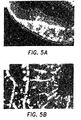
- FIG. 5 Flk-1 gene expression in the brain of the developing mouse. In situ hybridization analysis of Flk-1 gene expression in the brain at different developmental stages. All sections were probed with the Flk-1 antisense probe.
- A Sagittal section of the telencephalon of a day 11.5 mouse embryo. A single blood vessel expressing Flk-1, which sprouts from the meninges into the neuroectoderm, is indicated by an arrow.
- B Sagittal sections of the brain of embryo day 14.5 and (C) of postnatal day 4. Shown are regions of the mesencephalon. Branching capillaries and blood vessels expressing Flk-1 are indicated by an arrow.
- D Sagittal section of an adult brain; a region of the mesencephalon is shown. Cells expressing Flk-1 are indicated by an arrow. Abbreviations: M, meninges; V, ventricle;
- FIG. 6 Expression of Flk-1 in the choroid plexus of adult brain.
- A Darkfield illumination of the choroid plexus of an adult mouse brain hybridized with Flk-1 antisense probe.
- B Choroid plexus shown at a higher magnification. Arrows indicate single cells, which show strong expression of Flk-1. Abbreviations: CP, choroid plexus; E, ependyme; Ep, epithelial cells; V, ventricle.
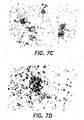
- FIG. 7 Flk-1 is expressed in the glomeruli of the kidney.
- A Parasagittal section of a 4-day postnatal kidney, hybridized with the Flk-1 antisense probe. Hybridization signal accumulates in the glomeruli, as . indicated by arrowheads.
- B Control hybridization of an adjacent section with the sense probe.
- C Sagittal section of an adult kidney probed with Flk-1. Arrowheads indicate glomeruli.
- D Glomerulus of an adult kidney at a higher magnification. The arrows in (A) and (D) indicate cells aligned in strands in the juxtaglomerular region expressing Flk-1.
- FIG. 8 In situ hybridization analysis of Flk-1 expression in early embryos and extraembryonic tissues.
- A Sagittal section of a day 8.5 mouse embryo in the maternal deciduum probed with Flk-1.
- B Higher magnification of the deciduum. Arrowheads indicate the endothelium of maternal blood vessels strongly expressing Flk-1 RNA.
- C High magnification of the yolk sac and the trophectoderm of a day 9.5 mouse embryo.
- D High magnification of a blood island.
- A allantois
- Bi blood island
- Bv maternal blood vessel
- D deciduum
- En endodermal layer of yolk sac
- M mesenchyme
- Ms mesodermal layer of yolk sac
- NF neural fold
- T trophoblast
- Y yolk sac.
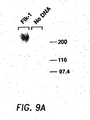
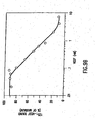
- Flk-1 is a receptor for VEGF.
- A Cross linking of 125 I-VEGF to COS cells transiently expressing the Flk-1 receptor and control cells were incubated with 125 I-VEGF at 4°C overnight, then washed twice with phosphate buffered saline (PBS) and exposed to 0.5 mM of the cross linking agent DSS in PBS for 1 hour at 4°C. The cells were lysed, Flk-1 receptor immunoprecipitated, and analyzed by polyacrylamide gel electrophoresis followed by autoradiography. Molecular size markers are indicated in kilodaltons.
- B Specific binding of 125 I-VEGF to COS cells expressing Flk-1.
- COS cells transiently expressing Flk-1 were removed from the plate and resuspended in binding medium (DMEM, 25 mM Hepes, 0.15% gelatin). Binding was performed at 15°C for 90 minutes in a total volume of 0.5 ml containing 2x10 5 cells, 15,000 cpm 125 I-VEGF, and the indicated concentrations of unlabeled ligand. The cells were washed twice with PBS / 0.1% BSA and counted in a gamma counter.
- binding medium DMEM, 25 mM Hepes, 0.15% gelatin
- FIG. 10 VEGF-induced autophosphorylation of Flk-1.
- COS cells transiently expressing Flk-1 receptor and control cells were starved for 24 hours in DMEM containing 0.5% fetal calf serum and then stimulated with VEGF for 10 minutes as indicated.
- the cells were solubilized, Flk-1 receptor immunoprecipitated with a polyclonal antibody against its C-terminus, separated by polyacrylamide gel electrophoresis, and transferred to nitrocellulose.
- the blot was probed with antiphosphotyrosine antibodies (5B2).
- the protein bands were visualized by using a horseradish-peroxidase coupled secondary antibody and BCLTM (Amersham) detection assay.
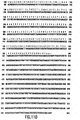
- FIG. 11 Nucleotide Sequence of Murine Flk-1.
- FIG. 12 Plasmid Maps of retroviral vector constructs.
- pLXSN Flk-1 TM Cl.1 and pLXSN Flk-1 TM cl.3 contain Flk-1 amino acids 1 through 806.
- pNTK-cfms-TM contains the 541 N-terminal amino acids of c-fms.
- FIG. 13 Inhibition of C6 glioblastoma tumor growth by transdominant-negative inhibition of Flk-1.
- C6 cells were implanted either alone or coimplanted with virus-producing cells. Cell numbers are as indicated in each panel. Two different virus-producing cells lines were used: one expressing the Flk-1 TM (transdominant-negative) mutant and one expressing a transdominant-negative c-fms mutant (c-fms TM) as a control. Beginning at the time when the first tumors appeared, tumor volumes were measured every 2 to 3 days to obtain a growth curve. Each group is represented by four mice.
- FIG. 14 Inhibition of C6 glioblastoma tumor growth by transdominant-negative inhibition of Flk-1.
- C6 cells were implanted either alone or coimplanted with virus-producing cells. Cell numbers are as indicated in each panel. Two different virus-producing cell lines were used: one expressing the Flk-1 TM (transdominant-negative) mutant and one expressing a transdominant-negative c-fms mutant (cfms TM) as a control. Beginning at the time when the first tumor appeared, tumor volumes were measured every 2 to 3 days to obtain growth curve. Each group is represented by four mice.
- the present invention relates to the use of recombinant vectors containing a nucleotide sequence encoding a flk-1 receptor having a mutation in the cytoplasmatic kinase domain to modulate angiogenesis and/or vasculogenesis.
- the invention is based, in part, on results from in situ -hybridization and Northern blot analyses indicating that Flk-1 is an endothelial cell specific RTK.
- cross-linking experiments have shown Flk-1 to be a high affinity receptor for vascular endothelial growth factor (VEGF), indicating that Flk-1 plays a crucial role in the development and differentiation of hemangioblast and in subsequent endothelial cell growth during vasculogenesis and angiogenesis.
- VEGF vascular endothelial growth factor
- the invention is based, on the discovery that expression of a transdominant-negative mutant form of the Flk-1 molecule can inhibit the biological activity of the endogenous wild type Flk-1.
- Experiments are descirbed herein, in which tumor cells and cells producing a recombinant retrovirus encoding a truncated Flk-1 receptor were mixed and injected into mice. Inhibition of vasculogenesis and growth of the injected tumor cells was observed in mice expressing the nestated form of the Flk-1 receptor.
- Expression of transdominant negative forms of the Flk-1 molecule may be useful for treatment of diseases resulting from abnormal proliferation of blood vessels, such as rheumatoid arthritis, retinopathies and growth of solid tumors.
- PCR polymerase chain reaction
- the nucleotide coding sequence and deduced amino acid sequence of the murine Flk-1 gene is depicted in Figure 11 (SEQ. ID NO. 1) and has recently been described in Matthews et al., 1991, Proc. Natl. Acad. Sci. U.S.A., 88:9026-9030.
- the nucleotide sequence of the Flk-1 protein or its functional equivalent in mammals, including humans can be used to generate recombinant molecules which direct the expression of Flk-1; hereinafter, this receptor will be referred to as "Flk-1", regardless of the species from which it is derived.
- the murine Flk-1 gene was isolated by performing a polymerase chain reaction (PCR) using two degenerate oligonucleotide primer pools that were designed on the basis of highly conserved sequences within the kinase domain of receptor tyrosine kinases (Hanks et al., 1988,)
- PCR polymerase chain reaction
- primer pools that were designed on the basis of highly conserved sequences within the kinase domain of receptor tyrosine kinases (Hanks et al., 1988,)
- DNA from a ⁇ gt10 cDNA library prepared from day 8.5 mouse embryos was used.
- similar primers were used to amplify RTK cDNA sequences from capillary endothelial cells that had been isolated from the brains of post-natal day 4-8 mice. This is a time when brain endothelial cell proliferation is maximal.
- the invention also relates to Flk-1 genes isolated from other species, including humans, in which Flk-1 activity exists.
- Flk-1 family are defined herein as those receptors that bind VEGF or fragments of the peptide. Such receptors may demonstrate about 80% homology at the amino acid level in substantial stretches of DNA sequence.
- a bacteriophage cDNA library may be screened, under conditions of reduced stringency, using a radioactively labeled fragment of the mouse Flk-1 clone.
- the mouse Flk-1 sequence can be used to design degenerate or fully degenerate oligonucleotide probes which can be used as PCR probes or to screen bacteriophage cDNA libraries.
- a polymerase chain reaction (PCR) based strategy may be used to clone human Flk-1.
- Two pools of degenerate oligonucleotides, corresponding to a conserved motifs between the mouse Flk-1 and receptor tyrosine kinases, may. be designed to serve as primers in a PCR reaction.
- the template for the reaction is cDNA obtained by reverse transcription of mRNA prepared from cell lines or tissue known to express human Flk-1.
- the PCR product may be subcloned and sequenced to insure that the amplified sequences represent the Flk-1 sequences.
- the PCR fragment may be used to isolate a full length Flk-1 cDNA clone by radioactively labeling the amplified fragment and screening a bacteriophage cDNA library.
- the labeled fragment may be used to screen a genomic library.
- cloning strategies which may be used, see e.g. , Maniatis, 1989, Molecular Cloning, A Laboratory Manual, Cold Springs Harbor Press, N.Y.; and Ausubel et al., 1989, Current Protocols in Molecular Biology, (Green Publishing Associates and Wiley Interscience, N.Y.)
- Isolation of a human Flk-1 cDNA may also be achieved by construction of a cDNA library in a mammalian expression vector such as pcDNA1, that contains SV40 origin of replication sequences which permit high copy number expression of plasmids when transferred into COS cells.
- the expression of Flk-1 on the surface of transfected COS cells may be detected in a number of ways, including the use of a labeled ligand such as VEGF or a VEGF agonist labeled with a radiolabel, fluorescent label or an enzyme.
- Cells expressing the human Flk-1 may be enriched by subjecting transfected cells to a FACS (fluorescent activated cell sorter) sort.
- FACS fluorescent activated cell sorter
- Flk-1 nucleotide sequences which encode Flk-1, peptide fragments of Flk-1, Flk-1 fusion proteins or functional equivalents thereof may be used to generate recombinant DNA molecules according to the invention in appropriate host cells.
- nucleotide sequences which hybridize to portions of the Flk-1 sequence may also be used in nucleic acid hybridization assays, Southern and Northern blot analyses, etc.
- DNA sequences which encode substantially the same or a functionally equivalent amino acid sequence, may be used in the practice of the invention for the cloning and expression of the Flk-1 protein.
- DNA sequences include those which are capable of hybridizing to the murine Flk-1 sequence under stringent conditions.
- Altered DNA sequences which may be used in accordance with the invention include deletions, additions or substitutions of different nucleotide residues resulting in a sequence that encodes the same or a functionally equivalent gene product.
- the gene product itself may contain deletions, additions or substitutions of amino acid residues within the Flk-1 sequence, which result in a silent change thus producing a functionally equivalent Flk-1.
- Such amino acid substitutions may be made on the basis of similarity in polarity, charge, solubility, hydrophobicity, hydrophilicity, and/or the amphipatic nature of the residues involved.
- negatively charged amino acids include aspartic acid and glutamic acid; positively charged amino acids include lysine and arginine; amino acids with uncharged polar head groups having similar hydrophilicity values include the following: leucine, isoleucine, valine; glycine, analine; asparagine, glutamine; serine, threonine; phenylalanine, tyrosine.
- a functionally equivalent Flk-1 refers to a receptor which binds to VEGF or fragments, but not necessarily with the same binding affinity of its counterpart native Flk-1.
- the DNA sequences of the invention may be engineered in order to alter the Flk-1 coding sequence for a variety of ends including but not limited to alterations which modify processing and expression of the gene product.
- mutations may be introduced using techniques which are well. known in the art, e.g. site-directed mutagenesis, to insert new restriction sites, to alter glycosylation patterns, phosphorylation, etc.
- host cells may over glycosylate the gene product.
- the coding sequence of Flk-1 could be synthesized in whole or in part, using chemical methods well known in the art. See, for example, Caruthers, et al., 1980, Nuc. Acids Res. Symp. Ser. 7:215-233; Crea and Horn, 180, Nuc. Acids Res. 9 (10):2331; Matteucci and Caruthers, 1980, Tetrahedron Letters 21:719; and Chow and Kempe, 1981, Nuc. Acids Res. 9(12):2807-2817.
- the protein itself could be produced using chemical methods to synthesize the Flk-1 amino acid sequence in whole or in part.
- peptides can be synthesized by solid phase techniques, cleaved from the resin, and purified by preparative high performance liquid chromatography.
- the composition of the synthetic peptides may be confirmed by amino acid analysis or sequencing (e.g. , the Edman degradation procedure; see Creighton, 1983, Proteins, Structures and Molecular Principles, W.H. Freeman and Co., N.Y., pp. 34-49.
- the nucleotide sequence coding for Flk-1 is inserted into an appropriate expression vector, i.e. , a vector which contains the necessary elements for the transcription and translation of the inserted coding sequence.
- an appropriate expression vector i.e. , a vector which contains the necessary elements for the transcription and translation of the inserted coding sequence.
- the Flk-1 gene products as well as host cells or cell lines transfected or transformed with recombinant Flk-1 expression vectors can be used for a variety of purposes. These include but are not limited to generating antibodies ( i.e.
- a variety of host-expression vector systems may be utilized to express the Flk-1 coding sequence. These include but are not limited to microorganisms such as bacteria transformed with recombinant bacteriophage DNA, plasmid DNA or cosmid DNA expression vectors containing the Flk-1 coding sequence; yeast transformed with recombinant yeast expression vectors containing the Flk-1 coding sequence; insect cell systems infected with recombinant virus expression vectors (e.g. , baculovirus) containing the Flk-1 coding sequence; plant cell systems infected with recombinant virus expression vectors (e.g.
- plasmid expression vectors e.g. , Ti plasmid
- animal cell systems infected with recombinant virus expression vectors e.g. , adenovirus, vaccinia virus
- cell lines engineered to contain multiple copies of the Flk-1 DNA either stably amplified (CHO/dhfr) or unstably amplified in double-minute chromosomes ( e.g. , murine cell lines).
- any of a number of suitable transcription and translation elements may be used in the expression vector.
- inducible promoters such as pL of bacteriophage ⁇ , plac, ptrp, ptac (ptrp-lac hybrid promoter) and the like may be used;
- promoters such as the baculovirus polyhedrin promoter may be used;
- promoters derived from the genome of plant cells e.g.
- heat shock promoters may be used; when cloning in mammalian cell systems, promoters derived from the genome of mammalian cells (e.g. , metallothionein promoter) or from mammalian viruses (e.g.
- the adenovirus late promoter may be used; when generating cell lines that contain multiple copies of the Flk-1 DNA SV40-, BPV- and EBV-based vectors may be used with an appropriate selectable marker.
- a number of expression vectors may be advantageously selected depending upon the use intended for the Flk-1 expressed.
- vectors which direct the expression of high levels of fusion protein products that are readily purified may be desirable.
- Such vectors include but are not limited to the E. coli expression vector pUR278 (Ruther et al., 1983, EMBO J. 2:1791), in which the Flk-1 coding sequence may be ligated into the vector in frame with the lac Z coding region so that a hybrid AS-lac Z protein is produced; pIN vectors (Inouye & Inouye, 1985, Nucleic acids Res.
- pGEX vectors may also be used to express foreign polypeptides as fusion proteins with glutathione S-transferase (GST).
- GST glutathione S-transferase
- fusion proteins are soluble and can easily be purified from lysed cells by adsorption to glutathione-agarose beads followed by elution in the presence of free glutathione.
- the pGEX vectors are designed to include thrombin or factor Xa protease cleavage sites so that the cloned polypeptide of interest can be released from the GST moiety.
- yeast a number of vectors containing constitutive or inducible promoters may be used.
- Current Protocols in Molecular Biology Vol. 2, 1988, Ed. Ausubel et al., Greene Publish. Assoc. & Wiley Interscience, Ch. 13; Grant et al., 1987, Expression and Secretion Vectors for Yeast, in Methods in Enzynology, Eds. Wu & Grossman, 1987, Acad. Press, N.Y., Vol. 153, pp. 516-544; Glover, 1986, DNA Cloning, Vol. II, IRL Press, Wash., D.C., Ch.
- the expression of the Flk-1 coding sequence may be driven by any of a number of promoters.
- viral promoters such as the 35S RNA and 19S RNA promoters of CaMV (Brisson et al., 1984, Nature 310:511-514), or the coat protein promoter of TMV (Takamatsu et al., 1987, EMBO J. 3:17-311) may be used; alternatively, plant promoters such as the small subunit of RUBISCO (Coruzzi et al., 1984, EMBO J. 3:1671-1680; Broglie et al., 1984, Science 224:838-843); or heat shock promoters, e.g.
- soybean hsp17.5-E or hsp17.3-B may be used. These constructs can be introduced into plant cells using Ti plasmids, Ri plasmids, plant virus vectors, direct DNA transformation, microinjection, electroporation, etc.
- Ti plasmids Ri plasmids
- plant virus vectors direct DNA transformation, microinjection, electroporation, etc.
- Grierson & Corey 1988, Plant Molecular Biology, 2d Ed., Blackie, London, Ch. 7-9.
- Flk-1 An alternative expression system which could be used to express Flk-1 is an insect system.
- Autographa californica nuclear polyhidrosis virus (AcNPV) is used as a vector to express foreign genes.
- the virus grows in Spodoptera frugiperda cells.
- the Flk-1 coding sequence may be cloned into non-essential regions (for example the polyhedrin gene) of the virus and placed under control of an AcNPV promoter (for example the polyhedrin promoter).
- Successful insertion of the Flk-1 coding sequence will result in inactivation of the polyhedrin gene and production of non-occluded recombinant virus (i.e. , virus lacking the proteinaceous coat coded for by the polyhedrin gene).
- the Flk-1 coding sequence may be ligated to an adenovirus transcription/translation control complex, e.g. , the late promoter and tripartite leader sequence.
- This chimeric gene may then be inserted in the adenovirus genome by in vitro or in vivo recombination. Insertion in a non-essential region of the viral genome (e.g. , region E1 or E3) will result in a recombinant virus that is viable and capable of expressing Flk-1 in infected hosts.
- a non-essential region of the viral genome e.g. , region E1 or E3
- the vaccinia 7.5K promoter may be used. (See, e.g. , Mackett et al., 1982, Proc. Natl. Acad. Sci. (USA) 79:7415-7419; Mackett et al., 1984, J. Virol. 49:857-864; Panicali et al., 1982, Proc. Natl. Acad. Sci. 79:4927-4931).
- Specific initiation signals may also be required for efficient translation of inserted Flk-1 coding sequences. These signals include the ATG initiation codon and adjacent sequences. In cases where the entire Flk-1 gene, including its own initiation codon and adjacent sequences, is inserted into the appropriate expression vector, no additional translational control signals may be needed. However, in cases where only a portion of the Flk-1 coding sequence is inserted, exogenous translational control signals, including the ATG initiation codon, must be provided. Furthermore, the initiation codon must be in phase with the reading frame of the Flk-1 coding sequence to ensure translation of the entire insert. These exogenous translational control signals and initiation codons can be of a variety of origins, both natural and synthetic. The efficiency of expression may be enhanced by the inclusion of appropriate transcription enhancer elements, transcription terminators, etc. (see Bittner et al., 1987, Methods in Enzymol. 153:516-544).
- a host cell strain may be chosen which modulates the expression of the inserted sequences, or modifies and processes the gene product in the specific fashion desired. Such modifications (e.g. , glycosylation) and processing (e.g. , cleavage) of protein products may be important for the function of the protein.
- Different host cells have characteristic and specific mechanisms for the post-translational processing and modification of proteins. Appropriate cells lines or host systems can be chosen to ensure the correct modification and processing of the foreign protein expressed.
- eukaryotic host cells which possess the cellular machinery for proper processing of the primary transcript, glycosylation, and phosphorylation of the gene product may be used.
- mammalian host cells include but are not limited to CHO, VERO, BHK, HeLa, COS, MDCK, 293, WI38, etc.
- cell lines which stably express the Flk-1 may be engineered.
- host cells can be transformed with the Flk-1 DNA controlled by appropriate expression control elements (e.g. , promoter, enhancer, sequences, transcription terminators, polyadenylation sites, etc.), and a selectable marker.
- expression control elements e.g. , promoter, enhancer, sequences, transcription terminators, polyadenylation sites, etc.
- engineered cells may be allowed to grow for 1-2 days in an enriched media, and then are switched to a selective media.
- the selectable marker in the recombinant plasmid confers resistance to the selection and allows cells to stably integrate the plasmid into their chromosomes and grow to form foci which in turn can be cloned and expanded into cell lines.
- This method may advantageously be used to engineer cell lines which express the Flk-1 on the cell surface, and which respond to VEGF mediated signal transduction. Such engineered cell lines are particularly useful in screening VEGF analogs.
- a number of selection systems may be used, including but not limited to the herpes simplex virus thymidine kinase (Wigler, et al., 1977, Cell 11:223), hypoxanthine-guanine phosphoribosyltransferase (Szybalska & Szybalski, 1962, Proc. Natl. Acad. Sci. USA 48:2026), and adenine phosphoribosyltransferase (Lowy, et al., 1980, Cell 22:817) genes can be employed in tk - , hgprt - or aprt - cells, respectively.
- antimetabolite resistance can be used as the basis of selection for dhfr, which confers resistance to methotrexate (Wigler, et al., 1980, Natl. Acad. Sci. USA 77:3567; O'Hare, et al., 1981, Proc. Natl. Acad. Sci. USA 78:1527); gpt, which confers resistance to mycophenolic acid (Mulligan & Berg, 1981), Proc. Natl. Acad. Sci. USA 78:2072); neo, which confers resistance to the aminoglycoside G-418 (Colberre-Garapin, et al., 1981, J. Mol. Biol.
- hygro which confers resistance to hygromycin (Santerre, et al., 1984, Gene 30:147) genes.
- trpB which allows cells to utilize indole in place of tryptophan
- hisD which allows cells to utilize histinol in place of histidine
- ODC ornithine decarboxylase
- the host cells which contain the coding sequence and which express the biologically active gene product may be identified by at least four general approaches; (a) DNA-DNA or DNA-RNA hybridization; (b) the presence or absence of "marker" gene functions; (c) assessing the level of transcription as measured by the expression of Flk-1 mRMA transcripts in the host cell; and (d) detection of the gene product as measured by immunoassay or by its biological activity.
- the presence of the Flk-1 coding sequence inserted in the expression vector can be detected by DNA-DNA or DNA-RNA hybridization using probes comprising nucleotide sequences that are homologous to the Flk-1 coding sequence, respectively, or portions or derivatives thereof.
- the recombinant expression vector/host system can be identified and selected based upon the presence or absence of certain "marker" gene functions (e.g. , thymidine kinase activity, resistance to antibiotics, resistance to methotrexate, transformation phenotype, occlusion body formation in baculovirus, etc.).
- certain "marker" gene functions e.g. , thymidine kinase activity, resistance to antibiotics, resistance to methotrexate, transformation phenotype, occlusion body formation in baculovirus, etc.
- a marker gene can be placed in tandem with the Flk-1 sequence under the control of the same or different promoter used to control the expression of the Flk-1 coding sequence. Expression of the marker in response to induction or selection indicates expression of the Flk-1 coding sequence.
- transcriptional activity for the Flk-1 coding region can be assessed by hybridization assays.
- RNA can be isolated and analyzed by Northern blot using a probe homologous to the Flk-1 coding sequence or particular portions thereof.
- total nucleic acids of the host cell may be extracted and assayed for hybridization to such probes.
- the expression of the Flk-1 protein product can be assessed immunologically, for example by Western blots, immunoassays such as radioimmuno-precipitation, enzyme-linked immunoassays and the like.
- the ultimate test of the success of the expression system involves the detection of the biologically active Flk-1 gene product.
- a number of assays can be used to detect receptor activity including but not limited to VEGF binding assays; and VEGF biological assays using engineered cell lines as the test . substrate.
- Angiogenesis the growth of new blood capillary vessels, is required for a number of physiological processes ranging from wound healing, tissue and organ regeneration, placental formation after pregnancy and embryonic development. Abnormal proliferation of blood vessels is an important component of a variety 'of diseases such as rheumatoid arthritis, retinopathies, and psoriasis. Angiogenesis is also an important factor in the growth and metastatic activity of solid tumors that rely on vascularization. Therefore, inhibitors of angiogenesis may be used therapeutically for the treatment of diseases resulting from or accompanied by abnormal growth of blood vessels and for treatments of malignancies involving growth and spread of solid tumors.
- Receptor dimerization induced by ligands is thought to provide an allosteric regulatory signal that functions to couple ligand binding to stimulation of kinase activity.
- Defective receptors can function as dominant negative mutations by suppressing the activation and response of normal receptors by formation of unproductive heterodimers. Therefore, defective receptors can be engineered into recombinant viral vectors and used in gene therapy in individuals that inappropriately express Flk-1.
- mutant forms of the Flk-1 molecule having a dominant negative effect may be identified by expression in selected cells.
- Deletion or missense mutants of Flk-1 that retain the ability to form dimers with wild type Flk-1 protein but cannot function in signal transduction may be used to inhibit the biological activity of the endogenous wild type Flk-1.
- the cytoplasmic kinase domain of Flk-1 may be deleted resulting in a truncated Flk-1 molecule that is still able to undergo dimerization with endogenous wild type receptors but unable to transduce a signal.
- Recombinant viruses may be engineered to express dominant negative forms of Flk-1 which may be used to inhibit the activity of the wild type endogenous Flk-1. These viruses may be used therapeutically for treatment of diseases resulting from aberrant expression or activity of Flk-1.
- Expression vectors derived from viruses such as retroviruses, vaccinia virus, adeno-associated virus, herpes viruses, or bovine papilloma virus may be used for delivery of recombinant Flk-1 into the targeted cell population.
- viruses such as retroviruses, vaccinia virus, adeno-associated virus, herpes viruses, or bovine papilloma virus.
- Methods which are well known to those skilled in the art can be used to construct recombinant viral vectors containing Flk-1 coding sequence. See, for example, the techniques described in Maniatis et al., 1989, Molecular Cloning A Laboratory Manual, Cold Spring Harbor Laboratory, N.Y. and Ausubel et al., 1989, Current Protocols in Molecular-Biology, Greene Publishing Associates and Wiley Interscience, N.Y.
- recombinant Flk-1 molecules can be reconstituted into liposomes for delivery to target cells.
- a deletion mutant of the Flk-1 receptor was engineered into a recombinant retroviral vector.
- Two clonal isolates designated pLXSN Flk-1 TM cl.1 and pLXSN Flk-1 TM cl.3 contain a truncated Flk-1 receptor lacking the 561 COOH-terminal amino acids.
- PA37 cells were transfected with the recombinant vectors and, subsequently, conditioned media containing virus were used to infect GPE cells.
- C6 rat gliobastoma cells tumor cells
- mouse cells producing the recombinant retroviruses
- Flk-1 is believed to be essential for formation of blood vessels
- blocking Flk-1 activity by expression of a truncated receptor might function to inhibit vascularization of the developing tumor and, thereby, inhibit its growth.
- coinjection of virus producing cells, expressing a truncated Flk-1 receptor significantly inhibits the growth of the tumor as compared to controls receiving only tumor cells.
- DNA extracted from ⁇ gt10 cDNA library of day 8.5 mouse embryos was used as template for polymerase chain reaction (PCR; Saiki, R.K. et al., 1985 Science 230:1350-1354).
- PCR polymerase chain reaction
- cDNA of capillary endothelial cells that had been isolated from the brain of postnatal day 4-8 mice was used for amplification (Risau, W., 1990 In: development of the Vascular system. Issues Biomed.
- Full length cDNA clones of Flk-1 were isolated from another day 8.5 mouse embryo cDNA library, which had been prepared according to the method of Okayama and Berg (1983), and a day 11.5 mouse embryo ⁇ gt11 library (Clonetech) using the 32 P-labeled (Feinberg, A.P. and Vogelstein, B. 1983 Anal. Biochen. 132:6-13) 210-bp PCR fragment.
- mice were mated overnight and the morning of vaginal plug detection was defined as 1/2 day of gestation.
- For Northern blot analysis the frozen embryos were homogenized in 5 M guanidinium thiocyanate and RNA was isolated as described (Ullrich, A. et al., 1985, Nature 313:756-761).
- RNA was isolated as described (Ullrich, A. et al., 1985, Nature 313:756-761).
- Tissue-Tek Tissue-Tek
- the 5'-located, 2619 bp of the receptor cDNA were. subcloned in the pGem3Z vector (Promega) as an EcoR1/BamH1 fragment.
- the probe for Northern blot hybridization was prepared by labelling the cDNA fragment with ⁇ - 32 PdATP (Amersham) by random hexanucleotide priming (Boehringer; Feinberg, A.P. and Vogelstein, B., 1983 Anal. Biochem. 132:6-13).
- RNA transcript was partially hydrolyzed in 100 mM NaOH for 20 minutes at 70°C, and the probe was neutralized with the same amount of HCl and purified with a Sephadex C50 column. After ethanol precipitation the probe was dissolved at a final specific activity of 5x10 5 cpm.
- a sense probe was prepared with the same method.
- cytoplasmic RNA was isolated according to the acidic phenol-method of Chromczynski and Sacchi (1987). Poly(A + ) RNA aliquots were electrophoresed in 1.2% agarose formaldehyde (Sambrook, J. et al., 1989 Molecular Cloning: A Laboratory Manual 2nd ed.
- Subcloning postfixation and hybridization was essentially performed according to Hogan et al. (1986). 10 ⁇ m thick sections were cut at -18°C on a Leitz cryostat. For prehybridization treatment no incubation with 0.2M HCl for removing the basic proteins was performed.
- Sections were incubated with the 35 S-cDNA probe (5x10 4 cpm/ ⁇ l) at 52°C in a buffer containing 50% formamide, 300 mM NuCl, 10 mM Tris-HCl, 10 mM NaPO 4 (pH 6.8), 5 mM EDTA, 0.02% Ficoll 400, 0.01% polyvinylprolidone 0.02% BSA 10 m /ml yeast RNA, 10% dextran sulfate, and 10 mM NaCl, 10 mM Tris-HCl, 10 mM NaPO 4 (pH 6.8), 5 mM EDTA, 10 Mm DTT at 52°C).
- slides were coated with Kodak NTB2 film emulsion and exposed for eight days. After developing, the sections were counterstained and toluidine blue or May-Grinwald.
- the 3' primed EcoRV/HindII fragment comprising the 128 C-terminal amino acids of Flk-1 was subcloned in the fusion protein expression vector pGEX3X (Smith, D.B. and Johnson, K.S., 1990 Gene. 67:31-40; Pharmacia).
- the fusion protein was purified as described and used for immunizing rabbits. After the second boost the rabbits were bled and the antiserum was used for immunoprecipitation.
- 20 ⁇ g of receptor cDNA cloned into a cytomegalovirus promotor driven expression vector was mixed in 0.5 ml of 0.25 M CaCa 2 , 0.5 ml of 2 x BBS (280 mM NaCl, 1.5 mM Na 2 HPO 4 , 50 mM BES, pH 6.96 and incubated for 30 min at room temperature.
- the calcium phosphate/DNA solution was then added to the cells, swirled gently, and incubated for 18 hours at 37°C under 3% CO 2 .
- the cells were removed from the plate and treated as described below.
- VEGF conditioned media cells were transfected in 15-cm dishes. Media was collected after 48 h and VEGF was partially purified by affinity chromatography using heparin High Trap TM columns (Pharmacia) and concentrated by ultrafiltration (Ferrara, N. and Henzel, W.J. 1989 Biochem. Biophys. Res. Comm. 161:851-858). The concentration of VEGF was determined by a ligand competition assay with bovine aortic endothelial cells.
- Recombinant human VEGF (5 ⁇ g; generously provided by Dr. H. Weich) was dissolved in 110 ⁇ l sodium phosphate buffer pH 76, and iodinated by the procedure of Hunter and Greenwood (1962). The reaction products were separated from the labeled protein by passage over a sephadex G50 column, pre-equilibrated with phosphate buffered saline (PBS) containing 0.7% bovine serum albumin (BSA), and aliquots of the collected fractions were counted before and after precipitation with 20% trichloracetic acid. The purity of the iodinated product was estimated to be superior to 90%, as determined by gel electrophoresis, and the specific activity was 77000 cpm/ng. The bioactivity of the iodinated VEGF was confirmed by comparison with the bioactivities of native VEGF using the tissue factor introduction assay described by Clauss, M. et al. (1990 J. Exp. Med. 172:1535-1545).
- COS-1 cells transiently expressing Flk-1 and untransfected COS-1 cells were incubated with 200 pM 125 I-VEGF at 4°C overnight, then washed twice with PBS and exposed to 0.5 mM disuccinimidyl suberate (DSS) in PBS for 1 h at 4°C.
- DSS disuccinimidyl suberate
- the cells were lysed, Flk-1 immunoprecipitated, and analyzed by electrophoresis on a 7% polytarcylamide gel followed by autoradiography.
- this cell suspension was incubated for 90 min at 15°C with 10 pM 125 I-VEGF, and increasing concentration of unlabeled ligand (from 0 to 7 x 10 -9 ), which was partially purified from conditioned media of COS-1 cells transiently expressing VEGF (164 amino acid form; Breier et al., 1992). After incubation, cells were washed with PBS 0.1% PBS in the cold. Free ligand was removed by repeated centrifugation and resuspension in binding buffer. Finally, the 125 I radioactivity bound to the cells were determined in a gamma counter (Riastar). Data obtained were analyzed by the method of Munson, P.J. and Rodbard, D. (1980 Anal. Biochem. 107:220-235).
- Recombinant retroviral vectors were constructed that contained the coding region for amino acids 1 through 806 of the Flk-1 receptor (pLX Flk-1 cl.1 and cl.3, Figure 12).
- a recombinant virus containing a truncated c-fms receptor mutant (pNTK cfms TM cl.7) was used as a control.
- mouse GPE cells were infected with amphotrophic virus-containing conditioned media of PA317 cells that had been transfected with recombinant retroviral DNA.
- C6 gliobastoma tumor cells were implanted into nude mice either alone or coimplanted with virus producing cells. Injected cell numbers for the two sets of experiments are indicated below.
- tumor volumes were measured every 2 to 3 days to obtain a growth curve.
- Experiment No. 1 Number of Mice Number of C6 Cells Virus-Producer Cell Line Number of Virus-Cells 4 5 x 10 5 pLXSN Flk-1 TM cl.3 1 x 10 7 4 5 x 10 5 None 0 4 5 x 10 5 pNTK cfms TM cl.7 5 x 10 6
- this receptor is a member of the type III subclass of RTKs (Ullrich, A. and Schlessinger, J. 1990, Cell 61:203-212) and is closely related to human flt , which also contains seven immunoglobin-like repeats in its extracellular domain in contrast to other RTKs of that subfamily, which contain only five such repeat structures (Matthews, W. et al., 1991, Proc. Natl. Acad Sci. U.S.A. 88:9026-9030). Sequence comparisons of Flk-1 with KDR (Terman, B.I.
- the neuroectoderm in the telencephalon of a day 11.5 mouse embryo is largely avascular; the first vascular sprouts begin to radially invade the organ originating from the perineural vascular plexus (Bär, J., 1980, Adv. Anat. Embryol. Cell. Biol. 59:1-62; Risau, W. and Lemmon, V. 1988, Dev. Biol. 125:441-450).
- expression of Flk-1 was high in the perineural vascular plexus and in invading vascular sprouts, as shown in Figure 5A.
- the full-length Flk-1 cDNA was cloned into the mammalian expression vector pCMV, which contains transcriptional control elements of the human cytomegalovirus (Gorman, C.M. et al., 1989, Virology 171:377-385).
- the Flk-1 expressing plasmid was then transfected into COS-1 fibroblasts.
- VEGF vascular endothelial growth factor
- Flk-1 RTK Flk-1 RTK Specific binding of VEGF to the Flk-1 RTK was demonstrated by crosslinking and competition binding experiments.
- Purified 125 I-labeled VEGF was incubated with COS-1 cells transfected with the pCMV-Flk-1 expression vector.
- Crosslinking with DSS and subsequent analysis of immunoprecipitation, PAGE, and autoradiography revealed an approximately 220 kD band which was not detected in the control experiment with untransfected COS-1 cells and is likely to represent the VEGF/Flk-1 receptor complex (Figure 9A).
- VEGF competed with 125 I-VEGF binding to Flk-1 expressing COS-1 cells ( Figure 9B), whereas untransfected COS-1 cells did not bind 125 I-VEGF.
- the Flk-1 receptor is believed to play a major role in vasculogenesis and angiogenesis. Therefore, inhibition of Flk-1 activity may inhibit vasculogenesis of a developing tumor and inhibit its growth.
- tumor cells C6 rat glioblastoma
- mouse cells producing a recombinant retrovirus encoding a truncated Flk-1 receptor were mixed and implanted subcutaneously into nude mice.
- the implanted C6 glioblastoma cells secrete VEGF which will bind to and activate the Flk-1 receptors expressed on the surface of mouse endothelial cells.
- the endothelial cells will proliferate and migrate towards the tumor cells.
- the tumor cells are co-injected with cells producing recombinant retrovirus encoding the dominant-negative Flk-1
- the endothelial cells growing towards the implanted tumor cells will become infected with recombinant retrovirus which may result in dominant-negative Flk-1 mutant expression and inhibition of endogenous Flk-1 signaling. Suppression of endothelial cell proliferation and migration will result in failure of the implanted tumor cells to become vascularized which will lead to inhibition of tumor growth.
- tumor growth is significantly inhibited in mice receiving implantations of cells producing truncated Flk-1 indicating that expression of a truncated Flk-1 receptor can act in a dominant-negative manner to inhibit the activity of endogenous wild-type Flk-1.
Landscapes
- Health & Medical Sciences (AREA)
- Chemical & Material Sciences (AREA)
- Organic Chemistry (AREA)
- Life Sciences & Earth Sciences (AREA)
- Medicinal Chemistry (AREA)
- General Health & Medical Sciences (AREA)
- Engineering & Computer Science (AREA)
- Immunology (AREA)
- Public Health (AREA)
- Veterinary Medicine (AREA)
- Biomedical Technology (AREA)
- Animal Behavior & Ethology (AREA)
- Pharmacology & Pharmacy (AREA)
- Epidemiology (AREA)
- Molecular Biology (AREA)
- Urology & Nephrology (AREA)
- Hematology (AREA)
- Biochemistry (AREA)
- Cell Biology (AREA)
- Pathology (AREA)
- Bioinformatics & Cheminformatics (AREA)
- Toxicology (AREA)
- Biotechnology (AREA)
- General Physics & Mathematics (AREA)
- Microbiology (AREA)
- Analytical Chemistry (AREA)
- Food Science & Technology (AREA)
- Physics & Mathematics (AREA)
- Tropical Medicine & Parasitology (AREA)
- Proteomics, Peptides & Aminoacids (AREA)
- Chemical Kinetics & Catalysis (AREA)
- Nuclear Medicine, Radiotherapy & Molecular Imaging (AREA)
- Biophysics (AREA)
- Genetics & Genomics (AREA)
- General Chemical & Material Sciences (AREA)
- Gastroenterology & Hepatology (AREA)
- Zoology (AREA)
- Emergency Medicine (AREA)
- Medicines That Contain Protein Lipid Enzymes And Other Medicines (AREA)
- Micro-Organisms Or Cultivation Processes Thereof (AREA)
Claims (14)
- Vecteur recombinant comprenant une séquence de nucléotide qui encode un récepteur Flk-1 manquant le domaine kinase cytoplasmique C terminal dans lequel ledit récepteur Flk-1 présente une activité négative dominante qui inhibe les effets cellulaires de la liaison du VEGF (facteur de croissance endothélial vasculaire).
- Vecteur recombinant de la revendication 1, contenant une séquence de nucléotide codant les acides aminés de 1 à 806 de Flk-1 mais pas les acides aminés de 807 à 1367 de Flk-1.
- Vecteur recombinant comprenant une séquence de nucléotide qui code un récepteur Flk-1 ayant une mutation dans le domaine kinase cytoplasmique du récepteur Flk-1 dans lequel ledit récepteur Flk-1 présente une activité négative dominante qui inhibe les effets cellulaires de la liaison du VEGF (facteur de croissance endothélial vasculaire).
- Vecteur recombinant des revendications 1, 2 ou 3 dans lequel le vecteur est un vecteur viral.
- Vecteur recombinant de la revendication 4 dans lequel le vecteur viral est un vecteur rétroviral.
- Ligne de cellules modifiées qui contient le vecteur recombinant de la revendication 4.
- Ligne de cellules modifiées qui contient le vecteur recombinant de la revendication 5.
- Utilisation d'une quantité efficace des vecteurs recombinants des revendications 1, 2 ou 3 pour la préparation d'une composition pour moduler les effets cellulaires du VEGF chez un mammifère.
- Utilisation selon la revendication 8 dans laquelle les vecteurs sont reconstitués en liposomes.
- Utilisation d'une quantité efficace du vecteur recombinant de la revendication 4 pour la préparation d'une composition pour la modulation des effets cellulaires du VEGF chez un mammifère.
- Utilisation d'une quantité efficace du vecteur recombinant de la revendication 5 pour la préparation d'une composition pour la modulation des effets cellulaires du VEGF chez un mammifère.
- Utilisation d'une quantité efficace d'un récepteur Flk-1 tronqué pour la préparation d'une composition pour moduler les effets cellulaires du VEGF chez un mammifère dans laquelle ledit récepteur Flk-1 présente une activité négative dominante qui inhibe les effets cellulaires de la liaison du VEGF.
- Utilisation d'une quantité efficace d'un récepteur Flk-1 tronqué ayant une mutation dans le domaine kinase cytoplasmique du récepteur Flk-1 dans laquelle ledit récepteur Flk-1 présente une activité négative dominante qui inhibe les effets cellulaires de la liaison du VEGF.
- Utilisation selon la revendication 8 ou 9, dans laquelle le récepteur Flk-1 est reconstitué en liposomes.
Priority Applications (1)
| Application Number | Priority Date | Filing Date | Title |
|---|---|---|---|
| EP03009148A EP1378570B1 (fr) | 1992-11-13 | 1993-11-15 | Récepteur Flk-1 dominant négatif lié à la membrane du facteur de croissance vasculaire endothélial VEGF |
Applications Claiming Priority (5)
| Application Number | Priority Date | Filing Date | Title |
|---|---|---|---|
| US97575092A | 1992-11-13 | 1992-11-13 | |
| US975750 | 1992-11-13 | ||
| US3859693A | 1993-03-26 | 1993-03-26 | |
| US38596 | 1993-03-26 | ||
| PCT/EP1993/003191 WO1994011499A1 (fr) | 1992-11-13 | 1993-11-15 | Flk-1 UTILISE COMME RECEPTEUR POUR FACTEUR DE CROISSANCE ENDOTHELIAL VASCULAIRE |
Related Child Applications (1)
| Application Number | Title | Priority Date | Filing Date |
|---|---|---|---|
| EP03009148A Division EP1378570B1 (fr) | 1992-11-13 | 1993-11-15 | Récepteur Flk-1 dominant négatif lié à la membrane du facteur de croissance vasculaire endothélial VEGF |
Publications (2)
| Publication Number | Publication Date |
|---|---|
| EP0669978A1 EP0669978A1 (fr) | 1995-09-06 |
| EP0669978B1 true EP0669978B1 (fr) | 2003-04-23 |
Family
ID=26715366
Family Applications (2)
| Application Number | Title | Priority Date | Filing Date |
|---|---|---|---|
| EP94900810A Expired - Lifetime EP0669978B1 (fr) | 1992-11-13 | 1993-11-15 | Flk-1 UTILISE COMME RECEPTEUR POUR FACTEUR DE CROISSANCE ENDOTHELIAL VASCULAIRE |
| EP03009148A Expired - Lifetime EP1378570B1 (fr) | 1992-11-13 | 1993-11-15 | Récepteur Flk-1 dominant négatif lié à la membrane du facteur de croissance vasculaire endothélial VEGF |
Family Applications After (1)
| Application Number | Title | Priority Date | Filing Date |
|---|---|---|---|
| EP03009148A Expired - Lifetime EP1378570B1 (fr) | 1992-11-13 | 1993-11-15 | Récepteur Flk-1 dominant négatif lié à la membrane du facteur de croissance vasculaire endothélial VEGF |
Country Status (11)
| Country | Link |
|---|---|
| EP (2) | EP0669978B1 (fr) |
| JP (1) | JP4054373B2 (fr) |
| CN (2) | CN1701814A (fr) |
| AT (2) | ATE384791T1 (fr) |
| AU (1) | AU5562794A (fr) |
| CA (1) | CA2149298C (fr) |
| DE (2) | DE69332907T2 (fr) |
| DK (1) | DK0669978T3 (fr) |
| ES (2) | ES2300516T3 (fr) |
| PT (1) | PT669978E (fr) |
| WO (1) | WO1994011499A1 (fr) |
Families Citing this family (74)
| Publication number | Priority date | Publication date | Assignee | Title |
|---|---|---|---|---|
| US5965132A (en) * | 1992-03-05 | 1999-10-12 | Board Of Regents, The University Of Texas System | Methods and compositions for targeting the vasculature of solid tumors |
| US6749853B1 (en) | 1992-03-05 | 2004-06-15 | Board Of Regents, The University Of Texas System | Combined methods and compositions for coagulation and tumor treatment |
| US5877289A (en) * | 1992-03-05 | 1999-03-02 | The Scripps Research Institute | Tissue factor compositions and ligands for the specific coagulation of vasculature |
| US6004555A (en) * | 1992-03-05 | 1999-12-21 | Board Of Regents, The University Of Texas System | Methods for the specific coagulation of vasculature |
| PT627940E (pt) * | 1992-03-05 | 2003-07-31 | Univ Texas | Utilizacao de imunoconjugados para o diagnostico e/ou terapia de tumores vascularizados |
| US6036955A (en) * | 1992-03-05 | 2000-03-14 | The Scripps Research Institute | Kits and methods for the specific coagulation of vasculature |
| US6093399A (en) * | 1992-03-05 | 2000-07-25 | Board Of Regents, The University Of Texas System | Methods and compositions for the specific coagulation of vasculature |
| US5776427A (en) * | 1992-03-05 | 1998-07-07 | Board Of Regents, The University Of Texas System | Methods for targeting the vasculature of solid tumors |
| CA2158745C (fr) | 1993-03-25 | 2007-06-19 | Richard L. Kendall | Inhibiteur du facteur de croissance des cellules vasculaires endotheliales |
| US6811779B2 (en) | 1994-02-10 | 2004-11-02 | Imclone Systems Incorporated | Methods for reducing tumor growth with VEGF receptor antibody combined with radiation and chemotherapy |
| AUPM379394A0 (en) * | 1994-02-10 | 1994-03-03 | Ludwig Institute For Cancer Research | Immunointeractive molecules - i |
| US6448077B1 (en) | 1994-02-10 | 2002-09-10 | Imclone Systems, Inc. | Chimeric and humanized monoclonal antibodies specific to VEGF receptors |
| US5861499A (en) | 1994-02-10 | 1999-01-19 | Imclone Systems Incorporated | Nucleic acid molecules encoding the variable or hypervariable region of a monoclonal antibody that binds to an extracellular domain |
| US5840301A (en) * | 1994-02-10 | 1998-11-24 | Imclone Systems Incorporated | Methods of use of chimerized, humanized, and single chain antibodies specific to VEGF receptors |
| US7063840B2 (en) | 1994-10-07 | 2006-06-20 | Regeneron Pharmaceuticals, Inc. | TIE-2 ligands, methods of making and uses thereof |
| AU4606196A (en) * | 1994-12-23 | 1996-07-19 | Ludwig Institute For Cancer Research | Assay, receptor proteins and ligands |
| US5888765A (en) * | 1995-06-23 | 1999-03-30 | President And Fellows Of Harvard College | Endothelial-cell specific promoter |
| CA2225460A1 (fr) * | 1995-06-23 | 1997-01-09 | Winston Campbell Patterson | Regulation de la transcription de genes codant des recepteurs du facteur de croissance endotheliale vasculaire |
| ES2202469T5 (es) | 1995-09-08 | 2011-06-06 | Genentech, Inc. | Proteína relacionada con el vegf. |
| EP1408111B1 (fr) * | 1995-10-26 | 2010-06-09 | Sirna Therapeutics, Inc. | Procédé et réactif de traitement de maladies ou troubles liés aux niveaux du récepteur du facteur de croissance endothéliale vasculaire |
| US7034009B2 (en) | 1995-10-26 | 2006-04-25 | Sirna Therapeutics, Inc. | Enzymatic nucleic acid-mediated treatment of ocular diseases or conditions related to levels of vascular endothelial growth factor receptor (VEGF-R) |
| AU769175B2 (en) * | 1995-10-26 | 2004-01-15 | Chiron Corporation | Method and reagent for the treatment of diseases or conditions related to levels of vascular endothelial growth factor receptor |
| US6346398B1 (en) | 1995-10-26 | 2002-02-12 | Ribozyme Pharmaceuticals, Inc. | Method and reagent for the treatment of diseases or conditions related to levels of vascular endothelial growth factor receptor |
| AU1116297A (en) | 1995-11-08 | 1997-05-29 | Immunex Corporation | Flk-1 binding protein |
| US6994989B1 (en) | 1995-11-08 | 2006-02-07 | Immunex Corp. | FLK-1 binding proteins |
| FR2742662B1 (fr) * | 1995-12-21 | 1998-01-23 | Centre Nat Rech Scient | Anticorps anti-idiotypiques du facteur de croissance endotheliale vasculaire et leur utilisation comme medicaments |
| US6030955A (en) * | 1996-03-21 | 2000-02-29 | The Trustees Of Columbia University In The City Of New York And Imclone Systems, Inc. | Methods of affecting intracellular phosphorylation of tyrosine using phosphorothioate oligonucleotides, and antiangiogenic and antiproliferative uses thereof |
| US5942385A (en) * | 1996-03-21 | 1999-08-24 | Sugen, Inc. | Method for molecular diagnosis of tumor angiogenesis and metastasis |
| US6100071A (en) * | 1996-05-07 | 2000-08-08 | Genentech, Inc. | Receptors as novel inhibitors of vascular endothelial growth factor activity and processes for their production |
| IL127623A0 (en) | 1996-06-19 | 1999-10-28 | Regeneron Pharma | Tie-2 receptor ligands (tie ligand-3; tie ligand-4) and their uses |
| US6846914B2 (en) | 1996-06-19 | 2005-01-25 | Regeneron Pharmaceuticals, Inc. | Tie-2 ligand-3 |
| US5851797A (en) * | 1996-06-19 | 1998-12-22 | Regeneron Pharmaceuticals, Inc. | Tie ligand-3, methods of making and uses thereof |
| WO1998002543A1 (fr) | 1996-07-15 | 1998-01-22 | Chugai Research Institute For Molecular Medicine, Inc. | Nouveaux facteurs analogues au vegf |
| KR980010423A (ko) * | 1996-07-23 | 1998-04-30 | 조규향 | 혈관생성인자를 이용한 위암판단 보조적 검사방법 |
| DE19638745C2 (de) | 1996-09-11 | 2001-05-10 | Schering Ag | Monoklonale Antikörper gegen die extrazelluläre Domäne des menschlichen VEGF - Rezeptorproteins (KDR) |
| ATE343400T1 (de) * | 1996-09-24 | 2006-11-15 | Merck & Co Inc | Verbindungen zur hemmung der angiogenese durch gentherapie |
| US6750044B1 (en) | 1996-10-17 | 2004-06-15 | Genentech, Inc. | Variants of vascular endothelial cell growth factor having antagonistic properties, nucleic acids encoding the same and host cells comprising those nucleic acids |
| GB9708265D0 (en) * | 1997-04-24 | 1997-06-18 | Nycomed Imaging As | Contrast agents |
| US6057156A (en) | 1997-01-31 | 2000-05-02 | Robozyme Pharmaceuticals, Inc. | Enzymatic nucleic acid treatment of diseases or conditions related to levels of epidermal growth factor receptors |
| WO1998058053A1 (fr) | 1997-06-18 | 1998-12-23 | Merck & Co., Inc. | Tyrosine kinase receptrice, kdr |
| US6635421B1 (en) | 1997-12-09 | 2003-10-21 | Children's Medical Center Corporation | Neuropilins and use thereof in methods for diagnosis and prognosis of cancer |
| EP1037981A1 (fr) | 1997-12-09 | 2000-09-27 | Children's Medical Center Corporation | Inhibiteurs solubles du facteur de croissance de l'endothelium vasculaire et leurs utilisations |
| CA2313390A1 (fr) * | 1997-12-09 | 1999-06-17 | Children's Medical Center Corporation | Peptides antagonistes du facteur de croissance de l'endothelium vasculaire |
| US6852533B1 (en) * | 1998-01-23 | 2005-02-08 | Cornell Research Foundation, Inc. | Purified populations of stem cells |
| CA2320339A1 (fr) * | 1998-02-11 | 1999-08-19 | Resolution Pharmaceuticals Inc. | Molecules ciblant l'angiogenese |
| US6524553B2 (en) | 1998-03-31 | 2003-02-25 | Bristol-Myers Squibb Pharma Company | Quinolone vitronectin receptor antagonist pharmaceuticals |
| US6548663B1 (en) | 1998-03-31 | 2003-04-15 | Bristol-Myers Squibb Pharma Company | Benzodiazepine vitronectin receptor antagonist pharmaceuticals |
| US6537520B1 (en) | 1998-03-31 | 2003-03-25 | Bristol-Myers Squibb Pharma Company | Pharmaceuticals for the imaging of angiogenic disorders |
| EP1068224B1 (fr) | 1998-03-31 | 2005-05-11 | Bristol-Myers Squibb Pharma Company | Produits pharmaceutiques pour l'imagerie de troubles angiogenes |
| AU766826B2 (en) * | 1998-07-30 | 2003-10-23 | Government of The United States of America, as represented by The Secretary Department of Health & Human Services, The National Institutes of Health, The | Thymosin beta4 promotes wound repair |
| CA2349333A1 (fr) | 1998-12-18 | 2000-06-22 | Du Pont Pharmaceuticals Company | Medicaments antagonistes du recepteur de la vitronectine |
| EP1140204A2 (fr) | 1998-12-18 | 2001-10-10 | Du Pont Pharmaceuticals Company | Medicaments antagonistes du recepteur de la vitronectine |
| US6794518B1 (en) | 1998-12-18 | 2004-09-21 | Bristol-Myers Squibb Pharma Company | Vitronectin receptor antagonist pharmaceuticals |
| US6511649B1 (en) | 1998-12-18 | 2003-01-28 | Thomas D. Harris | Vitronectin receptor antagonist pharmaceuticals |
| US6569402B1 (en) | 1998-12-18 | 2003-05-27 | Bristol-Myers Squibb Pharma Company | Vitronectin receptor antagonist pharmaceuticals |
| US6703020B1 (en) | 1999-04-28 | 2004-03-09 | Board Of Regents, The University Of Texas System | Antibody conjugate methods for selectively inhibiting VEGF |
| US6342219B1 (en) | 1999-04-28 | 2002-01-29 | Board Of Regents, The University Of Texas System | Antibody compositions for selectively inhibiting VEGF |
| GB9918057D0 (en) * | 1999-07-30 | 1999-10-06 | Univ Bristol | Therapeutic agents |
| JP2003517816A (ja) * | 1999-08-11 | 2003-06-03 | イオス バイオテクノロジー, インコーポレイテッド | 新脈管形成の診断の新規方法、新脈管形成調節因子についてのスクリーニングの組成物および方法 |
| US6867348B1 (en) | 1999-12-16 | 2005-03-15 | Xenogen Corporation | Methods and compositions for screening for angiogenesis modulating compounds |
| JP3597140B2 (ja) | 2000-05-18 | 2004-12-02 | 日本たばこ産業株式会社 | 副刺激伝達分子ailimに対するヒトモノクローナル抗体及びその医薬用途 |
| CA2369893A1 (fr) * | 2001-02-12 | 2002-08-12 | Warner-Lambert Company | Dosage biologique cellulaire sensible au facteur de croissance vegf pour determiner la bioactivite vegf |
| US7517864B2 (en) | 2001-05-18 | 2009-04-14 | Sirna Therapeutics, Inc. | RNA interference mediated inhibition of vascular endothelial growth factor and vascular endothelial growth factor receptor gene expression using short interfering nucleic acid (siNA) |
| US20050148530A1 (en) | 2002-02-20 | 2005-07-07 | Sirna Therapeutics, Inc. | RNA interference mediated inhibition of vascular endothelial growth factor and vascular endothelial growth factor receptor gene expression using short interfering nucleic acid (siNA) |
| WO2003020215A2 (fr) | 2001-08-29 | 2003-03-13 | Regenerx Biopharmaceuticals, Inc. | Procedes de guerison ou de prevention de l'inflammation, de la deterioration ou d'autres modifications intervenant avant, pendant ou immediatement apres un evenement myocardique par thymosine beta 4, ses analogues, isoformes ou autres derives |
| US6734017B2 (en) | 2001-09-28 | 2004-05-11 | Isis Pharmaceuticals, Inc. | Antisense modulation of vascular endothelial growth factor receptor-2 expression |
| GB0124317D0 (en) | 2001-10-10 | 2001-11-28 | Celltech R&D Ltd | Biological products |
| DE60327786D1 (de) * | 2002-09-12 | 2009-07-09 | Oncotherapy Science Inc | Kdr-peptide und diese enthaltende impfstoffe |
| CN101102791B (zh) * | 2004-11-18 | 2011-12-14 | 英克隆有限责任公司 | 抗血管内皮生长因子受体-1的抗体 |
| UA96139C2 (uk) | 2005-11-08 | 2011-10-10 | Дженентек, Інк. | Антитіло до нейропіліну-1 (nrp1) |
| TW201109029A (en) | 2009-06-11 | 2011-03-16 | Oncotherapy Science Inc | Vaccine therapy for choroidal neovascularization |
| WO2012006503A1 (fr) | 2010-07-09 | 2012-01-12 | Genentech, Inc. | Anticorps anti-neuropiline et leurs procédés d'utilisation |
| CN110862335B (zh) * | 2019-12-10 | 2022-03-15 | 安莱博医药(苏州)有限公司 | 一种vegfr2选择性抑制剂su1498的制备方法 |
| CN117717632B (zh) * | 2023-12-13 | 2024-11-22 | 深圳市眼科医院(深圳市眼病防治研究所) | 利用增强的先导编辑阻断异常血管生成的药剂及制备方法 |
Family Cites Families (3)
| Publication number | Priority date | Publication date | Assignee | Title |
|---|---|---|---|---|
| ATE152626T1 (de) * | 1989-03-24 | 1997-05-15 | Univ California | Endothelialer zellwachsfaktor, isolierung und expression |
| US20030125519A1 (en) * | 1990-08-27 | 2003-07-03 | Peter Besmer | Ligand for the c-kit receptor and methods of use thereof |
| US5185438A (en) * | 1991-04-02 | 1993-02-09 | The Trustees Of Princeton University | Nucleic acids encoding hencatoporetic stem cell receptor flk-2 |
-
1993
- 1993-11-13 CN CNA2004100789771A patent/CN1701814A/zh active Pending
- 1993-11-13 CN CNB93115345XA patent/CN1173991C/zh not_active Expired - Lifetime
- 1993-11-15 EP EP94900810A patent/EP0669978B1/fr not_active Expired - Lifetime
- 1993-11-15 DK DK94900810T patent/DK0669978T3/da active
- 1993-11-15 CA CA002149298A patent/CA2149298C/fr not_active Expired - Lifetime
- 1993-11-15 PT PT94900810T patent/PT669978E/pt unknown
- 1993-11-15 AU AU55627/94A patent/AU5562794A/en not_active Abandoned
- 1993-11-15 ES ES03009148T patent/ES2300516T3/es not_active Expired - Lifetime
- 1993-11-15 AT AT03009148T patent/ATE384791T1/de not_active IP Right Cessation
- 1993-11-15 DE DE69332907T patent/DE69332907T2/de not_active Expired - Lifetime
- 1993-11-15 EP EP03009148A patent/EP1378570B1/fr not_active Expired - Lifetime
- 1993-11-15 DE DE69334201T patent/DE69334201T2/de not_active Expired - Lifetime
- 1993-11-15 JP JP51171994A patent/JP4054373B2/ja not_active Expired - Lifetime
- 1993-11-15 WO PCT/EP1993/003191 patent/WO1994011499A1/fr not_active Ceased
- 1993-11-15 ES ES94900810T patent/ES2198415T3/es not_active Expired - Lifetime
- 1993-11-15 AT AT94900810T patent/ATE238418T1/de not_active IP Right Cessation
Also Published As
| Publication number | Publication date |
|---|---|
| ATE238418T1 (de) | 2003-05-15 |
| ES2198415T3 (es) | 2004-02-01 |
| HK1012025A1 (en) | 1999-07-23 |
| WO1994011499A1 (fr) | 1994-05-26 |
| CN1094445A (zh) | 1994-11-02 |
| DE69332907D1 (de) | 2003-05-28 |
| ES2300516T3 (es) | 2008-06-16 |
| DE69334201D1 (de) | 2008-03-13 |
| EP0669978A1 (fr) | 1995-09-06 |
| CN1701814A (zh) | 2005-11-30 |
| DK0669978T3 (da) | 2003-08-11 |
| ATE384791T1 (de) | 2008-02-15 |
| AU5562794A (en) | 1994-06-08 |
| JPH08505763A (ja) | 1996-06-25 |
| JP4054373B2 (ja) | 2008-02-27 |
| DE69334201T2 (de) | 2009-01-15 |
| DE69332907T2 (de) | 2004-02-26 |
| EP1378570A1 (fr) | 2004-01-07 |
| CA2149298C (fr) | 2009-05-05 |
| CA2149298A1 (fr) | 1994-05-26 |
| EP1378570B1 (fr) | 2008-01-23 |
| PT669978E (pt) | 2003-09-30 |
| CN1173991C (zh) | 2004-11-03 |
Similar Documents
| Publication | Publication Date | Title |
|---|---|---|
| EP0669978B1 (fr) | Flk-1 UTILISE COMME RECEPTEUR POUR FACTEUR DE CROISSANCE ENDOTHELIAL VASCULAIRE | |
| US6177401B1 (en) | Use of organic compounds for the inhibition of Flk-1 mediated vasculogenesis and angiogenesis | |
| US7893213B2 (en) | Antibodies to activin receptor | |
| JP3961562B2 (ja) | Cntf族アンタゴニスト | |
| EP0730606B1 (fr) | L'Hu-B1.219, UN NOUVEAU RECEPTEUR HUMAIN DE L'HEMATOPOIETINE | |
| US5885794A (en) | Recombinant production of vertebrate activin receptor polypeptides and identification of receptor DNAs in the activin/TGF-β superfamily | |
| US6835544B2 (en) | Methods of screening for compounds that bind to activin receptor | |
| US20030104485A1 (en) | Antibodies specific for osteoprotegerin binding proteins and method of use | |
| US5874562A (en) | Nucleic acid encoding developmentally-regulated endothelial cell locus-1 | |
| JPH06500574A (ja) | アクチビン/TGF―βスーパーファミリーのレセプターのクローニングおよび組換えによる産生 | |
| WO1995013387A1 (fr) | Nouvelle tyrosine-kinase receptrice appelee tie-2 | |
| US5763211A (en) | Isolated nucleic acid encoding Hu-B1.219, a novel human hematopoietin | |
| US20030096373A1 (en) | Antibodies to a novel EGF-receptor related protein (ERRP) | |
| US6872699B2 (en) | Truncated Flk-1 receptor protein, methods of use and a recombinant vector containing a nucleotide encoding the truncated Flk-1 protein | |
| CA2302993A1 (fr) | Mutants de thyrotropine et methodes fondees sur ces mutants | |
| HK1012025B (en) | Flk-1 is a receptor for vascular endothelial growth factor | |
| US7041801B1 (en) | Antibodies binding to polypeptides encoded by developmentally-regulated endothelial cell locus-1 | |
| HK1061697A (en) | Flk-1 is a receptor for vascular endothelial growth factor | |
| WO1995025166A1 (fr) | Methodes de traitement ou de diagnostic de maladies ou d'etats associes a une transduction anormale des signaux | |
| JP2002509693A (ja) | カドヘリン由来成長因子及びその使用 | |
| JP2001527418A (ja) | グリア細胞系由来の神経栄養因子レセプター | |
| JP2004201693A (ja) | 除神経筋キナーゼ(dmk)、チロシンキナーゼスーパーファミリーのレセプター | |
| CZ376199A3 (cs) | Izolovaný polynukleotid který kóduje savčí Z cyto 7 polypeptid expresívní vektor, " protilátka a způsob její přípravy |
Legal Events
| Date | Code | Title | Description |
|---|---|---|---|
| PUAI | Public reference made under article 153(3) epc to a published international application that has entered the european phase |
Free format text: ORIGINAL CODE: 0009012 |
|
| 17P | Request for examination filed |
Effective date: 19950610 |
|
| AK | Designated contracting states |
Kind code of ref document: A1 Designated state(s): AT BE CH DE DK ES FR GB GR IE IT LI LU MC NL PT SE |
|
| RIN1 | Information on inventor provided before grant (corrected) |
Inventor name: MILLAUER, BIRGIT Inventor name: RISAU, WERNER Inventor name: ULLRICH, AXEL |
|
| 17Q | First examination report despatched |
Effective date: 20000225 |
|
| GRAG | Despatch of communication of intention to grant |
Free format text: ORIGINAL CODE: EPIDOS AGRA |
|
| RIC1 | Information provided on ipc code assigned before grant |
Free format text: 7C 12N 15/12 A, 7C 07K 14/00 B, 7C 12P 21/08 B, 7C 12N 15/86 B, 7C 12Q 1/68 B, 7G 01N 33/567 B, 7A 61K 38/00 B, 7C 12N 15/62 B |
|
| RIC1 | Information provided on ipc code assigned before grant |
Free format text: 7C 12N 15/12 A, 7C 07K 14/00 B, 7C 12P 21/08 B, 7C 12N 15/86 B, 7C 12Q 1/68 B, 7G 01N 33/567 B, 7A 61K 38/00 B, 7C 12N 15/62 B |
|
| GRAG | Despatch of communication of intention to grant |
Free format text: ORIGINAL CODE: EPIDOS AGRA |
|
| GRAG | Despatch of communication of intention to grant |
Free format text: ORIGINAL CODE: EPIDOS AGRA |
|
| GRAH | Despatch of communication of intention to grant a patent |
Free format text: ORIGINAL CODE: EPIDOS IGRA |
|
| GRAH | Despatch of communication of intention to grant a patent |
Free format text: ORIGINAL CODE: EPIDOS IGRA |
|
| GRAA | (expected) grant |
Free format text: ORIGINAL CODE: 0009210 |
|
| AK | Designated contracting states |
Designated state(s): AT BE CH DE DK ES FR GB GR IE IT LI LU MC NL PT SE |
|
| REG | Reference to a national code |
Ref country code: GB Ref legal event code: FG4D |
|
| REG | Reference to a national code |
Ref country code: CH Ref legal event code: EP |
|
| REF | Corresponds to: |
Ref document number: 69332907 Country of ref document: DE Date of ref document: 20030528 Kind code of ref document: P |
|
| REG | Reference to a national code |
Ref country code: IE Ref legal event code: FG4D |
|
| REG | Reference to a national code |
Ref country code: DK Ref legal event code: T3 |
|
| REG | Reference to a national code |
Ref country code: SE Ref legal event code: TRGR |
|
| REG | Reference to a national code |
Ref country code: GR Ref legal event code: EP Ref document number: 20030402841 Country of ref document: GR |
|
| REG | Reference to a national code |
Ref country code: PT Ref legal event code: SC4A Free format text: AVAILABILITY OF NATIONAL TRANSLATION Effective date: 20030723 |
|
| REG | Reference to a national code |
Ref country code: ES Ref legal event code: FG2A Ref document number: 2198415 Country of ref document: ES Kind code of ref document: T3 |
|
| ET | Fr: translation filed | ||
| PLBE | No opposition filed within time limit |
Free format text: ORIGINAL CODE: 0009261 |
|
| STAA | Information on the status of an ep patent application or granted ep patent |
Free format text: STATUS: NO OPPOSITION FILED WITHIN TIME LIMIT |
|
| 26N | No opposition filed |
Effective date: 20040126 |
|
| REG | Reference to a national code |
Ref country code: CH Ref legal event code: NV Representative=s name: TROESCH SCHEIDEGGER WERNER AG |
|
| PGFP | Annual fee paid to national office [announced via postgrant information from national office to epo] |
Ref country code: SE Payment date: 20051114 Year of fee payment: 13 Ref country code: PT Payment date: 20051114 Year of fee payment: 13 Ref country code: NL Payment date: 20051114 Year of fee payment: 13 Ref country code: MC Payment date: 20051114 Year of fee payment: 13 Ref country code: CH Payment date: 20051114 Year of fee payment: 13 |
|
| PGFP | Annual fee paid to national office [announced via postgrant information from national office to epo] |
Ref country code: LU Payment date: 20051115 Year of fee payment: 13 Ref country code: DK Payment date: 20051115 Year of fee payment: 13 Ref country code: AT Payment date: 20051115 Year of fee payment: 13 |
|
| PGFP | Annual fee paid to national office [announced via postgrant information from national office to epo] |
Ref country code: GR Payment date: 20051125 Year of fee payment: 13 |
|
| PGFP | Annual fee paid to national office [announced via postgrant information from national office to epo] |
Ref country code: BE Payment date: 20051216 Year of fee payment: 13 |
|
| PG25 | Lapsed in a contracting state [announced via postgrant information from national office to epo] |
Ref country code: AT Free format text: LAPSE BECAUSE OF NON-PAYMENT OF DUE FEES Effective date: 20061115 |
|
| PG25 | Lapsed in a contracting state [announced via postgrant information from national office to epo] |
Ref country code: SE Free format text: LAPSE BECAUSE OF NON-PAYMENT OF DUE FEES Effective date: 20061116 |
|
| PG25 | Lapsed in a contracting state [announced via postgrant information from national office to epo] |
Ref country code: MC Free format text: LAPSE BECAUSE OF NON-PAYMENT OF DUE FEES Effective date: 20061130 Ref country code: LI Free format text: LAPSE BECAUSE OF NON-PAYMENT OF DUE FEES Effective date: 20061130 Ref country code: DK Free format text: LAPSE BECAUSE OF NON-PAYMENT OF DUE FEES Effective date: 20061130 Ref country code: CH Free format text: LAPSE BECAUSE OF NON-PAYMENT OF DUE FEES Effective date: 20061130 Ref country code: BE Free format text: LAPSE BECAUSE OF NON-PAYMENT OF DUE FEES Effective date: 20061130 |
|
| PG25 | Lapsed in a contracting state [announced via postgrant information from national office to epo] |
Ref country code: PT Free format text: LAPSE BECAUSE OF NON-PAYMENT OF DUE FEES Effective date: 20070515 |
|
| REG | Reference to a national code |
Ref country code: PT Ref legal event code: MM4A Free format text: LAPSE DUE TO NON-PAYMENT OF FEES Effective date: 20070515 |
|
| PG25 | Lapsed in a contracting state [announced via postgrant information from national office to epo] |
Ref country code: NL Free format text: LAPSE BECAUSE OF NON-PAYMENT OF DUE FEES Effective date: 20070601 |
|
| REG | Reference to a national code |
Ref country code: DK Ref legal event code: EBP |
|
| REG | Reference to a national code |
Ref country code: CH Ref legal event code: PL |
|
| EUG | Se: european patent has lapsed | ||
| NLV4 | Nl: lapsed or anulled due to non-payment of the annual fee |
Effective date: 20070601 |
|
| BERE | Be: lapsed |
Owner name: *MAX-PLANCK-GESELLSCHAFT ZUR FORDERUNG DER WISSENS Effective date: 20061130 |
|
| PG25 | Lapsed in a contracting state [announced via postgrant information from national office to epo] |
Ref country code: LU Free format text: LAPSE BECAUSE OF NON-PAYMENT OF DUE FEES Effective date: 20061115 |
|
| PG25 | Lapsed in a contracting state [announced via postgrant information from national office to epo] |
Ref country code: GR Free format text: LAPSE BECAUSE OF NON-PAYMENT OF DUE FEES Effective date: 20070604 |
|
| PGFP | Annual fee paid to national office [announced via postgrant information from national office to epo] |
Ref country code: IE Payment date: 20121112 Year of fee payment: 20 Ref country code: FR Payment date: 20121130 Year of fee payment: 20 Ref country code: DE Payment date: 20121107 Year of fee payment: 20 |
|
| PGFP | Annual fee paid to national office [announced via postgrant information from national office to epo] |
Ref country code: IT Payment date: 20121116 Year of fee payment: 20 Ref country code: ES Payment date: 20121212 Year of fee payment: 20 Ref country code: GB Payment date: 20121114 Year of fee payment: 20 |
|
| REG | Reference to a national code |
Ref country code: DE Ref legal event code: R071 Ref document number: 69332907 Country of ref document: DE |
|
| REG | Reference to a national code |
Ref country code: DE Ref legal event code: R071 Ref document number: 69332907 Country of ref document: DE |
|
| REG | Reference to a national code |
Ref country code: GB Ref legal event code: PE20 Expiry date: 20131114 |
|
| REG | Reference to a national code |
Ref country code: IE Ref legal event code: MK9A |
|
| PG25 | Lapsed in a contracting state [announced via postgrant information from national office to epo] |
Ref country code: IE Free format text: LAPSE BECAUSE OF EXPIRATION OF PROTECTION Effective date: 20131115 Ref country code: DE Free format text: LAPSE BECAUSE OF EXPIRATION OF PROTECTION Effective date: 20131116 Ref country code: GB Free format text: LAPSE BECAUSE OF EXPIRATION OF PROTECTION Effective date: 20131114 |
|
| REG | Reference to a national code |
Ref country code: ES Ref legal event code: FD2A Effective date: 20140925 |
|
| PG25 | Lapsed in a contracting state [announced via postgrant information from national office to epo] |
Ref country code: ES Free format text: LAPSE BECAUSE OF EXPIRATION OF PROTECTION Effective date: 20131116 |