EP0670281A2 - Drehteller für Faserbandablageeinrichtungen - Google Patents
Drehteller für Faserbandablageeinrichtungen Download PDFInfo
- Publication number
- EP0670281A2 EP0670281A2 EP95108297A EP95108297A EP0670281A2 EP 0670281 A2 EP0670281 A2 EP 0670281A2 EP 95108297 A EP95108297 A EP 95108297A EP 95108297 A EP95108297 A EP 95108297A EP 0670281 A2 EP0670281 A2 EP 0670281A2
- Authority
- EP
- European Patent Office
- Prior art keywords
- sliver
- turntable
- channel
- outlet
- band channel
- Prior art date
- Legal status (The legal status is an assumption and is not a legal conclusion. Google has not performed a legal analysis and makes no representation as to the accuracy of the status listed.)
- Granted
Links
Images


Classifications
-
- B—PERFORMING OPERATIONS; TRANSPORTING
- B65—CONVEYING; PACKING; STORING; HANDLING THIN OR FILAMENTARY MATERIAL
- B65H—HANDLING THIN OR FILAMENTARY MATERIAL, e.g. SHEETS, WEBS, CABLES
- B65H54/00—Winding, coiling, or depositing filamentary material
- B65H54/76—Depositing materials in cans or receptacles
- B65H54/80—Apparatus in which the depositing device or the receptacle is rotated
-
- B—PERFORMING OPERATIONS; TRANSPORTING
- B65—CONVEYING; PACKING; STORING; HANDLING THIN OR FILAMENTARY MATERIAL
- B65H—HANDLING THIN OR FILAMENTARY MATERIAL, e.g. SHEETS, WEBS, CABLES
- B65H2701/00—Handled material; Storage means
- B65H2701/30—Handled filamentary material
- B65H2701/31—Textiles threads or artificial strands of filaments
Definitions
- the present invention relates to a turntable for sliver storage devices with a band channel.
- a turntable for depositing slivers in sliver cans with a channel is known, the sliver opening from an inlet part above and in the axis of rotation of the turntable via an arcuate curvature in plan to an underlying, tangent to the turntable and leads approximately to the circumference of the outlet part.
- the channel has a straight and radial intermediate piece between its inlet part and its outlet part. Particularly in the case of modern, very fast-running machines with such turntables, it has been found that such channels lead to unfavorable and uneven sliver storage.
- the channel is composed of at least two pipe elbows bent in a circular arc. Due to the telescopic composition of the elbows, the course of the channel can be adapted to the different can diameters.
- the two pipe elbows are provided with straight ends at their connection point.
- this device also has the disadvantage that the sliver has a pipe elbow edge must be performed and runs through a changed channel cross-section. In the case of fast machines in particular, such a design is not well suited for high accuracy when laying the sliver and for gentle handling of the sliver. Deposits can form on the edge, which peel off from time to time and lead to irregularities in the sliver.
- the object is achieved by the features of claim 1. If the band channel is formed from a piece of pipe with two circular arcs that merge directly into one another, only slight acceleration forces act on the fiber band. Because no straight piece is arranged between the arcs, the sliver is guided gently in the sliver channel, so that practically no permanent deformation after storage in the sliver can is detected in the sliver. This even and gentle storage of the sliver is of great importance in the modern, very precise and fast draw frames and cards, so as not to destroy the previously produced sliver again during storage.
- both arcs have essentially the same radii, this has a positive effect on the acceleration of the sliver off, since in this case the sliver is wound in large radii and thus small deflection forces act on the sliver.
- both arcs have a common tangent at their transition, a constant and edge-free transition of the arcs is guaranteed.
- the sliver channel should consist exclusively of circular arcs.
- the circular arc-shaped run-out of the band channel has a positive effect on a low-force placement of the sliver.
- An angle of 130 ° has proven itself for an inclination of the planes in which the arcs are arranged.
- the transition of the band channel to the horizontal preferably takes place at a deposit angle of approximately 15 °.
- the band channel and / or a cover of the turntable is made of stainless steel.
- FIG. 1 shows a section through a turntable 1 according to the invention with a belt channel 2.
- Sliver enters the belt channel 2 in an inlet 5, passes through the belt channel 2 and exits the belt channel 2 at an outlet 6.
- the inlet 5 of the band channel 2 is arranged centrally in the turntable 1.
- a casting compound 4 connects the band channel 2 to a plate holder 3. This ensures that the band channel 2 is always correctly positioned and does not change its position due to external influences.
- the band channel 2 is also fixed at its outlet 6 with a casting compound 8.
- the casting compound 8 ensures that a gap-free transition between the band channel 2 and the turntable 1 on the underside of the turntable 1 is ensured.
- the underside of the turntable 1 is provided with a cover 7.
- the cover 7 is advantageously made of stainless steel. This ensures that extremely little friction and little wear occurs between the sliver 10 deposited in a sliver can and the underside of the turntable 1. In addition, complex processing of the bottom of the turntable 1, in particular grinding and filling of the cast aluminum turntable 1, is avoided. Less care must also be taken when pouring the band channel 2 with the casting compound 8 into the turntable 8.
- the device according to the invention advantageously has the effect that, with a large distance 9, no sliver is flung out over the edge of the sliver can during storage. Rather, the sliver is deposited in the spinning can 10 without a large radial speed component. This ensures a particularly even and orderly placement of the sliver. In addition, the orderly filing also ensures that the sliver is conveniently pulled out of the can 10. This is particularly important at high delivery speeds. The ejection of the sliver can be observed in particular in the first layers of the sliver deposited in the spinning can 10 in known generic devices.
- An axis of rotation 11 of the turntable 1 is a tangent to the inlet bend of the band channel 2.
- a center line 14 of the band channel 2 runs from the axis of rotation 11 at the inlet 5 of the band channel 2 to the outlet 6 and essentially represents the deformation of the fiber band when passing through the band channel 2.
- the center line 14 of the band channel 2 is shown in an XYZ coordinate system.
- the coordinate system is laid out in such a way that the inlet has 5 X and Y values 0 and the outlet 6 has Y and Z values 0.
- the center line 14 is formed from two arcs.
- the first arc has a center M1 and designates the outlet arch.
- the inlet arch has its center in a center M2.
- Both arches have the same radius R.
- the same radius R ensures that the fiber sliver is subjected to the lowest possible load when passing through the sliver channel 2.
- the radius R should be as large as possible so that there is a uniform force on the sliver during the entire passage through the sliver channel 2.
- the arcs which are formed around the center M1 and M2 merge directly into one another.
- the arcs therefore have a common tangent T at a turning point W.
- the end of the outlet bend 15 is determined by a fixed depositing radius Ra, a depositing angle ⁇ 1 of the exit tangent to the surface of the turntable, which corresponds to the Y-axis of the coordinate system, and by a height H of the belt channel 2.
- the inlet bend 16 is shorter than the outlet bend 15.
- the inclination of the plane E at an angle ⁇ to the Y axis ensures a short path through the band channel 2 which is low in acceleration for the sliver.
- Figure 3 shows a representation of the inclination of the plane E of the inlet bend 16 to the plane A of the outlet curve 15.
- the angle of inclination ⁇ is approximately 125 ° in the exemplary embodiment shown.
- the planes E and A intersect in the tangent T.
- the center points M1 and M2 of the two arcs of the band channel 2 are also in the plane A and E.
- a view B in FIG. 3 is shown in FIG.
- FIG. 4 shows a representation of the center line 14 of the band channel 2, in which the inlet bend 16 is shown undistorted.
- the inlet bend 16 has the radius R around the center M2.
- the inlet bend 16 extends over an angle ⁇ 1, which here is approximately 70 °.
- FIG. 4 shows, in addition to the outlet bend 15 and the inlet bend 16, a straight line 12 in front of the inlet bend 16.
- the straight line 12 is arranged in the semi-finished product for manufacturing reasons. This ensures that the arches 15 and 16 bend with tolerance, since the workpiece can be clamped in a bending device.
- the straight line 12 is separated from the arches 15 and 16 during the finishing of the band channel 2. By deburring the inlet 5, low-friction insertion of the sliver into the sliver channel 2 is ensured.
- FIG. 5 shows a view in the direction of arrow C in FIG. 3.
- the center line 14 of the band channel 2 has a radius R and the center point M1 in the outlet arch 15.
- Inlet bend 16 merges directly into outlet bend 15 at inflection point W.
- the outlet bend 15 has an angle ⁇ 2 which is approximately 127 °.
- a straight line 13 is arranged after the outlet curve 15 in the semi-finished product. As with the straight line 12 on the inlet bend 16, the straight line 13 on the outlet bend 15 ensures that the preferably stainless steel tube, which is used for forming the band channel 2, is securely clamped in the bending tool.
- the straight line 13 is cut off when the band channel 2 is completed.
- the end of the outlet bend 15 is preferably deburred.
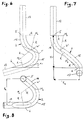
- FIG. 6 shows a band channel 2 in a view radially to the turntable 1.
- the straight lines 12 and 13 separated in the finished product are shown in dashed lines.
- the inlet bend 16 forms a common tangent T with the outlet bend 15 at the turning point W.
- Both the inlet bend 16 and the outlet bend 15 have the same bending radius R.
- This has proven to be particularly advantageous since the acceleration forces on the fiber sliver are particularly uniform.
- the outlet 6 is designed such that it ends flush with the bottom of the turntable 1.
- the outlet bend 15 enters the bottom of the turntable 2 at an angle ⁇ 1.
- a placement angle of 15 ° has proven to be advantageous for a distortion-free placement of the sliver.
- a radius R of approximately 80 mm has been found to be particularly gentle on the sliver.
- FIG. 7 shows a representation of the band channel 2 in the direction of rotation of the turntable 1.
- the direct transition of the inlet bend 16 into the outlet bend 15 into the turning point W is also shown here.
- the height H of the sliver channel 2 is predetermined by the structural requirements of the sliver storage device.
- the choice of the circular arcs used for the inlet arch 16 and the outlet arch 15, as well as the inclination of the planes B and A with respect to one another, is based on this height H and on a further predetermined storage radius Ra.
- FIG. 8 shows a view of the band channel 2 in the axial direction of the turntable. It can clearly be seen from the illustration in FIG. 8 that a round tube was used as the starting material in the exemplary embodiment shown. According to the invention, however, other cross sections can also be used for the band channel.
- the storage radius Ra is approximately 140 mm. This has proven to be advantageous when storing sliver in spinning cans 10 with a diameter of 450 mm. This ensures warp-free storage of the sliver with optimal filling of the sliver can 10 with sliver.
- the present invention is not restricted to the exemplary embodiment shown.
Landscapes
- Spinning Or Twisting Of Yarns (AREA)
- Coiling Of Filamentary Materials In General (AREA)
- Metal Extraction Processes (AREA)
- Cleaning In General (AREA)
- Preliminary Treatment Of Fibers (AREA)
Abstract
Description
- Die vorliegende Erfindung betrifft einen Drehteller für Faserbandablageeinrichtungen mit einem Bandkanal.
- Bekannt ist aus der DE-PS 15 10 310 ein Drehteller zum Ablegen von Faserbändern in Spinnkannen mit einem Kanal, der das Faserband von einem oben und in der Drehachse des Drehtellers mündenden Eintrittsteil über eine im Grundriß kreisbogenförmige Krümmung zu einem untenliegenden, tangential zum Drehteller und etwa an dessen Umfang mündenden Austrittsteil führt. Der Kanal weist zwischen seinem Eintrittsteil und seinem Austrittsteil ein gerade und radial verlaufendes Zwischenstück auf. Insbesondere bei den modernen, sehr schnell laufenden Maschinen mit derartigen Drehtellern hat sich herausgestellt, daß derartige Kanäle zu ungünstigen und ungleichmäßigen Faserbandablagen führen.
- Weiterhin ist aus der DE-PS 11 15 623 bekannt, daß der Kanal aus mindestens zwei kreisbogenförmig gebogenen Rohrkrümmern teleskopartig zusammengesetzt ist. Durch die teleskopartige Zusammensetzung der Krümmer kann der Verlauf des Kanals den verschiedenen Kannendurchmessern angepaßt werden. Die beiden Rohrkrümmer sind an ihre Verbindungsstelle mit geraden Enden versehen. Neben dem Nachteil des gerade verlaufenden Kanalteils wie in der oben erwähnten DE-PS 15 10 310 ergibt sich bei dieser Vorichtung noch zusätzlich der Nachteil, daß das Faserband über eine Rohrkrümmerkante geführt werden muß und einen veränderten Kanalquerschnitt durchläuft. Insbesondere bei schnellen Maschinen ist eine derartige Ausführung für eine hohe Genauigkeit bei der Ablage des Faserbandes und einer schonenden Behandlung des Faserbandes nicht gut geeignet. An der Kante können sich Ablagerungen bilden, die sich von Zeit zu Zeit ablösen und zu Ungleichmäßigkeiten in dem Faserband führen.
- Aufgabe der vorliegenden Erfindung ist es somit, insbesondere bei schnellen Vorichtungen zum Ablegen von Faserbändern in Spinnkannen durch eine entsprechende Gestaltung des Drehtellers und des Bandkanals eine in höchstem Maße gleichmäßige und faserbandschonende Ablage zu gewährleisten.
- Die Aufgabe wird gelöst durch die Merkmale des Anspruchs 1. Wird der Bandkanal aus einem Rohrstück mit zwei unmittelbar ineinander übergehenden Kreisbögen gebildet, so wirken auf das Faserband nur geringe Beschleunigungskräfte. Dadurch, daß kein gerades Stück zwischen den Kreisbögen angeordnet ist, wird das Faserband in dem Bandkanal schonend geführt, so daß praktisch keine bleibende Verformung nach der Ablage in der Spinnkanne in dem Faserband nachzuweisen ist. Diese gleichmäßige und schonende Ablage des Faserbandes ist bei den modernen, sehr genauen und schnellen Strecken und Karden von großer Bedeutung, um das zuvor hergestellte genaue Faserband bei der Ablage nicht wieder zu zerstören.
- Weisen beide Kreisbögen im wesentlichen gleiche Radien auf, so wirkt sich dies positiv auf die Beschleunigung des Faserbandes aus, da in diesem Fall des Faserbandes in großen Radien gewunden wird und somit geringe Umlenkkräfte auf das Faserband einwirken.
- Weisen beide Kreisbögen an ihrem Übergang eine gemeinsame Tangente auf, so ist ein stetiger und kantenfreier Übergang der Kreisbögen gewährleistet.
- Für die Faserbandablage hat sich in vorteilhafterweise herausgestellt, daß der Bandkanal ausschließlich aus Kreisbögen bestehen soll. Insbesonder das kreisbogenförmige Auslaufen des Bandkanals wirkt sich auf eine kraftarme Ablage des Faserbandes positiv aus.
- Für eine Neigung der Ebenen, in denen die Kreisbögen angeordnet sind hat sich ein Winkel von 130° bewährt. Der Übergang des Bandkanals in die Horizontale erfolgt vorzugsweise unter einem Ablagewinkel von etwa 15°.
- In einer vorteilhaften Ausgestaltung der erfindungsgemäßen Vorrichtung ist der Bandkanal und/oder eine Abdeckung des Drehtellers aus Edelstahl gefertigt. Dadurch werden geringe Reibungswerte des Faserbandes erzielt, wodurch sowohl der Verschleiß des Drehtellers und des Bandkanals, als auch die Beschädigung des Faserbandes in vorteilhafterweise reduziert werden.
- Die Erfindung wird im folgenden anhand von Ausführungsbeispielen beschrieben. Es zeigt
- Figur 1 einen Drehteller und eine Spinnkanne im Längsschnitt;
- Figur 2 eine räumliche Darstellung der Bandkanalebenen;
- Figuren 3 bis 5 eine Darstellung des Verlaufs der Mittellinie eines Bandkanals;
- Figuren 6 bis 8 eine Darstellung eines Bandkanals.
- Figur 1 zeigt einen Schnitt durch einen erfindungsgemäßen Drehteller 1 mit einem Bandkanal 2. Faserband tritt in den Bandkanal 2 in einem Einlauf 5 ein, durchläuft den Bandkanal 2 und tritt an einem Auslauf 6 aus dem Bandkanal 2 wieder aus. Der Einlauf 5 des Bandkanals 2 ist zentrisch in dem Drehteller 1 angeordnet. Eine Gußmasse 4 verbindet den Bandkanal 2 mit einem Tellerhalter 3. Dadurch ist gewährleistet, daß der Bandkanal 2 stets richtig positioniert ist und durch äußere Einflüsse seine Lage nicht verändert. Der Bandkanal 2 ist an seinem Auslauf 6 ebenfalls mit einer Gußmasse 8 fixiert. Durch die Gußmasse 8 wird gewährleistet, daß ein spaltfreier Übergang zwischen dem Bandkanal 2 und dem Drehteller 1 an der Unterseite des Drehtellers 1 gewährleistet ist. In einer erfindungsgemäßen Ausführung ist die Unterseite des Drehtellers 1 mit einer Abdeckung 7 versehen. Die Abdeckung 7 ist vorteilhafterweise aus Edelstahl hergestellt. Dadurch wird gewährleistet, daß zwischen dem in einer Spinnkanne 10 abgelegten Faserband und der Unterseite des Drehtellers 1 äußerst geringe Reibung und wenig Verschleiß auftritt. Darüber hinaus wird eine aufwendige Bearbeitung des Bodens des Drehtellers 1, insbesondere Schleifen und Spachteln des Aluminiumgußteiles Drehteller 1 vermieden. Auch muß weniger Sorgfalt beim Eingießen des Bandkanals 2 mit der Gußmasse 8 in den Drehteller 8 aufgewendet werden.
- Je nach Faserbandablageeinrichtung und Spinnkanne 10 besteht zwischen Drehteller 1 und Spinnkanne 10 ein mehr oder weniger großer Abstand 9. Die erfindungsgemäße Vorrichtung bewirkt in vorteilhafter Weise, daß bei einem großen Abstand 9 kein Faserband über den Spinnkannenrand bei der Ablage hinausgeschleudert wird. Das Faserband wird vielmehr ohne großer radialer Geschwindigkeitskomponente in der Spinnkanne 10 abgelegt. Dadurch wird eine besonders gleichmäßige und geordnete Ablage des Faserbandes gewährleistet. Außerdem ist durch die geordnete Ablage auch ein günstiges Abziehen des Faserbandes aus der Kanne 10 sichergestellt. Dies wirkt sich insbesondere bei hohen Liefergeschwindigkeiten aus. Das Herausschleudern des Faserbandes ist insbesondere bei den ersten in der Spinnkanne 10 abgelegten Lagen des Faserbandes bei bekannten gattungsgemäßen Vorrichtungen zu beobachten.
- Eine Drehachse 11 des Drehtellers 1 ist eine Tangente an dem Einlaufbogen des Bandkanals 2. Durch Drehung des Drehtellers 1 und der Kanne 10 entsteht eine zykloidenförmige Ablage des Faserbandes in der Spinnkanne 10. Eine Mittellinie 14 des Bandkanals 2 verläuft von der Drehachse 11 am Einlauf 5 des Bandkanals 2 bis zum Auslauf 6 und stellt im wesentlichen die Verformung des Faserbandes beim Durchlaufen des Bandkanals 2 dar.
- In Figur 2 ist die Mittellinie 14 des Bandkanals 2 in einem XYZ-Koordinatensystem dargestellt. Das Koordinatensystem ist dabei derart gelegt, daß der Einlauf 5 X und Y-Werte 0 hat und der Auslauf 6 Y- und Z-Werte 0 hat. Die Mittellinie 14 ist aus zwei Kreisbögen gebildet. Der erste Kreisbogen weist einen Mittelpunkt M1 auf und bezeichnet den Auslaufbogen. Der Einlaufbogen hat sein Zentrum in einem Mittelpunkt M2. Beide Bögen weisen einen gleichen Radius R auf. Durch den gleichen Radius R wird in einer vorteilhaften Ausgestaltung der Erfindung erreicht, daß das Faserband einer geringstmöglichen Belastung beim Durchlaufen des Bandkanals 2 ausgesetzt wird. Damit eine gleichmäßige Kraft auf das Faserband während des gesamten Durchlaufs durch den Bandkanal 2 herrscht, ist der Radius R möglichst groß zu wählen. Zur Erzielung möglichst großer Radien R ist es erfindungsgemäß vorteilhaft, wenn die Kreisbögen, die um die Mittelpunkt M1 und M2 geschlagen sind, unmittelbar ineinander übergehen. Die Kreisbögen weisen daher in einem Wendepunkt W eine gemeinsame Tangente T auf. Das Ende des Auslaufbogens 15 ist bestimmt durch einen festgelegten Ablageradius Ra, einen Ablagewinkel α1 der Austrittstangente zur Drehtellerbodenfläche, welche der Y-Achse des Koordinatensystems entspricht und durch eine Höhe H des Bandkanals 2. Zur Erreichung dieser vorgegebenen geometrischen Abmessungen ist eine Ebene E in welchem der Einlaufbogen 16 sich befindet zu einer Ebene A, in welcher sich der Auslaufbogen 15 befindet, um einen Winkel δ zueinander geneigt. Für einen raumsparenden Einbau des Drehtellers 1 in eine Faserbandablageeinrichtung hat sich als vorteilhaft erwiesen, wenn der Einlaufbogen 16 kürzer als der Auslaufbogen 15 ist. Durch die Neigung der Ebene E in einem Winkel α zur Y-Achse wird ein kurzer und für das Faserband beschleunigungsarmer Weg durch den Bandkanal 2 gewährleistet.
- Figur 3 zeigt eine Darstellung der Neigung der Ebene E des Einlaufbogens 16 zu der Ebene A des Auslaufbogens 15. Der Neigungswinkel δ beträgt in dem dargestellten Ausführungsbeispiel etwa 125°. Die Ebenen E und A schneiden sich in der Tangente T. Die Mittelpunkte M1 und M2 der beiden Kreisbögen des Bandkanals 2 liegen ebenfalls in der Ebene A bzw. E. Eine Ansicht B der Figur 3 ist in Figur 4 dargestellt. Figur 4 zeigt eine Darstellung der Mittellinie 14 des Bandkanals 2, bei welcher der Einlaufbogen 16 unverzerrt dargestellt ist. Der Einlaufbogen 16 weist den Radius R um den Mittelpunkt M2 auf. In dem vorliegenden Ausführungsbeispiel erstreckt sich der Einlaufbogen 16 über einen Winkel β1, der hier etwa 70° beträgt. Der Auslaufbogen 15 um den Mittelpunkt M1 ist in Figur 4 wegen der Neigung der Ebene A zu der Ebene E verzerrt dargestellt. Figur 4 zeigt neben dem Auslaufbogen 15 und dem Einlaufbogen 16 eine Gerade 12 vor dem Einlaufbogen 16. Die Gerade 12 ist bei dem Halbfertigprodukt aus fertigungstechnischen Gründen angeordnet. Es wird dadurch eine toleranzgenaue Biegung der Bögen 15 und 16 gewährleistet, da das Werkstück in eine Biegevorrichtung eingespannt werden kann. Die Gerade 12 wird bei der Fertigbearbeitung des Bandkanals 2 von den Bögen 15 und 16 abgetrennt. Durch Entgraten des Einlaufs 5 wird eine reibungsarme Einführung des Faserbandes in den Bandkanal 2 sichergestellt.
- Figur 5 zeigt eine Ansicht in Pfeilrichtung C der Figur 3. In Figur 5 ist der Auslaufbogen 15 unverzerrt dargestellt. Die Mittellinie 14 des Bandkanals 2 weist im Auslaufbogen 15 einen Radius R und den Mittelpunkt M1 auf. Einlaufbogen 16 geht in dem Wendepunkt W unmittelbar in den Auslaufbogen 15 über. In dem dargestellten Ausführungsbeispiel weist der Auslaufbogen 15 einen Winkel β2 auf, der etwa 127° beträgt. Aus fertigungstechnischen Gründen ist im Anschluß an den Auslaufbogen 15 beim Halbfertigprodukt eine Gerade 13 angeordnet. Ebenso wie bei der Gerade 12 am Einlaufbogen 16 ist durch die Gerade 13 am Auslaufbogen 15 ein sicheres Einspannen des vorzugsweise Edelstahlrohres, das für die Bildung des Bandkanals 2 verwendet wird, im Biegewerkzeug sichergestellt. Die Gerade 13 wird bei der Fertigstellung des Bandkanals 2 abgetrennt. Das Ende des Auslaufbogen 15 wird vorzugsweise entgratet.
- Figur 6 zeigt einen Bandkanal 2 in einer Ansicht radial zu dem Drehteller 1. Die beim Fertigprodukt abgetrennten Geraden 12 und 13 sind gestrichelt dargestellt. Es ist in Figur 6 deutlich zu erkennen, daß der Einlaufbogen 16 in dem Wendepunkt W mit dem Auslaufbogen 15 eine gemeinsame Tangente T bilden. Sowohl Einlaufbogen 16 als auch Auslaufbogen 15 weisen denselben Biegeradius R auf. Dies hat sich als besonders vorteilhaft erwiesen, da hierdurch die Beschleunigungskräfte auf das Faserband besonders gleichmäßig sind. Dadurch wird eine geordnete Abgabe des Faserbandes erzielt, ohne daß das Faserband bei der Ablage gegenüber seinem Zustand beim Einlauf in den Bandkanal 2 verändert wurde. Der Auslauf 6 ist derart ausgebildet, daß er mit dem Boden des Drehtellers 1 plan abschließt. Der Auslaufbogen 15 tritt in den Boden des Drehtellers 2 unter einem Ablagewinkel α1 ein. Als vorteilhaft hat sich für eine verzugsfreie Ablage des Faserbandes ein Ablagewinkel von 15° herausgestellt. Bei dem dargestellten Ausführungsbeispiel hat sich ein Radius R von etwa 80mm als besonders schonend für das Faserband ergeben.
- Figur 7 zeigt eine Darstellung des Bandkanals 2 in Drehrichtung des Drehtellers 1. Auch hier ist der unmittelbare Übergang des Einlaufbogens 16 in den Auslaufbogen 15 in den Wendepunkt W dargestellt. Die Höhe H des Bandkanals 2 ist durch die baulichen Voraussetzungen der Faserbandablageeinrichtung vorgegeben. Nach dieser Höhe H und nach einem weiteren vorgegebenen Ablageradius Ra richtet sich die Wahl der eingesetzten Kreisbögen für den Einlaufbogen 16 und den Auslaufbogen 15, sowie der Neigung der Ebenen B und A zueinander.
- In Figur 8 ist eine Ansicht in axialer Richtung des Drehtellers auf den Bandkanal 2 dargestellt. Aus der Darstellung in Figur 8 ist deutlich zu entnehmen, daß bei dem dargestellten Ausführungsbeispiel ein rundes Rohr als Ausgangsmaterial verwendet wurde. Erfindungsgemäß können jedoch auch andere Querschnitte für den Bandkanal verwendet werden. Im dargestellten Ausführungsbeispiel beträgt der Ablageradius Ra etwa 140mm. Dies hat sich als vorteilhaft erwiesen bei der Ablage von Faserband in Spinnkannen 10 mit einem Durchmesser von 450mm. Dadurch wird eine verzugsfreie Ablage des Faserbandes bei optimaler Füllung der Spinnkanne 10 mit Faserband gewährleistet.
- Die vorliegende Erfindung ist nicht auf das dargestellte Ausführungsbeispiel beschränkt.
Claims (6)
- Drehteller (1) für Faserbandablageeinrichtungen, insbesondere von Strecken und Karden, mit einem räumlich gekrümmten Bandkanal (2) mit einem Einlauf (5) und einem Auslauf (6) für Faserband, dadurch gekennzeichnet, daß der Bandkanal (2) und/oder eine Abdeckung (7) des Drehtellers (1) an dessen Unterseite aus Edelstahl gefertigt ist.
- Drehteller nach Anspruch 1, dadurch gekennzeichnet, daß der Bandkanal (2) aus einem Rohrstück mit zwei unmittelbar ineinander übergehenden Kreisbögen (15, 16) gebildet ist.
- Drehteller nach Anspruch 2, dadurch gekennzeichnet, daß beide Kreisbögen (15, 16) im wesentlichen gleichen Radius (R) aufweisen.
- Drehteller nach Anspruch 2 oder 3, dadurch gekennzeichnet, daß der eine Kreisbogen (16) am Einlauf (5) beginnt und/oder der andere Kreisbogen (15) am Auslauf (6) endet.
- Drehteller nach einem der Ansprüche 2 bis 4, dadurch gekennzeichnet, daß die Kreisbögen (15, 16) in zwei zueinander geneigten Ebenen (A, E) angeordnet sind.
- Drehteller nach einem der Ansprüche 1 bis 5, dadurch gekennzeichnet, daß der Bandkanal (2) mittels einer Gußmasse (8) mit dem Drehteller (1) verbunden ist.
Applications Claiming Priority (3)
| Application Number | Priority Date | Filing Date | Title |
|---|---|---|---|
| DE4131134A DE4131134A1 (de) | 1991-09-19 | 1991-09-19 | Drehteller fuer faserbandablageeinrichtungen |
| DE4131134 | 1991-09-19 | ||
| EP92114809A EP0532964B1 (de) | 1991-09-19 | 1992-08-29 | Drehteller für Faserbandablageeinrichtungen |
Related Parent Applications (1)
| Application Number | Title | Priority Date | Filing Date |
|---|---|---|---|
| EP92114809.4 Division | 1992-08-29 |
Publications (3)
| Publication Number | Publication Date |
|---|---|
| EP0670281A2 true EP0670281A2 (de) | 1995-09-06 |
| EP0670281A3 EP0670281A3 (de) | 1996-01-10 |
| EP0670281B1 EP0670281B1 (de) | 1998-07-15 |
Family
ID=6440942
Family Applications (2)
| Application Number | Title | Priority Date | Filing Date |
|---|---|---|---|
| EP92114809A Expired - Lifetime EP0532964B1 (de) | 1991-09-19 | 1992-08-29 | Drehteller für Faserbandablageeinrichtungen |
| EP95108297A Revoked EP0670281B1 (de) | 1991-09-19 | 1992-08-29 | Drehteller für Faserbandablageeinrichtungen |
Family Applications Before (1)
| Application Number | Title | Priority Date | Filing Date |
|---|---|---|---|
| EP92114809A Expired - Lifetime EP0532964B1 (de) | 1991-09-19 | 1992-08-29 | Drehteller für Faserbandablageeinrichtungen |
Country Status (7)
| Country | Link |
|---|---|
| US (1) | US5317786A (de) |
| EP (2) | EP0532964B1 (de) |
| JP (1) | JPH06218339A (de) |
| CN (1) | CN1027157C (de) |
| CZ (2) | CZ281572B6 (de) |
| DE (3) | DE4131134A1 (de) |
| RU (1) | RU2061642C1 (de) |
Cited By (2)
| Publication number | Priority date | Publication date | Assignee | Title |
|---|---|---|---|---|
| DE102004058573A1 (de) * | 2004-12-03 | 2006-06-08 | Trützschler GmbH & Co KG | Ablageteller für Faserbandablagevorrichtungen, insbesondere von Strecken und Karden |
| DE102012007415A1 (de) | 2012-02-07 | 2013-08-08 | TRüTZSCHLER GMBH & CO. KG | Vorrichtung an einer Spinnereivorbereitungsmaschine, insbesondere Karde, Strecke, Kämmmaschine o. dgl., mit einem Ablageteller für Faserbandablagevorrichtungen |
Families Citing this family (17)
| Publication number | Priority date | Publication date | Assignee | Title |
|---|---|---|---|---|
| DE4139910B4 (de) * | 1991-12-04 | 2005-07-14 | Rieter Ingolstadt Spinnereimaschinenbau Ag | Bandkanal |
| DE4143345B4 (de) * | 1991-12-04 | 2007-03-22 | Rieter Ingolstadt Spinnereimaschinenbau Ag | Drehteller einer Spinnereivorbereitungsmaschine |
| DE10063031A1 (de) * | 2000-12-18 | 2002-06-20 | Rieter Ingolstadt Spinnerei | Textilmaschine |
| DE10127815A1 (de) * | 2001-06-07 | 2002-12-12 | Truetzschler Gmbh & Co Kg | Drehteller für Faserbandablageeinrichtungen, insbesondere an Strecken, Karden u. dgl. |
| DE10127814A1 (de) * | 2001-06-07 | 2002-12-12 | Truetzschler Gmbh & Co Kg | Drehteller für Faserbandablageeinrichtungen, insbesondere an Strecken, Karden u. dgl. |
| US6694572B2 (en) | 2002-06-10 | 2004-02-24 | Trützschler GmbH & Co., KG | Sliver channel with reduced friction |
| US6568039B1 (en) | 2002-06-10 | 2003-05-27 | TRüTZSCHLER GMBH & CO. KG | Sliver channel with reduced friction |
| DE10334758B4 (de) * | 2002-08-19 | 2013-12-05 | Rieter Ingolstadt Gmbh | Drehteller einer Spinnereimaschine sowie Spinnereimaschine |
| DE102004034408A1 (de) * | 2004-07-16 | 2006-02-02 | Rieter Ingolstadt Spinnereimaschinenbau Ag | Drehteller für eine Faserbandablagevorrichtung |
| DE102004063027B4 (de) * | 2004-12-22 | 2017-10-12 | Trützschler GmbH & Co Kommanditgesellschaft | Vorrichtung an einer Spinnereivorbereitungsmaschine, z.B. Karde, Kardenstreckwerk, Strecke, Kämmmaschine o. dgl., zum Wechseln von Spinnkannen |
| CN101245506B (zh) * | 2008-03-27 | 2010-06-23 | 江苏凯宫机械股份有限公司 | 精梳机的圈条器 |
| CN103122513A (zh) * | 2011-11-18 | 2013-05-29 | 青岛云龙纺织机械有限公司 | 并条机v带式圈条盘装置 |
| CN104233518B (zh) * | 2014-09-02 | 2016-08-24 | 南通优旋圈条器有限公司 | 一种高光洁度的圈条器及其制备工艺 |
| DE102015001412B3 (de) * | 2015-02-06 | 2016-04-21 | ITA Technologietransfer GmbH | Verfahren zum Zuführen eines Stapelfaserbands zu einem Legekopf, Textilmaschine und Verfahren zum Nachrüsten einer Textilmaschine |
| CN105329677B (zh) * | 2015-09-29 | 2018-03-09 | 湖南海尚环境生物科技股份有限公司 | 物料循环搅拌机构及其控制使用方法和无水型生态厕所 |
| CN105478673B (zh) * | 2016-01-21 | 2017-12-12 | 黄永利 | 铝精铸导绵管一体圈条器及其铸造模具和制备方法 |
| CN119932777A (zh) * | 2024-02-01 | 2025-05-06 | 特吕茨施勒纺织机械(上海)有限公司 | 用于纺纱准备机器的圈条盘装置、纺纱准备机器以及制造圈条盘装置的方法 |
Family Cites Families (13)
| Publication number | Priority date | Publication date | Assignee | Title |
|---|---|---|---|---|
| NL98926C (de) * | 1958-02-28 | |||
| CH372962A (de) * | 1959-09-08 | 1963-10-31 | Luwa Ag | Verfahren zum Ablegen eines endlosen Bandes |
| DE1115623B (de) * | 1960-08-19 | 1961-10-19 | Schubert & Salzer Maschinen | Drehteller fuer Faserbandablegeeinrichtungen von Strecken, Karden und anderen Spinnereimaschinen |
| NL272159A (de) * | 1960-12-19 | |||
| DE1209030B (de) * | 1961-12-09 | 1966-01-13 | Schubert & Salzer Maschinen | Vorrichtung zum Verhueten von Faserband-stauungen in Drehtellerrohren von Faserbandablegevorrichtungen |
| DE2540148C3 (de) * | 1975-09-09 | 1980-06-26 | Barmag Barmer Maschinenfabrik Ag, 5630 Remscheid | Ablegevorrichtung fur Chemiefaserkabel und Arbeitsverfahren zum Betrieb der Vorrichtung |
| BR7601196A (pt) * | 1975-03-07 | 1976-09-14 | Barmag Barmer Maschf | Dispositivo transportador de cabo de fibras sinteticas,e,processo de sua operacao |
| DE2801010C2 (de) * | 1978-01-11 | 1980-01-24 | Rieter Deutschland Gmbh, 7000 Stuttgart | Drehteller zum Ablegen eines Faserbandes in eine Spinnkanne |
| CH639628A5 (de) * | 1979-10-01 | 1983-11-30 | Luwa Ag | Kannenpresse. |
| DE3118968A1 (de) * | 1981-05-13 | 1982-12-09 | Nordischer Maschinenbau Rud. Baader GmbH + Co KG, 2400 Lübeck | "vorrichtung zum ablegen eines faserbandes in eine spinnkanne" |
| DE3407135A1 (de) * | 1984-02-28 | 1985-08-29 | Zinser Textilmaschinen Gmbh, 7333 Ebersbach | Vorrichtung zum ablegen von lunte in eine rotierende kanne |
| DE3524601A1 (de) * | 1985-07-10 | 1987-01-15 | Truetzschler & Co | Vorrichtung zum antrieb einer faserbandeinlegeeinrichtung fuer eine rotierende spinnkanne, z.b. fuer karde, strecke |
| DE3810460A1 (de) * | 1988-03-26 | 1989-10-12 | Zinser Textilmaschinen Gmbh | Drehteller fuer eine strecke |
-
1991
- 1991-09-19 DE DE4131134A patent/DE4131134A1/de not_active Withdrawn
-
1992
- 1992-08-29 DE DE59209419T patent/DE59209419D1/de not_active Revoked
- 1992-08-29 DE DE59205226T patent/DE59205226D1/de not_active Expired - Fee Related
- 1992-08-29 EP EP92114809A patent/EP0532964B1/de not_active Expired - Lifetime
- 1992-08-29 EP EP95108297A patent/EP0670281B1/de not_active Revoked
- 1992-09-14 CZ CZ952766A patent/CZ281572B6/cs not_active IP Right Cessation
- 1992-09-14 CZ CS922826A patent/CZ281481B6/cs unknown
- 1992-09-18 US US07/947,345 patent/US5317786A/en not_active Expired - Lifetime
- 1992-09-18 JP JP4249207A patent/JPH06218339A/ja active Pending
- 1992-09-18 RU SU925052972A patent/RU2061642C1/ru active
- 1992-09-18 CN CN92111590A patent/CN1027157C/zh not_active Expired - Fee Related
Cited By (8)
| Publication number | Priority date | Publication date | Assignee | Title |
|---|---|---|---|---|
| DE102004058573A1 (de) * | 2004-12-03 | 2006-06-08 | Trützschler GmbH & Co KG | Ablageteller für Faserbandablagevorrichtungen, insbesondere von Strecken und Karden |
| GB2421033A (en) * | 2004-12-03 | 2006-06-14 | Truetzschler Gmbh & Co Kg | Coiler plate for sliver-coiling devices, especially of draw frames and carding machines |
| US7275287B2 (en) | 2004-12-03 | 2007-10-02 | Trutzschler Gmbh & Co. Kg | Coiler plate for silver-coiling devices, especially of draw frames and carding machines |
| GB2421033B (en) * | 2004-12-03 | 2009-03-11 | Truetzschler Gmbh & Co Kg | Coiler plate for sliver-coiling devices, especially of draw frames and carding machines |
| CN1781836B (zh) * | 2004-12-03 | 2012-05-02 | 特鲁菲舍尔股份有限公司及两合公司 | 长条卷绕装置的卷绕盘 |
| DE102004058573B4 (de) * | 2004-12-03 | 2017-10-12 | Trützschler GmbH & Co Kommanditgesellschaft | Ablageteller für Faserbandablagevorrichtungen, insbesondere von Strecken und Karden |
| DE102012007415A1 (de) | 2012-02-07 | 2013-08-08 | TRüTZSCHLER GMBH & CO. KG | Vorrichtung an einer Spinnereivorbereitungsmaschine, insbesondere Karde, Strecke, Kämmmaschine o. dgl., mit einem Ablageteller für Faserbandablagevorrichtungen |
| DE102012007415B4 (de) * | 2012-02-07 | 2025-11-13 | Trützschler Group SE | Vorrichtung an einer Spinnereivorbereitungsmaschine, insbesondere Karde, Strecke, Kämmmaschine o. dgl., mit einem Ablageteller für Faserbandablagevorrichtungen |
Also Published As
| Publication number | Publication date |
|---|---|
| CZ282692A3 (en) | 1994-03-16 |
| DE59209419D1 (de) | 1998-08-20 |
| EP0532964B1 (de) | 1996-01-31 |
| EP0670281B1 (de) | 1998-07-15 |
| CZ281481B6 (cs) | 1996-10-16 |
| EP0532964A1 (de) | 1993-03-24 |
| DE4131134A1 (de) | 1993-06-17 |
| JPH06218339A (ja) | 1994-08-09 |
| DE59205226D1 (de) | 1996-03-14 |
| RU2061642C1 (ru) | 1996-06-10 |
| CZ281572B6 (cs) | 1996-11-13 |
| US5317786A (en) | 1994-06-07 |
| CN1027157C (zh) | 1994-12-28 |
| EP0670281A3 (de) | 1996-01-10 |
| CN1074881A (zh) | 1993-08-04 |
| CZ276695A3 (en) | 1996-07-17 |
Similar Documents
| Publication | Publication Date | Title |
|---|---|---|
| EP0532964B1 (de) | Drehteller für Faserbandablageeinrichtungen | |
| DE527468C (de) | Fadenfuehrungsvorrichtung fuer Spulmaschinen | |
| DE4139910B4 (de) | Bandkanal | |
| DE3332498A1 (de) | Verbesserung an offenendspinnmaschinen | |
| EP3371353B1 (de) | Fadenabzugsdüse mit radial zur düsenbohrung verlaufenden kerben | |
| DE1710038B2 (de) | Offenend-spinnvorrichtung | |
| DE3002026C2 (de) | ||
| DE3345170A1 (de) | Verfahren und vorrichtung zur herstellung von seelengarn aus einem faserbaendchen | |
| EP1616828B1 (de) | Drehteller für eine Faserbandablagevorrichtung | |
| EP0489225B1 (de) | Doppeldraht-Zwirnspindel mit druckluftbetätigter Einfädelvorrichtung | |
| EP1718554B1 (de) | Antriebswalze für eine kreuzspulen herstellende textilmaschine | |
| EP3686329A1 (de) | Be- und entlastungseinrichtung für eine fadenklemmvorrichtung und fadenklemmvorrichtung | |
| DE1602265A1 (de) | Drahtablaufbremse | |
| DE1115622B (de) | Drehteller zum Ablegen von Faserbaendern in Spinnkannen von Spinnerei-Vorbereitungsmaschinen | |
| CH629453A5 (en) | Winding unit of a textile machine with a winding roller | |
| DD214773B1 (de) | Vorrichtung zur erzielung gleichmaessig geformter drahtwindungen von windungsstegern | |
| EP4431648B1 (de) | Faserbandverdichter für eine offenendspinnvorrichtung sowie offenendspinnvorrichtung | |
| EP0455190A1 (de) | Faserband-Kondensor an einem Flyer | |
| DE725630C (de) | Einfuehrungsvorrichtung, insbesondere an Schraegwalzen-Richtmaschinen | |
| DE2218520A1 (de) | Aufwickelspulenrahmen fuer textilmaschinen, insbesondere fuer aufwickelspul- und texturiermaschinen sowie spindellose feinspinnmaschinen und andere aehnliche maschinen | |
| DD270550B3 (de) | Verfahren und vorrichtung zur herstellung von stahldrahtlitzen mit variablem verseilaufbau | |
| EP0182241B1 (de) | Vorrichtung zum Friktionsspinnen | |
| DE1029783B (de) | Verlegearm fuer Edenborn-Haspel | |
| DE2824652A1 (de) | Vorrichtung zur aufnahme eines faserbands | |
| DE3319747A1 (de) | Verfahren und vorrichtung zur unterbrechung des flyerluntentransports auf einer spinnmaschine |
Legal Events
| Date | Code | Title | Description |
|---|---|---|---|
| PUAI | Public reference made under article 153(3) epc to a published international application that has entered the european phase |
Free format text: ORIGINAL CODE: 0009012 |
|
| 17P | Request for examination filed |
Effective date: 19950531 |
|
| AC | Divisional application: reference to earlier application |
Ref document number: 532964 Country of ref document: EP |
|
| AK | Designated contracting states |
Kind code of ref document: A2 Designated state(s): DE FR GB IT |
|
| PUAL | Search report despatched |
Free format text: ORIGINAL CODE: 0009013 |
|
| AK | Designated contracting states |
Kind code of ref document: A3 Designated state(s): DE FR GB IT |
|
| GRAG | Despatch of communication of intention to grant |
Free format text: ORIGINAL CODE: EPIDOS AGRA |
|
| 17Q | First examination report despatched |
Effective date: 19971119 |
|
| GRAG | Despatch of communication of intention to grant |
Free format text: ORIGINAL CODE: EPIDOS AGRA |
|
| GRAH | Despatch of communication of intention to grant a patent |
Free format text: ORIGINAL CODE: EPIDOS IGRA |
|
| GRAH | Despatch of communication of intention to grant a patent |
Free format text: ORIGINAL CODE: EPIDOS IGRA |
|
| GRAA | (expected) grant |
Free format text: ORIGINAL CODE: 0009210 |
|
| AC | Divisional application: reference to earlier application |
Ref document number: 532964 Country of ref document: EP |
|
| AK | Designated contracting states |
Kind code of ref document: B1 Designated state(s): DE FR GB IT |
|
| PG25 | Lapsed in a contracting state [announced via postgrant information from national office to epo] |
Ref country code: GB Free format text: LAPSE BECAUSE OF FAILURE TO SUBMIT A TRANSLATION OF THE DESCRIPTION OR TO PAY THE FEE WITHIN THE PRESCRIBED TIME-LIMIT Effective date: 19980715 |
|
| ITF | It: translation for a ep patent filed | ||
| REF | Corresponds to: |
Ref document number: 59209419 Country of ref document: DE Date of ref document: 19980820 |
|
| ET | Fr: translation filed | ||
| GBV | Gb: ep patent (uk) treated as always having been void in accordance with gb section 77(7)/1977 [no translation filed] |
Effective date: 19980715 |
|
| PLBI | Opposition filed |
Free format text: ORIGINAL CODE: 0009260 |
|
| PLBQ | Unpublished change to opponent data |
Free format text: ORIGINAL CODE: EPIDOS OPPO |
|
| PLBI | Opposition filed |
Free format text: ORIGINAL CODE: 0009260 |
|
| 26 | Opposition filed |
Opponent name: TRUETZSCHLER GMBH & CO.KG Effective date: 19990302 |
|
| PLBF | Reply of patent proprietor to notice(s) of opposition |
Free format text: ORIGINAL CODE: EPIDOS OBSO |
|
| PLAB | Opposition data, opponent's data or that of the opponent's representative modified |
Free format text: ORIGINAL CODE: 0009299OPPO |
|
| 26 | Opposition filed |
Opponent name: MAASLAND N.V. Effective date: 19990414 Opponent name: ZINSER TEXTILMASCHINEN GMBH Effective date: 19990413 Opponent name: TRUETZSCHLER GMBH & CO.KG Effective date: 19990302 |
|
| R26 | Opposition filed (corrected) |
Opponent name: TRUETZSCHLER GMBH & CO.KG * 19990413 ZINSER TEXTIL Effective date: 19990302 |
|
| PLBF | Reply of patent proprietor to notice(s) of opposition |
Free format text: ORIGINAL CODE: EPIDOS OBSO |
|
| PLBF | Reply of patent proprietor to notice(s) of opposition |
Free format text: ORIGINAL CODE: EPIDOS OBSO |
|
| PLBO | Opposition rejected |
Free format text: ORIGINAL CODE: EPIDOS REJO |
|
| APAC | Appeal dossier modified |
Free format text: ORIGINAL CODE: EPIDOS NOAPO |
|
| APAC | Appeal dossier modified |
Free format text: ORIGINAL CODE: EPIDOS NOAPO |
|
| APAE | Appeal reference modified |
Free format text: ORIGINAL CODE: EPIDOS REFNO |
|
| APAE | Appeal reference modified |
Free format text: ORIGINAL CODE: EPIDOS REFNO |
|
| APAC | Appeal dossier modified |
Free format text: ORIGINAL CODE: EPIDOS NOAPO |
|
| PGFP | Annual fee paid to national office [announced via postgrant information from national office to epo] |
Ref country code: FR Payment date: 20030814 Year of fee payment: 12 |
|
| PGFP | Annual fee paid to national office [announced via postgrant information from national office to epo] |
Ref country code: DE Payment date: 20030901 Year of fee payment: 12 |
|
| APBU | Appeal procedure closed |
Free format text: ORIGINAL CODE: EPIDOSNNOA9O |
|
| APBU | Appeal procedure closed |
Free format text: ORIGINAL CODE: EPIDOSNNOA9O |
|
| RDAF | Communication despatched that patent is revoked |
Free format text: ORIGINAL CODE: EPIDOSNREV1 |
|
| RDAG | Patent revoked |
Free format text: ORIGINAL CODE: 0009271 |
|
| STAA | Information on the status of an ep patent application or granted ep patent |
Free format text: STATUS: PATENT REVOKED |
|
| 27W | Patent revoked |
Effective date: 20040323 |
|
| APAH | Appeal reference modified |
Free format text: ORIGINAL CODE: EPIDOSCREFNO |