EP0671830A2 - Gerät und Verfahren zur geschützten Übertragung - Google Patents
Gerät und Verfahren zur geschützten Übertragung Download PDFInfo
- Publication number
- EP0671830A2 EP0671830A2 EP95301109A EP95301109A EP0671830A2 EP 0671830 A2 EP0671830 A2 EP 0671830A2 EP 95301109 A EP95301109 A EP 95301109A EP 95301109 A EP95301109 A EP 95301109A EP 0671830 A2 EP0671830 A2 EP 0671830A2
- Authority
- EP
- European Patent Office
- Prior art keywords
- message
- user
- communication apparatus
- smart card
- restricted
- Prior art date
- Legal status (The legal status is an assumption and is not a legal conclusion. Google has not performed a legal analysis and makes no representation as to the accuracy of the status listed.)
- Granted
Links
Images


Classifications
-
- H—ELECTRICITY
- H04—ELECTRIC COMMUNICATION TECHNIQUE
- H04N—PICTORIAL COMMUNICATION, e.g. TELEVISION
- H04N1/00—Scanning, transmission or reproduction of documents or the like, e.g. facsimile transmission; Details thereof
- H04N1/44—Secrecy systems
-
- H—ELECTRICITY
- H04—ELECTRIC COMMUNICATION TECHNIQUE
- H04M—TELEPHONIC COMMUNICATION
- H04M3/00—Automatic or semi-automatic exchanges
- H04M3/38—Graded-service arrangements, i.e. some subscribers prevented from establishing certain connections
- H04M3/387—Graded-service arrangements, i.e. some subscribers prevented from establishing certain connections using subscriber identification cards
-
- H—ELECTRICITY
- H04—ELECTRIC COMMUNICATION TECHNIQUE
- H04L—TRANSMISSION OF DIGITAL INFORMATION, e.g. TELEGRAPHIC COMMUNICATION
- H04L9/00—Cryptographic mechanisms or cryptographic arrangements for secret or secure communications; Network security protocols
- H04L9/08—Key distribution or management, e.g. generation, sharing or updating, of cryptographic keys or passwords
-
- H—ELECTRICITY
- H04—ELECTRIC COMMUNICATION TECHNIQUE
- H04L—TRANSMISSION OF DIGITAL INFORMATION, e.g. TELEGRAPHIC COMMUNICATION
- H04L9/00—Cryptographic mechanisms or cryptographic arrangements for secret or secure communications; Network security protocols
- H04L9/32—Cryptographic mechanisms or cryptographic arrangements for secret or secure communications; Network security protocols including means for verifying the identity or authority of a user of the system or for message authentication, e.g. authorization, entity authentication, data integrity or data verification, non-repudiation, key authentication or verification of credentials
- H04L9/3226—Cryptographic mechanisms or cryptographic arrangements for secret or secure communications; Network security protocols including means for verifying the identity or authority of a user of the system or for message authentication, e.g. authorization, entity authentication, data integrity or data verification, non-repudiation, key authentication or verification of credentials using a predetermined code, e.g. password, passphrase or PIN
-
- H—ELECTRICITY
- H04—ELECTRIC COMMUNICATION TECHNIQUE
- H04L—TRANSMISSION OF DIGITAL INFORMATION, e.g. TELEGRAPHIC COMMUNICATION
- H04L9/00—Cryptographic mechanisms or cryptographic arrangements for secret or secure communications; Network security protocols
- H04L9/32—Cryptographic mechanisms or cryptographic arrangements for secret or secure communications; Network security protocols including means for verifying the identity or authority of a user of the system or for message authentication, e.g. authorization, entity authentication, data integrity or data verification, non-repudiation, key authentication or verification of credentials
- H04L9/3234—Cryptographic mechanisms or cryptographic arrangements for secret or secure communications; Network security protocols including means for verifying the identity or authority of a user of the system or for message authentication, e.g. authorization, entity authentication, data integrity or data verification, non-repudiation, key authentication or verification of credentials involving additional secure or trusted devices, e.g. TPM, smartcard, USB or software token
-
- H—ELECTRICITY
- H04—ELECTRIC COMMUNICATION TECHNIQUE
- H04M—TELEPHONIC COMMUNICATION
- H04M3/00—Automatic or semi-automatic exchanges
- H04M3/42—Systems providing special services or facilities to subscribers
-
- H—ELECTRICITY
- H04—ELECTRIC COMMUNICATION TECHNIQUE
- H04M—TELEPHONIC COMMUNICATION
- H04M2203/00—Aspects of automatic or semi-automatic exchanges
- H04M2203/60—Aspects of automatic or semi-automatic exchanges related to security aspects in telephonic communication systems
- H04M2203/609—Secret communication
-
- H—ELECTRICITY
- H04—ELECTRIC COMMUNICATION TECHNIQUE
- H04M—TELEPHONIC COMMUNICATION
- H04M3/00—Automatic or semi-automatic exchanges
- H04M3/38—Graded-service arrangements, i.e. some subscribers prevented from establishing certain connections
- H04M3/382—Graded-service arrangements, i.e. some subscribers prevented from establishing certain connections using authorisation codes or passwords
Definitions
- This invention relates to communication apparatuses and, more particularly, to a secure communication apparatus and method of communicating messages.
- U. S. Patent 5,191,611 issued to G.S. Lang on March 2, 1993 describes a method and apparatus for protecting material on storage media by limiting access to the storage medium. More specifically, the storage medium is divided into sectors and each sector is assigned to a specific user. Access to that sector of the storage medium can be gained only when the appropriate sequence of signals is executed. More particularly, Lang contemplates using a smart card as the device that a user will use to gain access to the storage medium. The smart card contains an encryption key and processing power, and the two combine to interact with the computer that guards the storage medium.
- FIG. 6 of the above-identified patent Lang describes a facsimile apparatus (FIG. 6) for secure computerized fax (SCFAX) delivery.
- the sender loads a message/document to be transmitted, enters the sender's smart card, and enters the recipient's address.
- the recipient's fax machine is informed of the recipient's identity and that fax machine stores the information in the proper storage medium sector.
- the storing of the fax data in a particular sector insures proper delivery.
- the data itself is encrypted, either with a commonly known encryption key, or with the recipient's public key.
- the encryption is accomplished with the sender interfacing his/her smart card with the sending fax machine.
- the problem with the Lang approach is that the recipient fax machine must know, beforehand, of the identities of the people who will receive confidential faxes, so that the faxes can be stored in memory sectors associated with those people.
- the opposite is more likely. That is, a fax machine that is situated in a one-person office and communicates faxes to that individual does not need enhanced confidentiality, since no one else has access to the fax machine.
- This invention provides the desired enhanced confidentiality of message communications (e.g., fax documents) by providing unrestricted access to part of the message transmission (e.g., a header message) and a restricted access to the remainder of the message.
- the unrestricted portion identifies the message recipient and indicates the existence of a restricted portion of the message.
- Access to the restricted portion illustratively, requires one or more of the following: submitting a password to the receiving apparatus and using the appropriate key for decrypting the restricted portion (when the restricted portion has been previously encrypted by the sender). For these two approaches, processing power is needed at the recipient's apparatus, and that power is provided by a processor within the apparatus or, if a higher level of security is desired, by a smart card possessed by the recipient.
- all but a header message portion (which identifies an intended recipient) of a received message is restricted and, optionally, encrypted using either a public key, K RP , of an intended recipient of the message or a sender's private or secret key, K SS .
- the outputted header message portion informs the recipient (and all who care to know) of the receipt of a restricted (unencrypted or encrypted) message.
- Access to the restricted message (and decrypting, if necessary) is available after either 1) the recipient completes a login and password process or 2) the recipient inserts his/her smart card into the apparatus and enters a personal security code which is authenticated by the apparatus.
- the recipient can select which of a plurality of received stored encrypted messages is to be decrypted and outputted.
- the present invention also enables a message sender to insert a smart card and access an "address book" within it.
- the sending apparatus displays the addressee list (name and number) obtained from the sender's smart card and enables the sender to select a recipient (and various encryption keys) to whom the sender's message is to be sent.
- the sender's message may then be encrypted using the recipient's public key K RP or sender's private key K SS and sent to the recipient's apparatus.
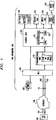
- FIG. 1 Shown in FIG. 1 is a block diagram of an illustrative network including two facsimile apparatuses 100 which connect to telephone switch network 190 via facilities 101 and 191.
- FIG. 1 also shows an illustrative block diagram of an embodiment of a facsimile apparatus 100 useful in describing the present invention.
- Network Control Unit (NCU) 104 controls in a known manner the interface to facility 101 which connects the facsimile apparatus to a telephone switch network 190.
- Facility 101 may be one duplex facility used both to send and receive facsimile messages or may be two simplex facilities 102 and 103, one to receive facsimile messages and one to dial-out over, respectively.
- NCU 104 enables signaling and voice communications, via telephone 105, and signaling and data communication, via communication unit 110 and control unit 120, between the facsimile machine 100 and the network 190.
- the control unit 120 controls the overall facsimile apparatus 100 operation.
- Control unit 120 operates under program control to control the operations of NCU 104, communication unit 110, operator panel 140, output unit 150, and input or scanning unit 160.
- Control unit 120 includes a microcomputer 121, RAM 122 and ROM 123 which together store the data tables of FIG. 4 as well as the programs necessary to perform the standard facsimile functions and the various features and functions (FIGS. 2 and 3) of the present invention.
- the communication unit 110 contains a modem for modulating and demodulating an image signal and a decoder/encoder for decoding and encoding the image signal. This unit also contains a Dual Tone Multi Frequency (DTMF) and dial pulse generator 111 which is used to dial outgoing calls.
- DTMF Dual Tone Multi Frequency
- the operator panel 140 contains buttons 141 (e.g., send button) or switches and a display 142 which enable the user to input information to and receive information from the facsimile apparatus.
- buttons 141 e.g., send button
- switches e.g., switches
- display 142 which enable the user to input information to and receive information from the facsimile apparatus.
- the output unit 150 is typically a printer incorporated in the facsimile apparatus and is used in a well-known manner to generate a hard copy of the received facsimile message.
- the input or scanning unit 160 is used to read, in a well-known manner, the image of the document to be transmitted by the facsimile apparatus.
- the smart card interface (or reader) 170 enables any of a variety of smart cards to be utilized by the present invention.
- the smart card identifies the user and enables the user to retrieve his/her fax messages from facsimile apparatus 100.
- the smart card 175 and interface 170 may be a well-known AT&T smart card Computer Security System (CSS) adapted to implement the features of the present invention.
- SCS Computer Security System
- the AT&T CSS is a user authentication system in which the user calls the system in the usual manner and the smart card responds to dynamic challenges from the system to prove the authenticity of the smart card. The user must then enter the proper PIN code to verify the user's authenticity. Only when the smart card and the user identity have been authenticated is access allowed to the system.
- FIG. 5 Shown in FIG. 5 is an illustrative block diagram of smart card 175.
- the smart card 175 includes a contactless interface 501 which provides communication capability with the smart card interface 170.
- a microprocessor 502 connects to interface 501 and to memory unit 503 and controls the operation of smart card 175.
- the memory unit 503 includes programs for implementing the above-described CSS authentication functions 505 as well as decrypt programs 506 and Tables 507 utilized for performing the function of the present invention.
- Microprocessor 502 controls the smart card 175 to perform data manipulation, card authentication as well as reception, decryption and transmission of messages in accordance with the present invention.
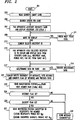
- FIG. 2 Shown in FIG. 2 is a flow chart describing the transmission of a secure facsimile message.
- a facsimile apparatus 100 in the transmit mode.
- step 201 the procedure is started.
- step 203 the sender inserts his or her smart card 175 into the smart card interface 170.
- the facsimile apparatus in step 203, authenticates the sender's smart card, illustratively in the manner described in the AT&T CSS arrangement.
- the sender enters a PIN code and the facsimile apparatus authenticates the sender's identity.
- step 207 the facsimile apparatus accesses the sender's smart card and displays an address book (Table 401 of FIG. 4) on display 142.
- Table 401 includes a list of recipient names, facsimile numbers, telephone numbers and public keys.
- step 209 if the size of Table 401 exceeds the display capability of display 142, the system permits the sender to step the display 142 to the next field or page of the addressee list. This is done in step 211.
- step 213 the sender selects the recipient to whom a facsimile message is to be sent.
- facsimile apparatus 100 uses the selected recipient identification to obtain and display data from the sender's smart card 175 (Table 401).
- step 217 the sender has an opportunity to add or change data in Table 401.
- step 219 the sender adds or changes data in Table 401.
- step 221 the sender inputs the document or message into the fax apparatus and, if appropriate, sets a restrict flag and encrypt flag (if it is desirable to restrict and encrypt the body of the transmitted fax message) and then presses the send button.
- the header portion of the message is sent unrestricted while the body of the message may be sent either unrestricted (restrict flag is 0) or restricted (restrict flag is 1).
- a restricted message can be sent unencrypted (encrypt flag is 0) or encrypted (encrypt flag is 1).
- encrypted messages may be encrypted in one of two different ways-- for example, by using a recipient's public key K RP (K RP encrypt flag is 1) or by using a sender's private key K SS (K SS encrypt flag is 1).
- K RP encrypt flag is 1
- K SS sender's private key
- the actual encryption keys K RP and K SS are obtained, respectively, from Table 401 and Table 402.
- the restrict and encrypt flags are sent as part of the header message (see Table 403).
- an illustrative header message including data fields such as recipient's name and facsimile number, date/time, sender's name and facsimile number, sender's public key (K SP ), a message identification number, a restrict flag, recipient's public key encrypt flag ( K RP ), and sender's private key encrypt flag (K SS ).
- K SP sender's public key
- K RP sender's public key
- K RP sender's public key encrypt flag
- K SS sender's private key encrypt flag
- step 224 it is determined if the restrict flag is set. If it is not set, then in step 229 the document or message is sent unencrypted. In step 224, if the restrict flag is set, then in step 225 it is determined if the encrypt flag is set. If it is not, then in step 229 the sender's document or message is sent unencrypted. If either the K RP or K SS flag is set, then in step 227 the header message is sent unencrypted and the document or body of the message is sent encrypted, using the appropriate recipient's public key K RP or the sender's private key K SS .
- the document or message is encrypted, it is transmitted over the facility as a random sequence of data bits to the receiving fax apparatus or any apparatus monitoring the facility. This random sequence of data bits can only be encrypted when the proper key is used, as will be described in later paragraphs.
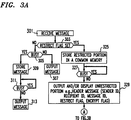
- step 301 the facsimile message is received.
- Table 404 is a listing of header messages which are displayed or printed at fax apparatus 100. Each header message is associated with a fax message or document received by fax apparatus 100.
- step 303 it is determined if the received fax message, e.g., 405, has a restricted portion (by checking the restrict bit of the header message). If there is no restricted portion (e.g., as in message 407), then in step 305 the fax apparatus determines if the printer output unit 150 is busy.
- step 325 the restricted message is stored in memory (RAM 122) and associated with the appropriate header message of Table 404.
- step 327 it is determined if the printer unit is busy. When the printer unit 150 is not busy, then in step 329 the apparatus outputs and/or displays the header message, illustratively in the form shown in Table 404.
- step 331 the user or recipient inserts his/her smart card 175 into smart card interface 170 and enters his/her PIN number via operator panel 140.
- step 339 the validity of the smart card and PIN is determined. (This is accomplished using authentication programs stored in facsimile apparatus 100 and smart card 175.) If the smart card and PIN number are not valid, then the operation is terminated in step 337. If the smart card and PIN number are valid, then control proceeds to step 341.
- Each header message 405-408 of Table 404 may include entries for all of the data fields.
- the operator panel 140 includes buttons for enabling a recipient to select his/her messages for output from the plurality of messages listed in Table 404.
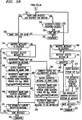
- the recipient determines if he/she has multiple messages. If the recipient does not have multiple messages, control passes to step 344; otherwise control passes to step 343.
- the recipient selects which of his/her received messages is to be outputted.
- fax apparatus 100 determines if the selected message is encrypted using the recipient's public key K RP (i.e., by checking the status of K RP flag). If the selected message is encrypted using the key K RP (such as message 403 in Table 404), then control passes to step 345. In step 345, the selected message is outputted via smart card interface 170 to smart card 175.
- the smart card 175 (with joint reference to FIGS. 3 and 5) illustratively receives the encrypted message via contactless interface 501.
- Microprocessor 502 obtains the recipient's private or secret key K RS from memory 503 and decrypts the encrypted message using key K RS .
- recipient's public key K RP was used to encrypt the transmitted facsimile message.
- the keys K RP and K RS each represent encryption functions that are inverses of each other.
- a random sequence results when a message is encrypted with the encryption function of key K RP .
- K X K RP (original message) the original message.
- Such an encryption arrangement is described in U.S. patent 4,590,470 issued on May 20, 1986 to A. R. Koenig.
- a message encrypted using sender's private key K SS can be decrypted only by using the sender's public key K SP .
- step 347 when microprocessor 502 applies the key K RS to a message that has been encrypted using the recipient's public key K RP , the resulting decrypted message is the original message sent by the sender.
- step 349 the recipient's smart card 175 outputs the decrypted message via the smart card interface 170 to fax apparatus 100.
- facsimile apparatus 100 outputs the decrypted message via printer unit 150.
- step 353 the recipient determines if there are additional messages for the recipient. If there are, then control returns to step 343, otherwise the receive mode is terminated in step 355.
- step 381 fax apparatus 100 determines if the selected message is encrypted using the sender's private key K SS (by checking if the K SS flag is set in the selected header message of Table 404). If yes (such as with message 405 of Table 404), then in step 382, the encrypted message is outputted to smart card 175. In step 383, the smart card 175 decrypts the encrypted message using the sender's public key K SP to obtain the original message. In step 384 the smart card 175 outputs the decrypted message to fax apparatus 100. Thereafter fax apparatus 100 outputs the decrypted message in step 351 as previously described.
- step 381 if the K SS flag is not set, then the restricted portion of the fax message was not encrypted (e.g., such as message 408 of Table 404 where both the K RP and K SS flags are not set), and control returns to step 363.
- the fax apparatus outputs the unencrypted restricted portion of the message via printer 150.
- step 364 it determines if more messages exist. If more messages exist, control returns to step 330; otherwise the received procedure is terminated in step 365.
- step 304 is performed.
- the recipient must enter his/her login and password and other information (such as the special password of message 403, if appropriate). If the login and password are not correctly entered, then fax apparatus 100 determines, in step 335, whether or not it should time out. If it does not time out, control returns to step 331. If a time out has occurred, then fax apparatus 100 terminates the operation in step 337. Note, even after termination, fax apparatus 100 may continue to display the header messages of Table 404 to identify messages previously received for each recipient. Obviously, a recipient can select his/her messages for retrieval at any time. Thus, step 331 need not immediately follow step 329.
- step 334 the recipient's login and password (and, optionally, other special passwords, if utilized) are checked by comparing them with the data entered in Table 410. If correctly entered, then in step 360 the recipient checks if multiple messages exist. If only one message exists, then step 362 is performed; otherwise, the recipient selects the desired message in step 361 and then step 362 checks if the restricted message is encrypted. Note, for security reasons, we assume that the message was encrypted using the sender's private key K SS , since then the user only has to enter the sender's public key K SP to decrypt the message. (If the restricted message was encrypted using the recipient's public key K RP , the recipient would then have to enter his/her private key K RS into apparatus 100. Such an arrangement may be less secure to the recipient.)
- step 372 the recipient enters the sender's public key K SP .
- step 362 if the K SS flag is not set, then the restricted message does not need to be decrypted. Hence, in step 363, the fax apparatus 100 outputs the restricted portion of the message. Processing continues from step 363 in the manner previously described.
Landscapes
- Engineering & Computer Science (AREA)
- Signal Processing (AREA)
- Computer Security & Cryptography (AREA)
- Computer Networks & Wireless Communication (AREA)
- Multimedia (AREA)
- Facsimile Transmission Control (AREA)
- Facsimiles In General (AREA)
- Communication Control (AREA)
Applications Claiming Priority (2)
| Application Number | Priority Date | Filing Date | Title |
|---|---|---|---|
| US08/206,710 US5552897A (en) | 1994-03-07 | 1994-03-07 | Secure communication apparatus and method |
| US206710 | 1994-03-07 |
Publications (3)
| Publication Number | Publication Date |
|---|---|
| EP0671830A2 true EP0671830A2 (de) | 1995-09-13 |
| EP0671830A3 EP0671830A3 (de) | 2000-03-08 |
| EP0671830B1 EP0671830B1 (de) | 2005-10-05 |
Family
ID=22767603
Family Applications (1)
| Application Number | Title | Priority Date | Filing Date |
|---|---|---|---|
| EP95301109A Expired - Lifetime EP0671830B1 (de) | 1994-03-07 | 1995-02-22 | Gerät und Verfahren zur geschützten Übertragung |
Country Status (7)
| Country | Link |
|---|---|
| US (1) | US5552897A (de) |
| EP (1) | EP0671830B1 (de) |
| JP (1) | JPH07298065A (de) |
| KR (1) | KR100361388B1 (de) |
| CA (1) | CA2141900C (de) |
| DE (1) | DE69534494T2 (de) |
| NO (1) | NO313850B1 (de) |
Cited By (7)
| Publication number | Priority date | Publication date | Assignee | Title |
|---|---|---|---|---|
| FR2774834A1 (fr) * | 1998-02-11 | 1999-08-13 | Sagem | Procede de transmission securisee de messages de donnees entre deux utilisateurs de deux equipements de transmission respectifs relies par un reseau de transmission de donnees |
| US6334216B1 (en) | 1997-12-05 | 2001-12-25 | Alcatel | Access control facility for a service-on-demand system |
| GB2366468A (en) * | 2000-08-25 | 2002-03-06 | Hewlett Packard Co | Secure facsimile reception using digital certificates and keys. |
| EP1091275A3 (de) * | 1999-10-04 | 2004-02-04 | Canon Kabushiki Kaisha | Authentifiziertes sicheres Drucken |
| EP1499107A2 (de) | 2003-07-15 | 2005-01-19 | Ricoh Company, Ltd. | Bildverarbeitungsvorrichtung |
| WO2005043361A3 (en) * | 2003-10-31 | 2005-08-25 | Hewlett Packard Development Co | Secure document access method and apparatus |
| CN110291770A (zh) * | 2017-02-15 | 2019-09-27 | 惠普发展公司,有限责任合伙企业 | 受保护的电子通信 |
Families Citing this family (50)
| Publication number | Priority date | Publication date | Assignee | Title |
|---|---|---|---|---|
| EP0664627B1 (de) * | 1993-07-07 | 2004-04-28 | Ntt Mobile Communications Network Inc. | Verfahren zur steuerung der vertraulichkeit einer persönlichen mitteilung |
| US5808754A (en) * | 1994-10-24 | 1998-09-15 | Brother Kogyo Kabushiki Kaisha | Facsimile machine with plural reception modes |
| US7898675B1 (en) * | 1995-11-13 | 2011-03-01 | Netfax Development, Llc | Internet global area networks fax system |
| US5633932A (en) * | 1995-12-19 | 1997-05-27 | Intel Corporation | Apparatus and method for preventing disclosure through user-authentication at a printing node |
| KR100217741B1 (ko) * | 1996-04-19 | 1999-09-01 | 윤종용 | 팩시밀리 시스템에 있어서 출력 제어방법 |
| US5859967A (en) * | 1996-07-09 | 1999-01-12 | Faxsav Incorporated | Method and system for relaying communications from authorized users |
| US5801856A (en) * | 1996-07-24 | 1998-09-01 | Eastman Kodak Company | Secure photographic systems |
| US5822408A (en) * | 1996-12-31 | 1998-10-13 | Bourbon; Ralph | Method and apparatus for verifying the identity of a receiver of a facsimile |
| US7447738B1 (en) * | 1997-03-14 | 2008-11-04 | International Business Machines Corporation | Component download selection mechanism for web browsers |
| US6000031A (en) * | 1997-05-01 | 1999-12-07 | At&T Corp | Method and system for collecting and authenticating updates to a network-based directory service |
| US6385723B1 (en) * | 1997-05-15 | 2002-05-07 | Mondex International Limited | Key transformation unit for an IC card |
| US6474544B2 (en) | 1998-03-23 | 2002-11-05 | Sun Microsystems, Inc. | Electronic vault for use in processing smart product transactions |
| JP3835655B2 (ja) * | 1998-06-09 | 2006-10-18 | ソニー株式会社 | 情報信号再生装置、情報信号処理装置、情報信号再生方法および情報信号出力方法 |
| US6460138B1 (en) | 1998-10-05 | 2002-10-01 | Flashpoint Technology, Inc. | User authentication for portable electronic devices using asymmetrical cryptography |
| US6990578B1 (en) * | 1999-10-29 | 2006-01-24 | International Business Machines Corp. | Method and apparatus for encrypting electronic messages composed using abbreviated address books |
| US7248693B1 (en) * | 2000-01-13 | 2007-07-24 | Hewlett-Packard Development Company, L.P. | Secure network-based system for the distributed printing of documents |
| JP2002010008A (ja) * | 2000-06-19 | 2002-01-11 | Canon Inc | 情報処理装置及びその制御方法ならびにそれらを記憶する記憶媒体 |
| JP3494961B2 (ja) * | 2000-07-21 | 2004-02-09 | パナソニック コミュニケーションズ株式会社 | 暗号化処理装置及び暗号化処理方法 |
| US7082536B2 (en) * | 2000-11-13 | 2006-07-25 | Globalcerts, Lc | System and method for computerized global messaging encryption |
| US8290160B1 (en) * | 2001-10-17 | 2012-10-16 | Appalachian Technologies Corporation of Pennsylvania | Method and apparatus for secured facsimile transmission |
| US8732566B2 (en) * | 2006-11-29 | 2014-05-20 | Omtool, Ltd. | Methods and apparatus for digital content handling |
| US8904270B2 (en) * | 2006-11-29 | 2014-12-02 | Omtool Ltd. | Methods and apparatus for enterprise document distribution |
| US7268899B2 (en) * | 2002-01-31 | 2007-09-11 | Hewlett-Packard Development Company, L.P. | Secure system for delivery of a fax to a remote user |
| GB2391770A (en) * | 2002-08-01 | 2004-02-11 | Andrew Christopher Kemshall | Sending email securely |
| US20040125396A1 (en) * | 2002-12-19 | 2004-07-01 | James Burke | System and method for routing voice/video/fax mail |
| US7587051B2 (en) | 2003-01-13 | 2009-09-08 | Denis Bisson | System and method for securing information, including a system and method for setting up a correspondent pairing |
| US20040158733A1 (en) | 2003-02-11 | 2004-08-12 | Thaddeus Bouchard | Method and system for secure facsimile delivery and registration |
| US7526555B2 (en) * | 2003-03-25 | 2009-04-28 | Toshiba Corporation | Smart card printing |
| US20040207884A1 (en) * | 2003-04-18 | 2004-10-21 | Chen Steven H. | User programmable fax machine to screen unwanted transmissions |
| US20040208320A1 (en) * | 2003-04-18 | 2004-10-21 | Chen Steven H. | Apparatus and method for secured facsimile transmission by use of a public key encryption algorithm |
| JP2005071175A (ja) * | 2003-08-26 | 2005-03-17 | Ricoh Co Ltd | 印刷データ生成方法、その方法をコンピュータに実行させるプログラム、クライアント端末、プリンタサーバ、印刷データ生成装置および画像形成装置 |
| US8331911B2 (en) | 2004-06-21 | 2012-12-11 | Research In Motion Limited | System and method for handling message receipt notification |
| US8166299B2 (en) * | 2004-07-06 | 2012-04-24 | Andrew Christopher Kemshall | Secure messaging |
| US8359332B1 (en) | 2004-08-02 | 2013-01-22 | Nvidia Corporation | Secure content enabled drive digital rights management system and method |
| US8402283B1 (en) * | 2004-08-02 | 2013-03-19 | Nvidia Corporation | Secure content enabled drive system and method |
| US8788425B1 (en) | 2004-12-15 | 2014-07-22 | Nvidia Corporation | Method and system for accessing content on demand |
| US8346807B1 (en) | 2004-12-15 | 2013-01-01 | Nvidia Corporation | Method and system for registering and activating content |
| US8875309B1 (en) | 2004-12-15 | 2014-10-28 | Nvidia Corporation | Content server and method of providing content therefrom |
| US8751825B1 (en) | 2004-12-15 | 2014-06-10 | Nvidia Corporation | Content server and method of storing content |
| US8893299B1 (en) | 2005-04-22 | 2014-11-18 | Nvidia Corporation | Content keys for authorizing access to content |
| JP4120892B2 (ja) * | 2005-11-01 | 2008-07-16 | コニカミノルタビジネステクノロジーズ株式会社 | 情報処理装置および機能制限解除方法 |
| EP1961153B1 (de) | 2005-12-15 | 2019-02-20 | Nokia Technologies Oy | Verfahren, einrichtung und computerprogrammprodukt zur netzwerkgestützten fernsteuerung über kontaktlose sichere speicherungen |
| JP2009519652A (ja) * | 2005-12-16 | 2009-05-14 | ノキア コーポレイション | 通信イベントを制御しその標示を提供するための方法およびデバイス |
| US20070296933A1 (en) * | 2006-06-09 | 2007-12-27 | Kabushiki Kaisha Toshiba | Image Forming Apparatus and Control Method Thereof |
| JP2008035097A (ja) * | 2006-07-27 | 2008-02-14 | Murata Mach Ltd | 電子メール管理装置 |
| US9020913B2 (en) * | 2007-10-25 | 2015-04-28 | International Business Machines Corporation | Real-time interactive authorization for enterprise search |
| US9397985B1 (en) * | 2015-04-14 | 2016-07-19 | Manifold Technology, Inc. | System and method for providing a cryptographic platform for exchanging information |
| CN105898054A (zh) * | 2016-04-08 | 2016-08-24 | 惠州Tcl移动通信有限公司 | 一种基于验证的消息显示方法及通信终端 |
| US12556908B1 (en) * | 2023-01-03 | 2026-02-17 | Fatah Muraisi | Encryption device and method for satellite phone |
| US20260025466A1 (en) * | 2024-07-16 | 2026-01-22 | Motorola Mobility Llc | Authentication security for interfacing with incoming communications at an electronic device |
Family Cites Families (7)
| Publication number | Priority date | Publication date | Assignee | Title |
|---|---|---|---|---|
| US5258998A (en) * | 1985-10-07 | 1993-11-02 | Canon Kabushiki Kaisha | Data communication apparatus permitting confidential communication |
| US4900902A (en) * | 1985-12-19 | 1990-02-13 | Canon Kabushiki Kaisha | Data communication apparatus |
| US5227613A (en) * | 1989-01-24 | 1993-07-13 | Matsushita Electric Industrial Co., Ltd. | Secure encrypted data communication system having physically secure ic cards and session key generation based on card identifying information |
| US5191611A (en) * | 1989-04-03 | 1993-03-02 | Lang Gerald S | Method and apparatus for protecting material on storage media and for transferring material on storage media to various recipients |
| US5048085A (en) * | 1989-10-06 | 1991-09-10 | International Business Machines Corporation | Transaction system security method and apparatus |
| SE470001B (sv) * | 1991-09-12 | 1993-10-18 | Televerket | Förfarande för identifiering och kryptonyckelutbyte mellan två kommunicerande apparater för krypterad trafik |
| US5353124A (en) * | 1993-10-15 | 1994-10-04 | Software Security, Inc. | Method of providing confidential treatment for facsimile transmissions |
-
1994
- 1994-03-07 US US08/206,710 patent/US5552897A/en not_active Expired - Lifetime
-
1995
- 1995-02-06 CA CA002141900A patent/CA2141900C/en not_active Expired - Lifetime
- 1995-02-22 EP EP95301109A patent/EP0671830B1/de not_active Expired - Lifetime
- 1995-02-22 DE DE69534494T patent/DE69534494T2/de not_active Expired - Lifetime
- 1995-03-06 JP JP7070480A patent/JPH07298065A/ja active Pending
- 1995-03-06 KR KR1019950004493A patent/KR100361388B1/ko not_active Expired - Lifetime
- 1995-03-06 NO NO19950866A patent/NO313850B1/no not_active IP Right Cessation
Cited By (12)
| Publication number | Priority date | Publication date | Assignee | Title |
|---|---|---|---|---|
| US6334216B1 (en) | 1997-12-05 | 2001-12-25 | Alcatel | Access control facility for a service-on-demand system |
| FR2774834A1 (fr) * | 1998-02-11 | 1999-08-13 | Sagem | Procede de transmission securisee de messages de donnees entre deux utilisateurs de deux equipements de transmission respectifs relies par un reseau de transmission de donnees |
| EP0936775A1 (de) * | 1998-02-11 | 1999-08-18 | Sagem Sa | Verfahren zur gesicherten Übertragung einer Datennachricht zwischen zwei Benutzern von zwei zugeordneten Übertragungseinrichtungen welche über ein Datenübertragungsnetz miteinander verbunden sind |
| EP1091275A3 (de) * | 1999-10-04 | 2004-02-04 | Canon Kabushiki Kaisha | Authentifiziertes sicheres Drucken |
| US6862583B1 (en) | 1999-10-04 | 2005-03-01 | Canon Kabushiki Kaisha | Authenticated secure printing |
| GB2366468A (en) * | 2000-08-25 | 2002-03-06 | Hewlett Packard Co | Secure facsimile reception using digital certificates and keys. |
| GB2366468B (en) * | 2000-08-25 | 2005-03-02 | Hewlett Packard Co | Improvements relating to document transmission techniques I |
| EP1499107A2 (de) | 2003-07-15 | 2005-01-19 | Ricoh Company, Ltd. | Bildverarbeitungsvorrichtung |
| EP1499107A3 (de) * | 2003-07-15 | 2006-12-27 | Ricoh Company, Ltd. | Bildverarbeitungsvorrichtung |
| WO2005043361A3 (en) * | 2003-10-31 | 2005-08-25 | Hewlett Packard Development Co | Secure document access method and apparatus |
| CN110291770A (zh) * | 2017-02-15 | 2019-09-27 | 惠普发展公司,有限责任合伙企业 | 受保护的电子通信 |
| EP3583773A4 (de) * | 2017-02-15 | 2020-10-21 | Hewlett-Packard Development Company, L.P. | Geschützte elektronische kommunikation |
Also Published As
| Publication number | Publication date |
|---|---|
| EP0671830A3 (de) | 2000-03-08 |
| US5552897A (en) | 1996-09-03 |
| NO313850B1 (no) | 2002-12-09 |
| JPH07298065A (ja) | 1995-11-10 |
| DE69534494T2 (de) | 2006-06-14 |
| CA2141900A1 (en) | 1995-09-08 |
| NO950866D0 (no) | 1995-03-06 |
| NO950866L (no) | 1995-09-08 |
| CA2141900C (en) | 2000-06-27 |
| DE69534494D1 (de) | 2005-11-10 |
| KR100361388B1 (ko) | 2003-03-03 |
| EP0671830B1 (de) | 2005-10-05 |
| KR950035289A (ko) | 1995-12-30 |
Similar Documents
| Publication | Publication Date | Title |
|---|---|---|
| EP0671830B1 (de) | Gerät und Verfahren zur geschützten Übertragung | |
| US5633932A (en) | Apparatus and method for preventing disclosure through user-authentication at a printing node | |
| US4799258A (en) | Apparatus and methods for granting access to computers | |
| US6636965B1 (en) | Embedding recipient specific comments in electronic messages using encryption | |
| US5935248A (en) | Security level control apparatus and method for a network securing communications between parties without presetting the security level | |
| JP2887299B2 (ja) | 知的情報処理方法および装置 | |
| US6058187A (en) | Secure telecommunications data transmission | |
| US7152159B2 (en) | Encrypted mail transmission system | |
| US20020051544A1 (en) | User support system for cryptographic communication in network systems | |
| JPH09147072A (ja) | 個人認証システム、個人認証カードおよびセンタ装置 | |
| US8290160B1 (en) | Method and apparatus for secured facsimile transmission | |
| US20020126848A1 (en) | Protected communication system | |
| EA016739B1 (ru) | Способ и устройство для защищённой факсимильной передачи | |
| US20030163529A1 (en) | Communication apparatus and method | |
| JPS60208137A (ja) | デ−タ処理方式 | |
| JPS60198968A (ja) | フアクシミリ秘密通信方式 | |
| WO1991012680A1 (en) | Apparatus and method for data communication | |
| JPH07162693A (ja) | 暗号化同報データ送受信装置およびアダプタ | |
| JP2541307B2 (ja) | 暗号鍵通信方法及びその装置 | |
| JPH07250249A (ja) | 通信機器 | |
| JPH11234330A (ja) | 電子メール送信内容証明システム装置 | |
| JP2000059354A (ja) | 可搬記録媒体を利用したセッション鍵の生成方法およびデータ配送システム | |
| US20070070399A1 (en) | FAX communication system | |
| JPH0993242A (ja) | データ送受信装置 | |
| KR0170164B1 (ko) | 스마트 카드를 이용한 펌 뱅킹 단말장치 및 그의 운용방법 |
Legal Events
| Date | Code | Title | Description |
|---|---|---|---|
| PUAI | Public reference made under article 153(3) epc to a published international application that has entered the european phase |
Free format text: ORIGINAL CODE: 0009012 |
|
| AK | Designated contracting states |
Kind code of ref document: A2 Designated state(s): DE FR GB NL |
|
| PUAL | Search report despatched |
Free format text: ORIGINAL CODE: 0009013 |
|
| AK | Designated contracting states |
Kind code of ref document: A3 Designated state(s): DE FR GB NL |
|
| 17P | Request for examination filed |
Effective date: 20000824 |
|
| GRAP | Despatch of communication of intention to grant a patent |
Free format text: ORIGINAL CODE: EPIDOSNIGR1 |
|
| GRAS | Grant fee paid |
Free format text: ORIGINAL CODE: EPIDOSNIGR3 |
|
| GRAA | (expected) grant |
Free format text: ORIGINAL CODE: 0009210 |
|
| AK | Designated contracting states |
Kind code of ref document: B1 Designated state(s): DE FR GB NL |
|
| REG | Reference to a national code |
Ref country code: GB Ref legal event code: FG4D |
|
| REF | Corresponds to: |
Ref document number: 69534494 Country of ref document: DE Date of ref document: 20051110 Kind code of ref document: P |
|
| ET | Fr: translation filed | ||
| PLBE | No opposition filed within time limit |
Free format text: ORIGINAL CODE: 0009261 |
|
| STAA | Information on the status of an ep patent application or granted ep patent |
Free format text: STATUS: NO OPPOSITION FILED WITHIN TIME LIMIT |
|
| 26N | No opposition filed |
Effective date: 20060706 |
|
| REG | Reference to a national code |
Ref country code: GB Ref legal event code: 732E Free format text: REGISTERED BETWEEN 20140102 AND 20140108 |
|
| REG | Reference to a national code |
Ref country code: GB Ref legal event code: 732E Free format text: REGISTERED BETWEEN 20140109 AND 20140115 |
|
| PGFP | Annual fee paid to national office [announced via postgrant information from national office to epo] |
Ref country code: NL Payment date: 20140218 Year of fee payment: 20 Ref country code: DE Payment date: 20140219 Year of fee payment: 20 |
|
| PGFP | Annual fee paid to national office [announced via postgrant information from national office to epo] |
Ref country code: FR Payment date: 20140219 Year of fee payment: 20 |
|
| PGFP | Annual fee paid to national office [announced via postgrant information from national office to epo] |
Ref country code: GB Payment date: 20140218 Year of fee payment: 20 |
|
| REG | Reference to a national code |
Ref country code: DE Ref legal event code: R071 Ref document number: 69534494 Country of ref document: DE |
|
| REG | Reference to a national code |
Ref country code: NL Ref legal event code: V4 Effective date: 20150222 |
|
| REG | Reference to a national code |
Ref country code: GB Ref legal event code: PE20 Expiry date: 20150221 |
|
| PG25 | Lapsed in a contracting state [announced via postgrant information from national office to epo] |
Ref country code: GB Free format text: LAPSE BECAUSE OF EXPIRATION OF PROTECTION Effective date: 20150221 |