EP0672410B1 - Silikonvesikeln und Einschlussprodukte - Google Patents
Silikonvesikeln und Einschlussprodukte Download PDFInfo
- Publication number
- EP0672410B1 EP0672410B1 EP95301552A EP95301552A EP0672410B1 EP 0672410 B1 EP0672410 B1 EP 0672410B1 EP 95301552 A EP95301552 A EP 95301552A EP 95301552 A EP95301552 A EP 95301552A EP 0672410 B1 EP0672410 B1 EP 0672410B1
- Authority
- EP
- European Patent Office
- Prior art keywords
- water
- group
- vesicles
- value
- methyl
- Prior art date
- Legal status (The legal status is an assumption and is not a legal conclusion. Google has not performed a legal analysis and makes no representation as to the accuracy of the status listed.)
- Expired - Lifetime
Links
- XUIMIQQOPSSXEZ-UHFFFAOYSA-N Silicon Chemical compound [Si] XUIMIQQOPSSXEZ-UHFFFAOYSA-N 0.000 title 1
- 229910052710 silicon Inorganic materials 0.000 title 1
- 239000010703 silicon Substances 0.000 title 1
- 239000004094 surface-active agent Substances 0.000 claims description 91
- KPUWHANPEXNPJT-UHFFFAOYSA-N disiloxane Chemical class [SiH3]O[SiH3] KPUWHANPEXNPJT-UHFFFAOYSA-N 0.000 claims description 77
- 239000000126 substance Substances 0.000 claims description 33
- XLYOFNOQVPJJNP-UHFFFAOYSA-N water Substances O XLYOFNOQVPJJNP-UHFFFAOYSA-N 0.000 claims description 24
- 238000000034 method Methods 0.000 claims description 17
- 239000000203 mixture Substances 0.000 claims description 14
- 125000002496 methyl group Chemical group [H]C([H])([H])* 0.000 claims description 11
- -1 polydimethylsiloxane Polymers 0.000 claims description 10
- 239000003814 drug Substances 0.000 claims description 8
- 229940079593 drug Drugs 0.000 claims description 7
- 238000002156 mixing Methods 0.000 claims description 6
- YGSDEFSMJLZEOE-UHFFFAOYSA-N salicylic acid Chemical group OC(=O)C1=CC=CC=C1O YGSDEFSMJLZEOE-UHFFFAOYSA-N 0.000 claims description 6
- 239000006185 dispersion Substances 0.000 claims description 5
- 230000000475 sunscreen effect Effects 0.000 claims description 5
- 239000000516 sunscreening agent Substances 0.000 claims description 5
- CIWBSHSKHKDKBQ-JLAZNSOCSA-N Ascorbic acid Chemical compound OC[C@H](O)[C@H]1OC(=O)C(O)=C1O CIWBSHSKHKDKBQ-JLAZNSOCSA-N 0.000 claims description 4
- PEDCQBHIVMGVHV-UHFFFAOYSA-N Glycerine Chemical compound OCC(O)CO PEDCQBHIVMGVHV-UHFFFAOYSA-N 0.000 claims description 4
- AEMRFAOFKBGASW-UHFFFAOYSA-N Glycolic acid Chemical compound OCC(O)=O AEMRFAOFKBGASW-UHFFFAOYSA-N 0.000 claims description 4
- 125000000217 alkyl group Chemical group 0.000 claims description 4
- 239000003755 preservative agent Substances 0.000 claims description 4
- CPELXLSAUQHCOX-UHFFFAOYSA-M Bromide Chemical compound [Br-] CPELXLSAUQHCOX-UHFFFAOYSA-M 0.000 claims description 3
- VEXZGXHMUGYJMC-UHFFFAOYSA-M Chloride anion Chemical compound [Cl-] VEXZGXHMUGYJMC-UHFFFAOYSA-M 0.000 claims description 3
- XFXPMWWXUTWYJX-UHFFFAOYSA-N Cyanide Chemical compound N#[C-] XFXPMWWXUTWYJX-UHFFFAOYSA-N 0.000 claims description 3
- 125000004432 carbon atom Chemical group C* 0.000 claims description 3
- 150000001875 compounds Chemical class 0.000 claims description 3
- 239000012530 fluid Substances 0.000 claims description 3
- 125000004435 hydrogen atom Chemical group [H]* 0.000 claims description 3
- XMBWDFGMSWQBCA-UHFFFAOYSA-N hydrogen iodide Chemical compound I XMBWDFGMSWQBCA-UHFFFAOYSA-N 0.000 claims description 3
- 150000003961 organosilicon compounds Chemical class 0.000 claims description 3
- FPIPGXGPPPQFEQ-UHFFFAOYSA-N 13-cis retinol Natural products OCC=C(C)C=CC=C(C)C=CC1=C(C)CCCC1(C)C FPIPGXGPPPQFEQ-UHFFFAOYSA-N 0.000 claims description 2
- ZZZCUOFIHGPKAK-UHFFFAOYSA-N D-erythro-ascorbic acid Natural products OCC1OC(=O)C(O)=C1O ZZZCUOFIHGPKAK-UHFFFAOYSA-N 0.000 claims description 2
- 102000004190 Enzymes Human genes 0.000 claims description 2
- 108090000790 Enzymes Proteins 0.000 claims description 2
- FPIPGXGPPPQFEQ-BOOMUCAASA-N Vitamin A Natural products OC/C=C(/C)\C=C\C=C(\C)/C=C/C1=C(C)CCCC1(C)C FPIPGXGPPPQFEQ-BOOMUCAASA-N 0.000 claims description 2
- 229930003268 Vitamin C Natural products 0.000 claims description 2
- FPIPGXGPPPQFEQ-OVSJKPMPSA-N all-trans-retinol Chemical compound OC\C=C(/C)\C=C\C=C(/C)\C=C\C1=C(C)CCCC1(C)C FPIPGXGPPPQFEQ-OVSJKPMPSA-N 0.000 claims description 2
- 230000001166 anti-perspirative effect Effects 0.000 claims description 2
- 239000003213 antiperspirant Substances 0.000 claims description 2
- 239000002781 deodorant agent Substances 0.000 claims description 2
- 239000004205 dimethyl polysiloxane Substances 0.000 claims description 2
- 235000011187 glycerol Nutrition 0.000 claims description 2
- FJKROLUGYXJWQN-UHFFFAOYSA-N papa-hydroxy-benzoic acid Natural products OC(=O)C1=CC=C(O)C=C1 FJKROLUGYXJWQN-UHFFFAOYSA-N 0.000 claims description 2
- 239000000049 pigment Substances 0.000 claims description 2
- 229920000435 poly(dimethylsiloxane) Polymers 0.000 claims description 2
- 229960004889 salicylic acid Drugs 0.000 claims description 2
- 150000003839 salts Chemical class 0.000 claims description 2
- RYYKJJJTJZKILX-UHFFFAOYSA-M sodium octadecanoate Chemical compound [Na+].CCCCCCCCCCCCCCCCCC([O-])=O RYYKJJJTJZKILX-UHFFFAOYSA-M 0.000 claims description 2
- 235000019155 vitamin A Nutrition 0.000 claims description 2
- 239000011719 vitamin A Substances 0.000 claims description 2
- 235000019154 vitamin C Nutrition 0.000 claims description 2
- 239000011718 vitamin C Substances 0.000 claims description 2
- 229940045997 vitamin a Drugs 0.000 claims description 2
- 125000002252 acyl group Chemical group 0.000 claims 2
- 125000001797 benzyl group Chemical group [H]C1=C([H])C([H])=C(C([H])=C1[H])C([H])([H])* 0.000 claims 2
- MOTZDAYCYVMXPC-UHFFFAOYSA-N dodecyl hydrogen sulfate Chemical group CCCCCCCCCCCCOS(O)(=O)=O MOTZDAYCYVMXPC-UHFFFAOYSA-N 0.000 claims 2
- 229910052739 hydrogen Inorganic materials 0.000 claims 2
- 239000001257 hydrogen Substances 0.000 claims 2
- 125000005527 methyl sulfate group Chemical group 0.000 claims 2
- 125000001997 phenyl group Chemical group [H]C1=C([H])C([H])=C(*)C([H])=C1[H] 0.000 claims 2
- 239000002502 liposome Substances 0.000 description 28
- 239000000243 solution Substances 0.000 description 23
- 239000002537 cosmetic Substances 0.000 description 21
- 150000002632 lipids Chemical class 0.000 description 19
- 230000008901 benefit Effects 0.000 description 16
- DEGAKNSWVGKMLS-UHFFFAOYSA-N calcein Chemical compound O1C(=O)C2=CC=CC=C2C21C1=CC(CN(CC(O)=O)CC(O)=O)=C(O)C=C1OC1=C2C=C(CN(CC(O)=O)CC(=O)O)C(O)=C1 DEGAKNSWVGKMLS-UHFFFAOYSA-N 0.000 description 13
- HEMHJVSKTPXQMS-UHFFFAOYSA-M Sodium hydroxide Chemical compound [OH-].[Na+] HEMHJVSKTPXQMS-UHFFFAOYSA-M 0.000 description 12
- 229960002378 oftasceine Drugs 0.000 description 12
- 239000000975 dye Substances 0.000 description 11
- 238000009472 formulation Methods 0.000 description 7
- 239000012071 phase Substances 0.000 description 7
- 150000003904 phospholipids Chemical class 0.000 description 7
- 238000002360 preparation method Methods 0.000 description 7
- 229920005654 Sephadex Polymers 0.000 description 6
- 239000012507 Sephadex™ Substances 0.000 description 6
- 230000015572 biosynthetic process Effects 0.000 description 6
- 239000004480 active ingredient Substances 0.000 description 5
- 150000002430 hydrocarbons Chemical class 0.000 description 5
- 239000000693 micelle Substances 0.000 description 5
- 210000003491 skin Anatomy 0.000 description 5
- 239000003981 vehicle Substances 0.000 description 5
- 239000004215 Carbon black (E152) Substances 0.000 description 4
- HEDRZPFGACZZDS-UHFFFAOYSA-N Chloroform Chemical compound ClC(Cl)Cl HEDRZPFGACZZDS-UHFFFAOYSA-N 0.000 description 4
- RTZKZFJDLAIYFH-UHFFFAOYSA-N Diethyl ether Chemical compound CCOCC RTZKZFJDLAIYFH-UHFFFAOYSA-N 0.000 description 4
- DBMJMQXJHONAFJ-UHFFFAOYSA-M Sodium laurylsulphate Chemical compound [Na+].CCCCCCCCCCCCOS([O-])(=O)=O DBMJMQXJHONAFJ-UHFFFAOYSA-M 0.000 description 4
- 239000007853 buffer solution Substances 0.000 description 4
- HVYWMOMLDIMFJA-DPAQBDIFSA-N cholesterol Chemical compound C1C=C2C[C@@H](O)CC[C@]2(C)[C@@H]2[C@@H]1[C@@H]1CC[C@H]([C@H](C)CCCC(C)C)[C@@]1(C)CC2 HVYWMOMLDIMFJA-DPAQBDIFSA-N 0.000 description 4
- 238000012377 drug delivery Methods 0.000 description 4
- 238000005538 encapsulation Methods 0.000 description 4
- 238000005516 engineering process Methods 0.000 description 4
- XJRPTMORGOIMMI-UHFFFAOYSA-N ethyl 2-amino-4-(trifluoromethyl)-1,3-thiazole-5-carboxylate Chemical compound CCOC(=O)C=1SC(N)=NC=1C(F)(F)F XJRPTMORGOIMMI-UHFFFAOYSA-N 0.000 description 4
- 229930195733 hydrocarbon Natural products 0.000 description 4
- 239000000463 material Substances 0.000 description 4
- 239000000047 product Substances 0.000 description 4
- 229940083575 sodium dodecyl sulfate Drugs 0.000 description 4
- 235000019333 sodium laurylsulphate Nutrition 0.000 description 4
- 210000000434 stratum corneum Anatomy 0.000 description 4
- LFQSCWFLJHTTHZ-UHFFFAOYSA-N Ethanol Chemical compound CCO LFQSCWFLJHTTHZ-UHFFFAOYSA-N 0.000 description 3
- DNIAPMSPPWPWGF-UHFFFAOYSA-N Propylene glycol Chemical compound CC(O)CO DNIAPMSPPWPWGF-UHFFFAOYSA-N 0.000 description 3
- 241000272534 Struthio camelus Species 0.000 description 3
- 238000013019 agitation Methods 0.000 description 3
- 238000009792 diffusion process Methods 0.000 description 3
- 230000007717 exclusion Effects 0.000 description 3
- 239000007788 liquid Substances 0.000 description 3
- WCYWZMWISLQXQU-UHFFFAOYSA-N methyl Chemical compound [CH3] WCYWZMWISLQXQU-UHFFFAOYSA-N 0.000 description 3
- 150000003254 radicals Chemical group 0.000 description 3
- 230000007332 vesicle formation Effects 0.000 description 3
- GVJHHUAWPYXKBD-UHFFFAOYSA-N (±)-α-Tocopherol Chemical compound OC1=C(C)C(C)=C2OC(CCCC(C)CCCC(C)CCCC(C)C)(C)CCC2=C1C GVJHHUAWPYXKBD-UHFFFAOYSA-N 0.000 description 2
- 239000004909 Moisturizer Substances 0.000 description 2
- 239000008346 aqueous phase Substances 0.000 description 2
- 239000007864 aqueous solution Substances 0.000 description 2
- 239000003093 cationic surfactant Substances 0.000 description 2
- 210000004027 cell Anatomy 0.000 description 2
- 238000005119 centrifugation Methods 0.000 description 2
- 239000003795 chemical substances by application Substances 0.000 description 2
- 235000012000 cholesterol Nutrition 0.000 description 2
- 239000006184 cosolvent Substances 0.000 description 2
- 239000006071 cream Substances 0.000 description 2
- 238000011161 development Methods 0.000 description 2
- 238000000502 dialysis Methods 0.000 description 2
- RNPXCFINMKSQPQ-UHFFFAOYSA-N dicetyl hydrogen phosphate Chemical compound CCCCCCCCCCCCCCCCOP(O)(=O)OCCCCCCCCCCCCCCCC RNPXCFINMKSQPQ-UHFFFAOYSA-N 0.000 description 2
- 229940093541 dicetylphosphate Drugs 0.000 description 2
- 230000000694 effects Effects 0.000 description 2
- 239000000839 emulsion Substances 0.000 description 2
- 150000002170 ethers Chemical class 0.000 description 2
- 230000006870 function Effects 0.000 description 2
- 150000004676 glycans Chemical class 0.000 description 2
- 239000000787 lecithin Substances 0.000 description 2
- 235000010445 lecithin Nutrition 0.000 description 2
- 238000004519 manufacturing process Methods 0.000 description 2
- 238000001000 micrograph Methods 0.000 description 2
- 230000001333 moisturizer Effects 0.000 description 2
- 230000003020 moisturizing effect Effects 0.000 description 2
- 150000002894 organic compounds Chemical class 0.000 description 2
- 239000003960 organic solvent Substances 0.000 description 2
- 238000012856 packing Methods 0.000 description 2
- 239000002245 particle Substances 0.000 description 2
- 239000008188 pellet Substances 0.000 description 2
- 230000000704 physical effect Effects 0.000 description 2
- 229920000223 polyglycerol Polymers 0.000 description 2
- 238000012545 processing Methods 0.000 description 2
- 239000001047 purple dye Substances 0.000 description 2
- 230000015227 regulation of liquid surface tension Effects 0.000 description 2
- 238000001542 size-exclusion chromatography Methods 0.000 description 2
- 210000004927 skin cell Anatomy 0.000 description 2
- 238000005063 solubilization Methods 0.000 description 2
- 230000007928 solubilization Effects 0.000 description 2
- 239000002904 solvent Substances 0.000 description 2
- 238000000527 sonication Methods 0.000 description 2
- 230000006641 stabilisation Effects 0.000 description 2
- 238000011105 stabilization Methods 0.000 description 2
- 239000006228 supernatant Substances 0.000 description 2
- 230000007704 transition Effects 0.000 description 2
- PORPENFLTBBHSG-MGBGTMOVSA-N 1,2-dihexadecanoyl-sn-glycerol-3-phosphate Chemical compound CCCCCCCCCCCCCCCC(=O)OC[C@H](COP(O)(O)=O)OC(=O)CCCCCCCCCCCCCCC PORPENFLTBBHSG-MGBGTMOVSA-N 0.000 description 1
- SLRMQYXOBQWXCR-UHFFFAOYSA-N 2154-56-5 Chemical compound [CH2]C1=CC=CC=C1 SLRMQYXOBQWXCR-UHFFFAOYSA-N 0.000 description 1
- 241001340526 Chrysoclista linneella Species 0.000 description 1
- 229920002307 Dextran Polymers 0.000 description 1
- 206010013786 Dry skin Diseases 0.000 description 1
- JZNWSCPGTDBMEW-UHFFFAOYSA-N Glycerophosphorylethanolamin Natural products NCCOP(O)(=O)OCC(O)CO JZNWSCPGTDBMEW-UHFFFAOYSA-N 0.000 description 1
- 239000000232 Lipid Bilayer Substances 0.000 description 1
- 239000004976 Lyotropic liquid crystal Substances 0.000 description 1
- 229910019142 PO4 Inorganic materials 0.000 description 1
- 229920005830 Polyurethane Foam Polymers 0.000 description 1
- 229910002808 Si–O–Si Inorganic materials 0.000 description 1
- 229930003427 Vitamin E Natural products 0.000 description 1
- CIUQDSCDWFSTQR-UHFFFAOYSA-N [C]1=CC=CC=C1 Chemical compound [C]1=CC=CC=C1 CIUQDSCDWFSTQR-UHFFFAOYSA-N 0.000 description 1
- 239000002253 acid Substances 0.000 description 1
- 230000009471 action Effects 0.000 description 1
- 239000011149 active material Substances 0.000 description 1
- 239000013543 active substance Substances 0.000 description 1
- 230000030741 antigen processing and presentation Effects 0.000 description 1
- 239000012736 aqueous medium Substances 0.000 description 1
- 239000007900 aqueous suspension Substances 0.000 description 1
- 230000004888 barrier function Effects 0.000 description 1
- 239000011324 bead Substances 0.000 description 1
- 239000003012 bilayer membrane Substances 0.000 description 1
- 238000004364 calculation method Methods 0.000 description 1
- 239000000969 carrier Substances 0.000 description 1
- 210000002421 cell wall Anatomy 0.000 description 1
- 230000008859 change Effects 0.000 description 1
- 238000012512 characterization method Methods 0.000 description 1
- 239000002738 chelating agent Substances 0.000 description 1
- 238000013375 chromatographic separation Methods 0.000 description 1
- 239000000084 colloidal system Substances 0.000 description 1
- 238000000604 cryogenic transmission electron microscopy Methods 0.000 description 1
- 239000000032 diagnostic agent Substances 0.000 description 1
- 229940039227 diagnostic agent Drugs 0.000 description 1
- OGQYPPBGSLZBEG-UHFFFAOYSA-N dimethyl(dioctadecyl)azanium Chemical compound CCCCCCCCCCCCCCCCCC[N+](C)(C)CCCCCCCCCCCCCCCCCC OGQYPPBGSLZBEG-UHFFFAOYSA-N 0.000 description 1
- 238000009826 distribution Methods 0.000 description 1
- 229940043264 dodecyl sulfate Drugs 0.000 description 1
- 239000013583 drug formulation Substances 0.000 description 1
- 230000037336 dry skin Effects 0.000 description 1
- 230000002500 effect on skin Effects 0.000 description 1
- 230000008030 elimination Effects 0.000 description 1
- 238000003379 elimination reaction Methods 0.000 description 1
- 230000002708 enhancing effect Effects 0.000 description 1
- 238000001125 extrusion Methods 0.000 description 1
- 150000002191 fatty alcohols Chemical class 0.000 description 1
- 239000012467 final product Substances 0.000 description 1
- 239000007850 fluorescent dye Substances 0.000 description 1
- WIGCFUFOHFEKBI-UHFFFAOYSA-N gamma-tocopherol Natural products CC(C)CCCC(C)CCCC(C)CCCC1CCC2C(C)C(O)C(C)C(C)C2O1 WIGCFUFOHFEKBI-UHFFFAOYSA-N 0.000 description 1
- 125000002791 glucosyl group Chemical group C1([C@H](O)[C@@H](O)[C@H](O)[C@H](O1)CO)* 0.000 description 1
- 150000002433 hydrophilic molecules Chemical class 0.000 description 1
- 230000002209 hydrophobic effect Effects 0.000 description 1
- 125000001165 hydrophobic group Chemical group 0.000 description 1
- CBOIHMRHGLHBPB-UHFFFAOYSA-N hydroxymethyl Chemical compound O[CH2] CBOIHMRHGLHBPB-UHFFFAOYSA-N 0.000 description 1
- 238000007654 immersion Methods 0.000 description 1
- 230000003993 interaction Effects 0.000 description 1
- 125000003010 ionic group Chemical group 0.000 description 1
- 230000001788 irregular Effects 0.000 description 1
- 238000011031 large-scale manufacturing process Methods 0.000 description 1
- 239000004973 liquid crystal related substance Substances 0.000 description 1
- 239000006210 lotion Substances 0.000 description 1
- 230000007246 mechanism Effects 0.000 description 1
- 238000002844 melting Methods 0.000 description 1
- 230000008018 melting Effects 0.000 description 1
- 239000012528 membrane Substances 0.000 description 1
- 210000004779 membrane envelope Anatomy 0.000 description 1
- 239000004530 micro-emulsion Substances 0.000 description 1
- 239000003607 modifier Substances 0.000 description 1
- 238000012544 monitoring process Methods 0.000 description 1
- 230000003287 optical effect Effects 0.000 description 1
- 239000011368 organic material Substances 0.000 description 1
- 229920000620 organic polymer Polymers 0.000 description 1
- 125000000913 palmityl group Chemical group [H]C([*])([H])C([H])([H])C([H])([H])C([H])([H])C([H])([H])C([H])([H])C([H])([H])C([H])([H])C([H])([H])C([H])([H])C([H])([H])C([H])([H])C([H])([H])C([H])([H])C([H])([H])C([H])([H])[H] 0.000 description 1
- 230000000149 penetrating effect Effects 0.000 description 1
- 230000002688 persistence Effects 0.000 description 1
- 235000021317 phosphate Nutrition 0.000 description 1
- WTJKGGKOPKCXLL-RRHRGVEJSA-N phosphatidylcholine Chemical compound CCCCCCCCCCCCCCCC(=O)OC[C@H](COP([O-])(=O)OCC[N+](C)(C)C)OC(=O)CCCCCCCC=CCCCCCCCC WTJKGGKOPKCXLL-RRHRGVEJSA-N 0.000 description 1
- 150000008104 phosphatidylethanolamines Chemical class 0.000 description 1
- 150000003905 phosphatidylinositols Chemical class 0.000 description 1
- 150000003013 phosphoric acid derivatives Chemical class 0.000 description 1
- 230000035479 physiological effects, processes and functions Effects 0.000 description 1
- 229920001282 polysaccharide Polymers 0.000 description 1
- 239000005017 polysaccharide Substances 0.000 description 1
- 150000004804 polysaccharides Polymers 0.000 description 1
- 239000011496 polyurethane foam Substances 0.000 description 1
- 239000000843 powder Substances 0.000 description 1
- 230000008569 process Effects 0.000 description 1
- 102000004169 proteins and genes Human genes 0.000 description 1
- 108090000623 proteins and genes Proteins 0.000 description 1
- 238000010791 quenching Methods 0.000 description 1
- 230000001172 regenerating effect Effects 0.000 description 1
- 229960001860 salicylate Drugs 0.000 description 1
- 229930195734 saturated hydrocarbon Natural products 0.000 description 1
- 238000001338 self-assembly Methods 0.000 description 1
- 230000008591 skin barrier function Effects 0.000 description 1
- 241000894007 species Species 0.000 description 1
- 150000003431 steroids Chemical class 0.000 description 1
- 238000003860 storage Methods 0.000 description 1
- 238000013268 sustained release Methods 0.000 description 1
- 239000012730 sustained-release form Substances 0.000 description 1
- 229920002994 synthetic fiber Polymers 0.000 description 1
- 230000008685 targeting Effects 0.000 description 1
- 210000005239 tubule Anatomy 0.000 description 1
- 238000005199 ultracentrifugation Methods 0.000 description 1
- 238000002604 ultrasonography Methods 0.000 description 1
- 239000002691 unilamellar liposome Substances 0.000 description 1
- 235000019165 vitamin E Nutrition 0.000 description 1
- 229940046009 vitamin E Drugs 0.000 description 1
- 239000011709 vitamin E Substances 0.000 description 1
- 238000005406 washing Methods 0.000 description 1
- 239000000080 wetting agent Substances 0.000 description 1
Images

Classifications
-
- A—HUMAN NECESSITIES
- A61—MEDICAL OR VETERINARY SCIENCE; HYGIENE
- A61K—PREPARATIONS FOR MEDICAL, DENTAL OR TOILETRY PURPOSES
- A61K8/00—Cosmetics or similar toiletry preparations
- A61K8/02—Cosmetics or similar toiletry preparations characterised by special physical form
- A61K8/14—Liposomes; Vesicles
-
- A—HUMAN NECESSITIES
- A61—MEDICAL OR VETERINARY SCIENCE; HYGIENE
- A61K—PREPARATIONS FOR MEDICAL, DENTAL OR TOILETRY PURPOSES
- A61K8/00—Cosmetics or similar toiletry preparations
- A61K8/18—Cosmetics or similar toiletry preparations characterised by the composition
- A61K8/72—Cosmetics or similar toiletry preparations characterised by the composition containing organic macromolecular compounds
- A61K8/84—Cosmetics or similar toiletry preparations characterised by the composition containing organic macromolecular compounds obtained by reactions otherwise than those involving only carbon-carbon unsaturated bonds
- A61K8/89—Polysiloxanes
- A61K8/891—Polysiloxanes saturated, e.g. dimethicone, phenyl trimethicone, C24-C28 methicone or stearyl dimethicone
- A61K8/893—Polysiloxanes saturated, e.g. dimethicone, phenyl trimethicone, C24-C28 methicone or stearyl dimethicone modified by an alkoxy or aryloxy group, e.g. behenoxy dimethicone or stearoxy dimethicone
-
- A—HUMAN NECESSITIES
- A61—MEDICAL OR VETERINARY SCIENCE; HYGIENE
- A61K—PREPARATIONS FOR MEDICAL, DENTAL OR TOILETRY PURPOSES
- A61K8/00—Cosmetics or similar toiletry preparations
- A61K8/18—Cosmetics or similar toiletry preparations characterised by the composition
- A61K8/72—Cosmetics or similar toiletry preparations characterised by the composition containing organic macromolecular compounds
- A61K8/84—Cosmetics or similar toiletry preparations characterised by the composition containing organic macromolecular compounds obtained by reactions otherwise than those involving only carbon-carbon unsaturated bonds
- A61K8/89—Polysiloxanes
- A61K8/891—Polysiloxanes saturated, e.g. dimethicone, phenyl trimethicone, C24-C28 methicone or stearyl dimethicone
- A61K8/894—Polysiloxanes saturated, e.g. dimethicone, phenyl trimethicone, C24-C28 methicone or stearyl dimethicone modified by a polyoxyalkylene group, e.g. cetyl dimethicone copolyol
-
- A—HUMAN NECESSITIES
- A61—MEDICAL OR VETERINARY SCIENCE; HYGIENE
- A61K—PREPARATIONS FOR MEDICAL, DENTAL OR TOILETRY PURPOSES
- A61K9/00—Medicinal preparations characterised by special physical form
- A61K9/10—Dispersions; Emulsions
- A61K9/127—Synthetic bilayered vehicles, e.g. liposomes or liposomes with cholesterol as the only non-phosphatidyl surfactant
- A61K9/1271—Non-conventional liposomes, e.g. PEGylated liposomes or liposomes coated or grafted with polymers
- A61K9/1272—Non-conventional liposomes, e.g. PEGylated liposomes or liposomes coated or grafted with polymers comprising non-phosphatidyl surfactants as bilayer-forming substances, e.g. cationic lipids or non-phosphatidyl liposomes coated or grafted with polymers
-
- A—HUMAN NECESSITIES
- A61—MEDICAL OR VETERINARY SCIENCE; HYGIENE
- A61Q—SPECIFIC USE OF COSMETICS OR SIMILAR TOILETRY PREPARATIONS
- A61Q19/00—Preparations for care of the skin
-
- A—HUMAN NECESSITIES
- A61—MEDICAL OR VETERINARY SCIENCE; HYGIENE
- A61Q—SPECIFIC USE OF COSMETICS OR SIMILAR TOILETRY PREPARATIONS
- A61Q15/00—Anti-perspirants or body deodorants
-
- A—HUMAN NECESSITIES
- A61—MEDICAL OR VETERINARY SCIENCE; HYGIENE
- A61Q—SPECIFIC USE OF COSMETICS OR SIMILAR TOILETRY PREPARATIONS
- A61Q17/00—Barrier preparations; Preparations brought into direct contact with the skin for affording protection against external influences, e.g. sunlight, X-rays or other harmful rays, corrosive materials, bacteria or insect stings
- A61Q17/04—Topical preparations for affording protection against sunlight or other radiation; Topical sun tanning preparations
-
- Y—GENERAL TAGGING OF NEW TECHNOLOGICAL DEVELOPMENTS; GENERAL TAGGING OF CROSS-SECTIONAL TECHNOLOGIES SPANNING OVER SEVERAL SECTIONS OF THE IPC; TECHNICAL SUBJECTS COVERED BY FORMER USPC CROSS-REFERENCE ART COLLECTIONS [XRACs] AND DIGESTS
- Y10—TECHNICAL SUBJECTS COVERED BY FORMER USPC
- Y10S—TECHNICAL SUBJECTS COVERED BY FORMER USPC CROSS-REFERENCE ART COLLECTIONS [XRACs] AND DIGESTS
- Y10S977/00—Nanotechnology
- Y10S977/70—Nanostructure
- Y10S977/778—Nanostructure within specified host or matrix material, e.g. nanocomposite films
-
- Y—GENERAL TAGGING OF NEW TECHNOLOGICAL DEVELOPMENTS; GENERAL TAGGING OF CROSS-SECTIONAL TECHNOLOGIES SPANNING OVER SEVERAL SECTIONS OF THE IPC; TECHNICAL SUBJECTS COVERED BY FORMER USPC CROSS-REFERENCE ART COLLECTIONS [XRACs] AND DIGESTS
- Y10—TECHNICAL SUBJECTS COVERED BY FORMER USPC
- Y10S—TECHNICAL SUBJECTS COVERED BY FORMER USPC CROSS-REFERENCE ART COLLECTIONS [XRACs] AND DIGESTS
- Y10S977/00—Nanotechnology
- Y10S977/70—Nanostructure
- Y10S977/778—Nanostructure within specified host or matrix material, e.g. nanocomposite films
- Y10S977/786—Fluidic host/matrix containing nanomaterials
-
- Y—GENERAL TAGGING OF NEW TECHNOLOGICAL DEVELOPMENTS; GENERAL TAGGING OF CROSS-SECTIONAL TECHNOLOGIES SPANNING OVER SEVERAL SECTIONS OF THE IPC; TECHNICAL SUBJECTS COVERED BY FORMER USPC CROSS-REFERENCE ART COLLECTIONS [XRACs] AND DIGESTS
- Y10—TECHNICAL SUBJECTS COVERED BY FORMER USPC
- Y10S—TECHNICAL SUBJECTS COVERED BY FORMER USPC CROSS-REFERENCE ART COLLECTIONS [XRACs] AND DIGESTS
- Y10S977/00—Nanotechnology
- Y10S977/70—Nanostructure
- Y10S977/788—Of specified organic or carbon-based composition
- Y10S977/797—Lipid particle
- Y10S977/798—Lipid particle having internalized material
- Y10S977/799—Containing biological material
- Y10S977/801—Drug
-
- Y—GENERAL TAGGING OF NEW TECHNOLOGICAL DEVELOPMENTS; GENERAL TAGGING OF CROSS-SECTIONAL TECHNOLOGIES SPANNING OVER SEVERAL SECTIONS OF THE IPC; TECHNICAL SUBJECTS COVERED BY FORMER USPC CROSS-REFERENCE ART COLLECTIONS [XRACs] AND DIGESTS
- Y10—TECHNICAL SUBJECTS COVERED BY FORMER USPC
- Y10S—TECHNICAL SUBJECTS COVERED BY FORMER USPC CROSS-REFERENCE ART COLLECTIONS [XRACs] AND DIGESTS
- Y10S977/00—Nanotechnology
- Y10S977/70—Nanostructure
- Y10S977/788—Of specified organic or carbon-based composition
- Y10S977/809—Organic film on silicon
-
- Y—GENERAL TAGGING OF NEW TECHNOLOGICAL DEVELOPMENTS; GENERAL TAGGING OF CROSS-SECTIONAL TECHNOLOGIES SPANNING OVER SEVERAL SECTIONS OF THE IPC; TECHNICAL SUBJECTS COVERED BY FORMER USPC CROSS-REFERENCE ART COLLECTIONS [XRACs] AND DIGESTS
- Y10—TECHNICAL SUBJECTS COVERED BY FORMER USPC
- Y10S—TECHNICAL SUBJECTS COVERED BY FORMER USPC CROSS-REFERENCE ART COLLECTIONS [XRACs] AND DIGESTS
- Y10S977/00—Nanotechnology
- Y10S977/84—Manufacture, treatment, or detection of nanostructure
- Y10S977/849—Manufacture, treatment, or detection of nanostructure with scanning probe
- Y10S977/86—Scanning probe structure
- Y10S977/868—Scanning probe structure with optical means
-
- Y—GENERAL TAGGING OF NEW TECHNOLOGICAL DEVELOPMENTS; GENERAL TAGGING OF CROSS-SECTIONAL TECHNOLOGIES SPANNING OVER SEVERAL SECTIONS OF THE IPC; TECHNICAL SUBJECTS COVERED BY FORMER USPC CROSS-REFERENCE ART COLLECTIONS [XRACs] AND DIGESTS
- Y10—TECHNICAL SUBJECTS COVERED BY FORMER USPC
- Y10S—TECHNICAL SUBJECTS COVERED BY FORMER USPC CROSS-REFERENCE ART COLLECTIONS [XRACs] AND DIGESTS
- Y10S977/00—Nanotechnology
- Y10S977/84—Manufacture, treatment, or detection of nanostructure
- Y10S977/88—Manufacture, treatment, or detection of nanostructure with arrangement, process, or apparatus for testing
- Y10S977/881—Microscopy or spectroscopy, e.g. sem, tem
-
- Y—GENERAL TAGGING OF NEW TECHNOLOGICAL DEVELOPMENTS; GENERAL TAGGING OF CROSS-SECTIONAL TECHNOLOGIES SPANNING OVER SEVERAL SECTIONS OF THE IPC; TECHNICAL SUBJECTS COVERED BY FORMER USPC CROSS-REFERENCE ART COLLECTIONS [XRACs] AND DIGESTS
- Y10—TECHNICAL SUBJECTS COVERED BY FORMER USPC
- Y10S—TECHNICAL SUBJECTS COVERED BY FORMER USPC CROSS-REFERENCE ART COLLECTIONS [XRACs] AND DIGESTS
- Y10S977/00—Nanotechnology
- Y10S977/902—Specified use of nanostructure
- Y10S977/904—Specified use of nanostructure for medical, immunological, body treatment, or diagnosis
- Y10S977/915—Therapeutic or pharmaceutical composition
-
- Y—GENERAL TAGGING OF NEW TECHNOLOGICAL DEVELOPMENTS; GENERAL TAGGING OF CROSS-SECTIONAL TECHNOLOGIES SPANNING OVER SEVERAL SECTIONS OF THE IPC; TECHNICAL SUBJECTS COVERED BY FORMER USPC CROSS-REFERENCE ART COLLECTIONS [XRACs] AND DIGESTS
- Y10—TECHNICAL SUBJECTS COVERED BY FORMER USPC
- Y10T—TECHNICAL SUBJECTS COVERED BY FORMER US CLASSIFICATION
- Y10T428/00—Stock material or miscellaneous articles
- Y10T428/29—Coated or structually defined flake, particle, cell, strand, strand portion, rod, filament, macroscopic fiber or mass thereof
- Y10T428/2982—Particulate matter [e.g., sphere, flake, etc.]
- Y10T428/2984—Microcapsule with fluid core [includes liposome]
Definitions
- This invention is directed to siloxane surfactants and to the formation of vesicles from siloxane surfactants. More particularly, the invention is directed to the use of vesicles formed from siloxane surfactants for the entrapment of water-soluble and water-insoluble substances.
- the first problem solved by the present invention is to find a siloxane molecule which is able to form vesicles.
- the second problem solved is to develop a use of such vesicles formed from siloxane surfactants for substance entrapment.
- siloxane surfactants do not follow the usual rules of surfactant activity with regard to aggregate formation and solubilization. Therefore, to even find a siloxane molecule which is able to form vesicles is quite surprising and unexpected. What is even more amazing, is that having once pinpointed a particular siloxane molecule for vesicle formation, that the vesicle formed from the siloxane surfactant would also be useful to entrap various substances.
- siloxane surfactants in vesicle formation and substance entrapment, include the fact that siloxanes possess a non-hydrocarbon character and, therefore, provide a different set of physical properties than is currently available with hydrocarbon-based surfactant molecules.
- siloxane surfactants have been found to form vesicles "spontaneously" on contact with water and, therefore, they eliminate the use of energy intensive processes such as sonification, which are required for nonsiloxane based surfactants.
- the siloxane backbone offers chemically reactive sites, it is possible to easily exploit the formation of polymerized vesicles.
- Aqueous dispersions of lipids in the form of particles having a lamellar structure are excellent vehicles for the delivery or encapsulation of pharmaceutical substances.
- Handjani-Vila et al. in the Int. J. Cosmetic Sci. , 1 (1979) 303, in an article entitled "Dispersions of lamellar phases of nonionic lipids in cosmetic products", have demonstrated the advantages that can be obtained by the application of such systems to the skin, in particular to the use of nonionic lipids in aqueous dispersions.
- the synthetic nonionic lipids described by Handjani-Vila are used either alone or as commonly practiced in combination with cholesterol or dicetylphosphate.
- Handjani-Vila showed that vesicles formed by nonionic lipids can form either a total cosmetic system alone or a vehicle for water soluble active substances.
- a cosmetic system they facilitate the supply of lipids and water to the stratum corneum and are able in the absence of a moisturizer to prevent the occurrence of dry skin.
- a vehicle they also effectively facilitate the transport of diverse substances such as moisturizers, tanning agents and sunscreens, into the stratum corneum and, furthermore, prevent subsequent elimination by water washing. These formulations were clearly less aggressive and more effective than conventional emulsion based lotions and creams.
- a lipid is defined in the " Dictionary of Colloid and Surface Science ", by Becher & Dekker, New York, 1990, to be any one of a group of organic compounds, characterized by a greasy feel, insoluble in water, but soluble in a number of organic solvents, such as an alcohol or ether; or as a fat.
- lipid means more specifically the class of surface active lipids, for example, the phospholipids or lecithins, which are dispersible into water to form lamellar phase particles or liposomes.
- Handjani-Vila also defined lipid to be a synthetic, tailor-made material of the structure R-[O-CH 2 -C(CH 2 OH)H] n -OH in which R is an alkyl group. These materials are said to be branched chain polyglycerol ethers. The advantage of this synthetic material is the avoidance of considerable problems of reproducibility and stability arising from the use of lecithins.
- Lautenschlager also states that such nonionic lipids are usually formulated on a 1:1 basis with cholesterol or dicetyl phosphate, because they do not form vesicles on their own.
- Other bilayer forming amphiphiles or surfactants which form vesicles include dialkyl phosphates and N,N-dimethyl-N,N-dialkyl ammonium salts.
- Liposomes are defined by Lautenschlager as spherical, globular, vesicles, the membranes of which consist of a bilayer of amphiphilic lipid molecules. Most cosmetic and pharmaceutical liposomes are composed of various phospholipids of natural, semi-synthetic and synthetic origin, with the major component being phosphatidylcholine. Minor components can include phosphatidylethanolamine, phosphatidylinositol and phosphatidic acid.
- vesicle refers to a structure consisting of a closed bilayer membrane envelope. Vesicles are often globular or tubular in shape but can also be quite irregular. In the context of the present invention however, vesicles made using siloxane surfactants are not liposomes, because they are not actually prepared from materials recognized as lipids. A liposome is rather a specific type of vesicle prepared from lipid amphiphiles.
- the manufacturing processes for vesicles taught in the prior art depend on the use of high energy homogenizers and usually consist of two steps which are (1) mixing the amphiphile with water, followed by (2) making the vesicles uniform in size distribution. Excess water soluble substance outside the vesicles can be removed in a third step, but for cosmetic applications this third step is not necessary.
- Some of the water insoluble substances of current interest for cosmetic vesicle delivery are vitamin E, retinoids, steroids and other lipophilic actives.
- Water soluble natural moisturizing factors have been incorporated into the interior of vesicles by Lautenschlager. Lautenschlager includes a range of potential uses of vesicles in cosmetic and dermatological formulations which exploit their unique properties.
- phase transition temperature that is gel-to-fluid
- the phase transition temperature is an important criteria in the selection of a basic liposomal formulation.
- One of the unique features of the siloxane surfactants of the present invention is that the siloxane surfactants form vesicles without any such phase transition between 0-90°C.
- This advantage of our invention over the teaching in Lautenschlager allows formulators more flexibility with regard to processing temperatures and storage stability. This feature, advantage and benefit is due to the low melting point of the methylated siloxane portion of the surfactant molecules of our invention.
- vesicles in cosmetics or dermatological formulations is limited by their compatibility with other components of the formulation and this is indicated by Lautenschlager.
- surfactants ethanol and propylene glycol
- other surfactants often transform vesicles into mixed micelles. Lautenschlager notes, however, that some vesicle forming surfactants are more stable to these effects than others.
- siloxane surfactants do not form mixed micelles with organic surfactants as readily as other organic surfactants, as noted by Hill in Mixed Surfactant Systems , Holland & Rubingh, ACS Symp. Ser., 501 (1992) 278, in an article entitled "Interactions between siloxane surfactants and hydrocarbon surfactants", it is reasonable to expect that vesicles formed from siloxane surfactants would be more tolerant of the presence of other surface active agents.
- Suzuki states that organic solvents are used in most liposome preparation methods. This creates a safety problem from solvent residues in the final product. Since no such solvent is required to efficiently form vesicles using siloxane surfactants, this represents another distinct and decided technical advantage for the instant siloxane technology.
- Cosmetic-carrying liposomes can be prepared by a variety of techniques. All such techniques involve an intensive agitation or shear of aqueous suspensions of lipids by means of sonication, high pressure extrusion or mixing of high pressure jets, as shown for example by Strauss in J. Soc. Cosmet. Chem. , 40 (1989) 51, in an article entitled "Liposomes: from theoretical model to cosmetic tool”. Liposomes have become increasingly important as a vehicle for the controlled delivery of cosmetics. This development parallels the application of liposomes for drug delivery. Liposomes can encapsulate many types of cosmetic agents. Such encapsulation offers improved uptake, adhesion and persistence of active ingredients in skin and hair products and this is noted by Strauss. Strauss also outlines procedures for the preparation of liposomes by incorporating either water soluble or water insoluble active ingredients.
- siloxane surfactants of the present invention particularly the polymeric type, however, is not at all apparent; although Hill et al. in Langmuir , 9 (1993) 2789, in an article entitled “Lyotropic liquid crystal phase behavior of polymeric siloxane surfactants”, provide procedures including bond lengths needed to apply this calculation to siloxane surfactants.
- the most preferred siloxane surfactant structures for forming vesicles are said to be those for which 0.5 ⁇ S ⁇ 1.5, as calculated using the procedures of Hill et al.
- vesicles formed using the siloxane surfactants of this invention offer a potential for overcoming these problems, because of the different physical properties and the distinctly non-lipid character of the vesicles formed from siloxane surfactants.
- the surfactants known to form vesicles were principally dialkyl cationic surfactants and/or phospholipids. There is no structural resemblance between these organic surfactants and the siloxane surfactants employed herein.
- siloxane surfactants are polymeric molecules which can contain a wide variety of molecular species. It is surprising that such a polydisperse mixture would form a highly organized structure such as a vesicle. It is even more unexpected that complex molecules such as siloxane surfactants would pack themselves together into an orderly, liquid crystalline state. In addition, because of the presence in our siloxane surfactant molecule of the ⁇ Si-O-Si ⁇ linkage, siloxane surfactants do not follow the usual patterns of surfactant activity.
- siloxane surfactants are useful in the manufacture of polyurethane foam and as wetting agents or surface-feel modifiers, the capability of siloxane surfactants to also form vesicles for the entrapment of water-soluble and water-insoluble substances is entirely unexpected. Comparable organic materials having similar uses are not known to possess the added capability of vesicle formation and entrapment.
- a principle benefit and advantage derived by the practice of this invention is the facility with which the siloxane surfactants forms vesicles.
- the formation of stable vesicles from known dialkyl cationic surfactants and phospholipids required very involved and special procedures including the necessity for high energy mixing in their preparation.
- vesicles formed from siloxane surfactants are formed with relative ease and they are formed simply as a matter of mixing the siloxane surfactant with water.
- Comparable organic polymers on the other hand which are not known to form vesicles require much more energy, time and special procedural and processing steps, just to disperse them into a solution.
- the single Figure 1 of the drawing is a cryo-TEM micrograph of a freshly prepared, ten percent solution of a siloxane surfactant having the formula R-[Si(Me) 2 O] 14 -Si(Me) 2 -R wherein R is -(CH 2 ) 3 (OCH 2 CH 2 ) 12 OH in water at 20°C.
- Figure 1 demonstrates that this siloxane surfactant forms vesicles in water. It should be noted that the photograph shows many single and multi-walled large vesicles. In particular, this micrograph shows the presence of a variety of structures including unilamellar and multilamellar vesicles which range in shape from globular to long tubules. The variety of morphologies visible reflects the polydispersity of the siloxane surfactant.
- the siloxane surfactant represented in Figure I is one of the three siloxane surfactants set forth below in Examples I-III.
- Vesicles sometimes referred to as liposomes, are surfactant molecules which form closed layered structures when dispersed in water. They are constructed of alternating layers of surfactant bilayers which are spaced by aqueous layers or compartments arranged in approximately concentric circles. If multilayered vesicles are subjected to ultrasound or vigorous agitation, the multilayered structure can be disrupted to produce a single bilayer assembly, which consists of a unilamellar vesicle in which a portion of the aqueous phase is entrapped within a single bilayer assembly. Typically, a vesicle has a diameter of 30 to 100 nanometers.
- Vesicles are able to entrap within their assembly a portion of the aqueous phase present at the time of their formation. This provides a convenient vehicle for the inclusion within the vesicle of water-soluble substances.
- Water and hydrophilic compounds are entrapped in the central cavity of the vesicle between planes of the hydrophilic head groups.
- Water-insoluble substances can also be incorporated into the vesicle, although the water-insoluble substance locates itself between planes of the hydrophobic head groups of the vesicle system.
- Suitable examples of water-insoluble substances which can be entrapped according to the invention are Vitamin A; water-insoluble preservatives; water-insoluble sunscreens; water-insoluble drugs; pigment dispersions; and polydimethylsiloxane fluids.
- Water-soluble substances are entrapped by dissolving the substance in water, forming and adding an appropriate siloxane surfactant, minimally agitating the mixture by mild shaking and removing excess substance in the external phase by centrifugation, by dialysis or by size exclusion chromatography.
- Water-insoluble substances are entrapped by dissolving the substance in an appropriate siloxane surfactant, followed by minimum agitation of the mixture by mild shaking. No removal step by centrifugation, dialysis or size exclusion chromatography is required.
- a suitable co-solvent such as chloroform may be included, however.
- the vesicle containing the entrapped water-insoluble substance can then be used by dispersing it in an aqueous system, if desired.
- siloxane surfactants of our invention have been found to form vesicles when used in low concentration levels up to the lower boundary of the lamellar liquid crystal phase.
- our siloxane surfactants are employed in an amount of from 0.1 percent by weight to 40.0 percent by weight, preferably in a range of from 0.5 to 20.0 percent by weight.
- the water-soluble substance which is entrapped in the vesicles formed from these siloxane surfactants is employed in an amount of from 0.1 percent by weight to 10.0 percent by weight, with the balance of the composition being water.
- the water-insoluble substance which is entrapped in the vesicles formed from these siloxane surfactants is likewise employed in an amount of from 0.1 percent by weight to 10.0 percent by weight, with the balance of the composition being a suitable co-solvent such as chloroform.
- Siloxane surfactant compounds for the formation of vesicles of this invention are represented by:
- R is a radical which can be methyl, -(CH 2 ) x O(C 2 H 4 O) y (C 3 H 6 O) z R' or -(CH 2 ) x N + R 3 ''A - , with the proviso that at least one R radical in the molecule is not a methyl radical.
- R' is either hydrogen atom, a methyl radical or an acyl radical.
- R'' is an alkyl radical having from one to six carbon atoms, a phenyl radical, a benzyl radical or the radical -CH 2 CH 2 OH.
- the counterion A - is chloride, bromide, iodide, cyanide, a methyl sulfate radical, a salicylate radical or a dodecylsulfate radical.
- a has a value of 0 to 200; b has a value of 0 to 50; with the proviso that a and b cannot both be zero.
- x has a value of 3 to 6; y has a value of 4 to 30; and z has a value of 0 to 5.
- siloxane surfactants were formed into vesicles according to the present invention and are representative of the types of organosilicon compounds set forth in the generic formulas: R-[Si(Me) 2 O] 14 -Si(Me) 2 -R in which R is -(CH 2 ) 3 (OCH 2 CH 2 ) 7 OH, R-[Si(Me) 2 O] 14 -Si(Me) 2 -R in which R is -(CH 2 ) 3 (OCH 2 CH 2 ) 12 OH, Me 3 SiO[Si(Me) 2 O) 22 -[SiMeRO] 2 -SiMe 3 in which R is -(CH 2 ) 3 (OCH 2 CH 2 ) 12 OH and Me 3 SiO[Si(Me) 2 O] 103 -[SiMeRO] 10 -SiMe 3 in which R is -(CH 2 ) 3 (OCH 2 CH 2 ) 12 OH.
- Vesicles were prepared from siloxane surfactants and their entrapping efficiency was evaluated.
- Three different siloxane surfactant molecules were employed which corresponded to the compounds Me 3 SiO[Si(Me) 2 O] 22 -[SiMeRO] 2 -SiMe 3 , R-[Si(Me) 2 O] 14 -Si(Me) 2 -R and Me 3 SiO[Si(Me) 2 O] 103 -[SiMeRO] 10 -SiMe 3 .
- R was -(CH 2 ) 3 (OCH 2 CH 2 ) 12 OH.
- the calcein dye was removed from the solution external to the vesicles by size exclusion chromatographic separation using a SEPHADEX® column and also by ultracentrifugation. Once the calcein dye external to the vesicles had been removed, any leakage of the dye out of the vesicle was detectable, because the calcein dye became fluorescent in the lower concentration of the environment external of the vesicle. The leakage rate was accordingly quantified by monitoring fluorescence as a function of time.
- Example II One-half of each of the solutions prepared in Example I was ultracentrifuged at 40,000 rpm (150,000 G) for thirty minutes. A small brown pellet of vesicles formed from the siloxane surfactant was visible in the bottom of each of the three solutions. The supernatant liquid was poured off and the vesicles were redispersed in a fresh buffer solution and again ultracentrifuged under the conditions noted above. Again a small brown pellet appeared at the bottom of each of the three solutions. Once more, the supernatant liquid was poured off and the vesicles were once again redispersed in a fresh buffer solution. The solutions each appeared to be light brown in color, which indicated the presence of vesicles entrapping the concentrated calcein dye solution.
- Example I The other one-half of each of the three solutions prepared in Example I was passed twice through a small pre-packed size exclusion SEPHADEX® column and a cloudy middle fraction was collected. The solutions were washed through the column using an iso-osmotic buffer solution.
- SEPHADEX® is a trademark of the Pharmacia Biotechnology Group of Piscataway, New Jersey and is a dry insoluble powder column packing composed of microscopic beads that are synthetic organic compounds derived from the polysaccharide dextran. The dextran chains are crosslinked to provide a three-dimensional network and functional ionic groups are attached to the glucose units of the polysaccharide chains by ether linkages.
- Bromocresol Purple is 5',5''-dibromo-o-cresol-sulfonephthalein.
- the acid form of Bromocresol Purple dye has a dark purple color while the base form has a bright yellow color. Vesicles formed in the solution and were observed under a microscope.
- the microscope was a Zeiss TM "Axioskop" optical microscope with Differential Interference Contrast optics.
- the microscope was equipped for photography of images and for real-time on-screen television viewing including video recording capability.
- the microscope is capable of detecting vesicles down to about 200 nanometers in size when equipped with a 100X oil-immersion lens at a 1250X total magnification.
- the vesicles were observed with the microscope and a purple color was seen both on the outside and on the inside of the vesicles.
- a sodium hydroxide solution was injected into the sample, an instantaneous color change was observed.
- the diffusion of sodium hydroxide was tracked by observing a yellow color front.
Landscapes
- Health & Medical Sciences (AREA)
- Life Sciences & Earth Sciences (AREA)
- Animal Behavior & Ethology (AREA)
- General Health & Medical Sciences (AREA)
- Public Health (AREA)
- Veterinary Medicine (AREA)
- Epidemiology (AREA)
- Birds (AREA)
- Chemical & Material Sciences (AREA)
- Dispersion Chemistry (AREA)
- Molecular Biology (AREA)
- Medicinal Chemistry (AREA)
- Pharmacology & Pharmacy (AREA)
- Biophysics (AREA)
- Dermatology (AREA)
- Manufacturing Of Micro-Capsules (AREA)
- Compositions Of Macromolecular Compounds (AREA)
- Cosmetics (AREA)
- Medicinal Preparation (AREA)
- Emulsifying, Dispersing, Foam-Producing Or Wetting Agents (AREA)
Claims (5)
- Verfahren zum Einschließen einer wasserlöslichen Substanz in aus einem grenzflächenaktiven Siloxanmaterial gebildeten Vesikeln durch Herstellen eines Gemisches durch Auflösen der einzuschließenden Substanz in Wasser, Zugeben eines grenzflächenaktiven Siloxanmaterials, Vermischen der wäßrigen Lösung und des grenzflächenaktiven Siloxanmaterials und Entfernen des überschüssigen Wassers und der überschüssigen Substanz aus dem Gemisch, wobei das grenzflächenaktive Siloxanmaterial eine Organosiliciumverbindung einer Formel ist, die aus den folgenden Formeln ausgewählt ist:worin Me für eine Methylgruppe steht, R ein Rest ist, der aus Methyl, -(CH2)xO(C2H4O)y(C3H6O)zR' und -(CH2)xN+R3''A- ausgewählt ist, wobei gilt, daß mindestens ein Rest R in dem Molekül keine Methylgruppe ist; R' aus Wasserstoff, einer Methylgruppe und einer Acylgruppe ausgewählt ist; R'' aus Alkylgruppen mit 1 bis 6 Kohlenstoffatom(en), einer Phenylgruppe, einer Benzylgruppe und der Gruppe -CH2CH2OH ausgewählt ist; A- für ein Gegenion steht, das aus Chlorid, Bromid, Iodid, Cyanid, einer Methylsulfatgruppe, einer Salicylatgruppe und einer Dodecylsulfatgruppe ausgewählt ist, a einen Wert von 0 bis 200 besitzt, b einen Wert von 0 bis 50 besitzt, wobei gilt, daß a und b nicht beide Null sein können, x einen Wert von 3 bis 6 besitzt, y einen Wert von 4 bis 30 besitzt und z einen Wert von 0 bis 5 besitzt.
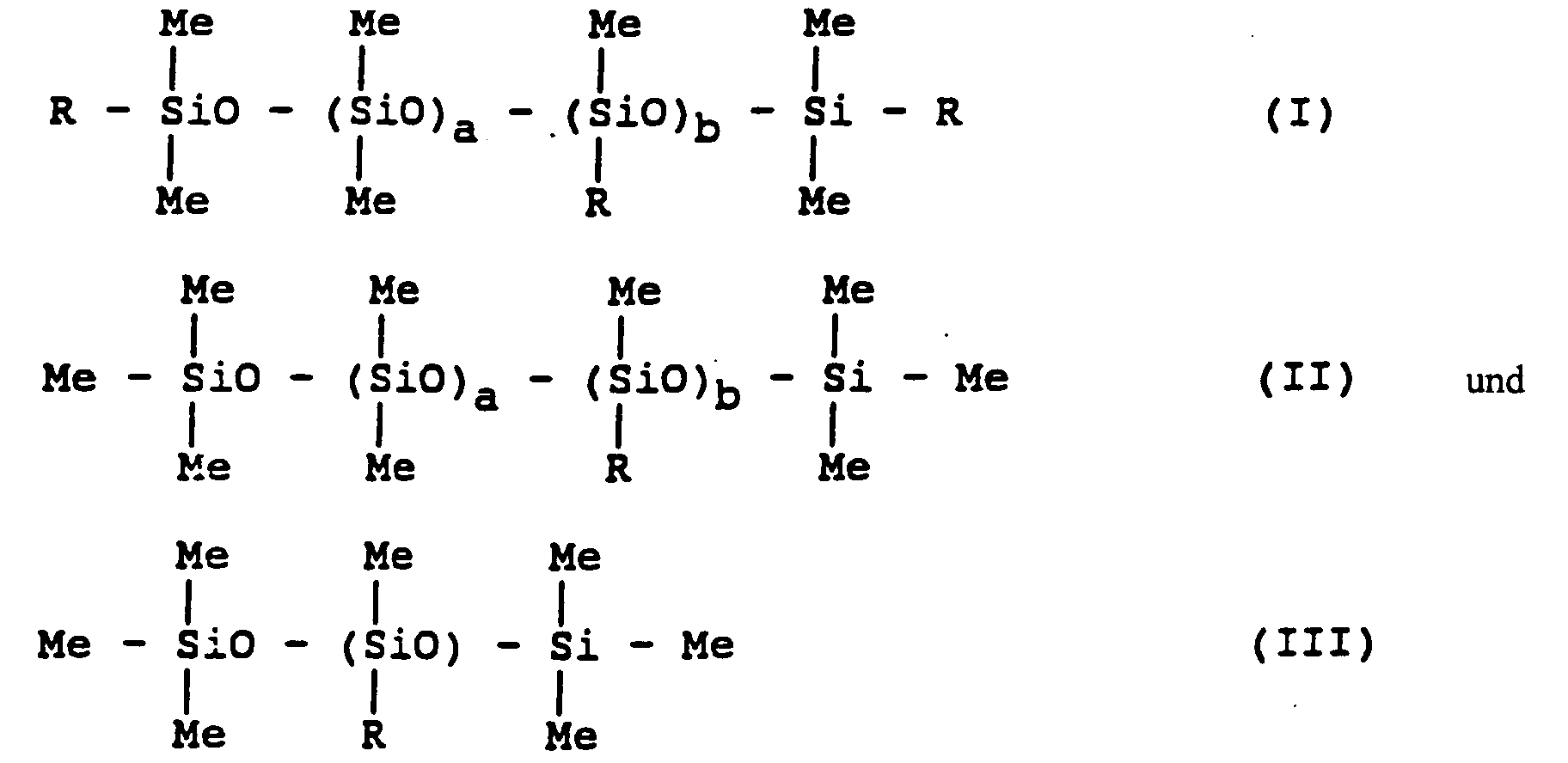
- Verfahren zum Einschließen einer wasserunlöslichen Substanz in aus einem grennflächenaktiven Siloxanmaterial gebildeten Vesikeln durch Auflösen der einzuschließenden Substanz in einem grenzflächenaktiven Siloxanmaterial und Vermischen der Substanz und des grenzflächenaktiven Siloxanmaterials, wobei das grenzflächenaktive Siloxanmaterial eine Organosiliciumverbindung einer Formel ist, die aus den folgenden Formeln ausgewählt ist:worin Me für eine Methylgruppe steht, R ein Rest ist, der aus Methyl, -(CH2)xO(C2H4O)y(C3H6O)zR' und -(CH2)xN+R3''A- ausgewählt ist, wobei gilt, daß mindestens ein Rest R in dem Molekül keine Methylgruppe ist; R' aus Wasserstoff, einer Methylgruppe und einer Acylgruppe ausgewählt ist; R'' aus Alkylgruppen mit 1 bis 6 Kohlenstoffatom(en), einer Phenylgruppe, einer Benzylgruppe und der Gruppe -CH2CH2OH ausgewählt ist; A- für ein Gegenion steht, das aus Chlorid, Bromid, Iodid, Cyanid, einer Methylsulfatgruppe, einer Salicylatgruppe und einer Dodecylsulfatgruppe ausgewählt ist, a einen Wert von 0 bis 200 besitzt, b einen Wert von 0 bis 50 besitzt, wobei gilt, daß a und b nicht beide Null sein können, x einen Wert von 3 bis 6 besitzt, y einen Wert von 4 bis 30 besitzt und z einen Wert von 0 bis 5 besitzt.

- Verfahren nach Anspruch 1, wobei die wasserlösliche Substanz aus Salicylsäure, Vitamin C, wasserlöslichen Desodorantsubstanzen, Antischweißmittelsalzen auf Natriumstearatbasis, wasserlöslichen Konservierungsmitteln, wasserlöslichen Sonnenschutzmitteln, Glycerin, Enzymen, Glykolsäure, Wasser, Violett Nr. 2 und wasserlöslichen Arzneimitteln ausgewählt ist.
- Verfahren nach Anspruch 1 oder 2, worin das grenzflächenaktive Siloxanmaterial eine Verbindung einer Formel ist, die aus den folgenden Formeln ausgewählt ist: R-[Si(Me)2O]14-Si(Me)2-R, worin R für -(CH2)3(OCH2CH2)7OH steht, R-[Si(Me)2O]14-Si(Me)2-R, worin R für -(CH2)3(OCH2CH2)12OH steht, Me3SiO[Si(Me)2O]22-[SiMeRO]2-SiMe3, worin R für -(CH2)3(OCH2CH2)12OH steht und Me3SiO[Si(Me)2O]103-[SiMeRO]10-SiMe3, worin R für -(CH2)3(OCH2CH2)12OH und Me für Methyl steht.
- Verfahren nach Anspruch 2, worin die wasserunlösliche Substanz aus Vitamin A, wasserunlöslichen Konservierungsmitteln, wasserunlöslichen Sonnenshutzmitteln, wasserunlöslichen Arzneimitteln, Pigmentdispersionen und Polydimethylsiloxanflüssigkeiten ausgewählt ist.
Applications Claiming Priority (2)
| Application Number | Priority Date | Filing Date | Title |
|---|---|---|---|
| US212753 | 1994-03-14 | ||
| US08/212,753 US5364633A (en) | 1994-03-14 | 1994-03-14 | Silicone vesicles and entrapment |
Publications (2)
| Publication Number | Publication Date |
|---|---|
| EP0672410A1 EP0672410A1 (de) | 1995-09-20 |
| EP0672410B1 true EP0672410B1 (de) | 1999-05-12 |
Family
ID=22792293
Family Applications (1)
| Application Number | Title | Priority Date | Filing Date |
|---|---|---|---|
| EP95301552A Expired - Lifetime EP0672410B1 (de) | 1994-03-14 | 1995-03-09 | Silikonvesikeln und Einschlussprodukte |
Country Status (4)
| Country | Link |
|---|---|
| US (2) | US5364633A (de) |
| EP (1) | EP0672410B1 (de) |
| JP (1) | JP3810825B2 (de) |
| DE (1) | DE69509574T2 (de) |
Families Citing this family (155)
| Publication number | Priority date | Publication date | Assignee | Title |
|---|---|---|---|---|
| CA2107253C (en) * | 1992-12-15 | 1998-04-21 | Anthony Castrogiovanni | Cosmetic compositions with improved transfer resistance |
| USRE39218E1 (en) | 1994-09-30 | 2006-08-01 | L'oreal | Anhydrous and water-resistant cosmetic compositions |
| US5958448A (en) * | 1995-01-13 | 1999-09-28 | Dow Corning Corporation | Siloxane MQ resin vesicles and entrapment |
| FR2742676B1 (fr) * | 1995-12-21 | 1998-02-06 | Oreal | Nanoemulsion transparente a base de tensioactifs silicones et utilisation en cosmetique ou en dermopharmacie |
| FR2742677B1 (fr) * | 1995-12-21 | 1998-01-16 | Oreal | Nanoparticules enrobees d'une phase lamellaire a base de tensioactif silicone et compositions les contenant |
| FR2742674B1 (fr) * | 1995-12-21 | 1998-02-06 | Oreal | Dispersion stable d'une phase non miscible a l'eau, dans une phase aqueuse au moyen de vesicules a base de tensioactif silicone |
| US6284163B1 (en) | 1996-01-26 | 2001-09-04 | California Institute Of Technology | Sol-gel encapsulation of lipid vesicles, lipid membranes and proteins |
| US7255877B2 (en) | 1996-08-22 | 2007-08-14 | Jagotec Ag | Fenofibrate microparticles |
| US6465016B2 (en) | 1996-08-22 | 2002-10-15 | Research Triangle Pharmaceuticals | Cyclosporiine particles |
| WO1998007414A1 (en) | 1996-08-22 | 1998-02-26 | Research Triangle Pharmaceuticals Ltd. | Compositions comprising microparticles of water-insoluble substances and method for preparing same |
| US5707434A (en) * | 1996-10-16 | 1998-01-13 | Dow Corning Corporation | Water soluble ammonium siloxane compositions and their use as fiber treatment agents |
| US5707435A (en) * | 1996-10-16 | 1998-01-13 | Dow Corning Corporation | Ammonium siloxane emulsions and their use as fiber treatment agents |
| FR2755854B1 (fr) * | 1996-11-15 | 1998-12-24 | Oreal | Nanoemulsion a base de lipides amphiphiles non-ioniques et cationiques et utilisations |
| FR2755851B1 (fr) | 1996-11-15 | 1998-12-24 | Oreal | Compositions cosmetiques detergentes et utilisation |
| US6979456B1 (en) | 1998-04-01 | 2005-12-27 | Jagotec Ag | Anticancer compositions |
| KR100635456B1 (ko) | 1998-05-29 | 2006-10-18 | 스키에파마 캐나다 인코포레이티드 | 열보호화 마이크로입자 조성물 및 그의 말단의 스팀멸균방법 |
| DE69912441T2 (de) | 1998-08-19 | 2004-08-19 | Skyepharma Canada Inc., Verdun | Injizierbare wässerige propofoldispersionen |
| FR2783713B1 (fr) * | 1998-09-29 | 2002-05-31 | Oreal | Utilisation d'une gomme de silicone pour stabiliser l'acide ascorbique et nouvelles compositions contenant ces composants |
| IL143197A0 (en) | 1998-11-20 | 2002-04-21 | Rtp Pharma Inc | Dispersible phospholipid stabilized microparticles |
| US6207717B1 (en) * | 1999-01-12 | 2001-03-27 | Dow Corning Corporation | Entrapment of vitamins with an elastomeric silicone polyether |
| FR2789329B1 (fr) * | 1999-02-05 | 2001-03-02 | Oreal | Composition cosmetique et/ou dermatologique constituee par une emulsion du type huile-dans-l'eau formee de vesicules lipidiques dispersees dans une phase aqueuse contenant au moins un actif acide hydrophile |
| FR2790405B1 (fr) * | 1999-03-02 | 2001-04-20 | Oreal | Nanocapsules a base de polymeres dendritiques |
| FR2804015B1 (fr) | 2000-01-21 | 2005-12-23 | Oreal | Nanoemulsion contenant des lipides amphiphiles et un polymere non ionique et utilisations |
| US6616934B1 (en) | 2000-05-22 | 2003-09-09 | Dow Corning Corporation | Clear silicone microemulsions |
| FR2809010B1 (fr) | 2000-05-22 | 2002-07-12 | Oreal | Nanoemulsion a base de polymeres anioniques, et ses utilisations notamment dans les domaines cosmetique, dermatologique, pharmaceutique et/ou ophtalmologique |
| FR2811564B1 (fr) * | 2000-07-13 | 2002-12-27 | Oreal | Nanoemulsion contenant des polymeres non ioniques, et ses utilisations notamment dans les domaines cosmetique, dermatologique, pharmaceutique et/ou ophtalmologique |
| US8586094B2 (en) | 2000-09-20 | 2013-11-19 | Jagotec Ag | Coated tablets |
| US6632420B1 (en) | 2000-09-28 | 2003-10-14 | The Gillette Company | Personal care product |
| US20020106511A1 (en) * | 2000-12-01 | 2002-08-08 | Novozymes A/S | Encapsulation of compounds in vesicles |
| EP1393706A1 (de) * | 2002-08-14 | 2004-03-03 | Quest International B.V. | Duftende Zusammensetzungen, eingekapselte Stoffe enthaltend |
| WO2004050045A1 (en) * | 2002-12-04 | 2004-06-17 | Dow Corning Corporation | Vesicle and microemulsion compositions of polar organic oils based on silicone surfactants |
| JP2007533452A (ja) * | 2004-04-20 | 2007-11-22 | ダウ・コーニング・コーポレイション | シリコーンベシクル |
| WO2005102248A2 (en) * | 2004-04-20 | 2005-11-03 | Dow Corning Corporation | Silicone vesicles containing actives |
| WO2005103117A1 (en) * | 2004-04-20 | 2005-11-03 | Dow Corning Corporation | Silicone polyether block copolymers |
| ATE434639T1 (de) * | 2004-04-20 | 2009-07-15 | Dow Corning | Wässrige dispersionen von silikon-polyether- blockcopolymeren |
| US8012387B2 (en) * | 2004-04-20 | 2011-09-06 | Dow Corning Corporation | Silicone vesicles |
| EP1755533A1 (de) * | 2004-04-20 | 2007-02-28 | Dow Corning Corporation | Vesikel von hochmolekularen silikonpolyethern |
| US20050239670A1 (en) * | 2004-04-21 | 2005-10-27 | Qing Stella | Personal care compositions that deposit hydrophilic benefit agents |
| JP4571514B2 (ja) * | 2005-01-21 | 2010-10-27 | ポーラ化成工業株式会社 | ベシクル系外用組成物 |
| FR2881955B1 (fr) | 2005-02-11 | 2007-05-11 | Oreal | Nanoemulsion cosmetique contenant un compose d'uree hydroxyle |
| WO2006091295A1 (en) * | 2005-02-22 | 2006-08-31 | Dow Corning Corporation | Polyoxyalkylene-alkyl functional siloxane resins and aqueous compositions thereof |
| US20070065392A1 (en) * | 2005-07-12 | 2007-03-22 | L'oreal | Cosmetic composition with an amphiphilic lipid phase |
| JP2009513661A (ja) * | 2005-11-01 | 2009-04-02 | ダウ・コーニング・コーポレイション | 活性剤を含むシリコーンベシクル |
| EP1981513B1 (de) | 2006-01-19 | 2015-05-27 | Mary Kay, Inc. | Zusammensetzungen mit kakadupflaumenextrakt oder assaibeerenextrakt |
| JP2009528348A (ja) * | 2006-02-28 | 2009-08-06 | ダウ・コーニング・コーポレイション | 活性剤を含むシリコーン小胞 |
| JP5121179B2 (ja) * | 2006-07-25 | 2013-01-16 | 株式会社 資生堂 | ベシクル含有組成物及びその製造方法 |
| RU2320323C1 (ru) * | 2006-08-03 | 2008-03-27 | Игорь Александрович Базиков | Система доставки биологически активных веществ с помощью ниосом |
| US20080095831A1 (en) * | 2006-08-10 | 2008-04-24 | Mc Graw Thomas L | Topical formulation of multilamellar vesicles composition for percutaneous absorption of pharmaceutically active agent |
| FR2910345A1 (fr) * | 2006-12-20 | 2008-06-27 | Oreal | Particules coeur/ecorce a base de composes silicones |
| FR2910286B1 (fr) | 2006-12-20 | 2009-04-17 | Oreal | Composition comprenant des composes silicones encapsules |
| FR2910284B1 (fr) * | 2006-12-20 | 2009-04-17 | Oreal | Produit cosmetique comprenant des composes silicones et un polymere amphiphile |
| CN101677914B (zh) | 2007-05-15 | 2012-06-06 | 株式会社资生堂 | 含泡囊的组合物及其制造方法 |
| FR2918296B1 (fr) | 2007-07-05 | 2009-09-18 | Oreal | Capsules de type noyau/ecorce et procede de preparation |
| WO2009028528A1 (ja) | 2007-08-31 | 2009-03-05 | Shiseido Company Ltd. | ベシクル-シリカ複合体含有組成物及びその製造方法 |
| RU2376981C2 (ru) * | 2007-09-27 | 2009-12-27 | Общество с ограниченной ответственностью Научно-производственное объединение "Клеточные технологии" | Солнцезащитный гель для лица "sun fight" spf 35 |
| RU2376982C2 (ru) * | 2007-09-27 | 2009-12-27 | Общество с ограниченной ответственностью Научно-производственное объединение "Клеточные технологии" | Увлажняющая сыворотка для лица "vita" |
| WO2010018003A2 (en) * | 2008-08-15 | 2010-02-18 | Salama Zoser B | Carrier system for biological agents containing organosilicon compounds and uses thereof |
| US8178106B2 (en) * | 2009-03-30 | 2012-05-15 | Mary Kay Inc. | Topical skin care formulations |
| WO2011028601A2 (en) | 2009-08-26 | 2011-03-10 | Mary Kay Inc. | Topical skin care formulations comprising plant extracts |
| US8048456B2 (en) | 2009-08-28 | 2011-11-01 | Mary Kay Inc. | Skin care formulations |
| FR2954107B1 (fr) | 2009-12-23 | 2012-04-20 | Oreal | Composition cosmetique sous forme de nanoemulsion contenant un alcane lineaire volatil |
| MX340494B (es) | 2010-02-19 | 2016-07-11 | Mary Kay Inc | Formulacion topica para el cuidado de la piel. |
| US8986720B2 (en) | 2010-06-16 | 2015-03-24 | Mary Kay Inc. | Skin moisturizer |
| WO2012033634A2 (en) | 2010-09-09 | 2012-03-15 | Mary Kay Inc. | Topical skin care formulations comprising plant extracts |
| US8747927B2 (en) | 2010-09-10 | 2014-06-10 | Mary Kay Inc. | Topical skin care formulations comprising jaboticaba and cashew fruit pulps and extracts thereof |
| US9168218B2 (en) | 2011-01-25 | 2015-10-27 | L'oreal S.A. | Use of photoluminescent polymers in cosmetic products |
| WO2012135337A2 (en) | 2011-03-28 | 2012-10-04 | Mary Kay Inc. | Topical skin care formulations comprising plant extracts |
| DE202012012769U1 (de) | 2011-04-06 | 2014-01-29 | Mary Kay Inc. | Topische Hautpflegeformulierungen, die Pflanzenextrake umfassen |
| KR102545052B1 (ko) | 2011-04-21 | 2023-06-16 | 마리 케이 인코포레이티드 | 식물 추출물을 포함하는 국소 스킨 케어 제형 |
| WO2012170695A2 (en) | 2011-06-08 | 2012-12-13 | Mary Kay Inc. | Sunscreen formulations |
| JP5960396B2 (ja) * | 2011-06-30 | 2016-08-02 | 国立大学法人信州大学 | ナノカプセルの製造方法 |
| US9402794B2 (en) | 2011-12-07 | 2016-08-02 | Mary Kay Inc. | Topical skin care formulation |
| CA2858211C (en) | 2011-12-09 | 2018-08-21 | Mary Kay Inc. | Skin care formulation |
| EP2793848B1 (de) | 2011-12-19 | 2019-06-26 | Mary Kay, Inc. | Weisse (navy) gartenbohnen extrakt zur hautaufhellung und zur verbesserung der hautfarbe |
| US9005588B2 (en) | 2011-12-22 | 2015-04-14 | Mary Kay Inc. | Substantive sunscreen formulation |
| JP2014122199A (ja) | 2012-12-21 | 2014-07-03 | L'oreal Sa | 化粧品組成物 |
| ES2766877T3 (es) | 2012-12-21 | 2020-06-15 | Oreal | Composición cosmética |
| JP2014122198A (ja) | 2012-12-21 | 2014-07-03 | L'oreal Sa | 化粧品組成物 |
| JP6356382B2 (ja) | 2012-12-21 | 2018-07-11 | ロレアル | 化粧品組成物 |
| JP2014122193A (ja) | 2012-12-21 | 2014-07-03 | L'oreal Sa | 油、非イオン界面活性剤及びビタミンb3を含む化粧品組成物 |
| US20140186411A1 (en) | 2012-12-27 | 2014-07-03 | L'oreal | Low viscosity meta-stable photoprotection composition |
| DK177696B1 (en) | 2013-02-25 | 2014-03-17 | Aquaporin As | Systems for water extraction |
| CA2904948A1 (en) | 2013-03-14 | 2014-10-02 | Mary Kay Inc. | Cosmetic compositions |
| WO2014150545A1 (en) | 2013-03-15 | 2014-09-25 | Mary Kay Inc. | Cosmetic compositions and uses thereof |
| JP5690373B2 (ja) | 2013-04-26 | 2015-03-25 | 株式会社 資生堂 | 水性組成物 |
| WO2015023926A1 (en) | 2013-08-15 | 2015-02-19 | Mary Kay Inc. | Topical skin compositions for treating wrinkles |
| JP2015124168A (ja) | 2013-12-26 | 2015-07-06 | ロレアル | 油及びマイクロカプセルを含有する透明な組成物 |
| FR3015870B1 (fr) | 2013-12-27 | 2016-02-05 | Oreal | Dispositif pour le maquillage par transfert des matieres keratiniques. |
| JP6510177B2 (ja) | 2014-04-01 | 2019-05-08 | ロレアル | ナノ又はマイクロエマルションの形態の組成物 |
| JP6537788B2 (ja) | 2014-06-25 | 2019-07-03 | ロレアル | ナノエマルション若しくはマイクロエマルションの形態の又はラメラ構造を有する組成物 |
| US20160008245A1 (en) | 2014-07-11 | 2016-01-14 | Mary Kay Inc. | Sunscreen compositions and methods of their use |
| US20160008244A1 (en) | 2014-07-11 | 2016-01-14 | Mary Kay Inc. | Sunscreen compositions and methods of their use |
| US9913799B2 (en) | 2014-07-11 | 2018-03-13 | Mary Kay Inc. | Cosmetic compositions and methods of their use |
| CN106535874B (zh) | 2014-07-11 | 2021-05-04 | 玫琳凯有限公司 | 毛孔缩小剂 |
| WO2016007519A1 (en) | 2014-07-11 | 2016-01-14 | Mary Kay Inc. | Cosmetic compositions |
| WO2016040778A1 (en) | 2014-09-11 | 2016-03-17 | Research Institute At Nationwide Children's Hospital | Treatment of otitis media |
| JP2016088917A (ja) | 2014-11-11 | 2016-05-23 | ロレアル | ケラチン繊維用組成物 |
| JP6591745B2 (ja) | 2014-12-08 | 2019-10-16 | ロレアル | ケラチン繊維のための化粧用組成物及びその製造方法 |
| WO2016161074A1 (en) | 2015-03-31 | 2016-10-06 | Gojo Industries, Inc. | Synergistic compositions and methods for mitigating skin irritation and enhancing skin barrier function |
| JP2017025051A (ja) | 2015-07-28 | 2017-02-02 | ロレアル | ケラチン繊維用の組成物、プロセス、方法及び使用 |
| JP6687341B2 (ja) | 2015-07-29 | 2020-04-22 | ロレアル | ケラチン物質のための組成物 |
| JP2017100985A (ja) | 2015-12-01 | 2017-06-08 | ロレアル | 美容のための使用に適した組成物 |
| JP6873598B2 (ja) | 2015-12-22 | 2021-05-19 | ロレアル | 活性成分のための改善された局所送達系 |
| JP6789631B2 (ja) | 2015-12-22 | 2020-11-25 | ロレアル | Spf及びレオロジーを改善するための高内相エマルション組成物 |
| JP2017193513A (ja) | 2016-04-22 | 2017-10-26 | ロレアル | ケラチン繊維を染色するための組成物 |
| JP6881908B2 (ja) | 2016-07-26 | 2021-06-02 | ロレアル | マット効果及び優れた質感を有するエマルション |
| JP6995472B2 (ja) | 2016-10-31 | 2022-01-14 | ロレアル | 自然な皮膚明色化効果のための組成物 |
| JP2018087149A (ja) | 2016-11-28 | 2018-06-07 | ロレアル | ナノ又はマイクロエマルションの形態の組成物 |
| JP6890962B2 (ja) | 2016-12-09 | 2021-06-18 | ロレアル | 非粘着性安定組成物 |
| JP6903426B2 (ja) | 2016-12-15 | 2021-07-14 | ロレアル | 発泡性組成物 |
| WO2018213903A1 (en) | 2017-05-26 | 2018-11-29 | L'oreal | High spf sunscreen compositions |
| JP7080605B2 (ja) | 2017-08-29 | 2022-06-06 | ロレアル | エーテル油を含む水中油型エマルション組成物 |
| JP7063567B2 (ja) | 2017-10-02 | 2022-05-09 | ロレアル | エラグ酸化合物を含む組成物 |
| JP7139104B2 (ja) | 2017-10-12 | 2022-09-20 | ロレアル | ケラチン繊維のためのプロセス、組成物、方法及び使用 |
| JP7246848B2 (ja) | 2017-10-12 | 2023-03-28 | ロレアル | ケラチン繊維のためのプロセス、組成物、方法及び使用 |
| JP7106262B2 (ja) | 2017-10-31 | 2022-07-26 | ロレアル | 冷却効果を有する組成物 |
| JP7199806B2 (ja) | 2017-12-13 | 2023-01-06 | ロレアル | ヒドロキシアルキル修飾デンプンを使用するキット及びプロセス |
| JP7214360B2 (ja) | 2018-04-10 | 2023-01-30 | ロレアル | 分解又は消失可能な顆粒又は集合体を含む、安定な組成物 |
| JP7277083B2 (ja) | 2018-06-12 | 2023-05-18 | ロレアル | 発泡性組成物 |
| JP7321681B2 (ja) | 2018-06-29 | 2023-08-07 | ロレアル | 持続的コンシール効果を有する組成物 |
| JP7353753B2 (ja) | 2018-12-11 | 2023-10-02 | ロレアル | エーテル油を含む水中油型エマルション組成物 |
| JP7353754B2 (ja) | 2018-12-14 | 2023-10-02 | ロレアル | ケラチン繊維の矯正法 |
| JP2020180062A (ja) | 2019-04-24 | 2020-11-05 | ロレアル | 加工デンプン/c13〜c15脂肪酸/クレイの組合せ |
| JP7508213B2 (ja) | 2019-10-30 | 2024-07-01 | ロレアル | 高内水相エマルション |
| JP7762137B2 (ja) | 2020-03-04 | 2025-10-29 | 株式会社 資生堂 | 水中油型乳化組成物 |
| WO2022075204A1 (en) | 2020-10-07 | 2022-04-14 | L'oreal | Composition for keratin fibers |
| FR3116199B1 (fr) | 2020-11-17 | 2023-12-08 | Oreal | Composition pour fibres kératineuses |
| FR3117017B1 (fr) | 2020-12-07 | 2023-04-21 | Oreal | Composition pour fibres kératiniques |
| EP4240311B1 (de) | 2020-11-06 | 2026-04-01 | L'oreal | Haarzusammensetzungen |
| WO2022118978A1 (en) | 2020-12-01 | 2022-06-09 | L'oreal | Composition for keratin fibers |
| FR3118875B1 (fr) | 2021-01-15 | 2023-09-08 | Oreal | Composition pour fibres kératiniques |
| WO2022118982A1 (en) | 2020-12-01 | 2022-06-09 | L'oreal | Process for treating keratin fibers |
| FR3118708B1 (fr) | 2021-01-11 | 2023-08-25 | Oreal | Composition pour fibres kératineuses |
| EP4271356A1 (de) | 2020-12-01 | 2023-11-08 | L'oreal | Zusammensetzung für keratinfasern |
| FR3118876B1 (fr) | 2021-01-15 | 2023-11-03 | Oreal | Procede de traitement des fibres kératineuses |
| EP4395735A1 (de) | 2021-08-30 | 2024-07-10 | L'oreal | Transparente zusammensetzung mit polyhydroxysäure |
| FR3127693B1 (fr) | 2021-10-05 | 2024-03-15 | Oreal | Composition transparente comprenant un polyhydroxyacide |
| EP4452214A1 (de) | 2021-12-08 | 2024-10-30 | L'oreal | Zusammensetzung für keratinfasern |
| FR3131696B1 (fr) | 2022-01-13 | 2026-04-17 | Oreal | Composition pour fibres kératiniques |
| WO2023112867A1 (en) | 2021-12-17 | 2023-06-22 | L'oreal | Composition comprising hyaluronic acid-based polyion complex particle and surfactant |
| FR3131842B1 (fr) | 2022-01-20 | 2025-03-14 | Oreal | Composition comprenant des particules complexes polyioniques à base d'acide hyaluronique et un tensioactif |
| FR3137835A1 (fr) | 2022-07-15 | 2024-01-19 | L'oreal | Composition pour la coloration des fibres kératineuses |
| WO2023228870A1 (en) | 2022-05-25 | 2023-11-30 | L'oreal | Composition for coloring keratin fibers |
| FR3145093B1 (fr) | 2023-01-19 | 2026-01-30 | Oreal | Composition stable non collante et non grasse avec propriété de transformation de texture |
| CN120187410A (zh) | 2022-11-18 | 2025-06-20 | 莱雅公司 | 具有质地转变性质的不粘的稳定组合物 |
| CN120359012A (zh) | 2022-12-20 | 2025-07-22 | 莱雅公司 | 包含基于透明质酸的聚离子复合物和亲水性或亲脂性抗氧化剂的组合物 |
| FR3145279B1 (fr) | 2023-01-30 | 2026-01-30 | Oreal | Composition comprenant un complexe polyionique à base d’acide hyaluronique et un antioxydant lipophile |
| FR3145281B1 (fr) | 2023-01-27 | 2026-01-30 | Oreal | Composition comprenant un complexe polyionique à base d’acide hyaluronique et un antioxydant hydrophile |
| WO2024135577A1 (en) | 2022-12-23 | 2024-06-27 | L'oreal | Stable dispersion composition comprising retinoid |
| FR3145278B1 (fr) | 2023-01-30 | 2026-04-10 | Oreal | Composition de dispersion stable comprenant un rétinoïde |
| FR3144754B1 (fr) | 2023-01-05 | 2026-01-02 | Oreal | Composition de soin de fibre kératineuse |
| FR3144755B1 (fr) | 2023-01-06 | 2026-04-03 | Oreal | Composition de soin du cuir chevelu comprenant un agent actif pulvérulent et un alcool de sucre |
| FR3144756B1 (fr) | 2023-01-09 | 2026-01-02 | Oreal | Composition de soin du cuir chevelu comprenant un agent actif solide lipophile, un monoalcool et un épaississant hydrophile |
| FR3145277A1 (fr) | 2023-01-27 | 2024-08-02 | L'oreal | Processus de décoloration et/ou d’éclaircissement de fibres kératineuses |
| FR3165181A3 (fr) | 2024-08-05 | 2026-02-06 | L'oreal | Produit cosmétique |
Family Cites Families (10)
| Publication number | Priority date | Publication date | Assignee | Title |
|---|---|---|---|---|
| US4078052A (en) * | 1976-06-30 | 1978-03-07 | The United States Of America As Represented By The Secretary Of Health, Education And Welfare | Large unilamellar vesicles (LUV) and method of preparing same |
| IT1213572B (it) * | 1986-12-19 | 1989-12-20 | Chimico Farmaceutico E Granell | Metodo per un efficace trattamento idratante della pelle, particolarmente per applicazione in campo cosmetico. |
| FR2634397B2 (fr) * | 1986-12-31 | 1991-04-19 | Centre Nat Rech Scient | Procede de preparation de systemes colloidaux dispersibles d'une proteine sous forme de nanoparticules |
| US5147723A (en) * | 1987-07-28 | 1992-09-15 | Micro-Pak, Inc. | Paucilamellar lipid vesicles |
| US5190822A (en) * | 1990-04-20 | 1993-03-02 | Fuji Photo Film Co., Ltd. | Surface-modifiable liposome and process for producing surface-modified liposome |
| US5165994A (en) * | 1990-06-05 | 1992-11-24 | University Of Delaware | Spontaneous equilbrium surfactant vesicles |
| DD297249A5 (de) * | 1990-08-07 | 1992-01-02 | Veb Mineralwollewerk Flechtingen Bereich F/E Mineralwolle,De | Verfahren zur automatischen ueberwachung des aushaertegrades an materialbahnen |
| ATE233547T1 (de) * | 1991-06-26 | 2003-03-15 | Yamanouchi Europ Bv | Vesiculae in nichtpolaren medien |
| US5360571A (en) * | 1992-03-31 | 1994-11-01 | Osi Specialties, Inc. | Surfactant compositions |
| US5235082A (en) * | 1993-01-08 | 1993-08-10 | Dow Corning Corporation | Cationic diquaternary ammonium salt functional silicones |
-
1994
- 1994-03-14 US US08/212,753 patent/US5364633A/en not_active Expired - Lifetime
- 1994-06-06 US US08/254,855 patent/US5411744A/en not_active Expired - Lifetime
-
1995
- 1995-03-09 DE DE69509574T patent/DE69509574T2/de not_active Expired - Fee Related
- 1995-03-09 EP EP95301552A patent/EP0672410B1/de not_active Expired - Lifetime
- 1995-03-14 JP JP05308695A patent/JP3810825B2/ja not_active Expired - Fee Related
Also Published As
| Publication number | Publication date |
|---|---|
| DE69509574D1 (de) | 1999-06-17 |
| JPH07323222A (ja) | 1995-12-12 |
| US5364633A (en) | 1994-11-15 |
| US5411744A (en) | 1995-05-02 |
| JP3810825B2 (ja) | 2006-08-16 |
| DE69509574T2 (de) | 1999-10-07 |
| EP0672410A1 (de) | 1995-09-20 |
Similar Documents
| Publication | Publication Date | Title |
|---|---|---|
| EP0672410B1 (de) | Silikonvesikeln und Einschlussprodukte | |
| EP0724876B1 (de) | MQ-Siloxanharze-Vesikel und Einschlussprodukte | |
| Rajera et al. | Niosomes: a controlled and novel drug delivery system | |
| Lawrence | Surfactant systems: microemulsions and vesicles as vehicles for drug delivery | |
| CN1160046C (zh) | 洁肤剂 | |
| Castangia et al. | Effect of diclofenac and glycol intercalation on structural assembly of phospholipid lamellar vesicles | |
| CA2160071C (fr) | Composition cosmetique ou dermatologique constituee d'une emulsion huile dans eau a base de globules huileux pourvus d'un enrobage cristal liquide lamellaire | |
| US9687423B2 (en) | Method for preparing nanoemulsion | |
| JPS6156016B2 (de) | ||
| PL176860B1 (pl) | Kompozycja kosmetyczna lub dermatologiczna w postaci emulsji typu olej w wodzie oraz sposób wytwarzania kompozycji kosmetycznej lub dermatologicznej w postaci emulsji typu olej w wodzie | |
| WO2005065630A1 (ja) | 一相マイクロエマルション組成物、o/w超微細エマルション外用剤、及びその製造方法 | |
| JP2001055308A (ja) | 有機ゲルとその化粧分野における使用 | |
| AU1543888A (en) | Lipid vesicles formed of surfactants and steroids | |
| Gökçe et al. | Nanocarriers in cosmetology | |
| CN114364364A (zh) | 脂质体复合物及包含其的用于皮肤改善的化妆品组合物 | |
| JPH02149336A (ja) | サブミクロン大リポソームの形態の両親媒性脂質の分散性コロイド系の調製方法 | |
| US5958433A (en) | Stable dispersion of a water-immiscible phase, in an aqueous phase by means of vesicles based on silicone surfactant | |
| EP1552820A1 (de) | Wässrige Dispersion von Nanokapseln mit einem öligen Kern und deren Herstellungsverfahren | |
| JP3544163B2 (ja) | アルコキシル化アルケニルスクシナートまたはグルコースのアルコキシル化アルケニルスクシナートを主成分とするナノエマルション及び、化粧品、皮膚科、眼科及び/または製薬分野におけるその使用 | |
| JPH05502882A (ja) | アルコール含有水性ゲル状リン脂質組成物、該リン脂質組成物を希釈するリポソーム溶液の製造方法及び該リン脂質組成物を含有する局所適用調製物 | |
| JP2016084340A (ja) | 皮膚外用剤および皮膚バリア機能改善剤 | |
| GB2250998A (en) | Cosmetic cleansing composition | |
| DE60120652T2 (de) | Emulsion enthaltend siliconöl- und co-lösungsmittelsystem enhaltend fettlösliche kosmetische wirkstoffe und daraus hergestelleten kosmetischen zubereitungen | |
| Fresta et al. | CDP-choline entrapment and release from multilamellar and reverse-phase evaporation liposomes | |
| KR20230119989A (ko) | 고농도의 세라마이드를 함유하는 다중층 라멜라 나노 리포좀을 포함하는 화장료 조성물 및 이의 제조 방법 |
Legal Events
| Date | Code | Title | Description |
|---|---|---|---|
| PUAI | Public reference made under article 153(3) epc to a published international application that has entered the european phase |
Free format text: ORIGINAL CODE: 0009012 |
|
| AK | Designated contracting states |
Kind code of ref document: A1 Designated state(s): DE FR GB |
|
| 17P | Request for examination filed |
Effective date: 19951019 |
|
| 17Q | First examination report despatched |
Effective date: 19971125 |
|
| GRAG | Despatch of communication of intention to grant |
Free format text: ORIGINAL CODE: EPIDOS AGRA |
|
| GRAG | Despatch of communication of intention to grant |
Free format text: ORIGINAL CODE: EPIDOS AGRA |
|
| GRAH | Despatch of communication of intention to grant a patent |
Free format text: ORIGINAL CODE: EPIDOS IGRA |
|
| GRAH | Despatch of communication of intention to grant a patent |
Free format text: ORIGINAL CODE: EPIDOS IGRA |
|
| GRAA | (expected) grant |
Free format text: ORIGINAL CODE: 0009210 |
|
| AK | Designated contracting states |
Kind code of ref document: B1 Designated state(s): DE FR GB |
|
| REF | Corresponds to: |
Ref document number: 69509574 Country of ref document: DE Date of ref document: 19990617 |
|
| ET | Fr: translation filed | ||
| PLBE | No opposition filed within time limit |
Free format text: ORIGINAL CODE: 0009261 |
|
| STAA | Information on the status of an ep patent application or granted ep patent |
Free format text: STATUS: NO OPPOSITION FILED WITHIN TIME LIMIT |
|
| 26N | No opposition filed | ||
| REG | Reference to a national code |
Ref country code: GB Ref legal event code: IF02 |
|
| PGFP | Annual fee paid to national office [announced via postgrant information from national office to epo] |
Ref country code: GB Payment date: 20090304 Year of fee payment: 15 |
|
| PGFP | Annual fee paid to national office [announced via postgrant information from national office to epo] |
Ref country code: DE Payment date: 20090306 Year of fee payment: 15 |
|
| PGFP | Annual fee paid to national office [announced via postgrant information from national office to epo] |
Ref country code: FR Payment date: 20090316 Year of fee payment: 15 |
|
| GBPC | Gb: european patent ceased through non-payment of renewal fee |
Effective date: 20100309 |
|
| REG | Reference to a national code |
Ref country code: FR Ref legal event code: ST Effective date: 20101130 |
|
| PG25 | Lapsed in a contracting state [announced via postgrant information from national office to epo] |
Ref country code: FR Free format text: LAPSE BECAUSE OF NON-PAYMENT OF DUE FEES Effective date: 20100331 |
|
| PG25 | Lapsed in a contracting state [announced via postgrant information from national office to epo] |
Ref country code: DE Free format text: LAPSE BECAUSE OF NON-PAYMENT OF DUE FEES Effective date: 20101001 |
|
| PG25 | Lapsed in a contracting state [announced via postgrant information from national office to epo] |
Ref country code: GB Free format text: LAPSE BECAUSE OF NON-PAYMENT OF DUE FEES Effective date: 20100309 |