EP0672860A1 - Emulsion stable d'hydrocarbures brutes visqueux en solution tampon aqueuse et procédé de sa préparation et transport - Google Patents
Emulsion stable d'hydrocarbures brutes visqueux en solution tampon aqueuse et procédé de sa préparation et transport Download PDFInfo
- Publication number
- EP0672860A1 EP0672860A1 EP19940200119 EP94200119A EP0672860A1 EP 0672860 A1 EP0672860 A1 EP 0672860A1 EP 19940200119 EP19940200119 EP 19940200119 EP 94200119 A EP94200119 A EP 94200119A EP 0672860 A1 EP0672860 A1 EP 0672860A1
- Authority
- EP
- European Patent Office
- Prior art keywords
- emulsion
- buffer solution
- aqueous buffer
- viscous crude
- equal
- Prior art date
- Legal status (The legal status is an assumption and is not a legal conclusion. Google has not performed a legal analysis and makes no representation as to the accuracy of the status listed.)
- Granted
Links
Images

Classifications
-
- C—CHEMISTRY; METALLURGY
- C10—PETROLEUM, GAS OR COKE INDUSTRIES; TECHNICAL GASES CONTAINING CARBON MONOXIDE; FUELS; LUBRICANTS; PEAT
- C10L—FUELS NOT OTHERWISE PROVIDED FOR; NATURAL GAS; SYNTHETIC NATURAL GAS OBTAINED BY PROCESSES NOT COVERED BY SUBCLASSES C10G OR C10K; LIQUIFIED PETROLEUM GAS; USE OF ADDITIVES TO FUELS OR FIRES; FIRE-LIGHTERS
- C10L1/00—Liquid carbonaceous fuels
- C10L1/32—Liquid carbonaceous fuels consisting of coal-oil suspensions or aqueous emulsions or oil emulsions
- C10L1/328—Oil emulsions containing water or any other hydrophilic phase
-
- Y—GENERAL TAGGING OF NEW TECHNOLOGICAL DEVELOPMENTS; GENERAL TAGGING OF CROSS-SECTIONAL TECHNOLOGIES SPANNING OVER SEVERAL SECTIONS OF THE IPC; TECHNICAL SUBJECTS COVERED BY FORMER USPC CROSS-REFERENCE ART COLLECTIONS [XRACs] AND DIGESTS
- Y10—TECHNICAL SUBJECTS COVERED BY FORMER USPC
- Y10S—TECHNICAL SUBJECTS COVERED BY FORMER USPC CROSS-REFERENCE ART COLLECTIONS [XRACs] AND DIGESTS
- Y10S516/00—Colloid systems and wetting agents; subcombinations thereof; processes of
- Y10S516/924—Significant dispersive or manipulative operation or step in making or stabilizing colloid system
- Y10S516/927—Significant dispersive or manipulative operation or step in making or stabilizing colloid system in situ formation of a colloid system making or stabilizing agent which chemical reaction
-
- Y—GENERAL TAGGING OF NEW TECHNOLOGICAL DEVELOPMENTS; GENERAL TAGGING OF CROSS-SECTIONAL TECHNOLOGIES SPANNING OVER SEVERAL SECTIONS OF THE IPC; TECHNICAL SUBJECTS COVERED BY FORMER USPC CROSS-REFERENCE ART COLLECTIONS [XRACs] AND DIGESTS
- Y10—TECHNICAL SUBJECTS COVERED BY FORMER USPC
- Y10T—TECHNICAL SUBJECTS COVERED BY FORMER US CLASSIFICATION
- Y10T137/00—Fluid handling
- Y10T137/0318—Processes
- Y10T137/0391—Affecting flow by the addition of material or energy
Definitions
- the invention relates to an emulsion and a method for forming an emulsion of a viscous crude hydrocarbon in an aqueous buffer solution.
- Typical viscous crude hydrocarbons may be characterized by the following chemical and physical properties: C wt. % of 78.2 to 85.5; H wt. % of 9.0 to 10.8; O wt. % of 0.26 to 1.1; N wt. % of 0.50 to 0.70; S wt. % of 2.00 to 4.50; Ash wt.
- % of 0.05 to 0.33 Vanadium, ppm of 50 to 1,000; Nickel, ppm of 20 to 500; Iron, ppm of 5 to 100; Sodium, ppm of 10 to 500; Gravity, API of 1.0 to 16.0; Viscosity (cST), 122°F. of 100 to 5,000,000; Viscosity (cST), 210°F. of 10 to 16,000; LHV (BTU/LB) of 15,000 to 19,000; and Asphaltenes, wt. % of 5.0 to 25.0.
- the invention relates to a stable emulsion of a viscous crude hydrocarbon in an aqueous buffer solution, as well as a method for forming such an emulsion without using commercial emulsifiers for stability.
- the stable emulsion is formed by a method including the steps of: providing a viscous crude hydrocarbon containing an inactive natural surfactant and having a salt content by weight of less than or equal to about 1.0% with respect to the emulsion continuous phase and having a total acid number of greater than or equal to about 1, preferably greater than or equal to about 2.5; forming a solution of a buffer additive in an aqueous solution to provide a basic aqueous buffer solution, the buffer additive being operative to extract and activate the inactive natural surfactant from the viscous crude hydrocarbon; and mixing the viscous crude hydrocarbon with the aqueous buffer solution at a rate sufficient to provide an emulsion of the viscous crude hydrocarbon in the aqueous buffer solution, whereby the buffer additive extracts the inactive natural surfactant from the viscous crude hydrocarbon and activates the inactive natural surfactant so as to stabilize the emulsion.
- the buffer additive is preferably either sodium bicarbonate with sodium hydroxide, or sodium silicate.
- the buffer additive may be added at a concentration of 8,000 ppm or more so as to provide a bimodal emulsion having improved viscosity characteristics.
- the invention relates to a stable emulsion of a viscous crude hydrocarbon in a basic aqueous buffer solution which is prepared without commercial surfactants.
- Viscous crude hydrocarbons are difficult to transport in conventional pipelines due to the high viscosity of the hydrocarbon. This difficulty has been addressed by the formation of hydrocarbon-in-water emulsions wherein commercial emulsifiers are used to stabilize the emulsion. Emulsions such as this have greatly reduced viscosity as compared to the original hydrocarbon, and are therefore easily transported through pipelines.
- viscous crude hydrocarbons are emulsified for transport without using commercial emulsifiers. Rather, the emulsions are formed by activating materials naturally contained in the viscous crude hydrocarbons. These materials are referred to herein as inactive surfactants which, when activated, are natural surfactants.
- viscous crude hydrocarbon refers generally to any viscous crude oil or bitumen which, when produced, is too viscous for practical pipeline flow.
- a typical viscous crude hydrocarbon may be characterized as follows: C wt. % of 78.2 to 85.5; H wt. % of 9.0 to 10.8; O wt. % of 0.26 to 1.1; N wt. % of 0.50 to 0.70; S wt. % of 2.00 to 4.50; Ash wt.
- % of 0.05 to 0.33 Vanadium, ppm of 50 to 1,000; Nickel, ppm of 20 to 500; Iron, ppm of 5 to 100; Sodium, ppm of 10 to 500; Gravity, API of 1.0 to 16.0; Viscosity (cST), 122°F. of 100 to 5,000,000; Viscosity (cST), 210°F. of 10 to 16,000; LHV (BTU/LB) of 15,000 to 19,000; and Asphaltenes, wt. % of 5.0 to 25.0.
- the viscous crude hydrocarbon has a salt content, by weight with respect to the emulsion continuous phase, of less than or equal to about 1.0%, a total acid number of greater than or equal to about 1, preferably greater than or equal to about 2.5, an API gravity of less than 16 and a viscosity at ambient temperature of between about 10,000 cp to about 500,000 cp.
- the total acid number refers to the volume, in cc's, of N/10 potassium hydroxide which are necessary to neutralize one gram of the viscous crude hydrocarbon.
- a TAN of 1 means that the hydrocarbon is such that 1 cc of N/10 KOH will neutralize one gram of the hydrocarbon.
- the inactive potential surfactants which are activated are acids which are saponifiable and which act as surfactants in their dehydrogenated form. Such acids may contain, for example, carboxylic acid groups and phenol groups.
- the potential surfactants are extracted and activated by a buffer additive which is added to the emulsion water to form a basic aqueous buffer solution.
- the basic nature of the solution is apparently necessary for the activation of the inactive surfactants, and the buffering helps to maintain the basic pH despite conditions to which the emulsion may be subjected which would normally cause the pH to fluctuate and which would, therefore, destabilize the emulsion.
- the buffer additive is preferably either sodium bicarbonate with sodium hydroxide, or sodium silicate.
- the function of the buffer additive is to raise the pH of the aqueous buffer solution to provide a basic aqueous buffer solution, to extract the inactive surfactants from the hydrocarbon, and to activate the surfactant by saponifying or dehydrogenating the inactive surfactant so as to provide an active natural surfactant for stabilizing the emulsion.
- the emulsion is formed as follows.
- Basic aqueous buffer solution is formed by adding the buffer additive to water at a concentration of equal to or greater than about 1,500 ppm, and preferably less than or equal to about 15,000 ppm.
- buffer additive is added in amounts sufficient to provide a pH of the basic aqueous buffer solution between about 9 to about 11.
- the aqueous buffer solution is then mixed with the viscous crude hydrocarbon at a mixing rate sufficient to provide an emulsion of the hydrocarbon in the buffer solution having desired viscosity and droplet size characteristics.
- the hydrocarbon and buffer solution are preferably mixed at a ratio, by weight, of hydrocarbon to buffer solution of at least about 50:50, preferably 60:40 and more preferably 70:30.
- the mixing step is preferably carried out at a mixing rate of greater than or equal to about 800 rpm so as to provide an emulsion having viscosity at room temperature of less than or equal to about 2,000 cp, and having an average droplet diameter of greater than or equal to about 3 ⁇ m, preferably greater than or equal to about 50 ⁇ m.
- This droplet size makes it easier to break the emulsion which, as mentioned above, is desirable after the emulsion has been transported to treatment facilities.
- Such emulsions are typically broken so as to reform an emulsion according to more refined parameters for various end uses such as combustible fuels and the like.
- the buffer additive is sodium bicarbonate
- sodium hydroxide is added to the solution in amounts sufficient to provide the desired basic pH, preferably between about 9 to about 11 as described above.
- Sodium bicarbonate is added at the aforedescribed concentration of between about 1,500 ppm to about 15,000 ppm to buffer the basic solution and to provide the means for extracting and activating the inactive surfactant of the hydrocarbon when the emulsion is mixed.
- the buffer additive is sodium silicate
- the proper pH is provided by manipulating the molar ratio in the sodium silicate of Na2O to SiO2.
- Providing a molar ratio of Na2O to SiO2 of greater than or equal to about 2.1 will provide a pH of the buffer solution of between about 9 to about 11 when the buffer additive is provided at a concentration in the solution of between about 1,500 ppm to about 15,000 ppm.
- the emulsion of the present invention may be formed at any convenient and desirable location along the production path of the viscous crude hydrocarbon. It is known, for example, to form such emulsions downhole, or at the well head, or at collecting stations serving multiple wells. Naturally, due to the highly viscous nature of the hydrocarbon, it is preferable to form the emulsion as soon as possible so as to take maximum advantage of the improved viscosity of the emulsion.
- bimodal emulsions may be formed having further improved viscosity characteristics.
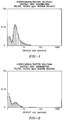
- a bimodal emulsion is an emulsion where the droplets of the dispersed phase have two distinct average droplet diameter populations. It has been found that such an emulsion can be provided, according to the invention, by utilizing a concentration of buffer additive in the aqueous buffer solution of at least about 8,000 ppm.
- Such a bimodal emulsion preferably has a small droplet size population having an average droplet size of up to about 4 microns, and a large droplet size population having an average droplet size of between about 4 microns to about 20 microns.
- such a bimodal emulsion has significantly improved viscosity characteristics as compared to a monomodal emulsion having a single average droplet size corresponding to the average droplet size of the bimodal emulsion.
- Emulsion formed according to the invention is easily transportable due to the reduced viscosity of the emulsion and is provided without the cost of commercial emulsifiers.
- such an emulsion may preferably be transported as follows.
- the emulsion is preferably preceded and followed by a plug of additional basic aqueous buffer solution which may be provided in the same manner as the basic aqueous buffer solution of the emulsion, or which may be any other conveniently provided basic aqueous buffer solution.
- additional basic aqueous buffer solution may be provided in the same manner as the basic aqueous buffer solution of the emulsion, or which may be any other conveniently provided basic aqueous buffer solution.
- a first volume or plug of the additional basic aqueous buffer solution is pumped through the pipeline, which is followed by the emulsion to be transported, which is in turn followed by a second volume or plug of the additional basic aqueous buffer solution.
- the first and second volumes of additional basic aqueous buffer solution are equal to the volume of a length of about 4.0 km of the pipeline through which the emulsion is to be transported.
- This example demonstrates the relation between mixing rate and stability of the emulsion formed according to the present invention.
- a Zuata crude was provided having the following characteristics: Density at 15°C, 1.005 kg/l; API gravity at 60°F, 9.3; kinetic viscosity at 100°F, 11,936 cST; kinetic viscosity at 140°F, 1,654 cST; and Sulphur content, % M/M, of 3.35.
- Buffer additive was used at a concentration of 10,000 ppm.
- Emulsions were prepared at a ratio by weight of hydrocarbon to buffer solution of 60:40. These emulsions were prepared at varying mixing rates, and the droplet diameter of the emulsions formed was monitored over time.
- Tables 1 and 2 below present the data obtained for emulsions prepared with sodium hydroxide/sodium bicarbonate and with sodium silicate, respectively.
- Table 1 Days 600 RPM ⁇ m 800 RPM ⁇ m 1,000 RPM ⁇ m 1,300 RPM ⁇ m 1 83 54 48 35 3 95 60 47 40 5 >100 62 49 40 7 Big Flocs 63 50 42 9 60 48 39
- Table 1 shows that emulsions formed using sodium hydroxide and 10,000 ppm sodium bicarbonate were stable when mixed at 800 rpm or higher. Emulsion formed at 600 rpm was unstable. Table 2 Days 600 RPM ⁇ m 800 RPM ⁇ m 1,000 RPM ⁇ m 1,300 RPM ⁇ m 1 100 100 85 78 3 100 100 98 83 5 Flocs 100 100 85 7 100 100 81 9 100 100 89
- Table 2 indicates, similar to Table 1, that 10,000 ppm sodium silicate provides stable emulsions at 800 rpm and higher.
- This example demonstrates the relation between buffer additive concentration and emulsion stability.
- Emulsions were formed using varying concentrations of sodium silicate and using the same crude as in Example 1, at a ratio of crude to buffer solution of 60:40. The emulsions were mixed at 800 rpm, and viscosity was measured over time. Table 3 below contains the data so obtained. Table 3 Buffer Concentration PPM Viscosity MPA-SEC Stability Days 1,000 unmeasurable 0.13 1,300 78 0.83 1,500 73 >6 1,650 72 >6 1,800 90 >6 2,000 94 >6
- emulsions formed using less than 1,500 ppm buffer additive were very unstable and broke within a 24 hour period.
- emulsions were provided which were stable for at least 6 days.
- Emulsions were formed as in Example 2, having ratios of crude to buffer solution of 60:40 and 70:30, at varying concentrations of sodium silicate. Both viscosity and average droplet diameter were monitored. Tables 4 and 5 below contain data obtained at ratios of 60:40 and 70:30 respectively.
- Fig. 1 and 2 show the distribution of droplet size of the emulsion, the two distinct populations being indicated by the separate spikes or humps in the distribution.
- This example demonstrates the stability of emulsions, formed according to the invention, during transport.
- An emulsion was formed as in Example 1, using Zuata crude in buffer solution at a ratio of 60:40.
- the buffer additive was sodium silicate at a concentration of 1,600 ppm, the emulsion being mixed in a reciprocal pump.
- a pipeline having a length of 55 km and a diameter of 6 inches was provided and equipped with temperature and pressure sensors along its length which were linked to a computer to gather data.
- the emulsion was pumped back and forth along the pipeline for 16 days, each time being preceded and followed by a plug of buffer solution equal to about 4 km of the pipeline.
- the emulsion was pumped at different flow rates and the pressure monitored. Significant changes in pressure would indicate meaningful changes in viscosity.
- Table 6 Time Days Flow Rate Barrels per Day Pressure PSI 1 7,424 880 2 7,118 860 3 5,228 530 4 5,528 540 5 7,278 6 6,435 7 6,336 8 6,512 560 9 600 10 5,490 600 11 12 5,217 390 13 5,140 14 5,143 560 15 640 16 600
- flowing the emulsion at rates of between about 5,000 to about 7,000 barrels per day for 16 days caused no significant variations in pumping pressure and, therefore, indicate a highly transportable emulsion.
- This example further demonstrates the stability of emulsions of the present invention during transport and also during storage.
- An emulsion was prepared as described in Example 4 above.
- the emulsion was pumped through a 55 km pipeline, having a 6 inch diameter, between station San Diego and station Budare. 1,440 m3 of emulsion were preceded and followed in the pipeline by 4 km plugs of additional basic aqueous buffer solution.
- the emulsion was transported 3 times along the length of the pipeline, for a total of 165 km.
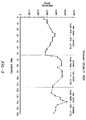
- the emulsion was tested every 2 hours during transportation. Oil to water ratio, droplet size, viscosity and pressure were measured. The results are shown in Figs. 3 and 4. No significant variation was observed.
- the increased pressure in the Budare - San Diego leg was due to an increase in flow rate, and the pressure increase in the final leg of the transport was caused by a change in droplet size due to passing the emulsion through two reciprocating pumps, in series, located along the pipeline.
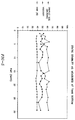
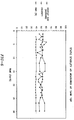
- the emulsion was stored in a 1,590 m3 tank for a period of 30 days. Samples of the emulsion were taken periodically from the top and the bottom of the tank and measured for droplet size, viscosity, and oil to water ratio. Figures 5 and 6 reflect the data so obtained for the tank bottom and top respectively. As shown, the emulsion remained substantially unchanged in the tank for the period of 30 days, indicating an excellent stability.
- emulsions formed according to the present invention without commercial emulsifiers, provide an excellent vehicle for the transport of viscous crude hydrocarbons. Such emulsions are stable and have reduced viscosity greatly facilitating transport.
Landscapes
- Chemical & Material Sciences (AREA)
- Oil, Petroleum & Natural Gas (AREA)
- Engineering & Computer Science (AREA)
- Chemical Kinetics & Catalysis (AREA)
- General Chemical & Material Sciences (AREA)
- Organic Chemistry (AREA)
- Liquid Carbonaceous Fuels (AREA)
- Production Of Liquid Hydrocarbon Mixture For Refining Petroleum (AREA)
- Colloid Chemistry (AREA)
Priority Applications (9)
| Application Number | Priority Date | Filing Date | Title |
|---|---|---|---|
| US08/006,779 US5526839A (en) | 1993-01-21 | 1993-01-21 | Stable emulsion of viscous crude hydrocarbon in aqueous buffer solution and method for forming and transporting same |
| CA 2113597 CA2113597C (fr) | 1993-01-21 | 1994-01-17 | Emulsion stable d'hydrocarbures brutes et visqueuses en solution tampon aqueuse et methode de production et de transport connexe |
| DK94200119T DK0672860T3 (da) | 1993-01-21 | 1994-01-19 | Stabil emulsion af viskøst råt carbonhydrid i vandig pufferopløsning samt fremgangsmåde til fremstilling og transport af denne |
| DE69400277T DE69400277T2 (de) | 1993-01-21 | 1994-01-19 | Stabile Emulsion aus viskosen, rohen Kohlenwasserstoffen in wässriger Pufferlösung, Verfahren zur Herstellung und Transport |
| EP19940200119 EP0672860B1 (fr) | 1993-01-21 | 1994-01-19 | Emulsion stable d'hydrocarbures brutes visqueux en solution tampon aqueuse et procédé de sa préparation et transport |
| ES94200119T ES2091665T3 (es) | 1993-01-21 | 1994-01-19 | Una emulsion y un procedimiento para formar una emulsion de un hidrocarburo crudo viscoso en una solucion tampon acuosa. |
| JP6004905A JP2530420B2 (ja) | 1993-01-21 | 1994-01-21 | 粘性粗製炭化水素の緩衝液中エマルジョン及びその形成方法並びに輸送方法 |
| CN94102644A CN1041058C (zh) | 1993-01-21 | 1994-01-21 | 粘性粗制烃在缓冲水溶液中的稳定乳化液及其制备 |
| BR9400307A BR9400307A (pt) | 1993-01-21 | 1994-01-21 | Processo para formar uma emulsão estável de um hidrocarboneto cru viscoso em uma solução tampão aquosa emulsão de hidrocarboneto cru e processo para transportar uma emulsão hidrocarboneto cru |
Applications Claiming Priority (6)
| Application Number | Priority Date | Filing Date | Title |
|---|---|---|---|
| US08/006,779 US5526839A (en) | 1993-01-21 | 1993-01-21 | Stable emulsion of viscous crude hydrocarbon in aqueous buffer solution and method for forming and transporting same |
| CA 2113597 CA2113597C (fr) | 1993-01-21 | 1994-01-17 | Emulsion stable d'hydrocarbures brutes et visqueuses en solution tampon aqueuse et methode de production et de transport connexe |
| EP19940200119 EP0672860B1 (fr) | 1993-01-21 | 1994-01-19 | Emulsion stable d'hydrocarbures brutes visqueux en solution tampon aqueuse et procédé de sa préparation et transport |
| JP6004905A JP2530420B2 (ja) | 1993-01-21 | 1994-01-21 | 粘性粗製炭化水素の緩衝液中エマルジョン及びその形成方法並びに輸送方法 |
| CN94102644A CN1041058C (zh) | 1993-01-21 | 1994-01-21 | 粘性粗制烃在缓冲水溶液中的稳定乳化液及其制备 |
| BR9400307A BR9400307A (pt) | 1993-01-21 | 1994-01-21 | Processo para formar uma emulsão estável de um hidrocarboneto cru viscoso em uma solução tampão aquosa emulsão de hidrocarboneto cru e processo para transportar uma emulsão hidrocarboneto cru |
Publications (2)
| Publication Number | Publication Date |
|---|---|
| EP0672860A1 true EP0672860A1 (fr) | 1995-09-20 |
| EP0672860B1 EP0672860B1 (fr) | 1996-07-03 |
Family
ID=37076187
Family Applications (1)
| Application Number | Title | Priority Date | Filing Date |
|---|---|---|---|
| EP19940200119 Expired - Lifetime EP0672860B1 (fr) | 1993-01-21 | 1994-01-19 | Emulsion stable d'hydrocarbures brutes visqueux en solution tampon aqueuse et procédé de sa préparation et transport |
Country Status (9)
| Country | Link |
|---|---|
| US (1) | US5526839A (fr) |
| EP (1) | EP0672860B1 (fr) |
| JP (1) | JP2530420B2 (fr) |
| CN (1) | CN1041058C (fr) |
| BR (1) | BR9400307A (fr) |
| CA (1) | CA2113597C (fr) |
| DE (1) | DE69400277T2 (fr) |
| DK (1) | DK0672860T3 (fr) |
| ES (1) | ES2091665T3 (fr) |
Cited By (1)
| Publication number | Priority date | Publication date | Assignee | Title |
|---|---|---|---|---|
| BE1010248A5 (fr) * | 1994-12-13 | 1998-04-07 | Intevep Sa | Procede pour la preparation d'un hydrocarbure visqueux dans des emulsions de solution tampon aqueuse. |
Families Citing this family (7)
| Publication number | Priority date | Publication date | Assignee | Title |
|---|---|---|---|---|
| US5525570A (en) * | 1991-03-09 | 1996-06-11 | Forschungszentrum Julich Gmbh | Process for producing a catalyst layer on a carrier and a catalyst produced therefrom |
| US5480583A (en) * | 1991-12-02 | 1996-01-02 | Intevep, S.A. | Emulsion of viscous hydrocarbon in aqueous buffer solution and method for preparing same |
| US6030424A (en) * | 1998-01-02 | 2000-02-29 | Matsumoto; Setsuo | Water-in-oil emulsion fuel oil production system |
| US7749378B2 (en) * | 2005-06-21 | 2010-07-06 | Kellogg Brown & Root Llc | Bitumen production-upgrade with common or different solvents |
| US20110077311A1 (en) * | 2009-09-25 | 2011-03-31 | Chevron U.S.A. Inc. | Method for handling viscous liquid crude hydrocarbons |
| US9028680B2 (en) | 2010-10-14 | 2015-05-12 | Chevron U.S.A. Inc. | Method and system for processing viscous liquid crude hydrocarbons |
| US9255043B2 (en) | 2011-08-31 | 2016-02-09 | Chevron Oronite Company Llc | Liquid crude hydrocarbon composition |
Citations (4)
| Publication number | Priority date | Publication date | Assignee | Title |
|---|---|---|---|---|
| US3487844A (en) * | 1966-01-03 | 1970-01-06 | Chevron Res | Pipelining crude oil |
| US3490471A (en) * | 1967-12-22 | 1970-01-20 | Texaco Inc | Pipeline transportation of viscous hydrocarbons |
| US4343323A (en) * | 1979-06-08 | 1982-08-10 | Research Council Of Alberta | Pipeline transportation of heavy crude oil |
| US4487262A (en) * | 1982-12-22 | 1984-12-11 | Mobil Oil Corporation | Drive for heavy oil recovery |
Family Cites Families (1)
| Publication number | Priority date | Publication date | Assignee | Title |
|---|---|---|---|---|
| NL185864C (nl) * | 1977-08-16 | 1990-08-01 | Shell Int Research | Werkwijze voor het transporteren van een viskeuze minerale olie door een pijpleiding. |
-
1993
- 1993-01-21 US US08/006,779 patent/US5526839A/en not_active Expired - Lifetime
-
1994
- 1994-01-17 CA CA 2113597 patent/CA2113597C/fr not_active Expired - Lifetime
- 1994-01-19 ES ES94200119T patent/ES2091665T3/es not_active Expired - Lifetime
- 1994-01-19 DE DE69400277T patent/DE69400277T2/de not_active Expired - Fee Related
- 1994-01-19 DK DK94200119T patent/DK0672860T3/da active
- 1994-01-19 EP EP19940200119 patent/EP0672860B1/fr not_active Expired - Lifetime
- 1994-01-21 JP JP6004905A patent/JP2530420B2/ja not_active Expired - Lifetime
- 1994-01-21 CN CN94102644A patent/CN1041058C/zh not_active Expired - Lifetime
- 1994-01-21 BR BR9400307A patent/BR9400307A/pt not_active Application Discontinuation
Patent Citations (4)
| Publication number | Priority date | Publication date | Assignee | Title |
|---|---|---|---|---|
| US3487844A (en) * | 1966-01-03 | 1970-01-06 | Chevron Res | Pipelining crude oil |
| US3490471A (en) * | 1967-12-22 | 1970-01-20 | Texaco Inc | Pipeline transportation of viscous hydrocarbons |
| US4343323A (en) * | 1979-06-08 | 1982-08-10 | Research Council Of Alberta | Pipeline transportation of heavy crude oil |
| US4487262A (en) * | 1982-12-22 | 1984-12-11 | Mobil Oil Corporation | Drive for heavy oil recovery |
Cited By (1)
| Publication number | Priority date | Publication date | Assignee | Title |
|---|---|---|---|---|
| BE1010248A5 (fr) * | 1994-12-13 | 1998-04-07 | Intevep Sa | Procede pour la preparation d'un hydrocarbure visqueux dans des emulsions de solution tampon aqueuse. |
Also Published As
| Publication number | Publication date |
|---|---|
| DE69400277T2 (de) | 1997-01-23 |
| EP0672860B1 (fr) | 1996-07-03 |
| JP2530420B2 (ja) | 1996-09-04 |
| CA2113597C (fr) | 1999-05-18 |
| US5526839A (en) | 1996-06-18 |
| CN1118713A (zh) | 1996-03-20 |
| CN1041058C (zh) | 1998-12-09 |
| BR9400307A (pt) | 1995-10-17 |
| DK0672860T3 (da) | 1996-07-29 |
| CA2113597A1 (fr) | 1994-07-22 |
| DE69400277D1 (de) | 1996-08-08 |
| JPH07224287A (ja) | 1995-08-22 |
| ES2091665T3 (es) | 1996-11-01 |
Similar Documents
| Publication | Publication Date | Title |
|---|---|---|
| US5480583A (en) | Emulsion of viscous hydrocarbon in aqueous buffer solution and method for preparing same | |
| CA2164902C (fr) | Methode pour preparer des emulsions renfermant des hydrocarbures visqueux et une solution aqueuse tampon | |
| US6509300B1 (en) | Liquid CO2/hydrocarbon oil emulsion fracturing system | |
| US5792223A (en) | Natural surfactant with amines and ethoxylated alcohol | |
| CA2083803C (fr) | Emulsion bimodale et methode de preparation | |
| CA1272934A (fr) | Preparation d'emulsions | |
| US3710865A (en) | Method of fracturing subterranean formations using oil-in-water emulsions | |
| US3519006A (en) | Pipelining oil/water mixtures | |
| CA2394028C (fr) | Procede de traitement d'un puits de forage | |
| CA1156171A (fr) | Methode d'acheminement des hydrocarbures lourds | |
| US5526839A (en) | Stable emulsion of viscous crude hydrocarbon in aqueous buffer solution and method for forming and transporting same | |
| US20010020531A1 (en) | Brine viscosification for enhanced oil recovery | |
| US4534411A (en) | Micellar slug for oil recovery | |
| US20110077311A1 (en) | Method for handling viscous liquid crude hydrocarbons | |
| US5964906A (en) | Emulsion with solid additive in hydrocarbon phase and process for preparing same | |
| US6069178A (en) | Emulsion with coke additive in hydrocarbon phase and process for preparing same | |
| CA2009123C (fr) | Procede pour stabiliser un hydrocarbure dans une emulsion d'eau; emulsion ainsi obtenue | |
| US4770199A (en) | Process for transporting heavy oils | |
| KR970002550B1 (ko) | 수성 완충 용액중의 점성질 조 탄화수소의 안정한 에멀젼, 그의 형성 방법 및 이송 방법 | |
| CA1274089A (fr) | Preparation d'emulsions de petrole brut | |
| GB2304601A (en) | Method for the preparation of viscous hydrocarbon in aqueous buffer solution emulsions | |
| US20090298723A1 (en) | Method for Treating Wells by Small-Size Additive-Containing Emulsions | |
| Seifriz | Studies in Emulsions. VI-VIII | |
| JPH06256778A (ja) | 高濃度石炭水スラリー |
Legal Events
| Date | Code | Title | Description |
|---|---|---|---|
| PUAI | Public reference made under article 153(3) epc to a published international application that has entered the european phase |
Free format text: ORIGINAL CODE: 0009012 |
|
| 17P | Request for examination filed |
Effective date: 19940922 |
|
| AK | Designated contracting states |
Kind code of ref document: A1 Designated state(s): BE DE DK ES FR IT LU NL |
|
| GRAH | Despatch of communication of intention to grant a patent |
Free format text: ORIGINAL CODE: EPIDOS IGRA |
|
| GRAH | Despatch of communication of intention to grant a patent |
Free format text: ORIGINAL CODE: EPIDOS IGRA |
|
| GRAA | (expected) grant |
Free format text: ORIGINAL CODE: 0009210 |
|
| AK | Designated contracting states |
Kind code of ref document: B1 Designated state(s): BE DE DK ES FR IT LU NL |
|
| PG25 | Lapsed in a contracting state [announced via postgrant information from national office to epo] |
Ref country code: BE Effective date: 19960703 |
|
| REG | Reference to a national code |
Ref country code: DK Ref legal event code: T3 |
|
| REF | Corresponds to: |
Ref document number: 69400277 Country of ref document: DE Date of ref document: 19960808 |
|
| ITF | It: translation for a ep patent filed | ||
| REG | Reference to a national code |
Ref country code: ES Ref legal event code: FG2A Ref document number: 2091665 Country of ref document: ES Kind code of ref document: T3 |
|
| ET | Fr: translation filed |
Free format text: CORRECTIONS |
|
| PG25 | Lapsed in a contracting state [announced via postgrant information from national office to epo] |
Ref country code: LU Free format text: LAPSE BECAUSE OF NON-PAYMENT OF DUE FEES Effective date: 19970131 |
|
| PLBE | No opposition filed within time limit |
Free format text: ORIGINAL CODE: 0009261 |
|
| STAA | Information on the status of an ep patent application or granted ep patent |
Free format text: STATUS: NO OPPOSITION FILED WITHIN TIME LIMIT |
|
| 26N | No opposition filed | ||
| PGFP | Annual fee paid to national office [announced via postgrant information from national office to epo] |
Ref country code: ES Payment date: 19970731 Year of fee payment: 4 |
|
| PG25 | Lapsed in a contracting state [announced via postgrant information from national office to epo] |
Ref country code: ES Free format text: THE PATENT HAS BEEN ANNULLED BY A DECISION OF A NATIONAL AUTHORITY Effective date: 19980120 |
|
| PGFP | Annual fee paid to national office [announced via postgrant information from national office to epo] |
Ref country code: DK Payment date: 20000112 Year of fee payment: 7 |
|
| PGFP | Annual fee paid to national office [announced via postgrant information from national office to epo] |
Ref country code: FR Payment date: 20000118 Year of fee payment: 7 |
|
| PGFP | Annual fee paid to national office [announced via postgrant information from national office to epo] |
Ref country code: NL Payment date: 20000131 Year of fee payment: 7 |
|
| PGFP | Annual fee paid to national office [announced via postgrant information from national office to epo] |
Ref country code: DE Payment date: 20000214 Year of fee payment: 7 |
|
| PG25 | Lapsed in a contracting state [announced via postgrant information from national office to epo] |
Ref country code: DK Free format text: LAPSE BECAUSE OF NON-PAYMENT OF DUE FEES Effective date: 20010119 |
|
| PG25 | Lapsed in a contracting state [announced via postgrant information from national office to epo] |
Ref country code: NL Free format text: LAPSE BECAUSE OF NON-PAYMENT OF DUE FEES Effective date: 20010801 |
|
| REG | Reference to a national code |
Ref country code: DK Ref legal event code: EBP |
|
| PG25 | Lapsed in a contracting state [announced via postgrant information from national office to epo] |
Ref country code: FR Free format text: LAPSE BECAUSE OF NON-PAYMENT OF DUE FEES Effective date: 20010928 |
|
| NLV4 | Nl: lapsed or anulled due to non-payment of the annual fee |
Effective date: 20010801 |
|
| PG25 | Lapsed in a contracting state [announced via postgrant information from national office to epo] |
Ref country code: DE Free format text: LAPSE BECAUSE OF NON-PAYMENT OF DUE FEES Effective date: 20011101 |
|
| REG | Reference to a national code |
Ref country code: FR Ref legal event code: ST |
|
| REG | Reference to a national code |
Ref country code: ES Ref legal event code: FD2A Effective date: 20020204 |
|
| PG25 | Lapsed in a contracting state [announced via postgrant information from national office to epo] |
Ref country code: IT Free format text: LAPSE BECAUSE OF NON-PAYMENT OF DUE FEES Effective date: 20050119 |