EP0672932A1 - Optischer Halbleitermodulator - Google Patents
Optischer Halbleitermodulator Download PDFInfo
- Publication number
- EP0672932A1 EP0672932A1 EP95101929A EP95101929A EP0672932A1 EP 0672932 A1 EP0672932 A1 EP 0672932A1 EP 95101929 A EP95101929 A EP 95101929A EP 95101929 A EP95101929 A EP 95101929A EP 0672932 A1 EP0672932 A1 EP 0672932A1
- Authority
- EP
- European Patent Office
- Prior art keywords
- modulator
- optical
- semiconductor
- region
- optical modulator
- Prior art date
- Legal status (The legal status is an assumption and is not a legal conclusion. Google has not performed a legal analysis and makes no representation as to the accuracy of the status listed.)
- Granted
Links
- 230000003287 optical effect Effects 0.000 title claims abstract description 84
- 239000004065 semiconductor Substances 0.000 title claims description 25
- 239000013307 optical fiber Substances 0.000 claims abstract description 21
- 230000005540 biological transmission Effects 0.000 claims abstract description 17
- 238000005253 cladding Methods 0.000 claims description 24
- 238000010521 absorption reaction Methods 0.000 claims description 7
- 230000000694 effects Effects 0.000 claims description 4
- 230000001902 propagating effect Effects 0.000 claims 1
- 230000008033 biological extinction Effects 0.000 abstract description 7
- 239000010410 layer Substances 0.000 description 59
- VYPSYNLAJGMNEJ-UHFFFAOYSA-N Silicium dioxide Chemical compound O=[Si]=O VYPSYNLAJGMNEJ-UHFFFAOYSA-N 0.000 description 34
- 229910052681 coesite Inorganic materials 0.000 description 17
- 229910052906 cristobalite Inorganic materials 0.000 description 17
- 239000000377 silicon dioxide Substances 0.000 description 17
- 235000012239 silicon dioxide Nutrition 0.000 description 17
- 229910052682 stishovite Inorganic materials 0.000 description 17
- 229910052905 tridymite Inorganic materials 0.000 description 17
- 230000000644 propagated effect Effects 0.000 description 6
- 230000003247 decreasing effect Effects 0.000 description 5
- 238000005530 etching Methods 0.000 description 5
- 229910004205 SiNX Inorganic materials 0.000 description 4
- 239000013078 crystal Substances 0.000 description 4
- 230000031700 light absorption Effects 0.000 description 4
- 229910000530 Gallium indium arsenide Inorganic materials 0.000 description 3
- 239000004642 Polyimide Substances 0.000 description 3
- 239000012792 core layer Substances 0.000 description 3
- 238000003780 insertion Methods 0.000 description 3
- 230000037431 insertion Effects 0.000 description 3
- 238000001451 molecular beam epitaxy Methods 0.000 description 3
- 229920001721 polyimide Polymers 0.000 description 3
- 238000001039 wet etching Methods 0.000 description 3
- 230000004888 barrier function Effects 0.000 description 2
- 238000005229 chemical vapour deposition Methods 0.000 description 2
- 230000008878 coupling Effects 0.000 description 2
- 238000010168 coupling process Methods 0.000 description 2
- 238000005859 coupling reaction Methods 0.000 description 2
- 238000001312 dry etching Methods 0.000 description 2
- 239000002184 metal Substances 0.000 description 2
- 238000000034 method Methods 0.000 description 2
- 230000010287 polarization Effects 0.000 description 2
- 238000001816 cooling Methods 0.000 description 1
- 230000002542 deteriorative effect Effects 0.000 description 1
- 230000005684 electric field Effects 0.000 description 1
- 230000005685 electric field effect Effects 0.000 description 1
- 239000000835 fiber Substances 0.000 description 1
- 230000001771 impaired effect Effects 0.000 description 1
- 238000002513 implantation Methods 0.000 description 1
- 239000012212 insulator Substances 0.000 description 1
- 239000000463 material Substances 0.000 description 1
- 238000005259 measurement Methods 0.000 description 1
- 230000010355 oscillation Effects 0.000 description 1
- 238000004806 packaging method and process Methods 0.000 description 1
- 238000007738 vacuum evaporation Methods 0.000 description 1
Images



Classifications
-
- G—PHYSICS
- G02—OPTICS
- G02F—OPTICAL DEVICES OR ARRANGEMENTS FOR THE CONTROL OF LIGHT BY MODIFICATION OF THE OPTICAL PROPERTIES OF THE MEDIA OF THE ELEMENTS INVOLVED THEREIN; NON-LINEAR OPTICS; FREQUENCY-CHANGING OF LIGHT; OPTICAL LOGIC ELEMENTS; OPTICAL ANALOGUE/DIGITAL CONVERTERS
- G02F1/00—Devices or arrangements for the control of the intensity, colour, phase, polarisation or direction of light arriving from an independent light source, e.g. switching, gating or modulating; Non-linear optics
- G02F1/01—Devices or arrangements for the control of the intensity, colour, phase, polarisation or direction of light arriving from an independent light source, e.g. switching, gating or modulating; Non-linear optics for the control of the intensity, phase, polarisation or colour
- G02F1/015—Devices or arrangements for the control of the intensity, colour, phase, polarisation or direction of light arriving from an independent light source, e.g. switching, gating or modulating; Non-linear optics for the control of the intensity, phase, polarisation or colour based on semiconductor elements having potential barriers, e.g. having a PN or PIN junction
- G02F1/025—Devices or arrangements for the control of the intensity, colour, phase, polarisation or direction of light arriving from an independent light source, e.g. switching, gating or modulating; Non-linear optics for the control of the intensity, phase, polarisation or colour based on semiconductor elements having potential barriers, e.g. having a PN or PIN junction in an optical waveguide structure
-
- B—PERFORMING OPERATIONS; TRANSPORTING
- B82—NANOTECHNOLOGY
- B82Y—SPECIFIC USES OR APPLICATIONS OF NANOSTRUCTURES; MEASUREMENT OR ANALYSIS OF NANOSTRUCTURES; MANUFACTURE OR TREATMENT OF NANOSTRUCTURES
- B82Y20/00—Nanooptics, e.g. quantum optics or photonic crystals
-
- G—PHYSICS
- G02—OPTICS
- G02F—OPTICAL DEVICES OR ARRANGEMENTS FOR THE CONTROL OF LIGHT BY MODIFICATION OF THE OPTICAL PROPERTIES OF THE MEDIA OF THE ELEMENTS INVOLVED THEREIN; NON-LINEAR OPTICS; FREQUENCY-CHANGING OF LIGHT; OPTICAL LOGIC ELEMENTS; OPTICAL ANALOGUE/DIGITAL CONVERTERS
- G02F1/00—Devices or arrangements for the control of the intensity, colour, phase, polarisation or direction of light arriving from an independent light source, e.g. switching, gating or modulating; Non-linear optics
- G02F1/01—Devices or arrangements for the control of the intensity, colour, phase, polarisation or direction of light arriving from an independent light source, e.g. switching, gating or modulating; Non-linear optics for the control of the intensity, phase, polarisation or colour
- G02F1/015—Devices or arrangements for the control of the intensity, colour, phase, polarisation or direction of light arriving from an independent light source, e.g. switching, gating or modulating; Non-linear optics for the control of the intensity, phase, polarisation or colour based on semiconductor elements having potential barriers, e.g. having a PN or PIN junction
- G02F1/017—Structures with periodic or quasi periodic potential variation, e.g. superlattices, quantum wells
- G02F1/01708—Structures with periodic or quasi periodic potential variation, e.g. superlattices, quantum wells in an optical wavequide structure
-
- G—PHYSICS
- G02—OPTICS
- G02B—OPTICAL ELEMENTS, SYSTEMS OR APPARATUS
- G02B6/00—Light guides; Structural details of arrangements comprising light guides and other optical elements, e.g. couplings
- G02B6/10—Light guides; Structural details of arrangements comprising light guides and other optical elements, e.g. couplings of the optical waveguide type
- G02B6/12—Light guides; Structural details of arrangements comprising light guides and other optical elements, e.g. couplings of the optical waveguide type of the integrated circuit kind
- G02B2006/12166—Manufacturing methods
- G02B2006/12178—Epitaxial growth
-
- G—PHYSICS
- G02—OPTICS
- G02F—OPTICAL DEVICES OR ARRANGEMENTS FOR THE CONTROL OF LIGHT BY MODIFICATION OF THE OPTICAL PROPERTIES OF THE MEDIA OF THE ELEMENTS INVOLVED THEREIN; NON-LINEAR OPTICS; FREQUENCY-CHANGING OF LIGHT; OPTICAL LOGIC ELEMENTS; OPTICAL ANALOGUE/DIGITAL CONVERTERS
- G02F1/00—Devices or arrangements for the control of the intensity, colour, phase, polarisation or direction of light arriving from an independent light source, e.g. switching, gating or modulating; Non-linear optics
- G02F1/01—Devices or arrangements for the control of the intensity, colour, phase, polarisation or direction of light arriving from an independent light source, e.g. switching, gating or modulating; Non-linear optics for the control of the intensity, phase, polarisation or colour
- G02F1/015—Devices or arrangements for the control of the intensity, colour, phase, polarisation or direction of light arriving from an independent light source, e.g. switching, gating or modulating; Non-linear optics for the control of the intensity, phase, polarisation or colour based on semiconductor elements having potential barriers, e.g. having a PN or PIN junction
- G02F1/0151—Devices or arrangements for the control of the intensity, colour, phase, polarisation or direction of light arriving from an independent light source, e.g. switching, gating or modulating; Non-linear optics for the control of the intensity, phase, polarisation or colour based on semiconductor elements having potential barriers, e.g. having a PN or PIN junction modulating the refractive index
-
- G—PHYSICS
- G02—OPTICS
- G02F—OPTICAL DEVICES OR ARRANGEMENTS FOR THE CONTROL OF LIGHT BY MODIFICATION OF THE OPTICAL PROPERTIES OF THE MEDIA OF THE ELEMENTS INVOLVED THEREIN; NON-LINEAR OPTICS; FREQUENCY-CHANGING OF LIGHT; OPTICAL LOGIC ELEMENTS; OPTICAL ANALOGUE/DIGITAL CONVERTERS
- G02F1/00—Devices or arrangements for the control of the intensity, colour, phase, polarisation or direction of light arriving from an independent light source, e.g. switching, gating or modulating; Non-linear optics
- G02F1/01—Devices or arrangements for the control of the intensity, colour, phase, polarisation or direction of light arriving from an independent light source, e.g. switching, gating or modulating; Non-linear optics for the control of the intensity, phase, polarisation or colour
- G02F1/015—Devices or arrangements for the control of the intensity, colour, phase, polarisation or direction of light arriving from an independent light source, e.g. switching, gating or modulating; Non-linear optics for the control of the intensity, phase, polarisation or colour based on semiconductor elements having potential barriers, e.g. having a PN or PIN junction
- G02F1/0155—Devices or arrangements for the control of the intensity, colour, phase, polarisation or direction of light arriving from an independent light source, e.g. switching, gating or modulating; Non-linear optics for the control of the intensity, phase, polarisation or colour based on semiconductor elements having potential barriers, e.g. having a PN or PIN junction modulating the optical absorption
- G02F1/0157—Devices or arrangements for the control of the intensity, colour, phase, polarisation or direction of light arriving from an independent light source, e.g. switching, gating or modulating; Non-linear optics for the control of the intensity, phase, polarisation or colour based on semiconductor elements having potential barriers, e.g. having a PN or PIN junction modulating the optical absorption using electro-absorption effects, e.g. Franz-Keldysh [FK] effect or quantum confined stark effect [QCSE]
Definitions
- the present invention relates to a semiconductor optical modulator, an optical modulator package using the semiconductor optical modulator, and an optical fiber transmission equipment.
- An optical modulator using the electric field effect of semiconductor can operate at a high-speed, high-efficiency light modulation. Therefore, it has been studied how to increase the operating speed of the modulator and to package the modulator in order to apply the modulator to optical fiber transmission equipment.
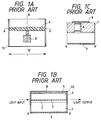
- FIGs. 1A to 1C show a conventional electro- absoprtion optical modulator which is one type of semiconductor optical modulators.
- numeral 1 denotes an n-doped semiconductor wafer
- 2 denotes an n-doped buffer layer
- 3 denotes an undoped light absorption layer
- 4 denotes a p-doped cladding layer
- 5 denotes a contact layer
- 6 denotes an optical waveguide
- 7 denotes an insulator
- 8 denotes a p electrode
- 9 denotes an n electrode
- 10 denotes an anti-reflection coat.
- the optical waveguide has the light absorption layer 3, and light is modulated by applying an electric field to the light absorption layer by use of electrodes and by changing the absorption intensity.
- FIGs. 2A and 2B show an optical modulator package using the above semiconductor optical modulator.
- numeral 21 denotes a package body
- 22 denotes a polarization holding fiber
- 23 denotes a carrier
- 24 denotes an unspherical lens
- 251 and 252 denotes microstrip lines
- 26 denotes an optical modulator
- 27 denotes a matching resistor
- 281 and 282 represent wire bonds
- 29 denotes input/output terminal pins
- 30 denotes a rod lens
- 31 denotes an electronic cooling device
- 32 denotes a package cover.
- optical coupling of the input/output optical fiber 22 and the optical modulator 26 is achieved by the rod lens 30 and unspherical lens 24.
- the element is mounted on the carrier 32 having a protrusion with a width (W) approximately equal to the modulator length (L) so that light is not scattered between the modulator 26 and the unspherical lens 24.
- An electrical signal is fed to the modulator through the microstrip line 251 and moreover, the matching resistor 27 for avoiding reflection of the signal is provided at the end of the strip line 251.
- This type of package is described in, for example, the TECHNICAL REPORT OF IEICE, EMD 93-33, CPM 93-46, OQE 93-67 (1993-08), pp. 55-60.
- the modulation speed of the above optical modulator is limited by the element capacitance. Therefore, to obtain a higher-speed optical modulator, it is necessary to decrease the element capacitance by decreasing the modulator length (L).
- the element has a length of 300 ⁇ m or less
- the light not coupled with the optical waveguide at the incidence facet of the modulator is propagated through the part above the optical modulator or within the wafer of the optical modulator and coupled with an optical fiber on the output side.
- the uncoupled light impairs the extinction characteristics of the package or makes the adjustment of the optical system difficult.
- the above object is achieved by forming a passive region one side or both sides of a modulation region for modulating light in a waveguide-type semiconductor modulator and forming at least part of a cladding layer in the passive region from undoped or semi- insulating semiconductor or electrically isolating the cladding layer in the passive region from the cladding layer in the passive region.
- numeral 41 denotes an n-InP wafer
- 42 denotes an n-InAlAs buffer layer
- 43 denotes an undoped InGaAs/InAlAs strained multiple- quantum well layer
- 44 denotes a p-InAlAs cladding layer
- 45 denotes a p+-InGaAs contact layer
- 46 denotes an SiO2 mask
- 47 denotes an undoped InP buffer layer
- 48 denotes an undoped InGaAsP core layer
- 49 denotes an undoped InP cladding layer
- 50 denotes an optical waveguide
- 51 denotes polyimide
- 52 denotes a Cr/Au p-electrode
- 53 denotes an AuGeNi n-electrode
- 54 denotes an SiNx anti-reflection
- the optical waveguide structure comprises a modulation region (length of L2) for modulating light and two passive regions (lengths of L1 and L3) for coupling the modulation region with the element facets.
- the band gap energy of the semiconductor constituting the optical waveguide in the passive region is sufficiently larger than the light energy, and the light is propagated in these regions with a low loss.
- the light entering through a facet is propagated through the passive region, modulated in the modulation region, propagated through the passive region again, and emitted outside. Because the cladding layer 49 in the passive region is formed of undoped or semi-insulating semiconductor, the element capacitance is not increased even when the passive regions are provided.
- the device has been described above in which optical waveguides are provided on both sides of a modulation region. However, it should be noted that the same effect can be expected by forming an optical waveguide on only one side of the modulation region. Moreover, though the method for insulating the whole of the cladding layer 49 in the passive region has been described above, completely the same effect can be expected by forming high-resistance regions between the passive regions and the modulation region to electrically isolate the cladding layers in both regions from each other even if the cladding layers in the passive regions are conductive.
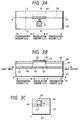
- FIG. 3A is a top view of the optical modulator of embodiment 1
- FIG. 3B is a sectional view along the line A-A' of FIG. 3A
- FIG. 3C is a sectional view along the line C-C' of FIG. 3A.
- the B-B' cross section in FIG. 3A is the same as that in FIG. 1C.
- Numeral 46 in FIG. 3A denotes an SiO2 mask used for etching and the second crystal growth.
- n-In 0.53 Al 0.47 As buffer layer 42 (0.2 ⁇ m), undoped In 0.48 Ga 0.52 As/In 0.60 Al 0.40 As strained multiple- quantum well layer 43 (well layer: 7 nm, barrier layer: 5 nm, number of wells: 10, and band gap wavelength: 1.49 ⁇ m), p-In 0.53 Al 0.47 As cladding layer 44 (2.0 ⁇ m), and p+-In 0.53 Ga 0.47 As contact layer 45 (0.2 ⁇ m) were formed in order on the n-InP wafer 41 by an MBE (Molecular Beam Epitaxy) technique. Then, the MBE growth layer in the region other than the SiO2 mask 46 was removed by selective wet etching using the SiO2 mask 46.
- MBE Molecular Beam Epitaxy
- the undoped InP buffer layer 47 (0.15 ⁇ m), undoped In 0.82 Ga 0.18 As 0.40 P 0.60 core layer 48 (0.2 ⁇ m), and undoped InP cladding layer 49 (1.5 ⁇ m) were grown in the region other than the SiO2 mask 46 by MOCVD (Metal Organic Chemical Vapor Deposition).
- MOCVD Metal Organic Chemical Vapor Deposition
- mesa-etching up to an InP wafer was performed by dry-etching to form an optical waveguide 50 (waveguide width of 3 ⁇ m).
- the element surface was planarized by polyimide 51, the Cr/Au p-electrode 52 was formed.
- the element After the AuGeNi n-electrode 53 is formed by vacuum-evaporation, the element is cleaved, and SiNx anti-reflection coats 54 are formed on both facets.
- the element had a length of 1,000 ⁇ m, the modulation region had a length (L1) of 100 ⁇ m, and the element had a capacitance of 0.3 pF.
- the optical modulator package shown in FIGs. 2A and 2B similar to a conventional one was fabricated using the thus obtained modulator.
- the carrier protrusion width (W) was 1,000 ⁇ m.
- a semiconductor laser beam of 1.55 ⁇ m was applied to the obtained optical modulator package to measure the modulation characteristics. In this measurement, the incidence polarization was adjusted so that the light in the modulator was propagated in the TE mode.
- the insertion loss in the state that no voltage was applied to the modulator (light output is ON) was 9 dB and the voltage necessary for 15-dB extinction was 1.5 V.
- the modulation band width (f 3dB ) of the optical modulator package was 20 GHz.
- FIG. 6 An optical fiber transmission equipment (transmission rate of 10 Gbits/s) shown in FIG. 6 was manufactured using the obtained optical modulator package.
- numeral 90 denotes a 1.55- ⁇ m DFB laser
- 91 denotes an optical modulator driving circuit
- 92 denotes an optical modulator package
- 93 denotes an optical fiber amplifier
- 94 denotes a dispersion-shift optical fiber.
- the light emitted from the DFB (distributed feedback) laser 90 with a oscillation wavelength of 1.55 ⁇ m was modulated by the optical modulator package 92, amplified by the optical fiber amplifier 93, transmitted through the dispersion-shift optical fiber 94 (100 km), and received by a receiver.
- the error rate of the optical fiber transmission equipment was measured, and a good value of 10-12 or less was obtained.
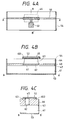
- FIG. 4A is a top view of the optical modulator of embodiment 2, and FIG. 4B is a sectional view along the line A-A' of FIG. 4A.
- the broken line 46 in FIG. 4A shows an SiO2 mask used for the etching and the second crystal growth.
- numeral 61 denotes an n-InP buffer layer
- 62 denotes an undoped In GaAsP absorption layer
- 63 denotes a p-InP cladding layer
- 64 denotes an Fe-doped semi-insulating InP upper cladding layer
- 651 and 652 denote n-InP cap layers
- 66 denotes an Fe-doped semi-insulating InP buried layer.
- n-InP buffer layer 61 (0.2 ⁇ m), undoped In 0.63 Ga 0.37 As 0.82 P 0.18 absorption layer 62 (0.2 ⁇ m, band gap wavelength: 1.47 ⁇ m), p-InP cladding layer 63 (2.0 ⁇ m), and p+-In 0.53 Ga 0.47 As contact layer 45 (0.2 ⁇ m) were formed in order on the n-InP wafer 41 by MOCVD. Then, the contact layer 45, cladding layer 63, and absorption layer 62 other than the SiO2 mask 46 were removed by selective wet etching using the SiO2 mask 46.
- the undoped In 0.82 Ga 0.18 As 0.40 P 0.60 core layer 48 (0.2 ⁇ m), Fe-doped semi-insulating InP cladding layer 64 (2.0 ⁇ m), and n-InP cap layer 651 were formed in the region other than the SiO2 mask 46 by MOCVD (Metal Organic Chemical Vapor Deposition).
- MOCVD Metal Organic Chemical Vapor Deposition
- etching is performed up to the InP wafer 41 by wet etching to form the optical waveguide 50 (waveguide width of 2 ⁇ m) and the waveguide was embedded with the Fe-doped InP 652 and n-InP 652.
- the Cr/Au p-electrode 52 was formed to partly remove the n-InP cap layers in the region other than the electrode. After the AuGeNi n-electrode 53 was vacuum-evaporated, the element was cleaved and the SiNx anti-reflection coats 54 were formed on both facets of the element.
- the element had an overall length of 1,000 ⁇ m, the modulation region has a length of 150 ⁇ m, and the element had a capacitance of 0.4 pF.
- An optical modulator package was manufactured by using the above optical modulator similarly to embodiment 1.
- the carrier protrusion width (W) was 1,000 ⁇ m similarly to embodiment 1.
- the insertion loss of the obtained modulator was 6 dB, the modulation band was 15 GHz, and the voltage necessary for 15-dB extinction was 3.0 V.
- An optical fiber transmission equipment like embodiment 1 was fabricated by using the optical modulator, and it was a good transmission equipment with an error rate of 10 ⁇ 12 or less.
- FIG. 5A is a top view of the optical modulator of embodiment 3, and FIG. 5B is a sectional view along the line A-A' of FIG. 5A.
- the broken lines in FIG. 5A show SiO2 masks 801 and 802 used for crystal growth.
- numeral 81 denotes an n-InGaAsP lower guiding layer
- 82 denotes an InGaAs/InGaAsP multiple- quantum well layer
- 83 denotes a p-InGaAsP upper guiding layer
- 84 denotes a p-InP cladding layer
- 85 denotes proton implantation.
- the SiO2 masks 801 and 802 were provided on an n-InP wafer, and the n-In 0.82 Ga 0.18 As 0.40 P 0.60 lower guiding layer 81 (0.15 ⁇ m), undoped In 0.53 Ga 0.47 As/ In 0.82 Ga 0.18 As 0.40 P 0.60 multiple-quantum well layer 82 (well layer: 4 nm, barrier layer: 7 nm, number of wells: 10, band gap wavelength: 1.45 ⁇ m), and p-In 0.82 Ga 0.18 As 0.40 P 0.60 upper guiding layer 83 (0.15 ⁇ m) were selectively grown in the region other than the SiO2 masks by MOCVD.
- the growth rate and mixed crystal composition were changed due to the material flowing from the tops of the masks, and the band gap wavelength of a multiple quantum well became larger than those of the passive regions.
- the opening widths of the SiO2 masks were adjusted so that the multiple quantum well band gap wavelength in the modulation region was 1.50 ⁇ m.
- a resist mask was placed on the light modulation region to partly remove the contact layer other than the light modulation region. Then, a protons were implanted into the part between the modulation region and the passive region to insulate the passive-region cladding layer from the modulation-region cladding layer.
- Mesa-etching was performed up to the InP wafer 41 by dry etching to form the optical waveguide 50 (waveguide width of 3 ⁇ m), and thereafter planarized with polyimide 51 to form the Cr/Au p-electrode 52.
- the element was cleaved to form the SiNx anti-reflection coats 54 on both facets of the element.
- the element had an overall length of 800 ⁇ m and the modulation region had a length of 100 ⁇ m.
- the obtained element had a capacitance of 0.3 pF.
- An optical module package was manufactured using the above optical modulator in the same manner as of embodiment 1.
- the carrier width (W) was 800 ⁇ m.
- the insertion loss of the obtained optical modulator was 6 dB, the modulation band was 18 GHz, and the voltage necessary for 15-dB extinction was 2.0 V.
- An optical fiber transmission equipment similar to embodiment 1 was made using the optical modulator, and it was a good optical fiber transmission equipment with an error rate of 10 ⁇ 12 or less was obtained.
- optical modulator of the present invention it is possible to enhance the operating speed of an optical modulator package without deteriorating the thermal, high-frequency, and extinction characteristics. Therefore, the operation of an optical fiber transmission equipment can be speeded up by applying the optical modulator of the present invention and the optical modulator package to optical fiber transmission equipment.
Landscapes
- Physics & Mathematics (AREA)
- Nonlinear Science (AREA)
- Optics & Photonics (AREA)
- General Physics & Mathematics (AREA)
- Chemical & Material Sciences (AREA)
- Engineering & Computer Science (AREA)
- Nanotechnology (AREA)
- Life Sciences & Earth Sciences (AREA)
- Biophysics (AREA)
- Crystallography & Structural Chemistry (AREA)
- Optical Modulation, Optical Deflection, Nonlinear Optics, Optical Demodulation, Optical Logic Elements (AREA)
- Optical Integrated Circuits (AREA)
Applications Claiming Priority (3)
| Application Number | Priority Date | Filing Date | Title |
|---|---|---|---|
| JP2087694 | 1994-02-18 | ||
| JP6020876A JPH07230066A (ja) | 1994-02-18 | 1994-02-18 | 半導体光変調器 |
| JP20876/94 | 1994-02-18 |
Publications (2)
| Publication Number | Publication Date |
|---|---|
| EP0672932A1 true EP0672932A1 (de) | 1995-09-20 |
| EP0672932B1 EP0672932B1 (de) | 2001-06-06 |
Family
ID=12039393
Family Applications (1)
| Application Number | Title | Priority Date | Filing Date |
|---|---|---|---|
| EP95101929A Expired - Lifetime EP0672932B1 (de) | 1994-02-18 | 1995-02-13 | Optischer Halbleitermodulator |
Country Status (4)
| Country | Link |
|---|---|
| US (1) | US5742423A (de) |
| EP (1) | EP0672932B1 (de) |
| JP (1) | JPH07230066A (de) |
| DE (1) | DE69521163T2 (de) |
Cited By (1)
| Publication number | Priority date | Publication date | Assignee | Title |
|---|---|---|---|---|
| US5742423A (en) * | 1994-02-18 | 1998-04-21 | Hitachi, Ltd. | Semiconductor optical modulator |
Families Citing this family (14)
| Publication number | Priority date | Publication date | Assignee | Title |
|---|---|---|---|---|
| JP2955986B2 (ja) * | 1996-05-22 | 1999-10-04 | 日本電気株式会社 | 半導体光変調器及びその製造方法 |
| JPH1096879A (ja) * | 1996-09-20 | 1998-04-14 | Nec Corp | 半導体光変調器とこれを用いた光通信装置 |
| CA2218262C (en) * | 1996-10-17 | 2001-04-24 | Kenji Kawano | Ultra-high-speed semiconductor optical modulator with traveling-wave electrode |
| US6529304B1 (en) | 1997-09-19 | 2003-03-04 | Hitachi, Ltd. | Optical communication equipment and system |
| JP3723333B2 (ja) * | 1997-09-29 | 2005-12-07 | 日本碍子株式会社 | 光変調器 |
| US6396801B1 (en) | 1998-03-17 | 2002-05-28 | Trw Inc. | Arbitrary waveform modem |
| US6466349B1 (en) * | 1998-05-14 | 2002-10-15 | Hughes Electronics Corporation | Integrated optical transmitter |
| KR100333482B1 (ko) | 1999-09-15 | 2002-04-25 | 오길록 | 초고속 반도체 광변조기 및 그 제조방법 |
| US6421161B1 (en) | 2001-01-18 | 2002-07-16 | The Boeing Company | Fiber modulator and associated method |
| US7120183B2 (en) | 2001-07-11 | 2006-10-10 | Optium Corporation | Electro-absorption modulated laser with high operating temperature tolerance |
| US6804421B2 (en) * | 2002-01-25 | 2004-10-12 | T-Networks, Inc. | Monolithic expanded beam mode electroabsorption modulator |
| JP2011203662A (ja) * | 2010-03-26 | 2011-10-13 | Mitsubishi Electric Corp | 光変調器とその製造方法 |
| US8410566B2 (en) * | 2011-07-21 | 2013-04-02 | Kotura, Inc. | Application of electrical field power to light-transmitting medium |
| US9153940B2 (en) * | 2013-11-26 | 2015-10-06 | Taiwan Semiconductor Manufacturing Company, Ltd. | Electro-optic modulator device and method of making the same |
Citations (2)
| Publication number | Priority date | Publication date | Assignee | Title |
|---|---|---|---|---|
| JPH0274918A (ja) * | 1988-09-12 | 1990-03-14 | Nippon Telegr & Teleph Corp <Ntt> | 導波路付光デバイス装置の製造方法 |
| JPH0529602A (ja) * | 1991-07-22 | 1993-02-05 | Hitachi Ltd | 半導体光集積素子及びその製造方法 |
Family Cites Families (7)
| Publication number | Priority date | Publication date | Assignee | Title |
|---|---|---|---|---|
| US4802182A (en) * | 1987-11-05 | 1989-01-31 | Xerox Corporation | Monolithic two dimensional waveguide coupled cavity laser/modulator |
| JPH03293622A (ja) * | 1990-04-12 | 1991-12-25 | Hitachi Ltd | 光変調器 |
| US5165105A (en) * | 1991-08-02 | 1992-11-17 | Minnesota Minning And Manufacturing Company | Separate confinement electroabsorption modulator utilizing the Franz-Keldysh effect |
| US5222162A (en) * | 1991-11-27 | 1993-06-22 | Hughes Aircraft Company | Monolithic integrated optical time delay network for antenna beam steering |
| JP2739666B2 (ja) * | 1992-06-11 | 1998-04-15 | 国際電信電話株式会社 | 光変調素子 |
| US5347601A (en) * | 1993-03-29 | 1994-09-13 | United Technologies Corporation | Integrated optical receiver/transmitter |
| JPH07230066A (ja) * | 1994-02-18 | 1995-08-29 | Hitachi Ltd | 半導体光変調器 |
-
1994
- 1994-02-18 JP JP6020876A patent/JPH07230066A/ja active Pending
-
1995
- 1995-02-13 DE DE69521163T patent/DE69521163T2/de not_active Expired - Fee Related
- 1995-02-13 EP EP95101929A patent/EP0672932B1/de not_active Expired - Lifetime
- 1995-02-17 US US08/390,794 patent/US5742423A/en not_active Expired - Fee Related
Patent Citations (2)
| Publication number | Priority date | Publication date | Assignee | Title |
|---|---|---|---|---|
| JPH0274918A (ja) * | 1988-09-12 | 1990-03-14 | Nippon Telegr & Teleph Corp <Ntt> | 導波路付光デバイス装置の製造方法 |
| JPH0529602A (ja) * | 1991-07-22 | 1993-02-05 | Hitachi Ltd | 半導体光集積素子及びその製造方法 |
Non-Patent Citations (6)
| Title |
|---|
| AOKI M ET AL: "New photonic device integration by selective-area MOVPE and its application to optical modulator/laser integration", MICROWAVE AND OPTICAL TECHNOLOGY LETTERS, 20 FEB. 1994, USA, vol. 7, no. 3, ISSN 0895-2477, pages 132 - 139 * |
| IDO T ET AL: "High-speed MQW electroabsorption optical modulators integrated with low-loss waveguides", IEEE PHOTONICS TECHNOLOGY LETTERS, FEB. 1995, USA, vol. 7, no. 2, ISSN 1041-1135, pages 170 - 172, XP011427278, DOI: doi:10.1109/68.345912 * |
| PATENT ABSTRACTS OF JAPAN vol. 014, no. 267 (P - 1058) 8 June 1990 (1990-06-08) * |
| PATENT ABSTRACTS OF JAPAN vol. 017, no. 313 (E - 1381) 15 June 1993 (1993-06-15) * |
| SASAKI T ET AL: "Novel structure photonic devices using selective MOVPE growth", NEC RESEARCH AND DEVELOPMENT, JULY 1992, JAPAN, vol. 33, no. 3, ISSN 0547-051X, pages 372 - 382, XP000327432 * |
| SHIMIZU H ET AL: "Electroabsorption modulator module", TECHNICAL REPORT OF IEICE, EMD93-33, CPM93-46, OQE93-67, vol. 93, no. 199, JAPAN, pages 55 - 60 * |
Cited By (1)
| Publication number | Priority date | Publication date | Assignee | Title |
|---|---|---|---|---|
| US5742423A (en) * | 1994-02-18 | 1998-04-21 | Hitachi, Ltd. | Semiconductor optical modulator |
Also Published As
| Publication number | Publication date |
|---|---|
| JPH07230066A (ja) | 1995-08-29 |
| US5742423A (en) | 1998-04-21 |
| DE69521163T2 (de) | 2002-02-28 |
| EP0672932B1 (de) | 2001-06-06 |
| DE69521163D1 (de) | 2001-07-12 |
Similar Documents
| Publication | Publication Date | Title |
|---|---|---|
| Zhang et al. | 25 GHz polarization-insensitive electroabsorption modulators with traveling-wave electrodes | |
| US5147825A (en) | Photonic-integrated-circuit fabrication process | |
| US5825047A (en) | Optical semiconductor device | |
| US6872966B2 (en) | Optical semiconductor device | |
| US6639241B2 (en) | Optical device using semiconductor | |
| US5742423A (en) | Semiconductor optical modulator | |
| JPH0715000A (ja) | 複量子井戸構造を有する集積モノリシックレーザ−モデュレーター構成 | |
| US5889913A (en) | Optical semiconductor device and method of fabricating the same | |
| JP3885528B2 (ja) | 光変調器 | |
| EP0917260B1 (de) | Elektrische Isolierung optoelektronischer Bauelemente | |
| CA2165711C (en) | Semiconductor light source having a spectrally broad, high power optical output | |
| EP0405800A2 (de) | Zusammensetzung eines Lasers und eines Photodetektors | |
| US5179567A (en) | Semiconductor laser device, method of fabricating the same and optical system of utilizing the same | |
| JPH01319986A (ja) | 半導体レーザ装置 | |
| WO2001013479A1 (en) | Modulator and integrated circuit | |
| JP3422279B2 (ja) | 光変調器及び光通信用光源並びにそれを用いる光モジュール、光通信システム | |
| JPH06112595A (ja) | 半導体光機能素子の製造方法 | |
| EP1372229B1 (de) | Integriertes Halbleiterlaser-Wellenleiter-Element | |
| Soda et al. | 5 Gbit/s modulation characteristics of optical intensity modulator monolithically integrated with DFB laser | |
| JP2605911B2 (ja) | 光変調器及び光検出器 | |
| JP2508332B2 (ja) | 集積型光変調器 | |
| JP2760276B2 (ja) | 選択成長導波型光制御素子 | |
| EP1227361A2 (de) | Optische Halbleitervorrichtung mit verminderter Streukapazität | |
| JPH1124020A (ja) | 埋め込み型半導体光機能素子 | |
| Kotaka et al. | High‐speed (20 Gb/s), low‐drive voltage (2 Vp‐p) strained InGaAsP mqw modulator/DFB laser light source |
Legal Events
| Date | Code | Title | Description |
|---|---|---|---|
| PUAI | Public reference made under article 153(3) epc to a published international application that has entered the european phase |
Free format text: ORIGINAL CODE: 0009012 |
|
| AK | Designated contracting states |
Kind code of ref document: A1 Designated state(s): DE FR GB |
|
| 17P | Request for examination filed |
Effective date: 19960312 |
|
| 17Q | First examination report despatched |
Effective date: 19990128 |
|
| GRAG | Despatch of communication of intention to grant |
Free format text: ORIGINAL CODE: EPIDOS AGRA |
|
| GRAG | Despatch of communication of intention to grant |
Free format text: ORIGINAL CODE: EPIDOS AGRA |
|
| GRAH | Despatch of communication of intention to grant a patent |
Free format text: ORIGINAL CODE: EPIDOS IGRA |
|
| GRAH | Despatch of communication of intention to grant a patent |
Free format text: ORIGINAL CODE: EPIDOS IGRA |
|
| GRAA | (expected) grant |
Free format text: ORIGINAL CODE: 0009210 |
|
| AK | Designated contracting states |
Kind code of ref document: B1 Designated state(s): DE FR GB |
|
| REF | Corresponds to: |
Ref document number: 69521163 Country of ref document: DE Date of ref document: 20010712 |
|
| ET | Fr: translation filed | ||
| REG | Reference to a national code |
Ref country code: GB Ref legal event code: IF02 |
|
| PGFP | Annual fee paid to national office [announced via postgrant information from national office to epo] |
Ref country code: FR Payment date: 20020118 Year of fee payment: 8 |
|
| PGFP | Annual fee paid to national office [announced via postgrant information from national office to epo] |
Ref country code: GB Payment date: 20020201 Year of fee payment: 8 |
|
| PLBE | No opposition filed within time limit |
Free format text: ORIGINAL CODE: 0009261 |
|
| STAA | Information on the status of an ep patent application or granted ep patent |
Free format text: STATUS: NO OPPOSITION FILED WITHIN TIME LIMIT |
|
| PGFP | Annual fee paid to national office [announced via postgrant information from national office to epo] |
Ref country code: DE Payment date: 20020423 Year of fee payment: 8 |
|
| 26N | No opposition filed | ||
| PG25 | Lapsed in a contracting state [announced via postgrant information from national office to epo] |
Ref country code: GB Free format text: LAPSE BECAUSE OF NON-PAYMENT OF DUE FEES Effective date: 20030213 |
|
| PG25 | Lapsed in a contracting state [announced via postgrant information from national office to epo] |
Ref country code: DE Free format text: LAPSE BECAUSE OF NON-PAYMENT OF DUE FEES Effective date: 20030902 |
|
| GBPC | Gb: european patent ceased through non-payment of renewal fee | ||
| PG25 | Lapsed in a contracting state [announced via postgrant information from national office to epo] |
Ref country code: FR Free format text: LAPSE BECAUSE OF NON-PAYMENT OF DUE FEES Effective date: 20031031 |
|
| REG | Reference to a national code |
Ref country code: FR Ref legal event code: ST |