EP0673675A2 - Feste Mehrkomponenten-Membranen für Reaktionen - Google Patents
Feste Mehrkomponenten-Membranen für Reaktionen Download PDFInfo
- Publication number
- EP0673675A2 EP0673675A2 EP95201914A EP95201914A EP0673675A2 EP 0673675 A2 EP0673675 A2 EP 0673675A2 EP 95201914 A EP95201914 A EP 95201914A EP 95201914 A EP95201914 A EP 95201914A EP 0673675 A2 EP0673675 A2 EP 0673675A2
- Authority
- EP
- European Patent Office
- Prior art keywords
- gas
- oxygen
- membrane
- mixture
- solid
- Prior art date
- Legal status (The legal status is an assumption and is not a legal conclusion. Google has not performed a legal analysis and makes no representation as to the accuracy of the status listed.)
- Withdrawn
Links
Images


Classifications
-
- B—PERFORMING OPERATIONS; TRANSPORTING
- B01—PHYSICAL OR CHEMICAL PROCESSES OR APPARATUS IN GENERAL
- B01D—SEPARATION
- B01D53/00—Separation of gases or vapours; Recovering vapours of volatile solvents from gases; Chemical or biological purification of waste gases, e.g. engine exhaust gases, smoke, fumes, flue gases, aerosols
- B01D53/32—Separation of gases or vapours; Recovering vapours of volatile solvents from gases; Chemical or biological purification of waste gases, e.g. engine exhaust gases, smoke, fumes, flue gases, aerosols by electrical effects other than those provided for in group B01D61/00
- B01D53/326—Separation of gases or vapours; Recovering vapours of volatile solvents from gases; Chemical or biological purification of waste gases, e.g. engine exhaust gases, smoke, fumes, flue gases, aerosols by electrical effects other than those provided for in group B01D61/00 in electrochemical cells
-
- B—PERFORMING OPERATIONS; TRANSPORTING
- B01—PHYSICAL OR CHEMICAL PROCESSES OR APPARATUS IN GENERAL
- B01D—SEPARATION
- B01D67/00—Processes specially adapted for manufacturing semi-permeable membranes for separation processes or apparatus
- B01D67/0039—Inorganic membrane manufacture
- B01D67/0044—Inorganic membrane manufacture by chemical reaction
-
- B—PERFORMING OPERATIONS; TRANSPORTING
- B01—PHYSICAL OR CHEMICAL PROCESSES OR APPARATUS IN GENERAL
- B01D—SEPARATION
- B01D71/00—Semi-permeable membranes for separation processes or apparatus characterised by the material; Manufacturing processes specially adapted therefor
- B01D71/02—Inorganic material
- B01D71/022—Metals
- B01D71/0223—Group 8, 9 or 10 metals
- B01D71/02231—Palladium
-
- B—PERFORMING OPERATIONS; TRANSPORTING
- B01—PHYSICAL OR CHEMICAL PROCESSES OR APPARATUS IN GENERAL
- B01D—SEPARATION
- B01D71/00—Semi-permeable membranes for separation processes or apparatus characterised by the material; Manufacturing processes specially adapted therefor
- B01D71/02—Inorganic material
- B01D71/022—Metals
- B01D71/0223—Group 8, 9 or 10 metals
- B01D71/02232—Nickel
-
- B—PERFORMING OPERATIONS; TRANSPORTING
- B01—PHYSICAL OR CHEMICAL PROCESSES OR APPARATUS IN GENERAL
- B01D—SEPARATION
- B01D71/00—Semi-permeable membranes for separation processes or apparatus characterised by the material; Manufacturing processes specially adapted therefor
- B01D71/02—Inorganic material
- B01D71/024—Oxides
- B01D71/0271—Perovskites
-
- B—PERFORMING OPERATIONS; TRANSPORTING
- B01—PHYSICAL OR CHEMICAL PROCESSES OR APPARATUS IN GENERAL
- B01J—CHEMICAL OR PHYSICAL PROCESSES, e.g. CATALYSIS OR COLLOID CHEMISTRY; THEIR RELEVANT APPARATUS
- B01J12/00—Chemical processes in general for reacting gaseous media with gaseous media; Apparatus specially adapted therefor
- B01J12/007—Chemical processes in general for reacting gaseous media with gaseous media; Apparatus specially adapted therefor in the presence of catalytically active bodies, e.g. porous plates
-
- B—PERFORMING OPERATIONS; TRANSPORTING
- B01—PHYSICAL OR CHEMICAL PROCESSES OR APPARATUS IN GENERAL
- B01J—CHEMICAL OR PHYSICAL PROCESSES, e.g. CATALYSIS OR COLLOID CHEMISTRY; THEIR RELEVANT APPARATUS
- B01J19/00—Chemical, physical or physico-chemical processes in general; Their relevant apparatus
- B01J19/24—Stationary reactors without moving elements inside
- B01J19/2475—Membrane reactors
-
- B—PERFORMING OPERATIONS; TRANSPORTING
- B01—PHYSICAL OR CHEMICAL PROCESSES OR APPARATUS IN GENERAL
- B01J—CHEMICAL OR PHYSICAL PROCESSES, e.g. CATALYSIS OR COLLOID CHEMISTRY; THEIR RELEVANT APPARATUS
- B01J35/00—Catalysts, in general, characterised by their form or physical properties
- B01J35/50—Catalysts, in general, characterised by their form or physical properties characterised by their shape or configuration
- B01J35/58—Fabrics or filaments
- B01J35/59—Membranes
-
- B—PERFORMING OPERATIONS; TRANSPORTING
- B01—PHYSICAL OR CHEMICAL PROCESSES OR APPARATUS IN GENERAL
- B01J—CHEMICAL OR PHYSICAL PROCESSES, e.g. CATALYSIS OR COLLOID CHEMISTRY; THEIR RELEVANT APPARATUS
- B01J8/00—Chemical or physical processes in general, conducted in the presence of fluids and solid particles; Apparatus for such processes
- B01J8/008—Details of the reactor or of the particulate material; Processes to increase or to retard the rate of reaction
- B01J8/009—Membranes, e.g. feeding or removing reactants or products to or from the catalyst bed through a membrane
-
- C—CHEMISTRY; METALLURGY
- C01—INORGANIC CHEMISTRY
- C01B—NON-METALLIC ELEMENTS; COMPOUNDS THEREOF; METALLOIDS OR COMPOUNDS THEREOF NOT COVERED BY SUBCLASS C01C
- C01B13/00—Oxygen; Ozone; Oxides or hydroxides in general
- C01B13/02—Preparation of oxygen
- C01B13/0229—Purification or separation processes
- C01B13/0248—Physical processing only
- C01B13/0251—Physical processing only by making use of membranes
- C01B13/0255—Physical processing only by making use of membranes characterised by the type of membrane
-
- C—CHEMISTRY; METALLURGY
- C01—INORGANIC CHEMISTRY
- C01B—NON-METALLIC ELEMENTS; COMPOUNDS THEREOF; METALLOIDS OR COMPOUNDS THEREOF NOT COVERED BY SUBCLASS C01C
- C01B13/00—Oxygen; Ozone; Oxides or hydroxides in general
- C01B13/02—Preparation of oxygen
- C01B13/0229—Purification or separation processes
- C01B13/0288—Combined chemical and physical processing
-
- C—CHEMISTRY; METALLURGY
- C01—INORGANIC CHEMISTRY
- C01B—NON-METALLIC ELEMENTS; COMPOUNDS THEREOF; METALLOIDS OR COMPOUNDS THEREOF NOT COVERED BY SUBCLASS C01C
- C01B3/00—Hydrogen; Gaseous mixtures containing hydrogen; Separation of hydrogen from mixtures containing it; Purification of hydrogen; Reversible storage of hydrogen
- C01B3/02—Production of hydrogen; Production of gaseous mixtures containing hydrogen
- C01B3/32—Production of hydrogen; Production of gaseous mixtures containing hydrogen by reaction of gaseous or liquid organic compounds with gasifying agents, e.g. water, carbon dioxide or air
- C01B3/34—Production of hydrogen; Production of gaseous mixtures containing hydrogen by reaction of gaseous or liquid organic compounds with gasifying agents, e.g. water, carbon dioxide or air by reaction of hydrocarbons with gasifying agents
- C01B3/36—Production of hydrogen; Production of gaseous mixtures containing hydrogen by reaction of gaseous or liquid organic compounds with gasifying agents, e.g. water, carbon dioxide or air by reaction of hydrocarbons with gasifying agents using oxygen; using mixtures containing oxygen as gasifying agents
-
- C—CHEMISTRY; METALLURGY
- C01—INORGANIC CHEMISTRY
- C01B—NON-METALLIC ELEMENTS; COMPOUNDS THEREOF; METALLOIDS OR COMPOUNDS THEREOF NOT COVERED BY SUBCLASS C01C
- C01B3/00—Hydrogen; Gaseous mixtures containing hydrogen; Separation of hydrogen from mixtures containing it; Purification of hydrogen; Reversible storage of hydrogen
- C01B3/02—Production of hydrogen; Production of gaseous mixtures containing hydrogen
- C01B3/32—Production of hydrogen; Production of gaseous mixtures containing hydrogen by reaction of gaseous or liquid organic compounds with gasifying agents, e.g. water, carbon dioxide or air
- C01B3/34—Production of hydrogen; Production of gaseous mixtures containing hydrogen by reaction of gaseous or liquid organic compounds with gasifying agents, e.g. water, carbon dioxide or air by reaction of hydrocarbons with gasifying agents
- C01B3/38—Production of hydrogen; Production of gaseous mixtures containing hydrogen by reaction of gaseous or liquid organic compounds with gasifying agents, e.g. water, carbon dioxide or air by reaction of hydrocarbons with gasifying agents using catalysts
- C01B3/386—Catalytic partial combustion
-
- C—CHEMISTRY; METALLURGY
- C01—INORGANIC CHEMISTRY
- C01C—AMMONIA; CYANOGEN; COMPOUNDS THEREOF
- C01C3/00—Cyanogen; Compounds thereof
- C01C3/02—Preparation, separation or purification of hydrogen cyanide
- C01C3/0208—Preparation in gaseous phase
- C01C3/0212—Preparation in gaseous phase from hydrocarbons and ammonia in the presence of oxygen, e.g. the Andrussow-process
- C01C3/0216—Preparation in gaseous phase from hydrocarbons and ammonia in the presence of oxygen, e.g. the Andrussow-process characterised by the catalyst used
-
- C—CHEMISTRY; METALLURGY
- C01—INORGANIC CHEMISTRY
- C01C—AMMONIA; CYANOGEN; COMPOUNDS THEREOF
- C01C3/00—Cyanogen; Compounds thereof
- C01C3/02—Preparation, separation or purification of hydrogen cyanide
- C01C3/0208—Preparation in gaseous phase
- C01C3/0212—Preparation in gaseous phase from hydrocarbons and ammonia in the presence of oxygen, e.g. the Andrussow-process
- C01C3/022—Apparatus therefor
- C01C3/0225—Apparatus therefor characterised by the synthesis reactor
-
- C—CHEMISTRY; METALLURGY
- C01—INORGANIC CHEMISTRY
- C01C—AMMONIA; CYANOGEN; COMPOUNDS THEREOF
- C01C3/00—Cyanogen; Compounds thereof
- C01C3/02—Preparation, separation or purification of hydrogen cyanide
- C01C3/0208—Preparation in gaseous phase
- C01C3/0229—Preparation in gaseous phase from hydrocarbons and ammonia in the absence of oxygen, e.g. HMA-process
- C01C3/0233—Preparation in gaseous phase from hydrocarbons and ammonia in the absence of oxygen, e.g. HMA-process making use of fluidised beds, e.g. the Shawinigan-process
-
- C—CHEMISTRY; METALLURGY
- C01—INORGANIC CHEMISTRY
- C01G—COMPOUNDS CONTAINING METALS NOT COVERED BY SUBCLASSES C01D OR C01F
- C01G45/00—Compounds of manganese
- C01G45/12—Complex oxides containing manganese and at least one other metal element
- C01G45/1221—Manganates or manganites with trivalent manganese, tetravalent manganese or mixtures thereof
- C01G45/125—Manganates or manganites with trivalent manganese, tetravalent manganese or mixtures thereof of the type (MnO3)n-, e.g. CaMnO3
- C01G45/1264—Manganates or manganites with trivalent manganese, tetravalent manganese or mixtures thereof of the type (MnO3)n-, e.g. CaMnO3 containing rare earths, e.g. (La1-xCax)MnO3 or LaMnO3
-
- C—CHEMISTRY; METALLURGY
- C01—INORGANIC CHEMISTRY
- C01G—COMPOUNDS CONTAINING METALS NOT COVERED BY SUBCLASSES C01D OR C01F
- C01G49/00—Compounds of iron
- C01G49/0018—Mixed oxides or hydroxides
-
- C—CHEMISTRY; METALLURGY
- C01—INORGANIC CHEMISTRY
- C01G—COMPOUNDS CONTAINING METALS NOT COVERED BY SUBCLASSES C01D OR C01F
- C01G51/00—Compounds of cobalt
- C01G51/40—Complex oxides containing cobalt and at least one other metal element
- C01G51/66—Complex oxides containing cobalt and at least one other metal element containing alkaline earth metals, e.g. SrCoO3
- C01G51/68—Complex oxides containing cobalt and at least one other metal element containing alkaline earth metals, e.g. SrCoO3 containing rare earths, e.g. (La0.3Sr0.7)CoO3
-
- C—CHEMISTRY; METALLURGY
- C25—ELECTROLYTIC OR ELECTROPHORETIC PROCESSES; APPARATUS THEREFOR
- C25B—ELECTROLYTIC OR ELECTROPHORETIC PROCESSES FOR THE PRODUCTION OF COMPOUNDS OR NON-METALS; APPARATUS THEREFOR
- C25B3/00—Electrolytic production of organic compounds
- C25B3/01—Products
- C25B3/03—Acyclic or carbocyclic hydrocarbons
-
- C—CHEMISTRY; METALLURGY
- C25—ELECTROLYTIC OR ELECTROPHORETIC PROCESSES; APPARATUS THEREFOR
- C25B—ELECTROLYTIC OR ELECTROPHORETIC PROCESSES FOR THE PRODUCTION OF COMPOUNDS OR NON-METALS; APPARATUS THEREFOR
- C25B3/00—Electrolytic production of organic compounds
- C25B3/20—Processes
- C25B3/23—Oxidation
-
- C—CHEMISTRY; METALLURGY
- C25—ELECTROLYTIC OR ELECTROPHORETIC PROCESSES; APPARATUS THEREFOR
- C25B—ELECTROLYTIC OR ELECTROPHORETIC PROCESSES FOR THE PRODUCTION OF COMPOUNDS OR NON-METALS; APPARATUS THEREFOR
- C25B5/00—Electrogenerative processes, i.e. processes for producing compounds in which electricity is generated simultaneously
-
- H—ELECTRICITY
- H01—ELECTRIC ELEMENTS
- H01M—PROCESSES OR MEANS, e.g. BATTERIES, FOR THE DIRECT CONVERSION OF CHEMICAL ENERGY INTO ELECTRICAL ENERGY
- H01M8/00—Fuel cells; Manufacture thereof
- H01M8/10—Fuel cells with solid electrolytes
- H01M8/12—Fuel cells with solid electrolytes operating at high temperature, e.g. with stabilised ZrO2 electrolyte
-
- H—ELECTRICITY
- H01—ELECTRIC ELEMENTS
- H01M—PROCESSES OR MEANS, e.g. BATTERIES, FOR THE DIRECT CONVERSION OF CHEMICAL ENERGY INTO ELECTRICAL ENERGY
- H01M8/00—Fuel cells; Manufacture thereof
- H01M8/10—Fuel cells with solid electrolytes
- H01M8/12—Fuel cells with solid electrolytes operating at high temperature, e.g. with stabilised ZrO2 electrolyte
- H01M8/1231—Fuel cells with solid electrolytes operating at high temperature, e.g. with stabilised ZrO2 electrolyte with both reactants being gaseous or vaporised
-
- H—ELECTRICITY
- H01—ELECTRIC ELEMENTS
- H01M—PROCESSES OR MEANS, e.g. BATTERIES, FOR THE DIRECT CONVERSION OF CHEMICAL ENERGY INTO ELECTRICAL ENERGY
- H01M8/00—Fuel cells; Manufacture thereof
- H01M8/10—Fuel cells with solid electrolytes
- H01M8/12—Fuel cells with solid electrolytes operating at high temperature, e.g. with stabilised ZrO2 electrolyte
- H01M8/124—Fuel cells with solid electrolytes operating at high temperature, e.g. with stabilised ZrO2 electrolyte characterised by the process of manufacturing or by the material of the electrolyte
- H01M8/1246—Fuel cells with solid electrolytes operating at high temperature, e.g. with stabilised ZrO2 electrolyte characterised by the process of manufacturing or by the material of the electrolyte the electrolyte consisting of oxides
-
- B—PERFORMING OPERATIONS; TRANSPORTING
- B01—PHYSICAL OR CHEMICAL PROCESSES OR APPARATUS IN GENERAL
- B01D—SEPARATION
- B01D2325/00—Details relating to properties of membranes
- B01D2325/08—Patterned membranes
-
- B—PERFORMING OPERATIONS; TRANSPORTING
- B01—PHYSICAL OR CHEMICAL PROCESSES OR APPARATUS IN GENERAL
- B01D—SEPARATION
- B01D2325/00—Details relating to properties of membranes
- B01D2325/26—Electrical properties
-
- B—PERFORMING OPERATIONS; TRANSPORTING
- B01—PHYSICAL OR CHEMICAL PROCESSES OR APPARATUS IN GENERAL
- B01J—CHEMICAL OR PHYSICAL PROCESSES, e.g. CATALYSIS OR COLLOID CHEMISTRY; THEIR RELEVANT APPARATUS
- B01J2208/00—Processes carried out in the presence of solid particles; Reactors therefor
- B01J2208/00008—Controlling the process
- B01J2208/00017—Controlling the temperature
- B01J2208/00026—Controlling or regulating the heat exchange system
- B01J2208/00035—Controlling or regulating the heat exchange system involving measured parameters
- B01J2208/00044—Temperature measurement
-
- B—PERFORMING OPERATIONS; TRANSPORTING
- B01—PHYSICAL OR CHEMICAL PROCESSES OR APPARATUS IN GENERAL
- B01J—CHEMICAL OR PHYSICAL PROCESSES, e.g. CATALYSIS OR COLLOID CHEMISTRY; THEIR RELEVANT APPARATUS
- B01J2208/00—Processes carried out in the presence of solid particles; Reactors therefor
- B01J2208/00008—Controlling the process
- B01J2208/00017—Controlling the temperature
- B01J2208/00106—Controlling the temperature by indirect heat exchange
-
- B—PERFORMING OPERATIONS; TRANSPORTING
- B01—PHYSICAL OR CHEMICAL PROCESSES OR APPARATUS IN GENERAL
- B01J—CHEMICAL OR PHYSICAL PROCESSES, e.g. CATALYSIS OR COLLOID CHEMISTRY; THEIR RELEVANT APPARATUS
- B01J2208/00—Processes carried out in the presence of solid particles; Reactors therefor
- B01J2208/00008—Controlling the process
- B01J2208/00017—Controlling the temperature
- B01J2208/00106—Controlling the temperature by indirect heat exchange
- B01J2208/00309—Controlling the temperature by indirect heat exchange with two or more reactions in heat exchange with each other, such as an endothermic reaction in heat exchange with an exothermic reaction
-
- B—PERFORMING OPERATIONS; TRANSPORTING
- B01—PHYSICAL OR CHEMICAL PROCESSES OR APPARATUS IN GENERAL
- B01J—CHEMICAL OR PHYSICAL PROCESSES, e.g. CATALYSIS OR COLLOID CHEMISTRY; THEIR RELEVANT APPARATUS
- B01J2208/00—Processes carried out in the presence of solid particles; Reactors therefor
- B01J2208/00008—Controlling the process
- B01J2208/00017—Controlling the temperature
- B01J2208/00327—Controlling the temperature by direct heat exchange
- B01J2208/00336—Controlling the temperature by direct heat exchange adding a temperature modifying medium to the reactants
-
- B—PERFORMING OPERATIONS; TRANSPORTING
- B01—PHYSICAL OR CHEMICAL PROCESSES OR APPARATUS IN GENERAL
- B01J—CHEMICAL OR PHYSICAL PROCESSES, e.g. CATALYSIS OR COLLOID CHEMISTRY; THEIR RELEVANT APPARATUS
- B01J2208/00—Processes carried out in the presence of solid particles; Reactors therefor
- B01J2208/00008—Controlling the process
- B01J2208/00017—Controlling the temperature
- B01J2208/00327—Controlling the temperature by direct heat exchange
- B01J2208/00336—Controlling the temperature by direct heat exchange adding a temperature modifying medium to the reactants
- B01J2208/00345—Cryogenic coolants
-
- B—PERFORMING OPERATIONS; TRANSPORTING
- B01—PHYSICAL OR CHEMICAL PROCESSES OR APPARATUS IN GENERAL
- B01J—CHEMICAL OR PHYSICAL PROCESSES, e.g. CATALYSIS OR COLLOID CHEMISTRY; THEIR RELEVANT APPARATUS
- B01J2208/00—Processes carried out in the presence of solid particles; Reactors therefor
- B01J2208/00008—Controlling the process
- B01J2208/00548—Flow
-
- B—PERFORMING OPERATIONS; TRANSPORTING
- B01—PHYSICAL OR CHEMICAL PROCESSES OR APPARATUS IN GENERAL
- B01J—CHEMICAL OR PHYSICAL PROCESSES, e.g. CATALYSIS OR COLLOID CHEMISTRY; THEIR RELEVANT APPARATUS
- B01J2208/00—Processes carried out in the presence of solid particles; Reactors therefor
- B01J2208/00008—Controlling the process
- B01J2208/00628—Controlling the composition of the reactive mixture
-
- B—PERFORMING OPERATIONS; TRANSPORTING
- B01—PHYSICAL OR CHEMICAL PROCESSES OR APPARATUS IN GENERAL
- B01J—CHEMICAL OR PHYSICAL PROCESSES, e.g. CATALYSIS OR COLLOID CHEMISTRY; THEIR RELEVANT APPARATUS
- B01J2219/00—Chemical, physical or physico-chemical processes in general; Their relevant apparatus
- B01J2219/00049—Controlling or regulating processes
- B01J2219/00051—Controlling the temperature
- B01J2219/00054—Controlling or regulating the heat exchange system
- B01J2219/00056—Controlling or regulating the heat exchange system involving measured parameters
- B01J2219/00058—Temperature measurement
-
- B—PERFORMING OPERATIONS; TRANSPORTING
- B01—PHYSICAL OR CHEMICAL PROCESSES OR APPARATUS IN GENERAL
- B01J—CHEMICAL OR PHYSICAL PROCESSES, e.g. CATALYSIS OR COLLOID CHEMISTRY; THEIR RELEVANT APPARATUS
- B01J2219/00—Chemical, physical or physico-chemical processes in general; Their relevant apparatus
- B01J2219/00049—Controlling or regulating processes
- B01J2219/00051—Controlling the temperature
- B01J2219/00074—Controlling the temperature by indirect heating or cooling employing heat exchange fluids
- B01J2219/00117—Controlling the temperature by indirect heating or cooling employing heat exchange fluids with two or more reactions in heat exchange with each other, such as an endothermic reaction in heat exchange with an exothermic reaction
-
- B—PERFORMING OPERATIONS; TRANSPORTING
- B01—PHYSICAL OR CHEMICAL PROCESSES OR APPARATUS IN GENERAL
- B01J—CHEMICAL OR PHYSICAL PROCESSES, e.g. CATALYSIS OR COLLOID CHEMISTRY; THEIR RELEVANT APPARATUS
- B01J2219/00—Chemical, physical or physico-chemical processes in general; Their relevant apparatus
- B01J2219/00049—Controlling or regulating processes
- B01J2219/00051—Controlling the temperature
- B01J2219/00121—Controlling the temperature by direct heating or cooling
- B01J2219/00123—Controlling the temperature by direct heating or cooling adding a temperature modifying medium to the reactants
-
- B—PERFORMING OPERATIONS; TRANSPORTING
- B01—PHYSICAL OR CHEMICAL PROCESSES OR APPARATUS IN GENERAL
- B01J—CHEMICAL OR PHYSICAL PROCESSES, e.g. CATALYSIS OR COLLOID CHEMISTRY; THEIR RELEVANT APPARATUS
- B01J2219/00—Chemical, physical or physico-chemical processes in general; Their relevant apparatus
- B01J2219/00049—Controlling or regulating processes
- B01J2219/00051—Controlling the temperature
- B01J2219/00121—Controlling the temperature by direct heating or cooling
- B01J2219/00123—Controlling the temperature by direct heating or cooling adding a temperature modifying medium to the reactants
- B01J2219/00126—Cryogenic coolants
-
- B—PERFORMING OPERATIONS; TRANSPORTING
- B01—PHYSICAL OR CHEMICAL PROCESSES OR APPARATUS IN GENERAL
- B01J—CHEMICAL OR PHYSICAL PROCESSES, e.g. CATALYSIS OR COLLOID CHEMISTRY; THEIR RELEVANT APPARATUS
- B01J2219/00—Chemical, physical or physico-chemical processes in general; Their relevant apparatus
- B01J2219/00049—Controlling or regulating processes
- B01J2219/00164—Controlling or regulating processes controlling the flow
-
- B—PERFORMING OPERATIONS; TRANSPORTING
- B01—PHYSICAL OR CHEMICAL PROCESSES OR APPARATUS IN GENERAL
- B01J—CHEMICAL OR PHYSICAL PROCESSES, e.g. CATALYSIS OR COLLOID CHEMISTRY; THEIR RELEVANT APPARATUS
- B01J2219/00—Chemical, physical or physico-chemical processes in general; Their relevant apparatus
- B01J2219/00049—Controlling or regulating processes
- B01J2219/00186—Controlling or regulating processes controlling the composition of the reactive mixture
-
- C—CHEMISTRY; METALLURGY
- C01—INORGANIC CHEMISTRY
- C01B—NON-METALLIC ELEMENTS; COMPOUNDS THEREOF; METALLOIDS OR COMPOUNDS THEREOF NOT COVERED BY SUBCLASS C01C
- C01B2203/00—Integrated processes for the production of hydrogen or synthesis gas
- C01B2203/02—Processes for making hydrogen or synthesis gas
- C01B2203/025—Processes for making hydrogen or synthesis gas containing a partial oxidation step
- C01B2203/0261—Processes for making hydrogen or synthesis gas containing a partial oxidation step containing a catalytic partial oxidation step [CPO]
-
- C—CHEMISTRY; METALLURGY
- C01—INORGANIC CHEMISTRY
- C01B—NON-METALLIC ELEMENTS; COMPOUNDS THEREOF; METALLOIDS OR COMPOUNDS THEREOF NOT COVERED BY SUBCLASS C01C
- C01B2203/00—Integrated processes for the production of hydrogen or synthesis gas
- C01B2203/10—Catalysts for performing the hydrogen forming reactions
- C01B2203/1005—Arrangement or shape of catalyst
- C01B2203/1035—Catalyst coated on equipment surfaces, e.g. reactor walls
-
- C—CHEMISTRY; METALLURGY
- C01—INORGANIC CHEMISTRY
- C01B—NON-METALLIC ELEMENTS; COMPOUNDS THEREOF; METALLOIDS OR COMPOUNDS THEREOF NOT COVERED BY SUBCLASS C01C
- C01B2203/00—Integrated processes for the production of hydrogen or synthesis gas
- C01B2203/12—Feeding the process for making hydrogen or synthesis gas
- C01B2203/1205—Composition of the feed
- C01B2203/1211—Organic compounds or organic mixtures used in the process for making hydrogen or synthesis gas
- C01B2203/1235—Hydrocarbons
- C01B2203/1241—Natural gas or methane
-
- C—CHEMISTRY; METALLURGY
- C01—INORGANIC CHEMISTRY
- C01B—NON-METALLIC ELEMENTS; COMPOUNDS THEREOF; METALLOIDS OR COMPOUNDS THEREOF NOT COVERED BY SUBCLASS C01C
- C01B2203/00—Integrated processes for the production of hydrogen or synthesis gas
- C01B2203/12—Feeding the process for making hydrogen or synthesis gas
- C01B2203/1258—Pre-treatment of the feed
-
- C—CHEMISTRY; METALLURGY
- C01—INORGANIC CHEMISTRY
- C01B—NON-METALLIC ELEMENTS; COMPOUNDS THEREOF; METALLOIDS OR COMPOUNDS THEREOF NOT COVERED BY SUBCLASS C01C
- C01B2210/00—Purification or separation of specific gases
- C01B2210/0001—Separation or purification processing
- C01B2210/0003—Chemical processing
-
- C—CHEMISTRY; METALLURGY
- C01—INORGANIC CHEMISTRY
- C01B—NON-METALLIC ELEMENTS; COMPOUNDS THEREOF; METALLOIDS OR COMPOUNDS THEREOF NOT COVERED BY SUBCLASS C01C
- C01B2210/00—Purification or separation of specific gases
- C01B2210/0001—Separation or purification processing
- C01B2210/0009—Physical processing
- C01B2210/001—Physical processing by making use of membranes
- C01B2210/0012—Physical processing by making use of membranes characterised by the membrane
-
- C—CHEMISTRY; METALLURGY
- C01—INORGANIC CHEMISTRY
- C01B—NON-METALLIC ELEMENTS; COMPOUNDS THEREOF; METALLOIDS OR COMPOUNDS THEREOF NOT COVERED BY SUBCLASS C01C
- C01B2210/00—Purification or separation of specific gases
- C01B2210/0043—Impurity removed
- C01B2210/0071—Sulfur oxides
-
- C—CHEMISTRY; METALLURGY
- C01—INORGANIC CHEMISTRY
- C01B—NON-METALLIC ELEMENTS; COMPOUNDS THEREOF; METALLOIDS OR COMPOUNDS THEREOF NOT COVERED BY SUBCLASS C01C
- C01B2210/00—Purification or separation of specific gases
- C01B2210/0043—Impurity removed
- C01B2210/0075—Nitrogen oxides
-
- C—CHEMISTRY; METALLURGY
- C01—INORGANIC CHEMISTRY
- C01P—INDEXING SCHEME RELATING TO STRUCTURAL AND PHYSICAL ASPECTS OF SOLID INORGANIC COMPOUNDS
- C01P2002/00—Crystal-structural characteristics
- C01P2002/30—Three-dimensional structures
- C01P2002/34—Three-dimensional structures perovskite-type (ABO3)
-
- C—CHEMISTRY; METALLURGY
- C01—INORGANIC CHEMISTRY
- C01P—INDEXING SCHEME RELATING TO STRUCTURAL AND PHYSICAL ASPECTS OF SOLID INORGANIC COMPOUNDS
- C01P2002/00—Crystal-structural characteristics
- C01P2002/50—Solid solutions
- C01P2002/52—Solid solutions containing elements as dopants
-
- C—CHEMISTRY; METALLURGY
- C01—INORGANIC CHEMISTRY
- C01P—INDEXING SCHEME RELATING TO STRUCTURAL AND PHYSICAL ASPECTS OF SOLID INORGANIC COMPOUNDS
- C01P2002/00—Crystal-structural characteristics
- C01P2002/50—Solid solutions
- C01P2002/52—Solid solutions containing elements as dopants
- C01P2002/54—Solid solutions containing elements as dopants one element only
-
- C—CHEMISTRY; METALLURGY
- C01—INORGANIC CHEMISTRY
- C01P—INDEXING SCHEME RELATING TO STRUCTURAL AND PHYSICAL ASPECTS OF SOLID INORGANIC COMPOUNDS
- C01P2004/00—Particle morphology
- C01P2004/01—Particle morphology depicted by an image
- C01P2004/03—Particle morphology depicted by an image obtained by SEM
-
- C—CHEMISTRY; METALLURGY
- C01—INORGANIC CHEMISTRY
- C01P—INDEXING SCHEME RELATING TO STRUCTURAL AND PHYSICAL ASPECTS OF SOLID INORGANIC COMPOUNDS
- C01P2006/00—Physical properties of inorganic compounds
- C01P2006/12—Surface area
-
- C—CHEMISTRY; METALLURGY
- C01—INORGANIC CHEMISTRY
- C01P—INDEXING SCHEME RELATING TO STRUCTURAL AND PHYSICAL ASPECTS OF SOLID INORGANIC COMPOUNDS
- C01P2006/00—Physical properties of inorganic compounds
- C01P2006/40—Electric properties
-
- Y—GENERAL TAGGING OF NEW TECHNOLOGICAL DEVELOPMENTS; GENERAL TAGGING OF CROSS-SECTIONAL TECHNOLOGIES SPANNING OVER SEVERAL SECTIONS OF THE IPC; TECHNICAL SUBJECTS COVERED BY FORMER USPC CROSS-REFERENCE ART COLLECTIONS [XRACs] AND DIGESTS
- Y02—TECHNOLOGIES OR APPLICATIONS FOR MITIGATION OR ADAPTATION AGAINST CLIMATE CHANGE
- Y02E—REDUCTION OF GREENHOUSE GAS [GHG] EMISSIONS, RELATED TO ENERGY GENERATION, TRANSMISSION OR DISTRIBUTION
- Y02E60/00—Enabling technologies; Technologies with a potential or indirect contribution to GHG emissions mitigation
- Y02E60/30—Hydrogen technology
- Y02E60/50—Fuel cells
-
- Y—GENERAL TAGGING OF NEW TECHNOLOGICAL DEVELOPMENTS; GENERAL TAGGING OF CROSS-SECTIONAL TECHNOLOGIES SPANNING OVER SEVERAL SECTIONS OF THE IPC; TECHNICAL SUBJECTS COVERED BY FORMER USPC CROSS-REFERENCE ART COLLECTIONS [XRACs] AND DIGESTS
- Y02—TECHNOLOGIES OR APPLICATIONS FOR MITIGATION OR ADAPTATION AGAINST CLIMATE CHANGE
- Y02P—CLIMATE CHANGE MITIGATION TECHNOLOGIES IN THE PRODUCTION OR PROCESSING OF GOODS
- Y02P20/00—Technologies relating to chemical industry
- Y02P20/50—Improvements relating to the production of bulk chemicals
- Y02P20/52—Improvements relating to the production of bulk chemicals using catalysts, e.g. selective catalysts
-
- Y—GENERAL TAGGING OF NEW TECHNOLOGICAL DEVELOPMENTS; GENERAL TAGGING OF CROSS-SECTIONAL TECHNOLOGIES SPANNING OVER SEVERAL SECTIONS OF THE IPC; TECHNICAL SUBJECTS COVERED BY FORMER USPC CROSS-REFERENCE ART COLLECTIONS [XRACs] AND DIGESTS
- Y02—TECHNOLOGIES OR APPLICATIONS FOR MITIGATION OR ADAPTATION AGAINST CLIMATE CHANGE
- Y02P—CLIMATE CHANGE MITIGATION TECHNOLOGIES IN THE PRODUCTION OR PROCESSING OF GOODS
- Y02P70/00—Climate change mitigation technologies in the production process for final industrial or consumer products
- Y02P70/50—Manufacturing or production processes characterised by the final manufactured product
Definitions
- This invention relates to the field of electro-chemical reactors which facilitate the transfer of oxygen.
- this invention relates to multi-component oxygen semipermeable membranes, electrochemical reactors containing the oxygen semipermeable membrane and electrochemical processes which use the oxygen semipermeable membrane to facilitate oxygen transport from an oxygen-containing gas to a gas that consumes oxygen.
- Synthesis gas is composed primarily of hydrogen and carbon monoxide. Generally the H2/CO molar ratio is from about 0.6 to 6.
- the production of synthesis gas from light hydrocarbons such as methane and natural gas by partial oxidation is known.
- the present invention describes an electrochemical reactor having a two-phase mixed conductor membrane (hereinafter referred to as a "solid multi-component membrane” or “dual conductor membrane”), which facilitates the electrocatalytic conversion of light hydrocarbons to synthesis gas.
- electrochemical reactor of the present invention uses for the electrochemical reactor of the present invention include the partial oxidation of light hydrocarbons to form olefins, extraction of oxygen from one or more oxygen-containing gases such as SO2, SO3, N2O, NO, NO2, steam, CO2, ammoxidation of methane, etc.
- oxygen-containing gases such as SO2, SO3, N2O, NO, NO2, steam, CO2, ammoxidation of methane, etc.
- Sulfur and nitrogen oxides are well known noxious pollutants in gas streams emanating from stationary and mobile sources such as power plants, automobiles, ships, trains, etc.
- Sulfur oxides are known to combine with water vapor to form a highly corrosive vapor causing irritation to eyes and mucous membrane, damage to metal-containing structures, and environmental harm to vegetation due to acid rain.
- Nitrogen oxides are toxic irritants and are also damaging to the environment.
- Carbonyl sulfide (COS) is another toxic pollutant formed as a product of a reaction between a sulfur-containing compound and carbon monoxide in a gas stream effluent. Regulations on the discharge of these pollutants into the atmosphere have become increasingly stringent.
- the present invention describes an electrocatalytic process and electrochemical cell for removing sulfur and nitrogen oxides from gas streams which utilize the chemical driving force of a fuel gas.
- U.S. Patent 4,330,633 to Yoshisato et al issued on May 18, 1982, describes a solid electrolyte for selectively separating oxygen from a gaseous atmosphere having a high oxygen partial pressure into a gaseous atmosphere having a low oxygen partial pressure.
- the solid electrolyte is disclosed as composed of a sintered body consisting essentially of an oxide of cobalt, an oxide of at least one metal selected from strontium and lanthanum, and an oxide of at least one metal selected from bismuth and cerium.
- U.S. Patent No. 4,659,448 to Gordon issued on April 21, 1987 basically describes a process for the removal of SO x and NO x from flue gases using a solid state electrochemical ceramic cell. That process applies an external electrical potential to electrocatalytically reduce SO x and NO x to elemental sulfur (S) and free nitrogen (N2). The oxygen apparently is removed through the solid electrolyte in what amounts to electrolysis.
- S elemental sulfur
- N2 free nitrogen
- a solid multi-component membrane is described for use in an electrochemical reactor.
- the solid multi-component membrane generally comprises an intimate, gas-impervious, multi-phase mixture of an electronically-conductive phase and an oxygen ion-conductive phase and/or a gas impervious "single phase" mixed metal oxides having a perovskite structure and having both electron-conductive and oxygen ion-conductive properties.
- An electrochemical reactor cell for transporting oxygen from any oxygen containing gas to any gas that consumes oxygen which generally comprises a solid multi-component membrane having an entrance end, an exit end and a passage therebetween for the movement of one or more gases from the entrance end to the exit end, wherein the solid membrane is the multi-component membrane defined above.
- This electrochemical reactor cell is placed in an environment containing an oxygen-containing gas on one side and an oxygen-consuming gas on the other side under reaction conditions of appropriate temperature and percentage of respective gases.
- An electrochemical reactor for reacting an oxygen-consuming gas with an oxygen-containing gas comprising a shell having an entrance end, an exit end and a passage therebetween for the movement of one or more gases from the entrance end to the exit end and a solid multi-component membrane, positioned within the shell, having an entrance end, an exit end and a passage therebetween for movement of one or more gases from the entrance end to the exit end, so that the shell and the solid membrane together form a first zone for introducing, reacting and expelling a first gas or gas mixture and a second zone within the solid membrane and separated from the first zone by the solid membrane for introducing, reacting and expelling a second gas or gas mixture, wherein the solid membrane is the multi-component membrane defined above.
- reactant gas is defined herein as a gas which is capable of reacting with oxygen or oxygen ions.
- One aspect of the present invention is an electrochemical process for oxidizing methane, natural gas or other light hydrocarbons to unsaturated hydrocarbons or synthesis gas.
- the electrochemical process generally comprises
- the electrochemical process comprises
- Another aspect of the present invention is an electrochemical process for extracting oxygen from an oxygen-containing gas which comprises
- the electrochemical process comprises
- the electrochemical cell includes a catalyst adjacent to or coated on the membrane in the first zone.
- oxygen extraction processes such as synthesis gas, unsaturated hydrocarbons, elemental sulfur, or oxygen-free gas
- those processes may further comprise recovering the desired product from the zone in which it is produced.
- Oxygen-free gas may, for example, be recovered from the first zone.
- the electrochemical process comprises
- This invention provides an electrochemical reactor for a continuous process for transporting oxygen from any oxygen-containing gas to any reactant gas that consumes oxygen.
- Processes which may be conducted with the present invention are, for example, the combustion of hydrogen to produce water, the partial oxidation of methane or natural gas to produce unsaturated compounds or synthesis gas, the partial oxidation of ethane, extraction of oxygen from oxygen-containing gases (e.g., extraction of oxygen from NO x , wherein x has a value from 0.5 to 2, SO y , wherein y has a value from 2 to 3, steam, CO2, etc.), ammoxidation of methane to hydrogen cyanide, etc.
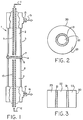
- One embodiment of the electrochemical reactor of the present invention may be schematically represented as shown in Fig. 1, wherein the side view, and cross-section of the reactor 1 shows a first zone 2 separated from a second zone 3 by a solid multi-component membrane 4.
- the outer perimeter of the first zone is defined by reactor tube 5 and the outer perimeter of the second zone is defined by reactor tube 6.
- Reactor tubes 5 and 6 form a gas-tight seal with membrane 4 by means of glass seals 7 and 8, respectively.
- Feed tubes 9 and 10 conduct the oxygen-containing gas 11 and oxygen-consuming gas 12 into zones 2 and 3, respectively. Exit ports 13 and 14 permit reacted gases 15 and 16 to escape zones 2 and 3, respectively.
- an oxygen-containing gas or gas mixture such as air
- the oxygen-consuming gas or gas mixture such as a reactant gas-containing feed gas
- the oxygen-consuming gas or gas mixture such as a reactant gas-containing feed gas
- the oxygen-consuming gas is methane or natural gas
- the oxygen-containing gas or gas mixture is air.
- the oxygen component of air is reduced to oxygen ions which are transported through the membrane to the second zone where the oxygen ions react with the methane to produce synthesis gas or olefins, depending on the reaction conditions.
- the oxygen-consuming gas is methane, natural gas, or hydrogen and the oxygen-containing gas is a flue or exhaust gas containing NO x and/or SO y , wherein x and y are defined as above.
- the oxygen of NO x and/or SO y is reduced to oxygen ions which are transported through the membrane to the second zone where the oxygen ions react with the oxygen-consuming gas to produce carbon dioxide and water, synthesis gas or olefins, depending on the reaction conditions.
- Nitrogen gas and elemental sulfur are electrochemically produced from NO x and SO y , respectively, in the first zone.
- the oxygen-containing gas is a gas containing steam (i.e., H2O gas).
- H2O gas gas containing steam
- the oxygen of H2O is reduced to oxygen ions which are transported through the membrane to the second zone where the oxygen ions react with methane or natural gas, for example.
- the H2O is reduced to hydrogen gas (H2) in the first zone.
- the hydrogen gas may be recovered and used, for example, to hydrogenate unsaturated hydrocarbons, provide fuel for an electrical current generating fuel cell, to provide fuel for heating the electrochemical cell of this invention or to provide a reactant gas for the electrochemical process for extracting oxygen from an oxygen-containing gas in accordance with the present invention.
- Materials which are copresent may participate in electrochemical reduction or oxidation taking place at the membrane of the present invention.
- methane is present with ammonia in the second zone and an oxygen-containing gas is present in the first zone
- hydrogen cyanide and water may be produced electrochemically in the second zone.
- oxygen-consuming gas include materials which are not gases at temperatures below the temperature ranges of the pertinent process of the present invention, and may include materials which are liquid or solid at room temperature.
- An example of an oxygen-containing gas which is liquid at room temperature is steam.
- the solid multi-component membrane used in the electrochemical reactor of the present invention may be an intimate, gas-impervious, multi-phase mixture of any electronically-conducting material with any oxygen ion-conducting material and/or a gas impervious "single phase" mixed metal oxides having a perovskite structure and having both electron-conductive and oxygen ion-conductive properties.
- gas-impervious is defined herein to mean “substantially gas-impervious or gas-tight" in that the mixture does not permit a substantial amount of the above-described oxygen-consuming or oxygen-containing gas to pass through the mixture as a gas (i.e., the mixture is non-porous, rather than porous, with respect to the relevant gases). In some cases, a minor degree of perviousness to gases might be acceptable or unavoidable, such as when hydrogen gas is present.
- mixtures in relation to the solid multi-component membrane includes materials comprised of two or more solid phases, and single-phase materials in which the atoms of the various elements are intermingled in the same solid phase, such as in the yttria-stabilized zirconia mentioned below.
- the examples of preferred metal-doped metal oxides are single-phase materials whereas the phrase "multi-phase mixture” refers to a composition which contains two or more solid phases interspersed without forming a single phase solution.
- the multi-phase mixture is "multi-phase", because the electronically-conductive material and the oxygen ion-conductive material are present as at least two solid phases in the gas impervious solid membrane, such that the atoms of the various components of the multi-component membrane are, for the most part, not intermingled in the same solid phase.
- the multi-phase solid membrane of the present invention differs substantially from "doped" materials known in the art.
- a typical doping procedure involves adding small amounts of an element, or its oxide (i.e., dopant), to a large amount of a composition (i.e., host material), such that the atoms of the dopant become permanently intermingled with the atoms of the host material during the doping process, whereby the material forms a single phase.
- the multi-phase solid membrane of the present invention comprises an oxygen ion conductive material and an electronically conductive material that are not present in the dopant/host material relationship described above, but are present in substantially discrete phases.
- the solid membrane of the present invention rather than being a doped material, may be referred to as a two-phase, dual-conductor, multi-phase, or multi-component membrane.
- the multi-phase membrane of the present invention can be distinguished from the doped materials by such routine procedures as electron microscopy, X-ray diffraction analysis, X-ray adsorption mapping, electron diffraction analysis, infrared analysis, etc., which can detect differences in composition over a multi-phase region of the membrane.
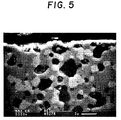
- An example of such physical evidence of multi-phase composition is the electron photomicrographs shown as Fig. 4 and Fig. 5. A detailed explanation of Fig. 4 and Fig. 5 follows Examples 1-5 below.
- the oxygen ion-conducting materials or phases of the dual-conductor are solid solutions formed between oxides containing divalent and trivalent cations such as calcium oxide, scandium oxide, yttrium oxide, lanthanum oxide, etc., with oxides containing tetravalent cations such as zirconia, thoria and ceria or the oxygen ion-conducting materials or phases comprise an oxygen ion-conductive mixed metal oxide of a perovskite structure.
- oxides containing divalent and trivalent cations such as calcium oxide, scandium oxide, yttrium oxide, lanthanum oxide, etc.
- oxides containing tetravalent cations such as zirconia, thoria and ceria
- the oxygen ion-conducting materials or phases comprise an oxygen ion-conductive mixed metal oxide of a perovskite structure.
- Their higher ionic conductivity is believed to be due to the existence of oxygen ion site vacancies.
- any of a large number of oxides such as yttria-stabilized zirconia, doped ceria, thoria-based materials, or doped bismuth oxides may be used.
- Some of the known solid oxide transfer materials include Y2O3-stabilized ZrO2, CaO-stabilized ZrO2, Sc2O3-stabilized ZrO2, Y2O3-stabilized Bi2O3, Y2O3-stabilized CeO2, CaO-stabilized CeO2, ThO2, Y2O3-stabilized ThO2, or ThO2, ZrO2, Bi2O3, CeO2, or HfO2 stabilized by addition of any one of the lanthanide oxides or CaO.
- Many other oxides are known which have demonstrated oxygen ion-conducting ability which could be used in the multi-phase mixtures, and they are included in the present concept.
- solid electrolytes Preferred among these solid electrolytes are the Y2O3- (yttria) and CaO-(calcia) stabilized ZrO2 (zirconia) materials. These two solid electrolytes are characterized by their high ionic conductivity, their oxygen ion conduction over wide ranges of temperature and oxygen pressure, and their relatively low cost.
- perovskites refers to a class of materials which have a structure based upon the structure of the mineral perovskite, CaTiO3.
- the perovskite structure has a cubic lattice in which a unit cell contains metal ions at the corners of the cell, another metal ion in its center and oxygen ions at the midpoints of the cube's edges. This is referred to as an ABO3-type structure, in which A and B represent metal ions.
- compounds having the perovskite structure have an A ion with a radius of between about 1.0 to about 1.4 angstrom and a B ion with a radius of between about 0.45 to about 0.75 angstrom.
- the inventors find generally that when mixed metal oxides of a perovskite structure contain A ions having radii approaching the low end of the A ion radius range for a given B ion as determined by the above formula, then oxygen ion conductivity generally increases. This trend toward increased oxygen ion conductivity can, however, be limited by greater instability of the perovskite structure at operating temperatures as A ion radii approach the lower limit of the desired radii for perovskites having a given B ion.
- perovskites useful in the present invention.
- any combination of metallic elements which satisfy the requirements of a perovskite may be used.
- Typical examples of such elements are the lanthanides, the metals of Groups Ia and IIa, the transition elements, Al, Ga, Ge, etc.
- preferred elements include La, Co, Sr, Ca, Fe, Cu, Ni, Mn, Cr, Y, Ba, Ti, Ce, Al, Sm, Pr, Nd, V, Gd, Ru, Pb, Na, W, Sc, Hf, Zr, oxides thereof, and mixtures thereof.
- Bi and/or Ce are typically not required in the preferred embodiments, but may be present if desired.
- Bi and/or Ce are present in amounts less than 13 mol%. More preferably, Bi and/or Ce are present in amounts less than about 10 mol%.
- a metals in the ABO3-type materials useful in the present invention include the lanthanides (La, Ce, Pr, Nd, Pm, Sm, Eu, Gd, Tb, Dy, Ho, Er, Tm, Yb, and Lu), yttrium and the alkaline earth metals, particularly Mg, Ca, Sr, and Ba.
- Preferred B metals in the ABO3 materials for the present invention include the first row of transition elements, namely Sc, Ti, V, Cr, Mn, Fe, Co, Ni, Cu, and Zn. Among these elements, cobalt is more preferred.
- the perovskite structure is tolerant of a wide variety of multiple cation substitutions on both the A and B sites, so that a variety of more complex perovskite compounds containing a mixture of A metals and B metals are useful for this invention.
- Perovskite materials containing more than 2 elements besides oxygen are preferred.
- Examples of mixed metal oxides having a perovskite structure which are useful as solid oxygen ion-conductive electrolyte in the present invention include lanthanum-strontium-cobaltite, lanthanum-strontium-ferrite, lanthanum-calcium-cobaltite, strontium-ferrite, strontium-cobaltite, gadolinium-strontium-cobaltite, etc., and mixtures thereof. Specific examples are La a Sr b CoO3, La a Sr b FeO3, La a Ca b CoO3, SrCO a Fe b O3, Gd a Sr b CoO3, etc., wherein a and b are numbers, the sum of which equals 1.
- the molar ratio between the respective metals represented by a:b may cover a wide range. Typical doping ratios of a:b are 4:1, 3:1, 1:4, 1:3, etc.
- the electronically-conducting material or phase of the membrane can be any material which exhibits sufficient electronic conductivity under the conditions of the reaction.
- the electronically-conducting phase is comprised of one or more metals or metal oxides which display appreciable electronic conductivity at reaction temperatures.
- Suitable metals include silver, gold, platinum, rhodium, ruthenium, palladium, nickel, cobalt, copper, etc., among which palladium and platinum are preferred.
- suitable metal oxides include bismuth oxides, tin-indium oxide mixtures, praeseodymium-indium oxide mixtures, cerium-lanthanum oxide mixtures, niobium-titanium oxide mixtures, electron-conductive mixed metal oxides of a perovskite structure, etc., among which the metal-doped metal oxides, such as praeseodymium-doped indium oxides, tin-doped indium oxides, cerium-doped lanthanum oxides, niobium-doped titanium oxide mixtures, electron-conductive mixed metal oxides of a perovskite structure, etc., are preferred. Among the metal-doped metal oxides, praeseodymium-doped indium oxides and mixed metal oxides are the most preferred.
- the actual structure is a continuum of a pseudosymmetric variant derived from the perfectly symmetrical simple cubic structure by small displacements of the ions. In some cases these displacements result in a slight distortion of the unit cell, the symmetry of which is accordingly reduced to tetragonal or orthorhombic, and in others the deformation is such that adjacent cells are no longer precisely identical so that the true unit cell comprises more than one of the smaller units.
- the ferroelectric properties of many of these oxides are due to such departures from an ideal structure.
- Electron-conductivity of mixed metal oxides having a perovskite structure generally increases when the A ion is partially substituted, or "doped", with a divalent metallic cation, such as Ba, Ca, or Sr. This trend toward greater electron-conductivity is often accompanied by greater instability at operating temperatures. Perovskites partially decomposed into a different structure might have electron conductivity which differs substantially from that of the original perovskite structure.
- the electron-conductive mixed metal oxide materials can be selected from any of the above-described doped perovskites. Specific examples include lanthanum-strontium manganite, lanthanum-strontium cobaltite, lanthanum-magnesium chromite, lanthanum-chromium ferrite, lanthanum cobaltite, yttrium-barium cuprite (e.g., YBa2Cu3O x wherein x is a number in the range from 6 to 7), etc., and mixtures thereof.
- the solid multi-component membrane used in the electrochemical reactor of the present invention may, as an alternative to a multi-phase multi-component membrane or in addition to the multi-phase material, comprise a gas impervious "single phase" mixed metal oxides having a perovskite structure and having both electron-conductive and oxygen ion-conductive properties.
- a gas impervious "single phase" mixed metal oxides having a perovskite structure and having both electron-conductive and oxygen ion-conductive properties.
- perovskite-type materials are suitable for this aspect of the present invention.
- perovskite materials which are useful include, but are not limited to, the following materials: LaCoO3; La .6 Sr .4 CoO3; La .2 Sr .8 CoO3; YCoO3; YBa2Cu3O x wherein x is a number in the range from about 6 to 7, etc.
- the additional conductive metal or metal oxide may be the same as, or different from, the elements present in the perovskite.
- the additional conductive metal or metal oxide has been found to form a separate phase from the perovskite material upon heating, providing additional conductive materials through the perovskite to form electron-conductive pathways through the membrane.
- the multi-component membrane comprises a mixture of a perovskite, such as lanthanum-cobaltite or lanthanum-strontium-cobaltite, and an excess of a conductive metal or metal oxide such as an excess of cobalt metal in a cobalt-containing perovskite.
- a perovskite such as lanthanum-cobaltite or lanthanum-strontium-cobaltite
- a conductive metal or metal oxide such as an excess of cobalt metal in a cobalt-containing perovskite.
- the multi-component membrane comprises a mixture of two or more perovskites, each perovskite having advantages in electron-conductivity or oxygen ion-conductivity, and may include additional conductive metal or metal oxide as discussed above.
- Perovskites also have varying degrees of stability with regard to the presence of a reducing gas and other reactive gas components. Since the process of the present invention exposes the membrane surface to such reactive components, it may be desirable to protect the surface of the multi-component membrane by formulating the surface of the membrane, or coating the membrane, with metal, metal oxide, or perovskite which has stability towards the gas in which it will be in contact when in use. Making the final layer of a perovskite multi-component membrane a layer which contains a lanthanide and chromium, rather than a lanthanide and cobalt, for example, would be one way to help preserve the stability of the surface exposed to a reactive gas such as a reducing gas.
- a reactive gas such as a reducing gas
- These multi-phase multi-component membranes may contain from about 1 to about 75 parts by volume of an electron-conductive material and from about 25 to about 99 parts by volume of an oxygen ion-conductive material.
- the elements Bi, Ce, and Ti, individually or collectively, may be excluded in the preferred embodiments.
- the multi-component membrane is fabricated by combining at least one of the electronically-conducting materials with at least one of the oxygen ion-conducting materials and shaping the combined materials to form a dense, gas-tight, multi-phase solid membrane.
- the solid membrane may be prepared by a process which comprises the steps of
- the solid membrane may also be prepared from at least one metal oxide, the metal of which is electronically-conductive, by a process which comprises the steps of
- a solid membrane having electron-conductive and oxygen ion-conductive properties may be prepared from a single material, such as the above-described perovskites.
- a variety of powder preparation methods may be used to prepare such solid membranes. Suitable methods include preparation from oxides, thermal decomposition of nitrates or acetates, and a citric acid preparation method.
- the solid membrane may be prepared from the oxides by a process which comprises the steps of:
- Preparation of mixed metal oxide compositions by thermal decomposition of nitrates and acetates comprises the steps of:
- Preparation according to the citric acid preparation method includes
- a binding agent is generally added to the mixture prior to the final heating step to aid in binding the metal and/or metal oxide particles to form a desired shape.
- the agent is preferably a material which does not interfere with the formation of a dense and solid membrane in the final step of heating the formed mixture to a temperature of at least 500°C and is capable of being easily dispersed in the mixture.
- a binding agent may, for example, be a wax or paraffinic hydrocarbon dispersed or dissolved in an appropriate solvent.
- a specific example of a binding agent is Carbowax 20MTM (Supelco) dissolved in sufficient chloroform to distribute a binding amount of wax on the electronically-conductive and oxygen ion-conductive particles.
- Modification and/or additional formation of perovskite structures may occur under reaction conditions in the reactor cell comprising the mixed metal oxides of perovskite structure.
- the solid membrane may comprise the multicomponent membrane optionally deposited on a solid material which is porous to the reactant or product gases and which functions as a support for the solid membrane.
- the porous solid may be any material which achieves the desired objective as long as it does not interfere with the reaction process under reaction conditions. Any of a large number of oxides, including yttria-stabilized zirconia, doped ceria, thoria-based materials, or doped bismuth oxides mentioned as oxygen-conducting materials and various other metal oxides may be used.
- Examples include CaO-stabilized ZrO2; Y2O3-stabilized ZrO2; Sc2O3-stabilized ZrO2; Y2O3-stabilized Bi2O3; Y2O3-stabilized CeO2; CaO-stabilized CeO2; ThO2; Y2O3-stabilized ThO2; ThO2, ZrO2, Bi2O3, CeO2 or HfO2 stabilized by the addition of any one of the lanthanide oxides or CaO; Al2O3; etc.
- the membranes of the present invention may be applied to a supporting substrate by any technique such as vapor deposition onto a porous substrate, impregnating a porous substrate, co-impregnating a porous support substrate, or any other technique commonly used to prepare ceramics.
- the membranes may be prepared by tape casting of a slurry mixture, slip-casting, or other techniques.
- Another technique is heat treating the formed membrane precursor to form a stable structure, or until it is gas-tight, and attaching the resulting membranes to a support structure and further heat treating to achieve the finished, supported membrane.
- Other techniques are possible so long as the supporting substrate permits an oxygen-containing gas and an oxygen-consuming gas to come into contact with the membrane of the present invention.
- Fig. 2 is a top view of an electrochemical cell useful in an embodiment of the electrochemical reactor of the present invention different from the electrochemical reactor shown in Fig. 1, and Fig. 3 is a side view, and a cross-section, of the same cell as that shown in Fig. 2.
- the electrochemical cell comprises a shell 20 in which is placed a circular solid cylindrical dual-conductor core 21.
- the cell contains an inner passage 22 within the core 21 traversing the entire length of the core 21 and an outer passage 23 between the outside surface of the core 21 and the inside surface of the shell 20.
- the process of the present invention is conducted with an apparatus such as illustrated in Figs. 2 and 3 by passing, for example, an oxygen-consuming gas through the inner passage 22 and an oxygen-containing gas through the outer passage 23.
- the oxygen-containing gas which contacts the outside surface of the dual-conductor core 21 is converted to oxygen ions which migrate through the solid core 21 to the inside surface of the core 21.
- the oxygen ions react with the oxygen-consuming gas contacting the inside surface. During this reaction, each oxygen ion loses two electrons which travel from the inside surface of the core 21 to the outside surface of the core 21.
- the porous support normally is on the outside surface of the membrane.
- the decision as to which zones to use for the oxygen-consuming gas and the oxygen-containing gas, and the location of a porous support, if any, will depend on which arrangement is most suitable for the particular application of the present invention. Determination of the most appropriate arrangement is well within the ability of one of ordinary skill to determine without undue experimentation.
- the electrochemical cell utilized in the process of the present invention may optionally contain a catalyst adjacent to or coated on the first conductive surface.
- a catalyst can facilitate reduction of oxides of sulfur and nitrogen and/or facilitate decomposition or carbonyl sulfide at the first conductive surface (i.e., cathode) of the electrochemical cell.
- the catalyst may be present as a film over the surface of the solid membrane of the electrochemical cell, dispersed or intermingled at the surface of the solid membrane (e.g., by doping the membrane surface), or present in the form of discrete particles or fibers packed adjacent to the surface of the cell membrane.
- the process may be conducted in a cell such as shown in Figs. 6 and 7, wherein the solid, multi-component membrane 33 has a first surface 34 which is capable of reducing oxygen to oxygen ions. Adjacent to the first surface 34 is a first passageway 36 containing the catalyst 35. The membrane 33 has a second surface 32 capable of reacting oxygen ions with an oxygen-consuming gas in a second passageway 31.
- the oxygen-containing gas which is treated in accordance with the process of the present invention may be any gas which contains free oxygen and/or contains oxygen in other forms such as N2O, NO, NO2, SO2, SO3, H2O(g) (i.e., steam), CO2, or a mixture of oxygen-containing gases, such as a flue gas, etc.
- the reactant gas comprises any gas which is capable of reacting with oxygen or oxygen ions, including one or more hydrocarbons which are in the gas phase and capable of reacting with oxygen or oxygen ions under process conditions such as saturated and unsaturated lower aliphatic hydrocarbons such as methane, natural gas, ethane, ethene, acetylene, propane, propene, propyne, butane, butene, butyne, isobutane, isobutene, etc., saturated and unsaturated lower cyclic hydrocarbons such as cyclopropane, cyclobutane, cyclobutene, etc., aromatic hydrocarbons such as benzene, naphthalene, etc., and mixtures thereof; natural gas; hydrogen; carbon monoxide; hydrogen sulfide; methanol; ammonia; etc.; and mixtures thereof. Selecting one or more gases which are capable of reacting with oxygen or oxygen ions under the reaction conditions of the present invention is within the pur
- Preferred reactant gases or gas mixtures for use in this process are those that are inexpensive per unit of volume, are a by-product of an industrial process, and/or form useful products when they react with oxygen or oxygen ions.
- a particularly preferred gas for use as a reactant gas is natural gas.
- At least one electrochemical cell is provided in the path of flue or exhaust gases for cleaning, purifying or recycling flue or exhaust gas emissions.
- the electrochemical cell in this process comprises a solid multi-component membrane of the present invention which separates a reactant gas zone from a zone containing flue or exhaust gas.
- the gas containing oxides of sulfur and/or nitrogen which is passed in contact with the first surface or cathode can contain SO2, SO3, NO2, NO, N2O, etc., in amounts as low as about 0.001 mol% up to 100 mol%.
- the amount of sulfur and/or nitrogen in the gas stream to be treated is in the range from about 0.005 to about 5 mol%, and more preferably in the range from about 0.1 to about 1 mol%, since typical flue and exhaust streams contain oxides of sulfur and/or nitrogen in this more preferred range of operation.
- the gas stream to be purified may also contain other components, such as nitrogen gas, oxygen gas, argon, helium, carbon dioxide, steam, carbon monoxide, unburned fuel, etc.
- oxygen-containing gases such as oxygen gas and carbon dioxide, for example, may waste some of the fuel gas used to convert oxides of sulfur and/or nitrogen.
- the inventors have found, however, that the present invention is particularly economical when used with such gas streams, since the additional fuel gas utilized is far less expensive than electricity used in electrolytic processes such as that disclosed in U.S. Patent 4,659,448 under the prevailing cost of fuel gas versus kilowatt hours of electricity in most areas.
- Preferred catalysts for the first passageway include oxides of lanthanum, oxides of lanthanum doped with europium (Eu), oxides of a mixture of lanthanum, strontium and cobalt, oxides of molybdenum and oxides of tungsten.
- Specific examples of catalysts for reducing oxides of sulfur include La2O3, La .6 Sr .4 CoO3 (a perovskite), ZnMoO4, FeWO4, etc. These catalyst materials may, or may not, retain the molecular formula and/or structure set forth here during the process of the present invention, since the sulfur atom can be highly reactive towards, and combine with, certain elements in the catalyst examples.
- Lanthanum oxides tend to form lanthanum oxysulfides, and perovskites, such as the aforementioned lanthanum-strontium-cobalt perovskite, often lose their perovskite structure when in contact with oxides of sulfur, for example.
- This process of the present invention is generally conducted at a temperature of at least about 300°C, and preferably at a temperature of at least about 400°C.
- the process temperature is preferably no greater than about 1000°C, and more preferably no greater than about 900°C.
- the temperature for a particular electrochemical cell/feed gas composition system can easily be optimized by one of ordinary skill in the art by checking conversion rates at different temperatures for the optimum conversion rate temperature.
- the upper limit to operating temperature is generally just below the temperature at which the electrochemical cell components decompose into undesired materials.
- the step of heating the electrochemical cell may be partially or completely provided by the heat normally present in the flue or exhaust gas, such as that generated by combustion of hydrocarbons or may be heated by an external source.
- Methods of temperature control including cooling by injection of a lower temperature gas or mixture of gases into the reactant gas zone and/or the zone containing the flue or exhaust gas, convective cooling, liquid cooling, etc., may be used if necessary to prevent overheating during the electrochemical process, and can be accomplished by various means which are known in the art. Such means are contemplated as being within the scope of this invention.
- this process of the present invention is conducted at a pressure of from about 0.1 to about 100 atmospheres, more preferably between about 0.5 to about 10 atmospheres, and even more preferably about 1.0 atmosphere.
- the flow rate of the sulfur and/or nitrogen oxide-containing gas stream through the cell may be varied as desired so long as there is sufficient contact by the gas stream with the cathode to obtain the desired reduction in sulfur and nitrogen oxide emissions. Contact times of from 0.1 to about 100 seconds may be used, although contact times of from 1 to 20 seconds are generally sufficient.
- the flow rate of the reducing gas may also be varied as desired so long as there is sufficient contact by the reducing gas with the anode to obtain the desired reduction of sulfur and nitrogen oxide emissions.
- the dual conductor membrane used in Examples 1 and 2 below is fabricated by making a disk which contains palladium metal as the electronically-conductive phase and yttria-stabilized zirconia (hereinafter "YSZ") as the ionically-conductive phase.
- YSZ yttria-stabilized zirconia
- a powder mixture of 50% each of palladium oxide and yttria (8 mol.%)-stabilized zirconia is first made. The powder is then heated in a mixture of hydrogen and nitrogen atmospheres at 400°C for 15 minutes to reduce the palladium oxide to palladium metal.
- To 4.0 grams of the mixture are added 0.4 grams Carbowax 20MTM (obtained from Supelco) dissolved in chloroform, and the resulting mixture is dried at 85°C.
- the resulting Pd/yttria-stabilized zirconia/Carbowax 20MTM powder is pressed into a disk using 60,000 psi applied pressure.
- the disk is then sintered in air at 1500°C for 30 minutes.
- the resultant disk is dense and gas tight.
- the disk is one inch in diameter and 0.03 inch (0.76 mm) thick.
- the dual-conductor membrane used in Example 3 below is fabricated by making a disk which contains platinum metal as the electronically-conductive phase and YSZ as the ionically-conductive phase.
- 9.52 grams of Engelhard Platinum Ink (a product of Engelhard Corporation: Cat. no. 6926) is diluted with 3cc of alphaterpineol and then 2.00 grams of yttria (8 mol.%)-stabilized zirconia is admixed in the diluted ink. The mixture is evaporated to dryness and the terpineol burned off in an oven at 100°C.
- the dried mass is then pulverized and 8.49 grams of the dried, pulverized powder is added to 0.94 grams of Carbowax 20MTM dissolved in 20cc of chloroform.
- the chloroform is evaporated off and the remaining powder is dried in an oven at 85°C for about 30 minutes and the powder is lightly reground and seived through a 120 mesh seive.
- 5.00 grams of the seived Pt/yttria-stabilized zirconia/Carbowax 20MTM powder is pressed into a disk having a diameter of 1-3/8 inch (3.50cm) using 60,000 psi applied pressure.
- the disk is then heated at a rate of 1-1/2°C/minute to 1650°C, sintered in air at 1650°C for two hours, and cooled at a rate of 4°C/minute.
- the resultant disk is dense and gas-tight.
- the dual-conductor membrane used in Example 4 below is fabricated by making a disk which contains a combination of lanthanum, chromium and magnesium oxides as the electronically-conductive phase and YSZ as the ionically-conductive phase.
- a powder mixture of 0.25 grams MgO, 5.52 grams CrO3 and 10.00 grams La2O3 is first made. The powder is then dried at 100°C and recrushed. Then 5.0 grams of the resulting La(Cr9Mg) powder is added to a hot aqueous solution containing 0.5 grams of B2O3 and the resulting solution is then dried and crushed to a very fine powder.
- the dual conductor membrane used in Example 5 below is fabricated by making a disk which contains BMgLaCrO x as the electronically-conductive phase and YSZ as the ionically-conductive phase in accordance with Example 3 above which after sintering is impregnated on one side (the anode side) with praeseodymium, yttrium, and zirconium.
- the BMgLaCrO x /YSZ disk is impregnated by applying 0.1cc of an aqueous solution containing 0.218 grams Pr(NO3)3 ⁇ 5H2O, 0.212 grams Zr (NO3)4 ⁇ 6H2O, and 0.0115 grams Y(NO3)3 ⁇ 6H2O per cc of water to one surface of the disk. The disk is then dried and heated to 1100°C under air.
- the dual conductor membrane used in Example 6 below is fabricated by making a disk which contains praeseodymium-doped indium oxide as the electronically-conductive phase and YSZ as the ionically-conductive phase.
- Darvan C a dispersing agent commercially available from R. T. Vanderbilt and Company, Inc., of Norwalk, Connecticut
- the mixture is then dried at 200°C, 10 weight percent Carbowax 20M in chloroform is admixed, and the total mixture is again dried at 100°C to remove the chloroform.
- the powder mixture is then recrushed and 4.0 grams of the mixture is pressed into a disk using 60,000 psi applied pressure.
- the disk is then heated at a rate of from 0.5°C to 1°C/min. to 1550°C, sintered in air at 1550°C for 3 hours, and cooled at a rate of 1°C/min.
- the resultant disk is dense and gas tight and has a final diameter of 3.12cm.
- FIG. 4 An electron photomicrograph back-scattered image of the surface of the dual conductor membrane prepared according to Example E above at 500 times magnification is shown in Fig. 4. Two regions that correspond to the two phases of the membrane are clearly evident in the image. The flatter, smoother regions comprise the oxide ion conductive phase, primarily yttria-stabilized zirconia, as confirmed by X-ray adsorption mapping. The thin, small-grained ribbon extending from nearly the top to the bottom in the center of the micrograph is the electronically conductive phase comprised primarily of indium oxide.
- FIG. 5 A second electron photomicrograph of the same membrane of Example 5 in cross section magnified 5,000 times is shown in Fig. 5.
- the small, white particles are the electronically conducting indium-containing phase and the gray region is the ionically conducting phase, primarily yttria-stabilized zirconia.
- the extremely dark regions are due to small voids created in the cross-section surface during sample preparation.
- Examples F and G illustrate the above-described preparation from the oxides.
- a solid membrane is fabricated based upon an ABO3-type material of the formula La .2 Sr .8 CoO3.
- a powder mixture of 7.50 grams La2O3, 18.47 grams Co3O4, and 19.08 grams SrO are ball-milled in ethyl alcohol using zirconia grinding media for about 24 hours.
- the resulting slurry is evaporated to dryness at 90°C and crushed into a dry powder.
- This powder is admixed with 10 weight-percent Carbowax 20MTM dissolved in chloroform.
- the resulting mixture is dried at room temperature and recrushed into a powder mixture and sieved through an 80 mesh screen.
- Four grams of a powder is pressed into a desired shape using 60,000 psi applied pressure.
- the shaped mixture is then slowly heated to about 600°C to burn out the CarbowaxTM binder, heated at a rate of about 0.6°C/min to 1200°C, maintained at 1200°C for about 5 hours and cooled to about 105°C at a rate of about 0.9°C/min.
- the resultant membrane is dense and gas-tight.
- a membrane is prepared according to the method of Example F, except an equivalent molar amount of CaO is substituted for SrO, to make a composition having the formula La .2 Ca .8 CoO3.
- Examples H-L illustrate preparation of solid membranes according to the above-described thermal decomposition of nitrate and/or acetate salt method.
- the powder suspension is dried at 200°C, 10 weight percent Carbowax 20MTM in chloroform is admixed, and the total mixture is then slowly dried on a hot plate while stirring, followed by further drying at 90°C in an oven.
- the resulting powder is crushed with a mortar and pestle and sieved through an 80 mesh screen.
- Four grams of the resulting powder is pressed into a desired shape using 60,000 psi applied pressure.
- the shaped mixture is then slowly heated to 600°C to burn out the CarbowaxTM binder, and is then heated to 1200°C at a rate of about 0.6°C/min and maintained at 1200°C for about 5 hours and permitted to cool.
- the resultant La .2 Sr .8 CoO3 ABO3-type multi-component membrane is dense and gas-tight.
- a solid membrane is prepared according to the method of Example H, except iron acetate is substituted for cobalt acetate at an equivalent molar amount of metal ion.
- the formula representing the product may be expressed as La .2 Sr .8 FeO3.
- a solid membrane is produced according to the method in Example H, except that iron acetate and chromium acetate are substituted for cobalt acetate in amounts such that the molar ratio of iron to chromium is 4:1 and the total molar content of iron and chromium is equivalent to the number of moles of cobalt.
- the products produced may be represented by the formula La .2 Sr .8 Fe .8 Cr .2 O3.
- a solid membrane is produced according to the method of Example H, except that gadolinium acetate is substituted for lanthanum acetate at equivalent molar amounts of metal ions.
- the products produced may be represented by the formula Gd .2 Sr .8 CoO3.
- a La .2 Sr .8 Fe .8 Cr .1 Co .1 O3 ABO3-type multicomponent membrane is fabricated from the nitrates or acetates by mixing them in a citric acid solution.
- About 30.0 grams of lanthanum nitrate, 60.96 grams of strontium nitrate, 117.85 grams of iron nitrate, 14.59 grams of chromium nitrate, 10.61 grams of cobalt nitrate and 138.71 grams of citric acid are dissolved in water. The solution is placed in a round glass flask and mixed on a rotating evaporator under vacuum, at 80°C until the mixture thickens.
- the liquid is poured into an evaporating dish and dried in a vacuum oven, at 110°C, under a partial vacuum for 20 hours.
- the powder is crushed and then calcined in air at 200°C for 1 hour and then at 900°C for 24 hours.
- the powder is placed in a plastic jar and ball-milled in acetone containing 3 drops of Darvan CTM dispersing agent with zirconia grinding media for 24 hours.
- the powder suspension is dried at 90°C, 5 weight percent Carbowax 20MTM in chloroform is admixed, and the total mixture is then slowly dried on a hot plate while stirring, followed by further drying at 90°C in an oven.
- the resulting powder is crushed with a mortar and pestle and sieved through a 60 mesh screen.
- the resulting powder is pressed into a desired shape using 37,500 psi applied pressure.
- the shaped mixture is slowly heated to 600°C to burn out the CarbowaxTM binder, and is then heated to 1200°C at a rate of about 0.6°C/min and maintained at 1200°C for about 5 hours and then permitted to cool.
- the resultant membrane is dense and gas-tight.
- Each dual-conductor disk of Examples A-M above is bonded between two one-inch diameter YSZ tubes.
- One end of this assembly is fitted with a quartz-lined stainless steel feed tube for introducing the oxygen-consuming gas and the other end of this assembly is fitted with a stainless steel feed tube for introducing the oxygen-containing gas.
- the assembly is placed in a split furnace which can be heated to 1100°C.
- the rate of oxygen flux through the disks comprising mixed metal oxides tested in Examples 7-13 is determined by feeding 60cc/min of a standard fuel mix to the fuel side of the disk, feeding 200cc/min of air to the opposite side of the disk, analyzing the gas composition exiting the fuel side of the disk for volume percent CO2, CO and N2 with a gas chromatograph, and measuring the volume percent of water in the effluent by collecting for water with a dry ice/acetone trap from the gas exiting the fuel side of the disk.
- Total O2 flux (O2 in effluent)+(O2 in effluent as H2O)-(O2 in feed)-(O2 leakage)
- O2 flux per unit surface area Total O2 flux/surface area of membrane exposed to fuel "mix”.
- the reactor assembly containing the Pd/YSZ dual conductor membrane of Example A is heated to 1100°C with nitrogen fed at a rate of about 60cc per minute to the side intended for the oxygen-consuming gas and air fed at 200cc per minute to the opposite side of the dual-conductor membrane intended for the oxygen-containing gas.
- the nitrogen stream is then replaced with a gas containing 90 parts hydrogen and 10 parts argon supplied at a rate which delivers 61.0cc per minute hydrogen gas at STP.
- the effluent gas is passed through a cold trap of dry-ice/acetone (-78°C) to collect the water produced and then through a gas collector for gas chromatography analysis.
- the hydrogen-argon gas mixture is fed to the reactor for three hours, and 1.23 grams of water is collected during that reaction time period.
- the surface area of the disk exposed to hydrogen is 2.2 cm2 and the amount of oxygen transported through the disk is equivalent to a current density of 550 mA/cm2.
- the reaction process in this Example is conducted in the same manner as in the preceding Example 1, except that the hydrogen-argon gas mixture is replaced by a gas mixture containing 17 parts methane and 83 parts nitrogen.
- the reaction process in this Example is conducted in the same manner as in the preceding Example 1, except that the dual conductor membrane is replaced with the Pt/YSZ membrane made according to Example B, the hydrogen-argon gas mixture is supplied at a rate which delivers 61.6cc per minute hydrogen gas at STP, and the hydrogen-argon gas mixture is fed to the reactor for two hours and thirty minutes.
- the reactor produces 0.38 grams of water.
- the surface area of the disk exposed to hydrogen is 1.0cm2 and the amount of oxygen transported through the disk is equivalent to a current density of 463 mA/cm2.
- the reaction process in this Example is conducted in the same manner as in the preceding Example 1, except the dual-conductor membrane is replaced with the BMgLaCrO x /YSZ membrane made in accordance with Example C, the hydrogen-argon gas mixture is fed to the reactor over a period of one hour, and 0.107 grams of water is collected during that reaction time period.
- the surface area of the disk exposed to hydrogen is 2.8cm2 and the amount of oxygen transported through the disk is equivalent to a maximum current density of 114 mA/cm2
- the reaction process in this Example is conducted in the same manner as in the preceding Example 1, except (a) the dual-conductor membrane is replaced with the PrYZr-BMgLaCrO x /YSZ membrane made according to Example D above positioned so that the side impregnated with praeseodynium, yttrium, and zirconium comes in contact with the hydrogen-argon gas mixture, (b) the hydrogen-argon gas mixture is fed to the reactor for one hour and thirty minutes (Run A) and for a period of two hours (Run B), and (c) 0.16 grams and 0.22 grams of water are collected during Runs A and B, respectively.
- the surface area of the disk exposed to hydrogen is 2.8cm2, so that the amount of oxygen transported through the disk is equivalent to a current density of 114 mA/cm2 for Run A and 117 mA/cm2 for Run B.
- the reaction process in this Example is conducted in the same manner as in the preceding Example 1, except the dual-conductor membrane is replaced with the PrInO x /YSZ membrane made according to Example E, the hydrogen-argon gas mixture is fed to the reactor for two hours, and 0.90 grams of water is collected during that reaction time period.
- the surface area of the disk exposed to hydrogen is 2.2cm2 and the amount of oxygen transported through the disk is equivalent to a current density of 601 mA/cm2.
- the perovskite disc of Example F is placed on a 330 stainless steel support plate in the furnace.
- Corning ground glass (#1724) is mixed with water to make a paste.
- a thin layer of the paste is then coated on the rim of the disc and a zirconia or mullite tube is then placed on the disc, allowing the wet paste to form a seal.
- the tube and disc are then heated in the furnace. At 925°C the ground glass melts to form a leak tight seal between the disc and tube.
- the reactor is then heated to the desired temperature with nitrogen fed to the sealed side of the disc (tube side) and air fed to the opposite side. Once the disc is at the desired temperature, the nitrogen feed is replaced with fuel for measuring the oxygen flux.
- the conditions for measurement are 1100°C, 60cc/min fuel fed to the sealed side of the disc, and 200cc/min of air fed to the opposite side of the disc.
- the disc is tested with a standard fuel "mix" which consists of 57% H2, 21.5% CO2, 16.5% CH4, 5.0% Ar.
- Example Nos. 8-13 The reaction process of Example Nos. 8-13 is conducted in the same manner as preceding Example 7, except the solid membrane of Example 7 is replaced with the solid membranes of Examples G-M, respectively.
- the reaction conditions in Example Nos. 8-13 are the same as in Example 7.
- C Citric Acid Prep.
Landscapes
- Chemical & Material Sciences (AREA)
- Organic Chemistry (AREA)
- Chemical Kinetics & Catalysis (AREA)
- Inorganic Chemistry (AREA)
- Engineering & Computer Science (AREA)
- Electrochemistry (AREA)
- Materials Engineering (AREA)
- Life Sciences & Earth Sciences (AREA)
- Health & Medical Sciences (AREA)
- General Health & Medical Sciences (AREA)
- Manufacturing & Machinery (AREA)
- General Chemical & Material Sciences (AREA)
- Toxicology (AREA)
- Sustainable Development (AREA)
- Combustion & Propulsion (AREA)
- General Life Sciences & Earth Sciences (AREA)
- Geology (AREA)
- Analytical Chemistry (AREA)
- Metallurgy (AREA)
- Sustainable Energy (AREA)
- Oil, Petroleum & Natural Gas (AREA)
- Physical Or Chemical Processes And Apparatus (AREA)
- Separation Using Semi-Permeable Membranes (AREA)
- Catalysts (AREA)
- Compositions Of Oxide Ceramics (AREA)
- Oxygen, Ozone, And Oxides In General (AREA)
- Hydrogen, Water And Hydrids (AREA)
- Fuel Cell (AREA)
- Filtering Materials (AREA)
- Heterocyclic Carbon Compounds Containing A Hetero Ring Having Oxygen Or Sulfur (AREA)
Applications Claiming Priority (5)
| Application Number | Priority Date | Filing Date | Title |
|---|---|---|---|
| US35731789A | 1989-05-25 | 1989-05-25 | |
| US357317 | 1989-05-25 | ||
| US51029690A | 1990-04-16 | 1990-04-16 | |
| US510296 | 1990-04-16 | ||
| EP90305684A EP0399833B1 (de) | 1989-05-25 | 1990-05-24 | Feste Mehrkomponenten-Membranen, elektrochemischer Reaktor und Anwendung dieser Membranen und dieses Reaktors für Oxidationsreaktionen |
Related Parent Applications (1)
| Application Number | Title | Priority Date | Filing Date |
|---|---|---|---|
| EP90305684.4 Division | 1990-05-24 |
Publications (2)
| Publication Number | Publication Date |
|---|---|
| EP0673675A2 true EP0673675A2 (de) | 1995-09-27 |
| EP0673675A3 EP0673675A3 (de) | 1995-12-06 |
Family
ID=26999598
Family Applications (2)
| Application Number | Title | Priority Date | Filing Date |
|---|---|---|---|
| EP95201914A Withdrawn EP0673675A3 (de) | 1989-05-25 | 1990-05-24 | Feste Mehrkomponenten-Membranen für Reaktionen. |
| EP90305684A Expired - Lifetime EP0399833B1 (de) | 1989-05-25 | 1990-05-24 | Feste Mehrkomponenten-Membranen, elektrochemischer Reaktor und Anwendung dieser Membranen und dieses Reaktors für Oxidationsreaktionen |
Family Applications After (1)
| Application Number | Title | Priority Date | Filing Date |
|---|---|---|---|
| EP90305684A Expired - Lifetime EP0399833B1 (de) | 1989-05-25 | 1990-05-24 | Feste Mehrkomponenten-Membranen, elektrochemischer Reaktor und Anwendung dieser Membranen und dieses Reaktors für Oxidationsreaktionen |
Country Status (9)
| Country | Link |
|---|---|
| EP (2) | EP0673675A3 (de) |
| JP (1) | JP3212304B2 (de) |
| CN (1) | CN1028493C (de) |
| AT (1) | ATE137421T1 (de) |
| AU (1) | AU5596290A (de) |
| CA (1) | CA2017243C (de) |
| DE (1) | DE69026752T2 (de) |
| MY (1) | MY107252A (de) |
| NO (1) | NO304808B1 (de) |
Cited By (12)
| Publication number | Priority date | Publication date | Assignee | Title |
|---|---|---|---|---|
| EP0882670A1 (de) * | 1997-06-06 | 1998-12-09 | Air Products And Chemicals, Inc. | Synthesegasproduktion mit Ionentransportmembranen |
| WO1999021649A1 (en) * | 1997-10-29 | 1999-05-06 | Eltron Research, Inc. | Catalytic membrane reactor with two component three-dimensional catalysis |
| EP0908903A3 (de) * | 1997-10-08 | 1999-12-08 | Murata Manufacturing Co., Ltd. | Halbleitende keramische Zusammensetzung und halbleitendes keramisches Element damit |
| DE19907796A1 (de) * | 1999-02-24 | 2000-02-24 | Daimler Chrysler Ag | Reaktor zur Wasserstofferzeugung |
| US6033632A (en) * | 1993-12-08 | 2000-03-07 | Eltron Research, Inc. | Solid state oxygen anion and electron mediating membrane and catalytic membrane reactors containing them |
| US6146549A (en) * | 1999-08-04 | 2000-11-14 | Eltron Research, Inc. | Ceramic membranes for catalytic membrane reactors with high ionic conductivities and low expansion properties |
| US6165431A (en) * | 1993-12-08 | 2000-12-26 | Eltron Research, Inc. | Methods for separating oxygen from oxygen-containing gases |
| SG90718A1 (en) * | 1999-02-17 | 2002-08-20 | Air Liquide | Process and installation for the recovery and/or purification of the nitrous oxide contained in a waste gas |
| US6471921B1 (en) | 1999-05-19 | 2002-10-29 | Eltron Research, Inc. | Mixed ionic and electronic conducting ceramic membranes for hydrocarbon processing |
| US6592782B2 (en) | 1993-12-08 | 2003-07-15 | Eltron Research, Inc. | Materials and methods for the separation of oxygen from air |
| DE19826496B4 (de) * | 1998-06-13 | 2006-05-18 | Hermsdorfer Institut Für Technische Keramik E.V. | Sauerstoffionen- und elektronenleitende Keramikmembran, Verfahren zu deren Herstellung sowie deren Verwendung |
| EP0926097B2 (de) † | 1997-12-23 | 2013-02-27 | Air Products And Chemicals, Inc. | Verwendung von mittels leitenten Mischmembranen hergestelltem Synthesegas |
Families Citing this family (75)
| Publication number | Priority date | Publication date | Assignee | Title |
|---|---|---|---|---|
| US5567398A (en) * | 1990-04-03 | 1996-10-22 | The Standard Oil Company | Endothermic reaction apparatus and method |
| US6153152A (en) * | 1990-04-03 | 2000-11-28 | The Standard Oil Company | Endothermic reaction apparatus and method |
| AU661877B2 (en) * | 1990-04-03 | 1995-08-10 | Standard Oil Company, The | Endothermic reaction apparatus |
| US6096106A (en) * | 1990-04-03 | 2000-08-01 | The Standard Oil Company | Endothermic reaction apparatus |
| GB9114474D0 (en) * | 1991-07-04 | 1991-08-21 | Normalair Garrett Ltd | Oxygen generating systems |
| GB2257054A (en) * | 1991-07-04 | 1993-01-06 | Normalair Garrett | Oxygen generating system |
| JP2502250B2 (ja) * | 1992-01-02 | 1996-05-29 | エアー.プロダクツ.アンド.ケミカルス.インコーポレーテッド | 有機金属化学蒸気浸透による無機膜の製法 |
| US5360635A (en) * | 1992-01-02 | 1994-11-01 | Air Products And Chemicals, Inc. | Method for manufacturing inorganic membranes by organometallic chemical vapor deposition |
| US5616223A (en) * | 1992-05-11 | 1997-04-01 | Gas Research Institute | Mixed ionic-electronic conducting composites for oxygen separation and electrocatalysis |
| FR2698016B1 (fr) * | 1992-11-13 | 1995-01-06 | Air Liquide | Procédé et composition pour la séparation d'oxygène d'un mélange gazeux. |
| US5589285A (en) * | 1993-09-09 | 1996-12-31 | Technology Management, Inc. | Electrochemical apparatus and process |
| US5445903A (en) * | 1993-09-09 | 1995-08-29 | Technology Management, Inc. | Electrochemical apparatus |
| US5512263A (en) * | 1994-05-06 | 1996-04-30 | The Dow Chemical Company | Method for chemical synthesis employing a composite membrane |
| FR2720080B1 (fr) * | 1994-05-19 | 1997-03-21 | Air Liquide | Structure composite comportant un électrolyte solide et au moins une électrode volumique. |
| US5478370A (en) * | 1994-07-01 | 1995-12-26 | Amoco Corporation | Method for producing synthesis gas |
| AU706663B2 (en) * | 1994-09-23 | 1999-06-17 | Standard Oil Company, The | Oxygen permeable mixed conductor membranes |
| US5910238A (en) * | 1995-06-01 | 1999-06-08 | Technology Management, Inc. | Microspheres for combined oxygen separation, storage and delivery |
| US5766317A (en) * | 1995-06-01 | 1998-06-16 | Technology Management, Inc. | Microspheres for combined oxygen separation, storage and delivery |
| US5837125A (en) * | 1995-12-05 | 1998-11-17 | Praxair Technology, Inc. | Reactive purge for solid electrolyte membrane gas separation |
| US5755840A (en) * | 1996-08-05 | 1998-05-26 | Atlantic Richfield Company | Method for providing oxygen in gas process |
| ID19327A (id) * | 1996-12-31 | 1998-07-02 | Praxiar Technology Inc | Membran elektrolit padat dengan unsur pokok pemertinggi secara mekanik dan pemertinggi secara katalitik yang bersifat dapat menyerap |
| US5980840A (en) * | 1997-04-25 | 1999-11-09 | Bp Amoco Corporation | Autothermic reactor and process using oxygen ion--conducting dense ceramic membrane |
| US5820655A (en) * | 1997-04-29 | 1998-10-13 | Praxair Technology, Inc. | Solid Electrolyte ionic conductor reactor design |
| US5888272A (en) * | 1997-06-05 | 1999-03-30 | Praxair Technology, Inc. | Process for enriched combustion using solid electrolyte ionic conductor systems |
| NO308399B1 (no) * | 1997-06-06 | 2000-09-11 | Norsk Hydro As | Prosess for generering av kraft og/eller varme |
| US5935533A (en) * | 1997-10-28 | 1999-08-10 | Bp Amoco Corporation | Membrane reactor hollow tube module with ceramic/metal interfacial zone |
| US6048472A (en) * | 1997-12-23 | 2000-04-11 | Air Products And Chemicals, Inc. | Production of synthesis gas by mixed conducting membranes |
| US6139810A (en) * | 1998-06-03 | 2000-10-31 | Praxair Technology, Inc. | Tube and shell reactor with oxygen selective ion transport ceramic reaction tubes |
| US6153163A (en) * | 1998-06-03 | 2000-11-28 | Praxair Technology, Inc. | Ceramic membrane reformer |
| US6114400A (en) * | 1998-09-21 | 2000-09-05 | Air Products And Chemicals, Inc. | Synthesis gas production by mixed conducting membranes with integrated conversion into liquid products |
| US6379586B1 (en) * | 1998-10-20 | 2002-04-30 | The Boc Group, Inc. | Hydrocarbon partial oxidation process |
| US6464955B2 (en) * | 1999-05-13 | 2002-10-15 | The Boc Group, Inc. | Production of hydrogen and carbon monoxide |
| US7163713B2 (en) | 1999-07-31 | 2007-01-16 | The Regents Of The University Of California | Method for making dense crack free thin films |
| DE19959873A1 (de) | 1999-12-10 | 2001-06-13 | Basf Ag | Oxidationsreaktionen unter Verwendung von gemischtleitenden sauerstoffselektiven Membranen |
| US6767662B2 (en) | 2000-10-10 | 2004-07-27 | The Regents Of The University Of California | Electrochemical device and process of making |
| US20020179887A1 (en) | 2001-05-01 | 2002-12-05 | Yongxian Zeng | Supported perovskite-type oxides and methods for preparation thereof |
| US7442344B2 (en) | 2001-11-09 | 2008-10-28 | Chubu Electric Power Co., Inc. | Ceramic member with oxygen ion conductivity and use thereof |
| WO2003051529A1 (en) | 2001-12-18 | 2003-06-26 | The Regents Of The University Of California | A process for making dense thin films |
| JP2005513721A (ja) | 2001-12-18 | 2005-05-12 | ザ、リージェンツ、オブ、ザ、ユニバーシティ、オブ、カリフォルニア | 酸化膜で保護された金属集電部 |
| JP4139885B2 (ja) * | 2002-04-03 | 2008-08-27 | 独立行政法人産業技術総合研究所 | 混合伝導性酸化物の前駆体組成物 |
| AU2003256251A1 (en) | 2002-04-24 | 2003-11-10 | The Regents Of The University Of California | Planar electrochemical device assembly |
| US7087211B2 (en) | 2002-09-17 | 2006-08-08 | The University Of Chicago | Hydrogen production by high temperature water splitting using electron conducting membranes |
| US6726893B2 (en) | 2002-09-17 | 2004-04-27 | The University Of Chicago | Hydrogen production by high-temperature water splitting using electron-conducting membranes |
| WO2004033061A2 (en) | 2002-10-04 | 2004-04-22 | The Regents Of The University Of California | Fluorine separation and generation device |
| EP1408018A1 (de) * | 2002-10-09 | 2004-04-14 | The Boc Group, Inc. | Trägerfixierte Metalloxide mit perowskitartiger Struktur sowie deren Herstellung |
| US7658788B2 (en) | 2003-08-06 | 2010-02-09 | Air Products And Chemicals, Inc. | Ion transport membrane module and vessel system with directed internal gas flow |
| US7179323B2 (en) | 2003-08-06 | 2007-02-20 | Air Products And Chemicals, Inc. | Ion transport membrane module and vessel system |
| US7425231B2 (en) | 2003-08-06 | 2008-09-16 | Air Products And Chemicals, Inc. | Feed gas contaminant removal in ion transport membrane systems |
| US7771519B2 (en) | 2005-01-03 | 2010-08-10 | Air Products And Chemicals, Inc. | Liners for ion transport membrane systems |
| JP4992185B2 (ja) * | 2005-02-24 | 2012-08-08 | トヨタ自動車株式会社 | 燃料電池用触媒、膜電極複合体、および固体高分子電解質型燃料電池 |
| JP4855706B2 (ja) * | 2005-04-12 | 2012-01-18 | 株式会社ノリタケカンパニーリミテド | 水素分離材及び水素分離装置 |
| US7563525B2 (en) * | 2006-02-15 | 2009-07-21 | Egt Enterprises, Inc. | Electric reaction technology for fuels processing |
| DE102006007773B4 (de) | 2006-02-20 | 2010-02-11 | Walter Dr. Kothe | Anordnung zum Spalten von Wasser |
| US20100234650A1 (en) * | 2006-06-21 | 2010-09-16 | Bp P.L.C. | Oxygen separation membrane |
| US7556676B2 (en) | 2006-08-22 | 2009-07-07 | Praxair Technology, Inc. | Composite oxygen ion transport membrane |
| CN101197444B (zh) * | 2006-12-08 | 2010-06-16 | 比亚迪股份有限公司 | 空气电极及其制备方法和设备 |
| EP2030668A1 (de) * | 2007-08-31 | 2009-03-04 | Technical University of Denmark | Robuste Struktur für eine gemischte und leitfähige Membran |
| DE102009039149A1 (de) | 2009-08-31 | 2011-03-03 | Uhde Gmbh | Katalytische Membranmaterial-Beschichtung |
| PT104812A (pt) * | 2009-11-06 | 2011-05-06 | Cuf Qu Micos Ind S A | Reactor catal?tico de membrana com bombagem electroqu?mica de hidrog?nio ou de oxig?nio e suas aplica??es |
| JP5743060B2 (ja) * | 2011-01-19 | 2015-07-01 | セイコーエプソン株式会社 | 液体噴射ヘッド、液体噴射装置、圧電素子、超音波センサー及び赤外線センサー |
| EP2691560B1 (de) | 2011-03-26 | 2017-08-16 | Honda Motor Co., Ltd. | Methode für die herstellung von kohlenstoff-nanoröhren |
| CN102424360A (zh) * | 2011-09-13 | 2012-04-25 | 昆明理工大学 | 一种载氧膜连续催化甲烷制合成气的方法 |
| CN106669448B (zh) * | 2015-11-06 | 2019-04-23 | 中国科学院大连化学物理研究所 | 一种钯膜抗硫抗氯方法 |
| CN107445277A (zh) * | 2017-09-27 | 2017-12-08 | 长沙华时捷环保科技发展股份有限公司 | 含氰废水的处理方法、设备及其应用 |
| EP3878547A1 (de) | 2020-03-13 | 2021-09-15 | Linde GmbH | Reaktor und verfahren zur durchführung einer chemischen reaktion |
| EP3878546A1 (de) | 2020-03-13 | 2021-09-15 | Linde GmbH | Reaktor und verfahren zur durchführung einer chemischen reaktion |
| CN111389242B (zh) * | 2020-03-19 | 2022-08-05 | 上海大学 | 无钴抗co2毒化的高透氧量双相透氧膜材料、其制备方法和应用 |
| EP3900817A1 (de) | 2020-04-23 | 2021-10-27 | Linde GmbH | Reaktor und verfahren zur durchführung einer chemischen reaktion |
| ES2947469T3 (es) | 2020-09-28 | 2023-08-09 | Linde Gmbh | Dispositivo para la realización de una reacción química en un fluido de proceso en una instalación de producción |
| ES2951414T3 (es) | 2020-11-06 | 2023-10-20 | Linde Gmbh | Reactor para realizar una reacción química |
| JP2024514553A (ja) * | 2021-04-07 | 2024-04-02 | リンデ ゲーエムベーハー | 化学反応を実行するための方法、および反応装置 |
| JP7776518B2 (ja) * | 2021-05-03 | 2025-11-26 | ユティリティ・グローバル・インコーポレイテッド | 電気化学水性ガスシフト反応器及び使用方法 |
| CN114395772B (zh) * | 2021-12-14 | 2023-06-09 | 深圳大学 | 一种降低能耗共电解烷烃与二氧化碳制备增殖化学品的方法及电解池反应器 |
| AT526210A1 (de) * | 2022-05-17 | 2023-12-15 | Gs Gruber Schmidt Gmbh | Erzeugung von Wasserstoff und Kohlendioxid aus Methanol mit Hilfe von Perowskiter Strukturen |
| WO2024083850A1 (en) | 2022-10-18 | 2024-04-25 | ETH Zürich | Electrocatalyst |
Citations (6)
| Publication number | Priority date | Publication date | Assignee | Title |
|---|---|---|---|---|
| US3630879A (en) | 1969-01-02 | 1971-12-28 | Gen Electric | Internally short-circuited solid oxygen-ion electrolyte cell |
| US4330633A (en) | 1980-08-15 | 1982-05-18 | Teijin Limited | Solid electrolyte |
| US4659448A (en) | 1985-11-12 | 1987-04-21 | Igr Enterprises | Solid state electrochemical pollution control device |
| US4791079A (en) | 1986-06-09 | 1988-12-13 | Arco Chemical Company | Ceramic membrane for hydrocarbon conversion |
| WO1989001922A1 (en) | 1987-08-24 | 1989-03-09 | The Dow Chemical Company | Preparation of abo3 compounds from mixed metal aromatic coordination complexes |
| EP0438902A2 (de) * | 1989-12-27 | 1991-07-31 | The Standard Oil Company | Für Oxydationsreaktionen nützliche elektrochemische Reaktoren und Mehrkomponenten-Membranen |
Family Cites Families (7)
| Publication number | Priority date | Publication date | Assignee | Title |
|---|---|---|---|---|
| DE1817719A1 (de) * | 1968-11-16 | 1970-07-16 | Dornier System Gmbh | Diaphragma fuer elektrokinetische Geraete |
| DE1809367A1 (de) * | 1968-11-16 | 1970-06-11 | Dornier System Gmbh | Diaphragma fuer elektrokinetische Geraete |
| US4272336A (en) * | 1979-07-27 | 1981-06-09 | Massachusetts Institute Of Technology | Method and apparatus for forming nitric oxide from ammonia |
| JPS5624020A (en) * | 1979-08-06 | 1981-03-07 | Teijin Ltd | Oxygen separating membrane and method of oxygen separation |
| US4463065A (en) * | 1982-02-02 | 1984-07-31 | W. R. Grace & Co. | Fuel cell and method for conducting gas-phase oxidation |
| CA1194925A (en) * | 1982-06-24 | 1985-10-08 | Tsutomu Takamura | Oxygen gas permselective membrane |
| JPS60250565A (ja) * | 1984-05-28 | 1985-12-11 | Asahi Glass Co Ltd | 燃料電池 |
-
1990
- 1990-05-22 NO NO902254A patent/NO304808B1/no not_active IP Right Cessation
- 1990-05-22 CA CA002017243A patent/CA2017243C/en not_active Expired - Lifetime
- 1990-05-24 DE DE69026752T patent/DE69026752T2/de not_active Expired - Lifetime
- 1990-05-24 AU AU55962/90A patent/AU5596290A/en not_active Abandoned
- 1990-05-24 EP EP95201914A patent/EP0673675A3/de not_active Withdrawn
- 1990-05-24 AT AT90305684T patent/ATE137421T1/de not_active IP Right Cessation
- 1990-05-24 MY MYPI90000847A patent/MY107252A/en unknown
- 1990-05-24 CN CN90103232A patent/CN1028493C/zh not_active Expired - Lifetime
- 1990-05-24 EP EP90305684A patent/EP0399833B1/de not_active Expired - Lifetime
- 1990-05-25 JP JP13690590A patent/JP3212304B2/ja not_active Expired - Lifetime
Patent Citations (6)
| Publication number | Priority date | Publication date | Assignee | Title |
|---|---|---|---|---|
| US3630879A (en) | 1969-01-02 | 1971-12-28 | Gen Electric | Internally short-circuited solid oxygen-ion electrolyte cell |
| US4330633A (en) | 1980-08-15 | 1982-05-18 | Teijin Limited | Solid electrolyte |
| US4659448A (en) | 1985-11-12 | 1987-04-21 | Igr Enterprises | Solid state electrochemical pollution control device |
| US4791079A (en) | 1986-06-09 | 1988-12-13 | Arco Chemical Company | Ceramic membrane for hydrocarbon conversion |
| WO1989001922A1 (en) | 1987-08-24 | 1989-03-09 | The Dow Chemical Company | Preparation of abo3 compounds from mixed metal aromatic coordination complexes |
| EP0438902A2 (de) * | 1989-12-27 | 1991-07-31 | The Standard Oil Company | Für Oxydationsreaktionen nützliche elektrochemische Reaktoren und Mehrkomponenten-Membranen |
Non-Patent Citations (8)
Cited By (22)
| Publication number | Priority date | Publication date | Assignee | Title |
|---|---|---|---|---|
| US6165431A (en) * | 1993-12-08 | 2000-12-26 | Eltron Research, Inc. | Methods for separating oxygen from oxygen-containing gases |
| US6949230B2 (en) | 1993-12-08 | 2005-09-27 | Eltron Research, Inc. | Solid state oxygen anion and electron mediating membrane and catalytic membrane reactors containing them |
| US6592782B2 (en) | 1993-12-08 | 2003-07-15 | Eltron Research, Inc. | Materials and methods for the separation of oxygen from air |
| US6355093B1 (en) | 1993-12-08 | 2002-03-12 | Eltron Research, Inc | Two component-three dimensional catalysis |
| US6033632A (en) * | 1993-12-08 | 2000-03-07 | Eltron Research, Inc. | Solid state oxygen anion and electron mediating membrane and catalytic membrane reactors containing them |
| US6214757B1 (en) | 1993-12-08 | 2001-04-10 | Eltron Research, Inc. | Solid state oxygen anion and electron mediating membrane and catalytic membrane reactors containing them |
| US6077323A (en) * | 1997-06-06 | 2000-06-20 | Air Products And Chemicals, Inc. | Synthesis gas production by ion transport membranes |
| US6214066B1 (en) | 1997-06-06 | 2001-04-10 | Air Products And Chemicals, Inc. | Synthesis gas production by ion transport membranes |
| EP0882670A1 (de) * | 1997-06-06 | 1998-12-09 | Air Products And Chemicals, Inc. | Synthesegasproduktion mit Ionentransportmembranen |
| EP0908903A3 (de) * | 1997-10-08 | 1999-12-08 | Murata Manufacturing Co., Ltd. | Halbleitende keramische Zusammensetzung und halbleitendes keramisches Element damit |
| US6090735A (en) * | 1997-10-08 | 2000-07-18 | Murata Manufacturing Co., Ltd. | Semiconductive ceramic composition and semiconductive ceramic element using the same |
| EP1227507A1 (de) * | 1997-10-08 | 2002-07-31 | Murata Manufacturing Co., Ltd. | Fern-Berichtsystem für ein Fahrzeug |
| CN1091436C (zh) * | 1997-10-08 | 2002-09-25 | 株式会社村田制作所 | 半导体陶瓷组合物和使用该组合物的半导体陶瓷元件 |
| SG100797A1 (en) * | 1997-10-08 | 2003-12-26 | Murata Manufacturing Co | Semiconductive ceramic composition and semiconductive ceramic element using the same |
| WO1999021649A1 (en) * | 1997-10-29 | 1999-05-06 | Eltron Research, Inc. | Catalytic membrane reactor with two component three-dimensional catalysis |
| EP0926097B2 (de) † | 1997-12-23 | 2013-02-27 | Air Products And Chemicals, Inc. | Verwendung von mittels leitenten Mischmembranen hergestelltem Synthesegas |
| DE19826496B4 (de) * | 1998-06-13 | 2006-05-18 | Hermsdorfer Institut Für Technische Keramik E.V. | Sauerstoffionen- und elektronenleitende Keramikmembran, Verfahren zu deren Herstellung sowie deren Verwendung |
| SG90718A1 (en) * | 1999-02-17 | 2002-08-20 | Air Liquide | Process and installation for the recovery and/or purification of the nitrous oxide contained in a waste gas |
| DE19907796A1 (de) * | 1999-02-24 | 2000-02-24 | Daimler Chrysler Ag | Reaktor zur Wasserstofferzeugung |
| US6471921B1 (en) | 1999-05-19 | 2002-10-29 | Eltron Research, Inc. | Mixed ionic and electronic conducting ceramic membranes for hydrocarbon processing |
| US6641626B2 (en) | 1999-05-19 | 2003-11-04 | Eltron Research, Inc. | Mixed ionic and electronic conducting ceramic membranes for hydrocarbon processing |
| US6146549A (en) * | 1999-08-04 | 2000-11-14 | Eltron Research, Inc. | Ceramic membranes for catalytic membrane reactors with high ionic conductivities and low expansion properties |
Also Published As
| Publication number | Publication date |
|---|---|
| JPH03101833A (ja) | 1991-04-26 |
| CA2017243C (en) | 2003-09-30 |
| EP0673675A3 (de) | 1995-12-06 |
| MY107252A (en) | 1995-10-31 |
| EP0399833B1 (de) | 1996-05-01 |
| ATE137421T1 (de) | 1996-05-15 |
| CN1048169A (zh) | 1991-01-02 |
| DE69026752T2 (de) | 1996-11-14 |
| CN1028493C (zh) | 1995-05-24 |
| NO304808B1 (no) | 1999-02-15 |
| EP0399833A1 (de) | 1990-11-28 |
| AU5596290A (en) | 1990-11-29 |
| CA2017243A1 (en) | 1990-11-25 |
| NO902254D0 (no) | 1990-05-22 |
| NO902254L (no) | 1990-11-26 |
| JP3212304B2 (ja) | 2001-09-25 |
| DE69026752D1 (de) | 1996-06-05 |
Similar Documents
| Publication | Publication Date | Title |
|---|---|---|
| EP0399833B1 (de) | Feste Mehrkomponenten-Membranen, elektrochemischer Reaktor und Anwendung dieser Membranen und dieses Reaktors für Oxidationsreaktionen | |
| EP0766330B1 (de) | Komponenten für elektrochemische Zellen und ihre Verwendung in Sauerstofftrennung | |
| US6287432B1 (en) | Solid multi-component membranes, electrochemical reactor components, electrochemical reactors and use of membranes, reactor components, and reactor for oxidation reactions | |
| US5591315A (en) | Solid-component membranes electrochemical reactor components electrochemical reactors use of membranes reactor components and reactor for oxidation reactions | |
| US5306411A (en) | Solid multi-component membranes, electrochemical reactor components, electrochemical reactors and use of membranes, reactor components, and reactor for oxidation reactions | |
| AU737377B2 (en) | Solid state oxygen anion and electron mediating membrane and catalytic membrane reactors containing them | |
| US7588626B2 (en) | Composite mixed oxide ionic and electronic conductors for hydrogen separation | |
| US5639437A (en) | Oxygen ion-conducting dense ceramic | |
| US5356728A (en) | Cross-flow electrochemical reactor cells, cross-flow reactors, and use of cross-flow reactors for oxidation reactions | |
| US6949230B2 (en) | Solid state oxygen anion and electron mediating membrane and catalytic membrane reactors containing them | |
| US6235417B1 (en) | Two-phase hydrogen permeation membrane | |
| EP1048613B1 (de) | Wasserstoffdurchlässigkeit durch protonen- und elektronenleitende Mischwerkstoffe |
Legal Events
| Date | Code | Title | Description |
|---|---|---|---|
| PUAI | Public reference made under article 153(3) epc to a published international application that has entered the european phase |
Free format text: ORIGINAL CODE: 0009012 |
|
| AC | Divisional application: reference to earlier application |
Ref document number: 399833 Country of ref document: EP |
|
| AK | Designated contracting states |
Kind code of ref document: A2 Designated state(s): AT BE CH DE DK ES FR GB GR IT LI LU NL SE |
|
| PUAL | Search report despatched |
Free format text: ORIGINAL CODE: 0009013 |
|
| AK | Designated contracting states |
Kind code of ref document: A3 Designated state(s): AT BE CH DE DK ES FR GB GR IT LI LU NL SE |
|
| 17P | Request for examination filed |
Effective date: 19960531 |
|
| 17Q | First examination report despatched |
Effective date: 19970512 |
|
| RAP1 | Party data changed (applicant data changed or rights of an application transferred) |
Owner name: THE STANDARD OIL COMPANY |
|
| STAA | Information on the status of an ep patent application or granted ep patent |
Free format text: STATUS: THE APPLICATION IS DEEMED TO BE WITHDRAWN |
|
| 18D | Application deemed to be withdrawn |
Effective date: 20060110 |