EP0673754A2 - Procédé de fabrication de la bande de roulement d'une roue ou d'un rouleau et produit fabriqué par ce procédé - Google Patents
Procédé de fabrication de la bande de roulement d'une roue ou d'un rouleau et produit fabriqué par ce procédé Download PDFInfo
- Publication number
- EP0673754A2 EP0673754A2 EP95101963A EP95101963A EP0673754A2 EP 0673754 A2 EP0673754 A2 EP 0673754A2 EP 95101963 A EP95101963 A EP 95101963A EP 95101963 A EP95101963 A EP 95101963A EP 0673754 A2 EP0673754 A2 EP 0673754A2
- Authority
- EP
- European Patent Office
- Prior art keywords
- base material
- tread
- mixed
- additional
- granulate
- Prior art date
- Legal status (The legal status is an assumption and is not a legal conclusion. Google has not performed a legal analysis and makes no representation as to the accuracy of the status listed.)
- Granted
Links
Images
Classifications
-
- B—PERFORMING OPERATIONS; TRANSPORTING
- B29—WORKING OF PLASTICS; WORKING OF SUBSTANCES IN A PLASTIC STATE IN GENERAL
- B29D—PRODUCING PARTICULAR ARTICLES FROM PLASTICS OR FROM SUBSTANCES IN A PLASTIC STATE
- B29D30/00—Producing pneumatic or solid tyres or parts thereof
- B29D30/04—Resilient fillings for rubber tyres; Filling tyres therewith
-
- B—PERFORMING OPERATIONS; TRANSPORTING
- B60—VEHICLES IN GENERAL
- B60B—VEHICLE WHEELS; CASTORS; AXLES FOR WHEELS OR CASTORS; INCREASING WHEEL ADHESION
- B60B33/00—Castors in general ; Anti-clogging castors
- B60B33/0028—Construction of wheels; methods of assembling on axle
-
- B—PERFORMING OPERATIONS; TRANSPORTING
- B60—VEHICLES IN GENERAL
- B60B—VEHICLE WHEELS; CASTORS; AXLES FOR WHEELS OR CASTORS; INCREASING WHEEL ADHESION
- B60B5/00—Wheels, spokes, disc bodies, rims, hubs, wholly or predominantly made of non-metallic material
- B60B5/02—Wheels, spokes, disc bodies, rims, hubs, wholly or predominantly made of non-metallic material made of synthetic material
Definitions
- the invention relates to a method for producing a tread of a wheel or a roller according to the preamble of claim 1 and a tread of a wheel or a roller according to the preamble of claim 17.
- the wheels or casters mentioned are used, for example, in rack and industrial conveyor technology, passenger transport technology and building technology. They are usually made of rubber or a plastic. When Plastic is particularly suitable for highly elastic, crosslinked polyurethane elastomers. In some cases, these achieve or exceed the characteristic properties of natural or synthetic rubber, such as elastic deformability, high elongation at break and tear resistance, resilience, vibration damping and abrasion resistance.
- the treads mentioned can be improved particularly with regard to traction. It is the ability of the treads to transfer the driving and braking forces to the road surface through friction. The greater the friction or grip, the better the traction. It is particularly problematic to ensure good traction on wet or dirty roads.
- the object of the invention is to provide a method for producing a tread of a wheel or a roller with improved traction and a tread of a wheel or a roller with improved traction.
- the invention is based on the basic idea of combining the positive properties of a base material with the advantageous properties of an additional material.
- the additional material should have a granular shape and a greater softness or lower hardness than the base material. Then it improves traction.
- an additional material with a higher melting point than the base material is provided. The mixture of melted base material or chemical components of the same and additional material is poured into the mold for the tread at a temperature below the melting point of the additional material, so that the granules are not melted.
- the granules In order to ensure increased traction over the entire circumference of the tread and its entire service life - even with worn tread thickness - the granules must be distributed as evenly as possible over the entire tread and its thickness.
- an additional material is chosen whose specific weight is as close as possible to that of the base material. This prevents the granules from floating in the liquid base material during mixing or in the form and collecting on the surface or sinking down and settling on the Store the floor.
- a polyurethane is preferably used for the base material and / or the additional material.
- the materials can be selected so that the base material has a melting point of about 110 to 130 ° C and the additional material has a melting point of about 180 to 220 ° C.
- the base material has a greater Shore hardness than the additional material, with favorable traction values being achieved at 92 ° Shore A of the base material and 80 ° Shore A of the additional material.
- the base material and additional material preferably have matching abrasion properties.
- the traction is influenced by the mixing ratio of the additive material and the base material. 100 to 200 g of additional material are advantageously mixed with about 1 kg of base material. The size of the granules also affects traction. The average grain size is preferably about 3 to 5 mm.
- the constituents of the base material can be mixed together in the molten or liquid state.
- the additional material is preferably mixed into the molten base material.
- the granules are preferably heated before mixing with the base material so that the chemical reaction of the base material is influenced as little as possible.
- this pretreatment ensures that the surface of the granules becomes slightly plastic and thus adheres optimally to the base material.
- optimal is understood to mean that there is neither too firm nor too loose adhesion to the base material.
- the granules are neither permanently connected to the base material, nor are they so loose in the base material that they can fall out at any time.
- the increased traction is achieved by using different materials.
- a completely identical specific weight of base material and additional material is not achieved, so that the granules always have a tendency to settle towards the bottom or the surface in the liquid base material.
- Edged granules are preferably used to reduce the buoyancy of the granules in the liquid mixture. This has a greater flow resistance than a round granulate and therefore settles less quickly.
- Angular granules are made by using a raw material - which can be round granules - fused and chopped into square granules after hardening, for example in a mill. This reshaping of the granulate material is only possible with thermoplastic material such as thermoplastic polyurethane.
- the inclusion of air bubbles during mixing must be prevented.
- the high viscosity of the liquid base material and the angular shape of the granules favor that small air bubbles adhere to the granules and increase their buoyancy.
- These air bubbles are also harmful to the mechanical properties of the tread.
- the prepolymer of the base material and the granulate are preferably mixed first, so that air inclusions can be released over a certain time without the risk of curing.
- the crosslinking agent of the base material can be added and the curing process can be started.
- the execution of a method by means of a casting machine is usually due to the small nozzle cross sections of about 0.5 to 1 mm, which granules with a grain size of about 3 to 4 mm do not let through.
- the liquid base material with the mixed granules is therefore preferably poured by hand, for example poured from a container into a mold in a free overflow.
- thermoplastic additional material is melted at a temperature of about 180 to 220 ° C and then cured. Then it is chopped in a mill into granules with a square shape and an average grain size of about 3 to 5 mm.
- Polyols of a PUR hot casting system are melted in tempered stirred tanks at a temperature of about 110 to 130 ° C and dewatered for a certain time by applying a vacuum.
- a special isocyanate is then added in a reaction device in a mixing ratio that must be exactly observed.
- the prepolymer is formed, to which granules preheated to the same temperature are added in a proportion of 100 to 200 g granules per kg.
- Granules and prepolymer mixed under vacuum for a certain time and thereby largely freed of air pockets. After a certain mixing and degassing time, the mixture of granules and prepolymer is removed.
- a crosslinker of the base material is then added to the mixture in a predetermined ratio.
- the crosslinker is briefly stirred in.
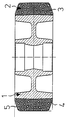
- the still liquid mixture of granules and base material is placed in a pot-like shape, the core of which is formed by an impeller 1 as shown in the drawing.
- the mixture fills the jacket space and the core and hardens into a tread 2 therein.
- the granules 3 are evenly distributed over the base material 4. This is due to the roughly matching specific weight of granules 3 and base material 4 and the angular shape of the grains 3.
- flanks 5 of the tread 2 are chamfered by mechanical processing after curing.
- the softer granulate inclusions 3 (approx. 80 ° Shore A) and the harder base material 4 (approx. 90 to 95 ° Shore A) causes the granules to deform more than the base material when unrolled. Since the granules 3 cannot escape in the base material 4, increased stresses arise in this area of the tread 2, which ultimately increase the traction.
Landscapes
- Engineering & Computer Science (AREA)
- Mechanical Engineering (AREA)
- Chemical & Material Sciences (AREA)
- Materials Engineering (AREA)
- Tires In General (AREA)
- Compositions Of Macromolecular Compounds (AREA)
- Processing And Handling Of Plastics And Other Materials For Molding In General (AREA)
- Processes Of Treating Macromolecular Substances (AREA)
Applications Claiming Priority (2)
| Application Number | Priority Date | Filing Date | Title |
|---|---|---|---|
| DE4410373 | 1994-03-25 | ||
| DE4410373A DE4410373C1 (de) | 1994-03-25 | 1994-03-25 | Verfahren zum Herstellen eines Laufbelages eines Rades oder einer Rolle |
Publications (3)
| Publication Number | Publication Date |
|---|---|
| EP0673754A2 true EP0673754A2 (fr) | 1995-09-27 |
| EP0673754A3 EP0673754A3 (fr) | 1996-02-07 |
| EP0673754B1 EP0673754B1 (fr) | 1997-09-03 |
Family
ID=6513832
Family Applications (1)
| Application Number | Title | Priority Date | Filing Date |
|---|---|---|---|
| EP95101963A Expired - Lifetime EP0673754B1 (fr) | 1994-03-25 | 1995-02-14 | Procédé de fabrication de la bande de roulement d'une roue ou d'un rouleau et produit fabriqué par ce procédé |
Country Status (2)
| Country | Link |
|---|---|
| EP (1) | EP0673754B1 (fr) |
| DE (2) | DE4410373C1 (fr) |
Families Citing this family (3)
| Publication number | Priority date | Publication date | Assignee | Title |
|---|---|---|---|---|
| CN104441368B (zh) * | 2014-10-31 | 2017-05-03 | 镇江环太硅科技有限公司 | 一种开方换向轮制作设备 |
| DE202015107054U1 (de) | 2015-02-04 | 2016-05-10 | Blickle Räder + Rollen GmbH & Co. KG | Mehrkomponenten-Lauffläche |
| CN108357302A (zh) * | 2018-03-13 | 2018-08-03 | 亿嘉和科技股份有限公司 | 装配式实心填充包胶轮胎及其生产工艺方法 |
Family Cites Families (8)
| Publication number | Priority date | Publication date | Assignee | Title |
|---|---|---|---|---|
| FR695691A (fr) * | 1930-05-15 | 1930-12-19 | Michelin & Cie | Procédé de fabrication de bandages |
| US3115178A (en) * | 1963-02-18 | 1963-12-24 | Leandro W Tomarkin | Tractive compositions |
| US3267187A (en) * | 1963-10-10 | 1966-08-16 | American Biltrite Rubber Co | Textured sheet material |
| US3227200A (en) * | 1964-08-12 | 1966-01-04 | Penn Plastic Company | Anti-skid tread for vehicle tires |
| DE2101224C3 (de) * | 1971-01-12 | 1978-03-09 | Phoenix Gummiwerke Ag, 2100 Hamburg | Kraftfahrzeugluftreifen mit in dem Laufstreifen eingebettetem Granulat aus Kunststoff |
| JPS6035938B2 (ja) * | 1977-04-27 | 1985-08-17 | 日本ゼオン株式会社 | 氷上摩擦抵抗の優れたゴム材料 |
| GB2044191B (en) * | 1979-03-16 | 1983-03-09 | Dunlop Ltd | Tyres |
| DE3500894A1 (de) * | 1985-01-12 | 1986-07-17 | Claus 8315 Geisenhausen Dräxlmaier | Reifen |
-
1994
- 1994-03-25 DE DE4410373A patent/DE4410373C1/de not_active Expired - Lifetime
-
1995
- 1995-02-14 DE DE59500581T patent/DE59500581D1/de not_active Expired - Lifetime
- 1995-02-14 EP EP95101963A patent/EP0673754B1/fr not_active Expired - Lifetime
Also Published As
| Publication number | Publication date |
|---|---|
| EP0673754A3 (fr) | 1996-02-07 |
| DE59500581D1 (de) | 1997-10-09 |
| EP0673754B1 (fr) | 1997-09-03 |
| DE4410373C1 (de) | 1995-09-28 |
Similar Documents
| Publication | Publication Date | Title |
|---|---|---|
| DE69009861T2 (de) | Schleifscheiben mit Bindemittel aus Polyurethan. | |
| DE3030914C2 (de) | Verfahren zur Herstellung von Maschinenständern mittels Polymerbeton | |
| DE69423143T2 (de) | Verfahren zur Herstellung einer Doppelschichtfolie | |
| DE3013553C2 (fr) | ||
| DE2515775A1 (de) | Polymermassen, verfahren zu deren herstellung und deren verwendung | |
| EP0095055A2 (fr) | Procédé de fabrication d'un corps abrasif | |
| EP0133537A2 (fr) | Matériau de construction formable à chaud, procédé pour sa fabrication et son utilisation | |
| DE2328203A1 (de) | Laufflaechen fuer luftreifen und ihre herstellung | |
| EP1013416B1 (fr) | Eléments composites comprenant (i) des polyuréthanes thermoplastiques et (ii) des polyuréthanes microcellulaires élastomères | |
| DE1769886A1 (de) | Koerper aus nachgiebigem Polyurethanschaum mit materialeinheitlich angeformter,zaeher,geschlossener Aussenhaut und Verfahren zu seiner Herstellung | |
| EP0673754B1 (fr) | Procédé de fabrication de la bande de roulement d'une roue ou d'un rouleau et produit fabriqué par ce procédé | |
| DE69705637T2 (de) | Klebstoff | |
| DE3135672A1 (de) | Verwendung von niederviskosen, selbsthaertenden mischungen fuer polyurethanzwischenschichten bei verbundscheiben | |
| DE3018694A1 (de) | Verfahren zur herstellung von maschinen-, apparate- und instrumententeilen | |
| DE2329001C2 (de) | Reifenlauffläche für Gußreifen und Verfahren zur Herstellung derselben | |
| DE602004010290T2 (de) | Runderneuerter Vollreifen und Methode dessen Herstellung | |
| DE69504532T2 (de) | Verfahren und vorrichtung zum ummanteln von glassscheibenkanten mit einer polyurethandichtung | |
| DE2254251A1 (de) | Verfahren zur herstellung von zusammengesetzten materialien | |
| DE3630132A1 (de) | Verfahren zur herstellung einer elastischen bituminoesen isolier- und dichtungsmasse | |
| DE9406375U1 (de) | Laufbelag eines Rades oder einer Rolle | |
| EP2904025B1 (fr) | Masse de fonderie de polyuréthane destinée à la fabrication de couches de protection contre l'usure dans des applications de fonderie | |
| DE2329083C2 (de) | Verfahren zur Herstellung eines Luftreifens | |
| DE19858825A1 (de) | Verfahren zum Herstellen eines elektrisch leitfähigen Laufbelages eines Rades oder einer Rolle und elektrisch leitfähiger Laufbelag eines Rades oder einer Rolle | |
| EP0425928B1 (fr) | Procédé pour la fabrication d'articles formés par emboutissage de préformes en polyuréthane obtenus à partir de produits d'addition de polyisocyanate | |
| DE1109362B (de) | Verfahren zur Herstellung von Polyurethanformkoerpern |
Legal Events
| Date | Code | Title | Description |
|---|---|---|---|
| PUAI | Public reference made under article 153(3) epc to a published international application that has entered the european phase |
Free format text: ORIGINAL CODE: 0009012 |
|
| AK | Designated contracting states |
Kind code of ref document: A2 Designated state(s): BE DE DK ES FR GB IT NL PT SE |
|
| PUAL | Search report despatched |
Free format text: ORIGINAL CODE: 0009013 |
|
| AK | Designated contracting states |
Kind code of ref document: A3 Designated state(s): BE DE DK ES FR GB IT NL PT SE |
|
| 17P | Request for examination filed |
Effective date: 19960229 |
|
| GRAG | Despatch of communication of intention to grant |
Free format text: ORIGINAL CODE: EPIDOS AGRA |
|
| 17Q | First examination report despatched |
Effective date: 19961227 |
|
| GRAH | Despatch of communication of intention to grant a patent |
Free format text: ORIGINAL CODE: EPIDOS IGRA |
|
| GRAH | Despatch of communication of intention to grant a patent |
Free format text: ORIGINAL CODE: EPIDOS IGRA |
|
| GRAA | (expected) grant |
Free format text: ORIGINAL CODE: 0009210 |
|
| AK | Designated contracting states |
Kind code of ref document: B1 Designated state(s): BE DE DK ES FR GB IT NL PT SE |
|
| PG25 | Lapsed in a contracting state [announced via postgrant information from national office to epo] |
Ref country code: NL Free format text: LAPSE BECAUSE OF FAILURE TO SUBMIT A TRANSLATION OF THE DESCRIPTION OR TO PAY THE FEE WITHIN THE PRESCRIBED TIME-LIMIT Effective date: 19970903 Ref country code: ES Free format text: THE PATENT HAS BEEN ANNULLED BY A DECISION OF A NATIONAL AUTHORITY Effective date: 19970903 Ref country code: DK Free format text: LAPSE BECAUSE OF NON-PAYMENT OF DUE FEES Effective date: 19970903 |
|
| REF | Corresponds to: |
Ref document number: 59500581 Country of ref document: DE Date of ref document: 19971009 |
|
| GBT | Gb: translation of ep patent filed (gb section 77(6)(a)/1977) |
Effective date: 19971021 |
|
| ITF | It: translation for a ep patent filed | ||
| PG25 | Lapsed in a contracting state [announced via postgrant information from national office to epo] |
Ref country code: PT Effective date: 19971203 |
|
| ET | Fr: translation filed | ||
| NLV1 | Nl: lapsed or annulled due to failure to fulfill the requirements of art. 29p and 29m of the patents act | ||
| PG25 | Lapsed in a contracting state [announced via postgrant information from national office to epo] |
Ref country code: BE Free format text: LAPSE BECAUSE OF NON-PAYMENT OF DUE FEES Effective date: 19980228 |
|
| PLBE | No opposition filed within time limit |
Free format text: ORIGINAL CODE: 0009261 |
|
| STAA | Information on the status of an ep patent application or granted ep patent |
Free format text: STATUS: NO OPPOSITION FILED WITHIN TIME LIMIT |
|
| 26N | No opposition filed | ||
| BERE | Be: lapsed |
Owner name: RADER-VOGEL RADER- UND ROLLENFABRIK G.M.B.H. & CO Effective date: 19980228 |
|
| REG | Reference to a national code |
Ref country code: GB Ref legal event code: IF02 |
|
| PGFP | Annual fee paid to national office [announced via postgrant information from national office to epo] |
Ref country code: FR Payment date: 20041230 Year of fee payment: 11 |
|
| PGFP | Annual fee paid to national office [announced via postgrant information from national office to epo] |
Ref country code: GB Payment date: 20050209 Year of fee payment: 11 |
|
| PG25 | Lapsed in a contracting state [announced via postgrant information from national office to epo] |
Ref country code: GB Free format text: LAPSE BECAUSE OF NON-PAYMENT OF DUE FEES Effective date: 20060214 |
|
| PGFP | Annual fee paid to national office [announced via postgrant information from national office to epo] |
Ref country code: IT Payment date: 20060228 Year of fee payment: 12 |
|
| GBPC | Gb: european patent ceased through non-payment of renewal fee |
Effective date: 20060214 |
|
| REG | Reference to a national code |
Ref country code: FR Ref legal event code: ST Effective date: 20061031 |
|
| PG25 | Lapsed in a contracting state [announced via postgrant information from national office to epo] |
Ref country code: FR Free format text: LAPSE BECAUSE OF NON-PAYMENT OF DUE FEES Effective date: 20060228 |
|
| PG25 | Lapsed in a contracting state [announced via postgrant information from national office to epo] |
Ref country code: IT Free format text: LAPSE BECAUSE OF NON-PAYMENT OF DUE FEES Effective date: 20070214 |
|
| REG | Reference to a national code |
Ref country code: DE Ref legal event code: R082 Ref document number: 59500581 Country of ref document: DE |
|
| PGFP | Annual fee paid to national office [announced via postgrant information from national office to epo] |
Ref country code: SE Payment date: 20140220 Year of fee payment: 20 |
|
| PGFP | Annual fee paid to national office [announced via postgrant information from national office to epo] |
Ref country code: DE Payment date: 20140417 Year of fee payment: 20 |
|
| REG | Reference to a national code |
Ref country code: DE Ref legal event code: R071 Ref document number: 59500581 Country of ref document: DE |
|
| REG | Reference to a national code |
Ref country code: DE Ref legal event code: R071 Ref document number: 59500581 Country of ref document: DE |
|
| REG | Reference to a national code |
Ref country code: SE Ref legal event code: EUG |