EP0674936A2 - Procédé d'utilisation de composants silice-aminofonctionnels pour la séparation sélective de gaz - Google Patents
Procédé d'utilisation de composants silice-aminofonctionnels pour la séparation sélective de gaz Download PDFInfo
- Publication number
- EP0674936A2 EP0674936A2 EP95302009A EP95302009A EP0674936A2 EP 0674936 A2 EP0674936 A2 EP 0674936A2 EP 95302009 A EP95302009 A EP 95302009A EP 95302009 A EP95302009 A EP 95302009A EP 0674936 A2 EP0674936 A2 EP 0674936A2
- Authority
- EP
- European Patent Office
- Prior art keywords
- mixtures
- carbon dioxide
- gases
- 2sio
- silicon compound
- Prior art date
- Legal status (The legal status is an assumption and is not a legal conclusion. Google has not performed a legal analysis and makes no representation as to the accuracy of the status listed.)
- Granted
Links
Images

Classifications
-
- B—PERFORMING OPERATIONS; TRANSPORTING
- B01—PHYSICAL OR CHEMICAL PROCESSES OR APPARATUS IN GENERAL
- B01D—SEPARATION
- B01D53/00—Separation of gases or vapours; Recovering vapours of volatile solvents from gases; Chemical or biological purification of waste gases, e.g. engine exhaust gases, smoke, fumes, flue gases, aerosols
- B01D53/14—Separation of gases or vapours; Recovering vapours of volatile solvents from gases; Chemical or biological purification of waste gases, e.g. engine exhaust gases, smoke, fumes, flue gases, aerosols by absorption
- B01D53/1493—Selection of liquid materials for use as absorbents
-
- B—PERFORMING OPERATIONS; TRANSPORTING
- B01—PHYSICAL OR CHEMICAL PROCESSES OR APPARATUS IN GENERAL
- B01D—SEPARATION
- B01D53/00—Separation of gases or vapours; Recovering vapours of volatile solvents from gases; Chemical or biological purification of waste gases, e.g. engine exhaust gases, smoke, fumes, flue gases, aerosols
- B01D53/34—Chemical or biological purification of waste gases
- B01D53/46—Removing components of defined structure
-
- B—PERFORMING OPERATIONS; TRANSPORTING
- B01—PHYSICAL OR CHEMICAL PROCESSES OR APPARATUS IN GENERAL
- B01D—SEPARATION
- B01D53/00—Separation of gases or vapours; Recovering vapours of volatile solvents from gases; Chemical or biological purification of waste gases, e.g. engine exhaust gases, smoke, fumes, flue gases, aerosols
- B01D53/34—Chemical or biological purification of waste gases
- B01D53/46—Removing components of defined structure
- B01D53/72—Organic compounds not provided for in groups B01D53/48 - B01D53/70, e.g. hydrocarbons
-
- Y—GENERAL TAGGING OF NEW TECHNOLOGICAL DEVELOPMENTS; GENERAL TAGGING OF CROSS-SECTIONAL TECHNOLOGIES SPANNING OVER SEVERAL SECTIONS OF THE IPC; TECHNICAL SUBJECTS COVERED BY FORMER USPC CROSS-REFERENCE ART COLLECTIONS [XRACs] AND DIGESTS
- Y02—TECHNOLOGIES OR APPLICATIONS FOR MITIGATION OR ADAPTATION AGAINST CLIMATE CHANGE
- Y02C—CAPTURE, STORAGE, SEQUESTRATION OR DISPOSAL OF GREENHOUSE GASES [GHG]
- Y02C20/00—Capture or disposal of greenhouse gases
- Y02C20/40—Capture or disposal of greenhouse gases of CO2
Definitions
- This invention provides a method of selectively removing certain gases from gas streams using aminofunctional silicon compounds.
- our method removes gases, such as carbon dioxide, sulfur oxides (SO x ) and nitrogen oxides (NO x ), from gas streams and addresses such processes as the separation of gas mixtures, gas purification and air pollution control.
- gases such as carbon dioxide, sulfur oxides (SO x ) and nitrogen oxides (NO x )
- Air pollution is defined as the presence in the atmosphere (or ambient air) of one or more contaminants of such quantity and duration as may be injurious to human, plant or animal life, public and private property or the conduct of business.
- This invention deals only with pollutants that are emitted as gases or aerosols. Further, this invention addresses the separation of pollutant gases from gas streams and not gases from other media. Obviously, the separation of pollutant gases leads one to the purification of gases as well.
- Major air pollutants include (SO x ), CO, CO2, (NO x ), hydrocarbons, photochemical oxidants, particulates, asbestos, mercury vapor, lead, polycyclic organic matter, fluoride compounds, chlorofluorocarbons, odors and the like.
- SO x sulfur dioxide
- CO carbon dioxide
- CO2 carbon dioxide
- NO x hydrocarbons
- photochemical oxidants photochemical oxidants
- particulates asbestos
- mercury vapor, lead polycyclic organic matter
- fluoride compounds chlorofluorocarbons
- odors and the like Normally, carbon dioxide is not considered a pollutant and, in fact, carbon dioxide plays a vital role in the earth's environment. It is a constituent in the atmosphere and, as such, is a necessary ingredient in the life cycle of animals and plants. The balance between animal and plant life cycles, as affected by the solubility of carbon dioxide in the earth's water, results in a carbon dioxide content in the atmosphere of about 0.03 vol%. However, carbon dioxide content of the
- Carbon dioxide has increased in average atmospheric concentrations from 290 ppm before 1900 to 330 ppm in the 1950s. Very little visible solar radiation is absorbed by atmospheric carbon dioxide. However, carbon dioxide is opaque to certain bands of the earth's long-wave radiation. Thus, increases in atmospheric carbon dioxide decrease the amount of energy that the earth loses to space resulting in a higher surface temperature of earth. There is some evidence that the rate of carbon dioxide release to the atmosphere may be greater than the earth's ability to assimilate it. Such an increase could result in a warmer temperature at the earth's surface by allowing the short heat waves from the sun to pass through the atmosphere while blocking larger waves that reflect from the earth. If the earth's average temperature were to increase by several degrees, portions of the polar ice caps could melt causing an increase in the level of the oceans, air circulation patterns could change, thereby altering rain patterns to make deserts of farmland or vice versa.
- Air pollution control methods today include five technical procedures: absorption, adsorption, condensation, chemical reaction and incineration.
- This invention deals with the procedure of chemical reactions, but not in the sense of decomposition as is currently used. Rather, our approach addresses the formation of useful chemical compounds which can be treated to give up the bound gases under controlled conditions. Suitable methods of chemical reaction of gaseous pollutants make them more easily collectable and, for example, nitrogen oxide can be decomposed to N2 and O2 in a catalytic device. Many odors and organic compounds can also be destroyed by strong oxidants such as KMnO4, HNO3 and hypochlorite solutions.
- Our invention introduces a method for selective separation of certain gases from contaminated gases.
- the method comprises contacting a contaminated gas with an aminofunctional silicon compound selected from A. silanes; B. siloxanes; C. mixtures of A. and B.; D. mixtures of A. and non-reactive organic fluids; E. mixtures of A. and non-reactive silicone fluids; F. mixtures of B. and non-reactive organic fluids; and G. mixtures of B. and non-reactive silicone fluids, for a time sufficient and at a temperature sufficient to reduce the contaminants in the contaminated gas.
- A. has the formula R a SiR' 3-a
- B. has a formula selected from
- This invention also provides a method for treating the aminofunctional silicon compound to retrieve the gas with which it has been previously reacted.
- This embodiment of the invention simply requires the aminofunctional silicon compound in its reacted form to be treated with heat under certain conditions, which treatment releases the bound gaseous material which can be recovered.
- This invention lends itself well to the purification of gases because of this simple treatment. It is further contemplated to use mixtures of A. and B., to use either of A. or B. or to use mixtures of them with non-reactive fluids, primarily as diluents, such as non-reactive, polymeric ethers or trimethylsiloxy endblocked polydimethylsiloxane fluids.
- Such a method comprises (I) contacting a contaminated gas with an aminofunctional silicon compound selected from A. silanes; B. siloxanes; C. mixtures of A. and B.; D. mixtures of A. and non-reactive organic fluids; E. mixtures of A. and non-reactive silicone fluids; F. mixtures of B. and non-reactive organic fluids; and G. mixtures of B. and non-reactive silicone fluids, for a time sufficient and at a temperature sufficient to reduce the contaminants in the contaminated gas and to form a reacted silicon compound.
- A. has the formula R a SiR' 3-a and B. has a formula selected from
- the key of our invention lies in the use of aminofunctional silicon compounds which have the ability to react with certain gases in a contaminated gas stream whereby certain gases are removed from the contaminated gas stream.
- carbon dioxide reacts with aminofunctional silicon compounds to form carbamates whereby the carbon dioxide is chemically bound in the molecule, while certain sulfur oxides (SO x ), such as SO2 and SO3, as well as certain nitrogen oxides (NO x ), such as NO and NO2, are believed to be complexed with the amine groups in our aminofunctional silicon compound.
- the method of contacting aminofunctional silicon compounds is not critical, as long as the contact time is sufficient to remove the desired gas and as long as the temperature is sufficient to allow the desired reactions to proceed. Contact times can range from less than 1 hour (15 minutes) to several hours (4 hours). It is preferred that the contact time be as short as possible; yet it should be sufficient to remove the desired amount of gas.
- one embodiment of this method is to retrieve the bound gaseous material from the reacted silicon compound and since this step is carried out using heat, it is desirable that the reaction for contacting the gaseous material be carried out under mild conditions. That is at a temperature of 120°C. or less and it is preferred that the reaction be performed at less than 80°C. It is most preferred that the reaction be carried out at less than 40°C., thus preventing the release of gaseous material during the reaction step.
- the "contact” referred to in the claims only requires that the gaseous stream to be treated is contacted with our aminofunctional silicon compound. This can be achieved by sparging the gaseous stream into or through the aminofunctional silicon compound, which is our preferred method; but it could also include misting the aminofunctional silicon compound into the gaseous material, the gaseous material could be blown through a mist of the aminofunctional silicon compound or the aminofunctional silicon compound could be made gaseous before being mixed with the gaseous material to be treated. The significant point is the gaseous material and the aminofunctional silicon compound are brought into intimate contact and the aminofunctional silicon compound is of the type that can be misted at low temperatures.
- this invention will run as a continuous process or as a bulk operation. There does not seem to be any major problems with the particular type of process as regards the intimate contact of the materials. The actual process equipment and process type are more dependent on the type of aminofunctional silicon compound that is used, the cost of the process and the desired end result.
- aminofunctional silicon compounds are those having the formulae of A. and B. mentioned above.
- silanes A that are suitable for this invention, there can be used silanes such as R a SiR' 3-a wherein R is a radical selected from radicals consisting essentially of primary or secondary amino substituted organic radicals.
- R is selected from radicals consisting essentially of the formula -R''NH 1-b Q b R'''NHQ' or -R''NHQ.
- R'' and R''' for purposes of this invention are each selected from -(CH2) z - wherein z has a value of 2 to 4 and isobutylene or isopropylene.
- the value of a is at least one
- the value of b is zero or one.
- R' is selected from alkyl groups of 1 to 6 carbon atoms, phenyl and ⁇ (CH3)3SiO ⁇ and specific examples of such silanes are: (CH3)3Si(CH2)3NH2, (CH)3Si(CH2)3NHCH2CH2NH2, ⁇ (CH3)3SiO)3Si(CH2)3NH2, ⁇ (CH3)2SiO ⁇ 3Si(CH2)3NHCH2CH2NH2, (CH3)2(C6H5)Si(CH2)3NHCH2CH2NH2, and the like.
- both Q and Q' are each selected from hydrogen atom and alkyl radicals of 1 to 6 carbon atoms such that either secondary or primary amino groups exist in the molecules.
- Most preferred for this invention are the silanes
- siloxanes B that are useful in our invention, there can be used siloxanes such as those having the formula selected from
- the aminofunctional radicals can be located along the chain of the siloxane, they can be located on the terminal ends of the siloxane or they can be located in both places at the same time on the molecule such as is shown for the siloxane of formula c.
- the siloxanes can be copolymers and such copolymers contain, in addition to the aminofunctional siloxane units, units such as dimethylsiloxane, methylphenylsiloxane, diphenylsiloxane, phenyldimethylsiloxane and the like. When units of siloxane other than the aminofunctional siloxanes and the dimethylsiloxanes are present in the molecule, they are generally present in less than 10 mole percent.
- siloxanes of our invention are well known to those skilled in the art and it is deemed unnecessary that detailed processes be set forth herein.
- the siloxanes of this invention can be prepared by the hydrosilylation of unsaturated siloxanes. This general reaction is illustrated by the reaction of a silane as follows: using platinum as the catalyst.
- siloxanes can also be prepared by the cohydrolysis of methyldialkoxyfunctionalaminoalkylfunctional silanes with other alkoxysilanes.
- Contaminated gas for purposes of this invention mean any combination of gases that contain at least one of carbon dioxide, sulfur oxides, nitrogen oxides or hydrogen sulfide.
- the air which surrounds us is an example of a contaminated gas.
- Our method is especially useful in removing carbon dioxide from the air or other gases.
- the carbon dioxide reacts with the amines to form carbamates, ie.
- the reacted silicon compound can then be stored in this manner or it can be heated to recover the carbon dioxide by driving the carbon dioxide away from the silicon compound.
- the recovered carbon dioxide can be reclaimed as an essentially pure material; that is purer than industrial grade carbon dioxide.
- sulfur or nitrogen containing gases can be treated by our method to recover the various (SO x ) and (NO x ) containing materials respectively.
- SO x sulfur or nitrogen containing gases
- NO x nitrogen containing gases
- H2S, Cl2, CO and other gases may also be recovered.
- this method may be used for the selective absorption of carbon dioxide, H2S, SO2 which would allow our method to be used in scrubbers for treatment of gases from burning fossil fuels, waste water treatment facilities and other industrial processes.
- Figure 1 depicts a continuous loop scrubber asembly used to perform the method of the present invention.
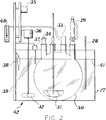
- FIG. 2 illustrates an alternate apparatus for carrying out this invention.
- FIG. 2 there is shown a 3 liter, 4-necked glass flask equipped with a stirrer, 125 ml addition funnel, a septum port for sampling and a vent port and bubbler.
- the flask was immersed in a constant temperature water bath maintained at 25°C.
- the pump was equipped with Gastec TM Analyzer Tubes (number 2H) that are specific for measuring carbon dioxide.
- the siloxane that was used was (CH3)3SiO ⁇ (CH3)2SiO ⁇ 96(CH3RSiO)2Si(CH3)3 wherein R is -CH2CH(CH3)CH2NHCH2CH2NH2, having a viscosity of 130 centistokes (mm2/s) at 25°C.
- the glass flask which contained air, was brought to equilibrium at 25°C.
- Solid carbon dioxide (0.68 g) was introduced into the flask, allowed to sublime and displace a portion of the air.
- the carbon dioxide concentration in the system was measured, showing good agreement with the added amount.
- the calculated amount was 12.2 vol% carbon dioxide.
- the reacted amino functional silicone from the previous example was heated at 125°C. until the carbon dioxide was essentially liberated from the molecule and 96.1 g of this regenerated fluid was then added to the contents of the comparison sample. An immediate reduction in pressure was observed and the carbon concentration of the material was reduced to 1.2 vol% (>86% reduction).
- a continuous loop scrubber 1 as generically shown in Figure 1 was assembled.
- the apparatus consisted of a 30.5 cm (12 inch) column 2 packed with glass beads 3.
- a calibrated air/CO2 mixture 4 was allowed to flow upward in the column 2.
- Test fluids 5 were allowed to flow downward, countercurrent to the gas mixture 4 to react with the carbon dioxide.
- the fluids 6, now enriched in carbon dioxide, were then pumped to a heated flask 7 which was continuously swept with nitrogen gas 8.
- the heated flask 7 served as a heat exchanger to liberate the bound carbon dioxide.
- the regenerated fluids 5 were then cooled and recycled through the column 2.
- Efficiency of the carbon dioxide removal was determined by measuring the carbon dioxide concentration exiting the top of the column 2, at sample port 16. For each sample run, there was used 700 ml of test fluid 5.
- the fluids were allowed to recycle for at least one theoretical residence time (see Table I).
Landscapes
- Chemical & Material Sciences (AREA)
- Engineering & Computer Science (AREA)
- Analytical Chemistry (AREA)
- General Chemical & Material Sciences (AREA)
- Oil, Petroleum & Natural Gas (AREA)
- Chemical Kinetics & Catalysis (AREA)
- Health & Medical Sciences (AREA)
- Biomedical Technology (AREA)
- Environmental & Geological Engineering (AREA)
- Treating Waste Gases (AREA)
Applications Claiming Priority (2)
| Application Number | Priority Date | Filing Date | Title |
|---|---|---|---|
| US22034594A | 1994-03-30 | 1994-03-30 | |
| US220345 | 1994-03-30 |
Publications (3)
| Publication Number | Publication Date |
|---|---|
| EP0674936A2 true EP0674936A2 (fr) | 1995-10-04 |
| EP0674936A3 EP0674936A3 (fr) | 1996-02-07 |
| EP0674936B1 EP0674936B1 (fr) | 1998-11-11 |
Family
ID=22823184
Family Applications (1)
| Application Number | Title | Priority Date | Filing Date |
|---|---|---|---|
| EP95302009A Expired - Lifetime EP0674936B1 (fr) | 1994-03-30 | 1995-03-27 | Procédé d'utilisation de composants silice-aminofonctionnels pour la séparation sélective de gaz |
Country Status (4)
| Country | Link |
|---|---|
| EP (1) | EP0674936B1 (fr) |
| JP (1) | JPH07265662A (fr) |
| CA (1) | CA2144678A1 (fr) |
| DE (1) | DE69505868T2 (fr) |
Cited By (6)
| Publication number | Priority date | Publication date | Assignee | Title |
|---|---|---|---|---|
| CN101898070A (zh) * | 2008-12-24 | 2010-12-01 | 通用电气公司 | 液态的二氧化碳吸收剂及其使用方法 |
| WO2011014277A1 (fr) * | 2009-07-30 | 2011-02-03 | General Electric Company | Absorbant de dioxyde de carbone à base de silicium liquide et procédés d'utilisation dudit absorbant |
| CN102549001A (zh) * | 2009-07-30 | 2012-07-04 | 通用电气公司 | 二氧化碳吸收剂及其使用方法 |
| EP2313178A4 (fr) * | 2008-07-18 | 2012-11-07 | Armstrong World Ind Inc | Compositions de réduction d' aldéhydes |
| WO2013028391A1 (fr) | 2011-08-25 | 2013-02-28 | General Electric Company | Compositions pour absorber le dioxyde de carbone, et procédés et systèmes associés |
| EP2668994A1 (fr) * | 2012-05-31 | 2013-12-04 | General Electric Company | Changement de phase de CO2 intégré absorbant pour système de séparation de CO2 |
Families Citing this family (5)
| Publication number | Priority date | Publication date | Assignee | Title |
|---|---|---|---|---|
| US9440182B2 (en) * | 2008-12-24 | 2016-09-13 | General Electric Company | Liquid carbon dioxide absorbents, methods of using the same, and related systems |
| US8747694B2 (en) | 2010-06-17 | 2014-06-10 | General Electric Company | Carbon dioxide absorbent and method of using the same |
| US20120027664A1 (en) * | 2010-07-30 | 2012-02-02 | General Electric Company | Carbon dioxide capture system and methods of capturing carbon dioxide |
| US8709367B2 (en) * | 2010-07-30 | 2014-04-29 | General Electric Company | Carbon dioxide capture system and methods of capturing carbon dioxide |
| US9427698B2 (en) | 2013-10-11 | 2016-08-30 | General Electric Company | Amino-siloxane composition and methods of using the same |
Family Cites Families (3)
| Publication number | Priority date | Publication date | Assignee | Title |
|---|---|---|---|---|
| US4142874A (en) * | 1978-03-27 | 1979-03-06 | Vaseen Vesper A | Separating gaseous nitrogen oxides from other gases by paramagnetic separation in a liquid media |
| JPS55165109A (en) * | 1979-06-12 | 1980-12-23 | Nippon Sekiyu Seisei Kk | Antifoaming method of amine solution |
| DE4208456C2 (de) * | 1992-03-17 | 1994-12-08 | Martin Kopp | Verfahren und Vorrichtung zur Reinigung der Abgase aus Verbrennungsmotoren |
-
1995
- 1995-03-15 CA CA002144678A patent/CA2144678A1/fr not_active Abandoned
- 1995-03-27 DE DE69505868T patent/DE69505868T2/de not_active Expired - Fee Related
- 1995-03-27 EP EP95302009A patent/EP0674936B1/fr not_active Expired - Lifetime
- 1995-03-30 JP JP7072174A patent/JPH07265662A/ja not_active Withdrawn
Cited By (12)
| Publication number | Priority date | Publication date | Assignee | Title |
|---|---|---|---|---|
| EP2313178A4 (fr) * | 2008-07-18 | 2012-11-07 | Armstrong World Ind Inc | Compositions de réduction d' aldéhydes |
| AU2009271543B2 (en) * | 2008-07-18 | 2014-02-13 | Armstrong World Industries, Inc. | Aldehyde reducing compositions |
| EP3069778A1 (fr) * | 2008-07-18 | 2016-09-21 | Armstrong World Industries, Inc. | Composition d'élimination d'aldéhydes d'air |
| CN101898070A (zh) * | 2008-12-24 | 2010-12-01 | 通用电气公司 | 液态的二氧化碳吸收剂及其使用方法 |
| EP2201994A3 (fr) * | 2008-12-24 | 2012-07-25 | General Electric Company | Absorbant oligomerique fonctionalisé pour dioxyde de carbone et procédés pour son utilisation |
| CN101898070B (zh) * | 2008-12-24 | 2016-08-10 | 通用电气公司 | 液态的二氧化碳吸收剂及其使用方法 |
| US9956520B2 (en) | 2008-12-24 | 2018-05-01 | General Electric Company | Liquid carbon dioxide absorbents, methods of using the same, and related systems |
| WO2011014277A1 (fr) * | 2009-07-30 | 2011-02-03 | General Electric Company | Absorbant de dioxyde de carbone à base de silicium liquide et procédés d'utilisation dudit absorbant |
| CN102549001A (zh) * | 2009-07-30 | 2012-07-04 | 通用电气公司 | 二氧化碳吸收剂及其使用方法 |
| AU2010276681B2 (en) * | 2009-07-30 | 2016-11-03 | Air Products And Chemicals, Inc. | Liquid silicon-based carbon dioxide absorbent and methods of using the same |
| WO2013028391A1 (fr) | 2011-08-25 | 2013-02-28 | General Electric Company | Compositions pour absorber le dioxyde de carbone, et procédés et systèmes associés |
| EP2668994A1 (fr) * | 2012-05-31 | 2013-12-04 | General Electric Company | Changement de phase de CO2 intégré absorbant pour système de séparation de CO2 |
Also Published As
| Publication number | Publication date |
|---|---|
| DE69505868D1 (de) | 1998-12-17 |
| EP0674936B1 (fr) | 1998-11-11 |
| JPH07265662A (ja) | 1995-10-17 |
| EP0674936A3 (fr) | 1996-02-07 |
| CA2144678A1 (fr) | 1995-10-01 |
| DE69505868T2 (de) | 1999-04-29 |
Similar Documents
| Publication | Publication Date | Title |
|---|---|---|
| EP0674936B1 (fr) | Procédé d'utilisation de composants silice-aminofonctionnels pour la séparation sélective de gaz | |
| US3767766A (en) | Method of removing gaseous sulfides from gaseous mixtures | |
| RU2418618C2 (ru) | Предварительно приготовленная смесь для получения абсорбента для удаления кислых газов из потоков жидкостей | |
| EP2618914B1 (fr) | Composition de solvant pour la récupération de dioxyde de carbone | |
| US8101144B2 (en) | Scrubber for removing heavy metals from gases | |
| Astarita et al. | The influence of carbonation ratio and total amine concentration on carbon dioxide absorption in aqueous monoethanolamine solutions | |
| DE3766906D1 (de) | Verfahren und einrichtung fuer die abtrennung von quecksilber aus rauchgasen und prozessabgasen. | |
| WO2007137143A2 (fr) | Procédé destiné au traitement d'un flux gazeux | |
| KR900000288A (ko) | 3불화 질소가스의 정제방법 | |
| CZ215793A3 (en) | Process for removing hydrogen monosulfide and/or carbon disulfide from waste gases | |
| US4892718A (en) | Decontamination of gases by scrubbing | |
| JP2001522928A (ja) | 硫化水素除去法 | |
| Benitez-Garcia et al. | Kinetics of the reaction between carbon dioxide and triethylamine in aqueous solutions | |
| ATE55276T1 (de) | Verfahren und vorrichtung zur reinigung von schadstoffhaltigen gasen. | |
| Yih et al. | Simultaneous absorption of hydrogen sulfide and carbon dioxide into di‐isopropanolamine solution | |
| EP1060783A1 (fr) | Réduction des gaz d'échappement issus de la fabrication de semi-conducteurs | |
| CN101479022A (zh) | 处理气体流的方法 | |
| EP0502970B1 (fr) | Traitement des gaz d'echappement | |
| US5486340A (en) | Exhaust gas conditioning | |
| JP2910419B2 (ja) | 加水分解性の有機シラン化合物を含有する塩化水素の精製方法 | |
| US20070092417A1 (en) | Method for removing mercury from waste gas | |
| SU1074574A1 (ru) | Способ очистки газа от сероводорода и двуокиси серы | |
| JP2005185897A (ja) | 六フッ化硫黄ガスの処理方法 | |
| SU1681921A1 (ru) | Способ очистки гор чих дымовых газов | |
| Mshewa | Carbon dioxide desorption/absorption with aqueous mixtures of methyldiethanolamine and diethanolamine at 40 to 120 degrees C |
Legal Events
| Date | Code | Title | Description |
|---|---|---|---|
| PUAI | Public reference made under article 153(3) epc to a published international application that has entered the european phase |
Free format text: ORIGINAL CODE: 0009012 |
|
| AK | Designated contracting states |
Kind code of ref document: A2 Designated state(s): DE FR GB IT |
|
| PUAL | Search report despatched |
Free format text: ORIGINAL CODE: 0009013 |
|
| AK | Designated contracting states |
Kind code of ref document: A3 Designated state(s): DE FR GB IT |
|
| 17P | Request for examination filed |
Effective date: 19960514 |
|
| GRAG | Despatch of communication of intention to grant |
Free format text: ORIGINAL CODE: EPIDOS AGRA |
|
| 17Q | First examination report despatched |
Effective date: 19980129 |
|
| GRAG | Despatch of communication of intention to grant |
Free format text: ORIGINAL CODE: EPIDOS AGRA |
|
| GRAG | Despatch of communication of intention to grant |
Free format text: ORIGINAL CODE: EPIDOS AGRA |
|
| GRAH | Despatch of communication of intention to grant a patent |
Free format text: ORIGINAL CODE: EPIDOS IGRA |
|
| GRAH | Despatch of communication of intention to grant a patent |
Free format text: ORIGINAL CODE: EPIDOS IGRA |
|
| GRAA | (expected) grant |
Free format text: ORIGINAL CODE: 0009210 |
|
| AK | Designated contracting states |
Kind code of ref document: B1 Designated state(s): DE FR GB IT |
|
| REF | Corresponds to: |
Ref document number: 69505868 Country of ref document: DE Date of ref document: 19981217 |
|
| ET | Fr: translation filed | ||
| PLBE | No opposition filed within time limit |
Free format text: ORIGINAL CODE: 0009261 |
|
| STAA | Information on the status of an ep patent application or granted ep patent |
Free format text: STATUS: NO OPPOSITION FILED WITHIN TIME LIMIT |
|
| 26N | No opposition filed | ||
| PGFP | Annual fee paid to national office [announced via postgrant information from national office to epo] |
Ref country code: GB Payment date: 20000214 Year of fee payment: 6 Ref country code: DE Payment date: 20000214 Year of fee payment: 6 |
|
| PGFP | Annual fee paid to national office [announced via postgrant information from national office to epo] |
Ref country code: FR Payment date: 20000216 Year of fee payment: 6 |
|
| PG25 | Lapsed in a contracting state [announced via postgrant information from national office to epo] |
Ref country code: GB Free format text: LAPSE BECAUSE OF NON-PAYMENT OF DUE FEES Effective date: 20010327 |
|
| GBPC | Gb: european patent ceased through non-payment of renewal fee |
Effective date: 20010327 |
|
| PG25 | Lapsed in a contracting state [announced via postgrant information from national office to epo] |
Ref country code: FR Free format text: LAPSE BECAUSE OF NON-PAYMENT OF DUE FEES Effective date: 20011130 |
|
| REG | Reference to a national code |
Ref country code: FR Ref legal event code: ST |
|
| PG25 | Lapsed in a contracting state [announced via postgrant information from national office to epo] |
Ref country code: DE Free format text: LAPSE BECAUSE OF NON-PAYMENT OF DUE FEES Effective date: 20020101 |
|
| PG25 | Lapsed in a contracting state [announced via postgrant information from national office to epo] |
Ref country code: IT Free format text: LAPSE BECAUSE OF NON-PAYMENT OF DUE FEES Effective date: 20050327 |