EP0675228A2 - Pflasterstein, sonstiger Pflasterblock oder Pflasterplatte - Google Patents
Pflasterstein, sonstiger Pflasterblock oder Pflasterplatte Download PDFInfo
- Publication number
- EP0675228A2 EP0675228A2 EP95103843A EP95103843A EP0675228A2 EP 0675228 A2 EP0675228 A2 EP 0675228A2 EP 95103843 A EP95103843 A EP 95103843A EP 95103843 A EP95103843 A EP 95103843A EP 0675228 A2 EP0675228 A2 EP 0675228A2
- Authority
- EP
- European Patent Office
- Prior art keywords
- paving
- stone
- insert
- block
- slab according
- Prior art date
- Legal status (The legal status is an assumption and is not a legal conclusion. Google has not performed a legal analysis and makes no representation as to the accuracy of the status listed.)
- Granted
Links
Images








Classifications
-
- E—FIXED CONSTRUCTIONS
- E01—CONSTRUCTION OF ROADS, RAILWAYS, OR BRIDGES
- E01C—CONSTRUCTION OF, OR SURFACES FOR, ROADS, SPORTS GROUNDS, OR THE LIKE; MACHINES OR AUXILIARY TOOLS FOR CONSTRUCTION OR REPAIR
- E01C5/00—Pavings made of prefabricated single units
- E01C5/22—Pavings made of prefabricated single units made of units composed of a mixture of materials covered by two or more of groups E01C5/008, E01C5/02 - E01C5/20 except embedded reinforcing materials
-
- E—FIXED CONSTRUCTIONS
- E01—CONSTRUCTION OF ROADS, RAILWAYS, OR BRIDGES
- E01C—CONSTRUCTION OF, OR SURFACES FOR, ROADS, SPORTS GROUNDS, OR THE LIKE; MACHINES OR AUXILIARY TOOLS FOR CONSTRUCTION OR REPAIR
- E01C2201/00—Paving elements
- E01C2201/04—Paving elements consisting of natural stones and a binder
Definitions
- the invention relates to a paving stone, another paving block or a paving slab.
- the invention has for its object to find a further technical possibility of decoration.
- this purpose is achieved in that a paving stone, other paving block or paving slab has an insert made of a different material or only with a different surface.
- the inserts according to the invention of the otherwise normally produced concrete blocks or slabs consist, for example, of metal, natural stone, ceramic, glass, plastic, wood or cork.
- An insert only with a different surface would consist of polished concrete, for example.
- the decorating technique is also possible for paving blocks or slabs made of other materials, such as ceramic or recycled plastic.
- the possibilities of variation in the design are always used, even in the press or casting mold, in order to create shaped spaces for the insertion of the decor-forming material, with its surface and / or its outline.
- the insert can be molded in when pressing or pouring the paving stone or the like, thereby forming its own position. However, it can also be introduced separately into a recess created by the molding tool during molding.
- the insert can be poured into the recess.
- the insert can be inserted and glued into the recess.
- the insert can be inserted into the recess and fastened by clamping.
- the insert is enclosed in the recess on the edge and clamped on the edge, and / or that it is annular and is clamped on the inner edge.
- the molded insert will be anchored as needed.
- a plurality of molded-in inserts expediently have a coherent anchoring which holds them in their mutual position until the end of the shaping.
- the inserts do not have to be enclosed on all sides at their edges. The nature of the insert results from the recess in which it is arranged. Most of the time, the insert will be flush with the rest of the top. However, it can also be used for a relief, ie it can remain a little below the rest of the surface or protrude beyond it.
- the insert can also be arranged as an edge strip or at least partially on a projection of the paving stone, other paving block or the Paving slab be arranged and have the surface shape of a filler in the combination of paving stones, other paving blocks or the paving slabs.
- the latter application is particularly advantageous in that it creates the appearance of an independent filler piece, as is known from four abutting, cut corners of paving stones or paving slabs, when the independent filler piece is replaced by a projection formed on one of the paving stones or slabs .
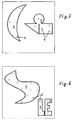
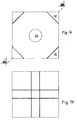
- FIGS. 1 to 28 each show the exemplary embodiments in plan view of a paving stone or a paving slab, partly in a different representation.
- FIGS. 1 and 2 show a top view or exploded isometric view of an insert 1 made of a sheet metal provided with cutouts 2.
- the sheet has been molded in and also held in the concrete of the paving stone by four anchors 3 attached to it.
- the paving stone was placed on the bottom of the mold before the concrete was poured in.
- it could also have been pressed into the still soft mass afterwards, for example while shaking, if, for example, the concrete block was poured.
- 3 and 4 show a top view and an isometric view, partially broken away, of an insert consisting of nine cylinders 5 connected by a lattice-shaped, common base 4 to form a unitary structure.
- the entire structure has been molded into the concrete mass by using the free ends of the cylinder 5 was placed on the bottom of the mold.
- the stone surface In order to free the end faces of the cylinders 5 from contamination by concrete milk lying in the stone surface, the stone surface has been brushed, sandblasted or the like, but preferably ground. This also applies to insert 1 and in other comparable cases.
- FIGS. 7 and 8 section along line VIII-VIII in FIG. 7
- recesses in the form of grooves 8 have been produced in the manufacture of the paving stone by using a corresponding press mold.
- the grooves 8 have then been filled with a plastic compound 9, not all the way to the stone surface.
- FIG. 9 square grooves 10 have taken the place of the grooves 8, in FIGS. 10 and 11 (section according to line XI-XI in FIG. 10) circular, curved recesses 11.
- FIG. 11 on closer inspection lets, here the plastic mass 12 has sunk towards the center of the recess 11. This is also a decorative feature.
- FIG. 12 illustrates that the technology according to FIGS. 8 to 11 also allows free choice in terms of decor design.
- inserts 15, 16 and 17 inserted in preformed recesses 13 and 14.
- the inserts 15 and 16 are glued-in marginal ridges, the former with miter, the latter with butt joint.
- the edge strips are made, for example, of metal or a hard plastic.
- the insert 17 is a jammed block, for example made of plastic, rubber, wood or cork.
- FIG. 15 is, analogous to the edge strips in FIGS. 13 and 14, provided with diagonally arranged strips 19 as inlays which abut one another without gaps with angled ends.
- the alternative of blunt abutment on a square intermediate piece 20 is shown in dashed lines.
- edge strips 27 and 28 in turn show inserts in the form of edge strips 27 and 28, however here, unlike in FIGS. 13 and 14, less as a frame of the stone itself and more as an emphasis on the joint.
- the edge strips 27 and 28 also lie here over their full width in a recess, i.e. a paragraph of the concrete block.
- the all-around edge strips 27 are fastened according to FIG.
- the edge strips 28 which are only arranged on two sides according to FIG. 21 are glued on. These concrete blocks are pressed.
- the paving stone of square basic form shown in FIG. 22 is cut in a circular arc at three corners, ie a corner 30 is in each case removed from the shape of a quarter circle, and is provided at the fourth corner with a projection 31 with the outline of a three-quarter circle.
- the paving stone is assembled with the same paving stones in such a way that the three-quarter circle of the projection 31 fills three quarter circles of cut corners 30.
- a circular recess 32 Arranged on the projection 31 is a circular recess 32, which extends on a quarter circle into the other paving stones and is filled by a circular disk 33 as a glued-in insert.
- the disc 33 is made of natural stone or polished concrete, for example.
- the modification is provided that the circular disk is an annular disk 34 made of plastic and is clamped onto a mandrel 35 rising in the recess 32.
- a circular recess 37 of smaller diameter is formed in the projection, here designated 36, into which a disk 38 is clamped and / or glued.
- a disk 38 is clamped and / or glued.
- FIG. 27 and 28 correspond to FIG. 24 with the modification that in FIG. 27 the disc is fastened by means of a barb 40 provided with a barb profile, pressed into a recess 39 in the recess 37 and in FIG. 28 by means of a disc formed directly on the circumference of the disc Barb profile 41.
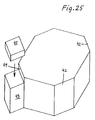
- Fig. 25 corresponds to Fig. 22 with the change that the corners 42 are cut off in a straight line and the projection 43 of square cross-section completely replaces a filler and the recess 44 is arranged on it alone, in which a square disc 45 is inserted as an insert.
- FIG. 26 shows an alternative to FIGS. 22 to 25 in such a way that instead of a projection on one corner which fills three other cut corners, two projections 46 are formed on two sides, which fill two incisions 47 on two other sides.
- the recesses 48 complement the projections 46 to form a check.
- the identically shaped disks 49 optically form a corresponding filler.
- FIGS. 27 and 28 could also only be used when paving.
Landscapes
- Engineering & Computer Science (AREA)
- Architecture (AREA)
- Civil Engineering (AREA)
- Structural Engineering (AREA)
- Road Paving Structures (AREA)
- Road Signs Or Road Markings (AREA)
Abstract
Als eine weitere technische Möglichkeit der Dekorierung wird vorgeschlagen, daß ein Pflasterstein, sonstiger Pflasterblock oder eine Pflasterplatte eine Einlage (1) aus einem anderen Material oder nur mit anderer Oberfläche aufweist.
Die Einlagen der, sonst wie üblich hergestellten, Betonsteine oder -platten bestehen beispielsweise aus Metall, Naturstein, Keramik, Glas, Kunststoff, Holz oder auch Kork.
Eine Einlage nur mit anderer Oberfläche bestünde beispielsweise aus geschliffenem Beton.
Die Dekorierungstechnik ist jedoch auch bei Pflasterblöcken oder -platten aus anderem Material möglich, z.B. aus Keramik oder Recycling-Kunststoff.
Immer werden aber die Variationsmöglichkeiten bei der Formgebung selbst in der Preß- oder Gießform genutzt, um geformte Plätze zu schaffen für das Einlegen des, mit seiner Oberfläche und/oder seinem Umriß, dekorbildenden Materials.
Description
- Die Erfindung betrifft einen Pflasterstein, einen sonstigen Pflasterblock oder einen Pflasterplatte.
- Um die Oberfläche von Beton-Pflastersteinen und -Pflasterplatten zu dekorieren, sind verschiedene Mittel bekannt.
Besonders verbreitet ist Waschbeton, bei dem eine Lage von Kieselsteinen freigelegt ist.
Andere bekannte Oberflächenbehandlungen sind Sandstrahlen und Wasserstrahlen.
Weiter bekannt sind sogenannte Vorsätze, d.h. dünne Oberflächenschichten eines mit teuren Zuschlägen, wie Glitzerkörnern oder Marmorsplitt, versehenen oder im Bindenmittel gefärbten Betons.
Schließlich kennt man bei der Formung erzeugte Reliefierungen der Oberfläche. - Der Erfindung liegt die Aufgabe zugrunde, eine weitere technische Möglichkeit der Dekorierung zu finden.
- Gemäß der Erfindung wird dieser Zweck erfüllt, indem ein Pflasterstein, sonstiger Pflasterblock oder eine Pflasterplatte eine Einlage aus einem anderen Material oder nur mit anderer Oberfläche aufweist.
- Die erfindungsgemäßen Einlagen der, sonst wie üblich hergestellten, Betonsteine oder -platten bestehen beispielsweise aus Metall, Naturstein, Keramik, Glas, Kunststoff, Holz oder auch Kork. Eine Einlage nur mit anderer Oberfläche bestünde beispielsweise aus geschliffenem Beton.
- Die Dekorierungstechnik ist jedoch auch bei Pflasterblöcken oder -platten aus anderem Material möglich, z.B. aus Keramik oder Recycling-Kunststoff.
Immer werden aber die Variationsmöglichkeiten bei der Formgebung selbst in der Preß- oder Gießform genutzt, um geformte Plätze zu schaffen für das Einlegen des, mit seiner Oberfläche und/oder seinem Umriß, dekorbildenden Materials. - Die Einlage kann beim Pressen oder Gießen des Pflastersteins o.a. mit eingeformt werden und sich damit selbst ihren Platz formen.
Sie kann aber auch in eine bei der Formung durch das Formwerkzeug erzeugte Ausnehmung gesondert eingebracht werden. - Dafür bestehen wiederum verschiedene Möglichkeiten:
Die Einlage kann in die Ausnehmung eingegossen werden.
Die Einlage kann in die Ausnehmung eingesetzt und angeklebt werden.
Die Einlage kann in die Ausnehmung eingesetzt und durch Klemmung befestigt werden. - Für letzteres bestehen wiederum die beiden verschiedenen Möglichkeiten, daß die Einlage in der Ausnehmung am Rand umschlossen und an dem Rand verklemmt ist, und/oder daß sie ringförmig ist und am inneren Rand verklemmt ist.
- Die eingeformte Einlage wird man nach Bedarf verankern.
Eine Mehrzahl eingeformter Einlagen weist zweckmäßigerweise eine zusammenhängende Verankerung auf, die sie bis zum Ende der Formgebung in ihrer gegenseitigen Lage hält.
Es ist, je nach dem betontechnischen Herstellungsverfahren, grundsätzlich auch möglich, Einlagen erst nach der Formgebung des eigentlichen Pflasterstein oder der Pflasterplatte in die noch weiche Masse, ggf. unter Rütteln, einzudrücken. - Die Einlagen müssen nicht an ihrem Rand allseitig umschlossen sein. Die Natur der Einlage ergibt sich aus der Vertiefung, in der sie angeordnet ist.
Meist wird die Einlage mit der übrigen Oberseite fluchten. Sie kann aber auch gerade zu einer Reliefierung benutzt werden, d.h. ein wenig unter der übrigen Oberfläche zurückbleiben oder über sie hinausstehen. - Beispielsweise kann die Einlage auch als Randleiste angeordnet sein oder mindestens teilweise auf einem Vorsprung des Pflastersteins, sonstigen Pflasterblockes oder der Pflasterplatte angeordnet sein und in der Kombination der Pflastersteine, sonstigen Pflasterblöcke oder der Pflasterplatten die Flächenform eines Füllstückes haben.
- Die letztere Anwendung ist von besonderem Vorteil insofern, als sie den Anblick eines selbständigen Füllstückes schafft, wie man es an vier zusammenstoßenden, abgeschnittenen Ecken von Pflastersteinen oder Plattenbelägen kennt, wenn das selbständige Füllstück durch einen an einem der Pflastersteine oder -platten angeformten Vorsprung ersetzt ist.
- Zahlreiche mögliche Ausgestaltungen der Erfindung sollen im folgenden anhand von Ausführungsbeispielen dargestellt werden.
- Die Zeichnungen Fig. 1 bis 28 geben die Ausführungsbeispiele jeweils in Draufsicht auf einen Pflasterstein oder eine Pflasterplatte, teilweise in anderer Darstellung, wieder.
- Fig. 1 und 2 zeigen in Draufsicht bzw. auseinandergezogener isometrischer Darstellung eine Einlage 1 aus einem mit Ausschnitten 2 versehenen Blech. Das Blech ist mit eingeformt worden und außerdem durch vier an ihm angebrachte Anker 3 im Beton des Pflastersteins gehalten.
Es ist beispielsweise bei der Formung des Pflastersteins vor dem Einfüllen des Betons auf den Boden der Preßform gelegt worden. Es könnte aber auch nachträglich in die noch weiche Masse eingedrückt worden sein, etwa unter Rütteln, wenn z.B. der Betonstein gegossen worden ist. - Fig. 3 und 4 zeigen in Draufsicht bzw. in isometrischer Darstellung, teilweise aufgebrochen, eine Einlage aus neun durch eine gitterförmige, gemeinsame Basis 4 zu einem einheitlichen Gebilde verbundenen Zylindern 5. Das gesamte Gebilde ist in die Betonmasse eingeformt worden, indem es mit den freien Enden der Zylinder 5 auf den Boden der Preßform gelegt wurde. Um die in der Steinoberfläche liegenden Stirnseiten der Zylinder 5 von Verschmutzung durch Betonmilch zu befreien, ist die Steinoberfläche gebürstet, sandgestrahlt o.a., vorzugsweise aber geschliffen, worden. Das gilt auch für die Einlage 1 sowie in den anderen vergleichbaren Fällen.
- Fig. 5 und 6 verdeutlichen die Gestaltungsmöglichkeiten wiederum mit durch Anker 6 gesicherten, pauschal mit 7 bezeichneten Einlagen aus Blech.
- Nach Fig. 7 und Fig. 8 (Schnitt nach Linie VIII-VIII in Fig. 7) sind bei der Herstellung des Pflastersteins durch Anwendung einer entsprechenden Preßform Ausnehmungen in Form von Rillen 8 erzeugt worden. Die Rillen 8 sind dann mit einer Kunststoffmasse 9, nicht ganz bis zur Steinoberfläche, ausgegossen worden.
- In Fig. 9 sind an die Stelle der Rillen 8 quadratische Vertiefungen 10 getreten, in Fig. 10 und Fig. 11 (Schnitt nach Linie XI-XI in Fig. 10) kreisförmige, eingewölbte Vertiefungen 11. Wie Fig. 11 bei genauem Hinsehen erkennen läßt, ist hier die Kunststoffmasse 12 jeweils zur Mitte der Vertiefung 11 hin eingesunken. Auch dies ist ein Dekormerkmal.
Fig. 12 verdeutlicht, daß auch die Technik gemäß Fig. 8 bis 11 hinsichtlich der Dekorgestaltung freie Wahl läßt. - Aus Fig. 13 und 14 (Schnitt nach Linie XIV-XIV in Fig. 13) gehen verschiedene weitere Möglichkeiten hervor, hier mit in vorgeformte Ausnehmungen 13 und 14 eingesetzten Einlagen 15, 16 und 17.
Die Einlagen 15 und 16 sind eingeklebte Randleisten, die ersteren mit Gehrung, die letzteren mit stumpfem Stoß. Die Randleisten bestehen beispielsweise aus Metall oder einem harten Kunststoff.
Die Einlage 17 ist ein bloß eingeklemmter Klotz, beispielsweise aus Kunststoff, Gummi, Holz oder Kork. - Der Pflasterstein nach Fig. 15 ist, analog zu den Randleisten in Fig. 13 und 14, mit diagonal angeordneten Leisten 19 als Einlagen versehen, die mit gewinkelten Enden lückenlos aneinanderstoßen. Gestrichelt gezeichnet ist die Alternative eines stumpfen Anstoßes an einem quadratischen Zwischenstück 20.
- Nach Fig. 16 und Fig. 17 (Schnitt nach Linie XVII-XVII in Fig. 16) sind eingeklebte Einlagen 21 an den Ecken mit einer eingegossenen Einlage 22 in der Mitte zusammengestellt.
- Fig. 18 zeigt eine weitere Gestaltungsmöglichkeit mit eingeklebten Einlagen.
- In Fig. 19 sind wiederum in Ausnehmungen 23 und 24 eingeklemmte Einlagen 25 und 26 dargestellt, erstere ein Klotz aus Holz und letztere aus Kunststoff. Wie schon für die Einlage 17, ist für die Einlagen 25 und 26 eine größere Tiefe vorgesehen als für die eingegossenen oder eingeklebten Einlagen.
- Fig. 20 und 21 zeigen wiederum Einlagen in Form von Randleisten 27 bzw. 28, hier jedoch, anders als in Fig. 13 und 14, weniger als Rahmen des Steines selbst und mehr als Betonung der Fuge. Die Randleisten 27 und 28 liegen auch hier auf ihrer vollen Breite in einer Ausnehmung, d.h. einem Absatz des Betonsteines. Die ringsum angeordneten Randleisten 27 sind nach Fig. 20, rechts, nur durch Anker 29 befestigt. Die nach Fig. 21 nur an zwei Seiten angeordneten Randleisten 28 sind angeklebt. Diese Betonsteine werden preß verlegt.
- Der in Fig. 22 dargestellte Pflasterstein von quadratischer Grundform ist an drei Ecken kreisbogenförmig abgeschnitten, d.h. es ist jeweils eine Ecke 30 von der Form eines Viertelkreises entfernt, und an der vierten Ecke mit einem Vorsprung 31 von dem Umriß eines Dreiviertelkreises versehen. Der Pflasterstein wird mit gleichen Pflastersteinen derart zusammengesetzt, daß der Dreiviertelkreis des Vorsprunges 31 drei Viertelkreise abgeschnittener Ecken 30 füllt.
An dem Vorsprung 31 ist eine, auf einem Viertelkreis auch in den übrigen Pflasterstein sich erstreckende, kreisförmige Ausnehmung 32 angeordnet, die durch eine kreisförmige Scheibe 33 als eingeklebte Einlage ausgefüllt wird. Die Scheibe 33 besteht beispielsweise aus Naturstein oder geschliffenem Beton. - Nach Fig. 23 ist die Abwandlung vorgesehen, daß die kreisförmige Scheibe eine ringförmige Scheibe 34 aus Kunststoff ist und auf einen in der Ausnehmung 32 sich erhebenden Dorn 35 aufgeklemmt ist.
- Nach Fig. 24 ist in dem, hier mit 36 bezeichneten, Vorsprung eine kreisförmige Ausnehmung 37 kleineren Durchmessers gebildet, in die eine Scheibe 38 eingeklemmt und/oder eingeklebt wird. Sie könnte z.B. aus Glas bestehen.
- Fig. 27 und 28 entsprechen Fig. 24 mit der Abwandlung, daß in Fig. 27 die Scheibe mittels eines mit einem Widerhakenprofil versehenen, in eine Vertiefung 39 der Ausnehmung 37 eingedrückten Dornes 40 befestigt ist und in Fig. 28 mittels eines unmittelbar am Scheibenumfang ausgebildeten Widerhakenprofils 41.
- Fig. 25 entspricht Fig. 22 mit der Änderung, daß die Ecken 42 geradlinig abgeschnitten sind und der Vorsprung 43 von quadratischem Querschnitt vollständig einen Füllstein ersetzt und allein auf ihm die Ausnehmung 44 angeordnet ist, in die eine quadratische Scheibe 45 als Einlage eingesetzt ist.
- Fig. 26 zeigt schließlich eine Alternative zu Fig. 22 bis 25 derart, daß statt eines Vorsprunges an einer Ecke, der drei andere abgeschnittene Ecken füllt, zwei Vorsprünge 46 an zwei Seiten angeformt sind, die zwei Einschnitte 47 an zwei anderen Seiten füllen. Die Ausnehmungen 48 ergänzen hier die Vorsprünge 46 zu einem Karo. Die gleich geformten Scheiben 49 bilden optisch ein entsprechendes Füllstück.
- Die nur einzuklemmenden Einlagen nach Fig. 19, 23, 24 und, insbesondere, Fig. 27 und 28 könnten auch erst beim Pflastern eingesetzt werden.
Claims (15)
- Pflasterstein, sonstiger Pflasterblock oder Pflasterplatte,
dadurch gekennzeichnet,
daß der Pflasterstein, sonstige Pflasterblock oder die Pflasterplatte eine Einlage (1;5;7;9;12;15;16;17;19;20;21;22;25;26;27;28;33;38;45;49) aus anderem Material oder nur mit anderer Oberfläche aufweist. - Pflasterstein, sonstiger Pflasterblock oder Pflasterplatte nach Anspruch 1,
dadurch gekennzeichnet,
daß die Einlage (1;5;7) eingeformt ist. - Pflasterstein, sonstiger Pflasterblock oder Pflasterplatte nach Anspruch 2,
dadurch gekennzeichnet,
daß die Einlage (1;5;7;27) verankert (3;4;6;29) ist. - Pflasterstein, sonstiger Pflasterblock oder Pflasterplatte nach Anspruch 3,
dadurch gekennzeichnet,
daß eine Mehrzahl von Einlagen (5) eine zusammenhängende Verankerung (4) aufweist. - Pflasterstein, sonstiger Pflasterblock oder Pflasterplatte nach Anspruch 1,
dadurch gekennzeichnet,
daß die Einlage (9;12;15;16;17;19;20;21;22;25;26;27;28;33;38;45;49) in eine bei der Formung erzeugte Ausnehmung (13;14;23;24;32;37;44;48) gesondert eingebracht ist. - Pflasterstein, sonstiger Pflasterblock oder Pflasterplatte nach Anspruch 5,
dadurch gekennzeichnet,
daß die Einlage (9;12;22) in die Ausnehmung (8;11) eingegossen ist. - Pflasterstein, sonstiger Pflasterblock oder Pflasterplatte nach Anspruch 5,
dadurch gekennzeichnet,
daß die Einlage (15;16;19;21;28;33;38;45;49) in die Ausnehmung (13;32;44;48) eingesetzt und angeklebt ist. - Pflasterstein, sonstiger Pflasterblock oder Pflasterplatte nach Anspruch 5,
dadurch gekennzeichnet,
daß die Einlage (17;25;26;34;38;40;41) in die Ausnehmung (14;23;24;32;37;39) eingesetzt und durch Klemmung befestigt ist. - Pflasterstein, sonstiger Pflasterblock oder Pflasterplatte nach Anspruch 8,
dadurch gekennzeichnet,
daß die Einlage (17;25;26;38;41) in der Ausnehmung (14;23;24;37) am Rand umschlossen und an dem Rand verklemmt ist. - Pflasterstein, sonstiger Pflasterblock oder Pflasterplatte nach Anspruch 8,
dadurch gekennzeichnet,
daß die Einlage (34) ringförmig ist und am inneren Rand auf einem Dorn (35) verklemmt ist. - Pflasterstein, sonstiger Pflasterblock oder Pflasterplatte nach einem der Ansprüche 1 bis 10,
dadurch gekennzeichnet,
daß die Einlage (15;16;21;27;28) an seinem bzw. ihrem Rand angeordnet ist. - Pflasterstein, sonstiger Pflasterblock oder Pflasterplatte nach einem der Ansprüche 1 bis 10,
dadurch gekennzeichnet,
daß die Einlage (33;34;38;45;49) mindestens teilweise auf einem Vorsprung (31;36;43;46) des Pflastersteins, sonstigen Pflasterblockes oder der Pflasterplatte angeordnet ist und, bezogen auf die Kombination der Pflastersteine, sonstigen Pflasterblöcke oder der Pflasterplatten, die Flächenform eines Füllstückes hat. - Pflasterstein, sonstiger Pflasterblock oder Pflasterplatte nach einem der Ansprüche 1 bis 12,
dadurch gekennzeichnet,
daß die Einlage aus Metall, Naturstein, Keramik, Glas, Kunststoff, Holz, Kork oder oberflächenbehandeltem Beton oder Kunststoff besteht. - Pflasterstein oder Pflasterplatte nach einem der Ansprüche 1 bis 13,
dadurch gekennzeichnet,
daß er bzw. sie aus Beton besteht. - Sonstiger Pflasterblock oder Pflasterplatte nach einem der Ansprüche 1 bis 13,
dadurch gekennzeichnet,
daß er bzw. sie aus Recycling-Kunststoff besteht.
Applications Claiming Priority (2)
| Application Number | Priority Date | Filing Date | Title |
|---|---|---|---|
| DE4410982A DE4410982A1 (de) | 1994-03-30 | 1994-03-30 | Pflasterstein, sonstiger Pflasterblock oder Pflasterplatte |
| DE4410982 | 1994-03-30 |
Publications (3)
| Publication Number | Publication Date |
|---|---|
| EP0675228A2 true EP0675228A2 (de) | 1995-10-04 |
| EP0675228A3 EP0675228A3 (de) | 1996-04-17 |
| EP0675228B1 EP0675228B1 (de) | 2002-08-21 |
Family
ID=6514204
Family Applications (1)
| Application Number | Title | Priority Date | Filing Date |
|---|---|---|---|
| EP95103843A Expired - Lifetime EP0675228B1 (de) | 1994-03-30 | 1995-03-16 | Pflasterstein, sonstiger Pflasterblock oder Pflasterplatte |
Country Status (4)
| Country | Link |
|---|---|
| EP (1) | EP0675228B1 (de) |
| AT (1) | ATE222623T1 (de) |
| CA (1) | CA2145823A1 (de) |
| DE (2) | DE4410982A1 (de) |
Cited By (2)
| Publication number | Priority date | Publication date | Assignee | Title |
|---|---|---|---|---|
| EP1002900A1 (de) * | 1998-11-18 | 2000-05-24 | SP Beton GmbH & Co. KG | Verkehrsflächen-Bodenbelag mit Bodenbelagelementen aus Kunststeinmaterial |
| EP2034105A1 (de) * | 2007-09-10 | 2009-03-11 | Eco Ceramica S.r.l. | Verkleidungs- und/oder Straßenbelagelemente mit Metalloberfläche |
Families Citing this family (1)
| Publication number | Priority date | Publication date | Assignee | Title |
|---|---|---|---|---|
| DE19735088A1 (de) * | 1997-08-13 | 1999-02-18 | Bodo Raupach | Verfahren zum Herstellen von Mustern auf Flächen, die aus Platten zusammengesetzt sind, und Flächenmuster |
Family Cites Families (16)
| Publication number | Priority date | Publication date | Assignee | Title |
|---|---|---|---|---|
| DE145999C (de) * | ||||
| DE94663C (de) * | ||||
| DE490106C (de) * | 1922-08-02 | 1930-01-24 | Universal Rubber Paviors Ltd | Kuenstlicher Pflasterblock |
| FR583326A (fr) * | 1923-07-13 | 1925-01-10 | Perfectionnements à la construction de routes, chaussées, etc., et aux moyens employés pour cette construction | |
| GB240517A (en) * | 1924-06-06 | 1925-10-06 | Louis Cox | Improvements in paving blocks for roadways and the like |
| FR798230A (fr) * | 1935-02-14 | 1936-05-12 | Revêtement de chaussée anti-dérapant | |
| DE1534372A1 (de) * | 1966-08-02 | 1970-02-12 | Josef Rebele | Verfahren zur Herstellung einer Fahrbahn-,Platz- oder Wege- Befestigung mit durchbrochenen Beton-Formsteinen und Formsteine zur Durchfuehrung des Verfahrens |
| US4430837A (en) * | 1981-11-16 | 1984-02-14 | Bell Telephone Laboratories, Incorporated | Fastening arrangement for abutting structural members |
| DE8317343U1 (de) * | 1983-06-14 | 1983-10-27 | Gummiwerk Kraiburg Elastik Gmbh & Co, 8261 Tittmoning | Platte aus gummielastischem material fuer die abdeckung von verkehrswegen |
| DE3435909A1 (de) * | 1984-09-29 | 1986-04-17 | Gerhard 7303 Neuhausen Götz | Rasenstein |
| DE8519517U1 (de) * | 1985-07-05 | 1985-08-14 | Stosch, Günther, 5000 Köln | Betonplattenstein |
| DE8716617U1 (de) * | 1987-12-17 | 1988-03-03 | Arens, Horst G., 5909 Burbach | Rost oder Matte als Bodenbelag |
| DE8903721U1 (de) * | 1989-03-24 | 1989-05-24 | Stelcon Ag, 4300 Essen | Industriefußbodenplatte aus Beton |
| DE9101959U1 (de) * | 1991-02-20 | 1991-07-04 | Philipp, Klaus Ulrich, 5920 Bad Berleburg | Bodenbelag |
| CA2048555C (en) * | 1991-08-07 | 2000-04-11 | Alfred Widmer | Custom design interlocking in a standard matrix |
| DE9318203U1 (de) * | 1993-11-30 | 1994-02-10 | Landt, Thomas, 50737 Köln | Bau- oder Pflasterstein aus Recycling-Kunststoff |
-
1994
- 1994-03-30 DE DE4410982A patent/DE4410982A1/de not_active Withdrawn
-
1995
- 1995-03-16 DE DE59510328T patent/DE59510328D1/de not_active Expired - Lifetime
- 1995-03-16 EP EP95103843A patent/EP0675228B1/de not_active Expired - Lifetime
- 1995-03-16 AT AT95103843T patent/ATE222623T1/de active
- 1995-03-29 CA CA002145823A patent/CA2145823A1/en not_active Abandoned
Cited By (3)
| Publication number | Priority date | Publication date | Assignee | Title |
|---|---|---|---|---|
| EP1002900A1 (de) * | 1998-11-18 | 2000-05-24 | SP Beton GmbH & Co. KG | Verkehrsflächen-Bodenbelag mit Bodenbelagelementen aus Kunststeinmaterial |
| WO2000029674A1 (de) * | 1998-11-18 | 2000-05-25 | Uni-International Bausysteme Gmbh + Co. | Verkehrsflächen-bodenbelag mit bodenbelagelementen aus kunststeinmaterial |
| EP2034105A1 (de) * | 2007-09-10 | 2009-03-11 | Eco Ceramica S.r.l. | Verkleidungs- und/oder Straßenbelagelemente mit Metalloberfläche |
Also Published As
| Publication number | Publication date |
|---|---|
| DE4410982A1 (de) | 1995-10-05 |
| EP0675228B1 (de) | 2002-08-21 |
| ATE222623T1 (de) | 2002-09-15 |
| DE59510328D1 (de) | 2002-09-26 |
| CA2145823A1 (en) | 1995-10-01 |
| EP0675228A3 (de) | 1996-04-17 |
Similar Documents
| Publication | Publication Date | Title |
|---|---|---|
| DE69710782T3 (de) | Verfahren und Vorrichtung zum Herstellen von Betongegenständen mit sichtbaren Zuschlagstoffen | |
| DE3710971A1 (de) | Verbund-bauelement sowie verfahren und vorrichtung zu seiner herstellung | |
| DE3937617A1 (de) | Ski | |
| EP0675228A2 (de) | Pflasterstein, sonstiger Pflasterblock oder Pflasterplatte | |
| EP0229262A2 (de) | Spüle, insbesondere Küchenspüle, und Verfahren zum Herstellen eines Formteiles für diese Spüle | |
| DE4032281A1 (de) | Bauelement sowie verfahren zum herstellen eines bauelementes | |
| DE4413865A1 (de) | Pflasterstein, sonstiger Pflasterblock oder Pflasterplatte | |
| DE3416847A1 (de) | Verfahren zur herstellung von betonwerksteinen | |
| CH617480A5 (en) | Laying plate and method of manufacturing it | |
| DE20014826U1 (de) | Künstliches Bruchstein-Pflaster | |
| DE19823246A1 (de) | Mauerstein | |
| DE10125862B4 (de) | Kunststein und ein Verfahren zum Herstellen eines Kunststeins | |
| DE3707029C2 (de) | ||
| DE19901978B4 (de) | Verfahren zum Herstellen einer Platte aus Beton | |
| DE2900668C3 (de) | Formbett zur Herstellung eines Formsteines | |
| EP1005966A1 (de) | Betonplatten und Betonsteine, sowie Verfahren zu deren Herstellung | |
| DE20016871U1 (de) | Bodenbelagelement, insbesondere Bodenplatte oder Pflasterstein, sowie Verlegeeinheit | |
| DE19601747A1 (de) | Verfahren zum Herstellen einer als Bodenbedeckung zu verwendenden Betonplatte | |
| DE10348220B4 (de) | Verfahren zur Herstellung von Ausschnitten in Oberflächen | |
| DE102006028887A1 (de) | Verfahren sowie Form zum Herstellen von Bodenplatten aus zementgebundenem Material bzw. Beton | |
| DE7431339U (de) | Vorgefertigter Betonkörper | |
| DE202005000401U1 (de) | Form zum Herstellen von Bodenplatten aus zementgebundenem Material bzw. Beton | |
| DE8222585U1 (de) | Pflasterstein | |
| DE19735088A1 (de) | Verfahren zum Herstellen von Mustern auf Flächen, die aus Platten zusammengesetzt sind, und Flächenmuster | |
| DE29506826U1 (de) | Bauelement aus Beton und Natursteinen |
Legal Events
| Date | Code | Title | Description |
|---|---|---|---|
| PUAI | Public reference made under article 153(3) epc to a published international application that has entered the european phase |
Free format text: ORIGINAL CODE: 0009012 |
|
| AK | Designated contracting states |
Kind code of ref document: A2 Designated state(s): AT CH DE FR IT LI NL |
|
| PUAL | Search report despatched |
Free format text: ORIGINAL CODE: 0009013 |
|
| AK | Designated contracting states |
Kind code of ref document: A3 Designated state(s): AT CH DE FR IT LI NL |
|
| 17P | Request for examination filed |
Effective date: 19961011 |
|
| RAP1 | Party data changed (applicant data changed or rights of an application transferred) |
Owner name: PETEC SOCIETE ANONYME |
|
| RIN1 | Information on inventor provided before grant (corrected) |
Inventor name: PERMESANG, CLAUS, DIPL.-ING. |
|
| 17Q | First examination report despatched |
Effective date: 19990521 |
|
| GRAG | Despatch of communication of intention to grant |
Free format text: ORIGINAL CODE: EPIDOS AGRA |
|
| GRAG | Despatch of communication of intention to grant |
Free format text: ORIGINAL CODE: EPIDOS AGRA |
|
| GRAH | Despatch of communication of intention to grant a patent |
Free format text: ORIGINAL CODE: EPIDOS IGRA |
|
| GRAH | Despatch of communication of intention to grant a patent |
Free format text: ORIGINAL CODE: EPIDOS IGRA |
|
| GRAA | (expected) grant |
Free format text: ORIGINAL CODE: 0009210 |
|
| AK | Designated contracting states |
Kind code of ref document: B1 Designated state(s): AT CH DE FR IT LI NL |
|
| REF | Corresponds to: |
Ref document number: 222623 Country of ref document: AT Date of ref document: 20020915 Kind code of ref document: T |
|
| REG | Reference to a national code |
Ref country code: CH Ref legal event code: EP |
|
| REF | Corresponds to: |
Ref document number: 59510328 Country of ref document: DE Date of ref document: 20020926 |
|
| REG | Reference to a national code |
Ref country code: CH Ref legal event code: NV Representative=s name: PA ALDO ROEMPLER |
|
| ET | Fr: translation filed | ||
| PLBE | No opposition filed within time limit |
Free format text: ORIGINAL CODE: 0009261 |
|
| STAA | Information on the status of an ep patent application or granted ep patent |
Free format text: STATUS: NO OPPOSITION FILED WITHIN TIME LIMIT |
|
| 26N | No opposition filed |
Effective date: 20030522 |
|
| REG | Reference to a national code |
Ref country code: CH Ref legal event code: PCAR Free format text: ALDO ROEMPLER PATENTANWALT;BRENDENWEG 11 POSTFACH 154;9424 RHEINECK (CH) |
|
| REG | Reference to a national code |
Ref country code: DE Ref legal event code: R082 Ref document number: 59510328 Country of ref document: DE Representative=s name: PATENTANWAELTE DR.-ING. W. BERNHARDT DR. R. BE, DE |
|
| REG | Reference to a national code |
Ref country code: DE Ref legal event code: R082 Ref document number: 59510328 Country of ref document: DE Representative=s name: PATENTANWAELTE BERNHARDT/WOLFF PARTNERSCHAFT, DE Effective date: 20110928 Ref country code: DE Ref legal event code: R081 Ref document number: 59510328 Country of ref document: DE Owner name: ARSRATIO HOLDING GMBH, AT Free format text: FORMER OWNER: PETEC S.A., LUXEMBURG/LUXEMBOURG, LU Effective date: 20110928 |
|
| PGFP | Annual fee paid to national office [announced via postgrant information from national office to epo] |
Ref country code: IT Payment date: 20120328 Year of fee payment: 18 |
|
| PGFP | Annual fee paid to national office [announced via postgrant information from national office to epo] |
Ref country code: CH Payment date: 20130214 Year of fee payment: 19 Ref country code: FR Payment date: 20130320 Year of fee payment: 19 |
|
| PGFP | Annual fee paid to national office [announced via postgrant information from national office to epo] |
Ref country code: NL Payment date: 20130318 Year of fee payment: 19 |
|
| PGFP | Annual fee paid to national office [announced via postgrant information from national office to epo] |
Ref country code: AT Payment date: 20130318 Year of fee payment: 19 |
|
| PGFP | Annual fee paid to national office [announced via postgrant information from national office to epo] |
Ref country code: DE Payment date: 20130515 Year of fee payment: 19 |
|
| REG | Reference to a national code |
Ref country code: DE Ref legal event code: R082 Ref document number: 59510328 Country of ref document: DE Representative=s name: PATENTANWAELTE BERNHARDT/WOLFF PARTNERSCHAFT, DE |
|
| REG | Reference to a national code |
Ref country code: DE Ref legal event code: R119 Ref document number: 59510328 Country of ref document: DE |
|
| REG | Reference to a national code |
Ref country code: NL Ref legal event code: V1 Effective date: 20141001 |
|
| REG | Reference to a national code |
Ref country code: CH Ref legal event code: PL |
|
| REG | Reference to a national code |
Ref country code: AT Ref legal event code: MM01 Ref document number: 222623 Country of ref document: AT Kind code of ref document: T Effective date: 20140316 |
|
| REG | Reference to a national code |
Ref country code: FR Ref legal event code: ST Effective date: 20141128 |
|
| REG | Reference to a national code |
Ref country code: DE Ref legal event code: R119 Ref document number: 59510328 Country of ref document: DE Effective date: 20141001 |
|
| PG25 | Lapsed in a contracting state [announced via postgrant information from national office to epo] |
Ref country code: DE Free format text: LAPSE BECAUSE OF NON-PAYMENT OF DUE FEES Effective date: 20141001 Ref country code: CH Free format text: LAPSE BECAUSE OF NON-PAYMENT OF DUE FEES Effective date: 20140331 Ref country code: LI Free format text: LAPSE BECAUSE OF NON-PAYMENT OF DUE FEES Effective date: 20140331 Ref country code: FR Free format text: LAPSE BECAUSE OF NON-PAYMENT OF DUE FEES Effective date: 20140331 |
|
| PG25 | Lapsed in a contracting state [announced via postgrant information from national office to epo] |
Ref country code: AT Free format text: LAPSE BECAUSE OF NON-PAYMENT OF DUE FEES Effective date: 20140316 Ref country code: NL Free format text: LAPSE BECAUSE OF NON-PAYMENT OF DUE FEES Effective date: 20141001 |
|
| PG25 | Lapsed in a contracting state [announced via postgrant information from national office to epo] |
Ref country code: IT Free format text: LAPSE BECAUSE OF NON-PAYMENT OF DUE FEES Effective date: 20140316 |