EP0675335A2 - Vorrichtung und Verfahren zum Kontrollieren des Rollens - Google Patents
Vorrichtung und Verfahren zum Kontrollieren des Rollens Download PDFInfo
- Publication number
- EP0675335A2 EP0675335A2 EP95104569A EP95104569A EP0675335A2 EP 0675335 A2 EP0675335 A2 EP 0675335A2 EP 95104569 A EP95104569 A EP 95104569A EP 95104569 A EP95104569 A EP 95104569A EP 0675335 A2 EP0675335 A2 EP 0675335A2
- Authority
- EP
- European Patent Office
- Prior art keywords
- projectile
- spin
- section
- fins
- roll
- Prior art date
- Legal status (The legal status is an assumption and is not a legal conclusion. Google has not performed a legal analysis and makes no representation as to the accuracy of the status listed.)
- Ceased
Links
- 238000000034 method Methods 0.000 title claims abstract description 13
- 230000003068 static effect Effects 0.000 claims abstract description 7
- 238000004804 winding Methods 0.000 claims description 5
- 230000003993 interaction Effects 0.000 claims description 4
- 238000010304 firing Methods 0.000 claims description 2
- 241000272517 Anseriformes Species 0.000 description 6
- 238000013016 damping Methods 0.000 description 5
- 230000007423 decrease Effects 0.000 description 5
- 230000008878 coupling Effects 0.000 description 4
- 238000010168 coupling process Methods 0.000 description 4
- 238000005859 coupling reaction Methods 0.000 description 4
- 238000010586 diagram Methods 0.000 description 4
- 230000004044 response Effects 0.000 description 4
- 230000002123 temporal effect Effects 0.000 description 4
- 230000006870 function Effects 0.000 description 3
- 238000006243 chemical reaction Methods 0.000 description 2
- 239000002360 explosive Substances 0.000 description 2
- 239000000463 material Substances 0.000 description 2
- 239000003380 propellant Substances 0.000 description 2
- 238000009987 spinning Methods 0.000 description 2
- XAGFODPZIPBFFR-UHFFFAOYSA-N aluminium Chemical compound [Al] XAGFODPZIPBFFR-UHFFFAOYSA-N 0.000 description 1
- 229910052782 aluminium Inorganic materials 0.000 description 1
- 230000000712 assembly Effects 0.000 description 1
- 238000000429 assembly Methods 0.000 description 1
- 230000008859 change Effects 0.000 description 1
- KPLQYGBQNPPQGA-UHFFFAOYSA-N cobalt samarium Chemical compound [Co].[Sm] KPLQYGBQNPPQGA-UHFFFAOYSA-N 0.000 description 1
- 230000006835 compression Effects 0.000 description 1
- 238000007906 compression Methods 0.000 description 1
- 238000005474 detonation Methods 0.000 description 1
- 238000004880 explosion Methods 0.000 description 1
- 239000007789 gas Substances 0.000 description 1
- 230000005389 magnetism Effects 0.000 description 1
- 238000005259 measurement Methods 0.000 description 1
- 230000002093 peripheral effect Effects 0.000 description 1
- 230000008569 process Effects 0.000 description 1
- 229910000938 samarium–cobalt magnet Inorganic materials 0.000 description 1
- 238000004088 simulation Methods 0.000 description 1
- 239000007787 solid Substances 0.000 description 1
Images




Classifications
-
- F—MECHANICAL ENGINEERING; LIGHTING; HEATING; WEAPONS; BLASTING
- F42—AMMUNITION; BLASTING
- F42B—EXPLOSIVE CHARGES, e.g. FOR BLASTING, FIREWORKS, AMMUNITION
- F42B10/00—Means for influencing, e.g. improving, the aerodynamic properties of projectiles or missiles; Arrangements on projectiles or missiles for stabilising, steering, range-reducing, range-increasing or fall-retarding
- F42B10/02—Stabilising arrangements
- F42B10/26—Stabilising arrangements using spin
Definitions
- the present invention relates generally to a projectile, and more particularly to a projectile having two sections decoupled about a roll axis, a first section having a stator and the second section having a rotor and a static spin imparting member (e.g., fins), wherein the spin rate of the projectile is controlled by utilizing the rotor and stator in combination as a generator to brake the spin or as a motor to establish spin.
- a static spin imparting member e.g., fins
- roll control devices for projectiles used either reaction jets and/or actuated aerodynamic surfaces.
- the use of such devices has presented several drawbacks.
- the devices generally included explosive elements or other high pressure devices.
- the use of explosives tends to disturb the projectile trajectory.
- propellant creates a limiting time factor to the control of the projectile, due to the predetermined burn time of the quantity of propellant stored on the projectile.
- U.S. Patent Nos. 4,568,039 and 4,438,893 disclose a guidance system for a spinning projectile.
- the main housing spins and a front canard frame is despun.
- Two stator windings are disposed within the main housing and a cooperative pair of rotors are arranged within the canard frame.
- the first stator winding and rotor set generate power to provide control of the rotational position of the canard frame.
- the second stator winding and rotor set generates power for control of the deflectable canards.
- the disclosed device includes several drawbacks. First, the device requires that the spin be imparted on the projectile by the launching device.
- an electromechanical roll control system (“EMRCS"), wherein a front (or first) section includes a stator and a rear (or second) section includes a rotor which is mounted in electromagnetic cooperation with the stator to form a motor.
- the first and second sections of the projectile are decoupled about the roll axis.
- the rear section of the projectile also includes a fixed torque application means to obtain a nominal steady state spin rate for the rear section.
- a controller senses the interaction and provides control signals to adjust the rate of spin of the front section by applying a resistive load across the armature coil or by supplying current to the armature coil.
- a front and rear section of the projectile are decoupled about the projectile longitudinal (or roll) axis using bearings or some other means for providing rotation between the front and rear sections while minimizing friction.
- an equal and opposite force i.e., a roll torque
- Folding fins on the rear of the projectile act as the fixed torque application means (e.g., the static spin imparting member), and are designed with cants or slight bevels.
- the torque is a nominal torque with a range about the nominal value.
- a battery is used to supply the current.
- a dynamic braking mode is used, in which the electromechanical system operates in a generator mode. In the latter mode, the current is preferably dumped to a resistive network. It will be appreciated by those skilled in the art that in the preferred embodiment described herein, the only aerodynamic roll torque acting on the front section is due to negligible surface drag. Thus, the front section accelerates as long as the torque is applied.
- One or more sensors mounted on the front section supplies a feedback signal for active damping of the control loop.
- One feature of the present invention is that no electrical power is required in the rear projectile section. This eliminates any requirements for batteries or a power connection with the front section, thereby reducing weight and complexity.
- An additional feature of the present invention is that the device provides control torque about a roll axis without disturbing the projectile trajectory. Therefore, a stabilized roll can be established on a missile or other projectile, as well as providing high-speed roll pointing control.
- Another feature of the present invention is that during spin-up, de-spin and pointing maneuvers, the EMRCS can operate as a generator, potentially giving rise to lowered requirements for the power-up of front-end electronics and the use as a power source far the roll rate sensor -- while the battery in the front section is being initiated and braking energy is generating power.
- stator and rotor are used herein, such terms do not connote that either of the sections (in which such elements are located) are not spinning. To the contrary, each of the front and rear sections, with the stator and rotor attached thereto, may rotate since neither is fixed when the projectile is in flight.
- projectile spin provides for in-flight stability of the projectile and provides energy to accomplish in-flight pointing ability, it is often desireable or necessary for the front section of the projectile to spin at a lower rate (or to not spin) in order to provide for effective warhead detonation and explosion patterns.
- a roll control apparatus for a projectile comprising: a) a first section, said first section including a stator; and b) a second section including a rotor and a static spin imparting member operatively connected to said second section, wherein said two sections are rotatably connected about a longitudinal axis and wherein said rotor and stator are electromechanically connected to form an armature, wherein the spin rate of the projectile is controlled by utilizing the rotor and stator in combination as a generator to brake the spin or as a motor to establish spin.
- an electro-mechanical roll control system for a projectile comprising: a) a front section including a stator having a coil; b) a rear section including a rotor which is mounted in electromagnetic cooperation with said stator, wherein said first and second sections are rotatably connected to one another about a longitudinal axis and wherein each of said first and second sections are rotatable about said longitudinal axis; c) a fixed torque application means, cooperatively connected on the exterior of said rear section, for applying a force to said rear section, whereby a nominal steady state spin rate for the rear section is established, and wherein when said rear section spins, then the electromagnetic interaction of said rotor and said stator generates a control current; d) one or more sensors, cooperatively located in said front section, for sensing said control current and generating an input signal; and e) a controller for receiving said input signal, determining the actual spin rate of said front section, comparing said actual spin rate with a predetermined target
- a multiple-part body may be used.
- the detailed descriptions of the theoretical operation, the elements utilized in the preferred embodiment, and the temporal events which occur during operation will be deferred pending a discussion of a projectile in which the present invention may be employed. After a discussion of such a projectile, each of the other three topics will be discussed in turn.
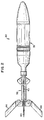
- a projectile referred to generally by the designation 30, in which a preferred embodiment electro-mechanical roll control apparatus and method may be utilized.
- the front section 31 i.e., the forward section of the projectile 30 body
- the payload section 33 in which certain electronics devices may also reside
- various electronics devices discussed below in connection with Fig. 5
- power supply/battery 50 discussed in more detail below.
- the projectile case 34 the material 35 which propels the projectile 30 from the launching device (not shown), and bearings 36.
- the front section 31 further includes the coils 38 for the armature of the control device brushless DC machine 52 (best seen in Fig. 5).
- the magnets 41 of the armature are connected to the rear section 32 (i.e., the aft section of the projectile 30 body) and are preferably permanent magnets.
- Tail boom 43 extends from a first end proximate the front section 31 to a second end which is at the aft end of the projectile 30.
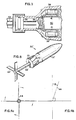
- fold-out fins 44 are hingedly attached and are biased into a flight position after the projectile 30 is in flight (best seen in Fig. 2).
- the fins 44 provide flight stability for projectile 30 and operate as the fixed torque application means (i.e., also the static spin imparting member).
- FIGs. 4a and 4b views of the fins 44 which illustrate the bevel 40 (Fig. 4a) and cant (Fig. 4b) of the fins 44 is provided.
- a cant will be discussed herein, however, a bevel might also be used.
- Each fin 44 is similarly canted in order to apply a torque as the projectile 30 moves through the atmosphere. It will be appreciated that the greater the cant, the larger the torque which will be generated. In the preferred embodiment, in view of the speed of the projectile, only a fraction of a degree ⁇ of cant is required to impart the necessary torque and, therefore, the necessary spin.
- the approximate spin rate of the preferred embodiment is in the 20 Hz range, however, other frequency/speeds might be used as those skilled in the art will appreciate.
- the cant or bevel of the fin must generally be found empirically for the specific projectile on which the present invention will be utilized.
- the fins are canted or beveled in order to establish a clockwise rotation as viewed looking along the projectile flight path from the rear to the front.
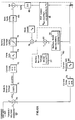
- Fig. 5 depicts a functional block diagram schematic of an EMRCS suitable for embodying the principles of the present invention
- Fig. 6 is a block diagram schematic of typical hardware interfaces suitable for implementing the functions of the embodiment of Fig. 5.
- the EMRCS may be disposed onboard a projectile 30 and be operative during the flight of the projectile 30 in order to orientate the front section 31 of the projectile 30 to point in a desired orientation about the projectile roll axis.
- the projectile is divided into front and rear sections or assemblies 31 and 32. Equal and opposite torques can be applied to the sections via the coupling field established between the coils 38 and magnets 41 of the preferred brushless DC machine 52.
- the torques acting on the rear section 32 about the roll axis are due primarily to the four sources set forth in Table 1.
- TABLE 1 1. The coupling field of the DC machine; 2. The aerodynamic damping torque imparted on the rear body by the fixed fins; 3. The aerodynamic torque due to the cant or beveling of the fixed fins; and 4. Friction on the bearing surfaces between the front and rear projectile sections.
- T b q ⁇ SdC l
- C l the aerodynamic roll moment coefficient of the rear section/assembly 32.
- T r T e +T d +T b +T f
- T f the frictional torque
- the spin rate of the rear section 32 tends towards a spin rate ⁇ p away from the equilibrium spin rate p, given above.
- the fin design must result in values of C lp and C l such that p r is at an acceptable value bounded away from the projectile 30 resonant frequency throughout the flight regime and that p r ⁇ p is an acceptably small range for the applied torques required for controlling the roll rate and roll orientation of the front section 31.
- the input signal to the drive electronics is an analog signal proportional to the desired torque.
- the controller utilizes current feedback control to ensure that the torque is developed. Even though the motor only rotates in one direction, both positive (accelerating) and negative (braking) torques are controlled. It will be appreciated that during the braking mode, the motor acts equivalent to a generator, and a resistive load must be provided to dissipate the energy. Protection circuitry is also preferably provided in order to prevent recharging the battery.
- driver board in the front section 31 which converts a digital signal in the digital processor block 59 into a current drive for the motor controller circuit block 51.
- the block 59 also includes proper digital to analog and analog to digital convertors.
- FIGs. 5 and 6 illustrate the various electrical functional blocks and logical data flow of the projectile and EMRCS. While not specifically detailed in Figs. 5 and 6, it will be understood that the functional blocks, and other devices are properly connected to appropriate bias and reference supplies so as to operate in their intended manner. Further, appropriate memory, buffer, timing and other attendant peripheral devices are to be properly connected for the devices to operate as intended.
- the fixed fin aerodynamics block 56 applies a torque to the rear projectile dynamics block 54a.
- the rear projectile dynamics block 54a includes all of the net forces (i.e., as discussed above in Table 1).
- the applied torque 53 from the rear projectile dynamics block 54a is applied to the front section 31 via magnets 41 of the armature of the motor (preferably a brushless DC machine 52) to the coils 38.
- the term brushless DC machine 52 is used to emphasize that an electromagnetic device is used in both a generator and alternator mode. It will be appreciated that an electromagnetic coupling exists between the magnets 41 and the coils 38.
- the coupling field is generally designated by the numeral 65.
- the front section 31 includes coils 38 as part of the armature of the brushless DC machine 52.
- the applied torque designated by the numeral 66 is provided to the front projectile dynamics block 54b. Similar to the rear projectile dynamics block 54a, the front projectile dynamics block 54b is illustrative of the net forces on the front section 31 of the projectile 30.
- the resulting physical parameters are measured by the front projectile angular rate sensor block 61 (e.g., to measure the roll rate) and a front projectile angular orientation sensor block 62 (e.g., to measure the roll position).
- the sensor blocks 61 and 62 provide digital signals, via switches 60a and 60b respectively, to a roll control digital processor block 59.
- This functional block provides a command signal to the motor controller circuit 51 to provide appropriate feedback control loop signals to stabilize the projectile 30.
- feedback control loops are well known in the art and may include proportional, integral and derivative components (or combinations thereof), fuzzy logic, and other types of control process algorithms.
- Voltage/torque control command switch 55 is interposed between the motor control circuit 51 and the roll control digital processor 59.
- Motor controller circuits are also well known in the art and so will not be described in detail herein.
- Battery 50 provides the necessary power to the motor controller circuit block 51 when operating the brushless DC machine 52 as a motor.
- the motor controller circuit 51 also includes a resistive network for dumping current from the coils 38 when the brushless DC machine 52 is operating as a generator.
- Fig. 6 there is illustrated in more detail blocks 50, 51, and 52 of Fig. 5.
- the voltage command signal 55 is summed at block 70 with a command voltage offset and the output from current compensation block 79.
- the resulting signal is provided to a scaling block 71 and from there is provided to current compensation block 72.
- the signal from current compensation block 72 is stepped up at pulse width modulator gain block 73 and is provided to battery induced voltage limiter block 74.
- Battery 50 includes a battery model block 78, battery no load voltage block 77, and summing block 93.
- the output of the summing block 93 is in turn summed with diode losses block 75 at summing block 76.
- the diode losses block 75 diodes are utilized for circuit protection during use of the resistive network during generator operation.
- the output of summing block 76 is also provided to the battery induced voltage limiter 74.
- Duty cycle losses block 83 provides the voltage limited signal to summation block 84.
- the motor controller block 51 further includes transistor losses block 81 and gain block 82 which is summed at summation block 84.
- the various elements of the brushless DC machine 52 include summation block 85 which provides a signal to the motor impedance block 86, the output of which includes the controlled current 59 (for current feedback gain block 80 and current compensation 79 block). Additionally, the output of the motor impedance block 86 is provided to the RMS type losses block 88. This signal is multiplied by the torque constant K t of the brushless DC machine 52 and is summed at summation block 90.
- the relative spin rate (in radians per second) is provided as an input signal to the voltage constant K e at block 87.
- the resulting back EMF signal is provided to summation block 85.
- the relative spin rate signal is provided to sliding friction block 100 which decreases the output summed at block 90 discussed above.
- Torque ripple block 91 is subtracted from the output at summation block 92 and provided as a motor torque output signal 53.
- the required torque is in the range of ⁇ 30 in.-lb. and shaft power of approximately 3 bursts of 500-600 watts for .1 second durations (needed for despin, vertical orientation and terminal pointing).
- the brushless DC machine 52 acts as a generator.
- the power generated may be used for warm-up and initialization of front-end electronics.
- the protection circuitry and resistive loads must be established such that excess power generated during braking does not recharge and destroy the thermal battery 50. It is currently believed by the inventors that the motor ripple torque at amplitudes of 100% will not impact the response and accuracy of the control system as long as the frequency is three times the roll rate of the rear section 32.
- the EMRCS weighs approximately 16-1/2 lbs. and preferably has a volume of less than 300 cubic inches.
- the available volume and size of the housing for the EMRCS is driven by the thickness of the housing required to withstand a 21,000 g setback load. This has been determined to be approximately 0.4 inch.
- the boom is a solid aluminum boom having a diameter of 1.4 inches. Other style booms such as a cursor form shaped boom might also be used.
- the bearings 36 are designed to withstand the friction generated by the system. In the preferred embodiment roller bearings are utilized. A seal is provided to protect the electronics from gases generated when firing the projectile. In the preferred embodiment, the seal includes a grooved washer.
- Table 2 illustrates a listing of the temporal events which occur during the flight of projectile 30.
- TABLE 2 TIME LINE OF TEMPORAL EVENTS 1. Projectile is fired from gun. 2. The onboard thermal battery 50 is initiated. 3. The tail fins 44 on the rear projectile section 32 are deployed into the airstream. 4. The rear section 32 spins up to the equilibrium roll rate. 5. The system power level comes up and the motor controller 51 is operable. 6. Either clockwise or counter-clockwise torques are applied about the projectile roll axis by supplying the corresponding command 55 to the motor controller circuit block 51. 7. Angular rate sensor 61 and position sensor 62 which are mounted on the front section 31 continuously supply measurement data to a roll control digital processor 59 which, in turn, commands the motor controller circuit block 51 with the desired feedback torque.
- Fig. 7 illustrates a simulation of the response of the control system.
- the inertial rotation of the rear section 31 is illustrated as ramping up very quickly and at area designated by the letter A decreases. This decrease corresponds to a command to speed up the front section 31.
- the spin rate of the rear section decreases further as the front section 31 spin rate is slowed.
- a second overshoot to settle the front section is illustrated at the section designated by the letter C. Thereafter, a steady state nominal spin rate is achieved.
- the curve illustrated in Fig. 7 is illustrative only and is provided herein for the purpose of depicting the temporal sequence of events which occurs when applying a step command to the front section.
- the alternative embodiment includes fins 110 on the front end 31' of the projectile 30' to cause the drive to operate as a generator for the duration of the flight. It will be appreciated that this can completely eliminate the need for thermal batteries on board the projectile 30', thereby reducing cost and increasing reliability.
- the electric drive when the electric drive is in the braking mode (i.e. the mode in which it generates power) it produces a clockwise torque on the front end 31' of the projectile 30'. If a net torque of ⁇ 30 in.-lb. is desired for control purposes, then additional torque to generate more power must be delivered. Assuming that electrical power requirement of 10 amps and 30 volts is required for the duration of the flight to power the front end 31', the motor is 80% efficient, and the fins 44' on the rear section 32' provide a steady state nominal spin rate of 20 Hz, then a torque of 26 in.-lb. is required to generate the electrical power.
- the fins 110 on the forward section 31' of the projectile 30' have to be sized to produce a counter-clockwise torque of 56 in.-lbs.
- the fins 110 on the forward section would be sized by the minimum dynamic pressure condition. Motor torque at this condition would vary from 26 to 86 in.-lbs. in order to produce the desired net torque of ⁇ 30 in.-lbs. for control purposes.
- the torque produced by the forward fins 110 would increase by about a factor of 2 (e.g., a counter-clockwise torque of 122 in.-lbs.). Under this maximum dynamic pressure condition, the motor must produce a torque of 82 in.-lbs. to 142 in.-lbs.
- the peak torque of the motor would range from 26 to 142 in.-lbs. instead of the ⁇ 30 in.-lbs. required in a system which makes use of thermal batteries.
- the fins 110 on the forward end 31' would have a total area of roughly 4 square inches. Drag on the projectile would be increased by roughly 1%.
- the permanent magnets for the motor may be mounted on the outside of the coils. This is commonly known as an inverted motor design. With this design, the magnets are mounted on the inside of the housing and the entire housing rotates with the rear end of the projectile. However, it is believed that a design with the permanent magnets mounted on the inside shaft is preferable. Most motors utilize this configuration because of the reduced motor inertia. In both implementations, however, the magnets rotate with the rear section, thereby eliminating any need for slip rings and electrical power in the rear end of the projectile.
- a configuration with the magnets on the inside is preferred for several other reasons as well.
Landscapes
- Physics & Mathematics (AREA)
- Fluid Mechanics (AREA)
- Engineering & Computer Science (AREA)
- General Engineering & Computer Science (AREA)
- Magnetic Bearings And Hydrostatic Bearings (AREA)
Applications Claiming Priority (2)
| Application Number | Priority Date | Filing Date | Title |
|---|---|---|---|
| US08/221,358 US5452864A (en) | 1994-03-31 | 1994-03-31 | Electro-mechanical roll control apparatus and method |
| US221358 | 1998-12-28 |
Publications (2)
| Publication Number | Publication Date |
|---|---|
| EP0675335A2 true EP0675335A2 (de) | 1995-10-04 |
| EP0675335A3 EP0675335A3 (de) | 1996-12-18 |
Family
ID=22827481
Family Applications (1)
| Application Number | Title | Priority Date | Filing Date |
|---|---|---|---|
| EP95104569A Ceased EP0675335A3 (de) | 1994-03-31 | 1995-03-28 | Vorrichtung und Verfahren zum Kontrollieren des Rollens. |
Country Status (2)
| Country | Link |
|---|---|
| US (1) | US5452864A (de) |
| EP (1) | EP0675335A3 (de) |
Cited By (13)
| Publication number | Priority date | Publication date | Assignee | Title |
|---|---|---|---|---|
| EP1930686A1 (de) * | 2006-12-05 | 2008-06-11 | Diehl BGT Defence GmbH & Co.KG | Drallstabilisierte bahnkorrigierbare Artilleriemunition |
| WO2008118159A3 (en) * | 2006-12-14 | 2008-12-11 | Simmonds Precision Products | Spin stabilizer projectile trajectory control |
| WO2009011949A3 (en) * | 2007-06-12 | 2009-05-14 | Hr Textron Inc | Techniques for articulating a nose member of a guidable projectile |
| WO2008108869A3 (en) * | 2006-08-10 | 2009-12-23 | Hr Textron, Inc. | Guided projectile with power and control mechanism |
| US7791007B2 (en) | 2007-06-21 | 2010-09-07 | Woodward Hrt, Inc. | Techniques for providing surface control to a guidable projectile |
| EP4015981A1 (de) * | 2020-12-16 | 2022-06-22 | BAE SYSTEMS plc | Energiegewinnungsanordnungen |
| US11555679B1 (en) | 2017-07-07 | 2023-01-17 | Northrop Grumman Systems Corporation | Active spin control |
| US11573069B1 (en) | 2020-07-02 | 2023-02-07 | Northrop Grumman Systems Corporation | Axial flux machine for use with projectiles |
| US11578956B1 (en) | 2017-11-01 | 2023-02-14 | Northrop Grumman Systems Corporation | Detecting body spin on a projectile |
| US11747121B2 (en) * | 2020-12-04 | 2023-09-05 | Bae Systems Information And Electronic Systems Integration Inc. | Despin maintenance motor |
| US12152866B2 (en) | 2020-12-16 | 2024-11-26 | Bae Systems Plc | Energy harvesting assemblies |
| US12209848B1 (en) | 2017-07-26 | 2025-01-28 | Northrop Grumman Systems Corporation | Despun wing control system for guided projectile maneuvers |
| US12313389B1 (en) | 2022-03-11 | 2025-05-27 | Northrop Grumman Systems Corporation | Tunable safe and arming devices and methods of manufacture |
Families Citing this family (40)
| Publication number | Priority date | Publication date | Assignee | Title |
|---|---|---|---|---|
| US5631830A (en) | 1995-02-03 | 1997-05-20 | Loral Vought Systems Corporation | Dual-control scheme for improved missle maneuverability |
| US5917442A (en) * | 1998-01-22 | 1999-06-29 | Raytheon Company | Missile guidance system |
| US6308911B1 (en) | 1998-10-30 | 2001-10-30 | Lockheed Martin Corp. | Method and apparatus for rapidly turning a vehicle in a fluid medium |
| DE19906969B4 (de) * | 1999-02-19 | 2004-10-14 | Rheinmetall W & M Gmbh | Aus einem Waffenrohr verschießbares leitwerkstabilisiertes Geschoß |
| SE518654C2 (sv) * | 2000-07-03 | 2002-11-05 | Bofors Defence Ab | Sätt och anordning vid artilleriprojektiler |
| US6559370B1 (en) * | 2002-08-06 | 2003-05-06 | The United States Of America As Represented By The Secretary Of The Navy | Submarine countermeasure vehicle with folding propeller |
| US6645020B1 (en) * | 2002-08-06 | 2003-11-11 | The United States Of America As Represented By The Secretary Of The Navy | Submarine countermeasure propeller protector |
| US6685143B1 (en) * | 2003-01-03 | 2004-02-03 | Orbital Research Inc. | Aircraft and missile forebody flow control device and method of controlling flow |
| US6745978B1 (en) * | 2003-03-24 | 2004-06-08 | At&T Corp. | Aerodynamic stabilization of a projectile |
| US6783095B1 (en) * | 2003-03-24 | 2004-08-31 | At&T Corp. | Deployable flare for aerodynamically stabilizing a projectile |
| US6869043B1 (en) * | 2003-03-24 | 2005-03-22 | At&T Corp. | Deployable flare with simplified design |
| US7681504B2 (en) * | 2003-08-26 | 2010-03-23 | Bae Systems Information And Electronic Systems Integration Inc. | Method and apparatus for displacing material and projectile thereof |
| US6981672B2 (en) * | 2003-09-17 | 2006-01-03 | Aleiant Techsystems Inc. | Fixed canard 2-D guidance of artillery projectiles |
| US7255304B2 (en) * | 2003-12-08 | 2007-08-14 | General Dynamics Ordnance And Tactical Systems, Inc. | Tandem motor actuator |
| US7163176B1 (en) * | 2004-01-15 | 2007-01-16 | Raytheon Company | 2-D projectile trajectory correction system and method |
| US7412930B2 (en) * | 2004-09-30 | 2008-08-19 | General Dynamic Ordnance And Tactical Systems, Inc. | Frictional roll control apparatus for a spinning projectile |
| US8113118B2 (en) * | 2004-11-22 | 2012-02-14 | Alliant Techsystems Inc. | Spin sensor for low spin munitions |
| US7677491B2 (en) | 2005-08-05 | 2010-03-16 | Raytheon Company | Methods and apparatus for airborne systems |
| WO2007030687A2 (en) * | 2005-09-09 | 2007-03-15 | General Dynamics Ordnance And Tactical Systems | Projectile trajectory control system |
| DE102005043078B4 (de) | 2005-09-10 | 2007-06-14 | Diehl Bgt Defence Gmbh & Co. Kg | Suchzündermunition |
| US7475846B2 (en) * | 2005-10-05 | 2009-01-13 | General Dynamics Ordnance And Tactical Systems, Inc. | Fin retention and deployment mechanism |
| US10408587B1 (en) * | 2006-04-20 | 2019-09-10 | United States Of America As Represented By The Secretary Of The Army | On-board power generation for rolling motor missiles |
| US7755012B2 (en) * | 2007-01-10 | 2010-07-13 | Hr Textron, Inc. | Eccentric drive control actuation system |
| US8193476B2 (en) * | 2008-06-13 | 2012-06-05 | Raytheon Company | Solid-fuel pellet thrust and control actuation system to maneuver a flight vehicle |
| US9040885B2 (en) * | 2008-11-12 | 2015-05-26 | General Dynamics Ordnance And Tactical Systems, Inc. | Trajectory modification of a spinning projectile |
| US8076623B2 (en) * | 2009-03-17 | 2011-12-13 | Raytheon Company | Projectile control device |
| US20120068002A1 (en) * | 2009-05-19 | 2012-03-22 | Unger Michael P | Guided missile |
| US8552349B1 (en) * | 2010-12-22 | 2013-10-08 | Interstate Electronics Corporation | Projectile guidance kit |
| TR201901397T4 (tr) | 2011-05-13 | 2019-02-21 | Leigh Aerosystems Corp | Karadan fırlatılan roket güdüm sistemi. |
| US9035475B1 (en) * | 2011-06-30 | 2015-05-19 | Bae Systems Information And Electronic Systems Integration Inc. | Air-drop device tail charger |
| SE535991C2 (sv) * | 2011-07-07 | 2013-03-19 | Bae Systems Bofors Ab | Rotationsstabiliserad styrbar projektil och förfarande därför |
| US9702673B1 (en) * | 2014-09-24 | 2017-07-11 | The United States Of America As Represented By The Secretary Of The Army | Projectile tail boom with self-locking fin |
| US9470491B1 (en) * | 2014-09-25 | 2016-10-18 | The United States Of America As Represented By The Secretary Of The Army | Frangible tail boom for projectile |
| WO2017035126A1 (en) * | 2015-08-24 | 2017-03-02 | Leigh Aerosystems Corporation | Ground-projectile guidance system |
| FR3041744B1 (fr) * | 2015-09-29 | 2018-08-17 | Nexter Munitions | Projectile d'artillerie ayant une phase pilotee. |
| US10280786B2 (en) | 2015-10-08 | 2019-05-07 | Leigh Aerosystems Corporation | Ground-projectile system |
| US10508892B1 (en) | 2016-08-15 | 2019-12-17 | The United States Of America As Represented By The Secretary Of The Navy | Distributed fuze architecture for highly reliable submunitions |
| CN106871741B (zh) * | 2017-01-05 | 2018-07-27 | 北京航天自动控制研究所 | 一种用于固定翼鸭舵的控制系统 |
| CN106871742B (zh) * | 2017-01-05 | 2018-07-27 | 北京航天自动控制研究所 | 一种设置在弹体上的控制系统 |
| US10996031B1 (en) * | 2017-07-26 | 2021-05-04 | U.S. Government As Represented By The Secretary Of The Army | Free spinning hub for mortar projectiles |
Family Cites Families (23)
| Publication number | Priority date | Publication date | Assignee | Title |
|---|---|---|---|---|
| US3125027A (en) * | 1964-03-17 | Self-regulating power supply | ||
| DE297942C (de) * | ||||
| DE300799C (de) * | ||||
| US2990776A (en) * | 1949-11-17 | 1961-07-04 | Allen S Clarke | Wind driven generator |
| US2920568A (en) * | 1952-01-03 | 1960-01-12 | Rabinow Jacob | Turbo-generator system |
| US3067681A (en) * | 1960-01-04 | 1962-12-11 | Telecomputing Corp | Guided missile |
| US3111088A (en) * | 1962-02-27 | 1963-11-19 | Martin Marietta Corp | Target seeking missile |
| US4512537A (en) * | 1973-08-10 | 1985-04-23 | Sanders Associates, Inc. | Canard control assembly for a projectile |
| US4438893A (en) * | 1973-08-10 | 1984-03-27 | Sanders Associates, Inc. | Prime power source and control for a guided projectile |
| US4568039A (en) * | 1973-08-10 | 1986-02-04 | Sanders Associates, Inc. | Guidance system for a projectile |
| US4188816A (en) * | 1974-11-29 | 1980-02-19 | Sanders Associates, Inc. | Apparatus and method for performing inertial measurements using translational acceleration transducers and for calibrating translational acceleration transducers |
| FR2321723A1 (fr) * | 1975-07-29 | 1977-03-18 | Thomson Brandt | Systeme de controle d'attitude et engin equipe d'un tel systeme |
| US4004519A (en) * | 1976-04-12 | 1977-01-25 | The United States Of America As Represented By The Secretary Of The Navy | Projectile power generator |
| US4222272A (en) * | 1978-03-27 | 1980-09-16 | Sanders Associates, Inc. | Processor for an inertial measurement unit |
| US4373688A (en) * | 1981-01-19 | 1983-02-15 | The United States Of America As Represented By The Secretary Of The Army | Canard drive mechanism latch for guided projectile |
| DE3403573A1 (de) * | 1983-11-09 | 1985-08-08 | Diehl GmbH & Co, 8500 Nürnberg | Geschoss mit herausklappbaren fluegeln |
| US5164538A (en) * | 1986-02-18 | 1992-11-17 | Twenty-First Century Research Institute | Projectile having plural rotatable sections with aerodynamic air foil surfaces |
| US4791573A (en) * | 1986-09-02 | 1988-12-13 | Sanders Associates, Inc. | State-deviation-estimation circuit employing a phase-locked-loop phase reference |
| DE3742836C1 (de) * | 1987-12-17 | 1989-07-13 | Messerschmitt Boelkow Blohm | Flugkoerper mit verstellbaren Steuerorganen |
| DE3827590A1 (de) * | 1988-08-13 | 1990-02-22 | Messerschmitt Boelkow Blohm | Flugkoerper |
| US4867393A (en) * | 1988-08-17 | 1989-09-19 | Morton Thiokol, Inc. | Reduced fin span thrust vector controlled pulsed tactical missile |
| USH905H (en) * | 1990-09-13 | 1991-04-02 | The United States Of America As Represented By The Secretary Of The Army | Fin assembly |
| USH932H (en) * | 1990-11-13 | 1991-07-02 | The United States Of America As Represented By The Secretary Of The Army | Projectile fin |
-
1994
- 1994-03-31 US US08/221,358 patent/US5452864A/en not_active Expired - Lifetime
-
1995
- 1995-03-28 EP EP95104569A patent/EP0675335A3/de not_active Ceased
Cited By (19)
| Publication number | Priority date | Publication date | Assignee | Title |
|---|---|---|---|---|
| WO2008108869A3 (en) * | 2006-08-10 | 2009-12-23 | Hr Textron, Inc. | Guided projectile with power and control mechanism |
| US7584922B2 (en) | 2006-12-05 | 2009-09-08 | Diehl Bgt Defence Gmbh & Co. Kg | Spin-stabilized correctible-trajectory artillery shell |
| EP1930686A1 (de) * | 2006-12-05 | 2008-06-11 | Diehl BGT Defence GmbH & Co.KG | Drallstabilisierte bahnkorrigierbare Artilleriemunition |
| US7963442B2 (en) | 2006-12-14 | 2011-06-21 | Simmonds Precision Products, Inc. | Spin stabilized projectile trajectory control |
| WO2008118159A3 (en) * | 2006-12-14 | 2008-12-11 | Simmonds Precision Products | Spin stabilizer projectile trajectory control |
| WO2009011949A3 (en) * | 2007-06-12 | 2009-05-14 | Hr Textron Inc | Techniques for articulating a nose member of a guidable projectile |
| US7696459B2 (en) | 2007-06-12 | 2010-04-13 | Hr Textron, Inc. | Techniques for articulating a nose member of a guidable projectile |
| US7791007B2 (en) | 2007-06-21 | 2010-09-07 | Woodward Hrt, Inc. | Techniques for providing surface control to a guidable projectile |
| US11555679B1 (en) | 2017-07-07 | 2023-01-17 | Northrop Grumman Systems Corporation | Active spin control |
| US12158326B1 (en) | 2017-07-07 | 2024-12-03 | Northrop Grumman Systems Corporation | Active spin control |
| US12209848B1 (en) | 2017-07-26 | 2025-01-28 | Northrop Grumman Systems Corporation | Despun wing control system for guided projectile maneuvers |
| US12276485B1 (en) | 2017-11-01 | 2025-04-15 | Northrop Grumman Systems Corporation | Detecting body spin on a projectile |
| US11578956B1 (en) | 2017-11-01 | 2023-02-14 | Northrop Grumman Systems Corporation | Detecting body spin on a projectile |
| US11573069B1 (en) | 2020-07-02 | 2023-02-07 | Northrop Grumman Systems Corporation | Axial flux machine for use with projectiles |
| US12055375B2 (en) | 2020-07-02 | 2024-08-06 | Northrop Grumman Systems Corporation | Axial flux machine for use with projectiles |
| US11747121B2 (en) * | 2020-12-04 | 2023-09-05 | Bae Systems Information And Electronic Systems Integration Inc. | Despin maintenance motor |
| US12152866B2 (en) | 2020-12-16 | 2024-11-26 | Bae Systems Plc | Energy harvesting assemblies |
| EP4015981A1 (de) * | 2020-12-16 | 2022-06-22 | BAE SYSTEMS plc | Energiegewinnungsanordnungen |
| US12313389B1 (en) | 2022-03-11 | 2025-05-27 | Northrop Grumman Systems Corporation | Tunable safe and arming devices and methods of manufacture |
Also Published As
| Publication number | Publication date |
|---|---|
| US5452864A (en) | 1995-09-26 |
| EP0675335A3 (de) | 1996-12-18 |
Similar Documents
| Publication | Publication Date | Title |
|---|---|---|
| US5452864A (en) | Electro-mechanical roll control apparatus and method | |
| CA1041978A (en) | Attitude controlling system and a missile equipped with such a system | |
| EP2145152B1 (de) | Geführtes projektil mit strom- und steuerungsmechanismus | |
| US4867393A (en) | Reduced fin span thrust vector controlled pulsed tactical missile | |
| US5235930A (en) | Self propelled underwater device with steerable fin stabilizer | |
| US5439188A (en) | Control system | |
| US6422507B1 (en) | Smart bullet | |
| EP0622604B1 (de) | Drehbar angeordneter und mittels eines flexiblen Bandes hergestellter Tragflügel | |
| US6695251B2 (en) | Method and system for synchronized forward and Aft thrust vector control | |
| JPH0759940B2 (ja) | スラスト変調型静電イオン・スラスターとその運転方法 | |
| US12055375B2 (en) | Axial flux machine for use with projectiles | |
| US5271328A (en) | Pendulum based power supply for projectiles | |
| US4044970A (en) | Integrated thrust vector aerodynamic control surface | |
| EP0747655A2 (de) | Vielseitiger Autopilot für Raketen | |
| Woodruff et al. | Fiber-fed Pulsed Plasma Thruster (FPPT) with Multi-axis Thrust Vectoring | |
| EP0227211B1 (de) | Abwerfbares Strahltriebwerk für Flugkörper | |
| US9926886B2 (en) | Magneto-rheologic damper for electromechanical actuator | |
| JPS61140800A (ja) | 飛しよう体 | |
| RU2124694C1 (ru) | Способ запуска управляемой ракеты и устройство для его осуществления | |
| JP2630262B2 (ja) | 空対空誘導弾 | |
| CA1078253A (en) | Integrated thrust vector aerodynamic control surface | |
| JP2878965B2 (ja) | インパルススラスタ用推力発生器 | |
| JP2784170B2 (ja) | サイドスラスタ型飛しよう体の制御方法 | |
| WASSOM | Optimal rocket motor design and control for tactical missiles(Ph. D. Thesis) | |
| Lusk | Flight Interruption System for a Small Diameter Missile with Telemeter |
Legal Events
| Date | Code | Title | Description |
|---|---|---|---|
| PUAI | Public reference made under article 153(3) epc to a published international application that has entered the european phase |
Free format text: ORIGINAL CODE: 0009012 |
|
| AK | Designated contracting states |
Kind code of ref document: A2 Designated state(s): DE FR GB |
|
| PUAL | Search report despatched |
Free format text: ORIGINAL CODE: 0009013 |
|
| AK | Designated contracting states |
Kind code of ref document: A3 Designated state(s): DE FR GB |
|
| 17P | Request for examination filed |
Effective date: 19970407 |
|
| 17Q | First examination report despatched |
Effective date: 19971106 |
|
| GRAG | Despatch of communication of intention to grant |
Free format text: ORIGINAL CODE: EPIDOS AGRA |
|
| STAA | Information on the status of an ep patent application or granted ep patent |
Free format text: STATUS: THE APPLICATION HAS BEEN REFUSED |
|
| 18R | Application refused |
Effective date: 20000509 |