EP0675357A1 - Verfahren zur Charakterisierung einer Gasmischung durch katalytische Oxidation - Google Patents
Verfahren zur Charakterisierung einer Gasmischung durch katalytische Oxidation Download PDFInfo
- Publication number
- EP0675357A1 EP0675357A1 EP95400645A EP95400645A EP0675357A1 EP 0675357 A1 EP0675357 A1 EP 0675357A1 EP 95400645 A EP95400645 A EP 95400645A EP 95400645 A EP95400645 A EP 95400645A EP 0675357 A1 EP0675357 A1 EP 0675357A1
- Authority
- EP
- European Patent Office
- Prior art keywords
- gas
- transducer
- catalytic
- temperature
- oxidizable
- Prior art date
- Legal status (The legal status is an assumption and is not a legal conclusion. Google has not performed a legal analysis and makes no representation as to the accuracy of the status listed.)
- Granted
Links
- 230000003197 catalytic effect Effects 0.000 title claims abstract description 54
- 238000000034 method Methods 0.000 title claims description 35
- 238000007254 oxidation reaction Methods 0.000 title claims description 11
- 230000003647 oxidation Effects 0.000 title claims description 8
- 239000008246 gaseous mixture Substances 0.000 title description 2
- 230000004044 response Effects 0.000 claims abstract description 48
- 238000012512 characterization method Methods 0.000 claims abstract description 10
- 239000007789 gas Substances 0.000 claims description 108
- VNWKTOKETHGBQD-UHFFFAOYSA-N methane Chemical compound C VNWKTOKETHGBQD-UHFFFAOYSA-N 0.000 claims description 46
- BASFCYQUMIYNBI-UHFFFAOYSA-N platinum Chemical compound [Pt] BASFCYQUMIYNBI-UHFFFAOYSA-N 0.000 claims description 31
- 230000008569 process Effects 0.000 claims description 17
- ATUOYWHBWRKTHZ-UHFFFAOYSA-N Propane Chemical compound CCC ATUOYWHBWRKTHZ-UHFFFAOYSA-N 0.000 claims description 16
- 229910052697 platinum Inorganic materials 0.000 claims description 13
- LFQSCWFLJHTTHZ-UHFFFAOYSA-N Ethanol Chemical compound CCO LFQSCWFLJHTTHZ-UHFFFAOYSA-N 0.000 claims description 10
- VGGSQFUCUMXWEO-UHFFFAOYSA-N Ethene Chemical compound C=C VGGSQFUCUMXWEO-UHFFFAOYSA-N 0.000 claims description 8
- 239000001273 butane Substances 0.000 claims description 8
- IJDNQMDRQITEOD-UHFFFAOYSA-N n-butane Chemical compound CCCC IJDNQMDRQITEOD-UHFFFAOYSA-N 0.000 claims description 8
- OFBQJSOFQDEBGM-UHFFFAOYSA-N n-pentane Natural products CCCCC OFBQJSOFQDEBGM-UHFFFAOYSA-N 0.000 claims description 8
- 239000001294 propane Substances 0.000 claims description 8
- 239000005977 Ethylene Substances 0.000 claims description 5
- 235000019441 ethanol Nutrition 0.000 claims description 5
- 230000001174 ascending effect Effects 0.000 claims description 4
- 239000001257 hydrogen Substances 0.000 claims description 4
- 229910052739 hydrogen Inorganic materials 0.000 claims description 4
- UFHFLCQGNIYNRP-UHFFFAOYSA-N Hydrogen Chemical compound [H][H] UFHFLCQGNIYNRP-UHFFFAOYSA-N 0.000 claims description 3
- 230000001419 dependent effect Effects 0.000 claims description 2
- 150000002431 hydrogen Chemical class 0.000 claims description 2
- 238000010438 heat treatment Methods 0.000 description 21
- 238000005259 measurement Methods 0.000 description 18
- 239000000203 mixture Substances 0.000 description 15
- 238000004364 calculation method Methods 0.000 description 6
- 230000035945 sensitivity Effects 0.000 description 6
- 230000007423 decrease Effects 0.000 description 5
- 238000004448 titration Methods 0.000 description 5
- 230000006870 function Effects 0.000 description 4
- 238000010586 diagram Methods 0.000 description 3
- 240000008042 Zea mays Species 0.000 description 2
- QVGXLLKOCUKJST-UHFFFAOYSA-N atomic oxygen Chemical compound [O] QVGXLLKOCUKJST-UHFFFAOYSA-N 0.000 description 2
- 230000001590 oxidative effect Effects 0.000 description 2
- 239000001301 oxygen Substances 0.000 description 2
- 229910052760 oxygen Inorganic materials 0.000 description 2
- 241001415961 Gaviidae Species 0.000 description 1
- 238000004616 Pyrometry Methods 0.000 description 1
- 241001080024 Telles Species 0.000 description 1
- 241000897276 Termes Species 0.000 description 1
- 230000003042 antagnostic effect Effects 0.000 description 1
- 239000003054 catalyst Substances 0.000 description 1
- 238000001514 detection method Methods 0.000 description 1
- 230000000694 effects Effects 0.000 description 1
- 238000011067 equilibration Methods 0.000 description 1
- 238000002474 experimental method Methods 0.000 description 1
- 238000004880 explosion Methods 0.000 description 1
- 239000000446 fuel Substances 0.000 description 1
- 238000012423 maintenance Methods 0.000 description 1
- 239000000463 material Substances 0.000 description 1
- 230000004048 modification Effects 0.000 description 1
- 238000012986 modification Methods 0.000 description 1
- 230000003287 optical effect Effects 0.000 description 1
- 230000003071 parasitic effect Effects 0.000 description 1
- 235000012830 plain croissants Nutrition 0.000 description 1
- 238000004381 surface treatment Methods 0.000 description 1
Images

Classifications
-
- G—PHYSICS
- G01—MEASURING; TESTING
- G01N—INVESTIGATING OR ANALYSING MATERIALS BY DETERMINING THEIR CHEMICAL OR PHYSICAL PROPERTIES
- G01N27/00—Investigating or analysing materials by the use of electric, electrochemical, or magnetic means
- G01N27/02—Investigating or analysing materials by the use of electric, electrochemical, or magnetic means by investigating impedance
- G01N27/04—Investigating or analysing materials by the use of electric, electrochemical, or magnetic means by investigating impedance by investigating resistance
- G01N27/14—Investigating or analysing materials by the use of electric, electrochemical, or magnetic means by investigating impedance by investigating resistance of an electrically-heated body in dependence upon change of temperature
- G01N27/16—Investigating or analysing materials by the use of electric, electrochemical, or magnetic means by investigating impedance by investigating resistance of an electrically-heated body in dependence upon change of temperature caused by burning or catalytic oxidation of surrounding material to be tested, e.g. of gas
-
- Y—GENERAL TAGGING OF NEW TECHNOLOGICAL DEVELOPMENTS; GENERAL TAGGING OF CROSS-SECTIONAL TECHNOLOGIES SPANNING OVER SEVERAL SECTIONS OF THE IPC; TECHNICAL SUBJECTS COVERED BY FORMER USPC CROSS-REFERENCE ART COLLECTIONS [XRACs] AND DIGESTS
- Y10—TECHNICAL SUBJECTS COVERED BY FORMER USPC
- Y10T—TECHNICAL SUBJECTS COVERED BY FORMER US CLASSIFICATION
- Y10T436/00—Chemistry: analytical and immunological testing
- Y10T436/21—Hydrocarbon
- Y10T436/214—Acyclic [e.g., methane, octane, isoparaffin, etc.]
-
- Y—GENERAL TAGGING OF NEW TECHNOLOGICAL DEVELOPMENTS; GENERAL TAGGING OF CROSS-SECTIONAL TECHNOLOGIES SPANNING OVER SEVERAL SECTIONS OF THE IPC; TECHNICAL SUBJECTS COVERED BY FORMER USPC CROSS-REFERENCE ART COLLECTIONS [XRACs] AND DIGESTS
- Y10—TECHNICAL SUBJECTS COVERED BY FORMER USPC
- Y10T—TECHNICAL SUBJECTS COVERED BY FORMER US CLASSIFICATION
- Y10T436/00—Chemistry: analytical and immunological testing
- Y10T436/21—Hydrocarbon
- Y10T436/218—Total hydrocarbon, flammability, combustibility [e.g., air-fuel mixture, etc.]
Definitions
- the invention relates to a process for the characterization by catalytic oxidation of a gaseous mixture of air and at least one combustible gas or vapor.
- the influence parameters acting on a catalytic transducer are the disturbing parameters for which the catalytic transducer is sensitive and provides a response which algebraically adds to the response due to the gas and which induces an error in the determination. of the volume title.
- the two main influence parameters are the thermal conductivity and the temperature of the gas mixture which determine the heat losses from the transducer in the mixture.
- Catalytic sensors currently still have two components: a detector (the catalytic transducer) and a compensator.
- the detector is brought to a temperature sufficient to oxidize all the gases.
- the heat given off by the gas oxidation reaction on the detector is measured by any technique. For example: measuring the increase in the electrical resistance of the transducer (which is a function of its temperature) - or measuring the decrease in the heating current in the case where the transducer has been operated at constant temperature.
- the detector therefore provides a response to a variation in heat: variation due to the oxidation of the gas - variation due to a modification of the losses in the mixture - or alternatively, variation due to the increase in the normal operating temperature for a regime given electrical power, which can happen in the long run if the transducer is a filament that wears out.
- a compensating element As its name suggests, the function of a compensating element is to compensate for the influences of these disturbing parameters on the response of the detector. Its geometry and constitution are identical to those of the detector so that it has the same temperature coefficient and the same wear coefficient. But it has received a surface treatment which prevents the oxidation reaction from taking place. It is heated to the same temperature as the detector.
- the gas signal is collected.
- the response signal translates the instantaneous value of a quantity characteristic of the thermal regime of the transducer or catalytic detector.
- the response of a catalytic transducer is not one-to-one. It increases to the stoichiometric concentration of the gas in the medium (for which the quantity of oxygen in the mixture is just enough to oxidize all the gas), then decreases due to lack of oxygen to cancel out in 100% gas. The answer is therefore ambivalent, and there is a doubt about the titration being measured that should be removed (hence the expression to remove doubt).
- the document WO-A-90-12313 proposes, for the determination of the concentration of a given gas, a pseudo-continuous supply of a catalytic filament, unique, for reduced power consumption; it is envisaged to use the equilibration time to characterize the gas concerned. None is planned to remove the doubt.
- the document EP-0.234.251 provides, for the measurement of the concentration in a given gas with a single filament, two alternative modes of measurement each using a specific temperature: one proceeds either by measurement of thermal conductivity at low temperature if the concentration is high, or by catalytic measurement at high temperature if this concentration is low.
- document EP-0.458.058 uses the combination of a detector filament and a compensating filament. In fact these documents do not allow, at the same time, a precise measurement (by understanding the possible parasitic phenomena) with only one filament, with raising of doubt and possibility of identifying the gas in question.
- the object of the invention is to overcome the aforementioned drawbacks and relates to a method for characterizing a gaseous medium composed mainly of air, and to a lesser extent at least one oxidizable gas, which only involves '' a catalytic transducer without compensating element, which makes it possible to determine the volume concentration (titer) of the medium in at least one predetermined oxidizable gas, which can also allow, always with a single transducer, the removal of doubt in the case of certain gases (methane in particular) as well as, always with the only catalytic transducer, a simultaneous determination or not of the concentration of the medium in several predetermined oxidizable gases (with therefore at least the possibility of identifying the one (assumed alone) which, among several possible gases predetermined, is present in the medium in addition to the air), this process being simple and reliable from the point of view of implementation, and leading to a moderate response time (typically around a few seconds at most).
- the main innovative feature of the process is that it achieves all these performances from the response of a single catalytic transducer, without using any other transducer or compensating element to compensate for the influence parameters.
- the process defined above therefore consists in measuring the response of the transducer for different increasing operating temperatures, during a short heating phase, then, from these responses, and depending on the application, calculating the volume titer, remove the doubt, and / or identify the gas (or even).
- the duration of the shutdown phase between the heating cycles is chosen according to the response time desired for the application.
- the number of temperature steps, which determines the duration of the heating phase also depends on the application: two stages for a methanometer, up to five stages (or more) for the two other applications indicated above.
- the method can be applied to all types of catalytic transducers, but it is particularly practical (when you want a quick response) for those whose thermal inertia is low enough to allow a short heating time. As such, it is very suitable for transducers of the filament type: pure platinum filament or certain filaments covered with a catalyst material.
- the temperatures considered are in practice the central temperatures, calculated from measurements carried out for example, by optical pyrometry.
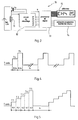
- Figure 1 shows the response of a platinum filament for various oxidizable gases, depending on its operating temperature.
- the order of magnitude of the response signal of the filament to gas, at 1000 °, is 20 mV /%.
- the quantity of methane oxidizing on the filament is not sufficient for it to give a usable response. It only becomes effective above this temperature and grows with it.
- the principle of the process is based on the form of these response characteristics and their temperature shifts.
- d1 S2 - S1 - Ct1
- Ct represents the term S T 2 - S T 1.
- the term is calculated and stored by the instrument when the zero is adjusted in clean air (not containing combustible gases). Note that S T 2 - S T 1 remains constant even when the filament wears out: wear, which increases the resistance of the filament, causes S T 2 and S T 1 to drift in the same positive direction at sufficiently close amplitudes so that the resulting error remains within the metrological tolerances.
- T1 and T2 determine the sensitivity of the sensor and its stability over time (which is improved by the process).
- Sensitivity is the amplitude of the response signal per volume% of oxidizable gas. Stability is the maintenance of this performance in time. It can be noted that if T2 - T1 decreases, the sensitivity decreases but the stability increases.
- a characterization identification of a gas among several known gases likely to appear in the gaseous medium (explosimeter)
- intervals that is to say that the upper threshold temperature of an interval is the lower threshold temperature of the immediately higher interval.
- the intervals for which we are interested in the difference d can be disjoint.
- FIG. 2 shows the response of the platinum filament during an experiment at different methane contents, at 800 ° (dotted line) and 1000 ° (solid line) of operating temperature.
- the response of the filament results from two antagonistic parameters: the oxidation of the gas, which provides heat but which decreases when the methane content increases, and the conductivity of the mixture which increases with this content but which removes heat.
- the quantities of gas oxidized at the two temperatures are practically identical above the stoichiometric content, while the thermal conductivity causes greater heat losses at 1000 ° than at 800 °. This explains why the response signal at 800 ° is higher than that at 1000 ° for high concentrations.
- FIG. 3 gives the electronic circuit of a device 10 used for the three applications which are indicated below (only the program differs).
- a heating circuit 12 actuates a current valve T1 so as to let through the filament only the heating current necessary to maintain it at a constant operating temperature, chosen by logical states applied to its inputs e1, e2, e3, e4, e5, for example according to the following correspondence: e5 e4 e3 e2 e1 Heating temperature 0 0 0 0 0 stop 0 0 0 0 1 T1 0 0 0 1 1 T2 0 0 1 1 1 T3 0 1 1 1 1 1 T4 1 1 1 1 1 1 T5
- the program and the various constants are stored in a memory circuit 14 of the type E.E. PROM.
- the results are displayed here, using a display element 15.
- FIG. 4 shows the temperature regime which one seeks to make the catalytic transducer follow when one is interested in a single gas and that it is the only oxidizable gas capable of appearing in the gaseous medium to be characterized: it shows two temperature levels increasing, of very short duration (0.2s approximately) followed by a longer stop at ambient level (here 5s but it can be chosen shorter depending on the needs; it may be enough to stop 2.5 s only if you want a quasi-continuous measurement).
- 800 ° C and 1000 ° C are chosen as the lower and upper threshold temperature for the temperature range considered.
- the invention is of course not limited to a transducer of the filament type (that is to say comprising itself a resistive element which, by JOULE effect, heats its catalytic surface to the desired temperature): the transducer can be indirectly heated by a resistive element (or any other heating element) which heats it or which is close to it.
Landscapes
- Chemical & Material Sciences (AREA)
- Chemical Kinetics & Catalysis (AREA)
- Electrochemistry (AREA)
- Physics & Mathematics (AREA)
- Health & Medical Sciences (AREA)
- Life Sciences & Earth Sciences (AREA)
- Analytical Chemistry (AREA)
- Biochemistry (AREA)
- General Health & Medical Sciences (AREA)
- General Physics & Mathematics (AREA)
- Immunology (AREA)
- Pathology (AREA)
- Investigating Or Analyzing Materials By The Use Of Electric Means (AREA)
- Investigating Or Analyzing Materials Using Thermal Means (AREA)
Applications Claiming Priority (2)
| Application Number | Priority Date | Filing Date | Title |
|---|---|---|---|
| FR9403825 | 1994-03-31 | ||
| FR9403825A FR2718240B1 (fr) | 1994-03-31 | 1994-03-31 | Procédé de caractérisation d'un mélange gazeux par oxydation catalytique. |
Publications (2)
| Publication Number | Publication Date |
|---|---|
| EP0675357A1 true EP0675357A1 (de) | 1995-10-04 |
| EP0675357B1 EP0675357B1 (de) | 1998-09-16 |
Family
ID=9461633
Family Applications (1)
| Application Number | Title | Priority Date | Filing Date |
|---|---|---|---|
| EP95400645A Expired - Lifetime EP0675357B1 (de) | 1994-03-31 | 1995-03-23 | Verfahren zur Charakterisierung einer Gasmischung durch katalytische Oxidation |
Country Status (5)
| Country | Link |
|---|---|
| US (1) | US5709792A (de) |
| EP (1) | EP0675357B1 (de) |
| JP (1) | JPH0843341A (de) |
| DE (1) | DE69504734T2 (de) |
| FR (1) | FR2718240B1 (de) |
Cited By (3)
| Publication number | Priority date | Publication date | Assignee | Title |
|---|---|---|---|---|
| EP0829718A1 (de) * | 1996-09-11 | 1998-03-18 | Heinz Prof. Dr. Kohler | Gasanalysegerät mit einem Halbleiter-Gassensor |
| EP0806655A3 (de) * | 1996-05-09 | 2001-11-07 | Epcos Ag | Verfahren zur Detektion von CH4 mit einem Ga2O3-Sensor und Verfahren zur Messung der CH4-Konzentration mit einem Ga2O3-Sensor |
| DE10307247A1 (de) * | 2003-02-17 | 2004-08-26 | E.G.O. Elektro-Gerätebau GmbH | Einrichtung zum Absaugen von Abluft eines Elektrowärmegeräts und Verfahren zum Betrieb derselben |
Families Citing this family (15)
| Publication number | Priority date | Publication date | Assignee | Title |
|---|---|---|---|---|
| FR2777351B1 (fr) * | 1998-04-08 | 2000-06-23 | Hycel Diagnostics | Procede et dispositif de mesure de particules en suspension dans un liquide |
| FR2790316B1 (fr) * | 1999-02-25 | 2001-11-23 | Oldham France Sa | Procede d'analyse d'un melange gazeux pour la determination de son explosibilite et dispositif pour la mise en oeuvre d'un tel procede |
| JP2001223501A (ja) * | 2000-02-14 | 2001-08-17 | Sony Corp | 伝送線路導波管変換器、マイクロ波受信用コンバータおよび衛星放送受信アンテナ |
| DE10164426B4 (de) * | 2001-12-29 | 2006-06-22 | Gert Petrick | Verfahren zur Bestimmung von 13C in Methan, bei dem Methan kontinuierlich über einen Katalysator geleitet und dabei in CO2 umgewandelt wird |
| US6742382B2 (en) * | 2002-02-28 | 2004-06-01 | Industrial Scientific Corporation | Combustible gas detector and method for its operation |
| AU2003257821A1 (en) * | 2003-08-11 | 2005-02-25 | Hitachi, Ltd. | Gas sensor and gas detecting method |
| RU2279668C1 (ru) * | 2004-11-26 | 2006-07-10 | Антоненко Владимир Иванович | Способ определения концентрации каталитически окисляемого газа в воздухе |
| DE102005024394B4 (de) * | 2005-05-27 | 2015-08-27 | Dräger Safety AG & Co. KGaA | Verfahren zur Konzentrationsmessung von Gasen |
| JP4849924B2 (ja) * | 2006-03-24 | 2012-01-11 | 株式会社東科精機 | 燻蒸ガス濃度測定装置 |
| JP5028453B2 (ja) * | 2009-07-27 | 2012-09-19 | 日立オートモティブシステムズ株式会社 | ガスセンサ及びガス検知方法 |
| US9279792B2 (en) | 2011-04-13 | 2016-03-08 | 3M Innovative Properties Company | Method of using an absorptive sensor element |
| US9506888B2 (en) | 2011-04-13 | 2016-11-29 | 3M Innovative Properties Company | Vapor sensor including sensor element with integral heating |
| WO2012141925A1 (en) | 2011-04-13 | 2012-10-18 | 3M Innovative Properties Company | Method of detecting volatile organic compounds |
| JP6038950B2 (ja) | 2011-12-13 | 2016-12-07 | スリーエム イノベイティブ プロパティズ カンパニー | 気体媒質内の未知の有機化合物の同定及び定量測定方法 |
| JP6153804B2 (ja) * | 2013-07-29 | 2017-06-28 | 新コスモス電機株式会社 | 接触燃焼式ガスセンサ |
Citations (4)
| Publication number | Priority date | Publication date | Assignee | Title |
|---|---|---|---|---|
| EP0234251A2 (de) * | 1986-01-21 | 1987-09-02 | Drägerwerk Aktiengesellschaft | Verfahren und Vorrichtung zum Nachweis von brennbaren Gasen |
| WO1990012313A1 (fr) * | 1989-04-06 | 1990-10-18 | Charbonnages De France | Procede pseudo-continu d'interrogation d'un detecteur de gaz oxydable |
| EP0444753A1 (de) * | 1990-03-02 | 1991-09-04 | ENIRICERCHE S.p.A. | Gassensoren zur Bestimmung von gasförmigen Kohlenwasserstoffen unter Verwendung von dünnen Zinnoxidschichten |
| EP0458058A2 (de) * | 1990-05-10 | 1991-11-27 | Drägerwerk Aktiengesellschaft | Verfahren für den Betrieb einer Messanordnung zum Nachweis des Anteils von brennbaren Gasen |
Family Cites Families (2)
| Publication number | Priority date | Publication date | Assignee | Title |
|---|---|---|---|---|
| GB8928177D0 (en) * | 1989-12-13 | 1990-02-14 | City Tech | Flammable gas detection |
| US5234737A (en) * | 1991-01-28 | 1993-08-10 | Fuji Xerox Co., Ltd. | Phase change optical recording medium |
-
1994
- 1994-03-31 FR FR9403825A patent/FR2718240B1/fr not_active Expired - Fee Related
-
1995
- 1995-03-23 EP EP95400645A patent/EP0675357B1/de not_active Expired - Lifetime
- 1995-03-23 DE DE69504734T patent/DE69504734T2/de not_active Expired - Fee Related
- 1995-03-31 JP JP7076316A patent/JPH0843341A/ja active Pending
-
1996
- 1996-03-21 US US08/619,154 patent/US5709792A/en not_active Expired - Fee Related
Patent Citations (4)
| Publication number | Priority date | Publication date | Assignee | Title |
|---|---|---|---|---|
| EP0234251A2 (de) * | 1986-01-21 | 1987-09-02 | Drägerwerk Aktiengesellschaft | Verfahren und Vorrichtung zum Nachweis von brennbaren Gasen |
| WO1990012313A1 (fr) * | 1989-04-06 | 1990-10-18 | Charbonnages De France | Procede pseudo-continu d'interrogation d'un detecteur de gaz oxydable |
| EP0444753A1 (de) * | 1990-03-02 | 1991-09-04 | ENIRICERCHE S.p.A. | Gassensoren zur Bestimmung von gasförmigen Kohlenwasserstoffen unter Verwendung von dünnen Zinnoxidschichten |
| EP0458058A2 (de) * | 1990-05-10 | 1991-11-27 | Drägerwerk Aktiengesellschaft | Verfahren für den Betrieb einer Messanordnung zum Nachweis des Anteils von brennbaren Gasen |
Cited By (3)
| Publication number | Priority date | Publication date | Assignee | Title |
|---|---|---|---|---|
| EP0806655A3 (de) * | 1996-05-09 | 2001-11-07 | Epcos Ag | Verfahren zur Detektion von CH4 mit einem Ga2O3-Sensor und Verfahren zur Messung der CH4-Konzentration mit einem Ga2O3-Sensor |
| EP0829718A1 (de) * | 1996-09-11 | 1998-03-18 | Heinz Prof. Dr. Kohler | Gasanalysegerät mit einem Halbleiter-Gassensor |
| DE10307247A1 (de) * | 2003-02-17 | 2004-08-26 | E.G.O. Elektro-Gerätebau GmbH | Einrichtung zum Absaugen von Abluft eines Elektrowärmegeräts und Verfahren zum Betrieb derselben |
Also Published As
| Publication number | Publication date |
|---|---|
| US5709792A (en) | 1998-01-20 |
| JPH0843341A (ja) | 1996-02-16 |
| FR2718240A1 (fr) | 1995-10-06 |
| EP0675357B1 (de) | 1998-09-16 |
| DE69504734D1 (de) | 1998-10-22 |
| FR2718240B1 (fr) | 1996-06-21 |
| DE69504734T2 (de) | 1999-06-10 |
Similar Documents
| Publication | Publication Date | Title |
|---|---|---|
| EP0675357B1 (de) | Verfahren zur Charakterisierung einer Gasmischung durch katalytische Oxidation | |
| EP2115440B1 (de) | Thermischer gassensor und verfahren zur konzentrationsmessung eines gases | |
| EP1068510B1 (de) | Verfahren zur wellenlängeneichung einer vorrichtung zur filterung elektromagnetischer strahlung | |
| FR2514497A1 (fr) | Dispositif de detection numerique de niveau par fil chaud | |
| EP0080705B1 (de) | Elektronisches Instrument für eine Überwachung und Behandlung weiblicher Unfruchtbarkeit | |
| US11467110B2 (en) | Method for operating a sensor device | |
| EP0466831B1 (de) | Pseudokontinuierliches verfahren zum abfragen eines detektors für oxydierbares gas | |
| EP0144253A1 (de) | Thermische Vorrichtung zur Messung des Flüssigkeitsstandes | |
| FR2478817A1 (fr) | Detecteur de mesure polarographique pour la determination de la teneur en oxygene dans des gaz | |
| FR2640381A1 (fr) | Procede d'etalonnage pour la mesure de la concentration relative de gaz ou de vapeur et capteur etalonnable pour effectuer cette mesure | |
| EP1446670A1 (de) | Mittels vibrierender doppelresonatoranordnung thermisch kompensiertes beschleunigungsmessverfahren | |
| EP0101353B1 (de) | Dosis- und Dosisleistungsmesser für ionisierende Strahlung | |
| EP1031829A1 (de) | Verfahren zur Analyse eines Gasgemisches zur Feststellung seiner Explosionsgrenze und zugehörige Verwendungsvorrichtung | |
| EP0114009B1 (de) | Verfahren und Vorrichtung zur Bestimmung der Explosionsgrenze in einem Gas | |
| EP0921390A1 (de) | Verfahren zur Bestimmung der Konzentration eines Gases in einem Gasgemisch und Analysevorrichtung zur Durchführung dieses Verfahrens | |
| US5889198A (en) | Method for detecting and measuring CH4 with GA2 O3 sensor | |
| FR2490340A1 (fr) | Thermometre electronique | |
| FR2999709A1 (fr) | Detecteur de fuite d'hydrogene | |
| EP1102975B1 (de) | Verfahren zur messung der spektralen absorption eines körpers und vorrichtung zur durchführung des verfahrens | |
| EP1203226B1 (de) | Gassensor | |
| FR2939509A1 (fr) | Procede et systeme d'estimation d'une temperature de veine dans un turboreacteur. | |
| WO2020109160A1 (fr) | Procede de detection d'au moins une quantite de gaz d'au moins un gaz predetermine a partir d'un capteur de mesure d'une pluralite de gaz | |
| JP2001242114A (ja) | 燃料電池用ガス検知装置用補償素子、気体熱伝導式ガス検知装置及び燃料電池用ガス供給装置 | |
| EP0145532B1 (de) | Piezometrische und thermometrische Vorrichtung zur Druck- und Temperaturmessung entsprechend einer Matrize | |
| JP2004144627A (ja) | 可燃性ガス検出素子及びその製造方法 |
Legal Events
| Date | Code | Title | Description |
|---|---|---|---|
| PUAI | Public reference made under article 153(3) epc to a published international application that has entered the european phase |
Free format text: ORIGINAL CODE: 0009012 |
|
| AK | Designated contracting states |
Kind code of ref document: A1 Designated state(s): BE DE FR GB IT NL |
|
| 17P | Request for examination filed |
Effective date: 19951103 |
|
| GRAG | Despatch of communication of intention to grant |
Free format text: ORIGINAL CODE: EPIDOS AGRA |
|
| 17Q | First examination report despatched |
Effective date: 19970801 |
|
| GRAG | Despatch of communication of intention to grant |
Free format text: ORIGINAL CODE: EPIDOS AGRA |
|
| GRAG | Despatch of communication of intention to grant |
Free format text: ORIGINAL CODE: EPIDOS AGRA |
|
| GRAH | Despatch of communication of intention to grant a patent |
Free format text: ORIGINAL CODE: EPIDOS IGRA |
|
| GRAH | Despatch of communication of intention to grant a patent |
Free format text: ORIGINAL CODE: EPIDOS IGRA |
|
| GRAA | (expected) grant |
Free format text: ORIGINAL CODE: 0009210 |
|
| AK | Designated contracting states |
Kind code of ref document: B1 Designated state(s): BE DE FR GB IT NL |
|
| GBT | Gb: translation of ep patent filed (gb section 77(6)(a)/1977) |
Effective date: 19980917 |
|
| REF | Corresponds to: |
Ref document number: 69504734 Country of ref document: DE Date of ref document: 19981022 |
|
| PLBE | No opposition filed within time limit |
Free format text: ORIGINAL CODE: 0009261 |
|
| STAA | Information on the status of an ep patent application or granted ep patent |
Free format text: STATUS: NO OPPOSITION FILED WITHIN TIME LIMIT |
|
| 26N | No opposition filed | ||
| REG | Reference to a national code |
Ref country code: GB Ref legal event code: IF02 |
|
| PGFP | Annual fee paid to national office [announced via postgrant information from national office to epo] |
Ref country code: FR Payment date: 20020326 Year of fee payment: 8 |
|
| PGFP | Annual fee paid to national office [announced via postgrant information from national office to epo] |
Ref country code: NL Payment date: 20020328 Year of fee payment: 8 |
|
| PGFP | Annual fee paid to national office [announced via postgrant information from national office to epo] |
Ref country code: GB Payment date: 20020403 Year of fee payment: 8 |
|
| PGFP | Annual fee paid to national office [announced via postgrant information from national office to epo] |
Ref country code: DE Payment date: 20020410 Year of fee payment: 8 |
|
| PGFP | Annual fee paid to national office [announced via postgrant information from national office to epo] |
Ref country code: BE Payment date: 20020514 Year of fee payment: 8 |
|
| PG25 | Lapsed in a contracting state [announced via postgrant information from national office to epo] |
Ref country code: GB Free format text: LAPSE BECAUSE OF NON-PAYMENT OF DUE FEES Effective date: 20030323 |
|
| PG25 | Lapsed in a contracting state [announced via postgrant information from national office to epo] |
Ref country code: BE Free format text: LAPSE BECAUSE OF NON-PAYMENT OF DUE FEES Effective date: 20030331 |
|
| BERE | Be: lapsed |
Owner name: L'INSTITUT NATIONAL DE L'*ENVIRONNEMENT INDUSTRIEL Effective date: 20030331 |
|
| PG25 | Lapsed in a contracting state [announced via postgrant information from national office to epo] |
Ref country code: NL Free format text: LAPSE BECAUSE OF NON-PAYMENT OF DUE FEES Effective date: 20031001 Ref country code: DE Free format text: LAPSE BECAUSE OF NON-PAYMENT OF DUE FEES Effective date: 20031001 |
|
| GBPC | Gb: european patent ceased through non-payment of renewal fee |
Effective date: 20030323 |
|
| PG25 | Lapsed in a contracting state [announced via postgrant information from national office to epo] |
Ref country code: FR Free format text: LAPSE BECAUSE OF NON-PAYMENT OF DUE FEES Effective date: 20031127 |
|
| NLV4 | Nl: lapsed or anulled due to non-payment of the annual fee |
Effective date: 20031001 |
|
| REG | Reference to a national code |
Ref country code: FR Ref legal event code: ST |
|
| PG25 | Lapsed in a contracting state [announced via postgrant information from national office to epo] |
Ref country code: IT Free format text: LAPSE BECAUSE OF NON-PAYMENT OF DUE FEES Effective date: 20050323 |