EP0675450A2 - Processeur à architecture parallèle pour le calcul numérique intensif - Google Patents
Processeur à architecture parallèle pour le calcul numérique intensif Download PDFInfo
- Publication number
- EP0675450A2 EP0675450A2 EP95100960A EP95100960A EP0675450A2 EP 0675450 A2 EP0675450 A2 EP 0675450A2 EP 95100960 A EP95100960 A EP 95100960A EP 95100960 A EP95100960 A EP 95100960A EP 0675450 A2 EP0675450 A2 EP 0675450A2
- Authority
- EP
- European Patent Office
- Prior art keywords
- vector
- matrix
- processing unit
- control unit
- unit
- Prior art date
- Legal status (The legal status is an assumption and is not a legal conclusion. Google has not performed a legal analysis and makes no representation as to the accuracy of the status listed.)
- Withdrawn
Links
Images


Classifications
-
- G—PHYSICS
- G06—COMPUTING OR CALCULATING; COUNTING
- G06F—ELECTRIC DIGITAL DATA PROCESSING
- G06F15/00—Digital computers in general; Data processing equipment in general
- G06F15/76—Architectures of general purpose stored program computers
- G06F15/80—Architectures of general purpose stored program computers comprising an array of processing units with common control, e.g. single instruction multiple data processors
- G06F15/8053—Vector processors
- G06F15/8092—Array of vector units
-
- G—PHYSICS
- G06—COMPUTING OR CALCULATING; COUNTING
- G06F—ELECTRIC DIGITAL DATA PROCESSING
- G06F15/00—Digital computers in general; Data processing equipment in general
- G06F15/76—Architectures of general purpose stored program computers
- G06F15/80—Architectures of general purpose stored program computers comprising an array of processing units with common control, e.g. single instruction multiple data processors
- G06F15/8007—Architectures of general purpose stored program computers comprising an array of processing units with common control, e.g. single instruction multiple data processors single instruction multiple data [SIMD] multiprocessors
- G06F15/8023—Two dimensional arrays, e.g. mesh, torus
Definitions
- This invention relates generally to the field of data processing systems.
- this invention relates to a data processing system for numerically intensive computing on a plurality of processors. More specifically, this invention relates to a multiple processor system in which N processors simultaneously execute a reduced instruction set instruction on an N element vector.
- Numerically intensive computing involves the computation of a limited set of operations on large amounts of data.
- Numerically intensive computing techniques are used in a wide variety of applications such as image processing, signal processing, artificial intelligence, or computer simulations of weather or fluid dynamics.
- the common problem facing numerically intensive computing techniques in these application is to compute the limited number of functions required on the large amount of data associated with each application in the minimum time possible.
- the processor's instructions to the memory to fetch data for one instruction may be occurring while the processor is decoding the operation code of another instruction.
- Pipelining does not speed up the execution of any one instruction but it does speed up the processing of a series of instructions because succeeding instructions start processing in the CPU before prior instructions have completed processing.
- the prior art also recognized that a limited set of instructions are repeatedly used for numerical problems.
- the prior art introduced special processor functional blocks within the CPU for rapidly performing those limited set of instructions. For example, some CPU's included functional blocks for performing only additions, multiplications, or branches. These functional blocks performed these limited functions much faster than the main CPU and this increased the speed of processing numerical functions.
- SIMD Single Instruction Single Data
- a SIMD processor unit comprises a plurality of processing elements having the same functional capabilities which are all operating on a single instruction at a time with each processing element operating on a separate data stream.
- Typical SIMD processor units include three primary components, an array of processing elements, a routing network, and a controller.
- the processors do not use a routing network therefore resulting in a lower cost processor and in reduction in time to move data to and from main memory and the processing elements.
- the routing network communicates the results from any one processing element to any other processing element in the array which may require it.
- the controller controls the operations of the array of processing elements and the routing network in response to instructions and data from the main CPU of which the SIMD processor unit is a part.
- This arrangement increases the ability of nearest neighbor processors to communicate and therefore increases the overall performance of the processors when instructions require communication only between nearest neighbors.
- most instructions require communication between random processors and routing communications through nearest neighbors to random processors decreases the overall performance of the processor array.
- the nearest neighbor connection of processors may actually decrease the performance of the multiprocessor array depending on the number and type of instructions executed.
- the speed of communications between processors is increased when processors are connected into a hypercube type arrangement in which each processor connects directly to a multiple number of other processors.
- This type of arrangement decreases the need for communications between processors not directly connected together and will increase the performance of the processor array.
- the increase in processor array performance is still limited by the memory bandwidth associated with the processor array.
- the processor array can only execute instructions as fast as the data can be delivered to individual processors.
- the hypercube arrangement requires such a high memory bandwidth that implementation of such a memory system in combination with the hypercube arrangement is impractical in many computer systems.
- An object of this invention is to define a system structure which achieves very high performance on a class of NIC (numerical intense computation) problems, while at the same time operating under the umbrella of "single instruction stream and memory map" model.
- This invention also provides algorithmic structures which work with the above system structure to reduce the memory bandwidth requirements for a class of numerically intensive computing problems.
- FDR flops-to-data ratio.
- FDR can be calculated for the problem as a whole as well as for sub-problems encompassed by the problem.
- FDR for sub-problems is significantly lower than that for the entire problem.
- FDR could be less than one.
- the memory bandwidth requirements at a given level of memory is inversely proportional to FDR ratio at that stage.
- the BW requirements are least and as we progress to lower (and smaller) levels of memory, the BW requirements progressively increase. The exact numbers will depend on the problem, algorithm used, and the amount of computing resources available. In general, higher computing resources imply higher BW requirements. Below, we will provide algorithmic non-limiting examples where a large amount of computing resources can be optimally utilized without significantly increasing memory BW requirements. In general algorithms can be tailored to optimally utilize various levels of memory and their associated bandwidths.
- a broad aspect of the present invention is a computing system having a parallel processor which simultaneously performs operations on groups of pairs of words of data to substantially increase the throughput of the computing system.
- Another broad aspect of the present invention is a computing system which performs a subsequent vector operation within one cycle time of a preceding vector operation.
- a more specific aspect of the present invention is a computing processor having a processor cycle time.
- the computing processor has K processing elements wherein K>1.
- Each of the K processing elements has a set of N registers wherein N>1 and an arithmetic unit.
- the Ith elements of each of the registers provides storage locations for an Ith vector register of vector length K.
- the computing processor has a means for performing at a predetermined cycle time a vector arithmetic operation between at least one of the N vectors and storing the results of the operation in one of the N vectors, wherein the vector arithmetic operation is performed by the K arithmetic units substantially simultaneously for all of the K elements of at least one of the N vectors.
- the computing processor has means for performing another vector operation in the next cycle time after the predetermined cycle time.
- FPC flops per cycle
- registers or floating point unit
- FPC for such a system is typically a small fraction.
- Machines like IBM RS/6000 have multiple functional units, each doing a specified function in a coordinated fashion resulting in 2 or more flops per cycle under ideal circumstances.
- Vector machines also achieve similar results by hiding the pipeline latencies in a long vector.
- arithmetic pipes In a traditional vector architecture, identical operations are performed on a set of independent operands. The number of independent operands is called the vector length. On current vector machines, these operands are processed sequentially by a pipelined arithmetic unit. On some machines, to increase the throughput (FPC), multiple arithmetic units, called arithmetic pipes, are provided. Generally, as more pipes are added, thememory BW is also increased accordingly.
- An invention herein is a system structure where each set of operands (each element of the vector) is processed by an independent arithmetic unit.
- the number of arithmetic units that can be utilized equals the vector length.
- vector section size (VSS or K).
- the number of cycles required for a vector execution will equal the pipeline length.
- an operation such as an addition is typically partitioned into two or more steps where each step is done in one machine cycle.
- the pipeline length delay is the delay in machine cycles between the input to the pipe and the output of the pipe with the final result of the operation.
- the operands can come from either a set of vector registers or memory.
- a RISC scalar architecture all operands are first loaded into a set of scalar registers. The arithmetic unit gets all its operands from registers and stores all results back to registers. This is a two step data path to/from memory to the arithmetic unit.
- the processing elements use a RISC vector architecture where all arithmetic units talk (get their operands from and store their results into) only to vector registers which in turn talk to the memory system.
- the RISC architecture is described in all the articles of the IBM Journal of Research and Development, Vol. 34, Number 1, January 1990.
- N another parameter
- N an arithmetic unit needs to talk to only N scalar registers. For best access, it is expected that these registers and the arithmetic unit will be on the same chip.
- PE processing element
- NICA Numerically Intensive Computing Accelerator
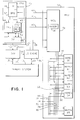
- FIG. 1 illustrates one embodiment of a computer system using a matrix unit (MXU) (or vector processor) according to the present invention.
- a central processing unit (CPU) 45 and the MXU 50 are coupled to main memory 10 through a storage control unit (SCU) 25 and a cache buffer memory (L2 cache) 35.
- the CPU 45 is coupled to the MXU 50 through an MXU instruction bus 43, an MXU address and count bus 42 and MXU storage request ID bus 41.
- the SCU 25 is connected to the main memory 10 by a memory address bus 15 and the SCU 25 is connected to the CPU 45 by an address bus 47.
- the cache 35 is connected to the main memory 10 by a memory data bus 20.
- the cache 35 is connected to the CPU 45 by a CPU data bus 37 and to the MXU by a MXU data bus 39.
- the CPU 45 is a general purpose processor composed of a branch unit (BRU) 57, a floating-point unit (FPU) 48, a fixed-point unit (FXU) 49, a level 1 instruction cache (IU) 46, and a level 1 data cache unit (DU) 44.
- the IU 46 and DU 44 are optional and only employed for performance reasons.
- the BRU 57 provides the control flow (determines which instruction is to be executed next) for the CPU 45 and MXU 50.
- the BRU 57 generates the address of the memory location of the next instruction to be executed. If the instruction is present in the IU 46 (it has recently been accessed), the instruction is fetched from the IU 46. If the instruction is not present in the IU 46, the BRU 57 generates a request for the location and sends the request to the SCU 25 via the L2 cache address bus 47.
- the SCU 25 contains a directory of the contents of the L2 cache 35.
- the SCU If the requested memory location is present in the L2 cache 35, then the SCU generates the controls necessary to access the location in the L2 cache 35 and communicates the access controls to the L2 cache via the L2 control bus 26.
- the L2 cache 35 performs the access and sends the contents of the location to the CPU 45 on the CPU data bus 37.
- the SCU 25 If the requested address is not present in the L2 cache 35, the SCU 25 generates a memory access request and sends the request to the memory system 10 on the memory address bus 15.
- the memory system accesses the requested location and returns the contents of the requested location the the L2 cache 35 on the memory data bus 20.
- the L2 cache 35 returns the contents of the requested memory location to the CPU 45 on the CPU data bus 37.
- the IU 46 Upon receiving the contents of the requested memory location the IU 46 forwards the instruction to the BRU 57 for dispatch and execution.
- the BRU 57 examines the next instruction to be executed and dispatches the instruction to the appropriate execution unit.
- Branch instructions are executed by the BRU 57.
- Scalar integer instructions are executed by the FXU 49.
- Scalar floating-point instructions are executed by the FPU 48.
- Vector instructions are executed by the MXU 50.
- Memory access instructions are executed jointly by the FXU 48 and the subject execution unit, where the FXU 48 generates the address of the load or store instruction and submits the request to the DU 44 (for FXU and FPU memory accesses) or to the SCU 25 (for MXU memory accesses).
- Vector instructions are dispatched by the BRU 57 to the MXU 50 on the MXU instruction bus 41.
- Vector memory access instructions are dispatched to both the MXU 50 and the FXU 49.
- vector memory access instructions are executed jointly by the FXU 49 and MXU 50.
- the FXU 49 computes the address of the memory access and forwards the memory request to the DU 44.
- the DU 44 performs a cache directory lookup to ensure the location requested is not present in the L1 data cache. If the memory location is present, that location is first flushed out to the L2 cache 35 to make it visible to the MXU memory access. Then the DU 44 forwards the memory access request to the SCU 25. Similar to instruction memory accesses, the SCU interrogates the L2 cache directory to determine if the requested memory location is present in the L2 cache.
- the memory location is requested from the memory system 10 and the contents are returned on the memory data bus 20 and placed in the L2 cache.
- MXU load instructions the contents of the requested memory location are returned to the MXU 50 on the MXU data bus 39.
- the SCU 25 informs the MXU 50 that load data is available on the MXU data bus 39 using the MXU-L2 cache control bus 54.
- MXU store instructions the SCU 25 and L2 cache 35 wait until the subject store data is presented on the MXU data bus 39 by the MXU 50 at which time the data is placed into the addressed memory location in the L2 cache 35.
- the MXCU 51 informs the SCU 25 that store data is available on the MXU data bus 39 using the MXU-L2 cache control bus 54.
- the matrix control unit (MXCU) 51 receives the instruction to be executed and places the instruction into an instruction queue for subsequent execution. When all required control information has been received (memory access instructions use the lower address bits for data alignment and element count from the FXU 49) the instruction drops into execution in the MXCU 51.
- the element count is contained in the Matrix Count Register (MCR) 53 and specifies the number of elements to be loaded or stored by the vector memory access instruction.
- the MXCU 51 sets up the appropriate command (a formatted version of the original instruction) and a processing element mask (identifying which MXPEs are to participate in executing the instruction) and dispatches that command (or series of commands) to the array of matrix processing elements (MXPE1 - MXPEK) on the MXPE command bus 70 for execution.
- the MXCU 51 receives the subject data from the L2 cache on the MXU data bus 39 and routes the data to the appropriate target MXPE data bus (or buses) to forward to the target MXPE (or MXPEs).
- the MXCU 51 eventually receives the subject store data from the source MXPE (or MXPEs) on its (their) respective MXPE data bus (or buses), routes the store data to the appropriate alignment and forwards the data to the L2 cache 35 on the MXU data bus 39.
- the MXCU 51 receives the result status (exception indications) from the MXPE(s) on the MXPE status bus 72. This status is captured in the matrix status and control register (MXSCR) 52 and forwarded to the BRU 57 on the MXU status bus 42 in the form of an interrupt request in the presence of maskable exception conditions.
- MXSCR matrix status and control register
- Every MXPE receives the command on the MXPE command bus 70.
- the MXCU also provides a mask with each command, identifying which MXPE(s) are to participate in the execution of an instruction.
- a subset of MXPEs can be selected due to a number of factors such as an element count less than the number of MXPEs, an unaligned memory access, or the program explicitly specifies a subset in the MXSCR's 52 start and end range fields.
- MXPEs that are masked off discard the instruction.
- MXPEs that are not masked off receive and queue the instruction for execution.
- the load data for selected MXPEs is received on their respective MXPE data bus with the load command.
- the selected MXPE(s) then place the load data into the target register.
- each selected MXPE accesses the source register, presenting the data on its MXPE data bus.
- each selected MXPE performs the requested arithmetic function in an SIMD fashion, obtaining the source operand(s) from the matrix registers (MXRs) and placing the result into the target MXR.
- Status for the arithmetic operation is placed into each of the selected MXPE's matrix condition register (MXCR) and a summary of the exceptions that occur are forwarded to the MXCU 51 on the MXPE status bus 72.
- MXCR matrix condition register
- FIG. 5 shows a more detailed view of the organization of the MXCU 51.
- the MXCU 51 is made up of three main components, an instruction control unit (ICU) 570 a load data unit (LDU) 560 and a store data unit (SDU) 550.
- the ICU 570 is composed of an instruction queue 571, command generation 572, and command dispatch 573.
- the instruction queue 571 is used to buffer MXU instructions that are dispatched from the CPU 45 until such a time all the prerequisite control information for the instruction has been received.
- An example of such prerequisite data is the element count for load and store instructions, indicating to the MXU 50 how many memory accesses are being set up by the CPU 45. Once all required prerequisite data has been collected the instruction proceeds to command generation 572.
- Command generation evaluates the subject instruction and related control information and sets up the appropriate command to be dispatched to the MXPEs that will properly and correctly execute the specified function.
- Such setup includes generating an MXPE mask based on the start and end range settings of the MXSCR 52 or the address alignment and element count of a memory access instruction. Any special register addressing modes can also be implemented in this stage.
- Command dispatch 573 assesses the current state of the MXU 50 to determine if the next command can be dispatched to the MXPEs. Performance enhancing techniques can be employed in this stage such as out-of-order dispatch if register dependencies will permit.
- the LDU 560 provides data buffering 504 for MXU load data that arrives before the load instruction is ready for execution.
- the LDU 560 then provides a network of multiplexors 508 intended to support routing load data to any arbitrary MXPE data bus port.
- the SDU 560 provides a network of multiplexors 534 intended to support routing store data from any arbitrary MXPE data bus port.
- a store data buffer 502 is provided to allow for MXU data bus 39 busy periods without stalling the MXPE data buses 74, 76, 78, 80.
- the MXU 50 provides certain distinctive advantages over currently available vector processors.
- Figure 2 shows a schematic representation of a currently available vector processing unit
- Figure 3 shows a schematic diagram of a matrix processing unit according to the present invention. A comparison of Figures 2 and 3 and the description herein will point out the differences and advantages of applicant's invention.
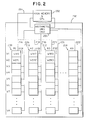
- FIG. 2 shows a schematic diagram of a vector processing unit 200 which receives data and instructions from a main memory and central processing unit of computing system 202 via data and control lines 204.
- Vector processing unit 200 contains at least one arithmetic unit (AU) 206.
- the arithmetic processing unit 206 can perform operations such as addition, multiplication and logical operations and the like.
- the vector processing unit 200 has a plurality of vector registers R1 to RN wherein N is greater than 1. Thus, the system has N vector registers. Four of these registers are shown in Figure 2 as registers 208, 210, 212 and 214.
- Each register R1 to RN contains words W1 to WK wherein K is greater than one and wherein each word has more than one bit of data. Thus each register contains K words.
- K is typically something like 64-256 words.
- N is typically 8-32 registers.
- Data or instructions are transferred from the main system 202 by means of data lines 204, 216, 218, 220 and 222. Each word is transferred to the word locations W1 to WK sequentially until each register is filled with data K words to form a vector of length K.
- a command is executed by AU 206 such as to add register 208 to register 210 and put the value into register 212.
- the words of each corresponding register location are added sequentially and the result deposited into the corresponding word location in register 3. For example, the word in word location W1 of register R1 that is word location W1R1 is transferred to the AU through data bus 224 and 226.
- the word in word location W1 of register R2, that is word location W1R2, is transferred to the AU 206 through data bus 228 and 230.
- the operation of W1R1 + W1R2 is performed in the AU 206 and the result is transferred through data lines 231 and 232 into word location W1 of register R3, that is W1R3.
- the next operation is to transfer the word W2R1 to the AU 206 and to transfer the word W2R2 to the AU 206 which performs the operation of W2R1 + W2R2 and deposits the result to word location W2R3.
- Sequential transfers are made from the word locations on each register R1 R2 from word location W1 to word location WK.
- the arithmetic operation and the vector processing unit 202 can have more than one arithmetic unit AU so that more than one transfer and more than one arithmetic operation can be done at a time.
- commonly used matrix vector processing units have no more than four arithmetic units AU, which means that four operations can be done at one time.
- One vector operation is the arithmetic combination of one vector such as in register R1 with the vector in register R2, such as addition, multiplication or a logical comparison and a transfer of the result into another vector such as R3.
- the number of machine cycles for such a vector instruction or operations is equal to the start up cycles for a vector instruction which is typically for such commonly available vector processors from 5-10 machine cycles plus the vector length K divided by the number of arithmetic units AU.
- the arithmetic unit is also referred to in the art as an arithmetic pipe.
- the minimal cycle time for a vector operation in such a vector processor is when the number of pipes is equal to the vector length, that is each word location such as W1 through WK has a pipe or an arithmetic unit associated with it. In such a case the cycle time per vector instruction is equal to the start up time for a vector operation which is from 5-10 machine cycles +1.
- the maximum number of cycles per vector instruction occurs when the number of pipe equals to 1, in which case the number of cycles per vector instruction is equal to the start up cycles which is from 5-10 machine cycles plus the vector length K.
- An enhanced bandwidth memory would be needed to utilize the K processing units 206 in order to achieve the minimum time of 5 to 10 cycles between vector operations. If Q is the bandwidth for one processing unit 206, the bandwidth must be K*Q for K processing units 206. Such an enhanced bandwidth memory requires greatly increased complexity and thereby cost. In contradistinction, processors, according to the present invention, do not need enhanced bandwidth memory to achieve one cycle time between vector operations and can achieve this with a bandwidth of Q.
- Vector operations are performed on at least one (typically two or three) vectors such as the negative, inverse or absolute value of one vector, addition or multiplication of two vectors or combinations of these arithmetic operations.
- Vector operations can be on more than two vectors such as the operation multiplying two vectors and adding a third vector which are done in one vector operation.
- a vector processing unit, according to the present invention, or matrix processing unit 300 is schematically shown in Figure 3 as 300.
- Processor unit 300 receives data and instructions from computing system 302 via data and control lines 304.
- N registers R1-RN there are N registers R1-RN, corresponding to N vectors and there are K words in each of these registers W1-WK for a vector length of K.
- All of the first word locations W1 of each of the registers R1-RN are contained within processing element 1 (PE1) designated as 302.
- the processing element 302 contains an arithmetic unit AU1 304.
- the second word W2 of each of the registers R1-RN are contained in processing element PE2 designated as 306.
- Processing element 306 contains arithmetic unit AU2 designated as 308.
- each word element (WI where I is to K) of each of the vectors is contained within a processing element which contains its own arithmetic unit.
- Each word element WI is contained in a resister having M locations to store M bits of data for an M bit word.
- each PE has N registers of M bits. Since the N vectors each having K words forms a KXN matrix of words. Therefore, the processor of Figure 3 is referred to herein as a matrix processor.
- matrix unit 50 includes the matrix control unit MXCU 52 and K processing elements MXPE1 through MXPEK.
- matrix processing elements are identified by numerals 54, 56, 58, 60, 62 and 64.
- the matrix control unit MCXU element 52 is connected to each of the matrix elements MXPE1 through MXPEK through command bus 66 and a plurality of data buses 68.
- the command bus 66 carries commands from the matrix control unit 52 to each of the processing elements MXPE1 through MXPEK.
- data control 68 are shown as elements 70, 72, 74 and 76.
- data control buses 68 can be shared between more than one matrix processing element (MXPE), for example, data control bus 76 is shared between matrix processing element MXPE1 and processing element MXPE5 as indicated by data control lines 80 and 82 respectively.
- the vector registers 402 correspond to registers of the single processing element 302 of Figure 3, for example, word locations W1R1 through W1RN.
- FIG. 5 shows a schematic diagram of the matrix control unit (MXCU) of Figure 1.
- An instruction is received from the MXU 50 instruction bus 43 by control unit 500 which determines, based on the type of instruction how to handle it which is either to store data into store buffer 502 or into the load buffer 504 and arithmetic instruction.
- Data is transferred to and from the MXU 50 via the CPU data bus 39.
- Data coming in along CPU data bus 39 goes to multiplexer 504 which upon receiving information from the CPU 45 routes the data along bus 506 to load buffer 504.
- the data in load buffer 504 is partitioned by switch 508 into data paths 510, 512, 514, 516.
- Each data path 510, 512, 514 and 516 goes to a multiplexer 518, 520, 522, 524, respectively, and from the multiplexers the data is transferred down the data buses 70, 72, 74 and 76. From the data buses 70, 72, 74 and 76 the data is transferred into the matrix processing elements MXPE1 through MXPEK.
- the data when data is transferred from the matrix processing elements MXPE1 through MXPEK the data is transferred through the data busses 70, 72, 74 and 76 into the multiplexers 518, 520, 522 and 524, respectively, and therefrom along data lines 526, 528, 530 and 532, respectively, through switch 534 from which the data is transferred into store buffer 502 through data line 534 through multiplexer 504 back through data bus 39 to CPU 45 of Figure 1.
- the multiplexer 504 has a two way input, the data bus 39 an two one way data lines 534 and 506.
- the other multiplexers 578, 520, 522 and 524 function similarly.
- FIG. 4 shows in greater detail a schematic diagram of one of the MXPEs of MXU 50 of Figure 1.
- Data bus 401 can be any of the data buses 74, 76, 78, or 80 of Figure 1. How NICA is going to talk to rest of the system (memory) will now be described.
- One key objective of the matrix unit according to the present invention is to reduce the memory BW bandwidth requirements. This can be achieved by a significant reuse of data loaded into the NICA registers. Therefore, the design point with respect to the BW (band width) between NICA and memory should be significantly less than a vector load/store (K ops) per cycle. We expect vector loads/stores to happen only at a rate of once in many cycles.
- K ops vector load/store
- the first component is an asynchronous transfer between the system and a NICA load/store buffer (LSB) 400 and the second component is a synchronous (SIMD) transfer between LSB 400 and NICA vector registers 402.
- LSB 400 is also distributed across all MXPEs of MXU 50.
- the number of locations provided per MXPE in LSB is another design parameter.
- the system calculates the addresses of the operands in memory, fetches them and tags the incoming data with the index of the destination MXPEs, and puts them on a bus (for higher bandwidth, multiple buses can be used, with each bus connected only to a subset of MXPEs).
- the destination MXPE latches the incoming data and puts it in the designated location of the LSB 400..
- the controller 404 initiates a SIMD transfer of data from LSB 400 to the designated vector register(s).
- the vector store works similarly but in reverse. Because of data reuse, it is expected that vector load/stores will be infrequent, and NICA will continue to do register to register RR vector arithmetic on data in registers.
- NICA For NICA to be applicable in solving a NIC problem, there are two key requirements: vectorization and data reuse. Most traditional vector operations can be implemented on NICA in a SIMD fashion. However, there are some exceptions. Those vector operations which require interaction between different elements of a vector can not be done in a SIMD fashion.
- An important example of such an instruction is vector accumulate (multiply-accumulate is similar to accumulate). In accumulate, we do sum reduction of a vector. Because of the arithmetic pipeline, even on a vector machine this is not very efficient. In accumulating a very long vector, every eighth (for example) element of the vector is accumulated in one of the accumulators. This phase of the operation is completed at the full vector speed.
- SIMD vector compares can be used to reduce the problem size to K. Thus, most of the work can be done in high performance SIMD mode.
- FORTRAN-90 An extension of FORTRAN called FORTRAN-90 has been defined. It provides facilities to do array arithmetic. Programs written in FORTRAN-90 can be easily compiled for NICA.
- LAPACK is a public domain software to do linear algebraic computations. It replaces LINPACK and EISPACK packages and significantly enhances them. It is being written for very high performance on most currently available computers. Because of its high performance, most users of linear algebra subroutines as well as other commercial software packages such as NAG, are migrating to LAPACK. The key idea behind the LAPACK project is that high performance can not be achieved unless most computing is done in BLAS-3. BLAS-3 is a set of linear algebra kernels which typically do order of N**3 computing on order of N**2 data points. LAPACK code is portable and makes use of tuned (for the specific machine) BLAS-3 kernels provided by the computer manufacturers.
- DGEMM matrix-matrix multiplication with update
- DGEMM does the following computing: C ⁇ -- C + A*B It is assumed that there is some outer level blocking on C suchthat at a time, we are computing on a block of C of size K byP, where P is less than N, the number of vector registers availablein NICA. In that case, this block of the C matrix fits in NICAregisters. Assume A is of size K by L, L is the middle dimensionof the problem. Then, the above computing amounts to doing arank-L update on the C matrix. This can be done in L steps.For each rank-1 update, we need one column of the A matrix (K elements)and one row of the B matrix (P elements). These K + P elementsare brought into NICA and used to generate 2*P*K flops.
- Theflops to data ratio for this problem is 2/(1/K + 1/P) . If bothK and P are large, this becomes a very compute intensive problem.
- the memory BW between NICA and the system must be large enough tosupport (K+P) data transfers while doing 2*K*P flops. Assumingthat 2*K flops can be done in one cycle, we need data transferrate of at least (1 + K/P) elements per cycle.This does not take into account initial loading and final storingof the C matrix.If L is large, this extra overhead becomes small.
- High performance graphics also tend to have highFDR and are vectorizable. These applications can also benefit from NICA.
Landscapes
- Engineering & Computer Science (AREA)
- Computer Hardware Design (AREA)
- Theoretical Computer Science (AREA)
- Computing Systems (AREA)
- Physics & Mathematics (AREA)
- General Engineering & Computer Science (AREA)
- General Physics & Mathematics (AREA)
- Complex Calculations (AREA)
Applications Claiming Priority (2)
| Application Number | Priority Date | Filing Date | Title |
|---|---|---|---|
| US21753394A | 1994-03-24 | 1994-03-24 | |
| US217533 | 1994-03-24 |
Publications (2)
| Publication Number | Publication Date |
|---|---|
| EP0675450A2 true EP0675450A2 (fr) | 1995-10-04 |
| EP0675450A3 EP0675450A3 (fr) | 1995-11-15 |
Family
ID=22811461
Family Applications (1)
| Application Number | Title | Priority Date | Filing Date |
|---|---|---|---|
| EP95100960A Withdrawn EP0675450A3 (fr) | 1994-03-24 | 1995-01-25 | Processeur à architecture parallèle pour le calcul numérique intensif |
Country Status (3)
| Country | Link |
|---|---|
| US (1) | US5825677A (fr) |
| EP (1) | EP0675450A3 (fr) |
| JP (1) | JPH07271764A (fr) |
Cited By (2)
| Publication number | Priority date | Publication date | Assignee | Title |
|---|---|---|---|---|
| EP0945992A1 (fr) * | 1998-03-27 | 1999-09-29 | TTP Communications Limited | Processeur à architecture parallèle pour AMDC |
| US11922292B2 (en) | 2020-01-27 | 2024-03-05 | Google Llc | Shared scratchpad memory with parallel load-store |
Families Citing this family (33)
| Publication number | Priority date | Publication date | Assignee | Title |
|---|---|---|---|---|
| US5953241A (en) * | 1995-08-16 | 1999-09-14 | Microunity Engeering Systems, Inc. | Multiplier array processing system with enhanced utilization at lower precision for group multiply and sum instruction |
| US6295599B1 (en) * | 1995-08-16 | 2001-09-25 | Microunity Systems Engineering | System and method for providing a wide operand architecture |
| US7301541B2 (en) | 1995-08-16 | 2007-11-27 | Microunity Systems Engineering, Inc. | Programmable processor and method with wide operations |
| US5742840A (en) | 1995-08-16 | 1998-04-21 | Microunity Systems Engineering, Inc. | General purpose, multiple precision parallel operation, programmable media processor |
| US6643765B1 (en) * | 1995-08-16 | 2003-11-04 | Microunity Systems Engineering, Inc. | Programmable processor with group floating point operations |
| US7100026B2 (en) | 2001-05-30 | 2006-08-29 | The Massachusetts Institute Of Technology | System and method for performing efficient conditional vector operations for data parallel architectures involving both input and conditional vector values |
| US6269435B1 (en) * | 1998-09-14 | 2001-07-31 | The Board Of Trustees Of The Leland Stanford Junior University | System and method for implementing conditional vector operations in which an input vector containing multiple operands to be used in conditional operations is divided into two or more output vectors based on a condition vector |
| US6336183B1 (en) * | 1999-02-26 | 2002-01-01 | International Business Machines Corporation | System and method for executing store instructions |
| US6901422B1 (en) | 2001-03-21 | 2005-05-31 | Apple Computer, Inc. | Matrix multiplication in a vector processing system |
| US20030145030A1 (en) * | 2002-01-31 | 2003-07-31 | Sheaffer Gad S. | Multiply-accumulate accelerator with data re-use |
| US7475101B2 (en) | 2003-09-29 | 2009-01-06 | International Business Machines Corporation | Method and structure for producing high performance linear algebra routines using streaming |
| US7490120B2 (en) * | 2003-09-29 | 2009-02-10 | International Business Machines Corporation | Method and structure for producing high performance linear algebra routines using a selectable one of six possible level 3 L1 kernel routines |
| US7487195B2 (en) | 2003-09-29 | 2009-02-03 | International Business Machines Corporation | Method and structure for producing high performance linear algebra routines using composite blocking based on L1 cache size |
| US7469266B2 (en) * | 2003-09-29 | 2008-12-23 | International Business Machines Corporation | Method and structure for producing high performance linear algebra routines using register block data format routines |
| US20050071405A1 (en) * | 2003-09-29 | 2005-03-31 | International Business Machines Corporation | Method and structure for producing high performance linear algebra routines using level 3 prefetching for kernel routines |
| US7571435B2 (en) * | 2003-09-29 | 2009-08-04 | International Business Machines Corporation | Method and structure for producing high performance linear algebra routines using preloading of floating point registers |
| US7386582B2 (en) * | 2003-09-29 | 2008-06-10 | International Business Machines Corporation | Method and structure for producing high performance linear algebra routines using a hybrid full-packed storage format |
| US7386703B2 (en) | 2003-11-18 | 2008-06-10 | International Business Machines Corporation | Two dimensional addressing of a matrix-vector register array |
| US20060161612A1 (en) * | 2005-01-14 | 2006-07-20 | International Business Machines Corporation | Method and structure for a generalized cache-register file interface with data restructuring methods for multiple cache levels and hardware pre-fetching |
| US20060168401A1 (en) * | 2005-01-26 | 2006-07-27 | International Business Machines Corporation | Method and structure for high-performance linear algebra in the presence of limited outstanding miss slots |
| JP4893621B2 (ja) * | 2005-05-20 | 2012-03-07 | ソニー株式会社 | 信号処理装置 |
| US9513905B2 (en) * | 2008-03-28 | 2016-12-06 | Intel Corporation | Vector instructions to enable efficient synchronization and parallel reduction operations |
| US8755515B1 (en) | 2008-09-29 | 2014-06-17 | Wai Wu | Parallel signal processing system and method |
| SE1151231A1 (sv) * | 2011-12-20 | 2013-05-07 | Mediatek Sweden Ab | Digital signalprocessor och basbandskommunikationsanordning |
| SE537552C2 (sv) * | 2011-12-21 | 2015-06-09 | Mediatek Sweden Ab | Digital signalprocessor |
| US8856420B2 (en) * | 2011-12-27 | 2014-10-07 | Intel Corporation | Multi-protocol I/O interconnect flow control |
| EP2965194A4 (fr) * | 2013-03-05 | 2016-11-30 | Intel Corp | Analyse des avantages potentiels de la vectorisation |
| US9477477B2 (en) * | 2014-01-22 | 2016-10-25 | Nvidia Corporation | System, method, and computer program product for executing casting-arithmetic instructions |
| US10996959B2 (en) * | 2015-01-08 | 2021-05-04 | Technion Research And Development Foundation Ltd. | Hybrid processor |
| JP6231155B2 (ja) * | 2016-05-02 | 2017-11-15 | インテル・コーポレーション | ベクトル散乱演算機能及びベクトル収集演算機能を提供する命令及びロジック |
| US10489063B2 (en) * | 2016-12-19 | 2019-11-26 | Intel Corporation | Memory-to-memory instructions to accelerate sparse-matrix by dense-vector and sparse-vector by dense-vector multiplication |
| US10261786B2 (en) * | 2017-03-09 | 2019-04-16 | Google Llc | Vector processing unit |
| US11921559B2 (en) * | 2021-05-03 | 2024-03-05 | Groq, Inc. | Power grid distribution for tensor streaming processors |
Family Cites Families (12)
| Publication number | Priority date | Publication date | Assignee | Title |
|---|---|---|---|---|
| JPS58114274A (ja) * | 1981-12-28 | 1983-07-07 | Hitachi Ltd | デ−タ処理装置 |
| JPS58134357A (ja) * | 1982-02-03 | 1983-08-10 | Hitachi Ltd | ベクトルプロセッサ |
| JPH0652530B2 (ja) * | 1982-10-25 | 1994-07-06 | 株式会社日立製作所 | ベクトル・プロセッサ |
| JPS59111569A (ja) * | 1982-12-17 | 1984-06-27 | Hitachi Ltd | ベクトル処理装置 |
| US4594682A (en) * | 1982-12-22 | 1986-06-10 | Ibm Corporation | Vector processing |
| JPS6027984A (ja) * | 1983-07-27 | 1985-02-13 | Hitachi Ltd | デ−タ処理装置 |
| JPS6057467A (ja) * | 1983-09-09 | 1985-04-03 | Nec Corp | ベクトルデ−タ処理装置 |
| JPS6077265A (ja) * | 1983-10-05 | 1985-05-01 | Hitachi Ltd | ベクトル処理装置 |
| CA1233260A (fr) * | 1985-03-13 | 1988-02-23 | Chuck H. Ngai | Processeur vectoriel parallele a haute performance a configuration de registre vectoriel/processeur d'elements modifiee |
| US5010477A (en) * | 1986-10-17 | 1991-04-23 | Hitachi, Ltd. | Method and apparatus for transferring vector data between parallel processing system with registers & logic for inter-processor data communication independents of processing operations |
| JPH04336378A (ja) * | 1991-05-14 | 1992-11-24 | Nec Corp | 情報処理装置 |
| US5274818A (en) * | 1992-02-03 | 1993-12-28 | Thinking Machines Corporation | System and method for compiling a fine-grained array based source program onto a course-grained hardware |
-
1994
- 1994-12-20 JP JP6316800A patent/JPH07271764A/ja active Pending
-
1995
- 1995-01-25 EP EP95100960A patent/EP0675450A3/fr not_active Withdrawn
-
1996
- 1996-03-20 US US08/619,456 patent/US5825677A/en not_active Expired - Fee Related
Cited By (3)
| Publication number | Priority date | Publication date | Assignee | Title |
|---|---|---|---|---|
| EP0945992A1 (fr) * | 1998-03-27 | 1999-09-29 | TTP Communications Limited | Processeur à architecture parallèle pour AMDC |
| US11922292B2 (en) | 2020-01-27 | 2024-03-05 | Google Llc | Shared scratchpad memory with parallel load-store |
| US12367383B2 (en) | 2020-01-27 | 2025-07-22 | Google Llc | Shared scratchpad memory with parallel load-store |
Also Published As
| Publication number | Publication date |
|---|---|
| EP0675450A3 (fr) | 1995-11-15 |
| US5825677A (en) | 1998-10-20 |
| JPH07271764A (ja) | 1995-10-20 |
Similar Documents
| Publication | Publication Date | Title |
|---|---|---|
| US5825677A (en) | Numerically intensive computer accelerator | |
| CN111381880B (zh) | 一种处理器、介质和处理器的操作方法 | |
| US7818539B2 (en) | System and method for performing efficient conditional vector operations for data parallel architectures involving both input and conditional vector values | |
| US5513366A (en) | Method and system for dynamically reconfiguring a register file in a vector processor | |
| CN111381939B (zh) | 多线程处理器中的寄存器文件 | |
| US6301653B1 (en) | Processor containing data path units with forwarding paths between two data path units and a unique configuration or register blocks | |
| US5261113A (en) | Apparatus and method for single operand register array for vector and scalar data processing operations | |
| US7072929B2 (en) | Methods and apparatus for efficient complex long multiplication and covariance matrix implementation | |
| US5659722A (en) | Multiple condition code branching system in a multi-processor environment | |
| US5559973A (en) | Data processing system and method thereof | |
| US9015354B2 (en) | Efficient complex multiplication and fast fourier transform (FFT) implementation on the ManArray architecture | |
| US5574933A (en) | Task flow computer architecture | |
| US20070271325A1 (en) | Matrix multiply with reduced bandwidth requirements | |
| EP0180048B1 (fr) | Processeur arithmétique ayant une fonction d'accumulation parallèle | |
| EP0588341B1 (fr) | Processeur de données | |
| US20210042127A1 (en) | Group Load Register of a Graph Streaming Processor | |
| US20030172248A1 (en) | Synergetic computing system | |
| Liang et al. | TCX: A RISC style tensor computing extension and a programmable tensor processor | |
| Smitley et al. | Bit-serial SIMD on the CM-2 and the Cray-2 | |
| KR19980053029A (ko) | 계층 버퍼 구조를 갖는 파이프라인 시스템 | |
| Schönauer et al. | Could user-friendly supercomputers be designed? | |
| KR100226694B1 (ko) | 복수 파이프라인 구조 및 복수 파이프라이닝 방법 | |
| Evripidou et al. | A decoupled data-driven architecture with vectors and macro actors | |
| Martin | Canonical variate analysis of large scale systems on a transputer array | |
| KR20250125412A (ko) | 데이터흐름 그래프(dfg)로 표현된 계산 작업의 정적 데이터흐름 실행을 위한 다형성 컴퓨팅 패브릭 |
Legal Events
| Date | Code | Title | Description |
|---|---|---|---|
| PUAI | Public reference made under article 153(3) epc to a published international application that has entered the european phase |
Free format text: ORIGINAL CODE: 0009012 |
|
| PUAL | Search report despatched |
Free format text: ORIGINAL CODE: 0009013 |
|
| AK | Designated contracting states |
Kind code of ref document: A2 Designated state(s): DE FR GB |
|
| AK | Designated contracting states |
Kind code of ref document: A3 Designated state(s): DE FR GB |
|
| STAA | Information on the status of an ep patent application or granted ep patent |
Free format text: STATUS: THE APPLICATION HAS BEEN WITHDRAWN |
|
| 18W | Application withdrawn |
Withdrawal date: 19960716 |