EP0675608A2 - Verfahren und Anordnung zur Kontrolle der Filterkoeffizienten eines adaptiven signalangepassten Filters in einem automatischen Entzerrer - Google Patents
Verfahren und Anordnung zur Kontrolle der Filterkoeffizienten eines adaptiven signalangepassten Filters in einem automatischen Entzerrer Download PDFInfo
- Publication number
- EP0675608A2 EP0675608A2 EP95104557A EP95104557A EP0675608A2 EP 0675608 A2 EP0675608 A2 EP 0675608A2 EP 95104557 A EP95104557 A EP 95104557A EP 95104557 A EP95104557 A EP 95104557A EP 0675608 A2 EP0675608 A2 EP 0675608A2
- Authority
- EP
- European Patent Office
- Prior art keywords
- detection signal
- status
- weighting coefficient
- output
- tap
- Prior art date
- Legal status (The legal status is an assumption and is not a legal conclusion. Google has not performed a legal analysis and makes no representation as to the accuracy of the status listed.)
- Granted
Links
- 230000003044 adaptive effect Effects 0.000 title claims abstract description 30
- 238000000034 method Methods 0.000 title claims description 8
- 238000001514 detection method Methods 0.000 claims abstract description 49
- 230000001360 synchronised effect Effects 0.000 claims abstract description 32
- 238000012935 Averaging Methods 0.000 claims abstract description 5
- 230000008859 change Effects 0.000 claims description 22
- 230000003247 decreasing effect Effects 0.000 claims description 9
- 230000003213 activating effect Effects 0.000 claims 1
- 238000005562 fading Methods 0.000 abstract description 7
- 238000010586 diagram Methods 0.000 description 8
- 238000010276 construction Methods 0.000 description 6
- 238000004891 communication Methods 0.000 description 5
- 230000002596 correlated effect Effects 0.000 description 5
- 230000003111 delayed effect Effects 0.000 description 4
- 230000004044 response Effects 0.000 description 4
- 230000001276 controlling effect Effects 0.000 description 3
- 230000007423 decrease Effects 0.000 description 3
- 230000007246 mechanism Effects 0.000 description 3
- 230000015556 catabolic process Effects 0.000 description 2
- 238000006731 degradation reaction Methods 0.000 description 2
- 238000013459 approach Methods 0.000 description 1
- 230000000875 corresponding effect Effects 0.000 description 1
- 230000000694 effects Effects 0.000 description 1
- 230000008569 process Effects 0.000 description 1
Images



Classifications
-
- H—ELECTRICITY
- H04—ELECTRIC COMMUNICATION TECHNIQUE
- H04L—TRANSMISSION OF DIGITAL INFORMATION, e.g. TELEGRAPHIC COMMUNICATION
- H04L25/00—Baseband systems
- H04L25/02—Details ; arrangements for supplying electrical power along data transmission lines
- H04L25/03—Shaping networks in transmitter or receiver, e.g. adaptive shaping networks
- H04L25/03006—Arrangements for removing intersymbol interference
- H04L25/03012—Arrangements for removing intersymbol interference operating in the time domain
- H04L25/03019—Arrangements for removing intersymbol interference operating in the time domain adaptive, i.e. capable of adjustment during data reception
- H04L25/03057—Arrangements for removing intersymbol interference operating in the time domain adaptive, i.e. capable of adjustment during data reception with a recursive structure
-
- H—ELECTRICITY
- H04—ELECTRIC COMMUNICATION TECHNIQUE
- H04L—TRANSMISSION OF DIGITAL INFORMATION, e.g. TELEGRAPHIC COMMUNICATION
- H04L25/00—Baseband systems
- H04L25/02—Details ; arrangements for supplying electrical power along data transmission lines
- H04L25/03—Shaping networks in transmitter or receiver, e.g. adaptive shaping networks
- H04L25/03006—Arrangements for removing intersymbol interference
- H04L2025/0335—Arrangements for removing intersymbol interference characterised by the type of transmission
- H04L2025/03375—Passband transmission
-
- H—ELECTRICITY
- H04—ELECTRIC COMMUNICATION TECHNIQUE
- H04L—TRANSMISSION OF DIGITAL INFORMATION, e.g. TELEGRAPHIC COMMUNICATION
- H04L25/00—Baseband systems
- H04L25/02—Details ; arrangements for supplying electrical power along data transmission lines
- H04L25/03—Shaping networks in transmitter or receiver, e.g. adaptive shaping networks
- H04L25/03006—Arrangements for removing intersymbol interference
- H04L2025/03433—Arrangements for removing intersymbol interference characterised by equaliser structure
- H04L2025/03439—Fixed structures
- H04L2025/03445—Time domain
- H04L2025/03471—Tapped delay lines
- H04L2025/03484—Tapped delay lines time-recursive
- H04L2025/0349—Tapped delay lines time-recursive as a feedback filter
-
- H—ELECTRICITY
- H04—ELECTRIC COMMUNICATION TECHNIQUE
- H04L—TRANSMISSION OF DIGITAL INFORMATION, e.g. TELEGRAPHIC COMMUNICATION
- H04L25/00—Baseband systems
- H04L25/02—Details ; arrangements for supplying electrical power along data transmission lines
- H04L25/03—Shaping networks in transmitter or receiver, e.g. adaptive shaping networks
- H04L25/03006—Arrangements for removing intersymbol interference
- H04L2025/03592—Adaptation methods
- H04L2025/03598—Algorithms
- H04L2025/03681—Control of adaptation
Definitions
- the present invention relates to an automatic equalizer used for a digital radio communication system, especially to an automatic equalizer comprising an adaptive matched filter and a decision feedback equalizer to remove an intersymbol interference due to radio channel fading and a method for controlling tap coefficients used therein.
- a conventional digital radio communication system has been so proposed to combine an adaptive matched filter (AMF) and a decision feedback equalizer (DFE) at a receiver side to compensate degradation of the channel quality due to frequency selective fading environment generated on a propagation path (See Paper No.B-929, Spring National Convention of Electronic Information Communication Society, 1989).
- AMF adaptive matched filter
- DFE decision feedback equalizer
- Fig.4 is a block diagram of a conventional automatic equalizer as a first example of a prior art.
- a reference numeral 1 is an A/D converter.
- Reference numerals 2 and 3 are delay circuits which delay a symbol space by T.
- Reference numerals 4 to 6 are multipliers.
- Reference numeral 7 is an adder, 8 to 10 are correlators, 11 to 13 are integrators, 101 is a demodulator, 201 is a transversal filter, and 301 is a decision feedback equalizer (DFE).
- DFE decision feedback equalizer
- the adaptive matched filter of a T space 3 tap type is composed of the transversal filter 201, the correlators 8 to 10, and the integrators 11 to 13.
- the demodulator 101 demodulates a received signal, and a demodulated signal is sample-quantized by the A/D converter 1.
- the sample-quantized digital signal string output from the A/D converter 1 is input to the transversal filter 201, then delayed by the delay circuits 2 and 3 sequentially.
- An input signals of the transversal filter 201 and output signals of the delay circuits 2 and 3 are respectively input to the multipliers 4 to 6 where they are multiplied by tap coefficients A ⁇ 1, A0, and A+1, respectively.
- Outputs of the multipliers 4 to 6 are added through the adder 7.
- the output of the adder 7 is input to the DFE 301 where the intersymbol interference is equalized and decided.
- a decision signal 104 output from the DFE 301 is input to the correlators 8 to 10 where the decision signal 104, the input signal of the transversal filter 201 and output signals of the delay circuits 2 and 3 are correlated.
- the respective mean values of outputs of the correlators 8 to 10 are obtained through the integrators 11 to 13 to define new tap coefficients A ⁇ 1, A0, and A+1, of the transversal filter 201.
- Fig.6 shows waveforms of the output response in case of ⁇ >1.
- Fig.7 shows waveforms of the output response in case of ⁇ 1.
- the adaptive matched filter serves to disperse the interference wave component due to frequency selective fading generated on the propagation path ahead and behind the main wave component, respectively as shown by Figs. 6 and 7.
- the AMF enables the preceding wave as the interference component to be dispersed ahead and behind the main wave.
- the interference wave component preceding the main wave that is difficult to be equalized by the DFE located behind the AMF is converted into that behind the main wave, thus the equalization characteristic of this case can be improved.
- Fig.5 is a block diagram of the second example of the conventional automatic equalizer.
- the same construction items as those shown by Fig.4 have the same reference numerals, thus omitting their explanations.
- reference numerals 30 and 31 are multipliers, 32 is a control signal generator, and 402 is a control circuit.
- the control signal generator 32 monitors outputs of the integrators 11 to 13 which represent impulse responses on the propagation path to determine the status thereof.
- control signal generator 32 If the propagation path status is determined as ⁇ >1, the control signal generator 32 outputs 1 to the multipliers 15 and 16, respectively to operate the AMF and DFE in the same manner as described in the first example. While if determined as ⁇ 1, it gradually decreases the value output to the multipliers 30 and 31 to 0 so as to operate the DFE unity only.
- the AMF generates outputs without diverging the interference wave as Figs. 8 and 9 show.
- Adding the control circuit 402 provides higher equalization characteristic with the automatic equalizer compared with the first example on the propagation path status in case of both ⁇ >1 and ⁇ 1.
- the AMF is reset (suspended) and DFE unity is only operated. So the interference wave component is not dispersed by the AMF, requiring some DFE taps to have substantially a great value.
- the equalization characteristic is degraded during pull-in status.
- an automatic equalizer comprising a demodulator for outputting a detection signal which indicates synchronous status as well as demodulating analog base band signals from received signals, an A/D converter for outputting a first digital signal string by sample-quantizing the analog base band signals, an adaptive matched filter for outputting a second digital signal string by converting the first digital signal string, a decision feedback equalizer for outputting a decision signal by equalizing intersymbol interferences in the second digital signal string, a correlator for correlating the decision signal with a signal on each tap of the adaptive matched filter, an integrator for averaging outputs of the correlator, and a control means for outputting each tap coefficient of the adaptive matched filter derived from multiplying an output of the integrator by a weighting coefficient based on the detection signal.
- the principle of the automatic equalizer of the present invention is described below.
- the interference wave precedes the main wave, so the tap in the plus side (hereinafter referred to as “plus tap(s)”) (more remotely from the input than the center tap) is correlated.
- the tap in the minus side hereinafter referred to as “minus tap(s)" (closer to the input than the center tap) is hardly correlated.
- the interference wave is behind the main wave, so the minus tap among the AMF taps is correlated to increase the value of its tap coefficient. At this time the plus tap is hardly correlated.
- the operation of the AMF minus tap is reset when the control is loop pulled-in, i.e., the demodulator is in synchronous status.
- the interference wave component is symmetrically dispersed through the AMF plus tap in case of ⁇ >1. While in case of ⁇ 1, the AMF outputs almost the same signals as input signals.
- the control loop When the control loop is divergent, i.e., the modulator is in asynchronous status, all taps of the AMF are enabled to improve the pull-in property. Once the control loop has been pulled-in, the AMF minus tap coefficient is gradually decreased at a rate lower than the tracking rate of DFE control. The operation of the AMF is, thus, suspended to enter into normal equalization.
- the AMF minus tap becomes active only in the repulling-in process after the control loop has diverged. Then the AMF operation is suspended so as to facilitate pull-in operation for the automatic equalizer.
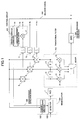
- Fig.1 is a block diagram of an embodiment of the present invention.
- the same construction items as those shown by Fig.4 have the same reference numerals, thus omitting their explanations.
- taps of a transversal filter 201 are divided into a center tap A0, minus taps A ⁇ 1 located at signal input side, and plus taps A+1 located at signal output side.
- a demodulator 101 in Fig.1 comprises a carrier reproduction section 102 and a detector 103.
- the carrier reproduction section 102 reproduces the carrier by means of decision signals and error signals output from the DFE 301. It also outputs a detection signal 105 indicating synchronous status of carrier reproduction. More specifically when the carrier reproduction is in synchronous status, the output detection signal 105 indicates synchronous status. On the contrary when it is in asynchronous due to divergence in the carrier reproduction loop, the detection signal 105 indicates the asynchronous status.
- the detector 103 demodulates the reproduced carrier output from the carrier reproduction section 102 and output an analog base band signal to A/D converter 1.
- a control circuit 401 comprises a weighting coefficient generator 14, a weighting coefficient control circuit 16, and a multiplier 17.
- the detection signal 105 output from the carrier reproduction section 102 is input to the weighting coefficient generator 14. In case the detection signal 105 indicates the synchronous status, it outputs the weighting coefficient 0. While in case the detection signal 105 indicates asynchronous status, it outputs the weighting coefficient 1.
- the weighting coefficient control circuit 16 controls weighting coefficients output from the weighting coefficient generator 14 based on the detection signal 105.
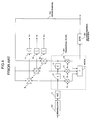
- Fig.2 is a block diagram of the weighting coefficient control circuit 16.
- a reference numeral 21 is a change amount set circuit
- 22 and 23 are selectors
- 24 is a flip-flop
- 25 is a subtracter
- 26 is a detector.
- change amount of the weighting coefficient is so set that the rate at which the weighting coefficient decreases from 1 to 0 is lower than the tracking rate of the DFE 301 control accompanied with the change in the status of the demodulator 101 from asynchronous to synchronous.
- the selector 22 receives a weighting coefficient output from the weighting coefficient generator 14 and a feedback value from the subtracter 25. In case the detection signal 105 indicates the synchronous status, the feedback value from the subtracter 25 is selected to be output. In case it indicates asynchronous status, the weighting coefficient output from the weighting coefficient generator 14 is selected to be output.
- the selector 23 receives a change amount output from the change amount set circuit 21 and a value 0. In case the detection signal 105 indicates synchronous status, the change amount output from the change amount set circuit 21 is selected to be output. In case it indicates asynchronous status, the value 0 is selected to be output.
- the flip-flop 24 retains the value output from the selector 22, and outputs it upon receiving the next value.
- the subtracter 25 subtracts an output value of the selector 22 from that of the flip-flop 24.
- the detector 26 monitors the feedback value from the subtracter 25. In case the feedback value is 0, it outputs a detection signal to the selector 22 to cause the weighting coefficient generator 14 to output the weighting coefficient and outputs a detection signal to the selector 23 to output the value 0.
- the multiplier 17 multiplies an output of the correlator 11 by the output of the weighting coefficient control circuit 16 and output a result as a coefficient of the tap A ⁇ 1.
- the carrier reproduction section 102 outputs a detection signal 105 indicating asynchronous status to the weighting coefficient generator 14 and the weighting coefficient control circuit 16.
- the weighting coefficient generator 14 Upon receiving the detection signal 105, the weighting coefficient generator 14 outputs the weighting coefficient 1.
- the selector 22 that receives the detection signal 105 selects the weighting coefficient 1 output from the weighting coefficient generator 14 to be output.
- the selector 23 selects 0 to be output to the subtracter 25.
- the subtracter 25 subtracts 0 from the weighting coefficient 1 that has been input via the flip-flop 24. It outputs the resultant weighting coefficient 1.
- the multiplier 17 multiplies the weighting coefficient 1 by an output of the correlator 11.
- the resultant value is output as the coefficient of the tap A ⁇ 1.
- the weighting coefficient 1 is output to make the tap A ⁇ 1 of the AMF active.
- the carrier reproduction section 102 outputs a detection signal 105 indicating synchronous status to the weighting coefficient generator 14 and the weighting coefficient control circuit 16.
- the weighting coefficient generator 14 Upon receiving the detection signal 105, the weighting coefficient generator 14 outputs the weighting coefficient 0.
- the selector 22 that has received the detection signal 105 selects the feedback value from the subtracter 25 (Since the flip-flop 24 retains the value 1, the initial value is derived form subtracting the change amount from 1, i.e., 1 - change amount.), and outputs it.
- the selector 23 selects the change amount output from the change amount set circuit 21 to be output to the subtracter 25.
- the subtracter 25 subtracts the change amount from the input value via the flip-flop 24. That is, the output value decreases by the change amount at every subtraction.
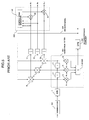
- the rate required for the change is lower than the tracking rate of the DFE 301 control.
- Fig.3 shows how this change has been done.
- the multiplier 17 multiplies the output value of the correlator 11 by the weighting coefficient to be output as the coefficient of the tap A ⁇ 1.
- the detector 26 outputs detection signals to the selectors 22 and 23.
- the selector 22 selects the output of the weighting coefficient generator 14, i.e., 1, and the selector 23 selects 0 to be output, respectively.
- the subtracter 25 subtracts the value 0 that is output by the weighting coefficient generator 14 from the value 0 that is output by the selector 23, i.e. "0".
- the weighting coefficient is decreased from 1 to 0 at a rate lower than the tracking rate of the DFE 301 control, the operation of tap A ⁇ 1 of the AMF is stoped.
- the above explanation relates to a transversal filter of 3 tap type as a simple example.
- all taps of the AMF are operated while the control loop is pulled-in. Once the control loop has been pulled-in, a tap coefficient for the minus tap of the AMF is gradually decreased at a rate lower than the tracking rate of the DFE control to stop operation of the AMF.
- the above construction realizes the automatic equalizer with excellent equalization characteristic and improved pull-in property for the control loop under fading on the propagation path status either in ⁇ >1 or ⁇ 1.
Landscapes
- Engineering & Computer Science (AREA)
- Power Engineering (AREA)
- Computer Networks & Wireless Communication (AREA)
- Signal Processing (AREA)
- Cable Transmission Systems, Equalization Of Radio And Reduction Of Echo (AREA)
- Filters That Use Time-Delay Elements (AREA)
Applications Claiming Priority (3)
| Application Number | Priority Date | Filing Date | Title |
|---|---|---|---|
| JP57589/94 | 1994-03-28 | ||
| JP5758994 | 1994-03-28 | ||
| JP5758994 | 1994-03-28 |
Publications (3)
| Publication Number | Publication Date |
|---|---|
| EP0675608A2 true EP0675608A2 (de) | 1995-10-04 |
| EP0675608A3 EP0675608A3 (de) | 2000-09-13 |
| EP0675608B1 EP0675608B1 (de) | 2004-12-01 |
Family
ID=13060042
Family Applications (1)
| Application Number | Title | Priority Date | Filing Date |
|---|---|---|---|
| EP95104557A Expired - Lifetime EP0675608B1 (de) | 1994-03-28 | 1995-03-28 | Verfahren und Vorrichtung zum Steuern der Filterkoeffizienten eines adaptiven signalangepassten Filters in einem automatischen Entzerrer |
Country Status (3)
| Country | Link |
|---|---|
| US (1) | US5668832A (de) |
| EP (1) | EP0675608B1 (de) |
| DE (1) | DE69533816T2 (de) |
Cited By (4)
| Publication number | Priority date | Publication date | Assignee | Title |
|---|---|---|---|---|
| WO2006036663A1 (en) * | 2004-09-27 | 2006-04-06 | Intel Corporation | Feed forward equalizer |
| WO2006036662A3 (en) * | 2004-09-27 | 2006-07-13 | Intel Corp | Feed forward equalizer for a communication system |
| GB2422989A (en) * | 2005-02-03 | 2006-08-09 | Agilent Technologies Inc | Correlating a received data signal with a time delayed version of the signal to obtain a measurement of inter-symbol interference |
| WO2008115702A1 (en) * | 2007-03-21 | 2008-09-25 | Freescale Semiconductor Inc. | Adaptive equalizer for communication channels |
Families Citing this family (4)
| Publication number | Priority date | Publication date | Assignee | Title |
|---|---|---|---|---|
| US6067655A (en) * | 1997-08-28 | 2000-05-23 | Stmicroelectronics, N.V. | Burst error limiting symbol detector system |
| IL133451A0 (en) * | 1999-12-10 | 2001-04-30 | Dspc Tech Ltd | Programmable convolver |
| TW480832B (en) * | 1999-12-20 | 2002-03-21 | Koninkl Philips Electronics Nv | An arrangement for receiving a digital signal from a transmission medium |
| US8270457B2 (en) * | 2007-06-27 | 2012-09-18 | Qualcomm Atheros, Inc. | High sensitivity GPS receiver |
Family Cites Families (10)
| Publication number | Priority date | Publication date | Assignee | Title |
|---|---|---|---|---|
| JPS5962228A (ja) * | 1982-10-01 | 1984-04-09 | Nec Corp | 自動等化器 |
| JPS5992631A (ja) * | 1982-11-19 | 1984-05-28 | Fujitsu Ltd | タツプ重み係数制御方式 |
| JP2616152B2 (ja) * | 1990-06-15 | 1997-06-04 | 日本電気株式会社 | 自動等化器 |
| JPH0770947B2 (ja) * | 1990-07-17 | 1995-07-31 | 日本電気株式会社 | 適応受信機 |
| JP3251023B2 (ja) * | 1991-02-27 | 2002-01-28 | 日本電気株式会社 | 自動等化器 |
| JP3169646B2 (ja) * | 1991-09-25 | 2001-05-28 | 日本電気株式会社 | 交差偏波干渉補償器 |
| JPH0590904A (ja) * | 1991-09-27 | 1993-04-09 | Nec Corp | 制御信号発生回路 |
| JPH05183456A (ja) * | 1991-12-27 | 1993-07-23 | Nec Corp | 制御信号発生装置 |
| JPH0744473B2 (ja) * | 1993-02-02 | 1995-05-15 | 日本電気株式会社 | 復調システム |
| JPH0738560B2 (ja) * | 1993-02-23 | 1995-04-26 | 日本電気株式会社 | 自動等化器 |
-
1995
- 1995-03-28 EP EP95104557A patent/EP0675608B1/de not_active Expired - Lifetime
- 1995-03-28 US US08/411,537 patent/US5668832A/en not_active Expired - Lifetime
- 1995-03-28 DE DE69533816T patent/DE69533816T2/de not_active Expired - Lifetime
Cited By (6)
| Publication number | Priority date | Publication date | Assignee | Title |
|---|---|---|---|---|
| WO2006036663A1 (en) * | 2004-09-27 | 2006-04-06 | Intel Corporation | Feed forward equalizer |
| WO2006036662A3 (en) * | 2004-09-27 | 2006-07-13 | Intel Corp | Feed forward equalizer for a communication system |
| US7551667B2 (en) | 2004-09-27 | 2009-06-23 | Intel Corporation | Feed forward equalizer |
| US7738546B2 (en) | 2004-09-27 | 2010-06-15 | Intel Corporation | Feed forward equalizer for a communication system |
| GB2422989A (en) * | 2005-02-03 | 2006-08-09 | Agilent Technologies Inc | Correlating a received data signal with a time delayed version of the signal to obtain a measurement of inter-symbol interference |
| WO2008115702A1 (en) * | 2007-03-21 | 2008-09-25 | Freescale Semiconductor Inc. | Adaptive equalizer for communication channels |
Also Published As
| Publication number | Publication date |
|---|---|
| DE69533816T2 (de) | 2005-04-21 |
| DE69533816D1 (de) | 2005-01-05 |
| US5668832A (en) | 1997-09-16 |
| EP0675608A3 (de) | 2000-09-13 |
| EP0675608B1 (de) | 2004-12-01 |
Similar Documents
| Publication | Publication Date | Title |
|---|---|---|
| US5394110A (en) | Demodulation system having adaptive matched filter and decision feedback equalizer | |
| EP0755141B1 (de) | Adaptive, entscheidungsrückgekoppelte Entzerrung für Kommunikationssysteme | |
| KR100283379B1 (ko) | 병렬 다단 간섭 제거 장치 | |
| US5905946A (en) | Method for estimating a channel and a receiver | |
| US5388123A (en) | Data receiving system | |
| CA2079292C (en) | Fast response matched filter receiver with decision feedback equalizer | |
| EP0716513A1 (de) | Diversity-Empfänger mit verbesserter Empfangscharakteristik | |
| US5335359A (en) | Diversity receiver using matched filter and decision feedback equalizer | |
| CA2109737A1 (en) | Compensation for multi-path interference using pilot symbols | |
| CA2076710C (en) | Channel impulse response estimator for a system having a rapidly fluctuating channel characteristic | |
| JP3099831B2 (ja) | 自動等化器 | |
| CA2061930C (en) | Adaptive matched pre-filtering of a decision feedback equalized input | |
| US5668832A (en) | Automatic equalizer for removing inter-code interference with fading and method of controlling tap coefficients thereof | |
| JP2616152B2 (ja) | 自動等化器 | |
| EP0235300B1 (de) | Funkdaten-übertragungssystem | |
| JP2611557B2 (ja) | 判定帰還形自動等化器 | |
| US20020027952A1 (en) | Method for automatic equalization for use in demodulating a digital multilevel modulation signal and automatic equalization circuit and receiver circuit using the method | |
| US5418816A (en) | Automatic equalizer | |
| JP2871519B2 (ja) | 自動等化器 | |
| JP3371256B2 (ja) | 自動等化器 | |
| JP2833587B2 (ja) | 復調装置 | |
| Ng et al. | Bandwidth-efficient pilot-symbol-aided technique for multipath-fading channels | |
| Uesugi et al. | Interference cancellation method using DFE | |
| JPH05218800A (ja) | 自動等化器 | |
| JPH04284731A (ja) | 復調装置 |
Legal Events
| Date | Code | Title | Description |
|---|---|---|---|
| PUAI | Public reference made under article 153(3) epc to a published international application that has entered the european phase |
Free format text: ORIGINAL CODE: 0009012 |
|
| AK | Designated contracting states |
Kind code of ref document: A2 Designated state(s): DE FR |
|
| PUAL | Search report despatched |
Free format text: ORIGINAL CODE: 0009013 |
|
| AK | Designated contracting states |
Kind code of ref document: A3 Designated state(s): DE FR |
|
| RIC1 | Information provided on ipc code assigned before grant |
Free format text: 7H 04B 7/005 A, 7H 04L 25/03 B |
|
| 17P | Request for examination filed |
Effective date: 20000809 |
|
| 17Q | First examination report despatched |
Effective date: 20030403 |
|
| GRAP | Despatch of communication of intention to grant a patent |
Free format text: ORIGINAL CODE: EPIDOSNIGR1 |
|
| GRAS | Grant fee paid |
Free format text: ORIGINAL CODE: EPIDOSNIGR3 |
|
| GRAA | (expected) grant |
Free format text: ORIGINAL CODE: 0009210 |
|
| AK | Designated contracting states |
Kind code of ref document: B1 Designated state(s): DE FR |
|
| REF | Corresponds to: |
Ref document number: 69533816 Country of ref document: DE Date of ref document: 20050105 Kind code of ref document: P |
|
| PLBE | No opposition filed within time limit |
Free format text: ORIGINAL CODE: 0009261 |
|
| STAA | Information on the status of an ep patent application or granted ep patent |
Free format text: STATUS: NO OPPOSITION FILED WITHIN TIME LIMIT |
|
| ET | Fr: translation filed | ||
| 26N | No opposition filed |
Effective date: 20050902 |
|
| PGFP | Annual fee paid to national office [announced via postgrant information from national office to epo] |
Ref country code: DE Payment date: 20130320 Year of fee payment: 19 Ref country code: FR Payment date: 20130325 Year of fee payment: 19 |
|
| REG | Reference to a national code |
Ref country code: DE Ref legal event code: R119 Ref document number: 69533816 Country of ref document: DE |
|
| REG | Reference to a national code |
Ref country code: FR Ref legal event code: ST Effective date: 20141128 |
|
| REG | Reference to a national code |
Ref country code: DE Ref legal event code: R119 Ref document number: 69533816 Country of ref document: DE Effective date: 20141001 |
|
| PG25 | Lapsed in a contracting state [announced via postgrant information from national office to epo] |
Ref country code: DE Free format text: LAPSE BECAUSE OF NON-PAYMENT OF DUE FEES Effective date: 20141001 Ref country code: FR Free format text: LAPSE BECAUSE OF NON-PAYMENT OF DUE FEES Effective date: 20140331 |