EP0676580A2 - Pièce à revêtement - Google Patents
Pièce à revêtement Download PDFInfo
- Publication number
- EP0676580A2 EP0676580A2 EP95810229A EP95810229A EP0676580A2 EP 0676580 A2 EP0676580 A2 EP 0676580A2 EP 95810229 A EP95810229 A EP 95810229A EP 95810229 A EP95810229 A EP 95810229A EP 0676580 A2 EP0676580 A2 EP 0676580A2
- Authority
- EP
- European Patent Office
- Prior art keywords
- insulation
- jacket
- sheath part
- parts
- jacket parts
- Prior art date
- Legal status (The legal status is an assumption and is not a legal conclusion. Google has not performed a legal analysis and makes no representation as to the accuracy of the status listed.)
- Granted
Links
- 238000009413 insulation Methods 0.000 claims abstract description 66
- 238000009434 installation Methods 0.000 claims abstract description 22
- 239000004794 expanded polystyrene Substances 0.000 claims abstract description 5
- 239000002131 composite material Substances 0.000 claims abstract description 3
- 238000010276 construction Methods 0.000 claims description 5
- 230000015572 biosynthetic process Effects 0.000 claims 1
- 239000012757 flame retardant agent Substances 0.000 claims 1
- 238000010438 heat treatment Methods 0.000 abstract description 16
- 239000000463 material Substances 0.000 description 9
- 230000008878 coupling Effects 0.000 description 7
- 238000010168 coupling process Methods 0.000 description 7
- 238000005859 coupling reaction Methods 0.000 description 7
- 230000008901 benefit Effects 0.000 description 4
- 230000000295 complement effect Effects 0.000 description 4
- 238000013461 design Methods 0.000 description 4
- 239000006260 foam Substances 0.000 description 4
- 229920006248 expandable polystyrene Polymers 0.000 description 3
- 238000004519 manufacturing process Methods 0.000 description 3
- RNFJDJUURJAICM-UHFFFAOYSA-N 2,2,4,4,6,6-hexaphenoxy-1,3,5-triaza-2$l^{5},4$l^{5},6$l^{5}-triphosphacyclohexa-1,3,5-triene Chemical compound N=1P(OC=2C=CC=CC=2)(OC=2C=CC=CC=2)=NP(OC=2C=CC=CC=2)(OC=2C=CC=CC=2)=NP=1(OC=1C=CC=CC=1)OC1=CC=CC=C1 RNFJDJUURJAICM-UHFFFAOYSA-N 0.000 description 2
- 239000004793 Polystyrene Substances 0.000 description 2
- 229910052782 aluminium Inorganic materials 0.000 description 2
- XAGFODPZIPBFFR-UHFFFAOYSA-N aluminium Chemical compound [Al] XAGFODPZIPBFFR-UHFFFAOYSA-N 0.000 description 2
- 239000003063 flame retardant Substances 0.000 description 2
- 239000011888 foil Substances 0.000 description 2
- 238000005304 joining Methods 0.000 description 2
- 229910052751 metal Inorganic materials 0.000 description 2
- 239000002184 metal Substances 0.000 description 2
- 238000000034 method Methods 0.000 description 2
- 229920002223 polystyrene Polymers 0.000 description 2
- 230000008569 process Effects 0.000 description 2
- 230000009471 action Effects 0.000 description 1
- 230000001427 coherent effect Effects 0.000 description 1
- 238000005520 cutting process Methods 0.000 description 1
- 230000001771 impaired effect Effects 0.000 description 1
- 238000003780 insertion Methods 0.000 description 1
- 230000037431 insertion Effects 0.000 description 1
- 239000012774 insulation material Substances 0.000 description 1
- 238000002955 isolation Methods 0.000 description 1
- 210000003127 knee Anatomy 0.000 description 1
- 238000012423 maintenance Methods 0.000 description 1
- 239000011490 mineral wool Substances 0.000 description 1
- 239000004033 plastic Substances 0.000 description 1
- 230000001681 protective effect Effects 0.000 description 1
- 239000002994 raw material Substances 0.000 description 1
- 230000008439 repair process Effects 0.000 description 1
- 238000011160 research Methods 0.000 description 1
- 238000005507 spraying Methods 0.000 description 1
- 239000000126 substance Substances 0.000 description 1
Images


Classifications
-
- F—MECHANICAL ENGINEERING; LIGHTING; HEATING; WEAPONS; BLASTING
- F16—ENGINEERING ELEMENTS AND UNITS; GENERAL MEASURES FOR PRODUCING AND MAINTAINING EFFECTIVE FUNCTIONING OF MACHINES OR INSTALLATIONS; THERMAL INSULATION IN GENERAL
- F16L—PIPES; JOINTS OR FITTINGS FOR PIPES; SUPPORTS FOR PIPES, CABLES OR PROTECTIVE TUBING; MEANS FOR THERMAL INSULATION IN GENERAL
- F16L59/00—Thermal insulation in general
- F16L59/02—Shape or form of insulating materials, with or without coverings integral with the insulating materials
- F16L59/021—Shape or form of insulating materials, with or without coverings integral with the insulating materials comprising a single piece or sleeve, e.g. split sleeves; consisting of two half sleeves; comprising more than two segments
- F16L59/024—Shape or form of insulating materials, with or without coverings integral with the insulating materials comprising a single piece or sleeve, e.g. split sleeves; consisting of two half sleeves; comprising more than two segments consisting of two half sleeves
-
- F—MECHANICAL ENGINEERING; LIGHTING; HEATING; WEAPONS; BLASTING
- F16—ENGINEERING ELEMENTS AND UNITS; GENERAL MEASURES FOR PRODUCING AND MAINTAINING EFFECTIVE FUNCTIONING OF MACHINES OR INSTALLATIONS; THERMAL INSULATION IN GENERAL
- F16L—PIPES; JOINTS OR FITTINGS FOR PIPES; SUPPORTS FOR PIPES, CABLES OR PROTECTIVE TUBING; MEANS FOR THERMAL INSULATION IN GENERAL
- F16L59/00—Thermal insulation in general
- F16L59/14—Arrangements for the insulation of pipes or pipe systems
- F16L59/16—Arrangements specially adapted to local requirements at flanges, junctions, valves or the like
Definitions
- the invention relates to a jacket part for creating a thermal insulation composed of several jacket parts for devices, installations and.
- the invention further relates to an insulation for installations such as pipeline sections, valves, pumps and the like, consisting of a plurality of jacket parts which can be joined together.
- the bowl-shaped housing is made of PVC and is individually prepared from plate-shaped raw material.
- the object of the invention is to provide a jacket part and insulation of the type mentioned, which can be efficiently produced in large quantities and can nevertheless be adapted to individual circumstances with little effort.
- the object is achieved in that flexible support aids are formed on the inside of the jacket part, in such a way that the composite insulation has hold on the devices or installations regardless of the exact external dimensions of the devices and installations mentioned.
- the invention enables z. B. to isolate heating pipes of different outside diameters.
- the flexible support aids ensure that the insulation cover has sufficient hold on the heating pipe (or other installation), the insulation cover being held centrally with respect to the part to be insulated.
- the jacket parts are preferably formed in one piece from heat-resistant insulation material.
- the support aids are - as an integral part - molded onto the inner wall of the jacket parts. That is, they consist of the same material as the rest of the jacket.
- the support aids are preferably formed in wall recesses with lateral free space in order to be able to evade the free space of the wall recess in the event of deformation. Whether or not such a wall recess should be provided also depends on the elasticity of the material. In the case of relatively rigid material, the suitable design of the support aids and the wall recesses respectively. cutouts created the required deformability.
- the support means are preferably formed by a plurality of deformable, in particular compressible pins.
- the support aids can also be designed as ribs. If the jacket part is designed to insulate conduits, then deformable ribs running transversely to the direction of the conduit can be particularly advantageous by causing the air volume to be divided between the conduit and the insulating sleeve (minimizing thermal convection).
- the jacket parts are in one piece and consist of heat-resistant expanded Polystyrene.
- This material can be used for a wide variety of insulation.
- its application is not limited to jacket parts with integrated support aids on the inside.
- the rigid foam parts according to the invention can be prefabricated in various standard sizes and then adapted to the particular circumstances using tools.
- An expandable polystyrene such as that sold by Shell Chemicals under the brand name "Caril” (also called expandable polystyrene) is particularly suitable for producing the parts according to the invention.
- a flame retardant is also advantageously added to this foam plastic, which expands at very high pressure.
- the material is quite resistant to mechanical influences, but can still be cut or cut well. to edit. Last but not least, it is harmless from an ecological point of view (compared to PVC).
- the insulation consists of exactly two parts, one of which is U-shaped in cross-section and the other C-shaped. With their open sides, the two cross sections are dimensionally matched to one another.
- a U-shaped profile is to be understood to mean a profile which is essentially at right angles to one another.
- a C-shaped cross section is to be understood as a rounded profile or at least formed from a plurality of sides which are not at right angles to one another.
- the advantage of such a design is its versatility. With such parts, most installations can be isolated, while the space requirement is relatively small.
- the parts have end faces with semicircular recesses to form the openings required for the supply and discharge lines of the heating installation.
- the recesses are preferably only made subsequently. That is,
- the shell-like parts produced in large quantities are free of application-specific bores or recesses. The latter are so z. B. only attached on site.
- a part can have guide means on the end face. These position the two halves that can be joined together relative to one another. Guide straps are preferably formed on the inside in a protected manner. In this case, it is also possible to remove the parts from the outside to reduce the wall thickness (which may be necessary in unfavorable space conditions) without the function of the tabs being impaired.
- At least one strap and a clamp closure are provided.
- the two parts are attached to the valve from both sides and Z. B. wrapped with two tapes.
- the clamp closure allows the straps to be easily tensioned and fixed.
- valve tap valve setting wheel axis
- the parts have integrally formed connecting means for positive mutual connection. This is particularly the case when multiple, damage-free opening and closing do not have to be guaranteed. This is especially true for pipe insulation.
- the parts according to the invention are designed as tubular half-shells, and depending on the application they are shaped as a straight, angled, round, T-shaped, etc. half-shell piece.
- the parts advantageously have connecting means which are suitable for the positive locking both on the front side and on the longitudinal side.
- Two parts complementary to the longitudinal axis of the pipe section to be insulated can be joined together via the longitudinal connecting means. Due to the front couplings, the parts that follow one another in the longitudinal axis of the pipe system can also be connected. This makes it possible to assemble an entire line system with little effort and without wire loops to form a coherent, quasi-compact insulation.
- a force fit is also conceivable under certain circumstances.
- An advantageous way of realizing the frictional or form-locking connection consists in a rib-groove construction of edge surfaces to be joined.
- the construction mentioned is preferably axially symmetrical (with respect to the corresponding longitudinal axis of the pipeline). This means that two identical parts can be joined together. It is obvious that this has advantages not only for the user, but also in manufacturing and sales.
- the parts can have a grooved contact surface with a zigzag cross section. Interlocking parts in this way largely prevent air exchange between the insulated interior and the surroundings.
- the wall thickness of the parts according to the invention is, for example, about 3-4 cm or even more. In this way a good insulation value is achieved with moderate material and space requirements.
- the most important application of the invention is the thermal insulation of heating systems (pipe systems, valves, Pumps).
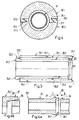
- 1a shows an insulation according to the invention in cross section. It consists essentially of two one-piece half-shells 1 and 2, which are formed from heat-resistant expanded polystyrene.
- the half-shell 1 is U-shaped in cross section, ie it has three perpendicular to each other standing outside surfaces 1.1, 1.2, 1.3.
- the half-shell 2, however, is C-shaped in cross section. It has outer surfaces 2.1,..., 2.5 standing at a 45 ° angle to one another.
- the two half-shells 1 and 2 lie close together to enclose a well-insulated interior 3.
- Two guide straps 4.1, 4.2 running in the longitudinal direction of the half-shell 2 are formed on the inner edge of the end face 2.6. They ensure that the two half-shells 1 and 2 are positioned precisely relative to one another in the assembled state.
- FIG. 1b shows the longitudinal section A shown in FIG. 1a.
- the half-shell 2 (and of course the half-shell 1 in an analogous manner) is elongated rectangular on its open side.
- the guide tabs 4.1, 4.2 are continuous, over the entire inner length extending longitudinal strips of a thickness of z. B. 5 mm.
- the half-shells 1 and 2 in turn preferably have a wall thickness of approximately 4 cm.
- the outer dimensions of the half-shells 1 and 2 are typically in the range of 20-50 cm (although the length can be longer).
- the two half-shells 1 and 2 are connected to one another by two bands 7.1, 7.2. Closures 8.1, 8.2 allow the straps 7.1, 7.2 to be easily tensioned and, if necessary, the insulation to be removed later.
- the half-shells 1 and 2 can be provided with circumferential recesses or depressions for placement of the bands 7.1, 7.2.
- the two recesses 5.1, 5.2 are, for. B. semicircular to form a round opening for a (not shown) heating tube.
- the two closures 8.1, 8.2 are designed so that they do not necessarily have to sit at the ends of a band. You assign z. B. two passages with clamping elements that can be solved or closed individually.
- a bore 6 is provided for a (not shown) axis of a valve adjusting wheel.
- FIG. 3 shows a preferred embodiment of the closure 8.1 or 8.2.
- An elongated base part 9 has two openable and closable clamps 10 and 11, which are rotatable about the axes 15 and 16 respectively attached to the opposite longitudinal ends of the base part 9.
- the brackets 10 and 11 are wedge-shaped, i. H. they taper with increasing distance from the respective axis 15 or 16.
- the clip 10 is approximately the same length as the base part 9. When closed, it covers the much shorter clip 11.
- the clip 10 preferably protrudes somewhat at its end beyond the base part 9 so that it can be easily opened if necessary.
- the clip 11 If the clip 11 is opened (or opened), it opens an insertion slot (between the axis 16 and the base part 9) into which one end of a tape can be threaded in the tape feed direction 13. To fix the band, the small clamp 11 is first closed (the band being clamped between the clamp 11 and the base part 9). Then the other end of the band, on which a bracket which can be attached to the teeth 14.1, 14.2 is attached, can be tensioned with the large clamp 10.
- the insulation shown in the figures is just as suitable for heating valves as for pumps.
- different openings or openings have to be made than those shown in FIG. 2.
- the described embodiment can be modified in many ways.
- the strip-shaped guide tabs attached on the inside can be caused by other projecting parts to be replaced.
- a suitable complementary gradation of the end faces is also conceivable.
- the entire insulation can be formed by two identical cuboidal or U-shaped parts.
- the material according to the invention can also be used to produce parts which can be joined together in a form-fitting manner to create line insulation.
- Fig. 4 shows schematically a conduit 17 of a heating installation which, according to a preferred embodiment, is insulated with two half-shells 18.1, 18.2 which can be joined together. These are preferably identical in cross section. Therefore, only one of the two half-shells 18.1, 18.2 is explained in detail below.
- the half-shell 18.1 has two longitudinal connection surfaces 19.1, 19.2, on which grooves 20.1, 20.2 and ribs 21.1, 21.2 extending in the longitudinal direction of the axis are formed. Viewed in cross section, the connection areas 19.1, 19.2 have an S shape. (In Fig. 4, for example, the rib 21 forms the lower semicircle and the groove 20 the upper semicircular S-shape.) Ribs and grooves 21.1, 21.2 and. 20.1, 20.2 are matched to one another in terms of shape, so that — as shown in FIG. 4 — two identical half-shells 18.1, 18.2 can be snapped together. The latching action must be just so great that the half-shells 18.1, 18.2 can be held together in any spatial position.
- the grooves 20.1, 20.2 and ribs 21.1, 21.2 preferably extend over the entire length of the connection surfaces 19.1, 19.2.
- the half-shell 18.1 also has recesses or gradations on its front connection surfaces 24.1, 24.2 with annular circumferential ribs 22.1, 22.2 and grooves 23.1, 23.2 to form an axial positive connection with a subsequent, identically designed half-shell.
- the ribs and grooves 22.1, 22.2, respectively. 23.1, 23.2 point radially inwards at one end (here with the connection surface 24.1) and radially outwards at the other end (here with the connection surface 24.2).
- the ribs and grooves 22.1, 22.2, respectively. 23.1, 23.2 in cross section form a symmetrical S-shape for the axial form fit (the "longitudinal axis" of the S-shape being parallel to the longitudinal axis of the half-shell 18.1).
- Half-shells of the type described can be put together to form line insulation of any length. Only the parts made of molded polystyrene are required. On outer shells, wire fastenings and. Like. Can be omitted. It is of course particularly advantageous if the valve shells explained with reference to FIGS. 1a, b and 2 are designed on the face side for the positive connection described with tubular half-shells.
- the positive connection can of course not only be implemented in the manner described. Instead of S-shaped rib-groove constructions, Z-shaped or other interlocking constructions can be used.
- FIGS. 6a, b An insulation tube 25 is unprocessed at one end 25.1 (i.e. only designed according to the cylindrical insulation cross section) and is provided at the other end 25.2 with a widening 27 designed according to the invention.
- the widening 27 has a recess 28 on the inside with a rotationally symmetrical inner lateral surface 28.1 widening conically towards the end 25.2.
- the average inside diameter of the inner surface 28.1 corresponds approximately to the outside diameter of the unfinished end 25.1 and the deviation from a cylindrical shape is less degrees (e.g. 1-5 °).
- an unprocessed end 26 of an axially adjoining insulation tube 25 can be pushed into the recess 28 so strongly that the two ends jam (FIG. 6b).
- the insulation tube 25 has a specific shape only at one end 25.2, it can be shortened (sawn) at the other end 25.2 if necessary, without losing the possibility of force-fittingly joining axially adjoining insulation tubes.
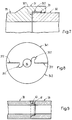
- FIG. 7 illustrates a further variant for the non-positive connection of two ends 29, 30. Again, only one end 29 is equipped with a specific ring extension 31, while the other end 30 is the usual one Has insulation pipe cross section.
- the ring extension 31 is provided with a step-like recess - formed by a stop surface 32.1 perpendicular to the longitudinal axis of the insulation tube and a cylindrical surface 32.2.
- the radius of the cylindrical surface 32.2 is slightly larger than the outer radius of the (cylindrical) end 30.
- the surface 32.2 has a circumferential rib 33 for clamping the end 30.
- the ring extension 31 can thus, as can be clearly seen in FIG. 7, be pushed over the unprocessed cylindrical end 30 of the subsequent insulation tube.
- 6a, b and 7 can be modified in various ways. Instead of a ring extension that engages on the outside, it can be provided that it engages on the inside. Furthermore, the ring process can be replaced by several corresponding individual processes.
- Form-locking means according to FIGS. 4 and 5 can be mixed with force-locking means according to FIGS. 6a, b and 7.
- force-locking means according to FIGS. 6a, b and 7. For radial assembly z. B. a positive connection and a non-positive connection for the axial.
- a complete set of different parts is preferably provided for the insulation of heating systems.
- half-shells for curved pipes and for T-branches are to be provided. It will also be necessary to provide half-shells of different lengths.
- Two semi-tubular parts 34.1, 34.2 each have a hook element 35.1 formed near the insulated interior 36, respectively. 35.2.
- a groove structure 37.1, 37.2 (cross-sectionally zigzag) is formed on the mutually facing and touching joint surfaces. The two parts 34.1, 34.2 are closely interlocked in this way and do not let warm air out of the interior 36.
- a first insulation tube 38 has on its end face a conical extension 40 with a max. Outside diameter.
- the attachment 40 has a circumferential rib 41 near its end.
- a second insulation tube 39 has a corresponding negative shape (ie a conical recess with a circumferential groove). The two insulation tubes 38 and 39 can be plugged together in a form-fitting manner. At the junction no widening of cross-section is required.
- the pins 44.1, ..., 44.3 are all essentially parallel to one another, the central pin 44.2 also protruding from the inside 43 in the radial direction.
- the pins 44.1, ..., 44.3 are z. B. 3-10 mm long. According to the invention, they are deformable. Depending on the outside diameter of the conduit to be insulated, the pins 44.1, ..., 44.3 are more or less compressed or. deformed. They thus support the jacket part 42 on the installation. In the case of an insulation consisting of two half-shells according to FIG. 10, the insulation is consequently kept coaxial with the conduit. With a tenon length of z. B. 10 mm can with the same type of jacket part a pipe diameter range of z. B. 60-80 mm can be operated.
- each pin 44.1, ..., 44.3 is a recess or. Deepening 45.1, ..., 45.3 assigned. If a large tube is inserted into the jacket part 42, the pins 44.1, ..., 44.3 can retract into these recesses 45.1, ..., 45.3.
- the depressions 45.1, ..., 45.3 do not have to be very large (e.g. 1-3 mm deep).
- the pins 44.1, ..., 44.3 z. B a diameter of 1-3 mm. They can be cylindrical or conical. In particular, it is also conceivable that they all stand radially against the longitudinal central axis of the jacket part 42 (or the conduit to be inserted).
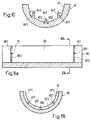
- FIG. 11a, b show a further preferred embodiment of a semi-cylindrical casing part 46.
- a plurality of ribs 47.1, ..., 47.4 and 48.1, 48.2 are provided as support aids near the ends. They protrude from the inside 50 of the casing part 46 and are perpendicular to the longitudinal axis of the casing part 46.
- the ribs 47.1, ..., 47.4 and 48.1, 48.2 are typically annular and separated by narrow gaps 49.1, 49.2, 49.3 and 51.
- the ribs 47.1, ..., 47.4, 48.1, 48.2 are designed in the manner of thin, high walls, so that they can be deformed or deformed to the required extent without problems. can be pushed aside.
- the annular air gap between the conduit and sleeve-like insulation is created by the ribs 47.1,..., 47.4, respectively. 48.1, 48.2 etc. divided into several longitudinal sections separated by convection. This has the advantage that if there is a leak in the insulation created (e.g. between the jacket parts adjoining on the end face), the heat loss is limited.
- the ribs 47.1, ..., 47.4, 48.1, 48.2 are not assigned any depressions or wall recesses.
- the recesses explained with reference to FIG. 10 can also be provided for the rib-like support aids according to FIGS. 11a, b.
- the depressions 45.1, ..., 45.3 can be dispensed with.
- Fig. 12 shows two half shells 52.1, 52.2 which can be joined together to isolate a pipe elbow.
- a flange-like Part is formed by an end face 54.1, a beveled surface 54.2 (e.g. at a 45 ° angle) and a shell-side or radial surface 54.3.
- the radius defined by the surface 54.3 is smaller than the radius formed by an outer surface 56 of the half-shell 52.1.
- An annular groove-like depression 55 follows on the surface 54.3.
- the thick-walled part of the half-shell 52.1 adjoins this.
- the coupling connections 53.1, 53.2 have a rotationally symmetrical outer shape when half shells 52.1, 52.2 are joined together.
- a cylindrical insulating sleeve (not shown) (likewise composed of two half-shells) is connected to the coupling connection 53.1, 53.2 and is designed to be complementary to the coupling connections 53.1, 53.2.
- the insulation sleeve to be connected on the face side therefore has an inner annular groove in which the coupling connection 53.1, 53.2 can engage in order to ensure a tension-proof, positive connection.
- surfaces 57.1,..., 57.4, respectively are staggered on the longitudinal end faces. 58.1, ..., 58.4 provided.
- the surfaces 57.2, 57.4 form two ribs on the half-shell 52.1, which fit into the grooves of the second half-shell 52.2 formed by the surfaces 58.2, 58.4.
- the surface 58.3 forms a rib which fits into the groove formed by the surface 57.3. It should be noted that, according to a preferred embodiment, surface 57.3 is lower than surface 57.1 (and correspondingly surface 58.3 protrudes more than surface 58.1).
- the two half shells 52.1, 52.2 can thus be put together like fits.
- the inner surfaces 59.1, 59.2 of the half-shells 52.1, respectively. 52.2 are - as far as the knee-shaped curved section is not affected - designed as cylindrical surfaces. In the assembled state, the two half-shells 52.1, 52.2 thus enclose an interior with a circular cross section.
- connection areas of the half-shells 52.1, 52.2 are provided with inner surfaces 62.1, 62.2 with a reduced inner radius. According to a preferred embodiment, they have lateral ribs 63.1, 63.2 and 64.1, 64.2.
- the said ribs 63.1, 63.2, 64.1, 64.2 are designed and arranged so that when half shells 52.1, 52.2 are joined, the ribs 63.1 and 64.1, respectively. 63.2 and 64.2 each appear as a rib.
- ribs 63.1, 63.2, respectively. 64.1, 64.2 of a half-shell 52.1, respectively. 52.2 are arranged and formed in mirror image (with respect to a "longitudinal center plane" of the half-shell 52.1 or 52.2).
- the pins 60.1, ..., 60.6, respectively. 61.1, ..., 61.4 etc. are in the knee area of the two half-shells 52.1 and. 52.2 and placed near the longitudinal center line of the inner surfaces 59.1, 59.2.
- pins or support aids according to the invention can not only be used for pipe insulation. They are also suitable for to correctly position shell-shaped insulation sleeves with regard to any devices or installations (pumps, valves, etc.). It should be noted that the support means can be deformed with relatively little effort and that the non-positive or positive connection between the jacket parts is large enough to hold the insulation together (against the "expansion pressure" caused by the support aids).
- a thin protective jacket Preferably z. B. pulled a film.
- This can consist of PVC.
- a metal foil aluminum foil
- a preferred variant consists in attaching the jacket by spraying on a suitable material (e.g. aluminum). So the behavior of a z. B. improve existing polystyrene jacket part in case of fire.
- the invention has created a particularly simple option for the efficient insulation of heating installations, in particular of small components such as valves or pumps.
Landscapes
- Engineering & Computer Science (AREA)
- General Engineering & Computer Science (AREA)
- Mechanical Engineering (AREA)
- Thermal Insulation (AREA)
- Packages (AREA)
- Materials For Medical Uses (AREA)
- Glass Compositions (AREA)
- Prostheses (AREA)
- Magnetic Resonance Imaging Apparatus (AREA)
- Liquid Crystal (AREA)
Applications Claiming Priority (9)
| Application Number | Priority Date | Filing Date | Title |
|---|---|---|---|
| CH105594A CH688973A5 (de) | 1994-04-08 | 1994-04-08 | Isolation für Heizungsinstallationen, insbesondere fuer Ventile und Pumpen . |
| CH105594 | 1994-04-08 | ||
| CH1055/94 | 1994-04-08 | ||
| CH140394 | 1994-05-04 | ||
| CH140394 | 1994-05-04 | ||
| CH1403/94 | 1994-05-04 | ||
| CH3483/94 | 1994-11-18 | ||
| CH348394 | 1994-11-18 | ||
| CH348394 | 1994-11-18 |
Publications (3)
| Publication Number | Publication Date |
|---|---|
| EP0676580A2 true EP0676580A2 (fr) | 1995-10-11 |
| EP0676580A3 EP0676580A3 (fr) | 1996-04-10 |
| EP0676580B1 EP0676580B1 (fr) | 2001-08-16 |
Family
ID=27172649
Family Applications (1)
| Application Number | Title | Priority Date | Filing Date |
|---|---|---|---|
| EP95810229A Revoked EP0676580B1 (fr) | 1994-04-08 | 1995-04-06 | Pièce à revêtement |
Country Status (3)
| Country | Link |
|---|---|
| EP (1) | EP0676580B1 (fr) |
| AT (1) | ATE204367T1 (fr) |
| DE (1) | DE59509500D1 (fr) |
Cited By (8)
| Publication number | Priority date | Publication date | Assignee | Title |
|---|---|---|---|---|
| EP0744574A1 (fr) * | 1995-05-26 | 1996-11-27 | ARMSTRONG WORLD INDUSTRIES GmbH | Elément isolant |
| WO1997048943A1 (fr) * | 1996-06-20 | 1997-12-24 | Etis Ag | Isolation pour composants presentant des surfaces exterieures tridimensionnelles |
| EP0864800A1 (fr) * | 1997-03-12 | 1998-09-16 | Theodor Heimeier Metallwerk GmbH & Co KG | Boítier de protection pour raccordements de type entréö et/ou sortie pour radiateurs |
| US6604603B1 (en) | 1998-12-17 | 2003-08-12 | Etis Ag | Soundproofing for insulating sound producing devices or parts of systems, especially devices that transmit vibrations such as vibrators |
| EP2781326A3 (fr) * | 2013-03-22 | 2015-07-29 | Paroc Group Oy | Unité de moule et procédé de formation d'une section d'isolation de tuyaux à partir d'un matériau d'isolation thermique durcissable et section d'isolation de tuyaux |
| CN104864225A (zh) * | 2015-06-16 | 2015-08-26 | 邓祥海 | 快速安装管道弯头填充保温外套 |
| CN112820498A (zh) * | 2021-02-02 | 2021-05-18 | 蔡益宇 | 一种电力安全物联绝缘遮蔽罩 |
| CN115143346A (zh) * | 2022-06-14 | 2022-10-04 | 浙江地球管业有限公司 | 一种便于装配的防冻给水管及其装配方法 |
Family Cites Families (6)
| Publication number | Priority date | Publication date | Assignee | Title |
|---|---|---|---|---|
| DE7824593U1 (de) * | 1978-08-17 | 1978-11-23 | Metzeler Schaum Gmbh, 8940 Memmingen | Rohrisolierschale |
| DE2943123A1 (de) * | 1979-10-25 | 1981-05-07 | Schenk, Horst, 5100 Aachen | Rohrisolationselemente |
| DE3338633C1 (de) * | 1983-10-25 | 1985-05-15 | Ludwig 4790 Paderborn Jacobs | Gehaeuse fuer waermeisolierte Armaturen und/oder Flanschverbindungen |
| DE3343959A1 (de) * | 1983-12-06 | 1985-06-20 | Basf Ag, 6700 Ludwigshafen | Halbschalen aus schaumstoff zur rohrisolierung |
| US5054513A (en) * | 1990-08-20 | 1991-10-08 | Trueb Steven R | Protective system for P-trap |
| DE9101393U1 (de) * | 1991-02-07 | 1991-06-06 | Staudacher, Peter, 7900 Ulm | Verschalung der vorzugsweise mit Heizkörpern verbundenen Installationselemente und Armaturengehäuse |
-
1995
- 1995-04-06 AT AT95810229T patent/ATE204367T1/de not_active IP Right Cessation
- 1995-04-06 EP EP95810229A patent/EP0676580B1/fr not_active Revoked
- 1995-04-06 DE DE59509500T patent/DE59509500D1/de not_active Expired - Fee Related
Cited By (9)
| Publication number | Priority date | Publication date | Assignee | Title |
|---|---|---|---|---|
| EP0744574A1 (fr) * | 1995-05-26 | 1996-11-27 | ARMSTRONG WORLD INDUSTRIES GmbH | Elément isolant |
| WO1997048943A1 (fr) * | 1996-06-20 | 1997-12-24 | Etis Ag | Isolation pour composants presentant des surfaces exterieures tridimensionnelles |
| EP0864800A1 (fr) * | 1997-03-12 | 1998-09-16 | Theodor Heimeier Metallwerk GmbH & Co KG | Boítier de protection pour raccordements de type entréö et/ou sortie pour radiateurs |
| US6604603B1 (en) | 1998-12-17 | 2003-08-12 | Etis Ag | Soundproofing for insulating sound producing devices or parts of systems, especially devices that transmit vibrations such as vibrators |
| EP2781326A3 (fr) * | 2013-03-22 | 2015-07-29 | Paroc Group Oy | Unité de moule et procédé de formation d'une section d'isolation de tuyaux à partir d'un matériau d'isolation thermique durcissable et section d'isolation de tuyaux |
| RU2596689C2 (ru) * | 2013-03-22 | 2016-09-10 | Парок Груп Ой | Модуль формы, способ формования секции трубной изоляции из отверждаемого теплоизолирующего материала и секция трубной изоляции |
| CN104864225A (zh) * | 2015-06-16 | 2015-08-26 | 邓祥海 | 快速安装管道弯头填充保温外套 |
| CN112820498A (zh) * | 2021-02-02 | 2021-05-18 | 蔡益宇 | 一种电力安全物联绝缘遮蔽罩 |
| CN115143346A (zh) * | 2022-06-14 | 2022-10-04 | 浙江地球管业有限公司 | 一种便于装配的防冻给水管及其装配方法 |
Also Published As
| Publication number | Publication date |
|---|---|
| DE59509500D1 (de) | 2001-09-20 |
| ATE204367T1 (de) | 2001-09-15 |
| EP0676580A3 (fr) | 1996-04-10 |
| EP0676580B1 (fr) | 2001-08-16 |
Similar Documents
| Publication | Publication Date | Title |
|---|---|---|
| DE3640226A1 (de) | Kunststoff-schutzrohranordnung fuer leitungen | |
| DE4004564A1 (de) | Rohranschlussteil, rohrverbindungsteil, und zugehoerige mutter | |
| DE69412458T2 (de) | Heizkörpersystem | |
| EP2644961B1 (fr) | Utilisation d'un dispositif de protection contre l'incendie lors du passage sur un tuyau en matière synthétique | |
| DE19603398B4 (de) | Heizungsanschlussvorrichtung, Verteiler und Bauelement für Heizungen | |
| EP2171819A1 (fr) | Canal à câbles et embranchement | |
| EP0676580B1 (fr) | Pièce à revêtement | |
| DE102012024122A1 (de) | Haltesystem zum Halten und Positionieren von langen Gegenständen, wie Schläuchen, Rohren, Kabeln, und dergleichen | |
| DE2744674A1 (de) | Flanschverbindung | |
| DE19641421A1 (de) | Wellrohr zur schützenden Ummantelung elektrischer Leitungen | |
| EP0899493A1 (fr) | Traversée de câble/tuyaux pour une ouverture dans un mur | |
| EP1108190B1 (fr) | Tube ou systeme tubulaire pour collecteurs de canalisations, de circuits de chauffage et de chaudieres | |
| DE3213414A1 (de) | Vorrichtung zum abdichten von hohlzylindrischen durchgangsoeffnungen fuer kabel, rohre o.dgl. | |
| DE8521685U1 (de) | Drallauslass | |
| DE202012011825U1 (de) | Haltesystem zum Halten und Positionieren von langen Gegenständen, wie Schläuchen, Rohren, Kabeln, und dergleichen | |
| EP3477174B1 (fr) | Manchette de protection contre l'incendie ainsi que logement correspondant et traversée de paroi ou de plafond comportant ladite manchette de protection contre l'incendie | |
| DE3108921C2 (de) | Feuerschutz-Absperrvorrichtung für einen Luftkanal | |
| DE3038922C2 (de) | Schlauchförmige Garnitur für elektrische Kabel und Rohrleitungen und Verfahren zu ihrer Herstellung | |
| EP0531276B1 (fr) | Manchon de câble | |
| AT392829B (de) | Anschlusseinrichtung fuer das anschliessen von heizkoerpern | |
| CH688973A5 (de) | Isolation für Heizungsinstallationen, insbesondere fuer Ventile und Pumpen . | |
| DE3310569A1 (de) | Be- und entlueftungsanlage fuer mehrgeschossige bauwerke | |
| DE10130194C2 (de) | Verfahren zum Anschluß eines Heizkörpers an ein Versorgungsleitungssystem sowie Heizkörper | |
| DE102007008016A1 (de) | Montageelement für zu isolierende, flexible Rohrleitungen und Rohrsystemmodul mit einem solchen Montageelement | |
| DE20306022U1 (de) | Bauelement für insbesondere Lüftungskanalsysteme |
Legal Events
| Date | Code | Title | Description |
|---|---|---|---|
| PUAI | Public reference made under article 153(3) epc to a published international application that has entered the european phase |
Free format text: ORIGINAL CODE: 0009012 |
|
| PUAL | Search report despatched |
Free format text: ORIGINAL CODE: 0009013 |
|
| PUAF | Information related to the publication of a search report (a3 document) modified or deleted |
Free format text: ORIGINAL CODE: 0009199SEPU |
|
| AK | Designated contracting states |
Kind code of ref document: A2 Designated state(s): AT CH DE DK FR LI SE |
|
| AK | Designated contracting states |
Kind code of ref document: A3 Designated state(s): AT CH DE DK FR LI SE |
|
| D17D | Deferred search report published (deleted) | ||
| PUAL | Search report despatched |
Free format text: ORIGINAL CODE: 0009013 |
|
| AK | Designated contracting states |
Kind code of ref document: A3 Designated state(s): AT CH DE DK FR LI SE |
|
| 17P | Request for examination filed |
Effective date: 19961002 |
|
| RIN1 | Information on inventor provided before grant (corrected) |
Inventor name: TSCHANZ, OTTO |
|
| RAP1 | Party data changed (applicant data changed or rights of an application transferred) |
Owner name: THERMCEL AG |
|
| 17Q | First examination report despatched |
Effective date: 19981106 |
|
| GRAG | Despatch of communication of intention to grant |
Free format text: ORIGINAL CODE: EPIDOS AGRA |
|
| 17Q | First examination report despatched |
Effective date: 19981106 |
|
| GRAG | Despatch of communication of intention to grant |
Free format text: ORIGINAL CODE: EPIDOS AGRA |
|
| GRAH | Despatch of communication of intention to grant a patent |
Free format text: ORIGINAL CODE: EPIDOS IGRA |
|
| GRAH | Despatch of communication of intention to grant a patent |
Free format text: ORIGINAL CODE: EPIDOS IGRA |
|
| GRAA | (expected) grant |
Free format text: ORIGINAL CODE: 0009210 |
|
| AK | Designated contracting states |
Kind code of ref document: B1 Designated state(s): AT CH DE DK FR LI SE |
|
| PG25 | Lapsed in a contracting state [announced via postgrant information from national office to epo] |
Ref country code: FR Free format text: LAPSE BECAUSE OF NON-PAYMENT OF DUE FEES Effective date: 20010816 |
|
| REF | Corresponds to: |
Ref document number: 204367 Country of ref document: AT Date of ref document: 20010915 Kind code of ref document: T |
|
| REG | Reference to a national code |
Ref country code: CH Ref legal event code: EP |
|
| REF | Corresponds to: |
Ref document number: 59509500 Country of ref document: DE Date of ref document: 20010920 |
|
| PG25 | Lapsed in a contracting state [announced via postgrant information from national office to epo] |
Ref country code: SE Free format text: LAPSE BECAUSE OF FAILURE TO SUBMIT A TRANSLATION OF THE DESCRIPTION OR TO PAY THE FEE WITHIN THE PRESCRIBED TIME-LIMIT Effective date: 20011116 Ref country code: DK Free format text: LAPSE BECAUSE OF FAILURE TO SUBMIT A TRANSLATION OF THE DESCRIPTION OR TO PAY THE FEE WITHIN THE PRESCRIBED TIME-LIMIT Effective date: 20011116 |
|
| PG25 | Lapsed in a contracting state [announced via postgrant information from national office to epo] |
Ref country code: AT Free format text: LAPSE BECAUSE OF NON-PAYMENT OF DUE FEES Effective date: 20020406 |
|
| PG25 | Lapsed in a contracting state [announced via postgrant information from national office to epo] |
Ref country code: LI Free format text: LAPSE BECAUSE OF NON-PAYMENT OF DUE FEES Effective date: 20020430 Ref country code: CH Free format text: LAPSE BECAUSE OF NON-PAYMENT OF DUE FEES Effective date: 20020430 |
|
| PLBI | Opposition filed |
Free format text: ORIGINAL CODE: 0009260 |
|
| PLBQ | Unpublished change to opponent data |
Free format text: ORIGINAL CODE: EPIDOS OPPO |
|
| PLBF | Reply of patent proprietor to notice(s) of opposition |
Free format text: ORIGINAL CODE: EPIDOS OBSO |
|
| 26 | Opposition filed |
Opponent name: ARMACELL ENTERPRISE GMBH Effective date: 20020514 |
|
| PG25 | Lapsed in a contracting state [announced via postgrant information from national office to epo] |
Ref country code: DE Free format text: LAPSE BECAUSE OF NON-PAYMENT OF DUE FEES Effective date: 20021101 |
|
| REG | Reference to a national code |
Ref country code: CH Ref legal event code: PL |
|
| RDAF | Communication despatched that patent is revoked |
Free format text: ORIGINAL CODE: EPIDOSNREV1 |
|
| RDAG | Patent revoked |
Free format text: ORIGINAL CODE: 0009271 |
|
| STAA | Information on the status of an ep patent application or granted ep patent |
Free format text: STATUS: PATENT REVOKED |
|
| 27W | Patent revoked |
Effective date: 20030421 |