EP0676741A2 - Moyens d'enregistrement, dispositif de reproduction et méthode d'utilisation de karaoke - Google Patents
Moyens d'enregistrement, dispositif de reproduction et méthode d'utilisation de karaoke Download PDFInfo
- Publication number
- EP0676741A2 EP0676741A2 EP95104957A EP95104957A EP0676741A2 EP 0676741 A2 EP0676741 A2 EP 0676741A2 EP 95104957 A EP95104957 A EP 95104957A EP 95104957 A EP95104957 A EP 95104957A EP 0676741 A2 EP0676741 A2 EP 0676741A2
- Authority
- EP
- European Patent Office
- Prior art keywords
- data
- scale
- musical
- audio signal
- signal
- Prior art date
- Legal status (The legal status is an assumption and is not a legal conclusion. Google has not performed a legal analysis and makes no representation as to the accuracy of the status listed.)
- Granted
Links
Images



Classifications
-
- G—PHYSICS
- G11—INFORMATION STORAGE
- G11B—INFORMATION STORAGE BASED ON RELATIVE MOVEMENT BETWEEN RECORD CARRIER AND TRANSDUCER
- G11B20/00—Signal processing not specific to the method of recording or reproducing; Circuits therefor
- G11B20/10—Digital recording or reproducing
-
- G—PHYSICS
- G10—MUSICAL INSTRUMENTS; ACOUSTICS
- G10H—ELECTROPHONIC MUSICAL INSTRUMENTS; INSTRUMENTS IN WHICH THE TONES ARE GENERATED BY ELECTROMECHANICAL MEANS OR ELECTRONIC GENERATORS, OR IN WHICH THE TONES ARE SYNTHESISED FROM A DATA STORE
- G10H1/00—Details of electrophonic musical instruments
- G10H1/0033—Recording/reproducing or transmission of music for electrophonic musical instruments
-
- G—PHYSICS
- G10—MUSICAL INSTRUMENTS; ACOUSTICS
- G10H—ELECTROPHONIC MUSICAL INSTRUMENTS; INSTRUMENTS IN WHICH THE TONES ARE GENERATED BY ELECTROMECHANICAL MEANS OR ELECTRONIC GENERATORS, OR IN WHICH THE TONES ARE SYNTHESISED FROM A DATA STORE
- G10H1/00—Details of electrophonic musical instruments
- G10H1/36—Accompaniment arrangements
- G10H1/38—Chord
-
- G—PHYSICS
- G10—MUSICAL INSTRUMENTS; ACOUSTICS
- G10H—ELECTROPHONIC MUSICAL INSTRUMENTS; INSTRUMENTS IN WHICH THE TONES ARE GENERATED BY ELECTROMECHANICAL MEANS OR ELECTRONIC GENERATORS, OR IN WHICH THE TONES ARE SYNTHESISED FROM A DATA STORE
- G10H1/00—Details of electrophonic musical instruments
- G10H1/44—Tuning means
Definitions
- the present invention relates to a reproducing apparatus for a medium, a reproducing apparatus for a recording medium and a medium for karaoke use. More particularly, the present invention relates to a medium having data showing a musical accompaniment scale or a reproducing apparatus for a recording medium having data showing a musical accompaniment scale and a medium for karaoke use having data showing a musical accompaniment scale.
- karaoke apparatus With karaoke apparatus, additional reverberation processing or frequency characteristic compensation is carried out on the singers voice i.e. the audio signal of singers, in order to enhance the results of the singers' singing.
- a reproducing apparatus for a medium.
- the medium has an audio signal related to musical accompaniment and data showing a scale of the musical accompaniment.
- the apparatus includes a reproducing unit, a signal generating unit and a mixer.
- the reproducing unit reproduces from the medium an audio signal relating to the musical accompaniment and data showing a scale.
- the signal generating unit generates a harmony signal which becomes a chord for an audio signal outputted from a microphone based on data showing a scale reproduced by the reproduced unit.
- the mixer mixes and outputs the audio signal outputted from the microphone, an audio signal reproduced by the reproducing unit and a harmony signal from the signal generating unit.
- a reproducing apparatus for a medium.
- the medium has an audio signal relating to musical accompaniment, character data relating to the musical accompaniment, data displaying a scale of the musical accompaniment and a key change position and scale data for after a key change.
- the apparatus has a reproducing unit, a signal generating unit and a mixer.
- the reproducing unit reproduces from the medium an audio signal relating to the musical accompaniment, character data, scale-displaying data and scale data for the key-change position and the position after key-changing.
- the signal generating unit generates a harmony signal which becomes a chord for an audio signal outputted from a microphone based on data a scale being played back by the reproducing unit and controls the scale of the harmony signal being generated based on scale data for the key-change position and the position after key-changing generated by the reproducing unit.
- the mixer mixes and outputs the audio signal outputted from the microphone, an audio signal reproduced by the reproducing unit and a harmony signal from the signal generating unit.
- a reproducing apparatus for a recording medium.
- the recording medium has an audio signal relating to musical accompaniment, character data relating to the musical accompaniment, data displaying a scale of the musical accompaniment, scale data for a key change position and after a key change and data relating to a time passage relating to the audio signal relating to the musical accompaniment.
- the apparatus includes a reproducing unit, a signal generating unit and a mixer.
- the reproducing unit reproduces from the recording medium the audio signal relating to the musical accompaniment, the character data and data displaying the scale.
- the signal generating unit generates a harmony signal becoming a chord for an audio signal outputted from a microphone based on data showing a scale being played back by the reproducing unit.
- the mixer mixes and outputs the audio signal outputted from the microphone, an audio signal reproduced back by the reproducing unit and a harmony signal from the signal generating unit.
- a medium for karaoke use equipped with at least one audio signal relating to a musical accompaniment song, scale data showing an audio signal scale relating to the musical accompaniment, character data relating to the musical accompaniment and scale data for a key change position and a position after a key change.
- a reference numeral 1 denotes a video CD taken as a disc recording medium for karaoke use and a reference numeral 10 denotes it's reproducing apparatus.
- the disc 1 is rotatably driven at a constant linear velocity by a rotational driving device not shown in the drawings.
- the disc 1 has a lead-in track at it's head portion, followed by N (N ⁇ 99) data tracks TRK1 to TRKN and a lead-out track.
- N N ⁇ 99
- An (N-1) song Karaoke data table is prepared at this first track TRK1, as shown in FIG. 2B.
- This table is referred to as the "sequence item table” and is constructed independently for every one song part. i.e. (N-1) sequence item tables SIT1 to SIT(N-1) corresponding to each karaoke song are provided.
- Clause number 19 is prepared with data showing the scales (musical intervals) C, C# and Cm.
- the clause sections 22 to 31 of clause numbers 22 to 31 are left open for the manufacturer or the maker which manufactures recording media for karaoke use.
- the data of the video signal and the data of the audio signal of the karaoke for the first program is recorded in data compressed form on a second track TRK2.
- the data of the video signal for example, a luminance signal and two color difference signals are data-compressed using an MPEG (Moving Picture Expert Coding Group) method and then recorded.
- MPEG Motion Picture Expert Coding Group
- left and right channel signals are put into single blocks on every prescribed number of samples and each of these blocks are then data compressed and recorded.
- video and audio signals are recorded in sector units but the sequence and number of video signal sectors and audio signal sectors i.e. the ration between the number of audio signal sectors and video signal sectors in not fixed. Because of this, data showing whether the signal recorded in a sector is a video signal or an audio signal is recorded together with other information at the head portion of each sector.
- the karaoke video signals and audio signals for the second to (N-1)th songs are recorded in data compressed states on the third to Nth tracks TRK3 to TRKN, respectively.
- a signal recorded on the disc 1 is read out by an optical pick-up 11.
- the output signal from the optical pickup 11 is then supplied to a playback decoder 13 through a playback amplifier 12, where processes such as EFM demodulation and error correction are carried out.
- the signal processed by the playback decoder 13 is supplied to a CD-ROM decoder 14 where selector unit decode processing is carried out and each signal is outputted.
- the data for the first track TRK1 of the output signals from the decoder 14 is taken up by a system controller 66 constructed from a microcomputer and is hereafter used by the system controller 66 for reproducing control.
- the data of the video signal of the output signals from the decoder 14 are inputted to the decoder 21 and decoded into video signals i.e. a luminance signal and two chrominance signals.
- This decoded video signal is then D/A converted into an analog signal at the D/A converter 22.
- This D/A converted video signal is supplied to an NTSC encoder 23, encoded into an NTSC color composite video signal and outputted to a terminal 24.
- the data of the audio signal of the output signals from the decoder 14 is inputted to an MPEG decoder 31 and decoded into an audio signal, i.e. left and right channel audio signals relating to musical accompaniment for karaoke use.
- This decoded audio signal is supplied to a musical interval converting circuit 32.
- This converting circuit 32 makes it easy to sing by adjusting the musical interval of the provided audio signals into an audio band in which the singer can sing.
- a musical interval inputting unit 61 is therefore provided at the reproducing apparatus 10 in order to achieve this.
- the inputted data is supplied to the converting circuit 32 through the system controller 66. This means that the musical interval of the audio signal being provided to the converting circuit 32 is transposed to the musical interval designated by the data inputted from the inputting unit 61.
- an operator 62 for adjusting song speed is provided at the reproducing apparatus 10.
- the output of this operator 62 is supplied to the system controller 66.
- the rotational speed of the disc 1 and the playback speed of the video signal and audio signal controlled by the decoder circuits 21 and 31 are then changed in accordance with the output of the operator 62. Variations in a signal occurring due to changes in this speed are then corrected.
- the audio signal from the converting circuit 32 is supplied to a mixer 53 through an equalizer 33.
- the equalizer 33 for example, divides the karaoke audio signal into a number of bands and corrects the level for each band.
- An audio signal corresponding to the singers voice is supplied to an A/D converter 43 through an amplifier 42 and is A/D converted.
- This A/D converted audio signal is supplied to the aforementioned mixer 44 via an equalizer 51 before being supplied to the mixer 53 through an echo processor 52.
- the equalizer 51 divides the signal corresponding to the singers voice up into a plurality of bands and corrects the level for each band.
- the echo processor 52 adds the desired reverberation to the audio signal corresponding to the singers voice provided.
- the audio signal read and reproduced from the disc 1 and the audio signal outputted from the microphone 41 are mixed at the mixer 53 i.e. an audio signal which is the singers voice with karaoke musical accompaniment is obtained.
- the audio signal outputted from the mixer 53 is supplied to the D/A converter 54, D/A converted, and outputted to the terminal 55.
- a harmony audio signal is formed from the audio signal outputted from the microphone 41 and this is added to the audio signal inputted through the microphone 41.
- the audio signal from the microphone 41 which is converted to a digital signal by the A/D converter 43 is supplied to a musical interval detection circuit 45 and the musical interval of the audio signal from the microphone 41 is detected.
- the detection signal which detected this musical interval is then supplied to a musical interval controller 67 composed of a microcomputer.
- the interval controller 67 generates musical interval data displaying a musical interval related to a chord with respect to a musical interval of an audio signal from a microphone 41 detected by the detection circuit 45.
- chord relationship is separated with respect to the musical interval of the audio signal from the microphone 41, i.e. the voice musical interval by +/- 3 octaves or +/- 5 octaves.
- the singers musical interval tends to be drawn-into the musical interval of that which is added.
- the harmony becomes too low and some of the harmonizing effect is lost.
- musical interval data showing a musical interval which is three octaves down from the musical interval of the singers voice detected by the detection circuit 45 is generated at the interval controller 67.
- the musical interval difference (frequency ratio) of a musical interval three octaves down from the vocal musical interval differs depending on the scale of the song.
- a C-minor scale is shown but the musical interval 3 octaves lower than Ab is F, with the musical interval difference being 300 cent.
- the musical interval difference is 400 cent.
- Eb is three octaves lower than G, with the musical interval difference being 400 cent.
- fv frequency of audio signal coming from microphone
- ⁇ f correction value of the frequency due to the converting circuit 32
- a table showing the musical interval difference for each musical interval for every scale i.e. a musical interval difference table, is provided at the interval controller 67, as shown, for example, in FIGS. 4A and 4B.
- data showing the scale of the karaoke musical accompaniment recorded in item number 19 is taken out from the data for the table SITi of the data for the first track TRK1 taken up by the system controller 66. This scale data is then supplied to the interval controller 67.
- musical interval difference tables for each of the scales of the kind shown in FIGS. 4A and 4B are selected by the scale data recorded at item number 19.
- Musical interval data is then formed for a musical interval 3 octaves down with respect to the musical interval of the singers voice using this selected musical interval difference table.
- the audio signal from the microphone 41 converted into a digital signal by the A/D converter 43 is supplied to the musical interval transposer 46 and musical interval data is supplied from the interval controller 67 to the musical interval transposer 46.
- the audio signal from the microphone 41 is transposed to an audio signal for the musical interval transposer 46 for which the musical interval is 3 octaves down, i.e. transposed to a harmony audio signal.
- This harmony audio signal is supplied to the mixer 44 and is mixed with the original audio signal i.e. the audio signal for the singers voice.
- An audio signal is therefore outputted from the mixer 44 which is the audio signal from the microphone 41 with harmonies added.
- An audio signal relating to the singers voice with harmonies added with the karaoke musical accompaniment reproduced from the disc 1 as background is then outputted from the terminal 55.
- karaoke can be enjoyed.
- harmonies can be automatically added to the singers vocals.
- Harmonies can also be added in a manner which is in line with musical theory by using scale data included in the table SITi.
- the harmony is constant.
- a very effective karaoke apparatus for public use can be obtained.
- a key-change may occur midway, depending on the song.
- the musical interval difference table is preparedly selected in accordance with the data for the scale recorded in item 19 of the table SITi, so the harmony structure will fall apart for this key-changed portion and become rather unpleasant.
- the case described in the following for the second embodiment of this invention also corresponds with key changes in the middle of a song.
- the following description of the second embodiment describes portions which are distinct from the first embodiment. Other portions are constructed in the same way as for the first embodiment.
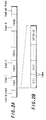
- the contents of, for example, item number 22 of item numbers 22 to 31 of the table SITi are made to be data showing a time position for the key change and the scale after the key change.
- an eight-byte area for a one-time key change is allotted to item number 22 of the table SITi.
- the first and second bytes of these bytes are, for example, for the data EDS and EDK showing the scale after a key change, as shown in FIGs 6A and 6B.
- EDS 20H (H denotes hexadecimal form)
- the third byte to the eighth byte are taken for data ET for displaying the minutes, seconds and frame of the time of the key change.
- This minute, second and frame are written into an absolute address showing a reproducing position on the disc 1 i.e. written into the leading header portion of each sector of the disc 1.
- This key-change position is designated using absolute time data displaying the passage of time from the leading portion of this song.
- This data EDS to ET is read out from the disc 1 when the disc 1 is installed in the reproducing apparatus 10 and is stored by the system controller 66. While the song is being reproduced, the key change time data ET from the data EDS to ET stored at the system controller 66 and the absolute time data played back from each sector of the disc 1 in real time are compared. When the absolute time position data ET and the absolute time data from the disc 1 both coincide, the scale data EDS and EDK for after the key change which has become a group with the key-change time position data ET which has coincided is transmitted to the interval controller 67.
- the musical interval difference table for the interval controller 67 is selected using the transmitted scale data EDS and EDK.
- Music interval data is then generated designating a musical interval which is 3 octaves down from the musical interval of the singers vocals using this selected musical interval difference table.
- This musical interval data is supplied to the musical interval transposer 46 and a harmony signal of a musical interval which is three octaves down from the musical interval of the vocal audio signal after the key change is generated.
- processing such as correcting frequency characteristics and echo processing can be carried out independently for the harmony audio signal.
- the data EDS and EDK can also be used for allowing and prohibiting the forming of a harmony audio signal.
- harmonies may be assigned only to a specific part of a singers vocals.
- the present invention may also be applicable to, for example, a usual music CD, an optical video disc or a karaoke system using communication network, as long as there is an audio signal for karaoke musical accompaniment and a medium having data displaying the karaoke scale.
Landscapes
- Engineering & Computer Science (AREA)
- Physics & Mathematics (AREA)
- Acoustics & Sound (AREA)
- Multimedia (AREA)
- Signal Processing (AREA)
- Reverberation, Karaoke And Other Acoustics (AREA)
- Electrophonic Musical Instruments (AREA)
- Signal Processing Not Specific To The Method Of Recording And Reproducing (AREA)
- Electrically Operated Instructional Devices (AREA)
Applications Claiming Priority (3)
| Application Number | Priority Date | Filing Date | Title |
|---|---|---|---|
| JP93141/94 | 1994-04-06 | ||
| JP09314194A JP3496689B2 (ja) | 1994-04-06 | 1994-04-06 | 再生装置 |
| JP9314194 | 1994-04-06 |
Publications (3)
| Publication Number | Publication Date |
|---|---|
| EP0676741A2 true EP0676741A2 (fr) | 1995-10-11 |
| EP0676741A3 EP0676741A3 (fr) | 1996-11-06 |
| EP0676741B1 EP0676741B1 (fr) | 2001-07-25 |
Family
ID=14074254
Family Applications (1)
| Application Number | Title | Priority Date | Filing Date |
|---|---|---|---|
| EP95104957A Expired - Lifetime EP0676741B1 (fr) | 1994-04-06 | 1995-04-03 | Dispositif de reproduction de karaoke |
Country Status (8)
| Country | Link |
|---|---|
| US (1) | US5652401A (fr) |
| EP (1) | EP0676741B1 (fr) |
| JP (1) | JP3496689B2 (fr) |
| KR (1) | KR100379844B1 (fr) |
| CN (1) | CN1066837C (fr) |
| DE (1) | DE69521822T2 (fr) |
| ES (1) | ES2158007T3 (fr) |
| MY (1) | MY114161A (fr) |
Cited By (1)
| Publication number | Priority date | Publication date | Assignee | Title |
|---|---|---|---|---|
| DE29601875U1 (de) * | 1996-02-05 | 1996-03-28 | Branstner, Gerhard, Dr., 10117 Berlin | Spielinstrument |
Families Citing this family (4)
| Publication number | Priority date | Publication date | Assignee | Title |
|---|---|---|---|---|
| JP3552379B2 (ja) * | 1996-01-19 | 2004-08-11 | ソニー株式会社 | 音響再生装置 |
| JP3365354B2 (ja) | 1999-06-30 | 2003-01-08 | ヤマハ株式会社 | 音声信号または楽音信号の処理装置 |
| JP2001117599A (ja) * | 1999-10-21 | 2001-04-27 | Yamaha Corp | 音声処理装置およびカラオケ装置 |
| CN105023559A (zh) * | 2015-05-27 | 2015-11-04 | 腾讯科技(深圳)有限公司 | K歌处理方法及系统 |
Family Cites Families (13)
| Publication number | Priority date | Publication date | Assignee | Title |
|---|---|---|---|---|
| GB2013386A (en) * | 1977-09-10 | 1979-08-08 | Fox H M | Electronic sound processing device |
| US4771671A (en) * | 1987-01-08 | 1988-09-20 | Breakaway Technologies, Inc. | Entertainment and creative expression device for easily playing along to background music |
| IT1206915B (it) * | 1987-02-06 | 1989-05-11 | Ketron Srl | Macchina automatica per la riproduzzione contemporanea di piu'note con intervalli di frequenza musicali prefissati su e forniti da tabelle di lettura contenenti tutte le armonie per ogni nota,a seconda dell'accordo e del tipo di accordo prescelti |
| US4915001A (en) * | 1988-08-01 | 1990-04-10 | Homer Dillard | Voice to music converter |
| US5157215A (en) * | 1989-09-20 | 1992-10-20 | Casio Computer Co., Ltd. | Electronic musical instrument for modulating musical tone signal with voice |
| US5159141A (en) * | 1990-04-23 | 1992-10-27 | Casio Computer Co., Ltd. | Apparatus for controlling reproduction states of audio signals recorded in recording medium and generation states of musical sound signals |
| JP2879948B2 (ja) * | 1990-06-08 | 1999-04-05 | ヤマハ 株式会社 | 音声処理装置 |
| US5446238A (en) * | 1990-06-08 | 1995-08-29 | Yamaha Corporation | Voice processor |
| US5313011A (en) * | 1990-11-29 | 1994-05-17 | Casio Computer Co., Ltd. | Apparatus for carrying out automatic play in synchronism with playback of data recorded on recording medium |
| JPH04294394A (ja) * | 1991-03-22 | 1992-10-19 | Kawai Musical Instr Mfg Co Ltd | 電子楽器 |
| US5286912A (en) * | 1991-03-29 | 1994-02-15 | Kabushiki Kaisha Kawai Gakki Seisakusho | Electronic musical instrument with playback of background tones and generation of key-on phrase tones |
| US5296643A (en) * | 1992-09-24 | 1994-03-22 | Kuo Jen Wei | Automatic musical key adjustment system for karaoke equipment |
| US5477003A (en) * | 1993-06-17 | 1995-12-19 | Matsushita Electric Industrial Co., Ltd. | Karaoke sound processor for automatically adjusting the pitch of the accompaniment signal |
-
1994
- 1994-04-06 JP JP09314194A patent/JP3496689B2/ja not_active Expired - Lifetime
-
1995
- 1995-03-29 US US08/412,528 patent/US5652401A/en not_active Expired - Lifetime
- 1995-04-03 ES ES95104957T patent/ES2158007T3/es not_active Expired - Lifetime
- 1995-04-03 EP EP95104957A patent/EP0676741B1/fr not_active Expired - Lifetime
- 1995-04-03 DE DE69521822T patent/DE69521822T2/de not_active Expired - Lifetime
- 1995-04-05 MY MYPI95000870A patent/MY114161A/en unknown
- 1995-04-06 KR KR1019950007910A patent/KR100379844B1/ko not_active Expired - Fee Related
- 1995-04-06 CN CN95114843A patent/CN1066837C/zh not_active Expired - Lifetime
Cited By (1)
| Publication number | Priority date | Publication date | Assignee | Title |
|---|---|---|---|---|
| DE29601875U1 (de) * | 1996-02-05 | 1996-03-28 | Branstner, Gerhard, Dr., 10117 Berlin | Spielinstrument |
Also Published As
| Publication number | Publication date |
|---|---|
| JPH07281684A (ja) | 1995-10-27 |
| EP0676741A3 (fr) | 1996-11-06 |
| CN1066837C (zh) | 2001-06-06 |
| DE69521822T2 (de) | 2001-11-08 |
| KR100379844B1 (ko) | 2003-06-28 |
| KR950034208A (ko) | 1995-12-26 |
| EP0676741B1 (fr) | 2001-07-25 |
| JP3496689B2 (ja) | 2004-02-16 |
| CN1118502A (zh) | 1996-03-13 |
| US5652401A (en) | 1997-07-29 |
| MY114161A (en) | 2002-08-30 |
| ES2158007T3 (es) | 2001-09-01 |
| DE69521822D1 (de) | 2001-08-30 |
Similar Documents
| Publication | Publication Date | Title |
|---|---|---|
| US5811708A (en) | Karaoke apparatus with tuning sub vocal aside main vocal | |
| US5296643A (en) | Automatic musical key adjustment system for karaoke equipment | |
| EP0529834B1 (fr) | Dispositif de reproduction pour information enregistrée | |
| US5889223A (en) | Karaoke apparatus converting gender of singing voice to match octave of song | |
| US5919047A (en) | Karaoke apparatus providing customized medley play by connecting plural music pieces | |
| US5862232A (en) | Sound pitch converting apparatus | |
| KR100465765B1 (ko) | 음향재생장치 | |
| US5294745A (en) | Information storage medium and apparatus for reproducing information therefrom | |
| US5652401A (en) | Recording media, reproducing apparatus and method for karaoke use including means for adding a harmonizing signal to a singer's voice | |
| JP2000010574A (ja) | カラオケ装置 | |
| JP3678973B2 (ja) | ハーモニー生成装置 | |
| US20040182228A1 (en) | Method for teaching individual parts in a musical ensemble | |
| JP2000010572A (ja) | 歌声発生装置およびカラオケ装置 | |
| JP2000330578A (ja) | 信号処理装置 | |
| JPH07281685A (ja) | カラオケ用ディスクおよび再生装置 | |
| JPH021734Y2 (fr) | ||
| Davis | Making the tape | |
| JP3017256B2 (ja) | 情報再生装置 | |
| KR970002863B1 (ko) | 영상노래반주전용 디스크 기록매체와 그 재생방법 및 장치 | |
| JPH09198057A (ja) | 音響再生装置 | |
| JPH1069285A (ja) | カラオケ装置 | |
| JPH03164799A (ja) | カラオケ装置 | |
| JPH02139763A (ja) | 伴奏音発生装置の発生音自動調整装置 | |
| JPH10282969A (ja) | カラオケ装置及び記録媒体 | |
| Marvin | Max Bruch:" Odysseus, op. 41, Scenes from The Odyssey for choir, soloists and orchestra";" Das Lied von der Glocke, op. 45, for choir, four solo voices and orchestra";" Moses" |
Legal Events
| Date | Code | Title | Description |
|---|---|---|---|
| PUAI | Public reference made under article 153(3) epc to a published international application that has entered the european phase |
Free format text: ORIGINAL CODE: 0009012 |
|
| AK | Designated contracting states |
Kind code of ref document: A2 Designated state(s): DE ES FR GB IT |
|
| PUAL | Search report despatched |
Free format text: ORIGINAL CODE: 0009013 |
|
| AK | Designated contracting states |
Kind code of ref document: A3 Designated state(s): DE ES FR GB IT |
|
| 17P | Request for examination filed |
Effective date: 19970408 |
|
| 17Q | First examination report despatched |
Effective date: 19990831 |
|
| RTI1 | Title (correction) |
Free format text: REPRODUCING APPARATUS FOR KARAOKE USE |
|
| GRAG | Despatch of communication of intention to grant |
Free format text: ORIGINAL CODE: EPIDOS AGRA |
|
| GRAG | Despatch of communication of intention to grant |
Free format text: ORIGINAL CODE: EPIDOS AGRA |
|
| GRAH | Despatch of communication of intention to grant a patent |
Free format text: ORIGINAL CODE: EPIDOS IGRA |
|
| GRAH | Despatch of communication of intention to grant a patent |
Free format text: ORIGINAL CODE: EPIDOS IGRA |
|
| GRAA | (expected) grant |
Free format text: ORIGINAL CODE: 0009210 |
|
| AK | Designated contracting states |
Kind code of ref document: B1 Designated state(s): DE ES FR GB IT |
|
| REF | Corresponds to: |
Ref document number: 69521822 Country of ref document: DE Date of ref document: 20010830 |
|
| REG | Reference to a national code |
Ref country code: ES Ref legal event code: FG2A Ref document number: 2158007 Country of ref document: ES Kind code of ref document: T3 |
|
| EN | Fr: translation not filed | ||
| REG | Reference to a national code |
Ref country code: GB Ref legal event code: IF02 |
|
| EN | Fr: translation not filed |
Free format text: BO 01/51 PAGES: 265, IL Y A LIEU DE SUPPRIMER: LA MENTION DE LA NON REMISE. LA REMISE EST PUBLIEE DANS LE PRESENT BOPI. |
|
| ET | Fr: translation filed | ||
| PLBE | No opposition filed within time limit |
Free format text: ORIGINAL CODE: 0009261 |
|
| STAA | Information on the status of an ep patent application or granted ep patent |
Free format text: STATUS: NO OPPOSITION FILED WITHIN TIME LIMIT |
|
| 26N | No opposition filed | ||
| REG | Reference to a national code |
Ref country code: GB Ref legal event code: 746 Effective date: 20120702 |
|
| PGFP | Annual fee paid to national office [announced via postgrant information from national office to epo] |
Ref country code: DE Payment date: 20120420 Year of fee payment: 18 |
|
| REG | Reference to a national code |
Ref country code: DE Ref legal event code: R084 Ref document number: 69521822 Country of ref document: DE Effective date: 20120614 |
|
| PGFP | Annual fee paid to national office [announced via postgrant information from national office to epo] |
Ref country code: GB Payment date: 20120419 Year of fee payment: 18 Ref country code: FR Payment date: 20120507 Year of fee payment: 18 |
|
| PGFP | Annual fee paid to national office [announced via postgrant information from national office to epo] |
Ref country code: IT Payment date: 20120424 Year of fee payment: 18 |
|
| PGFP | Annual fee paid to national office [announced via postgrant information from national office to epo] |
Ref country code: ES Payment date: 20120424 Year of fee payment: 18 |
|
| GBPC | Gb: european patent ceased through non-payment of renewal fee |
Effective date: 20130403 |
|
| PG25 | Lapsed in a contracting state [announced via postgrant information from national office to epo] |
Ref country code: GB Free format text: LAPSE BECAUSE OF NON-PAYMENT OF DUE FEES Effective date: 20130403 Ref country code: DE Free format text: LAPSE BECAUSE OF NON-PAYMENT OF DUE FEES Effective date: 20131101 |
|
| REG | Reference to a national code |
Ref country code: FR Ref legal event code: ST Effective date: 20131231 |
|
| REG | Reference to a national code |
Ref country code: DE Ref legal event code: R119 Ref document number: 69521822 Country of ref document: DE Effective date: 20131101 |
|
| PG25 | Lapsed in a contracting state [announced via postgrant information from national office to epo] |
Ref country code: FR Free format text: LAPSE BECAUSE OF NON-PAYMENT OF DUE FEES Effective date: 20130430 Ref country code: IT Free format text: LAPSE BECAUSE OF NON-PAYMENT OF DUE FEES Effective date: 20130403 |
|
| REG | Reference to a national code |
Ref country code: ES Ref legal event code: FD2A Effective date: 20140610 |
|
| PG25 | Lapsed in a contracting state [announced via postgrant information from national office to epo] |
Ref country code: ES Free format text: LAPSE BECAUSE OF NON-PAYMENT OF DUE FEES Effective date: 20130404 |