EP0678109B1 - Micropoudre - Google Patents
Micropoudre Download PDFInfo
- Publication number
- EP0678109B1 EP0678109B1 EP94904621A EP94904621A EP0678109B1 EP 0678109 B1 EP0678109 B1 EP 0678109B1 EP 94904621 A EP94904621 A EP 94904621A EP 94904621 A EP94904621 A EP 94904621A EP 0678109 B1 EP0678109 B1 EP 0678109B1
- Authority
- EP
- European Patent Office
- Prior art keywords
- polyarylene ether
- micropowder
- ether sulfone
- ether ketone
- essential component
- Prior art date
- Legal status (The legal status is an assumption and is not a legal conclusion. Google has not performed a legal analysis and makes no representation as to the accuracy of the status listed.)
- Expired - Lifetime
Links
- RTZKZFJDLAIYFH-UHFFFAOYSA-N ether Substances CCOCC RTZKZFJDLAIYFH-UHFFFAOYSA-N 0.000 claims abstract description 61
- 229920000412 polyarylene Polymers 0.000 claims abstract description 60
- 150000001875 compounds Chemical class 0.000 claims abstract description 9
- 238000001694 spray drying Methods 0.000 claims abstract description 9
- 239000012798 spherical particle Substances 0.000 claims abstract description 7
- -1 ether sulfone Chemical class 0.000 claims description 72
- 239000002245 particle Substances 0.000 claims description 25
- 239000007789 gas Substances 0.000 claims description 19
- 239000006185 dispersion Substances 0.000 claims description 12
- 239000007788 liquid Substances 0.000 claims description 11
- 239000002904 solvent Substances 0.000 claims description 11
- SECXISVLQFMRJM-UHFFFAOYSA-N N-Methylpyrrolidone Chemical compound CN1CCCC1=O SECXISVLQFMRJM-UHFFFAOYSA-N 0.000 claims description 10
- ZMXDDKWLCZADIW-UHFFFAOYSA-N N,N-Dimethylformamide Chemical compound CN(C)C=O ZMXDDKWLCZADIW-UHFFFAOYSA-N 0.000 claims description 9
- 238000000034 method Methods 0.000 claims description 8
- 229920001400 block copolymer Polymers 0.000 claims description 6
- 239000000126 substance Substances 0.000 claims description 6
- 125000000008 (C1-C10) alkyl group Chemical group 0.000 claims description 5
- 238000000576 coating method Methods 0.000 claims description 5
- 239000011737 fluorine Substances 0.000 claims description 5
- 229910052731 fluorine Inorganic materials 0.000 claims description 5
- 125000004435 hydrogen atom Chemical class [H]* 0.000 claims description 5
- IAZDPXIOMUYVGZ-UHFFFAOYSA-N Dimethylsulphoxide Chemical compound CS(C)=O IAZDPXIOMUYVGZ-UHFFFAOYSA-N 0.000 claims description 4
- 229910052736 halogen Inorganic materials 0.000 claims description 4
- 229910052739 hydrogen Inorganic materials 0.000 claims description 4
- 239000001257 hydrogen Substances 0.000 claims description 4
- 239000000463 material Substances 0.000 claims description 4
- 229910052760 oxygen Inorganic materials 0.000 claims description 4
- 125000001424 substituent group Chemical group 0.000 claims description 4
- YCKRFDGAMUMZLT-UHFFFAOYSA-N Fluorine atom Chemical compound [F] YCKRFDGAMUMZLT-UHFFFAOYSA-N 0.000 claims description 3
- 150000008064 anhydrides Chemical class 0.000 claims description 3
- 150000002367 halogens Chemical class 0.000 claims description 3
- 150000003949 imides Chemical class 0.000 claims description 3
- IMSODMZESSGVBE-UHFFFAOYSA-N 2-Oxazoline Chemical compound C1CN=CO1 IMSODMZESSGVBE-UHFFFAOYSA-N 0.000 claims description 2
- ZAMOUSCENKQFHK-UHFFFAOYSA-N Chlorine atom Chemical group [Cl] ZAMOUSCENKQFHK-UHFFFAOYSA-N 0.000 claims description 2
- 239000004593 Epoxy Substances 0.000 claims description 2
- JOYRKODLDBILNP-UHFFFAOYSA-N Ethyl urethane Chemical compound CCOC(N)=O JOYRKODLDBILNP-UHFFFAOYSA-N 0.000 claims description 2
- XSQUKJJJFZCRTK-UHFFFAOYSA-N Urea Chemical compound NC(N)=O XSQUKJJJFZCRTK-UHFFFAOYSA-N 0.000 claims description 2
- 150000001408 amides Chemical class 0.000 claims description 2
- 239000004202 carbamide Substances 0.000 claims description 2
- 125000002915 carbonyl group Chemical group [*:2]C([*:1])=O 0.000 claims description 2
- 150000007942 carboxylates Chemical class 0.000 claims description 2
- 150000001733 carboxylic acid esters Chemical class 0.000 claims description 2
- 239000000460 chlorine Chemical group 0.000 claims description 2
- 229910052801 chlorine Chemical group 0.000 claims description 2
- 239000011248 coating agent Substances 0.000 claims description 2
- 125000001153 fluoro group Chemical group F* 0.000 claims description 2
- 125000006277 halobenzyl group Chemical group 0.000 claims description 2
- 150000003951 lactams Chemical class 0.000 claims description 2
- 229920000098 polyolefin Polymers 0.000 claims description 2
- 125000000027 (C1-C10) alkoxy group Chemical group 0.000 claims 2
- 238000002360 preparation method Methods 0.000 claims 2
- 229920005604 random copolymer Polymers 0.000 claims 2
- 125000003178 carboxy group Chemical group [H]OC(*)=O 0.000 claims 1
- 150000002576 ketones Chemical class 0.000 abstract description 28
- 239000000155 melt Substances 0.000 abstract description 4
- 238000001035 drying Methods 0.000 description 14
- IJGRMHOSHXDMSA-UHFFFAOYSA-N Atomic nitrogen Chemical compound N#N IJGRMHOSHXDMSA-UHFFFAOYSA-N 0.000 description 12
- 238000000889 atomisation Methods 0.000 description 8
- 239000007921 spray Substances 0.000 description 7
- 125000003118 aryl group Chemical group 0.000 description 6
- 229910052757 nitrogen Inorganic materials 0.000 description 6
- 239000000843 powder Substances 0.000 description 6
- RFFLAFLAYFXFSW-UHFFFAOYSA-N 1,2-dichlorobenzene Chemical compound ClC1=CC=CC=C1Cl RFFLAFLAYFXFSW-UHFFFAOYSA-N 0.000 description 5
- 229920001577 copolymer Polymers 0.000 description 5
- 239000000203 mixture Substances 0.000 description 5
- VZCYOOQTPOCHFL-OWOJBTEDSA-N Fumaric acid Chemical compound OC(=O)\C=C\C(O)=O VZCYOOQTPOCHFL-OWOJBTEDSA-N 0.000 description 4
- VYPSYNLAJGMNEJ-UHFFFAOYSA-N Silicium dioxide Chemical compound O=[Si]=O VYPSYNLAJGMNEJ-UHFFFAOYSA-N 0.000 description 4
- KZTYYGOKRVBIMI-UHFFFAOYSA-N diphenyl sulfone Chemical compound C=1C=CC=CC=1S(=O)(=O)C1=CC=CC=C1 KZTYYGOKRVBIMI-UHFFFAOYSA-N 0.000 description 4
- 238000004519 manufacturing process Methods 0.000 description 4
- 239000013557 residual solvent Substances 0.000 description 4
- YMWUJEATGCHHMB-UHFFFAOYSA-N Dichloromethane Chemical compound ClCCl YMWUJEATGCHHMB-UHFFFAOYSA-N 0.000 description 3
- 239000002253 acid Substances 0.000 description 3
- 238000009826 distribution Methods 0.000 description 3
- 239000000839 emulsion Substances 0.000 description 3
- 239000003999 initiator Substances 0.000 description 3
- 125000002496 methyl group Chemical group [H]C([H])([H])* 0.000 description 3
- 239000000178 monomer Substances 0.000 description 3
- 125000001997 phenyl group Chemical group [H]C1=C([H])C([H])=C(*)C([H])=C1[H] 0.000 description 3
- 229920001343 polytetrafluoroethylene Polymers 0.000 description 3
- 239000004810 polytetrafluoroethylene Substances 0.000 description 3
- 239000007787 solid Substances 0.000 description 3
- VZCYOOQTPOCHFL-UHFFFAOYSA-N trans-butenedioic acid Natural products OC(=O)C=CC(O)=O VZCYOOQTPOCHFL-UHFFFAOYSA-N 0.000 description 3
- XLYOFNOQVPJJNP-UHFFFAOYSA-N water Substances O XLYOFNOQVPJJNP-UHFFFAOYSA-N 0.000 description 3
- JAHNSTQSQJOJLO-UHFFFAOYSA-N 2-(3-fluorophenyl)-1h-imidazole Chemical compound FC1=CC=CC(C=2NC=CN=2)=C1 JAHNSTQSQJOJLO-UHFFFAOYSA-N 0.000 description 2
- CURLTUGMZLYLDI-UHFFFAOYSA-N Carbon dioxide Chemical compound O=C=O CURLTUGMZLYLDI-UHFFFAOYSA-N 0.000 description 2
- PEDCQBHIVMGVHV-UHFFFAOYSA-N Glycerine Chemical compound OCC(O)CO PEDCQBHIVMGVHV-UHFFFAOYSA-N 0.000 description 2
- UFHFLCQGNIYNRP-UHFFFAOYSA-N Hydrogen Chemical compound [H][H] UFHFLCQGNIYNRP-UHFFFAOYSA-N 0.000 description 2
- ISWSIDIOOBJBQZ-UHFFFAOYSA-N Phenol Chemical compound OC1=CC=CC=C1 ISWSIDIOOBJBQZ-UHFFFAOYSA-N 0.000 description 2
- QAOWNCQODCNURD-UHFFFAOYSA-N Sulfuric acid Chemical compound OS(O)(=O)=O QAOWNCQODCNURD-UHFFFAOYSA-N 0.000 description 2
- DTQVDTLACAAQTR-UHFFFAOYSA-N Trifluoroacetic acid Chemical compound OC(=O)C(F)(F)F DTQVDTLACAAQTR-UHFFFAOYSA-N 0.000 description 2
- 150000007513 acids Chemical class 0.000 description 2
- 239000003513 alkali Substances 0.000 description 2
- 125000002877 alkyl aryl group Chemical group 0.000 description 2
- 229910052799 carbon Inorganic materials 0.000 description 2
- MVPPADPHJFYWMZ-UHFFFAOYSA-N chlorobenzene Chemical compound ClC1=CC=CC=C1 MVPPADPHJFYWMZ-UHFFFAOYSA-N 0.000 description 2
- 238000001816 cooling Methods 0.000 description 2
- 150000005690 diesters Chemical class 0.000 description 2
- ZUOUZKKEUPVFJK-UHFFFAOYSA-N diphenyl Chemical compound C1=CC=CC=C1C1=CC=CC=C1 ZUOUZKKEUPVFJK-UHFFFAOYSA-N 0.000 description 2
- 125000001495 ethyl group Chemical group [H]C([H])([H])C([H])([H])* 0.000 description 2
- 238000001704 evaporation Methods 0.000 description 2
- 230000008020 evaporation Effects 0.000 description 2
- 238000002474 experimental method Methods 0.000 description 2
- 239000012530 fluid Substances 0.000 description 2
- 239000001530 fumaric acid Substances 0.000 description 2
- FPYJFEHAWHCUMM-UHFFFAOYSA-N maleic anhydride Chemical compound O=C1OC(=O)C=C1 FPYJFEHAWHCUMM-UHFFFAOYSA-N 0.000 description 2
- LVHBHZANLOWSRM-UHFFFAOYSA-N methylenebutanedioic acid Natural products OC(=O)CC(=C)C(O)=O LVHBHZANLOWSRM-UHFFFAOYSA-N 0.000 description 2
- 239000003094 microcapsule Substances 0.000 description 2
- 238000002156 mixing Methods 0.000 description 2
- 239000004033 plastic Substances 0.000 description 2
- 229920003023 plastic Polymers 0.000 description 2
- 238000006068 polycondensation reaction Methods 0.000 description 2
- 229920000728 polyester Polymers 0.000 description 2
- 229920000642 polymer Polymers 0.000 description 2
- BWHMMNNQKKPAPP-UHFFFAOYSA-L potassium carbonate Chemical compound [K+].[K+].[O-]C([O-])=O BWHMMNNQKKPAPP-UHFFFAOYSA-L 0.000 description 2
- 125000001436 propyl group Chemical group [H]C([*])([H])C([H])([H])C([H])([H])[H] 0.000 description 2
- 239000000377 silicon dioxide Substances 0.000 description 2
- 238000005507 spraying Methods 0.000 description 2
- HHVIBTZHLRERCL-UHFFFAOYSA-N sulfonyldimethane Chemical compound CS(C)(=O)=O HHVIBTZHLRERCL-UHFFFAOYSA-N 0.000 description 2
- 229910052717 sulfur Inorganic materials 0.000 description 2
- 229920001169 thermoplastic Polymers 0.000 description 2
- 125000006702 (C1-C18) alkyl group Chemical group 0.000 description 1
- KZCDMIJHGSSDFO-UHFFFAOYSA-N 1-methyl-2-(2-methylphenyl)sulfonylbenzene Chemical compound CC1=CC=CC=C1S(=O)(=O)C1=CC=CC=C1C KZCDMIJHGSSDFO-UHFFFAOYSA-N 0.000 description 1
- HIDBROSJWZYGSZ-UHFFFAOYSA-N 1-phenylpyrrole-2,5-dione Chemical compound O=C1C=CC(=O)N1C1=CC=CC=C1 HIDBROSJWZYGSZ-UHFFFAOYSA-N 0.000 description 1
- NGNBDVOYPDDBFK-UHFFFAOYSA-N 2-[2,4-di(pentan-2-yl)phenoxy]acetyl chloride Chemical group CCCC(C)C1=CC=C(OCC(Cl)=O)C(C(C)CCC)=C1 NGNBDVOYPDDBFK-UHFFFAOYSA-N 0.000 description 1
- 229930185605 Bisphenol Natural products 0.000 description 1
- SYTHNYKDIHMYQK-UHFFFAOYSA-N CCC(C)(CC)c(cc1)ccc1N=O Chemical compound CCC(C)(CC)c(cc1)ccc1N=O SYTHNYKDIHMYQK-UHFFFAOYSA-N 0.000 description 1
- BVKZGUZCCUSVTD-UHFFFAOYSA-L Carbonate Chemical compound [O-]C([O-])=O BVKZGUZCCUSVTD-UHFFFAOYSA-L 0.000 description 1
- IWDCLRJOBJJRNH-UHFFFAOYSA-N Cc(cc1)ccc1O Chemical compound Cc(cc1)ccc1O IWDCLRJOBJJRNH-UHFFFAOYSA-N 0.000 description 1
- LFQSCWFLJHTTHZ-UHFFFAOYSA-N Ethanol Chemical compound CCO LFQSCWFLJHTTHZ-UHFFFAOYSA-N 0.000 description 1
- BGRDGMRNKXEXQD-UHFFFAOYSA-N Maleic hydrazide Chemical compound OC1=CC=C(O)N=N1 BGRDGMRNKXEXQD-UHFFFAOYSA-N 0.000 description 1
- FXHOOIRPVKKKFG-UHFFFAOYSA-N N,N-Dimethylacetamide Chemical compound CN(C)C(C)=O FXHOOIRPVKKKFG-UHFFFAOYSA-N 0.000 description 1
- YGYAWVDWMABLBF-UHFFFAOYSA-N Phosgene Chemical compound ClC(Cl)=O YGYAWVDWMABLBF-UHFFFAOYSA-N 0.000 description 1
- 239000004952 Polyamide Substances 0.000 description 1
- 239000004642 Polyimide Substances 0.000 description 1
- 239000004372 Polyvinyl alcohol Substances 0.000 description 1
- OFOBLEOULBTSOW-UHFFFAOYSA-N Propanedioic acid Natural products OC(=O)CC(O)=O OFOBLEOULBTSOW-UHFFFAOYSA-N 0.000 description 1
- 150000008065 acid anhydrides Chemical class 0.000 description 1
- 239000000654 additive Substances 0.000 description 1
- 239000002318 adhesion promoter Substances 0.000 description 1
- 150000001447 alkali salts Chemical class 0.000 description 1
- 125000003545 alkoxy group Chemical group 0.000 description 1
- 125000003277 amino group Chemical group 0.000 description 1
- 230000000181 anti-adherent effect Effects 0.000 description 1
- 239000000010 aprotic solvent Substances 0.000 description 1
- 239000003849 aromatic solvent Substances 0.000 description 1
- WPYMKLBDIGXBTP-UHFFFAOYSA-N benzoic acid Chemical compound OC(=O)C1=CC=CC=C1 WPYMKLBDIGXBTP-UHFFFAOYSA-N 0.000 description 1
- 230000015572 biosynthetic process Effects 0.000 description 1
- 239000004305 biphenyl Substances 0.000 description 1
- 235000010290 biphenyl Nutrition 0.000 description 1
- 238000009835 boiling Methods 0.000 description 1
- 239000001569 carbon dioxide Substances 0.000 description 1
- 229910002092 carbon dioxide Inorganic materials 0.000 description 1
- 150000004649 carbonic acid derivatives Chemical class 0.000 description 1
- 150000001732 carboxylic acid derivatives Chemical class 0.000 description 1
- 239000003054 catalyst Substances 0.000 description 1
- 239000007795 chemical reaction product Substances 0.000 description 1
- 125000001309 chloro group Chemical group Cl* 0.000 description 1
- HNEGQIOMVPPMNR-IHWYPQMZSA-N citraconic acid Chemical compound OC(=O)C(/C)=C\C(O)=O HNEGQIOMVPPMNR-IHWYPQMZSA-N 0.000 description 1
- 238000009833 condensation Methods 0.000 description 1
- 230000005494 condensation Effects 0.000 description 1
- IFDVQVHZEKPUSC-UHFFFAOYSA-N cyclohex-3-ene-1,2-dicarboxylic acid Chemical compound OC(=O)C1CCC=CC1C(O)=O IFDVQVHZEKPUSC-UHFFFAOYSA-N 0.000 description 1
- 238000007872 degassing Methods 0.000 description 1
- 150000001470 diamides Chemical class 0.000 description 1
- 150000001991 dicarboxylic acids Chemical class 0.000 description 1
- 239000000975 dye Substances 0.000 description 1
- 230000005686 electrostatic field Effects 0.000 description 1
- 239000003063 flame retardant Substances 0.000 description 1
- 235000011187 glycerol Nutrition 0.000 description 1
- 238000000227 grinding Methods 0.000 description 1
- 125000005843 halogen group Chemical group 0.000 description 1
- 230000002209 hydrophobic effect Effects 0.000 description 1
- 239000011261 inert gas Substances 0.000 description 1
- 230000001788 irregular Effects 0.000 description 1
- 125000001449 isopropyl group Chemical group [H]C([H])([H])C([H])(*)C([H])([H])[H] 0.000 description 1
- 238000004898 kneading Methods 0.000 description 1
- VZCYOOQTPOCHFL-UPHRSURJSA-N maleic acid Chemical compound OC(=O)\C=C/C(O)=O VZCYOOQTPOCHFL-UPHRSURJSA-N 0.000 description 1
- 239000011976 maleic acid Substances 0.000 description 1
- 125000000956 methoxy group Chemical group [H]C([H])([H])O* 0.000 description 1
- 125000004108 n-butyl group Chemical group [H]C([H])([H])C([H])([H])C([H])([H])C([H])([H])* 0.000 description 1
- 125000001280 n-hexyl group Chemical group C(CCCCC)* 0.000 description 1
- 125000001624 naphthyl group Chemical group 0.000 description 1
- TWNQGVIAIRXVLR-UHFFFAOYSA-N oxo(oxoalumanyloxy)alumane Chemical compound O=[Al]O[Al]=O TWNQGVIAIRXVLR-UHFFFAOYSA-N 0.000 description 1
- 125000003854 p-chlorophenyl group Chemical group [H]C1=C([H])C(*)=C([H])C([H])=C1Cl 0.000 description 1
- JTJMJGYZQZDUJJ-UHFFFAOYSA-N phencyclidine Chemical class C1CCCCN1C1(C=2C=CC=CC=2)CCCCC1 JTJMJGYZQZDUJJ-UHFFFAOYSA-N 0.000 description 1
- 239000000049 pigment Substances 0.000 description 1
- 229920000090 poly(aryl ether) Polymers 0.000 description 1
- 229920002492 poly(sulfone) Polymers 0.000 description 1
- 229920002647 polyamide Polymers 0.000 description 1
- 229920000515 polycarbonate Polymers 0.000 description 1
- 239000004417 polycarbonate Substances 0.000 description 1
- 229920001601 polyetherimide Polymers 0.000 description 1
- 229920001721 polyimide Polymers 0.000 description 1
- 229920001296 polysiloxane Polymers 0.000 description 1
- 229920002451 polyvinyl alcohol Polymers 0.000 description 1
- 229910000027 potassium carbonate Inorganic materials 0.000 description 1
- 238000001556 precipitation Methods 0.000 description 1
- 239000000376 reactant Substances 0.000 description 1
- 150000003839 salts Chemical class 0.000 description 1
- 238000004626 scanning electron microscopy Methods 0.000 description 1
- 238000000926 separation method Methods 0.000 description 1
- 235000012239 silicon dioxide Nutrition 0.000 description 1
- 238000005245 sintering Methods 0.000 description 1
- 238000000935 solvent evaporation Methods 0.000 description 1
- 239000003381 stabilizer Substances 0.000 description 1
- 239000007858 starting material Substances 0.000 description 1
- 238000003756 stirring Methods 0.000 description 1
- 239000000758 substrate Substances 0.000 description 1
- 150000003457 sulfones Chemical class 0.000 description 1
- 150000003462 sulfoxides Chemical class 0.000 description 1
- 239000004094 surface-active agent Substances 0.000 description 1
- 238000003786 synthesis reaction Methods 0.000 description 1
- 125000000999 tert-butyl group Chemical group [H]C([H])([H])C(*)(C([H])([H])[H])C([H])([H])[H] 0.000 description 1
- UFDHBDMSHIXOKF-UHFFFAOYSA-N tetrahydrophthalic acid Natural products OC(=O)C1=C(C(O)=O)CCCC1 UFDHBDMSHIXOKF-UHFFFAOYSA-N 0.000 description 1
- 239000004416 thermosoftening plastic Substances 0.000 description 1
- 239000010409 thin film Substances 0.000 description 1
- YTWOHSWDLJUCRK-UHFFFAOYSA-N thiolane 1,1-dioxide Chemical compound O=S1(=O)CCCC1.O=S1(=O)CCCC1 YTWOHSWDLJUCRK-UHFFFAOYSA-N 0.000 description 1
- 125000002023 trifluoromethyl group Chemical group FC(F)(F)* 0.000 description 1
- 238000002604 ultrasonography Methods 0.000 description 1
Images


Classifications
-
- C—CHEMISTRY; METALLURGY
- C08—ORGANIC MACROMOLECULAR COMPOUNDS; THEIR PREPARATION OR CHEMICAL WORKING-UP; COMPOSITIONS BASED THEREON
- C08J—WORKING-UP; GENERAL PROCESSES OF COMPOUNDING; AFTER-TREATMENT NOT COVERED BY SUBCLASSES C08B, C08C, C08F, C08G or C08H
- C08J3/00—Processes of treating or compounding macromolecular substances
- C08J3/12—Powdering or granulating
- C08J3/122—Pulverisation by spraying
-
- C—CHEMISTRY; METALLURGY
- C08—ORGANIC MACROMOLECULAR COMPOUNDS; THEIR PREPARATION OR CHEMICAL WORKING-UP; COMPOSITIONS BASED THEREON
- C08J—WORKING-UP; GENERAL PROCESSES OF COMPOUNDING; AFTER-TREATMENT NOT COVERED BY SUBCLASSES C08B, C08C, C08F, C08G or C08H
- C08J3/00—Processes of treating or compounding macromolecular substances
- C08J3/12—Powdering or granulating
-
- C—CHEMISTRY; METALLURGY
- C08—ORGANIC MACROMOLECULAR COMPOUNDS; THEIR PREPARATION OR CHEMICAL WORKING-UP; COMPOSITIONS BASED THEREON
- C08J—WORKING-UP; GENERAL PROCESSES OF COMPOUNDING; AFTER-TREATMENT NOT COVERED BY SUBCLASSES C08B, C08C, C08F, C08G or C08H
- C08J2381/00—Characterised by the use of macromolecular compounds obtained by reactions forming in the main chain of the macromolecule a linkage containing sulfur with or without nitrogen, oxygen, or carbon only; Polysulfones; Derivatives of such polymers
- C08J2381/06—Polysulfones; Polyethersulfones
Definitions
- the present invention relates to micropowder with a relative Span factor, determined as described below, no longer than 2.5 made of spherical particles an essentially smooth one Surface structure, the essential component of polyarylene ether sulfones contain or ketones and by spray drying whose solutions are available using a multi-component nozzle are.
- the invention relates to a method for Production of these micropowders and their use.
- aqueous dispersions containing the micropowder contain and coatings made from it.
- Micropowder based on polyarylene ether sulfones or ketones are known per se and are used, for example, as adhesion promoters between metallic surfaces and polytetrafluoroethylene used, for example, coatings with anti-adhesive effect and good sliding behavior (see for example GB 1 426 342).
- Known micropowders of this type are obtained by that the substrates become brittle by cooling and then be ground (see e.g. EP-A2-377 170).
- micropowder made from polyarylene ether sulfones are also accessible in that the polyarylene ether sulfones processed into a paste with a liquid, this emulsified in water with vigorous stirring and the emulsion is dried.
- the object of the present invention was therefore to apply micropowder based on polyarylene ether sulfones or ketones to be made up of spherical particles with a regular surface consist.
- micropowders according to the invention contain as an essential component Polyarylene ether sulfones or ketones. Of course you can also use mixtures of polyarylene ether sulfones and ketones contain.
- the micropowders according to the invention are surprisingly obtainable by the polyarylene ether sulfones or ketones dissolves or their viscosity with a suitable Reduces liquid and then spray-dried.
- the particles obtainable in this way are regular and round and have an almost non-porous surface.
- the middle one Particle diameter (volume average) is usually 1 ⁇ m or more. It can also be lower, but it is usually not less than 0.5 ⁇ m. In general, the middle ones Particle diameters up to 80 ⁇ m. It is also possible, that they are slightly larger, for example 100 microns. Larger average particle diameters are generally for most Applications, especially for the production of aqueous dispersions, not of interest.
- the mean are preferably Particle diameter 2 to 70 ⁇ m, particularly preferably 2 to 50 ⁇ m, for example 5 to 50 microns. These are very particularly preferably average particle diameter 1 to 20 microns, especially 1 to 10 ⁇ m.
- the particles are essentially solid, i.e. they are not hollow and generally have the density of the underlying Polyarylene ether sulfones or ketones. The concentration the particle can, however, also be slightly lower, for example when small amounts of gas are enclosed.
- the micropowders according to the invention are notable for being narrow Particle size distribution.
- the relative span factor ⁇ can be specified (see A.H. Lefebvre: "Atomization and Sprays", Hemisphere Publishing Corporation, 1989, page 100, equation 3.40).
- the relative The chip factor of the micropowder according to the invention is in general 1 to 2. However, it can also be higher, but mostly not over 2.5. Span factors up to about 1.5 are preferred. All the chip factors are particularly preferably less than 1.
- the micropowders according to the invention contain polyarylene ether sulfones or ketones. These contain recurring units I
- N means either -O- or -S-, preferably -O-.
- T and Q can be the same or different.
- T and Q are also preferably a chemical bond.
- R a to R d can, independently of one another, be either the same or different from one another and can either be hydrogen atoms or C 1 to C 10 alkyl groups, such as methyl, ethyl, propyl or t-butyl, preferably hydrogen or methyl.
- R c and R d can also represent C 1 to C 10 alkoxy, C 1 to C 10 alkylaryl or C 6 to C 18 aryl groups.
- Preferred groups include methoxy, ethoxy, propoxy, t-butoxy, benzyl and phenyl.
- the aforementioned groups can also each be substituted with fluorine and / or chlorine atoms.
- An example is the trifluoromethyl or p-chlorophenyl group.
- the variables Ar to Ar 3 can independently have the same meaning or can be different from one another. According to the invention, they are C 6 to C 18 aryl groups. These include phenyl, biphenyl and naphthyl. The aryl groups are preferably not substituted, but substituents can be selected from the group consisting of C 1 to C 10 alkyl, C 1 to C 10 alkylaryl, C 6 to C 18 aryl, C 1 to C 10 Have alkoxy radicals and halogen atoms.
- substituents are methyl, ethyl, propyl, i-propyl, n-butyl, i-pentyl, n-hexyl, methoxy, ethoxy, propoxy, butoxy, benzyl, ethylphenyl, phenyl, fluorine or chlorine.
- Micropowders are particularly preferred which contain as essential component A polyarylene ether sulfones or ketones with structural units (I 1 ), (I 2 ), (I 25 ) or (I 26 ). These include, for example, micropowder which, as essential component A, contains polyarylene ether sulfones with 0 to 100 mol%, preferably 5 to 95 mol% of structural units (I 1 ) and 0 to 100 mol%, preferably 5 to 95 mol% of structural units (I 2 ) contain.
- the polyarylene ether sulfones or ketones can also be co- or Block copolymers in which polyarylene ether segments and segments of other thermoplastic polymers such as polyamides, polyesters, aromatic polycarbonates, polyester carbonates, polysiloxanes, Polyimides or polyetherimides are present.
- the molecular weights the block or graft arms in the copolymers is usually in the range of 1,000 to 30,000 g / mol.
- the Blocks of different structures can alternate or statistically be arranged.
- the weight fraction of the polyarylene ether sulfones or ketones in the copolymers or block copolymers is in generally at least 3, preferably at least 10% by weight.
- the weight fraction of the polyarylene ether sulfones or ketones can be up to to be 97% by weight. Copolymers or block copolymers are preferred with a proportion by weight of polyarylene ether sulfones or ketones with up to 90% by weight. Copolymers or block copolymers are particularly preferred with 20 to 80 wt .-% polyaryl ether.
- the polyarylene ether sulfones or ketones can have any end groups e.g. Halogen, methoxy, benzyloxy, phenoxy or amino groups contain. Preferred end groups are halogen or methoxy groups.
- the polyarylene ether sulfones or ketones have average molecular weights M n (number average) in the range from 15,000 to 60,000 g / mol and relative viscosities from 0.25 to 0.95 dl / g.
- M n number average
- the relative viscosities are measured either in 1% strength by weight N-methylpyrrolidone solution, in mixtures of phenol and dichloromethane or in 96% strength sulfuric acid at 20 ° C. or 25 ° C. in each case.
- polyarylene ether sulfones which are suitable as component A. or ketones are known per se and can be known per se Methods are made. Polyarylene ether sulfones or -ketones are created e.g. by condensation of aromatic bishalogen compounds and the alkali double salts of aromatic bisphenols. You can also, for example, by self-condensing Alkali salts of aromatic halogen phenols in the presence of a catalyst getting produced.
- DE-A-38 43 438 is for example a detailed compilation of suitable monomers remove. Suitable methods are, among others, in the US-A-3 441 538, 4 108 837, DE-A1-27 38 962 and EP-A1-361 described.
- Polyarylene ether ketones are also electrophilic (Friedel-Crafts-) polycondensation accessible, among others described in WO 84/03892.
- electrophilic polycondensation either dicarboxylic acid chlorides are used to form the carbonyl bridges or phosgene with aromatics, which two - by exchangeable electrophilic substituents - contain hydrogen atoms, implemented, or an aromatic carboxylic acid chloride, which is both an acid chloride group and a substitutable one Contains hydrogen atom, polycondensed with itself.
- Preferred process conditions for the synthesis of polyarylene ether sulfones or ketones are for example in the EP-A-113 112 and 135 130.
- the monomers in the Implementing the melt has also proven advantageous in many cases proven.
- the micropowder can be used as an essential component B contain polyarylene ether sulfones or ketones by reacting a polyarylene ether sulfone or ketone A with a reactive Connection are available. Contain the reactive compounds in addition to a C, C double or triple bond, one or several carbonyl, carboxylic acid, carboxylate, acid anhydride, Acid imide, carboxylic acid ester, amino, hydroxyl, epoxy, oxazoline, Contain urethane, urea, lactam or halobenzyl group.
- Typical suitable compounds are, for example, maleic acid, methylmaleic acid, itaconic acid, tetrahydrophthalic acid, their anhydrides and imides, fumaric acid, the mono- and diesters of these acids, for example C 1 -C 18 -alkanols, the mono- or diamides of these acids such as N-phenylmaleimide, Maleic acid hydrazide.
- R 1 , R 2 , R 3 and R 4 can be independently hydrogen and C 1 -C 18 alkyl groups.
- Particularly suitable compounds are maleic anhydride and fumaric acid and itaconic acid.
- the polymers and the reactive compound can e.g. in one aromatic solvents are reacted with each other.
- Suitable solvents have been chlorobenzene, o-dichlorobenzene and N-methylpyrrolidone.
- the implementation is generally carried out at 75-150 ° C.
- the reaction product is by precipitation with a conventional precipitant, such as low molecular weight alcohol and ketone, or by removing the solvent (e.g. in the degassing extruder, thin-film evaporator), won.
- the reactants can, for example, also with a Temperature of 270 - 350 ° C in the melt in one continuous or batch mixing unit (e.g. single or twin-screw extruder, Kneaders) are implemented.
- one continuous or batch mixing unit e.g. single or twin-screw extruder, Kneaders
- the reactive compound is preferably liquid Form, especially within the kneading zone of a mixing unit metered in to melt the polymer.
- Preferred in the micropowders according to the invention are polyarylene ether sulfones or ketones B modified polyarylene ether sulfones or -ketones A used, which by converting from 80 to 99.9% by weight, in particular 90 to 99% by weight, of the unmodified Polyarylene ether sulfones or ketones A, with 0.1 to 20% by weight, in particular 1 to 10% by weight of the reactive compound had been.
- Polyarylene ether sulfones grafted with 0.1 to 1.5% by weight of maleic anhydride are particularly preferred as component B.
- Polyarylene ether sulfones containing 5 to 95 mol% of units I 1 and 5 to 95 mol% of units I 2 are preferred.
- Polyarylene ether sulfones with 80 to 95, preferably 85 to 95 mol% of units of the formulas I 2 and I 1 and correspondingly 5 to 20, preferably 5 to 15 mol% of units of the formulas I 1 and I 2 are particularly mentioned here.
- radical initiators are usually used in amounts of about 0.01 up to about 1% by weight, based on the polyarylene ether sulfones used or ketones A used. Of course you can too Mixtures of different radical initiators can be used.
- the micropowders can also be mixtures of the Components A and B included.
- the micropowders e.g. up to 40% by weight of other additives such as flame retardants, dyes or stabilizers.
- the spray drying of the polyarylene ether sulfones or ketones takes place by atomizing the solutions into one under the process conditions inert gas such as air or nitrogen.
- inert gas such as air or nitrogen.
- the polyarylene ether sulfones or ketones before spraying dissolved in a solvent Preferably the polyarylene ether sulfones or ketones before spraying dissolved in a solvent.
- Dipolar aprotic liquids are suitable as solvents.
- Suitable solvents include N-substituted acid amides, Sulfoxides and sulfones. Examples are N, N-dimethylformamide, N, N-dimethylacetamide, N-methylpyrrolidone, dimethyl sulfone, Tetramethylene sulfone (sulfolane) or diphenyl sulfone. Among them are N-methylpyrrolidone, dimethyl sulfoxide and dimethylformamide in particular prefers. For particularly poorly soluble polyarylene ether ketones Diphenyl sulfone, ditolyl sulfone or is particularly suitable Trifluoroacetic acid as a solvent.
- Either the atomization temperature can be chosen so that the melt or the solution suitable for atomization Has viscosity, or the solids content of the solution can be chosen so that the solution has the appropriate viscosity at a has certain atomization temperature, the latter preferred becomes.
- the reduced viscosity of the solution is at atomization temperature up to 8,000 mPas. It can also be above for example 10,000 mPas. In general, solutions are higher Difficult to atomize viscosities. Reduced ones are preferred Viscosities of 1,000 mPas and less. Particularly preferred 5 to 500 mPas, in particular 10 to 100 mPas.
- the solutions that are at room temperature atomized.
- the atomization temperatures are however below the boiling point of the respective solvent.
- Multi-component nozzles in particular two-component nozzles, are used for atomization be used. Examples of this are double flow or called three-flow two-substance nozzles. To a twist or one The two-component nozzles can be used to generate flow deflection contain. These can be both gas and liquid to be appropriate. It is also possible to use ultrasonic atomizers to use.
- the ratio of atomizer gas mass to liquid mass flow is generally greater than 2. Particularly advantageous have atomizer gas / liquid flow rates in the ratio proven from 3 to 10. As a rule, gas pressures of 5 bar or more needed. A gas pressure of more than 100 bar is rarely necessary. The gas pressures are generally from 10 to 70 bar.
- the liquid droplets can be in one Drying chamber for example in a spray tower of a known type dried (see e.g. K. Masters: Spray Drying Handbook, Leonhard Hill Books, London 1972).
- Evaporation of the solvent can be done both at normal pressure and in vacuum.
- the heat required for solvent evaporation becomes preferably supplied at the top of the tower by an inert drying gas. Nitrogen is particularly suitable as the drying gas. It can also use other gases such as carbon dioxide or air will.
- the gas temperature at the top of the drying tower is preferred greater than the evaporation temperature of the solvent and can be from room temperature to 500 ° C. Generally is them 100 ° C or more. It is preferably in the range of 200 ° C to 300 ° C.
- the drying gas preferably flows together with the liquid droplets through the drying tower and is at the exit of the tower suctioned off together with the dry material.
- the gas temperature on Exit of the tower depends on the desired residual solvent content of the powder. It can range from room temperature to just less than the gas temperature at the top of the drying tower. In usually it is 50 ° C or more, for example 120 ° C to 170 ° C. In general, temperatures above 200 ° C are not required.
- the powder can generally be passed through filters or cyclones as usual be separated from the gas stream.
- filters or cyclones as usual be separated from the gas stream.
- filters for solids separation are preferably filters for solids separation used.
- the residual solvent content of the micropowder according to the invention is generally not more than 5% without subsequent drying. in particular less than 2%.
- Post-drying can be done, for example, in a fluidized bed or fluid bed.
- spray aids with spray drying.
- Fine-grained inorganic for example, are suitable as spraying aids Materials such as silicon dioxide, hydrophobic silica or to mention aluminum oxide, in particular polytetrafluoroethylene.
- the spray aids are usually in amounts from 0.1 to 20 wt .-%, in particular 1 to 5 wt .-%, based on polyarylene ether sulfone or ketone, calc. 100%, applied.
- micropowders according to the invention are particularly suitable for coating of surfaces.
- the invention Micropowder used to coat metallic surfaces will.
- the micropowders are particularly suitable for manufacturing slippery surfaces or non-stick coatings for objects of all kinds, such as plain bearings, household appliances or electronic components. This can be done, for example, using a vortex sintering process or applying a dispersion of the micropowder respectively.
- the micropowders according to the invention can be dissolved in non-solvents, preferably disperse in water.
- aqueous dispersions of 5 to 50 wt .-%, preferably from 10 to 30% by weight of micropowder.
- the aqueous dispersions also dispersed other plastics contain.
- Preferred plastics are fluorine-containing olefin polymers, especially polytetrafluoroethylene. Beyond that it is possible the dispersing aids such as polyvinyl alcohol or add glycerin.
- the dispersions can over also contain flow aids and pigments. The dispersion can be sprayed or spread onto the surface, for example will.
- the particle sizes were determined using a particle size analyzer (model Helos from Sympatec). For this purpose, 1 g each of the micropowder was dispersed in 100 ml of H 2 O with the addition of a surfactant by means of ultrasound, and 1 ml was removed from the dispersion thus obtained and again dispersed in 100 ml of water. The particle sizes were measured by laser diffraction determination (laser diffraction particle size measuring device Cilas 715).
- a drying tower with a diameter of 20 cm and a length of 2 m was used as the drying chamber.
- the nitrogen used as the dry gas had a temperature of 205 ° C at the top of the tower.
- the temperature at the tower exit was 150 ° C.
- the throughput of the dry gas was 20 kg / h and that of the solution was 300 g / h.
- the residual solvent content of the powder was 5%.
- the particles are shown in Figure 1-3.
- a mixture of 16% by weight of the polyarylene ether sulfone described in Example 1 was prepared in N-methylpyrrolidone.
- This Solution that has a reduced viscosity of at room temperature Had 200 mPas, was in a pneumatic two-substance nozzle 0.5 mm fluid insert (model 970 from Schlick) in one Sprayed pressure of 2 bar.
- the liquid throughput was 300 g / h.
- the drying chamber described in Example 1 was used Drying tower used. Nitrogen, whose Temperature at the top of the drying tower was 180 ° C used. The nitrogen temperature at the exit of the tower was 155 ° C.
- Figures 4 and 5 show particle size distributions like them typically when spray drying the under Polyarylene ether sulfones specified in Example 1, dissolved in N-methylpyrrolidone, were obtained in further experiments.
- Figures 6 and 7 show scanning electron microscopy Images of those typically obtained in further experiments Micropowder according to the invention from that given in Example 1 Polyarylene ether sulfone made from an N-methylpyrrolidone solution was spray dried.
Landscapes
- Chemical & Material Sciences (AREA)
- Health & Medical Sciences (AREA)
- Chemical Kinetics & Catalysis (AREA)
- Medicinal Chemistry (AREA)
- Polymers & Plastics (AREA)
- Organic Chemistry (AREA)
- Processes Of Treating Macromolecular Substances (AREA)
- Compositions Of Macromolecular Compounds (AREA)
- Polyethers (AREA)
- Organic Low-Molecular-Weight Compounds And Preparation Thereof (AREA)
- Glanulating (AREA)
- Polymers With Sulfur, Phosphorus Or Metals In The Main Chain (AREA)
- Medicines Containing Plant Substances (AREA)
- Medicines Containing Material From Animals Or Micro-Organisms (AREA)
- Manufacturing Of Micro-Capsules (AREA)
- Liquid Crystal Substances (AREA)
Claims (14)
- Micropoudre avec un facteur d'ampleur relatif, déterminé de la manière décrite dans la description, non supérieur à 2,5, formée de particules sphériques, d'une structure surfacique sensiblement lisse, contenant, à titre de composants essentiels, des polyarylèneéthersulfones ou -cétones et d'une masse volumique qui correspond essentiellement à celle des polyarylèneéthersulfones ou -cétones, que l'on peut obtenir par le séchage par pulvérisation de leurs solutions, en recourant à l'emploi d'un ajutage multi-matière.
- Micropoudre suivant la revendication 1 avec un facteur d'ampleur relatif inférieur à 1.
- Micropoudre suivant la revendication 1 ou 2, où l'ajutage multi-matière est un ajutage pour deux matières à deux flux ou à trois flux.
- Micropoudre suivant l'une quelconque des revendications 1 à 3, contenant, à titre de composants essentiels,A) des polyarylèneéthersulfones ou -cétones qui contiennent des unités récurrentes IB) des polyarylèneéthersulfones ou -cétones, que l'on peut obtenir par la réaction de A avec un composé réactif, qui contiennent, outre une double liaison C-C ou une triple liaison C-C, un ou plusieurs radicaux carbonyle, acide carboxylique, carboxylate, anhydride d'acide, amide d'acide, imide d'acide, ester d'acide carboxylique, amino, hydroxyle, époxy, oxazoline, uréthanne, urée, lactame ou halogénobenzyle, ou leurs copolymères stochastiques ou leurs copolymères séquencés.
- Micropoudre suivant l'une quelconque des revendications 1 à 4, contenant, à titre de composants essentiels, des polyarylèneéthersulfones qui contiennent de 5 à 95% molaires d'unités récurrentes IIet

5 à 95% molaires d'unités récurrentes III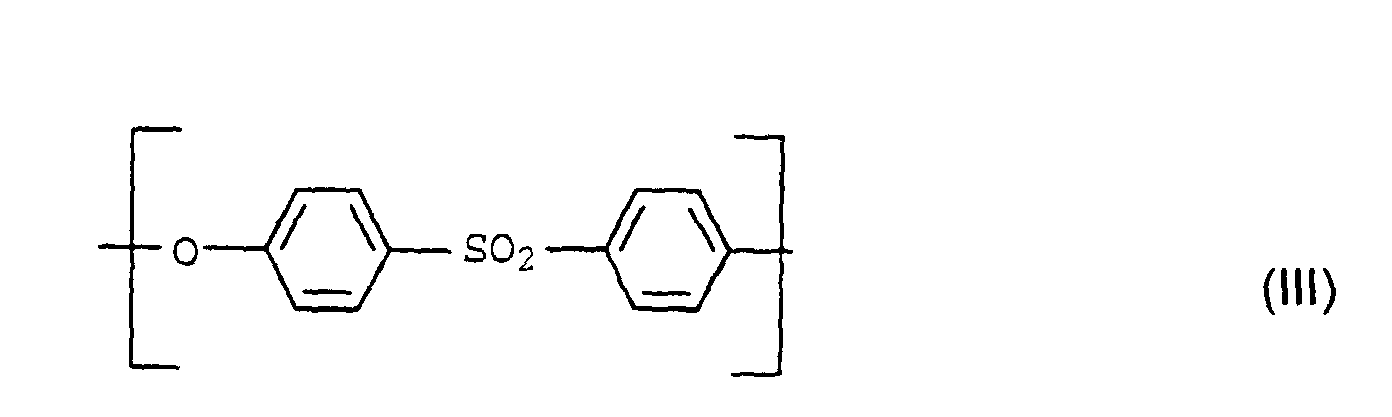
- Micropoudre suivant l'une quelconque des revendications 1 à 5, dans laquelle le diamètre moyen des particules varie de 1 à 100 µm.
- Micropoudre suivant l'une quelconque des revendications 1 à 6, que l'on peut obtenir par le séchage par pulvérisation de solutions de polyarylèneéthersulfones, où le solvant est la N-méthylpyrrolidone, le sulfoxyde de diméthyle ou le diméthylformamide.
- Procédé de préparation de micropoudres, possédant un facteur d'ampleur relatif, déterminé de la manière décrite dans la description, non supérieur à 2,5, constituées de particules sphériques, d'une structure surfacique essentiellement lisse, contenant, à titre de composants essentiels, des polyaryléthersulfones ou -cétones et une masse volumique qui correspond essentiellement à celles de polyarylèneéthersulfones ou -cétones, caractérisé en ce que l'on sèche par pulvérisation des solutions de polyarylèneéthersulfones ou -cétones, en recourant à l'emploi d'un ajutage multi-matière.
- Procédé suivant la revendication 1, caractérisé en ce que l'on utilise, à titre d'ajutage multi-matière, un ajutage pour deux matières à deux flux ou à trois flux.
- Procédé suivant la revendication 8 ou 9, caractérisé en ce que l'on choisit un rapport des masses de gaz à pulvériser au débit des masses de liquide de 3 à 10.
- Utilisation des micropoudres suivant l'une quelconque des revendications 1 à 7, pour la fabrication de dispersions aqueuses.
- Dispersions aqueuses qui contiennent des micropoudres suivant l'une quelconque des revendications 1 à 7.
- Dispersions aqueuses suivant la revendication 12, contenant des polymères d'oléfines fluorés.
- Revêtements, obtenus en recourant à l'emploi des dispersions aqueuses suivant la revendication 12 ou 13.
Applications Claiming Priority (5)
| Application Number | Priority Date | Filing Date | Title |
|---|---|---|---|
| DE4300326 | 1993-01-08 | ||
| DE4300326 | 1993-01-08 | ||
| DE4301543A DE4301543A1 (de) | 1993-01-08 | 1993-01-21 | Mikropulver |
| DE4301543 | 1993-01-21 | ||
| PCT/EP1994/000007 WO1994015999A1 (fr) | 1993-01-08 | 1994-01-04 | Micropoudre |
Publications (2)
| Publication Number | Publication Date |
|---|---|
| EP0678109A1 EP0678109A1 (fr) | 1995-10-25 |
| EP0678109B1 true EP0678109B1 (fr) | 1998-07-15 |
Family
ID=25922152
Family Applications (1)
| Application Number | Title | Priority Date | Filing Date |
|---|---|---|---|
| EP94904621A Expired - Lifetime EP0678109B1 (fr) | 1993-01-08 | 1994-01-04 | Micropoudre |
Country Status (11)
| Country | Link |
|---|---|
| EP (1) | EP0678109B1 (fr) |
| JP (1) | JP3369181B2 (fr) |
| CN (1) | CN1116428A (fr) |
| AT (1) | ATE168393T1 (fr) |
| AU (1) | AU5859394A (fr) |
| BR (1) | BR9405783A (fr) |
| CA (1) | CA2152279A1 (fr) |
| DK (1) | DK0678109T3 (fr) |
| ES (1) | ES2118378T3 (fr) |
| GR (1) | GR3027603T3 (fr) |
| WO (1) | WO1994015999A1 (fr) |
Families Citing this family (30)
| Publication number | Priority date | Publication date | Assignee | Title |
|---|---|---|---|---|
| DE10256097A1 (de) * | 2002-12-02 | 2004-06-17 | Eos Gmbh Electro Optical Systems | Kunststoffpulver für das Lasersintern |
| US9833788B2 (en) | 2004-03-21 | 2017-12-05 | Eos Gmbh Electro Optical Systems | Powder for layerwise manufacturing of objects |
| WO2005090448A1 (fr) * | 2004-03-21 | 2005-09-29 | Toyota Motorsport Gmbh | Poudres pour prototypage rapide et procede de production correspondant |
| US20050207931A1 (en) | 2004-03-21 | 2005-09-22 | Toyota Motorsport Gmbh | unknown |
| CN1305936C (zh) * | 2005-03-25 | 2007-03-21 | 吉林大学 | 可再分散性聚芳醚砜类微粉的制备方法 |
| CN1302047C (zh) * | 2005-03-25 | 2007-02-28 | 吉林大学 | 水基聚芳醚砜类分散液及其制备方法 |
| WO2008128579A1 (fr) | 2007-04-20 | 2008-10-30 | Saint-Gobain Performance Plastics Pampus Gmbh | Palier lisse ne nécessitant pas d'entretien |
| CN104109250B (zh) * | 2008-05-21 | 2017-04-12 | 东丽株式会社 | 聚合物微粒的制造方法 |
| CN101831177B (zh) * | 2010-05-05 | 2011-10-19 | 吉林大学 | 一种水分散聚芳醚砜类乳液的配方及生产工艺 |
| CA2833809A1 (fr) | 2011-04-29 | 2012-11-01 | Saint-Gobain Performance Plastics Corporation | Palier a glissement sans entretien comportant du fep ou du pfa dans la couche adhesive |
| KR101745017B1 (ko) | 2011-12-05 | 2017-06-09 | 현대자동차주식회사 | 초음파 고온 진동법을 이용한 열제어 소재용 마이크로 입자와, 이것의 제조 장치 및 방법 |
| FR2985215B1 (fr) | 2011-12-28 | 2014-09-19 | Saint Gobain Performance Plast | Revetements polymeres deposes sur des substrats par des techniques de projection thermique |
| CN103182808A (zh) | 2011-12-28 | 2013-07-03 | 圣戈班高功能塑料集团 | 一种包括含氟聚合物表面层以及非氟聚合物过渡层的多层复合物 |
| CN104364079B (zh) | 2012-06-29 | 2017-12-12 | 圣戈班性能塑料帕姆普斯有限公司 | 包含底漆体系作为粘附促进剂的滑动轴承 |
| WO2014049137A1 (fr) | 2012-09-28 | 2014-04-03 | Saint-Gobain Performance Plastics Pampus Gmbh | Palier à glissement sans entretien pourvu d'une couche de glissement adhésive combinée |
| CN105555841B (zh) * | 2013-07-18 | 2018-06-22 | 巴斯夫欧洲公司 | 聚亚芳基醚溶液的分离 |
| CN105377961B (zh) * | 2013-07-18 | 2018-12-14 | 巴斯夫欧洲公司 | 分散聚亚芳基醚溶液 |
| EP3022253B2 (fr) | 2013-07-18 | 2024-08-14 | Basf Se | Séparation d'une solution d'éther de polyaryles |
| CN104974661B (zh) * | 2014-04-03 | 2016-04-27 | 曾志玲 | 聚醚砜超细微粉、其用途以及含有聚醚砜超细微粉的涂料及它们的制备方法 |
| CN103881118A (zh) * | 2014-04-06 | 2014-06-25 | 吉林大学 | 一种可再分散聚芳醚砜类微粉的制备方法 |
| ES2975111T3 (es) * | 2016-04-13 | 2024-07-03 | Teijin Ltd | Preimpregnado, material compuesto reforzado con fibras y fibras de refuerzo de superficie modificada |
| US11685829B2 (en) * | 2017-06-07 | 2023-06-27 | Solvay Specialty Polymers Usa, Llc | Process for preparing particles of aromatic polymers, particles obtainable by said process and their uses |
| CN109705376A (zh) * | 2019-01-21 | 2019-05-03 | 开封夸克新材料有限公司 | 聚醚砜微粉、其制备方法及应用 |
| EP3921362B1 (fr) | 2019-02-04 | 2025-07-23 | Basf Se | Granulés facilement solubles et coulants à base de matières thermoplastiques haute température à faible teneur en composés organiques volatils |
| CN110655666B (zh) * | 2019-10-30 | 2023-01-20 | 中山大学 | 一种聚芳醚酮粉末及其制备方法 |
| CN111499890B (zh) * | 2020-05-13 | 2023-06-09 | 浙江帕尔科新材料有限公司 | 一种聚芳醚酮聚合物中空微粉及其制备方法 |
| CN111363139B (zh) * | 2020-05-13 | 2023-06-06 | 浙江帕尔科新材料有限公司 | 一种聚芳醚酮聚合物的后处理方法 |
| CN111471194B (zh) * | 2020-05-13 | 2023-07-25 | 吉林省中科聚合工程塑料有限公司 | 一种聚芳醚砜聚合物中空微粉及其制备方法 |
| CN111440319B (zh) * | 2020-05-13 | 2023-06-02 | 吉林省中科聚合工程塑料有限公司 | 一种聚芳醚砜聚合物的后处理方法 |
| JP7761514B2 (ja) * | 2022-03-17 | 2025-10-28 | 旭化成株式会社 | ポリフェニレンエーテル粒子の製造方法 |
Family Cites Families (6)
| Publication number | Priority date | Publication date | Assignee | Title |
|---|---|---|---|---|
| GB1426342A (en) | 1973-11-19 | 1976-02-25 | Ici Ltd | Coating compositions |
| JPS5416378A (en) * | 1977-07-08 | 1979-02-06 | Asahi Chem Ind Co Ltd | Polysulfone semipermeable membrane |
| JPS60125245A (ja) | 1983-12-12 | 1985-07-04 | Nitto Electric Ind Co Ltd | 液状活性物質含有マイクロカプセルの製造方法 |
| DE3844457A1 (de) | 1988-12-31 | 1990-07-12 | Hoechst Ag | Feinkoerniges polyetherketonpulver, verfahren zu dessen herstellung und dessen verwendung |
| US4945154A (en) | 1989-07-07 | 1990-07-31 | Hexcel Corporation | Densified polyethersulfone |
| EP0441047B1 (fr) | 1990-01-19 | 1996-06-05 | Minnesota Mining And Manufacturing Company | Composition thermodurcissable |
-
1994
- 1994-01-04 WO PCT/EP1994/000007 patent/WO1994015999A1/fr not_active Ceased
- 1994-01-04 CA CA002152279A patent/CA2152279A1/fr not_active Abandoned
- 1994-01-04 ES ES94904621T patent/ES2118378T3/es not_active Expired - Lifetime
- 1994-01-04 BR BR9405783A patent/BR9405783A/pt not_active Application Discontinuation
- 1994-01-04 AU AU58593/94A patent/AU5859394A/en not_active Abandoned
- 1994-01-04 CN CN94190908.5A patent/CN1116428A/zh active Pending
- 1994-01-04 JP JP51566494A patent/JP3369181B2/ja not_active Expired - Lifetime
- 1994-01-04 AT AT94904621T patent/ATE168393T1/de not_active IP Right Cessation
- 1994-01-04 EP EP94904621A patent/EP0678109B1/fr not_active Expired - Lifetime
- 1994-01-04 DK DK94904621T patent/DK0678109T3/da active
-
1998
- 1998-08-07 GR GR980401781T patent/GR3027603T3/el unknown
Non-Patent Citations (1)
| Title |
|---|
| A.H. LEFEBVRE: "Atomization and Sprays", 1989, HEMISPHERE PUBLISHING CORPORATION, NEW YORK * |
Also Published As
| Publication number | Publication date |
|---|---|
| AU5859394A (en) | 1994-08-15 |
| GR3027603T3 (en) | 1998-11-30 |
| ATE168393T1 (de) | 1998-08-15 |
| ES2118378T3 (es) | 1998-09-16 |
| WO1994015999A1 (fr) | 1994-07-21 |
| JPH08505180A (ja) | 1996-06-04 |
| BR9405783A (pt) | 1995-12-19 |
| CA2152279A1 (fr) | 1994-07-21 |
| DK0678109T3 (da) | 1998-11-02 |
| JP3369181B2 (ja) | 2003-01-20 |
| CN1116428A (zh) | 1996-02-07 |
| EP0678109A1 (fr) | 1995-10-25 |
Similar Documents
| Publication | Publication Date | Title |
|---|---|---|
| EP0678109B1 (fr) | Micropoudre | |
| US5910558A (en) | Micropowders | |
| EP0014772B1 (fr) | Procédé de préparation de compositions de revêtement pulvérulentes à base de polyamides contenant au moins 10 atomes de carbone aliphatiquement liés par groupement carbonamide | |
| DE3779841T2 (de) | Pulverbeschichtung auf polyvinylidenfluorid-basis. | |
| DE2844661C2 (de) | Verfahren zum Beschichten eines Substrates mit filmbildenden Feststoffen, verschäumbare wärmehärtbare Zusammensetzung und Vorrichtung zum Beschichten | |
| DE69929595T2 (de) | Wässrige grundierungszusammensetzung für fluorharzüberzug | |
| DE3628320A1 (de) | Hydrophobe pigmente und fuellstoffe fuer die einarbeitung in kunststoffe | |
| DE69800279T2 (de) | Kontinuierliches Verfahren zur Herstellung von Pulverbeschichtungszusammensetzungen | |
| EP1234813A2 (fr) | Utilisation de préparations pigmentaires pour l'impression par jet d'encre | |
| DE69507753T2 (de) | Verfahren zur Verminderung der Mikro-Schaumes bei wässrigen wärmehärtbaren aufgesprühten Zusammensetzungen | |
| DE3853532T2 (de) | Unterschichtzusammensetzung und metallisches Substrat, beschichtet mit einer Harzzusammensetzung. | |
| DE1221215B (de) | Verfahren zur Herstellung eingekapselter Isocyanate | |
| JP2004514038A (ja) | 固形、半固形及び液状の樹脂の分散系、及び該分散系の製造方法 | |
| DE3644464A1 (de) | Verfahren zur isolierung teilchenfoermiger polymere | |
| DE2500664B2 (de) | Verfahren zur herstellung von russ enthaltenden pigment/kunststoff-konzentraten | |
| DE60220866T2 (de) | Fällungsverfahren zur Herstellung von Pulverbeschichtungen aus Polyvinylidenfluorid und nach diesem Verfahren hergestellte Beschichtungen | |
| DE4301543A1 (de) | Mikropulver | |
| EP0200853B1 (fr) | Procédé de préparation de compositions de revêtement pulvérulent à base de polyamide | |
| EP1081195A2 (fr) | Procédé de fabrication de granulés de pigment | |
| EP1032608B1 (fr) | Procede pour la production de compositions reactives de poudre de revetement | |
| DE1920777C3 (de) | Verfahren und Vorrichtung zur Herstellung von Thermoplastpulvern | |
| DE4038002A1 (de) | Verfahren zur herstellung von verbesserten farbstoffgranulaten | |
| DE2744244B2 (de) | Thermisch vorbehandeltes, aus der Schmelze nicht verarbeitbares, mit einem perfluorierten Monomeren modifiziertes Tetrafluoräthylen-Polymerisatpulver und Verfahren zur Herstellung von Pulvern von aus der Schmelze nicht verarbeitbaren Tetrafluoräthylen-Polymerisaten mit hohem Schüttgewicht und guter Rieselfähigkeit | |
| DE3719241A1 (de) | Spruehgetrocknetes emulsionspolymerisat, verfahren zu seiner herstellung und verwendung und daraus bereitete formmasse | |
| DE2949771A1 (de) | Verfahren zum einheitlichen einverleiben einer geringen kernbildungsmittelmenge in ein hoch kristallines propylenpolymeres |
Legal Events
| Date | Code | Title | Description |
|---|---|---|---|
| PUAI | Public reference made under article 153(3) epc to a published international application that has entered the european phase |
Free format text: ORIGINAL CODE: 0009012 |
|
| 17P | Request for examination filed |
Effective date: 19950603 |
|
| AK | Designated contracting states |
Kind code of ref document: A1 Designated state(s): AT BE CH DE DK ES FR GB GR IE IT LI LU NL PT SE |
|
| 17Q | First examination report despatched |
Effective date: 19960603 |
|
| GRAG | Despatch of communication of intention to grant |
Free format text: ORIGINAL CODE: EPIDOS AGRA |
|
| GRAG | Despatch of communication of intention to grant |
Free format text: ORIGINAL CODE: EPIDOS AGRA |
|
| GRAG | Despatch of communication of intention to grant |
Free format text: ORIGINAL CODE: EPIDOS AGRA |
|
| GRAH | Despatch of communication of intention to grant a patent |
Free format text: ORIGINAL CODE: EPIDOS IGRA |
|
| GRAH | Despatch of communication of intention to grant a patent |
Free format text: ORIGINAL CODE: EPIDOS IGRA |
|
| GRAA | (expected) grant |
Free format text: ORIGINAL CODE: 0009210 |
|
| AK | Designated contracting states |
Kind code of ref document: B1 Designated state(s): AT BE CH DE DK ES FR GB GR IE IT LI LU NL PT SE |
|
| REF | Corresponds to: |
Ref document number: 168393 Country of ref document: AT Date of ref document: 19980815 Kind code of ref document: T |
|
| REG | Reference to a national code |
Ref country code: CH Ref legal event code: EP |
|
| GBT | Gb: translation of ep patent filed (gb section 77(6)(a)/1977) |
Effective date: 19980724 |
|
| REF | Corresponds to: |
Ref document number: 59406455 Country of ref document: DE Date of ref document: 19980820 |
|
| REG | Reference to a national code |
Ref country code: ES Ref legal event code: FG2A Ref document number: 2118378 Country of ref document: ES Kind code of ref document: T3 |
|
| ITF | It: translation for a ep patent filed | ||
| REG | Reference to a national code |
Ref country code: IE Ref legal event code: FG4D Free format text: GERMAN |
|
| REG | Reference to a national code |
Ref country code: DK Ref legal event code: T3 |
|
| ET | Fr: translation filed | ||
| REG | Reference to a national code |
Ref country code: PT Ref legal event code: SC4A Free format text: AVAILABILITY OF NATIONAL TRANSLATION Effective date: 19981002 |
|
| PG25 | Lapsed in a contracting state [announced via postgrant information from national office to epo] |
Ref country code: LI Free format text: LAPSE BECAUSE OF NON-PAYMENT OF DUE FEES Effective date: 19990131 Ref country code: CH Free format text: LAPSE BECAUSE OF NON-PAYMENT OF DUE FEES Effective date: 19990131 |
|
| PLBE | No opposition filed within time limit |
Free format text: ORIGINAL CODE: 0009261 |
|
| STAA | Information on the status of an ep patent application or granted ep patent |
Free format text: STATUS: NO OPPOSITION FILED WITHIN TIME LIMIT |
|
| 26N | No opposition filed | ||
| REG | Reference to a national code |
Ref country code: CH Ref legal event code: PL |
|
| PGFP | Annual fee paid to national office [announced via postgrant information from national office to epo] |
Ref country code: SE Payment date: 20011219 Year of fee payment: 9 Ref country code: PT Payment date: 20011219 Year of fee payment: 9 |
|
| PGFP | Annual fee paid to national office [announced via postgrant information from national office to epo] |
Ref country code: DK Payment date: 20011228 Year of fee payment: 9 Ref country code: AT Payment date: 20011228 Year of fee payment: 9 |
|
| PGFP | Annual fee paid to national office [announced via postgrant information from national office to epo] |
Ref country code: GR Payment date: 20011231 Year of fee payment: 9 |
|
| REG | Reference to a national code |
Ref country code: GB Ref legal event code: IF02 |
|
| PGFP | Annual fee paid to national office [announced via postgrant information from national office to epo] |
Ref country code: IE Payment date: 20020109 Year of fee payment: 9 |
|
| PGFP | Annual fee paid to national office [announced via postgrant information from national office to epo] |
Ref country code: LU Payment date: 20020205 Year of fee payment: 9 |
|
| PG25 | Lapsed in a contracting state [announced via postgrant information from national office to epo] |
Ref country code: LU Free format text: LAPSE BECAUSE OF NON-PAYMENT OF DUE FEES Effective date: 20030104 Ref country code: AT Free format text: LAPSE BECAUSE OF NON-PAYMENT OF DUE FEES Effective date: 20030104 |
|
| PG25 | Lapsed in a contracting state [announced via postgrant information from national office to epo] |
Ref country code: SE Free format text: LAPSE BECAUSE OF NON-PAYMENT OF DUE FEES Effective date: 20030105 |
|
| PG25 | Lapsed in a contracting state [announced via postgrant information from national office to epo] |
Ref country code: IE Free format text: LAPSE BECAUSE OF NON-PAYMENT OF DUE FEES Effective date: 20030106 |
|
| PG25 | Lapsed in a contracting state [announced via postgrant information from national office to epo] |
Ref country code: DK Free format text: LAPSE BECAUSE OF NON-PAYMENT OF DUE FEES Effective date: 20030131 |
|
| PG25 | Lapsed in a contracting state [announced via postgrant information from national office to epo] |
Ref country code: PT Free format text: LAPSE BECAUSE OF NON-PAYMENT OF DUE FEES Effective date: 20030731 |
|
| PG25 | Lapsed in a contracting state [announced via postgrant information from national office to epo] |
Ref country code: GR Free format text: LAPSE BECAUSE OF NON-PAYMENT OF DUE FEES Effective date: 20030804 |
|
| EUG | Se: european patent has lapsed | ||
| REG | Reference to a national code |
Ref country code: DK Ref legal event code: EBP |
|
| REG | Reference to a national code |
Ref country code: IE Ref legal event code: MM4A |
|
| PGFP | Annual fee paid to national office [announced via postgrant information from national office to epo] |
Ref country code: GB Payment date: 20091230 Year of fee payment: 17 Ref country code: ES Payment date: 20100128 Year of fee payment: 17 |
|
| PGFP | Annual fee paid to national office [announced via postgrant information from national office to epo] |
Ref country code: IT Payment date: 20100115 Year of fee payment: 17 Ref country code: FR Payment date: 20100208 Year of fee payment: 17 |
|
| PGFP | Annual fee paid to national office [announced via postgrant information from national office to epo] |
Ref country code: BE Payment date: 20100125 Year of fee payment: 17 |
|
| PGFP | Annual fee paid to national office [announced via postgrant information from national office to epo] |
Ref country code: NL Payment date: 20100101 Year of fee payment: 17 |
|
| BERE | Be: lapsed |
Owner name: *BASF A.G. Effective date: 20110131 |
|
| REG | Reference to a national code |
Ref country code: NL Ref legal event code: V1 Effective date: 20110801 |
|
| GBPC | Gb: european patent ceased through non-payment of renewal fee |
Effective date: 20110104 |
|
| REG | Reference to a national code |
Ref country code: FR Ref legal event code: ST Effective date: 20110930 |
|
| PG25 | Lapsed in a contracting state [announced via postgrant information from national office to epo] |
Ref country code: FR Free format text: LAPSE BECAUSE OF NON-PAYMENT OF DUE FEES Effective date: 20110131 |
|
| PG25 | Lapsed in a contracting state [announced via postgrant information from national office to epo] |
Ref country code: BE Free format text: LAPSE BECAUSE OF NON-PAYMENT OF DUE FEES Effective date: 20110131 Ref country code: GB Free format text: LAPSE BECAUSE OF NON-PAYMENT OF DUE FEES Effective date: 20110104 |
|
| PG25 | Lapsed in a contracting state [announced via postgrant information from national office to epo] |
Ref country code: IT Free format text: LAPSE BECAUSE OF NON-PAYMENT OF DUE FEES Effective date: 20110104 Ref country code: NL Free format text: LAPSE BECAUSE OF NON-PAYMENT OF DUE FEES Effective date: 20110801 |
|
| REG | Reference to a national code |
Ref country code: ES Ref legal event code: FD2A Effective date: 20120220 |
|
| PG25 | Lapsed in a contracting state [announced via postgrant information from national office to epo] |
Ref country code: ES Free format text: LAPSE BECAUSE OF NON-PAYMENT OF DUE FEES Effective date: 20110105 |
|
| PGFP | Annual fee paid to national office [announced via postgrant information from national office to epo] |
Ref country code: DE Payment date: 20130328 Year of fee payment: 20 |
|
| REG | Reference to a national code |
Ref country code: DE Ref legal event code: R071 Ref document number: 59406455 Country of ref document: DE |
|
| PG25 | Lapsed in a contracting state [announced via postgrant information from national office to epo] |
Ref country code: DE Free format text: LAPSE BECAUSE OF EXPIRATION OF PROTECTION Effective date: 20140108 |