EP0678529A2 - Transformation améliorée de polymères d'iso-oléfins - Google Patents
Transformation améliorée de polymères d'iso-oléfins Download PDFInfo
- Publication number
- EP0678529A2 EP0678529A2 EP95110803A EP95110803A EP0678529A2 EP 0678529 A2 EP0678529 A2 EP 0678529A2 EP 95110803 A EP95110803 A EP 95110803A EP 95110803 A EP95110803 A EP 95110803A EP 0678529 A2 EP0678529 A2 EP 0678529A2
- Authority
- EP
- European Patent Office
- Prior art keywords
- molecular weight
- butyl
- polymer
- rubber
- polymerization
- Prior art date
- Legal status (The legal status is an assumption and is not a legal conclusion. Google has not performed a legal analysis and makes no representation as to the accuracy of the status listed.)
- Granted
Links
- 229920000642 polymer Polymers 0.000 title claims abstract description 255
- 238000012545 processing Methods 0.000 title description 11
- 238000006116 polymerization reaction Methods 0.000 claims abstract description 156
- 239000000203 mixture Substances 0.000 claims abstract description 114
- 229920005549 butyl rubber Polymers 0.000 claims abstract description 87
- 238000009826 distribution Methods 0.000 claims abstract description 82
- 229920001971 elastomer Polymers 0.000 claims abstract description 46
- 239000005060 rubber Substances 0.000 claims abstract description 44
- 229920001577 copolymer Polymers 0.000 claims abstract description 28
- 239000003153 chemical reaction reagent Substances 0.000 claims abstract description 21
- 229920001519 homopolymer Polymers 0.000 claims abstract description 15
- 239000002002 slurry Substances 0.000 claims description 74
- 229920001195 polyisoprene Polymers 0.000 claims description 45
- 239000003381 stabilizer Substances 0.000 claims description 36
- 239000003085 diluting agent Substances 0.000 claims description 32
- 239000005062 Polybutadiene Substances 0.000 claims description 25
- 229920002857 polybutadiene Polymers 0.000 claims description 25
- 239000004793 Polystyrene Substances 0.000 claims description 24
- 229920002223 polystyrene Polymers 0.000 claims description 24
- 241000894007 species Species 0.000 claims description 13
- 150000002367 halogens Chemical class 0.000 claims description 11
- -1 polypiperylene Polymers 0.000 claims description 11
- 229910052736 halogen Inorganic materials 0.000 claims description 10
- 239000000126 substance Substances 0.000 claims description 7
- 150000001993 dienes Chemical class 0.000 claims description 6
- 229920003048 styrene butadiene rubber Polymers 0.000 claims description 6
- VSKJLJHPAFKHBX-UHFFFAOYSA-N 2-methylbuta-1,3-diene;styrene Chemical class CC(=C)C=C.C=CC1=CC=CC=C1.C=CC1=CC=CC=C1 VSKJLJHPAFKHBX-UHFFFAOYSA-N 0.000 claims description 4
- 244000043261 Hevea brasiliensis Species 0.000 claims description 4
- 238000010538 cationic polymerization reaction Methods 0.000 claims description 4
- 238000005647 hydrohalogenation reaction Methods 0.000 claims description 4
- 229920003052 natural elastomer Polymers 0.000 claims description 4
- 229920001194 natural rubber Polymers 0.000 claims description 4
- 229920000468 styrene butadiene styrene block copolymer Polymers 0.000 claims description 4
- 229920000346 polystyrene-polyisoprene block-polystyrene Polymers 0.000 claims description 2
- 229920002943 EPDM rubber Polymers 0.000 claims 1
- FACXGONDLDSNOE-UHFFFAOYSA-N buta-1,3-diene;styrene Chemical compound C=CC=C.C=CC1=CC=CC=C1.C=CC1=CC=CC=C1 FACXGONDLDSNOE-UHFFFAOYSA-N 0.000 claims 1
- 125000000484 butyl group Chemical group [H]C([*])([H])C([H])([H])C([H])([H])C([H])([H])[H] 0.000 abstract description 159
- 238000002156 mixing Methods 0.000 abstract description 20
- 229920005555 halobutyl Polymers 0.000 abstract description 6
- NEHMKBQYUWJMIP-UHFFFAOYSA-N chloromethane Chemical compound ClC NEHMKBQYUWJMIP-UHFFFAOYSA-N 0.000 description 98
- 229920005989 resin Polymers 0.000 description 86
- 239000011347 resin Substances 0.000 description 86
- RRHGJUQNOFWUDK-UHFFFAOYSA-N Isoprene Chemical compound CC(=C)C=C RRHGJUQNOFWUDK-UHFFFAOYSA-N 0.000 description 64
- 238000005227 gel permeation chromatography Methods 0.000 description 50
- 229940050176 methyl chloride Drugs 0.000 description 49
- 239000000243 solution Substances 0.000 description 46
- 239000000178 monomer Substances 0.000 description 43
- 238000006243 chemical reaction Methods 0.000 description 41
- 238000000034 method Methods 0.000 description 37
- 239000006085 branching agent Substances 0.000 description 36
- 239000003054 catalyst Substances 0.000 description 35
- 239000000047 product Substances 0.000 description 28
- VSCWAEJMTAWNJL-UHFFFAOYSA-K aluminium trichloride Chemical compound Cl[Al](Cl)Cl VSCWAEJMTAWNJL-UHFFFAOYSA-K 0.000 description 26
- 238000001374 small-angle light scattering Methods 0.000 description 24
- PPBRXRYQALVLMV-UHFFFAOYSA-N Styrene Chemical compound C=CC1=CC=CC=C1 PPBRXRYQALVLMV-UHFFFAOYSA-N 0.000 description 23
- 238000012360 testing method Methods 0.000 description 23
- YMWUJEATGCHHMB-UHFFFAOYSA-N Dichloromethane Chemical compound ClCCl YMWUJEATGCHHMB-UHFFFAOYSA-N 0.000 description 21
- VQTUBCCKSQIDNK-UHFFFAOYSA-N Isobutene Chemical group CC(C)=C VQTUBCCKSQIDNK-UHFFFAOYSA-N 0.000 description 19
- 229920005556 chlorobutyl Polymers 0.000 description 18
- VLKZOEOYAKHREP-UHFFFAOYSA-N n-Hexane Chemical compound CCCCCC VLKZOEOYAKHREP-UHFFFAOYSA-N 0.000 description 18
- 238000004519 manufacturing process Methods 0.000 description 17
- 230000008569 process Effects 0.000 description 16
- 230000000694 effects Effects 0.000 description 15
- 239000000463 material Substances 0.000 description 15
- 239000002904 solvent Substances 0.000 description 15
- 229920002367 Polyisobutene Polymers 0.000 description 14
- MYRTYDVEIRVNKP-UHFFFAOYSA-N 1,2-Divinylbenzene Chemical compound C=CC1=CC=CC=C1C=C MYRTYDVEIRVNKP-UHFFFAOYSA-N 0.000 description 13
- 238000005984 hydrogenation reaction Methods 0.000 description 13
- YXFVVABEGXRONW-UHFFFAOYSA-N Toluene Chemical compound CC1=CC=CC=C1 YXFVVABEGXRONW-UHFFFAOYSA-N 0.000 description 12
- 238000004458 analytical method Methods 0.000 description 11
- 230000015572 biosynthetic process Effects 0.000 description 11
- 229920001400 block copolymer Polymers 0.000 description 11
- 230000008859 change Effects 0.000 description 11
- 235000017168 chlorine Nutrition 0.000 description 11
- 230000006872 improvement Effects 0.000 description 11
- 239000003795 chemical substances by application Substances 0.000 description 10
- 125000001309 chloro group Chemical group Cl* 0.000 description 10
- 239000002245 particle Substances 0.000 description 10
- 230000003381 solubilizing effect Effects 0.000 description 10
- OKKJLVBELUTLKV-UHFFFAOYSA-N Methanol Chemical compound OC OKKJLVBELUTLKV-UHFFFAOYSA-N 0.000 description 9
- 239000000460 chlorine Substances 0.000 description 9
- 229910052801 chlorine Inorganic materials 0.000 description 9
- 238000011156 evaluation Methods 0.000 description 9
- 238000002474 experimental method Methods 0.000 description 9
- 230000006870 function Effects 0.000 description 9
- KAKZBPTYRLMSJV-UHFFFAOYSA-N Butadiene Chemical compound C=CC=C KAKZBPTYRLMSJV-UHFFFAOYSA-N 0.000 description 8
- NTIZESTWPVYFNL-UHFFFAOYSA-N Methyl isobutyl ketone Chemical compound CC(C)CC(C)=O NTIZESTWPVYFNL-UHFFFAOYSA-N 0.000 description 8
- 230000008901 benefit Effects 0.000 description 8
- 229910052799 carbon Inorganic materials 0.000 description 8
- 238000004132 cross linking Methods 0.000 description 8
- 125000000524 functional group Chemical group 0.000 description 8
- 238000003756 stirring Methods 0.000 description 8
- ZAMOUSCENKQFHK-UHFFFAOYSA-N Chlorine atom Chemical compound [Cl] ZAMOUSCENKQFHK-UHFFFAOYSA-N 0.000 description 7
- KFZMGEQAYNKOFK-UHFFFAOYSA-N Isopropanol Chemical compound CC(C)O KFZMGEQAYNKOFK-UHFFFAOYSA-N 0.000 description 7
- 125000000217 alkyl group Chemical group 0.000 description 7
- 238000009472 formulation Methods 0.000 description 7
- 238000005259 measurement Methods 0.000 description 7
- 238000010791 quenching Methods 0.000 description 7
- 230000009257 reactivity Effects 0.000 description 7
- IMNFDUFMRHMDMM-UHFFFAOYSA-N N-Heptane Chemical compound CCCCCCC IMNFDUFMRHMDMM-UHFFFAOYSA-N 0.000 description 6
- OFBQJSOFQDEBGM-UHFFFAOYSA-N Pentane Chemical compound CCCCC OFBQJSOFQDEBGM-UHFFFAOYSA-N 0.000 description 6
- WYURNTSHIVDZCO-UHFFFAOYSA-N Tetrahydrofuran Chemical compound C1CCOC1 WYURNTSHIVDZCO-UHFFFAOYSA-N 0.000 description 6
- 238000010828 elution Methods 0.000 description 6
- UAIZDWNSWGTKFZ-UHFFFAOYSA-L ethylaluminum(2+);dichloride Chemical compound CC[Al](Cl)Cl UAIZDWNSWGTKFZ-UHFFFAOYSA-L 0.000 description 6
- 238000010528 free radical solution polymerization reaction Methods 0.000 description 6
- 230000036961 partial effect Effects 0.000 description 6
- 229920002959 polymer blend Polymers 0.000 description 6
- 230000000171 quenching effect Effects 0.000 description 6
- 238000012546 transfer Methods 0.000 description 6
- VHOQXEIFYTTXJU-UHFFFAOYSA-N Isobutylene-isoprene copolymer Chemical compound CC(C)=C.CC(=C)C=C VHOQXEIFYTTXJU-UHFFFAOYSA-N 0.000 description 5
- 238000012512 characterization method Methods 0.000 description 5
- 238000007906 compression Methods 0.000 description 5
- 230000006835 compression Effects 0.000 description 5
- 238000000605 extraction Methods 0.000 description 5
- 238000011065 in-situ storage Methods 0.000 description 5
- 239000007788 liquid Substances 0.000 description 5
- 238000002360 preparation method Methods 0.000 description 5
- 230000006641 stabilisation Effects 0.000 description 5
- 238000011105 stabilization Methods 0.000 description 5
- OZAIFHULBGXAKX-UHFFFAOYSA-N 2-(2-cyanopropan-2-yldiazenyl)-2-methylpropanenitrile Chemical compound N#CC(C)(C)N=NC(C)(C)C#N OZAIFHULBGXAKX-UHFFFAOYSA-N 0.000 description 4
- WKBOTKDWSSQWDR-UHFFFAOYSA-N Bromine atom Chemical compound [Br] WKBOTKDWSSQWDR-UHFFFAOYSA-N 0.000 description 4
- 239000004322 Butylated hydroxytoluene Substances 0.000 description 4
- NLZUEZXRPGMBCV-UHFFFAOYSA-N Butylhydroxytoluene Chemical compound CC1=CC(C(C)(C)C)=C(O)C(C(C)(C)C)=C1 NLZUEZXRPGMBCV-UHFFFAOYSA-N 0.000 description 4
- 239000000654 additive Substances 0.000 description 4
- 238000013459 approach Methods 0.000 description 4
- SIPUZPBQZHNSDW-UHFFFAOYSA-N bis(2-methylpropyl)aluminum Chemical compound CC(C)C[Al]CC(C)C SIPUZPBQZHNSDW-UHFFFAOYSA-N 0.000 description 4
- GDTBXPJZTBHREO-UHFFFAOYSA-N bromine Substances BrBr GDTBXPJZTBHREO-UHFFFAOYSA-N 0.000 description 4
- 229910052794 bromium Inorganic materials 0.000 description 4
- MTAZNLWOLGHBHU-UHFFFAOYSA-N butadiene-styrene rubber Chemical compound C=CC=C.C=CC1=CC=CC=C1 MTAZNLWOLGHBHU-UHFFFAOYSA-N 0.000 description 4
- 235000010354 butylated hydroxytoluene Nutrition 0.000 description 4
- 229940095259 butylated hydroxytoluene Drugs 0.000 description 4
- 239000006229 carbon black Substances 0.000 description 4
- 125000002091 cationic group Chemical group 0.000 description 4
- NEHMKBQYUWJMIP-NJFSPNSNSA-N chloro(114C)methane Chemical compound [14CH3]Cl NEHMKBQYUWJMIP-NJFSPNSNSA-N 0.000 description 4
- 230000000052 comparative effect Effects 0.000 description 4
- 239000006185 dispersion Substances 0.000 description 4
- 239000000945 filler Substances 0.000 description 4
- 239000012530 fluid Substances 0.000 description 4
- 230000004048 modification Effects 0.000 description 4
- 238000012986 modification Methods 0.000 description 4
- 239000010734 process oil Substances 0.000 description 4
- 230000002829 reductive effect Effects 0.000 description 4
- XDTMQSROBMDMFD-UHFFFAOYSA-N Cyclohexane Chemical compound C1CCCCC1 XDTMQSROBMDMFD-UHFFFAOYSA-N 0.000 description 3
- 241001441571 Hiodontidae Species 0.000 description 3
- VEXZGXHMUGYJMC-UHFFFAOYSA-N Hydrochloric acid Chemical compound Cl VEXZGXHMUGYJMC-UHFFFAOYSA-N 0.000 description 3
- HEMHJVSKTPXQMS-UHFFFAOYSA-M Sodium hydroxide Chemical compound [OH-].[Na+] HEMHJVSKTPXQMS-UHFFFAOYSA-M 0.000 description 3
- 238000010539 anionic addition polymerization reaction Methods 0.000 description 3
- 239000003963 antioxidant agent Substances 0.000 description 3
- 238000000149 argon plasma sintering Methods 0.000 description 3
- 125000003118 aryl group Chemical group 0.000 description 3
- 230000002902 bimodal effect Effects 0.000 description 3
- 238000003490 calendering Methods 0.000 description 3
- 150000001875 compounds Chemical class 0.000 description 3
- 239000007822 coupling agent Substances 0.000 description 3
- 230000001419 dependent effect Effects 0.000 description 3
- 238000005516 engineering process Methods 0.000 description 3
- 239000000284 extract Substances 0.000 description 3
- 238000007038 hydrochlorination reaction Methods 0.000 description 3
- 238000007654 immersion Methods 0.000 description 3
- 230000000977 initiatory effect Effects 0.000 description 3
- WGOPGODQLGJZGL-UHFFFAOYSA-N lithium;butane Chemical compound [Li+].CC[CH-]C WGOPGODQLGJZGL-UHFFFAOYSA-N 0.000 description 3
- 238000010606 normalization Methods 0.000 description 3
- 229920000915 polyvinyl chloride Polymers 0.000 description 3
- 239000004800 polyvinyl chloride Substances 0.000 description 3
- 238000011084 recovery Methods 0.000 description 3
- 239000010421 standard material Substances 0.000 description 3
- 150000003440 styrenes Chemical class 0.000 description 3
- 238000005406 washing Methods 0.000 description 3
- PMJHHCWVYXUKFD-SNAWJCMRSA-N (E)-1,3-pentadiene Chemical group C\C=C\C=C PMJHHCWVYXUKFD-SNAWJCMRSA-N 0.000 description 2
- SDJHPPZKZZWAKF-UHFFFAOYSA-N 2,3-dimethylbuta-1,3-diene Chemical compound CC(=C)C(C)=C SDJHPPZKZZWAKF-UHFFFAOYSA-N 0.000 description 2
- FXNDIJDIPNCZQJ-UHFFFAOYSA-N 2,4,4-trimethylpent-1-ene Chemical group CC(=C)CC(C)(C)C FXNDIJDIPNCZQJ-UHFFFAOYSA-N 0.000 description 2
- IJGRMHOSHXDMSA-UHFFFAOYSA-N Atomic nitrogen Chemical compound N#N IJGRMHOSHXDMSA-UHFFFAOYSA-N 0.000 description 2
- 229920002799 BoPET Polymers 0.000 description 2
- 241000196324 Embryophyta Species 0.000 description 2
- 239000004606 Fillers/Extenders Substances 0.000 description 2
- 239000005041 Mylar™ Substances 0.000 description 2
- QQONPFPTGQHPMA-UHFFFAOYSA-N Propene Chemical compound CC=C QQONPFPTGQHPMA-UHFFFAOYSA-N 0.000 description 2
- 235000021355 Stearic acid Nutrition 0.000 description 2
- 239000002174 Styrene-butadiene Substances 0.000 description 2
- DKGAVHZHDRPRBM-UHFFFAOYSA-N Tert-Butanol Chemical compound CC(C)(C)O DKGAVHZHDRPRBM-UHFFFAOYSA-N 0.000 description 2
- BZHJMEDXRYGGRV-UHFFFAOYSA-N Vinyl chloride Chemical compound ClC=C BZHJMEDXRYGGRV-UHFFFAOYSA-N 0.000 description 2
- XLOMVQKBTHCTTD-UHFFFAOYSA-N Zinc monoxide Chemical compound [Zn]=O XLOMVQKBTHCTTD-UHFFFAOYSA-N 0.000 description 2
- 239000000853 adhesive Substances 0.000 description 2
- 230000001070 adhesive effect Effects 0.000 description 2
- 238000005054 agglomeration Methods 0.000 description 2
- 230000002776 aggregation Effects 0.000 description 2
- 150000001338 aliphatic hydrocarbons Chemical class 0.000 description 2
- 125000003342 alkenyl group Chemical group 0.000 description 2
- 230000003078 antioxidant effect Effects 0.000 description 2
- 238000009835 boiling Methods 0.000 description 2
- WTEOIRVLGSZEPR-UHFFFAOYSA-N boron trifluoride Chemical compound FB(F)F WTEOIRVLGSZEPR-UHFFFAOYSA-N 0.000 description 2
- 239000003638 chemical reducing agent Substances 0.000 description 2
- HRYZWHHZPQKTII-UHFFFAOYSA-N chloroethane Chemical compound CCCl HRYZWHHZPQKTII-UHFFFAOYSA-N 0.000 description 2
- 239000011248 coating agent Substances 0.000 description 2
- 238000000576 coating method Methods 0.000 description 2
- 238000001816 cooling Methods 0.000 description 2
- MGNZXYYWBUKAII-UHFFFAOYSA-N cyclohexa-1,3-diene Chemical compound C1CC=CC=C1 MGNZXYYWBUKAII-UHFFFAOYSA-N 0.000 description 2
- ZSWFCLXCOIISFI-UHFFFAOYSA-N cyclopentadiene Chemical compound C1C=CC=C1 ZSWFCLXCOIISFI-UHFFFAOYSA-N 0.000 description 2
- AFZSMODLJJCVPP-UHFFFAOYSA-N dibenzothiazol-2-yl disulfide Chemical compound C1=CC=C2SC(SSC=3SC4=CC=CC=C4N=3)=NC2=C1 AFZSMODLJJCVPP-UHFFFAOYSA-N 0.000 description 2
- 239000000806 elastomer Substances 0.000 description 2
- MTZQAGJQAFMTAQ-UHFFFAOYSA-N ethyl benzoate Chemical compound CCOC(=O)C1=CC=CC=C1 MTZQAGJQAFMTAQ-UHFFFAOYSA-N 0.000 description 2
- 229960003750 ethyl chloride Drugs 0.000 description 2
- 238000001125 extrusion Methods 0.000 description 2
- 238000007710 freezing Methods 0.000 description 2
- 230000008014 freezing Effects 0.000 description 2
- 239000001257 hydrogen Substances 0.000 description 2
- 229910052739 hydrogen Inorganic materials 0.000 description 2
- 125000004435 hydrogen atom Chemical group [H]* 0.000 description 2
- 238000010348 incorporation Methods 0.000 description 2
- 229920000126 latex Polymers 0.000 description 2
- 239000004816 latex Substances 0.000 description 2
- 230000000670 limiting effect Effects 0.000 description 2
- CPLXHLVBOLITMK-UHFFFAOYSA-N magnesium oxide Inorganic materials [Mg]=O CPLXHLVBOLITMK-UHFFFAOYSA-N 0.000 description 2
- 230000007246 mechanism Effects 0.000 description 2
- 125000002496 methyl group Chemical group [H]C([H])([H])* 0.000 description 2
- 238000003801 milling Methods 0.000 description 2
- 239000012299 nitrogen atmosphere Substances 0.000 description 2
- QIQXTHQIDYTFRH-UHFFFAOYSA-N octadecanoic acid Chemical compound CCCCCCCCCCCCCCCCCC(O)=O QIQXTHQIDYTFRH-UHFFFAOYSA-N 0.000 description 2
- OQCDKBAXFALNLD-UHFFFAOYSA-N octadecanoic acid Natural products CCCCCCCC(C)CCCCCCCCC(O)=O OQCDKBAXFALNLD-UHFFFAOYSA-N 0.000 description 2
- MMMNTDFSPSQXJP-UHFFFAOYSA-N orphenadrine citrate Chemical compound OC(=O)CC(O)(C(O)=O)CC(O)=O.C=1C=CC=C(C)C=1C(OCCN(C)C)C1=CC=CC=C1 MMMNTDFSPSQXJP-UHFFFAOYSA-N 0.000 description 2
- FDPIMTJIUBPUKL-UHFFFAOYSA-N pentan-3-one Chemical compound CCC(=O)CC FDPIMTJIUBPUKL-UHFFFAOYSA-N 0.000 description 2
- PMJHHCWVYXUKFD-UHFFFAOYSA-N piperylene Natural products CC=CC=C PMJHHCWVYXUKFD-UHFFFAOYSA-N 0.000 description 2
- 239000002574 poison Substances 0.000 description 2
- 231100000614 poison Toxicity 0.000 description 2
- 239000002243 precursor Substances 0.000 description 2
- 239000011541 reaction mixture Substances 0.000 description 2
- 239000008117 stearic acid Substances 0.000 description 2
- 238000003786 synthesis reaction Methods 0.000 description 2
- IXZDIALLLMRYOU-UHFFFAOYSA-N tert-butyl hypochlorite Chemical compound CC(C)(C)OCl IXZDIALLLMRYOU-UHFFFAOYSA-N 0.000 description 2
- XLYOFNOQVPJJNP-UHFFFAOYSA-N water Substances O XLYOFNOQVPJJNP-UHFFFAOYSA-N 0.000 description 2
- WTARULDDTDQWMU-RKDXNWHRSA-N (+)-β-pinene Chemical compound C1[C@H]2C(C)(C)[C@@H]1CCC2=C WTARULDDTDQWMU-RKDXNWHRSA-N 0.000 description 1
- WTARULDDTDQWMU-IUCAKERBSA-N (-)-Nopinene Natural products C1[C@@H]2C(C)(C)[C@H]1CCC2=C WTARULDDTDQWMU-IUCAKERBSA-N 0.000 description 1
- 125000006527 (C1-C5) alkyl group Chemical group 0.000 description 1
- 238000011925 1,2-addition Methods 0.000 description 1
- KTZVZZJJVJQZHV-UHFFFAOYSA-N 1-chloro-4-ethenylbenzene Chemical compound ClC1=CC=C(C=C)C=C1 KTZVZZJJVJQZHV-UHFFFAOYSA-N 0.000 description 1
- DZPCYXCBXGQBRN-UHFFFAOYSA-N 2,5-Dimethyl-2,4-hexadiene Chemical compound CC(C)=CC=C(C)C DZPCYXCBXGQBRN-UHFFFAOYSA-N 0.000 description 1
- YHQXBTXEYZIYOV-UHFFFAOYSA-N 3-methylbut-1-ene Chemical compound CC(C)C=C YHQXBTXEYZIYOV-UHFFFAOYSA-N 0.000 description 1
- WSSSPWUEQFSQQG-UHFFFAOYSA-N 4-methyl-1-pentene Chemical compound CC(C)CC=C WSSSPWUEQFSQQG-UHFFFAOYSA-N 0.000 description 1
- ZCYVEMRRCGMTRW-UHFFFAOYSA-N 7553-56-2 Chemical compound [I] ZCYVEMRRCGMTRW-UHFFFAOYSA-N 0.000 description 1
- 229910015900 BF3 Inorganic materials 0.000 description 1
- CPELXLSAUQHCOX-UHFFFAOYSA-M Bromide Chemical compound [Br-] CPELXLSAUQHCOX-UHFFFAOYSA-M 0.000 description 1
- KZBUYRJDOAKODT-UHFFFAOYSA-N Chlorine Chemical compound ClCl KZBUYRJDOAKODT-UHFFFAOYSA-N 0.000 description 1
- VGGSQFUCUMXWEO-UHFFFAOYSA-N Ethene Chemical compound C=C VGGSQFUCUMXWEO-UHFFFAOYSA-N 0.000 description 1
- 239000002841 Lewis acid Substances 0.000 description 1
- UIHCLUNTQKBZGK-UHFFFAOYSA-N Methyl isobutyl ketone Natural products CCC(C)C(C)=O UIHCLUNTQKBZGK-UHFFFAOYSA-N 0.000 description 1
- 239000006057 Non-nutritive feed additive Substances 0.000 description 1
- 241000282376 Panthera tigris Species 0.000 description 1
- 241001313099 Pieris napi Species 0.000 description 1
- 239000004698 Polyethylene Substances 0.000 description 1
- 239000004614 Process Aid Substances 0.000 description 1
- WTARULDDTDQWMU-UHFFFAOYSA-N Pseudopinene Natural products C1C2C(C)(C)C1CCC2=C WTARULDDTDQWMU-UHFFFAOYSA-N 0.000 description 1
- NINIDFKCEFEMDL-UHFFFAOYSA-N Sulfur Chemical compound [S] NINIDFKCEFEMDL-UHFFFAOYSA-N 0.000 description 1
- 238000010521 absorption reaction Methods 0.000 description 1
- 230000000996 additive effect Effects 0.000 description 1
- 239000013466 adhesive and sealant Substances 0.000 description 1
- XCPQUQHBVVXMRQ-UHFFFAOYSA-N alpha-Fenchene Natural products C1CC2C(=C)CC1C2(C)C XCPQUQHBVVXMRQ-UHFFFAOYSA-N 0.000 description 1
- XYLMUPLGERFSHI-UHFFFAOYSA-N alpha-Methylstyrene Chemical compound CC(=C)C1=CC=CC=C1 XYLMUPLGERFSHI-UHFFFAOYSA-N 0.000 description 1
- QVGXLLKOCUKJST-UHFFFAOYSA-N atomic oxygen Chemical compound [O] QVGXLLKOCUKJST-UHFFFAOYSA-N 0.000 description 1
- 229930006722 beta-pinene Natural products 0.000 description 1
- 229920005557 bromobutyl Polymers 0.000 description 1
- 230000005587 bubbling Effects 0.000 description 1
- 238000004364 calculation method Methods 0.000 description 1
- 238000011088 calibration curve Methods 0.000 description 1
- 125000004432 carbon atom Chemical group C* 0.000 description 1
- 230000015556 catabolic process Effects 0.000 description 1
- 238000006555 catalytic reaction Methods 0.000 description 1
- 150000008280 chlorinated hydrocarbons Chemical class 0.000 description 1
- 239000012320 chlorinating reagent Substances 0.000 description 1
- 238000005660 chlorination reaction Methods 0.000 description 1
- 150000001805 chlorine compounds Chemical group 0.000 description 1
- 239000003086 colorant Substances 0.000 description 1
- 238000010960 commercial process Methods 0.000 description 1
- 238000000748 compression moulding Methods 0.000 description 1
- 239000012141 concentrate Substances 0.000 description 1
- 230000003750 conditioning effect Effects 0.000 description 1
- 239000003431 cross linking reagent Substances 0.000 description 1
- 238000006731 degradation reaction Methods 0.000 description 1
- 238000000151 deposition Methods 0.000 description 1
- 238000011161 development Methods 0.000 description 1
- 230000018109 developmental process Effects 0.000 description 1
- 239000003814 drug Substances 0.000 description 1
- 238000001035 drying Methods 0.000 description 1
- 230000009977 dual effect Effects 0.000 description 1
- 125000001495 ethyl group Chemical group [H]C([H])([H])C([H])([H])* 0.000 description 1
- 239000012467 final product Substances 0.000 description 1
- 229920001002 functional polymer Polymers 0.000 description 1
- LCWMKIHBLJLORW-UHFFFAOYSA-N gamma-carene Natural products C1CC(=C)CC2C(C)(C)C21 LCWMKIHBLJLORW-UHFFFAOYSA-N 0.000 description 1
- 238000001641 gel filtration chromatography Methods 0.000 description 1
- 229920000578 graft copolymer Polymers 0.000 description 1
- 230000026030 halogenation Effects 0.000 description 1
- 238000005658 halogenation reaction Methods 0.000 description 1
- 239000013529 heat transfer fluid Substances 0.000 description 1
- 238000010438 heat treatment Methods 0.000 description 1
- 229920006158 high molecular weight polymer Polymers 0.000 description 1
- 239000013628 high molecular weight specie Substances 0.000 description 1
- 239000003701 inert diluent Substances 0.000 description 1
- 239000004615 ingredient Substances 0.000 description 1
- 239000003999 initiator Substances 0.000 description 1
- 239000007924 injection Substances 0.000 description 1
- 238000001746 injection moulding Methods 0.000 description 1
- 230000003993 interaction Effects 0.000 description 1
- 230000002452 interceptive effect Effects 0.000 description 1
- 229910052740 iodine Inorganic materials 0.000 description 1
- 239000011630 iodine Substances 0.000 description 1
- 150000007517 lewis acids Chemical class 0.000 description 1
- 238000004811 liquid chromatography Methods 0.000 description 1
- 239000013627 low molecular weight specie Substances 0.000 description 1
- 239000000395 magnesium oxide Substances 0.000 description 1
- AXZKOIWUVFPNLO-UHFFFAOYSA-N magnesium;oxygen(2-) Chemical compound [O-2].[Mg+2] AXZKOIWUVFPNLO-UHFFFAOYSA-N 0.000 description 1
- NFWSQSCIDYBUOU-UHFFFAOYSA-N methylcyclopentadiene Chemical compound CC1=CC=CC1 NFWSQSCIDYBUOU-UHFFFAOYSA-N 0.000 description 1
- 238000000465 moulding Methods 0.000 description 1
- 229920006173 natural rubber latex Polymers 0.000 description 1
- 229910052757 nitrogen Inorganic materials 0.000 description 1
- 239000003960 organic solvent Substances 0.000 description 1
- 230000003647 oxidation Effects 0.000 description 1
- 238000007254 oxidation reaction Methods 0.000 description 1
- 229910052760 oxygen Inorganic materials 0.000 description 1
- 239000001301 oxygen Substances 0.000 description 1
- 230000035699 permeability Effects 0.000 description 1
- 125000001997 phenyl group Chemical group [H]C1=C([H])C([H])=C(*)C([H])=C1[H] 0.000 description 1
- 238000005375 photometry Methods 0.000 description 1
- 239000004033 plastic Substances 0.000 description 1
- 229920003023 plastic Polymers 0.000 description 1
- 239000004014 plasticizer Substances 0.000 description 1
- 231100000572 poisoning Toxicity 0.000 description 1
- 230000000607 poisoning effect Effects 0.000 description 1
- 229920001084 poly(chloroprene) Polymers 0.000 description 1
- 229920000573 polyethylene Polymers 0.000 description 1
- 239000002685 polymerization catalyst Substances 0.000 description 1
- 230000000379 polymerizing effect Effects 0.000 description 1
- 239000000843 powder Substances 0.000 description 1
- 239000002244 precipitate Substances 0.000 description 1
- 238000001556 precipitation Methods 0.000 description 1
- 230000001681 protective effect Effects 0.000 description 1
- 238000010526 radical polymerization reaction Methods 0.000 description 1
- 239000000376 reactant Substances 0.000 description 1
- 230000009467 reduction Effects 0.000 description 1
- 239000012925 reference material Substances 0.000 description 1
- 230000003014 reinforcing effect Effects 0.000 description 1
- 230000004044 response Effects 0.000 description 1
- 238000010058 rubber compounding Methods 0.000 description 1
- 239000000565 sealant Substances 0.000 description 1
- 238000000926 separation method Methods 0.000 description 1
- 238000010008 shearing Methods 0.000 description 1
- 238000001179 sorption measurement Methods 0.000 description 1
- 230000000087 stabilizing effect Effects 0.000 description 1
- 125000001424 substituent group Chemical group 0.000 description 1
- 229910052717 sulfur Inorganic materials 0.000 description 1
- 239000011593 sulfur Substances 0.000 description 1
- 238000009864 tensile test Methods 0.000 description 1
- 238000010998 test method Methods 0.000 description 1
- YLQBMQCUIZJEEH-UHFFFAOYSA-N tetrahydrofuran Natural products C=1C=COC=1 YLQBMQCUIZJEEH-UHFFFAOYSA-N 0.000 description 1
- 229920001169 thermoplastic Polymers 0.000 description 1
- 239000004416 thermosoftening plastic Substances 0.000 description 1
- 125000003944 tolyl group Chemical group 0.000 description 1
- 238000001721 transfer moulding Methods 0.000 description 1
- 229920002554 vinyl polymer Polymers 0.000 description 1
- 238000010792 warming Methods 0.000 description 1
- 239000011787 zinc oxide Substances 0.000 description 1
Images


Classifications
-
- B—PERFORMING OPERATIONS; TRANSPORTING
- B60—VEHICLES IN GENERAL
- B60C—VEHICLE TYRES; TYRE INFLATION; TYRE CHANGING; CONNECTING VALVES TO INFLATABLE ELASTIC BODIES IN GENERAL; DEVICES OR ARRANGEMENTS RELATED TO TYRES
- B60C1/00—Tyres characterised by the chemical composition or the physical arrangement or mixture of the composition
- B60C1/0008—Compositions of the inner liner
-
- C—CHEMISTRY; METALLURGY
- C08—ORGANIC MACROMOLECULAR COMPOUNDS; THEIR PREPARATION OR CHEMICAL WORKING-UP; COMPOSITIONS BASED THEREON
- C08F—MACROMOLECULAR COMPOUNDS OBTAINED BY REACTIONS ONLY INVOLVING CARBON-TO-CARBON UNSATURATED BONDS
- C08F10/00—Homopolymers and copolymers of unsaturated aliphatic hydrocarbons having only one carbon-to-carbon double bond
- C08F10/04—Monomers containing three or four carbon atoms
- C08F10/08—Butenes
- C08F10/10—Isobutene
-
- C—CHEMISTRY; METALLURGY
- C08—ORGANIC MACROMOLECULAR COMPOUNDS; THEIR PREPARATION OR CHEMICAL WORKING-UP; COMPOSITIONS BASED THEREON
- C08F—MACROMOLECULAR COMPOUNDS OBTAINED BY REACTIONS ONLY INVOLVING CARBON-TO-CARBON UNSATURATED BONDS
- C08F210/00—Copolymers of unsaturated aliphatic hydrocarbons having only one carbon-to-carbon double bond
- C08F210/04—Monomers containing three or four carbon atoms
- C08F210/08—Butenes
- C08F210/10—Isobutene
- C08F210/12—Isobutene with conjugated diolefins, e.g. butyl rubber
-
- C—CHEMISTRY; METALLURGY
- C08—ORGANIC MACROMOLECULAR COMPOUNDS; THEIR PREPARATION OR CHEMICAL WORKING-UP; COMPOSITIONS BASED THEREON
- C08L—COMPOSITIONS OF MACROMOLECULAR COMPOUNDS
- C08L23/00—Compositions of homopolymers or copolymers of unsaturated aliphatic hydrocarbons having only one carbon-to-carbon double bond; Compositions of derivatives of such polymers
- C08L23/02—Compositions of homopolymers or copolymers of unsaturated aliphatic hydrocarbons having only one carbon-to-carbon double bond; Compositions of derivatives of such polymers not modified by chemical after-treatment
- C08L23/18—Homopolymers or copolymers of hydrocarbons having four or more carbon atoms
- C08L23/20—Homopolymers or copolymers of hydrocarbons having four or more carbon atoms having four to nine carbon atoms
- C08L23/22—Copolymers of isobutene; Butyl rubber; Homopolymers or copolymers of other iso-olefins
-
- C—CHEMISTRY; METALLURGY
- C08—ORGANIC MACROMOLECULAR COMPOUNDS; THEIR PREPARATION OR CHEMICAL WORKING-UP; COMPOSITIONS BASED THEREON
- C08L—COMPOSITIONS OF MACROMOLECULAR COMPOUNDS
- C08L23/00—Compositions of homopolymers or copolymers of unsaturated aliphatic hydrocarbons having only one carbon-to-carbon double bond; Compositions of derivatives of such polymers
- C08L23/26—Compositions of homopolymers or copolymers of unsaturated aliphatic hydrocarbons having only one carbon-to-carbon double bond; Compositions of derivatives of such polymers modified by chemical after-treatment
- C08L23/28—Compositions of homopolymers or copolymers of unsaturated aliphatic hydrocarbons having only one carbon-to-carbon double bond; Compositions of derivatives of such polymers modified by chemical after-treatment by reaction with halogens or halogen-containing compounds
- C08L23/283—Iso-olefin halogenated homopolymers or copolymers
-
- Y—GENERAL TAGGING OF NEW TECHNOLOGICAL DEVELOPMENTS; GENERAL TAGGING OF CROSS-SECTIONAL TECHNOLOGIES SPANNING OVER SEVERAL SECTIONS OF THE IPC; TECHNICAL SUBJECTS COVERED BY FORMER USPC CROSS-REFERENCE ART COLLECTIONS [XRACs] AND DIGESTS
- Y10—TECHNICAL SUBJECTS COVERED BY FORMER USPC
- Y10S—TECHNICAL SUBJECTS COVERED BY FORMER USPC CROSS-REFERENCE ART COLLECTIONS [XRACs] AND DIGESTS
- Y10S525/00—Synthetic resins or natural rubbers -- part of the class 520 series
- Y10S525/918—Polymer prepared by cationic polymerization
Definitions
- This invention relates to a method of improving the processing properties of isoolefinic homopolymers and copolymers, especially those commonly known as butyl rubber or isobutylene-isoprene copolymer rubber.
- the invention also relates to methods for producing such improved processing polymers and the specific molecular criteria which must be controlled in order to obtain these improved properties.
- the invention particularly relates to the achievement of improved processing properties by means of controlled and specific modification of the molecular weight distribution of these polymers.
- butyl rubber as used in the specification and claims means copolymers of C4 to C7 isoolefins and C4 to C14 conjugated dienes which comprise about 0.5 to about 15 mole percent conjugated diene and about 85 to 99.5 mole percent isoolefin.
- Illustrative examples of the isoolefins which may be used in the preparation of butyl rubber are isobutylene, 2-methyl-l-propene, 3-methyl-l-butene, 4-methyl-l-pentene and beta-pinene.
- conjugated dienes which may be used in the preparation of butyl rubber are isoprene, butadiene, 2,3-dimethyl butadiene, piperylene, 2,5-dimethylhexa-2,4-diene, cyclopentadiene, cyclohexadiene and methylcyclopentadiene.
- the preparation of butyl rubber is described in United States Patent Application Number 2,356,128 and is further described in an article by R. M. Thomas et al. in Ind. & Eng. Chem., vol. 32, pp. 1283 et seq., October, 1940.
- Butyl rubber generally has a viscosity average molecular weight between about 100,000 to about 1,500,000, preferably about 250,000 to about 800,000 and a Wijs Iodine No. (INOPO) of about 0.5 to 50, preferably 1 to 20 (for a description of the INOPO test, see Industrial and Engineering Chemistry, Vol. 17, p. 367, 1945).
- INOPO Wijs Iodine No.
- isoolefin homopolymers as used herein is meant to encompass those homopolymers of C4 to C7 isoolefins particularly polyisobutylene, which have a small degree of terminal unsaturation and certain elastomeric properties.
- the principal commercial forms of these butyl rubber and isoolefin polymers such as isobutylene isoprene butyl rubber and polyisobutylene, are prepared in a low temperature cationic polymerization process using Lewis acid type catalysts, typically aluminum chloride being employed. Ethyl aluminum dichloride and boron trifluoride are also considered useful in these processes.
- methyl chloride as the diluent for the reaction mixture at very low temperatures, that is less than minus 90°C.
- Methyl chloride is typically employed for a variety of reasons, including the fact that it is a solvent for the monomers and aluminum chloride catalyst and a nonsolvent for the polymer product thereby resulting in a slurry.
- methyl chloride has suitable freezing and boiling points to permit, respectively, low temperature polymerization and effective separation from the polymer and unreacted monomers.
- a diluent which is a solvent for the polymer produced, e.g., pentane, hexane and heptane and mixtures of such solvents with one another or with methyl chloride and/or methylene chloride.
- a solvent for the polymer produced e.g., pentane, hexane and heptane and mixtures of such solvents with one another or with methyl chloride and/or methylene chloride.
- the slurry polymerization process in methyl chloride offers a number of additional advantages in that a polymer concentration of approximately 30% by weight in the reaction mixture can be achieved, as opposed to the concentration of only about 8% to 12% in solution polymerization. Also, an acceptable, relatively low viscosity of the polymerization mass is obtained enabling the heat of polymerization to be removed more effectively by heat exchange.
- Slurry polymerization processes in methyl chloride are used in the production of high molecular weight polyisobutylene and isobutylene-isoprene butyl rubber polymers.
- a polar chlorinated hydrocarbon diluent such as methyl chloride, methylene chloride, vinyl chloride or ethyl chloride.
- a stabilizing agent being (i) a preformed copolymer having a lyophilic, polymerization diluent soluble portion and a lyophobic polymerization diluent insoluble portion, the lyophobic portion being soluble in or adsorbable by the product polymer and the stabilizing agent being capable of forming an adsorbed solubilized polymer coating around the precipitated isoolefin homopolymer or butyl copolymer to stabilize the slurry, or (ii) an in situ formed stabilizing agent copolymer formed from a stabilizer precursor, the stabilizer precursor being a lyophilic polymer containing a functional group capable of copolymerizing or forming a chemical bond with the product polymer, the functional group being cationically active halogen or cationically active unsaturation, the lyophobic portion of the stabilizing agent being product polymer, the stabilizing agent so
- Still other references disclose methods and products in which cationically polymerizable monomers such as isobutylene are grafted to halogenated polymers with reactive halogen such as chlorinated butyl rubber, polyvinylchloride, etc. (United States Patent Numbers 3,476,831; 3,904,708; and 3,933,942).
- the objective of these references is to produce a copolymer in which a monomer such as isobutylene (or isobutylene/isoprene) is grafted onto a diene polymer backbone which may include styrene.
- references are not directed to the butyl rubber process, the grafted materials are not essentially butyl polymers as described herein and the method of obtaining butyl polymers with the improved characteristics disclosed herein is not disclosed or suggested. Furthermore, the references are particularly limited with respect to the nature of the catalyst which can accomplish the grafting process, and ethyl aluminum dichloride, a useful catalyst herein, is described as particularly unsuitable for the purposes of these references (see, e.g., United States 3,904,708, Example 16).
- a composition of matter comprising C4 to C7 isoolefin homopolymer rubber, butyl copolymer rubber, halogenated butyl copolymer rubber or mixtures thereof, wherein the molecular weight distribution of the rubber or the mixture is such that the ratio of the moments of the molecular weight distribution, Mz/Mw, is equal to or exceeds 2.0 and that portion of the molecular weight distribution which is equal to and greater than 4 times the peak molecular weight, Mp, comprises greater than 8 percent of the total polymer species and Mp is greater than about 250,000 and wherein said polymer species of molecular weight less than Mp are substantially branch free.
- the desired molecular weight distribution is achieved by blending of homopolymers and/or copolymers of appropriate molecular weight and molecular weight distribution and by direct polymerization using a functional reagent to introduce branching.
- the rubbers are substantially gel free and have improved green strength and stress relaxation rate which properties are particularly advantageous in applications in which butyl or halogenated butyl rubber is used and where it is desired to obtain high green strength in combination with an increased rate of stress relaxation.
- Such polymers are particularly well suited for use in tire innerliner and innertube compositions.
- isoolefin homopolymer or butyl rubber copolymers e.g., polyisobutylene and isobutylene-isoprene butyl rubber
- polyisobutylene and isobutylene-isoprene butyl rubber e.g., polyisobutylene and isobutylene-isoprene butyl rubber
- Various grades of these polymers have been commercially available for many years, such products differing in molecular weight and unsaturation (in the case of the isoprene-containing copolymer).
- Processes used to produce these polymers include solution polymerization utilizing diluents such as aliphatic hydrocarbons, such as pentane, hexane and heptane. Since polymerization is typically conducted at low temperatures, generally less than about -20°C, typically less than about -70°C, preferably less than about -90°C, the diluent must be selected with the operating temperature in mind in order to avoid freezing.
- Alternative processes utilize the slurry polymerization method wherein the diluent is initially a solvent for the monomers and catalyst; upon polymerization the polymer forms a slurry in the diluent.
- Useful diluents for this purpose include methyl chloride, methylene chloride, vinyl chloride and ethyl chloride, with methyl chloride being preferred. Mixtures of diluents are also useful, including mixtures of solvent-type and slurry-type, for example hexane and methyl chloride.
- polyisoolefins such as polyisobutylene and butyl rubber such as isobutylene-isoprene rubber.
- the invention herein is directed to achieving improvements in the properties of green strength and stress relaxation of the polymer and compositions in which it is used (e.g., inner tubes and tire innerliners); improvements in tack can also be obtained.
- the desired improvements are achieved by modifying the molecular weight distribution in a specific manner and controlling the type and extent of branching in the polymer as will be described in detail.
- GPC is an analytical procedure used for separating molecules by differences in size.
- the procedure as applied to polymers results in a concentration distribution of molecular weights.
- concentration is determined using differential refractive index (DRI) and the concentration v. time elution curve is related to molecular weight by means of a calibration curve based on a "known" standard.
- DRI differential refractive index
- LALLS low-angle laser light-scattering
- Molecular weight averages can be calculated based on the data obtained from a GPC test (GPC-Yau, Chapter 1.3, page 4 ff). The most frequently cited molecular weight averages are: number average (Mn), weight average (Mw) and Z-average (Mz). These averages are also referred to as the various moments of the distribution. For a monodispersed system (in which each molecule has the same molecular weight), the moments would equal one another, but for a polydisperse system Mz is greater than Mw which is greater than Mn. Higher molecular weight species have a greater influence on the Z and weight averages whereas lower molecular weight species more greatly influence the number average.
- the breadth of the distribution overall as well as parts of it can be characterized by reference to various ratios, e.g., Mw/Mn and Mz/Mw; the higher the values of the ratio, the broader the distribution of molecular weights.
- a multimodal distribution can be more accurately characterized by reference to a ratio which incorporates that portion of the distribution reflecting the mode of interest. For example, comparison between a polymer with a large concentration of a high molecular weight "tail" and the same polymer without such a tail would be more accurately reflected in the Mz/Mw ratio.
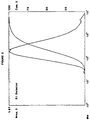
- peak molecular weight is that molecular weight corresponding to the maximum concentration in the polymer concentration-elution time GPC trace (chromatogram). Since GPC instruments do not usually operate with a strictly linear calibration relationship between the logarithm of molecular weight and elution time, such a maximum will be slightly displaced from the maximum in the differential weight distribution, dW(M)/d log M . For rigorous comparison between different GPC instruments, it is necessary that the calibration, log M versus time, be essentially linear in the region of Mp, but minor discrepancies do not detract from the basic advance of the present invention.
- Mp is identified as the molecular weight at the local maximum of the major component of the molecular weight distribution in the original GPC chromatogram trace.
- a major component comprises substantially linear molecules.
- Mp does not correspond to the high molecular weight component of the distribution generated by the use of a branching agent during polymerization. Similarly, it does not correspond to the high or low molecular weight components blended to prepare a final polymer composition.
- the high ends fraction of the molecular weight distribution is characterized by GPC analysis and comprises that portion of the distribution which is equal to and greater than four (4) times the peak molecular weight, Mp.
- the absolute molecular weights based on GPC analysis are assigned on the basis of an elution time calibration defined in terms of hydrodynamic volume or on the basis of light scattering intensity. For these two methods the following are the appropriate Mark Houwink and scattering parameters, all in tetrahydrofuran at 30°C:
- the Mw from light scattering can be used with Mv to calculate a branching index as defined below.
- the Mw/Mv from elution time is also used in that index. This latter quantity is not significantly affected by long chain branching.
- the exponential power a/b can be treated as equal to 1.
- Green strength, viscosity and elastic memory are important properties affecting the processability of polymers and compounds in various end-use applications, e.g., tire fabrication.
- Tire innerliner compounds for example, require low elastic memory. It would be expected that this property would be enhanced by lower viscosity, but it must be balanced against the need to maintain acceptable green strength which directionally increases as viscosity increases. Lower viscosity polymers are also preferred for easier mixing and calendering.
- Halogenated butyl rubber e.g., chlorinated and brominated butyl rubber
- chlorinated and brominated butyl rubber has become the material of choice for tire innerliner compositions in view of its outstanding air permeability characteristics.
- compositions have been developed with processing properties acceptable for the practical, commercial environment.
- improvements in these properties and, in particular, improvements which are not dependent on additional additives or difficult-to maintain process conditions.
- This has been a particularly difficult objective to achieve with compositions containing high percentages of halogenated butyl rubber (for example, up to and including 100 percent of the rubber component), which compositions demonstrate the best air holding characteristics.
- One means for achieving the improved properties disclosed herein is by blending polymers or polymer fractions of widely differing and defined molecular weights to produce "tailor-made" molecular weight distributions. This results in polymers and polymer compositions with the unique combination of green strength levels attributable to higher molecular weight butyl polymers combined with lower viscosity and lower elastic memory (faster stress relaxation) attributable to lower molecular weight butyl polymers.
- the effect of blending can be achieved in a direct synthesis process by utilizing the product produced by two or more polymerization reactors operating in parallel or series or two or more polymerization zones in a single vessel wherein the resulting polymers are mixed.
- each zone or each reactor produces a polymer with molecular weight and molecular weight distribution characteristics emphasizing specific region(s) of the molecular weight distribution of the desired final product.
- the blended product incorporates the essential features defined herein.
- the resulting polymer will have a molecular weight distribution such that Mz/Mw is equal to or exceeds 2.0, preferably is equal to 2.0 to about 11.0, more preferably about 2.5 to about 10.0, most preferably about 3.5 to about 9.0.
- blending means it is convenient to refer to three polymer components for achieving the desired molecular weight distribution of the blended composition, namely a high molecular weight component, a low molecular weight component and a moderate molecular weight component wherein the sum of the three equals 100 percent.
- Naturally fewer or greater numbers of components differing in molecular weight can be used to achieve the same end, but three represent a practical compromise.
- useful polymer blend components are: Molecular Weight Component Mv x 10-5 Mw/Mn Crosslinking Functionality* (A) High 15-30 (18-27) 1.5-3.0(1.8-2.7) .1-.3(.2) (B) Low 1.5-2.5 (1.8-2.2) 3.0-6.0 (3.5-5.0) 1.2-2.2(1.4-2.0) (C) Moderate 3.0-4.0 (3.3-3.7) 2.5-5.0(3.0-4.0) .6-.9(.8) * For 90% network perfection. The values in parentheses are considered preferable to those first expressed.
- the high molecular weight component is blended at a concentration of about 8 to about 25 weight percent, preferably about 10 to about 20, most preferably about 12 to about 18, for example about 14 to about 16; the low molecular weight component at about 0 to about 20 weight percent, preferably about 0 to about 15, most preferably about 1 to about 12, for example about 2 to about 10; the moderate molecular weight component is employed at a concentration such that the sum of the components equals 100 percent.
- Functionality e.g., halogen and/or unsaturation
- strength of the vulcanized or crosslinked composition is a significant factor.
- Some applications or uses may permit the use of a polymer blend in which molecular network perfection is less of an important factor and therefore functionality can be viewed as a secondary consideration.
- the contribution of functionality of each component to the crosslinked network will vary depending on the molecular weight of the component to be blended e.g., broadly speaking, less functionality is required for a high molecular weight component than for a low in order to incorporate each into a crosslinked network.
- even homopolymer polyisobutylene can be used as a high molecular weight component for blending to achieve the desired green strength and stress relaxation in the final mixture.
- branching in compositions prepared by blending of components depends on branching present in the component itself. With regard to branching, more is disclosed below.
- the polymers of the present invention can also be produced directly during polymerization, e.g., in a single continuous stirred tank reactor.
- such polymers will have highly branched structures by incorporating, during polymerization, crosslinking or cationically active comonomers or agents.
- branching agents preferably are, or contain, structural features which are soluble in the polymerization diluent.
- branching agents are used in conjunction with, or are themselves, stabilizers for the polymer slurry when such a slurry results, e.g., butyl rubber in methyl chloride (see United States Patents 4,252,710, 4,358,560 and 4,474,924 described earlier).
- the slurry stabilizers described in these patents were recognized as either being chemically inert with respect to the cationic polymerization process (e.g., substantially fully extractable from the polymer after polymerization) or chemically bonded to the polymer (see '924, column 4, lines 43 - column 5, line 7).
- the disclosure of bonding was limited to the concept of forming an in situ stabilizer with the preformed copolymer stabilizer acting as a functional lyophile and the product polymer a lyophobe.
- the prior art was unaware of the concept of using specific types and concentrations of additives as branching agents to control molecular weight distribution in order to effect particularly desirable properties in the product polymer.
- the present invention discloses a new control variable for producing such preferred polymeric products.
- branching preferably long chain branching
- branching results in a modification of the molecular weight distribution, and molecular chain configuration, as referred to earlier.
- Such changes if controlled in the manner taught, result in advantageous properties and provide a means for achieving these properties.
- branching is introduced selectively and in a controlled manner, the lower molecular weight polymer species are substantially branch free, i.e., those species with molecular weights less than the peak molecular weight, Mp.
- substantially branch free means a distribution or a portion thereof which would have a branching index value, g, of greater than 0.9.
- the nature of the polymerization diluent can have important effects on the polymer produced. Similarly important is the solubility of the branching agent under polymerization conditions throughout the entire course of the polymerization. As butyl is normally produced by slurry polymerization in methyl chloride diluent, the polymer precipitates out of solution as it is formed. Consequently, when a branching agent is incorporated, it is removed from solution and may become buried within the polymer particle so that the additional sites are no longer available in the solution phase for subsequent reaction. The actual branching reactions may be forced to occur within the precipitated butyl polymer in a very different and much more poorly controlled way than had the branching agent remained in solution.
- branched structures which significantly modify the molecular weight distribution, can also be achieved through the inclusion of reactor-diluent-soluble moieties containing multiple, cationically reactive sites, particularly in conjunction with slurry stabilizers (as previously discussed to prevent reactor fouling with insoluble gel).
- Slurry stabilizers stabilize butyl dispersions produced during polymerization in a diluent such as methyl chloride, and prevent the mass agglomeration of slurry particles.
- a diluent such as methyl chloride
- slurry stabilizers make it possible to produce dispersed butyl particles containing gel in the reactor without depositing fouling rubber containing gel on the heat transfer surfaces.
- slurry stabilizers it is possible to produce a modified butyl rubber containing as much branching and/or gel as is desired in a practical manner without interfering with the ability to wash the reactor in order to prepare it for reuse.
- branching agent through appropriate choice of the branching agent and the amount used, it is possible to exert considerable control over the branching process so that the desired changes in molecular weight distribution are achieved.
- crosslinking agents tend to introduce random long chain branching they modify the entire molecular weight distribution of the polymer.
- soluble moieties containing multiple reactive sites can be used to introduce a controlled amount of a high molecular weight branched fraction into the distribution without modifying the entire molecular weight distribution of the polymer.
- a small amount of a very highly functional and reactive soluble moiety can be used to introduce a small amount of very high molecular weight highly branched material into the distribution.
- a larger amount of a less reactive, lower functionality moiety can be used to introduce more of the branched fraction, but of lower molecular weight.
- the cationically reactive branching agents for use in producing the polymers of this invention are present during polymerization in an amount effective for producing the desired changes in molecular weight distribution. Such amounts vary depending on the number and reactivity of the cationically active species, including such variables as molecular weight and reactivity of the agent (particularly that portion of the agent containing the cationically active moiety). Additionally, polymerization conditions influence the effective concentration, e.g., batch versus continuous, temperature, monomer conversion, etc.
- Such agents are present in an amount, based on the monomers, greater than about 0.3 weight percent e.g., about 0.3 to about 3.0 weight percent, preferably greater than about 0.35 weight percent e.g., about 0.35 to about 2.8 weight percent, more preferably greater than about 0.4 weight percent e.g., about 0.4 to about 2.7 weight percent, most preferably greater than about 0.45 weight percent e.g., about 0.45 to about 2.6 weight percent, for example greater than about 0.5 weight percent e.g., about 0.5 to about 2.5 weight percent.
- Reagents which are not excessively reactive can be used in a commercial process at, e.g., about 1.1 to about 2.0 weight percent.
- the upper limit of concentration is limited to that concentration which causes the final polymer product to be gelled to an extent which is unacceptable for the intended use of the product.
- a particularly desirable method of introducing the desired high molecular weight ends branching is to combine the functions of the slurry stabilizer and the branching agent in one species by use of a slurry stabilizer with multiple active sites in an anchor group.
- the lyophilic portion of the slurry stabilizer solubilizes the anchor group, which contains multiple active sites to produce the desired branched fraction during polymerization, and the lyophilic portion then forms the protective shield around the butyl slurry particles to provide steric slurry stabilization.
- Block copolymers of polystyrene and polybutadiene or polystyrene and polyisoprene are examples of molecules which combine the functions of slurry stabilization and branching agent when butyl rubbers are polymerized in methyl chloride diluent as in commercial butyl rubber processes.
- the crosslinking comonomer and/or species containing multiple reactive sites is preferentially soluble under polymerization conditions because then it is more effectively utilized and the branching reactions can be better controlled.
- crosslinking comonomers are typically low molecular weight liquids, they are soluble in the polymerization diluent of interest, but species containing multiple reactive sites are normally polydienes with limited solubility in the normal butyl polymerization diluent (e.g., methyl chloride) under reaction conditions.
- the solubility requirement often limits the molecular weight of polydiene which can be used unless it also contains groups which enhance methyl chloride solubility.
- the choice of these solubilizing groups is restricted by the consideration that they must not poison the polymerization catalyst used or interfere with the polymerization.
- solubilizing group be a lyophilic polymeric chain that can act as a slurry stabilizer so that it serves dual functions.
- solubilizing groups makes it possible to utilize higher molecular weight polydienes during slurry polymerization of butyl rubbers in methyl chloride diluent and, hence, makes possible the production of a more highly branched, high molecular weight mode during polymerization.
- the polymerization diluent can also be changed to one in which the polydiene is more soluble but such a major process change is less desirable from economic and process viewpoints.
- the ability to vary the reactivity of the unsaturated groups as well as their number per chain affords considerable flexibility in producing a butyl rubber with the desired modification in molecular weight distribution.
- the Type IV unsaturation in a 1,4-polyisoprene chain is very active under butyl polymerization conditions and becomes extensively involved in branching reactions whereas the Type II unsaturation in a 1,4-polybutadiene is very much less active and, hence, becomes much less extensively utilized in branching reactions under any given set of conditions. Therefore, a very low molecular weight polyisoprene (e.g., 500-2500 molecular weight) which is still soluble in methyl chloride can be used to introduce a highly branched fraction during butyl polymerization.
- a very low molecular weight polyisoprene e.g., 500-2500 molecular weight
- the same number of branches can be achieved by using a much higher molecular weight polybutadiene containing far more unsaturation per chain, but the polybutadiene would need to be solubilized in the methyl chloride (e.g., by being present in a block copolymer with a solubilizing agent such as polystyrene) and would produce a different polymer with a lower branching density in the high molecular weight fraction or mode.
- a solubilizing agent such as polystyrene
- crosslinking comonomers and soluble moieties containing multiple reactive sites function to produce branching is similar and may be described as a "graft onto" or “grow-through” mechanism.
- a growing butyl chain attacks one of the reactive sites on the comonomer or soluble moiety containing multiple reactive sites to become attached to it (and can propagate through it) leaving the remaining unsaturated sites available for similar attack to produce a branched butyl polymer with two or more butyl chains attached to the same moiety.
- crosslinking comonomer only two butyl chains can become attached and so random long chain branching results and gel is produced whenever the critical branching value of two per chain is reached.
- the number of butyl chains attached to that moiety can be as many as desired since such chains do not contain active branching functionality and tend to terminate after attachment. It is controlled by setting the number and reactivity of the reactive sites and the amount of branched butyl produced can be controlled by the amount of reactive moiety added to the polymerization.
- a high molecular weight ends mode with many butyl chains attached to the reactive moiety, is produced with the remainder of the butyl distribution being unaffected.
- the molecular weight amount and density in the high molecular weight ends mode are all subject to some degree of independent control. Judicious use of a soluble moiety containing multiple reactive sites is a more flexible and controllable way of achieving the desired change in molecular weight distribution than is use of a crosslinking comonomer.
- soluble moieties containing multiple reactive sites are preferred because their use makes it possible to conduct the branching reactions much more nearly in the solution phase even when methyl chloride is used as the diluent. This is so because the solubilizing groups used with the polydiene tend to keep it in solution or at least at the surface of the precipitated butyl particle even after a butyl chain has become attached to it. This is especially so when the solubilizing group is a lyophilic polymer chain so that the polymeric branching agent is a slurry stabilizer and becomes attached to the butyl particle surface to keep the remaining unreacted sites relatively available for branching reactions.
- Solution polymerization also permits the direct use of polydienes and partially hydrogenated polydienes as the branching moiety without the need for other solubilizing groups on the polydiene.
- polybutadiene, polyisoprene, polypiperylene, natural rubber, and styrene/butadiene rubber can all be employed as the branching moiety during solution polymerization of butyl rubbers in a solvent such as hexane.
- the reactive site or functional group on the functional lyophile participates in the polymerization as discussed above and becomes the site at which the butyl chain becomes attached to form the block or graft copolymer. If the functional lyophile contains more than one functional group, then a butyl chain can become attached at each functional group and a number of butyl chains become attached to the lyophile.
- the multifunctional lyophile then becomes a means of linking many butyl chains together (by virtue of their attachment to the same lyophile molecule). The number of butyl chains which are linked together, and thus the molecular weight of the linked moiety, is easily controlled by controlling the functionality of the multifunctional lyophile.
- a high molecular weight end mode of any desired molecular weight is readily prepared in situ during polymerization.
- the architecture of the linked moiety can also be controlled by the spacing of the functional groups on the multifunctional lyophile.
- a cluster of butyl chains can be attached at intervals along the lyophile chain.
- the amount of the multifunctional lyophile added to the polymerization controls the amount of the high ends fraction formed. This is a convenient method to control the amount, nature and molecular weight of the high ends mode.
- modification of the molecular weight distribution is achieved by incorporating during polymerization of the polymers an effective amount of functional reagent selected from the group consisting of polymers and copolymers comprising functional groups capable of copolymerizing or forming a chemical bond with the product polymer, the functional group comprising cationically active halogen or cationically active unsaturation and such polymers and copolymers preferably comprising lyophilic polymerization diluent soluble moiety.
- functional reagent selected from the group consisting of polymers and copolymers comprising functional groups capable of copolymerizing or forming a chemical bond with the product polymer, the functional group comprising cationically active halogen or cationically active unsaturation and such polymers and copolymers preferably comprising lyophilic polymerization diluent soluble moiety.
- Suitable reagents in this class include chlorinated butyl and brominated butyl.
- Suitable reagents in this class include hydrochlorinated polyisoprene, hydrobrominated polyisoprene, isobutylene-vinylbenzyl chloride copolymer and chlorinated polystyrene.
- Suitable reagents in this class include polybutadiene, polyisoprene and polypiperylene.
- molecular weight and molecular weight distribution criteria are critical for obtaining the desired polymer products and achieving the unique balance of properties, i.e., green strength and stress relaxation.
- the amount of branching agent fed to the reactor and polymerization conditions, e.g., conversion, should be controlled in order to obtain useful polymers, i.e., those with high ends fraction of from about 8 to about 25 weight percent; preferably about 10 to about 20, most preferably about 12 to about 18, for example about 14 to about 16 weight percent.
- the amount of high ends fraction in useful polymers comprises that portion of the molecular weight distribution which is equal to or greater than 4 Mp, preferably about 5 Mp, most preferably about 6 Mp, for example about 8 Mp.
- Useful polymers are obtained when the peak molecular weight of the polymer, Mp, is greater than about 250,000; it is preferable that Mp is about 250,000 to about 850,000; more preferably about 270,000 to about 800,000; most preferably about 290,000 to about 750,000; for example about 300,000 to about 700,000.
- compositions can also be prepared by utilizing the principles of the blend approach, described hereinbefore, in combination with directly polymerized branched polymers.
- Useful compositions are prepared by blending highly branched polymers with polymers that are essentially linear. The resulting composition has the desirable green strength and stress relaxation characteristics when the blended composition has the defined molecular weight criteria.
- halogenated butyl rubber prepared using the butyl polymers described herein for subsequent halogenation.
- the halogenated polymers e.g., brominated butyl and chlorinated butyl can be used to produce tire innerliner compositions with improved processing properties such as higher green strength, and faster stress relaxation compared to similar halogenated butyl compositions absent the modified structure and molecular weight distribution.
- the polymers of this invention are particularly useful in compositions for products produced by extrusion, calendering, and injection, transfer and compression molding.
- Such products include tire components such as sidewalls, sidewall veneers, carcasses and treads, innertubes, wire and cable, hose, sheeting, film, automotive and mechanical goods, sponge products, pharmaceuticals, adhesives, sealants, etc.
- the polymers are also particularly useful in blends comprising other elastomers and plastics, including cured compositions as well as thermoplastic and dynamically vulcanized blends.
- Such compositions can typically include additional components such as reinforcing and nonreinforcing fillers, extenders and plasticizers, process aids, antioxidants and antiozonants, colorants, etc.
- compositions according to the invention have a molecular weight, Mz, greater than 1.2 x 10⁶ and, when the rubber is isobutylene-isoprene rubber, greater than 2.0 x 10⁶, when measured by gel permeation chromatography with a low angle laser light scattering detector.
- compositions comprise a linear and/or branched high molecular weight fraction of a C4-C7 isoolefin homopolymer rubber, butyl copolymer rubber, or mixtures thereof wherein, relative to a substantially linear butyl copolymer rubber, said composition exhibits at least a 5% faster stress relaxation at equivalent green strength or at least a 5% higher green strength at equivalent stress relaxation.
- the multifunctional lyophile is a hydrohalogenated styrene-isoprene-styrene triblock copolymer
- Polymer compositions were prepared by blending polymers differing in molecular weight.
- the compositions were blended in solutions of 10% by weight polymer in hexane, then steam stripped and dried on a rubber mill.
- the resulting polymer blends were then tested according to the tests described earlier.
- the polymers prepared in these blending experiments where characterized using the GPC method without the low angle laser light scattering (LALLS) detector which was later found to affect the determination of high molecular weight components (subsequent tests using LALLS indicated a decrease of about 0.4 units for the value of Mz/Mw as compared to values measured by refractive index).
- LALLS low angle laser light scattering
- the other, commercially available, polymers are also manufactured by Exxon Chemical Co.
- CIIR 1065 Chlorobutyl rubber, grade 1065
- CIIR 1066 Chlorobutyl rubber, grade 1066
- CIIR 1068 Chlorobutyl rubber, grade 1068
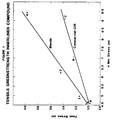
- IIR 268 butyl rubber, grade 268. Test results are reported in Table 1 for blends demonstrating the improved properties of the invention (blends A and B).
- Blend A exhibits the green strength of a higher Mooney viscosity rubber like CIIR 1066, at viscosity and stress relaxation levels comparable to lower Mooney viscosity polymers like CIIR 1065 or IIR 365.
- Comparing polymers 4-7 shows that blend B displays the green strength of CIIR 1068 or IIR 268 and the stress-relaxation capability of CIIR 1066, at significantly lower viscosity than these polymers.
- the experimental blends with molecular weight distribution features selected to improve specific performance properties exhibited higher green strength and faster stress relaxation compared to typical, commercial polymers of equivalent Mooney viscosity.
- compositions were also evaluated in compositions further comprising carbon black, rubber process oil and other ingredients typically used in end use applications, e.g., a tire innerliner formulation.
- the composition was mixed in a laboratory internal mixer (size B Banbury®) using the following formulation (parts by weight): Polymer 100 Carbon Black (type N660,GPF) 50 Naphthenic Process Oil (a) 8 Processing aid (b) 7 Stearic acid 2 Magnesium oxide (c) 0.15 Zinc oxide 3 MBTS (d) 1 Sulfur 0.5 (a) Flexon® 641 (Exxon Chemical Co.) (b) Struktol® 40MS (Struktol Co.) (c) Maglite® K (Merck) (d) 2,2'- Benzothiazyl disulfide
- Blend A is the same composition as above (which had improved properties compared to a higher Mooney viscosity commercial polymer.
- Blend C the amounts of both high and low MW components were increased to 20%. This resulted in essentially no change in Mooney viscosity or green strength, but a 10% increase in the relaxed stress level.
- Butyl 365 is compared with two blend compositions of slightly lower Mooney viscosity. Blends D and E both contain increased amounts of the low MW component with the high MW component held at 20%. This results in lower green strength levels than Butyl 365, and slower relaxation (higher relaxed stress levels).
- a series of batch dry box polymerizations were run to show the effect of low levels of a low molecular weight reactor-diluent-soluble polyisoprene polymer on the molecular weight distribution of butyl rubber slurry polymerized in methyl chloride diluent.
- the low molecular weight soluble polyisoprene used in this series of batch polymerizations was identified as AI-8803-084-5. It was prepared by "living" anionic polymerization of highly purified isoprene in cyclohexane diluent using secondary butyl lithium catalysis. It was a narrow molecular weight distribution liquid polymer with a molecular weight of 530 by GPC.
- This liquid polyisoprene was primarily an isoprene heptamer initiated from a secondary butyl group. It was readily soluble in methyl chloride or a typical butyl feed blend and contained about seven reactive double bonds per chain. Each polyisoprene molecule was thus capable of tying seven butyl rubber chains together (if all the unsaturated sites were utilized) to form a bush-type branched fraction consisting of seven butyl chains attached to each polyisoprene molecule. The amount of this high ends branched fraction is readily controlled by varying the amount of polyisoprene added to the polymerization.
- the batch dry box polymerizations were conducted as follows: the polymerizations were conducted in a 500 ml. 3-neck reaction flask setup in a glove box having an oxygen-free and moisture-free nitrogen atmosphere. The flask was cooled to -95°C by immersion in a controlled temperature liquid nitrogen cooled heat transfer bath. It was fitted with a thermometer, cooled dropping funnel and stirrer. Typically the flask is charged with 460 g. of a feed blend in methyl chloride and then a catalyst solution in methyl chloride is slowly dripped in to initiate polymerization while stirring of the bath is continued in order to maintain the desired polymerization temperature.
- the feed blend is typically defined by a "B" number, e.g., B-3.
- the B number is a shorthand reference of the approximate weight percent concentration of isoprene relative to isobutylene, e.g., 3.0 g. isoprene with 97.0 g. isobutylene calculates as 3.09 and is cited as B-3.
- the polymerization is quenched by addition of cold methanol (typically 25 ml.) and then transferred to a vented hood where it is allowed to warm and flash off the methyl chloride and unreacted monomers. Additional methanol containing a trace of butylated hydroxytoluene (BHT) stabilizer is added as the reactor liquids flash off in order to protect the polymer from degradation prior to recovery. After the monomer is completely flashed off, the polymer is kneaded and washed in isopropanol to remove catalyst residues and then vacuum oven dried at 80°C with 0.2 wt. % BHT added as an antioxidant.
- BHT butylated hydroxytoluene
- the dried polymer is then used for evaluation and characterization.
- the reaction was charged with a 10.9 wt.% B-3 feed in methyl chloride and chilled to -97°C before the 0.3 wt. % EADC catalyst solution was dripped in to produce polymer.
- Catalyst solution was dripped in slowly over the course of five minutes while stirring and maintaining temperature between -97 and -93°C before quenching and recovering the polymer as usual.
- a 53% conversion of monomer to polymer was realized and the recovered, dried polymer was a tough, rubbery, butyl polymer with a viscosity average molecular weight of 431,000, Mp of 420,000 and INOPO of 9.5 (approx.
- the low molecular weight polyisoprene apparently contained some poisons as about twice as much catalyst was required as in the control run to produce polymer and the polymer viscosity average molecular weight was reduced from 431,000 to 308,000. Nevertheless, molecular weight distribution broadening with the production of a high molecular weight tail was achieved (estimated to be about 4%).
- the polymer had an Mz/Mw ratio of 2.1 by GPC using an RI (refractive index) detector and a higher Mz/Mw ratio of 3.4 using LALLS to better resolve the high molecular weight species.
- This higher level of polyisoprene produced even more catalyst and molecular weight poisoning. Nevertheless, even more molecular weight broadening with still more of the high molecular weight tail was achieved (estimated to be about 6%).
- This polymer had an Mz/Mw ratio of 2.7 by GPC using an RI detector and a ratio of 4.2 using LALLS. Even at the low conversion achieved in this run, it contained 0.8 wt.% of the low molecular weight polyisoprene incorporated mainly in the high ends tail.
- the amount of incorporated polyisoprene is an estimate based on unsaturation measurements; to the extent unsaturation in the polyisoprene has been lost, the incorporation is even higher.
- the low molecular weight polyisoprene is being incorporated during polymerization to broaden the molecular weight distribution by producing a high ends fraction consisting of multiple butyl chains attached to each polyisoprene molecule. This broadening is achieved without any gel formation even with slurry polymerization because the limited functionality of the low molecular weight polyisoprene will not permit the attachment of more than seven butyl chains to each polyisoprene molecule.
- a high molecular weight fraction can be produced during polymerization through the use of a methyl chloride soluble polymer containing multiple cationically reactive unsaturation sites.
- the amount of the high ends fraction can be controlled by the amount of the reactive soluble polymer added; the molecular weight of the high ends fraction can be controlled by the amount and reactivity of the functionality on the reactive soluble polymer.
- the molecular weight of the high ends fraction can be raised by operating at high conversion to attach more butyl chains to each polyisoprene molecule and/or by raising the molecular weight of the polyisoprene so that each molecule contains more reactive unsaturation (sites).
- the polyisoprene becomes less soluble in methyl chloride and in order to maintain it in solution it becomes necessary to introduce solubilizing groups into the polyisoprene (preferentially as a solubilizing block) or to change the diluent to make it a better solvent for polyisoprene.
- the latter change also has the advantage of making the diluent a better solvent for butyl and changes the nature of the slurry and in the limit results in a change from slurry polymerization to solution polymerization. Raising the molecular weight and, hence, the number of double bonds per chain of the polyisoprene too much can produce such extensive branching that gel results.
- polystyrene resin i.e., polybutadiene, SBR rubbers, etc.
- polybutadiene i.e., polybutadiene, SBR rubbers, etc.
- SBR rubbers i.e., polybutadiene, SBR rubbers, etc.
- the Type IV double bonds in polyisoprene are very reactive under butyl polymerization conditions and so very low molecular weight soluble polyisoprenes are useful for introducing branching as shown in this example.
- the Type II double bonds in 1,4-polybutadiene are much less reactive and so a much higher molecular weight polymer are required to produce the same degree of branching in the butyl.
- solubilizing groups are required to make the high molecular weight polymers soluble in the polymerization diluent, e.g., methyl chloride, for use during slurry polymerization of butyl rubbers as is normally practiced.
- Suitable lyophilic groups have a Flory-Huggins interaction parameter with the polymerization diluent of less than 0.5.
- Such materials include polystyrene, polyvinyl chloride, polyvinyl bromide, neoprene, mono-, di- and trisubstituted styrenes (the substituents being halogen, such as chlorine, or lower C1-C5 alkyl groups, as illustrated by alpha-methyl styrene, para-t-butyl styrene, p-chlorostyrene and similar ring chlorinated styrenes).
- KR03-K-Resin® a styrene/butadiene block copolymer identified as KR03-K-Resin® (Phillips Chemical Company) as a branching agent during butyl polymerization.
- the polybutadiene micro-structure which is important in determining cationic activity during butyl polymerization, is about 12% 1,2 addition and 88% 1,4 addition with mixed cis/trans configuration, but mostly cis.
- the dry box runs were made using a 10.9% B-3 feed using 48.5 g. isobutylene and 1.5 g. isoprene in each run. All polymerizations were run with the cooling bath temperature set at about -66°C and polymerizations were initiated by dripping in a 0.18% solution of AlCl3 in methyl chloride as catalyst.
- KR03-K-Resin a styrene-butadiene block copolymer
- KR03-K-Resin a styrene-butadiene block copolymer
- An additional benefit of the KR03-K-Resin previously disclosed in U.S. 4,474,924 is that it acts as a slurry stabilizer to improve reactor operation.
- the slurry produced in the control run 1 agglomerated completely as made whereas stable, milky, slurries were produced in runs 2 and 3 with KR03-K-Resin added to the feed.
- KR03-K-Resin is a desirable material for introducing a controlled high ends fraction into butyl rubber during polymerization.
- the polybutadiene is attached to the coupling agent so that it comprises the central core of the block copolymer and the polybutadiene microstructure is similar to that of KR03.
- the runs were all made using a 10.9% feed containing 48.5 g. isobutylene and 1.5 g. isoprene in each batch reactor along with the desired amount of KROl-K-Resin where used.
- the cooling bath temperature was -66°C and an 0.18% solution of AlCl3 in methyl chloride was used as the catalyst.
- the control run with no branching agent was run 1 as already described in Example 3.
- run 1 of this example 0.5 g. of KROl-K-Resin (1% on monomers) was dissolved in the feed blend prior to initiating polymerization and 20 ml. of the catalyst solution was dripped in over the course of fourteen minutes while stirring and maintaining temperature between -63 and -55°C in the reactor.
- 37.97 g. (76% conversion) of a tough, white, rubbery butyl rubber containing a branched high ends fraction attached to some of the KROl-K-Resin was recovered.
- This polymer had an Mv (DSV) of 257,100, Mp of 230,000 and INOPO of 8.7. It had an Mz/Mw ratio of 3.4 by GPC/LALLS and also produced about 8.5% high ends branching of the molecular weight distribution.
- KROl acted as a slurry stabilizer to yield stable milky slurries in runs 1 and 2 as compared to the completely agglomerated mass of rubber produced in the control run.
- KROl can also be a useful material for introducing a controlled high ends fraction into butyl during polymerization.
- run 3 was made in which the KROl resin was partially hydrogenated to eliminate most of the active unsaturation prior to its use as a branching agent in a butyl batch dry box polymerization.
- This resin identified as 85% HKROl was prepared by the use of diisobutyl aluminum hydride as a chemical reducing agent to hydrogenate and remove most of the active unsaturation in the polybutadiene portion of the KROl-K-Resin without affecting the polystyrene blocks.
- the hydrogenation was effected by dissolving the KROl in dry toluene to give a 10% solution; adding the diisobutyl aluminum hydride at 1 mole per mole of butadiene and then heating to 90°C for two hours before quenching, washing and recovering the partically hydrogenated KROl resin.
- the recovered 85% HKROl was essentially unchanged from the starting KROl in molecular weight, but 85% of the polybutadiene unsaturation had been hydrogenated and removed. The remaining unsaturation was predominantly the more inert trans in-chain type.
- 0.5 g. of the 85% HKROl (1% on monomers) was dissolved in the feed blend and 12 ml.
- the slightly reduced molecular weight probably reflects the presence of some unreacted 85% HKROl resin in the polymer, but may also be due to slight molecular weight depression caused by the 85% HKROl in the reactor.
- a partially hydrogenated KR03 resin sample was prepared and evaluated as a branching agent in a batch dry box butyl polymerization.
- the KR03 resin was hydrogenated as just described for the KROl resin and again an 85% reduction in the polybutadiene unsaturation was achieved without affecting the polystyrene blocks of the KR03 resin or its molecular weight.
- the partially hydrogenated K-Resins used in these experiments were very effective slurry stabilizers and produced finer and more stable milky dispersion of the butyl rubber in methyl chloride than even the unhydrogenated K-Resins, but they were not significantly incorporated into the polymer during polymerization to produce a branched high ends fraction as were the unhydrogenated K-Resins.
- the hydrogenated K-Resins were absorbed on the butyl slurry particles and enhanced slurry stability whereas the unhydrogenated K-Resins became chemically attached to the butyl polymer during polymerization and produced a branched high ends fraction.
- the GPC test and Mz/Mw ratios already cited are evidence of this difference.
- Extraction experiments provide further proof of this difference.
- the extraction experiments were performed by recovering the butyl rubber from the batch experiment in methyl/ethyl ketone which is a non-solvent for butyl but a solvent for K-Resins or hydrogenated K-Resins.
- Two MEK extractions are performed and the extracts combined to recover the MEK soluble resin and the MEK insoluble rubber separately.
- the hydrogenated resins nearly all of the K-Resins can be extracted and recovered in unchanged form. With the unhydrogenated K-Resins, very little of the resin can be extracted, and the extracted material has butyl attached to it.
- a series of butyl polymerization runs were made in a butyl continuous polymerization reactor with various amounts and types of K-Resins.
- the reactor permitted polymerization experiments to be run under continuous polymerization conditions which closely simulated commercial polymerization conditions.
- the rector was a modified, baffled, draft tube containing well stirred tank type reactor of nominal one-gallon capacity and containing 2.86 square feet of heat transfer surface to remove the heat of polymerization and maintain the reactor contents at polymerization temperature.
- Separate feed and catalyst streams could be chilled and metered continuously into the reactor and the effluent continuously overflowed through a 3/4-inch overflow line into chilled product slurry receivers for quenching and recovery.
- Reactor temperature was maintained and controlled by circulating a heat transfer fluid at a controlled rate and temperature through channels within the reactor heat transfer surfaces.
- the equipment is designed to meter and chill four separate streams into the reactor to establish a steady-state set of polymerization conditions. Normally a monomer feed, an additive solution (i.e., K-Resin solution), a diluent stream, and a catalyst solution were fed into the reactor to establish the steady state. In a control polymerization with no K-Resin, run 1, a steady state was achieved with the following feeds into the reactor, all in grams per minute: Isobutylene 50.403 Isoprene 1.375 Methyl Chloride 135.465 AlCl3 0.047 187.29 ⁇
- Reactor temperature was controlled at -96.0°C and at the steady-state, monomer conversion was 94.5% with production of a 26.1% slurry.
- the reactor effluent was rather thick and lumpy and reactor fouling forced termination of the run after five hours.
- Reactor temperature was controlled at -94.3°C and at the steady-state, monomer conversion was 85.3% with production of a 26.3% slurry.
- the reactor effluent was thick and lumpy and reactor fouling forced termination of the run after 4-1/2 hours.
- Reactor temperature was controlled at -93.5°C and at the steady-state monomer conversion was 94.8% with production of a 31.3% slurry.
- the reactor effluent was a homogeneous fluid slurry and the reactor ran well with no evidence of fouling until the run was voluntarily terminated.
- the high INOPO reflects the presence in the butyl of KROl-K-Resin which was attached to the butyl to yield a high ends branched fraction. None of the KROl-K-Resin was extractable from the butyl using MEK, a good solvent for KROl-K-Resin.
- KROl-K-Resin level in the reactor was 0.75% on monomers or about 0.79% on polymer.
- GPC/LALLS analyses showed this polymer to have a long high molecular weight tail in the distribution. It had an Mz/Mw ratio of 3.9 and contained no detectable amount of gel.
- KROl-K-Resin introduced a branched high ends fraction of about 8.5% into butyl without producing gel while at the same time acting as a slurry stabilizer to improve reactor operation by allowing operation at a high slurry concentration without fouling.
- Reactor temperature was controlled at -92.0°C. At the steady-state, monomer conversion was about 99.5% with production of a 39.2% slurry.
- the reactor effluent was a very thick homogenous slurry and the reactor was barely operable with -92°C being the lowest polymerization temperature which could be maintained. The reactor only ran a few hours before temperature control became impossible and more diluent had to be added to dilute the slurry.
- This high INOPO for a feed with a B number of 2.70 is due to the KROl resin having become incorporated into the butyl to produce a branched high ends fraction during polymerization. None of the KROl was extractable from the butyl using MEK as the extracting solvent. The KROl level in the reactor was 1.82% on monomers or about 1.81% on polymer. The polymer apparently contained some very tenuous gel which was present in samples taken directly from the reactor effluent and vacuum oven dried but was absent in the final recovered polymer which was kneaded in isopropyl alcohol to effect deashing and was then hot mill dried.
- Reactor temperature was controlled at -95°C and at steady-state conversion was 93% with production of 34.1% slurry.
- the reactor effluent was a homogeneous fluid slurry, but gel was being made. Within a few hours, the run had to be terminated as the reactor was badly fouled with gel. It could not be cleaned in the normal manner by warming and solvent washing because the fouling polymer was an insoluble gel.
- the reactor had to be disassembled and manually cleaned before it could be used again.
- the butyl polymer produced during this steady-state condition contained more than 50% gel and so could not be characterized well; it contained no extractable KR03.
- the KR03 level in the reactor for this run was 1.3% on monomers.
- Reactor temperature was controlled at -95°C and the steady-state conversion was about 99% with production of a 36.7% slurry.
- the reactor effluent was a homogeneous, fluid, stable slurry and the reactor ran well with no evidence of fouling until the run was terminated voluntarily.
- the high INOPO reflects the presence of chemically bonded KR03 resin in the butyl.
- the KR03 level in the reactor was 1% on monomers and it was all chemically bonded to the butyl; none could be extracted from the recovered rubber.
- a KROl-K-Resin sample was chemically hydrogenated using diisobutyl aluminum hydride as in Example 4 to remove 85% of the polybutadiene unsaturation.
- This resin identified as 85% HKROl was dissolved in methyl chloride to yield a 1.90% wt. % solution of the 85% HKROl in methyl chloride as one of the feeds to the reactor.
- Reactor temperature was controlled at -95°C and at the steady-state monomer conversion was 98.0% with production of a 36.9% slurry.
- the reactor effluent was a very fluid homogeneous slurry and the reactor ran well with no evidence of fouling until the run was voluntarily terminated.
- styrene-butadiene-styrene block copolymer resins can be used to introduce a controlled high ends fraction into butyl during polymerization under conditions simulating commercial production.
- the branching activity of the styrene-butadiene-styrene block copolymer resins can be adjusted as desired by partial hydrogenation of the polybutadiene block so that the desired degree of branching can be achieved without excessive gel formation. Selection of the resin, the degree of hydrogenation, and the amount employed during polymerization enable considerable control to be exercised over the amount and nature of the high ends fraction introduced into butyl during polymerization.
- Styrenebutadiene block copolymers combine the desirable attributes of producing high ends branching while at the same time acting as slurry stabilizers to improve reactor operation and reduce the extent and rate of reactor fouling. It is thus possible to produce the desired high ends fraction under practical conditions by eliminating fouling of the reactor with insoluble gel.
- the slurry stabilization effectiveness of the block copolymers is enhanced by hydrogenation so activity in branching can be adjusted by partial hydrogenation without impairing their effectiveness at improving reactor operation.
- branching agent and slurry stabilizers can be employed to accomplish the same end while still employing partial hydrogenation to adjust branching activity to the desired level.
- branching agent and slurry stabilizer it is most preferable to combine the function of branching agent and slurry stabilizer in one species by utilizing a block copolymer comprising a lyophilic or methyl chloride soluble block (e.g., polystyrene, polyvinylchloride) and a block containing multiple reactive unsaturation (e.g., a polydiene block) to produce the desired high ends branched fraction during polymerization.
- a block copolymer comprising a lyophilic or methyl chloride soluble block (e.g., polystyrene, polyvinylchloride) and a block containing multiple reactive unsaturation (e.g., a polydiene block) to produce the desired high ends branched fraction during polymerization.
- Suitable block copolymers include: styrene/butadiene, styrene/isoprene, styrene/piperylene, etc.
- the preferred block architecture is a star block with the lyophile block on the periphery. It is also possible, though less preferable, to use separate species to accomplish the function of branching as already discussed with or without additional reagents for slurry stabilization.
- the high ends branched butyl polymer designated R49-C12 was prepared with the following feeds into the reactor: Isobutylene 35.122 Isoprene 0.878 Methyl Chloride 114.822 KROl-K-Resin 0.612 AlCl3 0.050 151.5 ⁇
- Reactor temperature was controlled at -94.2°C and at the steady-state monomer conversion was 89.7% with production of a 21.7% slurry.
- the KROl level was 1.7 wt. % on monomers or 1.9 wt. % on polymer and none was extractable from the recovered butyl.
- the reactor ran well and the butyl produced was gel free after hot milling and contained approximately 20.5% branched high ends mode which was rich in the K-Resin as determined by GPC.
- the high ends branched butyl polymer designated R4-C9 was prepared with the following feeds into the reactor: Isobutylene 48.44 Isoprene 1.46 Methyl Chloride 121.24 KROl-K-Resin 0.409 AlCl3 0.053 171.6 ⁇
- Reactor temperature was controlled at -93°C and at steady-state monomer conversion was 91.0% with production of a 26.7% slurry.
- the KROl level was 0.82 wt. % on monomers or 0.90 wt. % on polymer and none was extractable from the recovered butyl which was gel free after hot milling and contained about 12.5% branched high ends mode rich in K-Resin as determined by GPC.
- the model blend has a higher Mz/Mw than the reference commercial samples, but not nearly so high as is achieved with the controlled high ends branching produced by KROl-K-Resin; there are limitations in blending linear components.
- the two polymers R49C12 and R4C9 each had a clearly resolved branched high ends mode with a very high Mp for the high ends mode.
- Figures 2 and 3 contrast a GPC chromatogram (RI) for a typical Butyl 268 polymer and a polymer such as R49C12 which contains a branched high ends mode.
- the strong U.V. absorption peak by the polystyrene lyophile indicates incorporation of the branching agent in the high molecular weight end as indicated in the table ( Figure 4 illustrates such a U.V. trace).
- Mooney viscosity, green strength, and stress-relaxation measurements on the polymers of this example are summarized (for neat polymer) in the following table: Mooney (ML 1+8 at 125°C) Tensile Green Strength (psi) 4-Minute Relaxed Stress (psi) Exxon Butyl 268 50 33.8 11.8 Exxon Butyl 365 33 28.1 7.3 Blend 37 32.1 9.7 R49C12 42 33.1 9.5 R4C9 50 35.1 11.1
- Butyl 268 has higher green strength, but at the expense of longer relaxation time as shown by the higher relaxed stress after 4-minutes relaxation time.
- the green strength of Butyl 268 is adequate for most purposes, but it would be highly desirable to achieve this at the lower Mooney viscosity and higher stress-relaxation rate of Butyl 365.
- the blend is an improvement in that direction--it achieves a higher green strength than Butyl 365 and improved relaxation stress compared to Butyl 268.
- the high ends branched polymer R49C12 shows a higher green strength and faster stress-relaxation time than the blend; while R4C9 shows a much higher green strength than even Butyl 268 at a lower relaxed stress.
- the polymers of this example were each compounded in a typical butyl rubber innertube formulation for further evaluation.
- the formulation used is shown below (parts by weight): Polymer 100 GPF Carbon Black (Grade N660) 70 Paraffinic rubber process oil (a) 25 Stearic Acid 1 (a) Grade Flexon 845 (Exxon Chemical Company)
- Results are similar to the neat polymer results, and the advantages of the controlled high ends branched polymers are evident.
- the commercial butyl polymers show the expected results with the model blend being a step toward achieving a better balance of properties.
- the controlled high ends branched polymers significantly altered the balance of properties.
- R4C9 had much higher green strength than Butyl 268 and a lower relaxed stress.
- R49C12 had a compounded Mooney viscosity equivalent to Butyl 365 with a green strength better than Butyl 268 and a relaxed stress lower than Butyl 365; a particularly desirable combination of properties.
- Blend B had a lower cure state as indicated by the low delta Torque in the rheometer due to the unvulcanizable polyisobutylene component (Vistanex L140), which makes up the higher molecular weight species in this blend.
- a multifunctional lyophile-containing reagent was prepared by hydrochlorination of a styrene-isoprene-styrene triblock polymer containing a very short central polyisoprene block.
- the triblock polymer was polymerized anionically using sec-BuLi as the catalyst in cyclohexane with 10% THF. Monomer was added sequentially (styrene, isoprene, and then styrene again) to form the triblock.
- the central polyisoprene block comprised 5.78 wt.% of the triblock polymer. It was functionalized by addition of HCl to the central isoprene block in methylene chloride solution at O°C.
- the functionalized polymer contained 0.6 wt.% chlorine attached to the short central polyisoprene block; total Mn of the the triblock polymer was about 200,000.
- the functionalized triblock polymer was readily soluble in methyl chloride because of its high polystyrene content and essentially constituted a lyophile highly functionalized in the center by virtue of the chlorine atoms on the short central polyisoprene block.
- Each triblock chain contained greater than 25 active chlorine atoms to serve as sites for attaching butyl chains during polymerization to form the high ends mode.
- the isoprene was largely incorporated in the 3,4 mode in the central polyisoprene block and the HCl adduct contained mostly pendant tertiary chlorine atoms which are highly active during cationic butyl polymerization conditions.
- the structure of the active tertiary chlorine functionality is shown below: Under cationic butyl polymerization conditions the tertiary chlorine is removed to form a tertiary carbenium ion which initiates a butyl chain so that the butyl chain is attached to the functionalized lyophile at the site where the tertiary chlorine atom was removed.
- the multifunctional lyophile of this example is identified as 9851-39-D.
- This reagent was used in a batch dry box polymerization to produce a butyl rubber containing a high ends mode.
- a 500 ml. reaction flask fitted with a thermometer, stirrer, and dropping funnel was set up in a glove box having an oxygen and moisture-free nitrogen atmosphere and the flask was cooled to -65°C by immersion in a controlled temperature liquid-nitrogen-cooled heat transfer bath.
- the reactor was charged with 409.75 g. purified dry methyl chloride and then 0.25 g. 9851-39-D was added as a dry powder and stirred in. It dissolved quickly to give a clear solution. Then 48.5 g. purified, dried, and distilled polymerization grade isobutylene and 1.5 g.
- the reactor was then quenched by addition of cold methyl isobutyl ketone, MIBK (25 ml.) and transferred to the hood where it was allowed to stir and warm slowly with additional MIBK being added as the methyl chloride and unreacted monomers flashed off to yield a fine dispersion of polymer in MIBK at room temperature.
- the polymer was recovered by settling and decanting off the MIBK and then reslurrying in fresh MIBK and settling and decanting again to try to extract any unreacted functional lyophile from the butyl polymer.
- the extracted butyl was kneaded and washed in isopropanol to remove catalyst residues and then vacuum oven dried at 80°C with 0.2 wt.
- % BHT mixed into it as an antioxidant.
- the MIBK extracts were combined and allowed to evaporate to concentrate and then precipitated in methanol; however, essentially no polymer was present in the MIBK extracts, all the 9851-39-D had become incorporated into the butyl during polymerization and was recovered with the butyl. Thirty-five and a half grams of white, tough, rubbery butyl rubber were recovered. Conversion was 80% with a catalyst efficiency of 1500 g/g. The recovered polymer had a viscosity average molecular weight of 230,000 with an INOPO of 8.
- GPC analysis using RI and UV detectors showed the polymer to be bimodal with essentially all of the polystyrene lyophile in the high molecular weight mode as shown by the UV detector.
- the main polymer mode had a peak molecular weight of 140,000 and a normal breadth for batch butyl polymerization, but a second high molecular weight mode with a peak molecular weight of greater than 3 million (uncorrected) containing all of the polystyrene with many butyl arms attached was also present.
- Use of the multifunctional lyophile permitted the formation of a high molecular weight mode during polymerization. A large number of the butyl chains formed during polymerization were attached to each multifunctional lyophile molecule to form the high ends mode.
- a multifunctional lyophile-containing reagent was prepared by hydrochlorination of a styrene-isoprene-styrene triblock polymer containing a short central polyisoprene block.
- the lyophile was prepared by "living" anionic polymerization of styrene in cyclohexane at 60°C with sec-BuLi catalyst; after completion of the styrene polymerization a small amount of isoprene was added as a capping agent and then the capped polymer was coupled with ethyl benzoate to give triblock polymer with a very short central polyisoprene block.
- the coupled triblock polymer had a molecular weight of 170,000 with an INOPO of 5.6 and contained about 1.3 wt. % isoprene as a central block attached to the coupling agent. It was functionalized by addition of HCl in methylene chloride at approximately 3°C. The functionalized polymer contained 0.39 wt. % chlorine mostly present as the tertiary chloride, as in Example 7. The functionalized lyophile contained about 20 active chlorine atoms per chain, again clustered in the short central polyisoprene portion. This polyfunctional lyophile was identified as 10564-48-6. It was used in a batch dry box polymerization to produce a butyl rubber containing a high ends mode.
- Example 7 A batch butyl polymerization was conducted as in Example 7 except that 0.25 g. 10564-48-6 was dissolved in the methyl chloride as the polyfunctional lyophile instead of 9851-39-D.
- 7-1/4 ml. of 0.3% EADC in methyl chloride catalyst was dripped in over the course of 10 minutes while maintaining reactor temperature between -64 and -62°C. 11.7 g. of tough, rubbery butyl rubber were recovered as in Example 7.
- the rubber had a viscosity, average molecular weight of 286,000 and an INOPO of 9.1.
- GPC analysis showed this polymer was also bimodal containing a high ends mode consisting of many butyl chains attached to the polyfunctional lyophile.
- the main mode had a peak molecular weight of 180,000, and the high ends mode a peak (uncorrected) of greater than 4.5 million.
- the polyfunctional lyophile permitted production during polymerization of a butyl rubber containing a high ends mode.
- the amount and molecular weight of this high ends mode is controllable by varying the amount and functionality of the polyfunctional lyophile.
- Table 9-1 HCSI Branching Agent (a) Run Isoprene (b) Chlorine (b) Mv (c) Cl/Chain (d) 1 0.32 0.14 125 20 2 0.32 0.14 125 20 3 0.52 0.24 85 25 4 0.66 0.33 60 25 5 0.66 0.33 60 25 6 1.0 0.93 135 150 (a) Hydrochlorinated styrene/isoprene radical copolymer. (b) Weight %. (c) Values shown are x 10 ⁇ 3. (d) Approximate number of chlorine atoms per chain.
- a series of multifunctional lyophile-containing reagents were prepared by chlorination under radical conditions of a series of commercial and radically polymerized polystyrenes.
- the polystyrenes were chlorinated in methylene chloride using in situ formed t-butyl hypochlorite as the chlorinating agent.
- the in situ t-butyl hypochlorite was formed by bubbling chlorine gas into a methylene chloride solution of the polystyrene containing t-butyl alcohol plus some aqueous NaOH.
- some benzylic chlorines which are active under cationic polymerization conditions and serve as sites for attaching butyl chains, are introduced into the polystyrene.
- the active benzylic chlorines introduced are shown below:
- multifunctional lyophile-containing reagents of the type described in Examples 7-10 to introduce a controlled high ends mode into butyl rubber during polymerization is particularly desirable under continuous polymerization conditions because it introduces the desired high ends mode in a controllable manner without the associated problem of fouling the reactor with insoluble gel which prevents washing the reactor. Additionally, the multifunctional lyophile acts as a slurry stabilizer to prevent reactor fouling and so is a particularly desirable way of introducing the high ends mode.
- SRPT stress relaxation processability tester
- the improved composition of this invention has a faster relaxation time at a given green strength and, conversely, a higher green strength for a given relaxation time.
- the improved compositions have at least about a 5% improvement, as characterized by stress relaxation, more preferably at least about 10%, most preferably at least about 15%, for example, a 20% improvement.
- the rate of change of green strength improvements differs from that of stress relaxation.
- the reference polymer is a substantially linear polymer in its molecular configuration and does not contain the desirable high ends fraction which can also be achieved through blending (as, for example, where essentially linear components are used to prepare the blend).
- the polymer composition of the present invention is a halogenated polymer, e.g., brominated.
- the data are shown in Fig. 6; the data point for the large scale plant represents an average of six individual samples.
Landscapes
- Chemical & Material Sciences (AREA)
- Health & Medical Sciences (AREA)
- Chemical Kinetics & Catalysis (AREA)
- Medicinal Chemistry (AREA)
- Polymers & Plastics (AREA)
- Organic Chemistry (AREA)
- Engineering & Computer Science (AREA)
- Mechanical Engineering (AREA)
- General Chemical & Material Sciences (AREA)
- Compositions Of Macromolecular Compounds (AREA)
- Addition Polymer Or Copolymer, Post-Treatments, Or Chemical Modifications (AREA)
Applications Claiming Priority (3)
| Application Number | Priority Date | Filing Date | Title |
|---|---|---|---|
| US07/131,938 US5071913A (en) | 1987-12-11 | 1987-12-11 | Rubbery isoolefin polymers exhibiting improved processability |
| US131938 | 1987-12-11 | ||
| EP88311634A EP0320263B1 (fr) | 1987-12-11 | 1988-12-08 | Transformation de polymères d'iso-oléfine |
Related Parent Applications (2)
| Application Number | Title | Priority Date | Filing Date |
|---|---|---|---|
| EP88311634A Division EP0320263B1 (fr) | 1987-12-11 | 1988-12-08 | Transformation de polymères d'iso-oléfine |
| EP88311634.5 Division | 1988-12-08 |
Publications (3)
| Publication Number | Publication Date |
|---|---|
| EP0678529A2 true EP0678529A2 (fr) | 1995-10-25 |
| EP0678529A3 EP0678529A3 (fr) | 1995-11-15 |
| EP0678529B1 EP0678529B1 (fr) | 1999-07-14 |
Family
ID=22451686
Family Applications (2)
| Application Number | Title | Priority Date | Filing Date |
|---|---|---|---|
| EP88311634A Expired - Lifetime EP0320263B1 (fr) | 1987-12-11 | 1988-12-08 | Transformation de polymères d'iso-oléfine |
| EP95110803A Expired - Lifetime EP0678529B1 (fr) | 1987-12-11 | 1988-12-08 | Transformation améliorée de polymères d'iso-oléfins |
Family Applications Before (1)
| Application Number | Title | Priority Date | Filing Date |
|---|---|---|---|
| EP88311634A Expired - Lifetime EP0320263B1 (fr) | 1987-12-11 | 1988-12-08 | Transformation de polymères d'iso-oléfine |
Country Status (10)
| Country | Link |
|---|---|
| US (1) | US5071913A (fr) |
| EP (2) | EP0320263B1 (fr) |
| JP (1) | JP2865299B2 (fr) |
| KR (1) | KR0135766B1 (fr) |
| CN (1) | CN1036022A (fr) |
| AU (1) | AU2674788A (fr) |
| BR (1) | BR8806522A (fr) |
| CA (1) | CA1330144C (fr) |
| DE (2) | DE3855069T2 (fr) |
| ES (2) | ES2085261T3 (fr) |
Cited By (6)
| Publication number | Priority date | Publication date | Assignee | Title |
|---|---|---|---|---|
| EP0992538A1 (fr) * | 1998-08-27 | 2000-04-12 | Advanced Elastomer Systems, L.P. | Vulcanisés thermoplastiques de caoutchouc ramifiés en étoile |
| CN101613427B (zh) * | 2008-06-27 | 2011-04-20 | 北京化工大学 | 高反应活性聚异丁烯的制备方法 |
| US7956138B2 (en) | 2007-05-16 | 2011-06-07 | Exxonmobil Chemical Patents Inc. | Catalyst system for olefin polymerization and polymers produced therefrom |
| CN102464736A (zh) * | 2010-11-19 | 2012-05-23 | 北京化工大学 | 制备聚异丁烯的工艺方法及聚合装置 |
| CN103289001A (zh) * | 2008-07-15 | 2013-09-11 | 朗盛国际股份公司 | 用于生产高分子量卤代丁基橡胶的常规溶剂方法 |
| DE102018202610A1 (de) | 2018-02-21 | 2019-08-22 | Continental Reifen Deutschland Gmbh | Extrudervorrichtung zum Extrudieren von Kautschukmischungen mit einer Füttereinheit, Verwendung der Füttereinheit zum Füttern von Kautschukmischungen in eine Zuführeinheit einer Extrudervorrichtung sowie Verfahren zum Herstellen einer extrudierten Kautschukmischung |
Families Citing this family (65)
| Publication number | Priority date | Publication date | Assignee | Title |
|---|---|---|---|---|
| US5264494A (en) * | 1991-05-15 | 1993-11-23 | Polysar Rubber Corporation | Halogenated butyl rubber graft copolymers |
| US5286804A (en) * | 1991-09-17 | 1994-02-15 | Exxon Chemical Patents Inc. | Halogenation of star-branched butyl rubber with improved neutralization |
| US5194538A (en) * | 1992-07-15 | 1993-03-16 | Polysar Corporation | Preparation of butyl rubber with bimodal molecular weight distribution |
| US5578682A (en) * | 1995-05-25 | 1996-11-26 | Exxon Chemical Patents Inc. | Bimodalization of polymer molecular weight distribution |
| US6835778B2 (en) * | 1995-08-29 | 2004-12-28 | Chevron Phillips Chemical Company Lp | Conjugated diene/monovinylarene block copolymers blends |
| DE19628450A1 (de) * | 1996-07-15 | 1998-01-22 | Bayer Ag | Verfahren zur Herstellung von hochverzweigten Polyisoolefinen |
| JP2002544357A (ja) | 1999-05-19 | 2002-12-24 | エクソンモービル・ケミカル・パテンツ・インク | 改良された強度、弾性及び低減された透過性を有するイソブチレン系エラストマーブレンド |
| US6710116B1 (en) | 2000-10-18 | 2004-03-23 | Exxonmobil Chemical Patents Inc. | Abrasion resistant transparent and colorable elastomeric compositions |
| CA2316741A1 (fr) * | 2000-08-24 | 2002-02-24 | Bayer Inc. | Butylcaoutchouc a transformabilite amelioree et methode de production |
| US6632680B1 (en) * | 2000-09-22 | 2003-10-14 | Deslauriers Paul J. | Measurement of short chain branching in olefin copolymers using chemometric analysis |
| EP1335950A2 (fr) * | 2000-10-18 | 2003-08-20 | Exxonmobil Chemical Patents Inc. | Composition d'elastomere |
| US7425591B2 (en) * | 2001-10-16 | 2008-09-16 | Exxonmobil Chemical Patents Inc | Elastomeric composition |
| US20060167184A1 (en) * | 2000-10-18 | 2006-07-27 | Waddell Walter H | Innerliners for use in tires |
| TWI283257B (en) * | 2000-12-12 | 2007-07-01 | Lanxess Deutschland Gmbh | A process for the preparation of an isobutene/isoprene-copolymer |
| TWI285658B (en) * | 2000-12-12 | 2007-08-21 | Lanxess Deutschland Gmbh | Rubber composition for inner liner |
| DE60120497T2 (de) * | 2000-12-20 | 2007-06-06 | Exxonmobil Chemical Patents Inc., Baytown | Verfahren zur polymerisation von kationisch polymerisierbaren monomeren |
| EP1379563A2 (fr) * | 2001-01-10 | 2004-01-14 | Solvay (Societe Anonyme) | Procede de preparation de polymeres halogenes en deux etapes et polymeres halogenes plurimodales |
| DE10132337A1 (de) * | 2001-07-04 | 2003-01-16 | Basf Ag | Polyisobuten-Zusammensetzung |
| US20040030036A1 (en) * | 2001-10-16 | 2004-02-12 | Waddell Walter H. | Elastomeric composition |
| US6939921B2 (en) * | 2001-10-16 | 2005-09-06 | Exxonmobil Chemical Patents Inc. | Colorable elastomeric composition |
| CA2386646C (fr) * | 2002-05-16 | 2010-07-20 | Bayer Inc. | Compose a base de caoutchouc pour un dispositif d'amortissement des vibrations |
| CA2386628C (fr) * | 2002-05-16 | 2010-07-06 | Bayer Inc. | Articles faconnes exempts de soufre et d'halogenes a base de composes du butylcaoutchouc durcissables a l'aide de peroxyde |
| US6837287B2 (en) * | 2002-06-13 | 2005-01-04 | The Goodyear Tire & Rubber Company | Self-sealing pneumatic tire and preparation thereof |
| US7332554B2 (en) | 2002-12-20 | 2008-02-19 | Exxonmobil Chemical Patents Inc. | Polymers with new sequence distributions |
| EP1905581A1 (fr) | 2003-10-27 | 2008-04-02 | ExxonMobil Chemical Patents Inc. | Composites à micro-couches et son processus de fabrication |
| US20050166551A1 (en) * | 2004-02-02 | 2005-08-04 | Keane J. A. | Multilayer high clarity shrink film comprising monovinylarene-conjugated diene copolymer |
| CA2581050C (fr) * | 2004-06-15 | 2012-01-10 | Exxonmobil Chemical Patents Inc. | Compositions elastomeriques, barrieres pneumatiques, et leurs procedes de fabrication |
| US7906600B2 (en) * | 2004-12-29 | 2011-03-15 | Exxonmobil Chemical Patents Inc. | Processable filled, curable halogenated isoolefin elastomers |
| US7696266B2 (en) * | 2004-12-29 | 2010-04-13 | Exxonmobil Chemical Patents Inc. | Select elastomeric blends and their use in articles |
| US20090178748A1 (en) * | 2005-07-01 | 2009-07-16 | Francesca Baione | Process for Manufacturing Tires |
| EP2502742B1 (fr) | 2005-10-27 | 2017-06-21 | ExxonMobil Chemical Patents Inc. | Construction comprenant une couche de liaison pour bandage pneumatique |
| US7803629B2 (en) * | 2006-06-27 | 2010-09-28 | Chevron Phillips Chemical Company, Lp | Method for employing SEC-FTIR data to predict mechanical properties of polyethylene |
| US7498381B1 (en) | 2006-08-02 | 2009-03-03 | Exxonmobil Chemical Patents Inc. | Low permeability elastomeric-metal phosphate nanocomposites |
| CN101353403B (zh) * | 2007-07-27 | 2012-02-08 | 中国石油化工股份有限公司 | 星形支化聚异丁烯或丁基橡胶的制备方法 |
| EP2185610B1 (fr) * | 2007-08-31 | 2011-04-20 | ExxonMobil Chemical Patents Inc. | Procédé de réduction de dépôts dans des récipients de polymérisation |
| FR2925388A1 (fr) * | 2007-12-21 | 2009-06-26 | Michelin Soc Tech | Dispositif et procede de preparation d'un profile d'un gel thermoplastique elastomere |
| US20110060086A1 (en) * | 2009-09-10 | 2011-03-10 | Michael Brendan Rodgers | Elastomeric Copolymers, Copolymer Compositions, and Their Use in Articles |
| SG10201500432QA (en) * | 2010-01-20 | 2015-03-30 | Lanxess Int Sa | Common solvent process for producing high molecular weight halogenated rubber |
| JP5918133B2 (ja) | 2010-07-30 | 2016-05-18 | 株式会社ブリヂストン | 共重合体、ゴム組成物、架橋ゴム組成物、及びタイヤ |
| BR112014002313A2 (pt) * | 2011-08-03 | 2017-10-17 | Milliken & Co | artigo de borracha reforçado com elementos de fita |
| US9469753B2 (en) | 2013-07-22 | 2016-10-18 | Exxonmobil Chemical Patents Inc. | Propylene copolymers in elastomeric compositions |
| RU2699539C2 (ru) * | 2013-12-23 | 2019-09-06 | Арланксео Сингапур Пте. Лтд. | Особочистые галогенированные каучуки |
| EP3087138B1 (fr) * | 2013-12-23 | 2021-06-09 | Arlanxeo Singapore Pte. Ltd. | Caoutchoucs possédant des niveaux réglables d'anti-agglomérants contenant du métal |
| JP6717754B2 (ja) * | 2014-04-30 | 2020-07-01 | アランセオ・シンガポール・プライヴェート・リミテッド | 高不飽和多峰性ポリイソオレフィン組成物及びその調製方法 |
| EP3231820A1 (fr) * | 2016-04-15 | 2017-10-18 | ARLANXEO Canada Inc. | Compositions de polymère comprenant un polymère à base d'halo avec une liaison phosphine multifonctionnelle |
| US10899718B2 (en) | 2016-09-02 | 2021-01-26 | Bridgestone Corporation | Polymers functionalized with N-protected hydantoin compounds |
| US10894881B2 (en) | 2016-09-07 | 2021-01-19 | China Petroleum & Chemical Corporation | Product, composition and application thereof, and automobile tire inner liner, tube and curing bladder |
| BR112019009441B1 (pt) * | 2016-11-15 | 2023-05-09 | Zeon Corporation | Látex de poli-isopreno sintético, método para produção do látex de poli-isopreno sintético, composição de látex, artigo formado por película, e, estrutura de embalagem |
| WO2019036085A1 (fr) | 2017-08-18 | 2019-02-21 | Exxonmobil Chemical Patents Inc | Résines hydrocarbonées pour compositions à base de butyle et leurs procédés de préparation |
| CN110240761B (zh) * | 2018-03-08 | 2022-07-12 | 中国石油化工股份有限公司 | 一种橡胶组合物及其应用和一种硫化胶囊及其制备方法 |
| CN110240762B (zh) * | 2018-03-08 | 2022-03-29 | 中国石油化工股份有限公司 | 一种橡胶组合物及其应用和一种轮胎内胎及其制备方法 |
| CN112119120B (zh) | 2018-04-03 | 2023-05-26 | 埃克森美孚化学专利公司 | 硫代乙酸酯官能化基于异丁烯的聚合物及含有它的可固化组合物 |
| SG11202009506SA (en) | 2018-04-03 | 2020-10-29 | Exxonmobil Chemical Patents Inc | Solvent-free process for functionalizing isobutylene-based polymers |
| EP3774959B1 (fr) | 2018-04-03 | 2025-02-12 | ExxonMobil Chemical Patents Inc. | Polymères à base d'isobutylène avec des substituants de chaîne latérale oléfiniques et compositions durcissables les contenant |
| CN110763528B (zh) * | 2018-07-25 | 2022-06-03 | 中国石油天然气股份有限公司 | 一种确定橡胶支化度的方法 |
| CN109917029A (zh) * | 2018-11-22 | 2019-06-21 | 内蒙合成化工研究所 | 一种脂肪族聚醚多元醇官能度及分布的测定方法 |
| CN112011003B (zh) * | 2019-05-31 | 2022-11-04 | 中国石油天然气股份有限公司 | 一种用于丁基橡胶支化的官能化四臂星型支化剂的制备方法 |
| CN112011019B (zh) * | 2019-05-31 | 2022-11-04 | 中国石油天然气股份有限公司 | 一种卤化双峰分布星型支化丁基橡胶的制备方法 |
| CN112011018B (zh) * | 2019-05-31 | 2022-11-04 | 中国石油天然气股份有限公司 | 一种淤浆法制备双峰分布星型支化丁基橡胶的方法 |
| CN112011017B (zh) * | 2019-05-31 | 2022-11-04 | 中国石油天然气股份有限公司 | 一种溶液法制备双峰分布星型支化丁基橡胶的方法 |
| CN114423838B (zh) | 2019-07-17 | 2023-11-24 | 埃克森美孚化学专利公司 | 包含丙烯-乙烯(-二烯)共聚物的压敏粘合剂 |
| CN112646098B (zh) * | 2019-10-12 | 2022-09-20 | 中国石油化工股份有限公司 | 嵌段共聚物及其制备方法 |
| WO2021262842A1 (fr) | 2020-06-26 | 2021-12-30 | Exxonmobil Chemical Patents Inc. | COPOLYMERS D'ÉTHYLÈNE, α-OLÉFINE, DIÈNE NON CONJUGUÉ, ET CYCLOALCÈNE ARYL-SUBSTITUÉ, PROCÉDÉ DE PRODUCTION, MÉLANGES ET ARTICLES OBTENUS À PARTIR DE CEUX-CI |
| WO2021262838A1 (fr) | 2020-06-26 | 2021-12-30 | Exxonmobil Chemical Patents Inc. | Copolymères constitués d'éthylène, d'alpha-oléfine, de diène non conjugué et de styrène substitué et articles fabriqués à partir de ceux-ci |
| CN113637099B (zh) * | 2021-08-27 | 2026-01-27 | 山东京博中聚新材料有限公司 | 一种支化卤化丁基橡胶的制备方法 |
Citations (17)
| Publication number | Priority date | Publication date | Assignee | Title |
|---|---|---|---|---|
| US1443149A (en) | 1922-02-02 | 1923-01-23 | Schidrowitz Philip | Rubber composition and method of making the same |
| US1682857A (en) | 1922-09-14 | 1928-09-04 | Vultex Ltd | Manufacture of rubber and the like |
| US2356128A (en) | 1939-10-20 | 1944-08-22 | Jasco Inc | Mixed olefinic polymerization process and product |
| US2671774A (en) | 1952-07-28 | 1954-03-09 | Standard Oil Dev Co | High extrusion modified isoolefinmultiolefin copolymers |
| US2729626A (en) | 1952-05-01 | 1956-01-03 | Exxon Research Engineering Co | Isoolefin-multiolefin copolymers |
| US2781334A (en) | 1952-05-01 | 1957-02-12 | Exxon Research Engineering Co | Divinyl aromatic modified isoolefinmultiolefin copolymers |
| GB799043A (en) | 1953-09-08 | 1958-07-30 | Oliver Wallis Burke Jr | Improvement in vinylic fillers and the reinforcement of elastic and plastic materials therewith |
| US3135721A (en) | 1959-10-20 | 1964-06-02 | Exxon Research Engineering Co | Method of preventing reactor fouling |
| US3219641A (en) | 1961-05-10 | 1965-11-23 | Exxon Research Engineering Co | Process for modifying butyl rubber |
| US3476831A (en) | 1965-05-08 | 1969-11-04 | Basf Ag | Production of unsaturated isobutylene graft copolymers |
| US3548080A (en) | 1965-09-15 | 1970-12-15 | Siemens Ag | Circuit arrangement for teleprinter exchange systems |
| US3904708A (en) | 1966-07-26 | 1975-09-09 | Joseph P Kennedy | Process for graft polymerization |
| US3933942A (en) | 1968-01-08 | 1976-01-20 | Exxon Research And Engineering Company | Process for graft polymerization |
| US4245060A (en) | 1978-08-07 | 1981-01-13 | Exxon Research & Engineering Co. | Functional group containing cyclic diolefin butyl rubbers |
| US4252710A (en) | 1979-08-02 | 1981-02-24 | Exxon Research & Engineering Co. | Stabilized slurries of isoolefin polymers |
| US4358560A (en) | 1979-08-02 | 1982-11-09 | Exxon Research & Engineering Co. | Stabilized slurries of isoolefin polymers |
| US4474924A (en) | 1983-01-27 | 1984-10-02 | Exxon Research & Engineering Co. | Stabilized slurries of isoolefin polymers |
Family Cites Families (6)
| Publication number | Priority date | Publication date | Assignee | Title |
|---|---|---|---|---|
| BE627652A (fr) * | 1962-01-29 | |||
| US4139695A (en) * | 1975-11-13 | 1979-02-13 | Exxon Research & Engineering Co. | High molecular weight high unsaturation C4-C10 isoolefin conjugated diolefin copolymers and multipolymers containing methylcyclopentadiene |
| GB1604393A (en) * | 1977-09-09 | 1981-12-09 | Dunlop Ltd | Tyres |
| JPS5813090B2 (ja) * | 1979-08-24 | 1983-03-11 | 横浜ゴム株式会社 | タイヤトレッド用ゴム組成物の製造方法 |
| CA1247773A (fr) * | 1983-12-12 | 1988-12-28 | Bridgestone Corporation | Pneumatique concu pour le roulement sur les chaussees enneignees ou verglacees |
| EP0234114A3 (fr) * | 1985-12-16 | 1990-01-17 | Exxon Research And Engineering Company | Chaínes polymères à groupements terminaux, copolymères greffés et copolymères en étoile, et leur procédé de préparation |
-
1987
- 1987-12-11 US US07/131,938 patent/US5071913A/en not_active Expired - Lifetime
-
1988
- 1988-12-08 ES ES88311634T patent/ES2085261T3/es not_active Expired - Lifetime
- 1988-12-08 DE DE3855069T patent/DE3855069T2/de not_active Expired - Lifetime
- 1988-12-08 EP EP88311634A patent/EP0320263B1/fr not_active Expired - Lifetime
- 1988-12-08 EP EP95110803A patent/EP0678529B1/fr not_active Expired - Lifetime
- 1988-12-08 DE DE3856349T patent/DE3856349T2/de not_active Expired - Lifetime
- 1988-12-08 ES ES95110803T patent/ES2134976T3/es not_active Expired - Lifetime
- 1988-12-09 BR BR888806522A patent/BR8806522A/pt not_active IP Right Cessation
- 1988-12-09 CA CA000585501A patent/CA1330144C/fr not_active Expired - Fee Related
- 1988-12-09 JP JP63311805A patent/JP2865299B2/ja not_active Expired - Lifetime
- 1988-12-09 AU AU26747/88A patent/AU2674788A/en not_active Abandoned
- 1988-12-10 KR KR1019880016450A patent/KR0135766B1/ko not_active Expired - Fee Related
- 1988-12-12 CN CN88108392A patent/CN1036022A/zh active Pending
Patent Citations (17)
| Publication number | Priority date | Publication date | Assignee | Title |
|---|---|---|---|---|
| US1443149A (en) | 1922-02-02 | 1923-01-23 | Schidrowitz Philip | Rubber composition and method of making the same |
| US1682857A (en) | 1922-09-14 | 1928-09-04 | Vultex Ltd | Manufacture of rubber and the like |
| US2356128A (en) | 1939-10-20 | 1944-08-22 | Jasco Inc | Mixed olefinic polymerization process and product |
| US2729626A (en) | 1952-05-01 | 1956-01-03 | Exxon Research Engineering Co | Isoolefin-multiolefin copolymers |
| US2781334A (en) | 1952-05-01 | 1957-02-12 | Exxon Research Engineering Co | Divinyl aromatic modified isoolefinmultiolefin copolymers |
| US2671774A (en) | 1952-07-28 | 1954-03-09 | Standard Oil Dev Co | High extrusion modified isoolefinmultiolefin copolymers |
| GB799043A (en) | 1953-09-08 | 1958-07-30 | Oliver Wallis Burke Jr | Improvement in vinylic fillers and the reinforcement of elastic and plastic materials therewith |
| US3135721A (en) | 1959-10-20 | 1964-06-02 | Exxon Research Engineering Co | Method of preventing reactor fouling |
| US3219641A (en) | 1961-05-10 | 1965-11-23 | Exxon Research Engineering Co | Process for modifying butyl rubber |
| US3476831A (en) | 1965-05-08 | 1969-11-04 | Basf Ag | Production of unsaturated isobutylene graft copolymers |
| US3548080A (en) | 1965-09-15 | 1970-12-15 | Siemens Ag | Circuit arrangement for teleprinter exchange systems |
| US3904708A (en) | 1966-07-26 | 1975-09-09 | Joseph P Kennedy | Process for graft polymerization |
| US3933942A (en) | 1968-01-08 | 1976-01-20 | Exxon Research And Engineering Company | Process for graft polymerization |
| US4245060A (en) | 1978-08-07 | 1981-01-13 | Exxon Research & Engineering Co. | Functional group containing cyclic diolefin butyl rubbers |
| US4252710A (en) | 1979-08-02 | 1981-02-24 | Exxon Research & Engineering Co. | Stabilized slurries of isoolefin polymers |
| US4358560A (en) | 1979-08-02 | 1982-11-09 | Exxon Research & Engineering Co. | Stabilized slurries of isoolefin polymers |
| US4474924A (en) | 1983-01-27 | 1984-10-02 | Exxon Research & Engineering Co. | Stabilized slurries of isoolefin polymers |
Non-Patent Citations (8)
| Title |
|---|
| CRAWFORD AND TIGER, IND. & ENG. CHEM., vol. 41, 1949, pages 592 |
| D.L. SCHOENE, IND. & ENG. CHEM., vol. 38, 1946, pages 1246 |
| F.P. BALDWIN ET AL.: "Elastomeric Prepolymers for Adhesives and Sealants Provide Improved Strength and Versatility", ADHESIVES AGE, February 1967 (1967-02-01) |
| F.R. EIRICH: "Science and Technology of Rubber", 1978, ACADEMIC PRESS, article G. VER STRATE: "Structure Characterization in the Science and Technology of Elastomers" |
| L.M. WHITE, IND. & ENG. CHEM., vol. 37, 1945, pages 770 |
| R.M. THOMAS ET AL., IND. & ENG. CHEM., vol. 32, October 1940 (1940-10-01), pages 1283 - ET SEQ. |
| SCHMIDT, BOORD, JOURNAL OF THE AMERICAN CHEMICAL SOCIETY, vol. 54, 1932, pages 751 |
| W.G. WREN, RUBBER CHEMISTRY & TECHNOLOGY, vol. 34, 1961, pages 378 - 403 |
Cited By (8)
| Publication number | Priority date | Publication date | Assignee | Title |
|---|---|---|---|---|
| EP0992538A1 (fr) * | 1998-08-27 | 2000-04-12 | Advanced Elastomer Systems, L.P. | Vulcanisés thermoplastiques de caoutchouc ramifiés en étoile |
| US6255389B1 (en) | 1998-08-27 | 2001-07-03 | Advanced Elastomer Systems, L.P. | Star-branched rubber thermoplastic elastomer vulcanizates |
| US7956138B2 (en) | 2007-05-16 | 2011-06-07 | Exxonmobil Chemical Patents Inc. | Catalyst system for olefin polymerization and polymers produced therefrom |
| CN101613427B (zh) * | 2008-06-27 | 2011-04-20 | 北京化工大学 | 高反应活性聚异丁烯的制备方法 |
| CN103289001A (zh) * | 2008-07-15 | 2013-09-11 | 朗盛国际股份公司 | 用于生产高分子量卤代丁基橡胶的常规溶剂方法 |
| CN102464736A (zh) * | 2010-11-19 | 2012-05-23 | 北京化工大学 | 制备聚异丁烯的工艺方法及聚合装置 |
| CN102464736B (zh) * | 2010-11-19 | 2013-07-24 | 北京化工大学 | 制备聚异丁烯的工艺方法及聚合装置 |
| DE102018202610A1 (de) | 2018-02-21 | 2019-08-22 | Continental Reifen Deutschland Gmbh | Extrudervorrichtung zum Extrudieren von Kautschukmischungen mit einer Füttereinheit, Verwendung der Füttereinheit zum Füttern von Kautschukmischungen in eine Zuführeinheit einer Extrudervorrichtung sowie Verfahren zum Herstellen einer extrudierten Kautschukmischung |
Also Published As
| Publication number | Publication date |
|---|---|
| DE3856349T2 (de) | 2000-02-24 |
| JP2865299B2 (ja) | 1999-03-08 |
| DE3856349D1 (de) | 1999-08-19 |
| US5071913A (en) | 1991-12-10 |
| EP0320263B1 (fr) | 1996-03-06 |
| ES2134976T3 (es) | 1999-10-16 |
| DE3855069T2 (de) | 1996-10-10 |
| EP0678529B1 (fr) | 1999-07-14 |
| BR8806522A (pt) | 1989-08-22 |
| CA1330144C (fr) | 1994-06-07 |
| AU2674788A (en) | 1989-06-15 |
| DE3855069D1 (de) | 1996-04-11 |
| CN1036022A (zh) | 1989-10-04 |
| KR890010074A (ko) | 1989-08-05 |
| EP0320263A2 (fr) | 1989-06-14 |
| EP0678529A3 (fr) | 1995-11-15 |
| KR0135766B1 (ko) | 1998-04-23 |
| ES2085261T3 (es) | 1996-06-01 |
| EP0320263A3 (fr) | 1991-11-27 |
| JPH01207342A (ja) | 1989-08-21 |
Similar Documents
| Publication | Publication Date | Title |
|---|---|---|
| EP0320263B1 (fr) | Transformation de polymères d'iso-oléfine | |
| US5182333A (en) | Production of rubbery isoolefin polymers | |
| KR100195663B1 (ko) | 타이어 트레드용 조성물 | |
| RU2277544C2 (ru) | Бутильный каучук, обладающий улучшенной перерабатываемостью, и способ его получения | |
| JP5450671B2 (ja) | イソブチレン、ジオレフィンモノマーおよびスチレン系モノマーのハロゲン化ターポリマー | |
| JP2764765B2 (ja) | タイヤカーカス用組成物 | |
| JP2009114465A (ja) | 二重結合高含有ハロゲン化高分子量ゲルフリーイソブテンコポリマーおよびその製造方法 | |
| JP2715185B2 (ja) | タイヤインナーライナー用組成物 | |
| CN101010377B (zh) | 弹性体组合物、气密层及其制备方法 | |
| EP0981581A1 (fr) | Composition pour flancs de pneus et autres structures en caoutchouc | |
| JPH0696655B2 (ja) | 加工性の良いエチレンプロピレンエラストマー | |
| US6156859A (en) | Process for producing highly branched polyisoolefins | |
| JP3061816B2 (ja) | 塑弾性ポリオレフィン組成物および動的加硫法によるその製造法 | |
| CN102432757A (zh) | 用于改进填料相互作用的共轭三烯单体共聚物 | |
| Thame et al. | Graft modification of poly (vinyl chloride) and related reactions | |
| CA2458741A1 (fr) | Formulations a base de butylcaoutchouc durcissable a l'aide de peroxydes, contenant du butylcaoutchouc a haute teneur en isoprene | |
| US4433107A (en) | Polyisoprene rubber compositions | |
| EP4587486A1 (fr) | Synthèse d'élastomères à base d'isobutylène-co-paraméthylstyrène ayant de larges distributions de poids moléculaire | |
| CN119894943A (zh) | 基于异丁烯的弹性体组合物的受控分子量分布及其相关方法 |
Legal Events
| Date | Code | Title | Description |
|---|---|---|---|
| PUAI | Public reference made under article 153(3) epc to a published international application that has entered the european phase |
Free format text: ORIGINAL CODE: 0009012 |
|
| PUAL | Search report despatched |
Free format text: ORIGINAL CODE: 0009013 |
|
| 17P | Request for examination filed |
Effective date: 19950721 |
|
| AC | Divisional application: reference to earlier application |
Ref document number: 320263 Country of ref document: EP |
|
| AK | Designated contracting states |
Kind code of ref document: A2 Designated state(s): BE DE ES FR GB IT NL |
|
| AK | Designated contracting states |
Kind code of ref document: A3 Designated state(s): BE DE ES FR GB IT NL |
|
| RHK1 | Main classification (correction) |
Ipc: C08L 23/22 |
|
| RIN1 | Information on inventor provided before grant (corrected) |
Inventor name: FUSCO, JAMES VINCENT Inventor name: WANG, HSIEN-CHANG Inventor name: HANDY, DEBRA CLARK Inventor name: POWERS, KENNETH WILLIAM |
|
| 17Q | First examination report despatched |
Effective date: 19970325 |
|
| GRAG | Despatch of communication of intention to grant |
Free format text: ORIGINAL CODE: EPIDOS AGRA |
|
| GRAG | Despatch of communication of intention to grant |
Free format text: ORIGINAL CODE: EPIDOS AGRA |
|
| GRAG | Despatch of communication of intention to grant |
Free format text: ORIGINAL CODE: EPIDOS AGRA |
|
| GRAH | Despatch of communication of intention to grant a patent |
Free format text: ORIGINAL CODE: EPIDOS IGRA |
|
| GRAH | Despatch of communication of intention to grant a patent |
Free format text: ORIGINAL CODE: EPIDOS IGRA |
|
| GRAA | (expected) grant |
Free format text: ORIGINAL CODE: 0009210 |
|
| AC | Divisional application: reference to earlier application |
Ref document number: 320263 Country of ref document: EP |
|
| AK | Designated contracting states |
Kind code of ref document: B1 Designated state(s): BE DE ES FR GB IT NL |
|
| REF | Corresponds to: |
Ref document number: 3856349 Country of ref document: DE Date of ref document: 19990819 |
|
| ET | Fr: translation filed | ||
| ITF | It: translation for a ep patent filed | ||
| REG | Reference to a national code |
Ref country code: ES Ref legal event code: FG2A Ref document number: 2134976 Country of ref document: ES Kind code of ref document: T3 |
|
| PLBE | No opposition filed within time limit |
Free format text: ORIGINAL CODE: 0009261 |
|
| STAA | Information on the status of an ep patent application or granted ep patent |
Free format text: STATUS: NO OPPOSITION FILED WITHIN TIME LIMIT |
|
| 26N | No opposition filed | ||
| REG | Reference to a national code |
Ref country code: GB Ref legal event code: IF02 |
|
| PGFP | Annual fee paid to national office [announced via postgrant information from national office to epo] |
Ref country code: NL Payment date: 20041111 Year of fee payment: 17 |
|
| PGFP | Annual fee paid to national office [announced via postgrant information from national office to epo] |
Ref country code: ES Payment date: 20041222 Year of fee payment: 17 |
|
| PG25 | Lapsed in a contracting state [announced via postgrant information from national office to epo] |
Ref country code: ES Free format text: LAPSE BECAUSE OF NON-PAYMENT OF DUE FEES Effective date: 20051209 |
|
| PG25 | Lapsed in a contracting state [announced via postgrant information from national office to epo] |
Ref country code: NL Free format text: LAPSE BECAUSE OF NON-PAYMENT OF DUE FEES Effective date: 20060701 |
|
| NLV4 | Nl: lapsed or anulled due to non-payment of the annual fee |
Effective date: 20060701 |
|
| REG | Reference to a national code |
Ref country code: ES Ref legal event code: FD2A Effective date: 20051209 |
|
| PGFP | Annual fee paid to national office [announced via postgrant information from national office to epo] |
Ref country code: IT Payment date: 20071213 Year of fee payment: 20 |
|
| PGFP | Annual fee paid to national office [announced via postgrant information from national office to epo] |
Ref country code: BE Payment date: 20071221 Year of fee payment: 20 |
|
| PGFP | Annual fee paid to national office [announced via postgrant information from national office to epo] |
Ref country code: GB Payment date: 20071106 Year of fee payment: 20 |
|
| PGFP | Annual fee paid to national office [announced via postgrant information from national office to epo] |
Ref country code: DE Payment date: 20071228 Year of fee payment: 20 |
|
| PGFP | Annual fee paid to national office [announced via postgrant information from national office to epo] |
Ref country code: FR Payment date: 20071204 Year of fee payment: 20 |
|
| BE20 | Be: patent expired |
Owner name: *EXXON CHEMICAL PATENTS INC. Effective date: 20081208 |
|
| REG | Reference to a national code |
Ref country code: GB Ref legal event code: PE20 Expiry date: 20081207 |
|
| PG25 | Lapsed in a contracting state [announced via postgrant information from national office to epo] |
Ref country code: GB Free format text: LAPSE BECAUSE OF EXPIRATION OF PROTECTION Effective date: 20081207 |