EP0680314B1 - Detergensgemische mit verbesserten avivageeigenschaften - Google Patents
Detergensgemische mit verbesserten avivageeigenschaften Download PDFInfo
- Publication number
- EP0680314B1 EP0680314B1 EP94905062A EP94905062A EP0680314B1 EP 0680314 B1 EP0680314 B1 EP 0680314B1 EP 94905062 A EP94905062 A EP 94905062A EP 94905062 A EP94905062 A EP 94905062A EP 0680314 B1 EP0680314 B1 EP 0680314B1
- Authority
- EP
- European Patent Office
- Prior art keywords
- alkyl
- formula
- oils
- detergent mixtures
- carbon atoms
- Prior art date
- Legal status (The legal status is an assumption and is not a legal conclusion. Google has not performed a legal analysis and makes no representation as to the accuracy of the status listed.)
- Expired - Lifetime
Links
- 239000000203 mixture Substances 0.000 title claims abstract description 45
- 239000003599 detergent Substances 0.000 title claims abstract description 14
- 238000005282 brightening Methods 0.000 title 1
- 125000000217 alkyl group Chemical group 0.000 claims abstract description 46
- 125000003342 alkenyl group Chemical group 0.000 claims abstract description 18
- 125000004432 carbon atom Chemical group C* 0.000 claims abstract description 17
- -1 alkyl phosphate Chemical group 0.000 claims description 26
- 239000003921 oil Substances 0.000 claims description 15
- 235000014113 dietary fatty acids Nutrition 0.000 claims description 12
- 239000000194 fatty acid Substances 0.000 claims description 12
- 229930195729 fatty acid Natural products 0.000 claims description 12
- 150000001983 dialkylethers Chemical class 0.000 claims description 6
- 150000001298 alcohols Chemical class 0.000 claims description 5
- 125000002496 methyl group Chemical group [H]C([H])([H])* 0.000 claims description 5
- IAYPIBMASNFSPL-UHFFFAOYSA-N Ethylene oxide Chemical group C1CO1 IAYPIBMASNFSPL-UHFFFAOYSA-N 0.000 claims description 4
- 239000002202 Polyethylene glycol Chemical group 0.000 claims description 4
- 238000004519 manufacturing process Methods 0.000 claims description 4
- 229920001223 polyethylene glycol Chemical group 0.000 claims description 4
- 238000002360 preparation method Methods 0.000 claims description 4
- 229920002545 silicone oil Polymers 0.000 claims description 4
- 239000007787 solid Substances 0.000 claims description 4
- 229910019142 PO4 Inorganic materials 0.000 claims description 3
- 125000001931 aliphatic group Chemical group 0.000 claims description 3
- 230000003750 conditioning effect Effects 0.000 claims description 3
- 239000003995 emulsifying agent Substances 0.000 claims description 3
- 239000010685 fatty oil Substances 0.000 claims description 3
- 229910052736 halogen Inorganic materials 0.000 claims description 3
- 229930195733 hydrocarbon Natural products 0.000 claims description 3
- 150000002430 hydrocarbons Chemical class 0.000 claims description 3
- 239000012188 paraffin wax Substances 0.000 claims description 3
- 239000003755 preservative agent Substances 0.000 claims description 3
- 150000008051 alkyl sulfates Chemical group 0.000 claims description 2
- MTHSVFCYNBDYFN-UHFFFAOYSA-N diethylene glycol Chemical group OCCOCCO MTHSVFCYNBDYFN-UHFFFAOYSA-N 0.000 claims description 2
- 229930182478 glucoside Natural products 0.000 claims description 2
- 239000010452 phosphate Substances 0.000 claims description 2
- 150000001934 cyclohexanes Chemical class 0.000 claims 1
- 125000002791 glucosyl group Chemical group C1([C@H](O)[C@@H](O)[C@H](O)[C@H](O1)CO)* 0.000 claims 1
- 125000005843 halogen group Chemical group 0.000 claims 1
- 239000003093 cationic surfactant Substances 0.000 abstract description 3
- 239000000470 constituent Substances 0.000 abstract description 2
- 239000000178 monomer Substances 0.000 abstract 1
- 150000002148 esters Chemical class 0.000 description 12
- 230000003766 combability Effects 0.000 description 11
- 235000019198 oils Nutrition 0.000 description 11
- LFQSCWFLJHTTHZ-UHFFFAOYSA-N Ethanol Chemical compound CCO LFQSCWFLJHTTHZ-UHFFFAOYSA-N 0.000 description 7
- 150000004665 fatty acids Chemical class 0.000 description 7
- 239000003795 chemical substances by application Substances 0.000 description 6
- 239000000126 substance Substances 0.000 description 6
- 229920006317 cationic polymer Polymers 0.000 description 5
- 150000001875 compounds Chemical class 0.000 description 5
- 150000002191 fatty alcohols Chemical class 0.000 description 5
- 238000005259 measurement Methods 0.000 description 5
- 150000003856 quaternary ammonium compounds Chemical class 0.000 description 5
- KBPLFHHGFOOTCA-UHFFFAOYSA-N 1-Octanol Chemical compound CCCCCCCCO KBPLFHHGFOOTCA-UHFFFAOYSA-N 0.000 description 4
- WNWHHMBRJJOGFJ-UHFFFAOYSA-N 16-methylheptadecan-1-ol Chemical compound CC(C)CCCCCCCCCCCCCCCO WNWHHMBRJJOGFJ-UHFFFAOYSA-N 0.000 description 4
- 239000000654 additive Substances 0.000 description 4
- 239000002537 cosmetic Substances 0.000 description 4
- NOPFSRXAKWQILS-UHFFFAOYSA-N docosan-1-ol Chemical compound CCCCCCCCCCCCCCCCCCCCCCO NOPFSRXAKWQILS-UHFFFAOYSA-N 0.000 description 4
- 238000009472 formulation Methods 0.000 description 4
- BXWNKGSJHAJOGX-UHFFFAOYSA-N hexadecan-1-ol Chemical compound CCCCCCCCCCCCCCCCO BXWNKGSJHAJOGX-UHFFFAOYSA-N 0.000 description 4
- ZSIAUFGUXNUGDI-UHFFFAOYSA-N hexan-1-ol Chemical compound CCCCCCO ZSIAUFGUXNUGDI-UHFFFAOYSA-N 0.000 description 4
- 238000000034 method Methods 0.000 description 4
- GLDOVTGHNKAZLK-UHFFFAOYSA-N octadecan-1-ol Chemical compound CCCCCCCCCCCCCCCCCCO GLDOVTGHNKAZLK-UHFFFAOYSA-N 0.000 description 4
- WWZKQHOCKIZLMA-UHFFFAOYSA-N octanoic acid Chemical compound CCCCCCCC(O)=O WWZKQHOCKIZLMA-UHFFFAOYSA-N 0.000 description 4
- 239000002453 shampoo Substances 0.000 description 4
- 239000004094 surface-active agent Substances 0.000 description 4
- HLZKNKRTKFSKGZ-UHFFFAOYSA-N tetradecan-1-ol Chemical compound CCCCCCCCCCCCCCO HLZKNKRTKFSKGZ-UHFFFAOYSA-N 0.000 description 4
- 244000060011 Cocos nucifera Species 0.000 description 3
- 235000013162 Cocos nucifera Nutrition 0.000 description 3
- KFZMGEQAYNKOFK-UHFFFAOYSA-N Isopropanol Chemical compound CC(C)O KFZMGEQAYNKOFK-UHFFFAOYSA-N 0.000 description 3
- OKKJLVBELUTLKV-UHFFFAOYSA-N Methanol Chemical compound OC OKKJLVBELUTLKV-UHFFFAOYSA-N 0.000 description 3
- 239000000975 dye Substances 0.000 description 3
- 238000006384 oligomerization reaction Methods 0.000 description 3
- CFOQKXQWGLAKSK-KTKRTIGZSA-N (13Z)-docosen-1-ol Chemical compound CCCCCCCC\C=C/CCCCCCCCCCCCO CFOQKXQWGLAKSK-KTKRTIGZSA-N 0.000 description 2
- ALSTYHKOOCGGFT-KTKRTIGZSA-N (9Z)-octadecen-1-ol Chemical compound CCCCCCCC\C=C/CCCCCCCCO ALSTYHKOOCGGFT-KTKRTIGZSA-N 0.000 description 2
- QEGNUYASOUJEHD-UHFFFAOYSA-N 1,1-dimethylcyclohexane Chemical compound CC1(C)CCCCC1 QEGNUYASOUJEHD-UHFFFAOYSA-N 0.000 description 2
- IVSZLXZYQVIEFR-UHFFFAOYSA-N 1,3-Dimethylbenzene Natural products CC1=CC=CC(C)=C1 IVSZLXZYQVIEFR-UHFFFAOYSA-N 0.000 description 2
- BBMCTIGTTCKYKF-UHFFFAOYSA-N 1-heptanol Chemical compound CCCCCCCO BBMCTIGTTCKYKF-UHFFFAOYSA-N 0.000 description 2
- ULQISTXYYBZJSJ-UHFFFAOYSA-N 12-hydroxyoctadecanoic acid Chemical compound CCCCCCC(O)CCCCCCCCCCC(O)=O ULQISTXYYBZJSJ-UHFFFAOYSA-N 0.000 description 2
- CFOQKXQWGLAKSK-UHFFFAOYSA-N 13-docosen-1-ol Natural products CCCCCCCCC=CCCCCCCCCCCCCO CFOQKXQWGLAKSK-UHFFFAOYSA-N 0.000 description 2
- XDOFQFKRPWOURC-UHFFFAOYSA-N 16-methylheptadecanoic acid Chemical compound CC(C)CCCCCCCCCCCCCCC(O)=O XDOFQFKRPWOURC-UHFFFAOYSA-N 0.000 description 2
- YIWUKEYIRIRTPP-UHFFFAOYSA-N 2-ethylhexan-1-ol Chemical compound CCCCC(CC)CO YIWUKEYIRIRTPP-UHFFFAOYSA-N 0.000 description 2
- LQJBNNIYVWPHFW-UHFFFAOYSA-N 20:1omega9c fatty acid Natural products CCCCCCCCCCC=CCCCCCCCC(O)=O LQJBNNIYVWPHFW-UHFFFAOYSA-N 0.000 description 2
- XZOYHFBNQHPJRQ-UHFFFAOYSA-N 7-methyloctanoic acid Chemical compound CC(C)CCCCCC(O)=O XZOYHFBNQHPJRQ-UHFFFAOYSA-N 0.000 description 2
- ZCYVEMRRCGMTRW-UHFFFAOYSA-N 7553-56-2 Chemical compound [I] ZCYVEMRRCGMTRW-UHFFFAOYSA-N 0.000 description 2
- 239000005635 Caprylic acid (CAS 124-07-2) Substances 0.000 description 2
- LYCAIKOWRPUZTN-UHFFFAOYSA-N Ethylene glycol Chemical compound OCCO LYCAIKOWRPUZTN-UHFFFAOYSA-N 0.000 description 2
- LRHPLDYGYMQRHN-UHFFFAOYSA-N N-Butanol Chemical compound CCCCO LRHPLDYGYMQRHN-UHFFFAOYSA-N 0.000 description 2
- AMQJEAYHLZJPGS-UHFFFAOYSA-N N-Pentanol Chemical compound CCCCCO AMQJEAYHLZJPGS-UHFFFAOYSA-N 0.000 description 2
- ZQPPMHVWECSIRJ-UHFFFAOYSA-N Oleic acid Natural products CCCCCCCCC=CCCCCCCCC(O)=O ZQPPMHVWECSIRJ-UHFFFAOYSA-N 0.000 description 2
- URLKBWYHVLBVBO-UHFFFAOYSA-N Para-Xylene Chemical group CC1=CC=C(C)C=C1 URLKBWYHVLBVBO-UHFFFAOYSA-N 0.000 description 2
- FAPWRFPIFSIZLT-UHFFFAOYSA-M Sodium chloride Chemical compound [Na+].[Cl-] FAPWRFPIFSIZLT-UHFFFAOYSA-M 0.000 description 2
- 239000002253 acid Substances 0.000 description 2
- 125000002091 cationic group Chemical group 0.000 description 2
- 229960000541 cetyl alcohol Drugs 0.000 description 2
- UKMSUNONTOPOIO-UHFFFAOYSA-N docosanoic acid Chemical compound CCCCCCCCCCCCCCCCCCCCCC(O)=O UKMSUNONTOPOIO-UHFFFAOYSA-N 0.000 description 2
- 229960000735 docosanol Drugs 0.000 description 2
- LQZZUXJYWNFBMV-UHFFFAOYSA-N dodecan-1-ol Chemical compound CCCCCCCCCCCCO LQZZUXJYWNFBMV-UHFFFAOYSA-N 0.000 description 2
- POULHZVOKOAJMA-UHFFFAOYSA-N dodecanoic acid Chemical compound CCCCCCCCCCCC(O)=O POULHZVOKOAJMA-UHFFFAOYSA-N 0.000 description 2
- ZQPPMHVWECSIRJ-MDZDMXLPSA-N elaidic acid Chemical compound CCCCCCCC\C=C\CCCCCCCC(O)=O ZQPPMHVWECSIRJ-MDZDMXLPSA-N 0.000 description 2
- 239000006260 foam Substances 0.000 description 2
- 150000002367 halogens Chemical class 0.000 description 2
- IPCSVZSSVZVIGE-UHFFFAOYSA-N hexadecanoic acid Chemical compound CCCCCCCCCCCCCCCC(O)=O IPCSVZSSVZVIGE-UHFFFAOYSA-N 0.000 description 2
- FUZZWVXGSFPDMH-UHFFFAOYSA-N hexanoic acid Chemical compound CCCCCC(O)=O FUZZWVXGSFPDMH-UHFFFAOYSA-N 0.000 description 2
- 238000005984 hydrogenation reaction Methods 0.000 description 2
- 229910052740 iodine Inorganic materials 0.000 description 2
- 239000011630 iodine Substances 0.000 description 2
- QXJSBBXBKPUZAA-UHFFFAOYSA-N isooleic acid Natural products CCCCCCCC=CCCCCCCCCC(O)=O QXJSBBXBKPUZAA-UHFFFAOYSA-N 0.000 description 2
- SIOLDWZBFABPJU-UHFFFAOYSA-N isotridecanoic acid Chemical compound CC(C)CCCCCCCCCC(O)=O SIOLDWZBFABPJU-UHFFFAOYSA-N 0.000 description 2
- 229940043348 myristyl alcohol Drugs 0.000 description 2
- GOQYKNQRPGWPLP-UHFFFAOYSA-N n-heptadecyl alcohol Natural products CCCCCCCCCCCCCCCCCO GOQYKNQRPGWPLP-UHFFFAOYSA-N 0.000 description 2
- 229960002446 octanoic acid Drugs 0.000 description 2
- ALSTYHKOOCGGFT-MDZDMXLPSA-N oleyl alcohol Chemical compound CCCCCCCC\C=C\CCCCCCCCO ALSTYHKOOCGGFT-MDZDMXLPSA-N 0.000 description 2
- 229940055577 oleyl alcohol Drugs 0.000 description 2
- XMLQWXUVTXCDDL-UHFFFAOYSA-N oleyl alcohol Natural products CCCCCCC=CCCCCCCCCCCO XMLQWXUVTXCDDL-UHFFFAOYSA-N 0.000 description 2
- CNVZJPUDSLNTQU-SEYXRHQNSA-N petroselinic acid Chemical compound CCCCCCCCCCC\C=C/CCCCC(O)=O CNVZJPUDSLNTQU-SEYXRHQNSA-N 0.000 description 2
- 235000021317 phosphate Nutrition 0.000 description 2
- 229920000036 polyvinylpyrrolidone Polymers 0.000 description 2
- 239000001267 polyvinylpyrrolidone Substances 0.000 description 2
- 235000013855 polyvinylpyrrolidone Nutrition 0.000 description 2
- 150000003138 primary alcohols Chemical class 0.000 description 2
- BDERNNFJNOPAEC-UHFFFAOYSA-N propan-1-ol Chemical compound CCCO BDERNNFJNOPAEC-UHFFFAOYSA-N 0.000 description 2
- OULAJFUGPPVRBK-UHFFFAOYSA-N tetratriacontan-1-ol Chemical compound CCCCCCCCCCCCCCCCCCCCCCCCCCCCCCCCCCO OULAJFUGPPVRBK-UHFFFAOYSA-N 0.000 description 2
- JOXIMZWYDAKGHI-UHFFFAOYSA-N toluene-4-sulfonic acid Chemical compound CC1=CC=C(S(O)(=O)=O)C=C1 JOXIMZWYDAKGHI-UHFFFAOYSA-N 0.000 description 2
- ZDPHROOEEOARMN-UHFFFAOYSA-N undecanoic acid Chemical compound CCCCCCCCCCC(O)=O ZDPHROOEEOARMN-UHFFFAOYSA-N 0.000 description 2
- KJIOQYGWTQBHNH-UHFFFAOYSA-N undecanol Chemical compound CCCCCCCCCCCO KJIOQYGWTQBHNH-UHFFFAOYSA-N 0.000 description 2
- XLYOFNOQVPJJNP-UHFFFAOYSA-N water Substances O XLYOFNOQVPJJNP-UHFFFAOYSA-N 0.000 description 2
- 239000001993 wax Substances 0.000 description 2
- JNYAEWCLZODPBN-JGWLITMVSA-N (2r,3r,4s)-2-[(1r)-1,2-dihydroxyethyl]oxolane-3,4-diol Chemical class OC[C@@H](O)[C@H]1OC[C@H](O)[C@H]1O JNYAEWCLZODPBN-JGWLITMVSA-N 0.000 description 1
- CUXYLFPMQMFGPL-WPOADVJFSA-N (9Z,11E,13E)-octadeca-9,11,13-trienoic acid Chemical compound CCCC\C=C\C=C\C=C/CCCCCCCC(O)=O CUXYLFPMQMFGPL-WPOADVJFSA-N 0.000 description 1
- OYHQOLUKZRVURQ-NTGFUMLPSA-N (9Z,12Z)-9,10,12,13-tetratritiooctadeca-9,12-dienoic acid Chemical compound C(CCCCCCC\C(=C(/C\C(=C(/CCCCC)\[3H])\[3H])\[3H])\[3H])(=O)O OYHQOLUKZRVURQ-NTGFUMLPSA-N 0.000 description 1
- WRIDQFICGBMAFQ-UHFFFAOYSA-N (E)-8-Octadecenoic acid Natural products CCCCCCCCCC=CCCCCCCC(O)=O WRIDQFICGBMAFQ-UHFFFAOYSA-N 0.000 description 1
- DJYWKXYRGAMLRE-QXMHVHEDSA-N (z)-icos-9-en-1-ol Chemical compound CCCCCCCCCC\C=C/CCCCCCCCO DJYWKXYRGAMLRE-QXMHVHEDSA-N 0.000 description 1
- TVPWKOCQOFBNML-SEYXRHQNSA-N (z)-octadec-6-en-1-ol Chemical compound CCCCCCCCCCC\C=C/CCCCCO TVPWKOCQOFBNML-SEYXRHQNSA-N 0.000 description 1
- NKJOXAZJBOMXID-UHFFFAOYSA-N 1,1'-Oxybisoctane Chemical compound CCCCCCCCOCCCCCCCC NKJOXAZJBOMXID-UHFFFAOYSA-N 0.000 description 1
- MDXXMEMXNKUZKP-UHFFFAOYSA-N 1,1-dibutylcyclohexane Chemical compound CCCCC1(CCCC)CCCCC1 MDXXMEMXNKUZKP-UHFFFAOYSA-N 0.000 description 1
- GCYUJISWSVALJD-UHFFFAOYSA-N 1,1-diethylcyclohexane Chemical compound CCC1(CC)CCCCC1 GCYUJISWSVALJD-UHFFFAOYSA-N 0.000 description 1
- BODMYPYTCKYRSP-UHFFFAOYSA-N 1,1-dioctylcyclohexane Chemical compound CCCCCCCCC1(CCCCCCCC)CCCCC1 BODMYPYTCKYRSP-UHFFFAOYSA-N 0.000 description 1
- VYJNCGOCKAPHLC-UHFFFAOYSA-N 1,1-dipropylcyclohexane Chemical compound CCCC1(CCC)CCCCC1 VYJNCGOCKAPHLC-UHFFFAOYSA-N 0.000 description 1
- OZSWARGXPPFMLG-UHFFFAOYSA-N 1,1-ditert-butylcyclohexane Chemical compound CC(C)(C)C1(C(C)(C)C)CCCCC1 OZSWARGXPPFMLG-UHFFFAOYSA-N 0.000 description 1
- YPJRYQGOKHKNKZ-UHFFFAOYSA-N 1-ethyl-1-methylcyclohexane Chemical compound CCC1(C)CCCCC1 YPJRYQGOKHKNKZ-UHFFFAOYSA-N 0.000 description 1
- IIZPXYDJLKNOIY-JXPKJXOSSA-N 1-palmitoyl-2-arachidonoyl-sn-glycero-3-phosphocholine Chemical class CCCCCCCCCCCCCCCC(=O)OC[C@H](COP([O-])(=O)OCC[N+](C)(C)C)OC(=O)CCC\C=C/C\C=C/C\C=C/C\C=C/CCCCC IIZPXYDJLKNOIY-JXPKJXOSSA-N 0.000 description 1
- 229940114072 12-hydroxystearic acid Drugs 0.000 description 1
- OXEDXHIBHVMDST-UHFFFAOYSA-N 12Z-octadecenoic acid Natural products CCCCCC=CCCCCCCCCCCC(O)=O OXEDXHIBHVMDST-UHFFFAOYSA-N 0.000 description 1
- CAYHVMBQBLYQMT-UHFFFAOYSA-N 2-decyltetradecan-1-ol Chemical compound CCCCCCCCCCCCC(CO)CCCCCCCCCC CAYHVMBQBLYQMT-UHFFFAOYSA-N 0.000 description 1
- XULHFMYCBKQGEE-UHFFFAOYSA-N 2-hexyl-1-Decanol Chemical compound CCCCCCCCC(CO)CCCCCC XULHFMYCBKQGEE-UHFFFAOYSA-N 0.000 description 1
- LEACJMVNYZDSKR-UHFFFAOYSA-N 2-octyldodecan-1-ol Chemical compound CCCCCCCCCCC(CO)CCCCCCCC LEACJMVNYZDSKR-UHFFFAOYSA-N 0.000 description 1
- QCDWFXQBSFUVSP-UHFFFAOYSA-N 2-phenoxyethanol Chemical compound OCCOC1=CC=CC=C1 QCDWFXQBSFUVSP-UHFFFAOYSA-N 0.000 description 1
- YHCCCMIWRBJYHG-UHFFFAOYSA-N 3-(2-ethylhexoxymethyl)heptane Chemical compound CCCCC(CC)COCC(CC)CCCC YHCCCMIWRBJYHG-UHFFFAOYSA-N 0.000 description 1
- QSBYPNXLFMSGKH-UHFFFAOYSA-N 9-Heptadecensaeure Natural products CCCCCCCC=CCCCCCCCC(O)=O QSBYPNXLFMSGKH-UHFFFAOYSA-N 0.000 description 1
- HRPVXLWXLXDGHG-UHFFFAOYSA-N Acrylamide Chemical compound NC(=O)C=C HRPVXLWXLXDGHG-UHFFFAOYSA-N 0.000 description 1
- NIXOWILDQLNWCW-UHFFFAOYSA-N Acrylic acid Chemical class OC(=O)C=C NIXOWILDQLNWCW-UHFFFAOYSA-N 0.000 description 1
- 229920001817 Agar Polymers 0.000 description 1
- 235000019489 Almond oil Nutrition 0.000 description 1
- 235000021357 Behenic acid Nutrition 0.000 description 1
- 240000002791 Brassica napus Species 0.000 description 1
- DPUOLQHDNGRHBS-UHFFFAOYSA-N Brassidinsaeure Natural products CCCCCCCCC=CCCCCCCCCCCCC(O)=O DPUOLQHDNGRHBS-UHFFFAOYSA-N 0.000 description 1
- 229920002134 Carboxymethyl cellulose Polymers 0.000 description 1
- VEXZGXHMUGYJMC-UHFFFAOYSA-M Chloride anion Chemical compound [Cl-] VEXZGXHMUGYJMC-UHFFFAOYSA-M 0.000 description 1
- 244000303965 Cyamopsis psoralioides Species 0.000 description 1
- URXZXNYJPAJJOQ-UHFFFAOYSA-N Erucic acid Natural products CCCCCCC=CCCCCCCCCCCCC(O)=O URXZXNYJPAJJOQ-UHFFFAOYSA-N 0.000 description 1
- VGGSQFUCUMXWEO-UHFFFAOYSA-N Ethene Chemical compound C=C VGGSQFUCUMXWEO-UHFFFAOYSA-N 0.000 description 1
- 239000005977 Ethylene Substances 0.000 description 1
- WSFSSNUMVMOOMR-UHFFFAOYSA-N Formaldehyde Chemical compound O=C WSFSSNUMVMOOMR-UHFFFAOYSA-N 0.000 description 1
- 241000206672 Gelidium Species 0.000 description 1
- WQZGKKKJIJFFOK-GASJEMHNSA-N Glucose Natural products OC[C@H]1OC(O)[C@H](O)[C@@H](O)[C@@H]1O WQZGKKKJIJFFOK-GASJEMHNSA-N 0.000 description 1
- 239000004354 Hydroxyethyl cellulose Substances 0.000 description 1
- GWESVXSMPKAFAS-UHFFFAOYSA-N Isopropylcyclohexane Natural products CC(C)C1CCCCC1 GWESVXSMPKAFAS-UHFFFAOYSA-N 0.000 description 1
- 208000007976 Ketosis Diseases 0.000 description 1
- 239000004166 Lanolin Substances 0.000 description 1
- 239000005639 Lauric acid Substances 0.000 description 1
- 241001072282 Limnanthes Species 0.000 description 1
- 239000005642 Oleic acid Substances 0.000 description 1
- 239000004435 Oxo alcohol Substances 0.000 description 1
- 235000021314 Palmitic acid Nutrition 0.000 description 1
- 235000019483 Peanut oil Nutrition 0.000 description 1
- CNVZJPUDSLNTQU-UHFFFAOYSA-N Petroselaidic acid Natural products CCCCCCCCCCCC=CCCCCC(O)=O CNVZJPUDSLNTQU-UHFFFAOYSA-N 0.000 description 1
- 239000004721 Polyphenylene oxide Substances 0.000 description 1
- 239000004372 Polyvinyl alcohol Substances 0.000 description 1
- 235000019484 Rapeseed oil Nutrition 0.000 description 1
- XUIMIQQOPSSXEZ-UHFFFAOYSA-N Silicon Chemical group [Si] XUIMIQQOPSSXEZ-UHFFFAOYSA-N 0.000 description 1
- 229920002472 Starch Polymers 0.000 description 1
- 235000021355 Stearic acid Nutrition 0.000 description 1
- 235000019486 Sunflower oil Nutrition 0.000 description 1
- GSEJCLTVZPLZKY-UHFFFAOYSA-N Triethanolamine Chemical class OCCN(CCO)CCO GSEJCLTVZPLZKY-UHFFFAOYSA-N 0.000 description 1
- 241000384110 Tylos Species 0.000 description 1
- YUDRVAHLXDBKSR-UHFFFAOYSA-N [CH]1CCCCC1 Chemical compound [CH]1CCCCC1 YUDRVAHLXDBKSR-UHFFFAOYSA-N 0.000 description 1
- 239000013543 active substance Substances 0.000 description 1
- 235000010419 agar Nutrition 0.000 description 1
- 150000001299 aldehydes Chemical class 0.000 description 1
- 150000001323 aldoses Chemical class 0.000 description 1
- 229920000615 alginic acid Polymers 0.000 description 1
- 235000010443 alginic acid Nutrition 0.000 description 1
- 150000001335 aliphatic alkanes Chemical class 0.000 description 1
- 150000001350 alkyl halides Chemical class 0.000 description 1
- 239000008168 almond oil Substances 0.000 description 1
- DTOSIQBPPRVQHS-PDBXOOCHSA-N alpha-linolenic acid Chemical compound CC\C=C/C\C=C/C\C=C/CCCCCCCC(O)=O DTOSIQBPPRVQHS-PDBXOOCHSA-N 0.000 description 1
- 235000020661 alpha-linolenic acid Nutrition 0.000 description 1
- 150000001412 amines Chemical class 0.000 description 1
- 239000003945 anionic surfactant Substances 0.000 description 1
- 238000013459 approach Methods 0.000 description 1
- 235000021302 avocado oil Nutrition 0.000 description 1
- 239000008163 avocado oil Substances 0.000 description 1
- 229940116226 behenic acid Drugs 0.000 description 1
- 230000000035 biogenic effect Effects 0.000 description 1
- 244000309464 bull Species 0.000 description 1
- 239000001768 carboxy methyl cellulose Substances 0.000 description 1
- 235000010948 carboxy methyl cellulose Nutrition 0.000 description 1
- 229920003090 carboxymethyl hydroxyethyl cellulose Polymers 0.000 description 1
- 239000008112 carboxymethyl-cellulose Substances 0.000 description 1
- 238000009903 catalytic hydrogenation reaction Methods 0.000 description 1
- 229920003118 cationic copolymer Polymers 0.000 description 1
- 239000001913 cellulose Substances 0.000 description 1
- 229920002678 cellulose Polymers 0.000 description 1
- WOWHHFRSBJGXCM-UHFFFAOYSA-M cetyltrimethylammonium chloride Chemical compound [Cl-].CCCCCCCCCCCCCCCC[N+](C)(C)C WOWHHFRSBJGXCM-UHFFFAOYSA-M 0.000 description 1
- 229940096386 coconut alcohol Drugs 0.000 description 1
- 210000001520 comb Anatomy 0.000 description 1
- 238000009833 condensation Methods 0.000 description 1
- 230000005494 condensation Effects 0.000 description 1
- 229920001577 copolymer Polymers 0.000 description 1
- 239000010636 coriander oil Substances 0.000 description 1
- 239000000973 cosmetic coloring agent Substances 0.000 description 1
- 235000012343 cottonseed oil Nutrition 0.000 description 1
- 239000002385 cottonseed oil Substances 0.000 description 1
- 230000006866 deterioration Effects 0.000 description 1
- 150000008050 dialkyl sulfates Chemical class 0.000 description 1
- 150000005690 diesters Chemical class 0.000 description 1
- 238000006471 dimerization reaction Methods 0.000 description 1
- GQOKIYDTHHZSCJ-UHFFFAOYSA-M dimethyl-bis(prop-2-enyl)azanium;chloride Chemical compound [Cl-].C=CC[N+](C)(C)CC=C GQOKIYDTHHZSCJ-UHFFFAOYSA-M 0.000 description 1
- 238000004821 distillation Methods 0.000 description 1
- 238000009826 distribution Methods 0.000 description 1
- 239000003792 electrolyte Substances 0.000 description 1
- 238000007786 electrostatic charging Methods 0.000 description 1
- 238000005516 engineering process Methods 0.000 description 1
- DPUOLQHDNGRHBS-KTKRTIGZSA-N erucic acid Chemical compound CCCCCCCC\C=C/CCCCCCCCCCCC(O)=O DPUOLQHDNGRHBS-KTKRTIGZSA-N 0.000 description 1
- 230000032050 esterification Effects 0.000 description 1
- 238000005886 esterification reaction Methods 0.000 description 1
- BEFDCLMNVWHSGT-UHFFFAOYSA-N ethenylcyclopentane Chemical compound C=CC1CCCC1 BEFDCLMNVWHSGT-UHFFFAOYSA-N 0.000 description 1
- RTZKZFJDLAIYFH-UHFFFAOYSA-N ether Substances CCOCC RTZKZFJDLAIYFH-UHFFFAOYSA-N 0.000 description 1
- 238000007046 ethoxylation reaction Methods 0.000 description 1
- 235000019387 fatty acid methyl ester Nutrition 0.000 description 1
- 239000004872 foam stabilizing agent Substances 0.000 description 1
- 239000008098 formaldehyde solution Substances 0.000 description 1
- LQJBNNIYVWPHFW-QXMHVHEDSA-N gadoleic acid Chemical compound CCCCCCCCCC\C=C/CCCCCCCC(O)=O LQJBNNIYVWPHFW-QXMHVHEDSA-N 0.000 description 1
- 239000008103 glucose Substances 0.000 description 1
- 150000008131 glucosides Chemical class 0.000 description 1
- 150000004676 glycans Chemical class 0.000 description 1
- 125000003827 glycol group Chemical group 0.000 description 1
- 229930182470 glycoside Natural products 0.000 description 1
- WGCNASOHLSPBMP-UHFFFAOYSA-N hydroxyacetaldehyde Natural products OCC=O WGCNASOHLSPBMP-UHFFFAOYSA-N 0.000 description 1
- 235000019447 hydroxyethyl cellulose Nutrition 0.000 description 1
- VKOBVWXKNCXXDE-UHFFFAOYSA-N icosanoic acid Chemical compound CCCCCCCCCCCCCCCCCCCC(O)=O VKOBVWXKNCXXDE-UHFFFAOYSA-N 0.000 description 1
- 150000002584 ketoses Chemical class 0.000 description 1
- 235000019388 lanolin Nutrition 0.000 description 1
- 229940039717 lanolin Drugs 0.000 description 1
- 229960004488 linolenic acid Drugs 0.000 description 1
- KQQKGWQCNNTQJW-UHFFFAOYSA-N linolenic acid Natural products CC=CCCC=CCC=CCCCCCCCC(O)=O KQQKGWQCNNTQJW-UHFFFAOYSA-N 0.000 description 1
- 238000000691 measurement method Methods 0.000 description 1
- JZMJDSHXVKJFKW-UHFFFAOYSA-N methyl sulfate Chemical class COS(O)(=O)=O JZMJDSHXVKJFKW-UHFFFAOYSA-N 0.000 description 1
- JZMJDSHXVKJFKW-UHFFFAOYSA-M methyl sulfate(1-) Chemical compound COS([O-])(=O)=O JZMJDSHXVKJFKW-UHFFFAOYSA-M 0.000 description 1
- WQEPLUUGTLDZJY-UHFFFAOYSA-N n-Pentadecanoic acid Natural products CCCCCCCCCCCCCCC(O)=O WQEPLUUGTLDZJY-UHFFFAOYSA-N 0.000 description 1
- 239000002736 nonionic surfactant Substances 0.000 description 1
- 239000010466 nut oil Substances 0.000 description 1
- 235000019488 nut oil Nutrition 0.000 description 1
- QIQXTHQIDYTFRH-UHFFFAOYSA-N octadecanoic acid Chemical compound CCCCCCCCCCCCCCCCCC(O)=O QIQXTHQIDYTFRH-UHFFFAOYSA-N 0.000 description 1
- OQCDKBAXFALNLD-UHFFFAOYSA-N octadecanoic acid Natural products CCCCCCCC(C)CCCCCCCCC(O)=O OQCDKBAXFALNLD-UHFFFAOYSA-N 0.000 description 1
- 125000002347 octyl group Chemical group [H]C([*])([H])C([H])([H])C([H])([H])C([H])([H])C([H])([H])C([H])([H])C([H])([H])C([H])([H])[H] 0.000 description 1
- 239000004006 olive oil Substances 0.000 description 1
- 235000008390 olive oil Nutrition 0.000 description 1
- 125000004430 oxygen atom Chemical group O* 0.000 description 1
- 239000000312 peanut oil Substances 0.000 description 1
- 239000002304 perfume Substances 0.000 description 1
- 239000003208 petroleum Substances 0.000 description 1
- 229960005323 phenoxyethanol Drugs 0.000 description 1
- 150000003013 phosphoric acid derivatives Chemical class 0.000 description 1
- 239000000419 plant extract Substances 0.000 description 1
- 229920000058 polyacrylate Polymers 0.000 description 1
- 229920000570 polyether Polymers 0.000 description 1
- 229920000642 polymer Polymers 0.000 description 1
- 229920001282 polysaccharide Polymers 0.000 description 1
- 239000005017 polysaccharide Substances 0.000 description 1
- 229920001296 polysiloxane Polymers 0.000 description 1
- 229920002451 polyvinyl alcohol Polymers 0.000 description 1
- 230000002335 preservative effect Effects 0.000 description 1
- 239000003531 protein hydrolysate Substances 0.000 description 1
- 102000004169 proteins and genes Human genes 0.000 description 1
- 108090000623 proteins and genes Proteins 0.000 description 1
- 150000003254 radicals Chemical class 0.000 description 1
- 238000011160 research Methods 0.000 description 1
- 238000012552 review Methods 0.000 description 1
- WBHHMMIMDMUBKC-XLNAKTSKSA-N ricinelaidic acid Chemical compound CCCCCC[C@@H](O)C\C=C\CCCCCCCC(O)=O WBHHMMIMDMUBKC-XLNAKTSKSA-N 0.000 description 1
- 229960003656 ricinoleic acid Drugs 0.000 description 1
- FEUQNCSVHBHROZ-UHFFFAOYSA-N ricinoleic acid Natural products CCCCCCC(O[Si](C)(C)C)CC=CCCCCCCCC(=O)OC FEUQNCSVHBHROZ-UHFFFAOYSA-N 0.000 description 1
- 238000010079 rubber tapping Methods 0.000 description 1
- 229930182490 saponin Natural products 0.000 description 1
- 150000007949 saponins Chemical class 0.000 description 1
- 235000017709 saponins Nutrition 0.000 description 1
- 229920006395 saturated elastomer Polymers 0.000 description 1
- 238000000926 separation method Methods 0.000 description 1
- 239000000344 soap Substances 0.000 description 1
- 239000011780 sodium chloride Substances 0.000 description 1
- 239000004334 sorbic acid Substances 0.000 description 1
- 229940075582 sorbic acid Drugs 0.000 description 1
- 235000010199 sorbic acid Nutrition 0.000 description 1
- 238000003892 spreading Methods 0.000 description 1
- 239000008107 starch Substances 0.000 description 1
- 235000019698 starch Nutrition 0.000 description 1
- 239000008117 stearic acid Substances 0.000 description 1
- 229940012831 stearyl alcohol Drugs 0.000 description 1
- 150000003467 sulfuric acid derivatives Chemical class 0.000 description 1
- 239000002600 sunflower oil Substances 0.000 description 1
- 239000003760 tallow Substances 0.000 description 1
- 238000012360 testing method Methods 0.000 description 1
- TUNFSRHWOTWDNC-HKGQFRNVSA-N tetradecanoic acid Chemical compound CCCCCCCCCCCCC[14C](O)=O TUNFSRHWOTWDNC-HKGQFRNVSA-N 0.000 description 1
- 230000008719 thickening Effects 0.000 description 1
- 239000002562 thickening agent Substances 0.000 description 1
- AQWHMKSIVLSRNY-UHFFFAOYSA-N trans-Octadec-5-ensaeure Natural products CCCCCCCCCCCCC=CCCCC(O)=O AQWHMKSIVLSRNY-UHFFFAOYSA-N 0.000 description 1
- 150000003626 triacylglycerols Chemical class 0.000 description 1
- 229940057402 undecyl alcohol Drugs 0.000 description 1
- 235000021122 unsaturated fatty acids Nutrition 0.000 description 1
- 150000004670 unsaturated fatty acids Chemical class 0.000 description 1
- 239000011782 vitamin Substances 0.000 description 1
- 229940088594 vitamin Drugs 0.000 description 1
- 229930003231 vitamin Natural products 0.000 description 1
- 235000013343 vitamin Nutrition 0.000 description 1
- 150000003722 vitamin derivatives Chemical class 0.000 description 1
- 239000000230 xanthan gum Substances 0.000 description 1
- 229920001285 xanthan gum Polymers 0.000 description 1
- 235000010493 xanthan gum Nutrition 0.000 description 1
- 229940082509 xanthan gum Drugs 0.000 description 1
Classifications
-
- A—HUMAN NECESSITIES
- A61—MEDICAL OR VETERINARY SCIENCE; HYGIENE
- A61K—PREPARATIONS FOR MEDICAL, DENTAL OR TOILETRY PURPOSES
- A61K8/00—Cosmetics or similar toiletry preparations
- A61K8/18—Cosmetics or similar toiletry preparations characterised by the composition
- A61K8/30—Cosmetics or similar toiletry preparations characterised by the composition containing organic compounds
- A61K8/40—Cosmetics or similar toiletry preparations characterised by the composition containing organic compounds containing nitrogen
- A61K8/45—Derivatives containing from 2 to 10 oxyalkylene groups
-
- A—HUMAN NECESSITIES
- A61—MEDICAL OR VETERINARY SCIENCE; HYGIENE
- A61K—PREPARATIONS FOR MEDICAL, DENTAL OR TOILETRY PURPOSES
- A61K8/00—Cosmetics or similar toiletry preparations
- A61K8/18—Cosmetics or similar toiletry preparations characterised by the composition
- A61K8/30—Cosmetics or similar toiletry preparations characterised by the composition containing organic compounds
- A61K8/33—Cosmetics or similar toiletry preparations characterised by the composition containing organic compounds containing oxygen
- A61K8/39—Derivatives containing from 2 to 10 oxyalkylene groups
-
- A—HUMAN NECESSITIES
- A61—MEDICAL OR VETERINARY SCIENCE; HYGIENE
- A61K—PREPARATIONS FOR MEDICAL, DENTAL OR TOILETRY PURPOSES
- A61K8/00—Cosmetics or similar toiletry preparations
- A61K8/18—Cosmetics or similar toiletry preparations characterised by the composition
- A61K8/30—Cosmetics or similar toiletry preparations characterised by the composition containing organic compounds
- A61K8/40—Cosmetics or similar toiletry preparations characterised by the composition containing organic compounds containing nitrogen
- A61K8/41—Amines
- A61K8/416—Quaternary ammonium compounds
-
- A—HUMAN NECESSITIES
- A61—MEDICAL OR VETERINARY SCIENCE; HYGIENE
- A61K—PREPARATIONS FOR MEDICAL, DENTAL OR TOILETRY PURPOSES
- A61K8/00—Cosmetics or similar toiletry preparations
- A61K8/18—Cosmetics or similar toiletry preparations characterised by the composition
- A61K8/30—Cosmetics or similar toiletry preparations characterised by the composition containing organic compounds
- A61K8/60—Sugars; Derivatives thereof
- A61K8/604—Alkylpolyglycosides; Derivatives thereof, e.g. esters
-
- A—HUMAN NECESSITIES
- A61—MEDICAL OR VETERINARY SCIENCE; HYGIENE
- A61K—PREPARATIONS FOR MEDICAL, DENTAL OR TOILETRY PURPOSES
- A61K8/00—Cosmetics or similar toiletry preparations
- A61K8/18—Cosmetics or similar toiletry preparations characterised by the composition
- A61K8/72—Cosmetics or similar toiletry preparations characterised by the composition containing organic macromolecular compounds
- A61K8/84—Cosmetics or similar toiletry preparations characterised by the composition containing organic macromolecular compounds obtained by reactions otherwise than those involving only carbon-carbon unsaturated bonds
- A61K8/86—Polyethers
-
- A—HUMAN NECESSITIES
- A61—MEDICAL OR VETERINARY SCIENCE; HYGIENE
- A61Q—SPECIFIC USE OF COSMETICS OR SIMILAR TOILETRY PREPARATIONS
- A61Q19/00—Preparations for care of the skin
- A61Q19/10—Washing or bathing preparations
-
- C—CHEMISTRY; METALLURGY
- C11—ANIMAL OR VEGETABLE OILS, FATS, FATTY SUBSTANCES OR WAXES; FATTY ACIDS THEREFROM; DETERGENTS; CANDLES
- C11D—DETERGENT COMPOSITIONS; USE OF SINGLE SUBSTANCES AS DETERGENTS; SOAP OR SOAP-MAKING; RESIN SOAPS; RECOVERY OF GLYCEROL
- C11D1/00—Detergent compositions based essentially on surface-active compounds; Use of these compounds as a detergent
- C11D1/66—Non-ionic compounds
- C11D1/835—Mixtures of non-ionic with cationic compounds
-
- C—CHEMISTRY; METALLURGY
- C11—ANIMAL OR VEGETABLE OILS, FATS, FATTY SUBSTANCES OR WAXES; FATTY ACIDS THEREFROM; DETERGENTS; CANDLES
- C11D—DETERGENT COMPOSITIONS; USE OF SINGLE SUBSTANCES AS DETERGENTS; SOAP OR SOAP-MAKING; RESIN SOAPS; RECOVERY OF GLYCEROL
- C11D1/00—Detergent compositions based essentially on surface-active compounds; Use of these compounds as a detergent
- C11D1/38—Cationic compounds
- C11D1/62—Quaternary ammonium compounds
-
- C—CHEMISTRY; METALLURGY
- C11—ANIMAL OR VEGETABLE OILS, FATS, FATTY SUBSTANCES OR WAXES; FATTY ACIDS THEREFROM; DETERGENTS; CANDLES
- C11D—DETERGENT COMPOSITIONS; USE OF SINGLE SUBSTANCES AS DETERGENTS; SOAP OR SOAP-MAKING; RESIN SOAPS; RECOVERY OF GLYCEROL
- C11D1/00—Detergent compositions based essentially on surface-active compounds; Use of these compounds as a detergent
- C11D1/66—Non-ionic compounds
- C11D1/662—Carbohydrates or derivatives
-
- C—CHEMISTRY; METALLURGY
- C11—ANIMAL OR VEGETABLE OILS, FATS, FATTY SUBSTANCES OR WAXES; FATTY ACIDS THEREFROM; DETERGENTS; CANDLES
- C11D—DETERGENT COMPOSITIONS; USE OF SINGLE SUBSTANCES AS DETERGENTS; SOAP OR SOAP-MAKING; RESIN SOAPS; RECOVERY OF GLYCEROL
- C11D1/00—Detergent compositions based essentially on surface-active compounds; Use of these compounds as a detergent
- C11D1/66—Non-ionic compounds
- C11D1/667—Neutral esters, e.g. sorbitan esters
Definitions
- the invention relates to detergent mixtures containing alkyl and / or alkenyl oligoglycosides, esterquats and oil bodies, hair treatment compositions containing these mixtures and the use of the mixtures for the production of hair treatment compositions.
- Alkyl oligoglycosides in particular alkyl oligoglucosides, are nonionic surfactants which are becoming increasingly important due to their excellent detergent properties and high ecotoxicological compatibility. Preparation and use of these substances have been presented just recently in a number of review articles, one of which is representative of the articles by H. Hensen in Skin Care Forum, 1, (Okt.1992) D.Balzer and N.Ripke in soap Oils-fat-waxes 118 , 894 (1992) and B.Brancq in Soap-oils-fats-waxes 118 , 905 (1992) should be mentioned.
- alkyl oligoglucosides and cationic polymers in hair treatment compositions is also known from a number of publications.
- US Pat. No. 4,668,422 discloses a formulation for a foam bath which contains C 9/11 and C 12/13 alkyl oligoglucosides, betaines, amine oxides, pearlizing agents and cationic copolymers of acrylamide and dimethyldiallylammonium chloride.
- JP-A 01/144 497 discloses hair shampoos which, in addition to C 8/20 alkyl oligoglycosides, contain cationic polymers, quaternary ammonium compounds and anionic surfactants.
- Example 16 a hair shampoo is proposed in Example 16 which, in addition to C 8/20 alkyl oligoglucosides and saponins, contains cationic starch.
- Compositions are known from EP-A 0 094 118 which contain alkyl oligoglucosides, quaternary ammonium compounds and polysiloxane oils.
- EP-A1 0 337 354 relates to mild surfactant mixtures containing alkyl oligoglucosides and cationic polymers.
- alkyl oligoglycosides and quaternary ammonium compounds or cationic polymers are therefore well known and have been described in detail as advantageous constituents of particularly mild hair shampoos and foam baths.
- neither alkyl oligoglucosides, nor known monomeric cationic surfactants or their mixtures have surprising advantages, particularly with regard to hair conditioning.
- alkyl oligoglycosides alone do little to improve the wet and dry combability of hair, and the performance of quaternary ammonium compounds is also not enough for that of cationic polymers approach.
- the addition of alkyl oligoglycosides to known monomeric cationic surfactants tends to lead to a deterioration in hair conditioner. Mixtures of alkyl oligoglycosides and quaternary ammonium compounds are therefore rather unsuitable for use in hair treatment compositions.
- Alkyl and alkenyl oligoglycosides are known substances that can be obtained by the relevant methods of preparative organic chemistry. Representative of the extensive literature, reference is made here to the documents EP-A1-0 301 298 and WO 90/3977 .
- the alkyl and / or alkenyl oligoglycosides can be derived from aldoses or ketoses with 5 or 6 carbon atoms, preferably glucose.
- the preferred alkyl and / or alkenyl oligoglycosides are thus alkyl and / or alkenyl oligo glucosides .
- the alkyl or alkenyl radical R 1 can be derived from primary alcohols having 6 to 11, preferably 8 to 10, carbon atoms. Typical examples are capronic alcohol, caprylic alcohol, capric alcohol and undecyl alcohol and their technical mixtures, such as are obtained, for example, in the hydrogenation of technical fatty acid methyl esters or in the course of the hydrogenation of aldehydes from Roelen's oxosynthesis.
- the alkyl or alkenyl radical R 1 can also be derived from primary alcohols having 12 to 22, preferably 12 to 16 carbon atoms. Typical examples are lauryl alcohol, myristyl alcohol, cetyl alcohol, palmoleyl alcohol, stearyl alcohol, isostearyl alcohol, oleyl alcohol, elaidyl alcohol, petroselinyl alcohol, arachyl alcohol, gadoleyl alcohol, behenyl alcohol, erucyl alcohol, and their technical mixtures, which can be obtained as described above. Alkyl oligoglucosides based on hardened C 12/14 coconut alcohol with a DP of 1 to 3 are preferred.
- Ester quats of the formula (II) are technical mixtures of optionally ethoxylated mono- and difatty acid triethanolamine esters which are quaternized with ethylene oxide, alkyl halides, dialkyl sulfates or dialkyl phosphates. They are also known substances. Ester quats are preferably used which are derived from palm, coconut or tallow fatty acids with an iodine number in the range from 0 to 40 and have a degree of esterification from 1.5 to 1.9. The degree of ethoxylation can be 0 or 1 to 5, preferably 1 to 3.
- Esterquats of the formula (II) in which R 3 represents a methyl group or a polyethylene glycol chain having 1 to 3 ethylene oxide units and Y represents chloride or methyl sulfate are particularly suitable for reasons of application technology.
- a methyl-quaternized is particularly preferred Dipalm, dicoconut or ditallow fatty acid triethanolamine esters (Dehyquart (R) AU36, Pulcra / Barcelona).
- suitable oil bodies are fatty oils, fatty acid esters, Guerbet alcohols, dialkylcyclohexanes, dialkyl ethers, paraffin hydrocarbons and silicone oils.
- Fatty oils are understood to mean synthetic, but preferably natural, triglycerides which contain a high proportion of unsaturated fatty acids and have an iodine number in the range from 100 to 170.
- Typical examples are rapeseed and sunflower oil of new breed, peanut oil, cottonseed oil, coriander oil, olive oil, meadowfoam oil, avocado oil, almond oil and nut oil.
- Suitable fatty acid esters are compounds of the formula (III) in which R 4 CO is an aliphatic, linear or branched, optionally hydroxy-substituted acyl radical having 6 to 22 carbon atoms and R 5 is an alkyl and / or alkenyl radical having 1 to 22 carbon atoms.
- esters of fatty acids selected from the group consisting of caproic acid, caprylic acid, isononanoic acid, caprylic acid, undecanoic acid, lauric acid, isotridecanoic acid, Myristic acid, palmitic acid, palmoleic acid, stearic acid, isostearic acid, oleic acid, elaidic acid, petroselinic acid, linoleic acid, linolenic acid, elaeostearic acid, ricinoleic acid, 12-hydroxystearic acid, arachic acid, gadoleic acid, behenic acid and erucic acid and their technical mixtures, selected from the group consisting of, with alcohol, with alcohols those of methanol, ethanol, n-propanol, i-proponal, butanol, pentanol, hexanol, heptanol, octanol, 2-ethylhex
- Guerbet alcohols are to be understood as meaning compounds of the formula (IV) in which z stands for numbers from 6 to 12.
- Typical examples are 2-hexyldecanol, 2-octyldodecanol and 2-decyltetradecanol.
- dialkylcyclohexanes are known substances that can be obtained by relevant processes in preparative organic chemistry.
- An example of their production consists, for example, in subjecting dialkyl aromatics (ortho / meta / para-xylene) from the BTX fraction of the petroleum to a catalytic hydrogenation.
- dialkylcyclohexanes in question follow the formula (V) in which R 6 and R 7 independently of one another are alkyl radicals having 1 to 12 carbon atoms and C is a cyclohexyl radical.
- Typical examples are dimethylcyclohexane, diethylcyclohexane, methylethylcyclohexane, dipropylcyclohexane, di-n-butylcyclohexane, di-tert-butylcyclohexane, di-2-ethylhexylcyclohexane and in particular di-n-octylcylohexane.
- Dialkyl ethers are to be understood as meaning compounds of the formula (VI) in which R 8 and R 9 independently of one another represent alkyl radicals having 6 to 22 carbon atoms.
- Paraffin hydrocarbons are to be understood as known technical alkane mixtures as are usually used as oil bodies in cosmetic products. These are preferably low-viscosity paraffins which have a density of 0.81 to 0.875.
- silicone oil encompasses the group of polyorganosiloxanes in which silicon atoms are linked in a chain and / or network manner via oxygen atoms and the remaining valences are saturated by alkyl groups.
- Typical examples of silicone oils that can be used as suitable oil bodies are in perfume cosmetics. 67 , 232 (1986) .
- the alkyl and / or alkenyl oligoglycosides and the ester quats can usually be used in a weight ratio of 1: 3 to 3: 1, preferably 1: 2 to 2: 1. The same ratios are also recommended for the use of alkyl and / or alkenyl glycosides and oil bodies.
- hair treatment agents are to be understood in particular as hair rinses and hair shampoos and “two-in-one” combinations of the two products, which give the hair combability and shine and are intended to reduce the antistatic charge.
- the detergent mixtures according to the invention and the harbor treatment agents can contain minor amounts of further surfactants .
- Typical examples are fatty alcohol polyether sulfates, monoglyceride sulfates, ether carboxylic acids, alkyl amido betaines or protein fatty acid condensates.
- emulsifiers such as alkoxylated fatty alcohols or sorbitan esters can also be used Consideration.
- Superfatting agents may be used such as polyethoxylated lanolin derivatives, lecithin derivatives and fatty acid alkanolamides, the latter also serving as foam stabilizers.
- Suitable thickeners are, for example, polysaccharides, in particular xanthan gum, guar guar, agar agar, alginates and tyloses, carboxymethyl cellulose and hydroxyethyl cellulose, furthermore higher molecular weight polyethylene glycol mono- and diesters of fatty acids, polyacrylates, polyvinyl alcohol and polyvinyl pyrrolidone, and electrolytes such as sodium chloride.
- Biogenic active substances are understood to mean, for example, plant extracts, protein hydrolyzates and vitamin complexes.
- Common film formers are, for example, polyvinylpyrrolidone, vinylpyrrolidone-vinyl acetate copolymers, polymers of the acrylic acid series, quaternary cellulose derivatives and similar compounds.
- Suitable preservatives are, for example, phenoxyethanol, formaldehyde solution, parabens, pentadiol or sorbic acid.
- Suitable pearlizing agents are, for example, glycol distearic esters, such as ethylene, but also fatty acid monoglycol esters.
- the dyes which can be used are the substances which are suitable and approved for cosmetic purposes, as compiled, for example, in the publication "Cosmetic Dyes” by the Dye Commission of the German Research Foundation, published by Verlag Chemie, Weinheim, 1984, pp . 81-106 . These dyes are usually used in concentrations of 0.001 to 0.1% by weight, based on the mixture as a whole.
- the total proportion of auxiliaries and additives can make up 0 to 50, preferably 5 to 40,% by weight, based on the solids content of the overall mixture.
- the detergent mixtures according to the invention improve the wet and dry combability of hair, reduce the electrostatic charge, give hair a pleasant soft feel and a silky shine; an advantageous thickening behavior is also observed.
- the invention thus for the first time offers a teaching according to which hair treatment compositions with satisfactory properties can be produced on the basis of alkyl oligoglucosides and ester quats.
- Another object of the invention therefore relates to the use of the detergent mixtures according to the invention for the production of aqueous hair treatment compositions, in which they can be present in amounts of 1 to 100, preferably 5 to 70% by weight, based on the solids content of the compositions.
- Recipe A is according to the invention, recipes X, Y and Z are used for comparison.
- Tab. 1 Composition of the formulations examined All figures as% by weight Components Recipes X Y Z.
- All formulations also contain 3% by weight of emulsifier (cetylstearyl alcohol), 0.3% by weight of preservative and ad 100% by weight of water.
- emulsifier cetylstearyl alcohol
Landscapes
- Health & Medical Sciences (AREA)
- Life Sciences & Earth Sciences (AREA)
- Veterinary Medicine (AREA)
- Public Health (AREA)
- General Health & Medical Sciences (AREA)
- Animal Behavior & Ethology (AREA)
- Birds (AREA)
- Epidemiology (AREA)
- Chemical & Material Sciences (AREA)
- Oil, Petroleum & Natural Gas (AREA)
- Emergency Medicine (AREA)
- Organic Chemistry (AREA)
- Wood Science & Technology (AREA)
- Chemical Kinetics & Catalysis (AREA)
- Engineering & Computer Science (AREA)
- Dermatology (AREA)
- Cosmetics (AREA)
- Detergent Compositions (AREA)
Abstract
Description
- Die Erfindung betrifft Detergensgemische enthalten Alkyl- und/oder Alkenyloligoglykoside, Esterquats und Ölkörper, Haarbehandlungsmittel, die diese Gemische enthalten sowie die Verwendung der Gemische zur Herstellung von Haarbehandlungsmitteln.
- Alkyloligoglykoside, insbesondere Alkyloligoglucoside stellen nichtionische Tenside dar, die infolge ihrer ausgezeichneten Detergenseigenschaften und hohen ökotoxikologischen Verträglichkeit zunehmend an Bedeutung gewinnen. Herstellung und Verwendung dieser Stoffe sind gerade in letzter Zeit in einer Reihe von Übersichtsartikeln dargestellt worden, von denen stellvertretend die Veröffentlichungen von H.Hensen in Skin Care Forum, 1, (Okt.1992), D.Balzer und N.Ripke in Seifen-Öle-Fette-Wachse 118, 894 (1992) und B.Brancq in Seifen-Öle-Fette-Wachse 118, 905 (1992) genannt werden sollen.
- Auch die gemeinsame Verwendung von Alkyloligoglucosiden und kationischen Polymeren in Haarbehandlungsmitteln ist aus einer Reihe von Druckschriften bekannt.
- So wird in der US 4 668 422 (Henkel) eine Rezeptur für ein Schaumbad offenbart, die C9/11- und C12/13-Alkyloligoglucoside, Betaine, Aminoxide, Perlglanzmittel und kationische Copolymere von Acrylamid und Dimethyldiallylammoniumchlorid enthalten. Aus der JP-A 01/144 497 (Shiseido) sind Haarshampoos bekannt, die neben C8/20-Alkyloligoglykosiden, kationische Polymere, quartäre Ammoniumverbindungen und anionische Tenside enthalten. In der DE-A 30 18 600 (L'Oreal) wird in Beispiel 16 ein Haarshampoo vorgeschlagen, das neben C8/20-Alkyloligoglucosiden und Saponinen kationische Stärke enthält. Aus der EP-A 0 094 118 sind Zusammensetzungen bekannt, die Alkyloligoglucoside, quartäre Ammoniumverbindungen und Polysiloxanöle enthalten. Gegenstand der EP-A1 0 337 354 sind schließlich milde Tensidmischungen enthaltend Alkyloligoglucoside und kationische Polymere.
- Gemische von Alkyloligoglykosiden und quartären Ammoniumverbindungen bzw. kationischen Polymeren sind somit hinlänglich bekannt und als vorteilhafte Bestandteile von besonders milden Haarshampoos und Schaumbädern ausführlich beschrieben. Demgegenüber weisen weder Alkyloligoglucoside, noch bekannte monomere kationische Tenside oder deren Mischungen überraschenden Vorteile, insbesondere im Hinblick auf die Haaravivage auf. Alkyloligoglykoside alleine tragen beispielsweise kaum zu einer Verbesserung der Naß- und Trockenkämmbarkeit von Haaren bei, das Leistungsvermögen quartärer Ammoniumverbindungen reicht an das kationischer Polymere ebenfalls nicht heran. Der Zusatz von Alkyloligoglykosiden zu bekannten monomeren kationischen Tensiden führt eher zu einer Verschlechterung der Haaravivage. Für den Einsatz in Haarbehandlungsmitteln sind Mischungen von Alkyloligoglykosiden und quartären Ammoniumverbindungen somit eher ungeeignet.
- Trotz dieser ungünstigen Ausgangslage besteht bei den Herstellern kosmetischer Produkte infolge der hohen ökotoxikologischen Verträglichkeit der Produkte ein dringendes Bedürfnis nach Haarbehandlungsmitteln auf Basis von Alkyloligoglykosiden und kationischen monomeren Tensiden, wobei die Avivageleistung dieser Gemische jedoch zumindest den Produkten des Stands der Technik entsprechen sollte. Die Aufgabe der Erfindung hat somit darin bestanden, derartige Tensidmischungen unter Umgehung der aufgezeigten Nachteile zu entwickeln.
- Gegenstand der Erfindung sind Detergensgemische mit verbesserten Avivageeigenschaften, enthaltend
- a) Alkyl- und/oder Alkenyloligoglykoside der Formel (I),

- b) Esterquats der Formel (II),
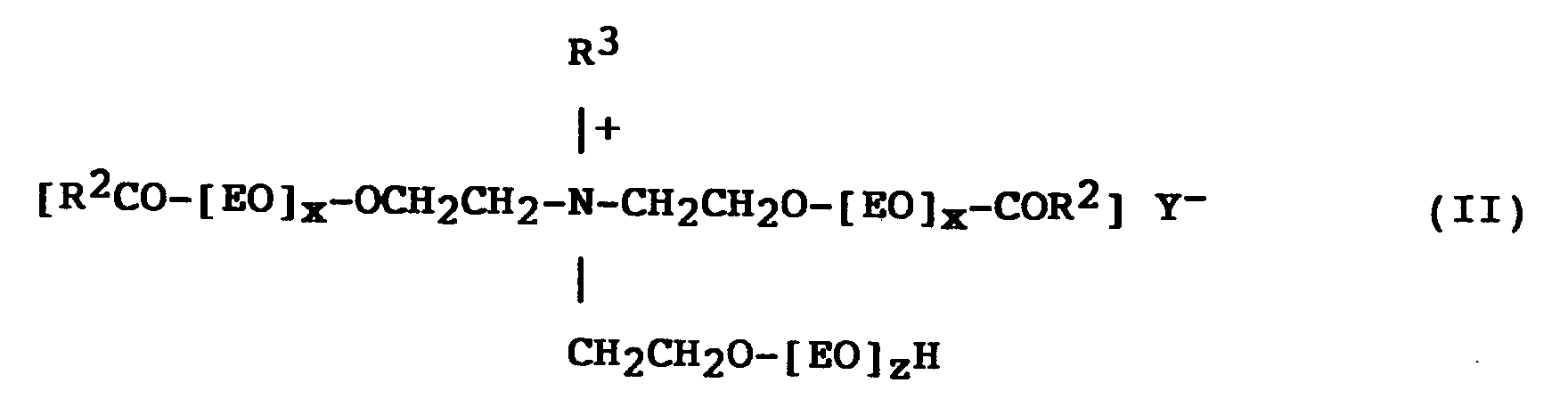
- c) Ölkörper.
- Überraschenderweise wurde gefunden, daß der Zusatz von Ölkörpern die Haaravivage von Mischungen aus Alkyl- und/oder Alkenyloligoglykosiden und Esterquats signifikant verbessert.
- Alkyl- und Alkenyloligoglykoside stellen bekannte Stoffe dar, die nach den einschlägigen Verfahren der präparativen organischen Chemie erhalten werden können. Stellvertretend für das umfangreiche Schrifttum sei hier auf die Schriften EP-A1-0 301 298 und WO 90/3977 verwiesen.
- Die Alkyl- und/oder Alkenyloligoglykoside können sich von Aldosen bzw. Ketosen mit 5 oder 6 Kohlenstoffatomen, vorzugsweise der Glucose ableiten. Die bevorzugten Alkyl- und/oder Alkenyloligoglykoside sind somit Alkyl- und/oder Alkenyloligoglucoside.
- Die Indexzahl p in der allgemeinen Formel (I) gibt den Oligomerisierungsgrad (DP-Grad), d. h. die Verteilung von Mono- und Oligoglykosiden an und steht für eine Zahl zwischen 1 und 10. Während p in einer gegebenen Verbindung stets ganzzahlig sein muß und hier vor allem die Werte p = 1 bis 6 annehmen kann, ist der Wert p für ein bestimmtes Alkyloligoglykosid eine analytisch ermittelte rechnerische Größe, die meistens eine gebrochene Zahl darstellt. Vorzugsweise werden Alkyl- und/oder Alkenyloligoglykoside mit einem mittleren Oligomerisierungsgrad p von 1,1 bis 3,0 eingesetzt. Aus anwendungstechnischer Sicht sind solche Alkyl- und/oder Alkenyloligoglykoside bevorzugt, deren Oligomerisierungsgrad kleiner als 1,7 ist und insbesondere zwischen 1,2 und 1,4 liegt.
- Der Alkyl- bzw. Alkenylrest R1 kann sich von primären Alkoholen mit 6 bis 11, vorzugsweise 8 bis 10 Kohlenstoffatomen ableiten. Typische Beispiele sind Capronalkohol, Caprylalkohol, Caprinalkohol und Undecylalkohol sowie deren technische Mischungen, wie sie beispielsweise bei der Hydrierung von technischen Fettsäuremethylestern oder im Verlauf der Hydrierung von Aldehyden aus der Roelen'schen Oxosynthese anfallen. Bevorzugt sind Alkyloligoglucoside der Kettenlänge C8-C10 (DP = 1 bis 3), die als Vorlauf bei der destillativen Auftrennung von technischem C8-C18-Kokosfettalkohol anfallen und mit einem Anteil von weniger als 6 Gew.-% C12-Alkohol verunreinigt sein können sowie Alkyloligoglucoside auf Basis technischer C9/11-Oxoalkohole (DP = 1 bis 3).
- Der Alkyl- bzw. Alkenylrest R1 kann sich ferner auch von primären Alkoholen mit 12 bis 22, vorzugsweise 12 bis 16 Kohlenstoffatomen ableiten. Typische Beispiele sind Laurylalkohol, Myristylalkohol, Cetylalkohol, Palmoleylalkohol, Stearylalko- hol, Isostearylalkohol, Oleylalkohol, Elaidylalkohol, Petroselinylalkohol, Arachylalkohol, Gadoleylalkohol, Behenylalkohol, Erucylalkohol, sowie deren technische Gemische, die wie oben beschrieben erhalten werden können. Bevorzugt sind Alkyloligoglucoside auf Basis von gehärtetem C12/14-Kokosalkohol mit einem DP von 1 bis 3.
- Esterquats der Formel (II) stellen technische Gemische von gegebenenfalls ethoxylierten Mono- und Difettsäuretriethanolaminestern dar, die mit Ethylenoxid, Alkylhalogeniden, Dialkylsulfaten oder Dialkylphosphaten quaterniert sind. Auch bei ihnen handelt es sich um bekannte Stoffe. Vorzugsweise werden Esterquats eingesetzt, die sich von Palm-, Kokos- oder Talgfettsäuren einer Iodzahl im Bereich 0 bis 40 ableiten und einen Veresterungsgrad von 1, 5 bis 1,9 aufweisen. Der Ethoxylierungsgrad kann 0 oder 1 bis 5, vorzugsweise 1 bis 3 betragen. Aus anwendungstechnischen Gründen besonders geeignet sind Esterquats der Formel (II), in der R3 für eine Methylgruppe oder eine Polyethylenglycolkette mit 1 bis 3 Ethylenoxideinheiten und Y für Chlorid oder Methylsulfat steht. Besonders bevorzugt ist ein methylquaternierter Dipalm-, Dikokos- oder Ditalgfettsäuretriethanolaminester (Dehyquart(R) AU36, Pulcra/Barcelona).
- Als Ölkörper kommen beispielsweise fette Öle, Fettsäureester, Guerbetalkohole, Dialkylcyclohexane, Dialkylether, Paraffinkohlenwasserstoffe und Siliconöle in Betracht.
- Unter fetten Ölen sind synthetische, vorzugsweise jedoch natürliche Triglyceride zu verstehen, die einen hohen Anteil ungesättigter Fettsäuren enthalten und eine Iodzahl im Bereich von 100 bis 170 aufweisen. Typische Beispiele sind Raps- und Sonnenblumenöl neuer Züchtung, Erdnußöl, Baumwollsaatöl, Korianderöl, Olivenöl, Meadowfoamöl, Avocadoöl, Mandelöl und Nussöl.
- Als Fettsäureester kommen Verbindungen der Formel (III) in Betracht,

- Typische Beispiel sind Ester von Fettsäuren, ausgewählt aus der Gruppe die von Capronsäure, Caprylsäure, Isononansäure, Caprylsäure, Undecansäure, Laurinsäure, Isotridecansäure, Myristinsäure, Palmitinsäure, Palmoleinsäure, Stearinsäure, Isostearinsäure, Ölsäure, Elaidinsäure, Petroselinsäure, Linolsäure, Linolensäure, Elaeostearinsäure, Ricinolsäure, 12-Hydroxystearinsäure, Arachinsäure, Gadoleinsäure, Behensäure und Erucasäure sowie deren technischen Gemischen gebildet wird, mit Alkoholen, ausgewählt aus der Gruppe, die von Methanol, Ethanol, n-Propanol, i-Proponal, Butanol, Pentanol, Hexanol, Heptanol, Octanol, 2-Ethylhexanol, Caprinalkohol, Laurylalkohol, Myristylalkohol, Cetylalkohol, Stearylalkohol, Isostearylalkohol, Oleylalkohol, Elaidylalkohol, Ricinolylalkohol, Behenylalkohol und Erucylalkohol sowie deren technischen Gemischen gebildet wird. Besonders bevorzugt ist der Einsatz von Estern der Isononansäure und der C16/18-Fettsäuren mit i-Propylalkohol oder Cetylstearylalkohol.
- Unter Guerbetalkoholen sind Verbindungen der Formel (IV) zu verstehen,

- Hierbei handelt es sich um primäre, verzweigte Alkohole, die auf bekannte Weise durch basenkatalysierte Dimerisierung von Fettalkoholen hergestellt werden. Typische Beispiele stellen 2-Hexyldecanol, 2-Octyldodecanol und 2-Decyltetradecanol dar.
- Bei den Dialkylcyclohexanen handelt es sich um bekannte Stoffe, die durch einschlägige Verfahren der präparativen organischen Chemie erhalten werden können. Ein Beispiel zu ihrer Herstellung besteht beispielsweise darin, Dialkylaromaten (ortho-/meta-/para-Xylol) aus der BTX-Fraktion des Erdöls einer katalytischen Hydrierung zu unterwerfen.
- Die in Betracht kommenden Dialkylcyclohexane folgen der Formel (V),

- Unter Dialkylethern sind Verbindungen der Formel (VI) zu verstehen,

- Auch hierbei handelt es sich um bekannte Stoffe, die nach den einschlägigen Verfahren der präparativen organischen Chemie erhalten werden können. Verfahren zu ihrer Herstellung, beispielsweise durch Kondensation von Fettalkoholen in Gegenwart von p-Toluolsulfonsäure, sind beispielsweise aus Bull.Soc. Chim.France, 333 (1949), DE-A1 40 39 950 (Hoechst) sowie DE-A1 41 03 489 (Henkel) bekannt. Aus anwendungstechnischer Sicht sind symmetrische Dialkylether bevorzugt, die 6 bis 12 Kohlenstoffatomen in den Alkylresten aufweisen. Ein besonders rasches Spreitvermögen weisen Dialkylether der Formel (VI) auf, in der R12 und R13 für Octyl- und/oder 2-Ethylhexylreste stehen. Die im Sinne der Erfindung besonders bevorzugten Dialkylether sind somit Di-n-octylether und Di-2-ethylhexylether.
- Unter Paraffinkohlenwasserstoffen sind bekannte technische Alkangemische zu verstehen, wie sie üblicherweise als Ölkörper in kosmetischen Produkten eingesetzt werden. Vorzugsweise handelt es sich hierbei um dünnflüssige Paraffine, die eine Dichte von 0,81 bis 0,875 aufweisen.
- Der Begriff Siliconöl umfaßt schließlich die Gruppe der Polyorganosiloxane, bei denen Siliciumatome über Sauerstoffatome ketten- und/oder netzartig verbunden und die restlichen Valenzen durch Alkylgruppen abgesättigt sind. Typische Beispiele für Siliconöle, die als geeignete Ölkörper Verwendung finden können, sind in Parfüm Kosmet. 67, 232 (1986) aufgelistet.
- Üblicherweise können die Alkyl- und/oder Alkenyloligoglykoside und die Esterquats im Gewichtsverhältnis 1 : 3 bis 3 : 1, vorzugsweise 1 : 2 bis 2 : 1 eingesetzt werden. Die gleichen Verhältnisse empfehlen sich auch für den Einsatz von Alkyl- und/oder Alkenylglykosiden und Ölkörpern.
- Ein weiterer Gegenstand der Erfindung betrifft wäßrige Haarbehandlungsmittel, enthaltend
- 15 bis 30 Gew.-% Alkyl- und/oder Alkenyloligoglykoside der Formel (I),
- 40 bis 70 Gew.-% Esterquats der Formel (II) und
- 15 bis 30 Gew.-% Ölkörper
- Unter Haarbehandlungsmittel sind in diesem Zusammenhang insbesondere Haarspülungen und Haarshampoos sowie "two-in-one" -Kombinationen beider Produkte zu verstehen, die den Haaren Kämmbarkeit und Glanz verleihen sowie die antistatische Aufladung herabsetzen sollen.
- Neben den Alkyl- und/oder Polyglykosiden und den Esterquats können die erfindungsgemäßen Detergensgemische sowie die Harbehandlungsmittel in untergeordneten Mengen weitere Tenside enthalten. Typische Beispiele sind Fettalkoholpolycolethersulfate, Monoglyceridsulfate, Ethercarbonsäuren, Alkylamidobetaine oder Einweißfettsäurekondensate.
- Als Hilfs- und Zusatzstoffe kommen fermer auch Emulgatoren wie etwa alkoxylierte Fettalkohole oder Sorbitanester in Betracht. Als Überfettungsmittel können Substanzen wie beispielsweise polyethoxylierte Lanolinderivate, Lecithinderivate und Fettsäurealkanolamide verwendet werden, wobei die letzteren gleichzeitig als Schaumstabilisatoren dienen. Geeignete Verdickungsmittel sind beispielsweise Polysaccharide, insbesondere Xanthan-Gum, Guar-Guar, Agar-Agar, Alginate und Tylosen, Carboxymethylcellulose und Hydroxyethylcellulose, ferner höhermolekulare Polyethylenglycolmono- und -diester von Fettsäuren, Polyacrylate, Polyvinylalkohol und Polyvinylpyrrolidon sowie Elektrolyte wie Kochsalz und Ammoniumchlorid. Unter biogenen Wirkstoffen sind beispielsweise Pflanzenextrakte, Eiweißhydrolysate und Vitaminkomplexe zu verstehen. Gebräuchliche Filmbildner sind beispielsweise Polyvinylpyrrolidon, Vinylpyrrolidon-Vinylacetat-Copolymerisate, Polymere der Acrylsäurereihe, quaternäre Cellulose-Derivate und ähnliche Verbindungen. Als Konservierungsmittel eignen sich beispielsweise Phenoxyethanol, Formaldehydlösung, Parabene, Pentadiol oder Sorbinsäure. Als Perlglanzmittel kommen beispielsweise Glycoldistearinsäureester wie Ethylenglycoldistearat, aber auch Fettsäuremonoglycolester in Betracht. Als Farbstoffe können die für kosmetische Zwecke geeigneten und zugelassenen Substanzen verwendet werden, wie sie beispielsweise in der Publikation "Kosmetische Färbemittel" der Farbstoffkommission der Deutschen Forschungsgemeinschaft, veröffentlicht im Verlag Chemie, Weinheim, 1984, S.81-106 zusammengestellt sind. Diese Farbstoffe werden üblicherweise in Konzentrationen von 0,001 bis 0,1 Gew.-%, bezogen auf die gesamte Mischung, eingesetzt.
- Der Gesamtanteil der Hilfs- und Zusatzstoffe kann 0 bis 50, vorzugsweise 5 bis 40 Gew.-% bezogen auf den Feststoffgehalt der Gesamtmischung ausmachen.
- Die erfindungsgemäßen Detergensgemische verbessern die Naß- und Trockenkämmbarkeit von Haaren, verringern die elektrostatische Aufladung, verleihen Haaren einen angenehmen Weichgriff und einen seidigen Glanz; desweiteren wird ein vorteilhaftes Verdickungsverhalten beobachtet. Die Erfindung bietet somit erstmals eine Lehre an, nach der man Haarbehandlungsmittel mit zufriedenstellenden Eigenschaften auf Basis von Alkyloligoglucosiden und Esterquats herstellen kann.
- Ein weiterer Gegenstand der Erfindung betrifft daher die Verwendung der erfindungsgemäßen Detergensgemische zur Herstellung von wäßrigen Haarbehandlungsmitteln, in denen sie in Mengen von 1 bis 100, vorzugsweise 5 bis 70 Gew.-% - bezogen auf den Feststoffgehalt der Mittel - enthalten sein können.
- Die folgenden Beispiele sollen den Gegenstand der Erfindung näher erläutern, ohne ihn darauf einzuschränken.
- Rezeptur A ist erfinndungsgemäß, die Rezepturen X, Y und Z dienen dem Vergleich.
Tab.1 Zusammensetzung der untersuchten Rezepturen Alle Zahlenangaben als Gew.-% Komponenten Rezepturen X Y Z A C12/16-Kokosalkyloligoglyucosid PlantarenR 1200, Fa. Henkel KGaA, Düsseldorf/FRG 2 0 2 2 Dipalmfettsäuretriethanolaminester, methylquaterniert, Methylsulfatsalz 0 0 0 4 Dioctylcyclohexan 0 0 0 2 Cetyl-trimethylammoniumchlorid DehyquartR E, Fa. Henkel KGaA, Düsseldorf/FRG 0 4 4 0 - Alle Rezepturen enthalten ferner 3 Gew.-% Emulgator (Cetylstearylalkohol), 0,3 Gew.-% Konservierungsmittel und ad 100 Gew.-% Wasser.
-
- a) Trockenkämmbarkeit
Die Trockenkämmbarkeit wurde unter Zulassung der elektrostatischen Aufladung untersucht. Es wurde eine relative Luftfeuchtigkeit von 20 % eingestellt. Die Konditionierungszeit betrug 12 h bei 30°C. Die Messung erfolgte über den Ladungsabgriff an einem doppelten Faraday-Käfig nach Ausführung von 10 Kämmungen. Der Fehler bei den Messungen betrug im Mittel 2,5 %, die statistische Sicherheit lag bei mindestens 99,9 %. Die Ergebnisse der Kämmarbeiten sind in Tab.2 dargestellt. - b) Naßkämmbarkeit
Die Naßkämmbarkeit wurde an braunem Haar (Alkinco #6634, Strähnenlänge 12 cm, Strähnenmasse 1 g) untersucht. Nach der Nullmessung wurden die Strähnen mit 100 ml der Formulierungen A bis J bzw. U, V und W getränkt. Nach einer Einwirkzeit von 5 min wurden die Strähnen 1 min unter fließendem Wasser (1 l/min, 38°C) ausgespült. Die Strähnen wurden erneut vermessen und mit der Nullmessung verglichen. Der Fehler bei den Messungen betrug im Mittel 2 %, die statistische Sicherheit lag bei mindestens 99 %. Die Ergebnisse sind ebenfalls in Tab.2 dargestellt. - Eine ausführliche Beschreibung der Meßmethoden befindet sich in J.Soc.Cosm.Chem., 24 , 782 (1973.
Tab.2 Trocken- und Naßkämmbarkeit Bsp. R Trockenkämmbarkeit [mJ] Naßkämmbarkeit [mJ] vor. nach. Diff. vor. nach. Diff. 1 A 5,3 4,6 0,7 70,1 12,0 58,1 V1 X 6,0 5,9 0,1 63,4 31,5 31,9 V2 Y 5,8 5,3 0,5 59,2 19,2 40,0 V3 Z 4,8 4,5 0,3 57,9 18,1 39,8 Legende:
R = Rezeptur
vor. = vorher
nach. = nachher
Diff. = Differenz
Claims (7)
- Detergensgemische mit verbesserten Avivageeigenschaften, enthaltenda) Alkyl- und/oder Alkenyloligoglykoside der Formel (I),
 b) Esterquats der Formel (II),
 c) Ölkörper.
 - Detergensgemische nach Anspruch 1, dadurch gekennzeichnet, daß sie Alkylglucoside der Formel (I) enthalten, in der R1 für einen Alkylrest mit 12 bis 16 Kohlenstoffatomen, G für einen Glucoserest und p für Zahlen von 1 bis 3 steht.
- Detergensgemische nach den Ansprüchen 1 und 2, dadurch gekennzeichnet, daß sie Ölkörper enthalten, ausgewählt aus der Gruppe, die von fetten Ölen, Fettsäureestern, Guerbetalkoholen, Dialkylethern, Dialkylcyclohexanen, Paraffinkohlenwasserstoffen und Siliconölen gebildet wird.
- Detergensgemische nach den Ansprüchen 1 bis 3, dadurch gekennzeichnet, daß sie die Alkyl- und/oder Alkenyloligoglykoside und die Esterquats im Gewichtsverhältnis 1 : 3 bis 3 : 1 enthalten.
- Detergensgemische nach den Ansprüchen 1 bis 4, dadurch gekennzeichnet, daß sie die Alkyl- und/oder Alkenyloligoglykoside und die Ölkörper im Gewichtsverhältnis 1 : 3 bis 3 : 1 enthalten.
- Wäßrige Haarbehandlungsmittel, enthaltend15 bis 30 Gew.-% Alkyl- und/oder Alkenyloligoglykoside der Formel (I),40 bis 70 Gew.-% Esterquats der Formel (II), und15 bis 30 Gew.-% Ölkörper- jeweils bezogen auf den Feststoffanteil - sowie gegebenenenfalls Emulgatoren, Konservierungsmittel und weitere übliche Hilfsstoffe.
- Verwendung von Detergensgemischen nach den Ansprüchen 1 bis 6 zur Herstellung von wäßrigen Haarbehandlungsmitteln.
Applications Claiming Priority (5)
| Application Number | Priority Date | Filing Date | Title |
|---|---|---|---|
| DE4301820 | 1993-01-23 | ||
| DE4301820A DE4301820C2 (de) | 1993-01-23 | 1993-01-23 | Schäumende Emulsionen, Verfahren zu ihrer Herstellung und ihre Verwendung |
| DE19934305726 DE4305726C2 (de) | 1993-02-25 | 1993-02-25 | Detergensgemische mit verbesserten Avivageeigenschaften |
| DE4305726 | 1993-02-25 | ||
| PCT/EP1994/000097 WO1994016677A1 (de) | 1993-01-23 | 1994-01-14 | Detergensgemische mit verbesserten avivageeigenschaften |
Publications (2)
| Publication Number | Publication Date |
|---|---|
| EP0680314A1 EP0680314A1 (de) | 1995-11-08 |
| EP0680314B1 true EP0680314B1 (de) | 1997-05-07 |
Family
ID=25922476
Family Applications (1)
| Application Number | Title | Priority Date | Filing Date |
|---|---|---|---|
| EP94905062A Expired - Lifetime EP0680314B1 (de) | 1993-01-23 | 1994-01-14 | Detergensgemische mit verbesserten avivageeigenschaften |
Country Status (5)
| Country | Link |
|---|---|
| EP (1) | EP0680314B1 (de) |
| JP (1) | JPH08510442A (de) |
| DE (1) | DE59402667D1 (de) |
| ES (1) | ES2102822T3 (de) |
| WO (1) | WO1994016677A1 (de) |
Cited By (1)
| Publication number | Priority date | Publication date | Assignee | Title |
|---|---|---|---|---|
| DE10054020B4 (de) * | 2000-11-01 | 2007-04-26 | Cognis Ip Management Gmbh | Verwendung von Mischungen als Textilbehandlungsmittel |
Families Citing this family (27)
| Publication number | Priority date | Publication date | Assignee | Title |
|---|---|---|---|---|
| DE4417476A1 (de) * | 1994-05-19 | 1995-11-23 | Henkel Kgaa | Mikroemulsionen |
| DE19548345C2 (de) * | 1995-12-22 | 1998-10-15 | Henkel Kgaa | Verwendung von Mischungen spezieller Emulgatoren und Ölkörpern |
| FR2751532B1 (fr) * | 1996-07-23 | 1998-08-28 | Oreal | Compositions lavantes et conditionnantes a base de silicone et de dialkylether |
| DE19635195C1 (de) * | 1996-08-30 | 1998-01-29 | Henkel Kgaa | Kosmetische Zubereitungen und Verfahren zu ihrer Herstellung |
| DE19646867C1 (de) * | 1996-11-13 | 1997-12-04 | Henkel Kgaa | Kosmetische Zubereitungen |
| DE19714044C1 (de) * | 1997-04-05 | 1998-04-16 | Henkel Kgaa | Hydrophile Avivagemittel sowie Verwendung von Mischungen, enthaltend Esterquats und Siliconverbindungen zur Herstellung derselben |
| DE19730649C1 (de) | 1997-07-17 | 1998-09-24 | Henkel Kgaa | Detergensgemische |
| FR2780278B1 (fr) * | 1998-06-24 | 2001-01-19 | Oreal | Composition conditionnante et detergente et utilisation |
| DE19851451A1 (de) * | 1998-11-09 | 2000-05-11 | Cognis Deutschland Gmbh | Kosmetische und/oder pharmazeutische Zubereitungen |
| DE10050782A1 (de) | 2000-10-13 | 2002-04-25 | Goldwell Gmbh | Haarpflegemittel |
| EP1512391B1 (de) | 2002-06-13 | 2011-11-02 | Kao Corporation | Kosmetisches haarpräparat |
| EP1570833B1 (de) | 2004-03-05 | 2016-08-31 | Kao Germany GmbH | Haarbehandlungsmittel |
| EP1728503B1 (de) | 2005-06-02 | 2008-09-17 | KPSS-Kao Professional Salon Services GmbH | Haarkonditionierende kosmetische Zusammensetzung |
| EP1728502A1 (de) | 2005-06-02 | 2006-12-06 | KPSS Kao Professional Salon Services GmbH | Kosmetische Zusammensetzung |
| EP1762224A1 (de) | 2005-09-08 | 2007-03-14 | KPSS-Kao Professional Salon Services GmbH | Aerosol Haarverformungsmittel enthaltend Wachs |
| EP1762225B1 (de) | 2005-09-08 | 2009-03-11 | KPSS-Kao Professional Salon Services GmbH | Aerosol Haarverformungsmittel enthaltend Wachs |
| JP4756249B2 (ja) * | 2006-11-07 | 2011-08-24 | 山栄化学株式会社 | 多剤式毛髪化粧料 |
| EP2018842A1 (de) | 2007-07-26 | 2009-01-28 | KPSS-Kao Professional Salon Services GmbH | Zusammensetzung zum Konditionieren und Färben des Haars |
| EP2018845A1 (de) | 2007-07-27 | 2009-01-28 | KPSS-Kao Professional Salon Services GmbH | Verfahren zur Färbung von Keratinfasern |
| EP2020252A1 (de) | 2007-07-30 | 2009-02-04 | KPSS-Kao Professional Salon Services GmbH | Verfahren zur Färbung und dauerhaften Verformung von Keratinfasern |
| EP2020253A1 (de) | 2007-07-30 | 2009-02-04 | KPSS-Kao Professional Salon Services GmbH | Verfahren zur Färbung und dauerhaften Verformung von Keratinfasern |
| EP2191864B1 (de) | 2008-11-26 | 2014-01-01 | Kao Germany GmbH | Verfahren zur Färbung und dauerhaften Glättung von Keratinfasern |
| EP2191865B1 (de) | 2008-11-26 | 2013-10-23 | Kao Germany GmbH | Verfahren zur Färbung und dauerhaften Glättung von Keratinfasern |
| JP2011093846A (ja) * | 2009-10-30 | 2011-05-12 | Milbon Co Ltd | 整髪剤組成物 |
| JP5841311B2 (ja) | 2009-12-21 | 2016-01-13 | 東レ・ダウコーニング株式会社 | 油性原料の増粘剤またはゲル化剤、それを含有してなるゲル状組成物および化粧料もしくは外用剤の製造方法 |
| JP6392669B2 (ja) | 2012-12-28 | 2018-09-19 | 東レ・ダウコーニング株式会社 | 透明乃至半透明の液状のグリセリン誘導体変性シリコーン組成物の製造方法 |
| EP2997959B1 (de) * | 2014-09-22 | 2019-12-25 | Evonik Operations GmbH | Formulierung enthaltend esterquats basierend auf isopropanolamin und tetrahydroxypropylethylenediamin |
Family Cites Families (3)
| Publication number | Priority date | Publication date | Assignee | Title |
|---|---|---|---|---|
| EP0094118B2 (de) * | 1982-05-10 | 1993-04-21 | THE PROCTER & GAMBLE COMPANY | Phosphatarme Wäschewaschmittelzusammensetzungen |
| DE4033928A1 (de) * | 1990-10-25 | 1992-04-30 | Henkel Kgaa | Oel-in-wasser-emulsionen |
| DE69209767T2 (de) * | 1991-10-22 | 1996-10-17 | Kao Corp | Haarkosmetikum |
-
1994
- 1994-01-14 ES ES94905062T patent/ES2102822T3/es not_active Expired - Lifetime
- 1994-01-14 DE DE59402667T patent/DE59402667D1/de not_active Expired - Lifetime
- 1994-01-14 WO PCT/EP1994/000097 patent/WO1994016677A1/de not_active Ceased
- 1994-01-14 JP JP6516629A patent/JPH08510442A/ja active Pending
- 1994-01-14 EP EP94905062A patent/EP0680314B1/de not_active Expired - Lifetime
Cited By (1)
| Publication number | Priority date | Publication date | Assignee | Title |
|---|---|---|---|---|
| DE10054020B4 (de) * | 2000-11-01 | 2007-04-26 | Cognis Ip Management Gmbh | Verwendung von Mischungen als Textilbehandlungsmittel |
Also Published As
| Publication number | Publication date |
|---|---|
| EP0680314A1 (de) | 1995-11-08 |
| DE59402667D1 (de) | 1997-06-12 |
| ES2102822T3 (es) | 1997-08-01 |
| WO1994016677A1 (de) | 1994-08-04 |
| JPH08510442A (ja) | 1996-11-05 |
Similar Documents
| Publication | Publication Date | Title |
|---|---|---|
| EP0680314B1 (de) | Detergensgemische mit verbesserten avivageeigenschaften | |
| EP0659207B1 (de) | Verwendung von detergensgemischen | |
| DE4301820C2 (de) | Schäumende Emulsionen, Verfahren zu ihrer Herstellung und ihre Verwendung | |
| EP1052972B1 (de) | Haarnachbehandlungsmittel | |
| EP0914087B1 (de) | Verwendung von fettstoffen als siliconersatz zur herstellung von kosmetischen und/oder pharmazeutischen zubereitungen | |
| EP0910329B1 (de) | Wässrige perlglanzkonzentrate | |
| DE19623763A1 (de) | Kosmetische Zubereitungen | |
| DE4309568A1 (de) | Detergensgemische mit verbesserten Avivageeigenschaften | |
| EP0776658A1 (de) | Zuckertenside und Fettsäurepartialglyceride enthaltende kosmetische und/oder pharmazeutische Zubereitungen | |
| EP0893120A2 (de) | Selbstemulgierende Zubereitungen | |
| EP0910328B1 (de) | Wässrige perlglanzkonzentrate | |
| EP0714288B1 (de) | Detergensgemische | |
| EP0912700B1 (de) | Wässrige perlglanzkonzentrate | |
| EP0785980A1 (de) | Pumpfähige wässrige tensidkonzentrate | |
| DE4305726C2 (de) | Detergensgemische mit verbesserten Avivageeigenschaften | |
| EP0904053B1 (de) | Haarbehandlungsmittel | |
| EP0848103B1 (de) | Mittel für die Avivage von Textil- und Keratinfasern | |
| EP1465582B1 (de) | Alkyl-und/oder alkylenoligoglycosid-betainesterquats | |
| DE3409634A1 (de) | Phosphonsaeureester in haarbehandlungsmitteln | |
| WO1998050006A1 (de) | Haarbehandlungsmittel | |
| DE19626905C2 (de) | Verwendung von Dialkylethern | |
| WO1996029982A1 (de) | Kosmetische und/oder pharmazeutische zubereitungen | |
| DE19724867C1 (de) | Verwendung von Emulgatormischungen | |
| DE4338691B4 (de) | Haarbehandlungsmittel | |
| DE19512411A1 (de) | Verfahren zur Herstellung viskoser Zuckertenside |
Legal Events
| Date | Code | Title | Description |
|---|---|---|---|
| PUAI | Public reference made under article 153(3) epc to a published international application that has entered the european phase |
Free format text: ORIGINAL CODE: 0009012 |
|
| 17P | Request for examination filed |
Effective date: 19950714 |
|
| AK | Designated contracting states |
Kind code of ref document: A1 Designated state(s): DE ES FR IT |
|
| 17Q | First examination report despatched |
Effective date: 19951227 |
|
| GRAG | Despatch of communication of intention to grant |
Free format text: ORIGINAL CODE: EPIDOS AGRA |
|
| GRAH | Despatch of communication of intention to grant a patent |
Free format text: ORIGINAL CODE: EPIDOS IGRA |
|
| RBV | Designated contracting states (corrected) |
Designated state(s): DE ES FR IT |
|
| GRAH | Despatch of communication of intention to grant a patent |
Free format text: ORIGINAL CODE: EPIDOS IGRA |
|
| GRAA | (expected) grant |
Free format text: ORIGINAL CODE: 0009210 |
|
| AK | Designated contracting states |
Kind code of ref document: B1 Designated state(s): DE ES FR IT |
|
| REF | Corresponds to: |
Ref document number: 59402667 Country of ref document: DE Date of ref document: 19970612 |
|
| ET | Fr: translation filed | ||
| REG | Reference to a national code |
Ref country code: ES Ref legal event code: FG2A Ref document number: 2102822 Country of ref document: ES Kind code of ref document: T3 |
|
| PLBE | No opposition filed within time limit |
Free format text: ORIGINAL CODE: 0009261 |
|
| STAA | Information on the status of an ep patent application or granted ep patent |
Free format text: STATUS: NO OPPOSITION FILED WITHIN TIME LIMIT |
|
| 26N | No opposition filed | ||
| PGFP | Annual fee paid to national office [announced via postgrant information from national office to epo] |
Ref country code: FR Payment date: 20010125 Year of fee payment: 8 |
|
| PG25 | Lapsed in a contracting state [announced via postgrant information from national office to epo] |
Ref country code: FR Free format text: LAPSE BECAUSE OF NON-PAYMENT OF DUE FEES Effective date: 20020930 |
|
| REG | Reference to a national code |
Ref country code: FR Ref legal event code: ST |
|
| PG25 | Lapsed in a contracting state [announced via postgrant information from national office to epo] |
Ref country code: IT Free format text: LAPSE BECAUSE OF NON-PAYMENT OF DUE FEES Effective date: 20050114 |
|
| PGFP | Annual fee paid to national office [announced via postgrant information from national office to epo] |
Ref country code: ES Payment date: 20130225 Year of fee payment: 20 |
|
| PGFP | Annual fee paid to national office [announced via postgrant information from national office to epo] |
Ref country code: DE Payment date: 20130328 Year of fee payment: 20 |
|
| REG | Reference to a national code |
Ref country code: DE Ref legal event code: R071 Ref document number: 59402667 Country of ref document: DE |
|
| REG | Reference to a national code |
Ref country code: ES Ref legal event code: FD2A Effective date: 20140321 |
|
| PG25 | Lapsed in a contracting state [announced via postgrant information from national office to epo] |
Ref country code: DE Free format text: LAPSE BECAUSE OF EXPIRATION OF PROTECTION Effective date: 20140115 |
|
| PG25 | Lapsed in a contracting state [announced via postgrant information from national office to epo] |
Ref country code: ES Free format text: LAPSE BECAUSE OF EXPIRATION OF PROTECTION Effective date: 20140115 |