EP0680873A1 - Gegendrehmomentvorrichtung mit einem eingelassenen Heckrotor und Abrichtstator und mit schrägen Richtleitschaufeln - Google Patents
Gegendrehmomentvorrichtung mit einem eingelassenen Heckrotor und Abrichtstator und mit schrägen Richtleitschaufeln Download PDFInfo
- Publication number
- EP0680873A1 EP0680873A1 EP95400998A EP95400998A EP0680873A1 EP 0680873 A1 EP0680873 A1 EP 0680873A1 EP 95400998 A EP95400998 A EP 95400998A EP 95400998 A EP95400998 A EP 95400998A EP 0680873 A1 EP0680873 A1 EP 0680873A1
- Authority
- EP
- European Patent Office
- Prior art keywords
- rotor
- blades
- vein
- approximately
- axis
- Prior art date
- Legal status (The legal status is an assumption and is not a legal conclusion. Google has not performed a legal analysis and makes no representation as to the accuracy of the status listed.)
- Granted
Links
- 230000005540 biological transmission Effects 0.000 claims abstract description 14
- 210000003462 vein Anatomy 0.000 claims description 117
- 230000008859 change Effects 0.000 claims description 11
- 238000011144 upstream manufacturing Methods 0.000 claims description 11
- UJCHIZDEQZMODR-BYPYZUCNSA-N (2r)-2-acetamido-3-sulfanylpropanamide Chemical compound CC(=O)N[C@@H](CS)C(N)=O UJCHIZDEQZMODR-BYPYZUCNSA-N 0.000 claims description 6
- 241001669680 Dormitator maculatus Species 0.000 claims description 6
- 230000003247 decreasing effect Effects 0.000 claims description 5
- 230000002829 reductive effect Effects 0.000 claims description 2
- 230000007246 mechanism Effects 0.000 abstract description 3
- 230000006870 function Effects 0.000 description 18
- 230000003993 interaction Effects 0.000 description 11
- 230000009467 reduction Effects 0.000 description 8
- 238000009792 diffusion process Methods 0.000 description 7
- 230000007423 decrease Effects 0.000 description 6
- 238000001228 spectrum Methods 0.000 description 6
- 230000002093 peripheral effect Effects 0.000 description 5
- 230000006872 improvement Effects 0.000 description 4
- 230000001788 irregular Effects 0.000 description 4
- 230000008901 benefit Effects 0.000 description 3
- 230000010363 phase shift Effects 0.000 description 3
- 241000251556 Chordata Species 0.000 description 2
- 241000940835 Pales Species 0.000 description 2
- 206010033546 Pallor Diseases 0.000 description 2
- 230000000712 assembly Effects 0.000 description 2
- 238000000429 assembly Methods 0.000 description 2
- 230000006378 damage Effects 0.000 description 2
- 230000000593 degrading effect Effects 0.000 description 2
- 238000004519 manufacturing process Methods 0.000 description 2
- 230000003071 parasitic effect Effects 0.000 description 2
- 230000036961 partial effect Effects 0.000 description 2
- 238000011084 recovery Methods 0.000 description 2
- 230000007704 transition Effects 0.000 description 2
- 229920000297 Rayon Polymers 0.000 description 1
- 208000027418 Wounds and injury Diseases 0.000 description 1
- 238000004873 anchoring Methods 0.000 description 1
- 230000002238 attenuated effect Effects 0.000 description 1
- 230000000903 blocking effect Effects 0.000 description 1
- 230000000295 complement effect Effects 0.000 description 1
- 230000006835 compression Effects 0.000 description 1
- 238000007906 compression Methods 0.000 description 1
- 238000010276 construction Methods 0.000 description 1
- 230000008602 contraction Effects 0.000 description 1
- 230000008094 contradictory effect Effects 0.000 description 1
- 238000012937 correction Methods 0.000 description 1
- 238000010586 diagram Methods 0.000 description 1
- 230000005284 excitation Effects 0.000 description 1
- 230000002349 favourable effect Effects 0.000 description 1
- 208000014674 injury Diseases 0.000 description 1
- 230000002452 interceptive effect Effects 0.000 description 1
- 230000000670 limiting effect Effects 0.000 description 1
- 239000002184 metal Substances 0.000 description 1
- 230000004048 modification Effects 0.000 description 1
- 238000012986 modification Methods 0.000 description 1
- 238000005457 optimization Methods 0.000 description 1
- 230000000737 periodic effect Effects 0.000 description 1
- 238000005086 pumping Methods 0.000 description 1
- 239000002964 rayon Substances 0.000 description 1
- 230000000717 retained effect Effects 0.000 description 1
- 230000035945 sensitivity Effects 0.000 description 1
- 230000003595 spectral effect Effects 0.000 description 1
- 230000006641 stabilisation Effects 0.000 description 1
- 238000011105 stabilization Methods 0.000 description 1
- 230000003068 static effect Effects 0.000 description 1
Images


Classifications
-
- B—PERFORMING OPERATIONS; TRANSPORTING
- B64—AIRCRAFT; AVIATION; COSMONAUTICS
- B64C—AEROPLANES; HELICOPTERS
- B64C27/00—Rotorcraft; Rotors peculiar thereto
- B64C27/82—Rotorcraft; Rotors peculiar thereto characterised by the provision of an auxiliary rotor or fluid-jet device for counter-balancing lifting rotor torque or changing direction of rotorcraft
-
- B—PERFORMING OPERATIONS; TRANSPORTING
- B64—AIRCRAFT; AVIATION; COSMONAUTICS
- B64C—AEROPLANES; HELICOPTERS
- B64C27/00—Rotorcraft; Rotors peculiar thereto
- B64C27/82—Rotorcraft; Rotors peculiar thereto characterised by the provision of an auxiliary rotor or fluid-jet device for counter-balancing lifting rotor torque or changing direction of rotorcraft
- B64C2027/8254—Shrouded tail rotors, e.g. "Fenestron" fans
Definitions
- the invention relates to improvements made to anti-torque devices with a rear rotor and streamlined stator stator for helicopters, in which the stator stator, comprising fixed blades with aerodynamic profile, is fixed downstream of the rotor in the flow stream of air arranged transversely in the hull integrated into the structure of the rear assemblies of a helicopter, such as the tail boom, the tailplane or a fin.
- the improvements made by the invention to anti-torque devices of this type make it possible to improve their acoustic and / or aerodynamic performance, to provide a significant reduction in noise and associated acoustic nuisances, as well as better yaw control, respectively.
- a faired anti-torque rotor prevents any risk of bodily injury on the ground, because it is protected inside the vein in the tail boom, unlike a conventional tail rotor.
- This arrangement of the faired anti-torque rotor also allows it to avoid ingesting any damaging object that may be entrained in the wake of the main rotor.
- the faired anti-torque rotor In flight or when maneuvering near the ground or on the ground, the faired anti-torque rotor is naturally protected by its fairing, which prevents any risk of impact with external obstacles such as power lines, branches, constructions or even the ground, which can cause fatal damage to a conventional tail rotor, and therefore the loss of the helicopter, with all the consequences that ensue for the crew.
- a faired anti-torque rotor eliminates a certain number of problems which appear when equipping a helicopter with a conventional rear rotor.
- the diameter of a conventional rear rotor is generally large.
- a conventional rear rotor is generally mounted at a high point on the fin, which creates a moment of roll on the helicopter, which must be balance, and generates parasitic drag in high speed forward flight. Due to its exposed position, a conventional tail rotor can be highly stressed by loads dynamics limiting its lifespan.
- the aerodynamic blocking effect of a conventional tail rotor due to the mask of the fin, generates a strongly asymmetrical behavior in crosswinds, and harmful impulse periodic aerodynamic loads.
- a faired tail rotor does not have these disadvantages. In general, it can easily be arranged so that its axis substantially intersects the roll axis of the helicopter, or is close to this roll axis, so that it does not create a parasitic roll moment. In addition, due to its fairing, it produces approximately half of its total anti-torque thrust by the sole phenomenon of suction by the collector, at the entrance to the vein that houses it. This makes it possible to discharge all the blades of the rotor, which practically do not undergo dynamic stresses, because of the effective protection provided by the fairing against external variations of the air flow, coming from the main rotor. and the fuselage of the helicopter.
- the faired anti-torque rotor In forward flight at high speed of the latter, the faired anti-torque rotor is unloaded, which correspondingly reduces its contribution to the overall drag of the device.
- the vertical fin possibly fitted with a turning flap, provides the anti-torque function.
- no drift or tail plane hinders the operation of the faired anti-torque rotor, which gives it maximum efficiency in crosswinds and during rapid maneuvers around the yaw axis.
- the diffusion ratio is close to 1, and can be increased by increasing the angle of divergence of a frustoconical part of the diffuser that the vein can have downstream of the plane. of rotation of the rotor blades, as described for example in American patent US Pat. No. 5,131,604, where this angle of divergence is limited to 5 °.
- the contraction of the wake on a conventional rear rotor freezes the diffusion ratio at 1/2, which prevents any improvement in performance by means of this parameter.
- a faired tail rotor still takes advantage of its positioning in a fairing vein: unlike a conventional tail rotor, which radiates noise in all directions, the detectability of a faired tail rotor towards the 'Forward and backward, in the forward direction of the helicopter, is greatly reduced due to the fairing.
- the combination of an angular speed of rotation ⁇ and a higher number of blades b on a faired anti-torque rotor than on a conventional tail rotor produces a "blade passage frequency" bx ⁇ and its frequencies multiple nb ⁇ which are much higher frequencies of concentration of the acoustic energy than for a traditional tail rotor, and typically in the range of frequencies from 400 Hz to 2000 Hz.
- these frequencies are very quickly attenuated in the atmosphere, while the very low frequencies of acoustic energy concentration of a conventional tail rotor propagate far.
- a drawback of faired anti-torque rotors is that raising the level of the acoustic energy concentration frequencies places the latter in a frequency zone of maximum sensitivity of the human ear.
- the very impulsive aspect of a faired anti-torque rotor noise spectrum is translated by a characteristic hiss very painful to the human ear, and which is strongly penalized by the criteria of acoustic certification by means of "corrections of pure sounds or emerging lines".
- the acoustic signature characteristic of a faired anti-torque rotor is also a harmful phenomenon, facilitating the identification of the helicopter.
- the overall level of dissipated acoustic energy is the second main factor in judging the quality of the acoustic level of a helicopter.
- the aerodynamic operation of a faired anti-torque rotor, with a high number of blades and for which the anti-torque thrust is provided for half by suction results in a lower blade load than that experienced by the blades of a conventional tail rotor, and therefore a lower load noise level.
- the presence of fixed obstacles in the fairing of the anti-torque rotor, downstream of the latter, such as for example the support arms of a rear gearbox associated with a collective pitch control mechanism of the blades, and on which the rotor is mounted in rotation, or even as a stator rectifier with fixed profiled blades, for example, can greatly increase the level of radiated acoustic energy.
- US Pat. No. 5,131,604 proposes that the three support arms be of elliptical section, one being radial and aligned with the longitudinal axis of the helicopter and the other two parallel to the vertical axis of the fairing, but offset towards the rear, the spacing, along the axis of the vein, between the plane of rotation of the rotor and the support arms being 2 to 2.5 times the minor axis of the ellipse of the section of the arms.
- These shapes and arrangements make it possible to significantly reduce the lines of acoustic interactions between the rotor and the support arms, for an eight-blade rotor whose peripheral speed is limited to approximately 225 m / s.
- the propeller has an even number of blades and greater than or equal to four, the blades being diametrically opposite two by two, and the pairs of blades being arranged offset with respect to each other with an angular deviation pitch of between approximately 15 ° and 50 °, so that the levels of the rotational noise harmonics are weakened by interference .
- An object of the invention is to propose improvements for the production of an anti-torque device with rotor and stator rectifier streamlined with minimal noise pollution, intended to equip a helicopter propelled by means of a single main rotor, while retaining , or even by improving, the aerodynamic performance of the device fairing anti-torque, compared to known assemblies of this type.
- an object of the invention is to propose a configuration and / or an arrangement of the rectifier according to the geometry of the rotor to minimize the interaction noise. , by reducing the radiated acoustic energy.
- Another object of the invention is to provide a streamlined vein configuration improving the aerodynamic performance of the anti-torque device, whether or not the rotor blades are evenly distributed angularly, to increase the level of thrust at given power, and decrease the noise caused by the flow of air in the vein.
- the invention aims to provide an anti-torque device with a faired rotor and stator rectifier, which is better suited to the various requirements of practice than the known faired anti-torque devices.
- an anti-torque device for a helicopter comprising a multi-blade variable pitch rotor mounted to rotate and substantially coaxial in an air flow stream of substantially axis transverse to the helicopter and passing through a hull integrated in the rear part of the helicopter, so that the pitch change axes of the blades move in a plane of rotation substantially perpendicular to the axis of the faired vein, as well as '' a stator rectifier fixed in the vein downstream of the rotor and comprising fixed blades arranged substantially in a star around the axis of the vein and each having an asymmetrical aerodynamic profile including the camber and the angular setting relative to the axis of the vein are such that the blades straighten the air flow downstream of the rotor substantially parallel to the axis of the vein, and which characterized in that the blades of the straightener are each inclined in the radial direction, preferably from an angle of about 1 ° to about 25
- This orientation is simultaneously favorable to the resumption of the torque, acting, in reaction to the rotation of the rotor, on a central body substantially coaxial with the vein, enclosing the rotor drive members and the collective pitch control members of the blades of the latter, and that the blades of the stator can thus advantageously support in the vein.
- each stator vane makes a non-zero angle relative to the plane of rotation of the rotor blades, while being inclined towards the exit of the vein, makes it possible to increase the distance which separates the plane of rotation of the blades.
- this distance is advantageous, in particularly if the chord c is measured at the start of the profiled running part of the blade, to obtain a good compromise between the level of radiated acoustic energy and the aerodynamic efficiency of the rectifier, and to favor its arrangement in the vein of the device anti-torque, and in particular the anchoring of its blades in the streamlined wall of the vein, as well as to ensure a good positioning of the rotor in the vein, by means of the rear gearbox supported in it by the blades.
- the blades fulfill their good function of supporting the central body simultaneously and their function of straightening the air flow passing through the vein, it is advantageous that they have an aerodynamic profile of the NACA 65 type, with a relative thickness. comprised between approximately 8% and approximately 12%, an angular setting on the axis of the vein comprised between approximately 2 ° and approximately 2.5 °, oriented to prick, and a camber comprised between approximately 20 ° and approximately 28 °.
- the thickness thus chosen is a compromise between the smallest possible relative thickness, in order to reduce both the load noise and the thickness of the rectifier working in the wake of the rotating blades, and a thickness sufficient to maintain the body supporting the rotor and enclosing the rear gearbox and the collective control of the pitch of the blades, which are thus secured to the rear assembly of the helicopter, comprising the end of the tail boom and a tail or a tail fin the helicopter, while being subjected to static and dynamic force fields.
- this arm is advantageously placed in the vein substantially in the place of one of the blades of the rectifier, the profiled blades of which are advantageously in number at least equal to the number of blades of the rotor decreased by one unit.
- a reduction in the noise nuisance and an increase in the aerodynamic performance of an anti-torque device with a faired rotor can also be obtained by a particular geometrical configuration of the vein, when the azimuthal modulation of the blades is irregular or regular. , and that the rotor is or is not associated with a rectifier.
- the vein comprises two parts, one of which is a manifold, corresponding to the part of the vein located upstream of the plane of rotation of the rotor, and the other is a diffuser, corresponding to the part of the vein.
- the manifold located downstream of the plane of rotation of the rotor, the manifold comprising an inlet convergent, delimited by an annular wall convex upstream and rounded with a constant radius Rc, and which extends towards the plane of rotation of the rotor by a cylindrical zone of a first length L1
- the diffuser comprising, from the plane of rotation of the rotor downstream, a cylindrical zone of a second length L2, extending the cylindrical zone of the manifold, then a frustoconical diverging of half angle at the top ⁇ , and a divergent outlet delimited by a convex annular wall downstream, and rounded with radius r.
- the position of the plane of rotation of the rotor in this cylindrical part is defined as a function of the chord c of the blades of the rotor, of their positive pitch range, of the distance a between their leading edge and the axis of change. pitch, and the maximum deformation f of the blade, characterizing its stiffness in flapping, so that the lengths L1 and L2 of the cylindrical zones are such that: L1> a sin ( ⁇ max) + f and L2 ⁇ (c - a) sin ( ⁇ max), where ⁇ max is the maximum positive pitch angle of the blades of the rotor.
- the lengths L1 and L2 of the cylindrical zones of the collector and of the diffuser respectively are between approximately 2% and approximately 8%, and between approximately 1% and approximately 3.5% of the diameter of the measured vein. in its cylindrical part.
- the vein has a cylindrical part, as soon as it has a converging inlet manifold delimited by a convex and rounded annular wall with a constant radius Rc, this radius is approximately 8% of the diameter of the vein measured at its neck, in its tightest section.
- the diffusion angle of the diffuser, or half-angle a of its frustoconical divergent is preferably chosen between about 5 ° and about 20 °.
- r1 is less than about 1.6% of the diameter of the vein, while r2 is between 4.3% of the diameter of the vein and the radius Rc chosen for the convergent of the collector, and the front zone of constant radius r1 extends over an arc of a circle corresponding to an angle at the center of at least 210 °, while the rear zone, of constant radius r2, extends over an arc of circle corresponding to an angle at the center of 90 °, symmetrically above and below the longitudinal axis of the helicopter.
- the vein may be formed in a hull integrated in a rear part of a helicopter comprising the rear end of a tail beam and a tailplane with at least one fin, the empennage being able to be bi-drift and of a type included among the cruciform empennage, in T or in V above the vein, and at least one stabilization of the empennage being able to comprise a deflectable flap.
- the axis of the vein may possibly be inclined to the horizontal direction so that the thrust of the faired rotor produces a lift component on the helicopter.
- the base of the tail unit 2 is arranged in a hull 5, crossed transversely by an air flow stream 6 of a faired anti-torque device also comprising a multi-blade rotor 7 with variable pitch, mounted rotatably and substantially coaxial in the vein 6, as well as a stator rectifier 8, fixed in the vein 6 downstream of the rotor 7, with respect to the direction of flow of the air flow passing through the vein 6, and comprising fixed vanes 9 arranged substantially in a star around of the axis XX of the vein 6.
- This anti-torque device which provides most of the yaw control in hovering or at low speed, is supplemented by the vertical fin 3 and the horizontal fin 4 to help control the helicopter's yaw and pitch, in moving at high speed.
- These same functions can be fulfilled by a V-shaped fin above the hull 5, or by a cruciform empennage, the vertical fin 4 being mounted substantially at mid-height on the vertical vertical fin 3, or alternatively at T-fin, the vertical fin 4 being mounted at the upper end of the fin 3.
- the vein 6 has, around its axis XX, substantially transverse to the longitudinal axis of the helicopter, a shape substantially of revolution, described below with reference to FIG. 6, and comprising a converging inlet 19 extended, towards the air outlet, by a cylindrical part 20 itself even extended to exit by a divergent 21-22.
- the rotor 7 is mounted in the vein 6 on the side of its inlet and so that its blades 10 rotate in the cylindrical part 20 of the vein 6, the pitch change axes of the blades 10 defining a plane P of rotation of the rotor, in which they move and which is substantially perpendicular to the axis XX of the streamlined stream 6.
- the rotor 7 is mounted and rotated on the rear gearbox in the central body 11, of substantially cylindrical external shape and coaxial with the vein 6, and integral with the structure of the tail unit 2 by means of the vanes 9 of the straightener 8, which hold the body 11 in the center of the vein 6 and on the side of its outlet relative to the rotor 7.
- the rear gearbox in the body 11 contains a mechanism for driving the rotor 7 in rotation by a motor shaft 12, itself driven from a transmission shaft passing through an arm 13 and connected to a annex output from the main gearbox of the helicopter, part of the arm 13 being disposed in the vein 6 in place of substantially one of the vanes 9 of the rectifier 8.
- the rear gearbox of the body 11 and the rotor 7 comprise a device for collective control of the pitch of the blades 10, actuated by a control rod, not shown, because it is assumed that the arm 13 of FIG. 1 serves as a fairing for the transmission shaft and the collective pitch control rod.
- each blade 10 comprises a running part 14 with an aerodynamic profile, a blade root 15 arranged in a sleeve, by which the blade 10 is mounted in a swivel fashion around its longitudinal axis of pitch change in at least one bearing arranged for this purpose in at least one annular wall of a rotor hub 17, and a root portion 16 which is twist and preferably also flexible, which passes through the blade root sleeve 15 and is retained by its end opposite to the sleeve 15 on the rotor hub 17, which is rotated by the drive shaft 12 projecting along the axis XX of the vein 6 on the body 11 surrounding the rear gearbox.
- each blade 10 has, projecting from one side of the blade 10, a pitch control lever 23, connected by a link to a control plate rotating freely with the rotor 7 but translatable along the axis of rotation of the rotor 7 by the operation of the pitch control rod to collectively control the change of pitch of the blades 10.
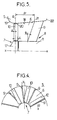
- the vanes 9, fixed in the vein 6 downstream of the blades 10 of the rotor 7, without however leaving the diverging part 21-22 of the vein 6, ensure recovery of the rotational energy of the air flow downstream of the blades 10, by straightening this flow towards the axis XX of the vein 6 and by providing an additional anti-torque thrust, as explained in French patent FR-2,534,222 of the applicant, the description of which is incorporated herein descriptive memory by way of reference, in particular with regard to the description of FIGS. 4 and 5 of this patent, of which FIG. 5 corresponds to FIG. 3 of the present application.
- the speed V2 playing for the fixed blade 9 has the same role as the speed W1 for the moving blade 10, V2 establishes a pressure field around each blade 9, and this field generates an aerodynamic result R2, which, on the one hand , is broken down into a lift force FZ2 and a drag force FX2, and, on the other hand, gives rise to an axial thrust S2, which is an additional thrust added to the thrust S1.
- the air flow is straightened and its speed V3 can be practically axial (parallel to XX) by the appropriate choice of the asymmetrical aerodynamic profile of the blades 9, and in particular of their camber and of the angular setting by relation to the axis XX of the vein 6.
- stator stator 8 with fixed blades 9 profiled downstream of the rotor 7 in the vein 6 makes it possible to produce a compact, balanced and rigid anti-torque device, providing, without modification of the drive power of the rotor 7, a thrust increased anti-torque.
- phase modulation For a rotor with ten blades 10, an example of irregular phase or azimuth modulation is shown in FIG. 2.
- the purpose of this phase modulation is to break the usual angular symmetry or the usual angular equi-distribution of the blades.
- a rotor so as not to reduce the acoustic energy emitted, but to distribute it more favorably on the frequency spectrum, contrary to what is obtained in the absence of modulation (evenly distributed blades), namely a concentration of energy on particular frequencies (b ⁇ , 2b ⁇ , 3b ⁇ ).
- nx 360 ° b represents the angular position of the n th blade, in an evenly distributed configuration
- ⁇ ⁇ sin (mxnx 360 ° b ) corresponds to the azimuthal modulation term compared to the equi-distributed configuration.
- the parameters m and ⁇ ⁇ are chosen as a function of the number b of the blades 10, so as to simultaneously ensure the dynamic balance of the rotor 7, the optimal distribution of energy in the frequency spectrum, and guarantee an angular deviation minimum interpale, imposed by the conditions of deflection of the blades in pitch and of structural resistance of the blades 10 to the hub 17.
- the integer m is the smallest possible and preferably fixed at 2 or 3 in order to obtain the densest spectrum possible, and therefore a better energy distribution by third of octave.
- the parameter m can at most be equal to 4, but the value 1 is to be avoided.
- the minimum interpale angular spacing admissible to allow the movement of the blades 10 in steps without interference between them, as well as a suitable structural behavior of the blades 10 to the hub 17 may require a choice of ⁇ ⁇ less than ⁇ ⁇ min recommended by the acoustic criteria (table 2). For example, for a rotor 7 with ten blades 10, the minimum interpale angular spacing is 24 °.
- phase modulation law based on a degraded sinusoidal law, for which b ⁇ ⁇ can be chosen in the value range extending from 1.5 radians to 1 radians and / or adopt a variation of ⁇ 5 ° around the angular position, initially given by the sinusoidal distribution law for each blade 10 of the rotor 7, to cover the constraint of the minimum interpale angular difference, while retaining good acoustic efficiency due to the phase modulation.
- the anti-torque device comprises the rectifier 8, the vanes 9 of which are regularly distributed around the axis XX of the stream 6, in order to limit the interference between the rotor 7 and the stator rectifier 8, and in particular in order to avoid any pumping phenomenon (dynamic excitation) between the rotor 7 and the stator 8, the phase modulation of the blades 10 of the rotor 7 is such that any angular difference between two blades 10 of the rotor, not necessarily consecutive, is different from any difference angular between two vanes 9 of the stator 8, not necessarily consecutive.
- this condition can be translated as follows: if ⁇ ij represents the angular difference between the blades of order i and j of the rotor 7, counted successively from any angular origin, that is to say the angle defined between the pitch change axes of the blades i and j, and if ⁇ k, 1 represents the angular difference between the vanes of order k and 1 of the rectifier 8, then, whatever the values of i, j, k, l, ⁇ i, j is different from ⁇ k, l.
- This inclination direction not only reduces the noise of interaction between the blades 10 of the rotor 7 and the blades 9 of the stator 8, but also ensures better recovery of the forces undergone by the rear gearbox in the body 11, the vanes 9 working in compression. Indeed, one of the functions of the rectifier 8 being to support the rear gearbox and the body 11, the blades 9 can thus best take up the reaction torque to the torque transmitted to the rotor 7.
- the relative thickness aerodynamic profiles of the blades 9 of the stator 8 is chosen so as to reduce as much as possible the bulk in the vein 6, while ensuring sufficient mechanical strength for the support function of the body 11, and, in practice, the relative thickness profiles of the blades 9 is between approximately 8% and approximately 12%.
- the reduction in the interaction noise between the rotor 7 and the stator 8 becomes significant from a minimum axial spacing, between the leading edge of the vanes 9 of the stator 8 and the plane P of rotation of the rotor 7 , defined by the pitch change axes of the blades 10, at around 40% of their chord c, this minimum spacing being at least equal to 1.3 c.
- the support of the rear gearbox and of the body 11 in the vein 6 is provided by the rectifier 8, in order to ensure a good tolerance on the position of the plane P of rotation of the rotor in the vein 6, it is necessary to fix the rectifier 8, the rear gearbox and the body 11 closest possible from plane P of rotor 7.
- the axial spacing between the plane P of rotation of the rotor 7 and the leading edge of the vanes 9 of the stator 8, at the periphery of the stream 6, is a distance dr of between approximately 1.3 c and approximately 2.5 c, where c is the chord of the blades 10 of the rotor 7, chosen in their main part 14, near the foot of the blade 15, when this chord c is not constant over the span of the running part 14.
- each blade 9 is such that its edge of attack is distant from a distance dr, ranging from approximately 1.3 c to approximately 2.5 c, from the plane P of rotation of the rotor, at the periphery of the vein 6, avoiding that the trailing edge of the blades 9 penetrates into the outlet delimited by a rounded lip of this vein 6, and each blade 9 is inclined in an arrow d'un of an angle ⁇ in a plane perpendicular to the plane P of the rotor, downstream and towards the periphery of the vein 6, to ensure positioning precise of the plane P of the rotor by correct positioning of the body 11 and of the rear gearbox.
- the transmission arm 13 is assimilated to a vane 9 of the stator 8 for determining the angular positions of the vanes 9 and of the blades 10, but it is not profiled, and the number of profiled vanes 9 is chosen to be higher. or equal to the number of blades 10 of the rotor 7 minus one.
- blades 10 advantageously have an aerodynamic profile of the OAF type, with relative thickness and curvature that varies according to the span, the relative thickness decreasing for example from 13.9% to 9.5% between 0.4 R and R, where R is the radius of the rotor 7. Similarly, the twist of the profile decreases as it moves away from the axis of the rotor.
- the annular wall 18 of the vein 6 comprises, from upstream to downstream, an inlet convergent 19, a cylindrical part 20, in which the rotor 7 rotates, as indicated by the plane of rotation P, and a frustoconical diverging part 21 ending in a rounded outlet lip 22.
- the vein 6 is subdivided into two parts, including a manifold, corresponding to the part of vein located upstream of the plane of rotation P of the rotor 7, and of axial dimension dc (along the axis XX of the vein 6), and a diffuser, corresponding to the part of vein 6 located downstream of the plane of the rotor P and of axial dimension dd.
- the collector is itself divided into two zones: the convergent 19, delimited by an annular wall or convex entry lip upstream and rounded with a constant radius Rc, and a cylindrical zone of length L1 which follows it.
- the diffuser is divided into three zones, including a cylindrical zone of length L2, extending the zone cylindrical L1 of the manifold, the frustoconical zone of half-angle at the apex ⁇ of the divergent 21, and the divergent outlet delimited by the outlet lip 22, in the form of an annular wall convex downstream and rounded with radius r.
- the ratio L1 / ⁇ must be between approximately 0.02 and approximately 0.08, to avoid that a too large cylindrical zone L1 strongly degrades the performance of the rotor faired.
- the radius Rc of the inlet lip 19 is determined so that its ratio to the diameter of the vein ⁇ is approximately 0.08.
- L1 must be such that: L1> a sin ( ⁇ max) + f, where ⁇ max is the maximum positive step angle. To avoid any overflow of the blade 10 outside and at the front of the cylindrical part 20, an additional margin of 1.33% of ⁇ is taken into account.
- the length L2 of the cylindrical zone of the diffuser varies between 1% and 3.5% of the vein diameter ⁇ . In practice, it is given by the following formula: L2 ⁇ (c - a) sin ( ⁇ max).
- the angle of diffusion ⁇ (half-angle at the top of the frustoconical divergent 21) is chosen between approximately 5 ° and approximately 20 °.
- the length df of the divergent part of the diffuser depends directly on the angle of diffusion a and is inversely proportional to the diffusion, defined by a diffusion rate corresponding to the ratio of the exit surface of the vein 6 to the surface of the disc of the rotor 7, this remaining broadcast ratio greater than 1.06.
- the radius r of the convex annular lip 22 of the diffuser outlet is not constant over the entire periphery of this lip.
- the evolution zones of the radius r are shown in FIG. 7 schematically showing the outlet of the diffuser in lateral elevation.
- the YY axis is the front (to the left) - rear (to the right) or longitudinal axis of the helicopter passing through the axis XX of the vein 6, and the ZZ axis is the vertical axis also intersecting the axis XX of the vein 6.
- the lip 2 has a small constant radius r1, less than about 1.6% of the diameter ⁇ of the vein 6, in a front zone extending over the arc of circle AA corresponding to an angle at the center of 210 ° and symmetrically with respect to the YY axis.
- the lip 22 has a radius r2> r1 and between approximately 4.3% of the diameter ⁇ of the vein and the radius Rc chosen for the convergent 19, in a rear zone extending over the arc BB corresponding to an angle at the center of 90 °, symmetrically on either side of the axis YY.
- front and rear zones extend two zones with an evolving radius, between r1 and r2, and corresponding to the arcs AB each subtended by an angle at the center of 30 °.
- These zones of changing radius necessary for manufacturing constraints, ensure the transition between the front and rear parts of the output lip 22.
- the front zone of small radius r1 can extend over the arc A'A 'corresponding to an angle at the center of up to 240 °.
- the transition zones corresponding to the arcs A'B are then shorter.
- the anti-torque device is faired in a 750 mm vein 6 of diameter, with a rotor with 8 metal blades having a running tail 14 and a monobloc sleeve 15, and as described in US Pat. No.
- the diameter of the rotor hub being 304 mm
- the pitch range of the blades extending from - 25 ° to + 41 ° to 0.7 R (R is the radius of the rotor)
- the blade profile being an evolving OAF profile, as mentioned above, with a twist law decreasing from 17 ° to 6.9 ° from 0.4 R to R.
- the inclination ⁇ of the vanes 9 on the radial direction passing through the base of each is of the order of 10 ° and their angle of arrow ⁇ towards the periphery and towards the exit of the vein 6 is 4 °.
- the distance dr separating the plane of rotation P of the rotor from the leading edge of the blades 9 is 96.5 mm, or approximately 1.53 times to 1.66 times the chord of the rotor blades.
- the profiled blades 9 of the rectifier have a NACA 65 type profile with a relative thickness of 10%, a camber of the mean line of the profile of 27 ° and a pitch setting of 2.5 ° on the axis XX of the vein. 6.
- the latter has a convergent 19 whose radius Rc is 60 mm, the length L1 of the cylindrical area of the manifold is 24 mm, the length L2 of the cylindrical area of the diffuser is 23 mm, the angle of divergence ⁇ is 7 °, and the outlet lip 22 has a radius r1 of 10 mm on the front zone and a radius r2 of 45 mm on the rear zone, the minimum length of the divergent part of the diffuser df being 187 mm.
- the anti-torque device comprises a rotor with 10 blades of 50 mm of rope, driven at a peripheral speed of 187.66 m / s (3584 rpm) with a hub with a diameter of 380mm, housed in a vein of 1 m in diameter.
- the blade profile is an OAF profile similar to that of the previous example, and the pitch range extends from - 25 ° to + 35 ° (at 0.7 R).
- the rectifier has ten blades profiled with a 97 mm cord, to which is added the transmission arm 13. This leads to the following modulation: not 1 2 3 4 5 ⁇ n 44.9 ° 77.5 ° 102.5 ° 105.1 ° 180 ° not 6 7 8 9 10 ⁇ n 224.9 ° 257.5 ° 282.5 ° 315.1 ° 360 °
- the deflection angle ⁇ of the profiled blades is 4 ° and their inclination ⁇ in the radial direction is 7.8 °.
- the distance dr between the plane P of the rotor and the profiled blades 9 is approximately 98 mm, or approximately 1.96 times the chord c of the blades.
- the vanes 9 of the rectifier have a NACA 65 type profile at 10% relative thickness, with a camber of 21 ° for the middle line of the profile, and a pitch setting of 2.5 °.
- the radius Rc of the inlet converging vein 6 is 80 mm, and the lengths L1 and L2 are respectively 23 mm and 17 mm for the cylindrical areas of the manifold and the diffuser respectively.
- the angle of divergence ⁇ is 7 ° and the minimum length df of the diverging part of the vein is 280 mm.
- the radius r1 of the front zone of the lip 22 is 10 mm while its radius r2 on the rear zone is 60 mm.
- an example of anti-torque device may include a rotor of ten blades with a 94 mm rope, driven with a peripheral speed at the end of blade of 180 m / s (3125 rpm) in a vein of 1100 mm in diameter, the radius of the hub being 225 mm.
- the pitch change axis of the blades is 40% of their chord c, and their profile is an evolving OAF profile, with the same law of variation of the relative thickness, but a twist law which decreases from 7.25 ° to - 1.2 ° between 0.4 R and R.
- the straightener comprises either 13 blades, 12 of which are profiled with an 80 mm cord to which the transmission arm, i.e. 17 blades, 16 of which are profiled with a 66 mm cord and to which the transmission arm is added.
- the profile of the profiled blades is a NACA 65 type profile with 10% relative thickness, a camber of 23 ° and a pitch setting of 2.2 °.
- the angle ⁇ of tilting of the profiled blades is 3 ° and their angle ⁇ of inclination in the radial direction is 11.2 °.
- the distance dr between the plane P of the rotor and the leading edge of the blades is 1.65 c to 1.7 c, and the application of the degraded sinusoidal law mentioned above, to obtain a phase modulation leading that no angle between any two blades is equal to any angle between any two blades, leads to the angular distribution of the 10 blades of the rotor given in table 3 below (see next page), depending on whether the stator rectifier comprises 13 or 17 blades.
- FIG. 2 represents the rotor having the angular distribution indicated in table 3 above for a stator rectifier with 13 blades.
Landscapes
- Engineering & Computer Science (AREA)
- Mechanical Engineering (AREA)
- Aviation & Aerospace Engineering (AREA)
- Structures Of Non-Positive Displacement Pumps (AREA)
Applications Claiming Priority (2)
| Application Number | Priority Date | Filing Date | Title |
|---|---|---|---|
| FR9405479A FR2719551B1 (fr) | 1994-05-04 | 1994-05-04 | Dispositif anti-couple à rotor et stator redresseur carénés, et à aubes redresseuses inclinées. |
| FR9405479 | 1994-05-04 |
Publications (2)
| Publication Number | Publication Date |
|---|---|
| EP0680873A1 true EP0680873A1 (de) | 1995-11-08 |
| EP0680873B1 EP0680873B1 (de) | 1998-04-01 |
Family
ID=9462872
Family Applications (1)
| Application Number | Title | Priority Date | Filing Date |
|---|---|---|---|
| EP95400998A Expired - Lifetime EP0680873B1 (de) | 1994-05-04 | 1995-05-02 | Gegendrehmomentvorrichtung mit einem eingelassenen Heckrotor und Abrichtstator und mit schrägen Richtleitschaufeln |
Country Status (6)
| Country | Link |
|---|---|
| US (1) | US5634611A (de) |
| EP (1) | EP0680873B1 (de) |
| JP (1) | JP3043594B2 (de) |
| CN (1) | CN1062226C (de) |
| DE (1) | DE69501911T2 (de) |
| FR (1) | FR2719551B1 (de) |
Cited By (6)
| Publication number | Priority date | Publication date | Assignee | Title |
|---|---|---|---|---|
| EP2671798A1 (de) | 2012-06-08 | 2013-12-11 | EUROCOPTER DEUTSCHLAND GmbH | Helikopter mit einem Querkanal |
| EP2706009A1 (de) | 2012-09-07 | 2014-03-12 | Eurocopter Deutschland GmbH | Leitwerk eines Helikopters |
| EP2913270A1 (de) | 2014-02-28 | 2015-09-02 | AIRBUS HELICOPTERS DEUTSCHLAND GmbH | Drehflügler mit mindestens einem Hauptrotor und mindestens einem Rotor zum Drehmomentausgleich |
| EP2913269A1 (de) | 2014-02-28 | 2015-09-02 | AIRBUS HELICOPTERS DEUTSCHLAND GmbH | Drehflügler mit mindestens einem Hauptrotor und mindestens einem Rotor zum Drehmomentausgleich |
| EP2913271A1 (de) | 2014-02-28 | 2015-09-02 | AIRBUS HELICOPTERS DEUTSCHLAND GmbH | Drehflügler mit mindestens einem Hauptrotor und mindestens einem rotor zum Drehmomentausgleich |
| CN106837863A (zh) * | 2017-03-29 | 2017-06-13 | 徐工集团工程机械有限公司 | 空调叶轮、工程车辆用空调以及工程车辆 |
Families Citing this family (26)
| Publication number | Priority date | Publication date | Assignee | Title |
|---|---|---|---|---|
| JP3051357B2 (ja) * | 1997-03-26 | 2000-06-12 | 株式会社コミュータヘリコプタ先進技術研究所 | 主ロータトルク補正装置 |
| US7234914B2 (en) * | 2002-11-12 | 2007-06-26 | Continum Dynamics, Inc. | Apparatus and method for enhancing lift produced by an airfoil |
| RU2263609C1 (ru) * | 2004-04-01 | 2005-11-10 | Открытое акционерное общество "Камов" | Устройство компенсации реактивного момента несущего винта вертолета |
| ATE449237T1 (de) | 2004-07-16 | 2009-12-15 | Bell Helicopter Textron Inc | Gegendrehmomentvorrichtung für hubschrauber |
| FR2925208B1 (fr) * | 2007-12-14 | 2016-07-01 | Eurocopter France | Structure absorbante pour l'attenuation de bruits generes notamment par un rotor et carenage comportant une telle structure |
| FR2926786B1 (fr) * | 2008-01-30 | 2010-02-19 | Eurocopter France | Procede d'optimisation d'un rotor anti-couple carene a gene acoustique minimale pour un giravion, notamment un helicoptere, et rotor anti-couple carene ainsi obtenu |
| DE102008058029B3 (de) * | 2008-11-18 | 2010-01-07 | Deutsches Zentrum für Luft- und Raumfahrt e.V. | Hubschrauber |
| CN102712364B (zh) * | 2009-05-22 | 2015-08-19 | 贝尔直升机泰克斯特龙公司 | 用于减弱振动的旋翼桨叶间距 |
| GB2482545B (en) * | 2010-08-06 | 2017-05-03 | Ge Aviat Systems Ltd | Aircraft propellers with composite blades mounted to a single propeller hub |
| US20120099983A1 (en) * | 2010-10-21 | 2012-04-26 | Charles Howard Medlock | Torque Balanced, Lift Rotor Module, Providing Increased Lift, With Few or No Moving Parts |
| FR2968272B1 (fr) * | 2010-12-06 | 2013-07-12 | Eurocopter France | Element de structure ameliore d'un giravion pour diminuer la trainee aerodynamique. |
| FR2987346B1 (fr) * | 2012-02-27 | 2014-08-29 | Eurocopter France | Pale de rotor, rotor, aeronef, et procede |
| EP2799334B1 (de) * | 2013-04-29 | 2016-09-07 | AIRBUS HELICOPTERS DEUTSCHLAND GmbH | Rotierende Blattanordnung mit aerodynamischem äußeren Toroidspoiler für eine ummantelte rotierende Antriebsanordnung |
| US8882024B1 (en) * | 2013-06-24 | 2014-11-11 | Bell Helicopter Textron Inc. | Rotorcraft anti-torque rotor and rudder system |
| EP2878433B1 (de) * | 2013-11-29 | 2016-04-20 | AIRBUS HELICOPTERS DEUTSCHLAND GmbH | Ummantelte Drehanordnung aus segmentiertem Verbundwerkstoff für Flugzeuge sowie verfahren zu deren Herstellung |
| FR3028838B1 (fr) * | 2014-11-20 | 2016-11-18 | Airbus Helicopters | Aeronef a voilure tournante muni d'un rotor arriere non carene comprenant au moins cinq pales |
| CN104743102B (zh) * | 2015-02-05 | 2017-08-25 | 深圳清华大学研究院 | 用于直升机的涵道和涵道组件 |
| CN104648668A (zh) * | 2015-02-05 | 2015-05-27 | 深圳清华大学研究院 | 用于直升机的尾桨组件 |
| US9944388B2 (en) * | 2015-08-27 | 2018-04-17 | Sikorsky Aircraft Corporation | Rotorcraft state control |
| US10570926B2 (en) | 2015-12-03 | 2020-02-25 | The Boeing Company | Variable-geometry ducted fan |
| CN106477036A (zh) * | 2016-11-29 | 2017-03-08 | 四川特飞科技股份有限公司 | 一种矩形组合涵道飞行器及其飞行控制系统和方法 |
| US10889366B2 (en) | 2018-09-21 | 2021-01-12 | Textron Innovations Inc. | Ducted thrusters |
| JP7269722B2 (ja) | 2018-12-13 | 2023-05-09 | 三菱重工業株式会社 | モータ一体型流体機械及び垂直離着陸機 |
| US11034440B2 (en) | 2019-03-01 | 2021-06-15 | Textron Innovations Inc. | Tail rotor gearbox support assemblies for helicopters |
| IT201900007935A1 (it) * | 2019-06-04 | 2020-12-04 | R E M Holding S R L | Ventilatore con virola migliorata |
| US11566530B2 (en) * | 2019-11-26 | 2023-01-31 | General Electric Company | Turbomachine nozzle with an airfoil having a circular trailing edge |
Citations (4)
| Publication number | Priority date | Publication date | Assignee | Title |
|---|---|---|---|---|
| EP0107543A1 (de) * | 1982-10-06 | 1984-05-02 | AEROSPATIALE Société Nationale Industrielle | Anordnung für Heckrotor mit grösserem Schub für Drehflügelflugzeug |
| GB2145774A (en) * | 1983-08-31 | 1985-04-03 | Dowty Rotol Ltd | Bladed rotors and ducts associated therewith |
| US5131604A (en) * | 1991-04-11 | 1992-07-21 | United Technologies Corporation | Helicopter antitorque device |
| EP0562527A1 (de) * | 1992-03-24 | 1993-09-29 | Kawasaki Jukogyo Kabushiki Kaisha | Heckrotor eines Drehflügelflugzeuges |
Family Cites Families (17)
| Publication number | Priority date | Publication date | Assignee | Title |
|---|---|---|---|---|
| US2962260A (en) * | 1954-12-13 | 1960-11-29 | United Aircraft Corp | Sweep back in blading |
| CH399643A (it) * | 1962-03-09 | 1965-09-30 | A De Jong N V | Ventilateur axial |
| CH478994A (de) * | 1963-05-21 | 1969-09-30 | Jerie Jan | Schaufelanordnung an Axialverdichter, Gebläse oder Ventilator |
| US3285502A (en) * | 1965-01-25 | 1966-11-15 | Brookside Corp | Balanced fan construction |
| US3346174A (en) * | 1966-07-05 | 1967-10-10 | Trane Co | Compact axial flow fan |
| FR1531536A (fr) * | 1967-05-22 | 1968-07-05 | Sud Aviation | Hélice ou rotor à pas variable |
| FR1593008A (de) * | 1968-07-11 | 1970-05-25 | ||
| US3883268A (en) * | 1971-11-01 | 1975-05-13 | Gen Electric | Blunted leading edge fan blade for noise reduction |
| US3747343A (en) * | 1972-02-10 | 1973-07-24 | United Aircraft Corp | Low noise prop-fan |
| JPS5524399Y2 (de) * | 1974-09-10 | 1980-06-11 | ||
| SU726358A1 (ru) * | 1978-06-29 | 1980-04-05 | Институт Горной Механики И Технической Кибернетики Им. М.М.Федорова | Направл ющий аппарат осевой турбомашины |
| FR2542695B1 (fr) * | 1983-03-18 | 1985-07-26 | Aerospatiale | Helice multipale a pas variable a pale s en materiaux composites demontables individuellement, procede de fabrication de telles pales et pales ainsi realisees |
| FR2600036B1 (fr) * | 1986-06-16 | 1988-09-16 | Aerospatiale | Dispositif directionnel et stabilisateur a rotor anti-couple carene et incline et a empennage en " v " dissymetrique, et helicoptere equipe d'un tel dispositif. |
| DE3736141A1 (de) | 1987-10-26 | 1989-05-11 | Deutsche Forsch Luft Raumfahrt | Flugzeugpropeller |
| US5169288A (en) * | 1991-09-06 | 1992-12-08 | General Electric Company | Low noise fan assembly |
| US6070506A (en) * | 1998-07-20 | 2000-06-06 | Snap-On Tools Company | Ratchet head electronic torque wrench |
| US20040102749A1 (en) * | 2002-11-21 | 2004-05-27 | Kimberly-Clark Worldwide, Inc. | Absorbent article with low coefficient of friction between materials of differential tensions |
-
1994
- 1994-05-04 FR FR9405479A patent/FR2719551B1/fr not_active Expired - Fee Related
-
1995
- 1995-04-27 JP JP7104303A patent/JP3043594B2/ja not_active Expired - Fee Related
- 1995-05-02 EP EP95400998A patent/EP0680873B1/de not_active Expired - Lifetime
- 1995-05-02 DE DE69501911T patent/DE69501911T2/de not_active Expired - Lifetime
- 1995-05-03 CN CN95105363A patent/CN1062226C/zh not_active Expired - Lifetime
-
1996
- 1996-09-30 US US08/720,469 patent/US5634611A/en not_active Expired - Lifetime
Patent Citations (4)
| Publication number | Priority date | Publication date | Assignee | Title |
|---|---|---|---|---|
| EP0107543A1 (de) * | 1982-10-06 | 1984-05-02 | AEROSPATIALE Société Nationale Industrielle | Anordnung für Heckrotor mit grösserem Schub für Drehflügelflugzeug |
| GB2145774A (en) * | 1983-08-31 | 1985-04-03 | Dowty Rotol Ltd | Bladed rotors and ducts associated therewith |
| US5131604A (en) * | 1991-04-11 | 1992-07-21 | United Technologies Corporation | Helicopter antitorque device |
| EP0562527A1 (de) * | 1992-03-24 | 1993-09-29 | Kawasaki Jukogyo Kabushiki Kaisha | Heckrotor eines Drehflügelflugzeuges |
Non-Patent Citations (1)
| Title |
|---|
| VIALLE, ARNAUD: "A NEW GENERATION OF FENESTRON FAN-IN-FIN TAIL ROTOR ON EC 135", PROCEEDINGS OF THE NINETEENTH EUROPEAN ROTORCRAFT FORUM, 14 September 1993 (1993-09-14), CERNOBBIO (ITALY), pages D4-1 - D4-13 * |
Cited By (8)
| Publication number | Priority date | Publication date | Assignee | Title |
|---|---|---|---|---|
| EP2671798A1 (de) | 2012-06-08 | 2013-12-11 | EUROCOPTER DEUTSCHLAND GmbH | Helikopter mit einem Querkanal |
| US8967525B2 (en) | 2012-06-08 | 2015-03-03 | Airbus Helicopters Deutschland GmbH | Helicopter with a transverse duct |
| EP2706009A1 (de) | 2012-09-07 | 2014-03-12 | Eurocopter Deutschland GmbH | Leitwerk eines Helikopters |
| US9266602B2 (en) | 2012-09-07 | 2016-02-23 | Airbus Helicopters Deutschland | Empennage of a helicopter |
| EP2913270A1 (de) | 2014-02-28 | 2015-09-02 | AIRBUS HELICOPTERS DEUTSCHLAND GmbH | Drehflügler mit mindestens einem Hauptrotor und mindestens einem Rotor zum Drehmomentausgleich |
| EP2913269A1 (de) | 2014-02-28 | 2015-09-02 | AIRBUS HELICOPTERS DEUTSCHLAND GmbH | Drehflügler mit mindestens einem Hauptrotor und mindestens einem Rotor zum Drehmomentausgleich |
| EP2913271A1 (de) | 2014-02-28 | 2015-09-02 | AIRBUS HELICOPTERS DEUTSCHLAND GmbH | Drehflügler mit mindestens einem Hauptrotor und mindestens einem rotor zum Drehmomentausgleich |
| CN106837863A (zh) * | 2017-03-29 | 2017-06-13 | 徐工集团工程机械有限公司 | 空调叶轮、工程车辆用空调以及工程车辆 |
Also Published As
| Publication number | Publication date |
|---|---|
| FR2719551B1 (fr) | 1996-07-12 |
| JPH08133192A (ja) | 1996-05-28 |
| FR2719551A1 (fr) | 1995-11-10 |
| CN1062226C (zh) | 2001-02-21 |
| JP3043594B2 (ja) | 2000-05-22 |
| DE69501911D1 (de) | 1998-05-07 |
| CN1126159A (zh) | 1996-07-10 |
| US5634611A (en) | 1997-06-03 |
| EP0680873B1 (de) | 1998-04-01 |
| DE69501911T2 (de) | 1998-11-26 |
Similar Documents
| Publication | Publication Date | Title |
|---|---|---|
| EP0680872B1 (de) | Gegendrehmomentvorrichtung mit einem eingelassenen Heckrotor und Abrichtstator, und Phasenmodulation der Rotorblattstellung, eines Hubschraubers | |
| EP0680871B1 (de) | Gegendrehmomentvorrichtung mit einem eingelassenen Heckrotor und Phasenmodulation der Rotorblattstellung eines Hubschraubers | |
| EP0680873B1 (de) | Gegendrehmomentvorrichtung mit einem eingelassenen Heckrotor und Abrichtstator und mit schrägen Richtleitschaufeln | |
| EP0842846B1 (de) | Rotorblatt eines Drehflügelflugzeuges mit Pfeilblattspitze | |
| EP0107543B1 (de) | Anordnung für Heckrotor mit grösserem Schub für Drehflügelflugzeug | |
| EP0901961B1 (de) | Rotorblatt eines Drehflügelflugzeuges mit reduzierten, akustischen Eigenschaften | |
| CA2849677C (fr) | Rotor carene d'aeronef, et giravion | |
| EP3118112A1 (de) | Kombiniertes luftfahrzeug, das mit einer zusätzlichen gegendrehmomentvorrichtung ausgestattet ist | |
| EP2465771B1 (de) | Schaufelblatt für Gegendrehmomentvorrichtung eines Hubschraubers | |
| EP3560830B1 (de) | Drehflügelflugzeug, das mit drehflügeln und mindestens zwei propellern ausgestattet ist, und von diesem drehflügelflugzeug angewandtes verfahren | |
| EP2085310B1 (de) | Optimierungsverfahren für einen verkleideten Heckrotor mit minimaler Lärmbelästigung für ein Drehflügelflugzeug, insbesondere einen Hubschrauber, und so erhaltener verkleideter Heckrotor | |
| EP0036825B1 (de) | Hochleistungsblattflügel für einen Hubschrauberrotor | |
| EP3184427B1 (de) | Rotorblatt eines luftfahrzeugs mit angepasster geometrie für die akustische verbesserung in der anflugphase und verbesserung der leistungen im schwebe- und vorwärtsflug | |
| FR2490586A1 (fr) | Profil de pale pour voilure tournante d'aeronef | |
| EP0298826A1 (de) | Blatt mit gebogener Spitze für ein Drehflügelflugzeug | |
| EP3527491B1 (de) | Methode zur verbesserung eines rotorblatts zur steigerung seiner negativen auswirkungen des strömungsabrisses | |
| FR2628062A1 (fr) | Pale pour helice carenee a hautes performances, helice carenee multipale pourvue de telles pales et agencement de rotor de queue a helice carenee pour aeronef a voilure tournante | |
| EP3023328B1 (de) | Drehflügelflugzeug, das mit einem nicht ummantelten heckrotor mit mindestens fünf rotorblättern ausgerüstet ist | |
| EP3527487B1 (de) | Verfahren zur verbesserung von einem flügel um den negativen anstellwinkel bei strömungsabriss zu erhöhen | |
| EP0360661A1 (de) | Drehflügelflugzeugblatt und Rotor, der damit ausgerüstet ist | |
| EP0265335B1 (de) | Luftschrauben, insbesondere für Flugzeugvortriebsmittel | |
| FR2793766A1 (fr) | Pale pour voilure tournante d'aeronef | |
| FR2898581A1 (fr) | Pale comportant une manchette integree et rotor de giravion pourvu d'une telle pale. | |
| EP4650272A1 (de) | Drehflügelblatt eines flugzeugs und flugzeug mit einem solchen flügel | |
| FR2524569A1 (fr) | Helice aerienne inclinee pour bateau ou eolienne |
Legal Events
| Date | Code | Title | Description |
|---|---|---|---|
| PUAI | Public reference made under article 153(3) epc to a published international application that has entered the european phase |
Free format text: ORIGINAL CODE: 0009012 |
|
| AK | Designated contracting states |
Kind code of ref document: A1 Designated state(s): DE FR GB IT |
|
| 17P | Request for examination filed |
Effective date: 19960315 |
|
| GRAG | Despatch of communication of intention to grant |
Free format text: ORIGINAL CODE: EPIDOS AGRA |
|
| 17Q | First examination report despatched |
Effective date: 19970729 |
|
| GRAG | Despatch of communication of intention to grant |
Free format text: ORIGINAL CODE: EPIDOS AGRA |
|
| GRAG | Despatch of communication of intention to grant |
Free format text: ORIGINAL CODE: EPIDOS AGRA |
|
| GRAH | Despatch of communication of intention to grant a patent |
Free format text: ORIGINAL CODE: EPIDOS IGRA |
|
| RAP1 | Party data changed (applicant data changed or rights of an application transferred) |
Owner name: EUROCOPTER |
|
| GRAH | Despatch of communication of intention to grant a patent |
Free format text: ORIGINAL CODE: EPIDOS IGRA |
|
| GRAA | (expected) grant |
Free format text: ORIGINAL CODE: 0009210 |
|
| AK | Designated contracting states |
Kind code of ref document: B1 Designated state(s): DE FR GB IT |
|
| GBT | Gb: translation of ep patent filed (gb section 77(6)(a)/1977) |
Effective date: 19980402 |
|
| ITF | It: translation for a ep patent filed | ||
| REF | Corresponds to: |
Ref document number: 69501911 Country of ref document: DE Date of ref document: 19980507 |
|
| PLBE | No opposition filed within time limit |
Free format text: ORIGINAL CODE: 0009261 |
|
| STAA | Information on the status of an ep patent application or granted ep patent |
Free format text: STATUS: NO OPPOSITION FILED WITHIN TIME LIMIT |
|
| 26N | No opposition filed | ||
| REG | Reference to a national code |
Ref country code: GB Ref legal event code: IF02 |
|
| PGFP | Annual fee paid to national office [announced via postgrant information from national office to epo] |
Ref country code: DE Payment date: 20130423 Year of fee payment: 19 Ref country code: GB Payment date: 20130424 Year of fee payment: 19 |
|
| PGFP | Annual fee paid to national office [announced via postgrant information from national office to epo] |
Ref country code: FR Payment date: 20130626 Year of fee payment: 19 |
|
| PGFP | Annual fee paid to national office [announced via postgrant information from national office to epo] |
Ref country code: IT Payment date: 20140428 Year of fee payment: 20 |
|
| REG | Reference to a national code |
Ref country code: DE Ref legal event code: R119 Ref document number: 69501911 Country of ref document: DE |
|
| GBPC | Gb: european patent ceased through non-payment of renewal fee |
Effective date: 20140502 |
|
| REG | Reference to a national code |
Ref country code: DE Ref legal event code: R119 Ref document number: 69501911 Country of ref document: DE Effective date: 20141202 |
|
| REG | Reference to a national code |
Ref country code: FR Ref legal event code: ST Effective date: 20150130 |
|
| PG25 | Lapsed in a contracting state [announced via postgrant information from national office to epo] |
Ref country code: DE Free format text: LAPSE BECAUSE OF NON-PAYMENT OF DUE FEES Effective date: 20141202 |
|
| PG25 | Lapsed in a contracting state [announced via postgrant information from national office to epo] |
Ref country code: FR Free format text: LAPSE BECAUSE OF NON-PAYMENT OF DUE FEES Effective date: 20140602 Ref country code: GB Free format text: LAPSE BECAUSE OF NON-PAYMENT OF DUE FEES Effective date: 20140502 |