EP0681005A1 - Triphendioxazin-Reaktivfarbstoffe - Google Patents
Triphendioxazin-Reaktivfarbstoffe Download PDFInfo
- Publication number
- EP0681005A1 EP0681005A1 EP95106075A EP95106075A EP0681005A1 EP 0681005 A1 EP0681005 A1 EP 0681005A1 EP 95106075 A EP95106075 A EP 95106075A EP 95106075 A EP95106075 A EP 95106075A EP 0681005 A1 EP0681005 A1 EP 0681005A1
- Authority
- EP
- European Patent Office
- Prior art keywords
- formula
- alkoxy
- phenylene
- alkyl
- methyl
- Prior art date
- Legal status (The legal status is an assumption and is not a legal conclusion. Google has not performed a legal analysis and makes no representation as to the accuracy of the status listed.)
- Granted
Links
- 239000000985 reactive dye Substances 0.000 title claims abstract description 28
- -1 s-triazinylamino Chemical group 0.000 claims abstract description 84
- 239000000975 dye Substances 0.000 claims abstract description 59
- 125000000020 sulfo group Chemical group O=S(=O)([*])O[H] 0.000 claims abstract description 26
- 229910004727 OSO3H Inorganic materials 0.000 claims abstract description 24
- 229910006069 SO3H Inorganic materials 0.000 claims abstract description 18
- 229910052801 chlorine Inorganic materials 0.000 claims abstract description 14
- 229910052794 bromium Inorganic materials 0.000 claims abstract description 13
- 229910052739 hydrogen Inorganic materials 0.000 claims abstract description 11
- 125000001997 phenyl group Chemical group [H]C1=C([H])C([H])=C(*)C([H])=C1[H] 0.000 claims abstract description 8
- 125000003545 alkoxy group Chemical group 0.000 claims abstract description 7
- 125000003917 carbamoyl group Chemical group [H]N([H])C(*)=O 0.000 claims abstract description 6
- 125000000951 phenoxy group Chemical group [H]C1=C([H])C([H])=C(O*)C([H])=C1[H] 0.000 claims abstract description 6
- 125000002924 primary amino group Chemical group [H]N([H])* 0.000 claims abstract description 6
- 125000003282 alkyl amino group Chemical group 0.000 claims abstract description 5
- 229910052736 halogen Inorganic materials 0.000 claims abstract description 5
- 150000002367 halogens Chemical class 0.000 claims abstract description 5
- 125000000391 vinyl group Chemical group [H]C([*])=C([H])[H] 0.000 claims abstract description 5
- 125000001769 aryl amino group Chemical group 0.000 claims abstract description 4
- 229910052731 fluorine Inorganic materials 0.000 claims abstract description 4
- 125000000956 methoxy group Chemical group [H]C([H])([H])O* 0.000 claims abstract description 4
- VGGSQFUCUMXWEO-UHFFFAOYSA-N Ethene Chemical compound C=C VGGSQFUCUMXWEO-UHFFFAOYSA-N 0.000 claims abstract description 3
- 239000005977 Ethylene Substances 0.000 claims abstract description 3
- 125000001931 aliphatic group Chemical group 0.000 claims abstract description 3
- 239000000203 mixture Substances 0.000 claims description 49
- 150000001875 compounds Chemical class 0.000 claims description 24
- 125000003178 carboxy group Chemical group [H]OC(*)=O 0.000 claims description 13
- 125000004178 (C1-C4) alkyl group Chemical group 0.000 claims description 11
- 125000002496 methyl group Chemical group [H]C([H])([H])* 0.000 claims description 11
- 238000000034 method Methods 0.000 claims description 10
- 238000009833 condensation Methods 0.000 claims description 9
- 230000005494 condensation Effects 0.000 claims description 9
- 125000000954 2-hydroxyethyl group Chemical group [H]C([*])([H])C([H])([H])O[H] 0.000 claims description 7
- 125000001495 ethyl group Chemical group [H]C([H])([H])C([H])([H])* 0.000 claims description 7
- 239000001257 hydrogen Substances 0.000 claims description 7
- 239000000463 material Substances 0.000 claims description 7
- 125000005842 heteroatom Chemical group 0.000 claims description 6
- NVBFHJWHLNUMCV-UHFFFAOYSA-N sulfamide Chemical compound NS(N)(=O)=O NVBFHJWHLNUMCV-UHFFFAOYSA-N 0.000 claims description 6
- 125000000229 (C1-C4)alkoxy group Chemical group 0.000 claims description 5
- 238000004043 dyeing Methods 0.000 claims description 5
- 125000002490 anilino group Chemical group [H]N(*)C1=C([H])C([H])=C([H])C([H])=C1[H] 0.000 claims description 4
- 125000003118 aryl group Chemical group 0.000 claims description 3
- 125000000143 2-carboxyethyl group Chemical group [H]OC(=O)C([H])([H])C([H])([H])* 0.000 claims description 2
- 150000003973 alkyl amines Chemical class 0.000 claims description 2
- 125000003368 amide group Chemical group 0.000 claims description 2
- MDFFNEOEWAXZRQ-UHFFFAOYSA-N aminyl Chemical compound [NH2] MDFFNEOEWAXZRQ-UHFFFAOYSA-N 0.000 claims description 2
- 125000000816 ethylene group Chemical group [H]C([H])([*:1])C([H])([H])[*:2] 0.000 claims description 2
- 125000002887 hydroxy group Chemical group [H]O* 0.000 claims description 2
- 125000004123 n-propyl group Chemical group [H]C([H])([H])C([H])([H])C([H])([H])* 0.000 claims description 2
- BHAAPTBBJKJZER-UHFFFAOYSA-N p-anisidine Chemical group COC1=CC=C(N)C=C1 BHAAPTBBJKJZER-UHFFFAOYSA-N 0.000 claims description 2
- 125000001037 p-tolyl group Chemical group [H]C1=C([H])C(=C([H])C([H])=C1*)C([H])([H])[H] 0.000 claims description 2
- 150000004992 toluidines Chemical group 0.000 claims description 2
- 125000004435 hydrogen atom Chemical group [H]* 0.000 claims 3
- 239000000758 substrate Substances 0.000 claims 1
- 125000000217 alkyl group Chemical group 0.000 abstract 4
- 125000000896 monocarboxylic acid group Chemical group 0.000 abstract 3
- JIHQDMXYYFUGFV-UHFFFAOYSA-N 1,3,5-triazine Chemical group C1=NC=NC=N1 JIHQDMXYYFUGFV-UHFFFAOYSA-N 0.000 abstract 1
- PVNIIMVLHYAWGP-UHFFFAOYSA-N Niacin Chemical compound OC(=O)C1=CC=CN=C1 PVNIIMVLHYAWGP-UHFFFAOYSA-N 0.000 abstract 1
- AHWXCYJGJOLNFA-UHFFFAOYSA-N [1,4]benzoxazino[2,3-b]phenoxazine Chemical compound O1C2=CC=CC=C2N=C2C1=CC1=NC3=CC=CC=C3OC1=C2 AHWXCYJGJOLNFA-UHFFFAOYSA-N 0.000 abstract 1
- 125000004104 aryloxy group Chemical group 0.000 abstract 1
- 125000001301 ethoxy group Chemical group [H]C([H])([H])C([H])([H])O* 0.000 abstract 1
- 229920002554 vinyl polymer Polymers 0.000 abstract 1
- 239000000243 solution Substances 0.000 description 67
- XLYOFNOQVPJJNP-UHFFFAOYSA-N water Substances O XLYOFNOQVPJJNP-UHFFFAOYSA-N 0.000 description 63
- HEMHJVSKTPXQMS-UHFFFAOYSA-M Sodium hydroxide Chemical compound [OH-].[Na+] HEMHJVSKTPXQMS-UHFFFAOYSA-M 0.000 description 33
- WCUXLLCKKVVCTQ-UHFFFAOYSA-M Potassium chloride Chemical compound [Cl-].[K+] WCUXLLCKKVVCTQ-UHFFFAOYSA-M 0.000 description 20
- CDBYLPFSWZWCQE-UHFFFAOYSA-L Sodium Carbonate Chemical compound [Na+].[Na+].[O-]C([O-])=O CDBYLPFSWZWCQE-UHFFFAOYSA-L 0.000 description 20
- 238000006243 chemical reaction Methods 0.000 description 17
- 150000001412 amines Chemical class 0.000 description 13
- 239000000725 suspension Substances 0.000 description 13
- KFZMGEQAYNKOFK-UHFFFAOYSA-N Isopropanol Chemical compound CC(C)O KFZMGEQAYNKOFK-UHFFFAOYSA-N 0.000 description 12
- 239000000047 product Substances 0.000 description 12
- 239000011541 reaction mixture Substances 0.000 description 11
- 235000011121 sodium hydroxide Nutrition 0.000 description 11
- 239000000460 chlorine Substances 0.000 description 10
- 239000001103 potassium chloride Substances 0.000 description 10
- 235000011164 potassium chloride Nutrition 0.000 description 10
- 239000002244 precipitate Substances 0.000 description 9
- 238000002360 preparation method Methods 0.000 description 9
- 229910000029 sodium carbonate Inorganic materials 0.000 description 9
- 235000017550 sodium carbonate Nutrition 0.000 description 9
- VMKJWLXVLHBJNK-UHFFFAOYSA-N cyanuric fluoride Chemical compound FC1=NC(F)=NC(F)=N1 VMKJWLXVLHBJNK-UHFFFAOYSA-N 0.000 description 8
- PUZPDOWCWNUUKD-UHFFFAOYSA-M sodium fluoride Chemical compound [F-].[Na+] PUZPDOWCWNUUKD-UHFFFAOYSA-M 0.000 description 8
- VEXZGXHMUGYJMC-UHFFFAOYSA-N Hydrochloric acid Chemical compound Cl VEXZGXHMUGYJMC-UHFFFAOYSA-N 0.000 description 7
- CSCPPACGZOOCGX-UHFFFAOYSA-N Acetone Chemical compound CC(C)=O CSCPPACGZOOCGX-UHFFFAOYSA-N 0.000 description 6
- 229920000742 Cotton Polymers 0.000 description 6
- 239000005457 ice water Substances 0.000 description 6
- 238000006798 ring closing metathesis reaction Methods 0.000 description 6
- QAOWNCQODCNURD-UHFFFAOYSA-N sulfuric acid Substances OS(O)(=O)=O QAOWNCQODCNURD-UHFFFAOYSA-N 0.000 description 6
- VTYYLEPIZMXCLO-UHFFFAOYSA-L Calcium carbonate Chemical compound [Ca+2].[O-]C([O-])=O VTYYLEPIZMXCLO-UHFFFAOYSA-L 0.000 description 5
- 239000008363 phosphate buffer Substances 0.000 description 5
- LPXPTNMVRIOKMN-UHFFFAOYSA-M sodium nitrite Chemical compound [Na+].[O-]N=O LPXPTNMVRIOKMN-UHFFFAOYSA-M 0.000 description 5
- 239000000126 substance Substances 0.000 description 5
- UGNWTBMOAKPKBL-UHFFFAOYSA-N tetrachloro-1,4-benzoquinone Chemical compound ClC1=C(Cl)C(=O)C(Cl)=C(Cl)C1=O UGNWTBMOAKPKBL-UHFFFAOYSA-N 0.000 description 5
- IJGRMHOSHXDMSA-UHFFFAOYSA-N Atomic nitrogen Chemical compound N#N IJGRMHOSHXDMSA-UHFFFAOYSA-N 0.000 description 4
- FAPWRFPIFSIZLT-UHFFFAOYSA-M Sodium chloride Chemical compound [Na+].[Cl-] FAPWRFPIFSIZLT-UHFFFAOYSA-M 0.000 description 4
- QAOWNCQODCNURD-UHFFFAOYSA-L Sulfate Chemical compound [O-]S([O-])(=O)=O QAOWNCQODCNURD-UHFFFAOYSA-L 0.000 description 4
- 239000002253 acid Substances 0.000 description 4
- 239000000470 constituent Substances 0.000 description 4
- 238000001035 drying Methods 0.000 description 4
- 239000000706 filtrate Substances 0.000 description 4
- WGYKZJWCGVVSQN-UHFFFAOYSA-N propylamine Chemical compound CCCN WGYKZJWCGVVSQN-UHFFFAOYSA-N 0.000 description 4
- 239000011775 sodium fluoride Substances 0.000 description 4
- 235000013024 sodium fluoride Nutrition 0.000 description 4
- HEAHMJLHQCESBZ-UHFFFAOYSA-N 2,5-diaminobenzenesulfonic acid Chemical compound NC1=CC=C(N)C(S(O)(=O)=O)=C1 HEAHMJLHQCESBZ-UHFFFAOYSA-N 0.000 description 3
- DXTBDXVFQCIYII-UHFFFAOYSA-N 5-amino-2-(2-aminoethylamino)benzenesulfonic acid Chemical compound NCCNC1=CC=C(N)C=C1S(O)(=O)=O DXTBDXVFQCIYII-UHFFFAOYSA-N 0.000 description 3
- 229920003043 Cellulose fiber Polymers 0.000 description 3
- DGAQECJNVWCQMB-PUAWFVPOSA-M Ilexoside XXIX Chemical compound C[C@@H]1CC[C@@]2(CC[C@@]3(C(=CC[C@H]4[C@]3(CC[C@@H]5[C@@]4(CC[C@@H](C5(C)C)OS(=O)(=O)[O-])C)C)[C@@H]2[C@]1(C)O)C)C(=O)O[C@H]6[C@@H]([C@H]([C@@H]([C@H](O6)CO)O)O)O.[Na+] DGAQECJNVWCQMB-PUAWFVPOSA-M 0.000 description 3
- WMFOQBRAJBCJND-UHFFFAOYSA-M Lithium hydroxide Chemical compound [Li+].[OH-] WMFOQBRAJBCJND-UHFFFAOYSA-M 0.000 description 3
- 235000010216 calcium carbonate Nutrition 0.000 description 3
- 239000003795 chemical substances by application Substances 0.000 description 3
- 238000001816 cooling Methods 0.000 description 3
- MGNCLNQXLYJVJD-UHFFFAOYSA-N cyanuric chloride Chemical compound ClC1=NC(Cl)=NC(Cl)=N1 MGNCLNQXLYJVJD-UHFFFAOYSA-N 0.000 description 3
- 239000003995 emulsifying agent Substances 0.000 description 3
- 150000002431 hydrogen Chemical class 0.000 description 3
- 230000007935 neutral effect Effects 0.000 description 3
- NLKNQRATVPKPDG-UHFFFAOYSA-M potassium iodide Chemical compound [K+].[I-] NLKNQRATVPKPDG-UHFFFAOYSA-M 0.000 description 3
- USHAGKDGDHPEEY-UHFFFAOYSA-L potassium persulfate Chemical compound [K+].[K+].[O-]S(=O)(=O)OOS([O-])(=O)=O USHAGKDGDHPEEY-UHFFFAOYSA-L 0.000 description 3
- 238000007363 ring formation reaction Methods 0.000 description 3
- 238000004448 titration Methods 0.000 description 3
- 0 *CCS(CCNc1ccccc1)(=O)=O Chemical compound *CCS(CCNc1ccccc1)(=O)=O 0.000 description 2
- AZQWKYJCGOJGHM-UHFFFAOYSA-N 1,4-benzoquinone Chemical compound O=C1C=CC(=O)C=C1 AZQWKYJCGOJGHM-UHFFFAOYSA-N 0.000 description 2
- 150000004057 1,4-benzoquinones Chemical class 0.000 description 2
- QUSNBJAOOMFDIB-UHFFFAOYSA-N Ethylamine Chemical compound CCN QUSNBJAOOMFDIB-UHFFFAOYSA-N 0.000 description 2
- UFHFLCQGNIYNRP-UHFFFAOYSA-N Hydrogen Chemical compound [H][H] UFHFLCQGNIYNRP-UHFFFAOYSA-N 0.000 description 2
- 239000004952 Polyamide Substances 0.000 description 2
- 125000004448 alkyl carbonyl group Chemical group 0.000 description 2
- ROOXNKNUYICQNP-UHFFFAOYSA-N ammonium persulfate Chemical compound [NH4+].[NH4+].[O-]S(=O)(=O)OOS([O-])(=O)=O ROOXNKNUYICQNP-UHFFFAOYSA-N 0.000 description 2
- 230000015572 biosynthetic process Effects 0.000 description 2
- 230000003139 buffering effect Effects 0.000 description 2
- 229910000019 calcium carbonate Inorganic materials 0.000 description 2
- OSGAYBCDTDRGGQ-UHFFFAOYSA-L calcium sulfate Chemical compound [Ca+2].[O-]S([O-])(=O)=O OSGAYBCDTDRGGQ-UHFFFAOYSA-L 0.000 description 2
- 229920002678 cellulose Polymers 0.000 description 2
- 239000001913 cellulose Substances 0.000 description 2
- 239000007859 condensation product Substances 0.000 description 2
- 239000010440 gypsum Substances 0.000 description 2
- 229910052602 gypsum Inorganic materials 0.000 description 2
- NUJOXMJBOLGQSY-UHFFFAOYSA-N manganese dioxide Chemical compound O=[Mn]=O NUJOXMJBOLGQSY-UHFFFAOYSA-N 0.000 description 2
- 238000004519 manufacturing process Methods 0.000 description 2
- 239000012452 mother liquor Substances 0.000 description 2
- 229910052757 nitrogen Inorganic materials 0.000 description 2
- 239000012299 nitrogen atmosphere Substances 0.000 description 2
- 239000003921 oil Substances 0.000 description 2
- 230000003647 oxidation Effects 0.000 description 2
- 238000007254 oxidation reaction Methods 0.000 description 2
- 229920002647 polyamide Polymers 0.000 description 2
- SCVFZCLFOSHCOH-UHFFFAOYSA-M potassium acetate Chemical compound [K+].CC([O-])=O SCVFZCLFOSHCOH-UHFFFAOYSA-M 0.000 description 2
- 235000015497 potassium bicarbonate Nutrition 0.000 description 2
- 239000011736 potassium bicarbonate Substances 0.000 description 2
- 229910000028 potassium bicarbonate Inorganic materials 0.000 description 2
- TYJJADVDDVDEDZ-UHFFFAOYSA-M potassium hydrogencarbonate Chemical compound [K+].OC([O-])=O TYJJADVDDVDEDZ-UHFFFAOYSA-M 0.000 description 2
- 229940086066 potassium hydrogencarbonate Drugs 0.000 description 2
- 238000005185 salting out Methods 0.000 description 2
- 150000003839 salts Chemical class 0.000 description 2
- 229910052708 sodium Inorganic materials 0.000 description 2
- 239000011780 sodium chloride Substances 0.000 description 2
- 235000010288 sodium nitrite Nutrition 0.000 description 2
- 238000003756 stirring Methods 0.000 description 2
- 125000000542 sulfonic acid group Chemical group 0.000 description 2
- DGVVWUTYPXICAM-UHFFFAOYSA-N β‐Mercaptoethanol Chemical compound OCCS DGVVWUTYPXICAM-UHFFFAOYSA-N 0.000 description 2
- AZUYLZMQTIKGSC-UHFFFAOYSA-N 1-[6-[4-(5-chloro-6-methyl-1H-indazol-4-yl)-5-methyl-3-(1-methylindazol-5-yl)pyrazol-1-yl]-2-azaspiro[3.3]heptan-2-yl]prop-2-en-1-one Chemical compound ClC=1C(=C2C=NNC2=CC=1C)C=1C(=NN(C=1C)C1CC2(CN(C2)C(C=C)=O)C1)C=1C=C2C=NN(C2=CC=1)C AZUYLZMQTIKGSC-UHFFFAOYSA-N 0.000 description 1
- 238000005160 1H NMR spectroscopy Methods 0.000 description 1
- QGNJPFLIBOTDKU-UHFFFAOYSA-N 2,5-diaminobenzene-1,3-disulfonic acid Chemical compound NC1=CC(S(O)(=O)=O)=C(N)C(S(O)(=O)=O)=C1 QGNJPFLIBOTDKU-UHFFFAOYSA-N 0.000 description 1
- VKPPFDPXZWFDFA-UHFFFAOYSA-N 2-chloroethanamine Chemical compound NCCCl VKPPFDPXZWFDFA-UHFFFAOYSA-N 0.000 description 1
- IMPPGHMHELILKG-UHFFFAOYSA-N 4-ethoxyaniline Chemical group CCOC1=CC=C(N)C=C1 IMPPGHMHELILKG-UHFFFAOYSA-N 0.000 description 1
- DMXIORUGSYPMCB-UHFFFAOYSA-N 5-amino-2-(3-aminopropylamino)benzenesulfonic acid Chemical compound NCCCNC1=CC=C(N)C=C1S(O)(=O)=O DMXIORUGSYPMCB-UHFFFAOYSA-N 0.000 description 1
- JXZGTFLJFKLVAX-UHFFFAOYSA-N 5-amino-2-methoxybenzenesulfonic acid Chemical compound COC1=CC=C(N)C=C1S(O)(=O)=O JXZGTFLJFKLVAX-UHFFFAOYSA-N 0.000 description 1
- 241001136792 Alle Species 0.000 description 1
- IAZDPXIOMUYVGZ-UHFFFAOYSA-N DMSO Substances CS(C)=O IAZDPXIOMUYVGZ-UHFFFAOYSA-N 0.000 description 1
- 206010013786 Dry skin Diseases 0.000 description 1
- WHXSMMKQMYFTQS-UHFFFAOYSA-N Lithium Chemical compound [Li] WHXSMMKQMYFTQS-UHFFFAOYSA-N 0.000 description 1
- 229910019142 PO4 Inorganic materials 0.000 description 1
- ZLMJMSJWJFRBEC-UHFFFAOYSA-N Potassium Chemical compound [K] ZLMJMSJWJFRBEC-UHFFFAOYSA-N 0.000 description 1
- KWYUFKZDYYNOTN-UHFFFAOYSA-M Potassium hydroxide Chemical compound [OH-].[K+] KWYUFKZDYYNOTN-UHFFFAOYSA-M 0.000 description 1
- CIUQDSCDWFSTQR-UHFFFAOYSA-N [C]1=CC=CC=C1 Chemical compound [C]1=CC=CC=C1 CIUQDSCDWFSTQR-UHFFFAOYSA-N 0.000 description 1
- 150000007513 acids Chemical class 0.000 description 1
- 125000002947 alkylene group Chemical group 0.000 description 1
- 229910001870 ammonium persulfate Inorganic materials 0.000 description 1
- 235000019395 ammonium persulphate Nutrition 0.000 description 1
- 150000001448 anilines Chemical class 0.000 description 1
- 125000000732 arylene group Chemical group 0.000 description 1
- 150000004054 benzoquinones Chemical class 0.000 description 1
- 239000011230 binding agent Substances 0.000 description 1
- 229910021538 borax Inorganic materials 0.000 description 1
- 239000012267 brine Substances 0.000 description 1
- 239000000872 buffer Substances 0.000 description 1
- 239000008366 buffered solution Substances 0.000 description 1
- 229910052799 carbon Inorganic materials 0.000 description 1
- 239000004359 castor oil Substances 0.000 description 1
- 235000019438 castor oil Nutrition 0.000 description 1
- 239000007795 chemical reaction product Substances 0.000 description 1
- 125000006849 chlorophenylene group Chemical group 0.000 description 1
- 239000008395 clarifying agent Substances 0.000 description 1
- PPSZHCXTGRHULJ-UHFFFAOYSA-N dioxazine Chemical compound O1ON=CC=C1 PPSZHCXTGRHULJ-UHFFFAOYSA-N 0.000 description 1
- 230000032050 esterification Effects 0.000 description 1
- 238000005886 esterification reaction Methods 0.000 description 1
- 239000012065 filter cake Substances 0.000 description 1
- 210000002196 fr. b Anatomy 0.000 description 1
- ZEMPKEQAKRGZGQ-XOQCFJPHSA-N glycerol triricinoleate Natural products CCCCCC[C@@H](O)CC=CCCCCCCCC(=O)OC[C@@H](COC(=O)CCCCCCCC=CC[C@@H](O)CCCCCC)OC(=O)CCCCCCCC=CC[C@H](O)CCCCCC ZEMPKEQAKRGZGQ-XOQCFJPHSA-N 0.000 description 1
- 229910052744 lithium Inorganic materials 0.000 description 1
- XGZVUEUWXADBQD-UHFFFAOYSA-L lithium carbonate Chemical compound [Li+].[Li+].[O-]C([O-])=O XGZVUEUWXADBQD-UHFFFAOYSA-L 0.000 description 1
- 229910052808 lithium carbonate Inorganic materials 0.000 description 1
- 239000002075 main ingredient Substances 0.000 description 1
- 150000001451 organic peroxides Chemical class 0.000 description 1
- 239000007800 oxidant agent Substances 0.000 description 1
- 230000001590 oxidative effect Effects 0.000 description 1
- 125000004430 oxygen atom Chemical group O* 0.000 description 1
- NBIIXXVUZAFLBC-UHFFFAOYSA-K phosphate Chemical compound [O-]P([O-])([O-])=O NBIIXXVUZAFLBC-UHFFFAOYSA-K 0.000 description 1
- 239000010452 phosphate Substances 0.000 description 1
- 235000021317 phosphate Nutrition 0.000 description 1
- 239000008055 phosphate buffer solution Substances 0.000 description 1
- 229960003975 potassium Drugs 0.000 description 1
- 239000011591 potassium Substances 0.000 description 1
- 235000011056 potassium acetate Nutrition 0.000 description 1
- 235000019394 potassium persulphate Nutrition 0.000 description 1
- 159000000001 potassium salts Chemical class 0.000 description 1
- 239000000843 powder Substances 0.000 description 1
- 238000000425 proton nuclear magnetic resonance spectrum Methods 0.000 description 1
- LVTJOONKWUXEFR-FZRMHRINSA-N protoneodioscin Natural products O(C[C@@H](CC[C@]1(O)[C@H](C)[C@@H]2[C@]3(C)[C@H]([C@H]4[C@@H]([C@]5(C)C(=CC4)C[C@@H](O[C@@H]4[C@H](O[C@H]6[C@@H](O)[C@@H](O)[C@@H](O)[C@H](C)O6)[C@@H](O)[C@H](O[C@H]6[C@@H](O)[C@@H](O)[C@@H](O)[C@H](C)O6)[C@H](CO)O4)CC5)CC3)C[C@@H]2O1)C)[C@H]1[C@H](O)[C@H](O)[C@H](O)[C@@H](CO)O1 LVTJOONKWUXEFR-FZRMHRINSA-N 0.000 description 1
- 238000004045 reactive dyeing Methods 0.000 description 1
- 239000004627 regenerated cellulose Substances 0.000 description 1
- 238000007127 saponification reaction Methods 0.000 description 1
- 239000011734 sodium Substances 0.000 description 1
- 239000001632 sodium acetate Substances 0.000 description 1
- 235000017281 sodium acetate Nutrition 0.000 description 1
- 235000017557 sodium bicarbonate Nutrition 0.000 description 1
- 229910000030 sodium bicarbonate Inorganic materials 0.000 description 1
- UIIMBOGNXHQVGW-UHFFFAOYSA-M sodium bicarbonate Substances [Na+].OC([O-])=O UIIMBOGNXHQVGW-UHFFFAOYSA-M 0.000 description 1
- 239000001488 sodium phosphate Substances 0.000 description 1
- 235000011008 sodium phosphates Nutrition 0.000 description 1
- 235000010339 sodium tetraborate Nutrition 0.000 description 1
- HPALAKNZSZLMCH-UHFFFAOYSA-M sodium;chloride;hydrate Chemical compound O.[Na+].[Cl-] HPALAKNZSZLMCH-UHFFFAOYSA-M 0.000 description 1
- 238000006277 sulfonation reaction Methods 0.000 description 1
- 150000003460 sulfonic acids Chemical class 0.000 description 1
- 239000001117 sulphuric acid Substances 0.000 description 1
- 238000003786 synthesis reaction Methods 0.000 description 1
- STOSPPMGXZPHKP-UHFFFAOYSA-N tetrachlorohydroquinone Chemical compound OC1=C(Cl)C(Cl)=C(O)C(Cl)=C1Cl STOSPPMGXZPHKP-UHFFFAOYSA-N 0.000 description 1
- 239000004753 textile Substances 0.000 description 1
- BSVBQGMMJUBVOD-UHFFFAOYSA-N trisodium borate Chemical compound [Na+].[Na+].[Na+].[O-]B([O-])[O-] BSVBQGMMJUBVOD-UHFFFAOYSA-N 0.000 description 1
- RYFMWSXOAZQYPI-UHFFFAOYSA-K trisodium phosphate Chemical class [Na+].[Na+].[Na+].[O-]P([O-])([O-])=O RYFMWSXOAZQYPI-UHFFFAOYSA-K 0.000 description 1
- 210000002268 wool Anatomy 0.000 description 1
Classifications
-
- C—CHEMISTRY; METALLURGY
- C09—DYES; PAINTS; POLISHES; NATURAL RESINS; ADHESIVES; COMPOSITIONS NOT OTHERWISE PROVIDED FOR; APPLICATIONS OF MATERIALS NOT OTHERWISE PROVIDED FOR
- C09B—ORGANIC DYES OR CLOSELY-RELATED COMPOUNDS FOR PRODUCING DYES, e.g. PIGMENTS; MORDANTS; LAKES
- C09B67/00—Influencing the physical, e.g. the dyeing or printing properties of dyestuffs without chemical reactions, e.g. by treating with solvents grinding or grinding assistants, coating of pigments or dyes; Process features in the making of dyestuff preparations; Dyestuff preparations of a special physical nature, e.g. tablets, films
- C09B67/0033—Blends of pigments; Mixtured crystals; Solid solutions
- C09B67/004—Mixtures of two or more reactive dyes
-
- C—CHEMISTRY; METALLURGY
- C09—DYES; PAINTS; POLISHES; NATURAL RESINS; ADHESIVES; COMPOSITIONS NOT OTHERWISE PROVIDED FOR; APPLICATIONS OF MATERIALS NOT OTHERWISE PROVIDED FOR
- C09B—ORGANIC DYES OR CLOSELY-RELATED COMPOUNDS FOR PRODUCING DYES, e.g. PIGMENTS; MORDANTS; LAKES
- C09B62/00—Reactive dyes, i.e. dyes which form covalent bonds with the substrates or which polymerise with themselves
- C09B62/44—Reactive dyes, i.e. dyes which form covalent bonds with the substrates or which polymerise with themselves with the reactive group not directly attached to a heterocyclic ring
- C09B62/4401—Reactive dyes, i.e. dyes which form covalent bonds with the substrates or which polymerise with themselves with the reactive group not directly attached to a heterocyclic ring with two or more reactive groups at least one of them being directly attached to a heterocyclic system and at least one of them being directly attached to a non-heterocyclic system
- C09B62/4403—Reactive dyes, i.e. dyes which form covalent bonds with the substrates or which polymerise with themselves with the reactive group not directly attached to a heterocyclic ring with two or more reactive groups at least one of them being directly attached to a heterocyclic system and at least one of them being directly attached to a non-heterocyclic system the heterocyclic system being a triazine ring
- C09B62/4405—Dioxazine dyes
Definitions
- the present invention relates to new reactive dyes, mixtures with these reactive dyes, processes for their preparation and their use.
- a preferred meaning for Y2 is amino; further preferred meanings for Y2 are C1-C4-alkylamino, optionally substituted by OH, OSO3H, SO3H, COOH, CONH2, NH2, C1-C2-alkoxy or interrupted by heteroatoms, Ar-C1-C2-alkylamino, especially phenyl-C1- C2-alkylamino, optionally substituted by SO3H; Arylamino, optionally substituted by SO3H, C1-C2-alkoxy, C1-C2-alkyl; C1-C4 alkoxy, optionally substituted by OH, OSO3H, C1-C2 alkoxy or interrupted by heteroatoms; Aroxy, optionally substituted by SO3H, C1-C2-alkyl, C1-C2-alkoxy.
- Suitable arylene radicals A are, for example: 1,2-, 1,3- and 1,4-phenylene, 4-sulfo-1,3-phenylene, 6-sulfo-1,3-phenylene, 2- or 3-sulfo-1,4-phenylene, 4 , 6-disulfo-1,3-phenylene, 2- or 3-methyl-1,4-phenylene, 4- or 6-methyl-1,3-phenylene, 5-methyl-1
- Suitable bridge members B are, for example: Ethylene, 1,2- and 1,3-propylene, 1,4-butylene, 1,5-pentylene, 1,6-hexylene, -CH2-CH2-O-CH2-CH2-, 2-hydroxy-1,3 -propylene, 2-sulfato-1,3-propylene.
- R 1 radicals are, for example: Methyl, ethyl, 1-propyl, 2-hydroxyethyl, 2-sulfatoethyl, 2-sulfoethyl, 2-carboxyethyl, 2-aminocarbonylethyl, 2-methoxy- or 2-ethoxycarbonylethyl, 2-carboxy-1-propyl.
- Residues R2 are apart from hydrogen: Methyl, ethyl, 2-hydroxyethyl, 2-sulfatoethyl, in particular phenyl, 2-, 3-, 4-sulfophenyl, 2-, 3-, 4-methylphenyl, 2-, 3-, 4-methoxy- or -ethoxyphenyl and the corresponding methyl, methoxy or ethoxyphenyl radicals substituted by sulfo groups, 2-, 3-, 4-carboxyphenyl.
- R5 radicals can be, for example: Methyl, ethyl, 2-hydroxyethyl, 2-sulfatoethyl.
- radicals R1 and R5 can also be linked directly to one another, the grouping be a piperidinediyl residue.
- Y2 Methylamino, ethylamino, 1- or 2-propylamino, 1- or 2-butylamino, cyclohexylamino, 2-hydroxyethylamino, 2-sulfatoethylamino, 2-sulfoethylamino, 2-carboxyethylamino, 2-aminocarbonylethylamino, 2-aminoethylamino, 3-amino-1- propylamino, 2-amino-1-propylamino, 2-methyl-1-propylamino, 2-hydroxy-1-propylamino, 2-sulfato-1-propylamino, 2-carboxy-1-propylamino, 2-methoxyethylamino, 2-ethoxyethylamino, 2- (2'-hydroxyethoxy) ethylamino, 2- (2'-sulfatoethoxy) ethylamino,
- Aroxy residues for Y2 can be, for example: Phenoxy, 2-, 3-, 4-sulfophenoxy, 2-, 3-, 4-cresoxy, 2-, 3-, 4-methoxyphenoxy, 1- or 2-naphthoxy and the sulfo groups substituted cresoxy-, methoxyphenoxy- or naphthoxy -Remains.
- Particularly preferred compounds of formula (I) are those in which Y2 is not Y1.
- the invention further relates to mixtures of dyes according to the invention of the formulas (I), in particular (II), with known dyes of the following formulas (III) and (IV) wherein Y1, Y2, R3, R4, T1, T2, m and n have the meaning given above, with the proviso that Y2 does not have the meaning of Y1.
- the dyes (I) are prepared, for example, by reacting corresponding dyes (XIII) - (XIV) wherein Y2, R3, R4, T1, T2, m, n, Q, A and R1 have the meaning given above, with reactive components of the formula wherein X, R2, B and Z have the meaning given above.
- dyes (I) Another possibility for the preparation of dyes (I) is the condensation of chromophores of the formula (XIII) - (XIV) with the trihalotriazines (XVI) to give dyes of the formula wherein Y2, R3, R4, T1, T2, m, n, Q, A, R1 and X have the meaning given above, and their further implementation with molar amounts of aminosulfone of the formula Aminosulfones of the formula (XVII) are described in EP-A-0 568 860, 0 568 876, 0 385 426, 0 085 025 and DE-A-4 007 049.
- the sulfonic acid groups in the benzene rings of the triphendioxazines can occur either in the o- or in the p-positions to the ring oxygen atoms of the dioxazine system.
- component (XXIII) may preferentially accumulate in the mother liquor.
- the condensation of the benzoquinones of the formula (XVIII) with the amines (XIX) and (XX) is best carried out in an aqueous or aqueous-organic medium with addition of alkaline condensing agents at pH values of 3 to 11, preferably 4 to 8, and temperatures of 20 to 90 ° C, preferably 40 to 70 ° C, or in buffered solutions containing the above alkaline condensing agents. You can also work in a purely organic environment with the addition of acid-binding agents.
- Alkaline condensing agents are, for example, sodium or potassium hydrogen carbonate, sodium carbonate, sodium or potassium acetate, sodium hydroxide solution, potassium hydroxide solution, sodium phosphates, sodium borate, lithium hydroxide, lithium carbonate.
- condensation products of the formula (XXI) - (XXIII) are poorly soluble, brown products.
- a variant for the preparation of compounds of the formula (XXI) - (XXIII) consists in the addition of amines (XIX) and (XX) to 1,4-benzoquinones of the formula wherein T1 and T2 have the meaning given above, and oxidation of the primary adducts.
- the ring closure of the quinone condensation products (XXI) - (XXIII) to the triphendioxazines can be carried out according to methods known per se, as described in German Offenlegungsschriften 2 122 262, 2 124 080, 2 302 383, 2 344 781, 2 503 611, 2 823 828 and described in British Patent 2,019,872, in particular in concentrated sulfuric acid and especially in oleum with SO3 contents of 1 to 50% at temperatures of 10 to 80 ° C, optionally with the addition of oxidizing agents such as potassium or ammonium peroxydisulfate, manganese dioxide or organic peroxides.
- oxidizing agents such as potassium or ammonium peroxydisulfate, manganese dioxide or organic peroxides.
- the molar percentage ratio of the dye constituents of the formulas (II) :( III) :( IV) in the context of the formula (I) can be within the limits (20-80) :( 80-20) :( 30-0), preferably within the limits (40-70) :( 40-25) :( 20-5) fluctuate.
- the dyes of the formula (I) according to the invention give colorations on cellulose and natural and synthetic polyamide materials which have a high color strength.
- the new dyes are of particular interest for dyeing textile materials containing hydroxyl groups and amide groups, in particular materials made from native and regenerated cellulose and synthetic polyamide materials, wool and silk.
- the materials mentioned are dyed or printed by the processes which are generally known and customary in the art for water-soluble reactive dyes. Light and wet fast dyeings and prints are then obtained. On cellulose fibers, especially cotton, the new dyes are characterized by high degrees of fixation and very good build-up.
- the formulas of the water-soluble reactive dyes in the description and in the examples are those of the free acids.
- the dyes are isolated and used in the form of the lithium, sodium or potassium salts.
- the solution of the dye mixture can either be evaporated in a vacuum or spray-dried, or salted out with the addition of 23% potassium chloride, suction filtered, washed with 25% potassium chloride solution and dried after adding phosphate buffer 50 ° C in a vacuum.
- the dye shows properties similar to that of Example 1d) in terms of fixation yield, structure and fastness properties.
- the triphendioxazine color bases are represented by the formula of their main part.
- Example 45a instead of the 16.8 g of 3- (2'-sulfatoethylsulfonyl) propylamine, 15.8 g of 2- (2'-sulfatoethylsulfonyl) ethylamine is used, which is described in US Pat. No. 2,785 190 from 2-chloroethylamine and 2-mercaptoethanol and subsequent H2O2 oxidation and esterification with sulfuric acid, and the rest of the procedure according to Example 45b), you get a dye, the main part of the formula corresponds and is similar in its properties to the dye of Example 45.
- Example 55 c 50.0 g of triphendioxazine mixture from Example 55 b) are dissolved in 1000 ml of water at pH 11.5. This solution is allowed to react in the manner shown in Example 55 c) with the solution of a reactive component which is prepared from 64.2 g according to the procedure of Example 1 c) and made 15.9 ml of cyanuric fluoride in the presence of 5.1 g of sodium fluoride.
Landscapes
- Chemical & Material Sciences (AREA)
- Organic Chemistry (AREA)
- Chemical Kinetics & Catalysis (AREA)
- Coloring (AREA)
- Nitrogen And Oxygen Or Sulfur-Condensed Heterocyclic Ring Systems (AREA)
Abstract
Description
- Die vorliegende Erfindung betrifft neue Reaktivfarbstoffe, Gemische mit diesen Reaktivfarbstoffen, Verfahren zu ihrer Herstellung und ihre Verwendung.
- Reaktivfarbstoffe zum Färben von Cellulosematerialien sind in großer Zahl bekannt. Darunter werden wegen ihrer hohen Farbstärke Triphendioxazin-Reaktivfarbstoffe für klare Blautöne zunehmend wichtig.
- Derartige Farbstoffe sind insbesondere bekannt aus EP-A-499 588 (= JP-A-050 981 175), EP-A-74 928 (= JP-A-58/065 759), EP-B-70 807, EP-A-485 336 (= US-A-5 207 801), EP-A-474 596 (= JP-A-4 255 762); EP-A-472 975, EP-A-568 860 (= JP-A-60 49 381), EP-A-576 123 und EP-A-260 227 (= US-A-4 841 049).
- Im Hinblick auf die immer höheren Anforderungen an Reaktivfärbungen in wirtschaftlicher und ökologischer Hinsicht sind Farbstoffe dieses Chromophor-Typs aber noch verbesserungsbedürftig. Insbesondere ist der Fixiergrad noch unbefriedigend, so daß ein erheblicher Anteil des Reaktivfarbstoffes in hydrolysierter Form dem Färbeprozeß verlorengeht.
- Darüber hinaus ist auch das Aufbauvermögen dieser Farbstoffe noch verbesserungsbedürftig.
- Die nachfolgend beschriebenen Farbstoffe zeigen hinsichtlich der erwähnten Anforderungen deutlich verbesserte Eigenschaften.
- Die Erfindung betrifft Reaktivfarbstoffe der Formel

worin - Y₁ =
- ein Rest der Formel

- A =
- ein Bindeglied, insbesondere C₂-C₆-Alkylen, gegebenenfalls substituiert durch OH, OSO₃H oder unterbrochen durch Heteroatome, Arylen, gegebenenfalls substituiert durch SO₃H, COOH, C₁-C₂-Alkyl, C₁-C₂-Alkoxy,
- B =
- ein aliphatisches Bindeglied, insbesondere C₂-C₆-Alkylen, gegebenenfalls substituiert durch OH, OSO₃H oder unterbrochen durch Heteroatome,
- R₁ =
- H, C₁-C₄Alkyl, gegebenenfalls substituiert durch OH, OSO₃H, COOH, CONH₂, SO₃H,
- R₂ =
- H, C₁-C₄-Alkyl, Aryl, gegebenenfalls substituiert durch SO₃H, COOH, C₁-C₂-Alkyl, C₁-C₂-Alkoxy,
- Q =
-
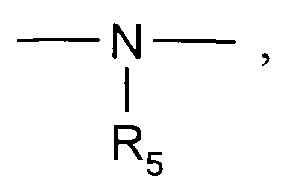
worin - R₅ =
- H, C₁-C₄-Alkyl oder mit R₁ zu einem vorzugsweise 5- bis 6-gliedrigen Ring verknüpft ist,
- X =
-

- Z =
- eine Vinylgruppe oder eine Ethylengruppe, die einen im alkalischen abspaltbaren Rest trägt, insbesondere -CH=CH₂, -CH₂-CH₂-OSO₃H, -CH₂-CH₂-Cl, -CH₂-CH₂-Br, -CH₂-CH₂-S₂O₃H, -CH₂-CH₂-OPO₃H₂, -CH₂-CH₂-OCOCH₃,


- Y₂ =
- Amino, Alkylamino, Alkoxy oder Aroxy oder
- Y₂ =
- Y₁,
- m =
- 1 oder 2,
- n =
- 1 oder 2,
- T₁, T₂ =
- unabhängig voneinander H, Cl, Br, C₁-C₄-Alkoxy, C₁-C₄-Alkyl, gegebenenfalls substituiertes Phenoxy oder Phenyl,
- R₃, R₄ =
- unabhängig voneinander H, C₁-C₂-Alkyl, C₁-C₂-Alkoxy, Carboxy, Halogen (Cl, Br).
- Eine bevorzugte Bedeutung für Y₂ ist Amino; weitere bevorzugte Bedeutungen für Y₂ sind C₁-C₄-Alkylamino, gegebenenfalls substituiert durch OH, OSO₃H, SO₃H, COOH, CONH₂, NH₂, C₁-C₂-Alkoxy oder unterbrochen durch Heteroatome, Ar-C₁-C₂-alkylamino, insbesondere Phenyl-C₁-C₂-alkylamino, gegebenenfalls substituiert durch SO₃H; Arylamino, gegebenenfalls substituiert durch SO₃H, C₁-C₂-Alkoxy, C₁-C₂-Alkyl; C₁-C₄-Alkoxy, gegebenenfalls substituiert durch OH, OSO₃H, C₁-C₂-Alkoxy oder unterbrochen durch Heteroatome; Aroxy, gegebenenfalls substituiert durch SO₃H, C₁-C₂-Alkyl, C₁-C₂-Alkoxy.
- C₂-C₆-Alkylen-Brückenglieder A sind beispielsweise:
Ethylen, 1,3-Propylen, 1,2-Propylen, 2-Hydroxy-1,3-propylen, 2-Sulfato-1,3-propylen, 1,4-, 1,3-, 2,3-Butylen, 1,5-Pentylen, 1,6- und 2,5-Hexylen, 1,4- oder 1,3-Cyclohexylen, -(CH₂-CH₂-O)n-CH₂-CH₂- mit n = 1 bis 3, -CH₂-CH₂-S-CH₂-CH₂-,
Geeignete Arylenreste A sind beispielsweise:
1,2-, 1,3- und 1,4-Phenylen, 4-Sulfo-1,3-phenylen, 6-Sulfo-1,3-phenylen, 2- oder 3-Sulfo-1,4-phenylen, 4,6-Disulfo-1,3-phenylen, 2- oder 3-Methyl-1,4-phenylen, 4- oder 6-Methyl-1,3-phenylen, 5-Methyl-1,2-phenylen, 3-Chlor-1,4-phenylen, 4-Chlor-1,3-phenylen, 4-Chlor-1,2-phenylen sowie die entsprechenden durch Sulfogruppen substituierten Methyl- und Chlorphenylenreste. - Geeignete Brückenglieder B sind beispielsweise:
Ethylen, 1,2- und 1,3-Propylen, 1,4-Butylen, 1,5-Pentylen, 1,6-Hexylen, -CH₂-CH₂-O-CH₂-CH₂-, 2-Hydroxy-1,3-propylen, 2-Sulfato-1,3-propylen. - Reste R₁ sind außer Wasserstoff zum Beispiel:
Methyl, Ethyl, 1-Propyl, 2-Hydroxyethyl, 2-Sulfatoethyl, 2-Sulfoethyl, 2-Carboxyethyl, 2-Aminocarbonylethyl, 2-Methoxy- oder 2-Ethoxycarbonylethyl, 2-Carboxy-1-propyl. - Reste R₂ sind außer Wasserstoff:
Methyl, Ethyl, 2-Hydroxyethyl, 2-Sulfatoethyl insbesondere Phenyl, 2-, 3-, 4-Sulfophenyl, 2-, 3-, 4-Methylphenyl, 2-, 3-, 4-Methoxy- oder -Ethoxyphenyl sowie die entsprechenden durch Sulfogruppen substituierten Methyl-, Methoxy- oder Ethoxyphenylreste, 2-, 3-, 4-Carboxyphenyl. - Reste R₅ können außer Wasserstoff beispielsweise sein:
Methyl, Ethyl, 2-Hydroxyethyl, 2-Sulfatoethyl. - Die Reste R₁ und R₅ können auch direkt miteinander verknüpft, die Gruppierung

ein Piperidindiyl-Rest sein. - Als Reste Y₂ sind außer NH₂ zu nennen:
Methylamino, Ethylamino, 1- oder 2-Propylamino, 1- oder 2-Butylamino, Cyclohexylamino, 2-Hydroxyethylamino, 2-Sulfatoethylamino, 2-Sulfoethylamino, 2-Carboxyethylamino, 2-Aminocarbonylethylamino, 2-Aminoethylamino, 3-Amino-1-propylamino, 2-Amino-1-propylamino, 2-Methyl-1-propylamino, 2-Hydroxy-1-propylamino, 2-Sulfato-1-propylamino, 2-Carboxy-1-propylamino, 2-Methoxyethylamino, 2-Ethoxyethylamino, 2-(2'-Hydroxyethoxy)-ethylamino, 2-(2'-Sulfatoethoxy)-ethylamino, Anilino, 2-, 3-, 4-Sulfoanilino, 2,5-, 2,4-Disulfoanilino, 2-, 3-, 4-Toluidino, 2-, 3-, 4-Anisidino, 2-, 3-, 4-Phenetidino sowie die entsprechenden durch Sulfogruppen substituierten Toluidin-, Anisidin- und Phenetidin-Reste, 4-(2-Hydroxyethoxy)-anilino, 4-(2-Sulfatoethoxy)-anilino, 3-Sulfo-4-(2-sulfatoethoxy)-anilino; C₁-C₄-Alkoxy-Reste für Y₂ sind beispielsweise Methoxy, Ethoxy, 2-Hydroxyethoxy, 2-Sulfatoethoxy, 2-Hydroxy-1-propoxy, 2-Sulfato-1-propoxy, 2,3-Dihydroxy-1-propoxy, 2,3-Disulfato-1-propoxy. - Aroxyreste für Y₂ können zum Beispiel sein:
Phenoxy, 2-, 3-, 4-Sulfophenoxy, 2-, 3-, 4-Kresoxy, 2-, 3-, 4-Methoxyphenoxy, 1- oder 2-Naphthoxy sowie die durch Sulfogruppen substituierten Kresoxy-, Methoxyphenoxy- oder Naphthoxy-Reste. - Besonders bevorzugte Verbindungen der Formel (I) sind derartige, bei denen Y₂ nicht die Bedeutung von Y₁ hat.
- Die Erfindung betrifft weiterhin Mischungen von erfindungsgemäßen Farbstoffen der Formeln (I), insbesondere (II),

mit an sich bekannten Farbstoffen folgender Formeln (III) und (IV)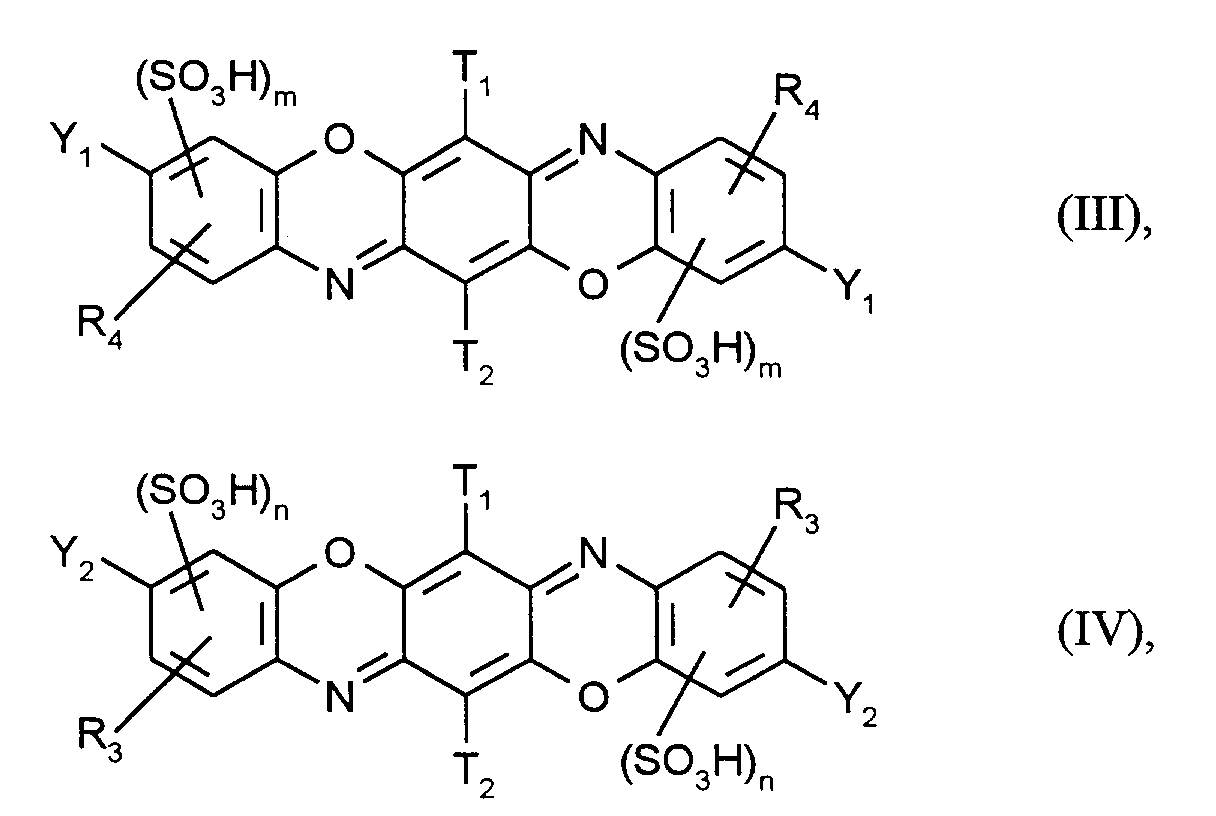
worin
Y₁, Y₂, R₃, R₄, T₁, T₂, m und n die oben angegebene Bedeutung haben, mit der Maßgabe, daß Y₂ nicht die Bedeutung von Y₁ zukommt. - Besonders bevorzugt sind Mischungen von Reaktivfarbstoffen der Formeln (II) und (III), in denen R₃, R₄ = H und T₁, T₂ = Halogen, insbesondere Cl.
- Weiterhin bevorzugt sind Farbstoffgemische der Formeln
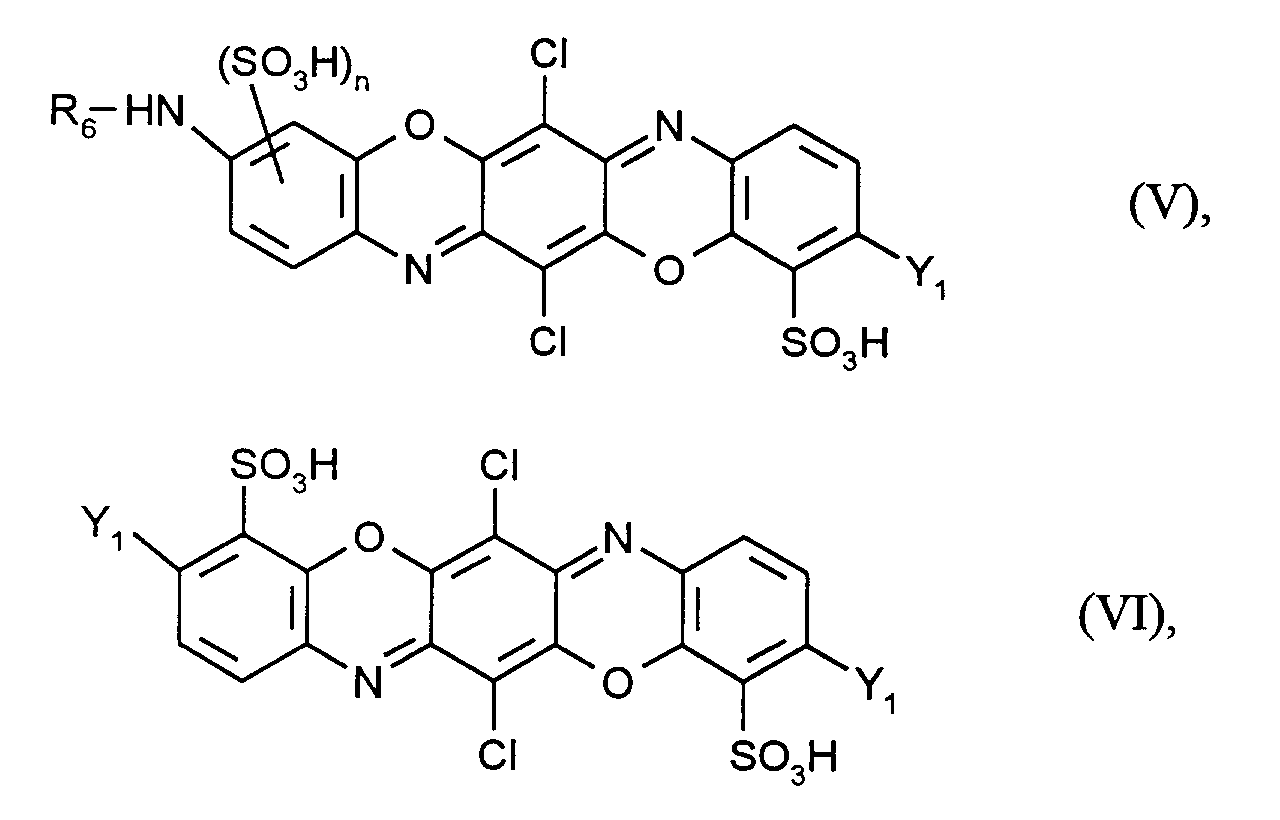
worin
R₆ = H, Methyl, Ethyl, 2-Hydroxyethyl, 2-Sulfatoethyl, 2-Sulfato-1-propyl und
Y₁ und n die oben angegebene Bedeutung haben. - Weiterhin bevorzugt sind Farbstoffgemische der Formeln


worin - A₁ =
- -CH₂-CH₂-, -(CH₂)₃-,


- Besonders bevorzugt sind Farbstoffgemische der Formeln


worin - Z₁ =
- -CH=CH₂, -CH₂-CH₂-OSO₃H, -CH₂-CH₂-Cl,
- p =
- 2 oder 3,
- k =
- 0 oder 1 und
- Ganz besonders bevorzugt sind Farbstoffgemische der Formeln


worin - q =
- 2 oder 3 und
- Die Herstellung der Farbstoffe (I) erfolgt beispielsweise durch Umsetzungen entsprechender Farbstoffe (XIII)-(XIV)

worin
Y₂, R₃, R₄, T₁, T₂, m, n, Q, A und R₁ die oben angegebene Bedeutung haben,
mit Reaktivkomponenten der Formel
worin
X, R₂, B und Z die oben angegebene Bedeutung haben. - Reaktivkomponenten der Formel (XV) lassen sich durch Kondensation von Trihalogentriazinen der Formel

worin - X =
- F, Cl, Br,
- Eine andere Möglichkeit zur Herstellung von Farbstoffen (I) besteht in der Kondensation von Chromophoren der Formel (XIII)-(XIV) mit den Trihalogentriazinen (XVI) zu Farbstoffen der Formel

worin
Y₂, R₃, R₄, T₁, T₂, m, n, Q, A, R₁ und X die oben angegebene Bedeutung haben,
und deren weitere Umsetzung mit molaren Mengen Aminosulfon der Formel
Aminosulfone der Formel (XVII) sind beschrieben in EP-A-0 568 860, 0 568 876, 0 385 426, 0 085 025 und DE-A-4 007 049. - Als Beispiele für Aminosulfone der Formel (XVII) sind zu nennen:


NH₂-CH₂-CH₂-SO₂-CH₂-CH₂-OSO₃H
NH₂-CH₂-CH₂-SO₂-CH₂-CH₂-OCOCH₃
NH₂-CH₂-CH₂-CH₂-SO₂-CH₂-CH₂-OSO₃H
NH₂-CH₂-CH₂-SO₂-CH=CH₂
NH₂-CH₂-CH₂-CH₂-SO₂-CH=CH₂
NH₂-CH₂-CH₂-O-CH₂-CH₂-SO₂-CH₂-CH₂-OSO₃H
NH₂-CH₂-CH₂-O-CH₂-CH₂-SO₂-CH=CH₂
CH₃-NH-CH₂-CH₂-SO₂-CH₂-CH₂-OSO₃H
C₂H₅-NH-CH₂-CH₂-SO₂-CH₂-CH₂-OSO₃H
CH₃-NH-CH₂-CH₂-CH₂-SO₂-CH₂-CH₂-OSO₃H
C₂H₅-NH-CH₂-CH₂-CH₂-SO₂-CH₂-CH₂-OSO₃H
HO-CH₂-CH₂-NH-CH₂-CH₂-SO₂-CH=CH₂
HO₃SO-O-CH₂-CH₂-NH-CH₂-CH₂-SO₂-CH₂-CH₂-OSO₃H. - Die Herstellung von Verbindungen der Formeln (XIII)-(XIV) erfolgt nach an sich bekannten Methoden durch Kondensation von 1,4-Benzochinonen der Formel

worin - T₃, T₄ =
- Wasserstoff, Cl, Br, O-Alkyl oder O-Aryl und
- R₇ =
- H, Alkylcarbonyl
- Je nach den beim Ringschluß angewandten Reaktionsbedingungen können die Sulfonsäuregruppen in den Benzringen der Triphendioxazine entweder in den o- oder in den p-Stellungen zu den Ringsauerstoffatomen des Dioxazin-Systems auftreten.
- Entsprechend den Löslichkeitsverhältnissen der Einzelkomponenten in den Triphendioxazin-Gemischen oder in den Anilgemischen (XXI)-(XXIII) und je nach den Aufarbeitungsbedingungen kann es zu Verschiebungen in den Mengenverhältnissen der Einzelkomponenten gegenüber dem ursprünglichen, nach der Synthese vorliegenden Verhältnis kommen.
- So kann sich beispielsweise bei der Isolierung des Anilgemisches die Komponente (XXIII) bevorzugt in der Mutterlauge anreichern.
- Die Kondensation der Benzochinone der Formel (XVIII) mit den Aminen (XIX) und (XX) erfolgt am besten in wäßrigem oder wäßrig-organischem Medium unter Zugabe alkalischer Kondensationsmittel bei pH-Werten von 3 bis 11, vorzugsweise 4 bis 8, und Temperaturen von 20 bis 90°C, vorzugsweise 40 bis 70°C, oder in gepufferten Lösungen, die obige alkalische Kondensationsmittel enthalten. Man kann auch in rein organischem Milieu unter Zusatz säurebindender Mittel arbeiten.
- Alkalische Kondensationsmittel sind beispielsweise Natrium- oder Kaliumhydrogencarbonat, Natriumcarbonat, Natrium- oder Kaliumacetat, Natronlauge, Kalilauge, Natriumphosphate, Natriumborat, Lithiumhydroxid, Lithiumcarbonat.
- Im allgemeinen fallen die Kondensationsprodukte der Formel (XXI)-(XXIII) als schwerlösliche, braune Produkte aus.
- Eine Variante zur Herstellung von Verbindungen der Formel (XXI)-(XXIII) besteht in der Addition von Aminen (XIX) und (XX) an 1,4-Benzochinone der Formel

worin
T₁ und T₂ die oben angegebene Bedeutung haben,
und Oxidation der primär entstehenden Addukte. - Der Ringschluß der Chinonkondensationsprodukte (XXI)-(XXIII) zu den Triphendioxazinen kann nach an sich bekannten Methoden, wie sie in den Deutschen Offenlegungsschriften 2 122 262, 2 124 080, 2 302 383, 2 344 781, 2 503 611, 2 823 828 und in der Britischen Patentschrift 2 019 872 beschrieben sind, insbesondere in konzentrierter Schwefelsäure und vor allem in Oleum mit SO₃-Gehalten von 1 bis 50 % bei Temperaturen von 10 bis 80°C, gegebenenfalls mit Zusatz von Oxidationsmitteln wie Kalium- oder Ammoniumperoxidisulfat, Braunstein oder organischen Peroxiden, vorgenommen werden.
- Als Beispiele für Amine der Formel (XIX) seien genannt:


- Als Beispiele für Amine der Formel (XX) sind aufzuführen:
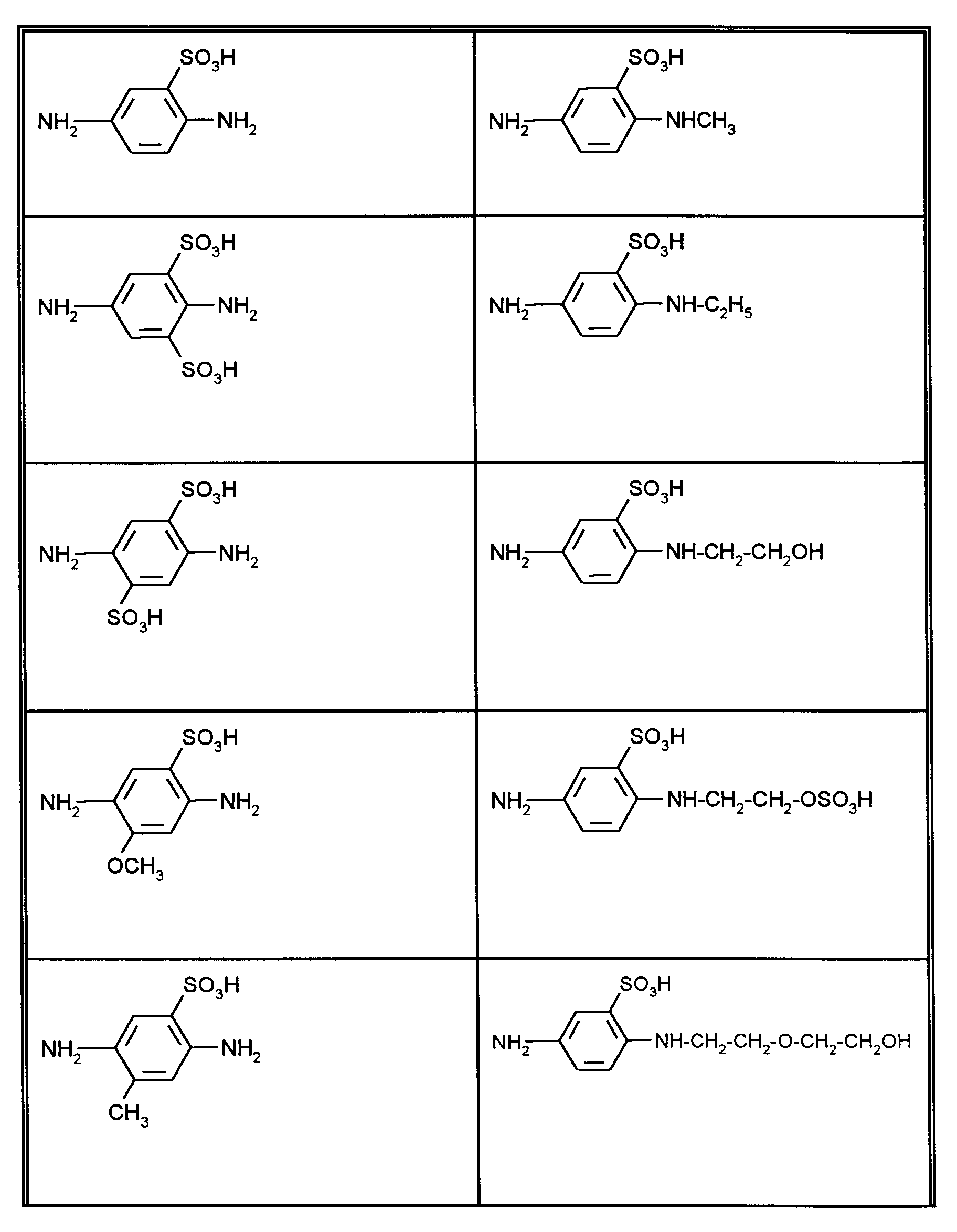


- Die für die Formeln (XIX) und (XX) beispielhaft genannten Amine stellen lediglich eine Auswahl aus einer größeren Zähl weiterer möglicher Amine dar.
- Die erfindungsgemäßen Farbstoffe der Formeln (I) und (II) fallen gegebenenfalls mit den symmetrischen Verbindungen der allgemeinen Formel (III) und gegebenenfalls mit Verbindungen der Formel (IV) an.
- Das Molprozentverhältnis der Farbstoffbestandteile der Formeln (II):(III):(IV) im Rahmen der Formel (I) kann in den Grenzen (20-80):(80-20):(30-0), bevorzugt in den Grenzen (40-70):(40-25):(20-5) schwanken.
- Die erfindungsgemäßen Farbstoffe der Formel (I) geben auf Cellulose- sowie natürlichen und synthetischen Polyamidmaterialien Färbungen, die eine hohe Farbstärke aufweisen.
- Als wasserlösliche Farbstoffe finden die neuen Farbstoffe bevorzugtes Interesse für das Färben hydroxylgruppen- und amidgruppenhaltiger Textilmaterialien, insbesondere von Materialien aus nativer und regenerierter Cellulose sowie synthetischen Polyamidmaterialien, Wolle und Seide.
- Die genannten Materialien werden nach den für wasserlösliche Reaktivfarbstoffe allgemein bekannten und in der Technik üblichen Verfahren gefärbt oder bedruckt. Man erhält dann licht- und naßechte Färbungen und Drucke. Auf Cellulosefasern, insbesondere auf Baumwolle, zeichnen sich die neuen Farbstoffe durch hohe Fixiergrade und sehr gutes Aufbauvermögen aus.
- Die Formeln der wasserlöslichen Reaktivfarbstoffe in der Beschreibung und in den Beispielen sind die der freien Säuren. Isoliert und angewandt werden die Farbstoffe in Form der Lithium-, Natrium- oder Kaliumsalze.
- Die in den nachfolgenden Beispielen und Tabellen angegebenen Formeln beziehen sich, wenn nicht anders vermerkt, in der Regel auf jeweils eines der bei den Umsetzungen entstehenden Reaktionsprodukte. Dieses bezieht sich auch auf die bezüglich der Stellung der Sulfogruppen am Triphendioxazinsystem isomeren Verbindungen.
-
- a) Herstellung der Anilkomponente
Zu einer unter Stickstoffatmosphäre hergestellten Lösung von 55,4 g 4-(β-Aminoethylamino)-3-sulfo-anilin und 45,1 g 2,5-Diaminobenzolsulfonsäure in 1000 ml Wasser, die auf pH 7 gestellt ist, gibt man bei 50°C 59,0 g Chloranil hinzu und hält im Reaktionsgemisch den pH-Wert auf 5,5-5,8. Nach Beendigung des Sodaverbrauches wird der Ansatz auf Raumtemperatur abgekühlt, der braune Niederschlag abgesaugt, mit Wasser und Aceton gewaschen und getrocknet. Überwiegender Bestandteil in dem aus dem gebildeten Gemisch dreier Substanzen A-C ausgefallenen Niederschlag ist die asymmetrische Verbindung der Formel A, daneben die symmetrische Verbindung B, während die symmetrische Verbindung C sich in der Mutterlauge und Wäsche stark anreichert.
- b) Cyclisierung zum Triphendioxazin
85,0 g des hergestellten Anilzwischenproduktes werden in 240 ml 20 %iges Oleum bei -5 bis -10°C eingetragen. Man erwärmt anschließend auf 25°C, rührt die Mischung nach, bis alles Anil gelöst ist und trägt nun bei 25°C 80,3 g Kaliumperoxodisulfat ein. Man rührt noch 1 Stunde bei Raumtemperatur nach und gießt nach Beendigung der Reaktion die Lösung auf Eis und Wasser.
Die erhaltene Fällung wird abgesaugt, mit 5 %iger Salzsäure und Wasser gewaschen, abschließend mit Isopropanol, bis der Ablauf sulfatfrei ist. Das Produkt entspricht den Formeln:

- c) Herstellung der Reaktivkomponente
46,7 g einer Komponente der Formel
- d) Kondensation zum Reaktivfarbstoff
35,0 g des im Abschnitt b) erhaltenen Triphendioxazin-Gemisches werden in 700 ml Wasser suspendiert und durch Zugabe von Natronlauge bis zum pH 12 gelöst.
Etwa 5 % der im Abschnitt c) hergestellten Lösung der Reaktivkomponente werden in 100 ml Eiswasser vorgelegt. Man läßt nun die Lösungen der Triphendioxazinverbindung und der Reaktivkomponente gleichzeitig so zutropfen, daß jeweils aliquote Anteile beider Lösungen in Kontakt gelangen, und hält im Reaktionsgemisch den pH-Wert durch Zutropfen von 2n Natronlauge auf 8,5-8,7 und die Temperatur auf 0 bis 3°C.
Wenn die Umsetzung beendet ist, erwärmt man den Ansatz auf Raumtemperatur und hält den pH-Wert noch 2 Stunden.
Aus der erhaltenen Lösung wird das Farbstoffgemisch mit 23 % Kaliumchlorid ausgesalzen, abgesaugt und mehrmals mit 25 %iger Kaliumchloridlösung abgedeckt. Nach Zusatz von Phosphatpufferlösung vom pH 6 wird der Farbstoff bei 40°C im Vaküum getrocknet.
Er entspricht einer Mischung gemäß dem Anteil der Komponente D im Abschnitt b) überwiegend der Formel

Das erhaltene Reaktivfarbstoff-Gemisch färbt Baumwolle aus langer Flotte mit hoher Fixierausbeute in brillanten Blautönen und zeigt hervorragendes Aufbauvermögen. - e) Herstellung der reaktiven Aminosulfonkomponente
50,0 g der in EP-A-0 568 876, Beispiel 117, beschriebenen Verbindung der Formel
Man gibt die Oleumlösung auf eine Mischung von Eis und Wasser und stellt die erhaltene Lösung durch Eintragen von Kalziumcarbonat auf pH = 4,5 und verdünnt, falls nötig, mit Wasser. Man saugt vom Kalziumsulfat ab, wäscht dieses mit Wasser und engt die erhaltenen Filtrate ein. Eine Gehaltsbestimmung z.B. durch Titration eines aliquoten Teiles mit Natriumnitrit in saurem Medium ergibt eine Ausbeute von 94 % d.Th. bezogen auf eingesetztes Öl.
Die erhaltene Lösung wird direkt weiter umgesetzt (vergleiche Abschnitt c).
Will man das erhaltene Produkt isolieren, dampft man die Lösung im Vakuum zur Trockne ein. Man erhält ein dunkelbraunes zähes Öl, das allmählich teilweise Kristallisiert, das sich jedoch beim Anreiben mit Isopropanol in ein graues Pulver verwandeln läßt. Man saugt es ab, wäscht mit Isopropanol und trocknet es.
Nach Ausweis des ¹H-NMR-Spektrums liegt ein Isomeren-Gemisch im Verhältnis etwa 2:1 aus folgenden Verbindungen vor:

δ = 3,37-3,55 ppm (m, 6H)
δ = 4,18-4,21 ppm (t, 2H)
δ = 6,64-6,70 ppm (d, 2/3 x 1H) d
δ = 6,86 ppm ppm (s, 2/3 x 1H) a
δ = 6,90-6,94 ppm (d, 2/3 x 1H) b
δ = 7,12-7,19 ppm (t, 2/3 x 1H) c
δ = 6,56-6,60 ppm (d, 1/3 x 2H) e
δ = 7,40-7,44 ppm (d, 1/3 x 2H) f.
In analoger Weise lassen sich die in Beispiel 30 oder 47 hergestellten Verbindungen

-
- a) Herstellung der Anilkomponente
55,4 g 4-(β-Aminoethylamino)-3-sulfoanilin und 64,3 g 2,5-Diaminobenzol-1,3-disulfosäure werden in 1000 ml Wasser und 180 ml Isopropanol bei pH 6,0 unter Stickstoffatmosphäre gelöst.
Man gibt 59,0 g bei 50°C Chloranil hinzu und hält den pH-Wert im Reaktionsgemisch mit 10 %iger Kaliumhydrogencarbonatlösung auf 6,0.
Wenn die Reaktion beendet ist, kühlt man die Mischung unter Rühren auf 20°C ab und stellt dann den pH-Wert mit 36 %iger Salzsäure auf 3,0. Die braune Fällung wird abgesaugt, mit Wasser und anschließend mit Aceton bis zum praktisch farblosen Ablauf gewaschen. Die Trocknung erfolgt bei 70°C im Vakuum.
Vorherrschender Bestandteil in dem aus dem gebildeten Gemisch dreier Substanzen A-C ausgefallenen Niederschlag ist die Komponente der Formel A,
- b) Cyclisierung zum Triphendioxazin
78,4 g Anilkomponente aus Abschnitt a) werden bei -10°C in 220 ml 20 %iges Oleum langsam eingetragen. Man läßt die Temperatur im Laufe einer Stunde auf 25°C ansteigen. Wenn vollständige Lösung eingetreten ist, trägt man in 1 Stunde bei 25°C unter Außenkühlung 71,3 g Kaliumperoxodisulfat ein, rührt 1 Stunde nach und gibt dann den Ansatz in eine Mischung von 1 kg Eis und 650 ml Wasser. Die Fällung wird abgesaugt, mit 1,5 l 5 %iger Salzsäure und 750 ml Wasser sulfatfrei gewaschen und bei 50°C im Vakuum getrocknet. Das Produkt ist eine Mischung und entspricht der Formel

- c) Kondensation zum Reaktivfarbstoff
39,8 g des erhaltenen Triphendioxazin-Gemisches werden in 750 ml Wasser suspendiert und durch Zugabe von ca. 40 ml 4n Natronlauge bis pH 11,4 gelöst.
Man stellt die Reaktivkomponente des Beispiels 1c) in gleicher Menge, wie dort beschrieben, her. - 100 ml Eiswasser und 5 % der hergestellten Reaktivkomponente werden vorgelegt. Man läßt im Gleichtakt jeweils aliquote Teile der Lösungen der Reaktiv- und der Triphendioxazinkomponente in 30-45 Minuten zulaufen und hält durch Zutropfen von 10 %iger Natronlauge den pH-Wert im Reaktionsgemisch auf 8,5-8,7, die Temperatur auf 0°C.
- Ist die Umsetzung beendet, hält man den pH-Wert nunmehr bei Raumtemperatur noch 2 Stunden in den obigen Grenzen.
- Die Lösung des Farbstoffgemisches kann nach Zusatz von 2 g Phosphatpuffergemisch (pH 6) entweder im Vakuum eingedampft oder sprühgetrocknet werden, oder man salzt durch Zusatz von 23 % Kaliumchlorid aus, saugt ab, wäscht mit 25 %iger Kaliumchloridlösung und trocknet nach Zusatz von Phosphatpuffer bei 50°C im Vakuum.
- Der erhaltene Farbstoff enthält als überwiegenden Bestandteil das Produkt der Formel

daneben das der Formel
λmax = 611 nm (H₂O) -
- a) 19,8 g einer Verbindung der Formel

werden in 40 ml Wasser und 40 g Eis verrührt. Man stellt mit 10 %iger Sodalösung den pH-Wert auf 6,8 und läßt eine Suspension zulaufen, die man aus 12,0 g Cyanurchlorid, 110 ml Wasser und 1,6 ml eines Emulgators bei 0°C hergestellt hat. Während des Zulaufs hält man den pH-Wert des Reaktionsgemisches mit 10 %iger Sodalösung auf 4,2-4,5. Man erhält eine graue Suspension der Reaktivkomponente
- b) 25,2 g Triphendioxazinverbindung aus Beispiel 2b) werden in 400 ml Wasser suspendiert und mit 50 %iger Natronlauge bei pH 11,3 und 20°C gelöst. Man legt 200 ml Wasser und 5 % der obigen Suspension der Reaktivkomponente vor und läßt dann bei 20°C die Lösung der Triphendioxazin-Farbbase und die Suspension der Reaktivkomponente mengenmäßig im Gleichtakt in die Vorlage laufen.
Man stellt während der Zugabe im Reaktionsgemisch den pH-Wert auf 8,5-9 und hält nach der Zugabe weiter mit 2n Natronlauge auf 8,8, bis die Umsetzung vollständig ist. Der Farbstoff wird mit Natriumchlorid ausgesalzen, abgesaugt, mit 20 %iger Natriumchloridlösung gewaschen und nach Anteigen mit Phosphatpuffer bei 40°C im Vakuum getrocknet. Er entspricht in seinem Hauptanteil der Formel
und färbt Baumwolle aus langer Flotte mit guten Fixierausbeuten in neutralen Blautönen. - Einen ähnlichen Farbstoff der Formel

λmax = 611nm(H₂O)
erhält man, wenn man 39,8 g Triphendioxazinkomponente des Beispiels 2 wie beschrieben löst und an Stelle der dortigen Umsetzung wie folgt weiter verfährt:
0,11 Mole der Verbindung der Formel
werden in 70 ml Wasser und 70 g Eis verrührt und neutral gelöst. Innerhalb von 5 Minuten tropft man bei 0 bis 3°C 0,12 Mole Cyanurfluorid zu und hält den pH-Wert mit verdünnter Sodalösung auf 4,0-4,5. Die erhaltene Lösung der Verbindung
wird in der in Beispiel 2d) aufgezeigten Weise mit der Triphendioxazin-Farbbase umgesetzt. - 35,8 g Triphendioxazin-Farbbasenmischung der Formeln A+B,

hergestellt durch Kondensation von 66,2 g 4-(3-Amino-1-propylamino)-3-sulfoanilin und 50,8 g 2,5-Diaminobenzolsulfonsäure mit 66,4 g Chloranil und anschließendem oxidativen Ringschluß des Anilgemisches in der in Beispiel 1a) und 1b) gezeigten Weise, werden mit Reaktivkomponente des Beispiels 1c) der Formel
hergestellt aus 46,7 g Aminkomponente und 11,6 ml Cyanurfluorid, nach der Lehre des Beispiels 1d) zu einem Farbstoff kondensiert, dessen Hauptkomponente der Formel
λmax = 615 nm (H₂O)
entspricht, begleitet von symmetrischen, aus der obigen Formel B entstandenen Reaktivfarbstoffanteilen. - Der Farbstoff zeigt hinsichtlich Fixierausbeute, Aufbau und Echtheiten ähnliche Eigenschaften wie der des Beispiels 1d).
-
- a) Eine Lösung von 29,7 g Verbindung der Formel

Man erhält eine Suspension der Reaktivkomponente
- b) 27,0 g Triphendioxazin-Farbbase des Beispiels 1b) werden in 540 ml Wasser bei pH 12 gelöst.
Man legt 5 % der in Abschnitt a) hergestellten Suspension der Reaktivkomponente in 150 ml Eiswasser vor und läßt die Lösung der Farbbase und die Suspension der Reaktivkomponente in etwa 30 Minuten synchron zulaufen. Im Reaktionsgemisch wird der pH-Wert durch gleichzeitiges Zutropfen von 2n Natronlauge auf 8,6-8,8, die Temperatur durch äußere Kühlung auf 0 bis 3°C gehalten.
Nach beendeter Umsetzung läßt man die Temperatur auf 20°C ansteigen und rührt noch 2 Stunden bei pH 8,5-8,6 nach. Aus der erhaltenen Lösung wird der Farbstoff mit Kaliumchlorid ausgesalzen, abgesaugt, mit 25 %iger Kaliumchloridlösung gewaschen und nach Anteigen mit Phosphatpuffer von pH 6 bei 40°C im Vakuum getrocknet. Er entspricht in der Hauptkomponente der Formel
und weist ähnliche coloristische Eigenschaften auf wie der Farbstoff des Beispiels 1d). -
- a) 30,0 g einer Verbindung der Formel

60 mmole der erhaltenen Lösung werden mit 1,7 g Natriumfluorid versetzt. Man läßt 5,7 ml Cyanurfluorid bei 0°C zutropfen und hält den pH-Wert mit 2n Sodalösung auf 3,0. Nach der Reaktion stellt man auf pH 4,0. Die in Form einer Suspension erhaltene Verbindung entspricht der Formel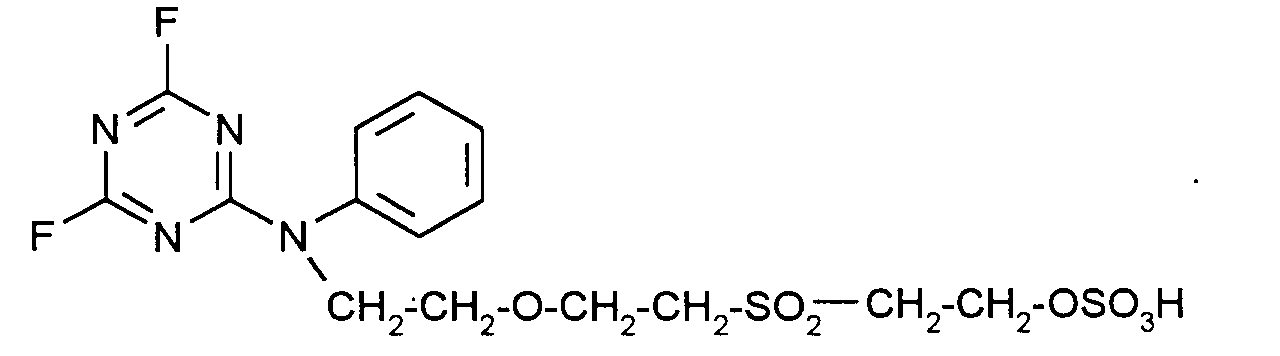
- b) 20,0 g Triphendioxazin-Farbbase des Beispiels 2b) werden in 380 ml Wasser mit Natronlauge bei pH 11,5 gelöst.
100 ml Eis-Wasser und 5 % der oben beschriebenen Suspension der Reaktivkomponente werden vorgelegt. Farbbasenlösung und Reaktivkomponente werden synchron in 30 Minuten eingetragen, der pH-Wert im Reaktionsgemisch mit 2n Natronlauge auf 8,5-8,7 und die Temperatur auf 0 bis 3°C gehalten. Man läßt unter diesen Bedingungen ausreagieren und hält dann bei gleichem pH-Wert die Temperatur noch 2 Stunden auf 20°C. Der aus der Lösung durch Aussalzen, Absaugen, Puffern und Trocknen zu isolierende Farbstoff entspricht in seinem Hauptbestandteil der Formel
- Weitere, den Beispielen 1 bis 7 ähnliche Farbstoffe erhält man, wenn man die in der Tabelle 1 aufgeführten Triphendioxazin-Farbbasen, Trihalogentriazine und N-(Sulfatoethylsulfonylalkyl)-aniline nach den aufgezeigten Verfahren kondensiert.
- Dabei sind die Triphendioxazin-Farbbasen durch die Formel ihres Hauptanteils wiedergegeben.


-
- a) 16,8 g 3-(2'-Sulfatoethylsulfonyl)-propylamin, hergestellt nach den Angaben der EP-A-0 385 426, werden in Eis-Wasser suspendiert (pH-Wert von 8,0).
14,0 g Cyanurchlorid werden in Eis/Wasser mit einem Emulgator verrührt. Man dosiert obige Aminkomponente in die Cyanurchloridsuspension und hält bei 0 bis 3°C den pH-Wert auf 7,0. Nach 2 Stunden läßt man die Temperatur unter weiterer pH-Kontrolle auf 10°C ansteigen.
Ist der Sodaverbrauch zum Stillstand gekommen, wird die erhaltene Lösung der Verbindung
- b) 26,7 g Triphendioxazinverbindung aus Beispiel 2b) werden in 500 ml Wasser bei pH 11,5 gelöst.
5 % der obigen Lösung der Reaktivkomponente werden in 150 ml Wasser vorgelegt. Man läßt nun die Lösungen der Farbbase und der Reaktivkomponente gleichzeitig zutropfen und hält den pH-Wert im Reaktionsgemisch auf 9,0, die Temperatur auf 20 bis 23°C.
Nach dem Eintropfen rührt man noch 1 Stunde bei pH 9,0 weiter und führt dann die Umsetzung bei pH 8,5 bis 8,7 zu Ende. Danach wird der Farbstoff ausgesalzen, abgesaugt und gewaschen.
Er entspricht in seinem Hauptanteil der Formel
und färbt Baumwolle in klaren Blautönen mit guten Fixierausbeuten und Echtheiten. - Setzt man im Beispiel 45a) an Stelle der 16,8 g 3-(2'-Sulfatoethylsulfonyl)-propylamin 15,8 g 2-(2'-Sulfatoethylsulfonyl)-ethylamin ein, das man nach den Angaben der US-Patentschrift 2 785 190 aus 2-Chlorethylamin und 2-Mercaptoethanol und nachfolgende H₂O₂-Oxidation und Veresterung mit Schwefelsäure gewinnen kann, und verfährt im übrigen weiter nach Beispiel 45b), so erhält man einen Farbstoff, der in seinem Hauptanteil der Formel

entspricht und in seinen Eigenschaften dem Farbstoff des Beispiels 45 ähnlich ist. - Weitere, den Beispielen 45-46 ähnliche Farbstoffe erhält man, wenn man die in Tabelle 2 aufgeführten Triphendioxazin-Farbbasen, Trihalogentriazine und 2-Sulfatoethylsulfonyl-alkylamine miteinander kondensiert, wobei die Triphendioxazin-Farbbasen mit der Formel ihres Hauptanteils angegeben sind.


-
- a) Herstellungs des Anils
51,8 g 4,4'-Diaminodiphenylamin-2,3'-disulfonsäure, 37,6 g 2,5-Diaminobenzolsulfonsäure werden in 800 ml Wasser bei pH 7 unter Stickstoff gelöst. Man setzt 0,2 ml eines Emulgators auf der Basis von sulfiertem Rizinusöl hinzu und erwärmt auf 50°C. 49,2 g Chloranil werden in 15 Minuten eingetragen. Man hält den pH-Wert im Reaktionsgemisch mit 10 %iger Sodalösung auf 5,8-6. Nach beendeter Umsetzung wird der pH-Wert auf 6,5 gestellt und die Lösung heiß von etwas entstandenem Tetrachlorhydrochinon geklärt.
Man stellt im Filtrat den pH-Wert auf 2,5 und saugt die Fällung ab. Der Filterkuchen wird mit verdünnter Salzsäure, dann mit Isopropanol gewaschen und getrocknet im Vakuum bei 60°C. Die in dem Produkt enthaltenen Substanzen entsprechen folgenden Formeln:
- b) Ringschluß zum Triphendioxazin
40 g obiges Anil werden in 110 mi 20 %iges Oleum eingetragen. Man fügt nun 0,1 g Kaliumiodid hinzu und läßt unter Kühlung 50 ml 65 %iges Oleum zulaufen und rührt dann solange bei 25°C weiter, bis eine chromatographische Probe vollständigen Ringschluß anzeigt. Man gibt auf 1,4 kg Eis und 450 ml Wasser und salzt mit Kaliumchlorid aus. Die Fällung wird abgesaugt, mit 25 %iger Kaliumchlorid Lösung abgedeckt und im Vakuum bei 50°C getrocknet. Das Produkt entspricht in seinem Hauptanteil der Formel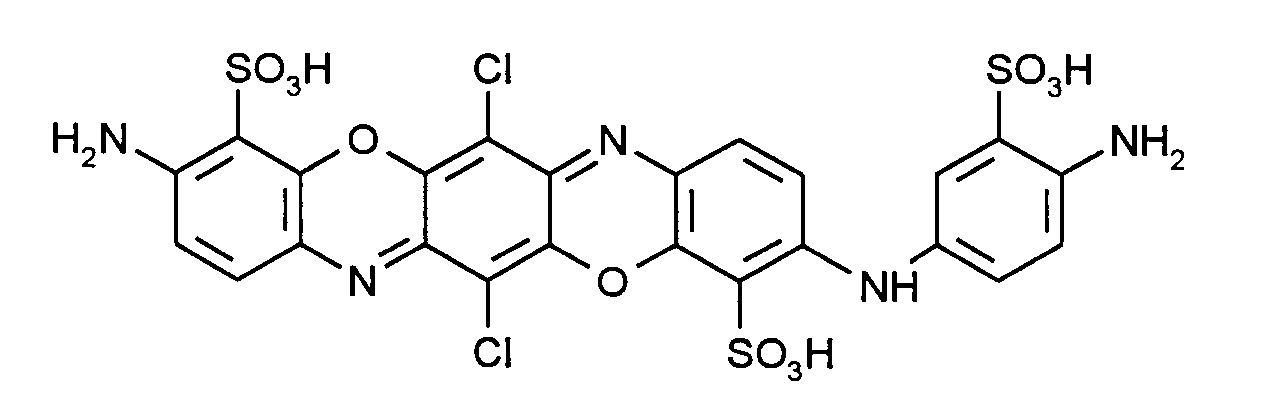
- c) Kondensation zum Reaktivfarbstoff
25,0 g Triphendioxazin-Farbbase Abschnitt b), berechnet auf salz- und wasserfreies Produkt, werden in Wasser bei pH 6 gelöst. Man läßt bei 0°C 4,1 ml Cyanurfluorid zutropfen und hält den pH-Wert mit Sodalösung auf 4,5. Dann gibt man eine neutral gestellte Lösung von 7,6 g 3-(2'-Sulfatoethylsulfonyl)-1-propylamin hinzu und hält den pH-Wert auf 7,0. Nach beendeter Umsetzung wird der Farbstoff ausgesalzen, abgesaugt und nach Anteigen mit Phosphatpuffer von pH 6 im Vakuum bei 50°C getrocknet.
Das Produkt der hauptsächlichen Formel
λmax = 598 nm (H₂O) -
- a) Herstellung der Anilkomponente
50,8 g 4-(β-Aminoethylamino)-3-sulfoanilin und 44,7 g 4-Aminoanisolsulfonsäure werden unter Stickstoff in 1250 ml Wasser und 250 ml Isopropanol bei pH 6,0 gelöst. Man erwärmt auf 50°C, trägt 54,1 g Chloranil ein und hält den pH-Wert auf 6,0. Wenn die Umsetzung beendet ist, läßt man auf Raumtemperatur abkühlen. Das ausgefallene Produkt wird abgesaugt, mit Wasser gewaschen, dann mit 350 ml Aceton abgedeckt und getrocknet. Das erhaltene Anil besteht aus einem Gemisch der drei Substanzen A-C, in dem die Komponenten A und B überwiegen.

- b) Cyclisierung zum Triphendioxazin
114 g obiges Anil-Gemisch werden in 3 Stunden bei -10 bis +4°C in 285 ml 20 %iges Oleum eingetragen. Man rührt bei 25°C nach, bis vollständige Lösung eingetreten ist. 113 g Kaliumperoxodisulfat werden bei 30°C eingestreut.
Die erhaltene blaue Lösung wird in Eis/Wasser eingerührt und die erhaltene Suspension ausgesalzen. Der Niederschlag wird abgesaugt und mit 15%iger Kaliumchlorid-Lösung frei von Sulfationen gewaschen. Man erhält nach dem Trocknen im Vakuum bei 60°C 154 g eines salzhaltigen oder nach Abzug des analytisch ermittelten Kaliumchlorids 106,4 g salzfreies Triphendioxazin-Gemisch. - c) Umsetzung zum Reaktivfarbstoff
50 g Triphendioxazin-Gemisch (berechnet auf salzfreie Substanz) werden in 1000 ml Wasser suspendiert und mit Natronlauge bei pH 11-12 gelöst.
Aus 51,0 g Verbindung der Formel

5 % der Reaktivkomponente werden in Eis-Wasser vorgelegt. Die Lösung der Triphendioxazinkomponente und die Reaktivkomponente werden synchron eingetragen. Man hält währenddessen und danach den pH-Wert im Reaktionsgemisch auf 8,6-8,8, die Temperatur auf 0-3°C. Nach beendeter Umsetzung erhöht man die Temperatur für 2 Stunden auf 20°C und salzt aus der blauen Lösung den Farbstoff aus, wäscht mit Salzlösung und trocknet ihn nach Pufferung mit Phosphat bei 45°C im Vakuum.
Der Farbstoff besteht aus einer Mischung der aus dem unsymmetrischen Anil A und dem symmetrischen Anil B hervorgegangenen Anteile, in welcher der Farbstoff der Formel
überwiegt.
Der Farbstoff färbt Cellulosefasern in rotstichig blauen Tönen mit ausgezeichneten Echtheiten und guter Fixierausbeute. - 50,0 g Triphendioxazin-Gemisch des Beispiels 55 b)

werden in 1000 ml Wasser bei pH 11,5 gelöst. Man läßt diese Lösung in der in Beispiel 55 c) gezeigten Weise mit der Lösung einer Reaktivkomponente reagieren, die man nach der Verfahrensweise des Beispiels 1 c) aus 64,2 g
und 15,9 ml Cyanurfluorid in Gegenwart von 5,1 g Natriumfluorid hergestellt hat. - Die Aufarbeitung der erhaltenen rotstichig blauen Lösung durch Aussalzen, Absaugen und Trocknen in Gegenwart von Puffern ergibt außer dem aus dem Triphendioxazin-Basen-Anteil B hervorgegangenen symmetrischen Reaktivfarbstoffanteil ein Produkt der Formel

λmax = 599 nm (H₂O)
Das Farbstoffgemisch färbt Baumwolle in rotstichig blauen Tönen mit ausgezeichneten Echtheiten und guter Fixierausbeute.

worin
R₂, B und Z die oben angegebene Bedeutung haben, herstellen.
mit vorzugsweise annähernd molaren Mengen Aminen der Formeln

und

worin
A, Q, R₁, R₃, R₄, Y₂ die oben angegebene Bedeutung haben,
zu Anilgemischen der Formeln


und nachfolgenden Ringschluß der Anilgemische (XXI)-(XXIII) zu den entsprechenden Triphendioxazingemischen. Im Zuge dieser letzten Operation können gegebenenfalls Sulfonsäuregruppen eingeführt werden. Weiterhin kann zusätzlich gegebenenfalls, wenn nicht vorher erfolgt, eine Umwandlung der Funktion

oder -NH₂
durch Verseifung vorgenommen werden.
und färbt Cellulosefasern mit guten Echtheiten in brillanten Blautönen.
Claims (13)
- Reaktivfarbstoff der Formel
 Y₁ = ein Rest der Formelworin
 A = ein Bindeglied,B = ein aliphatisches Bindeglied,R₁ = H, C₁-C₄Alkyl, gegebenenfalls substituiert durch OH, OSO₃H, COOH, CONH₂, SO₃H,R₂ = H, C₁-C₄-Alkyl, Aryl, gegebenenfalls substituiert durch SO₃H, COOH, C₁-C₂-Alkyl, C₁-C₂-Alkoxy,Q =
worinR₅ = H, C₁-C₄-Alkyl oder mit R₁ zu einem Ring verknüpft ist,X = F, Cl, Br oder Z = eine Vinylgruppe oder eine Ethylengruppe, die einen im alkalischen abspaltbaren Rest trägt,Y₂ = Amino, Alkylamino, Arylamino, Alkoxy oder Aroxy oderY₂ = Y₁,m = 1 oder 2,n = 1 oder 2,T₁, T₂ = unabhängig voneinander H, Cl, Br, C₁-C₄-Alkoxy, C₁-C₄-Alkyl, gegebenenfalls substituiertes Phenoxy oder Phenyl,R₃, R₄ = unabhängig voneinander H, C₁-C₂-Alkyl, C₁-C₂-Alkoxy, Carboxy, Halogen (Cl, Br),ausgenommen die aus EP-A-499 588, Seite 38, Zeile 40, bekannten Verbindungen aus der Farbbase der Formel
- Reaktivfarbstoff nach Anspruch 1, dadurch gekennzeichnet, daßY₂ = Amino; C₁-C₄-Alkylamino, gegebenenfalls substituiert durch OH, OSO₃H, SO₃H, COOH, CONH₂, NH₂, C₁-C₂-Alkoxy oder unterbrochen durch Heteroatome, Ar-C₁-C₂-alkylamino, gegebenenfalls substituiert durch SO₃H; Arylamino, gegebenenfalls substituiert durch SO₃H, C₁-C₂-Alkoxy, C₁-C₂-Alkyl; C₁-C₄-Alkoxy, gegebenenfalls substituiert durch OH, OSO₃H, C₁-C₂-Alkoxy oder unterbrochen durch Heteroatome; Aroxy, gegebenenfalls substituiert durch SO₃H, C₁-C₂-Alkyl, C₁-C₂-Alkoxy.
- Reaktivfarbstoff gemäß wenigstens einem der vorhergehenden Ansprüche, dadurch gekennzeichnet, daßA = Ethylen, 1,3-Propylen, 1,2-Propylen, 2-Hydroxy-1,3-propylen, 2-Sulfato-1,3-propylen, 1,4-, 1,3-, 2,3 Butylen, 1,5-Pentylen, 1,6- und 2,5-Hexylen, 1,4- oder 1,3-Cyclohexylen, -(CH₂-CH₂-O)n-CH₂-CH₂-mit n = 1 bis 3, -CH₂-CH₂-S-CH₂-CH₂- oder

- Reaktivfarbstoff gemäß wenigstens einem der vorhergehenden Ansprüche, dadurch gekennzeichnet, daßA = 1,2-, 1,3- und 1,4-Phenylen, 4-Sulfo-1,3-phenylen, 6-Sulfo-1,3-phenylen, 2- oder 3-Sulfo-1,4-phenylen, 4,6-Disulfo-1,3-phenylen, 2- oder 3-Methyl-1,4-phenylen, 4- oder 6-Methyl-1,3-phenylen, 5-Methyl-1,2-phenylen, 3-Chlor-1,4-phenylen, 4-Chlor-1,3-phenylen, 4-Chlor-1,2-phenylen oder entsprechende durch Sulfogruppen substituierte Methyl- und Chlorphenylenreste.
- Reaktivfarbstoff gemäß wenigstens einem der vorhergehenden Ansprüche, dadurch gekennzeichnet, daßB = Ethylen, 1,2- und 1,3-Propylen, 1,4-Butylen, 1,5-Pentylen, 1,6-Hexylen, -CH₂-CH₂-O-CH₂-CH₂-, 2-Hydroxy-1,3-propylen oder 2-Sulfato-1,3-propylen.
- Reaktivfarbstoff gemäß wenigstens einem der vorhergehenden Ansprüche, dadurch gekennzeichnet, daßR₁ = Wasserstoff oder Methyl, Ethyl, 1-Propyl, 2-Hydroxyethyl, 2-Sulfatoethyl, 2-Sulfoethyl, 2-Carboxyethyl, 2-Aminocarbonylethyl, 2-Methoxy- oder 2-Ethoxycarbonylethyl, 2-Carboxy-1-propyl,R₂ = Wasserstoff oder Methyl, Ethyl, 2-Hydroxyethyl, 2-Sulfatoethyl insbesondere Phenyl, 2-, 3-, 4-Sulfophenyl, 2-, 3-, 4-Methylphenyl, 2-, 3-, 4-Methoxy- oder -Ethoxyphenyl sowie die entsprechenden durch Sulfogruppen substituierten Methyl-, Methoxy- oder Ethoxyphenylreste, 2-, 3-, 4-Carboxyphenyl,R₅ = Wasserstoff oder Methyl, Ethyl, 2-Hydroxyethyl, 2-Sulfatoethyl, wobei die Reste R₁ und R₅ auch direkt miteinander verknüpft sein können und die Gruppierung

- Reaktivfarbstoff gemäß wenigstens einem der vorhergehenden Ansprüche, dadurch gekennzeichnet, daßY₂ = NH₂ oder Methylamino, Ethylamino, 1 - oder 2-Propylamino, 1- oder 2-Butylamino, Cyclohexylamino, 2-Hydroxyethylamino, 2-Sulfatoethylamino, 2-Sulfoethylamino, 2-Carboxyethylamino, 2-Aminocarbonylethylamino, 2-Aminoethylamino, 3-Amino-1-propylamino, 2-Amino-1-propylamino, 2-Methyl-1-propylamino, 2-Hydroxy-1-propylamino, 2-Sulfato-1-propylamino, 2-Carboxy-1-propylamino, 2-Methoxy-ethylamino, 2-Ethoxyethylamino, 2-(2'-Hydroxyethoxy)-ethylamino, 2-(2'-Sulfatoethoxy)-ethylamino, Anilino, 2-, 3-, 4-Sulfoanilino, 2,5-, 2,4-Disulfoanilino, 2-, 3-, 4-Toluidino, 2-, 3-, 4-Anisidino, 2-, 3-, 4-Phenetidino sowie die entsprechenden durch Sulfogruppen substituierten Toluidin-, Anisidin- und Phenelidin-Reste, 4-(2-Hydroxyethoxy)-anilino, 4-(2-Sulfatoethoxy)-anilino, 3-Sulfo-4-(2-sulfatoethoxy)-anilino.
- Reaktivfarbstoff gemäß wenigstens einem der vorhergehenden Ansprüche, dadurch gekennzeichnet, daßY₂ = Phenoxy, 2-, 3-, 4-Sulfophenoxy, 2-, 3-, 4-Kresoxy, 2-, 3-, 4-Methoxyphenoxy, 1- oder 2-Naphthoxy oder ein durch Sulfogruppen substituierter Kresoxy-, Methoxyphenoxy- oder Naphthoxy-Rest oder ein C₁-C₄-Alkoxy-Rest, der substituiert oder unsubstituiert ist.
- Reaktivfarbstoff gemäß wenigstens einem der vorhergehenden Ansprüche, dadurch gekennzeichnet, daß
Y₂ nicht die Bedeutung von Y₁ hat. - Mischung von Farbstoffen gemäß Anspruch 1, insbesondere Formel (II),


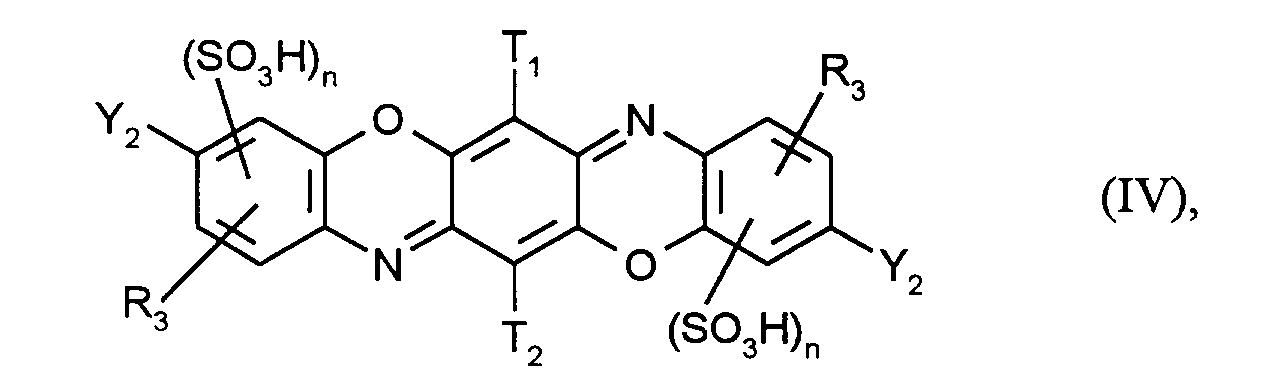
Y₁, Y₂, R₃, R₄, T₁, T₂, m und n die in Anspruch 1 angegebene Bedeutung haben, mit der Maßgabe, daß Y₂ nicht die Bedeutung von Y₁ zukommt. - Verfahren zur Herstellung eines Farbstoffes gemäß Anspruch 1 durch Umsetzungen entsprechender Farbstoffe (XIII)-(XIV)

Y₂, R₃, R₄, T₁, T₂, m, n, Q, A und R₁ die in Anspruch 1 angegebene Bedeutung haben,
mit Reaktivkomponenten der Formel
X, R₂, B und Z die in Anspruch 1 angegebene Bedeutung haben oder durch Kondensation von Chromophoren der Formel (XIII)-(XIV) mit den Trihalogentriazinen (XVI) zu Farbstoffen der Formel
Y₂, R₃, R₄, T₁, T₂, m, n, Q, A, R₁ und X die in Anspruch 1 angegebene Bedeutung haben,
und deren weitere Umsetzung mit molaren Mengen Aminosulfon. - Verfahren zum Färben oder Bedrucken von hydroxyl- oder amidgruppenhaltigen Materialien mit einem Reaktivfarbstoff, wobei der Farbstoff gemäß wenigstens einem der vorhergehenden Ansprüche verwendet wird.
- Gefärbte oder bedruckte Substrate, die wenigstens teilweise mit einem Farbstoff gemäß wenigstens einem der vorhergehenden Ansprüche gefärbt worden sind.
Applications Claiming Priority (2)
| Application Number | Priority Date | Filing Date | Title |
|---|---|---|---|
| DE4415780A DE4415780A1 (de) | 1994-05-05 | 1994-05-05 | Triphendioxazin-Reaktivfarbstoffe |
| DE4415780 | 1994-05-05 |
Publications (2)
| Publication Number | Publication Date |
|---|---|
| EP0681005A1 true EP0681005A1 (de) | 1995-11-08 |
| EP0681005B1 EP0681005B1 (de) | 1999-07-28 |
Family
ID=6517309
Family Applications (1)
| Application Number | Title | Priority Date | Filing Date |
|---|---|---|---|
| EP95106075A Expired - Lifetime EP0681005B1 (de) | 1994-05-05 | 1995-04-24 | Triphendioxazin-Reaktivfarbstoffe |
Country Status (4)
| Country | Link |
|---|---|
| US (1) | US5880282A (de) |
| EP (1) | EP0681005B1 (de) |
| JP (1) | JPH07304981A (de) |
| DE (2) | DE4415780A1 (de) |
Cited By (5)
| Publication number | Priority date | Publication date | Assignee | Title |
|---|---|---|---|---|
| EP0697443A3 (de) * | 1994-08-16 | 1996-03-06 | Hoechst Ag | |
| WO1999023171A1 (de) * | 1997-11-03 | 1999-05-14 | Bayer Aktiengesellschaft | Triphendioxazin-farbstoffe |
| WO1999051681A1 (en) * | 1998-04-03 | 1999-10-14 | Clariant Finance (Bvi) Limited | Triphendioxazine dyestuffs for dyeing organic substrates |
| EP1036825A1 (de) * | 1999-03-15 | 2000-09-20 | Ciba SC Holding AG | Reaktivfarbstoffe, Verfahren zu deren Herstellung und deren Verwendung |
| US6592634B1 (en) * | 1999-03-15 | 2003-07-15 | Ciba Specialty Chemicals Corporation | Reactive dyes, processes for their preparation and their use |
Families Citing this family (1)
| Publication number | Priority date | Publication date | Assignee | Title |
|---|---|---|---|---|
| US6406525B1 (en) | 1998-04-18 | 2002-06-18 | Clariant Finance (Bvi) Limited | Organic compounds |
Citations (7)
| Publication number | Priority date | Publication date | Assignee | Title |
|---|---|---|---|---|
| EP0070807A2 (de) * | 1981-07-21 | 1983-01-26 | Ciba-Geigy Ag | Reaktivfarbstoffe, deren Herstellung und Verwendung |
| EP0074928A2 (de) * | 1981-09-16 | 1983-03-23 | Ciba-Geigy Ag | Reaktivfarbstoffe, deren Herstellung und Verwendung |
| EP0472975A2 (de) * | 1990-08-21 | 1992-03-04 | Sumitomo Chemical Company, Limited | Unsymmetrische Dioxazinverbindungen und Verfahren zum Färben oder Bedrucken von Fasermaterialien mittels derselben |
| EP0499588A1 (de) * | 1991-02-15 | 1992-08-19 | Ciba-Geigy Ag | Reaktivefarbstoffe, Verfahren zu deren Herstellung und deren Verwendung |
| EP0568860A1 (de) * | 1992-05-04 | 1993-11-10 | Bayer Ag | Reaktivfarbstoffe, deren Herstellung und Verwendung |
| EP0629667A1 (de) * | 1993-05-18 | 1994-12-21 | Hoechst Aktiengesellschaft | Wasserlöslichse faserreaktive Farbstoffe, Verfahren zu ihrer Herstellung und ihre Verwendung |
| EP0652262A1 (de) * | 1993-11-08 | 1995-05-10 | Bayer Ag | Reaktivfarbstoffe, deren Herstellung und Verwendung |
Family Cites Families (5)
| Publication number | Priority date | Publication date | Assignee | Title |
|---|---|---|---|---|
| US4841049A (en) * | 1986-09-12 | 1989-06-20 | Ciba-Geigy Corporation | Reactive dyes of the dioxazine series |
| DE59106903D1 (de) * | 1990-09-06 | 1995-12-21 | Ciba Geigy Ag | Reaktivfarbstoffe, Verfahren zu deren Herstellung und deren Verwendung. |
| DE59108632D1 (de) * | 1990-11-06 | 1997-04-30 | Ciba Geigy | Reaktivfarbstoffmischungen, Verfahren zu deren Herstellung und deren Verwendung |
| EP0568876B1 (de) * | 1992-05-04 | 1996-08-28 | Bayer Ag | Reaktivfarbstoffe, deren Herstellung und Verwendung |
| GB9211110D0 (en) * | 1992-05-26 | 1992-07-08 | Ici Plc | Compound |
-
1994
- 1994-05-05 DE DE4415780A patent/DE4415780A1/de not_active Withdrawn
-
1995
- 1995-04-24 DE DE59506441T patent/DE59506441D1/de not_active Expired - Fee Related
- 1995-04-24 EP EP95106075A patent/EP0681005B1/de not_active Expired - Lifetime
- 1995-04-27 JP JP7127014A patent/JPH07304981A/ja active Pending
-
1997
- 1997-02-06 US US08/796,407 patent/US5880282A/en not_active Expired - Fee Related
Patent Citations (7)
| Publication number | Priority date | Publication date | Assignee | Title |
|---|---|---|---|---|
| EP0070807A2 (de) * | 1981-07-21 | 1983-01-26 | Ciba-Geigy Ag | Reaktivfarbstoffe, deren Herstellung und Verwendung |
| EP0074928A2 (de) * | 1981-09-16 | 1983-03-23 | Ciba-Geigy Ag | Reaktivfarbstoffe, deren Herstellung und Verwendung |
| EP0472975A2 (de) * | 1990-08-21 | 1992-03-04 | Sumitomo Chemical Company, Limited | Unsymmetrische Dioxazinverbindungen und Verfahren zum Färben oder Bedrucken von Fasermaterialien mittels derselben |
| EP0499588A1 (de) * | 1991-02-15 | 1992-08-19 | Ciba-Geigy Ag | Reaktivefarbstoffe, Verfahren zu deren Herstellung und deren Verwendung |
| EP0568860A1 (de) * | 1992-05-04 | 1993-11-10 | Bayer Ag | Reaktivfarbstoffe, deren Herstellung und Verwendung |
| EP0629667A1 (de) * | 1993-05-18 | 1994-12-21 | Hoechst Aktiengesellschaft | Wasserlöslichse faserreaktive Farbstoffe, Verfahren zu ihrer Herstellung und ihre Verwendung |
| EP0652262A1 (de) * | 1993-11-08 | 1995-05-10 | Bayer Ag | Reaktivfarbstoffe, deren Herstellung und Verwendung |
Cited By (6)
| Publication number | Priority date | Publication date | Assignee | Title |
|---|---|---|---|---|
| EP0697443A3 (de) * | 1994-08-16 | 1996-03-06 | Hoechst Ag | |
| WO1999023171A1 (de) * | 1997-11-03 | 1999-05-14 | Bayer Aktiengesellschaft | Triphendioxazin-farbstoffe |
| WO1999051681A1 (en) * | 1998-04-03 | 1999-10-14 | Clariant Finance (Bvi) Limited | Triphendioxazine dyestuffs for dyeing organic substrates |
| US6319289B1 (en) | 1998-04-03 | 2001-11-20 | Clariant Finance (Bvi) Limited | Organic compounds |
| EP1036825A1 (de) * | 1999-03-15 | 2000-09-20 | Ciba SC Holding AG | Reaktivfarbstoffe, Verfahren zu deren Herstellung und deren Verwendung |
| US6592634B1 (en) * | 1999-03-15 | 2003-07-15 | Ciba Specialty Chemicals Corporation | Reactive dyes, processes for their preparation and their use |
Also Published As
| Publication number | Publication date |
|---|---|
| JPH07304981A (ja) | 1995-11-21 |
| EP0681005B1 (de) | 1999-07-28 |
| DE59506441D1 (de) | 1999-09-02 |
| US5880282A (en) | 1999-03-09 |
| DE4415780A1 (de) | 1995-11-09 |
Similar Documents
| Publication | Publication Date | Title |
|---|---|---|
| EP0053743B1 (de) | Dioxazin-Reaktivfarbstoffe, Verfahren zu ihrer Herstellung und ihre Verwendung zum Färben und Bedrucken von hydroxyl- oder amidgruppenhaltigen Fasermaterialien | |
| DE2503611A1 (de) | Farbstoffe | |
| EP0101665A2 (de) | Reaktivfarbstoffe der Dioxazinreihe, deren Herstellung und Verwendung | |
| EP0568860A1 (de) | Reaktivfarbstoffe, deren Herstellung und Verwendung | |
| EP0681005A1 (de) | Triphendioxazin-Reaktivfarbstoffe | |
| EP0501252A1 (de) | Bifunktionelle Reaktivfarbstoffe | |
| DE4338117A1 (de) | Reaktivfarbstoffe, deren Herstellung und Verwendung | |
| DE2442839A1 (de) | Reaktivfarbstoffe | |
| EP0657508A1 (de) | Reaktivfarbstoffe, Verfahren zu deren Herstellung und deren Verwendung | |
| EP0299328B1 (de) | Reaktivfarbstoffe | |
| EP0168703A2 (de) | Reaktivfarbstoffe | |
| EP0318785B1 (de) | Reaktivfarbstoffe | |
| US5126450A (en) | Unsymmetrical triphenodioxazine dyes | |
| DE2652119C3 (de) | Anthrachinon-Reaktivfarbstoffe, deren Herstellung und deren Verwendung | |
| EP0557841B1 (de) | Reaktivfarbstoffe | |
| EP0272532A2 (de) | Farbstoffe | |
| EP0582886A1 (de) | Phthalocyaninreaktivfarbstoffe | |
| EP0356681B1 (de) | Disazoreaktivfarbstoffe | |
| EP0229339B1 (de) | Wasserlösliche Triphendioxazin-Verbindungen, deren sulfonylgruppenhaltigen Vorprodukte, Verfahren zu ihrer Herstellung und Verwendung der Triphendioxazine als Farbstoffe | |
| EP0794234A1 (de) | Farbstoffmischungen, Verfahren zu deren Herstellung und deren Verwendung | |
| EP0377902A1 (de) | Reaktivfarbstoffe | |
| EP0012342A1 (de) | Anthrachinon-Reaktivfarbstoffe und deren Verwendung beim Färben und Bedrucken von hydroxyl- oder amidgruppenhaltigen Materialien | |
| EP0603116A1 (de) | Azoreaktivfarbstoffe | |
| DE4106255A1 (de) | Bifunktionelle reaktivfarbstoffe | |
| EP0761767A1 (de) | Aluminium-Phthalocyanin-Reaktivfarbstoffe |
Legal Events
| Date | Code | Title | Description |
|---|---|---|---|
| PUAI | Public reference made under article 153(3) epc to a published international application that has entered the european phase |
Free format text: ORIGINAL CODE: 0009012 |
|
| AK | Designated contracting states |
Kind code of ref document: A1 Designated state(s): CH DE FR GB LI |
|
| 17P | Request for examination filed |
Effective date: 19960412 |
|
| 17Q | First examination report despatched |
Effective date: 19960530 |
|
| GRAG | Despatch of communication of intention to grant |
Free format text: ORIGINAL CODE: EPIDOS AGRA |
|
| GRAG | Despatch of communication of intention to grant |
Free format text: ORIGINAL CODE: EPIDOS AGRA |
|
| GRAH | Despatch of communication of intention to grant a patent |
Free format text: ORIGINAL CODE: EPIDOS IGRA |
|
| GRAH | Despatch of communication of intention to grant a patent |
Free format text: ORIGINAL CODE: EPIDOS IGRA |
|
| GRAA | (expected) grant |
Free format text: ORIGINAL CODE: 0009210 |
|
| AK | Designated contracting states |
Kind code of ref document: B1 Designated state(s): CH DE FR GB LI |
|
| REG | Reference to a national code |
Ref country code: CH Ref legal event code: EP |
|
| REG | Reference to a national code |
Ref country code: CH Ref legal event code: NV Representative=s name: E. BLUM & CO. PATENTANWAELTE |
|
| GBT | Gb: translation of ep patent filed (gb section 77(6)(a)/1977) |
Effective date: 19990806 |
|
| REF | Corresponds to: |
Ref document number: 59506441 Country of ref document: DE Date of ref document: 19990902 |
|
| ET | Fr: translation filed | ||
| PLBE | No opposition filed within time limit |
Free format text: ORIGINAL CODE: 0009261 |
|
| STAA | Information on the status of an ep patent application or granted ep patent |
Free format text: STATUS: NO OPPOSITION FILED WITHIN TIME LIMIT |
|
| 26N | No opposition filed | ||
| REG | Reference to a national code |
Ref country code: GB Ref legal event code: IF02 |
|
| PGFP | Annual fee paid to national office [announced via postgrant information from national office to epo] |
Ref country code: FR Payment date: 20060410 Year of fee payment: 12 |
|
| PGFP | Annual fee paid to national office [announced via postgrant information from national office to epo] |
Ref country code: GB Payment date: 20060419 Year of fee payment: 12 |
|
| PGFP | Annual fee paid to national office [announced via postgrant information from national office to epo] |
Ref country code: DE Payment date: 20060420 Year of fee payment: 12 |
|
| PGFP | Annual fee paid to national office [announced via postgrant information from national office to epo] |
Ref country code: CH Payment date: 20060427 Year of fee payment: 12 |
|
| REG | Reference to a national code |
Ref country code: CH Ref legal event code: PFA Owner name: BAYER AG Free format text: BAYER AG# #51368 LEVERKUSEN (DE) -TRANSFER TO- BAYER AG# #51368 LEVERKUSEN (DE) |
|
| REG | Reference to a national code |
Ref country code: CH Ref legal event code: PL |
|
| GBPC | Gb: european patent ceased through non-payment of renewal fee |
Effective date: 20070424 |
|
| PG25 | Lapsed in a contracting state [announced via postgrant information from national office to epo] |
Ref country code: DE Free format text: LAPSE BECAUSE OF NON-PAYMENT OF DUE FEES Effective date: 20071101 |
|
| PG25 | Lapsed in a contracting state [announced via postgrant information from national office to epo] |
Ref country code: LI Free format text: LAPSE BECAUSE OF NON-PAYMENT OF DUE FEES Effective date: 20070430 Ref country code: CH Free format text: LAPSE BECAUSE OF NON-PAYMENT OF DUE FEES Effective date: 20070430 |
|
| PG25 | Lapsed in a contracting state [announced via postgrant information from national office to epo] |
Ref country code: GB Free format text: LAPSE BECAUSE OF NON-PAYMENT OF DUE FEES Effective date: 20070424 |
|
| PG25 | Lapsed in a contracting state [announced via postgrant information from national office to epo] |
Ref country code: FR Free format text: LAPSE BECAUSE OF NON-PAYMENT OF DUE FEES Effective date: 20070430 |