EP0053743B1 - Dioxazin-Reaktivfarbstoffe, Verfahren zu ihrer Herstellung und ihre Verwendung zum Färben und Bedrucken von hydroxyl- oder amidgruppenhaltigen Fasermaterialien - Google Patents
Dioxazin-Reaktivfarbstoffe, Verfahren zu ihrer Herstellung und ihre Verwendung zum Färben und Bedrucken von hydroxyl- oder amidgruppenhaltigen Fasermaterialien Download PDFInfo
- Publication number
- EP0053743B1 EP0053743B1 EP81109755A EP81109755A EP0053743B1 EP 0053743 B1 EP0053743 B1 EP 0053743B1 EP 81109755 A EP81109755 A EP 81109755A EP 81109755 A EP81109755 A EP 81109755A EP 0053743 B1 EP0053743 B1 EP 0053743B1
- Authority
- EP
- European Patent Office
- Prior art keywords
- triazinyl
- formula
- dioxazine
- alkyl
- solution
- Prior art date
- Legal status (The legal status is an assumption and is not a legal conclusion. Google has not performed a legal analysis and makes no representation as to the accuracy of the status listed.)
- Expired
Links
- PPSZHCXTGRHULJ-UHFFFAOYSA-N dioxazine Chemical compound O1ON=CC=C1 PPSZHCXTGRHULJ-UHFFFAOYSA-N 0.000 title claims description 19
- 238000004043 dyeing Methods 0.000 title claims description 10
- 125000003368 amide group Chemical group 0.000 title claims description 3
- 238000000034 method Methods 0.000 title description 5
- 239000002657 fibrous material Substances 0.000 title 1
- 125000002947 alkylene group Chemical class 0.000 claims description 9
- 150000001875 compounds Chemical class 0.000 claims description 9
- 125000004178 (C1-C4) alkyl group Chemical group 0.000 claims description 7
- 125000000732 arylene group Chemical group 0.000 claims description 7
- 239000000463 material Substances 0.000 claims description 6
- 125000000020 sulfo group Chemical group O=S(=O)([*])O[H] 0.000 claims description 6
- 229910004727 OSO3H Inorganic materials 0.000 claims description 5
- 229910006069 SO3H Inorganic materials 0.000 claims description 5
- 125000000896 monocarboxylic acid group Chemical group 0.000 claims description 5
- 125000003118 aryl group Chemical group 0.000 claims description 4
- 125000005843 halogen group Chemical group 0.000 claims description 4
- 125000000623 heterocyclic group Chemical group 0.000 claims description 4
- 229910052739 hydrogen Inorganic materials 0.000 claims description 4
- 229910052717 sulfur Inorganic materials 0.000 claims description 4
- UFHFLCQGNIYNRP-UHFFFAOYSA-N Hydrogen Chemical compound [H][H] UFHFLCQGNIYNRP-UHFFFAOYSA-N 0.000 claims description 3
- 125000004432 carbon atom Chemical group C* 0.000 claims description 3
- 239000001257 hydrogen Substances 0.000 claims description 2
- 125000002887 hydroxy group Chemical group [H]O* 0.000 claims description 2
- 229910052760 oxygen Inorganic materials 0.000 claims description 2
- 125000004169 (C1-C6) alkyl group Chemical group 0.000 claims 1
- 239000000835 fiber Substances 0.000 claims 1
- -1 1,3-propylene Chemical group 0.000 description 98
- 239000000243 solution Substances 0.000 description 54
- FAPWRFPIFSIZLT-UHFFFAOYSA-M Sodium chloride Chemical compound [Na+].[Cl-] FAPWRFPIFSIZLT-UHFFFAOYSA-M 0.000 description 36
- XLYOFNOQVPJJNP-UHFFFAOYSA-N water Substances O XLYOFNOQVPJJNP-UHFFFAOYSA-N 0.000 description 32
- 239000000975 dye Substances 0.000 description 31
- CDBYLPFSWZWCQE-UHFFFAOYSA-L Sodium Carbonate Chemical compound [Na+].[Na+].[O-]C([O-])=O CDBYLPFSWZWCQE-UHFFFAOYSA-L 0.000 description 22
- 230000005494 condensation Effects 0.000 description 21
- 239000000203 mixture Substances 0.000 description 21
- 238000009833 condensation Methods 0.000 description 17
- 239000011780 sodium chloride Substances 0.000 description 17
- 239000000047 product Substances 0.000 description 14
- VEXZGXHMUGYJMC-UHFFFAOYSA-N Hydrochloric acid Chemical compound Cl VEXZGXHMUGYJMC-UHFFFAOYSA-N 0.000 description 11
- 239000000543 intermediate Substances 0.000 description 11
- 229920003043 Cellulose fiber Polymers 0.000 description 10
- 229910052736 halogen Inorganic materials 0.000 description 10
- 150000002367 halogens Chemical class 0.000 description 10
- WCUXLLCKKVVCTQ-UHFFFAOYSA-M Potassium chloride Chemical compound [Cl-].[K+] WCUXLLCKKVVCTQ-UHFFFAOYSA-M 0.000 description 9
- 238000006243 chemical reaction Methods 0.000 description 9
- XTHPWXDJESJLNJ-UHFFFAOYSA-N chlorosulfonic acid Substances OS(Cl)(=O)=O XTHPWXDJESJLNJ-UHFFFAOYSA-N 0.000 description 9
- 229910000029 sodium carbonate Inorganic materials 0.000 description 9
- ZAJAQTYSTDTMCU-UHFFFAOYSA-N 3-aminobenzenesulfonic acid Chemical compound NC1=CC=CC(S(O)(=O)=O)=C1 ZAJAQTYSTDTMCU-UHFFFAOYSA-N 0.000 description 8
- LFQSCWFLJHTTHZ-UHFFFAOYSA-N Ethanol Chemical compound CCO LFQSCWFLJHTTHZ-UHFFFAOYSA-N 0.000 description 8
- QAOWNCQODCNURD-UHFFFAOYSA-N Sulfuric acid Chemical compound OS(O)(=O)=O QAOWNCQODCNURD-UHFFFAOYSA-N 0.000 description 8
- VMKJWLXVLHBJNK-UHFFFAOYSA-N cyanuric fluoride Chemical compound FC1=NC(F)=NC(F)=N1 VMKJWLXVLHBJNK-UHFFFAOYSA-N 0.000 description 8
- 239000012065 filter cake Substances 0.000 description 8
- 239000002609 medium Substances 0.000 description 6
- 239000011541 reaction mixture Substances 0.000 description 6
- 238000003756 stirring Methods 0.000 description 6
- 238000001816 cooling Methods 0.000 description 5
- MGNCLNQXLYJVJD-UHFFFAOYSA-N cyanuric chloride Chemical compound ClC1=NC(Cl)=NC(Cl)=N1 MGNCLNQXLYJVJD-UHFFFAOYSA-N 0.000 description 5
- 239000002244 precipitate Substances 0.000 description 5
- KEQGZUUPPQEDPF-UHFFFAOYSA-N 1,3-dichloro-5,5-dimethylimidazolidine-2,4-dione Chemical compound CC1(C)N(Cl)C(=O)N(Cl)C1=O KEQGZUUPPQEDPF-UHFFFAOYSA-N 0.000 description 4
- HEAHMJLHQCESBZ-UHFFFAOYSA-N 2,5-diaminobenzenesulfonic acid Chemical compound NC1=CC=C(N)C(S(O)(=O)=O)=C1 HEAHMJLHQCESBZ-UHFFFAOYSA-N 0.000 description 4
- CSCPPACGZOOCGX-UHFFFAOYSA-N Acetone Chemical compound CC(C)=O CSCPPACGZOOCGX-UHFFFAOYSA-N 0.000 description 4
- BAVYZALUXZFZLV-UHFFFAOYSA-N Methylamine Chemical compound NC BAVYZALUXZFZLV-UHFFFAOYSA-N 0.000 description 4
- JUJWROOIHBZHMG-UHFFFAOYSA-N Pyridine Chemical compound C1=CC=NC=C1 JUJWROOIHBZHMG-UHFFFAOYSA-N 0.000 description 4
- 150000001412 amines Chemical class 0.000 description 4
- 239000008363 phosphate buffer Substances 0.000 description 4
- 239000001103 potassium chloride Substances 0.000 description 4
- 235000011164 potassium chloride Nutrition 0.000 description 4
- 125000002924 primary amino group Chemical group [H]N([H])* 0.000 description 4
- 239000000985 reactive dye Substances 0.000 description 4
- FYSNRJHAOHDILO-UHFFFAOYSA-N thionyl chloride Chemical compound ClS(Cl)=O FYSNRJHAOHDILO-UHFFFAOYSA-N 0.000 description 4
- 0 CCC(*1)C(C*)*(C)=C2C1=C(N)I1=*C(C*C3)C3OC1=C2C Chemical compound CCC(*1)C(C*)*(C)=C2C1=C(N)I1=*C(C*C3)C3OC1=C2C 0.000 description 3
- ZMXDDKWLCZADIW-UHFFFAOYSA-N N,N-Dimethylformamide Chemical compound CN(C)C=O ZMXDDKWLCZADIW-UHFFFAOYSA-N 0.000 description 3
- HEMHJVSKTPXQMS-UHFFFAOYSA-M Sodium hydroxide Chemical compound [OH-].[Na+] HEMHJVSKTPXQMS-UHFFFAOYSA-M 0.000 description 3
- ZMANZCXQSJIPKH-UHFFFAOYSA-N Triethylamine Chemical compound CCN(CC)CC ZMANZCXQSJIPKH-UHFFFAOYSA-N 0.000 description 3
- 239000002253 acid Substances 0.000 description 3
- 125000000217 alkyl group Chemical group 0.000 description 3
- 239000002585 base Substances 0.000 description 3
- 239000007859 condensation product Substances 0.000 description 3
- 125000004122 cyclic group Chemical group 0.000 description 3
- 239000013067 intermediate product Substances 0.000 description 3
- 230000007935 neutral effect Effects 0.000 description 3
- UUEVFMOUBSLVJW-UHFFFAOYSA-N oxo-[[1-[2-[2-[2-[4-(oxoazaniumylmethylidene)pyridin-1-yl]ethoxy]ethoxy]ethyl]pyridin-4-ylidene]methyl]azanium;dibromide Chemical compound [Br-].[Br-].C1=CC(=C[NH+]=O)C=CN1CCOCCOCCN1C=CC(=C[NH+]=O)C=C1 UUEVFMOUBSLVJW-UHFFFAOYSA-N 0.000 description 3
- 238000006798 ring closing metathesis reaction Methods 0.000 description 3
- 239000000725 suspension Substances 0.000 description 3
- RHUYHJGZWVXEHW-UHFFFAOYSA-N 1,1-Dimethyhydrazine Chemical compound CN(C)N RHUYHJGZWVXEHW-UHFFFAOYSA-N 0.000 description 2
- 150000004057 1,4-benzoquinones Chemical class 0.000 description 2
- 125000001140 1,4-phenylene group Chemical group [H]C1=C([H])C([*:2])=C([H])C([H])=C1[*:1] 0.000 description 2
- LDCCBULMAFILCT-UHFFFAOYSA-N 2-aminobenzene-1,4-disulfonic acid Chemical compound NC1=CC(S(O)(=O)=O)=CC=C1S(O)(=O)=O LDCCBULMAFILCT-UHFFFAOYSA-N 0.000 description 2
- TXNSZCSYBXHETP-UHFFFAOYSA-N 2-chloro-n-(hydroxymethyl)acetamide Chemical compound OCNC(=O)CCl TXNSZCSYBXHETP-UHFFFAOYSA-N 0.000 description 2
- SECXISVLQFMRJM-UHFFFAOYSA-N N-Methylpyrrolidone Chemical compound CN1CCCC1=O SECXISVLQFMRJM-UHFFFAOYSA-N 0.000 description 2
- PVNIIMVLHYAWGP-UHFFFAOYSA-N Niacin Chemical compound OC(=O)C1=CC=CN=C1 PVNIIMVLHYAWGP-UHFFFAOYSA-N 0.000 description 2
- NBIIXXVUZAFLBC-UHFFFAOYSA-N Phosphoric acid Chemical compound OP(O)(O)=O NBIIXXVUZAFLBC-UHFFFAOYSA-N 0.000 description 2
- NINIDFKCEFEMDL-UHFFFAOYSA-N Sulfur Chemical compound [S] NINIDFKCEFEMDL-UHFFFAOYSA-N 0.000 description 2
- 150000007513 acids Chemical class 0.000 description 2
- 125000004442 acylamino group Chemical group 0.000 description 2
- 125000001931 aliphatic group Chemical group 0.000 description 2
- 239000003513 alkali Substances 0.000 description 2
- 150000004984 aromatic diamines Chemical class 0.000 description 2
- 125000001769 aryl amino group Chemical group 0.000 description 2
- 229910052799 carbon Inorganic materials 0.000 description 2
- 229920002678 cellulose Polymers 0.000 description 2
- 239000001913 cellulose Substances 0.000 description 2
- 239000007795 chemical reaction product Substances 0.000 description 2
- 239000000460 chlorine Substances 0.000 description 2
- 229910052801 chlorine Inorganic materials 0.000 description 2
- 125000001309 chloro group Chemical group Cl* 0.000 description 2
- 125000000753 cycloalkyl group Chemical group 0.000 description 2
- 239000005457 ice water Substances 0.000 description 2
- TWBYWOBDOCUKOW-UHFFFAOYSA-N isonicotinic acid Chemical compound OC(=O)C1=CC=NC=C1 TWBYWOBDOCUKOW-UHFFFAOYSA-N 0.000 description 2
- 238000004519 manufacturing process Methods 0.000 description 2
- 230000001590 oxidative effect Effects 0.000 description 2
- UMJSCPRVCHMLSP-UHFFFAOYSA-N pyridine Natural products COC1=CC=CN=C1 UMJSCPRVCHMLSP-UHFFFAOYSA-N 0.000 description 2
- 238000005185 salting out Methods 0.000 description 2
- 238000007127 saponification reaction Methods 0.000 description 2
- 125000001424 substituent group Chemical group 0.000 description 2
- 239000011593 sulfur Substances 0.000 description 2
- AKEJUJNQAAGONA-UHFFFAOYSA-N sulfur trioxide Inorganic materials O=S(=O)=O AKEJUJNQAAGONA-UHFFFAOYSA-N 0.000 description 2
- VUNGRVUWQVLRQX-UHFFFAOYSA-N sulfurochloridic acid thionyl dichloride Chemical compound ClS(Cl)=O.OS(Cl)(=O)=O VUNGRVUWQVLRQX-UHFFFAOYSA-N 0.000 description 2
- 239000004753 textile Substances 0.000 description 2
- GETQZCLCWQTVFV-UHFFFAOYSA-N trimethylamine Chemical compound CN(C)C GETQZCLCWQTVFV-UHFFFAOYSA-N 0.000 description 2
- ZYECOAILUNWEAL-NUDFZHEQSA-N (4z)-4-[[2-methoxy-5-(phenylcarbamoyl)phenyl]hydrazinylidene]-n-(3-nitrophenyl)-3-oxonaphthalene-2-carboxamide Chemical compound COC1=CC=C(C(=O)NC=2C=CC=CC=2)C=C1N\N=C(C1=CC=CC=C1C=1)/C(=O)C=1C(=O)NC1=CC=CC([N+]([O-])=O)=C1 ZYECOAILUNWEAL-NUDFZHEQSA-N 0.000 description 1
- 125000006528 (C2-C6) alkyl group Chemical group 0.000 description 1
- JYEUMXHLPRZUAT-UHFFFAOYSA-N 1,2,3-triazine Chemical compound C1=CN=NN=C1 JYEUMXHLPRZUAT-UHFFFAOYSA-N 0.000 description 1
- 125000004955 1,4-cyclohexylene group Chemical group [H]C1([H])C([H])([H])C([H])([*:1])C([H])([H])C([H])([H])C1([H])[*:2] 0.000 description 1
- FECNOIODIVNEKI-UHFFFAOYSA-N 2-[(2-aminobenzoyl)amino]benzoic acid Chemical class NC1=CC=CC=C1C(=O)NC1=CC=CC=C1C(O)=O FECNOIODIVNEKI-UHFFFAOYSA-N 0.000 description 1
- LFNDYJSTRUOHKX-UHFFFAOYSA-N 2-[(4,6-dichloro-1,3,5-triazin-2-yl)amino]benzene-1,4-disulfonic acid Chemical compound OS(=O)(=O)C1=CC=C(S(O)(=O)=O)C(NC=2N=C(Cl)N=C(Cl)N=2)=C1 LFNDYJSTRUOHKX-UHFFFAOYSA-N 0.000 description 1
- DYZYEPOIDVJIBP-UHFFFAOYSA-N 2-amino-5-[[5-amino-2-(2-hydroxyethylamino)phenyl]sulfonylamino]benzenesulfonic acid Chemical compound NC1=C(C=C(C=C1)NS(=O)(=O)C1=C(C=CC(=C1)N)NCCO)S(=O)(=O)O DYZYEPOIDVJIBP-UHFFFAOYSA-N 0.000 description 1
- 125000005826 2-chloro-1,4-phenylene group Chemical group [H]C1=C([*:2])C([H])=C(Cl)C([*:1])=C1[H] 0.000 description 1
- 241001136792 Alle Species 0.000 description 1
- UDIJXHFIMYQBFF-UHFFFAOYSA-N CCN(C1C=CC=CC1c1c2)c1cc(OC1=C(C3NC4=CC56)Cl)c2N=C1C(Cl)=C3OC4=CC5N(CC)c1c6cccc1 Chemical compound CCN(C1C=CC=CC1c1c2)c1cc(OC1=C(C3NC4=CC56)Cl)c2N=C1C(Cl)=C3OC4=CC5N(CC)c1c6cccc1 UDIJXHFIMYQBFF-UHFFFAOYSA-N 0.000 description 1
- BVKZGUZCCUSVTD-UHFFFAOYSA-L Carbonate Chemical compound [O-]C([O-])=O BVKZGUZCCUSVTD-UHFFFAOYSA-L 0.000 description 1
- NHBUQTQOYQJYQF-UHFFFAOYSA-N Cc(c(NS(=O)=O)cc(S(O)(=O)=O)c1)c1N Chemical compound Cc(c(NS(=O)=O)cc(S(O)(=O)=O)c1)c1N NHBUQTQOYQJYQF-UHFFFAOYSA-N 0.000 description 1
- NZYUIZVZHGRZPZ-UHFFFAOYSA-N Cc(cc1)cc2c1N=C1C(Cl)=C3Oc(cc(cc4)OC)c4N=C3C(Cl)=C1O2 Chemical compound Cc(cc1)cc2c1N=C1C(Cl)=C3Oc(cc(cc4)OC)c4N=C3C(Cl)=C1O2 NZYUIZVZHGRZPZ-UHFFFAOYSA-N 0.000 description 1
- JUUDIZIFESUNBQ-UHFFFAOYSA-N ClC(C1=Nc(cc(c2ccccc2[o]2)c2c2)c2OC1=C(C1=NC2=CC34)Cl)=C1OC2=CC3Oc1c4cccc1 Chemical compound ClC(C1=Nc(cc(c2ccccc2[o]2)c2c2)c2OC1=C(C1=NC2=CC34)Cl)=C1OC2=CC3Oc1c4cccc1 JUUDIZIFESUNBQ-UHFFFAOYSA-N 0.000 description 1
- 229920000742 Cotton Polymers 0.000 description 1
- 241001295925 Gegenes Species 0.000 description 1
- DGAQECJNVWCQMB-PUAWFVPOSA-M Ilexoside XXIX Chemical compound C[C@@H]1CC[C@@]2(CC[C@@]3(C(=CC[C@H]4[C@]3(CC[C@@H]5[C@@]4(CC[C@@H](C5(C)C)OS(=O)(=O)[O-])C)C)[C@@H]2[C@]1(C)O)C)C(=O)O[C@H]6[C@@H]([C@H]([C@@H]([C@H](O6)CO)O)O)O.[Na+] DGAQECJNVWCQMB-PUAWFVPOSA-M 0.000 description 1
- UEEJHVSXFDXPFK-UHFFFAOYSA-N N-dimethylaminoethanol Chemical compound CN(C)CCO UEEJHVSXFDXPFK-UHFFFAOYSA-N 0.000 description 1
- 229910019142 PO4 Inorganic materials 0.000 description 1
- 239000004952 Polyamide Substances 0.000 description 1
- GSEJCLTVZPLZKY-UHFFFAOYSA-N Triethanolamine Chemical compound OCCN(CCO)CCO GSEJCLTVZPLZKY-UHFFFAOYSA-N 0.000 description 1
- 125000002777 acetyl group Chemical group [H]C([H])([H])C(*)=O 0.000 description 1
- 125000002252 acyl group Chemical group 0.000 description 1
- 229910001854 alkali hydroxide Inorganic materials 0.000 description 1
- 150000008044 alkali metal hydroxides Chemical class 0.000 description 1
- 150000001447 alkali salts Chemical class 0.000 description 1
- 125000004390 alkyl sulfonyl group Chemical group 0.000 description 1
- IYABWNGZIDDRAK-UHFFFAOYSA-N allene Chemical group C=C=C IYABWNGZIDDRAK-UHFFFAOYSA-N 0.000 description 1
- 229910000147 aluminium phosphate Inorganic materials 0.000 description 1
- 239000012736 aqueous medium Substances 0.000 description 1
- 150000004982 aromatic amines Chemical class 0.000 description 1
- 125000004391 aryl sulfonyl group Chemical group 0.000 description 1
- 125000004104 aryloxy group Chemical group 0.000 description 1
- 125000003236 benzoyl group Chemical group [H]C1=C([H])C([H])=C(C([H])=C1[H])C(*)=O 0.000 description 1
- 230000015572 biosynthetic process Effects 0.000 description 1
- 239000001045 blue dye Substances 0.000 description 1
- 239000003795 chemical substances by application Substances 0.000 description 1
- 238000004587 chromatography analysis Methods 0.000 description 1
- 235000019646 color tone Nutrition 0.000 description 1
- 125000004093 cyano group Chemical group *C#N 0.000 description 1
- 150000004985 diamines Chemical class 0.000 description 1
- 150000005125 dioxazines Chemical class 0.000 description 1
- 239000004744 fabric Substances 0.000 description 1
- 125000002485 formyl group Chemical group [H]C(*)=O 0.000 description 1
- 229910052500 inorganic mineral Inorganic materials 0.000 description 1
- XMYQHJDBLRZMLW-UHFFFAOYSA-N methanolamine Chemical class NCO XMYQHJDBLRZMLW-UHFFFAOYSA-N 0.000 description 1
- 125000000956 methoxy group Chemical group [H]C([H])([H])O* 0.000 description 1
- 235000010755 mineral Nutrition 0.000 description 1
- 239000011707 mineral Substances 0.000 description 1
- 125000001624 naphthyl group Chemical group 0.000 description 1
- 238000006386 neutralization reaction Methods 0.000 description 1
- 230000003472 neutralizing effect Effects 0.000 description 1
- 229960003512 nicotinic acid Drugs 0.000 description 1
- 235000001968 nicotinic acid Nutrition 0.000 description 1
- 239000011664 nicotinic acid Substances 0.000 description 1
- 125000000449 nitro group Chemical group [O-][N+](*)=O 0.000 description 1
- 125000003431 oxalo group Chemical group 0.000 description 1
- 125000001997 phenyl group Chemical group [H]C1=C([H])C([H])=C(*)C([H])=C1[H] 0.000 description 1
- 125000003170 phenylsulfonyl group Chemical group C1(=CC=CC=C1)S(=O)(=O)* 0.000 description 1
- NBIIXXVUZAFLBC-UHFFFAOYSA-K phosphate Chemical compound [O-]P([O-])([O-])=O NBIIXXVUZAFLBC-UHFFFAOYSA-K 0.000 description 1
- 239000010452 phosphate Substances 0.000 description 1
- 229910052698 phosphorus Inorganic materials 0.000 description 1
- 229920002647 polyamide Polymers 0.000 description 1
- 229920006306 polyurethane fiber Polymers 0.000 description 1
- USHAGKDGDHPEEY-UHFFFAOYSA-L potassium persulfate Chemical compound [K+].[K+].[O-]S(=O)(=O)OOS([O-])(=O)=O USHAGKDGDHPEEY-UHFFFAOYSA-L 0.000 description 1
- 235000019394 potassium persulphate Nutrition 0.000 description 1
- 159000000001 potassium salts Chemical class 0.000 description 1
- 238000004045 reactive dyeing Methods 0.000 description 1
- 239000004627 regenerated cellulose Substances 0.000 description 1
- 150000003839 salts Chemical group 0.000 description 1
- 229920006395 saturated elastomer Polymers 0.000 description 1
- 238000000926 separation method Methods 0.000 description 1
- 239000011734 sodium Substances 0.000 description 1
- 229910052708 sodium Inorganic materials 0.000 description 1
- NVBFHJWHLNUMCV-UHFFFAOYSA-N sulfamide Chemical compound NS(N)(=O)=O NVBFHJWHLNUMCV-UHFFFAOYSA-N 0.000 description 1
- 238000006277 sulfonation reaction Methods 0.000 description 1
- UDYFLDICVHJSOY-UHFFFAOYSA-N sulfur trioxide pyridine complex Chemical compound O=S(=O)=O.C1=CC=NC=C1 UDYFLDICVHJSOY-UHFFFAOYSA-N 0.000 description 1
- 239000000979 synthetic dye Substances 0.000 description 1
- UGNWTBMOAKPKBL-UHFFFAOYSA-N tetrachloro-1,4-benzoquinone Chemical compound ClC1=C(Cl)C(=O)C(Cl)=C(Cl)C1=O UGNWTBMOAKPKBL-UHFFFAOYSA-N 0.000 description 1
- 210000002268 wool Anatomy 0.000 description 1
Classifications
-
- C—CHEMISTRY; METALLURGY
- C09—DYES; PAINTS; POLISHES; NATURAL RESINS; ADHESIVES; COMPOSITIONS NOT OTHERWISE PROVIDED FOR; APPLICATIONS OF MATERIALS NOT OTHERWISE PROVIDED FOR
- C09B—ORGANIC DYES OR CLOSELY-RELATED COMPOUNDS FOR PRODUCING DYES, e.g. PIGMENTS; MORDANTS; LAKES
- C09B62/00—Reactive dyes, i.e. dyes which form covalent bonds with the substrates or which polymerise with themselves
- C09B62/44—Reactive dyes, i.e. dyes which form covalent bonds with the substrates or which polymerise with themselves with the reactive group not directly attached to a heterocyclic ring
- C09B62/4401—Reactive dyes, i.e. dyes which form covalent bonds with the substrates or which polymerise with themselves with the reactive group not directly attached to a heterocyclic ring with two or more reactive groups at least one of them being directly attached to a heterocyclic system and at least one of them being directly attached to a non-heterocyclic system
-
- C—CHEMISTRY; METALLURGY
- C09—DYES; PAINTS; POLISHES; NATURAL RESINS; ADHESIVES; COMPOSITIONS NOT OTHERWISE PROVIDED FOR; APPLICATIONS OF MATERIALS NOT OTHERWISE PROVIDED FOR
- C09B—ORGANIC DYES OR CLOSELY-RELATED COMPOUNDS FOR PRODUCING DYES, e.g. PIGMENTS; MORDANTS; LAKES
- C09B62/00—Reactive dyes, i.e. dyes which form covalent bonds with the substrates or which polymerise with themselves
- C09B62/002—Reactive dyes, i.e. dyes which form covalent bonds with the substrates or which polymerise with themselves with the linkage of the reactive group being alternatively specified
- C09B62/0025—Specific dyes not provided for in groups C09B62/004 - C09B62/018
Definitions
- the invention relates to new dioxazine reactive dyes of the formula wherein
- Alkylene alkylene radicals or cycloalkylene radicals with 1 to 6 carbon atoms, which can optionally be interrupted by O or S and which can optionally be substituted by OH, S0 3 H, OSO 3 H,
- Arylene 1,2-, 1,3- or 1,4-phenylene radicals optionally substituted by C 1 -C 4 alkyl, halogen, S0 3 H, COOH, C 1 -C 4 alkoxy.
- these ring systems can be further substituted, for example by C 1 -C 4 alkyl, aryl (especially phenyl and naphthyl), C 1 -C 4 alkoxy, aryloxy, halogen, nitro, acylamino, Cyano, NH 2 , optionally substituted C 1 -C 4 alkylamino, optionally substituted arylamino, SO 2 NH 2 , SO 2 -NH-alkyl or SO 2 N (alkyl) 2 .
- Possible substituents for C 1 -C 4 alkylamino and arylamino are preferably: OH, S0 3 H, COOH, halogen.
- the alkyl radicals in SO 2 -NH-alkyl and S0 2 N (alkyl) 2 preferably have 1 to 4 carbon atoms.
- Suitable alkylene radicals are, for example, methylene, ethylene, 1,2- and 1,3-propylene, 1,2-, 1,3-, 1,4- and 2,3-butylene, 2-methyl-1,3-propylene , 2,2, -dimethylpropylene, 1,5-pentylene, 1,6-hexylene, 1,3-cyclohexylene, 1,4-cyclohexylene, 2-hydroxy-1,3-propylene, -CH 2 -CH 2 -O -CH 2 -CH 2 - and -CH 2 -CH 2 -S-CH 2 -CH 2 ;
- the reactive halogen atoms in the above-mentioned 2-halogen-4-substituted-triazinyl radicals can form quaternary salts against tertiary bases such as trimethylamine, triethylamine, dimethyl- ⁇ -hydroxyethylamine, triethanolamine, N, N-dimethylhydrazine, pyridine, a -, y-Picolin, nicotinic acid or isonicotinic acid are exchanged.
- Dioxazine systems such as III-XI can be obtained by condensing optionally appropriately substituted 2,5-dihalo-1,4-benzoquinones with aromatic or aromatic-heterocytic amine components or by adding aromatic amines to substituted 1,4-benzoquinones and subsequent oxidative or condative ring closure can be obtained, this is done according to known methods, as are often described in the literature (K. Venkataraman "The Chemistry of Synthetic Dyes" Vol. 11, P. 786, Vol. V, P. 419).
- N-methylolamides wherein R, H or an interchangeable substituent such as.
- R, H or an interchangeable substituent such as.
- Acyl e.g. stands for formyl, acetyl, oxalyl, and the subsequent saponification of any excess sulfochloride groups and the acylamino groups present in dilute alkalis or mineral acids.
- the new dyes are extremely valuable products that are suitable for a wide variety of applications.
- they find preferred interest for dyeing textile materials containing hydroxyl groups and amide groups, in particular textile materials made from native and regenerated cellulose, and also from wool, silk, synthetic polyamide and polyurethane fibers.
- the materials mentioned are dyed or printed by the methods customary for reactive dyes. Light and wet fast, red, violet and blue dyeings and prints are obtained.
- the temperature information in the examples is ° C.
- the formulas of the dyes in the description and the examples are those of the free acids.
- the dyes are generally isolated and used in the form of their alkali salts, in particular the sodium or potassium salts.
- 17 g intermediate of the formula are introduced into 200 ml of water and 100 ml of 30% methylamine solution.
- the mixture is heated to 50 ° for several hours until the chlorine exchange in the side chain has ended and the mixture is then acidified with concentrated hydrochloric acid while adding ice.
- the precipitated product is filtered off and washed with 0.1% hydrochloric acid free of amine.
- the product obtained is dissolved in 450 ml of water at pH 9.5.
- the solution is heated to 20 ° and the dye is salted out with 22% sodium chloride.
- the precipitate is filtered off and dried with the addition of phosphate buffer at 40 ° in vacuo.
- the dye obtained corresponds to the formula and dyes cellulose fibers in blue tones.
- 21 g of the condensation product obtained are introduced into a mixture of 42 ml of 96% sulfuric acid and 72 ml of 20% oleum at 15-20 °. The mixture is stirred at 15-20 ° for 15 hours, the solution is poured onto 900 g of ice, filtered off with suction and the filter cake is washed with 500 ml of 5% hydrochloric acid.
- the product of the formula obtained is precipitated by salting out or acidifying, suction filtered and washed until it is free of amine.
- the product obtained is dissolved in 450 ml of water at pH 9.5.
- a solution of 2- (4 ', 6'-dichloro-s-triazinylamino) benzene-1,4-disulfonic acid is added dropwise, which in 80 ml of water by condensation at pH 5 and 20 ° C. from 10.8 g 2 -Aminobenzene-1,4-disulfonic acid and 7.9 g of cyanuric chloride was prepared, and maintains the pH in the reaction mixture at 7.5-8.5 at 20 °.
- the dye is salted out with 20% sodium chloride, suction filtered and washed with sodium chloride solution.
- the product of the formula gives wet-fast red prints and dyeings on cellulose fibers.
- the dioxazine color bases of column 11, table 1, prepared analogously, are condensed with 1 or 2 moles of the reactive components listed in column III, suitable dyes are obtained for reactive dyeing and printing of cellulosic materials, which are the color tones of the column IV result.
- the filter cake is placed in a neutral solution of 12.2 g of 2,5-diaminobenzenesulfonic acid in 500 ml of water and 80 ml of ethanol.
- the reaction mixture is kept at pH 7.0-8.0 by means of added sodium carbonate solution and the mixture is stirred for 16 hours.
- the sulfamide condensation product of the formula obtained is salted out with sodium chloride, suction filtered, washed with dilute sodium chloride solution and dried at 70 ° in a circulating air cabinet.
- the dye is salted out with 185 g of sodium chloride, the precipitate is filtered off and the cake is washed with 650 ml of 15% sodium chloride solution.
- the product is pasted with phosphate buffer and dried in vacuo at 40 °.
- 16.0 g of dioxazine compound of the formula are sulfochlorinated as in Example 4.
- the sulfochloride filter cake obtained is introduced into a solution of 5.9 g of 2,5-diaminobenzenesulfonic acid in 500 ml of water and 80 ml of ethanol.
- the mixture is stirred at pH 7.8-8.0 and 20 ° for 15 hours and finally heated at 80 ° at pH 9-10 for 2 hours.
- the intermediate product obtained is salted out with 15% sodium chloride, washed with sodium chloride solution and dried.
- Example 7 If the intermediate product prepared in Example 6 is reacted with cyanuric fluoride instead of with cyanuric chloride and then condensed with 3-aminobenzenesulfonic acid as described in Example 75, a similar dye of the approximate formula is obtained of the cellulose fibers dyes in slightly greener blue tones than that of Example 5.
- the precipitated dye is filtered off, washed with saturated sodium chloride solution and dried in vacuo at 40 ° C.
- cellulose fibers can be dyed and printed in red-violet tones.
- the resultant filter cake of the bis-sulfochloride is introduced into a neutralized solution of 16.0 g of 2,5-diaminobenzenesulfonic acid in 300 ml of water and the pH is kept at 7.5 with sodium carbonate solution. After 3 hours, the reaction product is heated to 60 ° C., kept at this temperature for 5 hours and then 30 ml of pyridine are added and the mixture is heated to 80 ° C.
- the reaction product is isolated by salting out, filtered off with suction and dried. 24.0 g of the product obtained are dissolved in 750 ml of water. 5.1 ml of cyanuric fluoride are added dropwise at 0-5 ° C. and the pH is kept at 5.0-5.5 with 2N sodium carbonate solution. To end the condensation, stirring is continued for 30 minutes at 0-5 ° C and then a neutral solution of 12.0 g of 3-aminobenzenesulfonic acid in 150 ml of water is added at 0-5 ° C and the pH is kept at 6 with soda solution , 0-6.2.
- the reaction has ended, the mixture is heated to 20 ° C. under pH control and the dye is salted out with 20% sodium chloride, filtered off with suction and washed with saturated sodium chloride solution.
- the filter cake is pasted with phosphate buffer and dried in vacuo at 40 ° C.
- the dye corresponds approximately to the formula
- It can be used to print or dye cotton in wet-fast red tones.
- A. 16.0 g of dioxazine intermediate of the formula are dissolved in 360 ml of water by neutralizing to pH 6.
- 3.2 ml of cyanuric fluoride are added dropwise to the solution at 0-5 ° and the pH is kept at 4.5-4.8 with 2N sodium carbonate solution.
- the mixture is stirred for 30 minutes and then a neutralized solution of 8.7 g of 3-aminobenzenesulfonic acid in 80 ml of water is used.
- the pH is kept at 6.0-6.2 with soda solution and the temperature is kept at 0-5 °.
- the mixture is warmed to 20 ° and the dye is salted out with 75 g of potassium chloride.
- the precipitate is filtered off and washed with 25% potassium chloride solution, pasted with phosphate buffer and dried in vacuo at 50 ° C.
- the dye of the formula gives clear, blue dyeings and prints on cellulose fibers with good - very good wet fastness properties.
- Example 10 If the cyanuric fluoride in Example 10 is replaced by 5.4 g of cyanuric chloride and the rest of the procedure is analogous, a blue dye is obtained which likewise gives wet-fast prints and dyeings on cellulose fabric.
- dyes cellulose fibers e.g. from a long liquor in strong blue tones with good wet fastness properties.
- the dye is salted out with sodium chloride, filtered off with suction, washed with 25% sodium chloride solution and dried. It corresponds to the formula and gives clear, blue prints and dyeings with good wet fastness properties on cellulose fibers.
Landscapes
- Chemical & Material Sciences (AREA)
- Organic Chemistry (AREA)
- Coloring (AREA)
Description
- Die Erfindung betrifft neue Dioxazin-Reaktivfarbstoffe der Formel

- D = ein- oder mehrwertiger, von einem Dioxazinsystem der Formel

- A 1-4 ankondensierte aromatische und/oder heterocyclische Ringe
- bedeuten,
- und worin
- Z= heterocyclischer Reaktivrest,
- m = 1 oder 2,
- n = 0 bis 4 und
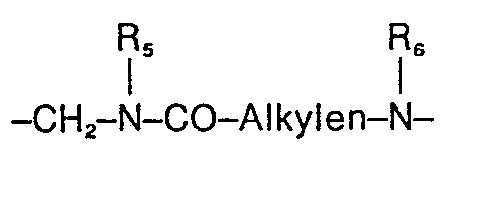
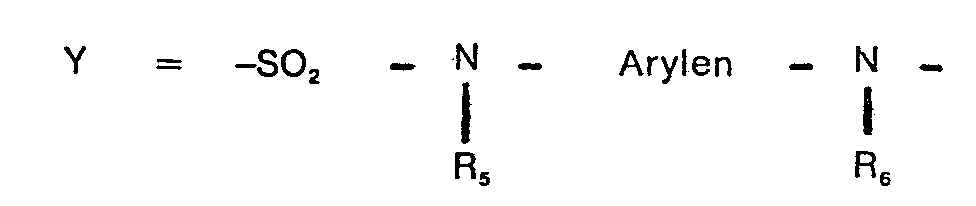
- Y für eines der folgenden Brückenglieder steht:


- Rs=H; gegebenenfalls durch OH, SO3H, OS03H, substituiertes C1-C4-Alkyl,
- R6=H; gegebenenfalls durch OH, S03H, OSO3H, substituiertes C1-C4-Alkyl,
- Alkylen = Alkylenreste oder Cycloalkylenreste mit 1 bis 6 Kohlenstoffatomen, welche gegebenenfalls durch O oder S unterbrochen sein können und welche gegebenenfalls durch OH, S03H, OSO3H substituiert sein können,
- Arylen = gegebenenfalls durch C1-C4-Alkyl, Halogen, S03H, COOH, C1-C4-Alkoxy substituierte 1,2-,1,3- oder 1,4-Phenylen-Reste.
- Beispiele für derartige Dioxazinsysteme sind:


- Ausser durch -Y-Z und SO3H können diese Ringsysfeme noch weiter substituiert sein, z.B. durch C1-C4-Alkyl, Aryl (insbesondere Phenyl und Naphthyl), C1-C4-Alkoxy, Aryloxy, Halogen, Nitro, Acylamino, Cyan, NH2, gegebenenfalls substituiertes C1-C4-Alkylamino, gegebenenfalls substituiertes Arylamino, SO2NH2, SO2-NH-Alkyl oder SO2N (Alkyl)2. Als Substituenten für C1-C4-Alkyl- amino und Arylamino kommen vorzugsweise in Frage: OH, S03H, COOH, Halogen. Die Alkylreste in SO2-NH-Alkyl und S02N (Alkyl)2 besitzen vorzugsweise 1 bis 4 Kohlenstoffatome.
- Geeignete Alkylenreste sind zum Beispiel Methylen, Ethylen, 1,2- und 1,3-Propylen, 1,2-, 1,3-, 1,4- und 2,3-Butylen, 2-Methyl-1,3-propylen, 2,2,-Dimethylpropylen, 1,5-Pentylen, 1,6-Hexylen, 1,3-Cyclohexylen, 1,4-Cyclohexylen, 2-Hydroxy-1,3-propylen, -CH2-CH2-O-CH2-CH2- und -CH2-CH2-S-CH2-CH2;
- Geeignete Arylenreste sind beispielsweise gegebenenfalls durch
- C1-C4-Alkyl, Halogen, S03H, COOH,
- C2-C4-Alkoxy substituierte
- 1,2-, 1,3- oder 1,4-Phenylen-Reste,
- wie z. B.
- 1,2-, 1,3-, 1,4-Phenylen,
- 3-Methyl-1,2-phenylen,
- 4-Methyl-1,2-phenylen,
- 2-Methyl-1,3-phenylen,
- 4-Methyl-1,3-phenylen,
- 2-Methyl-1,4-phenylen,
- 4-Chlor-1,3-phenylen,
- 2-Chlor-1,4-phenylen,
- 4-Sulfo-1,3-phenylen,
- 4-Sulfo-1,2-phenylen,
- 2-Sulfo-1,4-phenylen,
- 2,5-Disulfo-1,4-phenylen,
- 2-Carboxy-1,4-phenylen,
- 4-Carboxy-1,3-phenylen,
- 4-Methoxy-1,3-phenylen,
- 2-Methoxy-1,4-phenylen.
- Beispiele für reaktive heterocyclische Reste sind:
- 2,3-Dichlorchinoxalin-6- oder 7-carbonyl,
- 2,3-Dichlorchinoxalin-6- oder -7-sulfonyl,
- 1,4-Dichlorphthalazin-6-carbonyl,
- 1,4-Dichlorphthalazin-6-sulfonyl,
- 2,4-Dichlorchinazolin-6- oder -7-sulfonyl,
- 2,4-Dichlorchinazolin-6-carbonyl,
- 2,4,6-Trichlorchinazolin-7- oder -8-sulfonyl,
- 4,5-Dichlor-6-pyridazon-1-yl,
- 4-(4',5'-Dichlor-6-pyridazon-1-yl)-benzoyl,
- 4-(4',5'-Dichlor-6-pyridazon-1-yl)-phenylsulfonyl,
- 2,4,5-Trichlorpyrimidin-6-yl,
- 2,4-Dichlor-5-cyanpyrimidin-6-yl,
- 2,4-Dichlor-pyrimidinyl-5-carbonyl,
- 2-Methyl-sulfonyl-5-chlor-6-methylpyrimidin-4-yl,
- 2-Fluor-5-chlor-6-methylpyrimidin-4-yl,
- 2,4-Difluor-5-chlorpyrimidin-6-yl,
- 2,4-Difluor-pyrimidin-6-yl,
- 2,4-Difluor-pyrimidin-6-yl,
- 2-Fluor-4,5-dichlor-pyrimidin-6-yl,
- 3,5,6-Trifluorpyridazin-4-yl,
- 3,4,5-Trifluorpyridazin-6-yl,
- 3,6-Dichlorpyridazin-5-carbonyl,
- 2,4-Dichlor-s-triazinyl,
- 2,4-Dibrom-s-triazinyl,
- 2-Chlor-4-amino-s-triazinyl,
- 2-Fluor-4-amino-s-triazinyl,
- 2-Chlor-4-methoxy-s-triazinyl,
- 2-Fluor-4-methoxy-s-triazinyl,
- 2-Chlor-4-ß-methoxy-ethoxy-s-triazinyl,
- 2-Fluor-4-β-methoxy-ethoxy-s-triazinyl,
- 2-Chlor-4-phenyl-s-triazinyl,
- 2-Chlor-4-phenylamino-s-triazinyl,
- 2-Fluor-4-phenylamino-s-triazinyl,
- 2-Chlor-4-methyl- und -4-dimethylamino-s-triazinyl,
- 2-Fluor-4-methyl- und -4-dimethylamino-s-triazinyl,
- 2-Fluor-4-diethylamino-s-triazinyl,
- 2-Chlor-4-ß-hydroxyethylamino-s-triazinyl,
- 2-Chlor-4-ß-sulfatoethylamino-s-triazinyl,
- 2-Chlor-4-β-sulfoethylamino-s-triazinyl,
- 2-Chlor-4-phenoxy-s-triazinyl,
- 2-Chlor-4-(2'-, 3'- oder
- 4'-sulfophenylamino)-s-triazinyl,
- 2-Fluor-4-(2'-, 3'- oder
- 4'-sulfophenylamino)-s-triazinyl,
- 2-Chlor-(2',4'-, 2',5'-, 3',5'- oder
- 3',4'-disulfophenylamino)-s-triazinyl,
- 2-Fluor-4-(2',4'-, 2',5-, 3',5- oder
- 3',4'-disulfophenylamino)-s-triazinyl,
- 2-Chlor-4-(2'-,3'- oder
- 4'-carboxyphenylamino-)-s-triazinyl,
- 2-Fluor-4-(2'-, 3'- oder
- 4'-carboxyphenylamino)-s-triazinyl,
- 2-Fluor-4-(2',4'-dicarboxyphenylamino)-s-triazinyl,
- 2-Chlor-4-(2'-carboxy-4'- oder
- 5'-sulfophenyl-amino)-s-triazinyl,
- 2-Fluor-4-(2'-carboxy-4'- oder
- 5'-sulfophenyl-amino)-s-triazinyl,
- 2-Fluor-4-(2'-methyl-4',5'-disulfophenyl-
- amino)-s-triazinyl,
- 2-Chlor-4-(1',5'-, 2',6'-, 4',8'-, 5',7'- oder
- 6',8'-disulfo-2'-naphthylamino)-s-triazinyl,
- 2-Fluor-4-(1',5'-, 2',6'-, 4',8'-, 5',7'- oder
- 6',8'-disulfo-2'-naphthylamino)-s-triazinyl,
- 2-Chlor-4-(2',4'-, 3',7'-, 3',8'-, 4',8'-,
- 5',7'- oder 6',8'-disulfo-1'-naphthyl-
- amino)-s-triazinyl,
- 2-Fluor-4-(2',4'-, 3',7'-, 3',8'-,
- 4',8'-, 5',7'- oder 6',8'-disulfo-
- 1'-naphthylamino)-s-triazinyl,
- 2-Chlor-4-(1',5',7'- oder 3',6',8'-tri-
- sulfo-2'-naphthylamino)-s-triazinyl,
- 2-Fluor-4-(1',5',7'- oder 3',6',8'-tri-
- sulfo-2'-naphthylamino)-s-triazinyl,
- 2-Chlor-4-(3',5',7'- oder
- 3',6',8'-trisulfo-1'-naphthylamino)-s-triazinyl.
- Hiermit ist die Reihe der Halogen-s-triazinyl-Reste nicht begrenzt. So können in den 2-Halogen-4-alkylamino- oder -4-arylamino-s-triazinyl-Resten und in den 2-Halogen-4-alkoxy- oder 4-aroxy-s-triazinyl-Resten die Alkyl- oder Arlygruppen weiter substituiert sein.
- Weiterhin können die reaktiven Halogenatome in den oben genannten 2-Halogen-4-substituierten-triazinyl-Resten unter Bildung quartärer Salze noch gegen tertiäre Basen wie Trimethylamin, Triethylamin, Dimethyl-ß-hydroxyethylamin, Triethanolamin, N,N-Dimethylhydrazin, Pyridin, a-,y-Picolin, Nicotinsäure oder Isonicotinsäure ausgetauscht werden.
- Bevorzugte Farbstoffe sind solche der Formeln:


- m=1-2
- n=0-2
- Dioxazinsysteme wie III-XI können durch Kondensation von gegebenenfalls entsprechend substituierten 2,5-Dihalogen-1,4-benzochinonen mit aromatischen oder aromatisch-heterocytlischen Aminkomponenten oder auch durch Addition von aromatischen Aminen an substituierte 1,4-Benzochinone und anschliessenden oxidativen oder kondensativen Ringschluss gewonnen werden, dies geschieht nach bekannten Methoden, wie sie vielfach in der Literatur beschrieben sind (K. Venkataraman «The Chemistry of Synthetic Dyes» Vol. 11, S. 786, Vol. V, S. 419).
- In der genannten Ringsysteme wird das Brükkenglied

- durch Kondensation mit N-Methylolamiden

- Nach anschliessender oder vorheriger Sulfonierung in konzentrierter Schwefelsäure, Oleum, Chlorsulfonsäure, Schwefeltrioxid-Pyridin, Schwefeltrixoid in aliphatischen oderaromatischen Chlorkohlenwasserstoffen, Schwefeltrixoid-Dimethylformamid und Bildung der Verbindungen

- D, Rs, R7, Alkylen, m und n die oben angegebene Bedeutung haben,
- mittels Aminen R6-NH2 ein Austausch von R7 gegen NHR6 zu Verbindungen der Formel

- D, Rs, R6, Alkylen, m und n die angegebene Bedeutung haben,
- Die Sulfamid-Brückenglieder werden eingeführt durch Sulfochlorierung der obengenannten Ringsysteme beispielsweise mit Chlorsulfonsäure oder Chlorsulfonsäure-Thionylchlorid bei 20-120°, anschliessende Kondensation der Sulfonsäurechloride mit aliphatischen Diaminen oder aromatischen Diaminen der Formeln


- R5, R6, Alkylen und Arylen die angegebene Bedeutung haben,
- Acyl z.B. für Formyl, Acetyl, Oxalyl steht, und der anschliessenden Verseifung etwa vorhandener überschüssiger Sulfochloridgruppen und der Acylaminogruppen in verdünnten Alkalien oder Mineralsäuren.
- Eine spezielle Variante zur Herstellung von Zwischenprodukten der Formel


- D, R5, R6, Arylen und Alkylen die oben angegebene Bedeutung haben und
- p = 0-2 ist, besteht in der Kondensation von Polyhalogen-1,4-benzochinonen mit Verbindungen der Formel


- R8=C2-C6-Alkyl oder Cycloalkyl, gegebenenfalls substituiert durch OH, OCH3, OSO3H, SO3H, Halogen,
- R5, R6, Alkylen, Arylen die oben angegebene Bedeutung haben und mindestens einer der Reste Alkylen, Arylen oder Rs, R6, R8 eine wasserlöslichmachende Gruppe SO3H oder OSO3H enthalten muss,
-
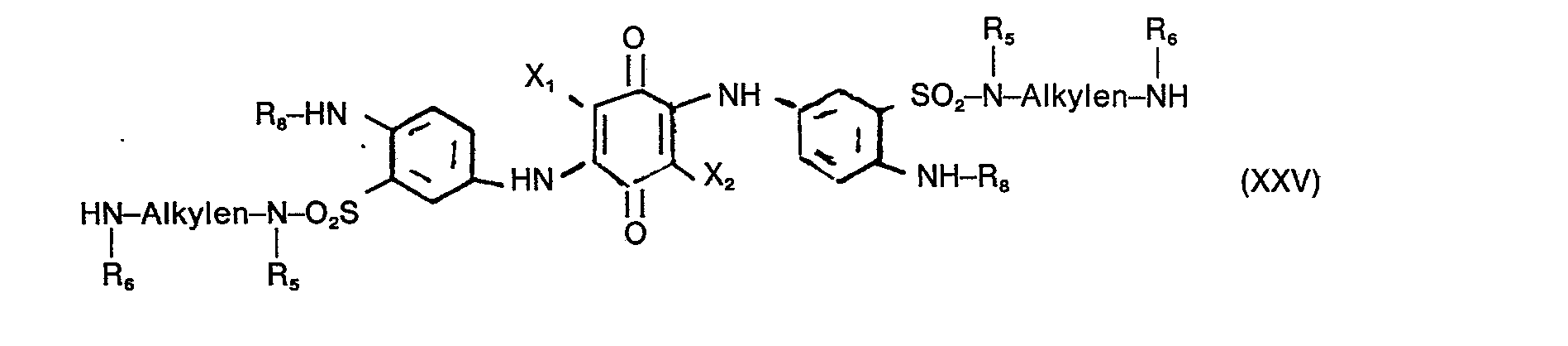

- R5, R6, R8, Alkylen, Arylen, X, und X2 die oben angegebene Bedeutung haben
und einem anschliessenden oxydativen Ringschluss der Zwischenprodukte XXV und XXVI zu den entsprechend substituierten Dioxazinverbindungen der Formel

- Die in allen Fällen erhaltenen Zwischenprodukte der Formel

- D, Y m und n die oben angegebene Bedeutung haben und H für Wasserstoff steht und die ebenfalls Gegenstand der Erfindung sind,
werden mit den Reaktivkomponenten
- Z die oben angegebene Bedeutung hat und Halogen F, CI oder Br ist
- Die neuen Farbstoffe sind äussert wertvolle Produkte die sich für verschiedenste Anwendungszwecke eignen. Als wasserlösliche Verbindungen finden sie bevorzugtes Interesse für das Färben hydroxylgruppenhaltiger und amidgruppenhaltiger Textilmaterialien, insbesondere von Textilmaterialien aus nativer und regenerierter Cellulose, ferner aus Wolle, Seide, synthetischen Polyamid- und Polyurethanfasern.
- Die genannten Materialien werden nach den für Reaktivfarbstoffe üblichen Verfahren gefärbt oder bedruckt. Man erhält licht- und nassechte, rote, violette und blaue Färbungen und Drucke.
- Bei Temperaturangaben in den Beispielen handelt es sich um °C. Die Formeln der Farbstoffe in der Beschreibung und den Beispielen sind die der freien Säuren. Die Farbstoffe werden im allgemeinen in Form ihrer Alkalisalze, insbesondere der Natrium- oder Kaliumsalze, isoliert und angewandt.
- 17 g Zwischenprodukt der Formel

- Das erhaltene Produkt wird in 450 ml Wasser bei pH 9,5 gelöst.
- 11,6 g 2-Aminobenzol-1,4-disulfonsäure werden in 60 ml Wasser bei pH 5 gelöst. Nach Abkühlen auf 0-5° tropft man 4,3 ml Cyanurfluorid zu und hält den pH-Wert mit 2n Soda auf 4,5-5,0. Die erhaltene Lösung der Reaktivkomponente wird bei 0-5° zu der oben hergestellten Lösung der Farbstoffkomponente getropft und der pH-Wert mit 2n Natronlauge auf 8-8,5 gehalten.
- Nach beendeter Umsetzung wird die Lösung auf 20° erwärmt und der Farbstoff mit 22% Natriumchlorid ausgesalzen. Man saugt die Fällung ab und trocknet sie unter Zusatz von Phosphatpuffer bei 40° im Vakuum.
- Der erhaltene Farbstoff entspricht der Formel

- In 90 ml 93%ige Schwefelsäure werden 9,1 Teile N-Methylolchloracetamid bei 0-5° eingetragen. Man trägt anschliessend 20,6 g einer Verbindung der Formel

- 21 g des erhaltenen Kondensationsproduktes werden in eine Mischung von 42 ml 96%iger Schwefelsäure und 72 ml 20%igem Oleum bei 15-20° eingetragen. Man lässt 15 Stunden bei 15-20° rühren, gibt die Lösung auf 900 g Eis, saugt ab und wäscht den Filterkuchen mit 500 ml 5%iger Salzsäure.
- 15,0 g der Dioxazinverbindung

- Man trägt nun 5,5 g N-Methylolchloracetamid ein und rührt 48 Stunden bei 20° nach. Nach beendeter Umsetzung wird auf Eis ausgetragen, das Produkt abgesaugt und mit verdünnter Salzsäure gewaschen. Der feuchte Kuchen wird nun in 250 ml Wasser und 50 ml 30%iger Methylaminlösung auf 45-50° erwärmt, bis der Chloraustausch beendet ist.
- Das erhaltene Produkt der Formel

- Das erhaltene Produkt wird bei pH 9,5 in 450 ml Wasser gelöst. Man lässt eine Lösung von 2-(4',6'-Dichlor-s-triazinylamino)-benzol-1,4-disulfonsäure zutropfen, die in 80 ml Wasser durch Kondensation bei pH 5 und 20°C aus 10,8 g 2-Aminobenzol-1,4-disulfonsäure und 7,9 g Cyanurchlorid hergestellt war, und hält bei 20° den pH-Wert im Reaktionsgemisch auf 7,5-8,5. Nach beendeter Umsetzung salzt man den Farbstoff mit 20% Natriumchlorid aus, saugt ihn ab und wäscht ihn mit Natriumchloridlösung.
- Das Produkt der Formel

- Kondensiert man in Fortführung der vorangegangenen Beispiele die analog hergestellten Dioxazin-Farbbasen der Spalte 11, Tabelle 1 mit 1 bzw. 2 Molen der in Spalte III aufgeführten Reaktivkomponenten, so erhält man zum reaktiven Färben und Bedrucken von Cellulosematerialien geeignete Farbstoffe, welche die Farbtöne der Spalte IV ergeben.
- Siehe dazu die nachfolgende Tabelle 1.


- 16,0 g Dioxazin-Verbindung der Formel

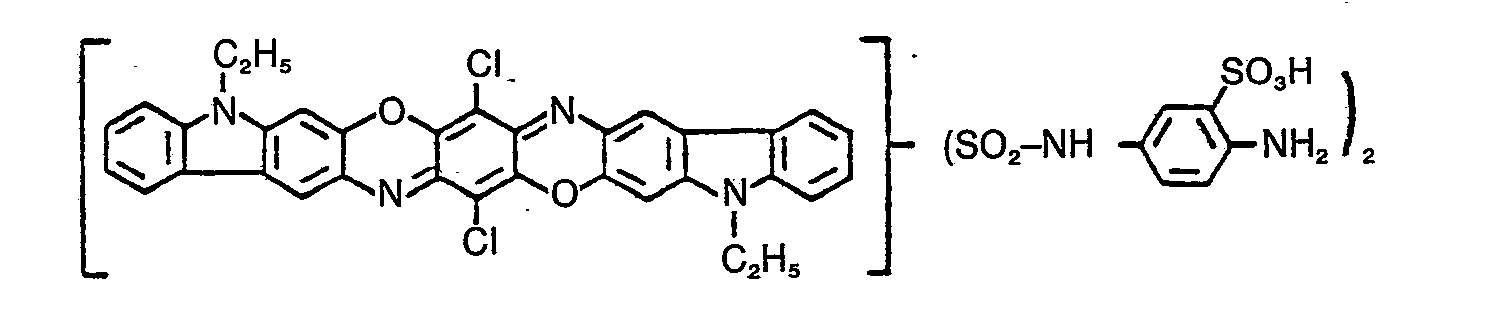
- 14,0 g Zwischenprodukt des Beispiels 4 werden in 200 ml Wasser und 100 ml N-Methylpyrrolidon gelöst. Nach Abkühlung der Lösung auf 0-5° lässt man 2,8 ml Cyanurfluorid in 5-10 Minuten zutropfen und hält den pH-Wert mit 2n Sodalösung auf 4,5-5,0. Nach beendeter Kondensation setzt man eine neutralisierte Lösung von 6,9 g 3-Aminobenzolsulfonsäure in 70 ml Wasser zu und hält anschliessend den pH-Wert mit 2n Sodalösung auf 6,0-6,2. Ist die Kondensation nach mehrstündigem Nachrühren beendet, wird der Ansatz auf 20° erwärmt. Man salzt den Farbstoff mit 185 g Natriumchlorid aus, saugt die Fällung ab und wäscht den Kuchen mit 650 ml 15%iger Natriumchloridlösung. Das Produkt wird mit Phosphatpuffer angeteigt und im Vakuum bei 40° getrocknet.
- Es entspricht der Formel

- 16,0 g Dioxazinverbindung der Formel

- 15,0 g des erhaltenen Zwischenproduktes werden in 300 ml Wasser gelöst. Man lässt bei 10° eine Lösung von 3,6 g Cyanurchlorid in 50 ml Aceton zutropfen und hält den pH-Wert im Raktionsgemisch auf 5,5. Nach beendeter Kondensation setzt man eine Lösung von 3,4 g 3-Aminobenzolsulfonsäure zu und erwärmt das Reaktionsgemisch auf 35-40°. Dabei wird der pH-Wert auf 6,0-6,5 gehalten. Ist die Umsetzung nach mehreren Stunden beendet, wird der Farbstoff mit Natriumchlorid ausgesalzen, gewaschen und getrocknet. Er entspricht der ungefähren Formel

- Setzt man das im Beispiel 6 hergestellte Zwischenprodukt statt mit Cyanurchlorid mit Cyanurfluorid um und kondensiert anschliessend mit 3-Aminobenzolsulfonsäure wie im Beispiel 75 beschrieben, so erhält man einen ähnlichen Farbstoff der annähernden Formel

- 16,0 g Dioxazinverbindung der Formel

- 10,5 g des aufgearbeiteten und getrockneten Produktes der Formel
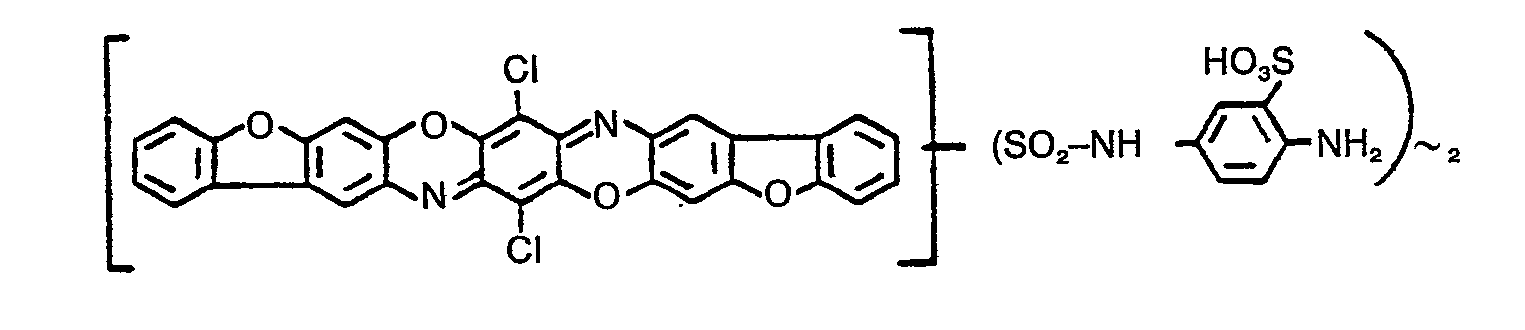
- Der gefällte Farbstoff wird abgesaugt, mit gesättigter Natriumchloridlösung gewaschen und im Vakuum bei 40°C getrocknet.
- Mit dem erhaltenen Farbstoff der Zusammensetzung
-

- 1 15,0g Dioxazinverbindung

- Man trägt den erhaltenen Filterkuchen des Bissulfochlorids in eine neutralisierte Lösung von 16,0 g 2,5-Diaminobenzolsulfonsäure in 300 ml Wasser ein und hält den pH-Wert mit Sodalösung auf 7,5. Nach 3 Stunden erwärmt man das Reaktionsprodukt auf 60°C, hält 5 Stunden bei dieser Temperatur und setzt dann 30 ml Pyridin zu und erwärmt auf 80 °C.
- Nach beendeter Umsetzung wird das Reaktionsprodukt durch Aussalzen isoliert, abgesaugt und getrocknet. 24,0 g des erhaltenen Produktes werden in 750 ml Wasser gelöst. Man lässt bei 0-5 °C 5,1 ml Cyanurfluorid zutropfen und hält den pH-Wert mit 2n Sodalösung auf 5,0-5,5. Man rührt zur Beendigung der Kondensation 30 Minuten bei 0-5 °C nach und setzt anschliessend eine neutrale Lösung von 12,0 g 3-Aminobenzolsulfonsäure in 150 ml Wasser bei 0-5 °C zu und hält den pH-Wert mit Sodalösung auf 6,0-6,2. Ist die Umsetzung beendet, erwärmt man unter pH-Kontrolle auf 20°C und salzt den Farbstoff mit 20% Natriumchlorid aus, saugt ab und wäscht ihn mit gesättigter Natriumchloridlösung.
- Der Filterkuchen wird mit Phosphatpuffer angeteigt und im Vakuum bei 40°C getrocknet.
- Der Farbstoff entspricht annähernd der Formel

- Mit ihm lässt sich Baumwolle in nassechten roten Tönen bedrucken oder färben.
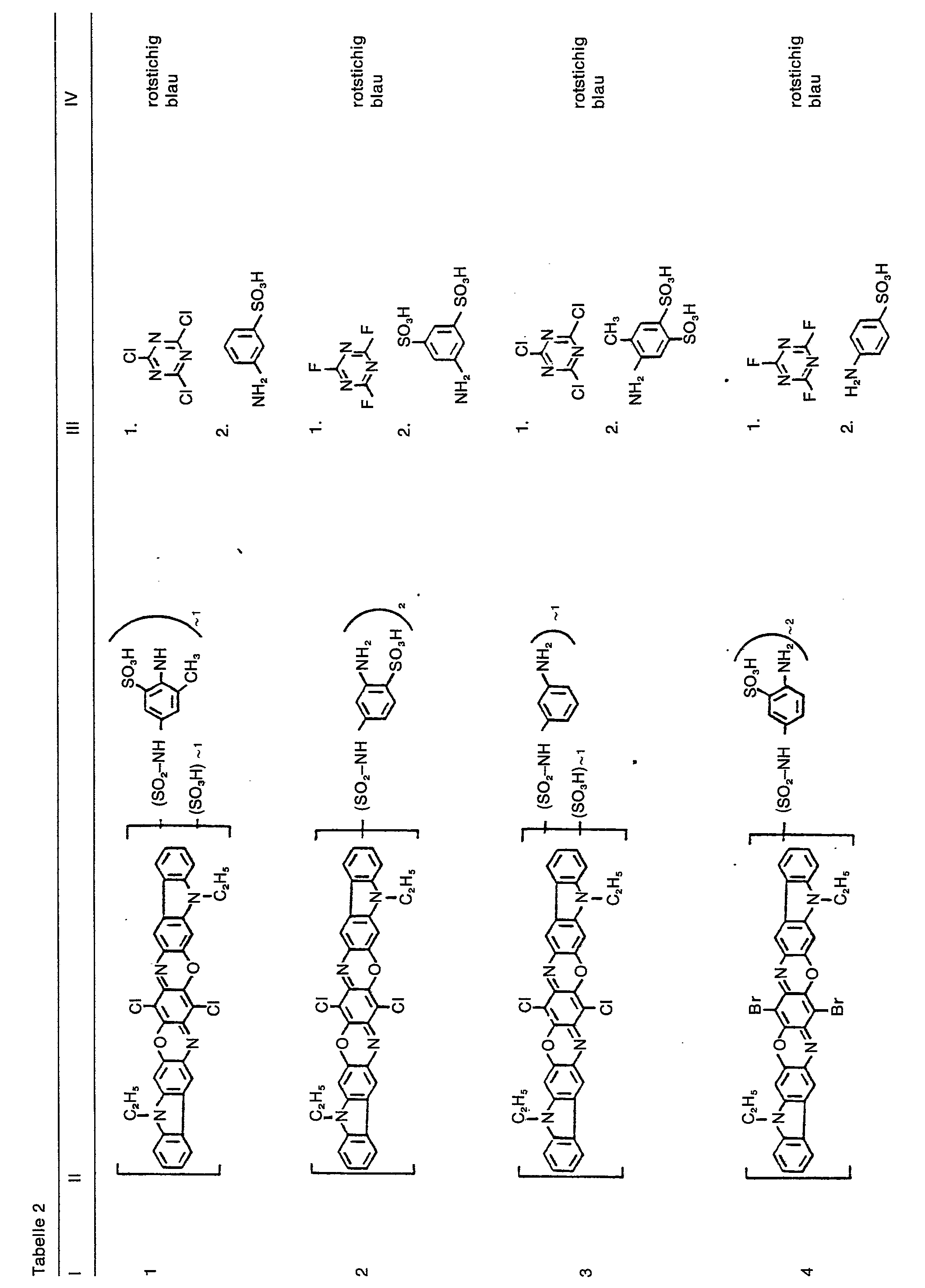
- Kondensiert man an Stelle der Farbstoff-Zwischenprodukte der Beispiele 4-9 die in Tabelle 2 Spalte II aufgeführten Verbindungen mit den Reaktivkomponenten der Spalte 111, so erhält man Farbstoffe, mit denen sich Cellulosematerialien nach den für Reaktivfarbstoffe üblichen Techniken in den angegebenen Tönen färben oder bedrukken lassen.
- Siehe dazu die nachfolgende Tabelle 2.


- A. 16,0 g Dioxazin-Zwischenprodukt der Formel


- B. Das eingesetzte Dioxazin-Zwischenprodukt wird folgendermassen hergestellt:
- 34,6 g 5-Amino-2-ß-hydroxyethylamino-benzolsulfonsäure-(4'-amino-3'-sulfo-phenylamid) werden in 250 ml Wasser bei pH 6 gelöst. Man erwärmt auf 45-50° und gibt eine Suspension von 10,5 g 2,3,5,6-Tetrachlorbenzochinon in 30 ml Ethanol zu der Lösung. Durch Zutropfen von 2n Sodalösung wird der pH-Wert auf 6,0-6,3 gehalten.
- . Nach einigen Stunden ist die Kondensation beendet. Der angefallene braune Niederschlag wird abgesaugt, mit 5%iger Natriumchloridlösung gewaschen und getrocknet.
- C. 31,0 g des unter B erhaltenen Kondensationsproduktes werden bei 15-20° in 150 ml 20%iger Oleum eingetragen. Man rührt kurze Zeit nach, bis alles gelöst ist und trägt nun innerhalb 20 Minuten 15,3 g Kaliumperoxidisulfat (K2S308) ein. Dabei hält man die Temperatur durch gelegentliche, leichte Kühlung auf 20-25°. Nach beendetem Ringschluss wird die Lösung auf 750 g Eis gegeben. Aus der blauen Lösung salzt man das Dioxazin-Zwischenprodukt durch Zusatz von 125 g Kaliumchlorid aus, vervollständigt die Abscheidung durch mehrstündiges Nachrühren, saugt ab und wäscht den Filterkuchen mit 25%iger Kaliumchloridlösung sulfatfrei. Der Filterkuchen wird im Umluftschrank bei 60° getrocknet.
- Ersetzt man in Beispiel 10 das Cyanurfluorid durch 5,4 g Cyanurchlorid und verfährt in übrigen analog, so erhält man einen blauen Farbstoff, der auf Cellulosegewebe ebenfalls nassechte Drucke und Färbungen liefert.
- 15,0 g Dioxazin-Zwischenprodukt der Formel

-

- 17,0 g Dioxazin-Zwischenprodukt der Formel (hergestellt analog Beispiel 10 B-C).


- Setzt man die in Tabelle 3, 2. Spalte, aufgeführten Dioxazinkomponenten mit den Reaktionskomponenten der Spalte 3 um, so erhält man weitere Reaktivfarbstoffe, welche auf Cellulosefasern nassechte, klare, blaue Färbungen und Drucke ergeben.


durchgeführt werden.
in wässrigem, wässrig-organischem oder organischem Medium und anschliessende Verseifung etwa vorhandener überschüssiger Sulfochloridgruppen in alkalischem Medium. Im Falle der aliphatischen und aromatischen Diamine besteht eine Variante in der Kondensation der Sulfochloride mit den Monoacylaminen


oder in der Addition von Verbindungen der Formel (XXIII) oder (XXIV) an gegebenenfalls substituierte 1,4-Benzochinone zu Zwischenprodukten der Formel
Claims (8)




Applications Claiming Priority (2)
| Application Number | Priority Date | Filing Date | Title |
|---|---|---|---|
| DE3045471 | 1980-12-02 | ||
| DE19803045471 DE3045471A1 (de) | 1980-12-02 | 1980-12-02 | Dioxazin-reaktivfarbstoffe, verfahren zu ihrer herstellung und ihre verwendung zum faerben und bedrucken von hydroxyl- oder amidgruppenhaltigen fasermaterialien |
Publications (3)
| Publication Number | Publication Date |
|---|---|
| EP0053743A2 EP0053743A2 (de) | 1982-06-16 |
| EP0053743A3 EP0053743A3 (en) | 1983-01-05 |
| EP0053743B1 true EP0053743B1 (de) | 1986-05-14 |
Family
ID=6118149
Family Applications (1)
| Application Number | Title | Priority Date | Filing Date |
|---|---|---|---|
| EP81109755A Expired EP0053743B1 (de) | 1980-12-02 | 1981-11-19 | Dioxazin-Reaktivfarbstoffe, Verfahren zu ihrer Herstellung und ihre Verwendung zum Färben und Bedrucken von hydroxyl- oder amidgruppenhaltigen Fasermaterialien |
Country Status (4)
| Country | Link |
|---|---|
| US (1) | US4400504A (de) |
| EP (1) | EP0053743B1 (de) |
| JP (1) | JPS57119955A (de) |
| DE (2) | DE3045471A1 (de) |
Families Citing this family (30)
| Publication number | Priority date | Publication date | Assignee | Title |
|---|---|---|---|---|
| DE3117956A1 (de) * | 1981-05-07 | 1982-11-25 | Basf Ag, 6700 Ludwigshafen | Kationische farbstoffe und deren verwendung zum faerben und bedrucken von papier |
| FR2515668A1 (fr) * | 1981-11-02 | 1983-05-06 | Sandoz Sa | Nouveaux composes dioxaziniques, leur preparation et leur utilisation comme pigments |
| EP0084718B1 (de) * | 1982-01-27 | 1986-04-16 | Imperial Chemical Industries Plc | Triphendioxazinfarbstoffe |
| JPS59145251A (ja) * | 1983-02-04 | 1984-08-20 | Sumitomo Chem Co Ltd | ジオキサジン化合物、その製造法およびそれを用いる繊維材料の染色方法 |
| DE3336362A1 (de) * | 1983-10-06 | 1985-04-18 | Bayer Ag, 5090 Leverkusen | Triphendioxazin-reaktivfarbstoffe |
| US4629788A (en) * | 1983-10-11 | 1986-12-16 | Bayer Aktiengesellschaft | Triphendioxazine reactive dyestuffs |
| DE3339923A1 (de) * | 1983-11-04 | 1985-05-15 | Bayer Ag, 5090 Leverkusen | Verfahren zur herstellung von triphendioxazinverbindungen |
| DE3344254A1 (de) * | 1983-12-07 | 1985-06-20 | Bayer Ag, 5090 Leverkusen | Triphendioxazinfarbstoffe |
| DE3439756A1 (de) * | 1984-02-11 | 1985-08-14 | Bayer Ag, 5090 Leverkusen | Triphendioxazin-vinylsulfon-farbstoffe |
| DE3409439A1 (de) * | 1984-03-15 | 1985-09-26 | Bayer Ag, 5090 Leverkusen | Triphendioxazinfarbstoffe |
| JPS60228571A (ja) * | 1984-04-05 | 1985-11-13 | バイエル・アクチエンゲゼルシヤフト | トリフエンジオキサジン染料 |
| DE3439755A1 (de) * | 1984-04-05 | 1985-10-17 | Bayer Ag, 5090 Leverkusen | Triphendioxazin-farbstoffe |
| DE3423581A1 (de) * | 1984-06-27 | 1986-01-09 | Bayer Ag, 5090 Leverkusen | Reaktivfarbstoffe |
| DE3426727A1 (de) * | 1984-07-20 | 1986-01-23 | Hoechst Ag, 6230 Frankfurt | Wasserloesliche triphendioxazin-verbindungen, verfahren zu ihrer herstellung und ihre verwendung als farbstoffe |
| FR2572382B1 (fr) * | 1984-10-25 | 1989-11-24 | Sandoz Sa | Nouveaux composes oxaziniques, leur preparation et leur utilisation comme colorants |
| DE3503564A1 (de) * | 1985-02-02 | 1986-08-07 | Bayer Ag, 5090 Leverkusen | Aminoalkylensulfon-triphendioxazin-farbstoffe |
| DE3510612A1 (de) * | 1985-03-23 | 1986-09-25 | Bayer Ag, 5090 Leverkusen | Triphendioxazin-farbstoffe |
| DE3520391A1 (de) * | 1985-06-07 | 1986-12-11 | Bayer Ag, 5090 Leverkusen | Reaktivfarbstoffe |
| DE3521358A1 (de) * | 1985-06-14 | 1986-12-18 | Bayer Ag, 5090 Leverkusen | Triphendioxazin-disulfimid-reaktivfarbstoffe |
| DE3625347A1 (de) * | 1985-09-19 | 1987-03-26 | Hoechst Ag | Wasserloesliche triphendioxazin-verbindungen, verfahren zu ihrer herstellung und ihre verwendung als farbstoffe |
| JPS62190258A (ja) * | 1986-02-17 | 1987-08-20 | Sumitomo Chem Co Ltd | ジオキサジン化合物およびそれを用いる染色または捺染法 |
| US5171852A (en) * | 1987-01-20 | 1992-12-15 | Imperial Chemical Industries Plc | Triphenodioxazine reactive dyes having sulphonate ester groups |
| DE3740978A1 (de) * | 1987-12-03 | 1989-06-15 | Basf Ag | Imidazolylmethylengruppen enthaltende triphendioxazin-farbstoffe und deren verwendung |
| DE4020422A1 (de) * | 1990-06-27 | 1992-01-02 | Basf Ag | Reaktivfarbstoffe mit einem triphendioxazin-chromophor |
| DE4101067A1 (de) * | 1991-01-16 | 1992-07-23 | Bayer Ag | Verfahren zur herstellung von reaktivfarbstoffen |
| FR2713234B1 (fr) * | 1993-12-06 | 1996-03-22 | Sandoz Sa | Nouveaux dérivés de la triphénodioxazine, leur préparation et leur utilisation comme pigments. |
| AT409144B (de) * | 1996-06-21 | 2002-05-27 | Chemiefaser Lenzing Ag | Verfahren zur behandlung von cellulosefasern und von gebilden aus diesen fasern |
| RU2174479C2 (ru) * | 1998-03-30 | 2001-10-10 | 15 Центральный научно-исследовательский испытательный институт Министерства обороны Российской Федерации им. Д.М. Карбышева | Моторное звено |
| CN101121827B (zh) * | 2006-08-09 | 2010-07-14 | 明德国际仓储贸易(上海)有限公司 | 具有硫烷基-s-三氮嗪反应基的反应性染料 |
| TW201105750A (en) | 2009-03-31 | 2011-02-16 | Solvay | Process for the preparation of easily dispersible violet pigment |
Family Cites Families (9)
| Publication number | Priority date | Publication date | Assignee | Title |
|---|---|---|---|---|
| DE1170898B (de) * | 1957-07-15 | 1964-05-27 | Bayer Ag | Verfahren zum Faerben und Bedrucken von Cellulosetextilmaterialien |
| FR1269613A (fr) * | 1959-08-08 | 1961-08-18 | Hoechst Ag | Procédé de réalisation de teintures et d'impressions solides au mouillé, sur matières cellulosiques |
| CH477534A (de) * | 1960-12-01 | 1969-08-31 | Hoechst Ag | Verfahren zur Herstellung von organischen Farbstoffen |
| GB1368158A (en) * | 1972-01-18 | 1974-09-25 | Ici Ltd | Reactive tripheno dioxazine dyestuffs |
| GB1384749A (en) * | 1972-09-06 | 1975-02-19 | Ici Ltd | Reactive dyestuffs |
| GB1450746A (en) * | 1974-01-31 | 1976-09-29 | Ici Ltd | Tripendioxazine dyestuffs |
| GB1477071A (en) * | 1975-01-13 | 1977-06-22 | Ici Ltd | Reactive dioxazine dyestuffs |
| JPS51133591A (en) * | 1976-04-15 | 1976-11-19 | Ici Ltd | Novel dyestuff * production thereof and dyeing method of cellulose and blended yarn fabric comprising said cellulose and polyester fiber |
| GB1559752A (en) * | 1977-07-12 | 1980-01-23 | Ici Ltd | Triphendioxazine dyestuffs |
-
1980
- 1980-12-02 DE DE19803045471 patent/DE3045471A1/de not_active Withdrawn
-
1981
- 1981-11-10 US US06/320,044 patent/US4400504A/en not_active Expired - Lifetime
- 1981-11-19 DE DE8181109755T patent/DE3174646D1/de not_active Expired
- 1981-11-19 EP EP81109755A patent/EP0053743B1/de not_active Expired
- 1981-12-02 JP JP56194345A patent/JPS57119955A/ja active Pending
Also Published As
| Publication number | Publication date |
|---|---|
| DE3045471A1 (de) | 1982-07-08 |
| EP0053743A2 (de) | 1982-06-16 |
| US4400504A (en) | 1983-08-23 |
| DE3174646D1 (en) | 1986-06-19 |
| JPS57119955A (en) | 1982-07-26 |
| EP0053743A3 (en) | 1983-01-05 |
Similar Documents
| Publication | Publication Date | Title |
|---|---|---|
| EP0053743A2 (de) | Dioxazin-Reaktivfarbstoffe, Verfahren zu ihrer Herstellung und ihre Verwendung zum Färben und Bedrucken von hydroxyl- oder amidgruppenhaltigen Fasermaterialien | |
| DE1245003C2 (de) | Verfahren zur Herstellung von Kuepenfarbstoffen | |
| EP0199036B1 (de) | Triphendioxazin-Farbstoffe | |
| EP0039306B1 (de) | Neue Azofarbstoffe, Verfahren zu deren Herstellung und deren Verwendung | |
| EP0158857B1 (de) | Reaktive Dichlorotriphendioxazinfarbstoffe | |
| DE2200107B2 (de) | Anthrachinonfarbstoffe, deren Herstellung und deren Verwendung | |
| EP0134033B1 (de) | Benzthiazinophenoxazin-Farbstoffe | |
| EP0299328B1 (de) | Reaktivfarbstoffe | |
| DE2455615A1 (de) | Reaktivfarbstoffe | |
| DE2529657A1 (de) | Fluessige farbstoffzubereitungen von faserreaktiven azofarbstoffen | |
| EP0204245B1 (de) | Reaktivfarbstoffe | |
| EP0024668B1 (de) | Reaktivfarbstoffe und deren Verwendung zum Färben und Bedrucken von hydroxylgruppen- und stickstoffhaltigen Materialien | |
| DE2822755C3 (de) | Neue wasserlösliche Anthrachinonfarbstoffe | |
| DE2840120C3 (de) | Anthrachinon-Azoverbindungen, Verfahren zu deren Herstellung und ihre Verwendung als Farbstoffe | |
| EP0158110B1 (de) | Triphendioxazinfarbstoffe | |
| DE1932647B2 (de) | Sulfonsäuregruppenhaltige Anthrachinonfarbstoffe, ihre Herstellung und Verwendung | |
| CH649571A5 (de) | Anthrachinon-azoverbindungen und ihre herstellung. | |
| EP0190603B1 (de) | Aminoalkylensulfon-triphendioxazin-Farbstoffe | |
| EP0205080B1 (de) | Triphendioxazin-disulfimid-Reaktivfarbstoffe | |
| EP0198350B1 (de) | Disazoreaktivfarbstoffe | |
| DE2337488B1 (de) | Verfahren zur Herstellung von reaktiven Xanthenfarbstoffen | |
| EP0741130B1 (de) | Verfahren zur Herstellung von Sulfonen | |
| EP0256331B1 (de) | N1-Substituierte 1H-Benzo-triazol-hydroxyethyl-sulfon-Verbindungen, Verfahren zu ihrer Herstellung und ihre Verwendung zur Herstellung von Farbstoffen | |
| EP0641841A1 (de) | Azo-Reaktivfarbstoffe | |
| EP0630947A1 (de) | Phenylazo- oder Naphthylazobenzole mit Thioethergruppen |
Legal Events
| Date | Code | Title | Description |
|---|---|---|---|
| PUAI | Public reference made under article 153(3) epc to a published international application that has entered the european phase |
Free format text: ORIGINAL CODE: 0009012 |
|
| 17P | Request for examination filed |
Effective date: 19811119 |
|
| AK | Designated contracting states |
Designated state(s): CH DE FR GB |
|
| PUAL | Search report despatched |
Free format text: ORIGINAL CODE: 0009013 |
|
| AK | Designated contracting states |
Designated state(s): CH DE FR GB LI |
|
| GRAA | (expected) grant |
Free format text: ORIGINAL CODE: 0009210 |
|
| AK | Designated contracting states |
Kind code of ref document: B1 Designated state(s): CH DE FR GB LI |
|
| REF | Corresponds to: |
Ref document number: 3174646 Country of ref document: DE Date of ref document: 19860619 |
|
| ET | Fr: translation filed | ||
| PLBE | No opposition filed within time limit |
Free format text: ORIGINAL CODE: 0009261 |
|
| STAA | Information on the status of an ep patent application or granted ep patent |
Free format text: STATUS: NO OPPOSITION FILED WITHIN TIME LIMIT |
|
| 26N | No opposition filed | ||
| PGFP | Annual fee paid to national office [announced via postgrant information from national office to epo] |
Ref country code: DE Payment date: 19951012 Year of fee payment: 15 |
|
| PGFP | Annual fee paid to national office [announced via postgrant information from national office to epo] |
Ref country code: CH Payment date: 19951027 Year of fee payment: 15 |
|
| PGFP | Annual fee paid to national office [announced via postgrant information from national office to epo] |
Ref country code: GB Payment date: 19951110 Year of fee payment: 15 |
|
| PGFP | Annual fee paid to national office [announced via postgrant information from national office to epo] |
Ref country code: FR Payment date: 19951115 Year of fee payment: 15 |
|
| PG25 | Lapsed in a contracting state [announced via postgrant information from national office to epo] |
Ref country code: GB Effective date: 19961119 |
|
| PG25 | Lapsed in a contracting state [announced via postgrant information from national office to epo] |
Ref country code: LI Effective date: 19961130 Ref country code: CH Effective date: 19961130 |
|
| GBPC | Gb: european patent ceased through non-payment of renewal fee |
Effective date: 19961119 |
|
| REG | Reference to a national code |
Ref country code: CH Ref legal event code: PL |
|
| PG25 | Lapsed in a contracting state [announced via postgrant information from national office to epo] |
Ref country code: FR Effective date: 19970731 |
|
| PG25 | Lapsed in a contracting state [announced via postgrant information from national office to epo] |
Ref country code: DE Effective date: 19970801 |
|
| REG | Reference to a national code |
Ref country code: FR Ref legal event code: ST |