EP0681116A2 - Verfahren zur Herstgellung von Scheibenbremsbelägen - Google Patents
Verfahren zur Herstgellung von Scheibenbremsbelägen Download PDFInfo
- Publication number
- EP0681116A2 EP0681116A2 EP95105505A EP95105505A EP0681116A2 EP 0681116 A2 EP0681116 A2 EP 0681116A2 EP 95105505 A EP95105505 A EP 95105505A EP 95105505 A EP95105505 A EP 95105505A EP 0681116 A2 EP0681116 A2 EP 0681116A2
- Authority
- EP
- European Patent Office
- Prior art keywords
- bonding layer
- back plate
- friction member
- brake pad
- disk brake
- Prior art date
- Legal status (The legal status is an assumption and is not a legal conclusion. Google has not performed a legal analysis and makes no representation as to the accuracy of the status listed.)
- Granted
Links
Images
Classifications
-
- F—MECHANICAL ENGINEERING; LIGHTING; HEATING; WEAPONS; BLASTING
- F16—ENGINEERING ELEMENTS AND UNITS; GENERAL MEASURES FOR PRODUCING AND MAINTAINING EFFECTIVE FUNCTIONING OF MACHINES OR INSTALLATIONS; THERMAL INSULATION IN GENERAL
- F16D—COUPLINGS FOR TRANSMITTING ROTATION; CLUTCHES; BRAKES
- F16D69/00—Friction linings; Attachment thereof; Selection of coacting friction substances or surfaces
- F16D69/02—Composition of linings ; Methods of manufacturing
- F16D69/025—Compositions based on an organic binder
- F16D69/026—Compositions based on an organic binder containing fibres
-
- B—PERFORMING OPERATIONS; TRANSPORTING
- B29—WORKING OF PLASTICS; WORKING OF SUBSTANCES IN A PLASTIC STATE IN GENERAL
- B29C—SHAPING OR JOINING OF PLASTICS; SHAPING OF MATERIAL IN A PLASTIC STATE, NOT OTHERWISE PROVIDED FOR; AFTER-TREATMENT OF THE SHAPED PRODUCTS, e.g. REPAIRING
- B29C43/00—Compression moulding, i.e. applying external pressure to flow the moulding material; Apparatus therefor
- B29C43/02—Compression moulding, i.e. applying external pressure to flow the moulding material; Apparatus therefor of articles of definite length, i.e. discrete articles
-
- C—CHEMISTRY; METALLURGY
- C08—ORGANIC MACROMOLECULAR COMPOUNDS; THEIR PREPARATION OR CHEMICAL WORKING-UP; COMPOSITIONS BASED THEREON
- C08J—WORKING-UP; GENERAL PROCESSES OF COMPOUNDING; AFTER-TREATMENT NOT COVERED BY SUBCLASSES C08B, C08C, C08F, C08G or C08H
- C08J5/00—Manufacture of articles or shaped materials containing macromolecular substances
-
- F—MECHANICAL ENGINEERING; LIGHTING; HEATING; WEAPONS; BLASTING
- F16—ENGINEERING ELEMENTS AND UNITS; GENERAL MEASURES FOR PRODUCING AND MAINTAINING EFFECTIVE FUNCTIONING OF MACHINES OR INSTALLATIONS; THERMAL INSULATION IN GENERAL
- F16D—COUPLINGS FOR TRANSMITTING ROTATION; CLUTCHES; BRAKES
- F16D69/00—Friction linings; Attachment thereof; Selection of coacting friction substances or surfaces
- F16D69/02—Composition of linings ; Methods of manufacturing
-
- F—MECHANICAL ENGINEERING; LIGHTING; HEATING; WEAPONS; BLASTING
- F16—ENGINEERING ELEMENTS AND UNITS; GENERAL MEASURES FOR PRODUCING AND MAINTAINING EFFECTIVE FUNCTIONING OF MACHINES OR INSTALLATIONS; THERMAL INSULATION IN GENERAL
- F16D—COUPLINGS FOR TRANSMITTING ROTATION; CLUTCHES; BRAKES
- F16D69/00—Friction linings; Attachment thereof; Selection of coacting friction substances or surfaces
- F16D69/04—Attachment of linings
-
- F—MECHANICAL ENGINEERING; LIGHTING; HEATING; WEAPONS; BLASTING
- F16—ENGINEERING ELEMENTS AND UNITS; GENERAL MEASURES FOR PRODUCING AND MAINTAINING EFFECTIVE FUNCTIONING OF MACHINES OR INSTALLATIONS; THERMAL INSULATION IN GENERAL
- F16D—COUPLINGS FOR TRANSMITTING ROTATION; CLUTCHES; BRAKES
- F16D69/00—Friction linings; Attachment thereof; Selection of coacting friction substances or surfaces
- F16D2069/002—Combination of different friction materials
-
- F—MECHANICAL ENGINEERING; LIGHTING; HEATING; WEAPONS; BLASTING
- F16—ENGINEERING ELEMENTS AND UNITS; GENERAL MEASURES FOR PRODUCING AND MAINTAINING EFFECTIVE FUNCTIONING OF MACHINES OR INSTALLATIONS; THERMAL INSULATION IN GENERAL
- F16D—COUPLINGS FOR TRANSMITTING ROTATION; CLUTCHES; BRAKES
- F16D69/00—Friction linings; Attachment thereof; Selection of coacting friction substances or surfaces
- F16D2069/005—Friction linings; Attachment thereof; Selection of coacting friction substances or surfaces having a layered structure
-
- F—MECHANICAL ENGINEERING; LIGHTING; HEATING; WEAPONS; BLASTING
- F16—ENGINEERING ELEMENTS AND UNITS; GENERAL MEASURES FOR PRODUCING AND MAINTAINING EFFECTIVE FUNCTIONING OF MACHINES OR INSTALLATIONS; THERMAL INSULATION IN GENERAL
- F16D—COUPLINGS FOR TRANSMITTING ROTATION; CLUTCHES; BRAKES
- F16D69/00—Friction linings; Attachment thereof; Selection of coacting friction substances or surfaces
- F16D2069/005—Friction linings; Attachment thereof; Selection of coacting friction substances or surfaces having a layered structure
- F16D2069/006—Friction linings; Attachment thereof; Selection of coacting friction substances or surfaces having a layered structure comprising a heat-insulating layer
-
- F—MECHANICAL ENGINEERING; LIGHTING; HEATING; WEAPONS; BLASTING
- F16—ENGINEERING ELEMENTS AND UNITS; GENERAL MEASURES FOR PRODUCING AND MAINTAINING EFFECTIVE FUNCTIONING OF MACHINES OR INSTALLATIONS; THERMAL INSULATION IN GENERAL
- F16D—COUPLINGS FOR TRANSMITTING ROTATION; CLUTCHES; BRAKES
- F16D69/00—Friction linings; Attachment thereof; Selection of coacting friction substances or surfaces
- F16D69/04—Attachment of linings
- F16D2069/0425—Attachment methods or devices
- F16D2069/045—Bonding
- F16D2069/0466—Bonding chemical, e.g. using adhesives, vulcanising
- F16D2069/0475—Bonding chemical, e.g. using adhesives, vulcanising comprising thermal treatment
-
- F—MECHANICAL ENGINEERING; LIGHTING; HEATING; WEAPONS; BLASTING
- F16—ENGINEERING ELEMENTS AND UNITS; GENERAL MEASURES FOR PRODUCING AND MAINTAINING EFFECTIVE FUNCTIONING OF MACHINES OR INSTALLATIONS; THERMAL INSULATION IN GENERAL
- F16D—COUPLINGS FOR TRANSMITTING ROTATION; CLUTCHES; BRAKES
- F16D69/00—Friction linings; Attachment thereof; Selection of coacting friction substances or surfaces
- F16D69/04—Attachment of linings
- F16D2069/0425—Attachment methods or devices
- F16D2069/0483—Lining or lining carrier material shaped in situ
-
- F—MECHANICAL ENGINEERING; LIGHTING; HEATING; WEAPONS; BLASTING
- F16—ENGINEERING ELEMENTS AND UNITS; GENERAL MEASURES FOR PRODUCING AND MAINTAINING EFFECTIVE FUNCTIONING OF MACHINES OR INSTALLATIONS; THERMAL INSULATION IN GENERAL
- F16D—COUPLINGS FOR TRANSMITTING ROTATION; CLUTCHES; BRAKES
- F16D69/00—Friction linings; Attachment thereof; Selection of coacting friction substances or surfaces
- F16D69/04—Attachment of linings
- F16D2069/0425—Attachment methods or devices
- F16D2069/0491—Tools, machines, processes
Definitions
- the present invention relates to a method of manufacturing disk brake pads for brakes of various vehicles including automobiles and other industrial machines, and highly reliable brake pads manufactured by the method.
- disk brake pads are formed to a metal back plate by bonding to a metal back plate a friction member (liner) formed by binding together reinforcing fibers such as inorganic fibers including mineral fibers, steel fibers, glass fibers, ceramic fibers or their composites, or composites of such inorganic fibers and organic fibers such as aramid fibers, friction adjusting agents such as graphite and barium sulfate, and fillers by means of a thermosetting binder such as a phenolic resin.
- reinforcing fibers such as inorganic fibers including mineral fibers, steel fibers, glass fibers, ceramic fibers or their composites, or composites of such inorganic fibers and organic fibers such as aramid fibers, friction adjusting agents such as graphite and barium sulfate, and fillers by means of a thermosetting binder such as a phenolic resin.
- Rusting on the joint surface begins to progress when the friction member of the pad contains water with prolonged use and the water content reaches the interface through pores in the friction member. If the porosity in the friction member is sufficiently low, rusting factors such as water cannot reach the interface, so that rusting can be avoided.
- Another conventional means to prevent rusting is to subject the back plate to dacrotizing treatment. But this is rather expensive. Thus, in order to prevent rusting, it is more advantageous to reduce the porosity to prevent water from permeating into the friction member.
- non-asbestos pads should have a porosity of about 15%, which is too high to effectively prevent the water content from reaching the interface.
- friction members having multi-layered structures comprising a frictional contact portion having a porosity higher than a predetermined level, and a bonding layer adjacent to the back plate and having a lower porosity.
- a friction member having such a multi-layered structure i.e. a friction member whose porosity changes in the direction of thickness, is disclosed in Unexamined Japanese Patent Publication 56-167929.
- the pad disclosed in the above publication is manufactured by pre-forming a tablet having a higher density and a tablet having a lower density, superimposing them, and heating them. This method requires a facility for pre-forming and is low in productivity and high in production cost.
- Such pre-formed tablets are flat at their joint surfaces, so that their reinforcing materials cannot show sufficient reinforcing effect at their interfaces.
- the pad thus formed tends to be low in bond strength between layers and thus low in resistance to separation between layers.
- An object of the present invention is to provide a method of manufacturing disk brake pads which effectively solves these problems, and to provide pads formed by this method which are less likely to suffer separation between layers.
- Another object of the present invention is to provide a fiber-containing pelletized material used for the production of disk brake pads and its manufacturing method.
- a method of manufacturing a disk brake pad comprising the steps of putting one over another a plurality of portions of a material for a friction member which is a mixture of reinforcing fibers, an organic and inorganic filler, and a binder resin into a cavity defined between a mold and a back plate so as to stack the portions in a plurality of layers in the cavity, one of the layers that is in contact with the back plate being a bonding layer formed from a pelletized material, thermoforming the material in the cavity including the pelletized material under pressure, and drying the material by heating.
- the organic fillers contained in the pelletized material should preferably be styrene-butadiene rubber (SBR), acrylonitrile-butadiene rubber (NBR), acrylic rubber (ACM), butyl rubber (IIR), isoprene rubbber (IR), butadiene rubber (BR), urethane rubber, ethylene-propyrene rubber (EPM), silicon rubber or other unvulcanized rubbers which soften by heat.
- SBR styrene-butadiene rubber
- NBR acrylonitrile-butadiene rubber
- ACM acrylic rubber
- IIR isoprene rubbber
- BR butadiene rubber
- urethane rubber ethylene-propyrene rubber
- EPM silicon rubber or other unvulcanized rubbers which soften by heat.
- Such rubber should preferably have a Mooney viscosity at 100°C of 20 to 150.
- the pelletized material should preferably contain a total of 15-40% by volume of rubber and binder
- the binder resins should be ones which fluidize at a temperature of 60°C - 200°C, such as phenol resin, epoxy resin, polyimide resin and melamine resin.
- the friction member of the disk brake pad according to the present invention which is manufactured by the above method has a multi-layered structure, and one of the layers of the friction member that is in contact with the back plate is a bonding layer formed from a pelletized material and having a top joint surface which penetrates into a layer on the bonding layer in a complicated manner.
- the fiber-containing pelletized material according to the present invention which is used as a material for a disk brake pad, is formed by mixing at least one of inorganic fiber, organic fiber and metal fiber, and rubber powder and thermosetting resin powder and an organic or inorganic filler. It has an average pellet diameter between 0.1 mm and 3 mm.
- the rubber powder and the thermosetting resin powder deform or melt by heat and serve as a binder to maintain the material in the shape of pellets.
- Such pelletized material is formed by mixing at least one of organic fiber, inorganic fiber and metal fiber, and rubber powder and thermosetting resin powder, and an organic or inorganic filler into a mixture, feeding the mixture onto an extruding plate heated to a temperature between 60°C and the setting temperature of the thermosetting resin in an unhumidified state, extruding under pressure the material through holes formed in the extruding plate, and cutting the material extruded to a predetermined size.
- the extruding plate should be heated to a temperature between 80°C and 120°C, and the material should be extruded under a pressure between 1 kg/cm2 and 100 kg/cm2.
- the bonding layer which is formed from such pellets, has a lower porosity after heat compression molding than the other layers of the friction member. Thus, it is possible to prevent the infiltration of water by the bonding layer having a low porosity, while keeping a sufficiently high porosity in the frictional contact portion.
- the use of the pelletized material makes it possible to form some layers from the pelletized material, which have a low porosity, and simultaneously form the other layers from non-pelletized or pelletized material having a higher porosity. There is no need to pre-form materials and thus no need for any pre-forming facility.
- the bonding layer has a porosity which is uniform at any part thereof and lower than those of the other layers.
- Such pellets may be formed using any conventional pelletizer including mixer type, compression type and extrusion type. It is preferable that the pellets contain rubber such as unvulcanized styrene-butadiene rubber (SBR), acrilonitrile-butadiene rubber (NBR), acrylic rubber (ACM), isoprene rubber (IR), butadiene rubber (BR), because such rubbers soften when heated and improve the fluidity of the entire material mixture when pelletizing it.
- SBR unvulcanized styrene-butadiene rubber
- NBR acrilonitrile-butadiene rubber
- ACM acrylic rubber
- IR isoprene rubber
- BR butadiene rubber
- the pelletized material forming the bonding layer should preferably contain a total of 15-40% by volume of rubbers and binder resins. If the content is less than 15%, the bond strength will be low. At more than 40%, the production of gases when forming will increase to such a level as to impair the forming operation. Most preferably, the total content of these components should be 20-30%.
- the thermosetting resin will suffer little degrading. If the material were humidified by water, the material could not retain the shape of pellets because the rubber and resin components never deform or melt. According to the present invention, the rubber powder and thermosetting resin powder deform or melt by heat to turn to a kind of binders, thereby retaining the shape of pellets. Further, since the resin is not thermosetting, it is possible to mold a single material.
- the rubbers in the material will soften and the thermosetting resin melt by heat conducted from the extruding plate, so that the fluidity of the material increases to a level necessary for extrusion.
- the fluidity of the material increases to a level necessary for extrusion.
- the pellet diameter should be between 0.1 mm and 3mm. If less than 0.1 mm, the pellets would produce dust. If more than 3 mm, it would become difficult to place the pellets uniformly in the mold. This leads to increased dimensional errors in the end product.
- the pellet diameter should preferably be from 0.5 mm to 2 mm.
- the Mooney viscosity of rubbers should be between 20 and 100.
- the extruding plate should be heated to at least 60°C. Below 60°C, the rubbers would not soften sufficiently to increase the fluidity of the material. But if it were heated to a temperature above the thermosetting temperature of the resin, the resin would set, making the forming of the material difficult. In either case, smooth pelletizing is impossible.
- the extruding plate should be heated to a temperature between 80°C and 120°C.
- the pressure applied to the material at such a temperature should be between 1 kg/cm2 and 100 kg/cm2. Within this range, it is possible to extrude the material at a rate between 0.1 kg/hour and 10 kg/hour per square centimeter of the area of the holes formed in the extruding plate. Thus, the productivity is sufficiently high.
- thermosetting resin it is preferable to use one having a melting point (when unset) between 60°C and 200°C. If less than 60°C, the strength of the pelletized material would be low. If more than 200°C, the rubbers in the material would degrade when forming the end product.
- a friction member comprising at least two layers having different porosity on a back plate of a pad without the need of pre-forming.
- a bonding layer having a low porosity with high efficiency and at low cost.
- the brake pad formed by this method is less likely to develop rust on the joint area between the back plate and the friction member.
- the bond strength between the bonding layer and the back plate is kept high.
- the bond strength between the bonding layer and the substrate is similarly very high.
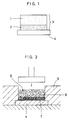
- Fig. 1 shows an embodiment of a disk brake pad including a friction member 3 having a double-layer structure.
- numeral 1 indicates a substrate layer as the frictional contact portion.
- 2 indicates a bonding layer through which the substrate layer 1 is to be bonded to a back plate 4.
- the bonding layer 2 is, in many cases, inserted into a recess or a hole formed in the back plate.
- the bonding layer 2 was simply bonded to the surface of a flat back plate having no recess or hole.
- the friction members of the pads of Examples 1-4 were formed from the materials shown in Table 1, while those of the pads of Control Examples 1 and 2 were formed from the materials shown in Table 2.
- the material for the substrate layer we used a mixture obtained by adding fibers, friction adjusting agents, fillers and binder resins shown in Table 1 at the contents shown in this table into an Eirich mixer and mixing them uniformly.
- the material for the bonding layer we used a pelletized material obtained by uniformly mixing the ingredients shown in Table 2 also in an Eirich mixer and pelletizing the mixture.
- the friction member was thermoformed by placing 10 g of a pelletized material 7 to be formed into the bonding layer and then 100 g of a mixture 8 to be formed into the substrate layer into a cavity 6 of a mold 5 heated to 160°C with the back plate 4 set under the cavity 6, pressurizing them at 200 kg/cm2 for 10 minutes, and finally by heating them at 230°C for three hours to harden or set the thermosetting binder resin contained in the material.
- the materials for both the substrate layer and the bonding layer were formed by adding the ingredients shown in Table 2 into an Eirich mixer at the contents shown in Table 2 and uniformly mixing them together. The mixtures thus formed were not pelletized. 10 g of the mixture for the bonding layer was used while 100 g of the mixture was used to form the substrate layer as in Examples 1-4.
- the pad of Control Example 1 was formed at the same mold temperature and under the same thermoforming conditions and the same hardening conditions as in Examples 1-4.
- the bonding layer was formed by pelletizing the material for the bonding layer as in Examples 1-4.
- the pad of this example was formed under exactly the same conditions as in the Examples except that the composition for the pelletized material is different.
- Example 1-4 were much lower in the porosity of the bonding layer than the conventional pad (Control Example 1) in which the bonding layer was formed from a cotton-like material.
- the bond strength at the interface between the friction member and the back plate is less likely to drop due to rusting with time.
- the strength at the bonded portion was also substantially high. This means that the pads of Examples 1-4 are less likely to separate.
- Control Example 2 Due to the low total content of rubber and binder resin, Control Example 2 was low in the porosity of the bonding layer even though it was formed under the same conditions as Examples 1-4. Thus, it was low in strength and it could not effectively prevent rusting.
- Tables 4 and 5 show the kinds and amounts of materials used in Examples and Control Examples. They were formed in the following ways.
- the substrate and the bonding layer were formed by putting the materials shown in Tables 4 and 5 in an Eirich mixer at the contents shown in Tables 4 and 5 and uniformly mixing them together.
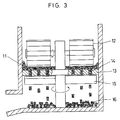
- the mixtures thus formed were fed into a disk pelleter (Fig. 3) made by Fuji Paudal after heating its extruding plate having 1-mm diameter holes to 60°C, and extruded under the pressure of 20 kg/cm2 to form pellets having an average diameter of 1 mm.
- the pellets produced no dust. It was possible to weigh such pellets simply by putting them in a container and scraping off the portion which heaps up from the brim of the container.
- Pellets were formed from the materials shown in Table 4 under the same conditions as in Example 5, but changing the diameter of the pellets by adjusting the diameter of the holes formed in the extruding plate. Brake pads were formed from these pellets in the same manner as in Example 5. As shown in Table 7, these brake pads were lower in porosity of the bonding layer, higher in strength, and less likely to develop rust than a conventional pad formed from a cotton-like mixture of materials.
- the substrate and bonding layers were formed from the materials shown in Tables 5 and 6.
- the materials for both the substrate and bonding layers were mixed uniformly in an Eirich mixer. 10 g of the non-pelletized mixture of materials for the bonding layer and 100 g of the mixture of materials for the substrate layer were put in a mold heated to 160°C, and pressurized at the pressure of 200 kg/cm2 for ten minutes. The article thus molded was hardened at 230°C for three hours.
- Table 7 shows the physical properties of the pad thus formed. This pad was higher in the porosity of the bonding layer, lower in strength and more likely to degrade by rusting than the pads of which the bonding layer is formed from pelletized material.
- Pellets were formed from the materials shown in Table 6 in the same manner as in Example 5 using an extruding plate having 5-mm diameter holes. Brake pads were formed by putting the pellets in a mold. It was difficult to obtain the pellets of uniform weight due to large pellet diameter. The brake pads thus formed were not of uniform quality.
- Pellets were formed from the materials shown in Table 6 in the same manner as in Example 5 using an extruding plate having 1.5-mm diameter holes. We tried to form brake pads from these pellets in the same manner as in Example 5, but failed.
- the disk pelleter shown in Fig. 3 comprises rollers 12 for pressing the material 11, an extruding plate 13 having holes 14 through which the material 11 is extruded, and a chopper 15 for cutting the material extruded from the extruding plate to a predetermined length.
Landscapes
- Engineering & Computer Science (AREA)
- General Engineering & Computer Science (AREA)
- Mechanical Engineering (AREA)
- Chemical & Material Sciences (AREA)
- Manufacturing & Machinery (AREA)
- Materials Engineering (AREA)
- Health & Medical Sciences (AREA)
- Chemical Kinetics & Catalysis (AREA)
- Medicinal Chemistry (AREA)
- Polymers & Plastics (AREA)
- Organic Chemistry (AREA)
- Braking Arrangements (AREA)
- Casting Or Compression Moulding Of Plastics Or The Like (AREA)
Applications Claiming Priority (6)
| Application Number | Priority Date | Filing Date | Title |
|---|---|---|---|
| JP8861494 | 1994-04-26 | ||
| JP6088614A JP2993362B2 (ja) | 1994-04-26 | 1994-04-26 | ファイバ含有造粒材料の製造方法 |
| JP88614/94 | 1994-04-26 | ||
| JP9349494 | 1994-05-02 | ||
| JP09349494A JP3409426B2 (ja) | 1994-05-02 | 1994-05-02 | ディスクブレーキパッドの製造方法 |
| JP93494/94 | 1994-05-02 |
Publications (4)
| Publication Number | Publication Date |
|---|---|
| EP0681116A2 true EP0681116A2 (de) | 1995-11-08 |
| EP0681116A3 EP0681116A3 (de) | 1996-05-01 |
| EP0681116B1 EP0681116B1 (de) | 1999-10-27 |
| EP0681116B2 EP0681116B2 (de) | 2002-12-18 |
Family
ID=26429972
Family Applications (1)
| Application Number | Title | Priority Date | Filing Date |
|---|---|---|---|
| EP95105505A Expired - Lifetime EP0681116B2 (de) | 1994-04-26 | 1995-04-12 | Verfahren zur Herstellung von Scheibenbremsbelägen |
Country Status (4)
| Country | Link |
|---|---|
| US (1) | US5641444A (de) |
| EP (1) | EP0681116B2 (de) |
| KR (1) | KR100211296B1 (de) |
| DE (1) | DE69512957T3 (de) |
Cited By (7)
| Publication number | Priority date | Publication date | Assignee | Title |
|---|---|---|---|---|
| EP1024310A1 (de) * | 1999-01-29 | 2000-08-02 | Valeo | Reibwerkstoff für Nasslaufkupplungen, mit kontrollierter Porosität |
| EP0943832A3 (de) * | 1998-03-16 | 2001-01-31 | Akebono Brake Industry Co., Ltd. | Reibmaterial |
| EP1081406A3 (de) * | 1999-07-30 | 2003-01-22 | Nisshinbo Industries, Inc. | Asbestfreie Reibungsmaterialien |
| EP1098104A3 (de) * | 1999-11-06 | 2003-03-12 | TMD Friction EsCo GmbH | Verfahren und Vorrichtung zur Herstellung von Bremsbelägen |
| EP1752681A1 (de) * | 2005-08-01 | 2007-02-14 | Nisshinbo Industries, Inc. | Verfahren zur Herstellung von Reibmaterial in Granulat Zustand für Reibbelag und damit hergestellter Reibbelag |
| CN103154559A (zh) * | 2010-10-29 | 2013-06-12 | 三菱电机株式会社 | 制动衬片及其制造方法 |
| CN105015012A (zh) * | 2015-06-26 | 2015-11-04 | 韦秀学 | 一种推进式灰尘压缩装置 |
Families Citing this family (18)
| Publication number | Priority date | Publication date | Assignee | Title |
|---|---|---|---|---|
| DE19543329A1 (de) * | 1995-11-21 | 1997-05-22 | Frimatec Ingenieurgesellschaft | Verfahren zur Herstellung von Reibbelägen |
| US5871159A (en) * | 1997-04-18 | 1999-02-16 | American Metal Fibers, Inc. | Fiber mixtures for brake pads |
| KR100466354B1 (ko) * | 1998-05-25 | 2005-06-01 | 주식회사 한국베랄 | 브레이크패드의제조방법과장치 |
| KR100612733B1 (ko) * | 1998-08-26 | 2006-08-18 | 닛신보세키 가부시키 가이샤 | 비석면계 마찰재 |
| US6153291A (en) * | 1998-10-13 | 2000-11-28 | Northrop Grumman Corporation | Ceramic-matrix composite component fabrication |
| US6585089B1 (en) * | 2000-08-24 | 2003-07-01 | James L. Parker | Coated brake pad and method for smoothing rotor surface and method of manufacture |
| DE10257831A1 (de) * | 2002-12-11 | 2004-07-01 | Fa. Otto Fuchs | Verfahren zum Herstellen eines im Bereich einer Lagerfläche mit einem reibungs- und verschleißoptimierten Belag beschichteten Gegenstandes |
| US20060272909A1 (en) * | 2005-06-02 | 2006-12-07 | Fuller Brian K | Brake assembly and coating |
| DE102005042424B3 (de) | 2005-09-07 | 2007-01-18 | Tmd Friction Services Gmbh | Verfahren und Vorrichtung zur Herstellung von Reibbelägen für Scheibenbremsen oder Kupplungen von Fahrzeugen |
| JP5183900B2 (ja) | 2005-11-14 | 2013-04-17 | 曙ブレーキ工業株式会社 | ノンアスベスト摩擦部材 |
| US20090014918A1 (en) * | 2007-07-10 | 2009-01-15 | Yuliu Zheng | Microwave-assisted press cure processing of friction pads |
| US8381885B2 (en) * | 2009-12-14 | 2013-02-26 | Kohler Co. | Brake system and lawn mower implementing the same |
| US10597823B2 (en) | 2013-05-03 | 2020-03-24 | Teijin Aramid B.V. | Crumb made of pulp |
| JP6562393B2 (ja) * | 2013-06-18 | 2019-08-21 | 曙ブレーキ工業株式会社 | ブレーキパッド用摩擦材の金型、製造装置、製造方法および予備成形物 |
| US10041421B2 (en) | 2015-02-27 | 2018-08-07 | Kohler Co. | Safety system for engine shutdown, and engines and equipment incorporating the same |
| EP3594525A1 (de) * | 2018-07-12 | 2020-01-15 | MAT Commercial Vehicle Products GmbH | Bremsbelag, scheibenbremsenbaugruppe und fahrzeug |
| DE102019116424A1 (de) * | 2019-06-18 | 2020-12-24 | Schaeffler Technologies AG & Co. KG | Radmodul für ein Fahrzeug sowie Fahrzeug mit dem Radmodul |
| IT202000012001A1 (it) * | 2020-05-22 | 2021-11-22 | Itt Italia Srl | Sottostrato per una pastiglia di freno di un rotore di disco di freno |
Family Cites Families (11)
| Publication number | Priority date | Publication date | Assignee | Title |
|---|---|---|---|---|
| FR2406128A1 (fr) * | 1977-07-25 | 1979-05-11 | Abex Pagid Equip | Procede de fabrication de garnitures pour freins a disques |
| JPS54113649A (en) † | 1978-02-24 | 1979-09-05 | Matsushita Electric Works Ltd | Manufacture of composition for friction materials |
| DE2928527A1 (de) * | 1979-07-14 | 1981-02-19 | Buckau Wolf Maschf R | Befahrbare rampe fuer kraftfahrzeuge |
| DE2928572A1 (de) * | 1979-07-14 | 1981-01-29 | Glyco Metall Werke | Schichtwerkstoff und verfahren zu seiner herstellung |
| JPS56167929A (en) † | 1980-05-26 | 1981-12-23 | Hitachi Chem Co Ltd | Pad for disk brake |
| FI64443C (fi) * | 1982-01-26 | 1983-11-10 | Matti Tapanainen | Foerfarande foer framstaellning av en bromskloss |
| DE8614363U1 (de) * | 1986-05-27 | 1987-10-01 | Textar Gmbh, 5090 Leverkusen | Bremsbacke für Scheibenbremsen |
| JPH0670449B2 (ja) * | 1989-10-10 | 1994-09-07 | アベックス・コーポレイション | エラストマ吸音材及びブレーキシュー組立体 |
| JPH051278A (ja) † | 1991-06-24 | 1993-01-08 | Nisshinbo Ind Inc | 非石綿系摩擦材 |
| FR2681925B1 (fr) * | 1991-10-01 | 1997-09-05 | Flertex Sa | Plaquette de frein a disque pour chemin de fer. |
| US5413194A (en) * | 1994-07-25 | 1995-05-09 | Pneumo Abex Corporation | Brake friction pad assembly |
-
1995
- 1995-04-12 DE DE69512957T patent/DE69512957T3/de not_active Expired - Fee Related
- 1995-04-12 EP EP95105505A patent/EP0681116B2/de not_active Expired - Lifetime
- 1995-04-20 US US08/425,433 patent/US5641444A/en not_active Expired - Lifetime
- 1995-04-26 KR KR1019950009959A patent/KR100211296B1/ko not_active Expired - Fee Related
Cited By (10)
| Publication number | Priority date | Publication date | Assignee | Title |
|---|---|---|---|---|
| US6260674B1 (en) | 1996-03-16 | 2001-07-17 | Akebono Brake Industry Co., Ltd. | Friction material |
| EP0943832A3 (de) * | 1998-03-16 | 2001-01-31 | Akebono Brake Industry Co., Ltd. | Reibmaterial |
| EP1024310A1 (de) * | 1999-01-29 | 2000-08-02 | Valeo | Reibwerkstoff für Nasslaufkupplungen, mit kontrollierter Porosität |
| FR2789143A1 (fr) * | 1999-01-29 | 2000-08-04 | Valeo | Dispositif mettant en oeuvre un frottement en milieu liquide et comportant une garniture de frottement a porosite controlee |
| US6336540B1 (en) | 1999-01-29 | 2002-01-08 | Valeo | Device using friction in a liquid medium and having a friction lining with controlled porosity |
| EP1081406A3 (de) * | 1999-07-30 | 2003-01-22 | Nisshinbo Industries, Inc. | Asbestfreie Reibungsmaterialien |
| EP1098104A3 (de) * | 1999-11-06 | 2003-03-12 | TMD Friction EsCo GmbH | Verfahren und Vorrichtung zur Herstellung von Bremsbelägen |
| EP1752681A1 (de) * | 2005-08-01 | 2007-02-14 | Nisshinbo Industries, Inc. | Verfahren zur Herstellung von Reibmaterial in Granulat Zustand für Reibbelag und damit hergestellter Reibbelag |
| CN103154559A (zh) * | 2010-10-29 | 2013-06-12 | 三菱电机株式会社 | 制动衬片及其制造方法 |
| CN105015012A (zh) * | 2015-06-26 | 2015-11-04 | 韦秀学 | 一种推进式灰尘压缩装置 |
Also Published As
| Publication number | Publication date |
|---|---|
| EP0681116B2 (de) | 2002-12-18 |
| DE69512957T2 (de) | 2000-06-29 |
| EP0681116B1 (de) | 1999-10-27 |
| KR950031487A (ko) | 1995-12-18 |
| DE69512957D1 (de) | 1999-12-02 |
| DE69512957T3 (de) | 2003-09-11 |
| KR100211296B1 (ko) | 1999-08-02 |
| US5641444A (en) | 1997-06-24 |
| EP0681116A3 (de) | 1996-05-01 |
Similar Documents
| Publication | Publication Date | Title |
|---|---|---|
| EP0681116B1 (de) | Verfahren zur Herstellung von Scheibenbremsbelägen | |
| EP0687829B1 (de) | Verstärktes Reibungsmaterial | |
| EP0154488B1 (de) | Reibungsmaterialien und deren Herstellung | |
| EP0694708A2 (de) | Reibbelaganordnung für Bremsen | |
| CN1105630C (zh) | 粘结件的制造 | |
| JP2001165210A (ja) | ディスクブレーキ、ディスクブレーキパッド、及び該ディスクブレーキパッド用バックプレート | |
| US7993549B2 (en) | Process for producing carbon-ceramic brake discs | |
| EP0751317B1 (de) | Vorgefertigtes Teil einer Reibungsbremse | |
| JP2993362B2 (ja) | ファイバ含有造粒材料の製造方法 | |
| JP3409426B2 (ja) | ディスクブレーキパッドの製造方法 | |
| US7837924B2 (en) | Method for manufacturing friction material or friction material products | |
| US6210146B1 (en) | Friction component manufacturing apparatus and method | |
| JP3391120B2 (ja) | ディスクブレーキパッドの製造方法 | |
| EP0542357B1 (de) | Bremsklotz mit Belag auf Rückenplatte befestigt | |
| KR20050065409A (ko) | 마찰재의 조립화 방법 및 마찰재용 예비 성형재의 제조 방법 | |
| JPH0239647B2 (de) | ||
| JPH02300532A (ja) | 摩擦バッド及びその製造法 | |
| JP2637240B2 (ja) | 熱可塑性樹脂含有の摩擦材 | |
| JP2001009813A (ja) | 木質系成形品の製造方法 | |
| MXPA96002484A (es) | Subunidad de freno de friccion |
Legal Events
| Date | Code | Title | Description |
|---|---|---|---|
| PUAI | Public reference made under article 153(3) epc to a published international application that has entered the european phase |
Free format text: ORIGINAL CODE: 0009012 |
|
| AK | Designated contracting states |
Kind code of ref document: A2 Designated state(s): DE FR GB |
|
| PUAL | Search report despatched |
Free format text: ORIGINAL CODE: 0009013 |
|
| AK | Designated contracting states |
Kind code of ref document: A3 Designated state(s): DE FR GB |
|
| 17P | Request for examination filed |
Effective date: 19960522 |
|
| 17Q | First examination report despatched |
Effective date: 19970915 |
|
| GRAG | Despatch of communication of intention to grant |
Free format text: ORIGINAL CODE: EPIDOS AGRA |
|
| GRAG | Despatch of communication of intention to grant |
Free format text: ORIGINAL CODE: EPIDOS AGRA |
|
| GRAH | Despatch of communication of intention to grant a patent |
Free format text: ORIGINAL CODE: EPIDOS IGRA |
|
| GRAH | Despatch of communication of intention to grant a patent |
Free format text: ORIGINAL CODE: EPIDOS IGRA |
|
| GRAA | (expected) grant |
Free format text: ORIGINAL CODE: 0009210 |
|
| AK | Designated contracting states |
Kind code of ref document: B1 Designated state(s): DE FR GB |
|
| REF | Corresponds to: |
Ref document number: 69512957 Country of ref document: DE Date of ref document: 19991202 |
|
| ET | Fr: translation filed | ||
| PLBQ | Unpublished change to opponent data |
Free format text: ORIGINAL CODE: EPIDOS OPPO |
|
| PLBI | Opposition filed |
Free format text: ORIGINAL CODE: 0009260 |
|
| PLBF | Reply of patent proprietor to notice(s) of opposition |
Free format text: ORIGINAL CODE: EPIDOS OBSO |
|
| 26 | Opposition filed |
Opponent name: VERBAND DER REIBBELAGINDUSTRIE E.V. Effective date: 20000712 |
|
| PLBF | Reply of patent proprietor to notice(s) of opposition |
Free format text: ORIGINAL CODE: EPIDOS OBSO |
|
| REG | Reference to a national code |
Ref country code: GB Ref legal event code: IF02 |
|
| PLAW | Interlocutory decision in opposition |
Free format text: ORIGINAL CODE: EPIDOS IDOP |
|
| PLAW | Interlocutory decision in opposition |
Free format text: ORIGINAL CODE: EPIDOS IDOP |
|
| PUAH | Patent maintained in amended form |
Free format text: ORIGINAL CODE: 0009272 |
|
| STAA | Information on the status of an ep patent application or granted ep patent |
Free format text: STATUS: PATENT MAINTAINED AS AMENDED |
|
| 27A | Patent maintained in amended form |
Effective date: 20021218 |
|
| AK | Designated contracting states |
Kind code of ref document: B2 Designated state(s): DE FR GB |
|
| ET3 | Fr: translation filed ** decision concerning opposition | ||
| PGFP | Annual fee paid to national office [announced via postgrant information from national office to epo] |
Ref country code: GB Payment date: 20070411 Year of fee payment: 13 |
|
| PGFP | Annual fee paid to national office [announced via postgrant information from national office to epo] |
Ref country code: FR Payment date: 20070411 Year of fee payment: 13 |
|
| PGFP | Annual fee paid to national office [announced via postgrant information from national office to epo] |
Ref country code: DE Payment date: 20080417 Year of fee payment: 14 |
|
| GBPC | Gb: european patent ceased through non-payment of renewal fee |
Effective date: 20080412 |
|
| REG | Reference to a national code |
Ref country code: FR Ref legal event code: ST Effective date: 20081231 |
|
| PG25 | Lapsed in a contracting state [announced via postgrant information from national office to epo] |
Ref country code: FR Free format text: LAPSE BECAUSE OF NON-PAYMENT OF DUE FEES Effective date: 20080430 |
|
| PG25 | Lapsed in a contracting state [announced via postgrant information from national office to epo] |
Ref country code: GB Free format text: LAPSE BECAUSE OF NON-PAYMENT OF DUE FEES Effective date: 20080412 |
|
| PLAB | Opposition data, opponent's data or that of the opponent's representative modified |
Free format text: ORIGINAL CODE: 0009299OPPO |
|
| PG25 | Lapsed in a contracting state [announced via postgrant information from national office to epo] |
Ref country code: DE Free format text: LAPSE BECAUSE OF NON-PAYMENT OF DUE FEES Effective date: 20091103 |
|
| PLAB | Opposition data, opponent's data or that of the opponent's representative modified |
Free format text: ORIGINAL CODE: 0009299OPPO |
|
| R26 | Opposition filed (corrected) |
Opponent name: VERBAND DER REIBBELAGINDUSTRIE E.V. Effective date: 20000712 |