EP0681608B1 - Applications therapeutiques d'une organogenese chimerique - Google Patents
Applications therapeutiques d'une organogenese chimerique Download PDFInfo
- Publication number
- EP0681608B1 EP0681608B1 EP94902570A EP94902570A EP0681608B1 EP 0681608 B1 EP0681608 B1 EP 0681608B1 EP 94902570 A EP94902570 A EP 94902570A EP 94902570 A EP94902570 A EP 94902570A EP 0681608 B1 EP0681608 B1 EP 0681608B1
- Authority
- EP
- European Patent Office
- Prior art keywords
- cells
- chimeric
- autologous
- host
- cell
- Prior art date
- Legal status (The legal status is an assumption and is not a legal conclusion. Google has not performed a legal analysis and makes no representation as to the accuracy of the status listed.)
- Expired - Lifetime
Links
- 230000001225 therapeutic effect Effects 0.000 title description 3
- 230000005305 organ development Effects 0.000 title 1
- 238000004113 cell culture Methods 0.000 claims abstract description 18
- 238000000034 method Methods 0.000 claims abstract description 16
- 230000008569 process Effects 0.000 claims abstract description 10
- 238000012258 culturing Methods 0.000 claims abstract description 3
- 210000004027 cell Anatomy 0.000 claims description 42
- 210000002510 keratinocyte Anatomy 0.000 claims description 21
- 210000003491 skin Anatomy 0.000 claims description 20
- 210000001339 epidermal cell Anatomy 0.000 claims description 14
- 210000002919 epithelial cell Anatomy 0.000 claims description 10
- 238000004519 manufacturing process Methods 0.000 claims description 10
- 238000002360 preparation method Methods 0.000 claims description 6
- 239000000203 mixture Substances 0.000 claims description 3
- 230000012010 growth Effects 0.000 claims description 2
- 230000000735 allogeneic effect Effects 0.000 abstract description 15
- 210000000981 epithelium Anatomy 0.000 abstract description 9
- 208000014674 injury Diseases 0.000 abstract description 8
- 238000000338 in vitro Methods 0.000 abstract description 7
- 230000008733 trauma Effects 0.000 abstract description 6
- 230000010261 cell growth Effects 0.000 abstract description 2
- 241000699670 Mus sp. Species 0.000 description 15
- 208000027418 Wounds and injury Diseases 0.000 description 8
- 238000001574 biopsy Methods 0.000 description 8
- 206010052428 Wound Diseases 0.000 description 7
- 239000006285 cell suspension Substances 0.000 description 7
- 210000001519 tissue Anatomy 0.000 description 7
- LFQSCWFLJHTTHZ-UHFFFAOYSA-N Ethanol Chemical compound CCO LFQSCWFLJHTTHZ-UHFFFAOYSA-N 0.000 description 6
- 210000002615 epidermis Anatomy 0.000 description 5
- 238000002054 transplantation Methods 0.000 description 5
- IJGRMHOSHXDMSA-UHFFFAOYSA-N Atomic nitrogen Chemical compound N#N IJGRMHOSHXDMSA-UHFFFAOYSA-N 0.000 description 4
- WZUVPPKBWHMQCE-UHFFFAOYSA-N Haematoxylin Chemical compound C12=CC(O)=C(O)C=C2CC2(O)C1C1=CC=C(O)C(O)=C1OC2 WZUVPPKBWHMQCE-UHFFFAOYSA-N 0.000 description 4
- 239000007943 implant Substances 0.000 description 4
- 239000000243 solution Substances 0.000 description 4
- 108091003079 Bovine Serum Albumin Proteins 0.000 description 3
- 241001529936 Murinae Species 0.000 description 3
- 241000699666 Mus <mouse, genus> Species 0.000 description 3
- 239000008188 pellet Substances 0.000 description 3
- 238000002560 therapeutic procedure Methods 0.000 description 3
- VBEQCZHXXJYVRD-GACYYNSASA-N uroanthelone Chemical compound C([C@@H](C(=O)N[C@H](C(=O)N[C@@H](CS)C(=O)N[C@@H](CC(N)=O)C(=O)N[C@@H](CS)C(=O)N[C@H](C(=O)N[C@@H]([C@@H](C)CC)C(=O)NCC(=O)N[C@@H](CC=1C=CC(O)=CC=1)C(=O)N[C@@H](CO)C(=O)NCC(=O)N[C@@H](CC(O)=O)C(=O)N[C@@H](CCCNC(N)=N)C(=O)N[C@@H](CS)C(=O)N[C@@H](CCC(N)=O)C(=O)N[C@@H]([C@@H](C)O)C(=O)N[C@@H](CCCNC(N)=N)C(=O)N[C@@H](CC(O)=O)C(=O)N[C@@H](CC(C)C)C(=O)N[C@@H](CCCNC(N)=N)C(=O)N[C@@H](CC=1C2=CC=CC=C2NC=1)C(=O)N[C@@H](CC=1C2=CC=CC=C2NC=1)C(=O)N[C@@H](CCC(O)=O)C(=O)N[C@@H](CC(C)C)C(=O)N[C@@H](CCCNC(N)=N)C(O)=O)C(C)C)[C@@H](C)O)NC(=O)[C@H](CO)NC(=O)[C@H](CC(O)=O)NC(=O)[C@H](CC(C)C)NC(=O)[C@H](CO)NC(=O)[C@H](CCC(O)=O)NC(=O)[C@@H](NC(=O)[C@H](CC=1NC=NC=1)NC(=O)[C@H](CCSC)NC(=O)[C@H](CS)NC(=O)[C@@H](NC(=O)CNC(=O)CNC(=O)[C@H](CC(N)=O)NC(=O)[C@H](CC(C)C)NC(=O)[C@H](CS)NC(=O)[C@H](CC=1C=CC(O)=CC=1)NC(=O)CNC(=O)[C@H](CC(O)=O)NC(=O)[C@H](CC=1C=CC(O)=CC=1)NC(=O)[C@H](CO)NC(=O)[C@H](CO)NC(=O)[C@H]1N(CCC1)C(=O)[C@H](CS)NC(=O)CNC(=O)[C@H]1N(CCC1)C(=O)[C@H](CC=1C=CC(O)=CC=1)NC(=O)[C@H](CO)NC(=O)[C@@H](N)CC(N)=O)C(C)C)[C@@H](C)CC)C1=CC=C(O)C=C1 VBEQCZHXXJYVRD-GACYYNSASA-N 0.000 description 3
- 241000283707 Capra Species 0.000 description 2
- 102000009024 Epidermal Growth Factor Human genes 0.000 description 2
- 101800003838 Epidermal growth factor Proteins 0.000 description 2
- JGSARLDLIJGVTE-MBNYWOFBSA-N Penicillin G Chemical compound N([C@H]1[C@H]2SC([C@@H](N2C1=O)C(O)=O)(C)C)C(=O)CC1=CC=CC=C1 JGSARLDLIJGVTE-MBNYWOFBSA-N 0.000 description 2
- PXIPVTKHYLBLMZ-UHFFFAOYSA-N Sodium azide Chemical compound [Na+].[N-]=[N+]=[N-] PXIPVTKHYLBLMZ-UHFFFAOYSA-N 0.000 description 2
- 238000004458 analytical method Methods 0.000 description 2
- 210000001142 back Anatomy 0.000 description 2
- 229940098773 bovine serum albumin Drugs 0.000 description 2
- 238000012136 culture method Methods 0.000 description 2
- 201000010099 disease Diseases 0.000 description 2
- 208000037265 diseases, disorders, signs and symptoms Diseases 0.000 description 2
- 108010007093 dispase Proteins 0.000 description 2
- 229940116977 epidermal growth factor Drugs 0.000 description 2
- 238000002474 experimental method Methods 0.000 description 2
- 238000000684 flow cytometry Methods 0.000 description 2
- 230000002068 genetic effect Effects 0.000 description 2
- JYGXADMDTFJGBT-VWUMJDOOSA-N hydrocortisone Chemical compound O=C1CC[C@]2(C)[C@H]3[C@@H](O)C[C@](C)([C@@](CC4)(O)C(=O)CO)[C@@H]4[C@@H]3CCC2=C1 JYGXADMDTFJGBT-VWUMJDOOSA-N 0.000 description 2
- 238000003125 immunofluorescent labeling Methods 0.000 description 2
- 230000008595 infiltration Effects 0.000 description 2
- 238000001764 infiltration Methods 0.000 description 2
- NOESYZHRGYRDHS-UHFFFAOYSA-N insulin Chemical compound N1C(=O)C(NC(=O)C(CCC(N)=O)NC(=O)C(CCC(O)=O)NC(=O)C(C(C)C)NC(=O)C(NC(=O)CN)C(C)CC)CSSCC(C(NC(CO)C(=O)NC(CC(C)C)C(=O)NC(CC=2C=CC(O)=CC=2)C(=O)NC(CCC(N)=O)C(=O)NC(CC(C)C)C(=O)NC(CCC(O)=O)C(=O)NC(CC(N)=O)C(=O)NC(CC=2C=CC(O)=CC=2)C(=O)NC(CSSCC(NC(=O)C(C(C)C)NC(=O)C(CC(C)C)NC(=O)C(CC=2C=CC(O)=CC=2)NC(=O)C(CC(C)C)NC(=O)C(C)NC(=O)C(CCC(O)=O)NC(=O)C(C(C)C)NC(=O)C(CC(C)C)NC(=O)C(CC=2NC=NC=2)NC(=O)C(CO)NC(=O)CNC2=O)C(=O)NCC(=O)NC(CCC(O)=O)C(=O)NC(CCCNC(N)=N)C(=O)NCC(=O)NC(CC=3C=CC=CC=3)C(=O)NC(CC=3C=CC=CC=3)C(=O)NC(CC=3C=CC(O)=CC=3)C(=O)NC(C(C)O)C(=O)N3C(CCC3)C(=O)NC(CCCCN)C(=O)NC(C)C(O)=O)C(=O)NC(CC(N)=O)C(O)=O)=O)NC(=O)C(C(C)CC)NC(=O)C(CO)NC(=O)C(C(C)O)NC(=O)C1CSSCC2NC(=O)C(CC(C)C)NC(=O)C(NC(=O)C(CCC(N)=O)NC(=O)C(CC(N)=O)NC(=O)C(NC(=O)C(N)CC=1C=CC=CC=1)C(C)C)CC1=CN=CN1 NOESYZHRGYRDHS-UHFFFAOYSA-N 0.000 description 2
- 239000007788 liquid Substances 0.000 description 2
- 210000001616 monocyte Anatomy 0.000 description 2
- 210000003205 muscle Anatomy 0.000 description 2
- 229910052757 nitrogen Inorganic materials 0.000 description 2
- 238000010899 nucleation Methods 0.000 description 2
- 210000000056 organ Anatomy 0.000 description 2
- GVKCHTBDSMQENH-UHFFFAOYSA-L phloxine B Chemical compound [Na+].[Na+].[O-]C(=O)C1=C(Cl)C(Cl)=C(Cl)C(Cl)=C1C1=C2C=C(Br)C(=O)C(Br)=C2OC2=C(Br)C([O-])=C(Br)C=C21 GVKCHTBDSMQENH-UHFFFAOYSA-L 0.000 description 2
- 230000035755 proliferation Effects 0.000 description 2
- 238000010186 staining Methods 0.000 description 2
- 229940099259 vaseline Drugs 0.000 description 2
- 230000029663 wound healing Effects 0.000 description 2
- HZCBWYNLGPIQRK-LBPRGKRZSA-N 3,3',5'-triiodo-L-thyronine Chemical compound IC1=CC(C[C@H]([NH3+])C([O-])=O)=CC=C1OC1=CC(I)=C(O)C(I)=C1 HZCBWYNLGPIQRK-LBPRGKRZSA-N 0.000 description 1
- GFFGJBXGBJISGV-UHFFFAOYSA-N Adenine Chemical compound NC1=NC=NC2=C1N=CN2 GFFGJBXGBJISGV-UHFFFAOYSA-N 0.000 description 1
- 229930024421 Adenine Natural products 0.000 description 1
- 239000011547 Bouin solution Substances 0.000 description 1
- 241001227713 Chiron Species 0.000 description 1
- 102000009016 Cholera Toxin Human genes 0.000 description 1
- 108010049048 Cholera Toxin Proteins 0.000 description 1
- 206010010356 Congenital anomaly Diseases 0.000 description 1
- 235000015655 Crocus sativus Nutrition 0.000 description 1
- 244000124209 Crocus sativus Species 0.000 description 1
- 108090000790 Enzymes Proteins 0.000 description 1
- 102000004190 Enzymes Human genes 0.000 description 1
- CEAZRRDELHUEMR-URQXQFDESA-N Gentamicin Chemical compound O1[C@H](C(C)NC)CC[C@@H](N)[C@H]1O[C@H]1[C@H](O)[C@@H](O[C@@H]2[C@@H]([C@@H](NC)[C@@](C)(O)CO2)O)[C@H](N)C[C@@H]1N CEAZRRDELHUEMR-URQXQFDESA-N 0.000 description 1
- 229930182566 Gentamicin Natural products 0.000 description 1
- 101000766306 Homo sapiens Serotransferrin Proteins 0.000 description 1
- 102000004877 Insulin Human genes 0.000 description 1
- 108090001061 Insulin Proteins 0.000 description 1
- YQEZLKZALYSWHR-UHFFFAOYSA-N Ketamine Chemical compound C=1C=CC=C(Cl)C=1C1(NC)CCCCC1=O YQEZLKZALYSWHR-UHFFFAOYSA-N 0.000 description 1
- 208000007256 Nevus Diseases 0.000 description 1
- -1 OCT compound Chemical class 0.000 description 1
- 229930040373 Paraformaldehyde Natural products 0.000 description 1
- 206010040844 Skin exfoliation Diseases 0.000 description 1
- 206010072170 Skin wound Diseases 0.000 description 1
- FAPWRFPIFSIZLT-UHFFFAOYSA-M Sodium chloride Chemical compound [Na+].[Cl-] FAPWRFPIFSIZLT-UHFFFAOYSA-M 0.000 description 1
- GLNADSQYFUSGOU-GPTZEZBUSA-J Trypan blue Chemical compound [Na+].[Na+].[Na+].[Na+].C1=C(S([O-])(=O)=O)C=C2C=C(S([O-])(=O)=O)C(/N=N/C3=CC=C(C=C3C)C=3C=C(C(=CC=3)\N=N\C=3C(=CC4=CC(=CC(N)=C4C=3O)S([O-])(=O)=O)S([O-])(=O)=O)C)=C(O)C2=C1N GLNADSQYFUSGOU-GPTZEZBUSA-J 0.000 description 1
- 208000025865 Ulcer Diseases 0.000 description 1
- 230000009471 action Effects 0.000 description 1
- 229960000643 adenine Drugs 0.000 description 1
- 230000032823 cell division Effects 0.000 description 1
- 230000003833 cell viability Effects 0.000 description 1
- 230000001684 chronic effect Effects 0.000 description 1
- 210000004748 cultured cell Anatomy 0.000 description 1
- 230000006378 damage Effects 0.000 description 1
- 230000003247 decreasing effect Effects 0.000 description 1
- 210000004207 dermis Anatomy 0.000 description 1
- 230000004069 differentiation Effects 0.000 description 1
- 238000010790 dilution Methods 0.000 description 1
- 239000012895 dilution Substances 0.000 description 1
- 210000003981 ectoderm Anatomy 0.000 description 1
- 238000002283 elective surgery Methods 0.000 description 1
- 210000003038 endothelium Anatomy 0.000 description 1
- 238000005516 engineering process Methods 0.000 description 1
- 210000005175 epidermal keratinocyte Anatomy 0.000 description 1
- 230000007717 exclusion Effects 0.000 description 1
- 210000002744 extracellular matrix Anatomy 0.000 description 1
- 239000012894 fetal calf serum Substances 0.000 description 1
- 210000002950 fibroblast Anatomy 0.000 description 1
- 238000005188 flotation Methods 0.000 description 1
- MHMNJMPURVTYEJ-UHFFFAOYSA-N fluorescein-5-isothiocyanate Chemical compound O1C(=O)C2=CC(N=C=S)=CC=C2C21C1=CC=C(O)C=C1OC1=CC(O)=CC=C21 MHMNJMPURVTYEJ-UHFFFAOYSA-N 0.000 description 1
- 229960002518 gentamicin Drugs 0.000 description 1
- 230000009036 growth inhibition Effects 0.000 description 1
- 238000013427 histology analysis Methods 0.000 description 1
- 229960000890 hydrocortisone Drugs 0.000 description 1
- 238000010166 immunofluorescence Methods 0.000 description 1
- 238000002991 immunohistochemical analysis Methods 0.000 description 1
- 238000012744 immunostaining Methods 0.000 description 1
- 238000011534 incubation Methods 0.000 description 1
- 208000015181 infectious disease Diseases 0.000 description 1
- 229940125396 insulin Drugs 0.000 description 1
- 238000010255 intramuscular injection Methods 0.000 description 1
- 239000007927 intramuscular injection Substances 0.000 description 1
- 229960003299 ketamine Drugs 0.000 description 1
- 239000000463 material Substances 0.000 description 1
- 230000007246 mechanism Effects 0.000 description 1
- 210000003716 mesoderm Anatomy 0.000 description 1
- 230000004048 modification Effects 0.000 description 1
- 238000012986 modification Methods 0.000 description 1
- 238000010172 mouse model Methods 0.000 description 1
- 239000013642 negative control Substances 0.000 description 1
- 239000012188 paraffin wax Substances 0.000 description 1
- 229920002866 paraformaldehyde Polymers 0.000 description 1
- 230000001575 pathological effect Effects 0.000 description 1
- 229940056360 penicillin g Drugs 0.000 description 1
- 239000008363 phosphate buffer Substances 0.000 description 1
- XNSAINXGIQZQOO-SRVKXCTJSA-N protirelin Chemical compound NC(=O)[C@@H]1CCCN1C(=O)[C@@H](NC(=O)[C@H]1NC(=O)CC1)CC1=CN=CN1 XNSAINXGIQZQOO-SRVKXCTJSA-N 0.000 description 1
- 230000009467 reduction Effects 0.000 description 1
- 235000013974 saffron Nutrition 0.000 description 1
- 239000004248 saffron Substances 0.000 description 1
- 210000002966 serum Anatomy 0.000 description 1
- 210000004894 snout Anatomy 0.000 description 1
- 239000011780 sodium chloride Substances 0.000 description 1
- 210000000438 stratum basale Anatomy 0.000 description 1
- 210000000434 stratum corneum Anatomy 0.000 description 1
- 210000000437 stratum spinosum Anatomy 0.000 description 1
- 239000000126 substance Substances 0.000 description 1
- 230000004083 survival effect Effects 0.000 description 1
- 230000000472 traumatic effect Effects 0.000 description 1
- 230000008736 traumatic injury Effects 0.000 description 1
- 230000036269 ulceration Effects 0.000 description 1
- 230000002792 vascular Effects 0.000 description 1
- 230000009385 viral infection Effects 0.000 description 1
- 238000005406 washing Methods 0.000 description 1
- BPICBUSOMSTKRF-UHFFFAOYSA-N xylazine Chemical compound CC1=CC=CC(C)=C1NC1=NCCCS1 BPICBUSOMSTKRF-UHFFFAOYSA-N 0.000 description 1
- 229960001600 xylazine Drugs 0.000 description 1
Images

Classifications
-
- A—HUMAN NECESSITIES
- A61—MEDICAL OR VETERINARY SCIENCE; HYGIENE
- A61L—METHODS OR APPARATUS FOR STERILISING MATERIALS OR OBJECTS IN GENERAL; DISINFECTION, STERILISATION OR DEODORISATION OF AIR; CHEMICAL ASPECTS OF BANDAGES, DRESSINGS, ABSORBENT PADS OR SURGICAL ARTICLES; MATERIALS FOR BANDAGES, DRESSINGS, ABSORBENT PADS OR SURGICAL ARTICLES
- A61L27/00—Materials for grafts or prostheses or for coating grafts or prostheses
- A61L27/36—Materials for grafts or prostheses or for coating grafts or prostheses containing ingredients of undetermined constitution or reaction products thereof, e.g. transplant tissue, natural bone, extracellular matrix
- A61L27/38—Materials for grafts or prostheses or for coating grafts or prostheses containing ingredients of undetermined constitution or reaction products thereof, e.g. transplant tissue, natural bone, extracellular matrix containing added animal cells
- A61L27/3804—Materials for grafts or prostheses or for coating grafts or prostheses containing ingredients of undetermined constitution or reaction products thereof, e.g. transplant tissue, natural bone, extracellular matrix containing added animal cells characterised by specific cells or progenitors thereof, e.g. fibroblasts, connective tissue cells, kidney cells
- A61L27/3813—Epithelial cells, e.g. keratinocytes, urothelial cells
-
- A—HUMAN NECESSITIES
- A61—MEDICAL OR VETERINARY SCIENCE; HYGIENE
- A61L—METHODS OR APPARATUS FOR STERILISING MATERIALS OR OBJECTS IN GENERAL; DISINFECTION, STERILISATION OR DEODORISATION OF AIR; CHEMICAL ASPECTS OF BANDAGES, DRESSINGS, ABSORBENT PADS OR SURGICAL ARTICLES; MATERIALS FOR BANDAGES, DRESSINGS, ABSORBENT PADS OR SURGICAL ARTICLES
- A61L27/00—Materials for grafts or prostheses or for coating grafts or prostheses
- A61L27/50—Materials characterised by their function or physical properties, e.g. injectable or lubricating compositions, shape-memory materials, surface modified materials
- A61L27/60—Materials for use in artificial skin
-
- C—CHEMISTRY; METALLURGY
- C12—BIOCHEMISTRY; BEER; SPIRITS; WINE; VINEGAR; MICROBIOLOGY; ENZYMOLOGY; MUTATION OR GENETIC ENGINEERING
- C12N—MICROORGANISMS OR ENZYMES; COMPOSITIONS THEREOF; PROPAGATING, PRESERVING, OR MAINTAINING MICROORGANISMS; MUTATION OR GENETIC ENGINEERING; CULTURE MEDIA
- C12N5/00—Undifferentiated human, animal or plant cells, e.g. cell lines; Tissues; Cultivation or maintenance thereof; Culture media therefor
- C12N5/06—Animal cells or tissues; Human cells or tissues
- C12N5/0602—Vertebrate cells
- C12N5/0625—Epidermal cells, skin cells; Cells of the oral mucosa
- C12N5/0629—Keratinocytes; Whole skin
-
- A—HUMAN NECESSITIES
- A61—MEDICAL OR VETERINARY SCIENCE; HYGIENE
- A61K—PREPARATIONS FOR MEDICAL, DENTAL OR TOILETRY PURPOSES
- A61K35/00—Medicinal preparations containing materials or reaction products thereof with undetermined constitution
- A61K35/12—Materials from mammals; Compositions comprising non-specified tissues or cells; Compositions comprising non-embryonic stem cells; Genetically modified cells
-
- C—CHEMISTRY; METALLURGY
- C12—BIOCHEMISTRY; BEER; SPIRITS; WINE; VINEGAR; MICROBIOLOGY; ENZYMOLOGY; MUTATION OR GENETIC ENGINEERING
- C12N—MICROORGANISMS OR ENZYMES; COMPOSITIONS THEREOF; PROPAGATING, PRESERVING, OR MAINTAINING MICROORGANISMS; MUTATION OR GENETIC ENGINEERING; CULTURE MEDIA
- C12N2500/00—Specific components of cell culture medium
- C12N2500/05—Inorganic components
- C12N2500/10—Metals; Metal chelators
- C12N2500/12—Light metals, i.e. alkali, alkaline earth, Be, Al, Mg
- C12N2500/16—Magnesium; Mg chelators
-
- C—CHEMISTRY; METALLURGY
- C12—BIOCHEMISTRY; BEER; SPIRITS; WINE; VINEGAR; MICROBIOLOGY; ENZYMOLOGY; MUTATION OR GENETIC ENGINEERING
- C12N—MICROORGANISMS OR ENZYMES; COMPOSITIONS THEREOF; PROPAGATING, PRESERVING, OR MAINTAINING MICROORGANISMS; MUTATION OR GENETIC ENGINEERING; CULTURE MEDIA
- C12N2501/00—Active agents used in cell culture processes, e.g. differentation
- C12N2501/10—Growth factors
- C12N2501/11—Epidermal growth factor [EGF]
-
- Y—GENERAL TAGGING OF NEW TECHNOLOGICAL DEVELOPMENTS; GENERAL TAGGING OF CROSS-SECTIONAL TECHNOLOGIES SPANNING OVER SEVERAL SECTIONS OF THE IPC; TECHNICAL SUBJECTS COVERED BY FORMER USPC CROSS-REFERENCE ART COLLECTIONS [XRACs] AND DIGESTS
- Y10—TECHNICAL SUBJECTS COVERED BY FORMER USPC
- Y10S—TECHNICAL SUBJECTS COVERED BY FORMER USPC CROSS-REFERENCE ART COLLECTIONS [XRACs] AND DIGESTS
- Y10S623/00—Prosthesis, i.e. artificial body members, parts thereof, or aids and accessories therefor
- Y10S623/915—Method or apparatus for preparing biological material
Definitions
- the present invention relates to the production of chimeric cell cultures.
- the invention relates to the production of chimeric epidermal cell cultures to be used in skin grafting.
- Uninjured tissues and organs of the body are composed of different cell types, and extracellular matrices that affect cell, tissue and organ functions.
- Noncongenital injury to cells and tissues causes wounds and initiates common mechanisms of wound healing at all sites in the body (Robbins SL. et al, (Eds.) "Pathologic Basis of Disease", 2nd ed Philadelphia: WB Saunders, 1979:55-106).
- Fundamental components of wound closure include restoration of stable ectoderm-derived tissue(epithelium or endothelium) and of uniform vascular supply in the adjacent mesoderm-derived tissue.
- the present invention relates to a process for growing and generating chimeric epithelium in vitro for treating skin trauma.
- a novel aspect of the invention is the use of allogeneic cells in the production of graftable epidermal sheets.
- These skin grafts can be used to treat a variety of skin trauma, notably burn wounds but also including other conditions such as large congenital nevi, chronic ulceration, nonhealing wounds, and other types of traumatic skin loss that may require therapeutic skin replacement. Indeed for patients who are massively burned the availability of donor skin is the limiting factor for wound coverage and survival. It is predicted that using allogeneic cells would save considerable time (up to 50%) in the production of the chimeric epithelium in vitro since the allogeneic cells can be stored in a skin bank.
- the present invention provides a process for producing a chimeric cell culture suitable for transplanting onto a host, said process comprising culturing epithelial cells that are autologous to said host with epithelial cells that are non-autologous to said host under conditions suitable to promote growth of the cells, wherein both said autologous and non-autologous cells are the same cell type.
- the present invention also provides a chimeric cell culture suitable for transplanting onto a host comprising a mixture of epithelial cells that are autologous to said host and epithelial cells that are non-autologous to said host, wherein both said autologous and non-autologous cells are the same cell type.
- both the cell types are epidermal cells, in particular keratinocytes.
- the present invention further provides the use of the chimeric cell culture described above in the manufacture of a preparation for use as a skin graft.
- the present invention yet also provides the use of the chimeric cell culture described above in the manufacture of a preparation for the treatment ot burns.
- mice Primary cultures of murine epidermal keratinocytes were established from neonatal Balb/c and C3H/HeN mouse skin according to the method of Yuspa and Harris (Exp. Cell. Res 1974, 86 : 95). Briefly, newborn mice were killed by cervical dislocation, then washed 3 times with 70% ethanol, cold proviodine, and 70% ethanol respectively. Limbs and tail were amputated, a longitudinal incision was made from tail to snout, and the skin was removed with forceps. Epidermis was separated from dermis after flotation of the skin on 0.25%-20 ⁇ g/ml of trypsin-DNase solution in phosphate buffer saline (PBS) overnight at 4°C.
- PBS phosphate buffer saline
- the detached epidermal pieces were aseptically transferred to a medium containing serum to inhibit the action of residual enzyme and to release the epidermal cells mechanically.
- Single-cell suspensions were washed twice and the pellets were resuspended in 5 ml of 10%FCS medium.
- the epidermal cell suspensions were applied onto Lympholyte-M gradients (Cedarlane Laboratories Limited, Canada) and spun at room temperature at 300 g for 30 min. The resulting pellet containing keratinous material and other debris was discarded.
- the interface layer containing nucleated epidermal cells was collected, washed twice, and resuspended in Dulbecco-Vogt modification of Eagle's medium (DME) mixed with Ham's F-12 in 3:1 proportion (Flow Labs, Mississauga, Ontario, Canada).
- DME Dulbecco-Vogt modification of Eagle's medium
- This medium was supplemented with 5 ⁇ g/ml of insulin, 10 -10 M cholera toxin (Schwarz/Mann, Cleveland, OH, U.S.A.), 24.3 ⁇ g/ml adenine, 5 ⁇ g/ml human transferrin, 2x10 -9 M 3,3',5'-triiodo-L-thyronine (Sigma Chemicals), 0.4 ⁇ M of hydrocortisone (Calbiochem, La Jolla, CA, U.S.A), 100 lU/ml penicillin G, 25 ⁇ g/ml gentamicin (Schering Canada Inc.), 10 ng/ml epidermal growth factor (EGF, Chiron Corp., Emeryville, CA., USA) and 10% of fetal calf serum (FCS, Flow Lab). Cell viability and a count of the epidermal cell suspension were ascertained by the trypan blue exclusion technique.
- Balb/c keratinocytes (BK) or C3H(CK) were grown individually in culture flasks, or mixed together at 50%BK-50%CK ratio.
- the seeding cell concentration was 10 5 cells/cm 2 .
- All cultures were allowed to attach for 24 h in a humidified atmosphere with 5% CO 2 at 37°C and then transferred to 31°C, and epidermal growth factor (EGF) was added to the medium.
- EGF epidermal growth factor
- the medium was changed every 2 days. For the first 48 hours of culture, the Mg 2 + concentration in the medium was adjusted to 2 mM; then it was increased to 5 mM (Molloy C.J. and Laskin J.D., 1988, Differentiation, 37 : 86).
- Confluent cultures were treated with 0.01%-0.05% Trypsin-EDTA solution to make cell suspensions. Cells were then treated with an anti-H-2 k monoclonal antibody (specific for C3H/HeN cells) for 45 min at 4°C . After two washes with PBS containing 1% bovine serum albumin (BSA) and 0.1% sodium azide (Az), cells were exposed to a goat anti-mouse IgM-IgG-fluorescein (FITC) conjugate (1/300 dilution) for 45 min in the dark at 4°C.
- BSA bovine serum albumin
- Az sodium azide
- Epidermal sheets were prepared when the primary cultures of keratinocytes had reached confluence. Cultures were washed twice with sterile PBS; then 5 ml of dispase (Sigma) at 2.5 mg/ml were added to each flask and incubated at 37°C for 20 to 30 minutes, to release these sheets from the flask's surface. Sheets were washed twice and transferred to a vaseline gauze (Ethicon Ltd, Johnson and Johnson, Peterborough Ont., Canada) basal side up and then fixed with Ligaclips (Sherwood Medical Industries Ltd, Markham, Ont., Canada). These sheets were left immersed in the appropriate medium until grafting.
- dispase Sigma
- the recipient mice used in the transplantation experiments were Balb/c and C3H/HeN mice.
- Each strain received transplants of epidermal sheets that were (a) isologous, (b) allogeneic or (c) chimeric to the mouse receiving the transplant.
- Balb/c mice were transplanted with epidermal sheets derived from (a) Balb/c mice (isologous transplant or isograft), (b) C3H/HeN mice (allogeneic graft) or (c) both Balb/c and C3H/HeN mice (chimeric graft).
- mice Inbred strains of mice, such as Balb/c and C3H/HeN mice, represent a homogeneous population wherein all members of one strain have the identical genetic make up. Therefore, it can be appreciated that an isograft can be considered as an experimental equivalent to an autograft since, in both situations, both the recipient and the transplant are of the same genetic make up.
- isografts were used instead of autografts, since the mice from which the epidermal sheets are prepared are sacrificed when the epidermal cells are isolated.
- Recipient mice were anaesthetized with an intramuscular injection of ketamine xylazine at 0.05 ml/10g weight.
- Mouse dorsum was prepared for grafting by shaving and washing the area with proviodine and 70% ethanol. Full thickness skin was excised down to the muscle.
- a Fusenig transplantation chamber (Fusenig N.E. et al. 1980. In : "Tissue Culture in Medical Research", Vol. 2, Richard R.G. and Rayan K. (Eds), Oxford, Pergamon. pp 87) was installed and a homogeneous or chimeric sheet was deposited over the muscle. The vaseline gauze was then gently detached.
- the top of the transplantation chamber was installed and fixed by four cutaneous stitches (silk 4-0 from Ethicon Ltd., Peterborough, Ont.) for five days and then removed. Fourteen and thirty days after grafting, biopsies were taken for histology and immunohistochemical analysis.
- biopsies were harvested from the isograft and the allogeneic and chimeric grafts, fixed in Bouin's solution and embedded in paraffin. Then 4-5 ⁇ m sections were stained with hematoxylin phloxine and saffron, and observed under an optic microscope (Nikon Optiphot, Japan).
- the inventors have developed a new epithelial culture method to produce chimeric graftable sheets composed of two different keratinocyte types, using a murine model. These graftable sheets should have use in treating and accelerating burn therapy as well as treating other dermatological trauma.
- the chimeric cultures comprising a 50:50 mixture of Balb/c and C3H/HeN keratinocytes were co-cultured until confluence.
- the confluent cultures were either (i) stained to assess the percentage of each cell type on these graftable chimeric sheets, using specific anti-H-2 d (for Balb/c) and/or anti-H-2 k (for C3H/HeN) monoclonal antibodies, or (ii) epithelia were obtained from confluent cultures by dispase treatment and grafted onto recipient Balb/c or C3H/HeN male mice 6 to 8 weeks old.
- Figure 1 shows that the chimeric culture contains approximately the same proportions of each cell type after 3 days of culture when assessed with both anti-H-2 d and anti-H-2 k monoclonal antibodies used in combination, or with each antibody used individually.
- panel (c) the percentage of Balb/c keratinocytes in the chimeric culture was 40% while the percentage of C3H/HeN keratinocytes was 42%.
- This immunostaining shows no growth inhibition of the Balb/c keratinocyte (BK) proliferation when co-cultured with the C3H/HeN keratinocytes (CK) and vice versa.
- the epithelial sheets ready for grafting were composed of the two cell types essentially at the same ratio as at the beginning of the culture seeding.
- the negative control represents staining with the second antibody, Anti-Mouse-IgG-FITC, only.
- Chimeric sheets were grafted and left on the recipient dorsum.
- biopsies were taken from the isograft and the allogeneic and chimeric grafts for histological analysis.
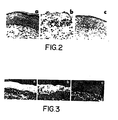
- the hematoxylin and phloxine staining ( Figure 2) showed a well structured epidermis with the presence of stratum corneum, stratum spinosum and stratum germinativum.
- No monocyte infiltration was observed in the chimeric graft or the isograft.
- the cultured epithelium allografts showed disorganized epithelial cells and an important monocyte and polymorphonuclear cell infiltration which is a sign of the implant rejection.
- the chimeric graft and the isograft were not rejected.
- the inventors have also shown that similar results have been obtained when the chimeric culture consists of as little as 25% of isologous cells, with 75% allogeneic cells. Therefore, this invention for generating chimeric epidermis using isologous and allogeneic epidermal cell suspensions shows high quality results for skin replacement.
- allogeneic keratinocytes stored in a cell bank may be thawed and plated onto culture flasks until confluence.
- Cell suspensions can be made separately from both the autologous and allogeneic cultures.
- the two cell types can then be mixed together at an appropriate ratio and then plated in new flasks and incubated for graftable sheet production.
- the epithelial sheets produced will be used for skin trauma therapy such as in burns.
- the chimeric sheets could be used for grafting on the first passage of cultured autologous keratinocytes rather than waiting for the second or, in many cases, the third passage. This method should allow significant reduction in the skin wound treatment duration.
Landscapes
- Health & Medical Sciences (AREA)
- Life Sciences & Earth Sciences (AREA)
- Engineering & Computer Science (AREA)
- Biomedical Technology (AREA)
- Chemical & Material Sciences (AREA)
- Dermatology (AREA)
- Cell Biology (AREA)
- General Health & Medical Sciences (AREA)
- Zoology (AREA)
- Epidemiology (AREA)
- Bioinformatics & Cheminformatics (AREA)
- Medicinal Chemistry (AREA)
- Oral & Maxillofacial Surgery (AREA)
- Transplantation (AREA)
- Organic Chemistry (AREA)
- Animal Behavior & Ethology (AREA)
- Wood Science & Technology (AREA)
- Public Health (AREA)
- Veterinary Medicine (AREA)
- Biotechnology (AREA)
- Genetics & Genomics (AREA)
- Chemical Kinetics & Catalysis (AREA)
- Microbiology (AREA)
- Urology & Nephrology (AREA)
- Biochemistry (AREA)
- General Engineering & Computer Science (AREA)
- Botany (AREA)
- Materials For Medical Uses (AREA)
- Micro-Organisms Or Cultivation Processes Thereof (AREA)
- Medicines Containing Material From Animals Or Micro-Organisms (AREA)
- Peptides Or Proteins (AREA)
Claims (10)
- Procédé pour la production d'une culture de cellules chimères apte à la transplantation sur un hôte, ledit procédé comprenant la culture de cellules épithéliales qui sont autologues pour ledit hôte avec des cellules épithéliales qui sont non autologues pour ledit hôte dans des conditions convenables pour favoriser la croissance des cellules, dans lequel lesdites cellules autologues et lesdites cellules non autologues sont du même type cellulaire.
- Procédé suivant la revendication 1, dans lequel lesdites cellules sont des cellules épidermiques.
- Procédé suivant la revendication 2, dans lequel lesdites cellules épidermiques sont des kératinocytes.
- Procédé suivant la revendication 3, dans lequel la culture de cellules chimères convient pour des greffes de peau.
- Culture de cellules chimères convenables pour la transplantation sur un hôte, comprenant un mélange de cellules épithéliales qui sont autologues pour ledit hôte avec des cellules épithéliales qui sont non autologues pour ledit hôte, dans laquelle lesdites cellules autologues et lesdites cellules non autologues sont du même type cellulaire.
- Culture de cellules suivant la revendication 5, dans laquelle lesdites cellules sont des cellules épidermiques.
- Culture de cellules suivant la revendication 6, dans laquelle lesdites cellules épidermiques sont des kératinocytes.
- Culture de cellules suivant la revendication 7, ladite culture de cellules étant convenable pour des greffes de peau.
- Utilisation de la culture de cellules chimères suivant l'une quelconque des revendications 5 à 7 dans la production d'une préparation destinée à être utilisée comme greffe de peau.
- Utilisation d'une culture de cellules chimères suivant la revendication 7 dans la production d'une préparation pour le traitement de brûlures.
Applications Claiming Priority (3)
| Application Number | Priority Date | Filing Date | Title |
|---|---|---|---|
| US08/007,318 US5610007A (en) | 1993-01-21 | 1993-01-21 | Chimeric sheets of epithelial cells |
| US7318 | 1993-01-21 | ||
| PCT/CA1993/000546 WO1994017179A1 (fr) | 1993-01-21 | 1993-12-21 | Applications therapeutiques d'une organogenese chimerique |
Publications (2)
| Publication Number | Publication Date |
|---|---|
| EP0681608A1 EP0681608A1 (fr) | 1995-11-15 |
| EP0681608B1 true EP0681608B1 (fr) | 2004-06-09 |
Family
ID=21725473
Family Applications (1)
| Application Number | Title | Priority Date | Filing Date |
|---|---|---|---|
| EP94902570A Expired - Lifetime EP0681608B1 (fr) | 1993-01-21 | 1993-12-21 | Applications therapeutiques d'une organogenese chimerique |
Country Status (7)
| Country | Link |
|---|---|
| US (1) | US5610007A (fr) |
| EP (1) | EP0681608B1 (fr) |
| JP (1) | JP3748882B2 (fr) |
| AT (1) | ATE268811T1 (fr) |
| DE (1) | DE69333547T2 (fr) |
| NZ (1) | NZ258838A (fr) |
| WO (1) | WO1994017179A1 (fr) |
Families Citing this family (11)
| Publication number | Priority date | Publication date | Assignee | Title |
|---|---|---|---|---|
| WO1999043787A2 (fr) * | 1998-02-24 | 1999-09-02 | Advanced Tissue Sciences, Inc. | Matiere de reconstitution de peau chimere et vivante |
| US6964869B2 (en) * | 1998-07-13 | 2005-11-15 | Wisconsin Alumni Research Foundation | Method and composition for skin grafts |
| US20060030044A1 (en) * | 1998-07-13 | 2006-02-09 | Allen-Hoffmann B Lynn | Method and composition for skin grafts |
| JP2003517858A (ja) * | 1999-11-05 | 2003-06-03 | ジェリジーン メディカル コーポレーション | 老齢関連の軟組織の欠陥の増強と修復 |
| US20020039788A1 (en) * | 2000-02-29 | 2002-04-04 | Isseroff Roslyn R. | Corneal epithelial graft composites |
| CA2444699C (fr) * | 2001-04-24 | 2012-08-07 | Wisconsin Alumni Research Foundation | Methode et composition destinees a des greffes cutanees |
| AU2003222697A1 (en) * | 2002-04-24 | 2003-11-10 | Biogentis Inc. | Method for preparing tissue constructs |
| TW558677B (en) * | 2002-08-02 | 2003-10-21 | Chih-Hao Yiu | Device for detecting angular position |
| AU300232S (en) | 2004-06-17 | 2004-11-18 | Hardie James Technology Ltd | Trim system component |
| EP1782846A1 (fr) * | 2004-06-30 | 2007-05-09 | Arblast Co., Ltd. | Surface épithéliale cornéenne et processus de production |
| CN101912636B (zh) * | 2010-05-19 | 2014-03-19 | 郭爱华 | 迷你皮肤结构及其制备方法和用途 |
Family Cites Families (7)
| Publication number | Priority date | Publication date | Assignee | Title |
|---|---|---|---|---|
| US4769317A (en) * | 1983-06-14 | 1988-09-06 | Hefton John M | Process for growing human epidermis, product thereof |
| FR2589165B1 (fr) * | 1985-10-24 | 1989-01-20 | Inst Nat Sante Rech Med | Procede d'obtention d'un epithelium humain de culture, tissu epithelial obtenu et son application aux allogreffes |
| US5032508A (en) * | 1988-09-08 | 1991-07-16 | Marrow-Tech, Inc. | Three-dimensional cell and tissue culture system |
| CA2000181A1 (fr) * | 1988-10-14 | 1990-04-14 | Chung-Faye Chao | Methode de culture de lambeaux d'epiderme, produit et methode |
| IL94611A (en) * | 1989-06-05 | 1994-12-29 | Organogenesis Inc | Medium for cell cultures containing insulin or growth factor similar to insulin, transferrin or iron ion, triiodothyronine or thyroxine and method of use |
| JPH04501510A (ja) * | 1989-07-25 | 1992-03-19 | セル ジェネシス,インコーポレイティド | 普遍的なドナー細胞及びキメラ性哺乳類宿主のための相同性組換え |
| RU2135191C1 (ru) * | 1990-04-24 | 1999-08-27 | Ортек Интернэшнл, Инк. | Композиционный эквивалент живой кожи, способ его получения, тест-набор |
-
1993
- 1993-01-21 US US08/007,318 patent/US5610007A/en not_active Expired - Lifetime
- 1993-12-21 AT AT94902570T patent/ATE268811T1/de not_active IP Right Cessation
- 1993-12-21 WO PCT/CA1993/000546 patent/WO1994017179A1/fr not_active Ceased
- 1993-12-21 DE DE69333547T patent/DE69333547T2/de not_active Expired - Lifetime
- 1993-12-21 NZ NZ258838A patent/NZ258838A/en not_active IP Right Cessation
- 1993-12-21 EP EP94902570A patent/EP0681608B1/fr not_active Expired - Lifetime
- 1993-12-21 JP JP51650594A patent/JP3748882B2/ja not_active Expired - Lifetime
Also Published As
| Publication number | Publication date |
|---|---|
| AU5690594A (en) | 1994-08-15 |
| US5610007A (en) | 1997-03-11 |
| ATE268811T1 (de) | 2004-06-15 |
| JP3748882B2 (ja) | 2006-02-22 |
| NZ258838A (en) | 1998-03-25 |
| AU682485B2 (en) | 1997-10-09 |
| DE69333547T2 (de) | 2005-08-18 |
| WO1994017179A1 (fr) | 1994-08-04 |
| JPH08508876A (ja) | 1996-09-24 |
| DE69333547D1 (de) | 2004-07-15 |
| EP0681608A1 (fr) | 1995-11-15 |
Similar Documents
| Publication | Publication Date | Title |
|---|---|---|
| Barrandon et al. | New techniques for the grafting of cultured human epidermal cells onto athymic animals | |
| US7754481B2 (en) | Keratinocytes useful for the treatment of wounds | |
| US5866167A (en) | Non-viable total keratinocyte lysate for promoting wound healing | |
| US20020039788A1 (en) | Corneal epithelial graft composites | |
| EP0681608B1 (fr) | Applications therapeutiques d'une organogenese chimerique | |
| US8206980B2 (en) | Method for cultivation of hair follicular dermal sheath cells | |
| Ben-Bassat et al. | Structural and functional evaluation of modifications in the composite skin graft: cryopreserved dermis and cultured keratinocytes | |
| EP1499710A2 (fr) | Procede de developpement d'equivalents des tissus conjonctivaux humains destines a la recherche, aux transplantations cliniques de la surface oculaire et a l'ingenierie tissulaire | |
| US6585969B1 (en) | Non-viable keratinocyte cell composition or lysate for promoting wound healing | |
| Rouabhia et al. | Optimization of murine keratinocyte culture for the production of graftable epidermal sheets | |
| Park et al. | Application of physical force is essential to enrich for epidermal stem cells in primary human keratinocyte isolation | |
| CA2154368C (fr) | Applications therapeutiques de l'organogenese chimerique | |
| AU682485C (en) | Therapeutic applications of chimeric organogenesis | |
| Hakim et al. | Use of biodegradable mesh as a transport for a cultured uroepithelial graft an improved method using collagen gel | |
| Rouabhia | Skin regeneration after heterologous epidermal substitute grafting | |
| Wechselberger et al. | Transplantation of autologous cultured urothelium cells onto a prefabricated capsule in rats | |
| Lawlor et al. | Epidermal cell transplantation | |
| Sarkisov et al. | Use of cultured fibroblasts to restore skin in patients with severe burns | |
| PARTS | Model for the In-Vitro Generation of Human Epidermal Autografts for Potential Use in Treatment of Sickle Cell Leg Ulcers |
Legal Events
| Date | Code | Title | Description |
|---|---|---|---|
| PUAI | Public reference made under article 153(3) epc to a published international application that has entered the european phase |
Free format text: ORIGINAL CODE: 0009012 |
|
| 17P | Request for examination filed |
Effective date: 19950821 |
|
| AK | Designated contracting states |
Kind code of ref document: A1 Designated state(s): AT BE CH DE DK ES FR GB GR IE IT LI LU MC NL PT SE |
|
| 17Q | First examination report despatched |
Effective date: 19991025 |
|
| GRAP | Despatch of communication of intention to grant a patent |
Free format text: ORIGINAL CODE: EPIDOSNIGR1 |
|
| GRAS | Grant fee paid |
Free format text: ORIGINAL CODE: EPIDOSNIGR3 |
|
| GRAA | (expected) grant |
Free format text: ORIGINAL CODE: 0009210 |
|
| AK | Designated contracting states |
Kind code of ref document: B1 Designated state(s): AT BE CH DE DK ES FR GB GR IE IT LI LU MC NL PT SE |
|
| PG25 | Lapsed in a contracting state [announced via postgrant information from national office to epo] |
Ref country code: NL Free format text: LAPSE BECAUSE OF FAILURE TO SUBMIT A TRANSLATION OF THE DESCRIPTION OR TO PAY THE FEE WITHIN THE PRESCRIBED TIME-LIMIT Effective date: 20040609 Ref country code: LI Free format text: LAPSE BECAUSE OF FAILURE TO SUBMIT A TRANSLATION OF THE DESCRIPTION OR TO PAY THE FEE WITHIN THE PRESCRIBED TIME-LIMIT Effective date: 20040609 Ref country code: IT Free format text: LAPSE BECAUSE OF FAILURE TO SUBMIT A TRANSLATION OF THE DESCRIPTION OR TO PAY THE FEE WITHIN THE PRE;WARNING: LAPSES OF ITALIAN PATENTS WITH EFFECTIVE DATE BEFORE 2007 MAY HAVE OCCURRED AT ANY TIME BEFORE 2007. THE CORRECT EFFECTIVE DATE MAY BE DIFFERENT FROM THE ONE RECORDED.SCRIBED TIME-LIMIT Effective date: 20040609 Ref country code: CH Free format text: LAPSE BECAUSE OF FAILURE TO SUBMIT A TRANSLATION OF THE DESCRIPTION OR TO PAY THE FEE WITHIN THE PRESCRIBED TIME-LIMIT Effective date: 20040609 Ref country code: BE Free format text: LAPSE BECAUSE OF FAILURE TO SUBMIT A TRANSLATION OF THE DESCRIPTION OR TO PAY THE FEE WITHIN THE PRESCRIBED TIME-LIMIT Effective date: 20040609 Ref country code: AT Free format text: LAPSE BECAUSE OF FAILURE TO SUBMIT A TRANSLATION OF THE DESCRIPTION OR TO PAY THE FEE WITHIN THE PRESCRIBED TIME-LIMIT Effective date: 20040609 |
|
| RAP1 | Party data changed (applicant data changed or rights of an application transferred) |
Owner name: UNIVERSITE LAVAL |
|
| REG | Reference to a national code |
Ref country code: GB Ref legal event code: FG4D |
|
| REG | Reference to a national code |
Ref country code: CH Ref legal event code: EP |
|
| REF | Corresponds to: |
Ref document number: 69333547 Country of ref document: DE Date of ref document: 20040715 Kind code of ref document: P |
|
| REG | Reference to a national code |
Ref country code: IE Ref legal event code: FG4D |
|
| PG25 | Lapsed in a contracting state [announced via postgrant information from national office to epo] |
Ref country code: SE Free format text: LAPSE BECAUSE OF FAILURE TO SUBMIT A TRANSLATION OF THE DESCRIPTION OR TO PAY THE FEE WITHIN THE PRESCRIBED TIME-LIMIT Effective date: 20040909 Ref country code: GR Free format text: LAPSE BECAUSE OF FAILURE TO SUBMIT A TRANSLATION OF THE DESCRIPTION OR TO PAY THE FEE WITHIN THE PRESCRIBED TIME-LIMIT Effective date: 20040909 Ref country code: DK Free format text: LAPSE BECAUSE OF FAILURE TO SUBMIT A TRANSLATION OF THE DESCRIPTION OR TO PAY THE FEE WITHIN THE PRESCRIBED TIME-LIMIT Effective date: 20040909 |
|
| PG25 | Lapsed in a contracting state [announced via postgrant information from national office to epo] |
Ref country code: ES Free format text: LAPSE BECAUSE OF FAILURE TO SUBMIT A TRANSLATION OF THE DESCRIPTION OR TO PAY THE FEE WITHIN THE PRESCRIBED TIME-LIMIT Effective date: 20040920 |
|
| NLV1 | Nl: lapsed or annulled due to failure to fulfill the requirements of art. 29p and 29m of the patents act | ||
| REG | Reference to a national code |
Ref country code: CH Ref legal event code: PL |
|
| PG25 | Lapsed in a contracting state [announced via postgrant information from national office to epo] |
Ref country code: LU Free format text: LAPSE BECAUSE OF NON-PAYMENT OF DUE FEES Effective date: 20041221 Ref country code: IE Free format text: LAPSE BECAUSE OF NON-PAYMENT OF DUE FEES Effective date: 20041221 |
|
| PG25 | Lapsed in a contracting state [announced via postgrant information from national office to epo] |
Ref country code: MC Free format text: LAPSE BECAUSE OF NON-PAYMENT OF DUE FEES Effective date: 20041231 |
|
| ET | Fr: translation filed | ||
| PLBE | No opposition filed within time limit |
Free format text: ORIGINAL CODE: 0009261 |
|
| STAA | Information on the status of an ep patent application or granted ep patent |
Free format text: STATUS: NO OPPOSITION FILED WITHIN TIME LIMIT |
|
| 26N | No opposition filed |
Effective date: 20050310 |
|
| REG | Reference to a national code |
Ref country code: IE Ref legal event code: MM4A |
|
| PG25 | Lapsed in a contracting state [announced via postgrant information from national office to epo] |
Ref country code: PT Free format text: LAPSE BECAUSE OF NON-PAYMENT OF DUE FEES Effective date: 20041109 |
|
| PGFP | Annual fee paid to national office [announced via postgrant information from national office to epo] |
Ref country code: DE Payment date: 20121017 Year of fee payment: 20 |
|
| PGFP | Annual fee paid to national office [announced via postgrant information from national office to epo] |
Ref country code: GB Payment date: 20121227 Year of fee payment: 20 |
|
| PGFP | Annual fee paid to national office [announced via postgrant information from national office to epo] |
Ref country code: FR Payment date: 20130108 Year of fee payment: 20 |
|
| REG | Reference to a national code |
Ref country code: DE Ref legal event code: R071 Ref document number: 69333547 Country of ref document: DE |
|
| REG | Reference to a national code |
Ref country code: DE Ref legal event code: R071 Ref document number: 69333547 Country of ref document: DE |
|
| REG | Reference to a national code |
Ref country code: GB Ref legal event code: PE20 Expiry date: 20131220 |
|
| PG25 | Lapsed in a contracting state [announced via postgrant information from national office to epo] |
Ref country code: GB Free format text: LAPSE BECAUSE OF EXPIRATION OF PROTECTION Effective date: 20131220 Ref country code: DE Free format text: LAPSE BECAUSE OF EXPIRATION OF PROTECTION Effective date: 20131224 |