EP0683171B1 - Procédé pour la préparation de bêta-thymidine - Google Patents
Procédé pour la préparation de bêta-thymidine Download PDFInfo
- Publication number
- EP0683171B1 EP0683171B1 EP94303637A EP94303637A EP0683171B1 EP 0683171 B1 EP0683171 B1 EP 0683171B1 EP 94303637 A EP94303637 A EP 94303637A EP 94303637 A EP94303637 A EP 94303637A EP 0683171 B1 EP0683171 B1 EP 0683171B1
- Authority
- EP
- European Patent Office
- Prior art keywords
- formula
- effected
- beta
- acetyl
- xylothymidine
- Prior art date
- Legal status (The legal status is an assumption and is not a legal conclusion. Google has not performed a legal analysis and makes no representation as to the accuracy of the status listed.)
- Expired - Lifetime
Links
- 0 C*(C(CO)CC1C(C2)*2=C)[C@]1C(C(C)C(C(*1I)O)N=C)C1=O Chemical compound C*(C(CO)CC1C(C2)*2=C)[C@]1C(C(C)C(C(*1I)O)N=C)C1=O 0.000 description 6
Classifications
-
- C—CHEMISTRY; METALLURGY
- C07—ORGANIC CHEMISTRY
- C07H—SUGARS; DERIVATIVES THEREOF; NUCLEOSIDES; NUCLEOTIDES; NUCLEIC ACIDS
- C07H19/00—Compounds containing a hetero ring sharing one ring hetero atom with a saccharide radical; Nucleosides; Mononucleotides; Anhydro-derivatives thereof
- C07H19/02—Compounds containing a hetero ring sharing one ring hetero atom with a saccharide radical; Nucleosides; Mononucleotides; Anhydro-derivatives thereof sharing nitrogen
- C07H19/04—Heterocyclic radicals containing only nitrogen atoms as ring hetero atom
- C07H19/06—Pyrimidine radicals
Definitions
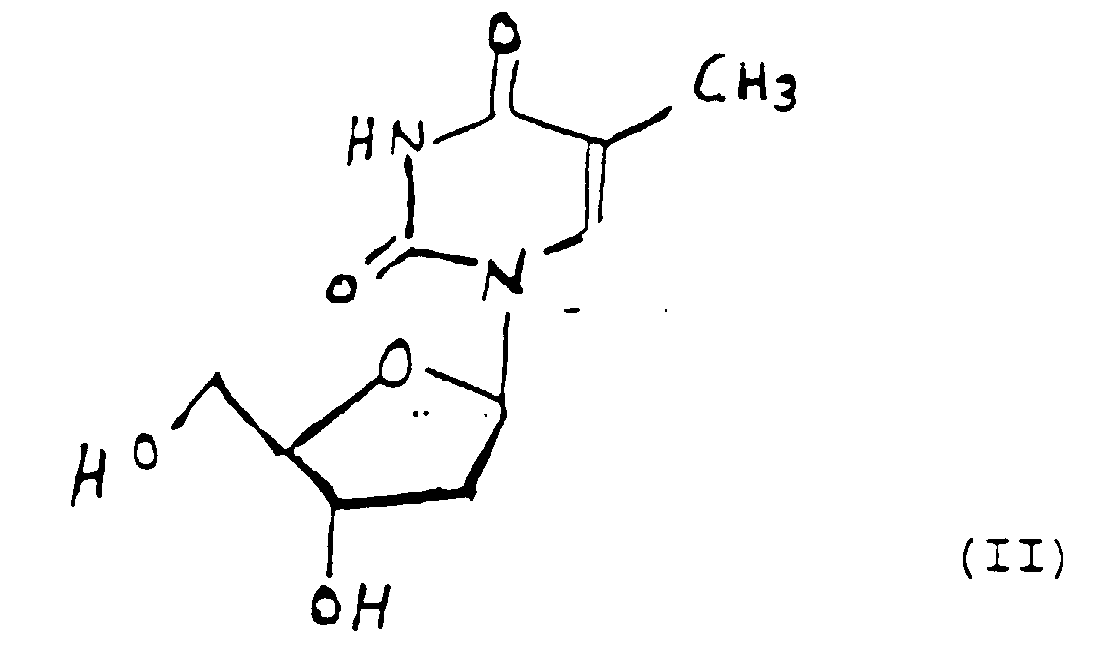
- Beta-thymidine prepared by the process of the present invention has the formula (II).
- Beta-thymidine is an important intermediate for the preparation of dideoxynucleosides.
- Dideoxy-nucleosides of the formula (I) where X represents hydrogen or N 3 , base represents thymine, cytosine or hypoxanthine are of current interest because of their clinical use in the treatment of acquired immuno deficiency syndrome (AIDS).
- AZT of the formula (I) where X represents N 3 and base represents thymine is the most active anti-AIDS agent for which many synthetic routes have been reported (R. Benhaddou et al, Bull, Soc. Chim. Fr., 1991 (Jan-Feb), 108-11; J.D. Wilson, US Pat. No. 4,921,950; Wellcome Foundation Ltd. Jp. Pat. No. 63,255,295; C. K. Chu, PCT Int. Appl. No. 9001,492; M.R. Almond et al, US Pat. No. 4,916,218).
- the commercially useful route for the preparation of AZT uses beta-thymidine of the formula (II) as the starting material.
- the process involves the following steps (a) converting a mixture of alpha and beta anomers of tetra-O-acetylribofuranose to tri-O-acetyl-beta-ribothymidine (b) converting tri-o-acetyl-beta-ribothymidine to beta-ribothymidine (c) converting the beta-ribothymidine to 2, 2'-anhydro-beta-thymidine (d) converting 2, 2'-anhydro-Beta-thymidine to 2'-halo-2'deoxy-5-methyluridine and (e) converting 2'-halo-2'deoxy-5-methyluridine to beta-thymidine.
- the mixture of alpha and beta anomers can be prepared by any suitable methods such as by converting lower alkyl ribofuranoside to the tetra-O-acetyl ribofuranose mixture.
- the lower alkyl ribofuranosides may in turn be prepared by various known methods.
- the desired method may make use of D-ribose as the starting material which is converted to the lower alkyl ribofuranoside.
- the present invention provides an improved process for the preparation of beta-thymidine of the formula (II) which comprises:
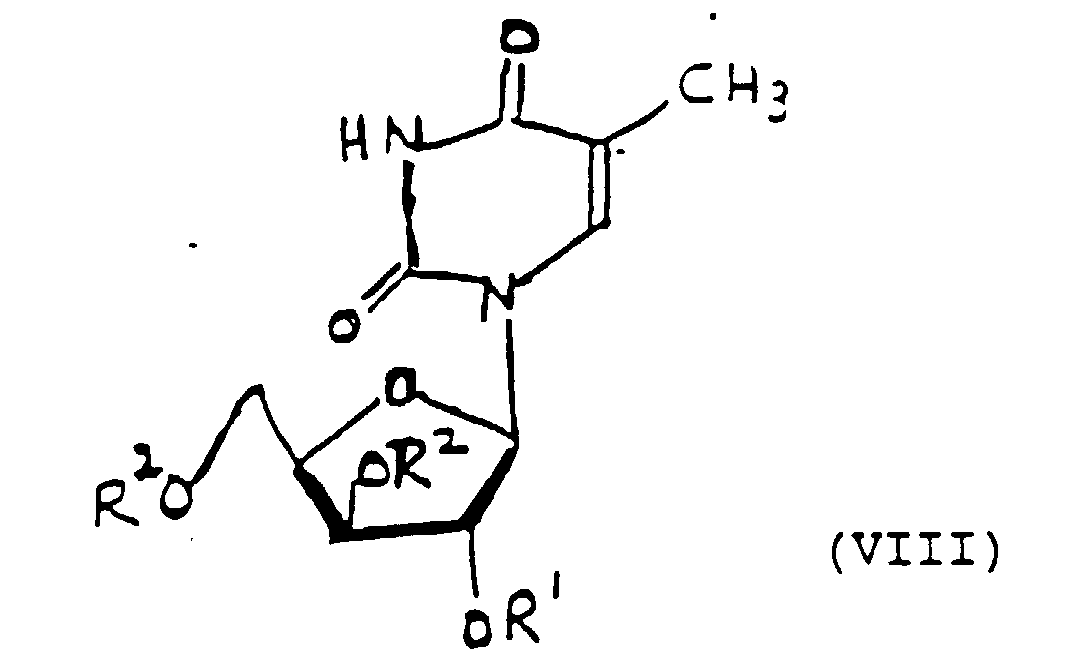
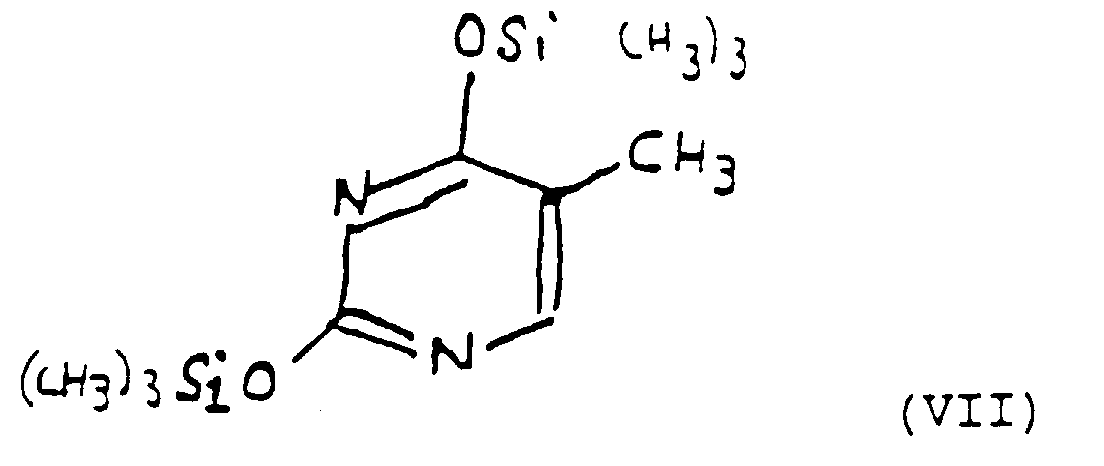
- the 1,2,3-tri-0-acylxlothymidine of the formula (VIII) can be prepared by condensing a mixture of alpha and beta-1,2,3,4-tetra-0-acylxylofuranose of the formula (VI) where R represents benzoyl group and Ac represents an acetyl group or by condensing a mixture of alpha and beta-1,2,3,4-tetra-0-acetylxylofuranose of the formula (VI) where R and Ac represent acetyl groups with 0,0-bis (trimethylsilyl) thymine of the formula (VII) in the presence of condensing agents like Lewis acids.
- the removal of acyl group from the compound of the formula (VI) can be effected in the presence of a base such as sodium methoxide, ammonia, potassium carbonate and the like.
- a base such as sodium methoxide, ammonia, potassium carbonate and the like.
- the organic solvent employed may be selected from methanol, ethanol and the like.
- the condensation of the compound of formula (IX) may be effected using a condensing agent which may be selected from dialkyl or diaryl carbonate such as dimethyl, diethyl, diphenyl carbonate and the like.
- the condensation of the compound formula (IX) may be effected in the presence of base like sodium bicarbonate, sodium carbonate, potassium carbonate, and the like in the presence of polar nonprotic solvent agents like N,N-dimethylformamide.
- the condensation may be effected at a temperature in the range of 120 to 160°C.
- the bromination of compound of formula (X) may be effected employing agents like hydrogen bromide dissolved in appropriate solvent like N,N-dimethylformamide and the like.
- the bromination may also be effected in the presence of agents like pyridinium hydrobromide, and the like.
- the bromo derivative may be reduced employing usually employed agents such as Raney Nickel, palladium on charcoal and the like.
- the deacetylation of the compound of the formula (XV) may be effected using a base such as sodium methoxide, ammonia, and the like. Solvents such as methanol, ethanol and the like may also be employed for the deacetylation.
- beta-thymidine of the formula (II) is fraught with many difficulties, the foremost being expensive starting materials.
- beta-thymidine is prepared by the coupling reaction between protected 2-deoxy-D-ribose of the formula (III) and protected thymine of the formula (VII) which unfortunately provides a mixture of alpha and beta nucleosides (A.J. Hubbard et al, Nucleic Acids Res. 1984, 12,682/; U. Nieball et al, J.Org. Chem. 1974, 39,3654; H. Vorbruggen et al, US Pat. No. 3,748,320).
- alpha-nucleoside has very little use in the synthesis of pharmaceutically useful compounds. Moreover the separation of alpha and beta nucleosides is a tedious process.
- the recently reported process for the preparation of beta-thymidine comprises the coupling reaction between protected D-ribose of the formula (IV) where R represents acetyl group and protected thymine of the formula (VII) followed by deoxygenation at C-2'.
- This process though it does not produce alpha nucleoside, is still an expensive process as it uses D-ribose as a starting material.
- D-xylose of the formula (V) may be converted into a mixture of alpha and beta 1,2-di-O-acetyl-3-5-di-0-benzolyxylofuranose of the formula (VI) where R represents benzoyl group and Ac represents an acetyl group following the procedure described in J. Heterocyl, Chem. 1982, 19(3), 597,602.
- the condensation of compound of formula (VI) with thymine of the formula (VIIA) may be effected in the presence of tintetrachloride (SnCl 4 ), hexamethyldisilazane (HMDS) and trimethylsilychloride (TMSCl).
- TinCl 4 tintetrachloride
- HMDS hexamethyldisilazane
- TMSCl trimethylsilychloride
- the coupling can also be done by condensing the above xylose derivative of the formula (VI) where R represents benzoyl and Ac represents an acetyl group with o,o-bis(trimethylsilyl) thymine of the formula (VII) in the presence of SnCl 4 -
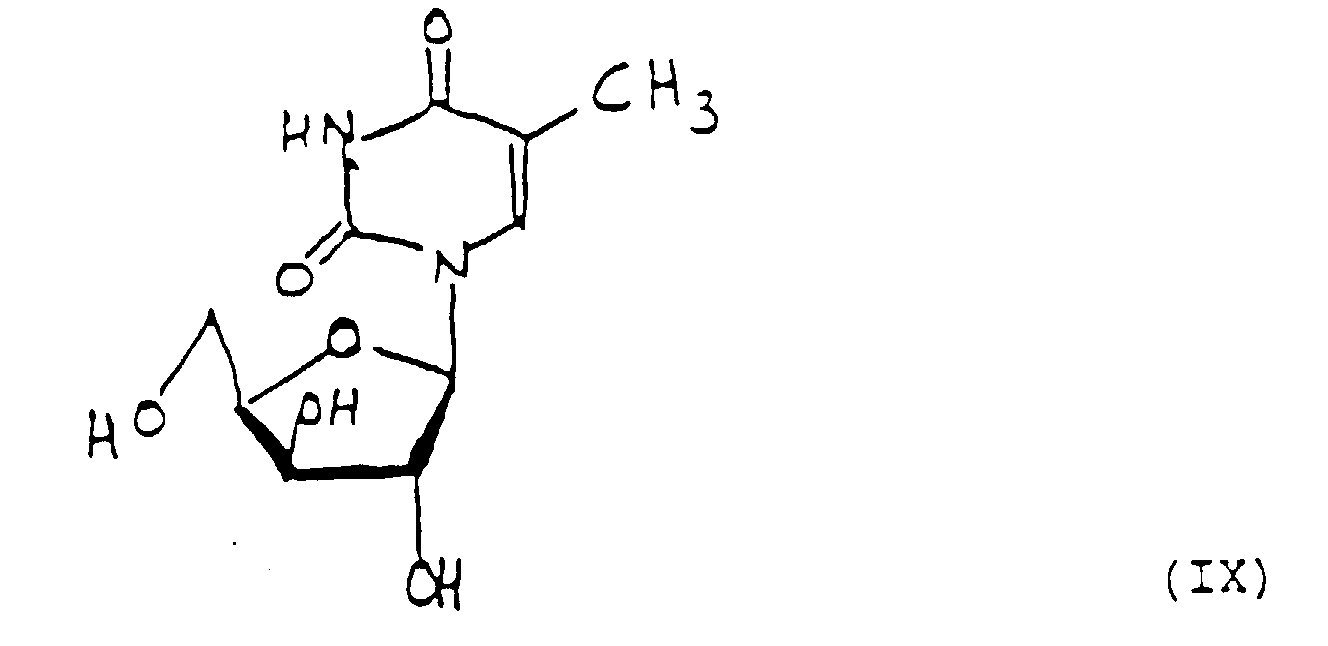
- the removal of the acetyl or benzoyl groups from the resulting compound of formula (VIII) where R 1 represents an acetyl group and R 2 represents benzoyl group may be effected using base such as sodium alkoxide or ammonia in methanol or potassium carbonate in methanol to provide xylothymidine of the formula (IX).
- 1,2,3,5-tetra-O-acetylxylofuranose of the formula (VII) where R and Ac represent acetyl group is condensed with protected thymine of the formula (VII) and deacetylated under the conditions given above to provide xylothymidine of the formula (IX).
- the dialkyl or diaryl carbonates used for the condensation of xylothymidine may be dimethyl, diethyl or diphenylcarbonate.
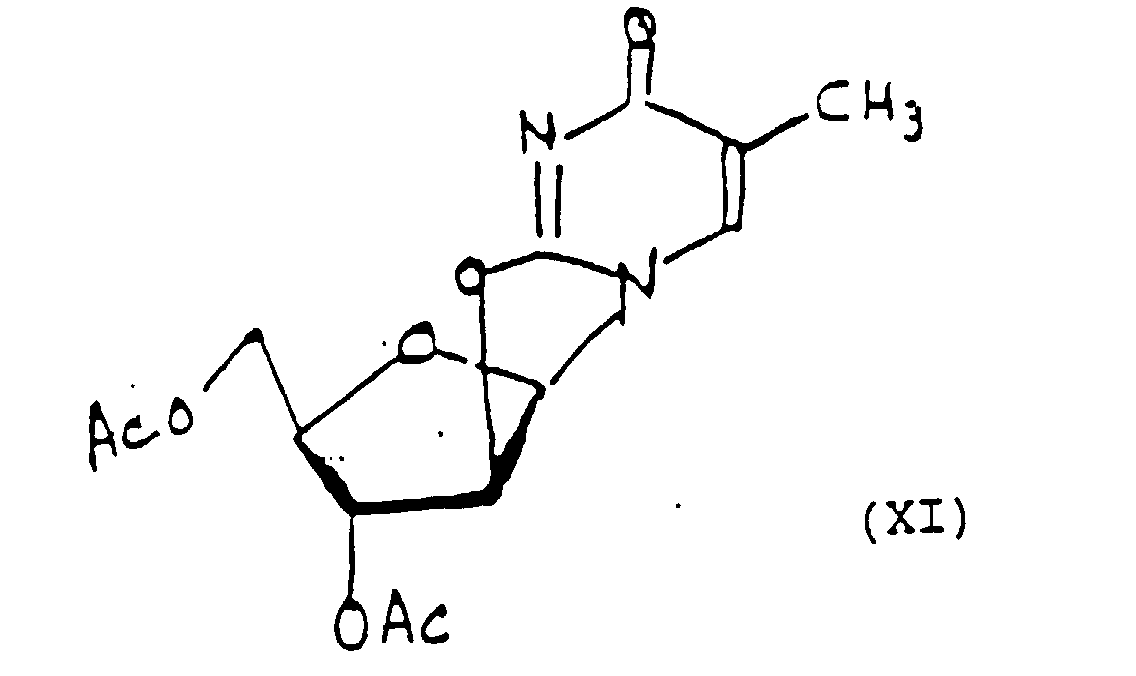
- the condensation may be effected in the presence of sodium bicarbonate in N,N-dimethylformamide (DMF) at a temperature in the range of 120 - 160°C to give 2,2'-anhydrothymidine of the formula (X) which is acetylated with pyridime and acetyle anhydride to give 3',5'-di-o-acetyl-2,2'-anhydrothmidine of the formula (XI) Ac represents acetyl group.
- DMF N,N-dimethylformamide
- the treatment of 2,2'-anhydrothymidine of the formula (X) or its diacetyl derivative of the formula (XI) with hydrogen bromide in N,N-dimethyllormamide may be effected at temperature in the range of 90-110°C or with pyridinium-hydrobromide salt in pyridine at a temperature in the range of 110-130°C to afford the 2'bromo derivative of the formula (XIV) where R represent acetyl group.
- Deacetylation of the compound of the formula (XV) with mild base resulted in the formation of beta-thymidine of the formula (II).
- Diacetylanhydrothymidine of the formula (XI) (5g) was dissolved in 20 ml of DMF containing 1.5g (gm) (1.2 eqv) of anhydrous HBr and kept at 90-110°C for 2h (hrs). The reaction mixture was poured into 100 ml ice water, extracted thrice with chloroform (30 ml), the organic layers combined, dried and concentrated to yield 5.9g (gm) (95%) of 2'-bromo-2'-deoxy-3',5-di-O-acetylthymidine of the formula (XIV).
Landscapes
- Chemical & Material Sciences (AREA)
- Organic Chemistry (AREA)
- Health & Medical Sciences (AREA)
- Life Sciences & Earth Sciences (AREA)
- Engineering & Computer Science (AREA)
- Biochemistry (AREA)
- Biotechnology (AREA)
- General Health & Medical Sciences (AREA)
- Genetics & Genomics (AREA)
- Molecular Biology (AREA)
- Saccharide Compounds (AREA)
Claims (16)
- Procédé pour la préparation de bêta-thymidine de formule (II)qui comprend :
 (a) la préparation de la xylothymidine déprotégée, de formule (IX)en éliminant par une méthode classique les groupes acyle de la 1,2,3-tri-O-acyl-xylothymidine de formule (VIII)
 où R1 représente un groupe acétyle, R2 représente un groupe benzoyle ou un groupe acétyle,
 (b) condensation de la xylothymidine déprotégée de formule (IX) avec un carbonate de dialkyle ou diaryle en présence d'une base et d'un solvant organique pour obtenir la 2,2'-anhydrothymidine de formule (X)
 (c) la bromation de la 2,2'-anhydrothymidine de formule (XI)par une méthode classique pour obtenir le dérivé 2'-bromé de formule (XIV)
 où R représente l'hydrogène ou un groupe acétyle,
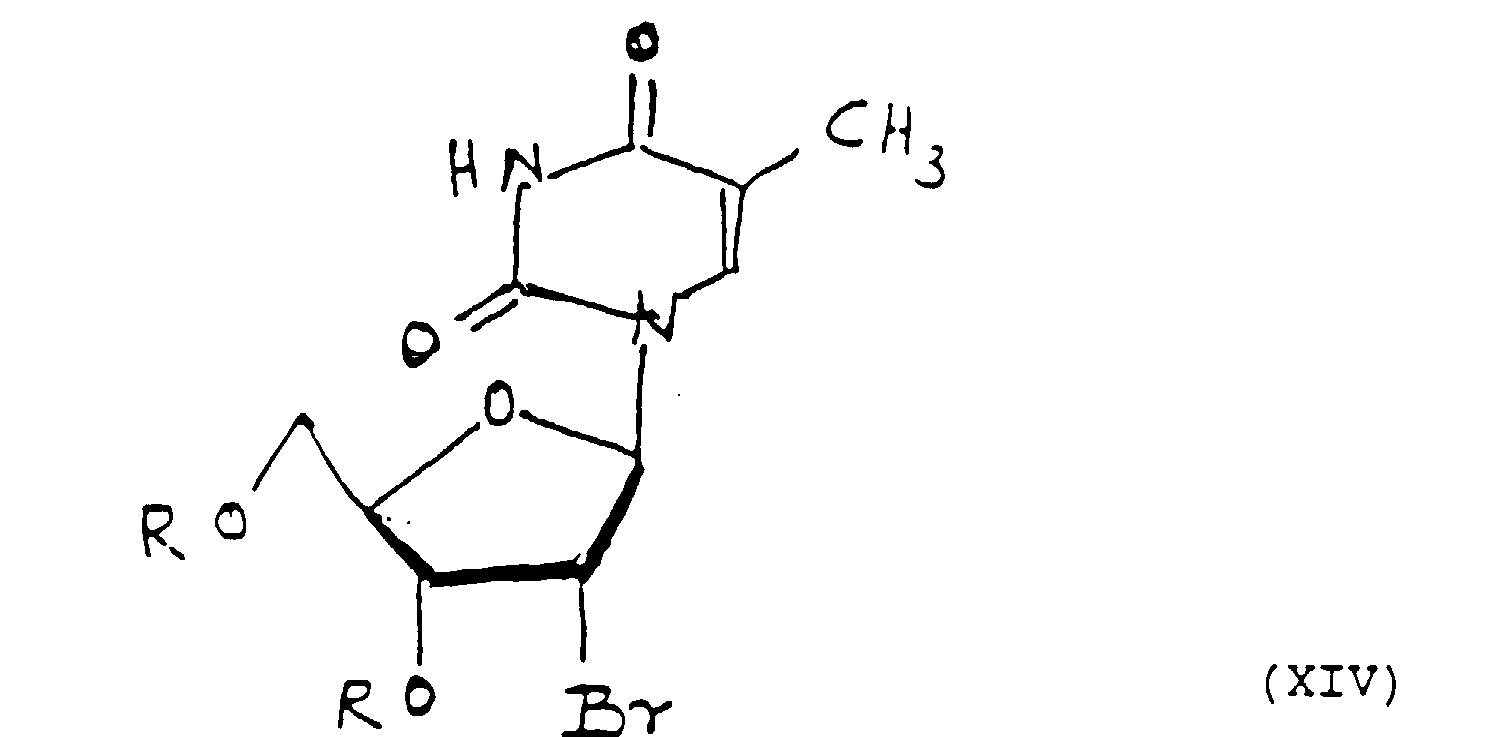 (d) la réduction du dérivé 2'-bromé de formule (XIV) par des méthodes classiques pour obtenir la bêta-thymidine de formule (II) ou son dérivé diacétylé de formule (XV)et
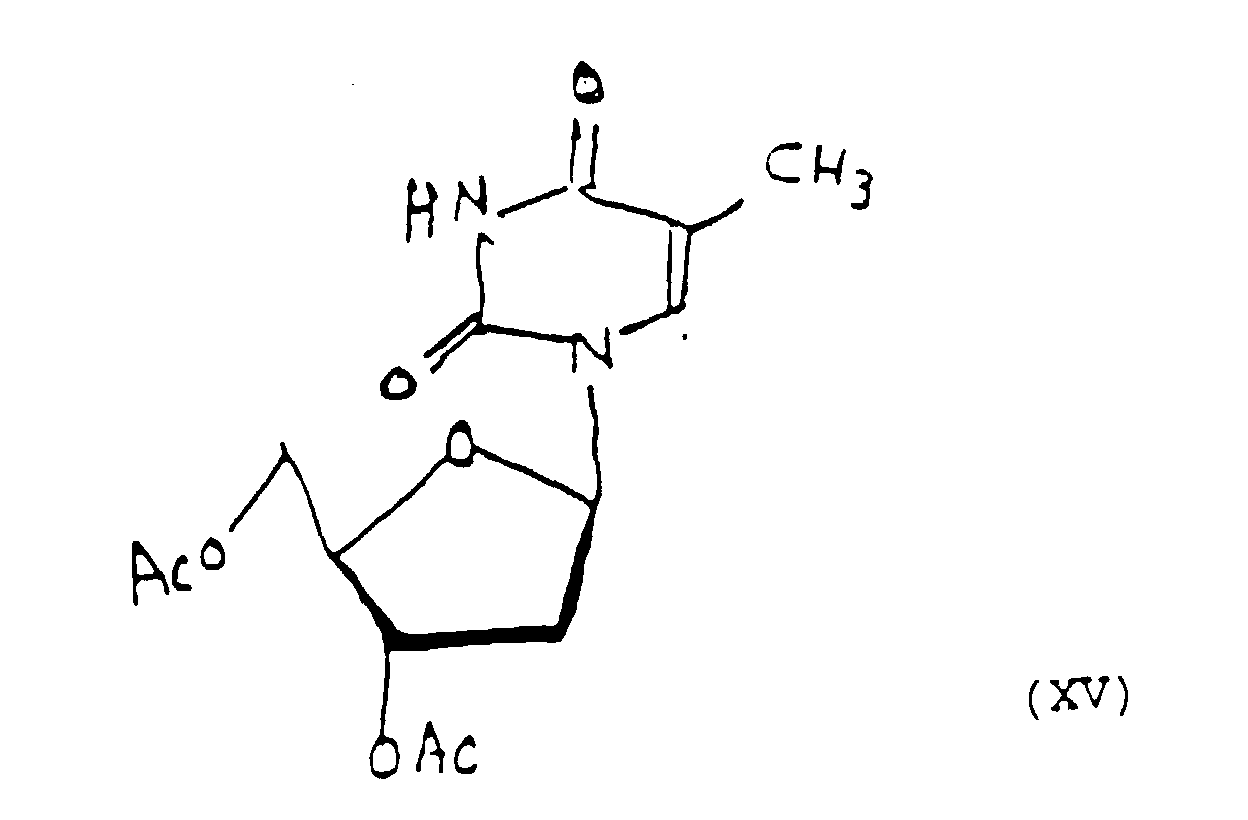 (e) facultativement, la désacyclation du dérivé acétylé de formule (XV), où Ac représente un groupe acétyle, par des méthodes classiques pour obtenir la bêta-thymidine de formule (II).
- Procédé tel que revendiqué dans la revendication 1, dans lequel la 1,2,3-tri-O-acyl-xylothymidine de formule (VIII) est préparée en condensant un mélange d'alpha- et bêta-1,2-di-O-acétyl-3,5-di-O-benzoyl-xylo-furannoses de formule (VI)où R représente un groupe benzoyle et Ac représente un groupe acétyle, ou un mélange d'alpha- et bêta-1,2,3,4-étra-O-acétylxylofurannoses de formule (VI) où R et Ac représentent des groupes acétyle avec la O,O-bis(triméthylsilyl)thymine de formule (VII)
 en présence d'un agent de condensation.
- Procédé tel que revendiqué dans la revendication 2, dans lequel l'agent de condensation utilisé est un acide de Lewis.
- Procédé tel que revendiqué dans la revendication 3, dans lequel l'acide de Lewis est SnCl4.
- Procédé tel que revendiqué dans la revendication 1, dans lequel l'élimination des groupes acyle du composé de formule (VIII) est effectuée en présence d'une base choisie parmi le méthylate de sodium, l'ammoniac ou le carbonate de potassium.
- Procédé tel que revendiqué dans la revendication 1, dans lequel le solvant organique utilisé est choisi parmi le méthanol et l'éthanol.
- Procédé tel que revendiqué dans la revendication 1, dans lequel le carbonate de dialkyle ou diaryle utilisé pour condenser le composé de formule (IX) est choisi parmi les carbonates de diméthyle, diéthyle ou diphényle.
- Procédé tel que revendiqué dans la revendication 1, dans lequel la condensation du composé de formule (IX) est effectuée en présence de bicarbonate de sodium comme base.
- Procédé tel que revendiqué dans la revendication 1, dans lequel la condensation est effectuée en présence de N,N-diméthylformamide comme solvant aprotique polaire.
- Procédé tel que revendiqué dans la revendication 1, dans lequel la condensation est effectuée à une température comprise dans l'intervalle de 120 à 160°C.
- Procédé tel que revendiqué dans la revendication 1, dans lequel la bromation est effectuée en utilisant du bromure d'hydrogène.
- Procédé tel que revendiqué dans la revendication 1, dans lequel la bromation est effectuée en présence d'hydrobromure de pyridinium comme agent de bromation.
- Procédé tel que revendiqué dans la revendication 1, dans lequel les solvants N,N-diméthylformamide ou pyridine sont également utilisés dans l'étape de bromation.
- Procédé tel que revendiqué dans la revendication 1, dans lequel le dérivé bromé est réduit en utilisant du nickel de Raney ou du palladium sur charbon.
- Procédé tel que revendiqué dans la revendication 1, dans lequel la désacétylation du composé de formule (XV) est effectuée en utilisant le méthylate de sodium ou l'ammoniac comme base.
- Procédé tel que revendiqué dans la revendication 1, dans lequel les solvants méthanol ou éthanol sont également utilisés pour la désacétylation.
Priority Applications (4)
| Application Number | Priority Date | Filing Date | Title |
|---|---|---|---|
| ES94303637T ES2125408T3 (es) | 1994-05-20 | 1994-05-20 | Un procedimiento para la preparacion de beta-timidina. |
| EP94303637A EP0683171B1 (fr) | 1994-05-20 | 1994-05-20 | Procédé pour la préparation de bêta-thymidine |
| US08/246,789 US5596087A (en) | 1994-05-20 | 1994-05-20 | Process for the preparation of beta thymidine |
| DE69415506T DE69415506T2 (de) | 1994-05-20 | 1994-05-20 | Verfahren zur Herstellung von Beta-Thymidine |
Applications Claiming Priority (2)
| Application Number | Priority Date | Filing Date | Title |
|---|---|---|---|
| EP94303637A EP0683171B1 (fr) | 1994-05-20 | 1994-05-20 | Procédé pour la préparation de bêta-thymidine |
| US08/246,789 US5596087A (en) | 1994-05-20 | 1994-05-20 | Process for the preparation of beta thymidine |
Publications (2)
| Publication Number | Publication Date |
|---|---|
| EP0683171A1 EP0683171A1 (fr) | 1995-11-22 |
| EP0683171B1 true EP0683171B1 (fr) | 1998-12-23 |
Family
ID=26137115
Family Applications (1)
| Application Number | Title | Priority Date | Filing Date |
|---|---|---|---|
| EP94303637A Expired - Lifetime EP0683171B1 (fr) | 1994-05-20 | 1994-05-20 | Procédé pour la préparation de bêta-thymidine |
Country Status (4)
| Country | Link |
|---|---|
| US (1) | US5596087A (fr) |
| EP (1) | EP0683171B1 (fr) |
| DE (1) | DE69415506T2 (fr) |
| ES (1) | ES2125408T3 (fr) |
Cited By (1)
| Publication number | Priority date | Publication date | Assignee | Title |
|---|---|---|---|---|
| EP2157095A2 (fr) | 2003-06-30 | 2010-02-24 | Novartis Ag | Synthèse de bêta-L-2-désoxynucléosides |
Families Citing this family (3)
| Publication number | Priority date | Publication date | Assignee | Title |
|---|---|---|---|---|
| WO1997006241A1 (fr) | 1995-08-04 | 1997-02-20 | The General Hospital Corporation | Porc transgenique et cellules de porc possedant des genes hla de l'homme |
| KR20060015542A (ko) * | 2003-04-28 | 2006-02-17 | 이데닉스 (케이만) 리미티드 | 산업 규모의 뉴클레오시드 합성 |
| CN1310936C (zh) * | 2004-10-28 | 2007-04-18 | 浙江沙星医药化工有限公司 | β-胸苷的工业制备方法 |
Family Cites Families (5)
| Publication number | Priority date | Publication date | Assignee | Title |
|---|---|---|---|---|
| US4730001A (en) * | 1986-01-22 | 1988-03-08 | Southern Research Institute | Carbocyclic analogues of amino and azido thymidines |
| US4914233A (en) * | 1988-03-01 | 1990-04-03 | Ethyl Corporation | Synthesis of beta-thymidine |
| US4921950A (en) * | 1988-06-09 | 1990-05-01 | Burroughs Wellcome Co. | Preparation of 3'azido-3-'-deoxythymidine |
| US4916218A (en) * | 1988-06-09 | 1990-04-10 | Almond Merrick R | 1-(β-D-xylofuranosyl)thymine derivatives |
| US5008384A (en) * | 1988-07-12 | 1991-04-16 | Pfizer Inc. | Process for the production of O.sup. 2,2'-anhydro-1-(β-D-arabinofuranosyl)thymine |
-
1994
- 1994-05-20 EP EP94303637A patent/EP0683171B1/fr not_active Expired - Lifetime
- 1994-05-20 US US08/246,789 patent/US5596087A/en not_active Expired - Fee Related
- 1994-05-20 ES ES94303637T patent/ES2125408T3/es not_active Expired - Lifetime
- 1994-05-20 DE DE69415506T patent/DE69415506T2/de not_active Expired - Fee Related
Cited By (1)
| Publication number | Priority date | Publication date | Assignee | Title |
|---|---|---|---|---|
| EP2157095A2 (fr) | 2003-06-30 | 2010-02-24 | Novartis Ag | Synthèse de bêta-L-2-désoxynucléosides |
Also Published As
| Publication number | Publication date |
|---|---|
| DE69415506D1 (de) | 1999-02-04 |
| DE69415506T2 (de) | 1999-08-12 |
| ES2125408T3 (es) | 1999-03-01 |
| US5596087A (en) | 1997-01-21 |
| EP0683171A1 (fr) | 1995-11-22 |
Similar Documents
| Publication | Publication Date | Title |
|---|---|---|
| US5606048A (en) | Stereoselective glycosylation process for preparing 2'-Deoxy-2', 2'-difluoronucleosides and 2'-deoxy-2'-fluoronucleosides | |
| US5128458A (en) | 2',3'-dideoxy-4'-thioribonucleosides as antiviral agents | |
| JPH05505815A (ja) | ヌクレオシド誘導体 | |
| US5744597A (en) | Stereoselective anion glycosylation process for preparing 2'-deoxy-2',2'-difluoronucleosides and 2'-deoxy-2'-fluoronucleosides | |
| JPH0723394B2 (ja) | 新規アデノシン誘導体及び該化合物を有効成分として含有する医薬組成物 | |
| US4689404A (en) | Production of cytosine nucleosides | |
| SK545290A3 (en) | Method of preparation of 2'3'-dideoxy-2'-fluoronucleosides and 2'3'-dideoxy-2'3'-didehydro-2'-fluoronucleosides | |
| KR970002659B1 (ko) | 2', 2'-디플루오로뉴클레오시드 및 중간체의 제조 방법 | |
| EP2157095A2 (fr) | Synthèse de bêta-L-2-désoxynucléosides | |
| WO1996032403A2 (fr) | Nouveaux derives cytosine et cytidine | |
| EP1373288B1 (fr) | Procede de preparation de 2'-halo-beta-l-arabinofuranosyl nucleosides | |
| US5596087A (en) | Process for the preparation of beta thymidine | |
| AU2002303187A1 (en) | Process for the preparation of 2'-HALO-Beta-L-arabinofuranosyl nucleosides | |
| JPS63255295A (ja) | 3′−アジド−3′−デオキシチミジン | |
| Sivets et al. | Synthesis of 2-fluoro-substituted and 2, 6-modified purine 2′, 3′-dideoxy-2′, 3′-difluoro-d-arabinofuranosyl nucleosides from d-xylose | |
| US3872084A (en) | Purine nucleoside 3,5-cyclicphosphate compounds | |
| US5466787A (en) | Process for preparing AZT | |
| WO2006070985A1 (fr) | Méthode de synthèse de la 2’-désoxy-2’,2’-difluorocytidine | |
| US4086416A (en) | Septacidin analogs | |
| DE69719673T2 (de) | D-pentofuranose-derivate und verfahren zu ihrer herstellung | |
| US5644043A (en) | 2',3'-dideoxy-2',2'-difluoronucleosides and intermediates | |
| US5478928A (en) | 2',3'-dideoxy-4'-thioribonucleosides and synthetic precursors thereof | |
| RU2108339C1 (ru) | Способ получения 2'-дезоксиксилотимидина, производные d-ксилофуранозы, производные ксилотимидина | |
| JPH01224390A (ja) | ヌクレオシド誘導体の製造方法 | |
| KR900006232B1 (ko) | 엘립티신 배당체의 제조방법 |
Legal Events
| Date | Code | Title | Description |
|---|---|---|---|
| PUAI | Public reference made under article 153(3) epc to a published international application that has entered the european phase |
Free format text: ORIGINAL CODE: 0009012 |
|
| AK | Designated contracting states |
Kind code of ref document: A1 Designated state(s): DE ES FR GB |
|
| 17P | Request for examination filed |
Effective date: 19951123 |
|
| 17Q | First examination report despatched |
Effective date: 19960124 |
|
| GRAG | Despatch of communication of intention to grant |
Free format text: ORIGINAL CODE: EPIDOS AGRA |
|
| GRAG | Despatch of communication of intention to grant |
Free format text: ORIGINAL CODE: EPIDOS AGRA |
|
| GRAH | Despatch of communication of intention to grant a patent |
Free format text: ORIGINAL CODE: EPIDOS IGRA |
|
| GRAH | Despatch of communication of intention to grant a patent |
Free format text: ORIGINAL CODE: EPIDOS IGRA |
|
| GRAA | (expected) grant |
Free format text: ORIGINAL CODE: 0009210 |
|
| AK | Designated contracting states |
Kind code of ref document: B1 Designated state(s): DE ES FR GB |
|
| REF | Corresponds to: |
Ref document number: 69415506 Country of ref document: DE Date of ref document: 19990204 |
|
| REG | Reference to a national code |
Ref country code: ES Ref legal event code: FG2A Ref document number: 2125408 Country of ref document: ES Kind code of ref document: T3 |
|
| ET | Fr: translation filed | ||
| PLBE | No opposition filed within time limit |
Free format text: ORIGINAL CODE: 0009261 |
|
| STAA | Information on the status of an ep patent application or granted ep patent |
Free format text: STATUS: NO OPPOSITION FILED WITHIN TIME LIMIT |
|
| 26N | No opposition filed | ||
| REG | Reference to a national code |
Ref country code: GB Ref legal event code: IF02 |
|
| PGFP | Annual fee paid to national office [announced via postgrant information from national office to epo] |
Ref country code: GB Payment date: 20030521 Year of fee payment: 10 |
|
| PGFP | Annual fee paid to national office [announced via postgrant information from national office to epo] |
Ref country code: FR Payment date: 20030528 Year of fee payment: 10 Ref country code: ES Payment date: 20030528 Year of fee payment: 10 |
|
| PGFP | Annual fee paid to national office [announced via postgrant information from national office to epo] |
Ref country code: DE Payment date: 20030530 Year of fee payment: 10 |
|
| PG25 | Lapsed in a contracting state [announced via postgrant information from national office to epo] |
Ref country code: GB Free format text: LAPSE BECAUSE OF NON-PAYMENT OF DUE FEES Effective date: 20040520 |
|
| PG25 | Lapsed in a contracting state [announced via postgrant information from national office to epo] |
Ref country code: ES Free format text: LAPSE BECAUSE OF NON-PAYMENT OF DUE FEES Effective date: 20040521 |
|
| PG25 | Lapsed in a contracting state [announced via postgrant information from national office to epo] |
Ref country code: DE Free format text: LAPSE BECAUSE OF NON-PAYMENT OF DUE FEES Effective date: 20041201 |
|
| GBPC | Gb: european patent ceased through non-payment of renewal fee |
Effective date: 20040520 |
|
| PG25 | Lapsed in a contracting state [announced via postgrant information from national office to epo] |
Ref country code: FR Free format text: LAPSE BECAUSE OF NON-PAYMENT OF DUE FEES Effective date: 20050131 |
|
| REG | Reference to a national code |
Ref country code: FR Ref legal event code: ST |
|
| REG | Reference to a national code |
Ref country code: ES Ref legal event code: FD2A Effective date: 20040521 |