EP0683252A1 - Polyamidfaser - Google Patents
Polyamidfaser Download PDFInfo
- Publication number
- EP0683252A1 EP0683252A1 EP95105882A EP95105882A EP0683252A1 EP 0683252 A1 EP0683252 A1 EP 0683252A1 EP 95105882 A EP95105882 A EP 95105882A EP 95105882 A EP95105882 A EP 95105882A EP 0683252 A1 EP0683252 A1 EP 0683252A1
- Authority
- EP
- European Patent Office
- Prior art keywords
- fiber
- kaolin clay
- polyamide fiber
- polyamide
- weight percent
- Prior art date
- Legal status (The legal status is an assumption and is not a legal conclusion. Google has not performed a legal analysis and makes no representation as to the accuracy of the status listed.)
- Ceased
Links
- 239000000835 fiber Substances 0.000 title claims abstract description 66
- 239000004952 Polyamide Substances 0.000 title claims abstract description 49
- 229920002647 polyamide Polymers 0.000 title claims abstract description 49
- GWEVSGVZZGPLCZ-UHFFFAOYSA-N Titan oxide Chemical compound O=[Ti]=O GWEVSGVZZGPLCZ-UHFFFAOYSA-N 0.000 claims abstract description 77
- 239000004927 clay Substances 0.000 claims abstract description 50
- NLYAJNPCOHFWQQ-UHFFFAOYSA-N kaolin Chemical compound O.O.O=[Al]O[Si](=O)O[Si](=O)O[Al]=O NLYAJNPCOHFWQQ-UHFFFAOYSA-N 0.000 claims abstract description 44
- 239000005995 Aluminium silicate Substances 0.000 claims abstract description 39
- 235000012211 aluminium silicate Nutrition 0.000 claims abstract description 39
- 239000004408 titanium dioxide Substances 0.000 claims abstract description 26
- 238000000034 method Methods 0.000 claims abstract description 14
- 239000002245 particle Substances 0.000 claims abstract description 11
- 229920002292 Nylon 6 Polymers 0.000 claims description 14
- 229920002302 Nylon 6,6 Polymers 0.000 claims description 4
- 230000003247 decreasing effect Effects 0.000 claims description 4
- 239000002932 luster Substances 0.000 description 23
- 239000012141 concentrate Substances 0.000 description 14
- 229920000642 polymer Polymers 0.000 description 9
- 239000000203 mixture Substances 0.000 description 8
- 239000004677 Nylon Substances 0.000 description 5
- 229920001778 nylon Polymers 0.000 description 5
- 239000000654 additive Substances 0.000 description 4
- 230000000996 additive effect Effects 0.000 description 4
- 230000000052 comparative effect Effects 0.000 description 4
- 230000004048 modification Effects 0.000 description 4
- 238000012986 modification Methods 0.000 description 4
- 229920006122 polyamide resin Polymers 0.000 description 4
- MWUXSHHQAYIFBG-UHFFFAOYSA-N Nitric oxide Chemical compound O=[N] MWUXSHHQAYIFBG-UHFFFAOYSA-N 0.000 description 3
- PNEYBMLMFCGWSK-UHFFFAOYSA-N aluminium oxide Inorganic materials [O-2].[O-2].[O-2].[Al+3].[Al+3] PNEYBMLMFCGWSK-UHFFFAOYSA-N 0.000 description 3
- 229910052593 corundum Inorganic materials 0.000 description 3
- 229910052622 kaolinite Inorganic materials 0.000 description 3
- 239000000463 material Substances 0.000 description 3
- 229910001845 yogo sapphire Inorganic materials 0.000 description 3
- 229920000577 Nylon 6/66 Polymers 0.000 description 2
- QVGXLLKOCUKJST-UHFFFAOYSA-N atomic oxygen Chemical compound [O] QVGXLLKOCUKJST-UHFFFAOYSA-N 0.000 description 2
- TZYHIGCKINZLPD-UHFFFAOYSA-N azepan-2-one;hexane-1,6-diamine;hexanedioic acid Chemical compound NCCCCCCN.O=C1CCCCCN1.OC(=O)CCCCC(O)=O TZYHIGCKINZLPD-UHFFFAOYSA-N 0.000 description 2
- GUJOJGAPFQRJSV-UHFFFAOYSA-N dialuminum;dioxosilane;oxygen(2-);hydrate Chemical compound O.[O-2].[O-2].[O-2].[Al+3].[Al+3].O=[Si]=O.O=[Si]=O.O=[Si]=O.O=[Si]=O GUJOJGAPFQRJSV-UHFFFAOYSA-N 0.000 description 2
- 238000011068 loading method Methods 0.000 description 2
- 239000002480 mineral oil Substances 0.000 description 2
- 235000010446 mineral oil Nutrition 0.000 description 2
- 229910052901 montmorillonite Inorganic materials 0.000 description 2
- 239000001301 oxygen Substances 0.000 description 2
- 229910052760 oxygen Inorganic materials 0.000 description 2
- 229920000728 polyester Polymers 0.000 description 2
- IJGRMHOSHXDMSA-UHFFFAOYSA-N Atomic nitrogen Chemical compound N#N IJGRMHOSHXDMSA-UHFFFAOYSA-N 0.000 description 1
- OKTJSMMVPCPJKN-UHFFFAOYSA-N Carbon Chemical compound [C] OKTJSMMVPCPJKN-UHFFFAOYSA-N 0.000 description 1
- 239000004606 Fillers/Extenders Substances 0.000 description 1
- JHWNWJKBPDFINM-UHFFFAOYSA-N Laurolactam Chemical compound O=C1CCCCCCCCCCCN1 JHWNWJKBPDFINM-UHFFFAOYSA-N 0.000 description 1
- 239000004594 Masterbatch (MB) Substances 0.000 description 1
- 229920000299 Nylon 12 Polymers 0.000 description 1
- 229920001007 Nylon 4 Polymers 0.000 description 1
- 229920000572 Nylon 6/12 Polymers 0.000 description 1
- CBENFWSGALASAD-UHFFFAOYSA-N Ozone Chemical compound [O-][O+]=O CBENFWSGALASAD-UHFFFAOYSA-N 0.000 description 1
- 239000004784 Superba Substances 0.000 description 1
- 241000324401 Superba Species 0.000 description 1
- 230000015572 biosynthetic process Effects 0.000 description 1
- 230000015556 catabolic process Effects 0.000 description 1
- 239000003795 chemical substances by application Substances 0.000 description 1
- 238000006731 degradation reaction Methods 0.000 description 1
- 229910001873 dinitrogen Inorganic materials 0.000 description 1
- ZMUCVNSKULGPQG-UHFFFAOYSA-N dodecanedioic acid;hexane-1,6-diamine Chemical compound NCCCCCCN.OC(=O)CCCCCCCCCCC(O)=O ZMUCVNSKULGPQG-UHFFFAOYSA-N 0.000 description 1
- 239000000975 dye Substances 0.000 description 1
- 230000000694 effects Effects 0.000 description 1
- 238000005562 fading Methods 0.000 description 1
- 239000000945 filler Substances 0.000 description 1
- XLYOFNOQVPJJNP-ZSJDYOACSA-N heavy water Substances [2H]O[2H] XLYOFNOQVPJJNP-ZSJDYOACSA-N 0.000 description 1
- 239000005457 ice water Substances 0.000 description 1
- 230000001788 irregular Effects 0.000 description 1
- 238000002156 mixing Methods 0.000 description 1
- 239000000178 monomer Substances 0.000 description 1
- 231100000989 no adverse effect Toxicity 0.000 description 1
- 239000000346 nonvolatile oil Substances 0.000 description 1
- 239000003921 oil Substances 0.000 description 1
- SOQBVABWOPYFQZ-UHFFFAOYSA-N oxygen(2-);titanium(4+) Chemical group [O-2].[O-2].[Ti+4] SOQBVABWOPYFQZ-UHFFFAOYSA-N 0.000 description 1
- 230000002186 photoactivation Effects 0.000 description 1
- 239000011941 photocatalyst Substances 0.000 description 1
- 238000006116 polymerization reaction Methods 0.000 description 1
- 238000010791 quenching Methods 0.000 description 1
- 230000000171 quenching effect Effects 0.000 description 1
- 239000011342 resin composition Substances 0.000 description 1
- FZHAPNGMFPVSLP-UHFFFAOYSA-N silanamine Chemical compound [SiH3]N FZHAPNGMFPVSLP-UHFFFAOYSA-N 0.000 description 1
- 239000002002 slurry Substances 0.000 description 1
- 238000009987 spinning Methods 0.000 description 1
- 238000004381 surface treatment Methods 0.000 description 1
- 229920001059 synthetic polymer Polymers 0.000 description 1
- 239000004753 textile Substances 0.000 description 1
- 238000009732 tufting Methods 0.000 description 1
- 238000004804 winding Methods 0.000 description 1
- 210000002268 wool Anatomy 0.000 description 1
- 229910052724 xenon Inorganic materials 0.000 description 1
- FHNFHKCVQCLJFQ-UHFFFAOYSA-N xenon atom Chemical compound [Xe] FHNFHKCVQCLJFQ-UHFFFAOYSA-N 0.000 description 1
Images
Classifications
-
- D—TEXTILES; PAPER
- D01—NATURAL OR MAN-MADE THREADS OR FIBRES; SPINNING
- D01F—CHEMICAL FEATURES IN THE MANUFACTURE OF ARTIFICIAL FILAMENTS, THREADS, FIBRES, BRISTLES OR RIBBONS; APPARATUS SPECIALLY ADAPTED FOR THE MANUFACTURE OF CARBON FILAMENTS
- D01F1/00—General methods for the manufacture of artificial filaments or the like
- D01F1/02—Addition of substances to the spinning solution or to the melt
- D01F1/10—Other agents for modifying properties
-
- D—TEXTILES; PAPER
- D01—NATURAL OR MAN-MADE THREADS OR FIBRES; SPINNING
- D01F—CHEMICAL FEATURES IN THE MANUFACTURE OF ARTIFICIAL FILAMENTS, THREADS, FIBRES, BRISTLES OR RIBBONS; APPARATUS SPECIALLY ADAPTED FOR THE MANUFACTURE OF CARBON FILAMENTS
- D01F6/00—Monocomponent artificial filaments or the like of synthetic polymers; Manufacture thereof
- D01F6/58—Monocomponent artificial filaments or the like of synthetic polymers; Manufacture thereof from homopolycondensation products
- D01F6/60—Monocomponent artificial filaments or the like of synthetic polymers; Manufacture thereof from homopolycondensation products from polyamides
-
- Y—GENERAL TAGGING OF NEW TECHNOLOGICAL DEVELOPMENTS; GENERAL TAGGING OF CROSS-SECTIONAL TECHNOLOGIES SPANNING OVER SEVERAL SECTIONS OF THE IPC; TECHNICAL SUBJECTS COVERED BY FORMER USPC CROSS-REFERENCE ART COLLECTIONS [XRACs] AND DIGESTS
- Y10—TECHNICAL SUBJECTS COVERED BY FORMER USPC
- Y10T—TECHNICAL SUBJECTS COVERED BY FORMER US CLASSIFICATION
- Y10T428/00—Stock material or miscellaneous articles
- Y10T428/29—Coated or structually defined flake, particle, cell, strand, strand portion, rod, filament, macroscopic fiber or mass thereof
- Y10T428/2913—Rod, strand, filament or fiber
-
- Y—GENERAL TAGGING OF NEW TECHNOLOGICAL DEVELOPMENTS; GENERAL TAGGING OF CROSS-SECTIONAL TECHNOLOGIES SPANNING OVER SEVERAL SECTIONS OF THE IPC; TECHNICAL SUBJECTS COVERED BY FORMER USPC CROSS-REFERENCE ART COLLECTIONS [XRACs] AND DIGESTS
- Y10—TECHNICAL SUBJECTS COVERED BY FORMER USPC
- Y10T—TECHNICAL SUBJECTS COVERED BY FORMER US CLASSIFICATION
- Y10T428/00—Stock material or miscellaneous articles
- Y10T428/29—Coated or structually defined flake, particle, cell, strand, strand portion, rod, filament, macroscopic fiber or mass thereof
- Y10T428/2913—Rod, strand, filament or fiber
- Y10T428/2927—Rod, strand, filament or fiber including structurally defined particulate matter
Definitions
- This invention relates to a polyamide fiber useful as carpet face fiber that has reduced luster and an improved, wool-like, appearance.
- Titanium dioxide has long been used as a material for delustering synthetic polymers, especially filament-forming polymers such as polyamides which are used as textile components.
- UV ultraviolet
- the titanium dioxide surface can then reabsorb oxygen and atmospheric moisture and again be photoactivated; hence, the titanium dioxide functions as a photocatalyst for degradation of polymers and the dyes contained in polymers.
- Another problem with titanium dioxide is that it imparts an undesirable chalky appearance to polyamide fiber at a loading above 0.10 weight percent.
- Japanese Published Patent Application No. 3-81364 describes a polyamide resin composition that includes montmorillonite (Al2O3 ⁇ 4SiO2 ⁇ H2O) and U.S. Patent No. 3,063,784 describes a method of treating nylon with a montmorillonite solution.
- U.S. Patent No. 3,366,597 describes a method for incorporating calcined kaolinite into a polyester fiber.
- the patent indicates that a polyester fiber may include a broad, general range of 0.1 to 10 and a preferred range of 0.1 to 3.0 weight percent calcined kaolinite having an average particle diameter of 0.5 to 1.5 microns.
- the calcined kaolinite is used in addition to titanium dioxide and all the exemplified fibers include at least 0.1 weight percent titanium dioxide.
- U.S. Patent No. 3,988,287 describes a polyamide composition that includes 5 to 70 weight percent clay and a treating agent for the clay.
- a polyamide fiber having an improved, wool-like appearance and a method for making the same.
- Such a fiber can be very useful as a face fiber in carpets.
- a polyamide fiber comprising 0.3 to 2.0 weight percent kaolin clay having an average particle size of 0.1 to 2.0 microns, and less than 0.1 weight percent titanium dioxide, and a carpet that includes such a polyamide fiber as a face fiber.
- a method for imparting decreased chalkiness to a polyamide fiber that includes at least 0.1 weight percent titanium dioxide comprising incorporating 0.3 to 2.0 weight percent kaolin clay having an average particle size of 0.1 to 2.0 microns into said polyamide fiber.
- polyamide denotes nylon 6, nylon 66, nylon 6/66, nylon 4, nylon 6/12, nylon 6/66/12 and other polymers containing the structure along with the (CH2)x chain. Nylon 6 and 66 are preferred.
- fiber denotes an elongate body, the length dimension of which is much greater than the transverse dimensions of width and thickness. Accordingly, “fiber” includes, for example, monofilament, multifilament yarn (continuous or staple), ribbon, strip, staple and other forms of chopped, cut or discontinuous fiber, and the like having regular or irregular cross-sections. “Fiber” includes a plurality of any one of the above or a combination of the above.
- the kaolin clay used in this invention may be either hydrous (Al2O3 ⁇ 2SiO2 ⁇ 2H2O) or calcined (Al2O3 ⁇ 2SiO2). Hydrous and calcined kaolin clay are well known, commercially available materials. Calcined kaolin clay is preferred because it is more white than hydrous kaolin clay, thus, having less impact on the color of the polyamide fiber. Preferably, the kaolin clay is not surface treated.
- the average particle size of the kaolin clay should be 0.1 to 2.0, preferably 0.1 to 1.0, and most preferably 0.1 to 0.5, microns. If an average particle diameter above 2.0 microns is used, there will be an increased tendency for clogging of the screen pack through which the polyamide passes immediately prior to entering the spinneret.
- the kaolin clay may be incorporated into the polyamide fiber by a variety of techniques.
- the kaolin clay can be mixed with the monomer(s) that forms the polyamide prior to polymerization or it can be mixed with a non-volatile oil to form a pourable slurry which is then added to the polyamide.
- the preferred method is by a masterbatch technique wherein a concentrate that contains polyamide and the kaolin clay is blended or letdown into a feed or base polyamide resin. The blend is then spun into fiber.
- the preferred blending method is melt injecting the concentrate into a spinning machine that includes the base polyamide resin.
- the concentrate should include about 9 to about 50, preferably about 25 to about 35, weight percent kaolin clay, based on the weight of the concentrate, with the remainder being polyamide. Since the kaolin clay is blended with the polyamide resin prior to fiber formation, the kaolin clay particles are present in the body of the fiber rather than only at the surface of the fiber.
- the amount of kaolin clay in the polyamide fiber should be from about 0.3 to about 2.0, preferably from about 0.6 to about 1.0, weight percent, based on the weight of the polyamide fiber. If less than 0.3 weight percent is included, the polyamide fiber will not exhibit the desired low luster. Above 2.0 weight percent, the increase in luster reduction is negligible compared to the increase in processing difficulties and fiber property shortcomings. Between 0.6 and 1.0 weight percent, decreased chalkiness is maximized.
- a significant advantage of the kaolin clay is that it replaces all or a portion of the conventionally used titanium dioxide.
- polyamide fibers Prior to this invention, polyamide fibers typically required at least about 0.1 weight percent of titanium dioxide in order to obtain the desired luster level. As discussed previously, phototactivation of titanium dioxide causes fading of dyed polyamide fibers and titanium dioxide imparts an undesirable chalkiness to the fiber. Combination of the kaolin clay with lower amounts of titanium dioxide results in a luster level that is achieved with the higher conventional level of titanium dioxide alone. Kaolin clay, in affect, acts as an extender for the more expensive titanium dioxide. Consequently, the amount of titanium dioxide necessary in the polyamide fiber ranges from effectively 0 weight percent to less than 0.1 weight percent. As used herein, "effectively 0 weight percent" means that the polyamide fiber can include up to a trace amount of titanium dioxide provided such trace amount does not materially effect any properties of the polyamide fiber.
- the polyamide fiber of the invention can be processed by known methods into a carpet yarn which may be made of multiple continuous filaments or spun staple fiber, both typically textured for increased bulk.
- the carpet yarn may be used as the face fiber in any type of carpet such as tufted or woven carpets.
- the polyamide fiber can also be used in apparel, flags, belts or other industrial uses.
- the polyamide fiber of the invention particularly when it is used in carpets, exhibits very low luster and chalkiness.
- the polyamide fiber when the polyamide fiber is dyed and tufted into carpet face fiber the resulting clarity of color closely resembles the desirable appearance of wool.
- Dyed polyamide fibers that contain calcined kaolin clay additive exhibited no adverse effect when tested for xenon, ozone and nitrogen oxide lightfastness.
- the luster values depicted in Tables 1 and 3 below were measured by the method described in commonly assigned allowed U.S. Patent Application No. 80,640 (filed June 24, 1993), incorporated herein by reference.
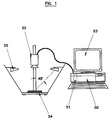
- the luster or sparkle was measured using a carpet image analyzer system.
- This system is illustrated in Figure 1 and consists of a desktop computer 50 , an image grabber board 51 capable of digitizing an image into 256 (horizontal) x 200 (vertical) pixels that each have 32 possible levels of red, green and blue, a video camera 52 with zoom and close-up lenses and an analog video monitor 53 .
- a carpet yarn sample 54 was placed on a stand and two fluorescent tubes 55 were arranged in a parallel and symmetrical pattern at an angle of about 45° relative to the sample plane.
- the carpet yarn samples 54 were prepared by winding yarn on black cardboard to cover an area of about 3 x 3 inches.
- the carpet yarn samples 54 were arranged with the filament axis parallel to the light direction.
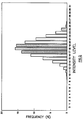
- the intensity of the reflected light is recorded by the video camera 52 and transmitted to the image grabber board 51 which, in turn, generates an intensity distribution curve, an example of which is shown in Figure 2.
- the intensity level is measured on a relative scale ranging from 0 to 31 with 0 representing black and 31 representing white.
- the intensity level is plotted against the frequency or likelihood that a particular pixel will have a certain intensity level.
- the "luster" of a sample is defined as the difference in intensity between the average intensity of the three highest intensity levels which occur and the average intensity of the middle three intensity levels which center on the most frequently occurring intensity levels. To further reduce electrical noise and variations associated with the digitization, the luster reading was calculated from an averaged image of four frames on the same location of a sample and seven readings taken for each sample at different locations.
- the L value is a measure of the color of a given sample.
- Delta L is the difference between the L value of a particular sample and the L value of a reference.
- the reference is a nylon 6 yarn that does not include any kaolin clay or titanium dioxide.
- L values can range from 0 to 100, with 0 representing black and 100 representing white. Consequently, the higher the L value the more white and chalkier the appearance.
- the L values are Hunter L H values measured according to ASTM D 2244-89.
- Nylon 6 polymer chip was oven dried under nitrogen gas to a moisture content of ⁇ 0.3 wt.% moisture.
- the dry chips (81.0 pounds) were tumble blended with 0.80 pounds of mineral oil in a twin shell rotary blender. After the chips were well coated with the oil, 9.0 pounds of calcined kaolin clay (available from Dry Branch Kaolin Co. under the tradename Glomax JDF) was added to the nylon chips and blended for 1 hour.
- the clay coated chips were then extruded in a twin screw extruder with an exit polymer temperature of about 260 C°.
- the strand of nylon with approximately 10 wt.% clay was cooled by quenching in an ice water bath. The cold strand was chopped into small chips with a mill.
- the resulting blends were spun as 2900 undrawn denier, 50 filament bulked continuous filament yarns, with a trilobal ("Y") filament cross section having a modification ratio of about 3.0 to 3.1.
- a commercial spin finish was applied at 6% wet pickup to the undrawn yarns.
- the undrawn yarns were drawn to a final denier of about 1100.
- the yarns were analyzed for % ash (% clay) with the results shown below in Table 1.
- the yarns were Superba heat set and 2 plied with 4.25S x 4.25Z twist then tufted into carpets.
- the carpets were tufted on a 1/10 gauge machine with a cut pile height of 9/32 inches and 28 oz./sq. yd. weight.
- yarn samples Prior to tufting, yarn samples were wrapped around black cardboard as described above in order to measure their luster. The modification ratio and luster results for the samples are given below in Table 1. TABLE 1 Sample No.
- Example 1 Concentrates were made as in Example 1 where dried nylon chips were first coated with 0.1% mineral oil and then tumble blended with the appropriate calcined kaolin clay. Two additional types of calcined kaolin clay were used that had been surface treated - tradename Translink 445, Translink 555 (treated with an aminosilane) and tradename Ultralink PA-100, both available from Englehard. The Satintone Special and Optiwhite clays are not surface treated.
- the coated chips were extruded on the twin screw extruder, quenched and pelletized with the mill. The concentrate chips were then dried to ⁇ 0.3 wt.% moisture in a steam heated vacuum oven.
- Comparative yarn samples 14 and 15 include the anatase TiO2 only in the wt.% ash amounts shown. The yarns were wrapped on a piece of black cardboard. The wrapped samples were placed on a table and visually compared by three people. TABLE 2 Sample No. Additive wt% Ash Luster Rank Comp.1 None, Control 0.04 1 2 Ultralink PA 0.59 2 3 Ultralink PA 0.91 3 4 Ultralink PA 1.71 6 5 Translink 555 0.63 2 6 Translink 555 0.94 2 7 Translink 555 1.79 3 8 Translink 445 0.68 1 9 Translink 445 0.98 3 10 Translink 445 1.87 5 11 Satintone Sp. 0.65 2 12 Satintone Sp. 1.00 3 13 Satintone Sp.
- a concentrate was prepared with nylon 6 and calcined kaolin clay (Glomax JDF).
- the concentrate produced was a small, light colored chip with 30.5 wt.% ash.
Landscapes
- Engineering & Computer Science (AREA)
- Chemical & Material Sciences (AREA)
- Chemical Kinetics & Catalysis (AREA)
- General Chemical & Material Sciences (AREA)
- Textile Engineering (AREA)
- Manufacturing & Machinery (AREA)
- Artificial Filaments (AREA)
- Compositions Of Macromolecular Compounds (AREA)
Applications Claiming Priority (2)
| Application Number | Priority Date | Filing Date | Title |
|---|---|---|---|
| US24303694A | 1994-05-16 | 1994-05-16 | |
| US243036 | 2002-09-13 |
Publications (1)
| Publication Number | Publication Date |
|---|---|
| EP0683252A1 true EP0683252A1 (de) | 1995-11-22 |
Family
ID=22917112
Family Applications (1)
| Application Number | Title | Priority Date | Filing Date |
|---|---|---|---|
| EP95105882A Ceased EP0683252A1 (de) | 1994-05-16 | 1995-04-20 | Polyamidfaser |
Country Status (2)
| Country | Link |
|---|---|
| US (2) | US5686517A (de) |
| EP (1) | EP0683252A1 (de) |
Cited By (2)
| Publication number | Priority date | Publication date | Assignee | Title |
|---|---|---|---|---|
| WO2000000680A1 (en) * | 1998-06-30 | 2000-01-06 | Kimberly-Clark Worldwide, Inc. | Cloth-like nonwoven webs made from thermoplastic polymers |
| CN106245144A (zh) * | 2016-08-26 | 2016-12-21 | 宜兴润德纺织品制造有限公司 | 一种用于纺织布编织的防冻纤维及其制备方法 |
Families Citing this family (9)
| Publication number | Priority date | Publication date | Assignee | Title |
|---|---|---|---|---|
| EP0683252A1 (de) * | 1994-05-16 | 1995-11-22 | AlliedSignal Inc. | Polyamidfaser |
| KR100701745B1 (ko) * | 2001-12-06 | 2007-03-29 | 주식회사 코오롱 | 나노크레이 복합강화 폴리아미드 수지 조성물 |
| US6670035B2 (en) | 2002-04-05 | 2003-12-30 | Arteva North America S.A.R.L. | Binder fiber and nonwoven web |
| TW577943B (en) * | 2002-05-17 | 2004-03-01 | Nanya Plastics Corp | Fiber with UV-shielding effect and fabric made from the same |
| US7258920B2 (en) * | 2003-11-18 | 2007-08-21 | Honeywell International Inc. | Multiphase fiber materials and compositions, methods of manufacture and uses thereof |
| KR101272683B1 (ko) * | 2006-12-28 | 2013-06-10 | 주식회사 효성 | 변형거동이 균일한 나일론 66 원사 |
| JP6258565B1 (ja) | 2014-12-30 | 2018-01-10 | スリーエム イノベイティブ プロパティズ カンパニー | 水性感圧接着剤組成物 |
| CN107109138B (zh) | 2014-12-30 | 2020-07-24 | 3M创新有限公司 | 水基压敏粘合剂组合物 |
| CN107207931B (zh) | 2014-12-30 | 2018-12-28 | 3M创新有限公司 | 水基压敏粘合剂组合物 |
Citations (2)
| Publication number | Priority date | Publication date | Assignee | Title |
|---|---|---|---|---|
| US3378514A (en) * | 1965-02-09 | 1968-04-16 | Du Pont | Process for making polycarbonamide yarns |
| US3397171A (en) * | 1963-04-18 | 1968-08-13 | Du Pont | Polyamide fibers containing kaolinite and process of preparation |
Family Cites Families (9)
| Publication number | Priority date | Publication date | Assignee | Title |
|---|---|---|---|---|
| US3063784A (en) * | 1960-02-15 | 1962-11-13 | West Point Mfg Co | Process for chemically modifying nylon with montmorillonite |
| US3366597A (en) * | 1965-05-26 | 1968-01-30 | Du Pont | Processes for improving polyester fiber and films with calcined kaolinite |
| US3988287A (en) * | 1974-02-09 | 1976-10-26 | Teijin Limited | Polyamide compositions |
| US4749736A (en) * | 1986-10-20 | 1988-06-07 | Allied Corporation | Nucleating system for polyamides |
| DE3827668A1 (de) * | 1988-08-16 | 1990-02-22 | Bayer Ag | Verstaerkte/gefuellte blends aus thermoplastischen interpolymeren und polyamiden, und ein verfahren |
| JP2716810B2 (ja) * | 1989-08-24 | 1998-02-18 | 宇部興産株式会社 | フィラメント用ポリアミド樹脂組成物及びフィラメント |
| US5109051A (en) * | 1990-03-13 | 1992-04-28 | The B. F. Goodrich Company | Aluminosilicate compositions as partial replacement for titanium dioxide in pigmented polyvinyl chloride and polyvinyl chloride type compositions |
| GB2254081B (en) * | 1991-03-25 | 1994-11-09 | Ecc Int Ltd | Mineral fillers |
| EP0683252A1 (de) * | 1994-05-16 | 1995-11-22 | AlliedSignal Inc. | Polyamidfaser |
-
1995
- 1995-04-20 EP EP95105882A patent/EP0683252A1/de not_active Ceased
- 1995-12-20 US US08/575,449 patent/US5686517A/en not_active Expired - Fee Related
-
1997
- 1997-07-09 US US08/890,261 patent/US5773119A/en not_active Expired - Lifetime
Patent Citations (2)
| Publication number | Priority date | Publication date | Assignee | Title |
|---|---|---|---|---|
| US3397171A (en) * | 1963-04-18 | 1968-08-13 | Du Pont | Polyamide fibers containing kaolinite and process of preparation |
| US3378514A (en) * | 1965-02-09 | 1968-04-16 | Du Pont | Process for making polycarbonamide yarns |
Non-Patent Citations (1)
| Title |
|---|
| CHEMICAL ABSTRACTS, vol. 80, no. 10, 11 March 1974, Columbus, Ohio, US; abstract no. 49097C, KATO T ET AL: "Thermoplastic synthetic fibers" page 51; column 2; * |
Cited By (5)
| Publication number | Priority date | Publication date | Assignee | Title |
|---|---|---|---|---|
| WO2000000680A1 (en) * | 1998-06-30 | 2000-01-06 | Kimberly-Clark Worldwide, Inc. | Cloth-like nonwoven webs made from thermoplastic polymers |
| GB2354250A (en) * | 1998-06-30 | 2001-03-21 | Kimberly Clark Co | Cloth-like nonwoven webs made from thermoplastic polymers |
| GB2354250B (en) * | 1998-06-30 | 2002-05-29 | Kimberly Clark Co | Cloth-like nonwoven webs made from thermoplastic polymers |
| US6797377B1 (en) | 1998-06-30 | 2004-09-28 | Kimberly-Clark Worldwide, Inc. | Cloth-like nonwoven webs made from thermoplastic polymers |
| CN106245144A (zh) * | 2016-08-26 | 2016-12-21 | 宜兴润德纺织品制造有限公司 | 一种用于纺织布编织的防冻纤维及其制备方法 |
Also Published As
| Publication number | Publication date |
|---|---|
| US5686517A (en) | 1997-11-11 |
| US5773119A (en) | 1998-06-30 |
Similar Documents
| Publication | Publication Date | Title |
|---|---|---|
| US4492731A (en) | Trilobal filaments exhibiting high bulk and sparkle | |
| EP0373655A2 (de) | Fleckenabweisende, pigmentierte Nylonfasern und Verfahren zur Herstellung derselben | |
| US6037057A (en) | Sheath-core polyester fiber including an antimicrobial agent | |
| US5773119A (en) | Polyamide fiber | |
| CA1172815A (en) | Synthetic technical multifilament yarn and process for the manufacture thereof | |
| AU675555B2 (en) | Nylon fibers with improved dye washfastness and heat stability | |
| US3803453A (en) | Synthetic filament having antistatic properties | |
| EP0574772A1 (de) | Wenig verschmutzende Teppichgarne und Teppich | |
| EP0661391A1 (de) | Drei- und vierlappige Fasern, die Hohlräume enthalten | |
| US5645935A (en) | Two-component loop yarns comprising aramid filaments, manufacture thereof and use thereof | |
| CN1514892A (zh) | 弹力皮芯型复合纱以及机织-针织弹力织物 | |
| KR900004916B1 (ko) | 고밀도 조면화 폴리에스테르 섬유 | |
| US5512367A (en) | Mixed cross-section carpet yarn | |
| AT399350B (de) | Verfahren zur herstellung von pet-fäden mit verbesserter produktivität | |
| EP0353386B1 (de) | Polystyren enthaltende elektrisch leitende Fäden und Verfahren zur Herstellung von antistatischen Garnen | |
| HK1052375A1 (en) | Thick and thin polyester multifilament yarn | |
| US5487856A (en) | Process for the manufacture of a post-heat set dyed fabric of polyamide fibers having improved dye washfastness and heat stability | |
| JPH08322707A (ja) | 防炎性暗幕 | |
| EP0763152B1 (de) | Mattierte nylon filamente mit polymethylpentenschlieren | |
| DE69315041T2 (de) | Teppichgarn mit Querschnittmischungen | |
| EP0328119A2 (de) | Stabilisierte Polyacrylnitrilfasern und Verfahren zur Herstellung derselben | |
| EP1219733A1 (de) | Multifilamentgarn aus polytrimethylenterephthalat | |
| JPH07324237A (ja) | ポリエステル複合加工糸 | |
| US20070014989A1 (en) | Polyester fibers, their production and their use | |
| JPH05263314A (ja) | ポリアミド系の生産効率の向上方法 |
Legal Events
| Date | Code | Title | Description |
|---|---|---|---|
| PUAI | Public reference made under article 153(3) epc to a published international application that has entered the european phase |
Free format text: ORIGINAL CODE: 0009012 |
|
| AK | Designated contracting states |
Kind code of ref document: A1 Designated state(s): BE DE FR GB IT NL |
|
| 17P | Request for examination filed |
Effective date: 19960415 |
|
| 17Q | First examination report despatched |
Effective date: 19961106 |
|
| STAA | Information on the status of an ep patent application or granted ep patent |
Free format text: STATUS: THE APPLICATION HAS BEEN REFUSED |
|
| 18R | Application refused |
Effective date: 20000706 |
|
| RIC1 | Information provided on ipc code assigned before grant |
Ipc: D01F 1/10 20060101ALI20111228BHEP Ipc: D01F 6/60 20060101AFI20111228BHEP |