EP0683777B1 - Oxindole 1-[n-(alcoxycarbonyl)] carboxamides et 1-[n-carboxamido]carboxamides utilises comme agents anti-inflammatoires - Google Patents
Oxindole 1-[n-(alcoxycarbonyl)] carboxamides et 1-[n-carboxamido]carboxamides utilises comme agents anti-inflammatoires Download PDFInfo
- Publication number
- EP0683777B1 EP0683777B1 EP94903461A EP94903461A EP0683777B1 EP 0683777 B1 EP0683777 B1 EP 0683777B1 EP 94903461 A EP94903461 A EP 94903461A EP 94903461 A EP94903461 A EP 94903461A EP 0683777 B1 EP0683777 B1 EP 0683777B1
- Authority
- EP
- European Patent Office
- Prior art keywords
- compound
- alkyl
- phenyl
- thienyl
- hydrogen
- Prior art date
- Legal status (The legal status is an assumption and is not a legal conclusion. Google has not performed a legal analysis and makes no representation as to the accuracy of the status listed.)
- Expired - Lifetime
Links
- 0 CC(*C(C)C1=O)C1=C(*)O Chemical compound CC(*C(C)C1=O)C1=C(*)O 0.000 description 2
Classifications
-
- C—CHEMISTRY; METALLURGY
- C07—ORGANIC CHEMISTRY
- C07D—HETEROCYCLIC COMPOUNDS
- C07D405/00—Heterocyclic compounds containing both one or more hetero rings having oxygen atoms as the only ring hetero atoms, and one or more rings having nitrogen as the only ring hetero atom
- C07D405/02—Heterocyclic compounds containing both one or more hetero rings having oxygen atoms as the only ring hetero atoms, and one or more rings having nitrogen as the only ring hetero atom containing two hetero rings
- C07D405/06—Heterocyclic compounds containing both one or more hetero rings having oxygen atoms as the only ring hetero atoms, and one or more rings having nitrogen as the only ring hetero atom containing two hetero rings linked by a carbon chain containing only aliphatic carbon atoms
-
- A—HUMAN NECESSITIES
- A61—MEDICAL OR VETERINARY SCIENCE; HYGIENE
- A61P—SPECIFIC THERAPEUTIC ACTIVITY OF CHEMICAL COMPOUNDS OR MEDICINAL PREPARATIONS
- A61P25/00—Drugs for disorders of the nervous system
- A61P25/04—Centrally acting analgesics, e.g. opioids
-
- A—HUMAN NECESSITIES
- A61—MEDICAL OR VETERINARY SCIENCE; HYGIENE
- A61P—SPECIFIC THERAPEUTIC ACTIVITY OF CHEMICAL COMPOUNDS OR MEDICINAL PREPARATIONS
- A61P29/00—Non-central analgesic, antipyretic or antiinflammatory agents, e.g. antirheumatic agents; Non-steroidal antiinflammatory drugs [NSAID]
-
- A—HUMAN NECESSITIES
- A61—MEDICAL OR VETERINARY SCIENCE; HYGIENE
- A61P—SPECIFIC THERAPEUTIC ACTIVITY OF CHEMICAL COMPOUNDS OR MEDICINAL PREPARATIONS
- A61P43/00—Drugs for specific purposes, not provided for in groups A61P1/00-A61P41/00
-
- C—CHEMISTRY; METALLURGY
- C07—ORGANIC CHEMISTRY
- C07D—HETEROCYCLIC COMPOUNDS
- C07D409/00—Heterocyclic compounds containing two or more hetero rings, at least one ring having sulfur atoms as the only ring hetero atoms
- C07D409/02—Heterocyclic compounds containing two or more hetero rings, at least one ring having sulfur atoms as the only ring hetero atoms containing two hetero rings
- C07D409/06—Heterocyclic compounds containing two or more hetero rings, at least one ring having sulfur atoms as the only ring hetero atoms containing two hetero rings linked by a carbon chain containing only aliphatic carbon atoms
-
- C—CHEMISTRY; METALLURGY
- C07—ORGANIC CHEMISTRY
- C07D—HETEROCYCLIC COMPOUNDS
- C07D409/00—Heterocyclic compounds containing two or more hetero rings, at least one ring having sulfur atoms as the only ring hetero atoms
- C07D409/14—Heterocyclic compounds containing two or more hetero rings, at least one ring having sulfur atoms as the only ring hetero atoms containing three or more hetero rings
Definitions
- the present invention is concerned with analgesic and antiinflammatory agents and, in particular, with oxindole-1-[N-(alkoxycarbonyl)]carboxamides and 1-(N-carboxamido)carboxamides as antiinflammatory agents.
- oxindoles as antiinflammatory agents has been reported in U.S. 3,634,453 which claimed 1-substituted-2-oxindole-3-carboxamides. Recently, a series of 3-acyl-2-oxindole-1-carboxamides was disclosed in U.S. 4,556,672 and U.S. 4,569,942 to be inhibitors of the cyclooxygenase (CO) and lipoxygenase (LO) enzymes and to be useful as analgesic and antiinflammatory agents in mammalian subjects.
- CO cyclooxygenase
- LO lipoxygenase
- 3-substituted-2-oxindole derivatives which are inhibitors of prostaglandin H 2 synthase, 5-lipoxygenase and interleukin-1 biosynthesis, and useful as analgesic, antiinflammatory and antiarthritic agents, are disclosed in EP-A-0393936.
- the present invention provides analgesic and antiinflammatory oxindoles of the formula wherein,
- a preferred group of compounds are those of formula I wherein X is 5-chloro and Y is hydrogen.
- a second preferred group of compounds are those of formula I wherein X is 5-fluoro, Y is 6-chloro and R 1 is 2-thienyl.
- a third preferred group of compounds are those of formula I wherein X is 5-fluoro, Y is 6-chloro, R 1 is 2-thienyl and Q is OR 2 wherein R 2 is alkyl, benzyl or (CH 2 ) m CH(NHR 7 )COOR 5 wherein m is one, and R 5 and R 7 are hydrogen.
- a fourth preferred group of compounds are those of formula I wherein X is 5-fluoro, Y is 6-chloro, R 1 is 2-thienyl and Q is N(OR 3 )R 6 .
- R 3 is hydrogen.
- a fifth preferred group of compounds are those of formula I wherein X is 5-fluoro, Y is 6-chloro, R 1 is 2-thienyl and Q is NR 2 R 3 .
- X is 5-fluoro
- Y is 6-chloro
- R 1 is 2-thienyl
- Q is NR 2 R 3 .
- R 2 is C 1 -C 6 alkyl or benzyl and R 3 is hydrogen or C 1 -C 6 alkyl.
- the present invention also comprises a method for treating pain or inflammation in a mammal which comprises administering to said mammal an analgesic or an antiinflammatory effective amount of a compound selected from those of formula (I).
- the present invention further comprises a pharmaceutical composition comprising an effective amount of a compound of formula (I) and a pharmaceutically acceptable carrier.
- the substituents on the exocyclic double bond at the 3-position can be syn, anti or a mixture of both.
- the compounds of the structures of mixtures thereof are depicted as These compounds may also exist in the tautomeric keto form All forms of these isomers are considered part of the present invention.
- Alkyl groups are defined according to the number of carbon atoms therein.
- the alkyl chains may be either linear or branched.
- phenyl and heterocyclic groups may be unsubstituted or optionally substituted with one to three substituents independently selected from C 1 -C 6 alkyl, C 1 -C 6 alkoxy, C 1 -C 6 haloalkoxy, halogen, nitro, carboxy carboalkoxy, carboxamide, amino or C 1 -C 6 alkylmercapto.
- the compounds of the present invention are prepared by the reactions shown below.
- the starting materials for the synthesis of compounds of formula I are the acyl oxindole derivatives II which are prepared as disclosed in U.S. Patents 4,556,672, 4,569,942 and 4,658,037.
- Alternative solvents for the reaction are those which will not react with chlorocarbonyl isocyanate, for example, chloroform, carbon tetrachloride, 1,2-dichloroethane, benzene, toluene, tetrahydrofuran, diethyl ether and 1,2-dimethoxyethane.
- Reaction temperatures may vary between -78°C and the boiling point of the solvent used. Reaction times may vary between 1 minute and several days depending on the temperature used.
- tertiary amines which will not react with chlorocarbonyl isocyanate including pyridine, 4-(dimethylamino)pyridine, 2,6-lutidine and diazabicycloundecene (DBU).
- the intermediate III is reacted with an alcohol (HOR 2 ) or and amine (HNR 2 R 3 ) as follows:
- the compound III is dissolved or slurried in the alcohol HOR 2 (1 or more equivalents, preferably 10 or more equivalents).
- the mixture is cooled in an ice bath and triethylamine (1 to 10 equivalents, preferably 1.1 equivalents) is added dropwise with stirring.
- the reaction is stirred at 25°C ovemight and at this time, is diluted with methylene chloride (or some other suitable, water; immiscible solvent, e.g. chloroform).
- methylene chloride or some other suitable, water; immiscible solvent, e.g. chloroform
- the resulting solution is washed with 1N HCl solution and brine and then dried over magnesium sulfate.
- an inert solvent such as methylene chloride, toluene, chloroform, dioxane or 1,2-dimethoxyethane using 1 to 10 equivalents of the alcohol.
- workup is the same as those reactions carried out without a solvent.
- R 2 is phenyl
- An inert solvent is required for this variation of the reaction: ether, tetrahydrofuran or 1,2-dimethoxyethane are particularly suitable; the workup is again the same as described above.
- Alcohols (R 2 OH) also containing a primary or secondary amino function cannot be used in this reaction as the amino group will react with Compound III first.
- the reaction is carried out with a derivative of the amino alcohol suitably protected on the nitrogen.
- Acceptable protecting groups include carbobenzyloxy (CBZ) (removed by catalytic hydrogenation), t-butoxycarbonyl (BOC) (removed with acid) and 2,2,2-trichloroethoxycarbonyl (TROC) (removed with zinc in acetic acid).
- CBZ carbobenzyloxy
- BOC t-butoxycarbonyl
- TROC 2,2,2-trichloroethoxycarbonyl
- Reaction times may vary between 15 minutes and several days depending on the temperature used.
- Alternative solvents for the reaction are those which will not react with Compound III such as methylene chloride, toluene, chloroform, dioxane or 1,2-dimethoxyethane.
- the reaction is run in the presence of an equivalent amount (relative to the amount of HNR 2 R 3 used) of triethylamine.
- Other bases which may be used in the reaction in place of triethylamine are tertiary amines which will not react directly with Compound III. These include pyridine, 4-(dimekylamino)pyridine, 2,6-lutidine and diazabicycloundecene (DBU).
- the compounds of the formula I are acidic and they form base salts. All such base salts are within the scope of this invention and they can be prepared by conventional methods. For example, they can be prepared simply by contacting the acidic and basic entities, usually in a stoichiometric ratio, in either an aqueous, nonaqueous or partially aqueous medium, as appropriate. The salts are recovered either by filtration, by precipitation with a non-solvent followed by filtration, by evaporation of the Solvent, as appropriate, or, in the case of aqueous solutions, by lyophilization.
- Typical salts of the compounds of formula I which can be prepared are primary, secondary and tertiary amine salts, alkali metal salts and alkaline earth metal salts. Especially valuable are the ethanolamine, diethanolamine and triethanolamine salts.
- Basic agents suitably employed in salt formation belong to both the organic and inorganic types, and they include organic amines, alkali metal hydroxides, alkali metal carbonates, alkali metal bicarbonates, alkali metal hydrides, alkali metal alkoxides, alkaline earth metal hydroxides, alkaline earth metal carbonates, alkaline earth metal hydrides and alkaline earth metal alkoxides.
- bases are primary amines, such as n-propylamine, n-butylamine, aniline, cyclohexylamine, benzylamine, p-toluidine, ethanolamine and glucamine; secondary amines, such as diethylamine, diethanolamine, N-methylglucamine, N-methylaniline, morpholine, pyrrolidine and piperidine; tertiary amines, such as triethylamine, triethanolamine, N,N-dimethylaniline, N-ethylpiperidine and N-methylmorpholine; hydroxides, such as sodium hydroxide; alkoxides, such as sodium ethoxide and potassium methoxide; hydrides, such as calcium hydride and sodium hydride; and carbonates, such as potassium carbonate and sodium carbonate.
- primary amines such as n-propylamine, n-butylamine, aniline, cyclohexylamine, benzy
- mice possess analgesic activity. This activity is demonstrated in mice by showing blockade of the abdominal stretching induced by administration of 2-phenyl-1,4-benzoquinone (PBQ).
- PBQ 2-phenyl-1,4-benzoquinone
- the method is based on that of Siegmund et al., Proc. Soc. Exp. Biol. Med. , 95: 729-731, 1957, as adapted for high throughput (see further Milne and Twomey, Agents and Actions , 10: 31-37, 1980).
- the mice used in these experiments are Carworth males, albino CF-1 strain, weighing 18-20 g. All mice are fasted overnight prior to drug administration and testing.
- the compounds of formula I are dissolved or suspended in a vehicle consisting of ethanol (5%), emulphor 620 (a mixture of polyoxyethylene fatty acid esters, 5%) and saline (90%). This vehicle also serves as control. Doses are on a logarithmic scale (i.e., ...0.32, 1.0, 3.2, 10, 32 ...mg/kg), and are calculated from weights of the salt when applicable, and not of the acid. The route of administration is oral, with concentrations varied to allow a constant dosage volume of 10 ml/kg of body weight. The aforesaid method Milne and Twomey is used to determine efficacy and potency.
- mice are treated with compounds orally, and one hour later receive PBQ, 2 mg/kg, intraperitoneally. Individual mice are then immediately placed in a warmed Lucite (transparent plastic) chamber, and, starting five minutes after PBQ administration, the number of abdominal constrictions during the subsequent 5 minutes are recorded.
- the degree of analgesic protection (% MPE) is calculated on the basis of suppression of abdominal constriction relative to counts from concurrent control animals run on the same day. At least four such determinations (N ⁇ ) provide dose-response data for generation of an MPE 50 , the best estimate of the dose that reduces abdominal constriction to 50% of control levels.
- the compounds of formula also possess antiinflammatory activity. This activity is demonstrated in rats by a method based on the standard carrageen-induced rat-foot edema test. (Winter et al., Proc. Soc. Exp. Biol. Med.. , 111: 544, 1963).
- Unanesthetized, adult, male, albino rats of 150 g to 190 g body weight are numbered, weighed, and an ink mark placed on the right lateral malleolus. Each paw is immersed in mercury exactly to the ink mark.
- the mercury is contained in a glass cylinder, connected to a Statham Pressure Transducer. The output from the transducer is fed through a control unit to a microvoltometer. The volume of mercury displaced by the immersed paw is read.
- Drugs are given by oral gavage.
- edema is induced by injection of 0.05 ml of 1% solution of carrageenin into the plantar tissue of the marked paws. Immediately thereafter, the volume of the injected foot is measured. The increase in foot volume 3 hours after the injection of carrageenin constitutes the individual inflammatory response.
- the ability of the compounds of formula (I) to inhibit prostaglandin H 2 synthase and 5-lipoxygenase may be determined by the following assay procedure. By this procedure, the levels of known products of prostaglandin H 2 synthase and 5-lipoxygenase are measured for cells treated with the compound under study with inhibition of prostaglandin H 2 synthase and/or 5-lipoxygenase being evidenced by a decrease in the amount of, or absence of, the known products of those enzymes.
- RBL-1 cells maintained in monolayer, are grown for 1 to 2 days in Spinner culture in Minimum Essential Medium (Eagle) with Earle's Salts plus 15% fetal bovine serum supplemented with antibiotic/antimycotic solution (Gibco) according to the method of Jakschik, B.A., et al., Nature 287 :51-52 (1980).
- the cells are washed twice and resuspended in cold RPMI 1640 to a cell density of 4 x 10 6 cells/ml. Then, a 0.25 ml aliquot of the compound under study at the desired concentration in RPMI 1640 is equilibrated at 37°C for 5 minutes.
- the tube containing the mixture is vortexed, clarified by centrifugation (300 rpm, 10 minutes) and the supematant is decanted and re-centrifuged for 2 minutes in a microfuge at high speed.
- a 100 ⁇ l aliquot of the supematant then is analyzed by HPLC on a Perkin Elmer-HS (3 micron) column using a gradient solvent system of acetonitrile/H 2 O with 0.1% trifluoroacetic acid and a flow rate of 2 ml/min.
- Radioactivity detection is accomplished with a Berthold LB504 Radioactivity Monitor equipped with an 800 ⁇ l flow cell mixing 2.4 ml/min of Omnifluor (Trademark of New England Nuclear, Boston, Massachusetts) with the column effluent. Quantitation of the eluted radioactivity is carried out by the use of a Spectra Physics SP4200 imputing integrator. The data so obtained is used in a data-reduction program where the integration units for each product are calculated as percent of the total integration units and compared to average control levels.
- the analgesic activity of the compounds of formula I makes them useful for acute administration to mammals for the control of pain, e.g., post-operative pain and the pain of trauma. Additionally the compounds of formula I are useful for chronic administration to mammals for the alleviation of the symptoms of chronic diseases, such as the inflammation of rheumatoid arthritis, and the pain associated with osteoarthritis and other musculoskeletal disorders.
- a compound of the formula I or a pharmaceutically acceptable salt thereof When a compound of the formula I or a pharmaceutically acceptable salt thereof is to be used as either an analgesic agent or an anti-inflammatory agent, it can be administered to a mammalian subject either alone, or, preferably, in combination with pharmaceutically-acceptable carriers or diluents in a pharmaceutical composition, according to standard pharmaceutical practice.
- a compound can be administered orally or parenterally. Parenteral administration includes intravenous, intramuscular, intraperitoneal, subcutaneous and topical administration.
- the weight ratio of carrier to active ingredient will normally be in the range from 1:4 to 4:1, and preferably 1:2 to 2:1. However, in any given case, the ratio chosen will depend on such factors as the solubility of the active component, the dosage contemplated and the precise route of administration.
- the compound can be administered, for example, in the form of tablets or capsules, or as an aqueous solution or suspension.
- carriers which are commonly used include lactose and com starch, and lubricating agents, such as magnesium stearate, are commonly added.
- useful diluents are lactose and dried com starch.
- aqueous suspensions are required for oral use, the active ingredient is combined with emulsifying and suspending agents. If desired, certain sweetening and/or flavoring agents can be added.
- sterile solutions of the active ingredient are usually prepared, and the pH of the solutions should be suitably adjusted and buffered.
- the total concentration of solutes should be controlled to render the preparation isotonic.
- the daily dosage will normally be determined by the prescribing physician. Moreover, the dosage will vary according to the age, weight and response of the individual patient, as well as the severity of the patient's symptoms and the potency of the particular compound being administered. However, for acute administration to relieve pain, an effective analgesic response eliciting dose in most instances will be 0.1 to 1.0 g as needed (e.g., every four to six hours). For chronic administration to alleviate (treat) inflammation and pain, in most instances an effective dose will be from 0.5 to 3.0 g per day, and preferably 0.5 to 1.5 g per day, in single or divided doses. On the other hand, it may be necessary to use dosages outside these limits in some cases.
- Phenol (141 mg, 1.49 mmol) was added to a slurry of NaH (36 mg, 1.5 mmol) in anhydrous 1,2-dimethoxyethane (15 ml). After stirring for 15 minutes, the compound of Example 2 (570 mg, 1.56 mmol) was added and the mixture was warmed at 40°C for 6 hours. After pouring into 1N HCI, the mixture was extracted with methylene chloride. The methylene chloride extract was washed with water, dried over MgSO 4 and concentrated to leave a yellow solid. This was recrystallized from acetonitrile to provide the title product as a yellow crystalline solid, 450 mg (63%).
Landscapes
- Chemical & Material Sciences (AREA)
- Organic Chemistry (AREA)
- Health & Medical Sciences (AREA)
- Life Sciences & Earth Sciences (AREA)
- Public Health (AREA)
- General Chemical & Material Sciences (AREA)
- Medicinal Chemistry (AREA)
- Nuclear Medicine, Radiotherapy & Molecular Imaging (AREA)
- Chemical Kinetics & Catalysis (AREA)
- Pharmacology & Pharmacy (AREA)
- Veterinary Medicine (AREA)
- Animal Behavior & Ethology (AREA)
- General Health & Medical Sciences (AREA)
- Bioinformatics & Cheminformatics (AREA)
- Engineering & Computer Science (AREA)
- Pain & Pain Management (AREA)
- Biomedical Technology (AREA)
- Neurology (AREA)
- Neurosurgery (AREA)
- Rheumatology (AREA)
- Pharmaceuticals Containing Other Organic And Inorganic Compounds (AREA)
- Indole Compounds (AREA)
- Plural Heterocyclic Compounds (AREA)
Claims (15)
- Composé de formule :
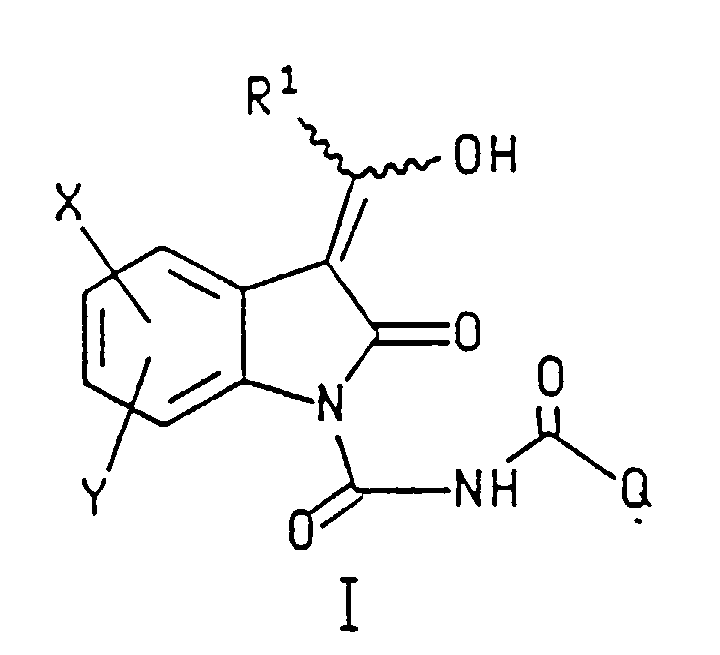 X représente l'hydrogène, le chlore ou le fluor ;Y représente l'hydrogène, le chlore ou le fluor ;R1 représente un groupe thiényle, furyle ou phényle substitué ou non substitué ;
Q représente un groupe OR2 ou NR3R4 ; dans lequelR2 représente un groupe alkyle en C1 à C10, cycloalkyle en C4 à C10, phényle, phényle substitué, cycloalcényle en C5 à C10, alcényle en C3 à C10, (CH2)mCH(R5)CO2R6, (CH2)mCH(R5)CONR6R7, (CH2)nCH(R8)NR5R9, farnésyle, géranyle, 6-indanyle, (CH2(2,2-diméthyl-1,3-dioxolane-4-yle), (CH2)n-2-thiényle, (CH2)n-3-thiényle, (CH2)n-3-furyle, (CH2)n-2-furyle, (CH2)n-2-pyridyle, (CH2)n-3-pyridyle, (CH2)n-4-pyridyle, (CH2)n-phényle ou (CH2)n-phényle substitué ;R3 représente l'hydrogène, un groupe OR5, alkyle en C1 à C10, cycloalkyle en C4 à C10, phényle, phényle substitué, alcényle en C3 à C10, cycloalcényle en C5 à C10, (CH2)mCH(R10)CO2R5, (CH2)yNR5R9, (CH2)n-phényle, (CH2)n-phényle substitué, (CH2)n-3-thiényle, (CH2)n-2-thiényle, (CH2)n-2-furyle, (CH2)n-3-furyle, (CH2)n 2-pyridyle, (CH2)n-3-pyridyle ou (CH2)n)-4-pyridyle ;R4 représente l'hydrogène, un groupe alkyle en C1 à C10, cycloalkyle en C4 à C10, phényle, phényle substitué, alcényle en C3 à C10, cycloalcényle en C5 à C10, (CH2)yNR5R9, (CH2)n-phényle, (CH2)n-phényle substitué, (CH2)n-2-thiényle, (CH2)n-3-thiényle, (CH2)n-2-furyle, (CH2)n-3-furyle, (CH2)n-2-pyridyle, (CH2)n-3-pyridyle ou (CH2)n-4-pyridyle ;R5, R6 et R7 représentent, indépendamment, l'hydrogène, un groupe alkyle en C1 à C6, benzyle, phényle, allyle, cycloalkyle en C4 à C8 ;R8 représente l'hydrogène, un groupe R5, CO2R5 ou CONR5R6 ;R9 représente un groupe R5, (alkyle en C1 à C6)-carbonyle, benzoyle, benzoyle substitué, benzyloxycarbonyle ou (alkoxy en C1 à C6)-carbonyle ;R10 représente un groupe alkyle en C1 à C6, (CH2)nNR5R9, CH(CH3)OR5, CH2OR5, CH2-3-indolyle, CH2SR5, CH2-p-C5H4OR5, (CH2)nSR6 ou (CH2)n-3-imidazolyle ;le terme "substitué" signifiant substitué avec un à trois substituants choisis, indépendamment, entre des groupes alkyle en C1 à C6, alkoxy en C1 à C6, halogénalkoxy en C1 à C6, halogéno, nitro, carboxy, carboalkoxy, carboxamide, amino et alkylmercapto en C1 à C6 ;
m a une valeur de 0 à 6 ; n a une valeur de 1 à 6 et y a une valeur de 2 à 6 ; ou un de ses sels pharmaceutiquement acceptables. - Composé suivant la revendication 1, dans lequel X représente un groupe 5-chloro et Y représente l'hydrogène.
- Composé suivant la revendication 1, dans lequel X représente un groupe 5-fluoro et Y représente un groupe 6-chloro.
- Composé suivant la revendication 3, dans lequel R1 représente un groupe 2-thiényle.
- Composé suivant la revendication 2, dans lequel R1 représente un groupe 2-thiényle.
- Composé suivant la revendication 4, dans lequel Q représente un groupe OR2 et R2 représente un groupe alkyle en C1 à C6, benzyle OU (CH2)mCH(NHR5)COOR6.
- Composé suivant la revendication 6, dans lequel R2 représente un groupe alkyle en C1 à C6.
- Composé suivant la revendication 5, dans lequel R2 représente un groupe (CH2)mCH(NHR5)COOR6, m est égal à 1 et R5 et R6 représentent l'hydrogène.
- Composé suivant la revendication 4, dans lequel Q représente un groupe NR3R4.
- Composé suivant la revendication 9, dans lequel R2 représente un groupe alkyle en C1 à C6 ou benzyle et R3 représente l'hydrogène ou un groupe alkyle en C1 à C6.
- Composé suivant la revendication 9, dans lequel R3 représente un groupe OR5.
- Composé suivant la revendication 11, dans lequel R3 et R5 représentent l'hydrogène.
- Composition pharmaceutique comprenant un composé de formule (I), ou un de ses sels pharmaceutiquement acceptables, suivant l'une quelconque des revendications 1 à 12, en association avec un support inerte pharmaceutiquement acceptable.
- Composé de formule (I), ou un de ses sels pharmaceutiquement acceptables, ou une composition pharmaceutique contenant l'une ou l'autre entité, suivant l'une quelconque des revendications 1 à 13, destiné à être utilisé comme médicament.
- Utilisation d'un composé de formule (I), ou d'un de ses sels pharmaceutiquement acceptables, ou d'une composition pharmaceutique contenant l'une ou l'autre entité, suivant l'une quelconque des revendications 1 à 13, pour la production d'un médicament destiné au traitement de l'inflammation ou de la douleur chez un mammifère.
Applications Claiming Priority (3)
| Application Number | Priority Date | Filing Date | Title |
|---|---|---|---|
| US1511493A | 1993-02-09 | 1993-02-09 | |
| US15114 | 1993-02-09 | ||
| PCT/US1993/011792 WO1994018194A1 (fr) | 1993-02-09 | 1993-12-10 | Oxindole 1-[n-(alcoxycarbonyl)] carboxamides et 1-(n-carboxamido)carboxamides utilises comme agents anti-inflammatoires. |
Publications (2)
| Publication Number | Publication Date |
|---|---|
| EP0683777A1 EP0683777A1 (fr) | 1995-11-29 |
| EP0683777B1 true EP0683777B1 (fr) | 1996-11-13 |
Family
ID=21769613
Family Applications (1)
| Application Number | Title | Priority Date | Filing Date |
|---|---|---|---|
| EP94903461A Expired - Lifetime EP0683777B1 (fr) | 1993-02-09 | 1993-12-10 | Oxindole 1-[n-(alcoxycarbonyl)] carboxamides et 1-[n-carboxamido]carboxamides utilises comme agents anti-inflammatoires |
Country Status (11)
| Country | Link |
|---|---|
| US (1) | US5607959A (fr) |
| EP (1) | EP0683777B1 (fr) |
| JP (1) | JP2709530B2 (fr) |
| AT (1) | ATE145206T1 (fr) |
| CA (1) | CA2155664C (fr) |
| DE (1) | DE69305999T2 (fr) |
| DK (1) | DK0683777T3 (fr) |
| ES (1) | ES2097025T3 (fr) |
| FI (1) | FI940568A7 (fr) |
| GR (1) | GR3021924T3 (fr) |
| WO (1) | WO1994018194A1 (fr) |
Families Citing this family (9)
| Publication number | Priority date | Publication date | Assignee | Title |
|---|---|---|---|---|
| WO1997013767A1 (fr) * | 1995-10-09 | 1997-04-17 | Chemisch Pharmazeutische Forschungsgesellschaft Mbh | 1-indolcarboxamides substitues heterocycliquement, s'utilisant comme inhibiteurs de la cyclo-oxygenase-2 |
| EP1175399B1 (fr) * | 1999-04-23 | 2009-03-11 | Vertex Pharmaceuticals Incorporated | Inhibiteurs des c-jun n-terminal kinases (jnk) |
| US7612065B2 (en) | 2000-04-21 | 2009-11-03 | Vertex Pharmaceuticals Incorporated | Inhibitors of c-JUN N-terminal kinases (JNK) |
| AU2002322720B2 (en) | 2001-07-25 | 2008-11-13 | Raptor Pharmaceutical Inc. | Compositions and methods for modulating blood-brain barrier transport |
| CN102379684B (zh) | 2005-04-28 | 2014-11-19 | 普罗透斯数字保健公司 | 药物信息系统 |
| KR20090071598A (ko) | 2006-09-18 | 2009-07-01 | 랩터 파마슈티컬 인코포레이티드 | 수용체 결합 단백질(rap)-접합체 투여에 의한 간 질환의 치료 |
| EP2398500B1 (fr) | 2009-02-20 | 2019-03-13 | 2-BBB Medicines B.V. | Sustème d'administration de médicament à base de glutathionne |
| ES2942923T3 (es) | 2009-05-06 | 2023-06-07 | Laboratory Skin Care Inc | Composiciones de administración dérmica que comprenden complejos de agente activo-partículas de fosfato de calcio y métodos de uso de las mismas |
| US20120077778A1 (en) | 2010-09-29 | 2012-03-29 | Andrea Bourdelais | Ladder-Frame Polyether Conjugates |
Family Cites Families (10)
| Publication number | Priority date | Publication date | Assignee | Title |
|---|---|---|---|---|
| ATE63543T1 (de) * | 1984-02-07 | 1991-06-15 | Pfizer | 2-oxindolzwischenprodukte. |
| US4721712A (en) * | 1984-06-12 | 1988-01-26 | Pfizer Inc. | 1,3-disubstituted 2-oxindoles as analgesic and anti-inflammatory agents |
| IN163263B (fr) * | 1984-02-07 | 1988-08-27 | Pfizer | |
| US4556672A (en) * | 1984-03-19 | 1985-12-03 | Pfizer Inc. | 3-Substituted 2-oxindole-1-carboxamides as analgesic and anti-inflammatory agents |
| US4569942A (en) * | 1984-05-04 | 1986-02-11 | Pfizer Inc. | N,3-Disubstituted 2-oxindole-1-carboxamides as analgesic and antiinflammatory agents |
| MX18021A (es) * | 1988-10-18 | 1993-11-01 | Pfizer | Pro-farmacos de la 3-acil-2-oxindol-1-carboxamidasanti-inflamatorias |
| ES2075055T3 (es) * | 1988-10-18 | 1995-10-01 | Pfizer | Profarmacos de 3-acil-2-oxindol-1-carboxamidas antiinflamatorias. |
| US5047554A (en) * | 1989-04-18 | 1991-09-10 | Pfizer Inc. | 3-substituted-2-oxindole derivatives |
| US4952703A (en) * | 1989-05-25 | 1990-08-28 | Pfizer Inc. | Intermediates for making 2-oxindole-1-carboxamides |
| US5270331A (en) * | 1993-01-26 | 1993-12-14 | Pfizer, Inc. | Prodrugs of antiinflammatory 3-acyl-2-oxindole-1-carboxamides |
-
1993
- 1993-12-10 WO PCT/US1993/011792 patent/WO1994018194A1/fr not_active Ceased
- 1993-12-10 DE DE69305999T patent/DE69305999T2/de not_active Expired - Fee Related
- 1993-12-10 EP EP94903461A patent/EP0683777B1/fr not_active Expired - Lifetime
- 1993-12-10 DK DK94903461.5T patent/DK0683777T3/da active
- 1993-12-10 JP JP6518013A patent/JP2709530B2/ja not_active Expired - Fee Related
- 1993-12-10 AT AT94903461T patent/ATE145206T1/de not_active IP Right Cessation
- 1993-12-10 US US08/495,509 patent/US5607959A/en not_active Expired - Fee Related
- 1993-12-10 ES ES94903461T patent/ES2097025T3/es not_active Expired - Lifetime
- 1993-12-10 CA CA002155664A patent/CA2155664C/fr not_active Expired - Fee Related
-
1994
- 1994-02-08 FI FI940568A patent/FI940568A7/fi not_active Application Discontinuation
-
1996
- 1996-12-06 GR GR960403329T patent/GR3021924T3/el unknown
Also Published As
| Publication number | Publication date |
|---|---|
| ATE145206T1 (de) | 1996-11-15 |
| JPH08502517A (ja) | 1996-03-19 |
| US5607959A (en) | 1997-03-04 |
| GR3021924T3 (en) | 1997-03-31 |
| FI940568L (fi) | 1994-08-10 |
| DE69305999D1 (en) | 1996-12-19 |
| DK0683777T3 (da) | 1997-04-28 |
| WO1994018194A1 (fr) | 1994-08-18 |
| CA2155664C (fr) | 1999-06-15 |
| JP2709530B2 (ja) | 1998-02-04 |
| DE69305999T2 (de) | 1997-03-06 |
| CA2155664A1 (fr) | 1994-08-18 |
| ES2097025T3 (es) | 1997-03-16 |
| FI940568A0 (fi) | 1994-02-08 |
| EP0683777A1 (fr) | 1995-11-29 |
| FI940568A7 (fi) | 1994-08-10 |
Similar Documents
| Publication | Publication Date | Title |
|---|---|---|
| EP0156603B1 (fr) | 1-Carboxamide-2-oxindols-3-substitués utilisés comme agents analgésiques et anti-inflammatoires | |
| EP0164860B1 (fr) | 2-Oxindole 1-carboxamides N, 3-disubstitués à titre d'agents analgésiques et anti-inflammatoires | |
| EP0175551B1 (fr) | Composés analgésiques et anti-inflammatoires dérivés du 1,3-diacyl 2-oxindole | |
| RU2059637C1 (ru) | Гетероциклические производные замещенных 2-ациламино-5-тиазолов, способы их получения, производное замещенного 2-аминотиазола, производные 2-амино-4-фенилтиазола | |
| US5206261A (en) | Oxindole derivative | |
| AP142A (en) | 3-substituted-2-oxindole derivatives. | |
| US4721712A (en) | 1,3-disubstituted 2-oxindoles as analgesic and anti-inflammatory agents | |
| SK11152001A3 (sk) | Indolové deriváty, spôsob ich prípravy, farmaceutická kompozícia s ich obsahom a ich použitie ako antagonistov mcp-1 | |
| KR880000434B1 (ko) | 3-치환된 옥스인돌 화합물 및 그의 제조방법 | |
| US4853403A (en) | 3-phenylthiomethylstyrene derivative, process for preparing the same, and antiallergic agent and tyrosinekinase inhibiting agent containing the same | |
| US5811432A (en) | Azaoxindole derivatives | |
| US5607959A (en) | Oxindole 1-[N-(alkoxycarbonyl) ] carboxamides and 1-(N-carboxamido) carboxamides as antiinflammatory agents | |
| EP0153818B1 (fr) | 2-Oxindoles 1,3-disubstitués et leur utilisation comme agents analgésiques et anti-inflammatoires | |
| US4898867A (en) | Thienopyrimidine derivaties as aldose-reductase inhibitors | |
| KR860001874B1 (ko) | 2-옥스인돌-1-카복스 아미드의 제조방법 | |
| JP2504659B2 (ja) | 3―(1―置換ピラゾイル)―2―オキシインド―ル誘導体 | |
| US4859700A (en) | 2-(2,3-dihydro-2-oxo-3-benzofuranyl)acetic acid compounds having antihypoxic and nootropic effects | |
| US4808601A (en) | Analgesic and antiinflammatory 1,3-diacyl-2-oxindole compounds | |
| US4730004A (en) | Analgesic and anti-inflammatory 1-acyl-2-oxindole-3-carboxamides | |
| US4791131A (en) | Analgesic and antiinflammatory 1-acyl-2-oxindole-3-carboxamides | |
| US4803197A (en) | 2,1-benzothiazepine-2,2-dioxide-5-carboxylic acid derivatives | |
| EP0284069B1 (fr) | Composés ester d'acide benzopyranopyridineacétique et leurs applications pharmaceutiques | |
| EP0145304B1 (fr) | Dérivés de la tétrahydro bêta-carboline et procédé pour leur préparation | |
| JPH0335315B2 (fr) | ||
| NO165798B (no) | Analogifremgangsmaate for fremstilling av terapeutisk aktive 1,3-disubstituerte 2-oksindol-derivater. |
Legal Events
| Date | Code | Title | Description |
|---|---|---|---|
| PUAI | Public reference made under article 153(3) epc to a published international application that has entered the european phase |
Free format text: ORIGINAL CODE: 0009012 |
|
| 17P | Request for examination filed |
Effective date: 19950731 |
|
| AK | Designated contracting states |
Kind code of ref document: A1 Designated state(s): AT BE CH DE DK ES FR GB GR IE IT LI LU NL PT SE |
|
| 17Q | First examination report despatched |
Effective date: 19951128 |
|
| GRAG | Despatch of communication of intention to grant |
Free format text: ORIGINAL CODE: EPIDOS AGRA |
|
| GRAH | Despatch of communication of intention to grant a patent |
Free format text: ORIGINAL CODE: EPIDOS IGRA |
|
| GRAH | Despatch of communication of intention to grant a patent |
Free format text: ORIGINAL CODE: EPIDOS IGRA |
|
| GRAA | (expected) grant |
Free format text: ORIGINAL CODE: 0009210 |
|
| AK | Designated contracting states |
Kind code of ref document: B1 Designated state(s): AT BE CH DE DK ES FR GB GR IE IT LI LU NL PT SE |
|
| REF | Corresponds to: |
Ref document number: 145206 Country of ref document: AT Date of ref document: 19961115 Kind code of ref document: T |
|
| REG | Reference to a national code |
Ref country code: CH Ref legal event code: NV Representative=s name: E. BLUM & CO. PATENTANWAELTE |
|
| REF | Corresponds to: |
Ref document number: 69305999 Country of ref document: DE Date of ref document: 19961219 |
|
| ET | Fr: translation filed | ||
| REG | Reference to a national code |
Ref country code: IE Ref legal event code: FG4D Free format text: 70654 |
|
| ITF | It: translation for a ep patent filed | ||
| REG | Reference to a national code |
Ref country code: GR Ref legal event code: FG4A Free format text: 3021924 |
|
| REG | Reference to a national code |
Ref country code: ES Ref legal event code: FG2A Ref document number: 2097025 Country of ref document: ES Kind code of ref document: T3 |
|
| REG | Reference to a national code |
Ref country code: PT Ref legal event code: SC4A Free format text: AVAILABILITY OF NATIONAL TRANSLATION Effective date: 19961212 |
|
| REG | Reference to a national code |
Ref country code: DK Ref legal event code: T3 |
|
| PLBE | No opposition filed within time limit |
Free format text: ORIGINAL CODE: 0009261 |
|
| STAA | Information on the status of an ep patent application or granted ep patent |
Free format text: STATUS: NO OPPOSITION FILED WITHIN TIME LIMIT |
|
| 26N | No opposition filed | ||
| REG | Reference to a national code |
Ref country code: GB Ref legal event code: IF02 |
|
| PGFP | Annual fee paid to national office [announced via postgrant information from national office to epo] |
Ref country code: PT Payment date: 20040929 Year of fee payment: 12 |
|
| PGFP | Annual fee paid to national office [announced via postgrant information from national office to epo] |
Ref country code: LU Payment date: 20041001 Year of fee payment: 12 |
|
| PGFP | Annual fee paid to national office [announced via postgrant information from national office to epo] |
Ref country code: GR Payment date: 20041027 Year of fee payment: 12 |
|
| PGFP | Annual fee paid to national office [announced via postgrant information from national office to epo] |
Ref country code: AT Payment date: 20041104 Year of fee payment: 12 |
|
| PGFP | Annual fee paid to national office [announced via postgrant information from national office to epo] |
Ref country code: DK Payment date: 20041109 Year of fee payment: 12 |
|
| PGFP | Annual fee paid to national office [announced via postgrant information from national office to epo] |
Ref country code: NL Payment date: 20041111 Year of fee payment: 12 |
|
| PGFP | Annual fee paid to national office [announced via postgrant information from national office to epo] |
Ref country code: SE Payment date: 20041202 Year of fee payment: 12 |
|
| PGFP | Annual fee paid to national office [announced via postgrant information from national office to epo] |
Ref country code: CH Payment date: 20050107 Year of fee payment: 12 |
|
| PGFP | Annual fee paid to national office [announced via postgrant information from national office to epo] |
Ref country code: BE Payment date: 20050113 Year of fee payment: 12 |
|
| PG25 | Lapsed in a contracting state [announced via postgrant information from national office to epo] |
Ref country code: AT Free format text: LAPSE BECAUSE OF NON-PAYMENT OF DUE FEES Effective date: 20051210 |
|
| PG25 | Lapsed in a contracting state [announced via postgrant information from national office to epo] |
Ref country code: SE Free format text: LAPSE BECAUSE OF NON-PAYMENT OF DUE FEES Effective date: 20051211 |
|
| PG25 | Lapsed in a contracting state [announced via postgrant information from national office to epo] |
Ref country code: LU Free format text: LAPSE BECAUSE OF NON-PAYMENT OF DUE FEES Effective date: 20051231 Ref country code: LI Free format text: LAPSE BECAUSE OF NON-PAYMENT OF DUE FEES Effective date: 20051231 Ref country code: CH Free format text: LAPSE BECAUSE OF NON-PAYMENT OF DUE FEES Effective date: 20051231 Ref country code: BE Free format text: LAPSE BECAUSE OF NON-PAYMENT OF DUE FEES Effective date: 20051231 |
|
| PG25 | Lapsed in a contracting state [announced via postgrant information from national office to epo] |
Ref country code: DK Free format text: LAPSE BECAUSE OF NON-PAYMENT OF DUE FEES Effective date: 20060102 |
|
| PG25 | Lapsed in a contracting state [announced via postgrant information from national office to epo] |
Ref country code: PT Free format text: LAPSE BECAUSE OF NON-PAYMENT OF DUE FEES Effective date: 20060612 |
|
| PG25 | Lapsed in a contracting state [announced via postgrant information from national office to epo] |
Ref country code: NL Free format text: LAPSE BECAUSE OF NON-PAYMENT OF DUE FEES Effective date: 20060701 |
|
| REG | Reference to a national code |
Ref country code: DK Ref legal event code: EBP |
|
| REG | Reference to a national code |
Ref country code: CH Ref legal event code: PL |
|
| EUG | Se: european patent has lapsed | ||
| REG | Reference to a national code |
Ref country code: PT Ref legal event code: MM4A Effective date: 20060612 |
|
| NLV4 | Nl: lapsed or anulled due to non-payment of the annual fee |
Effective date: 20060701 |
|
| PGFP | Annual fee paid to national office [announced via postgrant information from national office to epo] |
Ref country code: IE Payment date: 20061011 Year of fee payment: 14 |
|
| PGFP | Annual fee paid to national office [announced via postgrant information from national office to epo] |
Ref country code: GB Payment date: 20061106 Year of fee payment: 14 |
|
| PGFP | Annual fee paid to national office [announced via postgrant information from national office to epo] |
Ref country code: FR Payment date: 20061201 Year of fee payment: 14 |
|
| PGFP | Annual fee paid to national office [announced via postgrant information from national office to epo] |
Ref country code: ES Payment date: 20061222 Year of fee payment: 14 |
|
| PGFP | Annual fee paid to national office [announced via postgrant information from national office to epo] |
Ref country code: DE Payment date: 20061229 Year of fee payment: 14 |
|
| PGFP | Annual fee paid to national office [announced via postgrant information from national office to epo] |
Ref country code: IT Payment date: 20061231 Year of fee payment: 14 |
|
| BERE | Be: lapsed |
Owner name: *PFIZER INC. Effective date: 20051231 |
|
| PG25 | Lapsed in a contracting state [announced via postgrant information from national office to epo] |
Ref country code: GR Free format text: LAPSE BECAUSE OF NON-PAYMENT OF DUE FEES Effective date: 19961113 |
|
| GBPC | Gb: european patent ceased through non-payment of renewal fee |
Effective date: 20071210 |
|
| REG | Reference to a national code |
Ref country code: IE Ref legal event code: MM4A |
|
| PG25 | Lapsed in a contracting state [announced via postgrant information from national office to epo] |
Ref country code: DE Free format text: LAPSE BECAUSE OF NON-PAYMENT OF DUE FEES Effective date: 20080701 Ref country code: IE Free format text: LAPSE BECAUSE OF NON-PAYMENT OF DUE FEES Effective date: 20071210 |
|
| REG | Reference to a national code |
Ref country code: FR Ref legal event code: ST Effective date: 20081020 |
|
| PG25 | Lapsed in a contracting state [announced via postgrant information from national office to epo] |
Ref country code: GB Free format text: LAPSE BECAUSE OF NON-PAYMENT OF DUE FEES Effective date: 20071210 |
|
| REG | Reference to a national code |
Ref country code: ES Ref legal event code: FD2A Effective date: 20071211 |
|
| PG25 | Lapsed in a contracting state [announced via postgrant information from national office to epo] |
Ref country code: FR Free format text: LAPSE BECAUSE OF NON-PAYMENT OF DUE FEES Effective date: 20071231 Ref country code: ES Free format text: LAPSE BECAUSE OF NON-PAYMENT OF DUE FEES Effective date: 20071211 |
|
| PG25 | Lapsed in a contracting state [announced via postgrant information from national office to epo] |
Ref country code: IT Free format text: LAPSE BECAUSE OF NON-PAYMENT OF DUE FEES Effective date: 20071210 |