EP0684530B1 - Appareil de conditionnement d'une image formée à partir d'un développateur liquide - Google Patents
Appareil de conditionnement d'une image formée à partir d'un développateur liquide Download PDFInfo
- Publication number
- EP0684530B1 EP0684530B1 EP95303065A EP95303065A EP0684530B1 EP 0684530 B1 EP0684530 B1 EP 0684530B1 EP 95303065 A EP95303065 A EP 95303065A EP 95303065 A EP95303065 A EP 95303065A EP 0684530 B1 EP0684530 B1 EP 0684530B1
- Authority
- EP
- European Patent Office
- Prior art keywords
- roller
- image
- liquid carrier
- liquid
- toner particles
- Prior art date
- Legal status (The legal status is an assumption and is not a legal conclusion. Google has not performed a legal analysis and makes no representation as to the accuracy of the status listed.)
- Expired - Lifetime
Links
- 239000007788 liquid Substances 0.000 title claims description 93
- 230000003750 conditioning effect Effects 0.000 title claims description 5
- 239000002245 particle Substances 0.000 claims description 44
- 239000000463 material Substances 0.000 claims description 38
- 238000010521 absorption reaction Methods 0.000 claims description 21
- 238000000034 method Methods 0.000 description 29
- 230000008569 process Effects 0.000 description 22
- 239000006260 foam Substances 0.000 description 13
- 239000007787 solid Substances 0.000 description 11
- 239000011148 porous material Substances 0.000 description 10
- XLYOFNOQVPJJNP-UHFFFAOYSA-N water Substances O XLYOFNOQVPJJNP-UHFFFAOYSA-N 0.000 description 9
- 230000002745 absorbent Effects 0.000 description 7
- 239000002250 absorbent Substances 0.000 description 7
- 230000001846 repelling effect Effects 0.000 description 6
- 239000004215 Carbon black (E152) Substances 0.000 description 4
- 239000000969 carrier Substances 0.000 description 4
- 239000012530 fluid Substances 0.000 description 4
- 229930195733 hydrocarbon Natural products 0.000 description 4
- 150000002430 hydrocarbons Chemical class 0.000 description 4
- 239000002184 metal Substances 0.000 description 4
- 229910052751 metal Inorganic materials 0.000 description 4
- 230000003319 supportive effect Effects 0.000 description 4
- 238000004140 cleaning Methods 0.000 description 3
- 230000003247 decreasing effect Effects 0.000 description 3
- 230000005684 electric field Effects 0.000 description 3
- 230000002401 inhibitory effect Effects 0.000 description 3
- 238000004519 manufacturing process Methods 0.000 description 3
- 230000035699 permeability Effects 0.000 description 3
- 239000004033 plastic Substances 0.000 description 3
- 229920003023 plastic Polymers 0.000 description 3
- 229920002635 polyurethane Polymers 0.000 description 3
- 239000004814 polyurethane Substances 0.000 description 3
- 229910001220 stainless steel Inorganic materials 0.000 description 3
- 239000010935 stainless steel Substances 0.000 description 3
- 230000006835 compression Effects 0.000 description 2
- 238000007906 compression Methods 0.000 description 2
- 239000011231 conductive filler Substances 0.000 description 2
- 239000002270 dispersing agent Substances 0.000 description 2
- 229920001971 elastomer Polymers 0.000 description 2
- 230000008020 evaporation Effects 0.000 description 2
- 238000001704 evaporation Methods 0.000 description 2
- NBVXSUQYWXRMNV-UHFFFAOYSA-N fluoromethane Chemical compound FC NBVXSUQYWXRMNV-UHFFFAOYSA-N 0.000 description 2
- 239000006261 foam material Substances 0.000 description 2
- 230000036541 health Effects 0.000 description 2
- 238000003384 imaging method Methods 0.000 description 2
- 230000003287 optical effect Effects 0.000 description 2
- 239000000049 pigment Substances 0.000 description 2
- 239000000758 substrate Substances 0.000 description 2
- 230000007723 transport mechanism Effects 0.000 description 2
- 229910000906 Bronze Inorganic materials 0.000 description 1
- RYGMFSIKBFXOCR-UHFFFAOYSA-N Copper Chemical compound [Cu] RYGMFSIKBFXOCR-UHFFFAOYSA-N 0.000 description 1
- 229920000877 Melamine resin Polymers 0.000 description 1
- 239000004642 Polyimide Substances 0.000 description 1
- 229920005830 Polyurethane Foam Polymers 0.000 description 1
- 241001620634 Roger Species 0.000 description 1
- 150000001336 alkenes Chemical class 0.000 description 1
- 230000004888 barrier function Effects 0.000 description 1
- 239000011230 binding agent Substances 0.000 description 1
- 230000015572 biosynthetic process Effects 0.000 description 1
- 239000010974 bronze Substances 0.000 description 1
- 239000006229 carbon black Substances 0.000 description 1
- 239000012876 carrier material Substances 0.000 description 1
- 239000000919 ceramic Substances 0.000 description 1
- 239000007795 chemical reaction product Substances 0.000 description 1
- 239000003086 colorant Substances 0.000 description 1
- 230000001143 conditioned effect Effects 0.000 description 1
- 239000004020 conductor Substances 0.000 description 1
- 229910052802 copper Inorganic materials 0.000 description 1
- 239000010949 copper Substances 0.000 description 1
- KUNSUQLRTQLHQQ-UHFFFAOYSA-N copper tin Chemical compound [Cu].[Sn] KUNSUQLRTQLHQQ-UHFFFAOYSA-N 0.000 description 1
- 238000005553 drilling Methods 0.000 description 1
- 239000000806 elastomer Substances 0.000 description 1
- 239000013536 elastomeric material Substances 0.000 description 1
- 238000001962 electrophoresis Methods 0.000 description 1
- 230000007613 environmental effect Effects 0.000 description 1
- 238000005530 etching Methods 0.000 description 1
- 239000000945 filler Substances 0.000 description 1
- 239000012634 fragment Substances 0.000 description 1
- 239000008187 granular material Substances 0.000 description 1
- 238000005286 illumination Methods 0.000 description 1
- 230000001771 impaired effect Effects 0.000 description 1
- 150000002500 ions Chemical class 0.000 description 1
- 239000011344 liquid material Substances 0.000 description 1
- JDSHMPZPIAZGSV-UHFFFAOYSA-N melamine Chemical compound NC1=NC(N)=NC(N)=N1 JDSHMPZPIAZGSV-UHFFFAOYSA-N 0.000 description 1
- 239000012528 membrane Substances 0.000 description 1
- 150000002739 metals Chemical class 0.000 description 1
- 239000002480 mineral oil Substances 0.000 description 1
- 235000010446 mineral oil Nutrition 0.000 description 1
- 239000000203 mixture Substances 0.000 description 1
- 235000019645 odor Nutrition 0.000 description 1
- 239000012466 permeate Substances 0.000 description 1
- 108091008695 photoreceptors Proteins 0.000 description 1
- 229920001721 polyimide Polymers 0.000 description 1
- 229920000642 polymer Polymers 0.000 description 1
- 229920001296 polysiloxane Polymers 0.000 description 1
- 239000011496 polyurethane foam Substances 0.000 description 1
- 230000001681 protective effect Effects 0.000 description 1
- 230000002829 reductive effect Effects 0.000 description 1
- 239000007921 spray Substances 0.000 description 1
- 229920003002 synthetic resin Polymers 0.000 description 1
- 239000000057 synthetic resin Substances 0.000 description 1
- BFKJFAAPBSQJPD-UHFFFAOYSA-N tetrafluoroethene Chemical group FC(F)=C(F)F BFKJFAAPBSQJPD-UHFFFAOYSA-N 0.000 description 1
Images


Classifications
-
- G—PHYSICS
- G03—PHOTOGRAPHY; CINEMATOGRAPHY; ANALOGOUS TECHNIQUES USING WAVES OTHER THAN OPTICAL WAVES; ELECTROGRAPHY; HOLOGRAPHY
- G03G—ELECTROGRAPHY; ELECTROPHOTOGRAPHY; MAGNETOGRAPHY
- G03G15/00—Apparatus for electrographic processes using a charge pattern
- G03G15/14—Apparatus for electrographic processes using a charge pattern for transferring a pattern to a second base
- G03G15/16—Apparatus for electrographic processes using a charge pattern for transferring a pattern to a second base of a toner pattern, e.g. a powder pattern, e.g. magnetic transfer
- G03G15/1605—Apparatus for electrographic processes using a charge pattern for transferring a pattern to a second base of a toner pattern, e.g. a powder pattern, e.g. magnetic transfer using at least one intermediate support
- G03G15/161—Apparatus for electrographic processes using a charge pattern for transferring a pattern to a second base of a toner pattern, e.g. a powder pattern, e.g. magnetic transfer using at least one intermediate support with means for handling the intermediate support, e.g. heating, cleaning, coating with a transfer agent
-
- G—PHYSICS
- G03—PHOTOGRAPHY; CINEMATOGRAPHY; ANALOGOUS TECHNIQUES USING WAVES OTHER THAN OPTICAL WAVES; ELECTROGRAPHY; HOLOGRAPHY
- G03G—ELECTROGRAPHY; ELECTROPHOTOGRAPHY; MAGNETOGRAPHY
- G03G15/00—Apparatus for electrographic processes using a charge pattern
- G03G15/06—Apparatus for electrographic processes using a charge pattern for developing
- G03G15/10—Apparatus for electrographic processes using a charge pattern for developing using a liquid developer
- G03G15/11—Removing excess liquid developer, e.g. by heat
Definitions
- This invention relates to an apparatus for conditioning an image formed from a liquid developer, and more particularly to an apparatus for removing toner dispersant from an image formed from a liquid developer.
- a typical electrostatographic printing machine employs an imaging member that is exposed to an image to be printed. Exposure of the imaging member records an electrostatic latent image on it corresponding to the informational areas contained within the image to be printed. The latent image is developed by bringing a developer material into contact therewith. The developed image recorded on the photoconductive member is transferred to a copy sheet such as paper, either directly or via an intermediate transport member. The developed image on the copy sheet is generally subjected to heat and/or pressure to permanently fuse it thereto.
- developer material Two types are typically employed in electrostatographic printing machines.
- One type of developer material is known as dry developer material and comprises toner particles or carrier granules having toner particles adhering triboelectrically thereto.
- Another type of developer material is a liquid material comprising a liquid carrier or dispersant having toner particles dispersed therein.
- Liquid developer typically contains about 2 percent by weight of fine solid particulate toner material dispersed in the liquid carrier.
- the liquid carrier is typically a hydrocarbon.
- the developed image on the photoreceptor contains about 12 weight percent of particulate toner in liquid hydrocarbon carrier.
- the image should be conditioned, i.e. percent solids in liquid should be increased by removing liquid carrier from the image while preventing toner particles from departing the image.
- the percentage of solids in the liquid should be increased to in the range of 25 to 75 percent.
- Increase in percent solids may be achieved by removing excess liquid carrier with a porous blotter in the form of a roller or belt (hereinafter collectively referred to as "roller"), typically positioned with respect to the photoconductive member retaining the latent image.
- roller typically positioned with respect to the photoconductive member retaining the latent image.
- the developed image on the intermediate belt should again be blotted to further increase the percentage of toner solids, so that the amount of liquid on the final copy sheet is minimized, and a well defined, high quality image is produced.
- Polymers such as various polyurethanes, olefins, tetrafluoroethylene, and various elastomers, may be processed into open cell poromeric foam material appropriate for use in blotter roller applications, using the teachings, for example, in US-A-3,696,180; 3,729,536; 3,860,680; 3,968,292; 4,157,424, and other methods known in the art.
- Conductive fillers, organic and inorganic, ionic or electronic may be added to regulate the poromeric material conductivity.
- Another prior porous roller is described in EP-A-0639802 which was published after the earliest priority date of this case but which has an earlier priority date and so is relevant under Article 54(3) EPC.
- This skin covering generally tends to have pores of a smaller size and a lesser quantity than the open cell inner foam material, and serves as a structural support and protective covering the for inner foam layer.
- the skin covering must have a porosity sufficient to absorb liquid carrier from the developed image, however, should have a smooth, glossy surface texture so that toner particles from the developed image are prevented from departing the image and embedding into the irregularities found on a more textured blotter roller skin surface. It is important to prevent toner particles from entering the blotter roller, as the pores of the roller become blocked and the rate of absorption of the liquid carrier from the developed image is slowed.
- Image quality is impaired when toner particles depart therefrom, and frequent cleaning and/or replacement of the roller is necessitated.
- a bias applied to the blotter roller having the same polarity as the toner particles of the developed image presents as repelling force between the toner and the roller, further preventing toner particles from entering the blotter roller.
- a shortcoming of this type of blotter roller is that the skin covering tends to retard fluid flow through the poromeric material, even in systems having a vacuum assist for removal of the liquid from the roller. Therefore, blotter rollers are often unable to achieve the desired toner solid weight percentage at the required process speed for a high volume production colour printer. Process speed and/or image quality have been restricted by prior art blotting devices used in liquid developing systems. This shortcoming is even more apparent due to the increased tendency to use liquid carriers that are less volatile, for environmental, health and safety reasons. Less volatile liquid carriers have a decreased vapour pressure rate, and therefore give off less offensive odours and expose less vapour into the atmosphere during the image forming process. Pollution and potential health risks to individuals working near the machine are thereby reduced. However, due to the lower evaporation rates of these liquid carriers, there is provided yet an increased need for a system with an increased capacity for liquid carrier absorption from the developed image.
- rollers Other types of blotter rollers are shown in US-A-4237592. In most of these the roller is formed of an absorption material such as an elastic foam covered by netting formed of plastics material. A roller is also disclosed in which the absorbent material is covered by a perforated plastics or metal film.
- a roller for conditioning an image formed from a liquid developer including liquid carrier and toner particles comprising:
- the invention also embraces a printing machine of the type having an image receiving surface on which an image is developed with a liquid developer comprising liquid carrier and toner particles, and a roller in accordance with this invention for removing liquid carrier therefrom before transferring the developed image from the surface to a final copy sheet.
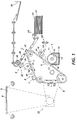
- printing machine 1 employs belt 2 having a photoconductive surface deposited on a conductive substrate. Initially, belt 2 passes through charging station A. At charging station A, a corona generating device 7 charges the photoconductive surface of belt 2 to a relatively high, substantially uniform potential.
- an original document 8 is placed upon a transparent support platen 9.
- An illumination assembly indicated generally by the reference numeral 10, illuminates the original document 8 on platen 9 to produce image rays corresponding to the document information areas.
- the image rays are projected by means of an optical system onto the charged portion of the photoconductive surface. The light image dissipates the charge in selected areas to record an electrostatic latent image on the photoconductive surface corresponding to the original document informational areas.
- belt 2 advances the electrostatic latent image to development station C.
- roller 11 rotating in the direction of arrow 12, advances a liquid developer material 13 from the chamber of housing 14 to development zone 17.
- An electrode 16 positioned before the entrance to development zone 17 is electrically biased to generate an AC field just prior to the entrance to development zone 17 so as to disperse the toner particles substantially uniformly throughout the liquid carrier.
- the toner particles, disseminated through the liquid carrier, pass by electrophoresis to the electrostatic latent image.
- the charge of the toner particles is opposite in polarity to the charge on the photoconductive surface.
- the insulating liquid carrier may be a hydrocarbon liquid although other insulating liquids may also be employed.
- a suitable hydrocarbon liquid is an Isopar which is a trademark of the Exxon Corporation.
- the toner particles comprise a binder and a pigment.
- the pigment may be carbon black.
- any suitable liquid development material may be employed.
- Development station C includes porous roller 18 having perforations (shown in Figures 3 through 6) through the roller skin covering.
- Roller 18 receives the developed image on belt 2 and conditions the image by reducing fluid content while inhibiting the departure of toner particles from the image. An increase in percent solids is thereby provided to the developed image, thereby improving the quality of the developed image.
- Porous roller 18 will be described hereinafter with reference to Figure 2, and in detail with reference to Figures 3 - 6.
- Porous roller 18 operates in conjunction with vacuum 19 for removal of liquid from the roller.
- a roller (not shown), in pressure against the blotter roller, may be used in conjunction with or in the place of the vacuum, to squeeze the absorbed liquid carrier from the blotter roller for deposit into a receptacle.
- a blotter roller of the type having a pressure roller for removal of liquid from the blotter roller is described in, for example, US-A-5352558.
- a bias voltage 53 is applied to an electroconductive roller creating an electric field having the same sign polarity as the toner particles, thereby repelling the toner particles and inhibiting their entry into the roller 18.
- variations to the blotter roller of the present invention such as a resistive foam layer found therein (described in further detail with reference to Figure 3A), or a pressure roller used thereagainst, may accompany the blotter roller in conjunction with the photoconductive belt, and/or in conjunction with the intermediate transfer belt as will be described with reference to Figure 2.
- the present invention may also find useful application where the liquid absorbing roller is in the form of a belt rotated by two or more internal rollers, whereby excess liquid carrier is absorbed through a foam layer and a skin covering having perforations formed therethrough.
- a belt used for collecting excess liquid from a region of liquid developed images is described in US-A-4,299,902 and 4,258,115.
- roller 18 rotates in direction 20 to impose against the "wet" image on belt 2.
- the porous body of roller 18 absorbs excess liquid from the surface of the image through the skin covering pores and perforations.
- Vacuum 19 located on one end of the central cavity of the roller, draws liquid that has permeated through roller 18 out through the cavity and deposits the liquid in a receptacle or some other location which will allow for either disposal or recirculation of the liquid carrier.
- Porous roller 18, discharged of excess liquid continues to rotate in direction 20 to provide a continuous absorption of liquid from image on belt 2.
- belt 2 advances the developed image to transfer station D.
- transfer station D a sheet of support material 22 is advanced from stack 23 by a sheet transport mechanism, indicated generally by the reference numeral 24.
- Transfer station D includes a corona generating device 25 which sprays ions onto the backside of the sheet of support material 22. This attracts the developed image from the photoconductive surface of belt 2 to copy sheet 22.
- conveyor belt 26 moves the copy sheet 22 to fusing station E.
- Fusing station E includes a fuser assembly indicated generally by the reference numeral 27, which permanently fuses the developed image to the copy sheet 22.
- Fuser assembly 27 includes a heated fuser roll 28 and back-up pressure roll 29 resiliently urged into engagement with one another to form a nip through which the copy sheet 22 passes. After fusing, the finished copy sheet 22 is discharged to output tray 30 for removal by the machine operator.
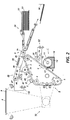
- FIG 2 is a schematic representation of a portion of another printing machine which employs a moving image carrying belt, from which an image is transferred to an intermediate belt. Electrostatographic reproduction apparatus utilizing intermediate belts are described, for example, in US-A-4,183,658; 4,684,238; 4,690,539; and 5,119,140.
- elements that are identical to elements in Figure 1 are identified with like reference numerals.
- a printing machine employing belt 2 having a photoconductive surface deposited on a conductive substrate.
- Roller 3 rotates and advances belt 2 in the direction of arrow 6.
- Belt 2 passes through charging station A where a corona generating device 7 charges the photoconductive surface of the belt 2.
- the charge portion of belt 2 is advanced to exposure station B where image rays from an original document are projected by means of an optical system onto the charged portion of the photoconductive surface to record an electrostatic latent image.
- belt 2 advances to development station C.
- roller 11 advances a liquid developer material 13 from the chamber of housing 14 to development zone 17.
- Electrode 16 positioned before the entrance to development zone 17 is electrically biased so as to disperse the toner particles substantially uniformly throughout the liquid carrier.
- Development station C includes porous blotter roller 18 having perforations through the skin surface. Roller 18 receives the developed image on belt 2 and conditions the image by reducing fluid content while inhibiting the departure of toner particles from the image. The percent solids in the image is thereby increased.
- the roller 18 operates in conjunction with vacuum 19 for removal of the liquid carrier.
- a bias voltage is applied to roller 1850 that a repelling force is present to prevent toner particles from leaving the photoconductive surface and entering the roller 18.
- belt 2 advances the developed image to transfer station D.
- transfer station D the developed liquid image is electrostatically transferred to an intermediate member or belt indicated generally by the reference numeral 35.
- Belt 35 is entrained about spaced rollers 36 and 37.
- Belt 35 moves in the direction of arrow 38.
- Bias transfer roller 39 imposes belt 35 against belt 2 to assure image transfer to the intermediate belt 35.
- the porous blotter roller 40 having perforations through the roller skin covering, receives the developed image on belt 35 and reduces fluid content while preventing toner particles from departing from the image, so that percent solids of the image is further increased.
- the roller 40 increases percent solids to about 25 to 75 wt.% by removing excess liquid carrier in this region.
- the roller of the present invention may be used for absorbing liquid carrier at an increased rate from an image in a system having an intermediate transfer belt. Consequently, the percent particles on the image is increased, thereby increasing process speed for color imagery.
- roller 40 rotates in direction 41 to impose against the image on belt 35.
- the porous body of roller 40 absorbs liquid from the surface of the image.
- the absorbed liquid permeates through roller 40 and into the inner hollow cavity 49, where a vacuum draws the liquid from the roller 40 into a liquid receptacle or some other location which will allow for either disposal or recirculation of the liquid carrier.
- Porous roller 40 discharged of excess liquid, continues to rotate in direction 41 to provide a continuous absorption of liquid from images on transfer belt 35.
- a bias voltage 53 is applied to the roller to establish a repelling force against the toner particles so that toner particles are prevented from entering the roller 40.
- Roller 40 may be used in conjunction with a pressure roller (not shown) to remove the liquid that has been absorbed into the roller 40.
- Belt 35 then advances the developed image to transfer station D.
- a sheet of support material 22 is advanced from stack 23 by a sheet transport mechanism, indicated generally by the reference numeral 24.
- the developed image from the photoconductive surface of belt 35 is attracted to copy sheet 22.
- conveyor belt 45 moves the copy sheet 22 to the discharge output tray 30.
- roller 50 comprises a rigid porous supportive core 46.
- the core 46 is in the form of a tube, having a hollow cavity 49 throughout the length of the roller.
- a conformable microporous roller 47, and a skin covering 48 having a pattern of apertures or perforations 52 therethrough is provided around the core 46.
- a vacuum 19 draws the liquid carrier that has permeated through roller 50 into cavity 49.
- a high voltage bias supply 53 is connected between the belt 2 and the conductive core 46 of roller 50 for providing a bias with the same charge as that of the toner particles. The bias continuously repels the toner particles of the image on belt from the roller, while the liquid carrier is absorbed into the roller 50.
- a pressure controller (not shown) may be used in association with the roller to provide a positive or negative pressure to the roller.
- the conformable microporous foam roller 47 is characterized by open cells forming the layer.
- the conformable foam roller 47 may comprise an absorbent polymeric and elastomeric material with incorporated conductive filler or dissipative filler.
- the conformable roller 47 is characterized by a durometer of from 10 to 90 Shore A, preferably from 20 to 60 Shore A, and has a thickness of 25.4 ⁇ m to 1.27 cm, preferably, a thickness of about 1 mm to 6.35 mm.
- the absorption material of the microporous roller 47 may be any suitable material, preferably a foam such as one selected from the group consisting of Polyurethane, Silicone, Fluorocarbon, Polyimide, Melamine, and rubber, such as Permair® (a microporous polyurethane material available from Porvair Ltd., England), and Tetratex® (a microporous semipermeable fluorocarbon membrane available from Tetratec Corp., Pennsylvania).
- the absorbent material is resistive so that the electric field created by the bias 53 applied to the core 46 further enhances the repelling action of the toner particles from the roller 50.
- the skin covering 48 has a smooth, glossy surface texture with micropores which are generally of a smaller size than the toner particles of the liquid developer.
- a minimal surface area texture of the skin covering is preferred so that toner particles are not encouraged to leave the developed image and embed into larger sized pores and/or the irregularities of a rougher skin surface having a greater surface area texture.
- the cylindrical assembly is then placed into an existing high pressure water jet system, where a fan jet nozzle is engaged to traverse the template assembly while it is rotating.
- the nozzle is positioned such that the high pressure fan of water blows through each hole to remove skin covering matching the predetermined hole diameter or pattern on the template.
- This process eliminates possible charring of outer edges of the perforations by a thermal technique, e.g. laser, and also minimizes skin residue remaining on the surface from a thermal or mechanical perforating process. Minimal residue is desired so that the surface texture of the skin covering is kept smooth, thereby preventing toner particles from departing the image and adhering to a rougher skin surface.
- apertures or perforations 54 are also formed as a separate process step through the conformable foam roller layer 47 using the aforementioned perforating processes and their equivalents.
- the size of the perforations formed through this foam layer 47 is not limited by the toner particle size, as is the size of the perforations 52 formed through the skin covering layer 48.
- the perforations 54 formed through the conformable foam layer average 250 to 300 ⁇ m in diameter.
- the perforations 56 are formed through the skin covering layer 48 and the conformable foam layer 47 in a single process step using the aforementioned perforating processes and their equivalents.
- the perforation size through both layers is restricted by the toner particle size, so that toner is blocked from entering the roller.
- the perforations 56 through both the skin covering 48 and conformable foam layer 47 average less than 15 ⁇ m in diameter.
Landscapes
- Physics & Mathematics (AREA)
- General Physics & Mathematics (AREA)
- Wet Developing In Electrophotography (AREA)
Claims (8)
- Rouleau (50) pour conditionner une image formée à partir d'un matériau de développement liquide (13) incluant un support liquide et des particules d'encre en poudre, comprenant :caractérisé en ce queun matériau d'absorption (46, 47) conçu pour absorber le support liquide ; etune couverture (48) en contact avec une partie dudit matériau d'absorption, ladite couverture étant sensiblement imperméable aux particules d'encre en poudre et perméable au support liquide afin d'empêcher les particules d'encre en poudre de quitter l'image ;le couverture (48) ayant une surface lisse et une pluralité de perforations (52) à travers elles, afin de permettre au support liquide de la traverser jusqu'audit matériau d'absorption,les perforations ont un diamètre compris entre 1 µm et 15 µm et étant espacées de centre à centre, entre elles, d'une distance moyenne comprise entre 15 µm et 30 µm.
- Rouleau selon la revendication 1, dans lequel ledit matériel d'absorption définit une cavité (49).
- Rouleau selon la revendication 1 ou 2, comprenant, en outre, des moyens de retrait destinés à éliminer le support liquide dudit matériau d'absorption.
- Rouleau selon l'une quelconque des revendications 1 à 3, dans lequel ledit matériel d'absorption comprend :un moyeu poreux rigide (46) ; etun rouleau poreux à cellules ouvertes en conformité (47) monté autour dudit moyeu (46).
- Rouleau selon la revendication 4, dans lequel ledit rouleau poreux à cellules ouvertes en conformité (47) a une résistivité comprise entre environ 10-5 ohm-cm et environ 10-11 ohm-cm.
- Rouleau selon l'une quelconque des revendications 1 à 5, dans lequel ladite couverture est microporeuse.
- Rouleau selon l'une quelconque des revendications 1 à 6, dans lequel les perforations formées à travers ladite couverture s'étendent à travers ledit matériau d'absorption et/ou ledit matériau d'absorption inclut une pluralité de perforations à travers lui dont le diamètre est compris entre environ 1 µm et environ 300 µm.
- Machine d'impression du type ayant une surface réceptrice d'image sur laquelle l'image est développée à l'aide d'un matériau de développement liquide comprenant un support liquide et des particules d'encre en poudre, et un rouleau selon l'une quelconque des revendications 1 à 7.
Applications Claiming Priority (2)
| Application Number | Priority Date | Filing Date | Title |
|---|---|---|---|
| US247737 | 1994-05-23 | ||
| US08/247,737 US5424813A (en) | 1994-05-23 | 1994-05-23 | Apparatus and method for improved blotter roller permeability |
Publications (2)
| Publication Number | Publication Date |
|---|---|
| EP0684530A1 EP0684530A1 (fr) | 1995-11-29 |
| EP0684530B1 true EP0684530B1 (fr) | 1999-09-01 |
Family
ID=22936160
Family Applications (1)
| Application Number | Title | Priority Date | Filing Date |
|---|---|---|---|
| EP95303065A Expired - Lifetime EP0684530B1 (fr) | 1994-05-23 | 1995-05-04 | Appareil de conditionnement d'une image formée à partir d'un développateur liquide |
Country Status (4)
| Country | Link |
|---|---|
| US (1) | US5424813A (fr) |
| EP (1) | EP0684530B1 (fr) |
| JP (1) | JPH07319291A (fr) |
| DE (1) | DE69511763T2 (fr) |
Families Citing this family (41)
| Publication number | Priority date | Publication date | Assignee | Title |
|---|---|---|---|---|
| US5689780A (en) * | 1993-01-27 | 1997-11-18 | Toray Industries, Inc. | Electrophotographic color printing apparatus using successively engageable developing units |
| JPH07334870A (ja) * | 1994-06-09 | 1995-12-22 | Olympus Optical Co Ltd | 光学的記録媒体の傷修復装置 |
| US5570173A (en) * | 1994-10-31 | 1996-10-29 | Xerox Corporation | Color printer using liquid developer |
| JP2970514B2 (ja) * | 1995-04-28 | 1999-11-02 | 富士ゼロックス株式会社 | 余剰現像液除去装置 |
| US5839037A (en) * | 1995-06-07 | 1998-11-17 | Xerox Corporation | Method for transferring a liquid image |
| US5574547A (en) * | 1995-06-07 | 1996-11-12 | Xerox Corporation | Liquid electrophotographic reproduction machine employing heated carrier liquid |
| US5557378A (en) * | 1995-08-25 | 1996-09-17 | Xerox Corporation | Liquid immersion development machine having a pressure differential nip apparatus |
| US5571463A (en) * | 1996-02-09 | 1996-11-05 | Xerox Corporation | Method of fabricating a microporous surface blotter roll |
| JPH09244425A (ja) * | 1996-03-13 | 1997-09-19 | Mitsubishi Heavy Ind Ltd | 画像形成装置および画像形成方法 |
| US5752144A (en) * | 1996-04-01 | 1998-05-12 | Xerox Corporation | Method of fabricating a reclaimable uniform conditioning blotter roll |
| US5717985A (en) * | 1996-09-27 | 1998-02-10 | Xerox Corporation | Sintered metal fiber core blotter roll and method of making same |
| US5745826A (en) * | 1997-01-21 | 1998-04-28 | Xerox Corporation | Liquid toner image conditioning roll having image protection surface layer |
| KR100234324B1 (ko) * | 1997-08-27 | 1999-12-15 | 윤종용 | 습식 전자사진방식 프린터 |
| JPH1173023A (ja) * | 1997-08-29 | 1999-03-16 | Brother Ind Ltd | 画像形成装置 |
| US6006059A (en) * | 1997-09-08 | 1999-12-21 | Xerox Corporation | Function-separated vacuum-assisted blotter for liquid development image conditioning |
| US5974292A (en) * | 1997-10-31 | 1999-10-26 | Xerox Corporation | Liquid ink development dragout control |
| US6068372A (en) * | 1997-10-31 | 2000-05-30 | Xerox Corporation | Replaceable intermediate transfer surface application assembly |
| US5895148A (en) * | 1997-11-19 | 1999-04-20 | Xerox Corporation | Control of fluid carrier resistance and water concentration in an aquatron charging device |
| US5895147A (en) * | 1997-11-19 | 1999-04-20 | Xerox Corporation | Roll charger with semi-permeable membrane for liquid charging |
| US6073684A (en) | 1998-02-23 | 2000-06-13 | Applied Thermal Technology | Clad casting for laptop computers and the like |
| JP2000075667A (ja) * | 1998-08-28 | 2000-03-14 | Brother Ind Ltd | 画像形成装置 |
| JP2000112246A (ja) * | 1998-09-30 | 2000-04-21 | Toshiba Corp | 画像形成装置 |
| US6274042B1 (en) * | 1998-10-29 | 2001-08-14 | Voith Sulzer Papiertechnik Gmbh | Semipermeable membrane for pressing apparatus |
| US6357350B1 (en) * | 2000-02-29 | 2002-03-19 | Eastman Kodak Company | Aluminum foam core vacuum imaging drum and method of drum fabrication |
| US6810227B2 (en) * | 2001-11-27 | 2004-10-26 | Bridgestone Corporation | Foamed elastic member for use in image forming apparatus |
| US7052426B2 (en) | 2002-01-25 | 2006-05-30 | Xerox Corporation | Seamed, conformable belt and method of making |
| AU2003229544A1 (en) * | 2002-05-24 | 2003-12-12 | F. Sperling Aps | A method for testing the interaction between at least one liquid sample and a respective solid sample. |
| US7462146B2 (en) * | 2003-08-29 | 2008-12-09 | Canon Kabushiki Kaisha | Roller member, and process for its manufacture |
| JP2006143471A (ja) * | 2004-10-18 | 2006-06-08 | Hokushin Ind Inc | 給紙ロール |
| JP2006349761A (ja) * | 2005-06-13 | 2006-12-28 | Toshiba Corp | 電子写真装置 |
| US7316605B1 (en) * | 2006-07-03 | 2008-01-08 | San Fang Chemical Industry Co., Ltd. | Sheet for mounting polishing workpiece and method for making the same |
| US7789738B2 (en) * | 2006-07-03 | 2010-09-07 | San Fang Chemical Industry Co., Ltd. | Sheet for mounting polishing workpiece and method for making the same |
| US20080064310A1 (en) * | 2006-09-08 | 2008-03-13 | Chung-Chih Feng | Polishing pad having hollow fibers and the method for making the same |
| US20090252876A1 (en) * | 2007-05-07 | 2009-10-08 | San Fang Chemical Industry Co., Ltd. | Sheet for mounting polishing workpiece and method for making the same |
| DE102010000549A1 (de) * | 2010-02-25 | 2011-08-25 | Océ Printing Systems GmbH, 85586 | Vorrichtung und Verfahren zur Entwicklung von auf einem Zwischenbildträger erzeugten Potentialbilder bei einer elektrografischen Druck- oder Kopiereinrichtung |
| US9027540B2 (en) | 2011-01-28 | 2015-05-12 | Copper John Corporation | Bowstring release |
| JP5609724B2 (ja) * | 2011-03-16 | 2014-10-22 | コニカミノルタ株式会社 | 湿式画像形成装置 |
| USD688346S1 (en) * | 2011-08-12 | 2013-08-20 | Scott Archery Manufacturing | Archery release |
| JP5786579B2 (ja) * | 2011-09-15 | 2015-09-30 | ソニー株式会社 | 構造物形成装置 |
| DE102012103343A1 (de) | 2012-04-17 | 2013-10-17 | Océ Printing Systems GmbH & Co. KG | Verfahren zum Betreiben eines Digitaldruckers unter Beaufschlagung eines Aufzeichnungsträgers mit Ionen sowie zugehöriger Digitaldrucker |
| US10145646B2 (en) | 2014-11-13 | 2018-12-04 | Scott Archery Llc | Archery bowstring release enabling sensitivity adjustment |
Citations (1)
| Publication number | Priority date | Publication date | Assignee | Title |
|---|---|---|---|---|
| EP0639802A2 (fr) * | 1993-08-18 | 1995-02-22 | Xerox Corporation | Appareil de reproduction électrostatographique avec rouleau poreux |
Family Cites Families (14)
| Publication number | Priority date | Publication date | Assignee | Title |
|---|---|---|---|---|
| US3694071A (en) * | 1969-11-12 | 1972-09-26 | Plastic Coating Corp | Apparatus for prewetting photoelectrostatic offset masters |
| US3955533A (en) * | 1972-09-27 | 1976-05-11 | Smith Ian E | Squeegee roller system for removing excess developer liquid from photoconductive surfaces |
| DE2645672B2 (de) * | 1976-10-09 | 1978-07-27 | Hoechst Ag, 6000 Frankfurt | Vorrichtung zum Entwickeln von elektrofotografischen Aufzeichnungsmaterialien |
| JPS5832707B2 (ja) * | 1977-06-10 | 1983-07-14 | キヤノン株式会社 | 弾性ロ−ラ− |
| JPS5424643A (en) * | 1977-07-26 | 1979-02-24 | Canon Inc | Method and apparatus for liquid developing |
| US4258115A (en) * | 1978-03-07 | 1981-03-24 | Canon Kabushiki Kaisha | Wet developing method using elastic roller for electrostatic image and a device therefor |
| US4263391A (en) * | 1978-08-31 | 1981-04-21 | Canon Kabushiki Kaisha | Liquid development process with porous elastic development cleaning roller |
| US4392742A (en) * | 1978-11-09 | 1983-07-12 | Savin Corporation | Liquid developer copier cleaning system incorporating resilient closed-cell cleaning roller |
| US4286039A (en) * | 1979-05-15 | 1981-08-25 | Savin Corporation | Method and apparatus for removing excess developing liquid from photoconductive surfaces |
| US4339858A (en) * | 1980-11-03 | 1982-07-20 | Minnesota Mining And Manufacturing Company | Dampener roll cover |
| NL8304099A (nl) * | 1983-11-30 | 1985-06-17 | Oce Nederland Bv | Contactfixeerinrichting. |
| US4985733A (en) * | 1988-04-02 | 1991-01-15 | Ricoh Company, Ltd. | Image fixing unit for use in wet-type electrophotographic copying machine |
| US5028964A (en) * | 1989-02-06 | 1991-07-02 | Spectrum Sciences B.V. | Imaging system with rigidizer and intermediate transfer member |
| EP0513820A3 (en) * | 1991-05-17 | 1993-05-19 | Hewlett-Packard Company | Conditioning roller and method of operation for use with a photoconductive drum in an electrophotographic color printer |
-
1994
- 1994-05-23 US US08/247,737 patent/US5424813A/en not_active Expired - Fee Related
-
1995
- 1995-05-04 EP EP95303065A patent/EP0684530B1/fr not_active Expired - Lifetime
- 1995-05-04 DE DE69511763T patent/DE69511763T2/de not_active Expired - Fee Related
- 1995-05-15 JP JP7116115A patent/JPH07319291A/ja not_active Withdrawn
Patent Citations (1)
| Publication number | Priority date | Publication date | Assignee | Title |
|---|---|---|---|---|
| EP0639802A2 (fr) * | 1993-08-18 | 1995-02-22 | Xerox Corporation | Appareil de reproduction électrostatographique avec rouleau poreux |
Also Published As
| Publication number | Publication date |
|---|---|
| DE69511763T2 (de) | 2000-03-09 |
| DE69511763D1 (de) | 1999-10-07 |
| EP0684530A1 (fr) | 1995-11-29 |
| JPH07319291A (ja) | 1995-12-08 |
| US5424813A (en) | 1995-06-13 |
Similar Documents
| Publication | Publication Date | Title |
|---|---|---|
| EP0684530B1 (fr) | Appareil de conditionnement d'une image formée à partir d'un développateur liquide | |
| US5493369A (en) | Apparatus and method for improved liquid developer image conditioning | |
| US5332642A (en) | Vacuum assisted dispersant reduction system | |
| US5640655A (en) | Carrier liquid removing apparatus and image reproducing apparatus using the same | |
| CA1144821A (fr) | Methode et appareil de developpement par liquide d'images electrostatiques latentes | |
| US6719423B2 (en) | Ink jet process including removal of excess liquid from an intermediate member | |
| US5481341A (en) | Roller for controlling application of carrier liquid | |
| US5968301A (en) | Method of recycling image supporting material and apparatus thereof | |
| EP0091780A1 (fr) | Appareil de développement pour images latentes électrostatiques | |
| US4745432A (en) | Liquid ink fusing system | |
| US5978630A (en) | System for cleaning contaminants from a vacuum assisted image conditioning roll | |
| US5758237A (en) | System for enhancing vacuum efficiency, particularly for conditioning liquid images in a liquid developing material-based electrostatographic system | |
| US5352558A (en) | Toner dispersant absorption belt system | |
| JPH1067132A (ja) | 液体インク型静電記録システムにおける液体インクコンディショニングシステム | |
| US5873014A (en) | System for purging contaminants from a vacuum assisted image conditioning roll | |
| CA1178643A (fr) | Dispositif de transmission d'images electrostatiques sur un support et procede de fabrication d'un support ameliore | |
| US4007983A (en) | Liquid developer cleaning means | |
| EP1241533A2 (fr) | Dispositif de rouleau de transfert améliorée | |
| US4089683A (en) | Liquid developer cleaning means | |
| US6256051B1 (en) | Electrophotographic device, electrophotography, and process for preparing sheet bearing toner images | |
| US4731635A (en) | Liquid ink fusing and carrier removal system | |
| US6006059A (en) | Function-separated vacuum-assisted blotter for liquid development image conditioning | |
| JPH09218587A (ja) | ブロッタローラ製造方法 | |
| US4478924A (en) | Process for transferring a pigment image using a spacer | |
| US6775502B1 (en) | System and method for high solids image conditioning of liquid ink images utilizing a source of high fluid pressure to configured to emit a jet of fluid |
Legal Events
| Date | Code | Title | Description |
|---|---|---|---|
| PUAI | Public reference made under article 153(3) epc to a published international application that has entered the european phase |
Free format text: ORIGINAL CODE: 0009012 |
|
| AK | Designated contracting states |
Kind code of ref document: A1 Designated state(s): DE FR GB |
|
| 17P | Request for examination filed |
Effective date: 19960529 |
|
| 17Q | First examination report despatched |
Effective date: 19980305 |
|
| GRAG | Despatch of communication of intention to grant |
Free format text: ORIGINAL CODE: EPIDOS AGRA |
|
| GRAG | Despatch of communication of intention to grant |
Free format text: ORIGINAL CODE: EPIDOS AGRA |
|
| GRAH | Despatch of communication of intention to grant a patent |
Free format text: ORIGINAL CODE: EPIDOS IGRA |
|
| GRAH | Despatch of communication of intention to grant a patent |
Free format text: ORIGINAL CODE: EPIDOS IGRA |
|
| GRAA | (expected) grant |
Free format text: ORIGINAL CODE: 0009210 |
|
| AK | Designated contracting states |
Kind code of ref document: B1 Designated state(s): DE FR GB |
|
| REF | Corresponds to: |
Ref document number: 69511763 Country of ref document: DE Date of ref document: 19991007 |
|
| ET | Fr: translation filed | ||
| PLBE | No opposition filed within time limit |
Free format text: ORIGINAL CODE: 0009261 |
|
| STAA | Information on the status of an ep patent application or granted ep patent |
Free format text: STATUS: NO OPPOSITION FILED WITHIN TIME LIMIT |
|
| 26N | No opposition filed | ||
| PGFP | Annual fee paid to national office [announced via postgrant information from national office to epo] |
Ref country code: DE Payment date: 20010430 Year of fee payment: 7 |
|
| PGFP | Annual fee paid to national office [announced via postgrant information from national office to epo] |
Ref country code: GB Payment date: 20010502 Year of fee payment: 7 |
|
| PGFP | Annual fee paid to national office [announced via postgrant information from national office to epo] |
Ref country code: FR Payment date: 20010518 Year of fee payment: 7 |
|
| REG | Reference to a national code |
Ref country code: GB Ref legal event code: IF02 |
|
| PG25 | Lapsed in a contracting state [announced via postgrant information from national office to epo] |
Ref country code: GB Free format text: LAPSE BECAUSE OF NON-PAYMENT OF DUE FEES Effective date: 20020504 |
|
| PG25 | Lapsed in a contracting state [announced via postgrant information from national office to epo] |
Ref country code: DE Free format text: LAPSE BECAUSE OF NON-PAYMENT OF DUE FEES Effective date: 20021203 |
|
| GBPC | Gb: european patent ceased through non-payment of renewal fee |
Effective date: 20020504 |
|
| PG25 | Lapsed in a contracting state [announced via postgrant information from national office to epo] |
Ref country code: FR Free format text: LAPSE BECAUSE OF NON-PAYMENT OF DUE FEES Effective date: 20030131 |
|
| REG | Reference to a national code |
Ref country code: FR Ref legal event code: ST |