EP0686093B1 - Pellicules en metal sur plastique a couche de promotion de l'adhesion - Google Patents
Pellicules en metal sur plastique a couche de promotion de l'adhesion Download PDFInfo
- Publication number
- EP0686093B1 EP0686093B1 EP94908723A EP94908723A EP0686093B1 EP 0686093 B1 EP0686093 B1 EP 0686093B1 EP 94908723 A EP94908723 A EP 94908723A EP 94908723 A EP94908723 A EP 94908723A EP 0686093 B1 EP0686093 B1 EP 0686093B1
- Authority
- EP
- European Patent Office
- Prior art keywords
- layer
- metal
- plastic
- adhesion
- oxide
- Prior art date
- Legal status (The legal status is an assumption and is not a legal conclusion. Google has not performed a legal analysis and makes no representation as to the accuracy of the status listed.)
- Expired - Lifetime
Links
- 229910052751 metal Inorganic materials 0.000 title claims abstract description 180
- 239000002184 metal Substances 0.000 title claims abstract description 180
- 239000002985 plastic film Substances 0.000 title claims description 27
- 229920006255 plastic film Polymers 0.000 title claims description 24
- 239000004033 plastic Substances 0.000 claims abstract description 59
- 229920003023 plastic Polymers 0.000 claims abstract description 59
- 239000000463 material Substances 0.000 claims abstract description 47
- 229910052709 silver Inorganic materials 0.000 claims abstract description 41
- 239000004332 silver Substances 0.000 claims abstract description 41
- BQCADISMDOOEFD-UHFFFAOYSA-N Silver Chemical compound [Ag] BQCADISMDOOEFD-UHFFFAOYSA-N 0.000 claims abstract description 38
- 239000000758 substrate Substances 0.000 claims abstract description 36
- 239000010949 copper Substances 0.000 claims abstract description 7
- RYGMFSIKBFXOCR-UHFFFAOYSA-N Copper Chemical compound [Cu] RYGMFSIKBFXOCR-UHFFFAOYSA-N 0.000 claims abstract description 6
- 229910052802 copper Inorganic materials 0.000 claims abstract description 6
- PCHJSUWPFVWCPO-UHFFFAOYSA-N gold Chemical compound [Au] PCHJSUWPFVWCPO-UHFFFAOYSA-N 0.000 claims abstract description 6
- 229910052737 gold Inorganic materials 0.000 claims abstract description 6
- 239000010931 gold Substances 0.000 claims abstract description 6
- 239000010936 titanium Substances 0.000 claims description 43
- RTAQQCXQSZGOHL-UHFFFAOYSA-N Titanium Chemical compound [Ti] RTAQQCXQSZGOHL-UHFFFAOYSA-N 0.000 claims description 30
- 229910052719 titanium Inorganic materials 0.000 claims description 30
- PXHVJJICTQNCMI-UHFFFAOYSA-N Nickel Chemical compound [Ni] PXHVJJICTQNCMI-UHFFFAOYSA-N 0.000 claims description 17
- 239000000853 adhesive Substances 0.000 claims description 14
- 230000001070 adhesive effect Effects 0.000 claims description 14
- 230000001681 protective effect Effects 0.000 claims description 12
- 239000011701 zinc Substances 0.000 claims description 12
- 239000011651 chromium Substances 0.000 claims description 11
- VYZAMTAEIAYCRO-UHFFFAOYSA-N Chromium Chemical compound [Cr] VYZAMTAEIAYCRO-UHFFFAOYSA-N 0.000 claims description 9
- KDLHZDBZIXYQEI-UHFFFAOYSA-N Palladium Chemical compound [Pd] KDLHZDBZIXYQEI-UHFFFAOYSA-N 0.000 claims description 9
- HCHKCACWOHOZIP-UHFFFAOYSA-N Zinc Chemical compound [Zn] HCHKCACWOHOZIP-UHFFFAOYSA-N 0.000 claims description 9
- 229910052725 zinc Inorganic materials 0.000 claims description 9
- 229910045601 alloy Inorganic materials 0.000 claims description 7
- 239000000956 alloy Substances 0.000 claims description 7
- 229910052804 chromium Inorganic materials 0.000 claims description 7
- 229910052759 nickel Inorganic materials 0.000 claims description 7
- 229910052738 indium Inorganic materials 0.000 claims description 6
- APFVFJFRJDLVQX-UHFFFAOYSA-N indium atom Chemical compound [In] APFVFJFRJDLVQX-UHFFFAOYSA-N 0.000 claims description 6
- 229910052715 tantalum Inorganic materials 0.000 claims description 6
- GUVRBAGPIYLISA-UHFFFAOYSA-N tantalum atom Chemical compound [Ta] GUVRBAGPIYLISA-UHFFFAOYSA-N 0.000 claims description 6
- 239000011135 tin Substances 0.000 claims description 6
- WFKWXMTUELFFGS-UHFFFAOYSA-N tungsten Chemical compound [W] WFKWXMTUELFFGS-UHFFFAOYSA-N 0.000 claims description 6
- 229910052721 tungsten Inorganic materials 0.000 claims description 6
- 239000010937 tungsten Substances 0.000 claims description 6
- 239000010955 niobium Substances 0.000 claims description 5
- ATJFFYVFTNAWJD-UHFFFAOYSA-N Tin Chemical compound [Sn] ATJFFYVFTNAWJD-UHFFFAOYSA-N 0.000 claims description 4
- 229910052782 aluminium Inorganic materials 0.000 claims description 4
- XAGFODPZIPBFFR-UHFFFAOYSA-N aluminium Chemical compound [Al] XAGFODPZIPBFFR-UHFFFAOYSA-N 0.000 claims description 4
- 229910052741 iridium Inorganic materials 0.000 claims description 4
- GKOZUEZYRPOHIO-UHFFFAOYSA-N iridium atom Chemical compound [Ir] GKOZUEZYRPOHIO-UHFFFAOYSA-N 0.000 claims description 4
- 229910052763 palladium Inorganic materials 0.000 claims description 4
- 229910052703 rhodium Inorganic materials 0.000 claims description 4
- 239000010948 rhodium Substances 0.000 claims description 4
- MHOVAHRLVXNVSD-UHFFFAOYSA-N rhodium atom Chemical compound [Rh] MHOVAHRLVXNVSD-UHFFFAOYSA-N 0.000 claims description 4
- 229910052718 tin Inorganic materials 0.000 claims description 4
- ZOKXTWBITQBERF-UHFFFAOYSA-N Molybdenum Chemical compound [Mo] ZOKXTWBITQBERF-UHFFFAOYSA-N 0.000 claims description 3
- QCWXUUIWCKQGHC-UHFFFAOYSA-N Zirconium Chemical compound [Zr] QCWXUUIWCKQGHC-UHFFFAOYSA-N 0.000 claims description 3
- 229910052787 antimony Inorganic materials 0.000 claims description 3
- WATWJIUSRGPENY-UHFFFAOYSA-N antimony atom Chemical compound [Sb] WATWJIUSRGPENY-UHFFFAOYSA-N 0.000 claims description 3
- 229910052797 bismuth Inorganic materials 0.000 claims description 3
- JCXGWMGPZLAOME-UHFFFAOYSA-N bismuth atom Chemical compound [Bi] JCXGWMGPZLAOME-UHFFFAOYSA-N 0.000 claims description 3
- 229910052793 cadmium Inorganic materials 0.000 claims description 3
- BDOSMKKIYDKNTQ-UHFFFAOYSA-N cadmium atom Chemical compound [Cd] BDOSMKKIYDKNTQ-UHFFFAOYSA-N 0.000 claims description 3
- 229910052735 hafnium Inorganic materials 0.000 claims description 3
- VBJZVLUMGGDVMO-UHFFFAOYSA-N hafnium atom Chemical compound [Hf] VBJZVLUMGGDVMO-UHFFFAOYSA-N 0.000 claims description 3
- 229910052750 molybdenum Inorganic materials 0.000 claims description 3
- 239000011733 molybdenum Substances 0.000 claims description 3
- 229910052758 niobium Inorganic materials 0.000 claims description 3
- GUCVJGMIXFAOAE-UHFFFAOYSA-N niobium atom Chemical compound [Nb] GUCVJGMIXFAOAE-UHFFFAOYSA-N 0.000 claims description 3
- 229910052720 vanadium Inorganic materials 0.000 claims description 3
- 229910052726 zirconium Inorganic materials 0.000 claims description 3
- 239000004411 aluminium Substances 0.000 claims 1
- 229920006267 polyester film Polymers 0.000 claims 1
- LEONUFNNVUYDNQ-UHFFFAOYSA-N vanadium atom Chemical compound [V] LEONUFNNVUYDNQ-UHFFFAOYSA-N 0.000 claims 1
- 150000002739 metals Chemical class 0.000 abstract description 37
- 230000015572 biosynthetic process Effects 0.000 abstract description 22
- 238000002844 melting Methods 0.000 abstract description 18
- 238000000034 method Methods 0.000 abstract description 18
- 230000008018 melting Effects 0.000 abstract description 17
- 238000000151 deposition Methods 0.000 abstract description 13
- 230000008569 process Effects 0.000 abstract description 11
- 239000010410 layer Substances 0.000 description 207
- 229910001120 nichrome Inorganic materials 0.000 description 61
- XKRFYHLGVUSROY-UHFFFAOYSA-N Argon Chemical compound [Ar] XKRFYHLGVUSROY-UHFFFAOYSA-N 0.000 description 54
- VNNRSPGTAMTISX-UHFFFAOYSA-N chromium nickel Chemical compound [Cr].[Ni] VNNRSPGTAMTISX-UHFFFAOYSA-N 0.000 description 35
- 125000004429 atom Chemical group 0.000 description 32
- 229910052786 argon Inorganic materials 0.000 description 27
- QVGXLLKOCUKJST-UHFFFAOYSA-N atomic oxygen Chemical compound [O] QVGXLLKOCUKJST-UHFFFAOYSA-N 0.000 description 25
- 239000001301 oxygen Substances 0.000 description 25
- 229910052760 oxygen Inorganic materials 0.000 description 25
- 239000000047 product Substances 0.000 description 22
- 238000004544 sputter deposition Methods 0.000 description 22
- 230000005540 biological transmission Effects 0.000 description 20
- 238000005260 corrosion Methods 0.000 description 16
- 230000007797 corrosion Effects 0.000 description 16
- 230000032798 delamination Effects 0.000 description 16
- GWEVSGVZZGPLCZ-UHFFFAOYSA-N Titan oxide Chemical compound O=[Ti]=O GWEVSGVZZGPLCZ-UHFFFAOYSA-N 0.000 description 15
- -1 poly(ethyleneterephthalate) Polymers 0.000 description 14
- XLOMVQKBTHCTTD-UHFFFAOYSA-N Zinc monoxide Chemical compound [Zn]=O XLOMVQKBTHCTTD-UHFFFAOYSA-N 0.000 description 12
- 238000002474 experimental method Methods 0.000 description 12
- 229920000139 polyethylene terephthalate Polymers 0.000 description 12
- 239000005020 polyethylene terephthalate Substances 0.000 description 12
- 238000004501 airglow Methods 0.000 description 11
- 238000000576 coating method Methods 0.000 description 10
- 229920000642 polymer Polymers 0.000 description 10
- 239000007789 gas Substances 0.000 description 9
- 238000010521 absorption reaction Methods 0.000 description 8
- 239000011248 coating agent Substances 0.000 description 8
- 229910044991 metal oxide Inorganic materials 0.000 description 8
- 150000004706 metal oxides Chemical class 0.000 description 8
- 150000003839 salts Chemical class 0.000 description 8
- 229910000831 Steel Inorganic materials 0.000 description 7
- 238000004519 manufacturing process Methods 0.000 description 7
- 238000002310 reflectometry Methods 0.000 description 7
- 239000010959 steel Substances 0.000 description 7
- OGIDPMRJRNCKJF-UHFFFAOYSA-N titanium oxide Inorganic materials [Ti]=O OGIDPMRJRNCKJF-UHFFFAOYSA-N 0.000 description 7
- IJGRMHOSHXDMSA-UHFFFAOYSA-N Atomic nitrogen Chemical compound N#N IJGRMHOSHXDMSA-UHFFFAOYSA-N 0.000 description 6
- 238000007254 oxidation reaction Methods 0.000 description 6
- XOLBLPGZBRYERU-UHFFFAOYSA-N tin dioxide Chemical compound O=[Sn]=O XOLBLPGZBRYERU-UHFFFAOYSA-N 0.000 description 6
- 239000011787 zinc oxide Substances 0.000 description 6
- VYPSYNLAJGMNEJ-UHFFFAOYSA-N Silicium dioxide Chemical compound O=[Si]=O VYPSYNLAJGMNEJ-UHFFFAOYSA-N 0.000 description 5
- XUIMIQQOPSSXEZ-UHFFFAOYSA-N Silicon Chemical compound [Si] XUIMIQQOPSSXEZ-UHFFFAOYSA-N 0.000 description 5
- 239000012790 adhesive layer Substances 0.000 description 5
- 238000010438 heat treatment Methods 0.000 description 5
- 229910052710 silicon Inorganic materials 0.000 description 5
- 239000010703 silicon Substances 0.000 description 5
- FAPWRFPIFSIZLT-UHFFFAOYSA-M Sodium chloride Chemical compound [Na+].[Cl-] FAPWRFPIFSIZLT-UHFFFAOYSA-M 0.000 description 4
- WGLPBDUCMAPZCE-UHFFFAOYSA-N Trioxochromium Chemical compound O=[Cr](=O)=O WGLPBDUCMAPZCE-UHFFFAOYSA-N 0.000 description 4
- 238000005516 engineering process Methods 0.000 description 4
- PJXISJQVUVHSOJ-UHFFFAOYSA-N indium(III) oxide Inorganic materials [O-2].[O-2].[O-2].[In+3].[In+3] PJXISJQVUVHSOJ-UHFFFAOYSA-N 0.000 description 4
- 229910010272 inorganic material Inorganic materials 0.000 description 4
- 150000002736 metal compounds Chemical class 0.000 description 4
- 239000000203 mixture Substances 0.000 description 4
- GNRSAWUEBMWBQH-UHFFFAOYSA-N nickel(II) oxide Inorganic materials [Ni]=O GNRSAWUEBMWBQH-UHFFFAOYSA-N 0.000 description 4
- 230000003647 oxidation Effects 0.000 description 4
- 239000011241 protective layer Substances 0.000 description 4
- 230000009467 reduction Effects 0.000 description 4
- 230000002829 reductive effect Effects 0.000 description 4
- 239000000126 substance Substances 0.000 description 4
- 230000015556 catabolic process Effects 0.000 description 3
- 239000011147 inorganic material Substances 0.000 description 3
- 229910052976 metal sulfide Inorganic materials 0.000 description 3
- 238000012544 monitoring process Methods 0.000 description 3
- 229910000480 nickel oxide Inorganic materials 0.000 description 3
- 150000004767 nitrides Chemical class 0.000 description 3
- 229910052757 nitrogen Inorganic materials 0.000 description 3
- QGLKJKCYBOYXKC-UHFFFAOYSA-N nonaoxidotritungsten Chemical compound O=[W]1(=O)O[W](=O)(=O)O[W](=O)(=O)O1 QGLKJKCYBOYXKC-UHFFFAOYSA-N 0.000 description 3
- 230000003287 optical effect Effects 0.000 description 3
- 230000036961 partial effect Effects 0.000 description 3
- 229920000728 polyester Polymers 0.000 description 3
- 150000003378 silver Chemical class 0.000 description 3
- 229910001930 tungsten oxide Inorganic materials 0.000 description 3
- 230000000007 visual effect Effects 0.000 description 3
- UCKMPCXJQFINFW-UHFFFAOYSA-N Sulphide Chemical compound [S-2] UCKMPCXJQFINFW-UHFFFAOYSA-N 0.000 description 2
- MCMNRKCIXSYSNV-UHFFFAOYSA-N Zirconium dioxide Chemical compound O=[Zr]=O MCMNRKCIXSYSNV-UHFFFAOYSA-N 0.000 description 2
- 230000008901 benefit Effects 0.000 description 2
- WMWLMWRWZQELOS-UHFFFAOYSA-N bismuth(iii) oxide Chemical compound O=[Bi]O[Bi]=O WMWLMWRWZQELOS-UHFFFAOYSA-N 0.000 description 2
- AYTAKQFHWFYBMA-UHFFFAOYSA-N chromium dioxide Chemical compound O=[Cr]=O AYTAKQFHWFYBMA-UHFFFAOYSA-N 0.000 description 2
- 229910000423 chromium oxide Inorganic materials 0.000 description 2
- 239000010960 cold rolled steel Substances 0.000 description 2
- 238000010276 construction Methods 0.000 description 2
- 230000002950 deficient Effects 0.000 description 2
- 230000008021 deposition Effects 0.000 description 2
- QDOXWKRWXJOMAK-UHFFFAOYSA-N dichromium trioxide Chemical compound O=[Cr]O[Cr]=O QDOXWKRWXJOMAK-UHFFFAOYSA-N 0.000 description 2
- QXYJCZRRLLQGCR-UHFFFAOYSA-N dioxomolybdenum Chemical compound O=[Mo]=O QXYJCZRRLLQGCR-UHFFFAOYSA-N 0.000 description 2
- 239000012467 final product Substances 0.000 description 2
- 230000006872 improvement Effects 0.000 description 2
- 238000011065 in-situ storage Methods 0.000 description 2
- 229910003437 indium oxide Inorganic materials 0.000 description 2
- 239000012939 laminating adhesive Substances 0.000 description 2
- 238000001755 magnetron sputter deposition Methods 0.000 description 2
- 238000005259 measurement Methods 0.000 description 2
- 230000007246 mechanism Effects 0.000 description 2
- JKQOBWVOAYFWKG-UHFFFAOYSA-N molybdenum trioxide Chemical compound O=[Mo](=O)=O JKQOBWVOAYFWKG-UHFFFAOYSA-N 0.000 description 2
- ZKATWMILCYLAPD-UHFFFAOYSA-N niobium pentoxide Chemical compound O=[Nb](=O)O[Nb](=O)=O ZKATWMILCYLAPD-UHFFFAOYSA-N 0.000 description 2
- 229920000620 organic polymer Polymers 0.000 description 2
- 230000001590 oxidative effect Effects 0.000 description 2
- BPUBBGLMJRNUCC-UHFFFAOYSA-N oxygen(2-);tantalum(5+) Chemical compound [O-2].[O-2].[O-2].[O-2].[O-2].[Ta+5].[Ta+5] BPUBBGLMJRNUCC-UHFFFAOYSA-N 0.000 description 2
- 229920003229 poly(methyl methacrylate) Polymers 0.000 description 2
- 229920000515 polycarbonate Polymers 0.000 description 2
- 239000004417 polycarbonate Substances 0.000 description 2
- 229920006254 polymer film Polymers 0.000 description 2
- 239000004926 polymethyl methacrylate Substances 0.000 description 2
- 238000002360 preparation method Methods 0.000 description 2
- 238000005546 reactive sputtering Methods 0.000 description 2
- 239000000377 silicon dioxide Substances 0.000 description 2
- 235000012239 silicon dioxide Nutrition 0.000 description 2
- 239000011780 sodium chloride Substances 0.000 description 2
- 238000005477 sputtering target Methods 0.000 description 2
- 238000004381 surface treatment Methods 0.000 description 2
- 229910001936 tantalum oxide Inorganic materials 0.000 description 2
- PBCFLUZVCVVTBY-UHFFFAOYSA-N tantalum pentoxide Inorganic materials O=[Ta](=O)O[Ta](=O)=O PBCFLUZVCVVTBY-UHFFFAOYSA-N 0.000 description 2
- 229910001887 tin oxide Inorganic materials 0.000 description 2
- GPPXJZIENCGNKB-UHFFFAOYSA-N vanadium Chemical compound [V]#[V] GPPXJZIENCGNKB-UHFFFAOYSA-N 0.000 description 2
- DMYOHQBLOZMDLP-UHFFFAOYSA-N 1-[2-(2-hydroxy-3-piperidin-1-ylpropoxy)phenyl]-3-phenylpropan-1-one Chemical compound C1CCCCN1CC(O)COC1=CC=CC=C1C(=O)CCC1=CC=CC=C1 DMYOHQBLOZMDLP-UHFFFAOYSA-N 0.000 description 1
- 229910000619 316 stainless steel Inorganic materials 0.000 description 1
- NIXOWILDQLNWCW-UHFFFAOYSA-M Acrylate Chemical compound [O-]C(=O)C=C NIXOWILDQLNWCW-UHFFFAOYSA-M 0.000 description 1
- 229920002799 BoPET Polymers 0.000 description 1
- 229910000599 Cr alloy Inorganic materials 0.000 description 1
- 239000004593 Epoxy Substances 0.000 description 1
- CERQOIWHTDAKMF-UHFFFAOYSA-M Methacrylate Chemical compound CC(=C)C([O-])=O CERQOIWHTDAKMF-UHFFFAOYSA-M 0.000 description 1
- 229910000792 Monel Inorganic materials 0.000 description 1
- 239000005041 Mylar™ Substances 0.000 description 1
- 229910000990 Ni alloy Inorganic materials 0.000 description 1
- 229910005855 NiOx Inorganic materials 0.000 description 1
- 229910018487 Ni—Cr Inorganic materials 0.000 description 1
- 229920002367 Polyisobutene Polymers 0.000 description 1
- 239000004743 Polypropylene Substances 0.000 description 1
- 239000004809 Teflon Substances 0.000 description 1
- 229920006362 Teflon® Polymers 0.000 description 1
- 229920001079 Thiokol (polymer) Polymers 0.000 description 1
- 229910009973 Ti2O3 Inorganic materials 0.000 description 1
- NRTOMJZYCJJWKI-UHFFFAOYSA-N Titanium nitride Chemical compound [Ti]#N NRTOMJZYCJJWKI-UHFFFAOYSA-N 0.000 description 1
- GYDJEQRTZSCIOI-UHFFFAOYSA-N Tranexamic acid Chemical compound NCC1CCC(C(O)=O)CC1 GYDJEQRTZSCIOI-UHFFFAOYSA-N 0.000 description 1
- 239000005083 Zinc sulfide Substances 0.000 description 1
- 230000009471 action Effects 0.000 description 1
- 239000002318 adhesion promoter Substances 0.000 description 1
- PNEYBMLMFCGWSK-UHFFFAOYSA-N aluminium oxide Inorganic materials [O-2].[O-2].[O-2].[Al+3].[Al+3] PNEYBMLMFCGWSK-UHFFFAOYSA-N 0.000 description 1
- LJCFOYOSGPHIOO-UHFFFAOYSA-N antimony pentoxide Inorganic materials O=[Sb](=O)O[Sb](=O)=O LJCFOYOSGPHIOO-UHFFFAOYSA-N 0.000 description 1
- 229910000411 antimony tetroxide Inorganic materials 0.000 description 1
- 230000033228 biological regulation Effects 0.000 description 1
- 239000003575 carbonaceous material Substances 0.000 description 1
- 230000003197 catalytic effect Effects 0.000 description 1
- 238000004140 cleaning Methods 0.000 description 1
- 229910052681 coesite Inorganic materials 0.000 description 1
- 238000010960 commercial process Methods 0.000 description 1
- 150000001875 compounds Chemical class 0.000 description 1
- 238000011109 contamination Methods 0.000 description 1
- 229920001577 copolymer Polymers 0.000 description 1
- 229910052593 corundum Inorganic materials 0.000 description 1
- 229910052906 cristobalite Inorganic materials 0.000 description 1
- 238000012864 cross contamination Methods 0.000 description 1
- 230000003247 decreasing effect Effects 0.000 description 1
- 238000006731 degradation reaction Methods 0.000 description 1
- 230000001419 dependent effect Effects 0.000 description 1
- 238000010586 diagram Methods 0.000 description 1
- 230000000694 effects Effects 0.000 description 1
- 238000004070 electrodeposition Methods 0.000 description 1
- 238000013213 extrapolation Methods 0.000 description 1
- 229920005570 flexible polymer Polymers 0.000 description 1
- NBVXSUQYWXRMNV-UHFFFAOYSA-N fluoromethane Chemical compound FC NBVXSUQYWXRMNV-UHFFFAOYSA-N 0.000 description 1
- 229920002313 fluoropolymer Polymers 0.000 description 1
- 230000014509 gene expression Effects 0.000 description 1
- 239000011521 glass Substances 0.000 description 1
- CJNBYAVZURUTKZ-UHFFFAOYSA-N hafnium(IV) oxide Inorganic materials O=[Hf]=O CJNBYAVZURUTKZ-UHFFFAOYSA-N 0.000 description 1
- 239000001257 hydrogen Substances 0.000 description 1
- 229910052739 hydrogen Inorganic materials 0.000 description 1
- 125000004435 hydrogen atom Chemical class [H]* 0.000 description 1
- 229910001026 inconel Inorganic materials 0.000 description 1
- 150000002484 inorganic compounds Chemical class 0.000 description 1
- 229910052743 krypton Inorganic materials 0.000 description 1
- DNNSSWSSYDEUBZ-UHFFFAOYSA-N krypton atom Chemical compound [Kr] DNNSSWSSYDEUBZ-UHFFFAOYSA-N 0.000 description 1
- 238000010030 laminating Methods 0.000 description 1
- 239000002346 layers by function Substances 0.000 description 1
- 230000000670 limiting effect Effects 0.000 description 1
- 239000007788 liquid Substances 0.000 description 1
- 150000002734 metacrylic acid derivatives Chemical class 0.000 description 1
- 150000001247 metal acetylides Chemical class 0.000 description 1
- 230000005012 migration Effects 0.000 description 1
- 238000013508 migration Methods 0.000 description 1
- GNMQOUGYKPVJRR-UHFFFAOYSA-N nickel(III) oxide Inorganic materials [O-2].[O-2].[O-2].[Ni+3].[Ni+3] GNMQOUGYKPVJRR-UHFFFAOYSA-N 0.000 description 1
- HFLAMWCKUFHSAZ-UHFFFAOYSA-N niobium dioxide Inorganic materials O=[Nb]=O HFLAMWCKUFHSAZ-UHFFFAOYSA-N 0.000 description 1
- 229910052756 noble gas Inorganic materials 0.000 description 1
- 238000001579 optical reflectometry Methods 0.000 description 1
- 150000002894 organic compounds Chemical class 0.000 description 1
- PZFKDUMHDHEBLD-UHFFFAOYSA-N oxo(oxonickeliooxy)nickel Chemical compound O=[Ni]O[Ni]=O PZFKDUMHDHEBLD-UHFFFAOYSA-N 0.000 description 1
- 238000007747 plating Methods 0.000 description 1
- 229920000058 polyacrylate Polymers 0.000 description 1
- 229920001707 polybutylene terephthalate Polymers 0.000 description 1
- 229920000120 polyethyl acrylate Polymers 0.000 description 1
- 239000002861 polymer material Substances 0.000 description 1
- 229920000307 polymer substrate Polymers 0.000 description 1
- 229920000193 polymethacrylate Polymers 0.000 description 1
- 229920000098 polyolefin Polymers 0.000 description 1
- 229920001155 polypropylene Polymers 0.000 description 1
- 238000012545 processing Methods 0.000 description 1
- 238000005086 pumping Methods 0.000 description 1
- 239000010453 quartz Substances 0.000 description 1
- 230000002441 reversible effect Effects 0.000 description 1
- 238000012552 review Methods 0.000 description 1
- 238000000926 separation method Methods 0.000 description 1
- HBMJWWWQQXIZIP-UHFFFAOYSA-N silicon carbide Chemical compound [Si+]#[C-] HBMJWWWQQXIZIP-UHFFFAOYSA-N 0.000 description 1
- 229910010271 silicon carbide Inorganic materials 0.000 description 1
- 229910000108 silver(I,III) oxide Inorganic materials 0.000 description 1
- 239000007787 solid Substances 0.000 description 1
- 230000003595 spectral effect Effects 0.000 description 1
- 239000010935 stainless steel Substances 0.000 description 1
- 229910001220 stainless steel Inorganic materials 0.000 description 1
- 230000003068 static effect Effects 0.000 description 1
- 229910052682 stishovite Inorganic materials 0.000 description 1
- GQUJEMVIKWQAEH-UHFFFAOYSA-N titanium(III) oxide Chemical compound O=[Ti]O[Ti]=O GQUJEMVIKWQAEH-UHFFFAOYSA-N 0.000 description 1
- 238000002834 transmittance Methods 0.000 description 1
- 229910052905 tridymite Inorganic materials 0.000 description 1
- 229910001845 yogo sapphire Inorganic materials 0.000 description 1
- 229910052984 zinc sulfide Inorganic materials 0.000 description 1
- DRDVZXDWVBGGMH-UHFFFAOYSA-N zinc;sulfide Chemical compound [S-2].[Zn+2] DRDVZXDWVBGGMH-UHFFFAOYSA-N 0.000 description 1
- ZVWKZXLXHLZXLS-UHFFFAOYSA-N zirconium nitride Chemical compound [Zr]#N ZVWKZXLXHLZXLS-UHFFFAOYSA-N 0.000 description 1
Images
Classifications
-
- C—CHEMISTRY; METALLURGY
- C23—COATING METALLIC MATERIAL; COATING MATERIAL WITH METALLIC MATERIAL; CHEMICAL SURFACE TREATMENT; DIFFUSION TREATMENT OF METALLIC MATERIAL; COATING BY VACUUM EVAPORATION, BY SPUTTERING, BY ION IMPLANTATION OR BY CHEMICAL VAPOUR DEPOSITION, IN GENERAL; INHIBITING CORROSION OF METALLIC MATERIAL OR INCRUSTATION IN GENERAL
- C23C—COATING METALLIC MATERIAL; COATING MATERIAL WITH METALLIC MATERIAL; SURFACE TREATMENT OF METALLIC MATERIAL BY DIFFUSION INTO THE SURFACE, BY CHEMICAL CONVERSION OR SUBSTITUTION; COATING BY VACUUM EVAPORATION, BY SPUTTERING, BY ION IMPLANTATION OR BY CHEMICAL VAPOUR DEPOSITION, IN GENERAL
- C23C14/00—Coating by vacuum evaporation, by sputtering or by ion implantation of the coating forming material
- C23C14/06—Coating by vacuum evaporation, by sputtering or by ion implantation of the coating forming material characterised by the coating material
- C23C14/14—Metallic material, boron or silicon
- C23C14/20—Metallic material, boron or silicon on organic substrates
- C23C14/205—Metallic material, boron or silicon on organic substrates by cathodic sputtering
-
- C—CHEMISTRY; METALLURGY
- C23—COATING METALLIC MATERIAL; COATING MATERIAL WITH METALLIC MATERIAL; CHEMICAL SURFACE TREATMENT; DIFFUSION TREATMENT OF METALLIC MATERIAL; COATING BY VACUUM EVAPORATION, BY SPUTTERING, BY ION IMPLANTATION OR BY CHEMICAL VAPOUR DEPOSITION, IN GENERAL; INHIBITING CORROSION OF METALLIC MATERIAL OR INCRUSTATION IN GENERAL
- C23C—COATING METALLIC MATERIAL; COATING MATERIAL WITH METALLIC MATERIAL; SURFACE TREATMENT OF METALLIC MATERIAL BY DIFFUSION INTO THE SURFACE, BY CHEMICAL CONVERSION OR SUBSTITUTION; COATING BY VACUUM EVAPORATION, BY SPUTTERING, BY ION IMPLANTATION OR BY CHEMICAL VAPOUR DEPOSITION, IN GENERAL
- C23C14/00—Coating by vacuum evaporation, by sputtering or by ion implantation of the coating forming material
- C23C14/02—Pretreatment of the material to be coated
- C23C14/024—Deposition of sublayers, e.g. to promote adhesion of the coating
-
- H—ELECTRICITY
- H05—ELECTRIC TECHNIQUES NOT OTHERWISE PROVIDED FOR
- H05K—PRINTED CIRCUITS; CASINGS OR CONSTRUCTIONAL DETAILS OF ELECTRIC APPARATUS; MANUFACTURE OF ASSEMBLAGES OF ELECTRICAL COMPONENTS
- H05K1/00—Printed circuits
- H05K1/02—Details
- H05K1/03—Use of materials for the substrate
- H05K1/0313—Organic insulating material
-
- H—ELECTRICITY
- H05—ELECTRIC TECHNIQUES NOT OTHERWISE PROVIDED FOR
- H05K—PRINTED CIRCUITS; CASINGS OR CONSTRUCTIONAL DETAILS OF ELECTRIC APPARATUS; MANUFACTURE OF ASSEMBLAGES OF ELECTRICAL COMPONENTS
- H05K3/00—Apparatus or processes for manufacturing printed circuits
- H05K3/38—Improvement of the adhesion between the insulating substrate and the metal
- H05K3/388—Improvement of the adhesion between the insulating substrate and the metal by the use of a metallic or inorganic thin film adhesion layer
-
- Y—GENERAL TAGGING OF NEW TECHNOLOGICAL DEVELOPMENTS; GENERAL TAGGING OF CROSS-SECTIONAL TECHNOLOGIES SPANNING OVER SEVERAL SECTIONS OF THE IPC; TECHNICAL SUBJECTS COVERED BY FORMER USPC CROSS-REFERENCE ART COLLECTIONS [XRACs] AND DIGESTS
- Y10—TECHNICAL SUBJECTS COVERED BY FORMER USPC
- Y10S—TECHNICAL SUBJECTS COVERED BY FORMER USPC CROSS-REFERENCE ART COLLECTIONS [XRACs] AND DIGESTS
- Y10S428/00—Stock material or miscellaneous articles
- Y10S428/913—Material designed to be responsive to temperature, light, moisture
-
- Y—GENERAL TAGGING OF NEW TECHNOLOGICAL DEVELOPMENTS; GENERAL TAGGING OF CROSS-SECTIONAL TECHNOLOGIES SPANNING OVER SEVERAL SECTIONS OF THE IPC; TECHNICAL SUBJECTS COVERED BY FORMER USPC CROSS-REFERENCE ART COLLECTIONS [XRACs] AND DIGESTS
- Y10—TECHNICAL SUBJECTS COVERED BY FORMER USPC
- Y10T—TECHNICAL SUBJECTS COVERED BY FORMER US CLASSIFICATION
- Y10T428/00—Stock material or miscellaneous articles
- Y10T428/12—All metal or with adjacent metals
- Y10T428/12493—Composite; i.e., plural, adjacent, spatially distinct metal components [e.g., layers, joint, etc.]
- Y10T428/12535—Composite; i.e., plural, adjacent, spatially distinct metal components [e.g., layers, joint, etc.] with additional, spatially distinct nonmetal component
- Y10T428/12556—Organic component
- Y10T428/12569—Synthetic resin
-
- Y—GENERAL TAGGING OF NEW TECHNOLOGICAL DEVELOPMENTS; GENERAL TAGGING OF CROSS-SECTIONAL TECHNOLOGIES SPANNING OVER SEVERAL SECTIONS OF THE IPC; TECHNICAL SUBJECTS COVERED BY FORMER USPC CROSS-REFERENCE ART COLLECTIONS [XRACs] AND DIGESTS
- Y10—TECHNICAL SUBJECTS COVERED BY FORMER USPC
- Y10T—TECHNICAL SUBJECTS COVERED BY FORMER US CLASSIFICATION
- Y10T428/00—Stock material or miscellaneous articles
- Y10T428/12—All metal or with adjacent metals
- Y10T428/12493—Composite; i.e., plural, adjacent, spatially distinct metal components [e.g., layers, joint, etc.]
- Y10T428/12535—Composite; i.e., plural, adjacent, spatially distinct metal components [e.g., layers, joint, etc.] with additional, spatially distinct nonmetal component
- Y10T428/12583—Component contains compound of adjacent metal
- Y10T428/1259—Oxide
-
- Y—GENERAL TAGGING OF NEW TECHNOLOGICAL DEVELOPMENTS; GENERAL TAGGING OF CROSS-SECTIONAL TECHNOLOGIES SPANNING OVER SEVERAL SECTIONS OF THE IPC; TECHNICAL SUBJECTS COVERED BY FORMER USPC CROSS-REFERENCE ART COLLECTIONS [XRACs] AND DIGESTS
- Y10—TECHNICAL SUBJECTS COVERED BY FORMER USPC
- Y10T—TECHNICAL SUBJECTS COVERED BY FORMER US CLASSIFICATION
- Y10T428/00—Stock material or miscellaneous articles
- Y10T428/12—All metal or with adjacent metals
- Y10T428/12493—Composite; i.e., plural, adjacent, spatially distinct metal components [e.g., layers, joint, etc.]
- Y10T428/12771—Transition metal-base component
- Y10T428/12806—Refractory [Group IVB, VB, or VIB] metal-base component
-
- Y—GENERAL TAGGING OF NEW TECHNOLOGICAL DEVELOPMENTS; GENERAL TAGGING OF CROSS-SECTIONAL TECHNOLOGIES SPANNING OVER SEVERAL SECTIONS OF THE IPC; TECHNICAL SUBJECTS COVERED BY FORMER USPC CROSS-REFERENCE ART COLLECTIONS [XRACs] AND DIGESTS
- Y10—TECHNICAL SUBJECTS COVERED BY FORMER USPC
- Y10T—TECHNICAL SUBJECTS COVERED BY FORMER US CLASSIFICATION
- Y10T428/00—Stock material or miscellaneous articles
- Y10T428/12—All metal or with adjacent metals
- Y10T428/12493—Composite; i.e., plural, adjacent, spatially distinct metal components [e.g., layers, joint, etc.]
- Y10T428/12771—Transition metal-base component
- Y10T428/12806—Refractory [Group IVB, VB, or VIB] metal-base component
- Y10T428/12819—Group VB metal-base component
-
- Y—GENERAL TAGGING OF NEW TECHNOLOGICAL DEVELOPMENTS; GENERAL TAGGING OF CROSS-SECTIONAL TECHNOLOGIES SPANNING OVER SEVERAL SECTIONS OF THE IPC; TECHNICAL SUBJECTS COVERED BY FORMER USPC CROSS-REFERENCE ART COLLECTIONS [XRACs] AND DIGESTS
- Y10—TECHNICAL SUBJECTS COVERED BY FORMER USPC
- Y10T—TECHNICAL SUBJECTS COVERED BY FORMER US CLASSIFICATION
- Y10T428/00—Stock material or miscellaneous articles
- Y10T428/12—All metal or with adjacent metals
- Y10T428/12493—Composite; i.e., plural, adjacent, spatially distinct metal components [e.g., layers, joint, etc.]
- Y10T428/12771—Transition metal-base component
- Y10T428/12806—Refractory [Group IVB, VB, or VIB] metal-base component
- Y10T428/12826—Group VIB metal-base component
-
- Y—GENERAL TAGGING OF NEW TECHNOLOGICAL DEVELOPMENTS; GENERAL TAGGING OF CROSS-SECTIONAL TECHNOLOGIES SPANNING OVER SEVERAL SECTIONS OF THE IPC; TECHNICAL SUBJECTS COVERED BY FORMER USPC CROSS-REFERENCE ART COLLECTIONS [XRACs] AND DIGESTS
- Y10—TECHNICAL SUBJECTS COVERED BY FORMER USPC
- Y10T—TECHNICAL SUBJECTS COVERED BY FORMER US CLASSIFICATION
- Y10T428/00—Stock material or miscellaneous articles
- Y10T428/12—All metal or with adjacent metals
- Y10T428/12993—Surface feature [e.g., rough, mirror]
-
- Y—GENERAL TAGGING OF NEW TECHNOLOGICAL DEVELOPMENTS; GENERAL TAGGING OF CROSS-SECTIONAL TECHNOLOGIES SPANNING OVER SEVERAL SECTIONS OF THE IPC; TECHNICAL SUBJECTS COVERED BY FORMER USPC CROSS-REFERENCE ART COLLECTIONS [XRACs] AND DIGESTS
- Y10—TECHNICAL SUBJECTS COVERED BY FORMER USPC
- Y10T—TECHNICAL SUBJECTS COVERED BY FORMER US CLASSIFICATION
- Y10T428/00—Stock material or miscellaneous articles
- Y10T428/31504—Composite [nonstructural laminate]
- Y10T428/31678—Of metal
- Y10T428/31681—Next to polyester, polyamide or polyimide [e.g., alkyd, glue, or nylon, etc.]
-
- Y—GENERAL TAGGING OF NEW TECHNOLOGICAL DEVELOPMENTS; GENERAL TAGGING OF CROSS-SECTIONAL TECHNOLOGIES SPANNING OVER SEVERAL SECTIONS OF THE IPC; TECHNICAL SUBJECTS COVERED BY FORMER USPC CROSS-REFERENCE ART COLLECTIONS [XRACs] AND DIGESTS
- Y10—TECHNICAL SUBJECTS COVERED BY FORMER USPC
- Y10T—TECHNICAL SUBJECTS COVERED BY FORMER US CLASSIFICATION
- Y10T428/00—Stock material or miscellaneous articles
- Y10T428/31504—Composite [nonstructural laminate]
- Y10T428/31786—Of polyester [e.g., alkyd, etc.]
Definitions
- This invention concerns an improvement in metal-on-plastic surfaces, particularly films such as reflector films. More particularly, it provides such films and methods for their production which are characterized by having significantly enhanced adhesion between the metal component and the plastic film.
- Plastic sheets and films having a functional metal layer adhered to them are relatively commonplace today. They find application in products ranging from amusement balloons to high performance protective tapes to reflective windows.
- the functional metal layer is reflective and the metal-on-plastic films serve as highly specular (reflective) films for use in reflectors, particularly reflectors in fluorescent luminaires. While in some of these applications durability and performance are secondary considerations, in many cases product durability, and especially durability over long periods of time, is a critical performance property.
- Southwall Technologies, Inc. the assignee of the present invention, has for several years marketed a reflective film product which is made up of a layer of polyester, such as poly(ethyleneterephthalate), coated with a thick (50 to 200 nm) (500-2000 ⁇ ) layer of sputter-deposited silver.
- This silver layer may, if desired for durability reasons or to improve handleability, be overcoated with a sputter-deposited metal or alloy such as nichrome, stainless steel, or the like.
- This product of Southwall Technologies, Inc. is flexible and can be laminated into the curved form of luminaire reflectors. In that application it has found wide acceptance. This product is capable of a very high degree of specularity that can only be achieved, in the case of plated materials, with very expensive precision plating techniques.
- This delamination can show up in several different configurations of metal-on-plastic films.
- an adhesive is applied to the metal layer and the plastic film plus metal layer is laminated to another surface.
- the delamination causes the plastic film itself to physically separate from the other surface. This separation of the plastic is the direct result of the metal layer delaminating from the plastic film.
- the breakdown in plastic-to-metal adhesion results in a breakdown of the consistent metal properties of the thick second film. If the adhesive is applied to the back of the plastic, delamination of the plastic from the other surface may not occur but instead the functional metal layer may come off the plastic.
- the present invention seeks to provide improved metal-on-plastic products and methods for their manufacture. These products have improved adhesion between their functional metal layers and their plastic layers. In the case of reflective embodiments, they achieve this improvement without significant degradation of the total specular reflectance of the product.
- the thick functional metal layers that we desire to adhere to the plastic may be characterized as comprising metals having an oxide heat of formation that is greater than -167472 kJ/kg atom (-40,000 calories/gm atom) of metal.
- Such "functional" metals are those relatively inert metals which provide a functional property to the resulting metal-on-plastic product. Typical functional properties include light reflectance, electrical conductance or resistance, and catalytic activity.
- the "functional" metal is silver, copper, gold, palladium, iridium, rhodium or an alloy thereof.
- This underlayer (also referred to as a primer layer) comprises one or more metals having an oxide heat of formation of less than -209340 kJ/kg atom (-50,000 calories/gm atom) of metal.
- These primer metals can be divided into two groups, with the first group being metals having a melting point that is greater than 1100°C. When one or more of these metals is the predominant component of the underlayer they should be in the form of the metal itself or be at most partially oxidized.
- the second group of these underlayer metals are those having a melting point that is less than 1100°C.
- these metals may be fully (stoichiometrically) oxidized.
- zinc it is preferred to have the zinc present in a substantially fully oxidized form to minimize migration into the functional metal layer.
- the underlayer should be laid down by sputter-depositing and should be from 0.3 to 20 nm (3 to 200 ⁇ ) thick.
- this invention provides a metal-on-plastic material having improved metal to plastic adhesion which includes a plastic substrate having a surface, typically a two-dimensional flat surface.
- the material has a 0.3 to 20 nm (3 to 200 ⁇ ) first (primer) layer upon the surface of the substrate.
- This first layer comprises metal having an oxide heat of formation of less than -209340 kJ/kg atom (-50,000 calories per gram atom) of metal and a melting point that is greater than 1100°C.
- This first layer is present in the form of the metal or at most partially oxidized metal. This first layer should be laid down by sputter-depositing.
- this invention provides a metal-on-plastic material having improved metal-to-plastic adhesion which includes a plastic substrate having a surface with a 0.3 to 20 nm (3 to 200 ⁇ ) first layer upon the surface of the substrate comprising metal having an oxide heat of formation of less than -209340 kJ/kg atom (-50,000 calories per gram atom) of metal and a melting point that is less than 1100°C.
- This first layer is present in the form of a metal, a substoichiometric oxide or a stoichiometric oxide. In the case of zinc it is preferably in the form of a stoichiometric oxide.
- This first layer should be laid down by sputter-depositing either in the metal mode (and up-oxidizing thereafter) or in the metal oxide mode (by reactive sputtering).
- a thick second layer comprising 50 to 300 nm (500 to 3000 ⁇ ) of functional metal having an oxide heat of formation of greater than -167472 kJ/kg atom (-40,000 calories per gram atom) of metal.
- the first (primer) layer it is desirable for the first (primer) layer to minimally interfere with the passage of light.
- the thin underlayer employed preferably is of a composition and thickness within the above-recited ranges so as to exhibit a high visible transmission -- that is, a transmission of greater than 90% of total visible light. This transmission property should be exhibited for this layer when the final product is completed.
- transmission goes up as the metal underlayer undergoes oxidation. As noted, this oxidation may take place prior to, during, or after the deposit of the layer of metal having an oxide heat of formation of greater than -167472 kJ/kg atom (-40,000 calories/gm atom).
- another factor is taken into consideration.
- This factor is the surface energy of the plastic upon which the adhesion-promoting underlayer is deposited.
- the surface energy of the plastic is adjusted, if needed, to greater than 5 N/m 2 (50 dynes/cm 2 ). This can be accomplished by exposing the surface of the substrate to an argon, nitrogen or oxygen-containing plasma. This exposure will adjust this property.
- the above-described metal-on-plastic materials are in the form of films.
- the thick layer of functional metal is preferably a reflective layer.
- the metal-on-plastic materials can include one or more additional layers applied over the thick layer of functional metal. These additional layers can be layers of hardcoat, layers of a protective metal or the like. This layer can include a metal, a metal oxide, a metal nitride, a metal sulfide and/or organic or inorganic compounds known in the art of plastic films and metal coatings as hardcoats.
- the metal-on-plastic materials are laminated to a support or other surface with laminating adhesive.
- This layer of laminating adhesive may be applied onto the "back” surface of the plastic material or directly onto the "front” surface of the thick functional metal layer or, and generally preferred, over the just-mentioned protective third layer of metal or hardcoat or the like.
- this invention provides light reflectors which are made of a metal or plastic reflector body having one of the above-described improved adhesion metal-on-plastic films adhered to it. This is accomplished either through adhesive applied to the "front" functional metal layer surface (with or without the intervening protective additional layers), or to the back side (nonmetalized side) of the plastic film.
- the invention provides methods for producing these films in which the first (thin) layer is sputter-deposited onto the plastic film and thereafter the second (thick) functional metal layer is sputter-deposited onto the first layer.
- the other layers, such as the protective overlayers, may be sputter-deposited as well, if appropriate.
- this invention is variously embodied as a process for producing a high-adhesion metal-on-plastic product and the product itself.
- the product comprises a polymer (plastic) surface with the thin adhesion-promoting layer and the thick metal layer thereon.
- the polymers which present the surfaces which benefit from the adhesion-promoting coating and process of this invention are carbon-based materials. They include organic polymers such as polyhydrocarbons, polyoxyhydrocarbons and polysulfohydrocarbons, and fluorocarbon and fluorohydrocarbon materials as well.
- organic polymers include polyesters such as poly(ethyleneterephthalate) ("PET”) and poly(butyleneterephthalate), polyacrylates and methacrylates such as poly(methylmethacrylate) (“PMMA”), poly(methacrylate), and poly(ethylacrylate), copolymers such as poly(methylmethacrylate-co-ethylacrylate) and polycarbonates.
- polyester and polycarbonate materials may be found at pages 129-135 of the McGraw-Hill Encyclopedia of Science and Technology , Volume 14 (1987).
- Fluorocarbon polymers such as Teflon and the various fluorohydrocarbon polymers known in the art can be used as well.
- clear, transparent, colorless plastic materials give attractive final materials.
- the term "clear, transparent, colorless” means a plastic or polymer which, in its configuration of use, exhibits an integrated transmission over the visual wavelengths (400-700 nM) of at least about 75%, i.e., from about 70% to about 95% without marked absorption or reflection peaks in this range.
- These plastics are particularly advantageous in products which are employed as reflectors with reflection taking place through the plastic material.
- polymers described above when in typical configurations of use, (i.e., plastic sheets or 12.7 to 127 ⁇ m (0.5 to 5 mil) thick films) commonly have from about 5 to about 20% reflection plus absorption, integrated over the visual wavelengths and thus integrated transmissions in the 80 to 95% range, and can qualify as "clear, transparent, colorless" substrates.
- a 25.4 to 76.2 ⁇ m (1 to 3 mil) thick film of commercial PET reflects and absorbs a total of about 10 to 15% of the visible light cast upon it.
- the polymer substrates themselves are commercially available or can be prepared by various art-known processes and do not, in and themselves, constitute an aspect of this invention.
- polymers may be presented in any form which yields a polymer surface in need of adhesion promotion.
- Such surfaces can be provided by solid bodies, by films, or by coatings applied or laminated onto nonpolymeric surfaces such as glass.
- the metal layers whose adhesion to the polymer layer is improved are made up of one or more functional metals having an oxide heat of formation greater than -167472 kJ/kg atom (-40,000 calories/gm atom) of metal.
- oxide heat of formation and "calories/gm atom of metal” are used together in this specification and claims they are to refer to the number of calories needed to convert one gram atom of metal into its corresponding oxide. Thus, it would be the amount of energy needed to convert one mole of tin into SnO 2 , one mole of indium into In 2 O 3 or one mole of silver into Ag 2 O.
- a "functional" metal is a relatively inert metal which provides a functional property to a product when present as a 50 - to 300 nm (500 to 3000 ⁇ ) layer. Such functional properties include optical, electrical and physical-chemical properties. Optical reflectivity is a typical and preferred functional property.
- Representative functional metals include copper, silver, gold, palladium, iridium, rhodium, and the like. Among these metals, copper, silver and gold are preferred, with silver being the most preferred metal.
- This metal layer which is laid down by sputtering, particularly magnetron sputtering, as will be described hereunder, is typically a relatively thick layer.
- the layer can range from about 50 nm (500 ⁇ ) in thickness up to about 300 nm (3000 ⁇ ) in thickness, with preferred thick metal layers being from about 100 nm (1000 ⁇ ) to about 300 nm (3000 ⁇ ) in thickness.
- Individual metals may be used, of a plurality of layers of different metals meeting the above-described heat of formation limitation, or layers of alloys of these metals may be used, if desired.
- the adhesion-promoting layer which is positioned between the plastic substrate and the reflective metal layer, is made up of one or more metals characterized by having an oxide heat of formation of less than -209340 kJ/kg atom (-50,000 calories/gm atom) of metal.
- metals which meet the requirement of having an oxide heat of formation below -209340 kJ/kg atom (-50,000 calories/gm atom) of metal include: hafnium, zirconium, tantalum, titanium, niobium, silicon, tungsten, aluminum, vanadium, molybdenum, chromium, tin, antimony, indium, zinc, bismuth, cadmium, nickel and the like.
- Table II lists these same metals as a function of their melting points so that those low-melting metals in the group which may be deposited as oxides can be determined. Heats of Formation for Various Oxides.
- an adhesion-promoting layer which is substantially transparent.
- substantially transparent when used in the context of an adhesion-promoting layer or an optional topcoat layer, is defined as follows.
- a "substantially transparent” layer when interposed in a light path, reduces the reflectance of a reflective metal layer, integrated over the visual wavelengths of 400-700 nM, by no more than 10 and preferably 5 percentage points relative to the reflectance measured in the absence of the layer.
- the adhesion-promoting layer Since some of the metals considered here for the adhesion-promoting layer exhibit substantial absorption in their metal state (i.e., > 3% absorption at thicknesses less than 2 nm (20 ⁇ )), it may be advantageous to either sputter them as full or partial oxides, depending upon whether, based on their melting points, they may be present as full or partial oxides. Similarly, it may be advantageous to up-oxidize the metal layers fully or partially after their deposition.
- the method for producing the adhesion-promoting layer is to magnetron-sputter the metal fully or partially in the metal mode.
- metal mode is known in the art. In this technique either no oxygen or a limited amount of oxygen is made available during the sputtering process so as to control the degree of oxidation and to allow the electrode itself to present a metal rather than metal oxide surface.
- metals considered i.e., those with melting points higher than 1100°C, for example hafnium, zirconium, tantalum, titanium, niobium, silicon, tungsten, aluminum, vanadium, molybdenum, chromium, antimony, bismuth, cadmium, nickel and the like
- a adhesion-promoting metal layer is sputtered in an oxygen-deficient environment, its transparency generally may be increased thereafter by the following techniques: exposing the layer, with or without the thick metal layer or any overlayers, to atmospheric oxygen for several days; heating the layer, with or without the thick metal layer or any overlayers, in oxygen for several hours; or passing the adhesion-promoting metal layer through an oxidative plasma prior to sputter-depositing the thick metal layer.
- adhesion-promoting layer i.e., ⁇ 3 nm (30 ⁇ )
- substantially oxidized prior to deposition of the reflective layer it is often advantageous for the adhesion-promoting layer to be substantially oxidized prior to deposition of the reflective layer. This is because such thick layers are not readily oxidized to desired levels of transparency by oxidative processes carried out after the reflective metal layer is deposited.
- Certain metal oxides i.e., those based on metals with melting points less than 1100°C such as indium, zinc, and tin
- the oxidized mode i.e., sputtered in the presence of an excess of oxygen so that the metal is fully oxidized
- the adhesion-promoting layer can be a mixture of two or more of the metals meeting the above-described criteria.
- the reflective thick metal layer is overcoated with one or more additional layers to improve chemical inertness, to enhance corrosion resistance, to provide physical robustness, or to improve handleability of film (i.e., reduce "static cling" of adjacent layers in a web).
- the additional layers may consist of one or more relatively thin (i.e., less than 1000 nm (10,000 ⁇ ) in thickness with 2 to 25 nm (20 to 250 ⁇ ) being typical) sputter-deposited materials which function to improve chemical inertness or improve handleability of the film.
- Materials for this purpose can include inorganic materials such as sputter-deposited metals, metal oxides, metal nitrides, metal sulfides or metal carbides.
- inorganic materials such as sputter-deposited metals, metal oxides, metal nitrides, metal sulfides or metal carbides.
- Typical materials for this purpose include: chromium, nickel chromium, Inconel, Monel, type 316 stainless steel, indium oxide, tin oxide, titanium oxide, zinc oxide, titanium nitride, zirconium nitride, silicon carbide, zinc sulfide, and the like.
- a relatively thick (i.e., greater than 1 ⁇ m in thickness) organic or silicon-based hardcoat can be provided to enhance corrosion resistance, to provide physical robustness.
- These layers are generally applied in a liquid form and thermally or radiatively cured. Typically, these layers are silica hardcoats, acrylate hardcoats, methacrylate hardcoats, polyolefin (e.g., polypropylene) layers and the like.
- the first layer is a relatively thin inorganic layer, for example about 2 nm to 20 nm (20 to 200 ⁇ ), of a transparent layer such as a metal oxide or sulfide, for example, indium oxide, tin oxide, or zinc oxide.
- a transparent layer such as a metal oxide or sulfide, for example, indium oxide, tin oxide, or zinc oxide.
- This layer functions as a protective layer.
- On the inorganic layer is deposited a thicker organic or silicon-based hardcoat layer as described above.
- Adhesive can be applied to the "back" side of the plastic film and the product can then be laminated to a support such as a reflector base.
- a support such as a reflector base.
- the construction described here when applied to reflective functional metal layer materials, produces a robust "front surface” mirror in which reflection occurs off of the reflective metal layer through the hardcoats. In this configuration, although an adhesion-promoting layer between the reflective layer and the plastic substrate is still required, it is not imperative that it be transparent.
- the high adhesion, metal-on-plastic films are prepared using sputter-depositing.
- Sputter-depositing is a commercial process for depositing inorganic materials such as metals, oxides, and the like on surfaces. Representative descriptions of sputter-depositing processes and equipment may be found in United States Patent Nos. 4,204,942 and 4,948,087, which are incorporated by reference.
- a voltage is applied to a metal or metal compound sputtering cathode (target) in the presence of a gas to create a plasma.
- a gas to create a plasma.
- the action of the sputtering gas plasma on the target causes atoms of the target to be dislodged and to travel and deposit upon a substrate positioned adjacent to the sputtering source.
- the thickness of the layer of material laid down is controlled by varying the voltage and current fed to the electrode targets, the gas flow rates and, in the case of continuous systems where the polymer surface and sputtering target move relative to one another, the speed at which the surface is moved past the target.
- the sputtering gas is a nonreactive noble gas such as krypton or argon or the like.
- Argon is the most common sputtering gas because of its relatively attractive cost.
- reactive sputtering processes one adds substantial amounts of one or more reactive gases such as oxygen or nitrogen during the metal lay down. This results in a compound such as an oxide or nitride being formed and deposited.
- the first metal layer that is, the adhesion-promoting metal layer having an oxide heat of formation less than -209340 kJ/kg atom (-50,000 calories per gram atom)
- the thick layer of the functional metal having an oxide heat of formation greater than -167472 kJ/kg atom (-40,000 calories per gram) atom is sputter-deposited onto the adhesion-promoting layer.
- the sputter-depositing can be carried out in the presence of an excess of oxygen so as to give rise to fully oxidized materials.
- the adhesion-promoting layer is to be laid down as a metal or with at most substoichiometric levels of incorporated oxygen, it is often not necessary to intentionally add substantial amounts of oxygen during the sputtering. Minor amounts of oxygen are commonly picked up off of the surface of the substrate or enter the sputtering zone due to leaks, contamination or the like.
- the laydown of the thin metal layer can be preceded by a mild pre-glow treatment to improve adhesion.
- This use of pre-glow relates to the finding that it is desirable to have the plastic film in a condition such that its surface has a surface energy of greater than 5 N/m 2 (50 dynes per cm 2 ).
- This pre-glow can be carried out in the presence of oxygen, the presence of air, or the presence of argon or the like.
- oxygen and air glows attain a higher surface energy than can be achieved with an argon glow.
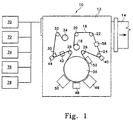
- Fig. 1 shows a continuous web coating sputtering system 10 suitable for laying down these various layers.
- System 10 includes vacuum chamber 12 which is evacuated via line 14. Contained within chamber 12 is a drive mechanism for moving a sheet of flexible polymer film 16 past a series of magnetron sputtering stations 50, 48, and 46.
- the drive mechanism includes feed roll 18, idlers 20, 22, 24, 26, 28, 30 and 32 and take-up roll 34.
- the film passes around chilled idler drum 36 as well.
- the film pauses a pair of monitors for determining its transmittance, 38, and reflectance, 40, before coating and a similar pair of monitors 42 and 44 after coating.
- This coater is configured to simultaneously sputter-deposit up to three layers on the plastic film using three separate DC magnetron cathodes 46, 48 and 50.
- cathode 46 is used to lay down the adhesion-promoting thin metal layer.
- Cathode 48 can be used to lay down the thick, functional (e.g. reflective) metal layer.
- Cathode 50 can be used to lay down an overcoating layer, if desired.
- a pre-glow station 52 for optional ionized gas cleaning or surface energy adjustment of the plastic film before coating.
- Each of these four stations is isolated from each other in space as a minichamber (see United States Patent No. 4,298,444), thereby producing a local environment for the containment of the various plasma gasses. This allows separate processes to be carried out simultaneously at each station with variations in atmosphere from station to station but with minimal cross-contamination among the four sources.
- Fig. 1 The control and monitoring of the sputtering system are normally accomplished using equipment and sensors which are conon in machines of this type. These are shown in Fig. 1 and include: 1) mass flow controllers 70 for regulation of gas flow into the cathode minichambers; 2) 5-10 kilowatt DC power supplies 72 (Advanced Energy) for all three sputtering cathodes; 3) an optical monitoring system 74 (Hexatron/Southwall Technologies) which measures both reflectance and transmission of the film over the spectral region from 360 to 2000 nm; and 4) a film motion control system 76 (Drivex) which regulates the tension, speed and distance of the film as it moves through the system and a preglow power supply 78.
- mass flow controllers 70 for regulation of gas flow into the cathode minichambers
- 5-10 kilowatt DC power supplies 72 Advanced Energy
- optical monitoring system 74 Hextron/Southwall Technologies
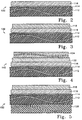
- FIG. 2 A typical structure of a product of this invention is shown in Fig. 2 as 120.
- This includes a plastic film substrate 112.
- This film substrate may have been subjected to a plasma surface treatment or other chemical surface treatment to modify its surface to obtain a surface energy of greater than 5 N/m 2 (50 dynes per cm 2 ).
- an adhesion-promoting layer 114 comprising a metal having an oxide heat of formation of less than -209340 kJ/kg atom (-50,000 calories per gram atom) of metal.
- Deposited upon this layer 114 is a thick layer 116 of functional metal having a heat of formation greater than -167472 kJ/kg atom (-40,000 calories per gram atom) of metal.
- Structure 130 includes an additional layer 118.
- This additional layer 118 is a protective overcoating layer. As noted above, it can be an inorganic material such as from about 2 to several tens of nm (20 to several hundred ⁇ ) of a metal or metal compound such as oxide, sulfide or carbide, or it can be a relatively thick organic or silicon-based hardcoat.
- a coated film 140 which has a particularly preferred overcoating structure.
- This overcoating structure includes a first layer 122 made up of 2 to several tens of nm (20 to several hundred ⁇ ) of metal or metal compound covered with a thicker hardcoat layer 124.
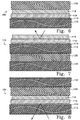
- any of the structures shown in Figs. 2 through 4 can be further coated with an adhesive layer 128 on either the plastic film side (structure 150, Fig. 5) or on the metal coated side (structure 160, Fig. 6).
- Layer 128 is typically formed from adhesive materials that are well known and used in the plastic laminating art and include for example, poly(isobutylene) and the like.
- Adhesive layer 128 may be covered with a temporary tear-away protective layer (not shown) for transporting or handling the adhesive-coated film.
- Adhesive layer 128 is useful for adhering the metal-on-plastic structures to a support or the like.
- structures 150 and 160 are shown as a part of reflectors 170 and 180, respectively, adhered to a support backing 132.
- This backing 132 is shown as a reflector body but can be any other surface to which the film of the present invention is desired to be laminated.
- the protective layer 118 is durable enough to protect the reflective metal layer and also that it be relatively transparent, so as to allow high degrees of reflection.
- the adhesive could be applied to the backside of film 112. Using this adhesive the film could be laminated onto a backing such as a lighting unit or the like.
- the presence of layer 114 improves the adhesion of the thick, functional metal layer 116 to plastic film 112.
- a roll of 0.025 ⁇ m (0.001 mil) thick PET (Mylar D by Dupont) was loaded into the sputtering machine depicted in Fig. 1. The roll was oriented so that the non-slip or untreated side of the roll faced the sputtering targets.
- a titanium target (127 x 396.9 mm) (5" x 15.625") was installed into the position marked 46 in Fig. 1.
- a silver target (82.55 x 396.9 mm) (3.25" x 15.625") was installed into the position marked 48.
- a nichrome target 80% nickel/20% chrome with dimensions of 127 x 396.9 mm (5" x 15.625") was installed into position 50.
- a flow of 11.2 sccm of argon was introduced into the minichamber surrounding the titanium target (i.e., position 46 in Fig. 1) to obtain a pressure of 0.4 Pa (3 x 10 -3 Torr).
- Power was applied to the titanium target (0.37 kW) and titanium was sputter-deposited onto the freshly "glowed" polymer film substantially in the form of titanium metal. No specific addition of oxygen was carried out.
- the power was selected to yield a thin adhesion-promoting layer of titanium which reduced the visible transmission of the substrate by 4.2 percentage points (i.e., from 88.8% to 84.6%) as determined by " in situ " measurement. (This transmission reduction by this measurement correlates experimentally to a titanium layer thickness of approximately 1.4 nm (14 ⁇ ).
- the roll was then reversed and a second coating operation was performed.
- a flow of 27.4 sccm of argon was introduced into the silver minichamber (position 48, Fig. 1) to obtain a pressure of 0.6 Pa (4.5 x 10 -3 Torr).
- the silver target was powered at 4.0 kW with the plastic film moving at 20 nm/sec and silver was sputter-deposited onto the titanium underlayer at a silver layer thickness of approximately 100 nm (1000 ⁇ ).
- the visible reflectivity (Rvis) of the resulting film as measured from the PET side within 24 hours from the completion of manufacturing was 95.5%. This is essentially the same reflectivity as was obtained when a sample having no adhesion-promoting layer but otherwise identical to LC1-23-32-3 was used.
- the titanium primer layer appeared to be almost completely oxidized, as evidenced by the insignificant reduction of the reflection of the silver layer when measured after the completion of the silver and nichrome layer deposit.
- An indication of the ease with which titanium films are oxidized to become transparent was observed by monitoring the transmission of the 4% titanium film in the vacuum chamber. Even in the absence of intentionally added oxygen, the transmission increased by more than 1 percentage point in 30 minutes.
- This silver sample sample number LC1-23-32-3, was laminated to 0.38 mm (0.015") thick cold-rolled steel using Morton Thiokol 503A adhesive.
- the adhesive was placed between the top sputtered nichrome layer and the steel.
- the laminated sample was subjected to a 30 minute, 77°C heat treatment and its reflectivity was remeasured. In the case of this material this heat treatment had no effect, indicating that the titanium underlayer, although laid down in a metal mode, had substantially up-oxidized to titanium oxide during subsequent processing steps.
- This example illustrates that certain metals having oxide heats of formation greater than -167472 kJ/kg atom (-40,000 calories/gram atom) of metals (namely those with melting points greater than 1100°C), when deposited as stoichiometric oxides, do not effectively promote corrosion-resistant adhesion of silver to a plastic substrate.
- the substrate was pre-glowed, an approximately 1.4 nm (14 ⁇ ) layer of titanium oxide was deposited, an approximately 100 nm (1000 ⁇ ) layer of silver was deposited, and an approximately 5 nm (50 ⁇ ) thick layer of nichrome was deposited, all in a single pass using all four sputtering positions in the machine shown in Fig. 1 (i.e., positions 52, 46, 48, and 50).
- the glow was carried out at a pressure of 0.16 Pa (1.2 x 10 -3 ) Torr with an air flow to the glow chamber of 18 sccm, a voltage of 1500 V, and a current of 75 mA.
- the titanium target was powered at 3.5 kW with 4.2 sccm of argon and 10 sccm of oxygen to obtain a minichamber pressure of 0.41 Pa (3.06 x 10 -3 Torr).
- the titanium target was operating in the oxidized mode to produce essentially fully stoichiometric TiO 2 with no significant (less than 1%) visible absorption.
- the silver target was powered at 0.84 kW with an argon flow of 19.5 sccm and a minichamber pressure of 0.4 Pa (3.0 x 10 -3 Torr).
- This silver sample sample number LC1-22-88-9, was laminated to 0.38 mm (0.015") thick cold-rolled steel using 5 minute Epoxy (Tru Bond) adhesive. The adhesive was placed between the top sputtered nichrome layer and the steel. The sample was then placed in a salt fog chamber operated at 95°C and 95% RH as described in ASTM B117. After about three days exposure the sample exhibited massive delamination between the silver layer and the PET as reported in Table IV.
- the "no adhesion-promotion layer samples”, LC1-22-88-1 and 2 are of interest as providing a “base line” reflectivity of about 95%. This indicates that materials of the invention, such as the material of Example 1, at worst are only very minimally disadvantaged in their absolute reflectivity performance by having their adhesion-promoting layers present.
- Example 3 tungsten and tungsten oxide were compared. Samples LC1-23-40-3 and LC1-23-38-1 show that tungsten effectively improved adhesion. Sample LC1-23-41-1 shows that tungsten deposited as tungsten oxide did not.
- Example 4 nickel and nickel oxide were compared.
- Sample LC11-23-45-1 shows that nickel effectively improved adhesion.
- Sample LC1-23-45-2 shows that nickel deposited as nickel oxide did not.
- Example 5 tantalum and tantalum oxide were compared.
- Sample LC1-23-40-3 shows that tantalum effectively improved adhesion.
- Sample LC1-23-41-1 shows that tantalum deposited as tantalum oxide did not.
- Example 6 chromium and chromium oxide were compared. Sample LC1-23-45-3 shows that chromium effectively improved adhesion. Sample LC1-23-45-4 shows that chromium deposited as chromium oxide did not.
- This example illustrates the use of an argon glow to increase the surface energy of the plastic substrate and improve the effectiveness of the adhesion-promoting layers of this invention.
- This sample labeled LC1-23-36-1 in Table III, was prepared with a titanium metal primer layer as described in Example 1, but with argon gas in the plasma pre-glow rather than air and with all the layers being laid down in one pass by the use of all the electrode positions in the sputtering machine.
- the glow pressure was 0.23 Pa (1.7 x 10 -3 Torr) with an argon flow of 38.9 sccm, a voltage of 1500 V, and a current of 75 mA.
- a titanium target in position 46 of Fig. 1 was powered at 0.26 kW with 10.3 sccm of argon to obtain a minichamber pressure of 0.4 Pa (3.0 x 10 -3 Torr).
- the resulting titanium layer caused the transmission of the uncoated substrate to be reduced by about 4 percentage points as discussed in Example 1.
- the silver target in position 48 of Fig. 1 was powered at 4.0 kW with 26.7 sccm of argon to obtain a minichamber pressure of 0.6 Pa (4.5 x 10 -3 Torr).
- the nichrome target in position 50 of Fig. 1 was powered at 0.84 kW with an argon flow of 19.9 sccm and a minichamber pressure of 0.4 Pa (3.0 x 10 -3 Torr). A linespeed of 20 mm/sec was used.
- the resulting silver film was laminated to steel and salt fog-tested as described in Example 1. After about three days exposure only 5% of the sample surface was corroded and delamination was not observed between the silver layer and the PET.
- Example 7 For comparison purposes, the experiment of Example 7 was substantially repeated but without a surface pretreatment to increase the surface energy.
- This sample labeled as LC1-23-36-2 in Table III, was prepared with a titanium metal primer layer as described in Example 7, but without pre-glowing the substrate.
- an argon flow of 38.9 sccm was introduced into the glow chamber but power was not applied to the glow rod.
- the titanium target was powered at 0.26 kW with 10.3 sccm of argon to obtain a minichamber pressure of 0.4 Pa (3.0 x 10 -3 Torr).
- the resulting titanium layer caused the transmission of the uncoated substrate to be reduced by about 4 percentage points.
- the silver target was powered at 4.0 kW with 26.7 sccm of argon to obtain a minichamber pressure of 0.6 Pa (4.5 x 10 -3 Torr).
- the nichrome target was powered at 0.84 kW with an argon flow of 19.9 sccm and a minichamber pressure of 0.4 Pa (3.0 x 10 -3 Torr).
- a linespeed of 20 mm/sec was used.
- Example 8 The resulting silver film was laminated to steel and salt fog-tested as described in Example 1. After about three days exposure, 50% of the sample surface was corroded. Thus, the corrosion resistance of the sample made in Example 8 is much lower than the sample described in Example 7. This demonstrates the advantage of pretreating the substrate to obtain optimum adhesion between the PET and the primer layer.
- Mixtures of metals can serve as adhesion-promoting layers for the solver PET interface.
- an 80/20 alloy of nickel and chromium, nichrome, is used.
- This sample labeled as LC1-22-89-1 in Table III, was prepared with a nichrome metal primer layer.
- An air flow of 17.5 sccm was introduced into the glow chamber to obtain a pressure of 1.73 Pa (1.3 x 10 -2 Torr) at 1500 volts and 75 mA.
- the nichrome target was powered at 0.10 kW with 15.3 sccm of argon to obtain a minichamber pressure of 0.4 Pa (3.0 x 10 -3 Torr).
- the resulting nichrome layer caused the transmission of the uncoated substrate to be reduced by about 5 percentage points.
- the silver target was powered at 4.0 kW with 26.0 sccm of argon to obtain a minichamber pressure of 0.6 Pa (4.5 x 10 -3 Torr).
- the top nichrome target i.e., position 50 in Fig. 1 was powered at 0.84 kW with an argon flow of 19.9 sccm and a minichamber pressure of 0.4 Pa (3.0 x 10 -3 Torr).
- a linespeed of 20 mm/sec was used.
- Example 1 The experiment of Example 1 was substantially repeated replacing the titanium primer layer with an indium primer layer (sample LC1-23-42-4) and with an aluminum primer layer (sample LC1-23-43-5). As shown in Table III, both of these metals were effective.
- Example 1 was substantially repeated halving (sample LC1-23-32-2) and doubling (sample LC1-23-32-4) the thickness of the titanium primer. As shown in Table III, each of these metals was effective. However, the thicker the primer layer the more effective the adhesion promotion.
- nichrome primer layer was deposited onto a pre-glowed film from an argon plasma power and linespeed (i.e., 8.6 kW at 150 mm/sec) which resulted in a 24 percentage point drop in the visible transmission of the substrate. This corresponds to an approximately 3 nm (30 ⁇ ) thick nichrome layer.
- Oxygen (93 sccm) was added to the nichrome sputtering plasma to a level which resulted in an increase in transmission of about 10 percentage points while keeping the target operating in the "metal mode.”
- Silver and a nichrome protective layer were deposited onto the partially oxidized nichrome layer in a manner similar to that described above.
- Example 2 The resulting sample was adhered to steel and salt fog-tested as described in Example 1. After a three day exposure, no corrosion or delamination was observed. Thus, unlike the stoichiometric titanium oxide primer described in Example 2, the substoichiometric nichrome oxide in this example did function as an effective adhesion promoter.
- primer metals with melting points lower than 1100°C can be sputtered in the oxide mode as stoichiometric oxides and function as effective adhesion primers.
- the substrate was pre-glowed, an approximately 3 nm (30 ⁇ ) layer of zinc oxide was deposited, an approximately 100 nm (1000 ⁇ ) layer of silver was deposited, and an approximately 10 nm (100 ⁇ ) layer of nichrome was deposited in a single pass using all plasma positions in the machine shown in Fig. 1.
- This sample is labeled as LC1-23-43-2 in Table III.
- the glow pressure was at 0.16 Pa (1.2 x 10 -3 Torr) with an air flow of 16.5 sccm, a voltage of 1500 V, and a current of 75 mA.
- the zinc target was powered at 1.04 kW with 5.0 sccm of argon, 4 sccm of nitrogen, 2 sccm of hydrogen, and 20 sccm of oxygen to obtain a minichamber pressure of 0.53 Pa (4.0 x 10 -3 Torr).
- the zinc target was operating in the oxidized mode to produce essentially fully stoichiometric zinc oxide with no significant (i.e., ⁇ 1%) visible absorption.)
- the silver target was powered at 4.0 kW with 26.2 sccm of argon to obtain a minichamber pressure of 0.6 Pa (4.5 x 10 -3 Torr).
- the nichrome target was powered at 0.84 kW with an argon flow of 21.3 sccm and a minichamber pressure of 0.4 Pa (3.0 x 10 -3 Torr).
- Example 1 A review of the results in Example 1, 12 and 13 showed that increasing primer thickness decreased reflectivity. These three experiments were repeated but with an O 2 glow inserted after the titanium layer deposit and before the silver deposit. The results of these experiments (samples LC1-23-35-1, LC1-23-35-2 and LC1-23-35-3 in Table III) show that the O 2 treatment helped oxidize the less than fully up-oxidized thicker titanium layers (as shown by improved reflectance), but that the "2%" material was substantially unaffected, indicating full up-oxidation as formed.
Landscapes
- Chemical & Material Sciences (AREA)
- Chemical Kinetics & Catalysis (AREA)
- Engineering & Computer Science (AREA)
- Materials Engineering (AREA)
- Mechanical Engineering (AREA)
- Metallurgy (AREA)
- Organic Chemistry (AREA)
- Laminated Bodies (AREA)
- Physical Vapour Deposition (AREA)
- Other Surface Treatments For Metallic Materials (AREA)
- Optical Elements Other Than Lenses (AREA)
Claims (10)
- Matière métal sur plastique, comprenantun substrat en matière plastique ayant une surface,une première couche de 0,3 nm à 20 nm (3 à 200 Å) d'épaisseur déposée par pulvérisation sur la surface du substrat étant constituée de métal choisi dans le groupe comprenant l'hafnium, le zirconium, le tantale, le titane, le niobium, le tungstène, le vanadium, le molybdène, le chrome, le nickel et des alliages de ceux-ci, le métal de ladite première couche se présentant sous la forme d'un métal ou d'un oxyde substoechiométrique, etsur la première couche, une deuxième couche constituée de 50 à 300 nm (500 à 3000 Å) de métal déposé par pulvérisation, choisi dans le groupe comprenant le cuivre, l'argent, l'or, le palladium, le rhodium, l'iridium et des alliages de ceux-ci.
- Matière métal sur plastique, comprenantun substrat en matière plastique ayant une surface,une première couche de 0,3 nm à 20 nm (3 à 200 Å) d'épaisseur déposée par pulvérisation sur la surface du substrat étant constituée de métal choisi dans le groupe comprenant l'aluminium, l'étain, l'antimoine, l'indium, le zinc, le bismuth, le cadmium et des alliages de ceux-ci, le métal de ladite première couche se présentant sous la forme d'un métal, d'un oxyde substoechiométrique ou d'un oxyde totalement stoechiométrique, etsur la première couche, une deuxième couche constituée de 50 à 300 nm (500 à 3000 Å) de métal déposé par pulvérisation, choisi dans le groupe comprenant le cuivre, l'argent, l'or, le palladium, le rhodium, l'iridium et des alliages de ceux-ci.
- Matière selon la revendication 1 ou 2, dans laquelle la deuxième couche est en argent.
- Matière selon la revendication 1 ou 2, dans laquelle la première couche est présente sous forme de métal.
- Matière selon la revendication 1 ou 2, dans laquelle la première couche est présente sous la forme d'un oxyde substoechiométrique.
- Matière selon la revendication 1 ou 2, dans laquelle le substrat en matière plastique est constitué par un film de polyester.
- Matière selon la revendication 1 ou 2, dans laquelle le substrat a une énergie de surface supérieure à 5 N/m2 (50 dynes par cm2).
- Matière selon la revendication 1 ou 2, comprenant en outre une couche de finition protectrice sur la surface de la deuxième couche.
- Matière selon la revendication 8, dans laquelle le substrat en matière plastique est constitué par un film de matière plastique ayant deux surfaces, une première surface étant la surface sur laquelle se trouve la première couche et comportant en outre une couche de colle adhérant à l'autre surface ou sur la couche de finition protectrice.
- Matière selon la revendication 9, dans laquelle la deuxième couche est une couche d'argent réfléchissant la lumière.
Applications Claiming Priority (3)
| Application Number | Priority Date | Filing Date | Title |
|---|---|---|---|
| US08/014,447 US5589280A (en) | 1993-02-05 | 1993-02-05 | Metal on plastic films with adhesion-promoting layer |
| US14447 | 1993-02-05 | ||
| PCT/US1994/001320 WO1994018003A1 (fr) | 1993-02-05 | 1994-02-04 | Pellicules en metal sur plastique a couche de promotion de l'adhesion |
Publications (3)
| Publication Number | Publication Date |
|---|---|
| EP0686093A1 EP0686093A1 (fr) | 1995-12-13 |
| EP0686093A4 EP0686093A4 (fr) | 1996-02-28 |
| EP0686093B1 true EP0686093B1 (fr) | 2000-08-09 |
Family
ID=21765532
Family Applications (1)
| Application Number | Title | Priority Date | Filing Date |
|---|---|---|---|
| EP94908723A Expired - Lifetime EP0686093B1 (fr) | 1993-02-05 | 1994-02-04 | Pellicules en metal sur plastique a couche de promotion de l'adhesion |
Country Status (6)
| Country | Link |
|---|---|
| US (1) | US5589280A (fr) |
| EP (1) | EP0686093B1 (fr) |
| JP (1) | JP3637057B2 (fr) |
| DE (1) | DE69425488T2 (fr) |
| TW (1) | TW294630B (fr) |
| WO (1) | WO1994018003A1 (fr) |
Families Citing this family (84)
| Publication number | Priority date | Publication date | Assignee | Title |
|---|---|---|---|---|
| EP0657562B1 (fr) * | 1993-11-12 | 2001-09-12 | PPG Industries Ohio, Inc. | Couche d'oxyde dure obtenue par pulvérisation cathodique |
| TW314600B (fr) * | 1995-05-31 | 1997-09-01 | Mitsui Toatsu Chemicals | |
| GB9600210D0 (en) | 1996-01-05 | 1996-03-06 | Vanderstraeten E Bvba | Improved sputtering targets and method for the preparation thereof |
| US6171714B1 (en) † | 1996-04-18 | 2001-01-09 | Gould Electronics Inc. | Adhesiveless flexible laminate and process for making adhesiveless flexible laminate |
| DE19629335A1 (de) * | 1996-07-20 | 1998-01-22 | Golden Records Ass Internation | Karte aus Kunststoff |
| FR2753725B1 (fr) * | 1996-09-26 | 1998-11-27 | Tecmachine | Revetement de surface de materiaux isolants, son procede d'obtention et son application pour la realisation de blindages pour boitiers isolants |
| US6103381A (en) * | 1997-08-01 | 2000-08-15 | Mascotech, Inc. | Coating having the appearance of black chrome with a silicone top layer |
| US6090490A (en) * | 1997-08-01 | 2000-07-18 | Mascotech, Inc. | Zirconium compound coating having a silicone layer thereon |
| US6242100B1 (en) | 1997-08-01 | 2001-06-05 | Mascotech Coatings, Inc. | Chrome coating having a top layer thereon |
| US6346327B1 (en) | 1997-08-01 | 2002-02-12 | Mascotech Coatings, Inc. | Chrome coated article |
| US6096426A (en) * | 1997-08-01 | 2000-08-01 | Mascotech, Inc. | Coating having the appearance of black chrome |
| US6268060B1 (en) * | 1997-08-01 | 2001-07-31 | Mascotech Coatings, Inc. | Chrome coating having a silicone top layer thereon |
| US6168242B1 (en) | 1997-08-01 | 2001-01-02 | Mascotech, Inc. | Zirconium nitride coating having a top layer thereon |
| DE19744953A1 (de) † | 1997-10-10 | 1999-04-15 | Giesecke & Devrient Gmbh | Sicherheitselement und Verfahren zu seiner Herstellung |
| DE19752329A1 (de) * | 1997-11-26 | 1999-05-27 | Stolberger Metallwerke Gmbh | Verfahren zur Herstellung eines metallischen Verbundbands |
| US6007901A (en) * | 1997-12-04 | 1999-12-28 | Cpfilms, Inc. | Heat reflecting fenestration products with color corrective and corrosion protective layers |
| US6042929A (en) * | 1998-03-26 | 2000-03-28 | Alchemia, Inc. | Multilayer metalized composite on polymer film product and process |
| US6770380B2 (en) | 1998-08-11 | 2004-08-03 | Nikko Materials Usa, Inc. | Resin/copper/metal laminate and method of producing same |
| US6262401B1 (en) | 1998-12-30 | 2001-07-17 | Aos Holding Company | Gold-plated water heater element and method of making same |
| US6277494B1 (en) | 1999-03-05 | 2001-08-21 | Mascotech, Inc. | Chrome coated article |
| US6146480A (en) | 1999-03-12 | 2000-11-14 | Ga-Tek Inc. | Flexible laminate for flexible circuit |
| US6268070B1 (en) | 1999-03-12 | 2001-07-31 | Gould Electronics Inc. | Laminate for multi-layer printed circuit |
| US6103135A (en) * | 1999-03-26 | 2000-08-15 | Ga-Tek Inc. | Multi-layer laminate and method of producing same |
| US6365284B1 (en) | 1999-06-04 | 2002-04-02 | Crown Operations International, Ltd. | Flexible solar-control laminates |
| US6264336B1 (en) | 1999-10-22 | 2001-07-24 | 3M Innovative Properties Company | Display apparatus with corrosion-resistant light directing film |
| US6590711B1 (en) | 2000-04-03 | 2003-07-08 | 3M Innovative Properties Co. | Light directing construction having corrosion resistant feature |
| JP4615701B2 (ja) * | 1999-12-07 | 2011-01-19 | 株式会社フルヤ金属 | 高耐熱性反射膜を用いた積層体 |
| US6391457B1 (en) | 1999-12-23 | 2002-05-21 | Vapor Technologies, Inc. | Coated article |
| US6399219B1 (en) | 1999-12-23 | 2002-06-04 | Vapor Technologies, Inc. | Article having a decorative and protective coating thereon |
| JP3510845B2 (ja) * | 2000-08-29 | 2004-03-29 | Hoya株式会社 | 反射防止膜を有する光学部材 |
| AU756842B2 (en) * | 2000-08-29 | 2003-01-23 | Hoya Corporation | Optical element having antireflection film |
| US6357884B1 (en) | 2000-09-14 | 2002-03-19 | Edward Quinn | Reflective element for still and motion photography |
| US6906257B2 (en) | 2001-01-29 | 2005-06-14 | Honeywell International Inc. | Metallic coated dielectric substrates |
| JP2004532423A (ja) * | 2001-01-29 | 2004-10-21 | ハネウェル・インターナショナル・インコーポレーテッド | 強健な高反射性光学構造物 |
| US20020187350A1 (en) * | 2001-01-29 | 2002-12-12 | Honeywell International Inc. | Robust highly reflective optical construction |
| EP1445627A3 (fr) * | 2001-01-29 | 2004-10-27 | Honeywell International Inc. | Construction optique robuste a haute reflexion |
| CN100503891C (zh) * | 2001-09-19 | 2009-06-24 | 西铁城控股株式会社 | 软质金属及其制造方法以及表的外装部件及其制造方法 |
| US7128959B2 (en) * | 2002-08-23 | 2006-10-31 | General Electric Company | Reflective article and method for the preparation thereof |
| US7132149B2 (en) * | 2002-08-23 | 2006-11-07 | General Electric Company | Data storage medium and method for the preparation thereof |
| US6707610B1 (en) * | 2002-09-20 | 2004-03-16 | Huper Optik International Pte Ltd | Reducing the susceptibility of titanium nitride optical layers to crack |
| CA2424630A1 (fr) * | 2003-04-07 | 2004-10-07 | Marko I.R.D.C. Inc. | Film reflechissant |
| US7241506B2 (en) * | 2003-06-10 | 2007-07-10 | Cardinal Cg Company | Corrosion-resistant low-emissivity coatings |
| ATE550456T1 (de) * | 2003-10-07 | 2012-04-15 | Deposition Sciences Inc | Vorrichtung und verfahren zur schnellen abscheidung von rutil-titandioxid |
| US20070003702A1 (en) * | 2003-11-17 | 2007-01-04 | Fumito Nishida | Method of preparing a metal-silicone rubber composite |
| EP1689906A1 (fr) * | 2003-11-17 | 2006-08-16 | Dow Corning Corporation | Procede de preparation d'un composite metal-caoutchouc de silicone |
| CA2550331A1 (fr) | 2003-12-22 | 2005-07-14 | Cardinal Cg Compagny | Revetements photocatalytiques degrades |
| JP3555660B1 (ja) * | 2004-02-02 | 2004-08-18 | セイコーエプソン株式会社 | 装飾品、装飾品の製造方法および時計 |
| JP2005234025A (ja) * | 2004-02-17 | 2005-09-02 | Omron Corp | 光導波路装置 |
| US8500965B2 (en) * | 2004-05-06 | 2013-08-06 | Ppg Industries Ohio, Inc. | MSVD coating process |
| EP1773729B1 (fr) | 2004-07-12 | 2007-11-07 | Cardinal CG Company | Revêtements à faible entretien |
| DE102004034369B4 (de) * | 2004-07-16 | 2007-04-26 | Fraunhofer-Gesellschaft zur Förderung der angewandten Forschung e.V. | Halogenlampe |
| US8092660B2 (en) | 2004-12-03 | 2012-01-10 | Cardinal Cg Company | Methods and equipment for depositing hydrophilic coatings, and deposition technologies for thin films |
| US7923114B2 (en) | 2004-12-03 | 2011-04-12 | Cardinal Cg Company | Hydrophilic coatings, methods for depositing hydrophilic coatings, and improved deposition technology for thin films |
| SG126776A1 (en) * | 2005-04-08 | 2006-11-29 | 3M Innovative Properties Co | Flexible circuit substrate |
| DE102006018602A1 (de) * | 2005-06-09 | 2006-12-14 | Bayer Materialscience Ag | Flammwidrige beschichtete Polycarbonat-Formkörper |
| JP4908884B2 (ja) * | 2006-03-15 | 2012-04-04 | 三菱重工業株式会社 | 成形体表面の導電化方法及び表面導電性成形体 |
| JP2009534563A (ja) | 2006-04-19 | 2009-09-24 | 日本板硝子株式会社 | 同等の単独の表面反射率を有する対向機能コーティング |
| US7550193B2 (en) | 2006-05-05 | 2009-06-23 | Nanofilm Ltd | Infrared radiation blocking laminate |
| US20080011599A1 (en) | 2006-07-12 | 2008-01-17 | Brabender Dennis M | Sputtering apparatus including novel target mounting and/or control |
| EP2498311A3 (fr) * | 2006-11-03 | 2014-09-10 | Danfoss A/S | Transducteur capacitif à action directe |
| DE602007014165D1 (de) * | 2006-11-03 | 2011-06-09 | Danfoss As | Dielektrischer Verbundwerkstoff und Verfahren zur Herstellung eines dielektrischen Verbundwerkstoffs |
| EP2498313A3 (fr) * | 2006-11-03 | 2014-09-03 | Danfoss A/S | Composite auto-cicatrisant |
| KR101511799B1 (ko) * | 2006-12-28 | 2015-04-13 | 쓰리엠 이노베이티브 프로퍼티즈 컴파니 | 박막 금속 층 형성을 위한 핵형성 층 |
| DE102007021896A1 (de) * | 2007-05-10 | 2008-11-20 | Fraunhofer-Gesellschaft zur Förderung der angewandten Forschung e.V. | Flexibles Leiterplattenmaterial und Verfahren zum Herstellen desselben |
| KR101512166B1 (ko) | 2007-09-14 | 2015-04-14 | 카디날 씨지 컴퍼니 | 관리가 용이한 코팅 기술 |
| US8916032B2 (en) * | 2007-10-02 | 2014-12-23 | Roger Wen Yi Hsu | Light emitting diode vacuum coating by magnetized mask |
| US20100313945A1 (en) * | 2008-08-21 | 2010-12-16 | Applied Materials, Inc. | Solar Cell Substrate and Methods of Manufacture |
| KR20100117173A (ko) * | 2009-04-24 | 2010-11-03 | 쓰리엠 이노베이티브 프로퍼티즈 캄파니 | 전기화학적 바이오센서용 전극 스트립 및 그 제조방법 |
| US20110030920A1 (en) * | 2009-08-04 | 2011-02-10 | Asia Vital Components (Shen Zhen) Co., Ltd. | Heat Sink Structure |
| JP5501002B2 (ja) * | 2010-01-15 | 2014-05-21 | 株式会社アルバック | フィルムコンデンサ用金属化フィルムの製造方法 |
| JP2011233872A (ja) * | 2010-04-08 | 2011-11-17 | Asahi Glass Co Ltd | 金属パターン付き基板の製造方法及び金属積層体付き基板 |
| US9726795B2 (en) | 2010-10-25 | 2017-08-08 | Covestro Deutschland Ag | Multilayer plastic structure having low energy transmission |
| CN102465259A (zh) * | 2010-11-11 | 2012-05-23 | 鸿富锦精密工业(深圳)有限公司 | 塑料表面电磁屏蔽处理方法及其制品 |
| TW201233820A (en) * | 2011-02-08 | 2012-08-16 | Chenming Mold Ind Corp | Ceramic member and manufacturing thereof |
| WO2013101822A2 (fr) * | 2011-12-29 | 2013-07-04 | 3M Innovative Properties Company | Métallisation de films à base d'élastomère fluoré |
| JP2013161026A (ja) * | 2012-02-08 | 2013-08-19 | Toyo Ink Sc Holdings Co Ltd | カラーフィルタ用着色剤組成物およびカラーフィルタ |
| DE102012020742A1 (de) * | 2012-10-23 | 2014-04-24 | Oerlikon Trading Ag, Trübbach | Mit einer eingebetteten PVD-Schicht beschichtetes Kunststoffteil |
| US11969964B2 (en) * | 2013-05-22 | 2024-04-30 | Ningbo Solartron Technology Co., Ltd. | Method for manufacturing silver-plated reflecting film |
| KR20140142123A (ko) * | 2013-05-31 | 2014-12-11 | 삼성전자주식회사 | 다층박막의 제조방법, 다층박막이 형성된 부재, 및 이를 포함하는 전자제품. |
| DE102015102496B4 (de) | 2014-10-27 | 2024-06-20 | Almeco Gmbh | Temperatur- und korrosionsstabiler Oberflächenreflektor |
| WO2018093985A1 (fr) | 2016-11-17 | 2018-05-24 | Cardinal Cg Company | Technologie de revêtement à dissipation statique |
| CN115349031A (zh) | 2020-01-31 | 2022-11-15 | 旭硝子欧洲玻璃公司 | 耐久的装饰性涂覆的基材及其获得方法 |
| US20240081199A1 (en) | 2021-02-02 | 2024-03-14 | Infrascreen Sa | Screen for greenhouse |
| CN119630832A (zh) | 2022-08-04 | 2025-03-14 | 旭硝子欧洲玻璃公司 | 装饰性涂覆的聚合物基材及其获得方法 |
Family Cites Families (19)
| Publication number | Priority date | Publication date | Assignee | Title |
|---|---|---|---|---|
| US3601471A (en) * | 1969-03-03 | 1971-08-24 | Optical Coating Laboratory Inc | Durable first surface silver high reflector |
| GB1307642A (en) * | 1969-04-07 | 1973-02-21 | Asahi Glass Co Ltd | Electrically conductive glass articles |
| US4223974A (en) * | 1978-08-02 | 1980-09-23 | American Optical Corporation | Enhanced bonding of silicon oxides and silver by intermediate coating of metal |
| JPS5827103B2 (ja) * | 1978-11-13 | 1983-06-07 | 横浜機工株式会社 | 多層コ−テイング反射板 |
| JPS5632352A (en) * | 1979-08-28 | 1981-04-01 | Honda Motor Co Ltd | Heat ray reflecting laminated glass for car |
| CA1179589A (fr) * | 1980-06-26 | 1984-12-18 | Dominic I. Nelson-Ashley | Ouvrages comprenant un element de polyethylene liaisonne a un support metallique, et methode de fabrication connexe |
| US4716086A (en) * | 1984-12-19 | 1987-12-29 | Ppg Industries, Inc. | Protective overcoat for low emissivity coated article |
| US4828346A (en) * | 1985-10-08 | 1989-05-09 | The Boc Group, Inc. | Transparent article having high visible transmittance |
| US4861680A (en) * | 1988-02-11 | 1989-08-29 | Southwall Technologies | Bronze-grey glazing film and window made therefrom |
| US4902580A (en) * | 1988-04-01 | 1990-02-20 | Ppg Industries, Inc. | Neutral reflecting coated articles with sputtered multilayer films of metal oxides |
| IL86366A0 (en) * | 1988-05-12 | 1988-11-15 | Luz Ind Israel Ltd | Protected silvered substrates and mirrors containing the same |
| GB8900165D0 (en) * | 1989-01-05 | 1989-03-01 | Glaverbel | Glass coating |
| US5216551A (en) * | 1990-02-16 | 1993-06-01 | Asahi Kogaku Kogyo K.K. | Surface reflector |
| US5215832A (en) * | 1990-04-25 | 1993-06-01 | Cardinal Ic Company | Lead-free mirrors and environmentally safe manufacture thereof |
| JP3063769B2 (ja) * | 1990-07-17 | 2000-07-12 | イーシー化学株式会社 | 大気圧プラズマ表面処理法 |
| US5306547A (en) * | 1990-12-14 | 1994-04-26 | Southwall Technologies Inc. | Low transmission heat-reflective glazing materials |
| TW205099B (fr) * | 1991-05-30 | 1993-05-01 | Mitsui Toatsu Chemicals | |
| CA2099852A1 (fr) * | 1992-07-07 | 1994-01-08 | Stephen Randall Holmes-Farley | Methode d'utilisation d'une intercouche metallique pour accroitre l'adherence entre le metal et un substrat polymere |
| US5361172A (en) * | 1993-01-21 | 1994-11-01 | Midwest Research Institute | Durable metallized polymer mirror |
-
1993
- 1993-02-05 US US08/014,447 patent/US5589280A/en not_active Expired - Lifetime
-
1994
- 1994-02-04 WO PCT/US1994/001320 patent/WO1994018003A1/fr not_active Ceased
- 1994-02-04 DE DE69425488T patent/DE69425488T2/de not_active Expired - Lifetime
- 1994-02-04 EP EP94908723A patent/EP0686093B1/fr not_active Expired - Lifetime
- 1994-02-04 JP JP51826594A patent/JP3637057B2/ja not_active Expired - Fee Related
- 1994-03-05 TW TW083101913A patent/TW294630B/zh not_active IP Right Cessation
Also Published As
| Publication number | Publication date |
|---|---|
| WO1994018003A1 (fr) | 1994-08-18 |
| JP3637057B2 (ja) | 2005-04-06 |
| EP0686093A4 (fr) | 1996-02-28 |
| US5589280A (en) | 1996-12-31 |
| EP0686093A1 (fr) | 1995-12-13 |
| TW294630B (fr) | 1997-01-01 |
| DE69425488D1 (de) | 2000-09-14 |
| JPH08510009A (ja) | 1996-10-22 |
| DE69425488T2 (de) | 2001-01-11 |
Similar Documents
| Publication | Publication Date | Title |
|---|---|---|
| EP0686093B1 (fr) | Pellicules en metal sur plastique a couche de promotion de l'adhesion | |
| EP0779938B1 (fr) | Films reflecteurs double-face | |
| US5763063A (en) | Multiple layer thin films with improved corrosion resistance | |
| EP1546771B1 (fr) | Reduction du risque de craquelement des couches optiques en nitrure de titane | |
| JP2505276B2 (ja) | 灰色高透過性低放射性物品及びその製法 | |
| US5494743A (en) | Antireflection coatings | |
| KR920001387B1 (ko) | 자동차의 열부하 감소용 저 복사성 필름 | |
| EP0049083B1 (fr) | Pellicule stratifiée | |
| JP4767167B2 (ja) | 濃度変調コーティング | |
| SE8904230L (sv) | Belagt foerglasningsmaterial och saett foer dess belaeggning | |
| JPS62196366A (ja) | 高透過率,低放射率物品 | |
| CA2315917A1 (fr) | Empilement de couches pour substrats transparents | |
| GB2027223A (en) | Optical interference filter | |
| US6255003B1 (en) | Gold-clad-silver-layer-containing films | |
| US4861680A (en) | Bronze-grey glazing film and window made therefrom | |
| US5705278A (en) | Heat processable metallic vacuum coatings | |
| KR100804340B1 (ko) | 광반사체용 기재 및 광반사체 | |
| JP2004532423A (ja) | 強健な高反射性光学構造物 | |
| JP3373298B2 (ja) | 機能性物品とその製造方法 | |
| HK40017712A (en) | Low emissivity coatings, glass surfaces including the same, and methods for making the same | |
| HK40017712B (en) | Low emissivity coatings, glass surfaces including the same, and methods for making the same |
Legal Events
| Date | Code | Title | Description |
|---|---|---|---|
| PUAI | Public reference made under article 153(3) epc to a published international application that has entered the european phase |
Free format text: ORIGINAL CODE: 0009012 |
|
| 17P | Request for examination filed |
Effective date: 19950807 |
|
| AK | Designated contracting states |
Kind code of ref document: A1 Designated state(s): BE DE FR GB IT NL |
|
| A4 | Supplementary search report drawn up and despatched |
Effective date: 19960111 |
|
| AK | Designated contracting states |
Kind code of ref document: A4 Designated state(s): BE DE FR GB IT NL |
|
| 17Q | First examination report despatched |
Effective date: 19980717 |
|
| GRAG | Despatch of communication of intention to grant |
Free format text: ORIGINAL CODE: EPIDOS AGRA |
|
| GRAG | Despatch of communication of intention to grant |
Free format text: ORIGINAL CODE: EPIDOS AGRA |
|
| GRAH | Despatch of communication of intention to grant a patent |
Free format text: ORIGINAL CODE: EPIDOS IGRA |
|
| GRAH | Despatch of communication of intention to grant a patent |
Free format text: ORIGINAL CODE: EPIDOS IGRA |
|
| GRAA | (expected) grant |
Free format text: ORIGINAL CODE: 0009210 |
|
| AK | Designated contracting states |
Kind code of ref document: B1 Designated state(s): BE DE FR GB IT NL |
|
| PG25 | Lapsed in a contracting state [announced via postgrant information from national office to epo] |
Ref country code: IT Free format text: LAPSE BECAUSE OF FAILURE TO SUBMIT A TRANSLATION OF THE DESCRIPTION OR TO PAY THE FEE WITHIN THE PRESCRIBED TIME-LIMIT;WARNING: LAPSES OF ITALIAN PATENTS WITH EFFECTIVE DATE BEFORE 2007 MAY HAVE OCCURRED AT ANY TIME BEFORE 2007. THE CORRECT EFFECTIVE DATE MAY BE DIFFERENT FROM THE ONE RECORDED. Effective date: 20000809 |
|
| REF | Corresponds to: |
Ref document number: 69425488 Country of ref document: DE Date of ref document: 20000914 |
|
| ET | Fr: translation filed | ||
| PLBE | No opposition filed within time limit |
Free format text: ORIGINAL CODE: 0009261 |
|
| STAA | Information on the status of an ep patent application or granted ep patent |
Free format text: STATUS: NO OPPOSITION FILED WITHIN TIME LIMIT |
|
| 26N | No opposition filed | ||
| REG | Reference to a national code |
Ref country code: GB Ref legal event code: IF02 |
|
| PGFP | Annual fee paid to national office [announced via postgrant information from national office to epo] |
Ref country code: NL Payment date: 20030226 Year of fee payment: 10 |
|
| PG25 | Lapsed in a contracting state [announced via postgrant information from national office to epo] |
Ref country code: NL Free format text: LAPSE BECAUSE OF NON-PAYMENT OF DUE FEES Effective date: 20040901 |
|
| NLV4 | Nl: lapsed or anulled due to non-payment of the annual fee |
Effective date: 20040901 |
|
| PGFP | Annual fee paid to national office [announced via postgrant information from national office to epo] |
Ref country code: GB Payment date: 20130227 Year of fee payment: 20 Ref country code: FR Payment date: 20130311 Year of fee payment: 20 Ref country code: DE Payment date: 20130227 Year of fee payment: 20 |
|
| PGFP | Annual fee paid to national office [announced via postgrant information from national office to epo] |
Ref country code: BE Payment date: 20130227 Year of fee payment: 20 |
|
| REG | Reference to a national code |
Ref country code: DE Ref legal event code: R071 Ref document number: 69425488 Country of ref document: DE |
|
| REG | Reference to a national code |
Ref country code: GB Ref legal event code: PE20 Expiry date: 20140203 |
|
| BE20 | Be: patent expired |
Owner name: *SOUTHWALL TECHNOLOGIES INC. Effective date: 20140204 |
|
| PG25 | Lapsed in a contracting state [announced via postgrant information from national office to epo] |
Ref country code: DE Free format text: LAPSE BECAUSE OF EXPIRATION OF PROTECTION Effective date: 20140205 Ref country code: GB Free format text: LAPSE BECAUSE OF EXPIRATION OF PROTECTION Effective date: 20140203 |