EP0686602A1 - Eau de nettoyage exempte de detergent, procede et appareil de production de ladite eau, et procede de separation d'emulsion formee par l'utilisation de ladite eau de nettoyage dans l'eau et l'huile - Google Patents
Eau de nettoyage exempte de detergent, procede et appareil de production de ladite eau, et procede de separation d'emulsion formee par l'utilisation de ladite eau de nettoyage dans l'eau et l'huile Download PDFInfo
- Publication number
- EP0686602A1 EP0686602A1 EP94907660A EP94907660A EP0686602A1 EP 0686602 A1 EP0686602 A1 EP 0686602A1 EP 94907660 A EP94907660 A EP 94907660A EP 94907660 A EP94907660 A EP 94907660A EP 0686602 A1 EP0686602 A1 EP 0686602A1
- Authority
- EP
- European Patent Office
- Prior art keywords
- water
- tourmaline
- metal
- washing water
- oil
- Prior art date
- Legal status (The legal status is an assumption and is not a legal conclusion. Google has not performed a legal analysis and makes no representation as to the accuracy of the status listed.)
- Withdrawn
Links
- XLYOFNOQVPJJNP-UHFFFAOYSA-N water Substances O XLYOFNOQVPJJNP-UHFFFAOYSA-N 0.000 title claims abstract description 222
- 238000000034 method Methods 0.000 title claims description 25
- 239000000839 emulsion Substances 0.000 title abstract description 17
- 239000011032 tourmaline Substances 0.000 claims abstract description 63
- 229940070527 tourmaline Drugs 0.000 claims abstract description 63
- 229910052613 tourmaline Inorganic materials 0.000 claims abstract description 63
- 229910052751 metal Inorganic materials 0.000 claims abstract description 48
- 239000002184 metal Substances 0.000 claims abstract description 48
- NWUYHJFMYQTDRP-UHFFFAOYSA-N 1,2-bis(ethenyl)benzene;1-ethenyl-2-ethylbenzene;styrene Chemical compound C=CC1=CC=CC=C1.CCC1=CC=CC=C1C=C.C=CC1=CC=CC=C1C=C NWUYHJFMYQTDRP-UHFFFAOYSA-N 0.000 claims abstract description 45
- 239000003456 ion exchange resin Substances 0.000 claims abstract description 44
- 229920003303 ion-exchange polymer Polymers 0.000 claims abstract description 44
- 150000002500 ions Chemical class 0.000 claims abstract description 23
- 239000008234 soft water Substances 0.000 claims abstract description 21
- 239000000203 mixture Substances 0.000 claims abstract description 14
- 239000008233 hard water Substances 0.000 claims abstract description 11
- 238000005406 washing Methods 0.000 claims description 85
- 239000002689 soil Substances 0.000 claims description 13
- 229910001415 sodium ion Inorganic materials 0.000 claims description 11
- 229910052782 aluminium Inorganic materials 0.000 claims description 10
- XAGFODPZIPBFFR-UHFFFAOYSA-N aluminium Chemical compound [Al] XAGFODPZIPBFFR-UHFFFAOYSA-N 0.000 claims description 10
- 229910052709 silver Inorganic materials 0.000 claims description 8
- 239000004332 silver Substances 0.000 claims description 8
- 239000000919 ceramic Substances 0.000 claims description 7
- 238000010438 heat treatment Methods 0.000 claims description 6
- 229910001220 stainless steel Inorganic materials 0.000 claims description 6
- 238000005342 ion exchange Methods 0.000 claims description 3
- 239000004411 aluminium Substances 0.000 claims description 2
- 239000000843 powder Substances 0.000 claims 1
- -1 hydroxyl ions Chemical class 0.000 abstract description 53
- XLYOFNOQVPJJNP-UHFFFAOYSA-O oxonium Chemical compound [OH3+] XLYOFNOQVPJJNP-UHFFFAOYSA-O 0.000 abstract description 29
- 239000011347 resin Substances 0.000 abstract description 5
- 229920005989 resin Polymers 0.000 abstract description 5
- 125000002887 hydroxy group Chemical group [H]O* 0.000 abstract 2
- 239000008399 tap water Substances 0.000 abstract 1
- 235000020679 tap water Nutrition 0.000 abstract 1
- 239000003921 oil Substances 0.000 description 48
- 239000003599 detergent Substances 0.000 description 11
- 230000000694 effects Effects 0.000 description 11
- 238000000926 separation method Methods 0.000 description 11
- 239000000047 product Substances 0.000 description 10
- 230000000844 anti-bacterial effect Effects 0.000 description 9
- 230000000843 anti-fungal effect Effects 0.000 description 8
- 239000002245 particle Substances 0.000 description 6
- 239000000126 substance Substances 0.000 description 6
- 238000013019 agitation Methods 0.000 description 5
- 238000004061 bleaching Methods 0.000 description 5
- 239000000460 chlorine Substances 0.000 description 5
- 239000000356 contaminant Substances 0.000 description 5
- JEIPFZHSYJVQDO-UHFFFAOYSA-N iron(III) oxide Inorganic materials O=[Fe]O[Fe]=O JEIPFZHSYJVQDO-UHFFFAOYSA-N 0.000 description 5
- 230000003449 preventive effect Effects 0.000 description 5
- ZAMOUSCENKQFHK-UHFFFAOYSA-N Chlorine atom Chemical compound [Cl] ZAMOUSCENKQFHK-UHFFFAOYSA-N 0.000 description 4
- 230000004308 accommodation Effects 0.000 description 4
- 238000006243 chemical reaction Methods 0.000 description 4
- 229910052801 chlorine Inorganic materials 0.000 description 4
- 239000000463 material Substances 0.000 description 4
- 229910021645 metal ion Inorganic materials 0.000 description 4
- 239000008188 pellet Substances 0.000 description 4
- 239000013589 supplement Substances 0.000 description 4
- PNEYBMLMFCGWSK-UHFFFAOYSA-N Alumina Chemical compound [O-2].[O-2].[O-2].[Al+3].[Al+3] PNEYBMLMFCGWSK-UHFFFAOYSA-N 0.000 description 3
- 229940121375 antifungal agent Drugs 0.000 description 3
- 150000001455 metallic ions Chemical class 0.000 description 3
- 150000002739 metals Chemical class 0.000 description 3
- 239000010935 stainless steel Substances 0.000 description 3
- 239000004094 surface-active agent Substances 0.000 description 3
- PPBRXRYQALVLMV-UHFFFAOYSA-N Styrene Chemical compound C=CC1=CC=CC=C1 PPBRXRYQALVLMV-UHFFFAOYSA-N 0.000 description 2
- 230000002378 acidificating effect Effects 0.000 description 2
- 125000002091 cationic group Chemical group 0.000 description 2
- 238000005260 corrosion Methods 0.000 description 2
- 230000007797 corrosion Effects 0.000 description 2
- 230000001804 emulsifying effect Effects 0.000 description 2
- 238000001914 filtration Methods 0.000 description 2
- 230000005484 gravity Effects 0.000 description 2
- 229910001385 heavy metal Inorganic materials 0.000 description 2
- 239000001257 hydrogen Substances 0.000 description 2
- 229910052739 hydrogen Inorganic materials 0.000 description 2
- 238000010348 incorporation Methods 0.000 description 2
- 238000004519 manufacturing process Methods 0.000 description 2
- 230000002829 reductive effect Effects 0.000 description 2
- 239000002341 toxic gas Substances 0.000 description 2
- 239000002351 wastewater Substances 0.000 description 2
- 239000002349 well water Substances 0.000 description 2
- 235000020681 well water Nutrition 0.000 description 2
- RYGMFSIKBFXOCR-UHFFFAOYSA-N Copper Chemical compound [Cu] RYGMFSIKBFXOCR-UHFFFAOYSA-N 0.000 description 1
- 230000002411 adverse Effects 0.000 description 1
- 230000015572 biosynthetic process Effects 0.000 description 1
- 238000010504 bond cleavage reaction Methods 0.000 description 1
- 238000011109 contamination Methods 0.000 description 1
- 229920001577 copolymer Polymers 0.000 description 1
- 229910052802 copper Inorganic materials 0.000 description 1
- 239000010949 copper Substances 0.000 description 1
- 230000003247 decreasing effect Effects 0.000 description 1
- 238000004090 dissolution Methods 0.000 description 1
- MYRTYDVEIRVNKP-UHFFFAOYSA-N divinylbenzene Substances C=CC1=CC=CC=C1C=C MYRTYDVEIRVNKP-UHFFFAOYSA-N 0.000 description 1
- 230000005684 electric field Effects 0.000 description 1
- 239000003995 emulsifying agent Substances 0.000 description 1
- 230000007613 environmental effect Effects 0.000 description 1
- 230000002349 favourable effect Effects 0.000 description 1
- PCHJSUWPFVWCPO-UHFFFAOYSA-N gold Chemical compound [Au] PCHJSUWPFVWCPO-UHFFFAOYSA-N 0.000 description 1
- 229910052737 gold Inorganic materials 0.000 description 1
- 239000010931 gold Substances 0.000 description 1
- 239000010842 industrial wastewater Substances 0.000 description 1
- 238000012423 maintenance Methods 0.000 description 1
- TWNQGVIAIRXVLR-UHFFFAOYSA-N oxo(oxoalumanyloxy)alumane Chemical compound O=[Al]O[Al]=O TWNQGVIAIRXVLR-UHFFFAOYSA-N 0.000 description 1
- 230000036961 partial effect Effects 0.000 description 1
- 230000000384 rearing effect Effects 0.000 description 1
- 230000001105 regulatory effect Effects 0.000 description 1
- 239000011435 rock Substances 0.000 description 1
- 230000007017 scission Effects 0.000 description 1
- 238000006467 substitution reaction Methods 0.000 description 1
- 238000006277 sulfonation reaction Methods 0.000 description 1
- 231100000419 toxicity Toxicity 0.000 description 1
- 230000001988 toxicity Effects 0.000 description 1
- 239000002699 waste material Substances 0.000 description 1
- 239000003643 water by type Substances 0.000 description 1
Images

Classifications
-
- C—CHEMISTRY; METALLURGY
- C02—TREATMENT OF WATER, WASTE WATER, SEWAGE, OR SLUDGE
- C02F—TREATMENT OF WATER, WASTE WATER, SEWAGE, OR SLUDGE
- C02F1/00—Treatment of water, waste water, or sewage
- C02F1/46—Treatment of water, waste water, or sewage by electrochemical methods
-
- B—PERFORMING OPERATIONS; TRANSPORTING
- B01—PHYSICAL OR CHEMICAL PROCESSES OR APPARATUS IN GENERAL
- B01D—SEPARATION
- B01D17/00—Separation of liquids, not provided for elsewhere, e.g. by thermal diffusion
- B01D17/02—Separation of non-miscible liquids
- B01D17/04—Breaking emulsions
- B01D17/047—Breaking emulsions with separation aids
-
- C—CHEMISTRY; METALLURGY
- C02—TREATMENT OF WATER, WASTE WATER, SEWAGE, OR SLUDGE
- C02F—TREATMENT OF WATER, WASTE WATER, SEWAGE, OR SLUDGE
- C02F1/00—Treatment of water, waste water, or sewage
- C02F1/42—Treatment of water, waste water, or sewage by ion-exchange
-
- C—CHEMISTRY; METALLURGY
- C02—TREATMENT OF WATER, WASTE WATER, SEWAGE, OR SLUDGE
- C02F—TREATMENT OF WATER, WASTE WATER, SEWAGE, OR SLUDGE
- C02F1/00—Treatment of water, waste water, or sewage
- C02F1/46—Treatment of water, waste water, or sewage by electrochemical methods
- C02F1/461—Treatment of water, waste water, or sewage by electrochemical methods by electrolysis
- C02F1/46104—Devices therefor; Their operating or servicing
- C02F1/46176—Galvanic cells
-
- C—CHEMISTRY; METALLURGY
- C02—TREATMENT OF WATER, WASTE WATER, SEWAGE, OR SLUDGE
- C02F—TREATMENT OF WATER, WASTE WATER, SEWAGE, OR SLUDGE
- C02F1/00—Treatment of water, waste water, or sewage
- C02F1/42—Treatment of water, waste water, or sewage by ion-exchange
- C02F2001/425—Treatment of water, waste water, or sewage by ion-exchange using cation exchangers
-
- C—CHEMISTRY; METALLURGY
- C02—TREATMENT OF WATER, WASTE WATER, SEWAGE, OR SLUDGE
- C02F—TREATMENT OF WATER, WASTE WATER, SEWAGE, OR SLUDGE
- C02F2101/00—Nature of the contaminant
- C02F2101/30—Organic compounds
- C02F2101/32—Hydrocarbons, e.g. oil
-
- C—CHEMISTRY; METALLURGY
- C02—TREATMENT OF WATER, WASTE WATER, SEWAGE, OR SLUDGE
- C02F—TREATMENT OF WATER, WASTE WATER, SEWAGE, OR SLUDGE
- C02F2303/00—Specific treatment goals
- C02F2303/04—Disinfection
-
- C—CHEMISTRY; METALLURGY
- C02—TREATMENT OF WATER, WASTE WATER, SEWAGE, OR SLUDGE
- C02F—TREATMENT OF WATER, WASTE WATER, SEWAGE, OR SLUDGE
- C02F9/00—Multistage treatment of water, waste water or sewage
Definitions
- This invention relates to washing water which is capable of removing contaminants or stains such as of oils without use of any detergent and also to method and apparatus for making such washing water.
- the invention also relates to a water/oil separation method wherein emulsified water obtained by removing contaminants such as of oils with the washing water is separated into water and an oil component.
- Contaminants which are deposited on products or parts in mills and are unlikely to come out or stains on clothes, tablewares or bathtubs in the home usually contain oily substances.
- the contaminants or stains containing the oily substances have been hitherto remove by means of detergents and water.
- Detergents in turn, contain not less than 20% of surface active agents.
- the water obtained by removing oil stains with surface active agents is a kind of emulsion, whichever O/W emulsion or W/O emulsion, caused by the emulsifying action of the surface active agent.
- any provision has not been regulated with respect to the discharge of waste water from domestic life.
- waste water from mills is discharged to rivers or seas
- emulsified water is prohibited from discharge. More particularly, only water after removal of oily substances therefrom has been permitted to be discharged to rivers or seas.
- Industrial waste water from a diversity of companies has to be one which is obtained by separating emulsified water into water and oil phases and removing the oil phase therefrom.
- Prior art methods of separating emulsified water into water and oil phases include (1) a natural separation method using gravity, (2) a centrifugal separation method using centrifugal separators, (3) a filtration method using passage through a filtering machine under pressure, (4) a heating method comprising heating at 40 ⁇ 60°C and separating in a heating condition, (5) a high voltage electric field method wherein a high voltage of about 10000 V is applied, and (6) a chemical treating method which makes use of chemicals capable of de-emulsifying the emulsion.
- any of these methods (1) ⁇ (6) it takes much time before separation into water and oil phases or the equipment costs become very high.
- the prior art methods could not separate the an aqueous emulsion into oil and water phases at low costs within a short in a simple manner.
- Washing water for products and parts in mills usually contain rust preventives. This is because ordinary water such as city or well water (usually hard water) contains metallic ions such as Ca2+, Mg2+, Fe2+ and the like, so that when the water is used for washing and deposited on the surfaces such as of products, these ions cause corrosion. Where products or parts are washed with detergents containing rust preventives, these products or parts have to be rinsed with clean water again. This requires additional costs for the rust preventives and an additional rinsing step.
- ordinary water such as city or well water (usually hard water) contains metallic ions such as Ca2+, Mg2+, Fe2+ and the like, so that when the water is used for washing and deposited on the surfaces such as of products, these ions cause corrosion.
- detergents containing rust preventives these products or parts have to be rinsed with clean water again. This requires additional costs for the rust preventives and an additional rinsing step.
- the invention has for its object the provision of washing water which is able to remove stains or contaminants such as of oils without use of any detergent and also method and apparatus for making the washing water at low costs by a simple manner.
- Another object of the invention is to provide a method for immediately separating emulsified water obtained by removing oily substances with surface active agent-free water into oil phase and oil-free water phase.
- a method for making washing water which comprises passing water through an ion exchange resin and a mixture of tourmaline and a metal or metals in this order.
- An apparatus for making washing water according to the invention comprises a soil water generator accommodating an ion exchange resin therein, and an ion generator accommodating a mixture of tourmaline and a metal therein and connected with the soft water generator, wherein water passing through the ion generator is jetted against the tourmaline and the metal under hydraulic pressure so that the tourmaline and the metal are agitated within the ion generator.
- a method for separating emulsified washing water obtained after removal of oil stains with washing water into an oil phase and an oil-free water phase comprising passing water through an ion exchange resin and a mixture of tourmaline and a metal in this order, removing oil stains with the resultant washing water, and mixing the thus oil stain-removed, emulsified washing water with hard water.
- the washing water of the invention is one which is obtained by passing water such as city water through an ion exchange resin and a mixture of tourmaline and a metal.
- water is passed through a soft water generator having an ion exchange resin therein wherein metallic ions such as Ca2+, Mg2+, Fe2+ and the like are removed for conversion to soft water and, at the same time, hydronium ions (H3O+) having detergency are produced in the water.
- the soft water is passed through the ion generator filled with tourmaline and a metal.
- hydronium ions (H3O+) are further produced and the resultant washing water contains a large amount of hydroxyl ions (H3O2 ⁇ ) having detergency.
- the washing water which has large amounts of hydronium ions (H3O+) and hydroxyl ions (H3O2 ⁇ ), both having detergency, is able to remove oil stains.
- the water obtained after the removal of oil is emulsified.
- the oil stain-removed and emulsified water is in the form of an O/W emulsion.
- the emulsified water is mixed with ordinary water such as city water, the hydronium ions (H3O+) and hydroxyl ions (H3O2 ⁇ ) covering oil particles therewith are converted to water and the oil is released from the hydronium ions (H3O+) and hydroxyl ions (H3O2 ⁇ ), resulting in separation into oil and water.
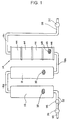
- FIG. 1 is an illustrative view showing an example of an apparatus for making water having a deterging function according to the invention.
- a first soft water generator 10, a second soft water generator 12, and an ion generator 14, are, respectively, connected through connection pipes 18a and 18b in series.
- Pressurized water such as, for example, city water, is supplied to the first soil water generator 10 from a water supply pipe 20 through a connection pipe 22.
- An on-off inlet valve 24 such as a bib cock between the water supply pipe 20 and the connection pipe 22 with a check valve 26 being provided on the way of the connection pipe 22.
- a delivery pipe 28 is provided at the outlet side of the ion generator 14 and has an outlet on-off valve 30 at the tip of or on the way of the delivery pipe 28.
- water fed from the water supply pipe 20 is passed to the first soft water generator 10, the second soft water generator 12 and the ion generator 14 in this order and is finally taken out from the delivery pipe 28 by opening the on-off valve 30.
- water stored in a water reservoir is introduced through the supply pipe 20 into the first soil water generator 10 by means of a pump although not particularly shown.
- a check valve 26 is provided between the pump and the first soft water generator 10.
- the soil water generators 10, 12 have, respectively, a body 24 which is cylindrical in shape and has water outlet and inlet ports 36a, 36b at upper and lower ends thereof, respectively.
- the cylindrical body 34 is provided with shield members 38a, 38b at inner wall surfaces kept slightly away from the upper and lower ends thereof as having, respectively, an opening at the center thereof.
- the ion exchange resin 32 contained in a fine net 40 is accommodated between the paired shield members 38a, 38b.
- the reason why the shield members 38 each having the opening at the center thereof are provided at the inner walls positioned slightly away from the outlet and inlet ports 36a, 36b is that the fine net 40 having the ion exchange resin 32 is placed between the paired shield members 38 to establish spaces 42a, 42b in the vicinity of the outlet and inlet portions 36a, 36b, respectively.
- the passage of water through the central openings of the shield members 38a, 38b permits invariable contact of water with the ion exchange resin 32.
- the reason why the ion exchange resin is placed in the net 40 is that the particulate ion exchange resin 32 can be wholly removed along with the net 40 when the particulate resin 32 is washed.
- the first and second soil water generators 10 and 12 have, respectively, a height of 80 cm and an inner diameter of 10 cm, for example.
- the height of accommodation of the ion exchange resin 32 is set, for example, at 70 cm (permitting the upper and lower spaces 42a, 42b to be established).
- the height of accommodation of the ion exchange resin 32 should be at least sufficient to satisfactorily effect ion exchange.
- the height of the accommodated ion exchange resin 32 is too great (e.g. over about 200 cm in the height of the accommodated ion exchange resin 32)
- the ion exchange resin becomes resistant to the passage of water, resulting in a reduced flow rate of water passing through the inside of the soft water generators. Accordingly, the height of the accommodated resin 32 should be determined as not reducing the flow rate.
- the two containers for accommodating the ion exchange resin 32 are used.
- the reason for this is that the first and second soil water generators 10, 12 are suppressed in height to substantially such a level as the ion generator 14 and the rock accommodating container 16 and that it is avoided to reduce the flow rate owing to the pressure loss of water passing therethrough.
- the two soil water generators 10, 12 may be combined together to provide one soil water generator.
- the inner diameter of the soft water generators, the height of the accommodated ion exchange resin 32 and the number of the soil water generators connected in series may be optionally determined.
- the ion exchange resin 32 serves to eliminate metal ions such as Ca2+, Mg2+, Fe2+ and the like from water to provide soil water.
- the ion exchange resin 32 used is, for example, a strongly acidic cationic exchange resin (RzSO3Na) obtained by uniform sulfonation of a sphere-shaped styrene ⁇ divinylbenzene copolymer.
- RzSO3Na strongly acidic cationic exchange resin obtained by uniform sulfonation of a sphere-shaped styrene ⁇ divinylbenzene copolymer.
- the ion exchange resin 32 undergoes the following ion exchange reaction with the metal ions such as Ca2+, Mg2+, Fe2+ and the like.
- chlorine is contained aside from the metal ions such as Ca2+, Mg2+, Fe2+ and the like. The chlorine undergoes no change when city water is passed through the ion exchange resin 32.
- the metal ions such as Ca2+, Mg2+, Fe2+ and the like are eliminated from the water to provide soft water.
- the passage through the ion exchange resin 32 results in the generation of Na+, OH ⁇ and hydronium ions (H3O+) in the water. Nevertheless, chlorine (Cl) in city water is passed as it is without undergoing ionization. It will be noted that depending on the type of ion exchange resin 32, Na+ is not produced at all.
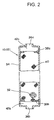
- the partial sectional view of the ion generator 14 is shown in Fig. 3.
- the ion generator 14 has a plurality of cartridges 44 arranged in a similar manner and continuously connected in series vertically.
- the individual cartridges 44 have particulate tourmaline 46 and a plate-shaped metal 48 accommodated therein.
- Tourmaline has plus and minus electrodes, with which an electromagnetic wave having a wavelength of 4 ⁇ 14 micrometers is applied to water, so that clusters of water are cleaved off thereby generating hydronium ions (H3O+).
- the electromagnetic wave having a wavelength of 4 ⁇ 14 micrometers has an energy of 0.004 watts/cm2.
- the tourmaline 46 used herein may consist of fine pieces of tourmaline.
- the tourmaline 46 may be a tourmaline mixture called tourmaline pellets which are commercially available as containing tourmaline, a ceramic and aluminum oxide (which may contain silver therein) at mixing ratios by weight of about 10:80:10.
- the ceramic contained in the tourmaline pellets acts to keep the plus and minus electrodes separated from each other.
- the tourmaline 46 may be made by mixing not less than 5 wt%, based on the ceramic, of tourmaline 46 with the ceramic and heating the mixture at 800°C or over by which the resultant tourmaline disappears within a given period of time under agitation in water (e.g. within about 3 months for a pellet diameter of 4 mm).
- the metal 48 used may be at least one selected from aluminum, a stainless steel and silver.
- the metal 48 should preferably be one which is not corroded in water and is not soluble in water.
- aluminum has the bactericidal or antifungal action and the bleaching function.
- Stainless steel has the bactericidal or antifungal action and the detergency-improving action and silver has the bactericidal or antifungal action.
- Silver is greater in bactericidal or antifungal activity than aluminum and stainless steel. Accordingly, if bleaching action is necessary along with more improved bactericidal or antifungal action, silver is mixed with aluminum. Copper or lead is not used as the metal 48 because of its toxicity. Expensive materials such as gold are not adopted in view of the economy.
- the incorporation of the metal 48 results in an increasing amount of generation of hydronium ions (H3O+) and hydroxyl ions (H3O2 ⁇ ) as will be described hereinafter.
- H3O+ hydronium ions
- H3O2 ⁇ hydroxyl ions
- aluminium is most preferred from the standpoint of costs and the amount of generation of hydronium ions (H3O+) and hydroxyl ions (H3O2 ⁇ ).
- the tourmaline 46 and the metal 48 are preferably mixed at a ratio by weight of approximately 10:1 ⁇ 1:10. More preferably, the ratio by weight between the tourmaline 46 and the metal 48 is in the range of 1:2 ⁇ 1:6. Preferably, the ratio by weight between commercially available tourmaline pellets having ratios by weight of tourmaline, a ceramic and aluminium oxide of 10:80:10 and the metal 48 of 5:1 ⁇ 5:2. This weight ratio is determined while taking into consideration the rates of generation of the hydronium ions (H3O+) and hydroxyl ions (H3O2 ⁇ ).
- the cartridge 44 is in the form of a hollow cylinder opened at one end thereof and has a multitude of holes 52 at the bottom 50 thereof.
- the size of the holes is so set that where the tourmaline mixture 46 and the metal 48 are placed in the cartridge 44, the tourmaline 46 and the metal 48 do not pass through the holes 52 at the bottom 50.
- the bottom 50 of the respective cartridges 44 having a multitude of holes 52 is set at a lower side, on which the tourmaline 46 and the metal 48 are placed. It is so designed that water is run from the bottom toward to the top of the respective cartridges 44. More particularly, in the cartridges 44, water passing through a multitude of holes 52 at the bottom 50 is passed as jetting upwardly through the tourmaline 46 and the metal 48. It will be noted that the size and number of the holes are so set that city water having a high hydraulic pressure is caused to vigorously collide with the tourmaline 46 and the metal 48.
- the reason why the tourmaline is agitated by jetting water toward the tourmaline is that the tourmaline and water are frictionally contacted under the agitation, with the result that the electrodes are dissolved out in water to cleave the clusters of water, thereby generating a large quantity of hydronium ions (H3O+) and hydroxyl ions (H3O2 ⁇ ).
- the jetting of pressurized water such as city water through the holes 52 toward tourmaline may omit additional provision of any agitator means.
- each cartridge 44 having an accommodation capacity with an inner diameter of 5 cm and a depth of 7 cm, are put one on another.
- the tourmaline 44 and the metal 48 are charged in the respective cartridges 44 in such a amount that the tourmaline 46 and the metal 48 can be freely moved within the cartridge 44.
- the number of the cartridges 44 may be increased or decreased. In a specific instance, only one cartridge 44 having a great accommodation capacity may be used.
- the tourmaline 46 and the metal 48 are, respectively, placed in a plurality of cartridges 44 having a reduced capacity.
- the plural cartridges 44 are connected wherein the agitation efficiency of the tourmaline 46 and the metal 48 by the force of water can be enhanced.
- the tourmaline 46 contained in the cartridge 44 disappears in several months by dissolution in water.
- the cartridges 44 are arranged as to be readily detached such as by screwing, permitting easy supplement of the tourmaline 46 in the respective cartridges 44.
- the metal which is not dissolved in water has no need of supplement but a fresh cartridge containing tourmaline 46 and a metal 48 may be used for substitution with a used one.
- the capacity of the cartridge 44 may vary depending on the flow rate.
- the tourmaline 46 has plus and minus electrodes.
- water (H2O) dissociates into hydrogen ions (H+) and hydroxide ions (OH ⁇ ) H2O ⁇ H+ + OH ⁇ (1) Further, hydronium ions (H3O+) having surface activity are produced from the hydrogen ions (H+) and water (H2O).
- the amount of the produced hydronium ions (H3O+) is far much larger than that generated by means of the ion exchange resin 32 H2O + H+ ⁇ H3O+ (2)
- the hydroxide ions (OH ⁇ ) combines with water (H2O) to form hydroxyl ions (H3O2 ⁇ ) H2O + OH ⁇ ⁇ H3O2 ⁇ (3)
- the hydroxyl ions (H3O2 ⁇ ) have high surface activity like hydronium ions (H3O+), serving to remove oil and cleanse clothes.
- the water passed through the ion exchange resin 32 is further passed through the ion generator 14.
- hydronium ions (H3O+), hydroxyl ions (H3O2 ⁇ ), H+ and OH ⁇ are generated in water.
- the chlorine passed through the ion exchange resin 32 and the Na+ generated at the ion exchange resin 32 pass through the ion generator as they are without undergoing any reaction.
- washing water contains Na+, Cl ⁇ , H+,OH ⁇ , hydronium ions (H3O+) and a large quantity of hydroxyl ions (H3O2 ⁇ ).
- the washing water is soft water and has a specific gravity of about 1.4 ⁇ 1.5. Additionally, the washing water has an energy is 0.004 watts/cm2 and also has an electromagnetic wave having a wavelength of 4 ⁇ 14 micrometers.
- the washing water has the following many effects.
- washing water A great amount of the hydronium ions (H3O+) and a great amount of the hydroxyl ions (H3O2 ⁇ ) present in the washing water has high surface activity (O/W type emulsion emulsifying action). If the washing water is placed and used in washing machines, any detergent is not necessary. This water may be applied not only to washing in washing machines, but also to all the domestic deterging fields where detergents are used , e.g. such as in ware-washing machines or for washing bath tubs. In addition, washing water may be used for cleansing oil-contaminated portions such as in mills or for cleansing parts or products.
- washing water when the washing water is applied for washing all the industrial and domestic articles without use of any detergent.
- the use of the washing water is better in economy and will not cause any environmental contamination by the effluence of washing waste.
- Tourmaline emits a very weak energy (an electromagnetic wave with a wavelength of 4 ⁇ 14 micrometers). This weak energy subjects great clusters of water to scission (36 ⁇ 38 clusters of city water converted to 3 ⁇ 6 clusters in the washing water), permitting toxic gases or heavy metals included in the cluster to emit to outside. More particularly, toxic gases or heavy metals included in the inside of water are released, thereby providing substantially impurities-free water. As a consequence, it can be utilized for washing precise parts.
- Aluminum, stainless steels and silver used as the metal 48 have all the antifungal and bactericidal actions. Where Na+ is generated by means of the ion exchange resin 32, Na+ also exhibits the antifungal and bactericidal actions. Eventually, where table wares or clothes or products are washed with the washing water, not only stains come out, but also the bactericidal action is performed.
- Aluminum has the bleaching action. If aluminum is added in large amounts, a bleaching effect appears on washing.
- the hydronium ions (H3O+) and hydroxyl ions (H3O2 ⁇ ) take oil particles as wrapping therein, thereby permitting all types of oil stains to come out.
- the water used after the removal of oil stains with the washing water serves as an emulsifier for an O//W emulsion (of the type where oil particles are wrapped with water).
- the use of the washing waster for the removal of oil stains leaves an O/W emulsion. The thus emulsified washing water is prohibited from discharge as it is.
- the water used for washing in the formed of an O/W emulsion obtained after removal of oil stains with the washing water have hydronium ions (H3O+) and hydroxyl ions (H3O2 ⁇ ) taking oil particles therein.
- the O/W emulsion washing water used for the removal of oil stains is still soft water in nature.
- the washing water in the form of the O/W emulsion obtained after removal of oil stains is charged into hard water such as city water. More particularly, a large amount of city water is placed in a vessel, into which the washing water in the form of the O/W emulsion is introduced. Although any trouble may not be produced when hard water such as city water is charged into the O/W emulsion-like washing water, it is usually favorable to charge the O/W emulsion-like washings water into ordinary water.
- the charge of the O/W emulsion-like washing water into ordinary water permits mixing of two types of waters which are contrary to each other in nature (hard water and soil water), whereupon the following reactions takes place on the hydronium ions (H3O+) and the hydroxyl ions (H3O2 ⁇ ) having oil particles wrapped therein H3O+ ⁇ H2O + H+ (4) H3O2+ ⁇ H2O + OH ⁇ (5) H+ + OH ⁇ ⁇ H2O (6)
- the hydronium ions (H3O+) and the hydroxyl ions (H3O2 ⁇ ) having oil particles wrapped therein are converted into water.
- the washing water of the invention comprises large amounts of hydronium ions (H3O+) having high surface activity and hydroxyl ions (H3O2 ⁇ ) also having high surface activity and is able to remove oil, thus being usable for industrial and domestic washings.
- H3O+ hydronium ions
- H3O2 ⁇ hydroxyl ions
- any detergent is not used, no adverse influence on environments is produced.
- the method for making washing water according to the invention comprises only passing water through an ion exchange resin and then through a mixture of tourmaline and a metal.
- production costs for the washing water is inexpensive.
- the apparatus simply makes use of the jetting force of water without use of electric power, thus production costs being inexpensive.
- the apparatus of the invention needs only washing of filling materials or supplement of the filling materials and thus involves substantially no maintenance.
- anyone can make washing or supplement of the materials.
Landscapes
- Chemical & Material Sciences (AREA)
- Hydrology & Water Resources (AREA)
- Engineering & Computer Science (AREA)
- Environmental & Geological Engineering (AREA)
- Water Supply & Treatment (AREA)
- Organic Chemistry (AREA)
- Life Sciences & Earth Sciences (AREA)
- Chemical Kinetics & Catalysis (AREA)
- Electrochemistry (AREA)
- General Chemical & Material Sciences (AREA)
- Thermal Sciences (AREA)
- Physics & Mathematics (AREA)
- Treatment Of Water By Ion Exchange (AREA)
- Washing And Drying Of Tableware (AREA)
- Cleaning By Liquid Or Steam (AREA)
- Water Treatment By Electricity Or Magnetism (AREA)
- Physical Water Treatments (AREA)
- Cosmetics (AREA)
- Detergent Compositions (AREA)
Applications Claiming Priority (5)
| Application Number | Priority Date | Filing Date | Title |
|---|---|---|---|
| JP12717/93U | 1993-02-26 | ||
| JP1271793 | 1993-02-26 | ||
| JP02306694A JP3170132B2 (ja) | 1993-02-26 | 1994-01-25 | 洗剤を使用しない洗浄水と、その洗浄水の製造方法並びにその製造装置、及びその洗浄水を使用して乳化したものを水と油に分離する水と油の分離方法 |
| JP23066/94 | 1994-01-25 | ||
| PCT/JP1994/000272 WO1994019285A1 (fr) | 1993-02-26 | 1994-02-23 | Eau de nettoyage exempte de detergent, procede et appareil de production de ladite eau, et procede de separation d'emulsion formee par l'utilisation de ladite eau de nettoyage dans l'eau et l'huile |
Publications (2)
| Publication Number | Publication Date |
|---|---|
| EP0686602A1 true EP0686602A1 (fr) | 1995-12-13 |
| EP0686602A4 EP0686602A4 (fr) | 1997-03-05 |
Family
ID=26348363
Family Applications (1)
| Application Number | Title | Priority Date | Filing Date |
|---|---|---|---|
| EP94907660A Withdrawn EP0686602A4 (fr) | 1993-02-26 | 1994-02-23 | Eau de nettoyage exempte de detergent, procede et appareil de production de ladite eau, et procede de separation d'emulsion formee par l'utilisation de ladite eau de nettoyage dans l'eau et l'huile |
Country Status (6)
| Country | Link |
|---|---|
| US (1) | US5599455A (fr) |
| EP (1) | EP0686602A4 (fr) |
| JP (1) | JP3170132B2 (fr) |
| KR (1) | KR100206312B1 (fr) |
| CA (1) | CA2155742C (fr) |
| WO (1) | WO1994019285A1 (fr) |
Families Citing this family (22)
| Publication number | Priority date | Publication date | Assignee | Title |
|---|---|---|---|---|
| JP2889903B2 (ja) * | 1993-11-09 | 1999-05-10 | 利春 深井 | 浄化活性作用を有する水の製造方法及び製造装置 |
| US6219871B1 (en) | 1997-04-14 | 2001-04-24 | Max B. Frederick | Washing apparatus and method utilizing flexible container to improve cleaning efficiency and minimize space occupancy |
| JP3121287B2 (ja) * | 1997-04-17 | 2000-12-25 | クランツ株式会社 | 水浄化装置 |
| US6034013A (en) * | 1998-03-12 | 2000-03-07 | Mino Ganryo Kagaku Corporation | Tourmaline composite grains and apparatus using them |
| US6036965A (en) * | 1998-03-13 | 2000-03-14 | Color Access, Inc. | Tourmaline in cosmetic cleansing compositions |
| US6308356B1 (en) | 1998-04-01 | 2001-10-30 | Max B. Frederick | Substantially environmental-pollution-free cleaning method and device employing electric energy and surface physical properties |
| DE60035473T2 (de) | 1999-12-08 | 2008-03-13 | Nipro Corp. | Leicht abziehbare Folie und medizinischer Verpackungsbehälter |
| JP2001347274A (ja) * | 2000-04-04 | 2001-12-18 | Kokichi Aoki | 水質改良剤、水質改良装置及び同装置の利用方法 |
| US20060180550A1 (en) * | 2005-02-16 | 2006-08-17 | Metal & Arsenic Removal Technology | Portable water purifier |
| JP4939077B2 (ja) * | 2006-02-23 | 2012-05-23 | 利春 深井 | 水に含まれるアスベストの除去方法及びその除去装置 |
| WO2008113151A1 (fr) * | 2007-03-21 | 2008-09-25 | Wei He | Matériau composite à rayonnement infrarouge lointain, procédé de production dudit matériau, et procédé de filtration d'un liquide ou d'eau |
| JP4551944B2 (ja) * | 2007-05-15 | 2010-09-29 | 利春 深井 | 油分乳化物 |
| JP2009165940A (ja) * | 2008-01-15 | 2009-07-30 | Toshiharu Fukai | 過飽和溶存酸素を含む水の製造方法 |
| DE102008023228A1 (de) | 2008-05-08 | 2009-11-19 | Technische Universität Dresden | Nanopartikel zur selektiven Gewebetherapie, Verfahren zu deren Herstellung und deren Verwendung in der Gewebetherapie |
| DE102008030035A1 (de) | 2008-06-18 | 2010-02-04 | Technische Universität Dresden | Verfahren zur Durchführung heterogen katalysierter chemischer Reaktionen sowie zur Steuerung von Phasenumwandlungsprozessen |
| JPWO2011136147A1 (ja) * | 2010-04-27 | 2013-07-18 | 深井 利春 | 水素の製造方法 |
| KR20130098870A (ko) * | 2010-04-27 | 2013-09-05 | 후카이도시하루 | 수소의 제조 방법 |
| US10302605B2 (en) | 2011-02-07 | 2019-05-28 | Agilent Technologies, Inc. | Column assembly for a gas chromatograph |
| WO2018005679A1 (fr) * | 2016-06-28 | 2018-01-04 | Perkinelmer Health Sciences, Inc. | Module gc amélioré à faible masse thermique |
| KR102040401B1 (ko) * | 2018-05-14 | 2019-11-05 | 채효순 | 액상소금을 이용한 클린룸 및 그 시스템 |
| IT201900010233A1 (it) * | 2019-06-27 | 2020-12-27 | Corrado Chierroni | Dispositivo per il trattamento dell’acqua di alimentazione di una lavatrice |
| JP7857592B2 (ja) * | 2020-02-20 | 2026-05-13 | パナソニックIpマネジメント株式会社 | 空気調和装置 |
Family Cites Families (11)
| Publication number | Priority date | Publication date | Assignee | Title |
|---|---|---|---|---|
| JPS586524B2 (ja) * | 1978-05-19 | 1983-02-04 | 松下電器産業株式会社 | 含油廃水の処理法 |
| US4483756A (en) * | 1982-09-27 | 1984-11-20 | Atlantic Richfield Company | Method of applying electrical energy to a reactant chamber |
| JPS605495U (ja) * | 1983-06-23 | 1985-01-16 | 株式会社東芝 | 水中の不純物除去装置 |
| JPS61181589A (ja) * | 1985-02-06 | 1986-08-14 | Nippon Paint Co Ltd | 脱イオン純水製造装置 |
| JPH01284387A (ja) * | 1988-05-12 | 1989-11-15 | Jiyunsui Service:Kk | カリウム水製造装置 |
| JPH03101892A (ja) * | 1989-09-13 | 1991-04-26 | Kamioka Kogyo Kk | 水処理方法及び装置 |
| JPH0738987B2 (ja) * | 1989-10-03 | 1995-05-01 | 有限会社久保技術事務所 | 電気石を用いた水の界面活性化装置および電気石粒状物 |
| JPH03249989A (ja) * | 1990-02-27 | 1991-11-07 | Kubo Gijutsu Jimusho:Kk | 電気石結晶によるイオン物質の電着除去方法と金属電着電気石結晶 |
| JPH0445593U (fr) * | 1990-08-17 | 1992-04-17 | ||
| JPH04141292A (ja) * | 1990-09-29 | 1992-05-14 | Nobuo Hirasawa | 水活性化作用を有する粉体の製造方法 |
| US5108618A (en) * | 1990-10-30 | 1992-04-28 | Nobuo Hirasawa | Method of and apparatus for modifying fuel |
-
1994
- 1994-01-25 JP JP02306694A patent/JP3170132B2/ja not_active Expired - Lifetime
- 1994-02-23 KR KR1019950703460A patent/KR100206312B1/ko not_active Expired - Fee Related
- 1994-02-23 WO PCT/JP1994/000272 patent/WO1994019285A1/fr not_active Ceased
- 1994-02-23 CA CA002155742A patent/CA2155742C/fr not_active Expired - Fee Related
- 1994-02-23 US US08/495,400 patent/US5599455A/en not_active Expired - Fee Related
- 1994-02-23 EP EP94907660A patent/EP0686602A4/fr not_active Withdrawn
Also Published As
| Publication number | Publication date |
|---|---|
| KR100206312B1 (ko) | 1999-07-01 |
| CA2155742C (fr) | 2000-08-15 |
| JP3170132B2 (ja) | 2001-05-28 |
| EP0686602A4 (fr) | 1997-03-05 |
| US5599455A (en) | 1997-02-04 |
| JPH0796283A (ja) | 1995-04-11 |
| CA2155742A1 (fr) | 1994-09-01 |
| WO1994019285A1 (fr) | 1994-09-01 |
| KR960700964A (ko) | 1996-02-24 |
Similar Documents
| Publication | Publication Date | Title |
|---|---|---|
| US5599455A (en) | Detergent-free washing water, method and apparatus for making the washing water, and water/oil separation method for separating matters emulsified with the washing water into water and oil phases | |
| CA2175698C (fr) | Procede et appareil de production d'eau presentant une activite de clarification | |
| EP2939982A1 (fr) | Dispositif générant de l'eau électrolysée gazeuse et appareil de nettoyage automatique | |
| CN101208158A (zh) | 餐具和其它厨房器具的清洁、杀菌和消毒的方法和清洁设备 | |
| MXPA04011401A (es) | Dispspositivos electroliticos autocontenidos, autoalimentados para mejorar el desmpeno de los lavaplatos automaticos. | |
| CN108914129A (zh) | 一种碱性蚀刻液循环再生系统及其方法 | |
| US3330769A (en) | Metal cleaning | |
| TW202444666A (zh) | 污水處理系統及具有污水處理系統的洗衣工廠 | |
| TW202405276A (zh) | 衣物洗滌系統 | |
| JP2005161145A (ja) | 軟水化アルカリと硬水化酸の製造装置および同装置を接続した洗濯機 | |
| CN104928061A (zh) | 一种机械加工产品清洁剂 | |
| TW304934B (fr) | ||
| JP4064977B2 (ja) | 洗浄剤の製造方法 | |
| JPH11156312A (ja) | 洗浄装置 | |
| KR20060110266A (ko) | 무세제 세탁방법 및 그 세탁기 | |
| JP2960057B1 (ja) | 過酸化水素の除去方法とその装置 | |
| TWM645471U (zh) | 衣物洗滌系統 | |
| Sundstrom et al. | Treatment of chelated iron and copper wastes by chemical oxidation | |
| CN210915433U (zh) | 再生效率高的树脂罐及软水机 | |
| WO1994023852A1 (fr) | Procede de nettoyage | |
| CN101090961A (zh) | 用于进行洗涤的设备和方法 | |
| EP4516982A1 (fr) | Système de lavage de linge | |
| EP4574772A1 (fr) | Procédé de traitement d'eau à base d'électrode à plusieurs étages | |
| RU2211241C2 (ru) | Пастообразное моющее и дезактивирующее средство | |
| Hack | Decreasing effluent pollution by the use of soap‐based building kit detergents |
Legal Events
| Date | Code | Title | Description |
|---|---|---|---|
| PUAI | Public reference made under article 153(3) epc to a published international application that has entered the european phase |
Free format text: ORIGINAL CODE: 0009012 |
|
| 17P | Request for examination filed |
Effective date: 19950821 |
|
| AK | Designated contracting states |
Kind code of ref document: A1 Designated state(s): AT BE CH DE DK ES FR GB GR IE IT LI MC NL PT SE |
|
| A4 | Supplementary search report drawn up and despatched | ||
| AK | Designated contracting states |
Kind code of ref document: A4 Designated state(s): AT BE CH DE DK ES FR GB GR IE IT LI MC NL PT SE |
|
| 17Q | First examination report despatched |
Effective date: 19981020 |
|
| RAP1 | Party data changed (applicant data changed or rights of an application transferred) |
Owner name: HUKAI, TOSHIHARU |
|
| STAA | Information on the status of an ep patent application or granted ep patent |
Free format text: STATUS: THE APPLICATION HAS BEEN WITHDRAWN |
|
| 18W | Application withdrawn |
Withdrawal date: 20000630 |