EP0688643A2 - Pièce moulée et son procédé de fabrication - Google Patents
Pièce moulée et son procédé de fabrication Download PDFInfo
- Publication number
- EP0688643A2 EP0688643A2 EP19950109463 EP95109463A EP0688643A2 EP 0688643 A2 EP0688643 A2 EP 0688643A2 EP 19950109463 EP19950109463 EP 19950109463 EP 95109463 A EP95109463 A EP 95109463A EP 0688643 A2 EP0688643 A2 EP 0688643A2
- Authority
- EP
- European Patent Office
- Prior art keywords
- shaped part
- carpet
- carpet material
- part according
- pressed
- Prior art date
- Legal status (The legal status is an assumption and is not a legal conclusion. Google has not performed a legal analysis and makes no representation as to the accuracy of the status listed.)
- Withdrawn
Links
- 238000000034 method Methods 0.000 title claims abstract description 18
- 238000004519 manufacturing process Methods 0.000 title claims description 16
- 239000000463 material Substances 0.000 claims abstract description 96
- 239000002023 wood Substances 0.000 claims abstract description 47
- 229920001169 thermoplastic Polymers 0.000 claims abstract description 38
- 239000004416 thermosoftening plastic Substances 0.000 claims abstract description 38
- 239000011230 binding agent Substances 0.000 claims abstract description 29
- 238000003825 pressing Methods 0.000 claims abstract description 10
- 230000008569 process Effects 0.000 claims abstract description 8
- 239000000835 fiber Substances 0.000 claims description 16
- -1 polypropylene Polymers 0.000 claims description 14
- 239000004743 Polypropylene Substances 0.000 claims description 12
- 229920001155 polypropylene Polymers 0.000 claims description 12
- 238000009826 distribution Methods 0.000 claims description 7
- 238000002844 melting Methods 0.000 claims description 7
- 230000008018 melting Effects 0.000 claims description 6
- VBICKXHEKHSIBG-UHFFFAOYSA-N 1-monostearoylglycerol Chemical compound CCCCCCCCCCCCCCCCCC(=O)OCC(O)CO VBICKXHEKHSIBG-UHFFFAOYSA-N 0.000 claims description 5
- DCXXMTOCNZCJGO-UHFFFAOYSA-N Glycerol trioctadecanoate Natural products CCCCCCCCCCCCCCCCCC(=O)OCC(OC(=O)CCCCCCCCCCCCCCCCC)COC(=O)CCCCCCCCCCCCCCCCC DCXXMTOCNZCJGO-UHFFFAOYSA-N 0.000 claims description 5
- 239000011248 coating agent Substances 0.000 claims description 5
- 238000000576 coating method Methods 0.000 claims description 5
- 239000000203 mixture Substances 0.000 claims description 5
- 238000000227 grinding Methods 0.000 claims description 4
- 238000000465 moulding Methods 0.000 claims description 3
- 239000010935 stainless steel Substances 0.000 claims description 2
- 239000000470 constituent Substances 0.000 claims 1
- 239000002699 waste material Substances 0.000 description 8
- 238000005452 bending Methods 0.000 description 7
- 239000002131 composite material Substances 0.000 description 7
- 239000000126 substance Substances 0.000 description 7
- 239000005011 phenolic resin Substances 0.000 description 5
- 229920001568 phenolic resin Polymers 0.000 description 5
- 239000004753 textile Substances 0.000 description 5
- KXGFMDJXCMQABM-UHFFFAOYSA-N 2-methoxy-6-methylphenol Chemical compound [CH]OC1=CC=CC([CH])=C1O KXGFMDJXCMQABM-UHFFFAOYSA-N 0.000 description 4
- 239000004952 Polyamide Substances 0.000 description 4
- 238000004140 cleaning Methods 0.000 description 4
- 238000002474 experimental method Methods 0.000 description 4
- 229920002647 polyamide Polymers 0.000 description 4
- 239000007858 starting material Substances 0.000 description 4
- 238000010438 heat treatment Methods 0.000 description 3
- 229910052500 inorganic mineral Inorganic materials 0.000 description 3
- 229910052751 metal Inorganic materials 0.000 description 3
- 239000002184 metal Substances 0.000 description 3
- 239000011707 mineral Substances 0.000 description 3
- 238000002156 mixing Methods 0.000 description 3
- 239000002245 particle Substances 0.000 description 3
- 229920000742 Cotton Polymers 0.000 description 2
- 239000000853 adhesive Substances 0.000 description 2
- 238000004026 adhesive bonding Methods 0.000 description 2
- 230000001070 adhesive effect Effects 0.000 description 2
- 238000005260 corrosion Methods 0.000 description 2
- 230000007797 corrosion Effects 0.000 description 2
- 230000000694 effects Effects 0.000 description 2
- 239000004744 fabric Substances 0.000 description 2
- 239000000945 filler Substances 0.000 description 2
- 238000009413 insulation Methods 0.000 description 2
- 230000003993 interaction Effects 0.000 description 2
- 239000004033 plastic Substances 0.000 description 2
- 238000004064 recycling Methods 0.000 description 2
- 230000003014 reinforcing effect Effects 0.000 description 2
- 229920001187 thermosetting polymer Polymers 0.000 description 2
- RYGMFSIKBFXOCR-UHFFFAOYSA-N Copper Chemical compound [Cu] RYGMFSIKBFXOCR-UHFFFAOYSA-N 0.000 description 1
- 239000004698 Polyethylene Substances 0.000 description 1
- 229910000831 Steel Inorganic materials 0.000 description 1
- 229920002522 Wood fibre Polymers 0.000 description 1
- 238000009825 accumulation Methods 0.000 description 1
- 229910052782 aluminium Inorganic materials 0.000 description 1
- XAGFODPZIPBFFR-UHFFFAOYSA-N aluminium Chemical compound [Al] XAGFODPZIPBFFR-UHFFFAOYSA-N 0.000 description 1
- 230000008275 binding mechanism Effects 0.000 description 1
- 150000001875 compounds Chemical class 0.000 description 1
- 230000006835 compression Effects 0.000 description 1
- 238000007906 compression Methods 0.000 description 1
- 238000010276 construction Methods 0.000 description 1
- 238000011109 contamination Methods 0.000 description 1
- 238000001816 cooling Methods 0.000 description 1
- 229910052802 copper Inorganic materials 0.000 description 1
- 239000010949 copper Substances 0.000 description 1
- 230000000994 depressogenic effect Effects 0.000 description 1
- 238000010586 diagram Methods 0.000 description 1
- 239000000428 dust Substances 0.000 description 1
- 239000000839 emulsion Substances 0.000 description 1
- 239000003344 environmental pollutant Substances 0.000 description 1
- 239000002657 fibrous material Substances 0.000 description 1
- 239000012530 fluid Substances 0.000 description 1
- 239000006260 foam Substances 0.000 description 1
- 239000006261 foam material Substances 0.000 description 1
- 230000001771 impaired effect Effects 0.000 description 1
- 230000006872 improvement Effects 0.000 description 1
- 230000001788 irregular Effects 0.000 description 1
- 238000009940 knitting Methods 0.000 description 1
- 239000004922 lacquer Substances 0.000 description 1
- 239000011159 matrix material Substances 0.000 description 1
- 239000010816 packaging waste Substances 0.000 description 1
- 229920003023 plastic Polymers 0.000 description 1
- 239000011120 plywood Substances 0.000 description 1
- 231100000719 pollutant Toxicity 0.000 description 1
- 229920000728 polyester Polymers 0.000 description 1
- 229920000573 polyethylene Polymers 0.000 description 1
- 230000008092 positive effect Effects 0.000 description 1
- 239000000843 powder Substances 0.000 description 1
- 239000002994 raw material Substances 0.000 description 1
- 230000009467 reduction Effects 0.000 description 1
- 238000009418 renovation Methods 0.000 description 1
- 230000000717 retained effect Effects 0.000 description 1
- 239000004576 sand Substances 0.000 description 1
- 238000000926 separation method Methods 0.000 description 1
- 238000005507 spraying Methods 0.000 description 1
- 238000003892 spreading Methods 0.000 description 1
- 230000007480 spreading Effects 0.000 description 1
- 239000010959 steel Substances 0.000 description 1
- 238000003860 storage Methods 0.000 description 1
- 239000010784 textile waste Substances 0.000 description 1
- 238000011144 upstream manufacturing Methods 0.000 description 1
- 235000013311 vegetables Nutrition 0.000 description 1
- 239000002025 wood fiber Substances 0.000 description 1
- 210000002268 wool Anatomy 0.000 description 1
Images


Classifications
-
- B—PERFORMING OPERATIONS; TRANSPORTING
- B32—LAYERED PRODUCTS
- B32B—LAYERED PRODUCTS, i.e. PRODUCTS BUILT-UP OF STRATA OF FLAT OR NON-FLAT, e.g. CELLULAR OR HONEYCOMB, FORM
- B32B21/00—Layered products comprising a layer of wood, e.g. wood board, veneer, wood particle board
- B32B21/14—Layered products comprising a layer of wood, e.g. wood board, veneer, wood particle board comprising wood board or veneer
-
- B—PERFORMING OPERATIONS; TRANSPORTING
- B27—WORKING OR PRESERVING WOOD OR SIMILAR MATERIAL; NAILING OR STAPLING MACHINES IN GENERAL
- B27N—MANUFACTURE BY DRY PROCESSES OF ARTICLES, WITH OR WITHOUT ORGANIC BINDING AGENTS, MADE FROM PARTICLES OR FIBRES CONSISTING OF WOOD OR OTHER LIGNOCELLULOSIC OR LIKE ORGANIC MATERIAL
- B27N3/00—Manufacture of substantially flat articles, e.g. boards, from particles or fibres
-
- B—PERFORMING OPERATIONS; TRANSPORTING
- B27—WORKING OR PRESERVING WOOD OR SIMILAR MATERIAL; NAILING OR STAPLING MACHINES IN GENERAL
- B27N—MANUFACTURE BY DRY PROCESSES OF ARTICLES, WITH OR WITHOUT ORGANIC BINDING AGENTS, MADE FROM PARTICLES OR FIBRES CONSISTING OF WOOD OR OTHER LIGNOCELLULOSIC OR LIKE ORGANIC MATERIAL
- B27N3/00—Manufacture of substantially flat articles, e.g. boards, from particles or fibres
- B27N3/007—Manufacture of substantially flat articles, e.g. boards, from particles or fibres and at least partly composed of recycled material
-
- B—PERFORMING OPERATIONS; TRANSPORTING
- B29—WORKING OF PLASTICS; WORKING OF SUBSTANCES IN A PLASTIC STATE IN GENERAL
- B29B—PREPARATION OR PRETREATMENT OF THE MATERIAL TO BE SHAPED; MAKING GRANULES OR PREFORMS; RECOVERY OF PLASTICS OR OTHER CONSTITUENTS OF WASTE MATERIAL CONTAINING PLASTICS
- B29B13/00—Conditioning or physical treatment of the material to be shaped
- B29B13/10—Conditioning or physical treatment of the material to be shaped by grinding, e.g. by triturating; by sieving; by filtering
-
- B—PERFORMING OPERATIONS; TRANSPORTING
- B29—WORKING OF PLASTICS; WORKING OF SUBSTANCES IN A PLASTIC STATE IN GENERAL
- B29B—PREPARATION OR PRETREATMENT OF THE MATERIAL TO BE SHAPED; MAKING GRANULES OR PREFORMS; RECOVERY OF PLASTICS OR OTHER CONSTITUENTS OF WASTE MATERIAL CONTAINING PLASTICS
- B29B17/00—Recovery of plastics or other constituents of waste material containing plastics
- B29B17/0026—Recovery of plastics or other constituents of waste material containing plastics by agglomeration or compacting
- B29B17/0042—Recovery of plastics or other constituents of waste material containing plastics by agglomeration or compacting for shaping parts, e.g. multilayered parts with at least one layer containing regenerated plastic
-
- B—PERFORMING OPERATIONS; TRANSPORTING
- B29—WORKING OF PLASTICS; WORKING OF SUBSTANCES IN A PLASTIC STATE IN GENERAL
- B29C—SHAPING OR JOINING OF PLASTICS; SHAPING OF MATERIAL IN A PLASTIC STATE, NOT OTHERWISE PROVIDED FOR; AFTER-TREATMENT OF THE SHAPED PRODUCTS, e.g. REPAIRING
- B29C43/00—Compression moulding, i.e. applying external pressure to flow the moulding material; Apparatus therefor
- B29C43/22—Compression moulding, i.e. applying external pressure to flow the moulding material; Apparatus therefor of articles of indefinite length
-
- B—PERFORMING OPERATIONS; TRANSPORTING
- B29—WORKING OF PLASTICS; WORKING OF SUBSTANCES IN A PLASTIC STATE IN GENERAL
- B29C—SHAPING OR JOINING OF PLASTICS; SHAPING OF MATERIAL IN A PLASTIC STATE, NOT OTHERWISE PROVIDED FOR; AFTER-TREATMENT OF THE SHAPED PRODUCTS, e.g. REPAIRING
- B29C70/00—Shaping composites, i.e. plastics material comprising reinforcements, fillers or preformed parts, e.g. inserts
- B29C70/04—Shaping composites, i.e. plastics material comprising reinforcements, fillers or preformed parts, e.g. inserts comprising reinforcements only, e.g. self-reinforcing plastics
- B29C70/06—Fibrous reinforcements only
- B29C70/08—Fibrous reinforcements only comprising combinations of different forms of fibrous reinforcements incorporated in matrix material, forming one or more layers, and with or without non-reinforced layers
-
- B—PERFORMING OPERATIONS; TRANSPORTING
- B29—WORKING OF PLASTICS; WORKING OF SUBSTANCES IN A PLASTIC STATE IN GENERAL
- B29C—SHAPING OR JOINING OF PLASTICS; SHAPING OF MATERIAL IN A PLASTIC STATE, NOT OTHERWISE PROVIDED FOR; AFTER-TREATMENT OF THE SHAPED PRODUCTS, e.g. REPAIRING
- B29C70/00—Shaping composites, i.e. plastics material comprising reinforcements, fillers or preformed parts, e.g. inserts
- B29C70/04—Shaping composites, i.e. plastics material comprising reinforcements, fillers or preformed parts, e.g. inserts comprising reinforcements only, e.g. self-reinforcing plastics
- B29C70/06—Fibrous reinforcements only
- B29C70/08—Fibrous reinforcements only comprising combinations of different forms of fibrous reinforcements incorporated in matrix material, forming one or more layers, and with or without non-reinforced layers
- B29C70/088—Fibrous reinforcements only comprising combinations of different forms of fibrous reinforcements incorporated in matrix material, forming one or more layers, and with or without non-reinforced layers and with one or more layers of non-plastics material or non-specified material, e.g. supports
-
- B—PERFORMING OPERATIONS; TRANSPORTING
- B29—WORKING OF PLASTICS; WORKING OF SUBSTANCES IN A PLASTIC STATE IN GENERAL
- B29C—SHAPING OR JOINING OF PLASTICS; SHAPING OF MATERIAL IN A PLASTIC STATE, NOT OTHERWISE PROVIDED FOR; AFTER-TREATMENT OF THE SHAPED PRODUCTS, e.g. REPAIRING
- B29C70/00—Shaping composites, i.e. plastics material comprising reinforcements, fillers or preformed parts, e.g. inserts
- B29C70/04—Shaping composites, i.e. plastics material comprising reinforcements, fillers or preformed parts, e.g. inserts comprising reinforcements only, e.g. self-reinforcing plastics
- B29C70/06—Fibrous reinforcements only
- B29C70/10—Fibrous reinforcements only characterised by the structure of fibrous reinforcements, e.g. hollow fibres
-
- B—PERFORMING OPERATIONS; TRANSPORTING
- B29—WORKING OF PLASTICS; WORKING OF SUBSTANCES IN A PLASTIC STATE IN GENERAL
- B29C—SHAPING OR JOINING OF PLASTICS; SHAPING OF MATERIAL IN A PLASTIC STATE, NOT OTHERWISE PROVIDED FOR; AFTER-TREATMENT OF THE SHAPED PRODUCTS, e.g. REPAIRING
- B29C70/00—Shaping composites, i.e. plastics material comprising reinforcements, fillers or preformed parts, e.g. inserts
- B29C70/04—Shaping composites, i.e. plastics material comprising reinforcements, fillers or preformed parts, e.g. inserts comprising reinforcements only, e.g. self-reinforcing plastics
- B29C70/28—Shaping operations therefor
- B29C70/40—Shaping or impregnating by compression not applied
- B29C70/50—Shaping or impregnating by compression not applied for producing articles of indefinite length, e.g. prepregs, sheet moulding compounds [SMC] or cross moulding compounds [XMC]
- B29C70/504—Shaping or impregnating by compression not applied for producing articles of indefinite length, e.g. prepregs, sheet moulding compounds [SMC] or cross moulding compounds [XMC] using rollers or pressure bands
-
- B—PERFORMING OPERATIONS; TRANSPORTING
- B32—LAYERED PRODUCTS
- B32B—LAYERED PRODUCTS, i.e. PRODUCTS BUILT-UP OF STRATA OF FLAT OR NON-FLAT, e.g. CELLULAR OR HONEYCOMB, FORM
- B32B21/00—Layered products comprising a layer of wood, e.g. wood board, veneer, wood particle board
- B32B21/10—Next to a fibrous or filamentary layer
-
- B—PERFORMING OPERATIONS; TRANSPORTING
- B32—LAYERED PRODUCTS
- B32B—LAYERED PRODUCTS, i.e. PRODUCTS BUILT-UP OF STRATA OF FLAT OR NON-FLAT, e.g. CELLULAR OR HONEYCOMB, FORM
- B32B5/00—Layered products characterised by the non- homogeneity or physical structure, i.e. comprising a fibrous, filamentary, particulate or foam layer; Layered products characterised by having a layer differing constitutionally or physically in different parts
- B32B5/02—Layered products characterised by the non- homogeneity or physical structure, i.e. comprising a fibrous, filamentary, particulate or foam layer; Layered products characterised by having a layer differing constitutionally or physically in different parts characterised by structural features of a fibrous or filamentary layer
-
- B—PERFORMING OPERATIONS; TRANSPORTING
- B29—WORKING OF PLASTICS; WORKING OF SUBSTANCES IN A PLASTIC STATE IN GENERAL
- B29K—INDEXING SCHEME ASSOCIATED WITH SUBCLASSES B29B, B29C OR B29D, RELATING TO MOULDING MATERIALS OR TO MATERIALS FOR MOULDS, REINFORCEMENTS, FILLERS OR PREFORMED PARTS, e.g. INSERTS
- B29K2023/00—Use of polyalkenes or derivatives thereof as moulding material
- B29K2023/10—Polymers of propylene
- B29K2023/12—PP, i.e. polypropylene
-
- B—PERFORMING OPERATIONS; TRANSPORTING
- B29—WORKING OF PLASTICS; WORKING OF SUBSTANCES IN A PLASTIC STATE IN GENERAL
- B29K—INDEXING SCHEME ASSOCIATED WITH SUBCLASSES B29B, B29C OR B29D, RELATING TO MOULDING MATERIALS OR TO MATERIALS FOR MOULDS, REINFORCEMENTS, FILLERS OR PREFORMED PARTS, e.g. INSERTS
- B29K2101/00—Use of unspecified macromolecular compounds as moulding material
- B29K2101/12—Thermoplastic materials
-
- B—PERFORMING OPERATIONS; TRANSPORTING
- B29—WORKING OF PLASTICS; WORKING OF SUBSTANCES IN A PLASTIC STATE IN GENERAL
- B29K—INDEXING SCHEME ASSOCIATED WITH SUBCLASSES B29B, B29C OR B29D, RELATING TO MOULDING MATERIALS OR TO MATERIALS FOR MOULDS, REINFORCEMENTS, FILLERS OR PREFORMED PARTS, e.g. INSERTS
- B29K2105/00—Condition, form or state of moulded material or of the material to be shaped
- B29K2105/06—Condition, form or state of moulded material or of the material to be shaped containing reinforcements, fillers or inserts
-
- B—PERFORMING OPERATIONS; TRANSPORTING
- B29—WORKING OF PLASTICS; WORKING OF SUBSTANCES IN A PLASTIC STATE IN GENERAL
- B29K—INDEXING SCHEME ASSOCIATED WITH SUBCLASSES B29B, B29C OR B29D, RELATING TO MOULDING MATERIALS OR TO MATERIALS FOR MOULDS, REINFORCEMENTS, FILLERS OR PREFORMED PARTS, e.g. INSERTS
- B29K2105/00—Condition, form or state of moulded material or of the material to be shaped
- B29K2105/26—Scrap or recycled material
-
- B—PERFORMING OPERATIONS; TRANSPORTING
- B29—WORKING OF PLASTICS; WORKING OF SUBSTANCES IN A PLASTIC STATE IN GENERAL
- B29K—INDEXING SCHEME ASSOCIATED WITH SUBCLASSES B29B, B29C OR B29D, RELATING TO MOULDING MATERIALS OR TO MATERIALS FOR MOULDS, REINFORCEMENTS, FILLERS OR PREFORMED PARTS, e.g. INSERTS
- B29K2711/00—Use of natural products or their composites, not provided for in groups B29K2601/00 - B29K2709/00, for preformed parts, e.g. for inserts
- B29K2711/14—Wood, e.g. woodboard or fibreboard
-
- B—PERFORMING OPERATIONS; TRANSPORTING
- B29—WORKING OF PLASTICS; WORKING OF SUBSTANCES IN A PLASTIC STATE IN GENERAL
- B29L—INDEXING SCHEME ASSOCIATED WITH SUBCLASS B29C, RELATING TO PARTICULAR ARTICLES
- B29L2031/00—Other particular articles
- B29L2031/732—Floor coverings
- B29L2031/7322—Carpets
-
- B—PERFORMING OPERATIONS; TRANSPORTING
- B32—LAYERED PRODUCTS
- B32B—LAYERED PRODUCTS, i.e. PRODUCTS BUILT-UP OF STRATA OF FLAT OR NON-FLAT, e.g. CELLULAR OR HONEYCOMB, FORM
- B32B2307/00—Properties of the layers or laminate
- B32B2307/70—Other properties
- B32B2307/718—Weight, e.g. weight per square meter
-
- Y—GENERAL TAGGING OF NEW TECHNOLOGICAL DEVELOPMENTS; GENERAL TAGGING OF CROSS-SECTIONAL TECHNOLOGIES SPANNING OVER SEVERAL SECTIONS OF THE IPC; TECHNICAL SUBJECTS COVERED BY FORMER USPC CROSS-REFERENCE ART COLLECTIONS [XRACs] AND DIGESTS
- Y02—TECHNOLOGIES OR APPLICATIONS FOR MITIGATION OR ADAPTATION AGAINST CLIMATE CHANGE
- Y02W—CLIMATE CHANGE MITIGATION TECHNOLOGIES RELATED TO WASTEWATER TREATMENT OR WASTE MANAGEMENT
- Y02W30/00—Technologies for solid waste management
- Y02W30/50—Reuse, recycling or recovery technologies
- Y02W30/62—Plastics recycling; Rubber recycling
-
- Y—GENERAL TAGGING OF NEW TECHNOLOGICAL DEVELOPMENTS; GENERAL TAGGING OF CROSS-SECTIONAL TECHNOLOGIES SPANNING OVER SEVERAL SECTIONS OF THE IPC; TECHNICAL SUBJECTS COVERED BY FORMER USPC CROSS-REFERENCE ART COLLECTIONS [XRACs] AND DIGESTS
- Y10—TECHNICAL SUBJECTS COVERED BY FORMER USPC
- Y10T—TECHNICAL SUBJECTS COVERED BY FORMER US CLASSIFICATION
- Y10T442/00—Fabric [woven, knitted, or nonwoven textile or cloth, etc.]
- Y10T442/20—Coated or impregnated woven, knit, or nonwoven fabric which is not [a] associated with another preformed layer or fiber layer or, [b] with respect to woven and knit, characterized, respectively, by a particular or differential weave or knit, wherein the coating or impregnation is neither a foamed material nor a free metal or alloy layer
Definitions
- the invention relates to a molded part according to the preamble of claim 1 and a method for its production according to the preamble of claim 21.
- old carpets that is, carpet material that has been used for a number of years in apartments or objects and is now removed for reasons of wear and tear or renovation and replaced with new goods.
- the old carpets come in a significant amount, which makes up a significant part of the carpet production.
- the lack of variety purity is given in two respects. It can be present on a single carpet, e.g. can have a pole made of polyamide or polyester and a back made of polypropylene or the like. However, it is also available in the total amount of old carpets for recycling, insofar as the origin and composition of the individual piece of carpet is mostly unknown and it is forbidden to examine individual pieces of carpet for cost reasons.
- the blending of varieties also has a special aspect, insofar as animal or vegetable fibers such as wool or cotton can be present in addition to thermoplastic or thermosetting plastic fibers. So in a lot of old carpet pieces, practically everything has to be expected with regard to the fibers.
- the load on the old carpets can be up to 30 percent by weight. It is dirt that has got into the carpet in the form of dust or organic or mineral particles that have entered the carpet over the course of time and remains of the back, i.e. of the foam material and fillers, as well as adhesive residues.
- DE 24 57 848 A1 describes a molded body which can also have the shape of a plate, in which waste material from carpets is carved and with a binder is allowed to set in the pressed state.
- the binder can contain phenolic resin, among other things, but can also be a foamable binder.
- the plate can have a cover layer made of paper, textile material, plastic, wood or the like.
- Another attempt of this type is the subject of DE 27 22 774 A1, in which the recycling of waste from car carpets and needle felts is described which have thermoplastic components. The wastes are cut, arranged in a layer and heated, pressed and cooled above the melting point of part of the thermoplastic components.
- An example of the thermoplastic components are polyethylene and polypropylene, which are sufficiently free-flowing at 160 to 180 ° to penetrate the total mass and form a homogeneous body of pressed material.
- DD-PS 61 094 and AT-PS 25 25 46 also deal with the pressing of textile waste into panels.
- the object of the invention is to permanently dispose of old carpet remnants with minimal effort.
- the molded parts according to the invention primarily but not exclusively panels - are of an astonishing flexural rigidity, that is to say the material has a high modulus of elasticity.
- the material has a high modulus of elasticity.
- the carpet material must first be shredded so intensively that the shredded product no longer adheres to anything carpet-like.
- the crushing must result in the carpet material being broken down into its individual fibers, so that the crushing product becomes a type of coarse-fiber cotton wool, which is what is meant by the expression "fibrous bulge”.
- thermoplastic binder When such a filler is pressed with a thermoplastic binder melted at the processing temperature, it is completely penetrated by the thermoplastic binder, and it forms the thermoplastic binder to a certain extent in a matrix in which the fibers form embedded reinforcing elements, so that a kind of composite material results . Due to the fine shredding of the carpet material, the volume of the finished molded part is penetrated with fibers in a fairly homogeneous manner, so that no unreinforced zones of greater size occur and the molded part appears homogeneously reinforced towards the outside.
- Another not to be expected advantageous result in the invention is that the high proportion of foreign substances in the used old carpets, that is, the dirt, the foam residues and the adhesive residues, is easily integrated into the molded parts and has a rather positive effect on the strength properties of the material. It is therefore possible with the method according to the invention to process old carpets as they are delivered and to produce the moldings according to the invention from them without expensive cleaning and separating processes.
- the molded parts have a good surface quality and can often be used as they come from the press. This is probably due to the thermoplastic component, which, under pressure, penetrates all gaps in the material and closes the surface.
- thermoplastic components melt on the one hand fibers in their fiber structure and their properties, for example obtained by knitting, should be retained in order to be used in the finished material as a reinforcing composite material Act.
- the melting of all thermoplastic parts required such high temperatures as can hardly be achieved with today's heating fluids for presses.
- the high temperatures are also due to the heat loss and should not be attempted. Rather, the heating should go so far that the lowest melting and softening ranges are exceeded and the binding mechanism comes into play through the melting and distribution under pressure of this thermoplastic component of the overall material.
- the pressing time is chosen so that the thermoplastic binding takes place as evenly as possible over the thickness of the molded part.
- the heat must be brought in from the pressing surfaces into the poorly heat-conducting molding compound, which takes a certain amount of time until the temperature is also on the inside to melt the thermoplastic bandage has increased by sufficient value.
- the carpet material can be used as far as it has been delivered. It is then only necessary to add the fibrous wood chips, which in many cases do not require any previous gluing, but are integrated by the thermoplastic binder.
- such binder can also be added to the carpet material, e.g. in the form of unmixed waste material consisting of the thermoplastic binder, e.g. from carpet remnants from manufacture or manufacture.
- the starting point of the invention was the problem of old carpets, it is not limited to the exclusive use of such old carpets, but only a certain proportion of such old carpets must be present, to which other or used carpet waste and other small-scale waste can also be added.
- the added wood chips can have a size distribution and shape according to claim 2, ie it can be material ground in a refiner, similar to the starting material for MDF (Medium Density Fibers) boards.
- MDF Medium Density Fibers
- the molded part according to claim 4 can also have a composition profile which can be achieved by correspondingly different scattering of the comminuted starting material.
- the content of fibrous wood chips in the vicinity of at least one surface can be greater. This distribution sometimes results in the molded part wanted a more wood-like surface and especially in the area near the surface an increased elastic modulus due to the composite effect and thus a particularly effective promotion of the bending strength. In this case, however, additional gluing of the fibrous wood chips added to the outer layers is recommended.
- the finished pressed molded part can have a coating on at least one surface (claim 7), which in turn can have a closed surface (claim 8), for example in the form of a powder coating or lacquer.
- the molded part can also have a cover layer, that is to say a thicker layer made of a different material (claim 9).
- An alternative embodiment with a cover layer is the subject of claim 10 and comprises thin wood chips, which can be dimensioned approximately according to claim 11.
- An essential embodiment of the invention is a molded part in the form of a plate, which e.g. can be pressed in a heatable double belt press (claim 12).
- the cover layer can already be brought together with the molded part during manufacture, for example in that a cover layer present as a rollable web also runs through the double belt press.
- the cover layer can be laminated onto the finished molded part.
- the molded part and cover layer are passed together through a suitable press or a roll gap, which results in the connection of the two components to the finished plate.
- the cover layer can be made of any suitable material, e.g. made of plastic, made of resin-impregnated paper, made of wood or metal, e.g. Aluminum or copper.
- a particularly interesting case in this context is a plate in which the cover layer consists of a sheet made of corrosion-resistant steel (claim 14).
- Such a material can always be used if a wall is exposed to a corrosion attack and at the same time should have good thermal insulation. This is the case, for example, if the wall surrounds a room with an aggressive atmosphere that is at an elevated or reduced temperature.
- damper walls which are quite large and usually have a temperature difference between inside and outside of 80 ° C and have the corresponding heat loss, are advantageously produced from the composite material according to the invention.
- the corrosion-resistant sheet metal can then be selected to be considerably thinner than in the previous constructions in which the rigidity has to be provided by the sheet metal alone.
- the plate pressed out of the remnants of the carpet makes a significant contribution to the rigidity and, moreover, significantly increases the thermal and acoustic insulation compared to the pure sheet.
- thermoplastic binder which is primarily considered in view of the frequent occurrence, the low softening point and the good manufacturability in the molten state, is polypropylene, which is often e.g. occurs as a backing material in modern carpet materials used as carpeting. It has a softening point in the range of about 160 ° C and becomes relatively thin, which promotes distribution through the fiber mass (claim 15).
- the raw material from shredded carpet remnants used to produce the molded part or the plate according to the invention has a not unproblematic structure. It consists of the textile fibers that form the aforementioned "fibrous crust" and the foreign substances present in the old carpet, which contain a certain proportion of mineral pollutants, which have a tendency to fall through the crust so that the ones to be compressed are scattered often had one-sidedness of the molded part or the plate, because foreign substances accumulate on the base.
- the molded part in order to avoid this effect, it has proven to be expedient for the molded part to contain a proportion of 0.5 to 2% wax or stearin (claim 16), which the total material to be pressed before sprinkling, for example by spraying on as an emulsion or in another liquefied form has been added. Mixing with the wax or stearin can occur during the shredding of the carpet material, eg during grinding, or in one of the shredding subsequent separate mixing process.
- a relatively thin sheet material can be made from the remnants of the carpet and combined with fabrics of comparable thickness, in particular strong wood veneer, to form a plywood-like composite material, the number of layers of which can be freely selected depending on the intended use and in which every second layer is not made of the fabric or the veneer , but consists of the plate material according to the invention.
- This plate material has a wood-like appearance due to its surfaces, but saves a lot of wood by using the plate material according to the invention inside.
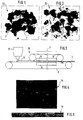
- the carpet material shown in Fig. 1 consists of old carpet which has been chopped into roughly palm-sized pieces in a chopping machine and then finely ground in a mill, with no cleaning taking place and the up to 30% of the weight of foreign substances, especially dirt , Sand and other mineral particles remain in the material.
- the crushing by grinding goes so far that the carpet structure is completely lost and only a fibrous bulge remains, which agglomerates into small loose balls 1 as it passes through the outlet sieve of the mill.
- the carpet had a polyamide pile and a ribbon back made of polypropylene.
- the back particles 2 are still recognizable as different materials.
- the thermoplastic fractions make up about 5 to 30 percent by weight, in the exemplary embodiment about 20 percent by weight, of the milled old carpet.
- the carpet material 10 of FIG. 1 contains only parts of the old carpet and forms a preliminary stage of the total mass 20 to be pressed, which is shown in FIG. 2.
- the total mass 2O comprises the carpet material 10 of FIG. 1 with an admixed addition of 10 to 50 percent by weight, in the exemplary embodiment 35 percent by weight of the carpet material 10 of fine, fibrous wood chips with a maximum thickness at 0.2 to 0.4 mm and a slenderness ratio of 1: 1O to 1: 100.
- the carpet material 10 of the exemplary embodiment inherently contains enough polypropylene, which serves as a thermoplastic binder. In the other case, additional must Polypropylene or a comparable thermoplastic binder can be added.
- the starting material mixed with the wood chips is pressed into a sheet web 4 in the double belt press 30 of FIG. 3.
- the double belt press 30 comprises an upper forming belt 5 and a lower forming belt 6 made of sheet steel, which circulate endlessly via deflection rollers and run opposite one pressing section 7 at the same speed in the direction of the arrow.
- the leading form belts 5, 6 are supported by corresponding devices 8, 9, which are only indicated schematically, and heat can be transferred through the form belts 5, 6 to the plate web 4 that is being formed.
- the lower forming belt 6 has an upstream spreading section in which a mat or bed 12 is made from a storage container 11 by means of suitable devices from the carpet material provided with thermoplastic binders, to which the proportion of fibrous wood chips has been homogeneously mixed.
- the bed 12 is at Inlet compressed between the forming belts 5, 6 and hardened in the press section 7 according to a predefinable time-temperature pressure diagram.
- the fully hardened plate web is cooled in the last piece of the double belt press 3O or in a separately connected cooling device and can then be assembled.
- a plate 14 removed from the plate web 4 has a marbled appearance with a dense, fairly smooth, dark surface. A structural difference over the thickness of the plate 14 cannot be determined with the eye, as shown in FIG. 5.
- the aim was to distribute the components as homogeneously as possible.
- a structural profile can be produced in a known manner over the plate thickness, for example by scattering a layer with a higher proportion of polypropylene or a layer with a higher proportion of fibrous wood chips on top of the main layer of the carpet material 10 with less or no fibrous wood shavings and a layer with more polypropylene or wood is placed on top. These layers are pressed together and then form a structured plate.
- the increase in bending strength due to the use of fibrous wood chips is noticeable both with a homogeneous distribution of the wood chips and especially with an increase in the wood chip content in the cover layers, the modulus of elasticity and tensile strength of which are particularly important in the bending stress.
- the underlying plates 14 had a thickness of 6 mm and a specific weight of 950 kg / m3.
- the pile of the carpet material used consisted of polyamide, the back made of polypropylene, which was made up to 20% by weight of the total carpet material by adding polypropylene waste.
- An addition of 5% by weight of phenolic resin as a thermosetting binder and an addition of fibrous wood chips were added to this total carpet material.
- the E-modules summarized in the table below were calculated from the bending values.
- a plate 15 is shown, on both sides a cover layer 16 of large (Fig. 6 has the scale 1: 1), flat and very thin wood chips of about 0.2 mm thickness and on the whole rectangular outline.
- the lower cover layer 16 is first sprinkled with glued chips 18, then the middle layer 17 made of the carpet material with wood content comminuted according to the invention and then the upper cover layer 16 made of the glued thin chips 18. The whole is done by the double belt press 30 hazards.
- the tangled scatter of the chips 18 leads to random differences in the local accumulation of wood material and, at a specific compression pressure, to different layer thicknesses of the cover layers 16.
- the middle layer 17 made of the carpet material according to the invention has strong thermoplastic properties when pressure and heat are used in the press section 7, 7, the thickness profile of the layers 16 presses inwards, while the outer surfaces 19 remain practically flat.
- a very bending-resistant composite material is obtained with the interesting surface shown in FIG. 6, which is flat despite the arbitrary scattering and at most at the edges of the uppermost chips 18 minor steps of the order of the thickness of the chips, i.e. from 0.1 to O, 3 mm high, but otherwise has practically flat surfaces.
- the plate material 40 of FIG. 8 is composed of three thin plates 14 according to FIGS. 4 and 5 in thickness and four veneer layers of approximately the same thickness in plywood.
- the thickness of the individual layers is approximately 1 to 4 mm, in the exemplary embodiment 2 mm.
- the direction of the fibers runs parallel to the plane of the drawing, in the veneer layers 21 'perpendicular to the plane of the drawing.
- Each plate layer 14 has a wood layer 21, 21 'on both sides.
- the production can be carried out in such a way that a standard plate 14 of a certain small thickness is produced and, in a desired number, is glued to the corresponding veneer layers under pressure.
- a double belt press according to DE-PS 21 57 764 was used for the production of the plates 14 according to FIGS. 4 and 5. 3 was about 2OO ° C, the pressure in the press section 7 about 5OO N / cm2. The time during which the carpet material was exposed to this temperature and pressure was 9O-18O s.
Landscapes
- Engineering & Computer Science (AREA)
- Mechanical Engineering (AREA)
- Life Sciences & Earth Sciences (AREA)
- Chemical & Material Sciences (AREA)
- Composite Materials (AREA)
- Wood Science & Technology (AREA)
- Manufacturing & Machinery (AREA)
- Forests & Forestry (AREA)
- Environmental & Geological Engineering (AREA)
- Dry Formation Of Fiberboard And The Like (AREA)
Applications Claiming Priority (2)
| Application Number | Priority Date | Filing Date | Title |
|---|---|---|---|
| US26454194A | 1994-06-23 | 1994-06-23 | |
| US264541 | 1994-06-23 |
Publications (2)
| Publication Number | Publication Date |
|---|---|
| EP0688643A2 true EP0688643A2 (fr) | 1995-12-27 |
| EP0688643A3 EP0688643A3 (fr) | 1996-11-27 |
Family
ID=23006514
Family Applications (1)
| Application Number | Title | Priority Date | Filing Date |
|---|---|---|---|
| EP19950109463 Withdrawn EP0688643A3 (fr) | 1994-06-23 | 1995-06-19 | Pièce moulée et son procédé de fabrication |
Country Status (2)
| Country | Link |
|---|---|
| US (1) | US5786279A (fr) |
| EP (1) | EP0688643A3 (fr) |
Cited By (2)
| Publication number | Priority date | Publication date | Assignee | Title |
|---|---|---|---|---|
| EP0888856A1 (fr) * | 1997-07-03 | 1999-01-07 | Günther Vöst | Procédé pour la fabrication de panneaux à base de déchets fractionnés d'une matière plastique |
| WO2025153744A1 (fr) * | 2024-01-17 | 2025-07-24 | Maplex Technology Ltd | Procédés de fabrication de panneaux composites à partir de fibres textiles et de bois |
Families Citing this family (12)
| Publication number | Priority date | Publication date | Assignee | Title |
|---|---|---|---|---|
| US6182913B1 (en) | 1999-01-25 | 2001-02-06 | Interface, Inc. | Method and apparatus for reclaiming carpet components |
| PT1642614E (pt) * | 2002-03-11 | 2010-02-15 | Fresenius Medical Care De Gmbh | Recipiente com um conector e um dispositivo de preparação de fluido de diálise associado |
| US7052542B2 (en) * | 2002-04-12 | 2006-05-30 | American As Recycle Technique Co., Ltd. | Composition for construction material and its method of making and using the same |
| DE10326181B4 (de) * | 2003-06-06 | 2008-04-30 | Cvp Clean Value Plastics Gmbh | Holzwerkstoffplatte und Verfahren zu ihrer Herstellung |
| US7875655B2 (en) | 2006-01-20 | 2011-01-25 | Material Innovations, Llc | Carpet waste composite |
| US20080213562A1 (en) * | 2006-11-22 | 2008-09-04 | Przybylinski James P | Plastic Composites Using Recycled Carpet Waste and Systems and Methods of Recycling Carpet Waste |
| EP2114648B1 (fr) * | 2006-11-22 | 2014-09-03 | Material Innovations, LLC | Composites bois-plastiques à base de déchets de tapis recyclés et procédés de fabrication |
| BRPI0922481A2 (pt) | 2008-12-19 | 2018-06-05 | Fiber Composites Llc | compósitos madeira-plásticos utilizando capstocks de ionômero e métodos de fabricação |
| WO2010151627A2 (fr) * | 2009-06-24 | 2010-12-29 | Federal-Mogul Powertrain, Inc. | Matériau en feuille non tissé, panneau produit à partir de celui-ci et procédés de production associés |
| US20120052760A1 (en) * | 2010-09-01 | 2012-03-01 | Nyloboard Llc | Structural substitutes made from polymer fibers |
| US12172421B2 (en) | 2020-11-18 | 2024-12-24 | Rise Building Products Llc | Composite building materials and methods of manufacture |
| US11572646B2 (en) | 2020-11-18 | 2023-02-07 | Material Innovations Llc | Composite building materials and methods of manufacture |
Citations (6)
| Publication number | Priority date | Publication date | Assignee | Title |
|---|---|---|---|---|
| DD61094A (fr) | 1900-01-01 | |||
| AT252546B (de) | 1963-06-10 | 1967-02-27 | Rudolf Wilfingseder Holzbearbe | Verfahren zur Herstellung von Formkörpern, insbesondere Platten |
| DE2157764A1 (de) | 1971-02-12 | 1972-08-24 | Greiter, Franz Johann, Altstätten (Schweiz) | Sportbekleidung |
| DE2457848A1 (de) | 1974-12-06 | 1976-06-10 | Klaus Lesti | Presstoffkoerper |
| DE2722774A1 (de) | 1977-05-20 | 1978-11-23 | Franz Dr Matejcek | Verfahren zur verwertung von textilen abfaellen |
| DE4137744A1 (de) | 1991-11-15 | 1993-05-19 | Kuesters Eduard Maschf | Verfahren zum herstellen eines schichtwerkstoffs unter wiederverwendung von kunststoffabfaellen und eigensteifer, kunstsoffabfaelle enthaltender schichtwerkstoff |
Family Cites Families (14)
| Publication number | Priority date | Publication date | Assignee | Title |
|---|---|---|---|---|
| DE101327C (fr) * | ||||
| CH467832A (de) * | 1963-10-18 | 1969-01-31 | Bunzl & Biach Ag | Verfahren zur Herstellung von Verbundkörpern |
| AT314190B (de) * | 1971-05-07 | 1974-03-25 | Reichhold Chemie Ag | Verfahren zur Herstellung von Formkörpern |
| CH570869A5 (fr) * | 1973-03-23 | 1976-05-14 | Icma San Giorgio S R L Ind Cos | |
| FR2296513A1 (fr) * | 1974-12-31 | 1976-07-30 | Inst Nat Rech Chimique | Procede de fabrication de produits finis ou semi-finis a partir de melanges de dechets de resines synthetiques differentes |
| DE2845117C2 (de) * | 1978-10-17 | 1985-03-07 | Casimir Kast Gmbh & Co Kg, 7562 Gernsbach | Verfahren und Anlage zur Herstellung von zu Formteilen verpreßbarem Plattenmaterial |
| DE3233385C2 (de) * | 1981-10-02 | 1984-05-17 | Günter Hans 1000 Berlin Kiss | Mehrschicht-Faserverbundstoff und Verfahren zu dessen Herstellung |
| DE3233241A1 (de) * | 1981-10-13 | 1983-04-28 | Günter Hans 1000 Berlin Kiss | Verfahren zum pressen von formteilen aus bindemittelhaltigen organischen fasermatten und vorrichtung zur durchfuehrung des verfahrens |
| IT1174102B (it) * | 1983-05-31 | 1987-07-01 | Allen Ind | Metodo ed apparecchiatura per la fabbricazione di un foglio di materiale |
| IT1174108B (it) * | 1983-05-31 | 1987-07-01 | Allen Ind | Metodo e apparecchiature per la produzione di un foglio dimateriale |
| US4642153A (en) * | 1983-05-31 | 1987-02-10 | Allen Industries, Inc. | Method and apparatus for making a sheet of material |
| EP0245544A3 (fr) * | 1986-03-11 | 1988-03-23 | Cellutane Co Ltd | Procédé et dispositif pour produire en continu des articles plans à partir de déchets de matière synthétique |
| ATE159452T1 (de) * | 1992-05-26 | 1997-11-15 | Guenter Tesch | Holzbelag, insbesondere holzbodenbelag |
| DE4236909A1 (de) * | 1992-10-31 | 1994-05-05 | Ph Kunststoff Recycling Gmbh & | Verfahren zur Herstellung einer Dämmplatte und nach diesem Verfahren hergestellte Dämmplatte |
-
1995
- 1995-06-19 EP EP19950109463 patent/EP0688643A3/fr not_active Withdrawn
-
1996
- 1996-12-12 US US08/764,032 patent/US5786279A/en not_active Expired - Fee Related
Patent Citations (6)
| Publication number | Priority date | Publication date | Assignee | Title |
|---|---|---|---|---|
| DD61094A (fr) | 1900-01-01 | |||
| AT252546B (de) | 1963-06-10 | 1967-02-27 | Rudolf Wilfingseder Holzbearbe | Verfahren zur Herstellung von Formkörpern, insbesondere Platten |
| DE2157764A1 (de) | 1971-02-12 | 1972-08-24 | Greiter, Franz Johann, Altstätten (Schweiz) | Sportbekleidung |
| DE2457848A1 (de) | 1974-12-06 | 1976-06-10 | Klaus Lesti | Presstoffkoerper |
| DE2722774A1 (de) | 1977-05-20 | 1978-11-23 | Franz Dr Matejcek | Verfahren zur verwertung von textilen abfaellen |
| DE4137744A1 (de) | 1991-11-15 | 1993-05-19 | Kuesters Eduard Maschf | Verfahren zum herstellen eines schichtwerkstoffs unter wiederverwendung von kunststoffabfaellen und eigensteifer, kunstsoffabfaelle enthaltender schichtwerkstoff |
Cited By (2)
| Publication number | Priority date | Publication date | Assignee | Title |
|---|---|---|---|---|
| EP0888856A1 (fr) * | 1997-07-03 | 1999-01-07 | Günther Vöst | Procédé pour la fabrication de panneaux à base de déchets fractionnés d'une matière plastique |
| WO2025153744A1 (fr) * | 2024-01-17 | 2025-07-24 | Maplex Technology Ltd | Procédés de fabrication de panneaux composites à partir de fibres textiles et de bois |
Also Published As
| Publication number | Publication date |
|---|---|
| US5786279A (en) | 1998-07-28 |
| EP0688643A3 (fr) | 1996-11-27 |
Similar Documents
| Publication | Publication Date | Title |
|---|---|---|
| EP0542186B1 (fr) | Procédé pour la fabrication d'un matériau en couches par recyclage des déchets en plastique, et matériau en couches rigidifié contenant des déchets en plastique | |
| DE2845112C3 (de) | Verfahren und Anlage zur Herstellung von Matten aus zellulosehaltigen Fasern und Verfahren zur Herstellung von Formteilen aus diesen | |
| EP0688644A2 (fr) | Pièce moulée et son procédé de fabrication | |
| DE102004062649C5 (de) | Verfahren zur Herstellung einer Holzfaserdämmstoffplatte bzw.-matte und nach diesem Verfahren hergestellte Holzfaserdämmstoffplatten bzw.-matten | |
| EP0688643A2 (fr) | Pièce moulée et son procédé de fabrication | |
| DE102008039720A1 (de) | Verfahren zur Herstellung von Holzfaser-Dämmplatten | |
| DE2442194A1 (de) | Verfahren zur herstellung von faservliesware | |
| EP1674633B1 (fr) | Plaque en fibres de bois isolant ou matte | |
| DE69225176T2 (de) | Verfahren und Anlage zur Wiederverwertung von Abfällen mit Kunststoff | |
| DE19714348C2 (de) | Verfahren zur Herstellung von Dämmstoffen aus Textilabfällen, danach hergestellte Dämmstoffe und Verwendung derselben | |
| EP0688642A2 (fr) | Pièce moulée et son procédé de fabrication | |
| DE4128927C2 (de) | Recycling von Formteilen aus bindemittelhaltigen Zellulose- oder Lignozellulosewerkstoffen | |
| EP1056892A1 (fr) | Dispositif et procede de production d'un composite en fibres | |
| DE3806108C2 (fr) | ||
| EP1436128A1 (fr) | Mat de fibres, piece moulee obtenue a partir dudit mat et procede permettant de le produire | |
| DE2845117C2 (de) | Verfahren und Anlage zur Herstellung von zu Formteilen verpreßbarem Plattenmaterial | |
| EP0688645A2 (fr) | Panneau et son procédé de fabrication | |
| EP0888856B1 (fr) | Procédé et disposatif pour la fabrication de panneaux à base de déchets fractionnés d'une matière plastique | |
| WO2003013809A1 (fr) | Panneau realise dans un materiau derive du bois et de production ecologique | |
| DE19734338B4 (de) | Verfahren zum Herstellen von Platten aus zerkleinerten Kunststoffabfällen | |
| DE4316498C2 (de) | Verfahren zur Herstellung von bindemittelhaltigen Holzfaserformteilen | |
| DE10320686B4 (de) | Verfahren zur Herstellung von Formkörpergrundmaterial | |
| DE202016002946U1 (de) | Verbundwerkstoff | |
| EP1414629B8 (fr) | Panneau realise dans un materiau derive du bois et de production ecologique | |
| DE29605878U1 (de) | Plattenförmige Elemente |
Legal Events
| Date | Code | Title | Description |
|---|---|---|---|
| PUAI | Public reference made under article 153(3) epc to a published international application that has entered the european phase |
Free format text: ORIGINAL CODE: 0009012 |
|
| AK | Designated contracting states |
Kind code of ref document: A2 Designated state(s): BE DE FR GB IT NL |
|
| PUAL | Search report despatched |
Free format text: ORIGINAL CODE: 0009013 |
|
| AK | Designated contracting states |
Kind code of ref document: A3 Designated state(s): BE DE FR GB IT NL |
|
| 17P | Request for examination filed |
Effective date: 19970121 |
|
| STAA | Information on the status of an ep patent application or granted ep patent |
Free format text: STATUS: THE APPLICATION IS DEEMED TO BE WITHDRAWN |
|
| 18D | Application deemed to be withdrawn |
Effective date: 19990102 |