EP0688892A1 - Toile de fibres creuses et procede de fabrication correspondant - Google Patents
Toile de fibres creuses et procede de fabrication correspondant Download PDFInfo
- Publication number
- EP0688892A1 EP0688892A1 EP95905232A EP95905232A EP0688892A1 EP 0688892 A1 EP0688892 A1 EP 0688892A1 EP 95905232 A EP95905232 A EP 95905232A EP 95905232 A EP95905232 A EP 95905232A EP 0688892 A1 EP0688892 A1 EP 0688892A1
- Authority
- EP
- European Patent Office
- Prior art keywords
- fibers
- hollow
- slits
- fabric
- portions
- Prior art date
- Legal status (The legal status is an assumption and is not a legal conclusion. Google has not performed a legal analysis and makes no representation as to the accuracy of the status listed.)
- Granted
Links
Images

Classifications
-
- D—TEXTILES; PAPER
- D01—NATURAL OR MAN-MADE THREADS OR FIBRES; SPINNING
- D01D—MECHANICAL METHODS OR APPARATUS IN THE MANUFACTURE OF ARTIFICIAL FILAMENTS, THREADS, FIBRES, BRISTLES OR RIBBONS
- D01D5/00—Formation of filaments, threads, or the like
- D01D5/24—Formation of filaments, threads, or the like with a hollow structure; Spinnerette packs therefor
-
- D—TEXTILES; PAPER
- D01—NATURAL OR MAN-MADE THREADS OR FIBRES; SPINNING
- D01F—CHEMICAL FEATURES IN THE MANUFACTURE OF ARTIFICIAL FILAMENTS, THREADS, FIBRES, BRISTLES OR RIBBONS; APPARATUS SPECIALLY ADAPTED FOR THE MANUFACTURE OF CARBON FILAMENTS
- D01F6/00—Monocomponent artificial filaments or the like of synthetic polymers; Manufacture thereof
- D01F6/58—Monocomponent artificial filaments or the like of synthetic polymers; Manufacture thereof from homopolycondensation products
- D01F6/62—Monocomponent artificial filaments or the like of synthetic polymers; Manufacture thereof from homopolycondensation products from polyesters
-
- D—TEXTILES; PAPER
- D03—WEAVING
- D03D—WOVEN FABRICS; METHODS OF WEAVING; LOOMS
- D03D15/00—Woven fabrics characterised by the material, structure or properties of the fibres, filaments, yarns, threads or other warp or weft elements used
- D03D15/20—Woven fabrics characterised by the material, structure or properties of the fibres, filaments, yarns, threads or other warp or weft elements used characterised by the material of the fibres or filaments constituting the yarns or threads
- D03D15/283—Woven fabrics characterised by the material, structure or properties of the fibres, filaments, yarns, threads or other warp or weft elements used characterised by the material of the fibres or filaments constituting the yarns or threads synthetic polymer-based, e.g. polyamide or polyester fibres
-
- D—TEXTILES; PAPER
- D03—WEAVING
- D03D—WOVEN FABRICS; METHODS OF WEAVING; LOOMS
- D03D15/00—Woven fabrics characterised by the material, structure or properties of the fibres, filaments, yarns, threads or other warp or weft elements used
- D03D15/30—Woven fabrics characterised by the material, structure or properties of the fibres, filaments, yarns, threads or other warp or weft elements used characterised by the structure of the fibres or filaments
- D03D15/37—Woven fabrics characterised by the material, structure or properties of the fibres, filaments, yarns, threads or other warp or weft elements used characterised by the structure of the fibres or filaments with specific cross-section or surface shape
-
- D—TEXTILES; PAPER
- D03—WEAVING
- D03D—WOVEN FABRICS; METHODS OF WEAVING; LOOMS
- D03D15/00—Woven fabrics characterised by the material, structure or properties of the fibres, filaments, yarns, threads or other warp or weft elements used
- D03D15/40—Woven fabrics characterised by the material, structure or properties of the fibres, filaments, yarns, threads or other warp or weft elements used characterised by the structure of the yarns or threads
- D03D15/44—Woven fabrics characterised by the material, structure or properties of the fibres, filaments, yarns, threads or other warp or weft elements used characterised by the structure of the yarns or threads with specific cross-section or surface shape
-
- D—TEXTILES; PAPER
- D03—WEAVING
- D03D—WOVEN FABRICS; METHODS OF WEAVING; LOOMS
- D03D15/00—Woven fabrics characterised by the material, structure or properties of the fibres, filaments, yarns, threads or other warp or weft elements used
- D03D15/50—Woven fabrics characterised by the material, structure or properties of the fibres, filaments, yarns, threads or other warp or weft elements used characterised by the properties of the yarns or threads
- D03D15/56—Woven fabrics characterised by the material, structure or properties of the fibres, filaments, yarns, threads or other warp or weft elements used characterised by the properties of the yarns or threads elastic
-
- D—TEXTILES; PAPER
- D10—INDEXING SCHEME ASSOCIATED WITH SUBLASSES OF SECTION D, RELATING TO TEXTILES
- D10B—INDEXING SCHEME ASSOCIATED WITH SUBLASSES OF SECTION D, RELATING TO TEXTILES
- D10B2201/00—Cellulose-based fibres, e.g. vegetable fibres
- D10B2201/01—Natural vegetable fibres
- D10B2201/02—Cotton
-
- D—TEXTILES; PAPER
- D10—INDEXING SCHEME ASSOCIATED WITH SUBLASSES OF SECTION D, RELATING TO TEXTILES
- D10B—INDEXING SCHEME ASSOCIATED WITH SUBLASSES OF SECTION D, RELATING TO TEXTILES
- D10B2201/00—Cellulose-based fibres, e.g. vegetable fibres
- D10B2201/20—Cellulose-derived artificial fibres
- D10B2201/22—Cellulose-derived artificial fibres made from cellulose solutions
- D10B2201/24—Viscose
-
- D—TEXTILES; PAPER
- D10—INDEXING SCHEME ASSOCIATED WITH SUBLASSES OF SECTION D, RELATING TO TEXTILES
- D10B—INDEXING SCHEME ASSOCIATED WITH SUBLASSES OF SECTION D, RELATING TO TEXTILES
- D10B2211/00—Protein-based fibres, e.g. animal fibres
- D10B2211/01—Natural animal fibres, e.g. keratin fibres
- D10B2211/02—Wool
-
- D—TEXTILES; PAPER
- D10—INDEXING SCHEME ASSOCIATED WITH SUBLASSES OF SECTION D, RELATING TO TEXTILES
- D10B—INDEXING SCHEME ASSOCIATED WITH SUBLASSES OF SECTION D, RELATING TO TEXTILES
- D10B2331/00—Fibres made from polymers obtained otherwise than by reactions only involving carbon-to-carbon unsaturated bonds, e.g. polycondensation products
- D10B2331/02—Fibres made from polymers obtained otherwise than by reactions only involving carbon-to-carbon unsaturated bonds, e.g. polycondensation products polyamides
-
- D—TEXTILES; PAPER
- D10—INDEXING SCHEME ASSOCIATED WITH SUBLASSES OF SECTION D, RELATING TO TEXTILES
- D10B—INDEXING SCHEME ASSOCIATED WITH SUBLASSES OF SECTION D, RELATING TO TEXTILES
- D10B2331/00—Fibres made from polymers obtained otherwise than by reactions only involving carbon-to-carbon unsaturated bonds, e.g. polycondensation products
- D10B2331/04—Fibres made from polymers obtained otherwise than by reactions only involving carbon-to-carbon unsaturated bonds, e.g. polycondensation products polyesters, e.g. polyethylene terephthalate [PET]
-
- D—TEXTILES; PAPER
- D10—INDEXING SCHEME ASSOCIATED WITH SUBLASSES OF SECTION D, RELATING TO TEXTILES
- D10B—INDEXING SCHEME ASSOCIATED WITH SUBLASSES OF SECTION D, RELATING TO TEXTILES
- D10B2401/00—Physical properties
- D10B2401/04—Heat-responsive characteristics
- D10B2401/041—Heat-responsive characteristics thermoplastic; thermosetting
-
- D—TEXTILES; PAPER
- D10—INDEXING SCHEME ASSOCIATED WITH SUBLASSES OF SECTION D, RELATING TO TEXTILES
- D10B—INDEXING SCHEME ASSOCIATED WITH SUBLASSES OF SECTION D, RELATING TO TEXTILES
- D10B2401/00—Physical properties
- D10B2401/06—Load-responsive characteristics
- D10B2401/061—Load-responsive characteristics elastic
-
- D—TEXTILES; PAPER
- D10—INDEXING SCHEME ASSOCIATED WITH SUBLASSES OF SECTION D, RELATING TO TEXTILES
- D10B—INDEXING SCHEME ASSOCIATED WITH SUBLASSES OF SECTION D, RELATING TO TEXTILES
- D10B2401/00—Physical properties
- D10B2401/16—Physical properties antistatic; conductive
-
- Y—GENERAL TAGGING OF NEW TECHNOLOGICAL DEVELOPMENTS; GENERAL TAGGING OF CROSS-SECTIONAL TECHNOLOGIES SPANNING OVER SEVERAL SECTIONS OF THE IPC; TECHNICAL SUBJECTS COVERED BY FORMER USPC CROSS-REFERENCE ART COLLECTIONS [XRACs] AND DIGESTS
- Y10—TECHNICAL SUBJECTS COVERED BY FORMER USPC
- Y10S—TECHNICAL SUBJECTS COVERED BY FORMER USPC CROSS-REFERENCE ART COLLECTIONS [XRACs] AND DIGESTS
- Y10S210/00—Liquid purification or separation
- Y10S210/918—Miscellaneous specific techniques
- Y10S210/922—Oil spill cleanup, e.g. bacterial
- Y10S210/924—Oil spill cleanup, e.g. bacterial using physical agent, e.g. sponge, mop
-
- Y—GENERAL TAGGING OF NEW TECHNOLOGICAL DEVELOPMENTS; GENERAL TAGGING OF CROSS-SECTIONAL TECHNOLOGIES SPANNING OVER SEVERAL SECTIONS OF THE IPC; TECHNICAL SUBJECTS COVERED BY FORMER USPC CROSS-REFERENCE ART COLLECTIONS [XRACs] AND DIGESTS
- Y10—TECHNICAL SUBJECTS COVERED BY FORMER USPC
- Y10T—TECHNICAL SUBJECTS COVERED BY FORMER US CLASSIFICATION
- Y10T428/00—Stock material or miscellaneous articles
- Y10T428/24—Structurally defined web or sheet [e.g., overall dimension, etc.]
- Y10T428/24273—Structurally defined web or sheet [e.g., overall dimension, etc.] including aperture
- Y10T428/24298—Noncircular aperture [e.g., slit, diamond, rectangular, etc.]
- Y10T428/24314—Slit or elongated
-
- Y—GENERAL TAGGING OF NEW TECHNOLOGICAL DEVELOPMENTS; GENERAL TAGGING OF CROSS-SECTIONAL TECHNOLOGIES SPANNING OVER SEVERAL SECTIONS OF THE IPC; TECHNICAL SUBJECTS COVERED BY FORMER USPC CROSS-REFERENCE ART COLLECTIONS [XRACs] AND DIGESTS
- Y10—TECHNICAL SUBJECTS COVERED BY FORMER USPC
- Y10T—TECHNICAL SUBJECTS COVERED BY FORMER US CLASSIFICATION
- Y10T428/00—Stock material or miscellaneous articles
- Y10T428/29—Coated or structually defined flake, particle, cell, strand, strand portion, rod, filament, macroscopic fiber or mass thereof
- Y10T428/2913—Rod, strand, filament or fiber
- Y10T428/2973—Particular cross section
- Y10T428/2975—Tubular or cellular
-
- Y—GENERAL TAGGING OF NEW TECHNOLOGICAL DEVELOPMENTS; GENERAL TAGGING OF CROSS-SECTIONAL TECHNOLOGIES SPANNING OVER SEVERAL SECTIONS OF THE IPC; TECHNICAL SUBJECTS COVERED BY FORMER USPC CROSS-REFERENCE ART COLLECTIONS [XRACs] AND DIGESTS
- Y10—TECHNICAL SUBJECTS COVERED BY FORMER USPC
- Y10T—TECHNICAL SUBJECTS COVERED BY FORMER US CLASSIFICATION
- Y10T428/00—Stock material or miscellaneous articles
- Y10T428/29—Coated or structually defined flake, particle, cell, strand, strand portion, rod, filament, macroscopic fiber or mass thereof
- Y10T428/2913—Rod, strand, filament or fiber
- Y10T428/2973—Particular cross section
- Y10T428/2978—Surface characteristic
-
- Y—GENERAL TAGGING OF NEW TECHNOLOGICAL DEVELOPMENTS; GENERAL TAGGING OF CROSS-SECTIONAL TECHNOLOGIES SPANNING OVER SEVERAL SECTIONS OF THE IPC; TECHNICAL SUBJECTS COVERED BY FORMER USPC CROSS-REFERENCE ART COLLECTIONS [XRACs] AND DIGESTS
- Y10—TECHNICAL SUBJECTS COVERED BY FORMER USPC
- Y10T—TECHNICAL SUBJECTS COVERED BY FORMER US CLASSIFICATION
- Y10T442/00—Fabric [woven, knitted, or nonwoven textile or cloth, etc.]
- Y10T442/60—Nonwoven fabric [i.e., nonwoven strand or fiber material]
- Y10T442/608—Including strand or fiber material which is of specific structural definition
- Y10T442/609—Cross-sectional configuration of strand or fiber material is specified
- Y10T442/612—Hollow strand or fiber material
Definitions
- the present invention relates to a hollow fiber fabric and a process for producing the same.
- the present invention also relates to a fabric having a novel structure wherein an agent, which gives a functionality to the fibers, is introduced in the hollow portions of the hollow fibers which constitute the fabric.
- hollow fibers having holes which communicate from the surface of the fibers to hollow portions thereof.
- a water absorptive fiber is disclosed in Japanese Examined Patent Publication No. 61-60188 in which polyester hollow fibers blended with an organic sulfonic acid metal salt are subjected to an alkali treatment to dissolve off the organic sulfonic acid metal salt and to form, as traces of the removed salt, micropores having a diameter of 5 ⁇ m and communicating to hollow portions.
- a hollow fiber has been proposed in which through grooves (microgrooves) or cracks (slits) are formed from the fiber surface to hollow portions thereof.
- through grooves microgrooves
- slits slits
- sheath-core type fibers in which the polymer in the sheath portion has a weight reduction rate with an alkali different from that of the core portion such extremely complicated steps in spinning technology, called composite spinning, must be used.
- composite spinning since the difficulty inevitably arises in these methods that the polymer in the core portion cannot completely be removed and that the removal ratio of the polymer in the core portion is dispersed, there have been problems that uneven dying occurs and that deterioration of the physical properties and abrasion resistance of the hollow fibers themselves occur, and thus the fibers may not withstand practical use.
- An object of the present invention is to overcome such disadvantages as in conventional methods which are caused from the use of polymers having different solubility; that is (1) a problem that spinning steps are complex and production cost increases; (2) a problem that complete removal of the core portion cannot be assured, and uneven dying and quality lowering arises due to the polymer remaining in the core portion; and (3) a problem that the physical properties as a hollow fiber are deteriorated.
- the present invention is aimed at providing a hollow fiber fabric comprising hollow fibers which have a high hollowness ratio of at least 20% and are composed of a polymer of a single composition, the hollow fibers having slits as traces of a removed polymer the slits being formed in the longitudinal direction of the fibers in such a state that the slits communicate with the hollow portions.
- the present invention is to provide a process for producing a hollow fiber fabric comprising the steps of treating a fabric comprising hollow fibers having a high hollowness ratio of at least 20% and composed of a polymer of a single composition with a solvent or solution which dissolve the polymer, to partially dissolve the polymer in low orientation portions and/or deformation strain concentrated portions located in the longitudinal direction of the hollow fibers to form slits as traces of removed polymer in the lengthwise direction of the hollow fibers in such a state that the slits communicate with hollow portions of the hollow fibers.
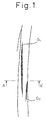
- Fig. 1 is a side view of a hollow fiber which constitutes at least a part of the fabric of the present invention, showing the shape of the slits.
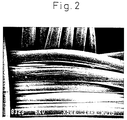
- Fig. 2 is an electron micrograph of the side view of such a hollow fiber as shown in Fig. 1.
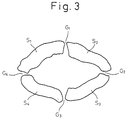
- Fig. 3 is a crosssectional view of a hollow which constitutes at least a part of the fabric of the present invention, showing the state wherein four slits extending in the longitudinal direction are in communication with a hollow portion.
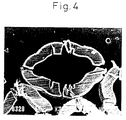
- Fig. 4 is an electron micrograph of the cross section of such a hollow fiber as shown in Fig. 3.
- Fig 5 is a crosssectional view showing an example of a circular nozzle for spinning a hollow fiber.
- Fig. 6 is a diagram showing an example of a crosssection of a hollow fiber after a pressure was applied.
- Fig. 7 is a diagram showing a crosssection of a hollow fiber after the pressure was eliminated and the elasticity was recovered.
- a hollow fiber of a circular crosssection is obtained by using a spinning nozzle comprised of an assembly of a pluraling of slit like orifices S1' to S4' as shown in Fig. 5. That is, there is a small gap C (called a canal) between edge portions of adjacent orifices, but the polymers extruded from each of the orifices are put together at this portion by the Barus effect to form a hollow fiber.
- a canal small gap between edge portions of adjacent orifices
- Fig. 1 demonstrates a side view of a hollow fiber after a fabric comprising a polyester hollow fiber was treated with an alkali, in which G1 to G4 (G3 and G4 are not shown in this side view) show slits extending in the longitudinal direction of the fiber.
- Fig. 3 demonstrates the crosssection taken along the line A - A' in Fig. 1.
- S1 to S4 indicate a thin skin portion of a hollow fiber
- G1 to G4 indicate a slit extending in the longitudinal direction of a fiber, and this portion is formed by preferentially dissolving off the low orientation and/or deformation strain concentrated portions of the polymer extruded from slit like orifices S1 to S4 shown in Fig. 5 by an alkali treatment.
- the "low orientation portion” refers to the portion where the thickness of the thin skin portion became thinner compared with its circumference due to the unevenness of extrusion at the time of polymer extrusion, etc., and the portion where the flow of the polymer did not sufficiently occur and the molecular orientation became lower as compared with other fiber forming portions.
- the "deformation strain concentrated portions” means the portion where deformation strain developed due to the stress applied in the direction perpendicular to the fiber axis at the steps of spinning and stretching, or the step of weaving or knitting; specifically it refers to the vicinity of each apex in the case where the cross-section of a hollow fiber is polygonal, or refers to the polymer junction portion where extruded polymers collide with each other due to the Barus effect (corresponding to each of the portions C in Fig. 5). Further, in the vicinity of these low orientation and/or deformation strain concentrated portions, additional slits may be produced in addition to the slits mentioned above.
- the polymer used in the present invention is suitable for the production of hollow fibers of a high hollow ratio.
- the polymer may be a thermoplstic polymer which can be dissolved with a solvent or solution after formed into fibers; and polyester and polyamide can preferably exemplified.
- the hollow fibers are composed of a polymer of a single composition in the present invention
- the hollow fibers composed of the polymer of a single composition as used herein means that the hollow fibers do not include composite fibers composed of polymers having two or more compositions, and thus the polymer composition itself may be composed of two or more polymers.
- the polymer used in the present invention may be blended with, for example, a modifier, antioxidant, flame retardant, antistat, agent for forming micropores, colorant, stabilizer, and inorganic fine particles as long as the object of the present invention can be attained.
- a modifier for example, a modifier, antioxidant, flame retardant, antistat, agent for forming micropores, colorant, stabilizer, and inorganic fine particles.
- an organic sulfonic acid metal salt proposed in Japanese Examined Patent Publication No. 61-60188 was added, fibrillation occurs, and fiber properties may be deteriorated.
- hollowness ratio means the value expressed by ⁇ S 2 /(S 1 +S 2 ) ⁇ ⁇ 100 when the area of the portions which are filled with a polymer and exist around the hollow portions in the crosssection of hollow fibers is assumed to be S1, and the area of hollow portions at the crosssection is assumed to be S2.
- the ratio is calculated as an average value of 20 fibers, from photographs of a crosssection of hollow fibers taken at a magnification of 500X.
- the hollowness ratio is less than 20%, dissolution of the low orientation and/or deformation strain concentrated portions hardly occurs, and the desired hollow fibers cannot be obtained.
- the upper limit of the hollowness ratio is suitably at the highest about 70% from the viewpoint of securing physical properties as fiber.
- the hollowness ratio is preferably in the range of 30 to 50%.
- extruded fibers may be stretched at a stretching ratio of less than its natural draw ratio (NDR) to form thick-and-thin hollow fibers in which unstretched thick portions and stretched thin portions exist in a mixture.
- NDR natural draw ratio
- more slits can be formed in the thick portions than in the thin portions by adjusting the conditions of a chemical treatment for dissolution as suitable since the orientation degree is particularly low in the thick portions.
- the thick to thin ratio (ratio of diameter of thick portions to that of thin portions) of a filament of the thick and thin hollow fibers mentioned above is preferably less than 1.9.
- the thick to thin ratio exceeds 1.9, microgrooves become too large and the fibrillation resistance may be deteriorated.
- the crosssectional shape of the hollow fibers there is no specific restriction in the crosssectional shape of the hollow fibers, and shapes such as triangle, plate-shaped, star-shaped, and boomerang-shaped in addition to a circular crosssection can be fredy adopted without restraint.
- the shape of the hollow portions may be the same as, or different from the peripheral shape of the fiber crosssection.
- the hollow fibers mentioned above are subjected to a dissolution treatment (chemical dissolution treatment) with a solvent or solution which dissolves the polymer to form slits in the longitudinal direction of the fibers after the fibers are converted into a fabric by a weaving or knitting or another suitable method.
- a dissolution treatment chemical dissolution treatment
- a solvent or solution which dissolves the polymer to form slits in the longitudinal direction of the fibers after the fibers are converted into a fabric by a weaving or knitting or another suitable method.
- These slits are formed in the longitudinal direction of the fibers as traces of removed low orientation and/or deformation strain concentrated portions which exist at at least one point on the portions having a thin skin in the crosssection of the hollow fiber; particularly in the case that the fabric is a woven fabric, the slits are formed predominantly at or in the vicinity of the crossing portions of warps with wefts where an excessive stress is applied; and in the case that the fabric is a knitted fabric, the slits are formed at or in the vicinity of knot portions where an excessive stress is applied, both cases leading to communication of the slits down to hollow portions of the fibers.
- the hollow fibers When made into a fabric, the hollow fibers may be used in the form of a union woven fabric, union knitted fabric, mixed fiber spinning, or combined filament yarn with synthetic fibers, natural fibers such as cotton and wool, regenerated fibers such as rayons, and polyether ester elastic fibers of a block copolymer having a polyethylene terephthalate type polyester as a hard segment and a polyoxybutylene glycol type polyester as a soft segment.
- the slits mentioned above are formed so that the width thereof is in a range of 0.2 to 10 ⁇ m and the length is in a range of 5 to 200 ⁇ m. Further, when the hollow fibers are thick and thin fibers, they are formed so that the width is 0.5 to 15 ⁇ m and the length is greater than 200 ⁇ m, but less than 2000 ⁇ m.
- the width of the slits is less than 0.2 ⁇ m or the length is less than 5 ⁇ m, not only can the "scroopy feeling" and water absorptive properties not be obtained but also the impregnation of the agent mentioned below which gives functionality to fibers is difficult to achieve.
- the width exceeds 15 ⁇ m or the length exceeds 2000 ⁇ m the surface of the fibers is liable to become fibrillose, so that abrasion resistance reduces, and maintenance of the hollow portions becomes difficult.
- the dissolution treatment for forming slits is carried out by the treatment for reducing the weight with an alkali which is conventionally performed, but it is possible to suitably control the frequency of the production of slits by carrying out the alkali treatment so as to rapidly reduce the weight of the fibers as compared with the ordinary alkali treatment for reducing the weight.
- methods which are already known can be used without restraint, for example, suspending weight reduction, cold batch, batch weight reduction with a jet dyeing machine, or continuous weight reduction using steam or super heated vapor.
- a high pressure dyeing treatment may be performed after the alkali weight reduction mentioned above.
- the use of a jet dyeing machine in a high pressure dyeing treatment in particular, is preferable since temperature increasing effect and crumpling effect preferably interact synergically.
- the fabric may be pressed prior to the dissolution treatment mentioned above. Since strain is concentrated at the low orientation and/or deformation strain concentrated portions existing in the longitudinal direction of the hollow fibers by pressing, and since partial dissolution treatment is accelerated by occurrence of microcracks or the like, the formation of slits tends to become easier.
- a calendar processing using a roll composed of cotton and metal can be mentioned, and a particularly remarkable accelerating effect of dissolution may be exhibited when so-called friction rolls where the speed of upper and lower rolls are different are used.
- friction rolls where the speed of upper and lower rolls are different are used.
- the roll to be used those having a flat surface or embossed rolls having engraved patterns are suitably selected depending on the purpose.
- Heating temperature is suitably lower than the second order transition temperature of the hollow fibers and when the hollow fibers are composed of polyester, a temperature lower than 50°C is more preferable.
- the pressure at this time is preferably 5 to 60 Kg/cm in terms of linear pressure.
- the linear pressure is less than 5 Kg/cm, the effect of accelerating partial dissolution treatment is insufficient, while on the other hand, if the linear pressure exceeds 60 Kg/cm, the hollow fibers are flattened, and the gloss of the fabric increases so that the fabric cannot be used.
- an agent which gives a functionality to fibers means a substance which can develop several chemical functionalities when added to the fibers, and the following can be mentioned as examples thereof:
- methods preferably include (i) a method in which the hollow portions are filled by substituting air with a solution or dispersion (including an emulsion) containing a fiber functionalizing agent, or a liquid such as a liquid state fiber functonalizing agent by allowing elastic recovery after a pressure within an elastic limit is applied to the hollow fibers, and (ii) a method in which air is removed by placing a hollow fiber fabric in a closed vessel and reducing pressure, and then injecting a fiber functionalizing agent.
- the medium used in these solution or dispersion (including an emulsion) is preferably a mixed solvent in which water and less than 20% by weight of an organic solvent are mixed.
- the pressure within an elastic limit refers to an approximate pressure under which collapsing of the hollow portions in the hollow fibers or deterioration of the physical properties of fibers does not substantially occur, and this pressure is determined based on the composition, shape, and hollowness ratio of the hollow fibers to be used.
- the inside of the hollow portions contact each other as shown in Fig. 7 or become similar to the shape shown in Fig. 7, and the fibers elastically recover to their original hollow shape (Fig. 6) after the pressure is removed.
- a liquid containing a fiber functionalizing agent is absorbed and fills, the hollow portions of the fibers as the fibers resume their original shape after the pressure is removed.
- the temperature during the pressurization is preferably lower than 100°C.
- the time in which the pressure is applied is desirably less than 10 seconds and more preferably less than 2 seconds. If the time is greater than 10 seconds, not only is the time needed for the restoration is prolonged, but also destruction of the hollow portions may occur when the pressure is applied.
- Pressurization is preferably carried out in a liquid containing a fiber functionalizing agent, but the hollow fibers may be immersed in a liquid after pressure is applied since from a few seconds to about one minute is required for the hollow portions to elastically recover their original state.
- a method in which the fibers are pressed or squeezed with a roll and a method in which the fibers are scraped with an edge such as of a knify can be used.
- heating refers to heating a liquid containing a fiber functionalizing agent to a temperature of from room temperature to 100°C.
- Vibration means that the fibers or fabric is directly vibrated, or that the solution around the fabric is vibrated.
- a vibrator, ultrasonic waves, or blowing a solution from a nozzle can be applied.
- a particularly preferable method is one in which a solution is blown from an orifice of a pipe installed in a liquid against the fibers or fabric. In this case, the diameter of the orifice is preferably less than 2 mm.
- the liquid medium containing the fiber functionalizing agent is removed by a heat treatment or another means, dried, and cured to fix the fiber functionalizing agent in the hollow portions.
- the present invention was completed by observing low orientation and/or deformation strain concentrated portions existing in the hollow fibers, based on the knowledge that, in the hollow fibers having a hollow ratio of not lower than 20% an extremely high chemical weight reduction property is exhibited at low orientation and/or deformation strain concentrated portions, while the hollow fibers are composed of a polymer of the same composition.
- Fig. 5 shows the crosssection of a nozzle for spinning a hollow fiber (here, a circular crosssection), and these nozzles for spinning hollow fibers are essentially composed of a plurality of slit-like orifices (here, four orifices).
- slits extending in the longitudinal direction of the fiber are formed as shown in Fig. 1.
- a chemical weight reduction treatment for instance, subjecting hollow fibers composed of a polyester to an alkali treatment
- slits extending in the longitudinal direction of the fiber are formed as shown in Fig. 1.
- thick-and-thin fibers having thick portions and thin portions are used as hollow fibers, it is possible to optionally adjust the frequency of slit formation by suitably adjusting the hollowness ratio and thick-to-thin ratio of the thick portions and thin portions, respectively.
- the slits mentioned above are remarkably formed when chemical weight reduction treatment is carried out at the portions where hollow fibers are most subjected to strain, that is, the crossing portions of warps with wefts or in the vicinity thereof in woven fabrics, or knotted portions of hollow fibers in the vicinity thereof in knitted fabrics, because hollow fibers are subjected to strain in the direction perpendicular to the fiber axis at the steps of spinning and stretching, and thus are formed predominantly at the portions where deformation strain is concentrated or hollow fibers are pressed after being converted into a fabric.
- the formation frequency of slits, width and length of the slits, hand feeling, water absorption ratio, and abrasion resistance were determined by the following methods:
- a polyethylene terephthalate containing 0.3% by weight of titanium oxide and having an intrinsic viscosity of 0.61 was melted, extruded from a nozzle for hollow fiber spinning shown in Fig. 5, and wound up at a rate of 1400 m/min.
- the amount of the polymer to be extruded was adjusted such that the total denier after stretching and heat treatment was 50 denier.
- the natural drawing ratio of the unstretched filaments thus obtained was 2.1 times, and the filaments were stretched between a supplying roll heated to 60°C and a stretching roll at a stretching ratio shown in Table 1 below, and consecutively subjected to a heat treatment with a non-contact heater at 180°C to obtain multi-filament yarns having a 35% hollowness ratio and a circular crosssection, and to obtain thick-and-thin hollow multi-filament yarns (50 denier/20 filaments) having a hollowness ratio of 35% at the thick portions and a circular crosssection.
- Plain weave fabrics were prepared from each of the multi-filament yarns by a conventional method, and subjected to a scouring treatment and a pre-set.
- the fabrics thus obtained were treated in a hot water (at 105°C) containing 50 g/l of sodium hydroxide for 10 min to reduce the weight by 15%, and then subjected to dyeing under the following conditions:
- the moisture absorptive property, abrasion resistance, and hand feeling were evaluated for each of the fabrics obtained.
- multi-filament yarns were taken out of each of the sample fabrics, and their surfaces were observed through an electron microscope to determine the formation frequency of the slits, and width and length of the slits.
- the thick to thin ratio and the length of the thick portions and thin portions were also determined for thick-and-thin yarn.
- the density of the plain weave fabrics mentioned above was warps 100 filaments/inch and wefts 80 filaments/inch, and thus the number of intersections was 8000/in2.
- a polyethylene terephthalate containing 2.5% by weight of titanium oxide and having an intrinsic viscosity of 0.61 was melted, extruded from a spinneret having 20 nozzles for hollow fiber spinning, and then subjected to a stretching and heat treatment to obtain multi-filament yarns of 50 denier/15 filaments having a hollowness ratio of 38%.
- a plain weave fabric was prepared according to a conventional method, and subjected to a scouring, relaxing, drying, and presetting.
- the fabric mentioned above was subjected to a pressing treatment under conditions of a temperature of 40°C, linear pressure of 50 Kg/cm, and at a rate of 10 m/min by using a calendaring device having a mirror surface roll and paper roll.
- this fabric was subjected to a boiling treatment in an aqueous sodium hydroxide solution of a concentration of 40 g/l for 60 min, to reduce its weight by 20%, and then dyed using the same method as in Example 1.
- Multi-filament yarns were taken out of the fabric obtained, its surface was observed by an electron microscope to observe slits having a width of 0.2 to 2.0 ⁇ m and length of 10 to 150 ⁇ m, at a frequency of 65%. Further, this fabric showed a scroopy feeling corresponding to the rate "Excellent", water absorption which was 2.0 seconds and abrasion resistance of grade 4.
- Example 3 The fabric obtained in Example 3 was subjected, without being pressed, to a boiling treatment in an aqueous sodium hydroxide solution of a concentration of 50 g/l for 20 min, to reduce its weight by 20%, and then dyed in the same method as in Example 1.
- Multi-filament yarns were taken out of the fabric obtained, its surface was observed with an electron microscope to observe the slits having a width of 0.5 to 5.0 ⁇ m and length of 40 to 120 ⁇ m, at a frequency of 49%.
- this fabric was immersed in 10% aqueous solution of a mixture of sodium pyrrolidonecarboxylic acid with monoundecylacyl glycerol as fiber functionalizing agent (Tendre DC-87, produced by Daiwa Chemical Industry Co., Ltd.) at 90°C for 1 min.
- fiber functionalizing agent Teendre DC-87, produced by Daiwa Chemical Industry Co., Ltd.
- the fabric was observed through a transmission type optical microscope (produced by OLYMPUS OPTICAL COMPANY LIMITED) to confirm that solid Tendre DC-87 was sufficiently filled in the hollow portions of the component fibers.
- the fabric had a soft and clammy feeling, and had an excellent moisture absorption ratio and antistatic property in addition to a high water absorptive property as shown in Table 4 below.
- Example 4 was repeated except that polyethylene terephthalate multi-filament yarns having a 15% hollowness ratio were used.
- Multi-filament yarns were taken out of the fabric obtained, and their surface were observed through an electron microscope, but almost no slits were observed (formation frequency 5%).
- Contact pressure load 600g Measuring atmosphere 20°C, 40% RH
- Example 4 was repeated except that a dispersion of an organic acid ester (produced by Daiwa Chemical Industry Co., Ltd., Tradename: Anincene CBT) which is a mite proof agent was used instead of a mixture of sodium pyrrolidonecarboxylic acid with monoundecylacyl glycerol.
- an organic acid ester produced by Daiwa Chemical Industry Co., Ltd., Tradename: Anincene CBT
- the pick up ratio when this fabric was taken out from the solution was 55%.
- the mite proof agent existed in the hollow portions in the fibers of the fabric obtained, it exhibited a soft feeling and a high mite proof property (Repellent ratio of Dermatophagoides pteronyssinus 92.8%).
- a mite proof test was carried out by the following method:
- the present invention can be advantageously employed in industry since it can provide a fabric composed of hollow fibers excellent in scroopy feeling and water absorptive property, and endowed with a desired functionality, as well as a method for producing the fabric.
Landscapes
- Engineering & Computer Science (AREA)
- Textile Engineering (AREA)
- Chemical & Material Sciences (AREA)
- Chemical Kinetics & Catalysis (AREA)
- General Chemical & Material Sciences (AREA)
- Mechanical Engineering (AREA)
- Woven Fabrics (AREA)
- Chemical Or Physical Treatment Of Fibers (AREA)
- Artificial Filaments (AREA)
- Spinning Methods And Devices For Manufacturing Artificial Fibers (AREA)
- Knitting Of Fabric (AREA)
Applications Claiming Priority (9)
| Application Number | Priority Date | Filing Date | Title |
|---|---|---|---|
| JP209994 | 1994-01-13 | ||
| JP2099/94 | 1994-01-13 | ||
| JP78604/94 | 1994-04-18 | ||
| JP7860494 | 1994-04-18 | ||
| JP7860494 | 1994-04-18 | ||
| JP149436/94 | 1994-06-30 | ||
| JP14943694 | 1994-06-30 | ||
| JP14943694 | 1994-06-30 | ||
| PCT/JP1995/000009 WO1995019461A1 (fr) | 1994-01-13 | 1995-01-09 | Toile de fibres creuses et procede de fabrication correspondant |
Publications (3)
| Publication Number | Publication Date |
|---|---|
| EP0688892A1 true EP0688892A1 (fr) | 1995-12-27 |
| EP0688892A4 EP0688892A4 (fr) | 1997-12-17 |
| EP0688892B1 EP0688892B1 (fr) | 2002-04-03 |
Family
ID=27275204
Family Applications (1)
| Application Number | Title | Priority Date | Filing Date |
|---|---|---|---|
| EP19950905232 Expired - Lifetime EP0688892B1 (fr) | 1994-01-13 | 1995-01-09 | Toile de fibres creuses et procede de fabrication correspondant |
Country Status (4)
| Country | Link |
|---|---|
| US (1) | US5604012A (fr) |
| EP (1) | EP0688892B1 (fr) |
| JP (1) | JP3058187B2 (fr) |
| WO (1) | WO1995019461A1 (fr) |
Cited By (4)
| Publication number | Priority date | Publication date | Assignee | Title |
|---|---|---|---|---|
| EP0860523A3 (fr) * | 1997-02-20 | 1999-09-29 | Teijin Limited | Fibres de polyester creuses et articles textiles les comprenant |
| EP0953660A1 (fr) * | 1998-04-30 | 1999-11-03 | Teijin Limited | Fibres creuses divisibles et fibres divisées en copolyester, étoffe tissée, tricotée ou non tissée et cuir artificiel les comprenant |
| EP2141268A1 (fr) * | 2008-06-30 | 2010-01-06 | L'Air Liquide Société Anonyme pour l'Etude et l'Exploitation des Procédés Georges Claude | Fibres composites organiques/inorganiques creuses, fibres frittées et leurs procédés de fabrication, modules de séparation de gaz intégrant lesdites fibres et procédés utilisant lesdits modules |
| US8268041B2 (en) | 2008-06-30 | 2012-09-18 | L'air Liquide Societe Anonyme Pour L'etude Et L'exploitation Des Procedes Georges Claude | Hollow organic/inorganic composite fibers, sintered fibers, methods of making such fibers, gas separation modules incorporating such fibers, and methods of using such modules |
Families Citing this family (13)
| Publication number | Priority date | Publication date | Assignee | Title |
|---|---|---|---|---|
| US6171496B1 (en) * | 1995-12-15 | 2001-01-09 | Microban Products Company | Antimicrobial filter cartridge |
| US5842916A (en) | 1996-03-07 | 1998-12-01 | Coinstar, Inc. | Method and apparatus for conditioning coins prior to discrimination |
| US5968638A (en) * | 1997-08-04 | 1999-10-19 | Specialty Filaments, Inc. | Hollow filament with crimp for use in spiral binding |
| US5971659A (en) * | 1998-01-27 | 1999-10-26 | Patterson; James A. | Oil spill recovery articles and method |
| US20070071649A1 (en) * | 2001-09-10 | 2007-03-29 | Marcus R Kenneth | Capillary-channeled polymer fibers as stationary phase media for spectroscopic analysis |
| US7374673B2 (en) * | 2001-09-10 | 2008-05-20 | Clemson University | Channeled polymer fibers as stationary/support phases for chemical separation by liquid chromatography and for waste stream clean-up |
| US7261813B2 (en) * | 2004-08-10 | 2007-08-28 | Clemson University | Monolithic structures comprising polymeric fibers for chemical separation by liquid chromatography |
| US7740763B2 (en) | 2004-08-10 | 2010-06-22 | Clemson University | Capillary-channeled polymeric fiber as solid phase extraction media |
| US20080302713A1 (en) * | 2007-06-05 | 2008-12-11 | Gilbert Patrick | Antimicrobial filter cartridge |
| TWI338733B (en) * | 2007-07-05 | 2011-03-11 | Formosa Taffeta Co Ltd | Method for manufacturing embossed conductive clothes |
| CN107663688A (zh) * | 2017-08-30 | 2018-02-06 | 孚日集团股份有限公司 | 一种镂空面料及其制造工艺 |
| US11326278B2 (en) | 2018-09-20 | 2022-05-10 | Kam Cheung Koo | Fabric constructions with hollow structures |
| CN109518326A (zh) * | 2018-09-20 | 2019-03-26 | 辜锦章 | 一种空心弹力纱 |
Family Cites Families (20)
| Publication number | Priority date | Publication date | Assignee | Title |
|---|---|---|---|---|
| JPS5215627A (en) * | 1975-07-09 | 1977-02-05 | Mitsubishi Rayon Co Ltd | Porous polypropylene hollow fibers and a process for manufacturing the m |
| US4336138A (en) * | 1975-07-26 | 1982-06-22 | Toyobo Co., Ltd. | Permeation separation apparatus |
| JPS54101917A (en) * | 1978-01-27 | 1979-08-10 | Teijin Ltd | Hollow fibers and their manufacture |
| US4357390A (en) * | 1980-03-25 | 1982-11-02 | Teijin Limited | Antistatic polyester fibers |
| US4348079A (en) * | 1980-04-08 | 1982-09-07 | Xerox Corporation | Acousto-optic device utilizing Fresnel zone plate electrode array |
| JPS6037203B2 (ja) * | 1980-04-26 | 1985-08-24 | カネボウ株式会社 | 吸水性人造繊維の製造法 |
| JPS56169817A (en) * | 1980-06-03 | 1981-12-26 | Toray Ind Inc | Hollow fiber with cracks and it production |
| JPS57101072A (en) * | 1980-12-15 | 1982-06-23 | Unitika Ltd | Production of fabric containing hollow fiber |
| IL64594A0 (en) * | 1981-12-20 | 1982-03-31 | Yser Chatow | Apparatus and method for producing fabric and garments and articles produced thereby |
| US4678573A (en) * | 1981-12-21 | 1987-07-07 | Monsanto Company | Fluid separation module |
| DE3586032D1 (de) * | 1984-10-19 | 1992-06-17 | Kanegafuchi Chemical Ind | Geschaeumte synthesefaser und verfahren zur herstellung derselben. |
| US4666469A (en) * | 1985-05-29 | 1987-05-19 | The Dow Chemical Company | Hollow fiber membrane device with inner wrap |
| JP2533089B2 (ja) * | 1986-06-09 | 1996-09-11 | ユニチカ株式会社 | 吸水性のポリエステル系合成繊維織編物 |
| FR2600265B1 (fr) * | 1986-06-20 | 1991-09-06 | Rhone Poulenc Rech | Membranes semi-permeables sechables et hydrophiles a base de polyfluorure de vinylidene |
| US5026479A (en) * | 1990-02-13 | 1991-06-25 | Union Carbide Industrial Gases Technology Corporation | Fluid separation device |
| EP0453624B1 (fr) * | 1990-04-25 | 1999-01-13 | Descente Ltd. | Fibre ayant une haute capacité d'absorption d'humidité |
| DE4121626A1 (de) * | 1991-06-29 | 1993-01-14 | Bayer Ag | Verfahren zur herstellung von hydraulische bindemittel enthaltende versteifungsmaterialien, insbesondere gipsbinden |
| JPH0544160A (ja) * | 1991-07-30 | 1993-02-23 | Kanebo Ltd | 紫外線透過防止加工布帛 |
| US5480712A (en) * | 1991-10-31 | 1996-01-02 | Ube-Nitto Kasei Co., Ltd. | Non-hollow adsorbent porous fiber |
| JP2969581B2 (ja) * | 1992-06-03 | 1999-11-02 | セーレン株式会社 | 吸湿性の改善された合成繊維 |
-
1995
- 1995-01-09 US US08/505,356 patent/US5604012A/en not_active Expired - Lifetime
- 1995-01-09 JP JP51894695A patent/JP3058187B2/ja not_active Expired - Fee Related
- 1995-01-09 WO PCT/JP1995/000009 patent/WO1995019461A1/fr not_active Ceased
- 1995-01-09 EP EP19950905232 patent/EP0688892B1/fr not_active Expired - Lifetime
Cited By (4)
| Publication number | Priority date | Publication date | Assignee | Title |
|---|---|---|---|---|
| EP0860523A3 (fr) * | 1997-02-20 | 1999-09-29 | Teijin Limited | Fibres de polyester creuses et articles textiles les comprenant |
| EP0953660A1 (fr) * | 1998-04-30 | 1999-11-03 | Teijin Limited | Fibres creuses divisibles et fibres divisées en copolyester, étoffe tissée, tricotée ou non tissée et cuir artificiel les comprenant |
| EP2141268A1 (fr) * | 2008-06-30 | 2010-01-06 | L'Air Liquide Société Anonyme pour l'Etude et l'Exploitation des Procédés Georges Claude | Fibres composites organiques/inorganiques creuses, fibres frittées et leurs procédés de fabrication, modules de séparation de gaz intégrant lesdites fibres et procédés utilisant lesdits modules |
| US8268041B2 (en) | 2008-06-30 | 2012-09-18 | L'air Liquide Societe Anonyme Pour L'etude Et L'exploitation Des Procedes Georges Claude | Hollow organic/inorganic composite fibers, sintered fibers, methods of making such fibers, gas separation modules incorporating such fibers, and methods of using such modules |
Also Published As
| Publication number | Publication date |
|---|---|
| US5604012A (en) | 1997-02-18 |
| JP3058187B2 (ja) | 2000-07-04 |
| WO1995019461A1 (fr) | 1995-07-20 |
| EP0688892B1 (fr) | 2002-04-03 |
| EP0688892A4 (fr) | 1997-12-17 |
Similar Documents
| Publication | Publication Date | Title |
|---|---|---|
| EP0688892B1 (fr) | Toile de fibres creuses et procede de fabrication correspondant | |
| JP6946819B2 (ja) | 芯鞘複合繊維 | |
| JPWO1995019461A1 (ja) | 中空繊維布帛およびその製造方法 | |
| JP5584297B2 (ja) | 多層構造布帛および繊維製品 | |
| JP2009024272A (ja) | 冷感に優れた編地および繊維製品 | |
| EP0270019B1 (fr) | Fil multifilamentaire de polymères synthétiques, utilisable comme fil frisé, et son procédé de fabrication | |
| JP4122582B2 (ja) | 紡績糸およびそれを用いてなる布帛 | |
| JP3869107B2 (ja) | 吸水速乾性織物 | |
| JPH0931781A (ja) | 中空状撚糸とその製造方法及び布帛 | |
| JP5495286B2 (ja) | 有毛編物の製造方法および有毛編物および繊維製品 | |
| JP5495290B2 (ja) | 衣料側地および衣料品 | |
| JP4123646B2 (ja) | ポリエステル繊維糸条および布帛 | |
| KR100253018B1 (ko) | 중공 섬유직물 및 이의 제조방법 | |
| JPH0881854A (ja) | 織物の製造方法 | |
| JP2004124316A (ja) | 着用快適性に優れた布帛 | |
| JP4506314B2 (ja) | 極細糸 | |
| JP3611051B2 (ja) | 吸水性に優れたポリエステル織編物及びその製造方法 | |
| CN112567084A (zh) | 一种面料 | |
| JPH0633319A (ja) | 中空複合繊維およびその製造方法 | |
| CN116018432B (zh) | 海岛型复合纤维及包含海岛型复合纤维的纤维制品 | |
| JP2804784B2 (ja) | 通気性防水布の製造方法 | |
| JP2865221B2 (ja) | 撥水性起毛調布帛の製造方法 | |
| JP2688794B2 (ja) | 吸水性ポリエステル繊維布帛及びその製法 | |
| JP3484822B2 (ja) | ポリエステルマルチフィラメント複合糸条及びその製造方法 | |
| JPH06330424A (ja) | 混繊糸 |
Legal Events
| Date | Code | Title | Description |
|---|---|---|---|
| PUAI | Public reference made under article 153(3) epc to a published international application that has entered the european phase |
Free format text: ORIGINAL CODE: 0009012 |
|
| AK | Designated contracting states |
Kind code of ref document: A1 Designated state(s): DE FR GB IT |
|
| 17P | Request for examination filed |
Effective date: 19960116 |
|
| A4 | Supplementary search report drawn up and despatched |
Effective date: 19971030 |
|
| AK | Designated contracting states |
Kind code of ref document: A4 Designated state(s): DE FR GB IT |
|
| 17Q | First examination report despatched |
Effective date: 19990423 |
|
| GRAG | Despatch of communication of intention to grant |
Free format text: ORIGINAL CODE: EPIDOS AGRA |
|
| GRAG | Despatch of communication of intention to grant |
Free format text: ORIGINAL CODE: EPIDOS AGRA |
|
| GRAH | Despatch of communication of intention to grant a patent |
Free format text: ORIGINAL CODE: EPIDOS IGRA |
|
| GRAH | Despatch of communication of intention to grant a patent |
Free format text: ORIGINAL CODE: EPIDOS IGRA |
|
| REG | Reference to a national code |
Ref country code: GB Ref legal event code: IF02 |
|
| GRAA | (expected) grant |
Free format text: ORIGINAL CODE: 0009210 |
|
| AK | Designated contracting states |
Kind code of ref document: B1 Designated state(s): DE FR GB IT |
|
| REF | Corresponds to: |
Ref document number: 69526146 Country of ref document: DE Date of ref document: 20020508 |
|
| PLBE | No opposition filed within time limit |
Free format text: ORIGINAL CODE: 0009261 |
|
| STAA | Information on the status of an ep patent application or granted ep patent |
Free format text: STATUS: NO OPPOSITION FILED WITHIN TIME LIMIT |
|
| 26N | No opposition filed |
Effective date: 20030106 |
|
| PGFP | Annual fee paid to national office [announced via postgrant information from national office to epo] |
Ref country code: IT Payment date: 20110127 Year of fee payment: 17 Ref country code: FR Payment date: 20110209 Year of fee payment: 17 Ref country code: DE Payment date: 20110218 Year of fee payment: 17 |
|
| PGFP | Annual fee paid to national office [announced via postgrant information from national office to epo] |
Ref country code: GB Payment date: 20110124 Year of fee payment: 17 |
|
| GBPC | Gb: european patent ceased through non-payment of renewal fee |
Effective date: 20120109 |
|
| REG | Reference to a national code |
Ref country code: FR Ref legal event code: ST Effective date: 20120928 |
|
| PG25 | Lapsed in a contracting state [announced via postgrant information from national office to epo] |
Ref country code: DE Free format text: LAPSE BECAUSE OF NON-PAYMENT OF DUE FEES Effective date: 20120801 Ref country code: GB Free format text: LAPSE BECAUSE OF NON-PAYMENT OF DUE FEES Effective date: 20120109 |
|
| REG | Reference to a national code |
Ref country code: DE Ref legal event code: R119 Ref document number: 69526146 Country of ref document: DE Effective date: 20120801 |
|
| PG25 | Lapsed in a contracting state [announced via postgrant information from national office to epo] |
Ref country code: IT Free format text: LAPSE BECAUSE OF NON-PAYMENT OF DUE FEES Effective date: 20120109 |
|
| PG25 | Lapsed in a contracting state [announced via postgrant information from national office to epo] |
Ref country code: FR Free format text: LAPSE BECAUSE OF NON-PAYMENT OF DUE FEES Effective date: 20120131 |