EP0689202A2 - Milieu d'enregistrement optique - Google Patents
Milieu d'enregistrement optique Download PDFInfo
- Publication number
- EP0689202A2 EP0689202A2 EP95109744A EP95109744A EP0689202A2 EP 0689202 A2 EP0689202 A2 EP 0689202A2 EP 95109744 A EP95109744 A EP 95109744A EP 95109744 A EP95109744 A EP 95109744A EP 0689202 A2 EP0689202 A2 EP 0689202A2
- Authority
- EP
- European Patent Office
- Prior art keywords
- layer
- substrate
- recording medium
- elastic body
- recording
- Prior art date
- Legal status (The legal status is an assumption and is not a legal conclusion. Google has not performed a legal analysis and makes no representation as to the accuracy of the status listed.)
- Withdrawn
Links
Images




Classifications
-
- G—PHYSICS
- G11—INFORMATION STORAGE
- G11B—INFORMATION STORAGE BASED ON RELATIVE MOVEMENT BETWEEN RECORD CARRIER AND TRANSDUCER
- G11B7/00—Recording or reproducing by optical means, e.g. recording using a thermal beam of optical radiation by modifying optical properties or the physical structure, reproducing using an optical beam at lower power by sensing optical properties; Record carriers therefor
- G11B7/24—Record carriers characterised by shape, structure or physical properties, or by the selection of the material
- G11B7/241—Record carriers characterised by shape, structure or physical properties, or by the selection of the material characterised by the selection of the material
- G11B7/242—Record carriers characterised by shape, structure or physical properties, or by the selection of the material characterised by the selection of the material of recording layers
- G11B7/244—Record carriers characterised by shape, structure or physical properties, or by the selection of the material characterised by the selection of the material of recording layers comprising organic materials only
- G11B7/246—Record carriers characterised by shape, structure or physical properties, or by the selection of the material characterised by the selection of the material of recording layers comprising organic materials only containing dyes
- G11B7/248—Record carriers characterised by shape, structure or physical properties, or by the selection of the material characterised by the selection of the material of recording layers comprising organic materials only containing dyes porphines; azaporphines, e.g. phthalocyanines
-
- G—PHYSICS
- G11—INFORMATION STORAGE
- G11B—INFORMATION STORAGE BASED ON RELATIVE MOVEMENT BETWEEN RECORD CARRIER AND TRANSDUCER
- G11B7/00—Recording or reproducing by optical means, e.g. recording using a thermal beam of optical radiation by modifying optical properties or the physical structure, reproducing using an optical beam at lower power by sensing optical properties; Record carriers therefor
- G11B7/24—Record carriers characterised by shape, structure or physical properties, or by the selection of the material
-
- G—PHYSICS
- G11—INFORMATION STORAGE
- G11B—INFORMATION STORAGE BASED ON RELATIVE MOVEMENT BETWEEN RECORD CARRIER AND TRANSDUCER
- G11B7/00—Recording or reproducing by optical means, e.g. recording using a thermal beam of optical radiation by modifying optical properties or the physical structure, reproducing using an optical beam at lower power by sensing optical properties; Record carriers therefor
- G11B7/24—Record carriers characterised by shape, structure or physical properties, or by the selection of the material
- G11B7/241—Record carriers characterised by shape, structure or physical properties, or by the selection of the material characterised by the selection of the material
- G11B7/242—Record carriers characterised by shape, structure or physical properties, or by the selection of the material characterised by the selection of the material of recording layers
- G11B7/244—Record carriers characterised by shape, structure or physical properties, or by the selection of the material characterised by the selection of the material of recording layers comprising organic materials only
- G11B7/249—Record carriers characterised by shape, structure or physical properties, or by the selection of the material characterised by the selection of the material of recording layers comprising organic materials only containing organometallic compounds
- G11B7/2492—Record carriers characterised by shape, structure or physical properties, or by the selection of the material characterised by the selection of the material of recording layers comprising organic materials only containing organometallic compounds neutral compounds
-
- G—PHYSICS
- G11—INFORMATION STORAGE
- G11B—INFORMATION STORAGE BASED ON RELATIVE MOVEMENT BETWEEN RECORD CARRIER AND TRANSDUCER
- G11B7/00—Recording or reproducing by optical means, e.g. recording using a thermal beam of optical radiation by modifying optical properties or the physical structure, reproducing using an optical beam at lower power by sensing optical properties; Record carriers therefor
- G11B7/24—Record carriers characterised by shape, structure or physical properties, or by the selection of the material
- G11B7/241—Record carriers characterised by shape, structure or physical properties, or by the selection of the material characterised by the selection of the material
- G11B7/252—Record carriers characterised by shape, structure or physical properties, or by the selection of the material characterised by the selection of the material of layers other than recording layers
- G11B7/257—Record carriers characterised by shape, structure or physical properties, or by the selection of the material characterised by the selection of the material of layers other than recording layers of layers having properties involved in recording or reproduction, e.g. optical interference layers or sensitising layers or dielectric layers, which are protecting the recording layers
- G11B7/2572—Record carriers characterised by shape, structure or physical properties, or by the selection of the material characterised by the selection of the material of layers other than recording layers of layers having properties involved in recording or reproduction, e.g. optical interference layers or sensitising layers or dielectric layers, which are protecting the recording layers consisting essentially of organic materials
-
- G—PHYSICS
- G11—INFORMATION STORAGE
- G11B—INFORMATION STORAGE BASED ON RELATIVE MOVEMENT BETWEEN RECORD CARRIER AND TRANSDUCER
- G11B7/00—Recording or reproducing by optical means, e.g. recording using a thermal beam of optical radiation by modifying optical properties or the physical structure, reproducing using an optical beam at lower power by sensing optical properties; Record carriers therefor
- G11B7/004—Recording, reproducing or erasing methods; Read, write or erase circuits therefor
- G11B7/0045—Recording
- G11B7/00451—Recording involving ablation of the recording layer
-
- G—PHYSICS
- G11—INFORMATION STORAGE
- G11B—INFORMATION STORAGE BASED ON RELATIVE MOVEMENT BETWEEN RECORD CARRIER AND TRANSDUCER
- G11B7/00—Recording or reproducing by optical means, e.g. recording using a thermal beam of optical radiation by modifying optical properties or the physical structure, reproducing using an optical beam at lower power by sensing optical properties; Record carriers therefor
- G11B7/24—Record carriers characterised by shape, structure or physical properties, or by the selection of the material
- G11B7/241—Record carriers characterised by shape, structure or physical properties, or by the selection of the material characterised by the selection of the material
- G11B7/242—Record carriers characterised by shape, structure or physical properties, or by the selection of the material characterised by the selection of the material of recording layers
- G11B7/244—Record carriers characterised by shape, structure or physical properties, or by the selection of the material characterised by the selection of the material of recording layers comprising organic materials only
- G11B7/246—Record carriers characterised by shape, structure or physical properties, or by the selection of the material characterised by the selection of the material of recording layers comprising organic materials only containing dyes
- G11B7/2467—Record carriers characterised by shape, structure or physical properties, or by the selection of the material characterised by the selection of the material of recording layers comprising organic materials only containing dyes azo-dyes
-
- G—PHYSICS
- G11—INFORMATION STORAGE
- G11B—INFORMATION STORAGE BASED ON RELATIVE MOVEMENT BETWEEN RECORD CARRIER AND TRANSDUCER
- G11B7/00—Recording or reproducing by optical means, e.g. recording using a thermal beam of optical radiation by modifying optical properties or the physical structure, reproducing using an optical beam at lower power by sensing optical properties; Record carriers therefor
- G11B7/24—Record carriers characterised by shape, structure or physical properties, or by the selection of the material
- G11B7/241—Record carriers characterised by shape, structure or physical properties, or by the selection of the material characterised by the selection of the material
- G11B7/252—Record carriers characterised by shape, structure or physical properties, or by the selection of the material characterised by the selection of the material of layers other than recording layers
- G11B7/253—Record carriers characterised by shape, structure or physical properties, or by the selection of the material characterised by the selection of the material of layers other than recording layers of substrates
- G11B7/2533—Record carriers characterised by shape, structure or physical properties, or by the selection of the material characterised by the selection of the material of layers other than recording layers of substrates comprising resins
-
- G—PHYSICS
- G11—INFORMATION STORAGE
- G11B—INFORMATION STORAGE BASED ON RELATIVE MOVEMENT BETWEEN RECORD CARRIER AND TRANSDUCER
- G11B7/00—Recording or reproducing by optical means, e.g. recording using a thermal beam of optical radiation by modifying optical properties or the physical structure, reproducing using an optical beam at lower power by sensing optical properties; Record carriers therefor
- G11B7/24—Record carriers characterised by shape, structure or physical properties, or by the selection of the material
- G11B7/241—Record carriers characterised by shape, structure or physical properties, or by the selection of the material characterised by the selection of the material
- G11B7/252—Record carriers characterised by shape, structure or physical properties, or by the selection of the material characterised by the selection of the material of layers other than recording layers
- G11B7/253—Record carriers characterised by shape, structure or physical properties, or by the selection of the material characterised by the selection of the material of layers other than recording layers of substrates
- G11B7/2533—Record carriers characterised by shape, structure or physical properties, or by the selection of the material characterised by the selection of the material of layers other than recording layers of substrates comprising resins
- G11B7/2534—Record carriers characterised by shape, structure or physical properties, or by the selection of the material characterised by the selection of the material of layers other than recording layers of substrates comprising resins polycarbonates [PC]
-
- G—PHYSICS
- G11—INFORMATION STORAGE
- G11B—INFORMATION STORAGE BASED ON RELATIVE MOVEMENT BETWEEN RECORD CARRIER AND TRANSDUCER
- G11B7/00—Recording or reproducing by optical means, e.g. recording using a thermal beam of optical radiation by modifying optical properties or the physical structure, reproducing using an optical beam at lower power by sensing optical properties; Record carriers therefor
- G11B7/24—Record carriers characterised by shape, structure or physical properties, or by the selection of the material
- G11B7/241—Record carriers characterised by shape, structure or physical properties, or by the selection of the material characterised by the selection of the material
- G11B7/252—Record carriers characterised by shape, structure or physical properties, or by the selection of the material characterised by the selection of the material of layers other than recording layers
- G11B7/256—Record carriers characterised by shape, structure or physical properties, or by the selection of the material characterised by the selection of the material of layers other than recording layers of layers improving adhesion between layers
-
- Y—GENERAL TAGGING OF NEW TECHNOLOGICAL DEVELOPMENTS; GENERAL TAGGING OF CROSS-SECTIONAL TECHNOLOGIES SPANNING OVER SEVERAL SECTIONS OF THE IPC; TECHNICAL SUBJECTS COVERED BY FORMER USPC CROSS-REFERENCE ART COLLECTIONS [XRACs] AND DIGESTS
- Y10—TECHNICAL SUBJECTS COVERED BY FORMER USPC
- Y10S—TECHNICAL SUBJECTS COVERED BY FORMER USPC CROSS-REFERENCE ART COLLECTIONS [XRACs] AND DIGESTS
- Y10S428/00—Stock material or miscellaneous articles
- Y10S428/913—Material designed to be responsive to temperature, light, moisture
-
- Y—GENERAL TAGGING OF NEW TECHNOLOGICAL DEVELOPMENTS; GENERAL TAGGING OF CROSS-SECTIONAL TECHNOLOGIES SPANNING OVER SEVERAL SECTIONS OF THE IPC; TECHNICAL SUBJECTS COVERED BY FORMER USPC CROSS-REFERENCE ART COLLECTIONS [XRACs] AND DIGESTS
- Y10—TECHNICAL SUBJECTS COVERED BY FORMER USPC
- Y10S—TECHNICAL SUBJECTS COVERED BY FORMER USPC CROSS-REFERENCE ART COLLECTIONS [XRACs] AND DIGESTS
- Y10S430/00—Radiation imagery chemistry: process, composition, or product thereof
- Y10S430/146—Laser beam
-
- Y—GENERAL TAGGING OF NEW TECHNOLOGICAL DEVELOPMENTS; GENERAL TAGGING OF CROSS-SECTIONAL TECHNOLOGIES SPANNING OVER SEVERAL SECTIONS OF THE IPC; TECHNICAL SUBJECTS COVERED BY FORMER USPC CROSS-REFERENCE ART COLLECTIONS [XRACs] AND DIGESTS
- Y10—TECHNICAL SUBJECTS COVERED BY FORMER USPC
- Y10T—TECHNICAL SUBJECTS COVERED BY FORMER US CLASSIFICATION
- Y10T428/00—Stock material or miscellaneous articles
- Y10T428/21—Circular sheet or circular blank
Definitions
- organic dyes such as a cyanine group organic dye and a phthalocyanine group organic dye.
- Recording information on this kind of optical disc of write once read many type is performed by condensing the laser beam to form a little spot on the organic dye film as the recording film, converting it to thermal energy, and forming a pit by changing the physical property such as the reflection coefficient, the plainness, the shape etc. of the recording film or by changing the chemical property.
- the information is recorded by sublimating the organic dye film by irradiating the laser beam, and forming an aperture.
- a first optical recording medium provided with: a substrate of optically transparent type; a recording layer formed on one surface of the substrate, which includes phthalocyanine dye; and an elastic body layer formed on a surface of the recording layer at a side opposite to the substrate.
- the elastic body layer is formed on the recording layer which includes the phthalocyanine dye, the deformation amount of the recording layer in case of recording the information to the recording layer is restrained by the elastic force of the elastic body layer.
- the pit shape can be made small as compared with the case where the recording layer faces to a free space as in the case of the air sandwich structure according to the related art. Therefore, the high density recording can be performed.
- the mechanical strength is improved.
- the thermal energy is not discharged into the free space at the time of recording, the thermal energy can be efficiently utilized, so that the recording power can be reduced.
- the recording layer is protected by the elastic body layer, an optical recording medium of single substrate type using the organic dye can be realized.
- the first optical recording medium is further provided with a protection layer on a surface of the elastic body layer at a side opposite to the recording layer.
- a protection layer on a surface of the elastic body layer at a side opposite to the recording layer.
- a second optical recording medium provided with: a first substrate of optically transparent type; a first recording layer formed on one surface of the first substrate, which includes phthalocyanine dye; a second substrate of optically transparent type; a second recording layer formed on one surface of the second substrate which includes phthalocyanine dye; and an elastic body layer formed between the first recording layer and the second recording layer.
- the second optical recording medium since the first recording layer and the second recording layer, each of which includes the phthalocyanine dye, are formed such that the elastic body layer is disposed therebetween, the deformation amount of each recording layer at the time of recording is restrained by the elastic force of the elastic body layer.
- the pit shape can be made small, the high density recording can be performed, the mechanical strength is improved, and the recording power can be reduced in the same manner as the first optical recording medium of the present invention.
- a third optical recording medium provided with: a first substrate of optically transparent type; a first recording layer formed on one surface of the first substrate, which includes phthalocyanine dye; a second substrate of optically transparent type; a second recording layer formed on one surface of the second substrate which includes phthalocyanine dye; a first elastic body layer formed on a surface of the first recording layer at a side opposite to the first substrate; a second elastic body layer formed on a surface of the second recording layer at a side opposite to the second substrate; and a bonding layer formed between the first elastic body layer and the second elastic body layer.
- the third optical recording medium since the first elastic body layer, on which the first recording layer including the phthalocyanine dye is formed, and the second elastic body layer, on which the second recording layer including the phthalocyanine dye is formed, are bonded together through the bonding layer.
- the combination of the first elastic body and the first substrate and the combination of the second elastic body layer and the second substrate are substantially coincident to each other in the structure. Accordingly, in addition to the effect of the above described second optical recording medium, such an advantage that the production of the optical disc is easy can be obtained according to the third optical recording medium.
- a silicon polymer layer having a hardness of not more than 30 degrees according to a hardness test of JIS (Japanese Industrial Standard) - A type spring method may be employed.
- such a recording layer which has a thickness of 20 to 150 nm may be employed.
- the optical recording medium is further provided with a coupling portion between the substrate and the elastic body layer at a peripheral portion of the optical recording medium.
- the bonding strength at the peripheral portion of the optical recording medium can be improved.
- FIG. 1 shows a cross sectional view of an optical disc of the first embodiment.
- An optical disc 1 is provided with: a first substrate 2 formed of an optically transparent material such as polycarbonate, PMMA (PolyMethyl MethAcrylate) etc.; a first recording layer 3, which is formed on the first substrate 2 and which includes phthalocyanine dye; a first silicon polymer layer 4 which is the first elastic body layer; a bonding layer 5 for bonding the first silicon polymer layer 4 and a second silicon polymer layer 6; the second silicon polymer layer 6 which is the second elastic body layer; a second recording layer 7 having the same construction as the first recording layer 3; and a second substrate 8 having the same construction as the first substrate 2.
- a first substrate 2 formed of an optically transparent material such as polycarbonate, PMMA (PolyMethyl MethAcrylate) etc.
- a first recording layer 3 which is formed on the first substrate 2 and which includes phthalocyanine dye
- a first silicon polymer layer 4 which is the first elastic body layer
- a bonding layer 5 for bonding the first silicon polymer
- the phthalocyanine dye is included.
- the phthalocyanine dye is expressed by the following general formula.
- R1 represents one of -H, -OH, -OCH3 and:
- R2 represents a component as following.
- R3 represents one of -H, -Cl and -CH3.
- the thickness of the first recording layer 3 is 20 to 150 nm, and preferably 30 to 110 nm. If the thickness is less than 20 nm, there arises a problem that the ideal recording cannot be performed since it runs short of the recording sensitivity, while there arises a problem that it runs short of the reflection coefficient if this value exceeds 150 nm.
- solvent used for coating various known materials are used, and, for example, diacetone alcohol, 2 - ethoxyethanol, 2 - methoxyethanol, isophorone, methanol, tetra fluoropropanol and so on, are listed up.
- the hardness according to the hardness test of JIS-A type spring method (hereinbelow, it is referred to as a JIS-A hardness) is not more than 30 (degrees) and the film thickness thereof is normally not less than 100 ⁇ m.
- the coupling agent C for example, the MEI53 made by TOSHIBA SILICON CO. is listed up here.
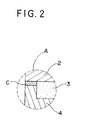
- FIG. 3 shows a more detailed partial cross sectional perspective view of the optical disc 1 of FIG. 1.
- the phthalocyanine dye included in the second recording layer 7 is solved and sublimed in the second recording layer 7, so that an empty portion 7a is formed while a capsule portion 7b is formed by pressing the second silicon polymer layer 6, resulting in that the record pit P is formed.
- the pressure of the second silicon polymer layer 6 is applied. Accordingly, the enlargement of the pit size is restrained, the cross-talk amount due to the physical shape of the pit is reduced, and the required recording power is also small.
- the optical disc of the bonding type is constructed.
- a protection layer of PMMA etc. on the first silicon polymer layer of this optical disc of single substrate type, it is possible to improve the protection ability of the recording surface of the optical disc.
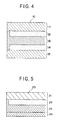
- FIG. 4 shows a cross sectional view of an optical disc of the second embodiment.
- An optical disc 10 is provided with: a first substrate 11 formed of an optically transparent material such as polycarbonate, PMMA etc.; a first recording layer 12, which is formed on the first substrate 11 and which includes phthalocyanine dye; a silicon polymer layer 13 which is the elastic body layer; a second recording layer 14 having the same construction as the first recording layer 12; and a second substrate 15 having the same construction as the first substrate 11.
- a first substrate 11 formed of an optically transparent material such as polycarbonate, PMMA etc.
- a first recording layer 12 which is formed on the first substrate 11 and which includes phthalocyanine dye
- a silicon polymer layer 13 which is the elastic body layer
- a second recording layer 14 having the same construction as the first recording layer 12
- a second substrate 15 having the same construction as the first substrate 11.
- the point where the optical disc 10 of the second embodiment different from the optical disc 1 of the first embodiment is the point where an adhesive type silicon polymer is used for the silicon polymer layer 13 to have the functions of the first elastic body layer (i.e. the first silicon polymer layer 4), the bonding layer 5 and the second elastic body layer (i.e. the second silicon polymer layer 6) in the first embodiment, so that it can make the formation process of the disc simplified.
- an adhesive type silicon polymer is used for the silicon polymer layer 13 to have the functions of the first elastic body layer (i.e. the first silicon polymer layer 4), the bonding layer 5 and the second elastic body layer (i.e. the second silicon polymer layer 6) in the first embodiment, so that it can make the formation process of the disc simplified.
- FIG. 5 shows a cross sectional view of an optical disc of the third embodiment.
- An optical disc 20 is provided with: a substrate 21 formed of an optically transparent material such as polycarbonate, PMMA etc.; a recording layer 22, which is formed on the substrate 21 and which includes phthalocyanine dye; a silicon polymer layer 23 which is the elastic body layer; and a protection layer 24.
- a substrate 21 formed of an optically transparent material such as polycarbonate, PMMA etc.
- a recording layer 22 which is formed on the substrate 21 and which includes phthalocyanine dye
- a silicon polymer layer 23 which is the elastic body layer
- a protection layer 24 is provided with: a substrate 21 formed of an optically transparent material such as polycarbonate, PMMA etc.
- the point where the optical disc 20 of the third embodiment different from the optical disc 1 of the first embodiment is the point where it is constructed in the single substrate type and the protection layer 24 is provided, so that it can make the formation process of the disc even more simplified.
- the protection layer 24 of PMMA etc. formed on the silicon polymer layer 23 it is also possible to improve the protection ability of the recording surface of the optical disc.
- the first recording film (or the second recording film) is formed as following. Namely, as the phthalocyanine dye included in the first recording layer and the second recording layer, the phthalocyanine having the basic structure specified by the following formula (II) is used, is solved in the 2 - ethoxyethanol solvent, and is coated on the polycarbonate substrate, which has the diameter of 30 cm, with the thickness of about 50 nm by means of the spinner coating method.
- the phthalocyanine dye included in the first recording layer and the second recording layer the phthalocyanine having the basic structure specified by the following formula (II) is used, is solved in the 2 - ethoxyethanol solvent, and is coated on the polycarbonate substrate, which has the diameter of 30 cm, with the thickness of about 50 nm by means of the spinner coating method.
- the phthalocyanine included in the first recording layer and the second recording layer the phthalocyanine having the basic structure specified by the formula [II] is used, wherein Me, R1 and R3 are specified as following.
- the recording layer is formed in the condition same as the aforementioned experimental example except that, in place of the phthalocyanine included in the first recording layer and the second recording layer, the cyanine dye specified by the following formula [IV] is used.
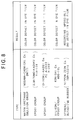
- the concrete condition of the spinner coating method is as following. solvent : diacetone alcohol concentration of the coating solution : 17 ⁇ 5 mg/ml condition of spinner : As for those optical recording media, the recording and reproduction of the 2 - 3 modulated signal (the shortest pit length: 0.66 ⁇ m) are performed under the following conditions. The evaluation result of the evaluation of the reproduced wave form from the view point of the bit error rate is shown in the table of FIG. 6.
- the silicon polymer As the silicon polymer, the silicon polymers shown below are used. Those are all made by TOSHIBA SILICON CO..
- the adhesive type polymer As the adhesive type polymer, the following polymers are used.
- the present embodiments it is possible to reduce the size of the pit, and the cross-talk due to the shape is not generated. Further, since it is not necessary to employ the air sandwich structure as the disc structure, it is strong even if it is thin even in the case of forming one disc by bonding two discs together so as to enable the recording and reproduction on both sides, and that the disc having the large area can be produced. Furthermore, since the recording is performed by the closed space which is different from the air sandwich structure, the energy at the time of recording can be utilized in a concentrated manner, so that the power at the time of recording can be reduced.
- the recording layer is formed in the closed space, the energy at the time of recording can be utilized in the concentrated manner, so that the power at the time of recording can be reduced.
Landscapes
- Chemical & Material Sciences (AREA)
- Organic Chemistry (AREA)
- Optical Record Carriers And Manufacture Thereof (AREA)
- Thermal Transfer Or Thermal Recording In General (AREA)
Applications Claiming Priority (2)
| Application Number | Priority Date | Filing Date | Title |
|---|---|---|---|
| JP6140576A JPH087337A (ja) | 1994-06-22 | 1994-06-22 | 光記録媒体 |
| JP140576/94 | 1994-06-22 |
Publications (2)
| Publication Number | Publication Date |
|---|---|
| EP0689202A2 true EP0689202A2 (fr) | 1995-12-27 |
| EP0689202A3 EP0689202A3 (fr) | 1996-02-07 |
Family
ID=15271908
Family Applications (1)
| Application Number | Title | Priority Date | Filing Date |
|---|---|---|---|
| EP95109744A Withdrawn EP0689202A3 (fr) | 1994-06-22 | 1995-06-22 | Milieu d'enregistrement optique |
Country Status (3)
| Country | Link |
|---|---|
| US (1) | US5635268A (fr) |
| EP (1) | EP0689202A3 (fr) |
| JP (1) | JPH087337A (fr) |
Families Citing this family (4)
| Publication number | Priority date | Publication date | Assignee | Title |
|---|---|---|---|---|
| CN1190785C (zh) | 1996-09-24 | 2005-02-23 | 富士写真菲林株式会社 | 光信息记录盘 |
| US6506814B2 (en) | 1997-10-30 | 2003-01-14 | Dsm N.V. | Dielectric, radiation-curable coating compositions |
| US6472451B2 (en) | 1998-03-27 | 2002-10-29 | Dsm N.V. | Radiation curable adhesive for digital versatile disc |
| JP2006120246A (ja) * | 2004-10-21 | 2006-05-11 | Ntn Corp | レンズプロテクターおよび光学式ピックアップ装置 |
Family Cites Families (11)
| Publication number | Priority date | Publication date | Assignee | Title |
|---|---|---|---|---|
| JPS5836490A (ja) * | 1981-07-24 | 1983-03-03 | Ricoh Co Ltd | 光学的情報記録媒体 |
| JPS5856892A (ja) * | 1981-10-01 | 1983-04-04 | Ricoh Co Ltd | 光学的情報記録媒体 |
| JPS60190388A (ja) * | 1984-03-13 | 1985-09-27 | Nec Corp | 光学記録媒体 |
| DE3882894T2 (de) * | 1987-10-20 | 1994-03-17 | Mitsui Toatsu Chemicals | 1,2-Naphtalocyanine, Infrarotabsorber und sie verwendende Aufzeichnungsmaterialien. |
| DE69030982T2 (de) * | 1989-04-27 | 1997-11-13 | Canon Kk | Optisches Aufzeichnungsmedium und Verfahren zu seiner Herstellung |
| JPH0827983B2 (ja) * | 1989-05-02 | 1996-03-21 | 太陽誘電株式会社 | 光情報記録媒体 |
| JP2543230B2 (ja) * | 1990-06-20 | 1996-10-16 | 松下電器産業株式会社 | 光学情報記録媒体 |
| US5354590A (en) * | 1991-02-16 | 1994-10-11 | Canon Kabushiki Kaisha | Optical recording medium |
| CA2068618A1 (fr) * | 1991-05-21 | 1992-11-22 | Tadahiko Mizukuki | Support d'enregistrement optique et production de ce support |
| DE69231842T2 (de) * | 1991-08-02 | 2001-10-31 | Canon K.K., Tokio/Tokyo | Optisches Aufzeichnungsmedium, Verfahren zu dessen Herstellung, und Datenaufzeichnungsverfahren |
| US5424171A (en) * | 1992-04-03 | 1995-06-13 | Pioneer Electronic Corporation | Optical recording medium |
-
1994
- 1994-06-22 JP JP6140576A patent/JPH087337A/ja active Pending
-
1995
- 1995-06-19 US US08/491,718 patent/US5635268A/en not_active Expired - Fee Related
- 1995-06-22 EP EP95109744A patent/EP0689202A3/fr not_active Withdrawn
Also Published As
| Publication number | Publication date |
|---|---|
| EP0689202A3 (fr) | 1996-02-07 |
| JPH087337A (ja) | 1996-01-12 |
| US5635268A (en) | 1997-06-03 |
Similar Documents
| Publication | Publication Date | Title |
|---|---|---|
| JP3026358B2 (ja) | 光記録媒体 | |
| EP0689202A2 (fr) | Milieu d'enregistrement optique | |
| JPH05579A (ja) | 光記録媒体 | |
| JPH052771A (ja) | 光記録媒体 | |
| JP3026357B2 (ja) | 光記録媒体 | |
| JP3026356B2 (ja) | 光記録媒体 | |
| EP0978392A1 (fr) | Supports d'enregistrement optique | |
| US4829509A (en) | Optical recording medium, its preparation and its use as a read only memory information carrier | |
| JPH0568016B2 (fr) | ||
| EP0395053B1 (fr) | Support d'enregistrement d'information optique | |
| JP2521178B2 (ja) | 光学的記録媒体円盤 | |
| JPH07107755B2 (ja) | 光情報記録カード | |
| US5580631A (en) | Optical recording medium and optical recording method | |
| JP3088510B2 (ja) | 情報記録媒体 | |
| JP3257470B2 (ja) | 光記録媒体 | |
| JP3088501B2 (ja) | 情報記録媒体 | |
| JPS63220434A (ja) | 光デイスクおよびその記録再生方法 | |
| JPS5811196A (ja) | 光記録媒体 | |
| KR100207582B1 (ko) | 광기록매체 | |
| KR100207581B1 (ko) | 광기록매체 | |
| JPH0981966A (ja) | 光記録媒体 | |
| EP0398255A2 (fr) | Support d'enregistrement optique et méthode d'enregistrement | |
| JPH0765413A (ja) | 情報記録媒体 | |
| KR100224748B1 (ko) | 기록/재생 가능한 광기록 매체 | |
| JPH10247340A (ja) | 光情報記録媒体 |
Legal Events
| Date | Code | Title | Description |
|---|---|---|---|
| PUAI | Public reference made under article 153(3) epc to a published international application that has entered the european phase |
Free format text: ORIGINAL CODE: 0009012 |
|
| AK | Designated contracting states |
Kind code of ref document: A2 Designated state(s): DE FR GB |
|
| PUAL | Search report despatched |
Free format text: ORIGINAL CODE: 0009013 |
|
| AK | Designated contracting states |
Kind code of ref document: A3 Designated state(s): DE FR GB |
|
| 17P | Request for examination filed |
Effective date: 19960328 |
|
| 17Q | First examination report despatched |
Effective date: 19960612 |
|
| STAA | Information on the status of an ep patent application or granted ep patent |
Free format text: STATUS: THE APPLICATION HAS BEEN WITHDRAWN |
|
| 18W | Application withdrawn |
Withdrawal date: 19980306 |