EP0691699A1 - Graphit Schichtmaterial - Google Patents
Graphit Schichtmaterial Download PDFInfo
- Publication number
- EP0691699A1 EP0691699A1 EP95110464A EP95110464A EP0691699A1 EP 0691699 A1 EP0691699 A1 EP 0691699A1 EP 95110464 A EP95110464 A EP 95110464A EP 95110464 A EP95110464 A EP 95110464A EP 0691699 A1 EP0691699 A1 EP 0691699A1
- Authority
- EP
- European Patent Office
- Prior art keywords
- graphite
- layer material
- intercalant
- graphite layer
- layers
- Prior art date
- Legal status (The legal status is an assumption and is not a legal conclusion. Google has not performed a legal analysis and makes no representation as to the accuracy of the status listed.)
- Granted
Links
Images

Classifications
-
- H—ELECTRICITY
- H01—ELECTRIC ELEMENTS
- H01M—PROCESSES OR MEANS, e.g. BATTERIES, FOR THE DIRECT CONVERSION OF CHEMICAL ENERGY INTO ELECTRICAL ENERGY
- H01M4/00—Electrodes
- H01M4/02—Electrodes composed of, or comprising, active material
- H01M4/36—Selection of substances as active materials, active masses, active liquids
- H01M4/58—Selection of substances as active materials, active masses, active liquids of inorganic compounds other than oxides or hydroxides, e.g. sulfides, selenides, tellurides, halogenides or LiCoFy; of polyanionic structures, e.g. phosphates, silicates or borates
- H01M4/583—Carbonaceous material, e.g. graphite-intercalation compounds or CFx
- H01M4/587—Carbonaceous material, e.g. graphite-intercalation compounds or CFx for inserting or intercalating light metals
-
- H—ELECTRICITY
- H01—ELECTRIC ELEMENTS
- H01M—PROCESSES OR MEANS, e.g. BATTERIES, FOR THE DIRECT CONVERSION OF CHEMICAL ENERGY INTO ELECTRICAL ENERGY
- H01M10/00—Secondary cells; Manufacture thereof
- H01M10/05—Accumulators with non-aqueous electrolyte
- H01M10/052—Li-accumulators
- H01M10/0525—Rocking-chair batteries, i.e. batteries with lithium insertion or intercalation in both electrodes; Lithium-ion batteries
-
- H—ELECTRICITY
- H01—ELECTRIC ELEMENTS
- H01M—PROCESSES OR MEANS, e.g. BATTERIES, FOR THE DIRECT CONVERSION OF CHEMICAL ENERGY INTO ELECTRICAL ENERGY
- H01M4/00—Electrodes
- H01M4/02—Electrodes composed of, or comprising, active material
- H01M4/13—Electrodes for accumulators with non-aqueous electrolyte, e.g. for lithium-accumulators; Processes of manufacture thereof
- H01M4/133—Electrodes based on carbonaceous material, e.g. graphite-intercalation compounds or CFx
-
- H—ELECTRICITY
- H01—ELECTRIC ELEMENTS
- H01M—PROCESSES OR MEANS, e.g. BATTERIES, FOR THE DIRECT CONVERSION OF CHEMICAL ENERGY INTO ELECTRICAL ENERGY
- H01M4/00—Electrodes
- H01M4/02—Electrodes composed of, or comprising, active material
- H01M4/36—Selection of substances as active materials, active masses, active liquids
- H01M4/58—Selection of substances as active materials, active masses, active liquids of inorganic compounds other than oxides or hydroxides, e.g. sulfides, selenides, tellurides, halogenides or LiCoFy; of polyanionic structures, e.g. phosphates, silicates or borates
- H01M4/583—Carbonaceous material, e.g. graphite-intercalation compounds or CFx
-
- H—ELECTRICITY
- H01—ELECTRIC ELEMENTS
- H01M—PROCESSES OR MEANS, e.g. BATTERIES, FOR THE DIRECT CONVERSION OF CHEMICAL ENERGY INTO ELECTRICAL ENERGY
- H01M10/00—Secondary cells; Manufacture thereof
- H01M10/05—Accumulators with non-aqueous electrolyte
- H01M10/052—Li-accumulators
-
- H—ELECTRICITY
- H01—ELECTRIC ELEMENTS
- H01M—PROCESSES OR MEANS, e.g. BATTERIES, FOR THE DIRECT CONVERSION OF CHEMICAL ENERGY INTO ELECTRICAL ENERGY
- H01M4/00—Electrodes
- H01M4/02—Electrodes composed of, or comprising, active material
- H01M2004/021—Physical characteristics, e.g. porosity, surface area
-
- Y—GENERAL TAGGING OF NEW TECHNOLOGICAL DEVELOPMENTS; GENERAL TAGGING OF CROSS-SECTIONAL TECHNOLOGIES SPANNING OVER SEVERAL SECTIONS OF THE IPC; TECHNICAL SUBJECTS COVERED BY FORMER USPC CROSS-REFERENCE ART COLLECTIONS [XRACs] AND DIGESTS
- Y02—TECHNOLOGIES OR APPLICATIONS FOR MITIGATION OR ADAPTATION AGAINST CLIMATE CHANGE
- Y02E—REDUCTION OF GREENHOUSE GAS [GHG] EMISSIONS, RELATED TO ENERGY GENERATION, TRANSMISSION OR DISTRIBUTION
- Y02E60/00—Enabling technologies; Technologies with a potential or indirect contribution to GHG emissions mitigation
- Y02E60/10—Energy storage using batteries
-
- Y—GENERAL TAGGING OF NEW TECHNOLOGICAL DEVELOPMENTS; GENERAL TAGGING OF CROSS-SECTIONAL TECHNOLOGIES SPANNING OVER SEVERAL SECTIONS OF THE IPC; TECHNICAL SUBJECTS COVERED BY FORMER USPC CROSS-REFERENCE ART COLLECTIONS [XRACs] AND DIGESTS
- Y10—TECHNICAL SUBJECTS COVERED BY FORMER USPC
- Y10T—TECHNICAL SUBJECTS COVERED BY FORMER US CLASSIFICATION
- Y10T428/00—Stock material or miscellaneous articles
- Y10T428/249921—Web or sheet containing structurally defined element or component
- Y10T428/249953—Composite having voids in a component [e.g., porous, cellular, etc.]
- Y10T428/249967—Inorganic matrix in void-containing component
-
- Y—GENERAL TAGGING OF NEW TECHNOLOGICAL DEVELOPMENTS; GENERAL TAGGING OF CROSS-SECTIONAL TECHNOLOGIES SPANNING OVER SEVERAL SECTIONS OF THE IPC; TECHNICAL SUBJECTS COVERED BY FORMER USPC CROSS-REFERENCE ART COLLECTIONS [XRACs] AND DIGESTS
- Y10—TECHNICAL SUBJECTS COVERED BY FORMER USPC
- Y10T—TECHNICAL SUBJECTS COVERED BY FORMER US CLASSIFICATION
- Y10T428/00—Stock material or miscellaneous articles
- Y10T428/249921—Web or sheet containing structurally defined element or component
- Y10T428/249953—Composite having voids in a component [e.g., porous, cellular, etc.]
- Y10T428/249978—Voids specified as micro
-
- Y—GENERAL TAGGING OF NEW TECHNOLOGICAL DEVELOPMENTS; GENERAL TAGGING OF CROSS-SECTIONAL TECHNOLOGIES SPANNING OVER SEVERAL SECTIONS OF THE IPC; TECHNICAL SUBJECTS COVERED BY FORMER USPC CROSS-REFERENCE ART COLLECTIONS [XRACs] AND DIGESTS
- Y10—TECHNICAL SUBJECTS COVERED BY FORMER USPC
- Y10T—TECHNICAL SUBJECTS COVERED BY FORMER US CLASSIFICATION
- Y10T428/00—Stock material or miscellaneous articles
- Y10T428/30—Self-sustaining carbon mass or layer with impregnant or other layer
Definitions
- the present invention relates to a graphite layer material. More particularly, it relates to a graphite layer material which is used for a graphite electrode for a secondary cell.
- Graphites are important as industrial materials because of their useful characteristics such as excellent heat and chemical resistances, high conductivity, etc., and have been widely used as electrode materials for secondary cells, heating elements, structural materials, gaskets, heat resistant sealing materials and the like.
- Examples of the conventional graphite to be used for these applications include the followings.
- the electrode for secondary cell using the graphite or carbon is used by bringing lithium into contact with the graphite, forming an interlayer compound which is obtained by inserting lithium between layers of the graphite to cause dedoping/doping to take electric current out.
- the cell characteristics are largely influenced by the properties of the graphite or carbon electrode, and are not always good.
- Highly oriented graphite has recently been studied as novel graphite.
- One of them is a so-called "HOPG (Highly Oriented Pyrolytic Graphite)" which is obtained by depositing carbon atom on a substrate using a hydrocarbon gas by a CVD (Chemical Vapor Deposition) process, followed by annealing.
- the HOPG is one in which the orientation direction of a crystal is adjusted to one direction.
- Another highly oriented pyrogenic graphite which is obtained by a different production process is described in Japanese Laid-Open Patent Publication Nos. 3-75211, 4-21508, etc.
- the graphites can be produced in a short time and has a desired size and excellent physical properties approaching those of a homogeneous single crystal, which arises no problem due to the residual acid described in the above item (b).
- the cell characteristics are largely influenced by the properties of the graphite or carbon electrode, and the cell is not superior in cell characteristics.
- One object of the present invention is to provide a graphite layer material, comprising a highly oriented graphite and an intercalant, the intercalant being inserted between layers of the highly oriented graphite, which is used as an electrode material exhibiting excellent cell characteristics when used for a secondary cell.
- Another object of the present invention is to provide a graphite layer material which exhibits excellent cell characteristics when used for a secondary cell, by inserting an intercalant between layers of a highly oriented graphite, rapidly and uniformly, to control an amount of the intercalant to be inserted.
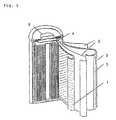
- Fig. 1 is a sectional view illustrating a lithium secondary cell using the graphite layer material of one embodiment of the present invention as a graphite electrode material for secondary cell.
- Fig. 2 is a sectional view illustrating a lithium secondary cell using the graphite layer material of another embodiment of the present invention as a graphite electrode material for secondary cell.
- the present inventors have studied intensively in order to solve the above mentioned problems. It has been found that preferred characteristics can be obtained when using a highly oriented graphite of which a direction of crystalline orientation is adjusted to a planar direction as the graphite. It has also been found that, when an intercalant is inserted between the highly oriented graphite layers, most of the intercalant is inserted in the direction parallel to the direction of crystalline orientation through an interlayer gap at an end surface of the graphite, and strong carbon skeleton disturbs the insertion of the intercalant from the direction perpendicular to the direction of crystalline orientation.
- the present invention provides a graphite layer material which comprises highly oriented graphite layers of which a direction of crystalline orientation is adjusted to a planar direction, and an intercalant inserted between the graphite layers.
- the graphite layer material of the present invention is characterized in that an intercalant is inserted between highly oriented graphite layer of which a direction of crystalline orientation is adjusted to a planar direction.
- the intercalant to be used is preferably a donative intercalant, more preferably at least one selected from the group consisting of chloride and fluoride.
- the highly oriented graphite layer material is provided with a large number of micropores.
- the highly oriented graphite layer material is that obtained by graphitizing polymer film.
- Preferred polymer film is made from at least one selected from the group consisting of polyoxadiazole, polybenzothiazole, polybenzobisthiazole, polybenzoxazole, polybenzobisoxazole, polyimide, polyamide, polyphenylenebenzoimidazole, polyphenylenebenzimidazole, polythiazole and polyparaphenylenevinylene.
- the graphitization is conducted by calcining at a temperature of not less than 2000 °C.
- the highly oriented graphite planar material has a flexibility.
- Preferred intercalant is at least one selected from the group consisting of Li, K, Rb, Cs, Sr and Ba.
- a size of the micropore is 1 to 100 ⁇ m.
- the highly oriented graphite layer material to be used for the graphite layer material of the present invention may be one that a direction of crystalline orientation is adjusted to a planar direction.
- Examples thereof include one which is obtained by depositing carbon atom on a substrate by a CVD process using a hydrocarbon gas, followed by annealing; one which is obtained by graphitizing polymer film; and the like.
- one which is obtained by graphitizing polymer film is preferably used because the intercalant can be inserted between the resulting graphite layers, rapidly and uniformly.
- polymer film made from at least one selected from the group consisting of polyoxadiazoles (POD), polybenzothiazole (PBT), polybenzobisthiazole (PBBT), polybenzoxazole (PBO), polybenzobisoxazole (PBBO), polyimides (PI), polyamides (PA), polyphenylenebenzimidazole (PBI), polyphenylenebenzbisimidazole (PPBI), polythiazole (PT) and polyparaphenylenevinylene (PPV), because the intercalant can be inserted between the resulting graphite layers, rapidly and uniformly.
- POD polyoxadiazoles
- PBT polybenzothiazole
- PBBT polybenzobisthiazole
- PBO polybenzoxazole
- PBBO polybenzobisoxazole
- PI polyimides
- PA polyamides
- PA polyphenylenebenzimidazole
- PPBI polyphenylenebenzbisimidazole
- PT polythiazo
- Polyoxadiazoles include polyparaphenylene-1,3,4-oxadiazole and an isomer thereof.
- the calcining condition for graphitizing the polymer film is not specifically limited, but preferably at a temperature of not less than 2000 °C, more preferably about 3000 °C because the intercalant can be inserted between the resulting graphite layers, rapidly and uniformly.
- the calcining is normally conducted in an inert gas.
- a thickness of the polymer film is preferably not less than 100 ⁇ m, in order to inhibit influence of a gas to be generated in the process of the graphitization by adjusting a treating atmosphere to a pressure atmosphere at the time of calcining.
- the pressure at the time of calcining varies depending upon a film thickness, but is preferably within a range of 0.1 to 50 kg/cm2.
- a sheeting treatment may be optionally conducted.
- the polymer film is graphitized ,for example, by a process comprising cutting the polymer film into pieces having a suitable size, introducing one cut film or a laminate of about 1000 cut films in a calcining furnace, heating to 3000 °C to graphitize the film or laminate. After calcining, the graphitized film or laminate may be optionally subjected to a sheeting treatment, as described above.
- the highly oriented graphite planar material thus obtained may take any form such as film, sheet, plate and the like. Further, it may be flexible or hard with no flexibility.
- the highly oriented graphite layer material having a flexibility is preferred so as to use the graphite layer material of the present invention as the electrode material in an integrated form.
- a thickness of the polymer film is preferably within a range of not more than 400 ⁇ m, more preferably 5 to 200 ⁇ m.
- the thickness of the raw film exceeds 400 ⁇ m, the film changes into a degradated state by a gas to be generated from the interior of film in the heat treatment process. Therefore, it becomes difficult to use it alone as a good quality electrode material.
- the graphite in the degradated state can be an useful electrode material if it is molded into a composite material with a fluorine resin such as polytetrafluoroethylene known to so-called "Teflon". Further, it is also possible to use the graphite by making it powder to mold into a composite material with a fluorine resin. In case of composite material, the proportion (weight ratio) of the graphite to the fluorine resin is preferably within a range of 50:1 to 2:1.
- the intercalant a donative one is suitable and is preferred as the electrode for secondary cell. It is more preferred that the intercalant is at least one selected from the group consisting of chloride and fluoride.
- chloride and fluoride there can be used chlorides and fluorides of any metal.
- the graphite layer material becomes an electrode material exhibiting excellent cell characteristics when used for a secondary cell.
- Interlayer compounds having a different layer structure can be obtained from the same intercalant substance depending on reaction condition.
- the interlayer compound is formed by an interaction between a guest substance (intercalant) inserted between graphite layers as a host.
- the highly oriented graphite layer material is processed so that it may have many micropores on its surface.
- the intercalant can be inserted between the graphite layers, rapidly and uniformly, to control the amount of the intercalant to be inserted, thereby exhibiting excellent cell characteristics when using the graphite layer material for the secondary cell.
- the method for perforating the micropores on the surface of the layer material is not specifically limited, for example,the micropores may be perforated by subjecting to perforation processing using a press, or the micropores may be perforated using laser beam.
- the shape of the micropores is not specifically limited, and it takes any form such as circle, ellipse, polygon and the like.
- the size of the micropore is not specifically limited, for example, it is 1 to 100 ⁇ m. When the size is within this range, it becomes possible to insert the intercalant between layers of the highly oriented graphite, more rapidly and uniformly, to precisely control the amount of the intercalant to be inserted.
- the size of the micropore is preferably 2 to 50 ⁇ m, more preferably 5 to 20 ⁇ m.
- a large number of micropores may be arranged on the surface of the layer material, regularly or irregularly. However, it is preferred that micropores are arranged regularly in order to insert the intercalant between the graphite layers, uniformly, to control the amount of the intercalant to be inserted.
- the method for inserting the intercalant between the graphite layers through a large number of micropores on the surface of the highly oriented graphite layer material is not specifically limited, and examples thereof include vapor phase constant pressure reaction process, liquid phase contact process, solid phase pressure process, solvent process and the like.
- the intercalant is diffused between the graphite layers by an action such as capillary action through a large number of micropores on the surface of the highly oriented graphite layer material.
- the intercalant can be inserted between the graphite layers, rapidly and uniformly, to control the amount of the intercalant to be inserted.
- a strong carbon skeleton does not disturb the insertion of the intercalant from the direction perpendicular to the direction of crystalline orientation and, therefore, the intercalant can be inserted between layers of the graphite from the direction perpendicular to the orientation of the crystal through a large number of micropores. Not only the intercalant is inserted between layers through a large number of micropores, but also it is sometimes inserted in the direction parallel to the orientation direction of the crystal through an interlayer gap between layers at the end surface of the graphite.
- the graphite layer material obtained by inserting the intercalant between graphite layers of the highly oriented graphite planar material thus obtained may be subjected to a dedoping treatment.
- the method for conducting the dedoping process is not specifically limited, for example, there can be used a method for conducting a heat treatment by washing with water or water vapor at elevated temperature.
- the graphite interlayer compound changes into the state where the interaction between layers is deteriorated by subjecting to the dedoping treatment, and excellent cell characteristics can be exhibited when using the graphite layer material as a cell material.
- the graphite layer material obtained according to the present invention is preferably used as an electrode material of a positive electrode of the secondary cell using lithium as a negative electrode, particularly.
- the graphite layer material of the present invention can exhibit doping and dedoping actions, thereby exhibiting excellent cell characteristics, because the intercalant is inserted between layers of the highly oriented graphite layer material of which a direction of crystalline orientation is adjusted to a planar direction.
- the intercalant can be inserted between layers through these micropores.
- the graphite layer material of the present invention can be used as an electrode material exhibiting excellent cell characteristics when using for a secondary cell, because it comprises a highly oriented graphite layer material of which a direction of crystalline orientation is adjusted to a planar direction, and an intercalant inserted between the graphite layers.
- the intercalant can be preferably used as an electrode for secondary cell when the intercalant is a donative intercalant. It is more preferred that the intercalant is at least one sort selected from the group consisting of chloride and fluoride.
- the highly oriented graphite planar material is provided with a large number of micropores
- a graphite layer material exhibiting excellent cell characteristics when using for a secondary cell, by inserting an intercalant between layers of the highly oriented graphite, rapidly and uniformly, to control the amount of the intercalant to be inserted.
- the highly oriented graphite planar material is that obtained by graphitizing polymer film, a donative intercalant can be inserted between layers of the graphite, more rapidly and uniformly.
- the polymer film is made from at least one selected from the group consisting of polyoxadiazole, polybenzothiazole, polybenzobisthiazole, polybenzoxazole, polybenzobisoxazole, polyimide, polyamide, polyphenylenebenzoimidazole, polyphenylenebenzbisimidazole, polythiazole and polyparaphenylenevinylene and the graphitization is conducted by calcining within a temperature range of not less than 2000°C, a donative intercalant can be inserted between layers of the graphite, more rapidly and uniformly.
- the highly oriented graphite planar material has a flexibility, it becomes possible to use the graphite layer material of the present invention as the electrode material in the integrated form.
- the intercalant is at least one sort selected from the group consisting of Li, K, Rb, Cs, Sr and Ba, it becomes an electrode material exhibiting excellent cell characteristics when using for a secondary cell.
- a size of the fine pore is 1 to 100 ⁇ m, it becomes possible to insert an intercalant between layers of the graphite, more rapidly and uniformly, to precisely control the amount of the intercalant to be inserted.
- a polyparaphenylene-1,3,4-oxadiazole film having a thickness of 50 ⁇ m was subjected to a preliminary heat treatment by heating to 1000 °C at a rate of 10 °C/minute in a nitrogen gas, using an electric furnace (model LTF-8, manufactured by Sankyo Denro Co. Ltd.) and maintaining at 1000 °C for one hour. Then, the resulting carbonaceous film was set stretchably in a graphite cylindrical container and heated at a rate of 20 °C/minute, using an ultrahigh temperature furnace (model 46-5, manufactured by Shinsei Denro Co. Ltd.). The film was calcined so that the maximum temperature may become 2000, 2500 and 3000 °C, respectively, to obtain three graphites. For comparison, a graphite (Comparative Example) was obtained by calcining at the maximum temperature of 1800 °C lower than 2000 °C. Incidentally, the calcining was conducted in an argon gas under pressure (0.2 kg/cm2).
- the graphitized film thus obtained had flexibility. After this film was set in a pyrex glass container so that it may contact directly with metal lithium and metal sodium, the container was sealed under vacuum and subjected to a heat treatment at 150 °C.
- Regular micropores (10 ⁇ m) were perforated on the surface of a separate graphitized film having flexibility obtained above, using a press. After the film having micropores was set in a pyrex glass container so that it may contact directly with metal lithium and metal sodium, the container was sealed under vacuum and subjected to a heat treatment at 150 °C.
- a lithium secondary cell of a structure as shown in Fig. 1 was prepared by using the resulting graphite layer material as a positive electrode 1 of an electrode material and subjecting the positive electrode to pressure molding in an inert gas, together with a polypropylene separator 3 having a porous structure and a lithium metal as a negative electrode 2.
- an electrolyte solution a solution comprising propylene carbonate containing lithium perchlorate, and 1,2-dimethoxyethane is used.
- This secondary cell has excellent charging/discharging characteristics.
- graphite of the Comparative Example no satisfactory characteristics were obtained because no interlayer compound was formed.
- the calcining temperature and charging/discharging characteristics are mutually related. The higher the calcining temperature, the more the characteristics were improved. It became clear that the characteristics are improved when micropores are perforated.
- the graphite layer material of Example 1 as the electrode material was allowed to stand in air for 24 hours, subjected to a dedoping treatment by treating with boiling distilled water and then dried, before subjecting to pressure molding in an inert gas together with polypropylene having a porous structure and lithium metal. Then, according to the same manner as that described in Example 1, a secondary cell was prepared and the charging/discharging characteristics of the secondary cell were examined.
- the secondary cell of Example 2 had excellent charging/discharging characteristics, similar to Example 1. On the other hand, in case of graphite of the Comparative Example, no satisfactory characteristics were obtained because no interlayer compound was formed. Further, the calcining temperature and charging/discharging characteristics are mutually related. The higher the calcining temperature, the more the characteristics were improved. It became clear that the characteristics are improved when micropores are perforated.
- Example 2 According to the same manner as that described in Example 1 except that a laminate of one thousand polyparaphenylene-1,3,4-oxadiazole films having a thickness of 50 ⁇ m was calcined, a graphitized plate was obtained. This plate had a flexibility. Then, according to the same manner as that described in Example 1, a secondary cell as shown in Fig. 2 was prepared and the charging/discharging characteristics of the secondary cell were examined.
- the secondary cell of Example 3 had excellent charging/discharging characteristics, similar to Example 1. Further, the calcining temperature and charging/discharging characteristics are mutually related. The higher the calcining temperature, the more the characteristics were improved.
- the secondary cell of Example 3 had excellent charging/discharging characteristics, similar to Example 1. Further, the calcining temperature and charging/discharging characteristics are mutually related. The higher the calcining temperature, the more the characteristics were improved.
Landscapes
- Chemical & Material Sciences (AREA)
- Chemical Kinetics & Catalysis (AREA)
- Electrochemistry (AREA)
- General Chemical & Material Sciences (AREA)
- Engineering & Computer Science (AREA)
- Inorganic Chemistry (AREA)
- Materials Engineering (AREA)
- Manufacturing & Machinery (AREA)
- Carbon And Carbon Compounds (AREA)
- Battery Electrode And Active Subsutance (AREA)
- Secondary Cells (AREA)
- Cell Electrode Carriers And Collectors (AREA)
Applications Claiming Priority (2)
| Application Number | Priority Date | Filing Date | Title |
|---|---|---|---|
| JP154626/94 | 1994-07-06 | ||
| JP06154626A JP3129087B2 (ja) | 1994-07-06 | 1994-07-06 | グラファイト層状体 |
Publications (2)
| Publication Number | Publication Date |
|---|---|
| EP0691699A1 true EP0691699A1 (de) | 1996-01-10 |
| EP0691699B1 EP0691699B1 (de) | 1998-11-25 |
Family
ID=15588305
Family Applications (1)
| Application Number | Title | Priority Date | Filing Date |
|---|---|---|---|
| EP95110464A Expired - Lifetime EP0691699B1 (de) | 1994-07-06 | 1995-07-05 | Graphit Schichtmaterial |
Country Status (6)
| Country | Link |
|---|---|
| US (1) | US5618615A (de) |
| EP (1) | EP0691699B1 (de) |
| JP (1) | JP3129087B2 (de) |
| KR (1) | KR100189315B1 (de) |
| CN (1) | CN1121265A (de) |
| DE (1) | DE69506183T2 (de) |
Cited By (1)
| Publication number | Priority date | Publication date | Assignee | Title |
|---|---|---|---|---|
| EP0903799A3 (de) * | 1997-09-19 | 1999-09-15 | Matsushita Electric Industrial Co., Ltd. | Nichtwässrige Sekundär Batterie und ihre Anode |
Families Citing this family (23)
| Publication number | Priority date | Publication date | Assignee | Title |
|---|---|---|---|---|
| JPH0821446A (ja) * | 1994-07-06 | 1996-01-23 | Matsushita Electric Ind Co Ltd | 表面平滑部品 |
| KR100420043B1 (ko) * | 1996-11-19 | 2004-05-10 | 삼성에스디아이 주식회사 | 리튬전지용음극활물질제조방법 |
| KR100445415B1 (ko) * | 1997-09-11 | 2004-10-14 | 삼성에스디아이 주식회사 | 분말 탄소재료의 제조방법 |
| JP2001163603A (ja) * | 1999-12-08 | 2001-06-19 | Sanyo Electric Co Ltd | 金属水素化物及びその製造方法 |
| JP4693470B2 (ja) * | 2004-04-12 | 2011-06-01 | 三星エスディアイ株式会社 | リチウム二次電池用負極活物質、及びこれを含む負極、及びリチウム二次電池 |
| US7359060B2 (en) * | 2005-11-07 | 2008-04-15 | Thermo Electron Scientific Instruments Llc | Multi-mode sampling probes |
| TW201212289A (en) * | 2010-09-01 | 2012-03-16 | Chien-Min Sung | Graphene transparent electrode, graphene light emitting diode, and method of fabricating the graphene light emitting diode |
| JP2013171712A (ja) * | 2012-02-21 | 2013-09-02 | Seiko Epson Corp | 電極活物質層、電極体およびリチウムイオン二次電池 |
| CN103258986B (zh) | 2012-02-21 | 2017-08-08 | 精工爱普生株式会社 | 电极活性物质层的制造方法 |
| JP5948941B2 (ja) * | 2012-02-21 | 2016-07-06 | セイコーエプソン株式会社 | 電極活物質層の製造方法、電極活物質層、電極体およびリチウムイオン二次電池 |
| US9843070B2 (en) * | 2014-02-28 | 2017-12-12 | The Board Of Trustees Of The Leland Stanford Junior University | Ultra-fast rechargeable metal-ion battery |
| CN105655002B (zh) * | 2014-11-27 | 2017-06-23 | 松下知识产权经营株式会社 | 导电材料 |
| CN104966813A (zh) * | 2015-05-08 | 2015-10-07 | 中国科学院青岛生物能源与过程研究所 | 一种钠离子电池负极片及钠离子电池 |
| CN106477564A (zh) * | 2016-10-18 | 2017-03-08 | 深圳丹邦科技股份有限公司 | 多层石墨烯量子碳基与碳纳米管结构体复合材料及制备方法 |
| CN106744846B (zh) * | 2016-12-28 | 2019-07-30 | 山东理工大学 | 一种高氮含量的二维氮掺杂石墨烯的制备方法 |
| CN106744847B (zh) * | 2016-12-28 | 2019-04-30 | 山东理工大学 | 用聚(2,5苯并咪唑)制备三维氮掺杂石墨烯的方法 |
| CN106744851B (zh) * | 2016-12-28 | 2019-07-30 | 山东理工大学 | 用聚苯并咪唑制备高氮含量的二维氮掺杂石墨烯的方法 |
| CN106744850B (zh) * | 2016-12-28 | 2019-07-23 | 山东理工大学 | 过渡金属和氮共掺杂的多级孔道三维石墨烯的制备 |
| CN106744848B (zh) * | 2016-12-28 | 2019-07-23 | 山东理工大学 | 多级孔道的铁钴和氮三元共掺杂的三维石墨烯的制备 |
| CN106744849B (zh) * | 2016-12-28 | 2019-07-30 | 山东理工大学 | 聚苯并咪唑(pbi)类高分子制备三维石墨烯的方法 |
| CN106744852B (zh) * | 2016-12-28 | 2019-07-23 | 山东理工大学 | 铁和氮共掺杂的三维石墨烯的制备方法 |
| KR102519441B1 (ko) | 2017-12-22 | 2023-04-07 | 삼성에스디아이 주식회사 | 리튬 이차전지용 음극활물질, 이를 포함한 음극, 및 리튬 이차전지 |
| CN113644264B (zh) * | 2021-07-27 | 2023-04-11 | 北京理工大学 | 一种天然石墨负极材料的改性方法 |
Citations (5)
| Publication number | Priority date | Publication date | Assignee | Title |
|---|---|---|---|---|
| CA870183A (en) * | 1971-05-04 | M. Vaught Leonard | Graphite structures | |
| JPS4839392A (de) * | 1971-09-23 | 1973-06-09 | ||
| US4358046A (en) * | 1977-03-17 | 1982-11-09 | Union Carbide Corporation | Oriented graphite layer and formation |
| EP0223047A2 (de) * | 1985-10-12 | 1987-05-27 | Research Development Corporation of Japan | Film einer Graphiteinlagerungsverbindung und Verfahren zu dessen Herstellung |
| WO1989007577A1 (fr) * | 1988-02-10 | 1989-08-24 | Toyo Carbon Company Limited | Procede de production de graphite fortement oriente |
Family Cites Families (8)
| Publication number | Priority date | Publication date | Assignee | Title |
|---|---|---|---|---|
| IL67645A (en) | 1983-01-10 | 1986-03-31 | Israel Palchan | Intercalation compounds of graphite |
| US4608192A (en) | 1984-01-16 | 1986-08-26 | Gte Laboratories Incorporated | Graphite intercalates containing metal-charge transfer salts |
| JP2615054B2 (ja) * | 1987-06-23 | 1997-05-28 | 矢崎総業株式会社 | 非水電解質系二次電池 |
| JPS6456356A (en) * | 1987-08-28 | 1989-03-03 | Hitachi Ltd | High temperature superconducting material |
| JP2718696B2 (ja) * | 1988-06-08 | 1998-02-25 | シャープ株式会社 | 電 極 |
| JP2553784B2 (ja) * | 1991-07-10 | 1996-11-13 | 松下電器産業株式会社 | グラファイトの製造方法 |
| JPH0742095B2 (ja) * | 1991-07-10 | 1995-05-10 | 松下電器産業株式会社 | グラファイトの製造方法 |
| US5340670A (en) * | 1992-06-01 | 1994-08-23 | Kabushiki Kaisha Toshiba | Lithium secondary battery and method of manufacturing carbonaceous material for negative electrode of the battery |
-
1994
- 1994-07-06 JP JP06154626A patent/JP3129087B2/ja not_active Expired - Fee Related
-
1995
- 1995-07-04 KR KR1019950019390A patent/KR100189315B1/ko not_active Expired - Fee Related
- 1995-07-05 EP EP95110464A patent/EP0691699B1/de not_active Expired - Lifetime
- 1995-07-05 US US08/498,224 patent/US5618615A/en not_active Expired - Lifetime
- 1995-07-05 DE DE69506183T patent/DE69506183T2/de not_active Expired - Fee Related
- 1995-07-06 CN CN95107854A patent/CN1121265A/zh active Pending
Patent Citations (5)
| Publication number | Priority date | Publication date | Assignee | Title |
|---|---|---|---|---|
| CA870183A (en) * | 1971-05-04 | M. Vaught Leonard | Graphite structures | |
| JPS4839392A (de) * | 1971-09-23 | 1973-06-09 | ||
| US4358046A (en) * | 1977-03-17 | 1982-11-09 | Union Carbide Corporation | Oriented graphite layer and formation |
| EP0223047A2 (de) * | 1985-10-12 | 1987-05-27 | Research Development Corporation of Japan | Film einer Graphiteinlagerungsverbindung und Verfahren zu dessen Herstellung |
| WO1989007577A1 (fr) * | 1988-02-10 | 1989-08-24 | Toyo Carbon Company Limited | Procede de production de graphite fortement oriente |
Non-Patent Citations (3)
| Title |
|---|
| CHEMICAL ABSTRACTS, Columbus, Ohio, US; * |
| CHEMICAL ABSTRACTS, vol. 79, no. 14, 8 October 1973, Columbus, Ohio, US; abstract no. 80908W, KOYAMA T.: "Plane- -oriented graphite films from pyrolysis of hydrocarbons" page 138; * |
| PATENT ABSTRACTS OF JAPAN * |
Cited By (1)
| Publication number | Priority date | Publication date | Assignee | Title |
|---|---|---|---|---|
| EP0903799A3 (de) * | 1997-09-19 | 1999-09-15 | Matsushita Electric Industrial Co., Ltd. | Nichtwässrige Sekundär Batterie und ihre Anode |
Also Published As
| Publication number | Publication date |
|---|---|
| EP0691699B1 (de) | 1998-11-25 |
| DE69506183D1 (de) | 1999-01-07 |
| CN1121265A (zh) | 1996-04-24 |
| JP3129087B2 (ja) | 2001-01-29 |
| DE69506183T2 (de) | 1999-07-29 |
| KR100189315B1 (ko) | 1999-06-01 |
| KR960006112A (ko) | 1996-02-23 |
| JPH0812308A (ja) | 1996-01-16 |
| US5618615A (en) | 1997-04-08 |
Similar Documents
| Publication | Publication Date | Title |
|---|---|---|
| US5618615A (en) | Graphite layer material | |
| KR0184316B1 (ko) | 그래파이트전극재료 및 그 제조방법 | |
| EP0184679B1 (de) | Verfahren zur Herstellung eines Graphitfluorids zur Verwendung in einer elektrochemischen Zelle | |
| EP2268574B1 (de) | Anodenpulver für batterien | |
| US7785661B2 (en) | Methods of preparing composite carbon-graphite-silicon particles and using same | |
| US5558954A (en) | Preparation of carbon electrodes by polymer-precipitation | |
| EP0196055B1 (de) | Aus aromatischen Kondensationspolymeren hergestellter poröser Gegenstand mit offenen Poren und seine Anwendung | |
| WO2002093666A1 (en) | Nonaqueous electrolytic secondary battery and method of producing anode material thereof | |
| JP5718874B2 (ja) | リチウム空気電池正極用炭素材料及びリチウム空気電池 | |
| KR20110100221A (ko) | 전지용 플루오르화 리튬 바나듐 폴리음이온 분말의 제조 방법 | |
| EP1999812A2 (de) | Elektrochemie aus kohlenstoffsubfluoriden | |
| KR0169170B1 (ko) | 2차 전지용 탄소질 전극재료 | |
| Alvarez‐Sanchez et al. | Polymer‐MTiO3 (M= Ca, Sr, Ba) composites as facile and scalable supercapacitor separators | |
| RU2713189C2 (ru) | Трубчатая твердооксидная электрохимическая ячейка с несущим электродом | |
| EP1556912B1 (de) | Trennglied für elektrochemische einrichtungen | |
| Guo et al. | Defect-enhanced performance of a 3D graphene anode in a lithium-ion battery | |
| Poyraz et al. | Potassium‐Based α‐Manganese Dioxide Nanofiber Binder‐Free Self‐Supporting Electrodes: A Design Strategy for High Energy Density Batteries | |
| Zhang et al. | Ballmilling-assisted synthesis and electrochemical performance of LiFePO4/C for lithium-ion battery adopting citric acid as carbon precursor | |
| JPS63121265A (ja) | 二次電池 | |
| JP2017031032A (ja) | 炭素被覆シリコン材料の製造方法 | |
| CN116605850B (zh) | 一种结晶性氮化碳/氮掺杂碳复合纳米片及其制备方法和应用 | |
| EP3045575A1 (de) | Verfahren zur herstellung von graphitnanofasern aus biogas | |
| KR20190096972A (ko) | 할로겐화된 리튬 이온 기반 에너지 저장 장치 및 관련 방법 | |
| JPH11339795A (ja) | リチウム二次電池用負極活物質 | |
| Nozato et al. | Facile preparation method for polymer and exfoliated graphite composites and their application as conduction-promoting materials |
Legal Events
| Date | Code | Title | Description |
|---|---|---|---|
| PUAI | Public reference made under article 153(3) epc to a published international application that has entered the european phase |
Free format text: ORIGINAL CODE: 0009012 |
|
| 17P | Request for examination filed |
Effective date: 19950705 |
|
| AK | Designated contracting states |
Kind code of ref document: A1 Designated state(s): DE FR GB |
|
| 17Q | First examination report despatched |
Effective date: 19970120 |
|
| GRAG | Despatch of communication of intention to grant |
Free format text: ORIGINAL CODE: EPIDOS AGRA |
|
| GRAG | Despatch of communication of intention to grant |
Free format text: ORIGINAL CODE: EPIDOS AGRA |
|
| GRAH | Despatch of communication of intention to grant a patent |
Free format text: ORIGINAL CODE: EPIDOS IGRA |
|
| GRAH | Despatch of communication of intention to grant a patent |
Free format text: ORIGINAL CODE: EPIDOS IGRA |
|
| GRAA | (expected) grant |
Free format text: ORIGINAL CODE: 0009210 |
|
| AK | Designated contracting states |
Kind code of ref document: B1 Designated state(s): DE FR GB |
|
| REF | Corresponds to: |
Ref document number: 69506183 Country of ref document: DE Date of ref document: 19990107 |
|
| K2C3 | Correction of patent specification (complete document) published |
Effective date: 19981125 |
|
| ET | Fr: translation filed | ||
| PLBE | No opposition filed within time limit |
Free format text: ORIGINAL CODE: 0009261 |
|
| STAA | Information on the status of an ep patent application or granted ep patent |
Free format text: STATUS: NO OPPOSITION FILED WITHIN TIME LIMIT |
|
| 26N | No opposition filed | ||
| REG | Reference to a national code |
Ref country code: GB Ref legal event code: IF02 |
|
| PGFP | Annual fee paid to national office [announced via postgrant information from national office to epo] |
Ref country code: DE Payment date: 20060629 Year of fee payment: 12 |
|
| PGFP | Annual fee paid to national office [announced via postgrant information from national office to epo] |
Ref country code: GB Payment date: 20060705 Year of fee payment: 12 |
|
| PGFP | Annual fee paid to national office [announced via postgrant information from national office to epo] |
Ref country code: FR Payment date: 20060719 Year of fee payment: 12 |
|
| GBPC | Gb: european patent ceased through non-payment of renewal fee |
Effective date: 20070705 |
|
| PG25 | Lapsed in a contracting state [announced via postgrant information from national office to epo] |
Ref country code: DE Free format text: LAPSE BECAUSE OF NON-PAYMENT OF DUE FEES Effective date: 20080201 |
|
| PG25 | Lapsed in a contracting state [announced via postgrant information from national office to epo] |
Ref country code: GB Free format text: LAPSE BECAUSE OF NON-PAYMENT OF DUE FEES Effective date: 20070705 |
|
| REG | Reference to a national code |
Ref country code: FR Ref legal event code: ST Effective date: 20080331 |
|
| PG25 | Lapsed in a contracting state [announced via postgrant information from national office to epo] |
Ref country code: FR Free format text: LAPSE BECAUSE OF NON-PAYMENT OF DUE FEES Effective date: 20070731 |