EP0693365A2 - Machine pour confectionner des sacs portatifs avec poignée - Google Patents
Machine pour confectionner des sacs portatifs avec poignée Download PDFInfo
- Publication number
- EP0693365A2 EP0693365A2 EP95110721A EP95110721A EP0693365A2 EP 0693365 A2 EP0693365 A2 EP 0693365A2 EP 95110721 A EP95110721 A EP 95110721A EP 95110721 A EP95110721 A EP 95110721A EP 0693365 A2 EP0693365 A2 EP 0693365A2
- Authority
- EP
- European Patent Office
- Prior art keywords
- cord
- modules
- knot
- module
- Prior art date
- Legal status (The legal status is an assumption and is not a legal conclusion. Google has not performed a legal analysis and makes no representation as to the accuracy of the status listed.)
- Granted
Links
- 238000004080 punching Methods 0.000 claims description 17
- 238000005520 cutting process Methods 0.000 claims description 10
- 238000004519 manufacturing process Methods 0.000 claims description 7
- 238000000034 method Methods 0.000 claims description 7
- 238000003780 insertion Methods 0.000 claims description 5
- 230000037431 insertion Effects 0.000 claims description 5
- 230000004888 barrier function Effects 0.000 description 2
- 230000001133 acceleration Effects 0.000 description 1
- 238000005266 casting Methods 0.000 description 1
- 238000010276 construction Methods 0.000 description 1
- 230000000694 effects Effects 0.000 description 1
- 238000005516 engineering process Methods 0.000 description 1
- 239000002184 metal Substances 0.000 description 1
- 238000004806 packaging method and process Methods 0.000 description 1
- 238000000275 quality assurance Methods 0.000 description 1
- 230000002787 reinforcement Effects 0.000 description 1
- 230000003014 reinforcing effect Effects 0.000 description 1
Images



Classifications
-
- B—PERFORMING OPERATIONS; TRANSPORTING
- B65—CONVEYING; PACKING; STORING; HANDLING THIN OR FILAMENTARY MATERIAL
- B65H—HANDLING THIN OR FILAMENTARY MATERIAL, e.g. SHEETS, WEBS, CABLES
- B65H69/00—Methods of, or devices for, interconnecting successive lengths of material; Knot-tying devices ;Control of the correct working of the interconnecting device
- B65H69/04—Methods of, or devices for, interconnecting successive lengths of material; Knot-tying devices ;Control of the correct working of the interconnecting device by knotting
-
- B—PERFORMING OPERATIONS; TRANSPORTING
- B31—MAKING ARTICLES OF PAPER, CARDBOARD OR MATERIAL WORKED IN A MANNER ANALOGOUS TO PAPER; WORKING PAPER, CARDBOARD OR MATERIAL WORKED IN A MANNER ANALOGOUS TO PAPER
- B31B—MAKING CONTAINERS OF PAPER, CARDBOARD OR MATERIAL WORKED IN A MANNER ANALOGOUS TO PAPER
- B31B70/00—Making flexible containers, e.g. envelopes or bags
- B31B70/74—Auxiliary operations
- B31B70/86—Forming integral handles or mounting separate handles
- B31B70/864—Mounting separate handles on bags, sheets or webs
-
- B—PERFORMING OPERATIONS; TRANSPORTING
- B65—CONVEYING; PACKING; STORING; HANDLING THIN OR FILAMENTARY MATERIAL
- B65H—HANDLING THIN OR FILAMENTARY MATERIAL, e.g. SHEETS, WEBS, CABLES
- B65H2701/00—Handled material; Storage means
- B65H2701/30—Handled filamentary material
- B65H2701/31—Textiles threads or artificial strands of filaments
Definitions
- the invention relates to a device for assembling carrier bags with carrying cords, which are guided through punched holes in the optionally reinforced pocket edge, the free ends of the cord being knotted.
- carrier bags for high-quality products made from laminated and multi-color printed paper could previously only be assembled by hand, since threading the cord into the punching holes in the carrier bag and knotting the free ends using the previously available technologies was not economically feasible.
- An aggravating boundary condition for this task is that the carrier bags are manufactured in very different dimensions, so that such a device has to be designed very flexibly and easily and can be converted to other types of bags in a short time.
- the actual carrier bags are normally punched out, folded and glued from the already printed and laminated paper in a fully mechanized production line and generally provided with reinforcements on the bottom and edge of the bag. Since the assembly with the cords could only be carried out by hand, usually at home, the carrier bags had to be provisionally folded, packed and, after returning from the assembly to completion, quality assurance and packaging, reintroduced into the production line. This interruption of the process often leads to considerable logistical problems and the frequently necessary changes in production lead to disruptions in the production process.
- This object is achieved by the combination of the following features, some of which are known per se: a device for clamping the pocket edges, a punching device arranged on or positioned on the clamping device for punching the holes in the pocket edge and a device for guiding the cord between the punched holes and knotting devices for knotting the ends of the cords, wherein at least the guide device for the cords is arranged on the clamping device or can be positioned thereon and control devices are provided which alternately use the punching and insertion device.
- the invention further relates to a number of configurations of the new device and to methods for assembling the above-mentioned carrier bags.
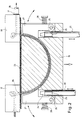
- Figures 1 to 5 show schematically the device according to the invention for assembling carrier bags made of laminated and printed paper, which are provided with loops made of cords.
- the invention makes it possible to integrate these operations into a fully mechanized production line for such carrier bags.
- the assembly device consists of two identical components 15, 16, each assigned to a pocket edge. These two components are arranged on a carriage (not shown), which can be moved vertically, and are inserted into the open carrying bag from above in a first phase of the assembly process.
- Each of the two components comprises two knot modules 17, 18 and a connecting channel 19 with punching devices 20 for making the holes through which the cord 3 running from a supply spool 21 is threaded.
- the knot modules and the connecting channel can be displaced in parallel relative to one another (a guide is shown schematically in the drawing and designated by 22).
- the modules 17, 18 are removed from the connecting channel 19 while the carriage is being moved into the pocket 23, in the next step they are pressed against one another, the edge of the carrier bag being clamped.
- the punching device 20 provided in the connecting channel comprises the punch 24, which has a step 25 on its shaft. This stage cooperates with a cam 26 of a flap 27 which, in the retracted position of the stamp 24, forms a closed channel for the cord 3 and, when the stamp is advanced, the flap 27 pivots against the force of a spring 28 out of the path of the stamp.
- the stamp finally hits the edge of the carrier bag and punched a hole in it, the diameter of which corresponds to that of the cord.
- the holes 29 punched in this way lie exactly opposite the inlet and outlet channels of the knot modules 17, 18.
- FIG. 3 shows the first knot module in various details.
- the module is designed in two parts, both module halves 17a and 17b being connected via a hinge 30 and pressed together by a spring 31.
- the cord 3 is sucked into the channels by vacuum, the negative pressure inside the module 17 additionally increasing the closing force of the two mold halves 17a and 17b.
- the lower part 17a of the module is provided with an inlet funnel 32.
- a cutting blade 33 is also slidably mounted on the lower part and is actuated by a pneumatic cylinder (not shown). Parallel to the cutting blade 33, a clamping jaw 34 is slidably arranged, which is carried by the cutting blade 33 via a spring 35 and clamps the cord end with a defined force (FIG. 4).
- the second knot module 18 is constructed analogously, it is also in two parts and is kept closed by spring force (FIG. 5).
- the exit of the module is connected to a vacuum line 36, a grid 37 arranged between the module 18 and the vacuum line limiting the path of the cord 3 and ensuring that it takes up a precisely defined position after being inserted.
- a light barrier 38 signals the control of the machine when the cord 3 has reached its end position
- the already opened carrier bag moves into the assembly station on a conveyor belt, the slide with the two components 15, 16 is inserted into the bag from above and clamps the two edges of the bag 23.
- 20 holes 29 are made in the punching device Punched pocket edges, the stamps 24 are then withdrawn, so that the flaps 27 close the connecting channel for the cord 3 again.
- the control of the machine now connects the vacuum line 36 to a vacuum boiler via a solenoid valve (not shown). Due to the negative pressure, the cord 3 is shot in through the first knot module 17, the first punch hole 29, the connecting channel 19, the second punch hole 29 and finally through the second knot module 18 until the end abuts the grid 37 and the light barrier 38 is thus activated. This causes the solenoid valve and thus the vacuum to switch off.
- the pneumatic cylinders are activated, which actuate the cutting device 33 and the clamping jaw 34.
- the cord 3 is thus cut off directly on the knot module 17, both ends are clamped outside the knot modules 17, 18.
- the connecting channel 19 is withdrawn from the edge of the pocket, the cord 3, which initially lies loosely in the channels of the knot modules, tightens to form a knot.
- the contracting knot presses the two halves of the knot module against the force of the spring 31.
- the holding force of the clamping jaws 34 is overcome and the cord ends are pulled out of the clamping devices. Entry channels drawn and further compressed.
- the connecting channel 19 opening along a horizontal plane and releasing the cord loop.
- FIGS. 6 and 7 show a variant of the knot modules 17 and 18 shown in the above figures.
- FIG. 6 shows a module 1 made in one piece from plastic, which in its Inside has a channel 2, which corresponds on the one hand to the dimension of the cord 3 to be knotted and on the other hand in terms of its shape to the desired type of knot.
- the channel forms a one-sided, inwardly open channel, so that the cord can contract into the cavity 4 enclosed by this channel and tighten to a knot.
- the inlet channel 5 has a diameter which enables the passage of a taut knot. It is also possible to remove the knot from the module through the outlet channel 6; in this case the diameter of the outlet channel is of course increased accordingly.
- Module 1 can be manufactured by casting using an inserted core. It can also be made of metal instead of plastic.
- the cord is injected through the inlet channel using compressed air or, as in the example above, using a vacuum
- one end of the cord 3 is jerkily accelerated away from the module, the knot initially contracting slightly due to the inertia effect.
- the friction between the different cord parts against one another further tightens the knot.
- the knot is further tightened and calibrated as desired in channels 5 and 6.
- the free end of the cord can be braked slightly while the other end is pulled with a uniform and constant force, as in the The above example is described.
- FIGS. 8-20 A further exemplary embodiment is described with reference to FIGS. 8-20, the same reference numerals as in the example above being used for parts and components of the same type.
- a stationary Head "41 is arranged, which contains 4 pneumatically operated punching tools 20 in its interior and 4 knot modules in an underlying level, the inlet and outlet channels of which are aligned with the punching tools.
- the head 41 and the associated periphery are symmetrical with respect to the axis 46 In the drawing, therefore, the device was completely omitted in many cases, opposite the head is the guide device, which is made up of two parts 44 and 45. This can be moved up to the head 41 by the pneumatic cylinder 42.
- a U-shaped channel 47 is provided for the cord 3, on the other hand, the top of the part 45 is planar.
- the U-shaped channel 47 can be connected at one end to a vacuum line, and on the other side there is a feed device for the cord 3 and a cutting device with which the cord is cut to length after insertion into the channel 47.
- the latter devices essentially correspond to the analog devices in the device according to FIGS. 1-7, so that a detailed description could be dispensed with.
- the pocket 23 which has already been folded, glued and provided with a reinforcing edge, is pushed over the head 41 from below until the upper edge of the pocket dips into the gap between the cutting plate 43 and the head 41 and finally strikes the stop 48.
- the punching tools 20 are activated and punch a total of 4 holes in the reinforced pocket edge.
- Figures 10 to 12 show the next step: the clamping of the pocket edge is loosened and the pocket from the stamp, not shown, is moved downwards by a defined distance in which the pocket edge punched holes 29 lie in the plane of the channel 47 of the guide device. A piece of cord 3 is sucked into the channel 47 by vacuum and then cut to length by the cutting device.
- the guide device 44, 45 is moved to the head 41 by the pneumatic cylinder 42, the channel 47, the punched holes in the pocket edge and the entry channels of the knot modules being aligned.
- the other two channels of the knot modules are connected to a vacuum system. If vacuum is now applied to the two knot modules, the free ends of the prepared U-shaped cord loop are sucked into the knot modules.
- the top part 44 of the guide device is lifted off by a further pneumatic cylinder 49, so that in each case a sufficient piece of cord can be inserted into the knot modules.
- the guide device 44, 45 is then withdrawn from the head 41. In the phase shown in FIG.
- the modules are designed in two parts analogously to the modules 17 and 18 of the first exemplary embodiment, wherein the opening of the two halves can be supported by pneumatic cylinders.
- the cord is pulled through the punched holes in the edge of the bag until it stops.
- the further downward movement of the pocket causes the knots to be tightened and compressed by pulling them in or out. Exit channel of the knot modules until the knots are finally completely pulled out of the modules (Fig. 20).
- the bag is now fully assembled and is folded up in the following stations of the system and packed ready for dispatch.
Landscapes
- Making Paper Articles (AREA)
Applications Claiming Priority (2)
| Application Number | Priority Date | Filing Date | Title |
|---|---|---|---|
| AT0141894A AT400959B (de) | 1994-07-19 | 1994-07-19 | Vorrichtung zum herstellen von knoten |
| AT1418/94 | 1994-07-19 |
Publications (3)
| Publication Number | Publication Date |
|---|---|
| EP0693365A2 true EP0693365A2 (fr) | 1996-01-24 |
| EP0693365A3 EP0693365A3 (fr) | 1996-07-03 |
| EP0693365B1 EP0693365B1 (fr) | 1998-04-01 |
Family
ID=3513472
Family Applications (1)
| Application Number | Title | Priority Date | Filing Date |
|---|---|---|---|
| EP95110721A Expired - Lifetime EP0693365B1 (fr) | 1994-07-19 | 1995-07-10 | Machine pour confectionner des sacs portatifs avec poignée |
Country Status (3)
| Country | Link |
|---|---|
| EP (1) | EP0693365B1 (fr) |
| AT (1) | AT400959B (fr) |
| DE (1) | DE59501750D1 (fr) |
Cited By (5)
| Publication number | Priority date | Publication date | Assignee | Title |
|---|---|---|---|---|
| EP1164003A3 (fr) * | 2000-06-10 | 2002-11-13 | HETTLERmaschinen GmbH | Procédé et appareil pour fixer un cordon à un sac à poignée |
| EP0907499A4 (fr) * | 1996-06-20 | 2004-07-28 | Handletec Pty Ltd | Sac et procede de fabrication |
| CN110027253A (zh) * | 2019-04-03 | 2019-07-19 | 浙江理工大学 | 一种两侧同步抓取的半自动礼品盒穿绳装置及其穿绳方法 |
| CN111063322A (zh) * | 2019-12-31 | 2020-04-24 | 广州珠江恺撒堡钢琴有限公司 | 钢琴攀带的制作设备和制作方法 |
| CN114801329A (zh) * | 2022-06-02 | 2022-07-29 | 济南弦润机械设备有限公司 | 手提袋自动穿绳机及穿绳方法 |
Families Citing this family (1)
| Publication number | Priority date | Publication date | Assignee | Title |
|---|---|---|---|---|
| CN110126357A (zh) * | 2019-04-18 | 2019-08-16 | 杭州彼特环保包装有限公司 | 一种手绳安装设备及其手绳安装方法 |
Family Cites Families (5)
| Publication number | Priority date | Publication date | Assignee | Title |
|---|---|---|---|---|
| US3464620A (en) * | 1968-03-14 | 1969-09-02 | Equitable Paper Bag Co | Handle construction for carrier box bag |
| DE1785185A1 (de) * | 1968-08-22 | 1971-01-21 | Melzer Ohg Maschb Und Metallve | Verfahren und Vorrichtung zum Knoten oder Verknoten von Faeden,Schnueren od.dgl. |
| US5044773A (en) * | 1990-04-18 | 1991-09-03 | Berwick Industries Inc. | Container for receiving and holding an object including support member therefor |
| DE4115994A1 (de) * | 1991-05-16 | 1992-11-19 | Joest Norbert | Vorrichtung und verfahren zur erzeugung beliebiger knoten aus einer schnur oder aehnlichem material um ununterbrochene sozusagen endlose straenge wie lange plastikschlaeuche oder wurstdaerme |
| DE4314945B4 (de) * | 1992-06-04 | 2004-09-02 | Hettler Maschinen Gmbh | Knoter zum Anbringen von Knoten mit einem Knoterführungsrohr |
-
1994
- 1994-07-19 AT AT0141894A patent/AT400959B/de not_active IP Right Cessation
-
1995
- 1995-07-10 DE DE59501750T patent/DE59501750D1/de not_active Expired - Fee Related
- 1995-07-10 EP EP95110721A patent/EP0693365B1/fr not_active Expired - Lifetime
Non-Patent Citations (1)
| Title |
|---|
| None |
Cited By (5)
| Publication number | Priority date | Publication date | Assignee | Title |
|---|---|---|---|---|
| EP0907499A4 (fr) * | 1996-06-20 | 2004-07-28 | Handletec Pty Ltd | Sac et procede de fabrication |
| EP1164003A3 (fr) * | 2000-06-10 | 2002-11-13 | HETTLERmaschinen GmbH | Procédé et appareil pour fixer un cordon à un sac à poignée |
| CN110027253A (zh) * | 2019-04-03 | 2019-07-19 | 浙江理工大学 | 一种两侧同步抓取的半自动礼品盒穿绳装置及其穿绳方法 |
| CN111063322A (zh) * | 2019-12-31 | 2020-04-24 | 广州珠江恺撒堡钢琴有限公司 | 钢琴攀带的制作设备和制作方法 |
| CN114801329A (zh) * | 2022-06-02 | 2022-07-29 | 济南弦润机械设备有限公司 | 手提袋自动穿绳机及穿绳方法 |
Also Published As
| Publication number | Publication date |
|---|---|
| EP0693365B1 (fr) | 1998-04-01 |
| EP0693365A3 (fr) | 1996-07-03 |
| DE59501750D1 (de) | 1998-05-07 |
| AT400959B (de) | 1996-05-28 |
| ATA141894A (de) | 1995-09-15 |
Similar Documents
| Publication | Publication Date | Title |
|---|---|---|
| DE3340744C2 (fr) | ||
| EP0084680B1 (fr) | Appareil pour lier des balles dans une presse à balles | |
| DE2927991A1 (de) | Verpackung mit behaelterteil | |
| DE69306856T2 (de) | Binden von gelochten Bögen | |
| EP0084620A2 (fr) | Appareil pour cercler des balles | |
| DE1811213A1 (de) | Verfahren und Vorrichtung zum OEffnen,Fuellen und Schliessen von Beuteln od.dgl. | |
| CH635236A5 (de) | Verfahren und vorrichtung zum aufbringen eines verstaerkungsbandes auf einen reissverschluss mit einem trennbaren endglied. | |
| EP0693365B1 (fr) | Machine pour confectionner des sacs portatifs avec poignée | |
| DE3008030C2 (de) | Vorrichtung zum Abschneiden von zwei entkuppelten fortlaufenden Reißverschlußbändern und zum Kuppeln der abgeschnittenen Reißverschlußbänder | |
| EP0339188B1 (fr) | Scie pour découper des panneaux | |
| DE3130121A1 (de) | Verfahren und vorrichtung zum anbringen von oberen begrenzungsteilen an einem reissverschlussband | |
| DE2909050A1 (de) | Vorrichtung zur befestigung von oesenteilen auf baendern | |
| EP1731295B1 (fr) | Dispositif pour nouer au moins une matière souple | |
| CH675223A5 (en) | Alignment aid for cutting machine for sheets | |
| DE2904554A1 (de) | Verfahren zum einlegen von flossenpackungen in einen behaelter und einrichtung zur durchfuehrung des verfahrens | |
| DE2711430B2 (de) | Verschluß- und Abschneidevorrichtung für zusammengeraffte Verpackungsschläuche, wie Wursthüllen, Beutel u.dgl | |
| DE864532C (de) | Vorrichtung zum Aufbringen von Endgliedern auf Reissverschlussketten | |
| DE1082564B (de) | Vorrichtung zum Herstellen von gliedfreien Stellen bei Verschlussstreifen von aus fortlaufenden Windungen bestehenden Reissverschluessen | |
| EP1489002B1 (fr) | Dispositif et procédé pour insérer une goupille dans une ouverture d'un levier de serrage et une bande de goupilles associée | |
| DE19730655C2 (de) | Vorrichtung zur Entnahme von Spritzgießartikeln aus einer Spritzgießmaschine | |
| DE1610460A1 (de) | Vorrichtung zum automatischen Aufsetzen von Reissverschlussschiebern auf eine vorkonfektionierte Reissverschlusskette mit gliedfreien Stellen | |
| DE102024115922A1 (de) | Greiferanordnung, Traysealer und Verfahren zum Perforieren einer Deckelfolie in einem Traysealer | |
| DE102021110008A1 (de) | Vorrichtung und Verfahren zum Lesebandeinlegen | |
| DE2708136C3 (de) | Zweinadelnähmaschine mit einer Vorrichtung zum Zuführen eines ReiOverschlußabschnittes | |
| DE19505991C2 (de) | Vorrichtung zum Zuführen von mit Gewindekernöffnungen versehenen Stanz-Formteilen |
Legal Events
| Date | Code | Title | Description |
|---|---|---|---|
| PUAI | Public reference made under article 153(3) epc to a published international application that has entered the european phase |
Free format text: ORIGINAL CODE: 0009012 |
|
| AK | Designated contracting states |
Kind code of ref document: A2 Designated state(s): CH DE FR IT LI |
|
| RIN1 | Information on inventor provided before grant (corrected) |
Inventor name: JERICKE, KARL PETER HERMANN |
|
| PUAL | Search report despatched |
Free format text: ORIGINAL CODE: 0009013 |
|
| AK | Designated contracting states |
Kind code of ref document: A3 Designated state(s): CH DE FR IT LI |
|
| 17P | Request for examination filed |
Effective date: 19961119 |
|
| GRAG | Despatch of communication of intention to grant |
Free format text: ORIGINAL CODE: EPIDOS AGRA |
|
| GRAG | Despatch of communication of intention to grant |
Free format text: ORIGINAL CODE: EPIDOS AGRA |
|
| GRAH | Despatch of communication of intention to grant a patent |
Free format text: ORIGINAL CODE: EPIDOS IGRA |
|
| 17Q | First examination report despatched |
Effective date: 19970911 |
|
| ITF | It: translation for a ep patent filed | ||
| GRAH | Despatch of communication of intention to grant a patent |
Free format text: ORIGINAL CODE: EPIDOS IGRA |
|
| GRAA | (expected) grant |
Free format text: ORIGINAL CODE: 0009210 |
|
| AK | Designated contracting states |
Kind code of ref document: B1 Designated state(s): CH DE FR IT LI |
|
| REG | Reference to a national code |
Ref country code: CH Ref legal event code: NV Representative=s name: BUECHEL, VON REVY & PARTNER Ref country code: CH Ref legal event code: EP |
|
| ET | Fr: translation filed | ||
| REF | Corresponds to: |
Ref document number: 59501750 Country of ref document: DE Date of ref document: 19980507 |
|
| PLBE | No opposition filed within time limit |
Free format text: ORIGINAL CODE: 0009261 |
|
| STAA | Information on the status of an ep patent application or granted ep patent |
Free format text: STATUS: NO OPPOSITION FILED WITHIN TIME LIMIT |
|
| 26N | No opposition filed | ||
| PGFP | Annual fee paid to national office [announced via postgrant information from national office to epo] |
Ref country code: FR Payment date: 20050727 Year of fee payment: 11 |
|
| PGFP | Annual fee paid to national office [announced via postgrant information from national office to epo] |
Ref country code: CH Payment date: 20050829 Year of fee payment: 11 |
|
| PGFP | Annual fee paid to national office [announced via postgrant information from national office to epo] |
Ref country code: DE Payment date: 20050917 Year of fee payment: 11 |
|
| PG25 | Lapsed in a contracting state [announced via postgrant information from national office to epo] |
Ref country code: LI Free format text: LAPSE BECAUSE OF NON-PAYMENT OF DUE FEES Effective date: 20060731 Ref country code: CH Free format text: LAPSE BECAUSE OF NON-PAYMENT OF DUE FEES Effective date: 20060731 |
|
| PGFP | Annual fee paid to national office [announced via postgrant information from national office to epo] |
Ref country code: IT Payment date: 20060731 Year of fee payment: 12 |
|
| PG25 | Lapsed in a contracting state [announced via postgrant information from national office to epo] |
Ref country code: DE Free format text: LAPSE BECAUSE OF NON-PAYMENT OF DUE FEES Effective date: 20070201 |
|
| REG | Reference to a national code |
Ref country code: CH Ref legal event code: PL |
|
| REG | Reference to a national code |
Ref country code: FR Ref legal event code: ST Effective date: 20070330 |
|
| PG25 | Lapsed in a contracting state [announced via postgrant information from national office to epo] |
Ref country code: FR Free format text: LAPSE BECAUSE OF NON-PAYMENT OF DUE FEES Effective date: 20060731 |
|
| PG25 | Lapsed in a contracting state [announced via postgrant information from national office to epo] |
Ref country code: IT Free format text: LAPSE BECAUSE OF NON-PAYMENT OF DUE FEES Effective date: 20070710 |