EP0695848A2 - Elément de construction constitué d'un vitrage et d'un longeron ou d'une armature collés sur le vitrage - Google Patents
Elément de construction constitué d'un vitrage et d'un longeron ou d'une armature collés sur le vitrage Download PDFInfo
- Publication number
- EP0695848A2 EP0695848A2 EP95401714A EP95401714A EP0695848A2 EP 0695848 A2 EP0695848 A2 EP 0695848A2 EP 95401714 A EP95401714 A EP 95401714A EP 95401714 A EP95401714 A EP 95401714A EP 0695848 A2 EP0695848 A2 EP 0695848A2
- Authority
- EP
- European Patent Office
- Prior art keywords
- glazing
- spar
- element according
- glued
- construction element
- Prior art date
- Legal status (The legal status is an assumption and is not a legal conclusion. Google has not performed a legal analysis and makes no representation as to the accuracy of the status listed.)
- Granted
Links
Images
Classifications
-
- B—PERFORMING OPERATIONS; TRANSPORTING
- B60—VEHICLES IN GENERAL
- B60J—WINDOWS, WINDSCREENS, NON-FIXED ROOFS, DOORS, OR SIMILAR DEVICES FOR VEHICLES; REMOVABLE EXTERNAL PROTECTIVE COVERINGS SPECIALLY ADAPTED FOR VEHICLES
- B60J5/00—Doors
- B60J5/10—Doors arranged at the vehicle rear
- B60J5/101—Doors arranged at the vehicle rear for non-load transporting vehicles, i.e. family cars including vans
-
- B—PERFORMING OPERATIONS; TRANSPORTING
- B60—VEHICLES IN GENERAL
- B60J—WINDOWS, WINDSCREENS, NON-FIXED ROOFS, DOORS, OR SIMILAR DEVICES FOR VEHICLES; REMOVABLE EXTERNAL PROTECTIVE COVERINGS SPECIALLY ADAPTED FOR VEHICLES
- B60J1/00—Windows; Windscreens; Accessories therefor
- B60J1/18—Windows; Windscreens; Accessories therefor arranged at the vehicle rear
-
- B—PERFORMING OPERATIONS; TRANSPORTING
- B60—VEHICLES IN GENERAL
- B60J—WINDOWS, WINDSCREENS, NON-FIXED ROOFS, DOORS, OR SIMILAR DEVICES FOR VEHICLES; REMOVABLE EXTERNAL PROTECTIVE COVERINGS SPECIALLY ADAPTED FOR VEHICLES
- B60J5/00—Doors
- B60J5/10—Doors arranged at the vehicle rear
- B60J5/101—Doors arranged at the vehicle rear for non-load transporting vehicles, i.e. family cars including vans
- B60J5/107—Doors arranged at the vehicle rear for non-load transporting vehicles, i.e. family cars including vans constructional details, e.g. about door frame, panels, materials used, reinforcements
-
- E—FIXED CONSTRUCTIONS
- E06—DOORS, WINDOWS, SHUTTERS, OR ROLLER BLINDS IN GENERAL; LADDERS
- E06B—FIXED OR MOVABLE CLOSURES FOR OPENINGS IN BUILDINGS, VEHICLES, FENCES OR LIKE ENCLOSURES IN GENERAL, e.g. DOORS, WINDOWS, BLINDS, GATES
- E06B3/00—Window sashes, door leaves, or like elements for closing wall or like openings; Layout of fixed or moving closures, e.g. windows in wall or like openings; Features of rigidly-mounted outer frames relating to the mounting of wing frames
- E06B3/54—Fixing of glass panes or like plates
- E06B3/5427—Fixing of glass panes or like plates the panes mounted flush with the surrounding frame or with the surrounding panes
Definitions
- the present invention relates to a construction element comprising at least one glazing (or “window") and at least one spar glued to the glazing, the spar possibly forming part of a frame.
- construction elements means the elements as mentioned above, which find their application both in the building as in the automobile construction and the manufacture of industrial or household appliances.
- these may for example be facade elements, cladding, prefabricated panels, windows or doors.
- windows or doors In automobile construction, it can also be windows or doors, or tailgates, sunroofs, etc.
- these elements can be used in construction windows, doors, etc ...
- the spar is generally part of a frame glued to the glass around its entire periphery.
- the spar may also be part of a frame having one or more discontinuities or may have a shorter length than the side of the glazing on which it is glued.
- the spar or the frame comprising the spar must meet certain requirements.
- the spar glued to the glass consists of a sheet metal profile and the thickness of the sheet is relatively small, as can usually be note in automobile construction, the required stability and torsional rigidity are obtained by using so-called closed box profiles, that is to say hollow sections of closed section. The manufacture of these profiles or rails in closed box is however relatively expensive.
- the object of the invention is to design a construction element having a lower weight than that of known construction elements, without any prejudice to the torsional rigidity of the element.
- the building element according to the invention comprises at least one glazing and at least one spar possibly forming part of a frame and is characterized in that the spar consists of a section of open section and in that the glazing and the spar are glued to each other so as to form a rigid and solid assembly of closed section.
- the profile comprising a core and wings has at its base an approximately U-shaped section and its wings are folded at their free end so as to form flanges for gluing the glazing and the spar.
- the bonding is done by means of a layer of rigid adhesive and the assembly formed by the profile and the glazing between the bonding edges of the spar has a closed section and is torsionally rigid.
- a thin sheet metal beam with an open cross-section, in particular with an approximately U-shaped cross-section, is not only lighter in weight than a closed box-beam, but it is also easier and cheaper to manufacture than a beam made of a box profile. Furthermore, in order to obtain a high torsional rigidity for a box profile, the sheet metal joints must be made by stapling or welding; this assembly is carried out more simply in the solution according to the invention by rigid bonding of the ends of the wings of the profile on the glass. This by itself has great rigidity and a wall thickness much greater than the sheet of the spar.
- an appropriate rigid bonding of the wings on the glass enables a profiled box-type structure to be produced from a spar of open section, this structure being characterized by a torsional rigidity at least equal to and even greater than that of '' a spar of closed section due to the particular mechanical characteristics of resistance of the glass.
- the building element according to the invention can be obtained, for example, from longitudinal members whose wings are curved inward, that is to say curved towards each other. But it is particularly advantageous to bend the wings outwards. In this case, a much wider part of the glass closes the profile to form a box structure, which results in an exceptional increase in the torsional rigidity of the element.
- Glues suitable for this use are however marketed, so that one can easily choose from the glues available those whose properties best meet the conditions of use according to the invention.
- the adhesives which have a relatively high Shore hardness in the hardened state, preferably a Shore A hardness greater than 50, and which have a low elastic and plastic deformability.
- the adhesive layers must have a minimum thickness, in general a thickness greater than or equal to 3-4 mm, owing to the inevitable shape tolerances of the panes.
- the adhesive layers must therefore, for this relatively large thickness, fulfill the desired conditions of resistance to deformation and mechanical rigidity.
- these layers must, depending on the dimensions of the surface of the glass, be able to withstand or absorb the mechanical stresses which appear due to the differential thermal expansion, in general inevitable, of the glass and the metal frame. . If necessary, appropriate tests make it possible to select the adhesive suitable for a specific use.
- the invention can be used for a wide variety of applications, both in automobile construction, building and appliance manufacturing.
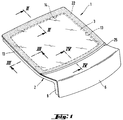
- the tailgate 1 consists for its essential elements of a frame 2 formed by stamping from a relatively thin sheet, and a glass pane 3 of approximately 6 mm thick consisting of thermally toughened glass.
- the glazing 3 can of course be provided with known elements, for example heating resistors and / or conductors for antenna, which are however not shown for the clarity of the drawing.
- the elements which are normally fixed to the tailgate frame, such as the hinges, the locking device, among others, are not shown because they are not essential to the representation of the invention.
- the glazing 3 has on three sides the same dimensions as those of the metal frame, for the embodiment chosen, so that the glazing 3 is not framed on these sides, but qu 'It extends over the entire width of the tailgate, the part of the frame supporting the glazing thus not being directly visible from the outside once the tailgate is installed in the vehicle. Achievements having a particular aesthetic effect by their design are therefore possible.
- the details of the structure of the frame 2 can be seen in FIGS. 2 to 4.
- the lower part 6 of the frame 2 conventionally consists of two shaped pieces of stamped sheet metal, namely a piece of upper shape 7 and a piece of lower shape 8 , which are for example welded or stapled together.
- the curved end part 9 of the upper part 7 forms a recess and is welded or stapled with the end part 10 of the lower form part 8; the glass 3 is bonded in the recess.
- the lower part 6 of the frame 2 has a satisfactory torsional rigidity owing to its dimensions and its design, so that the configuration according to the invention of the construction element is not essential in this segment.
- the other parts of the frame 2 that is to say the two side rails 13 and the upper beam 14, each consist of a sheet metal profile curved in U and open upwards.
- the width of the side members 13 and 14, that is to say the width of the lower belt 15 or 16, can vary and fulfill the specific requirements formulated.
- the side rails 13 of the frame are narrower than the upper beam 14, but other dimensions are of course conceivable depending on the requirements.
- the two wings 17 and 18 of the side members 13 and 14 are respectively curved outwards. Their curved end portion is approximately parallel to the glazing 3 and constitutes, on each side for each of the longitudinal members, two flanges 20 for bonding the longitudinal members to the glazing 3.
- the glazing 3 is provided with a decorative frame 22 on its periphery and on its face glued to the border element 2. This type of decoration arranged on the periphery of the glazing is common and necessary in order to protect the layer of adhesive under UV rays and prevent the vision of the frame and the glue by transparency of the glazing.
- the layer of adhesive 24 between the flanges 20 of the side members 13, 14 and the glazing 3 provides a rigid connection between the glass and the side members.
- This layer consists of a suitable adhesive system which hardens to give a rigid adhesive layer with high shear strength and very low elastic and plastic deformability.
- the adhesive layer may have a greater or lesser thickness. As a result of the inevitable shape tolerances of the frame and of the glazing, the thickness of this layer is preferably greater than 5 mm in this exemplary embodiment.
- a seal is placed between the lower edge of the glazing 3 and the lower part 6 of the frame.
- This joint consists of a profiled strip 25, the base of which is anchored in the layer of adhesive 24.
- the application of the invention in the manufacture of the tailgate represents only one of the many examples of use.
- other components of a vehicle can be designed according to the invention, for example retractable sunroofs, for which a glass pane is glued to a frame with an appropriate structure.
- the invention can even be successfully exploited for elements of the bodywork or for the bodywork of the vehicle as a whole, when the latter is fitted with glass panes fixedly mounted.
- the side rails of the bodywork are configured according to the invention and are linked to the glass by a rigid fixing
- the manufacture of the load-bearing elements of the bodywork can be simpler and less costly.
- the invention can be used successfully.
Landscapes
- Engineering & Computer Science (AREA)
- Mechanical Engineering (AREA)
- Civil Engineering (AREA)
- Structural Engineering (AREA)
- Joining Of Glass To Other Materials (AREA)
- Body Structure For Vehicles (AREA)
- Processing Of Stones Or Stones Resemblance Materials (AREA)
- Laminated Bodies (AREA)
Abstract
Description
- La présente invention concerne un élément de construction comprenant au moins un vitrage (ou « vitre ») et au moins un longeron collé sur le vitrage, le longeron faisant éventuellement partie d'un cadre.
- Par la suite, on entend par « éléments de construction » les éléments tels que mentionnés précédemment, qui trouvent leur application aussi bien dans le bâtiment que dans la construction automobile et la fabrication d'appareils industriels ou ménagers. Dans le domaine du bâtiment, il peut s'agir par exemple d'éléments de façade, de bardage, de panneaux préfabriqués, de fenêtres ou de portes. Dans la construction automobile, il peut aussi s'agir de fenêtres ou de portes, ou encore de hayons, de toits ouvrants, etc... De même, dans la fabrication des appareils industriels ou ménagers, ces éléments peuvent être utilisés dans la construction de fenêtres, de portes, etc...
- Dans les éléments de construction, le longeron fait en général partie d'un cadre collé à la vitre sur tout son pourtour. Le longeron peut également faire partie d'un cadre présentant une ou plusieurs discontinuités ou peut présenter une longueur plus faible que le côté du vitrage sur lequel il est collé.
- Pour certaines applications, il est important que les éléments de construction présentent une bonne rigidité en torsion. Pour cette raison, le longeron ou le cadre comprenant le longeron doivent répondre à certaines exigences. Lorsque pour des raisons de poids ou de coût le longeron collé à la glace est constitué d'un profilé en tôle et que l'épaisseur de la tôle est relativement faible, comme on peut d'habitude le constater en construction automobile, la stabilité et la rigidité en torsion requises sont obtenues en utilisant des profilés dits « en caisson » fermés, c'est-à-dire des profilés creux de section fermée. La fabrication de ces profilés ou longerons en caisson fermés est cependant relativement coûteuse.
- L'objet de l'invention est de concevoir un élément de construction présentant un poids inférieur à celui des éléments de construction connus, sans aucun préjudice pour la rigidité en torsion de l'élément.
- L'élément de construction selon l'invention comprend au moins un vitrage et au moins un longeron faisant éventuellement partie d'un cadre et se caractérise en ce que le longeron est constitué d'un profilé de section ouverte et en ce que le vitrage et le longeron sont collés l'un à l'autre de façon à former un ensemble rigide et solide de section fermée. De préférence selon l'invention, le profilé comprenant une âme et des ailes présente à sa base une section approximativement en U et ses ailes sont repliées en leur extrémité libre de façon à former des rebords pour le collage du vitrage et du longeron. Le collage se fait au moyen d'une couche de colle rigide et l'ensemble formé par le profilé et le vitrage entre les rebords de collage du longeron présente une section fermée et est rigide en torsion.
- Un longeron en tôle mince à section ouverte, notamment à section approximativement en U, est non seulement plus léger en poids qu'un longeron-caisson fermé, mais il est en outre plus facile et moins cher à fabriquer qu'un longeron constitué d'un profilé en caisson. Par ailleurs, afin d'obtenir une rigidité en torsion élevée pour un profilé en caisson, les jonctions des tôles doivent être effectuées par agrafage ou soudure ; cet assemblage est effectué plus simplement dans la solution selon l'invention par le collage rigide des extrémités des ailes du profilé sur la vitre. Celle-ci présente par elle-même une grande rigidité et une épaisseur de paroi bien plus élevée que la tôle du longeron. Par conséquent, un collage rigide approprié des ailes sur la vitre permet de réaliser une structure de type profilé en caisson à partir d'un longeron de section ouverte, cette structure se caractérisant par une rigidité en torsion au moins égale et même supérieure à celle d'un longeron de section fermée en raison des caractéristiques mécaniques particulières de résistance de la vitre.
- L'élément de construction selon l'invention peut être obtenu, par exemple, à partir de longerons dont les ailes sont recourbées vers l'intérieur, c'est-à-dire courbées l'une vers l'autre. Mais il est particulièrement avantageux de recourber les ailes vers l'extérieur. Dans ce cas, une partie beaucoup plus large de la vitre ferme le profilé pour former une structure en caisson, ce qui entraîne un accroissement exceptionnel de la rigidité en torsion de l'élément.
- Bien entendu, une importance particulière doit être accordée aux caractéristiques physiques des couches de colle. Des colles appropriées à cet emploi sont cependant commercialisées, de sorte que l'on peut choisir sans difficulté parmi les colles disponibles celles dont les propriétés remplissent le mieux les conditions d'utilisation selon l'invention. Dans la présente invention, il faut surtout prendre en considération les colles qui présentent une dureté Shore relativement élevée à l'état durcies, de préférence une dureté shore A supérieure à 50, et qui possèdent une déformabilité élastique et plastique peu élevée. Lors du choix d'une colle adéquate, il faut tenir compte du fait que les couches de colle doivent présenter une épaisseur minimale, en général une épaisseur supérieure ou égale à 3-4 mm, par suite des tolérances de forme inévitables des vitres. Les couches de colle doivent donc, pour cette épaisseur relativement importante, remplir les conditions voulues de résistance à la déformation et de rigidité mécaniques. D'autre part, ces couches doivent, en fonction des dimensions de la surface de la vitre, pouvoir supporter ou absorber les contraintes mécaniques qui apparaissent en raison de la dilatation thermique différentielle, en général inévitable, de la vitre et de l'armature métallique. Le cas échéant, des essais appropriés permettent de sélectionner la colle convenant à une utilisation spécifique.
- Comme il a déjà été mentionné, l'invention peut être utilisée pour les applications les plus variées, à la fois dans la construction automobile, le bâtiment et la fabrication d'appareils.
- Un exemple de réalisation sera décrit ci-après au moyen des dessins représentant le hayon d'un véhicule, dont la conception est conforme à l'invention.
- Parmi les dessins :
- la figure 1 est une vue d'ensemble du hayon d'un véhicule réalisé selon l'invention ;
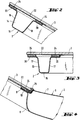
- la figure 2 est une coupe selon la ligne II-II de la figure 1 ;
- la figure 3 est une coupe selon la ligne III-III de la figure 1 ;
- la figure 4 est une coupe selon la ligne IV-IV de la figure 1.
- Le hayon 1 se compose pour ses éléments essentiels d'un cadre 2 formé par emboutissage à partir d'une tôle relativement mince, et d'un vitrage en verre 3 d'environ 6 mm d'épaisseur constitué d'un verre trempé thermiquement. Le vitrage 3 peut bien entendu être muni d'éléments connus, par exemple de résistances chauffantes et/ou de conducteurs pour antenne, qui ne sont cependant pas représentés pour la clarté du dessin. De même, les éléments qui sont normalement fixés au cadre du hayon, comme les charnières, le dispositif de verrouillage, entre autres, ne sont pas représentés car ils ne sont pas indispensables à la représentation de l'invention.
- Comme le montre en particulier la figure 1, le vitrage 3 présente sur trois côtés les mêmes dimensions que celles du cadre métallique, pour l'exemple de réalisation choisi, de sorte que le vitrage 3 n'est pas encadré sur ces côtés, mais qu'elle s'étend sur toute la largeur du hayon, la partie du cadre soutenant le vitrage n'étant ainsi pas directement visible de l'extérieur une fois le hayon mis en place dans le véhicule. Des réalisations ayant un effet esthétique particulier par leur conception sont, par conséquent, possibles.
- Les détails de structure du cadre 2 peuvent être observés dans les figures 2 à 4. La partie inférieure 6 du cadre 2 se compose classiquement de deux pièces de forme en tôle emboutie, soit une pièce de forme supérieure 7 et une pièce de forme inférieure 8, qui sont par exemple soudées ou agrafées entre elles. La partie terminale recourbée 9 de la pièce supérieure 7 forme un renfoncement et est soudée ou agrafée avec la partie terminale 10 de la pièce de forme inférieure 8 ; le collage de la vitre 3 est effectué dans le renfoncement. La partie inférieure 6 du cadre 2 possède une rigidité en torsion satisfaisante par suite de ses dimensions et de sa conception, de sorte que la configuration selon l'invention de l'élément de construction n'est pas indispensable dans ce segment.
- Cependant, les autres parties du cadre 2, c'est-à-dire les deux longerons latéraux 13 et le longeron supérieur 14, se composent chacun d'un profilé de tôle courbé en U et ouvert vers le haut. La largeur des longerons 13 et 14, c'est-à-dire la largeur de la ceinture inférieure 15 ou 16, peut varier et remplir les exigences particulières formulées. Dans le cas présent, les longerons latéraux 13 de l'armature sont plus étroits que le longeron supérieur 14, mais d'autres dimensions sont bien entendu envisageables en fonction des exigences posées.
- Les deux ailes 17 et 18 des longerons 13 et 14 sont respectivement recourbées vers l'extérieur. Leur partie terminale recourbée est approximativement parallèle au vitrage 3 et constitue de part et d'autre pour chacun des longerons deux rebords 20 pour le collage des longerons sur le vitrage 3.
- Le vitrage 3 est muni d'un encadrement décoratif 22 sur son pourtour et sur sa face collée à l'élément de bordure 2. Ce type de décor disposé sur le pourtour des vitrages est courant et nécessaire afin de protéger la couche de colle sous-jacente des rayons U.V. et d'empêcher la vision du cadre et de la colle par transparence du vitrage.
- La couche de colle 24 entre les rebords 20 des longerons 13, 14 et le vitrage 3 assure une liaison rigide entre la vitre et les longerons. Cette couche se compose d'un système de colle approprié qui durcit pour donner une couche de colle rigide ayant une résistance au cisaillement élevée et une très faible déformabilité élastique et plastique. En fonction du système de colle utilisé dans chaque cas particulier pour les besoins mentionnés, la couche de colle peut présenter une épaisseur plus ou moins grande. Par suite des tolérances de forme inévitables du cadre et du vitrage, I'épaisseur de cette couche est, de préférence, supérieure à 5 mm dans cet exemple de réalisation.
- Comme représenté en figure 4, un joint est placé entre l'arête inférieure du vitrage 3 et la partie inférieure 6 du cadre. Ce joint consiste en une bande profilée 25, dont la base est ancrée dans la couche de colle 24.
- Bien entendu, l'application de l'invention dans la fabrication du hayon ne représente que l'un des nombreux exemples d'utilisation. Ainsi, d'autres composants d'un véhicule peuvent être conçus selon l'invention, par exemple les toits ouvrants escamotables, pour lesquels une vitre en verre est collée sur un cadre à structure appropriée. L'invention peut même être exploitée avec succès pour des éléments de la carrosserie ou pour la carrosserie du véhicule dans son ensemble, lorsque celle-ci est équipée de vitres montées de manière fixe. Lorsque par exemple les longerons latéraux de la carrosserie sont configurés selon l'invention et sont liés à la vitre par une fixation rigide, la fabrication des éléments porteurs de la carrosserie peut être plus simple et moins coûteuse. En particulier, pour des vitres latérales à montage fixe, l'invention peut être utilisée avec succès.
Claims (9)
- Élément de construction comprenant au moins un vitrage et au moins un longeron, caractérisé en ce que le longeron est constitué d'un profilé de section ouverte et en ce que le vitrage et le longeron sont collés l'un à l'autre de façon à former un ensemble rigide et solide de section fermée.
- Élément de construction selon la revendication 1, caractérisé en ce que le profilé comprend une âme et des ailes et présente, à sa base, une section approximativement en U, ses ailes étant repliées en leur extrémité libre de façon à former des rebords pour le collage du vitrage et du longeron.
- Élément de construction selon l'une des revendications 1 ou 2, caractérisé en ce que les ailes sont recourbées vers l'extérieur pour former les rebords.
- Élément de construction selon l'une des revendications 1 à 3, caractérisé en ce que le vitrage est constitué par un verre trempé thermiquement.
- Élément de construction selon l'une des revendications 1 à 4, caractérisé en ce que le longeron est collé sur une des faces du vitrage, à sa périphérie.
- Élément de construction selon l'une des revendications 1 à 5, caractérisé en ce que le longeron fait partie d'un cadre.
- Élément de construction selon l'une des revendications 1 à 6, caractérisé en ce que le vitrage et le longeron ou le cadre présentent au moins une dimension commune.
- Élément de construction selon l'une des revendications 1 à 7, caractérisé en ce que le vitrage et le longeron sont collés par l'intermédiaire d'une colle rigide.
- Élément de construction selon l'une des revendications 1 à 8, caractérisé en ce que le vitrage et le longeron sont collés par l'intermédiaire d'une colle présentant, après durcissement, une résistance élevée au cisaillement et une déformabilité élastique et plastique peu élevées.
Applications Claiming Priority (2)
| Application Number | Priority Date | Filing Date | Title |
|---|---|---|---|
| DE4427402A DE4427402A1 (de) | 1994-08-03 | 1994-08-03 | Konstruktionselement aus einer Glasscheibe und einem mit der Glasscheibe verklebten Holm oder Rahmen |
| DE4427402 | 1994-08-03 |
Publications (3)
| Publication Number | Publication Date |
|---|---|
| EP0695848A2 true EP0695848A2 (fr) | 1996-02-07 |
| EP0695848A3 EP0695848A3 (fr) | 1996-06-12 |
| EP0695848B1 EP0695848B1 (fr) | 2003-04-02 |
Family
ID=6524783
Family Applications (1)
| Application Number | Title | Priority Date | Filing Date |
|---|---|---|---|
| EP95401714A Expired - Lifetime EP0695848B1 (fr) | 1994-08-03 | 1995-07-19 | Elément de construction constitué d'un vitrage et d'un longeron ou d'une armature collés sur le vitrage |
Country Status (4)
| Country | Link |
|---|---|
| EP (1) | EP0695848B1 (fr) |
| DE (2) | DE4427402A1 (fr) |
| ES (1) | ES2194893T3 (fr) |
| PT (1) | PT695848E (fr) |
Cited By (10)
| Publication number | Priority date | Publication date | Assignee | Title |
|---|---|---|---|---|
| WO1998009833A1 (fr) * | 1996-09-04 | 1998-03-12 | Schade Gmbh & Co. Kg | Porte pivotante ou coulissante |
| EP1052362A3 (fr) * | 1999-05-10 | 2002-01-23 | Hutchinson | Panneau à double vitrage |
| FR2922859A1 (fr) * | 2007-10-31 | 2009-05-01 | Plastic Omnium Cie | Ensemble d'un caisson de hayon et d'une piece destinee a etre rapportee sur le caisson |
| CN104203730A (zh) * | 2012-04-04 | 2014-12-10 | 奥迪股份公司 | 结构单元的连接装置和用于连接结构单元的方法 |
| FR3010352A1 (fr) * | 2013-09-11 | 2015-03-13 | Renault Sa | Hayon pour vehicule automobile avec ossature de support et vehicule correspondant |
| EP2979909A1 (fr) * | 2014-07-30 | 2016-02-03 | Toyota Jidosha Kabushiki Kaisha | Structure de porte arrière de véhicule en résine |
| US20160167494A1 (en) * | 2014-12-15 | 2016-06-16 | Toyota Jidosha Kabushiki Kaisha | Vehicle back door assembling method and vehicle back door |
| WO2021052114A1 (fr) * | 2019-09-19 | 2021-03-25 | 宁波信泰机械有限公司 | Porte arrière en plastique à haut niveau d'intégration |
| US11141950B1 (en) * | 2016-02-22 | 2021-10-12 | Apple Inc. | Glass fastening and sealing systems |
| WO2026077641A1 (fr) * | 2024-10-08 | 2026-04-16 | Stellantis Auto Sas | Ensemble hayon et véhicule le comprenant |
Families Citing this family (13)
| Publication number | Priority date | Publication date | Assignee | Title |
|---|---|---|---|---|
| DE19739388C2 (de) * | 1997-09-09 | 2001-08-23 | Webasto Karosseriesysteme | Deckel zum Verschließen einer Fahrzeugkarosserieöffnung |
| FR2821320B1 (fr) * | 2001-02-26 | 2003-06-06 | Plastic Omnium Cie | Encadrement de vitre d'habitacle de vehicule automobile et ouvrant comportant un tel encadrement |
| FI20030767A0 (fi) * | 2003-05-21 | 2003-05-21 | Valmet Automotive Oy | Avoauto |
| DE102005016325A1 (de) * | 2005-04-09 | 2006-10-12 | GM Global Technology Operations, Inc., Detroit | Karosserieteil für ein Kraftfahrzeug |
| DE102005033351A1 (de) * | 2005-07-16 | 2007-01-18 | Volkswagen Ag | Herstellung von Kunststoffbaugruppen mit Dehnungselementen |
| DE102006050756A1 (de) | 2006-10-27 | 2008-04-30 | Saint-Gobain Sekurit Deutschland Gmbh & Co. Kg | Schwenkbare Fahrzeugscheibe |
| US8720135B2 (en) | 2007-08-03 | 2014-05-13 | Vkr Holding A/S | Window comprising a bordered pane module |
| US8943769B2 (en) | 2007-08-03 | 2015-02-03 | Vkr Holding A/S | Pane module for use in a window |
| WO2009018827A1 (fr) | 2007-08-03 | 2009-02-12 | Vkr Holding A/S | Procédé de fabrication d'un module de vitre et fenêtre comprenant un tel module de vitre |
| ES2608686T3 (es) * | 2007-08-03 | 2017-04-12 | Vkr Holding A/S | Ventana con un vidrio de enmascarado |
| DE102008011428B4 (de) * | 2008-02-27 | 2021-06-10 | Dr. Ing. H.C. F. Porsche Aktiengesellschaft | Heckklappe für ein Kraftfahrzeug |
| ES2869379T3 (es) | 2009-02-03 | 2021-10-25 | Vkr Holding As | Una ventana que tiene un marco y una conexión mejorada a la bisagra |
| DE102011000063B4 (de) * | 2011-01-10 | 2022-07-14 | Dr. Ing. H.C. F. Porsche Aktiengesellschaft | Heckklappe und Kraftfahrzeug mit einer derartigen Heckklappe |
Family Cites Families (2)
| Publication number | Priority date | Publication date | Assignee | Title |
|---|---|---|---|---|
| DE1819525U (de) * | 1960-06-22 | 1960-10-13 | Hermann Volland | Selbsttragende ebene polyesterharz-lichtplatte. |
| DE3832178A1 (de) * | 1988-09-22 | 1990-04-05 | Hans Victor Schoenfeld | Klebeverbindung von glasscheiben, fassaden-, wandelementen u. dgl. |
-
1994
- 1994-08-03 DE DE4427402A patent/DE4427402A1/de not_active Withdrawn
-
1995
- 1995-07-19 EP EP95401714A patent/EP0695848B1/fr not_active Expired - Lifetime
- 1995-07-19 PT PT95401714T patent/PT695848E/pt unknown
- 1995-07-19 ES ES95401714T patent/ES2194893T3/es not_active Expired - Lifetime
- 1995-07-19 DE DE69530150T patent/DE69530150T2/de not_active Expired - Fee Related
Non-Patent Citations (1)
| Title |
|---|
| None |
Cited By (20)
| Publication number | Priority date | Publication date | Assignee | Title |
|---|---|---|---|---|
| US6003931A (en) * | 1996-09-04 | 1999-12-21 | Schnade Gmbh & Co., Kg | Swivelling or sliding backboard |
| WO1998009833A1 (fr) * | 1996-09-04 | 1998-03-12 | Schade Gmbh & Co. Kg | Porte pivotante ou coulissante |
| EP1052362A3 (fr) * | 1999-05-10 | 2002-01-23 | Hutchinson | Panneau à double vitrage |
| FR2922859A1 (fr) * | 2007-10-31 | 2009-05-01 | Plastic Omnium Cie | Ensemble d'un caisson de hayon et d'une piece destinee a etre rapportee sur le caisson |
| WO2009056775A3 (fr) * | 2007-10-31 | 2009-07-02 | Plastic Omnium Cie | Ensemble d'un caisson de hayon et d'une piece destinee a etre rapportee sur le caisson |
| US8419108B2 (en) | 2007-10-31 | 2013-04-16 | Compagnie Plastic Omnium | Assembly of a tailgate shell and of a component intended to be attached to the shell |
| US9394009B2 (en) | 2012-04-04 | 2016-07-19 | Audi Ag | Connection arrangement of structural units and method for connecting structural units |
| CN104203730A (zh) * | 2012-04-04 | 2014-12-10 | 奥迪股份公司 | 结构单元的连接装置和用于连接结构单元的方法 |
| CN104203730B (zh) * | 2012-04-04 | 2016-08-24 | 奥迪股份公司 | 结构单元的连接装置和用于连接结构单元的方法 |
| FR3010352A1 (fr) * | 2013-09-11 | 2015-03-13 | Renault Sa | Hayon pour vehicule automobile avec ossature de support et vehicule correspondant |
| WO2015036671A1 (fr) * | 2013-09-11 | 2015-03-19 | Renault S.A.S. | Hayon pour véhicule automobile avec ossature de support et véhicule correspondant |
| EP2979909A1 (fr) * | 2014-07-30 | 2016-02-03 | Toyota Jidosha Kabushiki Kaisha | Structure de porte arrière de véhicule en résine |
| US20160167494A1 (en) * | 2014-12-15 | 2016-06-16 | Toyota Jidosha Kabushiki Kaisha | Vehicle back door assembling method and vehicle back door |
| CN105691168A (zh) * | 2014-12-15 | 2016-06-22 | 丰田自动车株式会社 | 车辆用后尾门的接合方法及车辆用后尾门 |
| US9688125B2 (en) * | 2014-12-15 | 2017-06-27 | Toyota Jidosha Kabushiki Kaisha | Vehicle back door assembling method and vehicle back door |
| US11141950B1 (en) * | 2016-02-22 | 2021-10-12 | Apple Inc. | Glass fastening and sealing systems |
| US11772354B1 (en) | 2016-02-22 | 2023-10-03 | Apple Inc. | Glass fastening and sealing systems |
| WO2021052114A1 (fr) * | 2019-09-19 | 2021-03-25 | 宁波信泰机械有限公司 | Porte arrière en plastique à haut niveau d'intégration |
| US12187346B2 (en) | 2019-09-19 | 2025-01-07 | Ningbo Shintai Machines Co., Ltd. | High-integration-level plastic tail door |
| WO2026077641A1 (fr) * | 2024-10-08 | 2026-04-16 | Stellantis Auto Sas | Ensemble hayon et véhicule le comprenant |
Also Published As
| Publication number | Publication date |
|---|---|
| EP0695848A3 (fr) | 1996-06-12 |
| DE4427402A1 (de) | 1996-02-15 |
| ES2194893T3 (es) | 2003-12-01 |
| DE69530150D1 (de) | 2003-05-08 |
| DE69530150T2 (de) | 2004-03-04 |
| EP0695848B1 (fr) | 2003-04-02 |
| PT695848E (pt) | 2003-08-29 |
Similar Documents
| Publication | Publication Date | Title |
|---|---|---|
| EP0695848B1 (fr) | Elément de construction constitué d'un vitrage et d'un longeron ou d'une armature collés sur le vitrage | |
| EP0014141B1 (fr) | Vitrage composite à haute résistance aux impacts | |
| CA1329231C (fr) | Fenetre de vehicule | |
| EP0282468B1 (fr) | Panneau vitré cintré | |
| EP2852502B1 (fr) | Pare-brise comportant un fenestron pourvu d'une semelle d'accouplement intégrée de forme conjuguée a celle du montant de carrosserie | |
| EP0128086B1 (fr) | Vitrage, en particulier vitrage pour véhicule automobile garni d'une lisière métallique collée | |
| EP0441928B1 (fr) | Panneau de facade a chassis metallique et facade revetue d'un tel panneau | |
| CA2590679C (fr) | Vitrage complexe constitue d'au moins deux elements vitres contigus et procede de realisation de ce vitrage complexe. | |
| FR2708030A1 (fr) | Paroi vitrée isolante, à surface transparente maximale. | |
| FR2769570A1 (fr) | Toit de vehicule | |
| EP0049204A1 (fr) | Cadre entretoise pour vitrage anti-feu à gel | |
| EP0884444B1 (fr) | Porte d'entrée de local | |
| FR2619587A1 (fr) | Panneau de revetement ou de fenetre pour la surface exterieure d'une facade, et facade equipee d'un tel panneau | |
| CA3057604A1 (fr) | Vitrage comprenant un seul cordon profile pour la liaison entre deux vitres et vitre pour un tel vitrage | |
| EP1052362A2 (fr) | Panneau à double vitrage | |
| EP1827881B1 (fr) | Pare brise panoramique pour vehicule automobile | |
| EP0352151B1 (fr) | Panneau mobile transparent et notamment panneau transparent d'un hayon de véhicle automobile | |
| FR3054587B1 (fr) | Vitrage multiple pour dispositif de fermeture | |
| FR2692541A1 (fr) | Véhicule ferroviaire formé par assemblage modulaire. | |
| FR2741658A1 (fr) | Store de garniture et d'isolation pour toit ouvrant de vehicule automobile | |
| EP4313579B1 (fr) | Vitrage comportant deux vitres et un joint d'assemblage desdites vitres | |
| BE1010178A5 (fr) | Porte en verre structurel autoportant. | |
| WO2008053118A2 (fr) | Vitrage pivotant de vehicule | |
| FR2719335A1 (fr) | Porte en verre structurel autoportant. | |
| WO2005073493A1 (fr) | Vitre de fenetre avec des lamelles |
Legal Events
| Date | Code | Title | Description |
|---|---|---|---|
| PUAI | Public reference made under article 153(3) epc to a published international application that has entered the european phase |
Free format text: ORIGINAL CODE: 0009012 |
|
| AK | Designated contracting states |
Kind code of ref document: A2 Designated state(s): BE DE ES FR GB IT LU PT SE |
|
| PUAL | Search report despatched |
Free format text: ORIGINAL CODE: 0009013 |
|
| RHK1 | Main classification (correction) |
Ipc: E04C 2/54 |
|
| AK | Designated contracting states |
Kind code of ref document: A3 Designated state(s): BE DE ES FR GB IT LU PT SE |
|
| 17P | Request for examination filed |
Effective date: 19960627 |
|
| 17Q | First examination report despatched |
Effective date: 19990903 |
|
| RAP1 | Party data changed (applicant data changed or rights of an application transferred) |
Owner name: SAINT-GOBAIN GLASS FRANCE |
|
| GRAH | Despatch of communication of intention to grant a patent |
Free format text: ORIGINAL CODE: EPIDOS IGRA |
|
| RIC1 | Information provided on ipc code assigned before grant |
Free format text: 7E 04C 2/54 A, 7E 06B 3/54 B, 7B 60J 1/18 B |
|
| GRAH | Despatch of communication of intention to grant a patent |
Free format text: ORIGINAL CODE: EPIDOS IGRA |
|
| GRAA | (expected) grant |
Free format text: ORIGINAL CODE: 0009210 |
|
| AK | Designated contracting states |
Designated state(s): BE DE ES FR GB IT LU PT SE |
|
| REG | Reference to a national code |
Ref country code: GB Ref legal event code: FG4D Free format text: NOT ENGLISH |
|
| REF | Corresponds to: |
Ref document number: 69530150 Country of ref document: DE Date of ref document: 20030508 Kind code of ref document: P |
|
| PGFP | Annual fee paid to national office [announced via postgrant information from national office to epo] |
Ref country code: PT Payment date: 20030627 Year of fee payment: 9 |
|
| PGFP | Annual fee paid to national office [announced via postgrant information from national office to epo] |
Ref country code: FR Payment date: 20030702 Year of fee payment: 9 |
|
| PGFP | Annual fee paid to national office [announced via postgrant information from national office to epo] |
Ref country code: SE Payment date: 20030707 Year of fee payment: 9 |
|
| PGFP | Annual fee paid to national office [announced via postgrant information from national office to epo] |
Ref country code: GB Payment date: 20030716 Year of fee payment: 9 |
|
| REG | Reference to a national code |
Ref country code: SE Ref legal event code: TRGR |
|
| PGFP | Annual fee paid to national office [announced via postgrant information from national office to epo] |
Ref country code: LU Payment date: 20030724 Year of fee payment: 9 |
|
| PGFP | Annual fee paid to national office [announced via postgrant information from national office to epo] |
Ref country code: BE Payment date: 20030812 Year of fee payment: 9 |
|
| GBT | Gb: translation of ep patent filed (gb section 77(6)(a)/1977) |
Effective date: 20030728 |
|
| PLBE | No opposition filed within time limit |
Free format text: ORIGINAL CODE: 0009261 |
|
| STAA | Information on the status of an ep patent application or granted ep patent |
Free format text: STATUS: NO OPPOSITION FILED WITHIN TIME LIMIT |
|
| 26N | No opposition filed |
Effective date: 20040105 |
|
| PG25 | Lapsed in a contracting state [announced via postgrant information from national office to epo] |
Ref country code: LU Free format text: LAPSE BECAUSE OF NON-PAYMENT OF DUE FEES Effective date: 20040719 Ref country code: GB Free format text: LAPSE BECAUSE OF NON-PAYMENT OF DUE FEES Effective date: 20040719 |
|
| PGFP | Annual fee paid to national office [announced via postgrant information from national office to epo] |
Ref country code: ES Payment date: 20040719 Year of fee payment: 10 |
|
| PG25 | Lapsed in a contracting state [announced via postgrant information from national office to epo] |
Ref country code: SE Free format text: LAPSE BECAUSE OF NON-PAYMENT OF DUE FEES Effective date: 20040720 |
|
| PG25 | Lapsed in a contracting state [announced via postgrant information from national office to epo] |
Ref country code: BE Free format text: LAPSE BECAUSE OF NON-PAYMENT OF DUE FEES Effective date: 20040731 |
|
| PGFP | Annual fee paid to national office [announced via postgrant information from national office to epo] |
Ref country code: DE Payment date: 20040731 Year of fee payment: 10 |
|
| PG25 | Lapsed in a contracting state [announced via postgrant information from national office to epo] |
Ref country code: PT Free format text: LAPSE BECAUSE OF NON-PAYMENT OF DUE FEES Effective date: 20050119 |
|
| BERE | Be: lapsed |
Owner name: *SAINT-GOBAIN GLASS FRANCE Effective date: 20040731 |
|
| EUG | Se: european patent has lapsed | ||
| GBPC | Gb: european patent ceased through non-payment of renewal fee |
Effective date: 20040719 |
|
| PG25 | Lapsed in a contracting state [announced via postgrant information from national office to epo] |
Ref country code: FR Free format text: LAPSE BECAUSE OF NON-PAYMENT OF DUE FEES Effective date: 20050331 |
|
| REG | Reference to a national code |
Ref country code: PT Ref legal event code: MM4A Free format text: LAPSE DUE TO NON-PAYMENT OF FEES Effective date: 20050119 |
|
| REG | Reference to a national code |
Ref country code: FR Ref legal event code: ST |
|
| PG25 | Lapsed in a contracting state [announced via postgrant information from national office to epo] |
Ref country code: IT Free format text: LAPSE BECAUSE OF NON-PAYMENT OF DUE FEES;WARNING: LAPSES OF ITALIAN PATENTS WITH EFFECTIVE DATE BEFORE 2007 MAY HAVE OCCURRED AT ANY TIME BEFORE 2007. THE CORRECT EFFECTIVE DATE MAY BE DIFFERENT FROM THE ONE RECORDED. Effective date: 20050719 |
|
| PG25 | Lapsed in a contracting state [announced via postgrant information from national office to epo] |
Ref country code: ES Free format text: LAPSE BECAUSE OF NON-PAYMENT OF DUE FEES Effective date: 20050720 |
|
| PG25 | Lapsed in a contracting state [announced via postgrant information from national office to epo] |
Ref country code: DE Free format text: LAPSE BECAUSE OF NON-PAYMENT OF DUE FEES Effective date: 20060201 |
|
| REG | Reference to a national code |
Ref country code: ES Ref legal event code: FD2A Effective date: 20050720 |
|
| BERE | Be: lapsed |
Owner name: *SAINT-GOBAIN GLASS FRANCE Effective date: 20040731 |