EP0696014A1 - Druckempfindliche Dateneigabevorrichtung, die um einen menschlichen Finger getragen werden kann - Google Patents
Druckempfindliche Dateneigabevorrichtung, die um einen menschlichen Finger getragen werden kann Download PDFInfo
- Publication number
- EP0696014A1 EP0696014A1 EP95304100A EP95304100A EP0696014A1 EP 0696014 A1 EP0696014 A1 EP 0696014A1 EP 95304100 A EP95304100 A EP 95304100A EP 95304100 A EP95304100 A EP 95304100A EP 0696014 A1 EP0696014 A1 EP 0696014A1
- Authority
- EP
- European Patent Office
- Prior art keywords
- electronic device
- cap
- input device
- pressure
- display
- Prior art date
- Legal status (The legal status is an assumption and is not a legal conclusion. Google has not performed a legal analysis and makes no representation as to the accuracy of the status listed.)
- Granted
Links
Images




Classifications
-
- G—PHYSICS
- G06—COMPUTING OR CALCULATING; COUNTING
- G06F—ELECTRIC DIGITAL DATA PROCESSING
- G06F3/00—Input arrangements for transferring data to be processed into a form capable of being handled by the computer; Output arrangements for transferring data from processing unit to output unit, e.g. interface arrangements
- G06F3/01—Input arrangements or combined input and output arrangements for interaction between user and computer
- G06F3/03—Arrangements for converting the position or the displacement of a member into a coded form
- G06F3/033—Pointing devices displaced or positioned by the user, e.g. mice, trackballs, pens or joysticks; Accessories therefor
- G06F3/0338—Pointing devices displaced or positioned by the user, e.g. mice, trackballs, pens or joysticks; Accessories therefor with detection of limited linear or angular displacement of an operating part of the device from a neutral position, e.g. isotonic or isometric joysticks
-
- G—PHYSICS
- G06—COMPUTING OR CALCULATING; COUNTING
- G06F—ELECTRIC DIGITAL DATA PROCESSING
- G06F2203/00—Indexing scheme relating to G06F3/00 - G06F3/048
- G06F2203/033—Indexing scheme relating to G06F3/033
- G06F2203/0331—Finger worn pointing device
Definitions
- This invention relates to the electronics circuitry field. More particularly, this invention is a pressure sensitive input device wearable around a human finger.
- the mouse unlike the keyboard, allowed for a cursor to be moved relatively easily from one position on the display to another position on a display.
- the user rested his/her palm on top of the mouse, grabbed the sides of the mouse with large portions of their thumb and "pinkie” finger, and moved the mouse across a mouse pad, often by moving their entire arm in the process.
- US Patent 4,954,817 points out that muscles of the human body are mapped in an orderly fashion to the human brain, but that some muscles have more "brain" mapped to them then others.
- the muscles in the thumb have a much higher degree of brain mapping than most other parts of the human body, including other parts of the human hand.
- the opposable thumb is what sets human beings apart from others in the animal kingdom. The thumb, especially when used in conjunction with the index finger, is capable of very fine motor control.
- a pressure sensitive input device is wearable around a human finger, such as a thumb.
- the input device has a sheath, preferably with one end enclosed in a thimble-like fashion.
- the sheath contains a cap and a pressure sensor, such as force sensitive resistors.
- the input device communicates to an electronic device having a display, such as a computer, via an electronic device interface.
- the pressure sensor detects pressure on the cap, the information displayed on the display is changed. Pressure in two dimensions (X and Y) on the cap is detected by the pressure sensor.
- the information that is changed on the display is the repositioning of a cursor on the display, although writing on the device can also be performed.
- the cursor is repositioned corresponding to the direction and magnitude of the pressure detected on the cap. Switches present on the sheath can be used to execute an operation corresponding to the position of the cursor on the display.
- Fig. 1 shows the input device of the preferred embodiment of the invention, as worn by a human being.
- Fig. 2A shows a side view of the sheath of the input device of the preferred embodiment of the invention.
- Fig. 2B shows a side view of the sheath of the input device of an alternate embodiment of the invention.
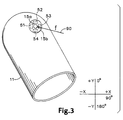
- Fig. 3 shows a top view of the sheath of the input device of the preferred and alternate embodiments of the invention.
- Fig. 4A shows actuation of the input device of the preferred embodiment of the invention to control an electronic device via a wireless data link.
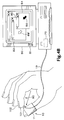
- Fig. 4B shows actuation of the input device of an alternate embodiment of the invention to control an electronic device via a wired data link.
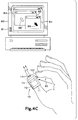
- Fig. 4C shows actuation of the input device of an alternate embodiment of the invention to control an electronic device via a wireless data link contained in the sheath.
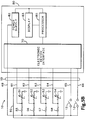
- Fig. 5A shows a block diagram of the input device and electronic device of the preferred embodiment of the invention.
- Fig. 5B shows a block diagram of the input device and electronic device of an alternate embodiment of the invention.
- Fig. 6 shows actuation of the input device of an embodiment of the invention to control an alternate "pen based" electronic device via a wireless data link.
- Fig. 1 shows input device 10 of the preferred embodiment of the invention, as worn by a human being.
- Input device 10 contains sheath 11, cap 15, cable 16, and electronic device interface 70.
- Sheath 11 is wearable around a human finger.
- Sheath 11 is preferably but optionally enclosed on one end in a thimble-like fashion preferrably placed on the tip of a user's thumb 100, as is shown in Fig. 1.
- Cable 16 connects cap 15 with electronic device interface 70.
- Electronic device interface 70 is preferably worn around user's wrist 110, similar to a wristwatch. In fact, network device interface 70 can be part of a wristwatch.
- Fig. 2A shows a side view of sheath 11 of input device 10 of the preferred embodiment of the invention.
- Cap 15 contains upper cap portion 15a and lower cap portion 15b.
- Cable 16 is connected to lower cap portion 15b and switches 12 and 13.
- Fig. 28 shows a side view of sheath 11 of input device 10 of an alternate embodiment of the invention.
- cap 15 contains upper cap portion 15a and lower cap portion 15b
- sheath 11 contains switches 12 and 13.
- sheath 11 also contains infrared port 14.
- Infared port 14 is connected to lower cap portion 15b and switches 12 and 13, and transmits wireless information to an electronic device equipped with another infared port, as will be discussed in more detail later.
- Fig. 3 shows a top view of sheath 11 of the input device of the preferred and alternate embodiments of the invention.
- the relative position of pressure sensors 51-54 are shown in dashed lines in Fig. 3, since these sensors are contained in and hidden from view by lower cap portion 15b.
- Pressure sensors 51-54 are part of pressure sensor 50, whose operation will be described in more detail later. While four sensors are shown, each oriented perpendicularly to its adjacent sensors, those skilled in the art will appreciate that more or fewer sensors could be used.
- pressure sensors 51-54 are force sensitive resistors, such as those manufactured by Interlink Electronics, although other components that can translate pressure into electronic signals, such as strain gauges, could also be used.
- force and pressure shall be used interchangeably throughout the remainder of this document.
- Fig. 4A shows how input device 10 of the preferred embodiment of the invention is actuated to control electronic device 80 via wireless data link 75.
- the user applies pressure to cap 15 with index finger 101. This pressure is sensed by pressure sensor 50, and is transmitted to electronic device 80 via infared port 14 in electronic device interface 70 over wireless link 75 to infrared port 81.
- index finger 101 such as force 90 shown in Fig. 3
- the information displayed on display 83 of electronic device 80 is changed. Pressure in the X and Y directions on upper cap portion 15a is detected by pressure sensors 51-54.
- the information that is changed on the display is the repositioning of cursor 89 on display 83 to position 89'.
- Cursor 89 is repositioned corresponding to the pressure detected in the X and Y direction on upper cap portion 15a.
- the user has applied force 90 to upper cap portion 15a to move cursor 89 to position 89' so she can move from viewport 84 to viewport 85.
- switch 12 on the underside of sheath 11, hidden from this view by the thumb
- middle finger 102 an operation similar to a "click” or “double click” on a mouse button can be performed.
- actuating switch 12 twice in a rapid manner will result in the selection of viewport 85 as the active viewport.
- switches 12 and 13 could be located in electronic device interface 70 for actuation by one or more fingers of the opposite hand and still fall within the spirit and scope of the invention.
- Fig. 4B shows actuation of the input device of an alternate embodiment of the invention to control an electronic device via a wired data link.
- electronic device interface 70 is no longer contained in a watch-like device worn around the user's wrist; it is instead contained in electronic device 80.
- Wireless data link 75 of the preferred embodiment is replaced by cable 19. Cable 19 directly connects cap 15 to electronic device 80.
- This embodiment may be preferred in some applications where the cost of input device 10 needs to be kept to an absolute minimum.
- sheath 11 of Fig. 4B is more ring-like or band-like. Those skilled in the art will appreciate that sheath 11 can take on a variety of different configurations and still fall within the spirit and scope of the invention.
- Fig. 4C shows actuation of the input device of an alternate embodiment of the invention to control an electronic device via a wireless data link contained in sheath 11.
- infared port 14 and electronic device interface 70 is no longer part of input device 10; it is instead contained in sheath 11. This embodiment may be preferred in some applications where the additional cost associated with putting electronic device interface 70 and infared port 14 in sheath 11 can be justified.
- Fig. 5A shows a block diagram of input device 10 and electronic device 80 of the preferred embodiment of the invention shown in Fig. 4A and the alternate embodiment of the invention shown in Fig. 4C.
- Battery 72 (part of electronic device interface 70 in both embodiments) is connected to pressure sensor 50.
- pressure sensor 50 includes force sensitive resistors 51-54.
- Pressure sensor 50 also includes fixed pull up resistors 55-58. Pull up resistors 55-58 form a voltage divider network with force sensitive resistors 51-54.
- the signals provided to electronic device interface 70 on input lines 61-64 are proportional to the force applied to force sensitive resistors 51-54. When force sensitive resistors 51-54 are oriented as shown in Fig.
- the signal on input line 64 will be proportional to the force applied on cap 15 in a +Y direction of 0°.
- the signal on input line 61 will be proportional to the force applied in a +X direction of 90°
- the signal on input line 62 will be proportional to the force applied in a -Y direction of 180°
- the signal on input line 63 will be proportional to the force applied in a -X direction of 270°.
- force 90 shown in Fig. 4A would result in a signal on input line 63 to indicate the -X directional component of force 90
- a signal on input line 64 to indicate the Y directional component of force 90.
- resistors 53 and 54 would not be necessary if resistors 51 and 52 were preloaded to a predefined amount of force, so that "negative pressure” on the resistors (e.g., force on resistors 51 and 52 from force 90 of Fig. 3) could be measured.
- the signals (if any) resulting from the "pair" of any force sensitive resistor measuring positive pressure is simply ignored, since the direction of the force on cap 15 can be uniquely determined from the signals resulting from the force sensitive resistors measuring positive pressure.
- electronic device interface 70 can uniquely determine the direction of any X-Y force applied to cap 15, as well as the amount of force applied.
- electronic device interface 70 is similar in many respects to driver circuitry found in conventional input devices, such as mice and trackballs, that receive positional data from X-Y rollers or similar devices.
- This positional data is sent by electronic device interface 70 to electronic device 80 over wireless data link 75 (via IR ports 71 and 81) using a specific protocol, such as the Serial Infrared (SIR) Protocol used by Hewlett-Packard palmtop and superportable PCs, understandable by processor 85.
- SIR Serial Infrared
- Processor 85 responsive to signals sent to it over wireless data link 75, causes the information contained on display 83 to change, as was discussed in Fig. 4A with the change of the position of cursor 89 to position 89'.
- Switches 12 and 13 operate in a manner similar to buttons on a conventional mouse. In the example discussed above in conjunction with Fig. 4A, pressing down on switch 12 twice in a rapid manner with middle finger 102 will result in the selection of viewport 85 as the active viewport.
- Fig. 5B shows a block diagram of the input device and electronic device of the alternate embodiment of the invention discussed previously in Fig. 4B.
- Electronic device interface 70 part of input device 10 in Fig. 5A, is shown in Fig. 5B contained in electronic device 80.
- Wireless data link 75 of the preferred embodiment is replaced by cable 19.
- Cable 19 provides power to input device 10 from power supply 82 via line 68.
- X and Y positional information and switch information from switches 12 and 13 is sent to electronic device interface 88 over cable 19 via lines 61-66.
- Fig. 6 shows actuation of input device 10 of an embodiment of the invention to control alternate "pen based" electronic device 180 via a wireless data link 75.
- Electronic device 180 is similar in some respects to electronic device 80, but lacks a keyboard as an input device and is normally smaller in size. In fact, electronic device 180 can fit in a human hand, or even be as small as a wristwatch.
- Electronic device 180 is capable of performing the popular personal digital assistant (PDA) function of "writing" on the device, similar to pen-based PDA's such as the Apple Newton, but without the pen or stylus. Instead, the user writes by applying pressure to cap 15 of input device 10, thereby moving cursor 180 along in much the same manner as a pencil is moved across a piece of paper when one is writing a letter or the like.
- PDA personal digital assistant
- cursor 189 is helpful in providing positional feedback to a user, it is not required to be displayed to the user.
- Switches 12 and 13 can be used to control device 180 by scrolling down/up, selecting an item from a menu, etc.
- device 10 shown in Fig. 6 is particularly well suited for applications involving writing, due to the very fine motor control supported by the device.
Landscapes
- Engineering & Computer Science (AREA)
- General Engineering & Computer Science (AREA)
- Theoretical Computer Science (AREA)
- Human Computer Interaction (AREA)
- Physics & Mathematics (AREA)
- General Physics & Mathematics (AREA)
- Position Input By Displaying (AREA)
Applications Claiming Priority (2)
| Application Number | Priority Date | Filing Date | Title |
|---|---|---|---|
| US28213594A | 1994-07-28 | 1994-07-28 | |
| US282135 | 1994-07-28 |
Publications (2)
| Publication Number | Publication Date |
|---|---|
| EP0696014A1 true EP0696014A1 (de) | 1996-02-07 |
| EP0696014B1 EP0696014B1 (de) | 2000-09-20 |
Family
ID=23080250
Family Applications (1)
| Application Number | Title | Priority Date | Filing Date |
|---|---|---|---|
| EP19950304100 Expired - Lifetime EP0696014B1 (de) | 1994-07-28 | 1995-06-14 | Druckempfindliche Dateneigabevorrichtung, die um einen menschlichen Finger getragen werden kann |
Country Status (3)
| Country | Link |
|---|---|
| EP (1) | EP0696014B1 (de) |
| JP (1) | JPH0854981A (de) |
| DE (1) | DE69518884T2 (de) |
Cited By (13)
| Publication number | Priority date | Publication date | Assignee | Title |
|---|---|---|---|---|
| WO1996039679A1 (en) * | 1995-06-06 | 1996-12-12 | Mrigank Shekhar | Pointer device |
| WO1998008062A1 (en) * | 1996-08-16 | 1998-02-26 | The University Court Of The University Of Dundee | Manually operated signalling apparatus |
| DE10103888A1 (de) * | 2001-01-30 | 2002-08-14 | Paul Bellendorf | Steuerungseinrichtung |
| WO2003005176A1 (en) * | 2001-07-06 | 2003-01-16 | The Deanmark Corporation | Computer mouse on a glove |
| NL1018577C2 (nl) * | 2001-07-18 | 2003-01-21 | Glenn Kenneth Leilis | Computeraanwijsinrichting. |
| WO2003100717A1 (en) * | 2002-05-28 | 2003-12-04 | Digityper Ab | A device for inputting control signals to a peripheral unit and a combination including such a device |
| US6748281B2 (en) * | 2000-09-29 | 2004-06-08 | Gunilla Alsio | Wearable data input interface |
| WO2005017733A1 (en) * | 2003-08-13 | 2005-02-24 | Crc As | Control device for providing position information |
| EP1673871A4 (de) * | 2003-09-06 | 2007-05-09 | Michael W Mcrae | Handmanipulierte datenvorrichtung für computer und videospiele |
| WO2009000024A1 (en) * | 2007-06-27 | 2008-12-31 | Murray David Edwards | A thumb mountable device for holding equipment |
| DE102008007248A1 (de) * | 2008-02-01 | 2009-01-22 | Siemens Aktiengesellschaft | Positionserfassungssystem |
| GB2458583A (en) * | 2005-01-18 | 2009-09-30 | Rallypoint Inc | Wearable article sensing a force and a direction associated the force |
| US7737942B2 (en) | 2001-07-06 | 2010-06-15 | Bajramovic Mark B | Computer mouse on a glove |
Families Citing this family (4)
| Publication number | Priority date | Publication date | Assignee | Title |
|---|---|---|---|---|
| DE10104162A1 (de) * | 2001-01-30 | 2002-08-01 | Volkswagen Ag | Bedien-und/oder Steuerungseinrichtung für mindestens eine elektronische Einrichtung und Verfahren zur Bedienung und/oder Steuerung |
| JP2005339306A (ja) * | 2004-05-28 | 2005-12-08 | Yokogawa Electric Corp | データ入力装置 |
| JP5254117B2 (ja) * | 2009-04-20 | 2013-08-07 | シャープ株式会社 | 入力器具、その制御方法、その制御プログラムおよびコンピュータ読み取り可能な記録媒体、ならびに、タッチパネル入力システム |
| CN106409577B (zh) * | 2015-07-31 | 2018-07-13 | 宏碁股份有限公司 | 穿戴式触发装置 |
Citations (4)
| Publication number | Priority date | Publication date | Assignee | Title |
|---|---|---|---|---|
| JPS63184129A (ja) * | 1986-07-23 | 1988-07-29 | Manabu Koda | 文字記号図形等を手からコンピュ−タ−等に入力する装置 |
| US4954817A (en) | 1988-05-02 | 1990-09-04 | Levine Neil A | Finger worn graphic interface device |
| WO1991007826A1 (en) * | 1989-11-22 | 1991-05-30 | Russell David C | Computer control system |
| FR2709575A1 (fr) * | 1993-09-03 | 1995-03-10 | Albertin Pierre | Dispositif portatif de saisie et d'entrée pour ordinateur. |
Family Cites Families (5)
| Publication number | Priority date | Publication date | Assignee | Title |
|---|---|---|---|---|
| JPH0334130U (de) * | 1989-08-04 | 1991-04-03 | ||
| US5181181A (en) * | 1990-09-27 | 1993-01-19 | Triton Technologies, Inc. | Computer apparatus input device for three-dimensional information |
| US5432530A (en) * | 1991-05-15 | 1995-07-11 | Fujitsu Limited | Pointing device and method of control of same |
| JPH0635601A (ja) * | 1992-07-16 | 1994-02-10 | Nec Corp | サムマウス |
| US5313229A (en) * | 1993-02-05 | 1994-05-17 | Gilligan Federico G | Mouse and method for concurrent cursor position and scrolling control |
-
1995
- 1995-06-14 EP EP19950304100 patent/EP0696014B1/de not_active Expired - Lifetime
- 1995-06-14 DE DE1995618884 patent/DE69518884T2/de not_active Expired - Fee Related
- 1995-07-27 JP JP7211091A patent/JPH0854981A/ja active Pending
Patent Citations (4)
| Publication number | Priority date | Publication date | Assignee | Title |
|---|---|---|---|---|
| JPS63184129A (ja) * | 1986-07-23 | 1988-07-29 | Manabu Koda | 文字記号図形等を手からコンピュ−タ−等に入力する装置 |
| US4954817A (en) | 1988-05-02 | 1990-09-04 | Levine Neil A | Finger worn graphic interface device |
| WO1991007826A1 (en) * | 1989-11-22 | 1991-05-30 | Russell David C | Computer control system |
| FR2709575A1 (fr) * | 1993-09-03 | 1995-03-10 | Albertin Pierre | Dispositif portatif de saisie et d'entrée pour ordinateur. |
Non-Patent Citations (1)
| Title |
|---|
| PATENT ABSTRACTS OF JAPAN vol. 012, no. 460 (P - 795) 5 December 1988 (1988-12-05) * |
Cited By (16)
| Publication number | Priority date | Publication date | Assignee | Title |
|---|---|---|---|---|
| WO1996039679A1 (en) * | 1995-06-06 | 1996-12-12 | Mrigank Shekhar | Pointer device |
| WO1998008062A1 (en) * | 1996-08-16 | 1998-02-26 | The University Court Of The University Of Dundee | Manually operated signalling apparatus |
| US6748281B2 (en) * | 2000-09-29 | 2004-06-08 | Gunilla Alsio | Wearable data input interface |
| DE10103888A1 (de) * | 2001-01-30 | 2002-08-14 | Paul Bellendorf | Steuerungseinrichtung |
| DE10103888C2 (de) * | 2001-01-30 | 2002-11-28 | Paul Bellendorf | Steuerungseinrichtung |
| US7737942B2 (en) | 2001-07-06 | 2010-06-15 | Bajramovic Mark B | Computer mouse on a glove |
| WO2003005176A1 (en) * | 2001-07-06 | 2003-01-16 | The Deanmark Corporation | Computer mouse on a glove |
| US7057604B2 (en) | 2001-07-06 | 2006-06-06 | Mikamed Health Technologies Inc. | Computer mouse on a glove |
| NL1018577C2 (nl) * | 2001-07-18 | 2003-01-21 | Glenn Kenneth Leilis | Computeraanwijsinrichting. |
| WO2003100717A1 (en) * | 2002-05-28 | 2003-12-04 | Digityper Ab | A device for inputting control signals to a peripheral unit and a combination including such a device |
| WO2005017733A1 (en) * | 2003-08-13 | 2005-02-24 | Crc As | Control device for providing position information |
| EP1673871A4 (de) * | 2003-09-06 | 2007-05-09 | Michael W Mcrae | Handmanipulierte datenvorrichtung für computer und videospiele |
| GB2458583A (en) * | 2005-01-18 | 2009-09-30 | Rallypoint Inc | Wearable article sensing a force and a direction associated the force |
| GB2458583B (en) * | 2005-01-18 | 2009-12-09 | Rallypoint Inc | Sensing input actions |
| WO2009000024A1 (en) * | 2007-06-27 | 2008-12-31 | Murray David Edwards | A thumb mountable device for holding equipment |
| DE102008007248A1 (de) * | 2008-02-01 | 2009-01-22 | Siemens Aktiengesellschaft | Positionserfassungssystem |
Also Published As
| Publication number | Publication date |
|---|---|
| DE69518884D1 (de) | 2000-10-26 |
| JPH0854981A (ja) | 1996-02-27 |
| DE69518884T2 (de) | 2001-02-01 |
| EP0696014B1 (de) | 2000-09-20 |
Similar Documents
| Publication | Publication Date | Title |
|---|---|---|
| EP0696014B1 (de) | Druckempfindliche Dateneigabevorrichtung, die um einen menschlichen Finger getragen werden kann | |
| EP0731407B1 (de) | Eingabevorrichtung für einen Rechner | |
| CN101111817B (zh) | 电脑鼠标周边装置 | |
| US5563628A (en) | Hand held computer cursor controller and command input device | |
| US4954817A (en) | Finger worn graphic interface device | |
| US6031518A (en) | Ergonomic input device | |
| US6359611B2 (en) | Finger controlled computer mouse | |
| US5063376A (en) | Numeric mouse one hand controllable computer peripheral pointing device | |
| US6937227B2 (en) | Hand-held pointing device | |
| EP0653725B1 (de) | Koordinateneingabegerät | |
| JPH0778120A (ja) | 手持ち演算装置及び手持ち演算装置における入力信号処理方法 | |
| JP2007504559A (ja) | コンピュータ及びビデオゲーム用のハンドマニピュレート情報機器 | |
| WO2004021324A2 (en) | Method and apparatus for a hybrid pointing device with a data processing system | |
| JP2006004453A (ja) | タッチ操作型コンピュータ | |
| JPH07271510A (ja) | 多次元マウス | |
| WO2002041129A2 (en) | 3d sensitive plate | |
| US20050270274A1 (en) | Rapid input device | |
| JPS59127143A (ja) | 手操作形計算機制御装置 | |
| US7154471B2 (en) | Color arrangement for a cursor | |
| US6320569B1 (en) | Miniature track ball pointer with built-in selector | |
| US20060164392A1 (en) | Integrated mouse and the keyboard device | |
| EP0782093A1 (de) | Dateneingabegerät | |
| CN100374998C (zh) | 一种触控式信息输入装置及方法 | |
| WO2002099616A2 (en) | Pointing device for use with a computer | |
| WO1998043194A2 (en) | Apparatus and methods for moving a cursor on a computer display and specifying parameters |
Legal Events
| Date | Code | Title | Description |
|---|---|---|---|
| PUAI | Public reference made under article 153(3) epc to a published international application that has entered the european phase |
Free format text: ORIGINAL CODE: 0009012 |
|
| AK | Designated contracting states |
Kind code of ref document: A1 Designated state(s): DE FR GB |
|
| 17P | Request for examination filed |
Effective date: 19960502 |
|
| 17Q | First examination report despatched |
Effective date: 19990218 |
|
| GRAG | Despatch of communication of intention to grant |
Free format text: ORIGINAL CODE: EPIDOS AGRA |
|
| 17Q | First examination report despatched |
Effective date: 19990218 |
|
| GRAG | Despatch of communication of intention to grant |
Free format text: ORIGINAL CODE: EPIDOS AGRA |
|
| GRAH | Despatch of communication of intention to grant a patent |
Free format text: ORIGINAL CODE: EPIDOS IGRA |
|
| GRAH | Despatch of communication of intention to grant a patent |
Free format text: ORIGINAL CODE: EPIDOS IGRA |
|
| GRAA | (expected) grant |
Free format text: ORIGINAL CODE: 0009210 |
|
| AK | Designated contracting states |
Kind code of ref document: B1 Designated state(s): DE FR GB |
|
| REF | Corresponds to: |
Ref document number: 69518884 Country of ref document: DE Date of ref document: 20001026 |
|
| ET | Fr: translation filed | ||
| RAP2 | Party data changed (patent owner data changed or rights of a patent transferred) |
Owner name: HEWLETT-PACKARD COMPANY, A DELAWARE CORPORATION |
|
| PLBE | No opposition filed within time limit |
Free format text: ORIGINAL CODE: 0009261 |
|
| STAA | Information on the status of an ep patent application or granted ep patent |
Free format text: STATUS: NO OPPOSITION FILED WITHIN TIME LIMIT |
|
| 26N | No opposition filed | ||
| REG | Reference to a national code |
Ref country code: GB Ref legal event code: IF02 |
|
| REG | Reference to a national code |
Ref country code: GB Ref legal event code: 732E |
|
| REG | Reference to a national code |
Ref country code: FR Ref legal event code: TP |
|
| PGFP | Annual fee paid to national office [announced via postgrant information from national office to epo] |
Ref country code: DE Payment date: 20070731 Year of fee payment: 13 |
|
| PGFP | Annual fee paid to national office [announced via postgrant information from national office to epo] |
Ref country code: GB Payment date: 20070628 Year of fee payment: 13 |
|
| PGFP | Annual fee paid to national office [announced via postgrant information from national office to epo] |
Ref country code: FR Payment date: 20070618 Year of fee payment: 13 |
|
| GBPC | Gb: european patent ceased through non-payment of renewal fee |
Effective date: 20080614 |
|
| REG | Reference to a national code |
Ref country code: FR Ref legal event code: ST Effective date: 20090228 |
|
| PG25 | Lapsed in a contracting state [announced via postgrant information from national office to epo] |
Ref country code: DE Free format text: LAPSE BECAUSE OF NON-PAYMENT OF DUE FEES Effective date: 20090101 |
|
| PG25 | Lapsed in a contracting state [announced via postgrant information from national office to epo] |
Ref country code: GB Free format text: LAPSE BECAUSE OF NON-PAYMENT OF DUE FEES Effective date: 20080614 |
|
| PG25 | Lapsed in a contracting state [announced via postgrant information from national office to epo] |
Ref country code: FR Free format text: LAPSE BECAUSE OF NON-PAYMENT OF DUE FEES Effective date: 20080630 |