EP0696129B1 - Bildumsetzungsverfahren und -system unter Verwendung von dynamischer Fehlerdiffusion - Google Patents
Bildumsetzungsverfahren und -system unter Verwendung von dynamischer Fehlerdiffusion Download PDFInfo
- Publication number
- EP0696129B1 EP0696129B1 EP95305324A EP95305324A EP0696129B1 EP 0696129 B1 EP0696129 B1 EP 0696129B1 EP 95305324 A EP95305324 A EP 95305324A EP 95305324 A EP95305324 A EP 95305324A EP 0696129 B1 EP0696129 B1 EP 0696129B1
- Authority
- EP
- European Patent Office
- Prior art keywords
- image
- pixel
- error
- image processing
- weighting coefficients
- Prior art date
- Legal status (The legal status is an assumption and is not a legal conclusion. Google has not performed a legal analysis and makes no representation as to the accuracy of the status listed.)
- Revoked
Links
- 238000000034 method Methods 0.000 title claims description 26
- 238000009792 diffusion process Methods 0.000 title description 56
- 238000006243 chemical reaction Methods 0.000 title description 2
- 238000012545 processing Methods 0.000 claims description 62
- 238000003709 image segmentation Methods 0.000 claims description 17
- 230000008569 process Effects 0.000 claims description 15
- 238000009877 rendering Methods 0.000 claims description 10
- 238000012216 screening Methods 0.000 claims description 4
- 238000009826 distribution Methods 0.000 description 23
- 230000000694 effects Effects 0.000 description 15
- 230000003287 optical effect Effects 0.000 description 12
- 230000000644 propagated effect Effects 0.000 description 9
- 238000010586 diagram Methods 0.000 description 5
- 230000011218 segmentation Effects 0.000 description 4
- 239000000835 fiber Substances 0.000 description 3
- 239000011159 matrix material Substances 0.000 description 3
- 238000005303 weighing Methods 0.000 description 3
- 239000000463 material Substances 0.000 description 2
- 238000012986 modification Methods 0.000 description 2
- 230000004048 modification Effects 0.000 description 2
- 230000004044 response Effects 0.000 description 2
- 229910002056 binary alloy Inorganic materials 0.000 description 1
- 238000004364 calculation method Methods 0.000 description 1
- 230000008859 change Effects 0.000 description 1
- 238000013461 design Methods 0.000 description 1
- 238000001514 detection method Methods 0.000 description 1
- 238000004519 manufacturing process Methods 0.000 description 1
- 239000000203 mixture Substances 0.000 description 1
- 108091008695 photoreceptors Proteins 0.000 description 1
- 230000009467 reduction Effects 0.000 description 1
- 238000010561 standard procedure Methods 0.000 description 1
- 230000003068 static effect Effects 0.000 description 1
- 238000012546 transfer Methods 0.000 description 1
Images



Classifications
-
- H—ELECTRICITY
- H04—ELECTRIC COMMUNICATION TECHNIQUE
- H04N—PICTORIAL COMMUNICATION, e.g. TELEVISION
- H04N1/00—Scanning, transmission or reproduction of documents or the like, e.g. facsimile transmission; Details thereof
- H04N1/40—Picture signal circuits
- H04N1/405—Halftoning, i.e. converting the picture signal of a continuous-tone original into a corresponding signal showing only two levels
- H04N1/4051—Halftoning, i.e. converting the picture signal of a continuous-tone original into a corresponding signal showing only two levels producing a dispersed dots halftone pattern, the dots having substantially the same size
- H04N1/4052—Halftoning, i.e. converting the picture signal of a continuous-tone original into a corresponding signal showing only two levels producing a dispersed dots halftone pattern, the dots having substantially the same size by error diffusion, i.e. transferring the binarising error to neighbouring dot decisions
- H04N1/4053—Halftoning, i.e. converting the picture signal of a continuous-tone original into a corresponding signal showing only two levels producing a dispersed dots halftone pattern, the dots having substantially the same size by error diffusion, i.e. transferring the binarising error to neighbouring dot decisions with threshold modulated relative to input image data or vice versa
Definitions
- the present invention is directed to the reduction of the number of levels of a multilevel grey scale pixel value representing an image to a number of levels renderable by an output device utilizing dynamic error diffusion. More specifically, the present invention is directed to a dynamic error diffusion process wherein the error diffusion weighting coefficients are dynamically established based on a physical characteristic of the image data being processed.
- Image information is derived by scanning, initially at least, in a grey level format containing a large number of levels; e.g., 256 levels of black and white and more than 16 million levels or color, thus, grey level image data may be presented as a large multi-level value.
- the large multi-level value is usually unprintable by standard printers since standard printers print a limited number of levels, either a spot or no spot in a binary printer, or a limited number of levels associated with the spot, for example, four in the quaternary case. Accordingly, it is necessary to reduce the multi-level grey image data to a limited number of levels so that it is printable.
- Dithering presents problems, however, in that the amount of grey within an original image is not maintained over an area, i.e., the error arising from the difference between the threshold value and the actual grey level value at any particular cellpixel is simply thrown away. This results in loss of image information.
- Algorithms that convert grey images to binary or other number of level images while attempting to preserve the local density exists include among them error diffusion.
- Error diffusion can render complex images that contain a mixture of text and picture data reasonably well.
- the utilization of error diffusion can eliminate the need to have image segmentation which identifies which image data, pixel, corresponds to text and which image data, pixel, corresponds to a picture. Normally, this identification process is necessary so that the picture aspect of the document can be screened and the text aspect of the document can be threshold.
- Error diffusion attempts to maintain grey by making the conversion from grey pixels to binary or other level pixels on a pixel-by-pixel basis.
- the procedure examines each pixel with respect to a threshold, and the difference between the grey level pixel value and the threshold is then forwarded to a selected group of neighboring pixels, in accordance with a weighting scheme.
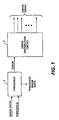
- Figure 1 illustrates a typical error diffusion circuit.
- image data is fed into a threshold circuit 1 along with a threshold value.
- the threshold circuit 1 compares the image data with the threshold value to determine whether the image data is equal to or greater than the threshold value. In a binarization case, if the image data is greater than or equal to the threshold value, the threshold circuit 1 outputs image data equal to a logical 1 value. On the other hand, if the image data is less than the threshold value, the threshold circuit 1 outputs a logical 0 value.
- an error value is generated by the threshold circuit 1.
- This error value is fed into an error distribution circuit 3 wherein the error term is multiplied by a plurality of weighting coefficients, wherein each weighting coefficient is associated with a certain pixel that is to receive a portion of the error value.
- the error distribution circuit 3 distributes the error generated by the threshold circuit 1 to pixels which are adjacent to the pixel being presently processed according to a set of weighting coefficients.
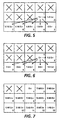
- FIGS 7-9 show known distribution and weighting schemes. The distinction between the weighting and distribution schemes shown is in the size of the error distribution matrix or number of neighboring pixels over which error is distributed, which also requires somewhat different weighting schemes. In these Figures, as well as in other Figures showing error diffusion matrices, each cell shows the weighting value.
- the set of weighting coefficients for the error diffusion process is selected in the design stage wherein the same weighting coefficients are used in processing all image types.
- a problem noted with the selection of a single set of error diffusion weighting coefficients for a standard error diffusion algorithm is production of different artifacts in regions of differing image types or image processing operations. These artifacts can affect the appearance quality of the image being rendered because the selection of the set of weighing coefficients results from the balancing of desired image quality for a particular image type and the actual image quality generated by the image rendering device.
- one set of weighing coefficients may produce a high quality image for halftone images, but render an image of lower quality for text data; whereas another set of weighing coefficients may render a high quality image for continuous tone image data, but render an image of lower quality for halftone image data.
- an error diffusion process which is capable of optimizing the image quality for all different types of image characteristics and image types.
- the IEEE Global Telecommunications Conference, Globecom' 91, conference record, volume 1, pages 104 to 109 describe a system which uses error diffusion techniques when quantizing images.
- the system scales the error which is diffused to adjacent pixels depending on the image segmentation variable of the pixel from which the error is derived.
- One aspect of the present invention is a method for diffusing an error generated from thresholding a grey level value representing a pixel.
- the method determines an image characteristic of an area of the image containing the pixel and thresholds the pixel.
- An error value is generated as a result of the threshold process.
- a set of weighting coefficients is selected from a plurality of possible weighting coefficient sets based on the image characteristic of the pixel and the error value is diffused to adjacent pixels based on the selected set of weighting coefficients.
- a second aspect of the present invention is a system for diffusing an error generated from thresholding a grey level value representing a pixel.
- the system includes image segmentation means for determining an image characteristic of an area of the image containing the pixel and threshold means for thresholding the pixel and for generating an error value as a result of the thresholding process.
- Coefficient means operatively connected to the image segmentation means, generates a set of weighting coefficients from a plurality of possible weighting coefficients based on the image characteristic of the pixel.
- Diffusing means operatively connected to the threshold means and coefficient means, diffuses the error value to adjust pixels based on the generated set of weighting coefficients.
- a third aspect of the present invention is a method of binarizing a multi-level pixel.
- the method identifies areas of an image to be processed by a set of first image processing operations and areas of the image to be processed by a set of second image processing operations.
- the multi-level pixel is processed with the set of first image processing operations when the multi-level pixel is in an area identified as to be processed by the set of first image processing operations and an error and binary value are generated therefrom.
- the multi-level pixel is processed with the set of second image processing operations when the multi-level pixel is in an area identified as to be processed by the set of second image processing operations and an error and binary value are generated therefrom.
- a weighted portion of the error is diffused to unprocessed pixels based on a first set of weighting coefficients when the multi-level pixel is processed by the set of first image processing operations.
- a weighted portion of the error is diffused to unprocessed pixels based on a second set of weighting coefficients when the multi-level pixel is processed by the set of second image processing operations.
- a fourth aspect of the present invention is a printing system for rendering marks on a receiving medium.
- the system includes receiving means for receiving a pixel having a first resolution and first image processing means for screening the pixel with a predetermined screen.
- Second image processing means converts the pixel to a second resolution higher than the first resolution and third image processing means binarizes the pixel so as to output a binary signal and an error, the error having a resolution equal to the first resolution.
- Image segmentation means operatively connected to the receiving means, the first image processing means, the second image processing means, and the third image processing means, determines an image characteristic of an area of the image containing the pixel and controls the operations of the first, second and third image processing means.
- Coefficients means operatively connected to the image segmentation means, generates a first set of weighting coefficients when the first, second and third image processing means are operated in sequence and generates a second set of weighting coefficients when the second and third image processing means are operated in sequence and the first image processing means is rendered nonoperational by the image segmentation means.
- Diffusing means operatively connected to the coefficients means, diffuses the error to adjacent pixels based on the set of weighting coefficients generated by the coefficients means, and rendering means converts the binary signal into a mark on the receiving medium.
- the video signal has a value and a range between 0 and 255.
- any range for the video signal can be utilized in conjunction with the present invention.
- grey level will be used to described both black and white and color applications.
- the terms pixel and subpixel will be utilized. These terms may refer to an electrical (or optical, if fiber optics are used) signal which represents the physically measurable optical properties at a physically definable area on a receiving medium.
- the receiving medium can be any tangible document, photoreceptor, or marking material transfer medium.
- the terms pixel and subpixel may refer to an electrical (or optical, if fiber optics are used) signal which represents the physically measurable optical properties at a physically definable area on a display medium.
- a plurality of the physically definable areas for both situations represent the physically measurable optical properties of an entire physical image to be rendered by either a material marking device, electrical or magnetic marking device, or optical display device.
- pixel may refer to an electrical (or optical, if fiber optics are used) signal which represents physical optical property data generated from a single photosensor cell when scanning a physical image so as to convert the physical optical properties of the physical image to an electronic or electrical representation.
- a pixel is an electrical (or optical) representation of the physical optical properties of a physical image measured at a physically definable area on an optical sensor.
- the printing of the pixel is determined by comparing a modified input video signal with a threshold value.
- the modified input video signal is a sum of an input video signal plus an accumulated error term determined from the processing of previous pixels. If the modified input video of the pixel is greater than or equal to the threshold, the output is a logical 1 value and an error term of input video signal plus the accumulated error term minus highest possible video signal value is propagated to the downstream pixels. If the modified input video signal is less than the threshold value, the logical output is 0 and an error term of the input video signal plus the accumulated error term is propagated to downstream pixels.
- the error diffusion process must be responsive to information indicating the characteristics of the image data being presently processed and be able to modify or change the distribution of the error to be propagated to downstream pixels based on this information.
- An example of such a dynamic error diffusion circuit is illustrated in Figure 2.
- a segmentation circuit 15 receives image data from a scanner or other image data producing device.
- the segmentation circuit 15 analyzes the image data to determine the characteristic of the image data or image type.
- the image data is also temporarily stored in a buffer 16.
- the segmentation circuit 15 Upon determining the image type, the segmentation circuit 15 generates an effect dataword which contains the characteristic and image type data for the particular pixel being processed.
- a more detailed description of image segmentation and the associated circuits are set forth in US-A- 4,760,463, US-A-4,780,709, US-A-4,887,163, US-A-4,897,803, US-A-4,951,231, and US-A-5,307,180.
- the effect dataword is fed into a first decoder 13 corresponding to an image processing module 14.
- Image processing module 14 receives the temporarily stored image data from buffer 16. After receiving the temporarily stored image data, the first image processing module 14 performs the appropriate image processing operations in response to the decoding of the effect dataword by decoder 13. After completion of the operations, the effect dataword is passed on to a second decoder 11 and the (non)processed image data is passed on to a second image processing module 12.
- the second decoder and second image processing module operate in essentially the same manner as the first decoder and first image processing module; except, the image processing operations of the second image processing module 12 are different from that of the first image processing module 14.
- effect dataword and (non)processed image data are propagated through a variety of decoders and associated image processing modules until all the appropriate image processing operations are being carried out.
- an image processing module may be rendered nonoperational by its associated decoder as a result of the decoding of the effect dataword. In this situation, the image data passes through the image processing module without processing, thereby outputting nonprocessed image data.
- the error diffusion circuit 5 includes a thresholding circuit and an error distribution circuit for distributing the error associated with the thresholding process.
- the distribution coefficient memory 4 stores various sets of weighting coefficients to be utilized in the error diffusion process.
- the actual set of weighting coefficients to be utilized by the error diffusion process is determined according to information received from the error diffusion decoder 7. More specifically, the set of weighting coefficients to be utilized in the error diffusion process is selected based upon the image type or image characteristic of the pixel being processed.
- the distribution coefficient memory 4 loads the properly selected set of weighting coefficients into the error diffusion circuit 5 so that the proper error terms can be propagated to downstream pixels.
- the error diffusion circuit 5 outputs image data which is capable of being rendered on an output device.
- FIG. 3 illustrates a more detailed block diagram of the error distribution circuit 5 of Figure 2.
- a threshold circuit 10 receives (non)processed image data and a threshold value. As a result of the threshold process, the threshold circuit 10 outputs image data which is capable of being rendered by an output device and error data.
- the error data is fed into an error distribution circuit 30 which distributes the error to downstream pixels according to a set of weighting coefficients.
- the actual set of weighting coefficients utilized by the error distribution circuit 30 is provided by a distribution coefficients memory 40.
- the distribution coefficient memory 40 stores various sets of weighting coefficients wherein each set of weighting coefficients is associated with a certain image type or image characteristic. The selection of the proper set of weighting coefficients is realized by receiving an address from address generator 20.
- the address generator 20 generates an address for selecting the proper set of weighting coefficients in the distribution coefficient memory 40 based on received image characteristic data. Thus, if the pixel being processed has been labeled as a halftone image, one set of weighting coefficients are selected to be utilized in the error distribution circuit 30; whereas if the pixel being processed has been identified as continuous tone data, another set of weighting coefficients are provided to the error distribution circuit 30 for proper propagation of the error terms to downstream pixels.
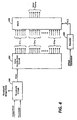
- Figure 4 illustrates another embodiment of the dynamic error diffusion process of the present invention.
- a threshold circuit 100 receives image data and threshold data.
- the threshold circuit produces image data which is capable of being rendered by an output device and character data.
- the error data is fed into an error distribution circuit 300 which has pre-loaded therein all possible sets of weighting coefficients.
- the error distribution circuit 300 produces, in parallel, all possible sets of error terms that are to be propagated to downstream pixels. This is shown by the illustration of the sets of error terms Err 1 , Err 2 ,... Err n . All the possible sets of error terms generated by the error distribution circuit are fed into a multiplexer 600 which selects the proper set of error terms to be propagated to downstream pixels.
- Decoder 500 operates in essentially the same way as the error diffusion decoder 7 of Figure 2 in that is receives the effect dataword and decodes the effect dataword to determine which set of error terms associated with a particular set of weighting coefficients are to be selected by the multiplexer to be propagated to downstream pixels.
- An image segmentation module (segmentation circuit 15 of Figure 2) is utilized to detect the type of image being presently processed. As a result of the detection, an effect dataword or pointer tag is produced for the particular image pixel value.
- This effect dataword or pointer tag is utilized in the image processing system to activate or deactivate various image processing modules (14, 12,... 9 of Figure 2).
- the effect dataword or pointer tag also includes information as to what individual image processes are to be performed by an activated image processing module.
- the image data is binarized for rendering by an output device.
- This binarization process produces an error which is to be propagated downstream.
- the propagation of the error depends on the weighting coefficients of the error diffusion process.
- the selection of the weighting coefficients can be selected based merely on the image processing operations previously performed on the pixel. For example, if a high addressability error diffusion process is performed on the pixel, the weighting coefficients illustrated in Figure 5 would be chosen in the preferred embodiment of the present invention. A full description of a high addressability error diffusion process is disclosed in EP-A-696132 corresponding to U.S. Patent Application, Serial No. 08/285,326, filed concurrently herewith.
- Another application of the concepts of the present invention is the utilization of two different error diffusion matrices, in a single image, for portions of the image which are determined to have relatively low or relatively high intensity regions, a relatively large diffusion matrix like that shown in Figure 9 can be used for the binarization process. For portions of the image which are determined to have mid-level grey values, the error diffusion matrix of Figure 8 can be used.
- the present invention has been described with respect to a video range of 0 to 255.
- the video range can be any suitable range to describe the grey level of the pixel being processed.
- the present invention is readily applicable to any rendering system, not necessarily a binary output device. It is contemplated that the concepts of the present invention are readily applicable to a four-level output terminal or higher.
- the present invention has been described as having the set of weighting coefficients prestored in a memory device, such as a ROM or EPROM, but the present invention also contemplates the utilization of a processor which performs a predetermined algorithm to generate the set of weighting coefficients, and thus the utilization of a large look-up table can be avoided.
- the present invention has been described with respect to a monochrome or black/white environment.
- the concepts of the present invention are readily applicable to a color environment. Namely, the dynamic error diffusion process of the present invention can be applied to each color space value representing the color pixel.
Landscapes
- Engineering & Computer Science (AREA)
- Multimedia (AREA)
- Signal Processing (AREA)
- Facsimile Image Signal Circuits (AREA)
- Image Processing (AREA)
Claims (6)
- Verfahren für die Diffusion eines Fehlers, der beim Schwellenwertvergleich eines Graustufenwertes, der ein Pixel darstellt, generiert wird, das die folgenden Schritte umfasst:a) Bestimmen einer Bildeigenschaft eines Bereiches des Bildes, das das Pixel enthält;b) Ausführen von Schwellenwertvergfeich für das Pixel;c) Generieren eines Fehlerwertes als Ergebnis des Schwellenwertvergleich-Vorgangs in dem Schritt b);d) Auswählen einer Gruppe von Gewichtungskoeffizienten aus einer Vielzahl möglicher Sätze von Gewichtungskoeffizienten auf der Grundlage der Bildeigenschaft des Pixels; unde) Diffusion des Fehlerwertes auf angrenzende Pixel auf der Grundlage des ausgewählten Satzes von Gewichtungskoeffizienten.
- Verfahren nach Anspruch 1, wobei es sich bei der Bildeigenschaft um 1. eine Bildtyp- oder 2. eine Bilddichteinformation handelt.
- System für die Diffusion eines Fehlers, der beim Schwellenwertvergleich eines Graustufenwertes generiert wird, der ein Pixel darstellt, das umfasst:eine Bildsegmentierungseinrichtung (15), die eine Bildeigenschaft eines Bereiches des Bildes bestimmt, das das Pixel enthält;eine Schwellenwertvergleichseinrichtung (10), die Schwellenwertvergleich für das Pixel ausführt und einen Fehlerwert als Ergebnis des Schwellenwertvergleich-Vorgangs ausführt;eine Koeffizienteneinrichtung (20, 40), die funktionell mit der Bildsegmentierungseinrichtung verbunden ist und einen Satz von Gewichtungskoeffizienten aus einer Vielzahl möglicher Sätze von Gewichtungskoeffizienten auf der Grundlage der Bildeigenschaft des Pixels generiert; undeine Diffusionseinrichtung (30), die funktionell mit der Schwellenwertvergleichseinrichtung und der Koeffizienteneinrichtung verbunden ist und Diffusion des Fehlerwertes auf angrenzende Pixel auf der Grundlage des generierten Satzes von Gewichtungskoeffizienten ausführt.
- System nach Anspruch 3, wobei die Bildsegmentierungseinrichtung (15) ermittelt: 1. ob das Pixel innerhalb des Bildes Text, Halbton (continuous tone) oder Raster (half tone) ist, so dass die Bildeigenschaft einen festgestellten Bildtyp reflektiert, oder 2. eine Bilddichte des Pixels innerhalb des Bildes, so dass die Bildeigenschaft eine festgestellte Dichte reflektiert.
- Verfahren zum Digitalisieren eines Mehrstufen-Pixels, das die folgenden Schritte umfasst:a) Identifizieren von Bereichen eines Bildes, die mit einem Satz erster Bildverarbeitungsvorgänge zu verarbeiten sind, und Bereichen des Bildes, die mit einem Satz zweiter Bildverarbeitungsvorgänge zu verarbeiten sind;b) Verarbeiten des Mehrstufen-Pixels mit dem Satz erster Bildverarbeitungsvorgänge, wenn das Mehrstufen-Pixel in einem Bereich liegt, der der Identifizierung zufolge mit dem Satz erster Bildverarbeitungsvorgänge zu verarbeiten ist, und Generieren eines Fehlers sowie eines Binärwertes daraus;c) Verarbeiten des Mehrstufen-Pixels mit dem Satz zweiter Bildverarbeitungsvorgänge, wenn das Mehrstufen-Pixel in einem Bereich liegt, der der Identifizierung zufolge mit dem Satz zweiter Bildverarbeitungsvorgänge zu verarbeiten ist, und Generieren eines Fehlers und eines Binärwertes daraus;d) Verteilen eines gewichteten Teils des Fehlers auf unverarbeitete Pixel auf der Grundlage eines ersten Satzes von Gewichtungskoeffizienten, wenn das Mehrstufen-Pixel mit dem Schritt b) verarbeitet wird; unde) Verteilen eines gewichteten Teils des Fehlers auf unverarbeitete Pixel auf der Grundlage eines zweiten Satzes von Gewichtungskoeffizienten, wenn das Mehrstufen-Pixel mit dem Schritt c) verarbeitet wird.
- Drucksystem zum Wiedergeben von Zeichen auf einem Aufnahmemedium, das umfasst:eine Empfangseinrichtung, die ein Pixel mit einer ersten Auflösung empfängt;eine erste Bildverarbeitungseinrichtung (14), die das Pixel mit einem vorgegebenen Raster rastert;eine zweite Bildverarbeitungseinrichtung (12), die das Pixel in eine zweite Aufiösung umwandelt, die höher ist als die erste Auflösung;eine dritte Bildverarbeitungseinrichtung (9), die das Pixel digitalisiert und ein Binärsignal und einen Fehler ausgibt, wobei der Fehler eine Auflösung hat, die der ersten Auflösung entspricht;eine Bildsegmentierungseinrichtung (15), die funktionell mit der Empfangseinrichtung, der ersten Bildverarbeitungseinrichtung, der zweiten Bildverarbeitungseinrichtung und der dritten Bildverarbeitungseinrichtung verbunden ist und eine Bildeigenschaft eines Bereiches des Bildes bestimmt, das das Pixel enthält und Funktionen der ersten, der zweiten und der dritten Bildverarbeitungseinrichtung steuert;eine Koeffizienteneinrichtung (20, 40), die funktionell mit der Bildsegmentierungseinrichtung verbunden ist und einen ersten Satz von Gewichtunaskoeffizienten generiert, wenn die erste, die zweite und die dritte Bildverarbeitungseinrichtung in Folge betätigt werden und einen zweiten Satz von Gewichtungskoeffizienten generiert, wenn die zweite und die dritte Bildverarbeitungseinrichtung in Folge betätigt werden und die erste Bildverarbeitungseinrichtung durch die Bildsegmentierungseinrichtung unwirksam gemacht wird;eine Diffusionseinrichtung (30), die funktionell mit der Koeffizienteneinrichtung verbunden ist und Diffusion des Fehlers auf angrenzende Pixel auf der Grundlage des durch die Koeffizienteneinrichtung generierten Satzes von Gewichtungskoeffizienten ausführt; undeine Wiedergabeeinrichtung, die das Binärsignal in ein Zeichen auf dem Aufnahmemedium umwandelt.
Applications Claiming Priority (2)
| Application Number | Priority Date | Filing Date | Title |
|---|---|---|---|
| US285324 | 1994-08-03 | ||
| US08/285,324 US6427030B1 (en) | 1994-08-03 | 1994-08-03 | Method and system for image conversion utilizing dynamic error diffusion |
Publications (3)
| Publication Number | Publication Date |
|---|---|
| EP0696129A2 EP0696129A2 (de) | 1996-02-07 |
| EP0696129A3 EP0696129A3 (de) | 1996-12-27 |
| EP0696129B1 true EP0696129B1 (de) | 2002-04-24 |
Family
ID=23093744
Family Applications (1)
| Application Number | Title | Priority Date | Filing Date |
|---|---|---|---|
| EP95305324A Revoked EP0696129B1 (de) | 1994-08-03 | 1995-07-31 | Bildumsetzungsverfahren und -system unter Verwendung von dynamischer Fehlerdiffusion |
Country Status (5)
| Country | Link |
|---|---|
| US (2) | US6427030B1 (de) |
| EP (1) | EP0696129B1 (de) |
| JP (1) | JPH0865515A (de) |
| BR (1) | BR9503501A (de) |
| DE (1) | DE69526469T2 (de) |
Families Citing this family (45)
| Publication number | Priority date | Publication date | Assignee | Title |
|---|---|---|---|---|
| US5911009A (en) * | 1996-01-25 | 1999-06-08 | Dainippon Screen Mfg. Co., Ltd. | Method and apparatus for binary coding of image data including adding error accumulated for a target pixel and a pixel in the vicinity to be later coded |
| US5933539A (en) * | 1996-05-30 | 1999-08-03 | Xerox Corporation | Method and system for hybrid error diffusion processing of image information using programmable screen modulation |
| US5787206A (en) * | 1996-05-30 | 1998-07-28 | Xerox Corporation | Method and system for processing image information using expanded dynamic screening and error diffusion |
| US5822464A (en) * | 1996-05-30 | 1998-10-13 | Xerox Corporation | Method and system for processing image information using video dependent dampened screening and error diffusion |
| US6449061B2 (en) | 1997-09-23 | 2002-09-10 | Xerox Corporation | System and method for providing dynamic noise profile selection for hybrid and error diffusion image processing |
| AUPO995597A0 (en) * | 1997-10-23 | 1997-11-13 | Gosnell, Glenn | Halftoning method and apparatus |
| JP3548748B2 (ja) * | 1998-04-07 | 2004-07-28 | オムロン株式会社 | 画像処理装置および方法、画像処理のためのプログラムを記憶した媒体、ならびに検査装置 |
| US6519367B2 (en) * | 1998-09-23 | 2003-02-11 | Xerox Corporation | Method and system for propagating selective amounts of error in a hybrid screening device |
| US6501564B1 (en) * | 1999-05-07 | 2002-12-31 | Hewlett-Packard Company | Tone dependent plane dependent error diffusion halftoning |
| US6563957B1 (en) * | 1999-05-07 | 2003-05-13 | Hewlett-Packard Company | Tone dependent error diffusion |
| JP2001157056A (ja) * | 1999-11-30 | 2001-06-08 | Fujitsu Ltd | ハーフトーン化方法およびハーフトーン化装置並びにハーフトーン化プログラムを記録したコンピュータ読み取り可能な記録媒体 |
| US6744534B1 (en) * | 2000-05-02 | 2004-06-01 | Xerox Corporation | Robust colorimetry transform |
| US7221381B2 (en) * | 2001-05-09 | 2007-05-22 | Clairvoyante, Inc | Methods and systems for sub-pixel rendering with gamma adjustment |
| JP4797308B2 (ja) * | 2001-09-27 | 2011-10-19 | ブラザー工業株式会社 | 画像処理装置及び画像処理プログラム |
| US7061645B2 (en) * | 2001-09-27 | 2006-06-13 | Sharp Laboratories Of America, Inc. | Non-segmentation, individual pixel-by-pixel-based image rendering system |
| US7319549B2 (en) | 2003-03-27 | 2008-01-15 | Lexmark International, Inc. | Multiple weight error diffusion |
| EP1482670A1 (de) * | 2003-05-30 | 2004-12-01 | Matsushita Electric Industrial Co., Ltd. | Verfahren und Empfänger zur Datenpufferung, welche HARQ und eine zweistufigen Ratenanpassungsmechanismus verwenden |
| US7978716B2 (en) | 2003-11-24 | 2011-07-12 | Citrix Systems, Inc. | Systems and methods for providing a VPN solution |
| KR100646293B1 (ko) | 2004-04-14 | 2006-11-23 | 엘지전자 주식회사 | 플라즈마 디스플레이 패널의 화상처리 방법 |
| US8739274B2 (en) | 2004-06-30 | 2014-05-27 | Citrix Systems, Inc. | Method and device for performing integrated caching in a data communication network |
| US7757074B2 (en) | 2004-06-30 | 2010-07-13 | Citrix Application Networking, Llc | System and method for establishing a virtual private network |
| US8495305B2 (en) | 2004-06-30 | 2013-07-23 | Citrix Systems, Inc. | Method and device for performing caching of dynamically generated objects in a data communication network |
| CN101199187A (zh) | 2004-07-23 | 2008-06-11 | 茨特里克斯系统公司 | 用于网络节点之间通信最优化的系统和方法 |
| KR20070045282A (ko) | 2004-07-23 | 2007-05-02 | 사이트릭스 시스템스, 인크. | 네트워크 노드 간의 통신을 최적화하기 위한 시스템 및방법 |
| US7639887B2 (en) * | 2004-12-14 | 2009-12-29 | Intel Corporation | Error diffusion-based image processing |
| US8549149B2 (en) | 2004-12-30 | 2013-10-01 | Citrix Systems, Inc. | Systems and methods for providing client-side accelerated access to remote applications via TCP multiplexing |
| US8706877B2 (en) * | 2004-12-30 | 2014-04-22 | Citrix Systems, Inc. | Systems and methods for providing client-side dynamic redirection to bypass an intermediary |
| US7810089B2 (en) | 2004-12-30 | 2010-10-05 | Citrix Systems, Inc. | Systems and methods for automatic installation and execution of a client-side acceleration program |
| US8954595B2 (en) | 2004-12-30 | 2015-02-10 | Citrix Systems, Inc. | Systems and methods for providing client-side accelerated access to remote applications via TCP buffering |
| US8700695B2 (en) | 2004-12-30 | 2014-04-15 | Citrix Systems, Inc. | Systems and methods for providing client-side accelerated access to remote applications via TCP pooling |
| US8255456B2 (en) | 2005-12-30 | 2012-08-28 | Citrix Systems, Inc. | System and method for performing flash caching of dynamically generated objects in a data communication network |
| US7787703B2 (en) * | 2005-05-11 | 2010-08-31 | Xerox Corporation | Method and system for extending binary image data to contone image data |
| US7724981B2 (en) * | 2005-07-21 | 2010-05-25 | Ancestry.Com Operations Inc. | Adaptive contrast control systems and methods |
| US7826096B2 (en) * | 2005-09-16 | 2010-11-02 | Fujifilm Corporation | Image processing method and image recording apparatus |
| US7773254B2 (en) * | 2005-11-10 | 2010-08-10 | Xerox Corporation | Method and system for improved copy quality in a multifunction reprographic system |
| US7869093B2 (en) * | 2005-11-17 | 2011-01-11 | Xerox Corporation | Method and system for improved copy quality in a multifunction reprographic system |
| US8301839B2 (en) | 2005-12-30 | 2012-10-30 | Citrix Systems, Inc. | System and method for performing granular invalidation of cached dynamically generated objects in a data communication network |
| US7921184B2 (en) | 2005-12-30 | 2011-04-05 | Citrix Systems, Inc. | System and method for performing flash crowd caching of dynamically generated objects in a data communication network |
| JP4777185B2 (ja) * | 2006-08-08 | 2011-09-21 | キヤノン株式会社 | 画像処理装置及びその制御方法、並びに、コンピュータプログラム及びコンピュータ可読記憶媒体、及び、画像符号化装置 |
| US20080049238A1 (en) * | 2006-08-28 | 2008-02-28 | Xerox Corporation | Method and system for automatic window classification in a digital reprographic system |
| US9460491B2 (en) * | 2008-08-25 | 2016-10-04 | Xerox Corporation | Method for binary to contone conversion with non-solid edge detection |
| US9633458B2 (en) * | 2012-01-23 | 2017-04-25 | Nvidia Corporation | Method and system for reducing a polygon bounding box |
| US9215345B2 (en) | 2013-03-26 | 2015-12-15 | Xerox Corporation | Method and system for inverse halftoning utilizing inverse projection of predicted errors |
| CN105635523B (zh) * | 2015-12-30 | 2018-08-10 | 珠海赛纳打印科技股份有限公司 | 图像处理方法、图像处理装置及图像形成设备 |
| WO2020046302A1 (en) | 2018-08-30 | 2020-03-05 | Hewlett-Packard Development Company, L.P. | Error diffusion for printing |
Family Cites Families (22)
| Publication number | Priority date | Publication date | Assignee | Title |
|---|---|---|---|---|
| EP0031247B1 (de) * | 1979-12-20 | 1984-03-14 | Cambridge Consultants Limited | Vorrichtung und Verfahren zur Herstellung eines aus Streupunkten bestehenden Halbtonbildes aus einem Normalbild |
| US4760463A (en) * | 1985-12-07 | 1988-07-26 | Kabushiki Kaisha Toshiba | Image scanner apparatus with scanning function |
| US4780709A (en) * | 1986-02-10 | 1988-10-25 | Intel Corporation | Display processor |
| EP0249661B1 (de) * | 1986-06-16 | 1991-08-21 | International Business Machines Corporation | Bilddatenanzeigesystem |
| US4924332A (en) * | 1986-08-08 | 1990-05-08 | Dictaphone Corporation | Display for modular dictation/transcription system |
| GB2194117B (en) * | 1986-08-14 | 1991-05-01 | Canon Kk | Image processing apparatus |
| US4829587A (en) * | 1987-03-02 | 1989-05-09 | Digital Equipment Corporation | Fast bitonal to gray scale image scaling |
| US4955065A (en) * | 1987-03-17 | 1990-09-04 | Digital Equipment Corporation | System for producing dithered images from continuous-tone image data |
| US4897803A (en) * | 1987-11-23 | 1990-01-30 | Xerox Corporation | Address token based image manipulation |
| US4924322A (en) | 1988-03-18 | 1990-05-08 | Matsushita Electric Industrial Co., Ltd. | Bi-level image display signal processing apparatus |
| US5289293A (en) * | 1989-03-14 | 1994-02-22 | Canon Kabushiki Kaisha | Pixel density conversion and processing |
| JPH0380767A (ja) * | 1989-08-24 | 1991-04-05 | Ricoh Co Ltd | 画像の階調記録装置 |
| US5410615A (en) * | 1990-09-25 | 1995-04-25 | Xerox Corporation | Bitmap image resolution converter compensating for write-white xerographic laser printing |
| JPH04119763A (ja) * | 1990-09-11 | 1992-04-21 | Toshiba Corp | 画像処理装置 |
| JP3031994B2 (ja) * | 1990-11-16 | 2000-04-10 | 株式会社東芝 | 画像処理装置 |
| JPH07101917B2 (ja) * | 1991-05-14 | 1995-11-01 | 富士ゼロックス株式会社 | 領域制御装置 |
| US5258854A (en) * | 1991-12-06 | 1993-11-02 | Xerox Corporation | Converting between write-white, write-black and neutral bitmaps |
| KR940005247B1 (ko) * | 1991-12-07 | 1994-06-15 | 삼성전자 주식회사 | 화상처리 시스템의 해상도 변환방법 |
| US5307180A (en) * | 1991-12-18 | 1994-04-26 | Xerox Corporation | Method and apparatus for controlling the processing of digital image signals |
| US5321525A (en) * | 1992-12-14 | 1994-06-14 | Xerox Corporation | Clustered halftoning with dot-to-dot error diffusion |
| JP3240803B2 (ja) * | 1994-02-14 | 2001-12-25 | セイコーエプソン株式会社 | 画像処理装置および画像処理方法 |
| US5696601A (en) * | 1994-08-03 | 1997-12-09 | Xerox Corporation | System and method for redistributing error values from an error diffusion process |
-
1994
- 1994-08-03 US US08/285,324 patent/US6427030B1/en not_active Expired - Lifetime
-
1995
- 1995-07-27 JP JP7192019A patent/JPH0865515A/ja active Pending
- 1995-07-31 BR BR9503501A patent/BR9503501A/pt not_active IP Right Cessation
- 1995-07-31 EP EP95305324A patent/EP0696129B1/de not_active Revoked
- 1995-07-31 DE DE69526469T patent/DE69526469T2/de not_active Revoked
-
1997
- 1997-11-26 US US08/979,320 patent/US6144775A/en not_active Expired - Lifetime
Also Published As
| Publication number | Publication date |
|---|---|
| EP0696129A3 (de) | 1996-12-27 |
| JPH0865515A (ja) | 1996-03-08 |
| BR9503501A (pt) | 1996-05-21 |
| EP0696129A2 (de) | 1996-02-07 |
| US6144775A (en) | 2000-11-07 |
| DE69526469T2 (de) | 2002-10-24 |
| DE69526469D1 (de) | 2002-05-29 |
| US6427030B1 (en) | 2002-07-30 |
Similar Documents
| Publication | Publication Date | Title |
|---|---|---|
| EP0696129A2 (de) | Bildumsetzungsverfahren und -system unter Verwendung von dynamischer Fehlerdiffusion | |
| US6285464B1 (en) | Apparatus and method for producing a half-tone image | |
| US5535019A (en) | Error diffusion halftoning with homogeneous response in high/low intensity image regions | |
| EP0648040B1 (de) | Bildabhängige Belichtungsverbesserung | |
| JP3313399B2 (ja) | 画像処理装置 | |
| AU635676B2 (en) | Image processing apparatus | |
| EP0774856B1 (de) | System und Verfahren für ein hochadressierbares Drucksystem | |
| US5343283A (en) | Scan/print system for performing image processing and an image selection unit for use in the scan/print system | |
| US5289294A (en) | Image processing apparatus | |
| US5177795A (en) | Image processing apparatus | |
| US6519367B2 (en) | Method and system for propagating selective amounts of error in a hybrid screening device | |
| JP2000032278A (ja) | 画像処理装置 | |
| US5742708A (en) | Method and system for performing perspective projection conversion | |
| US4996602A (en) | Image-processing apparatus | |
| US6552824B2 (en) | Method of processing pixels with binary or multibit error diffusion | |
| US6307647B1 (en) | Digital halftoning with error diffusion | |
| EP0696131B1 (de) | Verfahren und Gerät zur Bildinformationsverarbeitung unter Verwendung von Rasterung und Fehlerdiffusion | |
| JP3083673B2 (ja) | 像域識別装置 | |
| US6385344B2 (en) | Image processing apparatus | |
| US6411735B1 (en) | Method and apparatus for distinguishing between noisy continuous tone document types and other document types to maintain reliable image segmentation | |
| US6078405A (en) | Image processing device | |
| US6870640B1 (en) | Method and apparatus for rendering a continuous tone image representation with multiple digital halftoning | |
| JPS6080365A (ja) | 疑似中間調画像処理装置 | |
| KR930007979B1 (ko) | 중간조 화상 표현방법 | |
| KR0136120B1 (ko) | 중간조 영상 추출 방법 |
Legal Events
| Date | Code | Title | Description |
|---|---|---|---|
| PUAI | Public reference made under article 153(3) epc to a published international application that has entered the european phase |
Free format text: ORIGINAL CODE: 0009012 |
|
| AK | Designated contracting states |
Kind code of ref document: A2 Designated state(s): DE FR GB |
|
| PUAL | Search report despatched |
Free format text: ORIGINAL CODE: 0009013 |
|
| AK | Designated contracting states |
Kind code of ref document: A3 Designated state(s): DE FR GB |
|
| 17P | Request for examination filed |
Effective date: 19970627 |
|
| 17Q | First examination report despatched |
Effective date: 19990728 |
|
| GRAG | Despatch of communication of intention to grant |
Free format text: ORIGINAL CODE: EPIDOS AGRA |
|
| GRAG | Despatch of communication of intention to grant |
Free format text: ORIGINAL CODE: EPIDOS AGRA |
|
| GRAH | Despatch of communication of intention to grant a patent |
Free format text: ORIGINAL CODE: EPIDOS IGRA |
|
| REG | Reference to a national code |
Ref country code: GB Ref legal event code: IF02 |
|
| GRAH | Despatch of communication of intention to grant a patent |
Free format text: ORIGINAL CODE: EPIDOS IGRA |
|
| GRAA | (expected) grant |
Free format text: ORIGINAL CODE: 0009210 |
|
| AK | Designated contracting states |
Kind code of ref document: B1 Designated state(s): DE FR GB |
|
| REG | Reference to a national code |
Ref country code: GB Ref legal event code: FG4D |
|
| REF | Corresponds to: |
Ref document number: 69526469 Country of ref document: DE Date of ref document: 20020529 |
|
| PGFP | Annual fee paid to national office [announced via postgrant information from national office to epo] |
Ref country code: DE Payment date: 20020807 Year of fee payment: 8 |
|
| ET | Fr: translation filed | ||
| PLBQ | Unpublished change to opponent data |
Free format text: ORIGINAL CODE: EPIDOS OPPO |
|
| PLBI | Opposition filed |
Free format text: ORIGINAL CODE: 0009260 |
|
| PLBF | Reply of patent proprietor to notice(s) of opposition |
Free format text: ORIGINAL CODE: EPIDOS OBSO |
|
| 26 | Opposition filed |
Opponent name: OCE-TECHNOLOGIES B.V. Effective date: 20030122 |
|
| PLBF | Reply of patent proprietor to notice(s) of opposition |
Free format text: ORIGINAL CODE: EPIDOS OBSO |
|
| RDAH | Patent revoked |
Free format text: ORIGINAL CODE: EPIDOS REVO |
|
| PGFP | Annual fee paid to national office [announced via postgrant information from national office to epo] |
Ref country code: FR Payment date: 20030711 Year of fee payment: 9 |
|
| PGFP | Annual fee paid to national office [announced via postgrant information from national office to epo] |
Ref country code: GB Payment date: 20030730 Year of fee payment: 9 |
|
| RDAG | Patent revoked |
Free format text: ORIGINAL CODE: 0009271 |
|
| STAA | Information on the status of an ep patent application or granted ep patent |
Free format text: STATUS: PATENT REVOKED |
|
| 27W | Patent revoked |
Effective date: 20030613 |
|
| GBPR | Gb: patent revoked under art. 102 of the ep convention designating the uk as contracting state |
Free format text: 20030613 |