EP0696154A2 - Verfahren zum optimalen Zuordnen von Betriebsmitteln für den Datenflusstransport mit variabler Bandbreite in ATM-Netzen, und Querverbinungsknoten zur Anwendung dieses Verfahrens - Google Patents
Verfahren zum optimalen Zuordnen von Betriebsmitteln für den Datenflusstransport mit variabler Bandbreite in ATM-Netzen, und Querverbinungsknoten zur Anwendung dieses Verfahrens Download PDFInfo
- Publication number
- EP0696154A2 EP0696154A2 EP95111627A EP95111627A EP0696154A2 EP 0696154 A2 EP0696154 A2 EP 0696154A2 EP 95111627 A EP95111627 A EP 95111627A EP 95111627 A EP95111627 A EP 95111627A EP 0696154 A2 EP0696154 A2 EP 0696154A2
- Authority
- EP
- European Patent Office
- Prior art keywords
- virtual
- node
- output
- paths
- cross
- Prior art date
- Legal status (The legal status is an assumption and is not a legal conclusion. Google has not performed a legal analysis and makes no representation as to the accuracy of the status listed.)
- Withdrawn
Links
- 238000000034 method Methods 0.000 title claims description 27
- 238000013468 resource allocation Methods 0.000 title description 2
- 238000007493 shaping process Methods 0.000 claims abstract description 26
- 230000015654 memory Effects 0.000 claims description 26
- 239000000872 buffer Substances 0.000 claims description 16
- 101000702718 Homo sapiens Phosphatidylcholine:ceramide cholinephosphotransferase 1 Proteins 0.000 claims description 8
- 102100030919 Phosphatidylcholine:ceramide cholinephosphotransferase 1 Human genes 0.000 claims description 8
- 101000825940 Homo sapiens Phosphatidylcholine:ceramide cholinephosphotransferase 2 Proteins 0.000 claims description 7
- 102100022771 Phosphatidylcholine:ceramide cholinephosphotransferase 2 Human genes 0.000 claims description 7
- 238000012545 processing Methods 0.000 claims description 6
- 238000003780 insertion Methods 0.000 claims description 4
- 230000037431 insertion Effects 0.000 claims description 4
- 230000006870 function Effects 0.000 description 11
- 238000010586 diagram Methods 0.000 description 10
- 238000007726 management method Methods 0.000 description 6
- 238000004891 communication Methods 0.000 description 5
- 230000007246 mechanism Effects 0.000 description 4
- 238000000926 separation method Methods 0.000 description 3
- 238000011161 development Methods 0.000 description 2
- 238000012546 transfer Methods 0.000 description 2
- 239000002699 waste material Substances 0.000 description 2
- 101100168934 Arabidopsis thaliana C/VIF1 gene Proteins 0.000 description 1
- 101100314406 Saccharomyces cerevisiae (strain ATCC 204508 / S288c) TPS1 gene Proteins 0.000 description 1
- 238000004458 analytical method Methods 0.000 description 1
- 230000005540 biological transmission Effects 0.000 description 1
- 230000006727 cell loss Effects 0.000 description 1
- 238000006243 chemical reaction Methods 0.000 description 1
- 101150100265 cif-1 gene Proteins 0.000 description 1
- 230000000295 complement effect Effects 0.000 description 1
- 239000012141 concentrate Substances 0.000 description 1
- 230000009977 dual effect Effects 0.000 description 1
- 230000000694 effects Effects 0.000 description 1
- 238000005516 engineering process Methods 0.000 description 1
- 239000000284 extract Substances 0.000 description 1
- 238000000605 extraction Methods 0.000 description 1
- 238000009499 grossing Methods 0.000 description 1
- 230000001788 irregular Effects 0.000 description 1
- 238000012986 modification Methods 0.000 description 1
- 230000004048 modification Effects 0.000 description 1
- 238000012544 monitoring process Methods 0.000 description 1
- 230000004043 responsiveness Effects 0.000 description 1
- 230000003068 static effect Effects 0.000 description 1
Images


Classifications
-
- H—ELECTRICITY
- H04—ELECTRIC COMMUNICATION TECHNIQUE
- H04L—TRANSMISSION OF DIGITAL INFORMATION, e.g. TELEGRAPHIC COMMUNICATION
- H04L12/00—Data switching networks
- H04L12/54—Store-and-forward switching systems
- H04L12/56—Packet switching systems
- H04L12/5601—Transfer mode dependent, e.g. ATM
- H04L12/5602—Bandwidth control in ATM Networks, e.g. leaky bucket
-
- H—ELECTRICITY
- H04—ELECTRIC COMMUNICATION TECHNIQUE
- H04Q—SELECTING
- H04Q11/00—Selecting arrangements for multiplex systems
- H04Q11/04—Selecting arrangements for multiplex systems for time-division multiplexing
- H04Q11/0428—Integrated services digital network, i.e. systems for transmission of different types of digitised signals, e.g. speech, data, telecentral, television signals
- H04Q11/0478—Provisions for broadband connections
-
- H—ELECTRICITY
- H04—ELECTRIC COMMUNICATION TECHNIQUE
- H04L—TRANSMISSION OF DIGITAL INFORMATION, e.g. TELEGRAPHIC COMMUNICATION
- H04L12/00—Data switching networks
- H04L12/54—Store-and-forward switching systems
- H04L12/56—Packet switching systems
- H04L12/5601—Transfer mode dependent, e.g. ATM
- H04L2012/5603—Access techniques
- H04L2012/5609—Topology
- H04L2012/561—Star, e.g. cross-connect, concentrator, subscriber group equipment, remote electronics
-
- H—ELECTRICITY
- H04—ELECTRIC COMMUNICATION TECHNIQUE
- H04L—TRANSMISSION OF DIGITAL INFORMATION, e.g. TELEGRAPHIC COMMUNICATION
- H04L12/00—Data switching networks
- H04L12/54—Store-and-forward switching systems
- H04L12/56—Packet switching systems
- H04L12/5601—Transfer mode dependent, e.g. ATM
- H04L2012/5619—Network Node Interface, e.g. tandem connections, transit switching
-
- H—ELECTRICITY
- H04—ELECTRIC COMMUNICATION TECHNIQUE
- H04L—TRANSMISSION OF DIGITAL INFORMATION, e.g. TELEGRAPHIC COMMUNICATION
- H04L12/00—Data switching networks
- H04L12/54—Store-and-forward switching systems
- H04L12/56—Packet switching systems
- H04L12/5601—Transfer mode dependent, e.g. ATM
- H04L2012/5629—Admission control
- H04L2012/5631—Resource management and allocation
- H04L2012/5632—Bandwidth allocation
Definitions
- the invention described herein relates to ATM networks and in particular concerns a method for the optimal resource allocation for the transport of variable-bandwidth data flows in one of such networks, and a cross-connect node which utilizes the method.
- the commonly adopted solution to this problem entails the realization of private networks based on the use of leased dedicated lines.
- the data traffic generated in the interconnection of local area networks has a typically bursty (or variable-bandwidth) profile; this may lead to a scarcely efficient and flexible use of dedicated resources, so that it may be difficult to amortize the cost involved, which is quite high.
- a possible alternative could be the use of high bit-rate ATM networks, which are particularly well suited to deal with variable bandwidth traffic and also constitute, for the user, a more economical option than leased lines.
- the public operator of the ATM network could provide a broadband virtual private network within the public network.
- the purpose of the invention is to provide a method which allows an optimal utilization of network resources and guarantees an adequate performance level on message transfer, in the presence of data flows characterized by a highly irregular traffic profile.
- a method which is applied to data flows composed of ATM cells carried along the network through virtual channels grouped into virtual paths, and in which a peak bandwidth is assigned to the virtual paths during the connection set-up and, in correspondence with each node, traffic is policed at the node input and output, to prevent traffic coming from different virtual paths and directed to the same virtual path egressing the node from exceeding the node capacity, and the traffic itself is shaped, to render the emission of cells related to a given virtual path as uniform as possible, the method being characterized in that: the flow of ATM cells makes two consecutive passes through the node connection network, such that: in the first pass the virtual channels of the input virtual paths are distributed among intermediate bundles of virtual channels each with an overall peak bandwidth equal to the bandwidth of the virtual path of origin of the contributing channels; between the first and the second pass, a cross-connection of the virtual channels and a temporary memorization of the related cells is performed, by introducing such cells in service queues associated with the output virtual paths, together with a shaping of the cell flow to
- temporary memorization and shaping are realized in a device inserted between the outputs and the inputs of the node connection network.
- the intermediate bundles of virtual channels built in the first cross-connection phase shall be obtained by cross-connecting the input virtual channels, or by cross-connecting both virtual paths and virtual channels, in such a way that all the virtual channels that are to be transferred to the output virtual paths served by a unit reach the unit itself.
- each virtual path active on a node output is allocated an overall bandwidth, multiple of an elementary bandwidth, and the cells of the corresponding queue are read according to a frame formed by a number of time intervals equal to the number of elementary bandwidths necessary to form the overall bandwidth.
- the invention also provides a node in which the cross-connection is accomplished according to the above method, the node including a connection network and means for the temporary memorization of the cells to be routed along the output virtual paths and for traffic shaping, to render the emission of cells related to a given virtual path as uniform as possible, characterized in that the means for temporary memorization and traffic shaping are connected between a group of outputs and a group of inputs of the connection network and are arranged to:
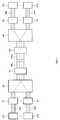
- an ATM network has been represented with a certain number of users UT1...UTh, UTk...UTn and a certain number of cross-connect nodes Na...Nm.
- the "users" can be, for instance, local area networks supporting the communication services of different branches of the same company.
- ATM cells into which a data transmission is organized leave the users or reach the users through virtual channels; virtual channels are then grouped according to certain logical criteria into virtual paths VP1...VPh, VPk...VPn.
- virtual channels are indicated in dashed lines within virtual paths. For the sake of simplicity, only one virtual path VPa outgoing from Na and only one virtual path VPm entering Nm have been indicated.
- the association between the various virtual channels and the physical links over which they are physically conveyed has not been considered.
- the same virtual path VP1...VPh, VPk...VPn will group, for example, all virtual channels outgoing from a user or respectively directed to a user. It is up to the user to manage the virtual channel bandwidth within a virtual path.
- such management is based on statistical multiplexing criteria (i.e. the bandwidth allocated to the different virtual channels of a virtual path varies dynamically so that in the whole the peak bandwidth of the virtual path is never exceeded) because this provides a saving on the bandwidth assigned to the virtual paths.
- the network nodes will instead control (or "police") traffic at the virtual path level: in particular, traffic will be policed at both the input and the output of the node (blocks P1...Ph, Pa, Pm, Pk...Pn) to prevent traffic coming from several input virtual paths and directed to the same output virtual path from exceeding the capacity of the latter.
- Traffic policing is a conventional function in ATM networks and it essentially consists in discarding a part of the cells when the bandwidth required for a virtual path exceeds the bandwidth established for it. This function is described for instance in ITU-T recommendation 1.371.
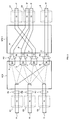
- Figure 2 represents the logic diagram of the operations of a generic node N in the network of Figure 1, when cross-connection of virtual channels and paths occurs with the criterion described in the introduction.
- a certain number of virtual paths enter the node (three in the example illustrated, indicated with A, B, C and belonging to different input links E1, E2, E3), and each virtual path is associated with a peak bandwidth Wi, indicated within the respective representative element.
- peak bandwidth is assumed to be the same (10 Mbit/s) for all virtual paths.
- the node has to cross-connect the virtual channels belonging to the different input virtual paths and to form output virtual paths D', E', F', G': those paths are conveyed by three output links U1 (path F'), U2 (D', E'), U3 (G') and each of them is allocated a bandwidth Wu which, again by way of non-limiting example, is assumed to be equal for all paths and equal to that of the input virtual paths.
- Cross-connection takes place in two phases, schematized by the node subdivision into the two blocks VCX, VPX1.
- node N acts only as a virtual channel cross-connect and redistributes the channels present in paths A, B, C among a group of intermediate virtual paths D, E, F, G.
- Each incoming channel (or each group of incoming channels that are to be transferred to the same output virtual path) is allocated its own peak bandwidth, assumed to be equal to that of the virtual path to which the channel belongs.
- the devices for policing traffic entering the node (represented by ellipses PA, PB, PC) ensure the peak bandwidth available in the virtual path is not exceeded.
- Each of the virtual paths D-G is allocated, as stated above, a bandwidth equal to the sum of the bandwidths of the contributing virtual paths. It is evident that there is a high bandwidth requirement with poor utilization: in fact, for an input flow that in the example is, on average, 10 Mbit/s, it is necessary to provide 20 or 30 Mbit/s on the output ports of the node (i.e.
- Virtual paths D, E, F, G are associated with output traffic policing devices (ellipses PD, PE, PF, PG) to limit the peak bandwidth of these virtual paths to the desired value (10 Mbit) for the output virtual paths.
- output traffic policing devices ellipses PD, PE, PF, PG
- their peak bandwidth is Wu and, in the second phase, they are made to go back into the node where they are cross-connected and multiplexed on high utilization network lines U1...U3.
- the node in this phase acts as a virtual path cross-connect VPX1.
- the problem that may arise in this second phase is that a policing device used alone attributes the responsibility for a correct bandwidth utilization to the sources taken as a whole, which may be difficult to realize as the sources are independent of each other.
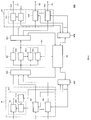
- Figure 3 is a diagram of the operation principle of node N when utilizing the invention, assuming the same association virtual paths/physical lines and the same bandwidth allocation to the input and output virtual paths already examined in connection with Figure 2. The elements also present in Figure 2 are indicated with the same references.
- the cross-connection still requires a double pass through the node, as represented schematically by the two blocks VPX2, VPX3; moreover, before the second pass, the ATM flows are processed in a temporary memorization device or statistical multiplexing server SMS, which switches the virtual paths and also performs all bandwidth control functions and statistical multiplexing on the different data flows, forming outgoing virtual paths D', E', F', G' with the required bandwidth Wu.
- the node behaves as a virtual path cross-connect and transfers incoming virtual paths A, B, C to the output ports to which device SMS is joined, while keeping unchanged the peak bandwidth assigned to the individual paths.
- Virtual paths outgoing from SMS then make the second pass in the node, as in the previous case, in order to be cross-connected on the appropriate output link.
- the packet queues for the different output virtual paths are shown schematically as BD, BE, BF, BG.
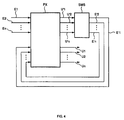
- Figure 4 represents the connection of server SMS in a node.
- the node includes a connection network PX having two groups of input and output ports.
- a certain number of the input links E1...En coming from other nodes and conveying virtual paths to be transferred over an equal number of the output links U1...Un towards other nodes arrive at a first group of input ports.
- a second group of n output links U'1...U'n is connected to the inputs of server SMS, whose outputs are connected to links E'1...E'n which are brought back to the second group of inputs of PX.
- traffic present on the input links is switched onto outputs U'1...U'n of the second group, to be processed in SMS.
- server SMS may be required to perform concentration functions.
- this element has only virtual channel switching functions.
- All incoming virtual paths including virtual channels that must be transferred to an output virtual path, and all outgoing virtual paths to which there are conveyed the virtual channels of a given incoming path must be present at the ports of server SMS. If the bandwidth of those outgoing channels exceeds the bandwidth available at the module output, the server will have to comprise several modules, each of them managing a part of the paths.
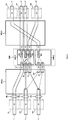
- An example of this possibility is represented in Figure 5, where the server is composed of two modules SMS1, SMS2: virtual paths D', E', G' go out of SMS1, whilst virtual path F' goes out of SMS2.
- a virtual path entering the node may include virtual channels that must be transferred to output virtual paths managed by different modules.
- the Figure illustrates the case in which virtual paths B, C include channels directed towards output paths served by the two modules SMS1, SMS2. Therefore in the first pass inside the node it will also be necessary to cross-connect virtual channels so as to group the virtual channels directed towards distinct modules into distinct bundles having an aggregate peak bandwidth equal to that of the virtual path of origin. In the first phase, the node will therefore behave, in general, as a cross-connect VPCX for both virtual paths and virtual channels.
- virtual path A is still switched as a whole, since all its virtual channels are destined to virtual paths formed by SMS1; for path B, part of its channels is switched so as to form an intermediate virtual path B'' managed by SMS1 and a path B''' managed by SMS2; analogously, virtual path C originates virtual paths C'', C'''.
- each one of the paths B'', B''', C'', C''' is assigned a 10 Mbit/s bandwidth.
- the virtual channels are cross-connected so as to form the four output virtual paths, as in the previous case.
- the second pass through the node again consists in the simple virtual path cross-connection, and therefore the second logic block in the node is again indicated by VPX3.
- server SMS essentially comprises an input section IN, buffer BU, control unit UC of buffer BU and an output section OU.
- Input section IN comprises a number of elements IN1, IN2...INn each connected to one of the lines U'1...U'n.
- each element comprises a FIFO memory IF1, with its respective controller CIF1, and an associative memory (for instance a content addressable memory) TLB1 which memorizes information related to the output virtual path to which the cell is associated (in particular an internal code identifying a virtual queue realized in BU and corresponding to such path) and a state information for the virtual channel to which the cell belongs, utilized for the selective discarding at the message level with the procedures that will be described further on.
- an associative memory for instance a content addressable memory
- This information is provided by control unit UC through a first multiplexing-demultiplexing unit MD1 which in one direction allows supplying the content addressable memories and the controllers of the various input section elements with the information pertaining to them, and in the other direction allows transferring information from controllers CIF to unit UC.
- Memory IF1 and the corresponding memories in IN2...INn temporarily store incoming cells for possible processing of the label field and for aligning and synchronizing flows with the internal time base of the device. The cells are then transferred from memory IF in the respective input section element IN1...INn to memory BU through a first multiplexer MX1.
- An additional input of MX1 is connected to control unit UC to allow the latter to insert particular information flows for control and management purposes.
- Controllers CIF carry out the usual functions necessary for writing and reading data into and from the memories of elements IN1...INn. They also perform extraction and analysis of the cell header fields, needed to recognize the cell type and the virtual connection to which the cell belongs, in particular virtual path and virtual channel identifiers VPI/VCI, field PT containing payload type identifier PTI and field CLP (Cell Loss Priority). If label conversion to replace input identifiers VPI/VCI with the output identifiers has not been performed already by other units in the node, controllers CIF also carry out that operation. Information extracted by controllers CIF are then supplied to control unit UC.
- Output section OU also comprises a number of elements OU1...OUn, each connected to one of the output lines E'1...E'n.
- each element contains a FIFO memory FU1 and the respective controller CFU1, which performs dual functions of those of controllers CIF of the FIFO memories in IN, excepted extracting and analyzing outgoing cell fields, which is generally not strictly necessary.
- the cells to be written into the various memories FU of OU arrive from BU through a first demultiplexer DM1, which has an additional output for sending particular groups of cells to UC; a second multiplexing-demultiplexing unit MD2 allows information exchange between controllers CFU and UC.
- Suffer BU is composed of a read/write memory, inside which service queues BU1...BUn (some of which correspond to those indicated by BD...BG in Figures 3 and 5) related to individual output virtual paths are realized.
- a particular group of queues indicated by BUx is reserved to flows coming from or directed to control unit UC.
- the buffer is shared on all queues, which therefore are logic (or virtual) queues, and not physical queues: in other words it is not necessary to allocate memory areas to the individual queues in a static way.
- Control unit UC is a processing unit specialized in effectively carrying out the intelligent management and control of BU.
- UC manages, through a conventional list mechanism, the addresses of memory BU in order to realize and maintain virtual queues with the procedures required by the selective discarding and shaping technique adopted according to the invention.
- each virtual channel is managed by UC as a state machine which can assume the following three states:
- the acceptance threshold it is also suitable to set a maximum limit to the sizes of the virtual path service queues, so as to prevent too long messages from clogging the entire buffer BU, damaging the queues of other virtual paths; this also limits cell wait in the server.
- the technique adopted is based on assigning the individual virtual paths, in the bandwidth negotiation phase, a bandwidth that is a multiple of a certain quantum.
- Each virtual path is assigned the number of slots necessary to provide the required bandwidth to the path, and the slots will be distributed inside the frame in such a way that the cells of each virtual path are served with emission intervals that are as uniform as possible and that the cell delay variability caused by conflicts on the same service times is minimized.
- Building a frame simply entails realizing a memory table with the desired number of positions, each associated with the index of a virtual path to be served. Each slot in the frame corresponds to the emission time of a cell.
- the frame is scanned cyclically.
- the service frame is built only once for each group of virtual paths simultaneously active on a particular output of SMS and is modified only when a virtual path is released or inserted among the active ones.
- controller CIF of the memory involved extracts and analyzes the header fields containing identifiers VPI/VCI, identifier PTI (i.e. the contents of field PT) and the contents of field CLP. Through identifiers VPI/VCI, controller CIF reads in memory TLB the state (idle/accept/reject) of the channel to which the cell belongs and the information needed for the insertion into the appropriate virtual queue in BU.
- the internal identifier of the queue is sent to control unit UC which, for channels in accept state, determines on the basis of this identifier the insertion, into the appropriate list, of the address of the buffer into which the cell is to be written, in such a way as to determine the logic cell queueing in the associated virtual queue.
- the writing address for the cell has been previously written into TLB by UC which has taken it from the free ones, according to the usual queue management procedures.
- control unit UC evaluates, by monitoring the queue length, whether it is necessary to temporarily disable storage of the cells of the incoming channel destined to the particular queue under consideration; in that case UC carries out, directly or through control logic IN, the configuration operations in memory TLB that are necessary to temporarily disable (modify to reject state) the cells destined to the aforesaid queue. Analogously, the channel under consideration will be enabled anew (thus its state will be changed to accept), when the length of the queue returns below the preset threshold.
- UC examines the frame upon which the shaping of the queues associated with virtual paths is based, which frame, as stated, is stored in a suitable memory area. By reading the frame, UC derives information relevant to the virtual queue which has to be served in each operating cycle, and specifically the internal identifier of the virtual queue from which the output cell has to be transmitted. Consequently, UC sends to block OU involved, during each operating cycle, the address of the cell that has to be transmitted and, subsequently inserts again the address into the set of addresses of free locations inside BU.
Landscapes
- Engineering & Computer Science (AREA)
- Computer Networks & Wireless Communication (AREA)
- Signal Processing (AREA)
- Data Exchanges In Wide-Area Networks (AREA)
Applications Claiming Priority (2)
| Application Number | Priority Date | Filing Date | Title |
|---|---|---|---|
| IT94TO000615A IT1266895B1 (it) | 1994-07-26 | 1994-07-26 | Procedimento per l'allocazione ottimale delle risorse per il trasporto di flussi informativi a banda variabile su reti in tecnica atm, e nodo |
| ITTO940615 | 1994-07-26 |
Publications (2)
| Publication Number | Publication Date |
|---|---|
| EP0696154A2 true EP0696154A2 (de) | 1996-02-07 |
| EP0696154A3 EP0696154A3 (de) | 1998-08-26 |
Family
ID=11412699
Family Applications (1)
| Application Number | Title | Priority Date | Filing Date |
|---|---|---|---|
| EP95111627A Withdrawn EP0696154A3 (de) | 1994-07-26 | 1995-07-24 | Verfahren zum optimalen Zuordnen von Betriebsmitteln für den Datenflusstransport mit variabler Bandbreite in ATM-Netzen, und Querverbinungsknoten zur Anwendung dieses Verfahrens |
Country Status (7)
| Country | Link |
|---|---|
| US (1) | US5557611A (de) |
| EP (1) | EP0696154A3 (de) |
| JP (1) | JPH0865319A (de) |
| CA (1) | CA2150658C (de) |
| DE (1) | DE696154T1 (de) |
| ES (1) | ES2122948T1 (de) |
| IT (1) | IT1266895B1 (de) |
Cited By (9)
| Publication number | Priority date | Publication date | Assignee | Title |
|---|---|---|---|---|
| EP0809382A1 (de) * | 1996-05-21 | 1997-11-26 | CS Technologies Informatiques | Verfahren zur Verknüpfung von Knoten eines echtzeitparallelen Rechners |
| WO1999022567A3 (en) * | 1997-11-04 | 1999-08-12 | Koninkl Philips Electronics Nv | Communication network with increased routing flexibility |
| WO1999022566A3 (en) * | 1997-11-04 | 1999-08-12 | Koninkl Philips Electronics Nv | Communication network using different transmission properties |
| EP0801481A3 (de) * | 1996-04-12 | 2001-01-31 | Alcatel | Virtuelles Privatnetz |
| US6205484B1 (en) | 1997-07-11 | 2001-03-20 | Telefonaktiebolaget Lm Ericsson | Controlling access to resources in a connectionless network using a ticket message containing reserved network resource allocation information |
| EP1046252A4 (de) * | 1998-01-07 | 2002-01-16 | Mci Worldcom Inc | Resourcenmanager für virtuelle nutzkanalplatform |
| WO2003019392A1 (en) * | 2001-08-24 | 2003-03-06 | Intel Corporation | A general input/output architecture, protocol and related methods to provide isochronous channels |
| US7152128B2 (en) | 2001-08-24 | 2006-12-19 | Intel Corporation | General input/output architecture, protocol and related methods to manage data integrity |
| US9836424B2 (en) | 2001-08-24 | 2017-12-05 | Intel Corporation | General input/output architecture, protocol and related methods to implement flow control |
Families Citing this family (46)
| Publication number | Priority date | Publication date | Assignee | Title |
|---|---|---|---|---|
| KR0150367B1 (ko) * | 1995-12-19 | 1998-11-02 | 양승택 | 완결 결합형 에이티엠 스위칭 장치 |
| JP3194868B2 (ja) | 1996-07-10 | 2001-08-06 | 三菱電機株式会社 | パケット転送装置 |
| US6298386B1 (en) * | 1996-08-14 | 2001-10-02 | Emc Corporation | Network file server having a message collector queue for connection and connectionless oriented protocols |
| US5901147A (en) * | 1996-08-30 | 1999-05-04 | Mmc Networks, Inc. | Apparatus and methods to change thresholds to control congestion in ATM switches |
| US6128278A (en) * | 1996-08-30 | 2000-10-03 | Mmc Networks, Inc. | Cell queuing in ATM switches |
| US5884064A (en) * | 1996-09-04 | 1999-03-16 | Lucent Technologies Inc. | System for emulating a virtual path in an ATM network |
| US5831980A (en) * | 1996-09-13 | 1998-11-03 | Lsi Logic Corporation | Shared memory fabric architecture for very high speed ATM switches |
| JP2956608B2 (ja) * | 1996-09-17 | 1999-10-04 | 日本電気株式会社 | Atm伝送装置 |
| NL1004296C2 (en) * | 1996-10-16 | 1998-04-20 | Nederland Ptt | Automatic determination of values of transmission parameters between network nodes |
| US6195333B1 (en) * | 1996-10-28 | 2001-02-27 | Fujitsu Network Communications, Inc. | Unframed isochronous shaping method to reduce delay and delay variation in a CBR transmission system |
| US6046980A (en) * | 1996-12-09 | 2000-04-04 | Packeteer, Inc. | System for managing flow bandwidth utilization at network, transport and application layers in store and forward network |
| US5953338A (en) * | 1996-12-13 | 1999-09-14 | Northern Telecom Limited | Dynamic control processes and systems for asynchronous transfer mode networks |
| US6041059A (en) * | 1997-04-25 | 2000-03-21 | Mmc Networks, Inc. | Time-wheel ATM cell scheduling |
| US6014367A (en) * | 1997-04-25 | 2000-01-11 | Mmc Networks, Inc | Method for weighted fair queuing for ATM cell scheduling |
| US5996013A (en) * | 1997-04-30 | 1999-11-30 | International Business Machines Corporation | Method and apparatus for resource allocation with guarantees |
| US6141322A (en) * | 1997-05-09 | 2000-10-31 | General Datacomm, Inc. | Method and apparatus for precedence and preemption in ATM connection admission control |
| US6178462B1 (en) | 1997-11-24 | 2001-01-23 | International Business Machines Corporation | Protocol for using a PCI interface for connecting networks |
| US6052375A (en) * | 1997-11-26 | 2000-04-18 | International Business Machines Corporation | High speed internetworking traffic scaler and shaper |
| CA2223118A1 (en) * | 1997-11-28 | 1999-05-28 | Newbridge Networks Corporation | Virtual path level fairness |
| JP3480801B2 (ja) * | 1997-12-05 | 2003-12-22 | 株式会社東芝 | パケット転送方法及びノード装置 |
| US6504845B1 (en) * | 1997-12-19 | 2003-01-07 | Telefonaktiebolaget Lm Ericsson (Publ) | Centralized queuing for ATM node |
| US6757247B1 (en) * | 1998-02-20 | 2004-06-29 | Adc Telecommunications, Inc. | Circuit and method for controlling virtual connections in a ring network |
| AU2335399A (en) | 1998-02-20 | 1999-09-06 | Adc Telecommunications, Incorporated | Protection switching of virtual connections |
| US6233221B1 (en) | 1998-02-20 | 2001-05-15 | Adc Telecommunications, Inc. | System and method for a ring network with virtual path connections |
| US6407983B1 (en) | 1998-02-20 | 2002-06-18 | Adc Telecommunications, Inc. | Circuit and method for shaping traffic in a virtual connection network |
| US6940810B1 (en) | 1998-02-20 | 2005-09-06 | Adc Telecommunications, Inc. | Protection switching of virtual connections at the data link layer |
| US6216166B1 (en) | 1998-02-20 | 2001-04-10 | Adc Telecommunications, Inc. | Shared media communications in a virtual connection network |
| US7055151B1 (en) * | 1998-04-03 | 2006-05-30 | Applied Micro Circuits Corporation | Systems and methods for multi-tasking, resource sharing and execution of computer instructions |
| US6307860B1 (en) | 1998-04-03 | 2001-10-23 | Mmc Networks, Inc. | Systems and methods for data transformation and transfer in networks |
| US6330584B1 (en) | 1998-04-03 | 2001-12-11 | Mmc Networks, Inc. | Systems and methods for multi-tasking, resource sharing and execution of computer instructions |
| DE19827347A1 (de) * | 1998-06-19 | 1999-12-23 | Alcatel Sa | Verfahren zum Anbieten und Bereithalten von Netzkapazität sowie Netzmanagementeinrichtung zur Durchführung des Verfahrens |
| US6438595B1 (en) | 1998-06-24 | 2002-08-20 | Emc Corporation | Load balancing using directory services in a data processing system |
| US6195703B1 (en) | 1998-06-24 | 2001-02-27 | Emc Corporation | Dynamic routing for performance partitioning in a data processing network |
| US6295575B1 (en) | 1998-06-29 | 2001-09-25 | Emc Corporation | Configuring vectors of logical storage units for data storage partitioning and sharing |
| US6260120B1 (en) | 1998-06-29 | 2001-07-10 | Emc Corporation | Storage mapping and partitioning among multiple host processors in the presence of login state changes and host controller replacement |
| US6421711B1 (en) * | 1998-06-29 | 2002-07-16 | Emc Corporation | Virtual ports for data transferring of a data storage system |
| US6973455B1 (en) | 1999-03-03 | 2005-12-06 | Emc Corporation | File server system providing direct data sharing between clients with a server acting as an arbiter and coordinator |
| US6324581B1 (en) | 1999-03-03 | 2001-11-27 | Emc Corporation | File server system using file system storage, data movers, and an exchange of meta data among data movers for file locking and direct access to shared file systems |
| US6721323B1 (en) * | 1999-06-14 | 2004-04-13 | Tellab Operations, Inc. | Distributed virtual path |
| US6675225B1 (en) * | 1999-08-26 | 2004-01-06 | International Business Machines Corporation | Method and system for algorithm-based address-evading network snoop avoider |
| US6614800B1 (en) | 1999-09-02 | 2003-09-02 | International Business Machines Corporation | Method and system for virtual private network administration channels |
| JP2001292148A (ja) * | 2000-02-01 | 2001-10-19 | Hitachi Ltd | Atm通信装置及びその帯域制御方法 |
| US6874040B2 (en) | 2000-12-19 | 2005-03-29 | International Business Machines Corporation | Employing a data mover to communicate between dynamically selected zones of a central processing complex |
| US7301906B2 (en) | 2001-12-17 | 2007-11-27 | Lsi Corporation | Methods and structures for improved buffer management and dynamic adaption of flow control status in high-speed communication networks |
| US7151938B2 (en) * | 2002-04-15 | 2006-12-19 | America Online, Inc. | Dynamically managing and reconfiguring wireless mesh networks |
| US12047275B2 (en) * | 2022-03-25 | 2024-07-23 | Xilinx, Inc. | Efficiency and quality of service improvements for systems with higher bandwidth clients mixed with lower bandwidth clients |
Family Cites Families (6)
| Publication number | Priority date | Publication date | Assignee | Title |
|---|---|---|---|---|
| JPH04100342A (ja) * | 1990-08-20 | 1992-04-02 | Toshiba Corp | トラヒック制御方式 |
| US5168492A (en) * | 1991-04-11 | 1992-12-01 | Northern Telecom Limited | Rotating-access ATM-STM packet switch |
| US5287346A (en) * | 1991-10-16 | 1994-02-15 | Carnegie Mellon University | Packet switch |
| JP2953924B2 (ja) * | 1992-10-21 | 1999-09-27 | 日本電気株式会社 | パケット通信における私設網構成方法およびシステム |
| US5402415A (en) * | 1993-04-22 | 1995-03-28 | Washington University | Multicast virtual circuit switch using cell recycling |
| US5416769A (en) * | 1993-07-13 | 1995-05-16 | At&T Corp. | Controlled-feedback packet switching system |
-
1994
- 1994-07-26 IT IT94TO000615A patent/IT1266895B1/it active IP Right Grant
-
1995
- 1995-05-31 CA CA002150658A patent/CA2150658C/en not_active Expired - Fee Related
- 1995-07-11 JP JP19715195A patent/JPH0865319A/ja active Pending
- 1995-07-19 US US08/503,968 patent/US5557611A/en not_active Expired - Fee Related
- 1995-07-24 EP EP95111627A patent/EP0696154A3/de not_active Withdrawn
- 1995-07-24 DE DE0696154T patent/DE696154T1/de active Pending
- 1995-07-24 ES ES95111627T patent/ES2122948T1/es active Pending
Non-Patent Citations (1)
| Title |
|---|
| "XIV International Switching Symposium", article S.M. WALTERS, M. AHMED: "Broadband Virtual Private Networks and Their Evolution" |
Cited By (23)
| Publication number | Priority date | Publication date | Assignee | Title |
|---|---|---|---|---|
| EP0801481A3 (de) * | 1996-04-12 | 2001-01-31 | Alcatel | Virtuelles Privatnetz |
| EP0809382A1 (de) * | 1996-05-21 | 1997-11-26 | CS Technologies Informatiques | Verfahren zur Verknüpfung von Knoten eines echtzeitparallelen Rechners |
| FR2749092A1 (fr) * | 1996-05-21 | 1997-11-28 | Cs Technologies Informatiques | Procede d'interconnexion des noeuds d'un calculateur parallele temps reel |
| US6205484B1 (en) | 1997-07-11 | 2001-03-20 | Telefonaktiebolaget Lm Ericsson | Controlling access to resources in a connectionless network using a ticket message containing reserved network resource allocation information |
| WO1999022567A3 (en) * | 1997-11-04 | 1999-08-12 | Koninkl Philips Electronics Nv | Communication network with increased routing flexibility |
| WO1999022566A3 (en) * | 1997-11-04 | 1999-08-12 | Koninkl Philips Electronics Nv | Communication network using different transmission properties |
| EP1046252A4 (de) * | 1998-01-07 | 2002-01-16 | Mci Worldcom Inc | Resourcenmanager für virtuelle nutzkanalplatform |
| US7231486B2 (en) | 2001-08-24 | 2007-06-12 | Intel Corporation | General input/output architecture, protocol and related methods to support legacy interrupts |
| US8566473B2 (en) | 2001-08-24 | 2013-10-22 | Intel Corporation | General input/output architecture, protocol and related methods to implement flow control |
| US7177971B2 (en) | 2001-08-24 | 2007-02-13 | Intel Corporation | General input/output architecture, protocol and related methods to provide isochronous channels |
| WO2003019392A1 (en) * | 2001-08-24 | 2003-03-06 | Intel Corporation | A general input/output architecture, protocol and related methods to provide isochronous channels |
| KR100726304B1 (ko) * | 2001-08-24 | 2007-06-13 | 인텔 코오퍼레이션 | 등시성 채널을 제공하는 범용 입출력 아키텍쳐 프로토콜및 관련 방법 |
| US7353313B2 (en) | 2001-08-24 | 2008-04-01 | Intel Corporation | General input/output architecture, protocol and related methods to manage data integrity |
| US7536473B2 (en) | 2001-08-24 | 2009-05-19 | Intel Corporation | General input/output architecture, protocol and related methods to implement flow control |
| US7152128B2 (en) | 2001-08-24 | 2006-12-19 | Intel Corporation | General input/output architecture, protocol and related methods to manage data integrity |
| US8819306B2 (en) | 2001-08-24 | 2014-08-26 | Intel Corporation | General input/output architecture with PCI express protocol with credit-based flow control |
| US9049125B2 (en) | 2001-08-24 | 2015-06-02 | Intel Corporation | General input/output architecture, protocol and related methods to implement flow control |
| US9071528B2 (en) | 2001-08-24 | 2015-06-30 | Intel Corporation | General input/output architecture, protocol and related methods to implement flow control |
| US9088495B2 (en) | 2001-08-24 | 2015-07-21 | Intel Corporation | General input/output architecture, protocol and related methods to implement flow control |
| US9565106B2 (en) | 2001-08-24 | 2017-02-07 | Intel Corporation | General input/output architecture, protocol and related methods to implement flow control |
| US9602408B2 (en) | 2001-08-24 | 2017-03-21 | Intel Corporation | General input/output architecture, protocol and related methods to implement flow control |
| US9836424B2 (en) | 2001-08-24 | 2017-12-05 | Intel Corporation | General input/output architecture, protocol and related methods to implement flow control |
| US9860173B2 (en) | 2001-08-24 | 2018-01-02 | Intel Corporation | General input/output architecture, protocol and related methods to implement flow control |
Also Published As
| Publication number | Publication date |
|---|---|
| CA2150658C (en) | 1999-12-21 |
| EP0696154A3 (de) | 1998-08-26 |
| JPH0865319A (ja) | 1996-03-08 |
| US5557611A (en) | 1996-09-17 |
| ITTO940615A0 (it) | 1994-07-26 |
| ES2122948T1 (es) | 1999-01-01 |
| CA2150658A1 (en) | 1996-01-27 |
| IT1266895B1 (it) | 1997-01-21 |
| DE696154T1 (de) | 1999-02-25 |
| ITTO940615A1 (it) | 1996-01-26 |
Similar Documents
| Publication | Publication Date | Title |
|---|---|---|
| US5557611A (en) | ATM cross-connect node utilizing two passes through the connection network with shaping between passes for optimal resource allocation in a bursty environment | |
| US6826196B1 (en) | Method and apparatus to allow connection establishment over diverse link types | |
| US7298754B1 (en) | Configurable switch fabric interface bandwidth system and method | |
| US6822966B2 (en) | Allocating buffers for data transmission in a network communication device | |
| US5689499A (en) | Method and apparatus for managing the statistical multiplexing of data in digital communication networks | |
| US5991295A (en) | Digital switch | |
| EP1041780B1 (de) | Grosse kombinierte Breitband und Schmalband Vermittlungsstelle | |
| US6542511B1 (en) | Programmable transport and network architecture | |
| EP0717532A1 (de) | Dynamische gerechte Warteschlangenbildung zur Unterstützung von bestmöglichem Verkehr in einem ATM netz | |
| US7349393B2 (en) | Method and system for implementing an improved universal packet switching capability in a data switch | |
| JPH1013427A (ja) | パケット交換機およびセル転送制御方法 | |
| US7212528B2 (en) | System and method for reassembling packets in a network element | |
| JPH11239158A (ja) | 分散構成のatmスイッチでのフロー制御方法 | |
| EP1415500B1 (de) | Bandbreiteneffiziente quality-of-service-trennung von aal2-verkehr | |
| WO2000056113A1 (en) | Internet protocol switch and method | |
| US6192049B1 (en) | Jitterless and lossless switching fabric with network routing | |
| US7450503B1 (en) | System and method to multicast guaranteed and best-effort traffic in a communications network | |
| US6683869B1 (en) | Method and system for implementing an improved DSO switching capability in a data switch | |
| EP0537743B1 (de) | Vermittlungsverfahren und Koppelfeldeinrichtung mit einem gemeinsamen Pufferspeicher | |
| AU670662B2 (en) | A telecommunications system and a method of transmitting data in a telecommunications system | |
| US7505467B1 (en) | Method and apparatus for dynamic bandwidth management for voice traffic in a digital communications network | |
| JP3574363B2 (ja) | 光ネットワーク | |
| Kozaki et al. | PVC reservation on shared buffer type ATM switch for data communication | |
| KR970002817B1 (ko) | 에이티엠(atm)망에서 가상경로에 의한 링크공유 제어장치 | |
| KR100204492B1 (ko) | 에이티엠망에서의 계층적 라운드 로빈 큐 서비스방식에 있어서 지터 보장방법 |
Legal Events
| Date | Code | Title | Description |
|---|---|---|---|
| PUAI | Public reference made under article 153(3) epc to a published international application that has entered the european phase |
Free format text: ORIGINAL CODE: 0009012 |
|
| AK | Designated contracting states |
Kind code of ref document: A2 Designated state(s): DE DK ES FR GB IT NL SE |
|
| PUAL | Search report despatched |
Free format text: ORIGINAL CODE: 0009013 |
|
| AK | Designated contracting states |
Kind code of ref document: A3 Designated state(s): DE DK ES FR GB IT NL SE |
|
| 17P | Request for examination filed |
Effective date: 19980919 |
|
| EL | Fr: translation of claims filed | ||
| TCNL | Nl: translation of patent claims filed | ||
| REG | Reference to a national code |
Ref country code: ES Ref legal event code: BA2A Ref document number: 2122948 Country of ref document: ES Kind code of ref document: T1 |
|
| DET | De: translation of patent claims | ||
| STAA | Information on the status of an ep patent application or granted ep patent |
Free format text: STATUS: THE APPLICATION IS DEEMED TO BE WITHDRAWN |
|
| 18D | Application deemed to be withdrawn |
Effective date: 20010201 |