EP0696542A1 - Emballage perforé pour boyaux - Google Patents
Emballage perforé pour boyaux Download PDFInfo
- Publication number
- EP0696542A1 EP0696542A1 EP95112413A EP95112413A EP0696542A1 EP 0696542 A1 EP0696542 A1 EP 0696542A1 EP 95112413 A EP95112413 A EP 95112413A EP 95112413 A EP95112413 A EP 95112413A EP 0696542 A1 EP0696542 A1 EP 0696542A1
- Authority
- EP
- European Patent Office
- Prior art keywords
- film
- rows
- perforations
- sticks
- package
- Prior art date
- Legal status (The legal status is an assumption and is not a legal conclusion. Google has not performed a legal analysis and makes no representation as to the accuracy of the status listed.)
- Granted
Links
- 235000013305 food Nutrition 0.000 title claims abstract description 10
- 238000004806 packaging method and process Methods 0.000 title abstract description 29
- 239000002985 plastic film Substances 0.000 claims description 6
- 229920006255 plastic film Polymers 0.000 claims description 6
- 229920001169 thermoplastic Polymers 0.000 claims description 2
- 239000004416 thermosoftening plastic Substances 0.000 claims description 2
- 230000000977 initiatory effect Effects 0.000 claims 1
- 229920006300 shrink film Polymers 0.000 abstract description 7
- 229920006302 stretch film Polymers 0.000 abstract description 4
- 230000000717 retained effect Effects 0.000 abstract description 3
- 239000004033 plastic Substances 0.000 description 11
- 229920003023 plastic Polymers 0.000 description 11
- 235000015244 frankfurter Nutrition 0.000 description 6
- XLYOFNOQVPJJNP-UHFFFAOYSA-N water Substances O XLYOFNOQVPJJNP-UHFFFAOYSA-N 0.000 description 6
- 239000004698 Polyethylene Substances 0.000 description 4
- 238000000034 method Methods 0.000 description 4
- -1 polyethylene Polymers 0.000 description 4
- 229920000573 polyethylene Polymers 0.000 description 4
- 239000011096 corrugated fiberboard Substances 0.000 description 3
- 238000012360 testing method Methods 0.000 description 3
- 238000001816 cooling Methods 0.000 description 2
- 239000000839 emulsion Substances 0.000 description 2
- 238000004519 manufacturing process Methods 0.000 description 2
- 235000013372 meat Nutrition 0.000 description 2
- 235000013580 sausages Nutrition 0.000 description 2
- 238000007789 sealing Methods 0.000 description 2
- 239000002699 waste material Substances 0.000 description 2
- VHCQVGQULWFQTM-VOTSOKGWSA-N Rubone Chemical compound COC1=CC(OC)=CC(O)=C1C(=O)\C=C\C1=CC(OC)=C(OC)C=C1OC VHCQVGQULWFQTM-VOTSOKGWSA-N 0.000 description 1
- VHCQVGQULWFQTM-UHFFFAOYSA-N Rubone Natural products COC1=CC(OC)=CC(O)=C1C(=O)C=CC1=CC(OC)=C(OC)C=C1OC VHCQVGQULWFQTM-UHFFFAOYSA-N 0.000 description 1
- 238000011109 contamination Methods 0.000 description 1
- 238000009795 derivation Methods 0.000 description 1
- 230000007613 environmental effect Effects 0.000 description 1
- 238000002474 experimental method Methods 0.000 description 1
- 235000013622 meat product Nutrition 0.000 description 1
- 239000002184 metal Substances 0.000 description 1
- 238000012986 modification Methods 0.000 description 1
- 230000004048 modification Effects 0.000 description 1
- 239000005022 packaging material Substances 0.000 description 1
- 238000012545 processing Methods 0.000 description 1
- 230000002269 spontaneous effect Effects 0.000 description 1
- 239000007921 spray Substances 0.000 description 1
Images


Classifications
-
- B—PERFORMING OPERATIONS; TRANSPORTING
- B65—CONVEYING; PACKING; STORING; HANDLING THIN OR FILAMENTARY MATERIAL
- B65D—CONTAINERS FOR STORAGE OR TRANSPORT OF ARTICLES OR MATERIALS, e.g. BAGS, BARRELS, BOTTLES, BOXES, CANS, CARTONS, CRATES, DRUMS, JARS, TANKS, HOPPERS, FORWARDING CONTAINERS; ACCESSORIES, CLOSURES, OR FITTINGS THEREFOR; PACKAGING ELEMENTS; PACKAGES
- B65D71/00—Bundles of articles held together by packaging elements for convenience of storage or transport, e.g. portable segregating carrier for plural receptacles such as beer cans or pop bottles; Bales of material
- B65D71/06—Packaging elements holding or encircling completely or almost completely the bundle of articles, e.g. wrappers
- B65D71/08—Wrappers shrunk by heat or under tension, e.g. stretch films or films tensioned by compressed articles
-
- B—PERFORMING OPERATIONS; TRANSPORTING
- B65—CONVEYING; PACKING; STORING; HANDLING THIN OR FILAMENTARY MATERIAL
- B65D—CONTAINERS FOR STORAGE OR TRANSPORT OF ARTICLES OR MATERIALS, e.g. BAGS, BARRELS, BOTTLES, BOXES, CANS, CARTONS, CRATES, DRUMS, JARS, TANKS, HOPPERS, FORWARDING CONTAINERS; ACCESSORIES, CLOSURES, OR FITTINGS THEREFOR; PACKAGING ELEMENTS; PACKAGES
- B65D2585/00—Containers, packaging elements or packages specially adapted for particular articles or materials
- B65D2585/08—Containers, packaging elements or packages specially adapted for particular articles or materials for compressible or flexible rod-shaped or tubular article
- B65D2585/085—Shirred sausage casings
-
- B—PERFORMING OPERATIONS; TRANSPORTING
- B65—CONVEYING; PACKING; STORING; HANDLING THIN OR FILAMENTARY MATERIAL
- B65D—CONTAINERS FOR STORAGE OR TRANSPORT OF ARTICLES OR MATERIALS, e.g. BAGS, BARRELS, BOTTLES, BOXES, CANS, CARTONS, CRATES, DRUMS, JARS, TANKS, HOPPERS, FORWARDING CONTAINERS; ACCESSORIES, CLOSURES, OR FITTINGS THEREFOR; PACKAGING ELEMENTS; PACKAGES
- B65D75/00—Packages comprising articles or materials partially or wholly enclosed in strips, sheets, blanks, tubes or webs of flexible sheet material, e.g. in folded wrappers
- B65D75/52—Details
- B65D75/58—Opening or contents-removing devices added or incorporated during package manufacture
- B65D75/5827—Tear-lines provided in a wall portion
- B65D75/5833—Tear-lines provided in a wall portion for tearing out a portion of the wall
Definitions
- the present invention relates to an easily opened shirred food casing packaging and, more particularly, to a package including a bundle of shirred casings retained in an easy opening container formed of a resilient stretch or shrink film having a specific arrangement of rows of perforations and removable film panels.
- Small diameter sausages such as frankfurters or the like usually are made using cellulosic food casings. These casings or the like customarily are manufactured in long, continuous tubes. For handling convenience, these long tubes are gathered into pleats by shirring and are longitudinally compressed by known techniques to obtain a shorter, relatively rigid tube known in the industry as a shirred casing stick.
- the coherency of the shirred stick is derived in part from the shirring operation which forms the casing into generally conical pleats which nest one within another.
- the stick is loaded onto a stuffing horn and a food emulsion is fed through the horn and into casing, which is drawn forward from the stick by the stuffing pressure. It is not uncommon for a shirred stick 50 cm long to contain upwards of 50 meters or more of casing, allowing a large number of individual frankfurters to be made with each stick.
- shirred sticks of this casing are relatively fragile in that the nested pleats of casing formed by the shirring operation are easily separated or pulled apart. If the pleats separate, the stick is said to break or lose "coherency". The result is one or more rigid shirred sections connected by loose unshirred sections. Sticks in this condition are not easily loaded onto a stuffing horn and are not at all suitable for automatic stuffing operations wherein the stick is loaded onto a stuffing horn by mechanical means. Accordingly, the packaging for the shirred sticks must be able to minimize stick breakage.
- Shirred sticks also are susceptible to damage if made wet. Since stuffing machines frequently are hosed down with water after a stuffing operation, any sticks in the area should be retained in packaging that protects the sticks from damage due to water overspray.
- Bundling sticks together accomplishes several functions. For example, if the sticks are tight together, there is less likelihood of relative motion between the sticks so the sticks do not rub one against another. Rubbing together of sticks tends to produce undesirable pinhole damage in shirred casing. Also, a tight bundle helps to prevent bowing of individual sticks. Bowing is the result of a number of factors known in the art and is cause for concern because a bowed stick may not load onto a stuffing horn. A tight bundle further tends to reduce the likelihood of stick breakage as long as the bundle remains intact.
- Conventional packaging for retaining a stick bundle generally is a carton or box comprising a combination of corrugated fiber board (cardboard) and a plastic wrap such as a shrink or stretch film.
- Packages of this type are rigid, but contain a large amount of cardboard packaging material that must be, generally after a single usage, disposed of, most often in a landfill. Besides generating a potentially large expense for the end user of the product in terms of waste handling and disposal, it is an environmental concern.
- certain end users of these casings have been prohibited from having cardboard in the meat stuffing area of their processing plant due to an increased risk of biological contamination on the cardboard, as opposed to plastic packaging, which in turn can contaminate the meat product. It is desirable to remove the cardboard while providing a functional, easy to use packaging system of these stick bundles.
- Another solution to the easy opening problem is shrink wrapping the packaging around the goods to be packaged in such a way that an open space is left at a place on the packaging.
- the operator can grasp the edges of the open space and pull off the plastic packaging.
- the problem with this solution is that the tough plastic must be manually ripped, which generally does not follow a straight line, or cut with a sharp object, lending itself to damage of the casing underneath. In both cases, there is only one narrow opening left making removal of the sticks very difficult.
- Still another solution is placing two rows of perforations longitudinally down the film and multiple rows of perforations transversely between the longitudinal rows to form squares.
- Various sized openings are made when one or more squares of film are removed. This type of opening has a drawback in that the operator is limited to one orientation of the packaging for opening and emptying at the stuffing machine, which can be difficult in a high pressure situation.
- the package should further provide protection from water spray, be easily formed, and be easy to open. Finally, such packaging should help to reduce the amount of waste sent to a landfill as compared to the amount sent when cardboard is used.
- the present invention is characterized in one aspect by a easily opened package of shirred food casing comprising
- Another aspect of the invention is a film for use in wrapping any goods, but in particular multiple shirred casing sticks in a multisided bundle, comprising an oriented heat shrinkable thermoplastic film that has transversely spaced rows of frangible perforations that extend between the longitudinal edges of the film, where the film between any adjacent rows forms a removable panel, and the spacing between the rows of perforations in relation to the perimeter of the bundle is sufficient to locate at least one of the panels in each of at least two sides of the bundle and is also sufficient so that when the film is wrapped around the bundle at least four rows of perforations occur around the bundle.
- This invention makes it unexpectedly easier for users of casing, or any goods, wrapped in a resilient film, to open the package with a simple pull at any point along a side edge of the package, so a panel is removed completely from the package leaving a substantial opening from which casing, or any other goods, can be removed from the package as needed.
- the film is a plastic, it provides a degree of protection from water, and once the container is empty, it can be disposed of using much less landfill space than does cardboard.
- Figure 1 is a plan view of a sheet of film showing at least one arrangement of rows of perforations according to the present invention.
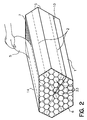
- Figure 2 is a perspective end view showing one embodiment of an easy open shirred food casing package of the present invention.
- Figure 3 is a view similar to Figure 3 only from an opposite end and showing another embodiment of the invention.
- This invention in one aspect comprises a mono-or bioriented heat shrinkable or stretch plastic film that contains transverse rows of frangible perforations, where a panel of film is formed between the rows.
- This film is used to package goods, such as multiple shirred sticks of sausage casing, in a tight bundle. At least one end of the bundle is partially open and provides a film edge for grasping to tear open the package.
- the rows of perforations are spaced apart and arranged in such a way that when the film is disposed about the shirred sticks to form the bundle, there are at least four rows of perforations disposed about the perimeter of the bundle.
- This provides at least one panel that spans adjacent sections of two sides of the package.
- the rows of perforations will be such that at least one row will be placed on each side of the package, and one or more of the panels overlap two adjacent sides of the bundle.
- the panels can be torn from the package by a user grasping the film edge at any point at the partly open end of the package and pulling. It has been found that on a typical bundle of fifty shirred casing sticks, no more than twelve rows of evenly spaced perforations, or six panels, are useful. Increasing the number of rows of perforations and panels weakens the film strength to the point where unintended opening of the package may occur by spontaneous tearing along a line of perforations.
- Figure 1 shows the film of the present invention indicated at 1.
- Film 1 is shown as having two longitudinal edges 3 and two transverse edges 4, only one of which is shown.
- the film further has multiple transverse rows of perforations 2 extending across the width of the film, or transversely, from one film side edge 3 to the other.
- the rows of perforations 2 are spaced apart so that the distance "D" between them forms a panel 5 large enough to remove the goods that will be wrapped by film 1.
- the rows of perforations 2 are spaced from about 50 mm to about 100 mm apart and more preferably about 70 mm apart.
- the film that can be used in the present invention is any plastic film of appropriate gauge for tightly wrapping foods and that can be either heat shrunk or is stretchable and is preferably heat sealable. If the package of goods is to be large and/or heavy, a stronger, possibly heavier gauge film will be needed as opposed to a light or smaller package of goods.
- Preferably polyethylene films can be used. These films are oriented in the transverse direction and/or the machine (longitudinal) direction by methods well known to those skilled in the art.
- Various heat shrink films were tested after being wrapped around stacks of shirred casing sticks, and it was found that the functional range of film retraction on the bundle was from about 70% to about 90% longitudinal and from 0% to about 30% transverse shrink.
- the preferred film has a shrink of about 70% in the longitudinal direction and about 30% in the transverse direction.
- the rows of perforations 2 can be made as either holes or slits, but slits lying in the transverse direction or having a "v" shape are preferable. It has been found that the use of holes for the perforations yield poor tear efficiencies in that the tear line wanders into the packaging and does not continue on the line of perforation. This may result in the removal of only a part of the panel preventing easy, quick emptying of, and may provoke damage to, the packaged goods.
- the preferred slits are from about 1 to about 3 millimeters (mm) long, spaced at intervals of about 1 to about 3 mm and can be made with, for example, a sharp edged blade or with a roll provided with appropriately spaced apart knife blades on its surface, as described in US 4,879,124 and 5,086,924.
- the "v" shaped slits are preferably about 2 mm long and spaced at about 2 mm intervals.
- Figure 2 shows one embodiment of the package of the present invention.
- fifty shirred casing sticks 23 are arranged to form a six sided stack, which is tightly wrapped with the film 1 to bundle the sticks together and form package 14.
- the two transverse ends of the film are connected to each other to maintain tension around the stack and to transversely seal the package shut. This can be accomplished, for example, by heat sealing the edges together to form a seal 10 or by folding the transverse edges of the film and taping them.
- End 6 of package 14 is completely enclosed by film 1, which can be either stretched or heat shrunk around the bundle.
- the opposite end 7, not shown in this figure, is partially open.
- Complete enclosure of end 6 can be accomplished, for example, by having an excess of film that folds on itself around the end, which on heat shrinking will seal to itself. Also, an excess of film may be folded over an end of the stack in such a manner where it can be heat sealed shut. Another method is by gathering an excess of film at one end and placing a metal or plastic clip around the gathered plastic so that an end is fully enclosed.
- Figure 2 also shows eight rows of perforations 2 so that at least one row of perforations 2 is disposed on each of the six sides and a panel 5 is formed between each set of adjacent rows of perforations.
- Figure 3 shows another embodiment of the present invention where multiple sticks of casing 23 are arranged on top of each other to form a square stack, which is tightly wrapped by film 1 to form package 30.
- the transverse edges 4 of the film have been connected to each other by heat sealing to form seal 10.
- Both end 9 and the opposite end (not shown) are partially enclosed by film 1, substantially as described above.
- Six rows of perforations are shown on the film on end 9, so that at least one row of perforations 2 is disposed in each of the four sides and at least one of the panels 5 formed between each set of adjacent rows extends over portions of two adjacent sides of the package.
- a person needing to access the casing sticks 23 inside the package grasps the longitudinal edge 3 of the film at any point at the partially or fully opened end 9 of the package and pulls. This initiates tearing along two adjacent rows of perforations that extend completely across the package. Once the tearing is complete, a full panel 5 can be removed and the casing sticks, or any other goods that have been so packaged, can be removed.
- This invention is an improvement over most conventional plastic packaging in that in order to access the packaged goods, the user of the goods does not need to cut or rip the plastic or to find the one spot on the plastic film that contains a weakened area, such as a single row of perforations, to open the package.
- This is a disadvantage especially when time is critically short, as in a high speed manufacturing environment where frankfurters are made.
- the packaging is plastic, it is water resistant and will protect the sticks from incidental water exposure.
- the film rated Fail1 did not have enough shrink, and therefore tension, in both longitudinal and transverse directions to hold the stack of sticks tightly together.
- the film rated Fail2 did not have enough shrink in the longitudinal direction to hold the stack of sticks tightly together.
- the films rated Very Satisfactory3 had good shrink in both directions and held stacks of sticks tightly together.
- the films rated Fail4 did not have enough shrink in the longitudinal direction, and too much in the transverse direction, so much so that the packages would not easily release the sticks on opening, causing some sticks to break.
- the film rated Satisfactory5 showed that there was a slight excess of shrink in the transverse direction and some sticks were not easily released when the package was opened.
- a number of sheets of bioriented polyethylene film with 70% longitudinal and 30% transverse shrink were perforated with rows of either needle holes or slits with various spacings between each perforation. The rows were made in one direction, transversely along the film, from one longitudinal edge to the other.
- the film was used to wrap bundles of fifty casing sticks each, as described in Example 1 above. After cooling, the packages of casing sticks were grasped at the 50% open edge and pulled.
- the % of tear efficiency of each of these rows was measured as the percentage, on average, of the length of perforated line that pulled apart before the tear would propagate into the plastic film away from the rows of perforation.
- I Impossible to use for wrapping the stack of sticks as only two or three rows of perforations were disposed around the sticks and on opening there was no control of the sticks. Upon opening, the bundle would deteriorate and the sticks would fall out uncontrollably and break.
- O Satisfactory, as the packaging was easy to open, the encased sticks stayed under control, and were only released from the packaging when expected to.
- X Unsatisfactory, as thirteen or more rows of perforations were disposed around the sticks and the packaging would spontaneously break open during heat shrinking or handling.
- Y Unsatisfactory, because for bundles of small diameter casing, there were insufficient rows of perforations in the film to assure at least four rows of perforations disposed about the bundle, giving rise to the conditions "I" above.
Landscapes
- Engineering & Computer Science (AREA)
- Mechanical Engineering (AREA)
- Packages (AREA)
- Packging For Living Organisms, Food Or Medicinal Products That Are Sensitive To Environmental Conditiond (AREA)
- Wrappers (AREA)
Applications Claiming Priority (2)
| Application Number | Priority Date | Filing Date | Title |
|---|---|---|---|
| US28981094A | 1994-08-12 | 1994-08-12 | |
| US289810 | 1994-08-12 |
Publications (2)
| Publication Number | Publication Date |
|---|---|
| EP0696542A1 true EP0696542A1 (fr) | 1996-02-14 |
| EP0696542B1 EP0696542B1 (fr) | 1998-11-04 |
Family
ID=23113196
Family Applications (1)
| Application Number | Title | Priority Date | Filing Date |
|---|---|---|---|
| EP19950112413 Expired - Lifetime EP0696542B1 (fr) | 1994-08-12 | 1995-08-07 | Emballage perforé pour boyaux |
Country Status (4)
| Country | Link |
|---|---|
| EP (1) | EP0696542B1 (fr) |
| CA (1) | CA2153713C (fr) |
| DE (1) | DE69505751T2 (fr) |
| ES (1) | ES2125534T3 (fr) |
Cited By (10)
| Publication number | Priority date | Publication date | Assignee | Title |
|---|---|---|---|---|
| WO1998045186A1 (fr) * | 1997-04-08 | 1998-10-15 | Coca-Cola & Schweppes Beverages Ltd. | Emballage et machines d'emballage |
| EP0888976A1 (fr) * | 1997-07-01 | 1999-01-07 | Devro-Teepak, Inc. | Emballage facile à ouvrir |
| US6250468B1 (en) | 1999-02-10 | 2001-06-26 | Teepak Investments, Inc. | Easy to remove overwrap |
| US6409018B1 (en) | 2001-03-21 | 2002-06-25 | Arteva North America S.A.R.L. | Caddy of shirred food casing sticks |
| FR2857939A1 (fr) * | 2003-07-24 | 2005-01-28 | Mars Inc | Film d'emballage |
| US7842750B2 (en) | 2005-10-06 | 2010-11-30 | Capzo International B.V. | Polymer composition containing a heat accumulating phase-change material, a process for producing such a composition and a product in which such a composition is included |
| GB2499258A (en) * | 2012-02-13 | 2013-08-14 | British American Tobacco Co | Various Wrappers with Tear Strips for Multiple Containers |
| EP3683356A1 (fr) * | 2019-01-21 | 2020-07-22 | Hiu Tang Lo | Papier d'emballage pliable |
| US11565864B2 (en) | 2018-08-17 | 2023-01-31 | Niagara Bottling, Llc | Perforated case pack top panel |
| US12473132B2 (en) | 2023-03-09 | 2025-11-18 | Niagara Bottling, Llc | Perforated panel for bottle packaging |
Families Citing this family (2)
| Publication number | Priority date | Publication date | Assignee | Title |
|---|---|---|---|---|
| US20040166261A1 (en) | 2003-02-20 | 2004-08-26 | Pockat Gregory Robert | Heat-shrinkable packaging receptacle |
| DE102007021045A1 (de) * | 2007-05-04 | 2008-11-06 | Poly-Clip System Gmbh & Co. Kg | Perforationsverfahren für Schutzumhüllungen, Vorrichtung sowie Folienmaterial hierfür |
Citations (8)
| Publication number | Priority date | Publication date | Assignee | Title |
|---|---|---|---|---|
| GB488743A (en) * | 1937-04-07 | 1938-07-13 | Hans Hildner | Improvements in and relating to transparent foils |
| FR1191548A (fr) * | 1958-02-14 | 1959-10-20 | Perfectionnements aux emballages | |
| FR2199319A5 (fr) * | 1972-09-11 | 1974-04-05 | Union Carbide Corp | |
| FR2201219A1 (fr) * | 1972-10-03 | 1974-04-26 | Tetra Pak Int | |
| US4586312A (en) | 1984-04-02 | 1986-05-06 | Pet Incorporated | Method for producing heat shrinkable package with a frangible access panel |
| US4879124A (en) | 1985-10-08 | 1989-11-07 | W. R. Grace & Co.-Conn | Perforated cook-in shrink bag |
| US5086924A (en) | 1985-10-08 | 1992-02-11 | W. R. Grace & Co. - Conn. | Perforated cook-in shrink bag |
| EP0614610A1 (fr) * | 1993-03-12 | 1994-09-14 | Viskase Corporation | Emballage pour boyaux tubulaires plissés et procédé de sa fabrication |
-
1995
- 1995-07-12 CA CA 2153713 patent/CA2153713C/fr not_active Expired - Fee Related
- 1995-08-07 EP EP19950112413 patent/EP0696542B1/fr not_active Expired - Lifetime
- 1995-08-07 DE DE1995605751 patent/DE69505751T2/de not_active Expired - Lifetime
- 1995-08-07 ES ES95112413T patent/ES2125534T3/es not_active Expired - Lifetime
Patent Citations (8)
| Publication number | Priority date | Publication date | Assignee | Title |
|---|---|---|---|---|
| GB488743A (en) * | 1937-04-07 | 1938-07-13 | Hans Hildner | Improvements in and relating to transparent foils |
| FR1191548A (fr) * | 1958-02-14 | 1959-10-20 | Perfectionnements aux emballages | |
| FR2199319A5 (fr) * | 1972-09-11 | 1974-04-05 | Union Carbide Corp | |
| FR2201219A1 (fr) * | 1972-10-03 | 1974-04-26 | Tetra Pak Int | |
| US4586312A (en) | 1984-04-02 | 1986-05-06 | Pet Incorporated | Method for producing heat shrinkable package with a frangible access panel |
| US4879124A (en) | 1985-10-08 | 1989-11-07 | W. R. Grace & Co.-Conn | Perforated cook-in shrink bag |
| US5086924A (en) | 1985-10-08 | 1992-02-11 | W. R. Grace & Co. - Conn. | Perforated cook-in shrink bag |
| EP0614610A1 (fr) * | 1993-03-12 | 1994-09-14 | Viskase Corporation | Emballage pour boyaux tubulaires plissés et procédé de sa fabrication |
Cited By (13)
| Publication number | Priority date | Publication date | Assignee | Title |
|---|---|---|---|---|
| WO1998045186A1 (fr) * | 1997-04-08 | 1998-10-15 | Coca-Cola & Schweppes Beverages Ltd. | Emballage et machines d'emballage |
| GB2324075B (en) * | 1997-04-08 | 2000-12-20 | Coca Cola & Schweppes Beverage | Packaging and packaging machines therefor |
| US6490845B1 (en) | 1997-04-08 | 2002-12-10 | Coca-Cola Enterprises Limited | Packaging and packaging machines therefor |
| EP0888976A1 (fr) * | 1997-07-01 | 1999-01-07 | Devro-Teepak, Inc. | Emballage facile à ouvrir |
| US6250468B1 (en) | 1999-02-10 | 2001-06-26 | Teepak Investments, Inc. | Easy to remove overwrap |
| US6409018B1 (en) | 2001-03-21 | 2002-06-25 | Arteva North America S.A.R.L. | Caddy of shirred food casing sticks |
| FR2857939A1 (fr) * | 2003-07-24 | 2005-01-28 | Mars Inc | Film d'emballage |
| WO2005014424A1 (fr) * | 2003-07-24 | 2005-02-17 | Mars, Incorporated | Film d'emballage |
| US7842750B2 (en) | 2005-10-06 | 2010-11-30 | Capzo International B.V. | Polymer composition containing a heat accumulating phase-change material, a process for producing such a composition and a product in which such a composition is included |
| GB2499258A (en) * | 2012-02-13 | 2013-08-14 | British American Tobacco Co | Various Wrappers with Tear Strips for Multiple Containers |
| US11565864B2 (en) | 2018-08-17 | 2023-01-31 | Niagara Bottling, Llc | Perforated case pack top panel |
| EP3683356A1 (fr) * | 2019-01-21 | 2020-07-22 | Hiu Tang Lo | Papier d'emballage pliable |
| US12473132B2 (en) | 2023-03-09 | 2025-11-18 | Niagara Bottling, Llc | Perforated panel for bottle packaging |
Also Published As
| Publication number | Publication date |
|---|---|
| EP0696542B1 (fr) | 1998-11-04 |
| DE69505751D1 (de) | 1998-12-10 |
| CA2153713C (fr) | 2000-10-17 |
| CA2153713A1 (fr) | 1996-02-13 |
| DE69505751T2 (de) | 1999-05-27 |
| ES2125534T3 (es) | 1999-03-01 |
Similar Documents
| Publication | Publication Date | Title |
|---|---|---|
| CA2116189C (fr) | Methode de remplissage de boyaux fronces | |
| US5382190A (en) | Package of shirred food casings | |
| EP0696542B1 (fr) | Emballage perforé pour boyaux | |
| US10427813B2 (en) | Methods of packaging products and packaging arrangements using a shrinkable protective cover to keep a graphic on a band formed, intact, and visible | |
| US20010000480A1 (en) | Plastic film packaging with tearable tape strip | |
| EP0675043B1 (fr) | Procédé et dispositif pour emballer des boyaux tubulaires plissés et article obtenu | |
| EP0641725B1 (fr) | Emballage pour boyaux tubulaires plissés et procédé de sa fabrication | |
| WO2002087990A1 (fr) | Emballage de produits presentant un systeme de bande detachable formant une poignee | |
| EP0888976A1 (fr) | Emballage facile à ouvrir | |
| GB2212471A (en) | Tear-open packaging for articles, in particular of right parallelepipedal shape | |
| JPH06286719A (ja) | 効率的なストランドパッケージ | |
| DE2345499A1 (de) | Verpackung aus schrumpffolien | |
| JPH09104467A (ja) | 円筒状長尺物の包装 | |
| US5735106A (en) | Continuous process for packaging compressible products | |
| AU1393099A (en) | Overwrap traypack | |
| JP3103328B2 (ja) | 切花用包装体 | |
| JPH082548A (ja) | 結束テープ、結束方法および結束物 | |
| CA2123655C (fr) | Boyaux fronces a usage alimentaire | |
| EP0511171A1 (fr) | Elément de déchirure pour le découpage automatique d'une feuille rétractable d'emballage | |
| AU677685B2 (en) | A packaging | |
| JPH0741036A (ja) | 自動帯掛機用巻回テープ | |
| EP0425444A1 (fr) | Dispositif de déchirure pour couper les pellicules en matière plastique |
Legal Events
| Date | Code | Title | Description |
|---|---|---|---|
| PUAI | Public reference made under article 153(3) epc to a published international application that has entered the european phase |
Free format text: ORIGINAL CODE: 0009012 |
|
| AK | Designated contracting states |
Kind code of ref document: A1 Designated state(s): BE DE ES FR |
|
| 17P | Request for examination filed |
Effective date: 19960223 |
|
| 17Q | First examination report despatched |
Effective date: 19970319 |
|
| GRAG | Despatch of communication of intention to grant |
Free format text: ORIGINAL CODE: EPIDOS AGRA |
|
| GRAG | Despatch of communication of intention to grant |
Free format text: ORIGINAL CODE: EPIDOS AGRA |
|
| GRAH | Despatch of communication of intention to grant a patent |
Free format text: ORIGINAL CODE: EPIDOS IGRA |
|
| GRAH | Despatch of communication of intention to grant a patent |
Free format text: ORIGINAL CODE: EPIDOS IGRA |
|
| GRAA | (expected) grant |
Free format text: ORIGINAL CODE: 0009210 |
|
| AK | Designated contracting states |
Kind code of ref document: B1 Designated state(s): BE DE ES FR |
|
| REF | Corresponds to: |
Ref document number: 69505751 Country of ref document: DE Date of ref document: 19981210 |
|
| ET | Fr: translation filed | ||
| REG | Reference to a national code |
Ref country code: ES Ref legal event code: FG2A Ref document number: 2125534 Country of ref document: ES Kind code of ref document: T3 |
|
| PLBE | No opposition filed within time limit |
Free format text: ORIGINAL CODE: 0009261 |
|
| STAA | Information on the status of an ep patent application or granted ep patent |
Free format text: STATUS: NO OPPOSITION FILED WITHIN TIME LIMIT |
|
| 26N | No opposition filed | ||
| PGFP | Annual fee paid to national office [announced via postgrant information from national office to epo] |
Ref country code: FR Payment date: 20090817 Year of fee payment: 15 Ref country code: ES Payment date: 20090826 Year of fee payment: 15 |
|
| PGFP | Annual fee paid to national office [announced via postgrant information from national office to epo] |
Ref country code: DE Payment date: 20090827 Year of fee payment: 15 |
|
| PGFP | Annual fee paid to national office [announced via postgrant information from national office to epo] |
Ref country code: BE Payment date: 20090915 Year of fee payment: 15 |
|
| BERE | Be: lapsed |
Owner name: *VISKASE CORP. Effective date: 20100831 |
|
| REG | Reference to a national code |
Ref country code: FR Ref legal event code: ST Effective date: 20110502 |
|
| REG | Reference to a national code |
Ref country code: DE Ref legal event code: R119 Ref document number: 69505751 Country of ref document: DE Effective date: 20110301 |
|
| PG25 | Lapsed in a contracting state [announced via postgrant information from national office to epo] |
Ref country code: DE Free format text: LAPSE BECAUSE OF NON-PAYMENT OF DUE FEES Effective date: 20110301 Ref country code: BE Free format text: LAPSE BECAUSE OF NON-PAYMENT OF DUE FEES Effective date: 20100831 Ref country code: FR Free format text: LAPSE BECAUSE OF NON-PAYMENT OF DUE FEES Effective date: 20100831 |
|
| REG | Reference to a national code |
Ref country code: ES Ref legal event code: FD2A Effective date: 20111019 |
|
| PG25 | Lapsed in a contracting state [announced via postgrant information from national office to epo] |
Ref country code: ES Free format text: LAPSE BECAUSE OF NON-PAYMENT OF DUE FEES Effective date: 20100808 |