EP0696576A2 - Verfahren zur Herstellung von 2-Amino-2-arylethanolen und neue Zwischenprodukte - Google Patents
Verfahren zur Herstellung von 2-Amino-2-arylethanolen und neue Zwischenprodukte Download PDFInfo
- Publication number
- EP0696576A2 EP0696576A2 EP95112059A EP95112059A EP0696576A2 EP 0696576 A2 EP0696576 A2 EP 0696576A2 EP 95112059 A EP95112059 A EP 95112059A EP 95112059 A EP95112059 A EP 95112059A EP 0696576 A2 EP0696576 A2 EP 0696576A2
- Authority
- EP
- European Patent Office
- Prior art keywords
- chlorine
- fluorine
- substituted
- alkoxy
- alkyl
- Prior art date
- Legal status (The legal status is an assumption and is not a legal conclusion. Google has not performed a legal analysis and makes no representation as to the accuracy of the status listed.)
- Granted
Links
- 238000000034 method Methods 0.000 title claims abstract description 26
- 238000002360 preparation method Methods 0.000 title claims abstract description 18
- 239000000543 intermediate Substances 0.000 title description 3
- 229910052736 halogen Inorganic materials 0.000 claims abstract description 38
- 150000002367 halogens Chemical class 0.000 claims abstract description 38
- 125000001997 phenyl group Chemical group [H]C1=C([H])C([H])=C(*)C([H])=C1[H] 0.000 claims abstract description 37
- 125000001424 substituent group Chemical group 0.000 claims abstract description 21
- 125000003545 alkoxy group Chemical group 0.000 claims abstract description 12
- 125000004438 haloalkoxy group Chemical group 0.000 claims abstract description 11
- 239000007868 Raney catalyst Substances 0.000 claims abstract description 10
- 229910000564 Raney nickel Inorganic materials 0.000 claims abstract description 10
- NPXOKRUENSOPAO-UHFFFAOYSA-N Raney nickel Chemical compound [Al].[Ni] NPXOKRUENSOPAO-UHFFFAOYSA-N 0.000 claims abstract description 10
- 125000000217 alkyl group Chemical group 0.000 claims abstract description 8
- 125000001188 haloalkyl group Chemical group 0.000 claims abstract description 8
- 125000001072 heteroaryl group Chemical group 0.000 claims abstract description 8
- 229910017052 cobalt Inorganic materials 0.000 claims abstract description 7
- 239000010941 cobalt Substances 0.000 claims abstract description 7
- 125000003118 aryl group Chemical group 0.000 claims abstract description 6
- 125000000000 cycloalkoxy group Chemical group 0.000 claims abstract description 6
- 239000003085 diluting agent Substances 0.000 claims abstract description 6
- GUTLYIVDDKVIGB-UHFFFAOYSA-N cobalt atom Chemical compound [Co] GUTLYIVDDKVIGB-UHFFFAOYSA-N 0.000 claims abstract description 5
- 125000005338 substituted cycloalkoxy group Chemical group 0.000 claims abstract description 5
- PXGOKWXKJXAPGV-UHFFFAOYSA-N Fluorine Chemical compound FF PXGOKWXKJXAPGV-UHFFFAOYSA-N 0.000 claims description 52
- ZAMOUSCENKQFHK-UHFFFAOYSA-N Chlorine atom Chemical compound [Cl] ZAMOUSCENKQFHK-UHFFFAOYSA-N 0.000 claims description 51
- 229910052731 fluorine Inorganic materials 0.000 claims description 50
- 239000011737 fluorine Substances 0.000 claims description 50
- 229910052801 chlorine Inorganic materials 0.000 claims description 44
- 239000000460 chlorine Substances 0.000 claims description 44
- 150000001875 compounds Chemical class 0.000 claims description 29
- WKBOTKDWSSQWDR-UHFFFAOYSA-N Bromine atom Chemical compound [Br] WKBOTKDWSSQWDR-UHFFFAOYSA-N 0.000 claims description 26
- GDTBXPJZTBHREO-UHFFFAOYSA-N bromine Substances BrBr GDTBXPJZTBHREO-UHFFFAOYSA-N 0.000 claims description 26
- 229910052794 bromium Inorganic materials 0.000 claims description 26
- 125000001153 fluoro group Chemical group F* 0.000 claims description 23
- 125000004178 (C1-C4) alkyl group Chemical group 0.000 claims description 21
- 125000000229 (C1-C4)alkoxy group Chemical group 0.000 claims description 20
- 125000004169 (C1-C6) alkyl group Chemical group 0.000 claims description 19
- 125000004076 pyridyl group Chemical group 0.000 claims description 12
- 125000000714 pyrimidinyl group Chemical group 0.000 claims description 12
- 125000001544 thienyl group Chemical group 0.000 claims description 12
- 125000004767 (C1-C4) haloalkoxy group Chemical group 0.000 claims description 10
- 125000004191 (C1-C6) alkoxy group Chemical group 0.000 claims description 9
- 125000004737 (C1-C6) haloalkoxy group Chemical group 0.000 claims description 8
- FAMFSGYPUYWNDM-UHFFFAOYSA-N 2-(5-bromothiophen-2-yl)-2-hydroxyiminoethanol Chemical compound OCC(=NO)C1=CC=C(Br)S1 FAMFSGYPUYWNDM-UHFFFAOYSA-N 0.000 claims description 8
- XFXUSMVZQORNQN-UHFFFAOYSA-N 2-hydroxyimino-2-(4-methoxyphenyl)ethanol Chemical compound COC1=CC=C(C(CO)=NO)C=C1 XFXUSMVZQORNQN-UHFFFAOYSA-N 0.000 claims description 5
- 125000004765 (C1-C4) haloalkyl group Chemical group 0.000 claims description 4
- 125000000171 (C1-C6) haloalkyl group Chemical group 0.000 claims description 4
- 125000003107 substituted aryl group Chemical group 0.000 abstract description 2
- CODNYICXDISAEA-UHFFFAOYSA-N bromine monochloride Chemical compound BrCl CODNYICXDISAEA-UHFFFAOYSA-N 0.000 description 13
- 239000003054 catalyst Substances 0.000 description 8
- LFQSCWFLJHTTHZ-UHFFFAOYSA-N Ethanol Chemical compound CCO LFQSCWFLJHTTHZ-UHFFFAOYSA-N 0.000 description 7
- OKKJLVBELUTLKV-UHFFFAOYSA-N Methanol Chemical compound OC OKKJLVBELUTLKV-UHFFFAOYSA-N 0.000 description 6
- QGZKDVFQNNGYKY-UHFFFAOYSA-N Ammonia Chemical compound N QGZKDVFQNNGYKY-UHFFFAOYSA-N 0.000 description 5
- RTZKZFJDLAIYFH-UHFFFAOYSA-N Diethyl ether Chemical compound CCOCC RTZKZFJDLAIYFH-UHFFFAOYSA-N 0.000 description 5
- UFHFLCQGNIYNRP-UHFFFAOYSA-N Hydrogen Chemical compound [H][H] UFHFLCQGNIYNRP-UHFFFAOYSA-N 0.000 description 5
- -1 aromatic amino acids Chemical class 0.000 description 5
- 238000006243 chemical reaction Methods 0.000 description 5
- 239000001257 hydrogen Substances 0.000 description 5
- 229910052739 hydrogen Inorganic materials 0.000 description 5
- XLYOFNOQVPJJNP-UHFFFAOYSA-N water Substances O XLYOFNOQVPJJNP-UHFFFAOYSA-N 0.000 description 5
- WTDHULULXKLSOZ-UHFFFAOYSA-N Hydroxylamine hydrochloride Chemical compound Cl.ON WTDHULULXKLSOZ-UHFFFAOYSA-N 0.000 description 4
- KDLHZDBZIXYQEI-UHFFFAOYSA-N Palladium Chemical compound [Pd] KDLHZDBZIXYQEI-UHFFFAOYSA-N 0.000 description 4
- VSCWAEJMTAWNJL-UHFFFAOYSA-K aluminium trichloride Chemical compound Cl[Al](Cl)Cl VSCWAEJMTAWNJL-UHFFFAOYSA-K 0.000 description 4
- 238000002844 melting Methods 0.000 description 4
- 230000008018 melting Effects 0.000 description 4
- 239000000203 mixture Substances 0.000 description 4
- 239000007858 starting material Substances 0.000 description 4
- QTBSBXVTEAMEQO-UHFFFAOYSA-N Acetic acid Chemical compound CC(O)=O QTBSBXVTEAMEQO-UHFFFAOYSA-N 0.000 description 3
- UHOVQNZJYSORNB-UHFFFAOYSA-N Benzene Chemical compound C1=CC=CC=C1 UHOVQNZJYSORNB-UHFFFAOYSA-N 0.000 description 3
- YMWUJEATGCHHMB-UHFFFAOYSA-N Dichloromethane Chemical compound ClCCl YMWUJEATGCHHMB-UHFFFAOYSA-N 0.000 description 3
- XTHFKEDIFFGKHM-UHFFFAOYSA-N Dimethoxyethane Chemical compound COCCOC XTHFKEDIFFGKHM-UHFFFAOYSA-N 0.000 description 3
- XEKOWRVHYACXOJ-UHFFFAOYSA-N Ethyl acetate Chemical compound CCOC(C)=O XEKOWRVHYACXOJ-UHFFFAOYSA-N 0.000 description 3
- YXFVVABEGXRONW-UHFFFAOYSA-N Toluene Chemical compound CC1=CC=CC=C1 YXFVVABEGXRONW-UHFFFAOYSA-N 0.000 description 3
- 238000004519 manufacturing process Methods 0.000 description 3
- VLKZOEOYAKHREP-UHFFFAOYSA-N n-Hexane Chemical compound CCCCCC VLKZOEOYAKHREP-UHFFFAOYSA-N 0.000 description 3
- VGCXGMAHQTYDJK-UHFFFAOYSA-N Chloroacetyl chloride Chemical compound ClCC(Cl)=O VGCXGMAHQTYDJK-UHFFFAOYSA-N 0.000 description 2
- KFZMGEQAYNKOFK-UHFFFAOYSA-N Isopropanol Chemical compound CC(C)O KFZMGEQAYNKOFK-UHFFFAOYSA-N 0.000 description 2
- LRHPLDYGYMQRHN-UHFFFAOYSA-N N-Butanol Chemical compound CCCCO LRHPLDYGYMQRHN-UHFFFAOYSA-N 0.000 description 2
- UIIMBOGNXHQVGW-UHFFFAOYSA-M Sodium bicarbonate Chemical compound [Na+].OC([O-])=O UIIMBOGNXHQVGW-UHFFFAOYSA-M 0.000 description 2
- QAOWNCQODCNURD-UHFFFAOYSA-N Sulfuric acid Chemical compound OS(O)(=O)=O QAOWNCQODCNURD-UHFFFAOYSA-N 0.000 description 2
- WYURNTSHIVDZCO-UHFFFAOYSA-N Tetrahydrofuran Chemical compound C1CCOC1 WYURNTSHIVDZCO-UHFFFAOYSA-N 0.000 description 2
- 150000001412 amines Chemical class 0.000 description 2
- 229910021529 ammonia Inorganic materials 0.000 description 2
- 239000002585 base Substances 0.000 description 2
- 238000009903 catalytic hydrogenation reaction Methods 0.000 description 2
- 125000001309 chloro group Chemical group Cl* 0.000 description 2
- 239000012043 crude product Substances 0.000 description 2
- 239000013078 crystal Substances 0.000 description 2
- 239000005457 ice water Substances 0.000 description 2
- ZXEKIIBDNHEJCQ-UHFFFAOYSA-N isobutanol Chemical compound CC(C)CO ZXEKIIBDNHEJCQ-UHFFFAOYSA-N 0.000 description 2
- 229910052987 metal hydride Inorganic materials 0.000 description 2
- 150000004681 metal hydrides Chemical class 0.000 description 2
- BDAGIHXWWSANSR-UHFFFAOYSA-N methanoic acid Natural products OC=O BDAGIHXWWSANSR-UHFFFAOYSA-N 0.000 description 2
- 229910052763 palladium Inorganic materials 0.000 description 2
- BASFCYQUMIYNBI-UHFFFAOYSA-N platinum Chemical compound [Pt] BASFCYQUMIYNBI-UHFFFAOYSA-N 0.000 description 2
- BDERNNFJNOPAEC-UHFFFAOYSA-N propan-1-ol Chemical compound CCCO BDERNNFJNOPAEC-UHFFFAOYSA-N 0.000 description 2
- 230000009467 reduction Effects 0.000 description 2
- 229910052703 rhodium Inorganic materials 0.000 description 2
- 239000010948 rhodium Substances 0.000 description 2
- MHOVAHRLVXNVSD-UHFFFAOYSA-N rhodium atom Chemical compound [Rh] MHOVAHRLVXNVSD-UHFFFAOYSA-N 0.000 description 2
- 150000003839 salts Chemical class 0.000 description 2
- 239000002904 solvent Substances 0.000 description 2
- 0 *c1ccc(C(CO)N)cc1 Chemical compound *c1ccc(C(CO)N)cc1 0.000 description 1
- WSLDOOZREJYCGB-UHFFFAOYSA-N 1,2-Dichloroethane Chemical compound ClCCCl WSLDOOZREJYCGB-UHFFFAOYSA-N 0.000 description 1
- RYHBNJHYFVUHQT-UHFFFAOYSA-N 1,4-Dioxane Chemical compound C1COCCO1 RYHBNJHYFVUHQT-UHFFFAOYSA-N 0.000 description 1
- CXBDYQVECUFKRK-UHFFFAOYSA-N 1-methoxybutane Chemical compound CCCCOC CXBDYQVECUFKRK-UHFFFAOYSA-N 0.000 description 1
- DBUJFULDVAZULB-UHFFFAOYSA-N 1-methoxypentane Chemical compound CCCCCOC DBUJFULDVAZULB-UHFFFAOYSA-N 0.000 description 1
- BANUTYPBALYVJT-UHFFFAOYSA-N 1-phenyl-4-(trifluoromethoxy)benzene Chemical group C1=CC(OC(F)(F)F)=CC=C1C1=CC=CC=C1 BANUTYPBALYVJT-UHFFFAOYSA-N 0.000 description 1
- ZFFWFWQIEVJQLB-UHFFFAOYSA-N 2-[4-(difluoromethoxy)phenyl]-2-hydroxyiminoethanol Chemical compound OCC(=NO)C1=CC=C(OC(F)F)C=C1 ZFFWFWQIEVJQLB-UHFFFAOYSA-N 0.000 description 1
- YTHACPLZDAHPTP-UHFFFAOYSA-N 2-amino-2-[4-(difluoromethoxy)phenyl]ethanol Chemical compound OCC(N)C1=CC=C(OC(F)F)C=C1 YTHACPLZDAHPTP-UHFFFAOYSA-N 0.000 description 1
- XCMXYMDWKRBPMH-UHFFFAOYSA-N 2-chloro-1-phenyl-2-[4-(trifluoromethoxy)phenyl]ethanone Chemical compound C1=CC(OC(F)(F)F)=CC=C1C(Cl)C(=O)C1=CC=CC=C1 XCMXYMDWKRBPMH-UHFFFAOYSA-N 0.000 description 1
- XSVVXRZTCVAUHL-UHFFFAOYSA-N 2-hydroxy-1-phenyl-2-[4-(trifluoromethoxy)phenyl]ethanone Chemical compound C=1C=C(OC(F)(F)F)C=CC=1C(O)C(=O)C1=CC=CC=C1 XSVVXRZTCVAUHL-UHFFFAOYSA-N 0.000 description 1
- ZWVHTXAYIKBMEE-UHFFFAOYSA-N 2-hydroxyacetophenone Chemical compound OCC(=O)C1=CC=CC=C1 ZWVHTXAYIKBMEE-UHFFFAOYSA-N 0.000 description 1
- OSWFIVFLDKOXQC-UHFFFAOYSA-N 4-(3-methoxyphenyl)aniline Chemical compound COC1=CC=CC(C=2C=CC(N)=CC=2)=C1 OSWFIVFLDKOXQC-UHFFFAOYSA-N 0.000 description 1
- XDTMQSROBMDMFD-UHFFFAOYSA-N Cyclohexane Chemical compound C1CCCCC1 XDTMQSROBMDMFD-UHFFFAOYSA-N 0.000 description 1
- ZAFNJMIOTHYJRJ-UHFFFAOYSA-N Diisopropyl ether Chemical compound CC(C)OC(C)C ZAFNJMIOTHYJRJ-UHFFFAOYSA-N 0.000 description 1
- 238000005863 Friedel-Crafts acylation reaction Methods 0.000 description 1
- VEXZGXHMUGYJMC-UHFFFAOYSA-N Hydrochloric acid Chemical compound Cl VEXZGXHMUGYJMC-UHFFFAOYSA-N 0.000 description 1
- 229910010084 LiAlH4 Inorganic materials 0.000 description 1
- CTQNGGLPUBDAKN-UHFFFAOYSA-N O-Xylene Chemical compound CC1=CC=CC=C1C CTQNGGLPUBDAKN-UHFFFAOYSA-N 0.000 description 1
- VYPSYNLAJGMNEJ-UHFFFAOYSA-N Silicium dioxide Chemical compound O=[Si]=O VYPSYNLAJGMNEJ-UHFFFAOYSA-N 0.000 description 1
- VMHLLURERBWHNL-UHFFFAOYSA-M Sodium acetate Chemical compound [Na+].CC([O-])=O VMHLLURERBWHNL-UHFFFAOYSA-M 0.000 description 1
- 239000004280 Sodium formate Substances 0.000 description 1
- 239000002253 acid Substances 0.000 description 1
- 150000007513 acids Chemical class 0.000 description 1
- 150000001298 alcohols Chemical class 0.000 description 1
- 150000001414 amino alcohols Chemical class 0.000 description 1
- 150000001555 benzenes Chemical class 0.000 description 1
- 238000009835 boiling Methods 0.000 description 1
- 239000007795 chemical reaction product Substances 0.000 description 1
- 238000004587 chromatography analysis Methods 0.000 description 1
- 238000001816 cooling Methods 0.000 description 1
- 239000003480 eluent Substances 0.000 description 1
- 150000002148 esters Chemical class 0.000 description 1
- 238000001914 filtration Methods 0.000 description 1
- 235000019253 formic acid Nutrition 0.000 description 1
- 238000004817 gas chromatography Methods 0.000 description 1
- 229930195733 hydrocarbon Natural products 0.000 description 1
- 150000002430 hydrocarbons Chemical class 0.000 description 1
- 150000003840 hydrochlorides Chemical class 0.000 description 1
- IXCSERBJSXMMFS-UHFFFAOYSA-N hydrogen chloride Substances Cl.Cl IXCSERBJSXMMFS-UHFFFAOYSA-N 0.000 description 1
- 229910000041 hydrogen chloride Inorganic materials 0.000 description 1
- 150000002443 hydroxylamines Chemical class 0.000 description 1
- 229960004592 isopropanol Drugs 0.000 description 1
- 239000007788 liquid Substances 0.000 description 1
- 239000012280 lithium aluminium hydride Substances 0.000 description 1
- 229910000510 noble metal Inorganic materials 0.000 description 1
- 239000012074 organic phase Substances 0.000 description 1
- 239000003960 organic solvent Substances 0.000 description 1
- 150000002923 oximes Chemical class 0.000 description 1
- 239000000575 pesticide Substances 0.000 description 1
- IMACFCSSMIZSPP-UHFFFAOYSA-N phenacyl chloride Chemical compound ClCC(=O)C1=CC=CC=C1 IMACFCSSMIZSPP-UHFFFAOYSA-N 0.000 description 1
- 229910052697 platinum Inorganic materials 0.000 description 1
- 239000002994 raw material Substances 0.000 description 1
- 238000001953 recrystallisation Methods 0.000 description 1
- 239000000741 silica gel Substances 0.000 description 1
- 229910002027 silica gel Inorganic materials 0.000 description 1
- 239000001632 sodium acetate Substances 0.000 description 1
- 235000017281 sodium acetate Nutrition 0.000 description 1
- 229910000030 sodium bicarbonate Inorganic materials 0.000 description 1
- 235000017557 sodium bicarbonate Nutrition 0.000 description 1
- 239000012279 sodium borohydride Substances 0.000 description 1
- 229910000033 sodium borohydride Inorganic materials 0.000 description 1
- HLBBKKJFGFRGMU-UHFFFAOYSA-M sodium formate Chemical compound [Na+].[O-]C=O HLBBKKJFGFRGMU-UHFFFAOYSA-M 0.000 description 1
- 235000019254 sodium formate Nutrition 0.000 description 1
- 238000003786 synthesis reaction Methods 0.000 description 1
- YLQBMQCUIZJEEH-UHFFFAOYSA-N tetrahydrofuran Natural products C=1C=COC=1 YLQBMQCUIZJEEH-UHFFFAOYSA-N 0.000 description 1
- 239000008096 xylene Substances 0.000 description 1
Classifications
-
- C—CHEMISTRY; METALLURGY
- C07—ORGANIC CHEMISTRY
- C07C—ACYCLIC OR CARBOCYCLIC COMPOUNDS
- C07C217/00—Compounds containing amino and etherified hydroxy groups bound to the same carbon skeleton
- C07C217/54—Compounds containing amino and etherified hydroxy groups bound to the same carbon skeleton having etherified hydroxy groups bound to carbon atoms of at least one six-membered aromatic ring and amino groups bound to acyclic carbon atoms or to carbon atoms of rings other than six-membered aromatic rings of the same carbon skeleton
- C07C217/64—Compounds containing amino and etherified hydroxy groups bound to the same carbon skeleton having etherified hydroxy groups bound to carbon atoms of at least one six-membered aromatic ring and amino groups bound to acyclic carbon atoms or to carbon atoms of rings other than six-membered aromatic rings of the same carbon skeleton with amino groups linked to the six-membered aromatic ring, or to the condensed ring system containing that ring, by carbon chains further substituted by singly-bound oxygen atoms
-
- C—CHEMISTRY; METALLURGY
- C07—ORGANIC CHEMISTRY
- C07C—ACYCLIC OR CARBOCYCLIC COMPOUNDS
- C07C213/00—Preparation of compounds containing amino and hydroxy, amino and etherified hydroxy or amino and esterified hydroxy groups bound to the same carbon skeleton
- C07C213/02—Preparation of compounds containing amino and hydroxy, amino and etherified hydroxy or amino and esterified hydroxy groups bound to the same carbon skeleton by reactions involving the formation of amino groups from compounds containing hydroxy groups or etherified or esterified hydroxy groups
-
- C—CHEMISTRY; METALLURGY
- C07—ORGANIC CHEMISTRY
- C07C—ACYCLIC OR CARBOCYCLIC COMPOUNDS
- C07C251/00—Compounds containing nitrogen atoms doubly-bound to a carbon skeleton
- C07C251/32—Oximes
- C07C251/34—Oximes with oxygen atoms of oxyimino groups bound to hydrogen atoms or to carbon atoms of unsubstituted hydrocarbon radicals
- C07C251/48—Oximes with oxygen atoms of oxyimino groups bound to hydrogen atoms or to carbon atoms of unsubstituted hydrocarbon radicals with the carbon atom of at least one of the oxyimino groups bound to a carbon atom of a six-membered aromatic ring
-
- C—CHEMISTRY; METALLURGY
- C07—ORGANIC CHEMISTRY
- C07C—ACYCLIC OR CARBOCYCLIC COMPOUNDS
- C07C2601/00—Systems containing only non-condensed rings
- C07C2601/04—Systems containing only non-condensed rings with a four-membered ring
-
- C—CHEMISTRY; METALLURGY
- C07—ORGANIC CHEMISTRY
- C07C—ACYCLIC OR CARBOCYCLIC COMPOUNDS
- C07C2601/00—Systems containing only non-condensed rings
- C07C2601/06—Systems containing only non-condensed rings with a five-membered ring
- C07C2601/10—Systems containing only non-condensed rings with a five-membered ring the ring being unsaturated
Definitions
- the invention relates to a new process for the preparation of new 2-amino-2-arylethanols and new intermediates for their preparation.
- amines can be obtained by catalytic hydrogenation with noble metal catalysts, such as, for example, rhodium or palladium catalysts and, if appropriate, in the presence of acids, such as, for example, acetic acid, sulfuric acid or hydrogen chloride (see, for example, J. Org. Chem. 27 , 2209 , 1962; J. Org. Chem. 28, 2797, 1963; J. Org. Chem. 48, 2520 (1983).
- noble metal catalysts such as, for example, rhodium or palladium catalysts and, if appropriate, in the presence of acids, such as, for example, acetic acid, sulfuric acid or hydrogen chloride
- the process (1) according to the invention gives the 2-amino-2-arylethanols of the formula (I) in very good yields and in high purity, since it is known that catalytic hydrogenation of ketoximes and use of platinum or Raney nickel catalysts hydroxylamines arise [Houben-Weyl, Methods of Organic Chemistry, Georg Thieme Verlag, Stuttgart, Volume IV, 1c, Part 1, page 251; JACS 59 , 715 (1937) and Chem. Ber. 88, 38 (1955)].
- the process according to the invention for the preparation of the 2-amino-2-arylethanols of the formula (I) referred to above under (1) is widely applicable and thus represents a valuable enrichment of the technology.
- Formula (II) provides a general definition of the ⁇ -hydroxy-ketoximes to be used as starting materials in the process according to the invention for the preparation of the compounds of the formula (I) given under (1).
- Ar preferably or particularly preferably represents those meanings which have already been given as preferred or particularly preferred for Ar in connection with the description of the compounds of the formula (I).
- ⁇ -hydroxy-ketoximes of the formula (II) are known in some cases (cf. e.g. J. Chem. Technol. Biotechnol., 54 (1), 19-26, 1992).
- the known and also the new compounds of formula (II) can be obtained from the corresponding ⁇ -hydroxyketones and hydroxylamine hydrochloride in a conventional manner and in a conventional manner (cf. Preparation example).
- the ⁇ -hydroxy ketones are obtained e.g. by reacting the corresponding ⁇ -chloro ketones, which in turn are accessible, for example, by Friedel-Crafts acylation of substituted benzenes with chloroacetyl chloride in the presence of aluminum chloride, with salts of formic acid (cf. the preparation examples).
- Raney nickel or Raney cobalt are well-known catalysts which are described, for example, in Houben-Weyl, Methods of Organic Chemistry, Georg Thieme Verlag, Stuttgart, Volume 4 / 1c (Reductions) p. 18 ff.
- the process according to the invention described under (1) is preferably carried out in the presence of a diluent.
- Suitable diluents are all customary organic solvents which are inert under the reaction conditions. These include alcohols, such as methanol, ethanol, n-propanol, iso-propanol, n-butanol or iso-butanol; Hydrocarbons, such as benzene, toluene, xylene, hexane, cyclohexane or ether, such as diethyl ether, diisopropyl ether, tert. Butyl methyl ether, tert. Amyl methyl ether, 1,2-dimethoxyethane, tetrahydrofuran and dioxane.
- alcohols such as methanol, ethanol, n-propanol, iso-propanol, n-butanol or iso-butanol
- Hydrocarbons such as benzene, toluene, xylene, hexane, cyclohex
- reaction temperatures can be varied within a substantial range when carrying out the process according to the invention described under (1). In general, temperatures between 15 ° C and 180 ° C, preferably at temperatures between 30 ° C and 120 ° C.
- the process according to the invention described under (1) is carried out in the presence of hydrogen and generally under pressure, the hydrogen pressure being between 1 and 150 bar, preferably between 15 and 100 bar.
- the process according to the invention described under (1) is carried out under basic reaction conditions, preferably in the presence of ammonia. This can optionally be used in gaseous or liquid form.
- Working up can be carried out by customary methods, for example by filtering off the catalyst and removing the solvent under reduced pressure Print.
- the crude product thus obtained can be purified by recrystallization or chromatography.
- the amino alcohols can also be purified by forming their salts, for example the hydrochlorides.
- the 2-amino-2-arylethanols of the formula (Ia) are new and the subject of the invention. They can be obtained by process (1) according to the invention.
- the 2-amino-2-arylethanols of the formula (I) to be prepared by the process according to the invention can be used as starting materials for the production of pesticides (cf., for example, EP 432661).
Landscapes
- Chemical & Material Sciences (AREA)
- Organic Chemistry (AREA)
- Chemical Kinetics & Catalysis (AREA)
- Organic Low-Molecular-Weight Compounds And Preparation Thereof (AREA)
- Low-Molecular Organic Synthesis Reactions Using Catalysts (AREA)
- Time Recorders, Dirve Recorders, Access Control (AREA)
Abstract

in welcher
- Ar
- für jeweils gegebenenfalls einfach bis fünffach, gleich oder verschieden substituiertes Aryl oder Hetaryl steht, wobei als Substituenten genannt seien:
Halogen, Alkyl, Halogenalkyl, Alkoxy, Halogenalkoxy, gegebenenfalls substituiertes Cycloalkyloxy oder gegebenenfalls substituiertes Phenyl,

in welcher
- Ar
- die oben angegebene Bedeutung hat,
neue 2-Amino-2-arylethanole und neue α-Hydroxy-ketoxime.
Description
- Die Erfindung betrifft ein neues Verfahren zur Herstellung von neuen 2-Amino-2-arylethanolen und neue Zwischenprodukte zu ihrer Herstellung.
- Es ist bekannt, daß man 2-Amino-2-aryl-ethanole und ihre Derivate erhält, wenn man entsprechend substituierte aromatische Aminosäuren oder ihre Ester oder Oximether oder Hydroxyoxime mit komplexen Metallhydriden wie beispielsweise NaBH₄/BF₃ oder LiAlH₄ reduziert (vgl. z.B. EP 322982, Z. Anorg. Allg. Chemie 1970, 376, 296-302 oder Comprehensive Organic Synthesis, Band 8, S. 64ff.). Die Verwendung dieser Metallhydride ist großtechnisch allerdings nur in beschränktem Umfang möglich, da sie einerseits sehr teuer sind und andererseits die Umsetzungen einen erheblichen Sicherheitsaufwand erfordern.
- Weiter ist bekannt daß bestimmte Amine durch katalytische Hydrierung mit Edelmetall-Katalysatoren, wie beispielsweise Rhodium- oder Palladiumkatalysatoren und gegebenenfalls in Gegenwart von Säuren, wie beispielsweise Essigsäure, Schwefelsäure oder Chlorwasserstoff erhalten werden können (vgl. z.B. J. Org. Chem. 27, 2209, 1962; J. Org. Chem. 28, 2797, 1963; J. Org. Chem. 48, 2520 (1983). Diese Verfahren weisen jedoch den Nachteil auf daß sie nicht ohne Einschränkungen anwendbar sind. So gelingt beispielsweise mit Rhodium als Katalysator die Reduktion des Indanon-2-oxims zu dem entsprechenden Amin nicht (vgl. Houben-Weyl, Methoden der Organischen Chemie, Georg Thieme Verlag, Stuttgart, Band IV, 1c, Seite 251-252). Auch Palladium-Katalysatoren können nicht universell eingesetzt werden, da zum Beispiel aus halogensubstituierten Aromaten das Halogen reduktiv entfernt wird.
- Gegenstand der vorliegenden Erfindung ist
- (1) ein Verfahren zur Herstellung von 2-Amino-2-aryl-ethanolen der Formel (I)

- Ar
- für jeweils gegebenenfalls einfach bis fünffach, gleich oder verschieden substituiertes Aryl oder Hetaryl steht, wobei als Substituenten genannt seien:
Halogen, Alkyl, Halogenalkyl, Alkoxy, Halogenalkoxy, gegebenenfalls substituiertes Cycloalkyloxy oder gegebenenfalls substituiertes Phenyl,

- Ar
- die oben angegebene Bedeutung hat,
- (2) neue 2-Amino-2-arylethanole der Formel (Ia)

- R
- für einen Rest

- X
- für Halogen, Alkyl oder Alkoxy steht,
- Y
- für Halogenalkoxy oder durch Halogen substituiertes Cycloalkyloxy steht,
- m
- für die Zahlen 0, 1 oder 2 steht und
- n
- für die Zahlen 1 oder 2 steht;
- (3) neue α-Hydroxy-ketoxime der Formel (IIa)

- Ar¹
- für jeweils einfach bis fünffach gleich oder verschieden substituiertes Aryl oder Hetaryl steht, wobei als Substituenten genannt seien:
Halogen, Halogenalkyl, Alkoxy, Halogenalkoxy, gegebenenfalls substituiertes Cycloalkoxy oder einfach bis mehrfach gleich oder verschieden substituiertes Phenyl,
ausgenommen die Verbindungen 1-(4-Methoxyphenyl)-2-hydroxyethanon-oxim und 1-(5-Brom-2-thienyl)-2-hydroxy-ethanonoxim (Khimiya i Tekhnol, Elementoorg. Poluproduktov i Polimerov, Volgograd (1984) 20-4, from: Ref. Zh., Khim, 1985, Abstr. No. 9Zh241; Huaxue Xuebao (1983), 41(4), 380-4, CODEN: HHHPA4; ISSN: 0567-7351).
- Es ist als ausgesprochen überraschend anzusehen, daß nach dem erfindungsgemäßen Verfahren (1) die 2-Amino-2-arylethanole der Formel (I) in sehr guten Ausbeuten und in hoher Reinheit erhalten werden, da bekannt ist, daß bei der katalytischen Hydrierung von Ketoximen und Verwendung von Platin- oder Raney-Nickel-Katalysatoren Hydroxylamine entstehen [Houben-Weyl, Methoden der Organischen Chemie, Georg Thieme Verlag, Stuttgart, Band IV, 1c, Teil 1, Seite 251; JACS 59, 715 (1937) und Chem. Ber. 88, 38 (1955)]. Das erfindungsgemäße Verfahren zur Herstellung der oben unter (1) bezeichneten 2-Amino-2-arylethanole der Formel (I) ist hingegen breit anwendbar und stellt somit eine wertvolle Bereicherung der Technik dar.
- Nach dem erfindungsgemäßen Verfahren werden bevorzugt Verbindungen der Formel (I) hergestellt, in welcher
- Ar
- für jeweils einfach bis fünffach, gleich oder verschieden substituiertes Phenyl oder jeweils einfach bis dreifach, gleich oder verschieden substituiertes Thienyl, Pyridyl oder Pyrimidinyl steht, wobei jeweils als Substituenten genannt seien:
Fluor, Chlor, Brom, C₁-C₆-Alkyl, C₁-C₆-Halogenalkyl, C₁-C₆-Alkoxy, C₁-C₆-Halogenalkoxy, gegebenenfalls durch Halogen oder C₁-C₆-Alkyl substituiertes C₃-C₆-Cycloalkyloxy und gegebenenfalls einfach bis fünffach, gleich oder verschieden durch Fluor, Chlor, Brom, C₁-C₆-Alkyl, C₁-C₆-Halogenalkyl, C₁-C₆-Alkoxy, C₁-C₆-Halogenalkoxy oder gegebenenfalls durch Halogen oder C₁-C₆-Alkyl substituiertes C₃-C₆-Cycloalkyloxy substituiertes Phenyl. - Nach dem erfindungsgemäßen Verfahren werden besonders bevorzugt Verbindungen der Formel (I) hergestellt, in welcher
- Ar
- für jeweils einfach bis dreifach, gleich oder verschieden substituiertes Phenyl, Thienyl, Pyridyl oder Pyrimidinyl steht, wobei als Substituenten genannt seien:
Fluor, Chlor, Brom, C₁-C₄-Alkyl, C₁-C₄-Halogenalkyl, C₁-C₄-Alkoxy, C₁-C₄-Halogenalkoxy, gegebenenfalls durch Halogen substituiertes C₃-C₆-Cycloalkyloxy und gegebenenfalls einfach bis dreifach, gleich oder verschieden durch Fluor, Chlor, Brom, C₁-C₄-Alkyl, C₁-C₄-Halogenalkyl, C₁-C₄-Alkoxy, C₁-C₄-Halogenalkoxy oder gegebenenfalls durch Halogen substituiertes C₃-C₆-Cycloalkyloxy substituiertes Phenyl. - Nach dem erfindungsgemäßen Verfahren werden ganz besonders bevorzugt Verbindungen der Formel (I) hergestellt, in welcher
- Ar
- für einfach oder zweifach, gleich oder verschieden substituiertes Phenyl steht, wobei als Substituenten genannt seien: Fluor, Chlor, Brom, gegebenenfalls durch Fluor und/oder Chlor substituiertes C₁-C₄-Alkyl, gegebenenfalls durch Fluor und/oder Chlor substituiertes C₁-C₄-Alkoxy, gegebenenfalls einfach oder mehrfach durch Fluor und/oder Chlor substituiertes C₃-C₆-Cycloalkyloxy und gegebenenfalls einfach oder zweifach, gleich oder verschieden durch Fluor, Chlor, Brom, gegebenenfalls durch Fluor und/oder Chlor substituiertes C₁-C₄-Alkyl, gegebenenfalls durch Fluor und/oder Chlor substituiertes C₁-C₄-Alkoxy oder gegebenenfalls einfach oder mehrfach durch Fluor und/oder Chlor substituiertes C₃-C₆-Cycloalkyloxy substituiertes Phenyl.
- Die oben aufgeführten allgemeinen oder in Vorzugsbereichen angegebenen Restedefinitionen gelten sowohl für die Endprodukte der Formel (I) als auch entsprechend für die jeweils zur Herstellung benötigten Ausgangsstoffe bzw. Zwischenprodukte.
- Diese Restedefinitionen können untereinander, also auch zwischen den jeweiligen Bereichen und Vorzugsbereichen beliebig kombiniert werden.
- Verwendet man beispielsweise als Ausgangsstoff das Oxim des 4-Difluormethoxy-ω-hydroxy-acetophenons, Wasserstoff und als Katalysator Raney-Nickel, so läßt sich der Reaktionsablauf des erfindungsgemäßen Verfahrens durch das folgende Formelschema darstellen:

Die bei dem unter (1) angegebenen erfindungsgemäßen Verfahren zur Herstellung der Verbindungen der Formel (I) als Ausgangsstoffe zu verwendenden α-Hydroxy-ketoxime sind durch die Formel (II) allgemein definiert. In der Formel (II) steht Ar bevorzugt bzw. besonders bevorzugt für diejenigen Bedeutungen, die bereits oben im Zusammenhang mit der Beschreibung der Verbindungen der Formel (I) als bevorzugt bzw. besonders bevorzugt für Ar angegeben wurden. - Die α-Hydroxy-ketoxime der Formel (II) sind teilweise bekannt (vgl. z.B. J. Chem. Technol. Biotechnol., 54(1), 19-26, 1992).
- Noch nicht bekannt und ebenfalls Gegenstand dieser Erfindung sind jedoch die oben unter (3) angegebenen und durch die Formel (IIa) definierten α-Hydroxy-ketoxime.
- Ar¹
- steht bevorzugt für einfach bis fünffach, gleich oder verschieden substituiertes Phenyl, oder jeweils einfach bis dreifach, gleich oder verschieden substituiertes Thienyl, Pyridyl oder Pyrimidinyl, wobei als Substituenten genannt seien:
Fluor, Chlor, Brom, C₂-C₆-Alkoxy, C₁-C₆-Halogenalkoxy, gegebenenfalls durch Halogen oder C₁-C₆-Alkyl substituiertes C₃-C₆-Cycloalkyloxy und einfach bis fünffach, gleich oder verschieden durch Fluor, Chlor, Brom, C₁-C₆-Alkyl, C₁-C₆-Alkoxy, C₁-C₆-Halogenalkoxy oder gegebenenfalls durch Halogen oder C₁-C₆-Alkyl substituiertes C₃-C₆-Cycloalkyloxy substituiertes Phenyl. - Ar¹
- steht besonders bevorzugt für jeweils einfach bis dreifach, gleich oder verschieden substituiertes Phenyl, Thienyl, Pyridyl oder Pyrimidinyl, wobei als Substituenten genannt seien:
Fluor, Chlor, Brom, C₂-C₄-Alkoxy, C₁-C₄-Halogenalkoxy, gegebenenfalls durch Halogen substituiertes C₃-C₆-Cycloalkyloxy und einfach bis dreifach, gleich oder verschieden durch Fluor, Chlor, Brom, C₁-C₄-Alkyl, C₁-C₄-Alkoxy, C₁-C₄-Halogenalkoxy oder gegebenenfalls durch Halogen substituiertes C₃-C₆-Cycloalkyloxy substituiertes Phenyl. - Ar¹
- steht ganz besonders bevorzugt für einfach oder zweifach, gleich oder verschieden substituiertes Phenyl, wobei als Substituenten genannt seien: Fluor, Chlor, Brom, C₂-C₄-Alkoxy, durch Fluor und/oder Chlor substituiertes C₁-C₄-Alkoxy, gegebenenfalls einfach oder mehrfach durch Fluor und/oder Chlor substituiertes C₃-C₆-Cycloalkyloxy und einfach oder zweifach, gleich oder verschieden durch Fluor, Chlor, Brom, C₁-C₄-Alkyl, gegebenenfalls durch Fluor und/oder Chlor substituiertes C₁-C₄-Alkoxy, oder gegebenenfalls einfach oder mehrfach durch Fluor und/oder Chlor substituiertes C₃-C₆-Cycloalkyloxy substituiertes Phenyl.
Dabei sind die Verbindungen 1-(4-Methoxyphenyl)-2-hydroxy-ethanonoxim und 1-(5-Brom-2-thienyl)-2-hydroxy-ethanonoxim (Khimiya i Tekhnol, Elementoorg. Poluproduktov i Polimerov, Volgograd (1984) 20-4, from: Ref. Zh., Khim, 1985, Abstr. No. 9Zh241; Huaxue Xuebao (1983), 41(4), 380-4, CODEN: HHHPA4; ISSN: 0567-7351) jeweils ausgenommen. - Die bekannten und auch die neuen Verbindungen der Formel (II) können nach allgemein bekannten Verfahren und auf übliche Weise aus den entsprechenden ω-Hydroxyketonen und Hydroxylaminhydrochlorid erhalten werden (vgl. Herstellungsbeispiel).
- Die ω-Hydroxyketone erhält man z.B. durch Umsetzung der entsprechenden ω -Chlorketone, die ihrerseits beispielsweise durch Friedel-Crafts-Acylierung substituierter Benzole mit Chloracetylchlorid in Gegenwart von Aluminiumchlorid zugänglich sind, mit Salzen der Ameisensäure (vgl. die Herstellungsbeispiele).
- Das unter (1) beschriebene Verfahren wird in Gegenwart von Raney-Nickel oder Raney-Cobalt durchgeführt. Dabei handelt es sich um wohlbekannte Katalysatoren, die z.B. in Houben-Weyl, Methoden der Organischen Chemie, Georg Thieme Verlag, Stuttgart, Band 4/1c (Reduktionen) S. 18 ff., beschrieben sind.
- Das unter (1) beschriebene erfindungsgemäße Verfahren wird vorzugsweise in Gegenwart eines Verdünnungsmittels durchgeführt.
- Als Verdünnungsmittel kommen alle unter den Reaktionsbedingungen inerten, üblichen organischen Lösungsmittel in Betracht. Hierzu gehören Alkohole, wie beispielsweise Methanol, Ethanol, n-Propanol, iso-Propanol, n-Butanol oder iso-Butanol; Kohlenwasserstoffe, wie beispielsweise Benzol, Toluol, Xylol, Hexan, Cyclohexan oder Ether, wie beispielsweise Diethylether, Diisopropylether, tert. Butylmethylether, tert. Amylmethylether, 1,2-Dimethoxyethan, Tetrahydrofuran und Dioxan.
- Unter den Reaktionsbedingungen kann es jedoch auch vorteilhaft sein, Gemische aus Wasser und einem der oben angegebenen Verdünnungsmittel einzusetzen.
- Die Reaktionstemperaturen können bei der Durchführung des unter (1) beschriebenen erfindungsgemäßen Verfahrens in einem größeren Bereich variiert werden. Im allgemeinen arbeitet man bei Temperaturen zwischen 15°C und 180°C, vorzugsweise bei Temperaturen zwischen 30°C und 120°C.
- Das unter (1) beschriebene erfindungsgemäße Verfahren wird in Gegenwart von Wasserstoff und im allgemeinen unter Druck durchgeführt, wobei der Wasserstoffdruck zwischen einem und 150 bar, vorzugsweise zwischen 15 und 100 bar liegt.
- Das unter (1) beschriebene erfindungsgemäße Verfahren wird unter basischen Reaktionsbedingungen, vorzugsweise in Gegenwart von Ammoniak durchgeführt. Dieser kann gegebenenfalls gasförmig oder flüssig eingesetzt werden.
- Auf beispielsweise 1 Mol α-Hydroxyketoxim der Formel (II) werden 1 bis 100 Äquivalente, vorzugsweise 5 bis 50 Äquivalente Ammoniak und 1 bis 150 Gewichtsprozent Raney-Nickel oder Raney-Cobalt verwendet, vorzugsweise 10 bis 60 Gewichtsprozent.
- Die Aufarbeitung kann nach üblichen Methoden erfolgen, beispielsweise durch Abfiltrieren des Katalysators und Entfernen des Lösungsmittels unter vermindertem Druck. Das so erhaltene Rohprodukt kann durch Umkristallisation oder Chromatographie gereinigt werden. Die Aminoalkohole können auch durch Bildung ihrer Salze, z.B. der Hydrochloride gereinigt werden.
- Die oben unter (2) angegebenen 2-Amino-2-arylethanole sind durch die Formel (Ia) allgemein definiert. Für diese Formel gilt, daß für m = 2 bzw. n = 2 die Reste X bzw. Y gleich oder verschieden sein können.
- In dem Rest R der Formel (Ia) steht
- X
- bevorzugt für Fluor, Chlor, Brom, C₁-C₄-Alkyl oder C₁-C₄-Alkoxy,
- Y
- bevorzugt für C₁-C₄-Halogenalkoxy oder für durch Halogen substituiertes C₃-C₆-Cycloalkoxy,
- n
- bevorzugt für die Zahl 1 und
- m
- bevorzugt für 0 oder 1.
- Besonders bevorzugt sind Verbindungen der Formel (Ia) in welcher
- R
- für einen Rest steht,

- Y
- für durch Fluor und/oder Chlor substituiertes C₁-C₄-Alkoxy oder für durch Fluor und/oder Chlor substituiertes C₃-C₆-Cycloalkoxy und
- n
- für die Zahl 1 steht.
- Ganz besonders bevorzugt sind Verbindungen der Formel (Ia) in welcher
- R
- für einen Rest

in welchem - Y
- für einen der folgenden Reste:
-OCHF₂, -OCClF₂, -OCF₂CHFCl, -OCF₂CH₂F, -OCF₂CHF₂, -OCF₂CCl₃, -OCF₂CHFCF₃, -OCH₂CF₃, -OCH₂CF₂CHF₂, -OCH₂CF₂CF₃,
- n
- für die Zahl 1 steht.
- Die 2-Amino-2-arylethanole der Formel (Ia) sind neu und Gegenstand der Erfindung. Sie können nach dem erfindungsgemäßen Verfahren (1) erhalten werden.
- Die nach dem erfindungsgemäßen Verfahren herzustellenden 2-Amino-2-arylethanole der Formel (I) können als Ausgangsstoffe zur Herstellung von Schädlingsbekämpfungsmitteln verwendet werden (vgl. z.B. EP 432661).
-
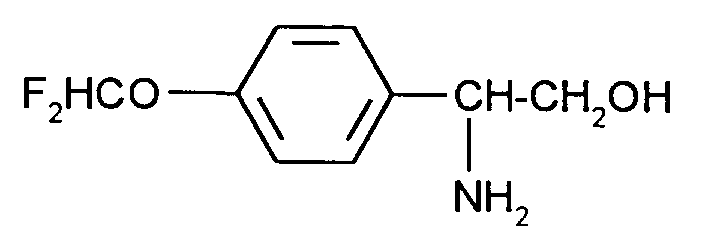
9,8 g (0,045 Mol) 2-Hydroxy-1-(4-difluormethoxy-phenyl)-ethanon-oxim in 100 ml Methanol, 25 ml flüssigem Ammoniak und 5 g Raney-Nickel werden bei 50°C und einem Wasserstoffdruck von 60 bis 70 bar hydriert, bis kein Wasserstoff mehr aufgenommen wird. Nach dem Abkühlen wird entspannt, abfiltriert und das Lösungsmittel unter vermindertem Druck entfernt. Zurück bleibt ein dunkles Öl, das langsam kristallisiert. - Man erhält 7,8 g (84,5% der Theorie) 2-Amino-2-(4-difluormethoxyphenyl)-ethanol mit einer Reinheit von >99% (gaschromatographisch) und einem Schmelzpunkt von 54-57°C.
- Auf analoge Weise und gemäß den allgemeinen Angaben zur Herstellung werden die nachfolgend in Tabelle 1 aufgeführten Verbindungen der Formel (I) erhalten:


-

5,9 g (0,02 Mol) 4-Trifluormethoxyphenyl-ω-hydroxyacetophenon werden in 50 ml Dimethoxyethan vorgelegt, 5 ml Wasser zugegeben, danach 2,1 g (0,025 Mol) Natriumacetat, sowie 1,7 g (0,025 Mol) Hydroxylaminhydrochlorid und 12 Stunden bei Raumtemperatur gerührt. Man gießt auf Eiswasser und filtriert ab. Ausbeute: 5,9 g (88% der Theorie) Schmelzpunkt 150-157°C (E/Z: 25:75) - Analog zu Beispiel II-1 und gemäß den allgemeinen Angaben zur Herstellung werden die nachfolgend in Tabelle 2 aufgeführten Verbindungen der Formel (II) erhalten:


-

6,75 g (0,0215 Mol) 4-Trifluormethoxyphenyl-ω-chloracetophenon werden in Ethanol/Wasser suspendiert und 9,2 g (0,1358 Mol) Natriumformiat hinzugefügt. Man erhitzt 12 Stunden zum Sieden, destilliert das Ethanol weitgehend ab, verdünnt mit Wasser und filtriert ab. - Man erhält 6,5 g beige Kristalle (90% der Theorie) vom Schmelzpunkt 165°C.
-

7 g (0,0525 Mol) Aluminiumchlorid wird in 50 ml 1,2-Dichlorethan vorgelegt. Bei 5 bis 10°C werden 5,9 g (0,0525 Mol) Chloracetylchlorid zugetropft und anschließend 11,9 g (0,05 Mol) 4-Trifluormethoxybiphenyl bei -10°C portionsweise zugegeben. Es wird 12 Stunden bei Raumtemperatur nachgerührt, das Reaktionsgemisch auf Eiswasser gegossen und mit Essigsäureethylester extrahiert. Die organische Phase wird abgetrennt, einmal mit Natriumbicarbonatlösung und zweimal mit Wasser gewaschen, getrocknet und eingeengt. - Man erhält 14,3 g Rohprodukt, das über eine Kieselgelsäule (Laufmittel: Methylenchlorid) gereinigt wird. Man erhält 6,85 g hellbeige Kristalle vom Schmelzpunkt 74-76°C. Ausbeute: 38,5% der Theorie.
Claims (12)
- Verfahren zur Herstellung von Verbindungen der Formel (I)
 Ar für jeweils gegebenenfalls einfach bis fünffach, gleich oder verschieden substituiertes Aryl oder Hetaryl steht, wobei als Substituenten genannt seien:dadurch gekennzeichnet, daß man Verbindungen der Formel (II)
Halogen, Alkyl, Halogenalkyl, Alkoxy, Halogenalkoxy, gegebenenfalls substituiertes Cycloalkyloxy oder gegebenenfalls substituiertes Phenyl, Ar die oben angegebene Bedeutung hat,mit Raney-Nickel oder Raney-Cobalt in Gegenwart eines Verdünnungsmittels und in Gegenwart einer Base katalytisch hydriert.
 - Verfahren zur Herstellung von Verbindungen der Formel (I) gemäß Anspruch 1, in welcherAr für jeweils einfach bis fünffach, gleich oder verschieden substituiertes Phenyl oder jeweils einfach bis dreifach, gleich oder verschieden substituiertes Thienyl, Pyridyl oder Pyrimidinyl steht, wobei jeweils als Substituenten genannt seien:
Fluor, Chlor, Brom, C₁-C₆-Alkyl, C₁-C₆-Halogenalkyl, C₁-C₆-Alkoxy, C₁-C₆-Halogenalkoxy, gegebenenfalls durch Halogen oder C₁-C₆-Alkyl substituiertes C₃-C₆-Cycloalkyloxy und gegebenenfalls einfach bis fünffach, gleich oder verschieden durch Fluor, Chlor, Brom, C₁-C₆-Alkyl, C₁-C₆-Halogenalkyl, C₁-C₆-Alkoxy, C₁-C₆-Halogenalkoxy oder gegebenenfalls durch Halogen oder C₁-C₆-Alkyl substituiertes C₃-C₆-Cycloalkyloxy substituiertes Phenyl. - Verfahren zur Herstellung von Verbindungen der Formel (I) gemäß Anspruch 1, in welcherAr für jeweils einfach bis dreifach, gleich oder verschieden substituiertes Phenyl, Thienyl, Pyridyl oder Pyrimidinyl steht, wobei als Substituenten genannt seien:
Fluor, Chlor, Brom, C₁-C₄-Alkyl, C₁-C₄-Halogenalkyl, C₁-C₄-Alkoxy, C₁-C₄-Halogenalkoxy, gegebenenfalls durch Halogen substituiertes C₃-C₆-Cycloalkyloxy und gegebenenfalls einfach bis dreifach, gleich oder verschieden durch Fluor, Chlor, Brom, C₁-C₄-Alkyl, C₁-C₄-Halogenalkyl, C₁-C₄-Alkoxy, C₁-C₄-Halogenalkoxy oder gegebenenfalls durch Halogen substituiertes C₃-C₆-Cycloalkyloxy substituiertes Phenyl. - Verfahren zur Herstellung von Verbindungen der Formel (I) gemäß Anspruch 1, in welcherAr für einfach oder zweifach, gleich oder verschieden substituiertes Phenyl steht, wobei als Substituenten genannt seien: Fluor, Chlor, Brom, gegebenenfalls durch Fluor und/oder Chlor substituiertes C₁-C₄-Alkyl, gegebenenfalls durch Fluor und/oder Chlor substituiertes C₁-C₄-Alkoxy, gegebenenfalls einfach oder mehrfach durch Fluor und/oder Chlor substituiertes C₃-C₆-Cycloalkyloxy und gegebenenfalls einfach oder zweifach, gleich oder verschieden durch Fluor, Chlor, Brom, gegebenenfalls durch Fluor und/oder Chlor substituiertes C₁-C₄-Alkyl, gegebenenfalls durch Fluor und/oder Chlor substituiertes C₁-C₄-Alkoxy oder gegebenenfalls einfach oder mehrfach durch Fluor und/oder Chlor substituiertes C₃-C₆-Cycloalkyloxy substituiertes Phenyl.
- Verbindungen der Formel (Ia)
 R für einen Restin welchem
 X für Halogen, Alkyl oder Alkoxy steht,Y für Halogenalkoxy oder durch Halogen substituiertes Cycloalkyloxy steht,m für die Zahlen 0, 1 und 2 steht undn für die Zahlen 1 und 2 steht.
 - Verbindungen der Formel (Ia) gemäß Anspruch 5, in welcherX für Fluor, Chlor, Brom, C₁-C₄-Alkyl oder C₁-C₄-Alkoxy,Y für C₁-C₄-Halogenalkoxy oder für durch Halogen substituiertes C₃-C₆-Cycloalkoxy,n für die Zahl 1 undm für 0 oder 1 steht.
- Verbindungen der Formel (Ia) gemäß Anspruch 5, in welcherR für einen Restin welchem
 Y für durch Fluor und/oder Chlor substituiertes C₁-C₄-Alkoxy oder für durch Fluor und/oder Chlor substituiertes C₃-C₆-Cycloalkoxy undn für die Zahl 1 steht.
 - Verbindungen der Formel (Ia) gemäß Anspruch 5, in welcherR für einen Restin welchem
 Y für einen der folgenden Reste:
-OCHF₂, -OCClF₂, -OCF₂CHFCl, -OCF₂CH₂F, -OCF₂CHF₂, -OCF₂CCl₃, -OCF₂CHFCF₃, -OCH₂CF₃, -OCH₂CF₂CHF₂, -OCH₂CF₂CF₃, n für die Zahl 1 steht.
 - Verbindungen der Formel (IIa)
 Ar¹ für jeweils einfach bis fünffach, gleich oder verschieden substituiertes Aryl oder Hetaryl steht, wobei als Substituenten genannt seien:
Halogen, Halogenalkyl, Alkoxy, Halogenalkoxy, gegebenenfalls substituiertes Cycloalkoxy oder einfach bis mehrfach gleich oder verschieden substituiertes Phenyl,
ausgenommen die Verbindungen 1-(4-Methoxyphenyl)-2-hydroxy-ethanon-oxim und 1-(5-Brom-2-thienyl)-2-hydroxy-ethanonoxim. - Verbindungen der Formel (IIa) gemäß Anspruch 9, in welcherAr¹ für einfach bis fünffach, gleich oder verschieden substituiertes Phenyl, oder jeweils einfach bis dreifach, gleich oder verschieden substituiertes Thienyl, Pyridyl oder Pyrimidinyl steht, wobei als Substituenten genannt seien:
Fluor, Chlor, Brom, C₂-C₆-Alkoxy, C₁-C₆-Halogenalkoxy, gegebenenfalls durch Halogen oder C₁-C₆-Alkyl substituiertes C₃-C₆-Cycloalkyloxy und einfach bis fünffach, gleich oder verschieden durch Fluor, Chlor, Brom, C₁-C₆-Alkyl, C₁-C₆-Alkoxy, C₁-C₆-Halogenalkoxy oder gegebenenfalls durch Halogen oder C₁-C₆-Alkyl substituiertes C₃-C₆-Cycloalkyloxy substituiertes Phenyl, ausgenommen die Verbindung 1-(5-Brom-2-thienyl)-2-hydroxy-ethanonoxim. - Verbindungen der Formel (IIa) gemäß Anspruch 9, in welcherAr¹ für jeweils einfach bis dreifach, gleich oder verschieden substituiertes Phenyl, Thienyl, Pyridyl oder Pyrimidinyl steht, wobei als Substituenten genannt seien:
Fluor, Chlor, Brom, C₂-C₄-Alkoxy, C₁-C₄-Halogenalkoxy, gegebenenfalls durch Halogen substituiertes C₃-C₆-Cycloalkyloxy und einfach bis dreifach, gleich oder verschieden durch Fluor, Chlor, Brom, C₁-C₄-Alkyl, C₁-C₄-Alkoxy, C₁-C₄-Halogenalkoxy oder gegebenenfalls durch Halogen substituiertes C₃-C₆-Cycloalkyloxy substituiertes Phenyl,
ausgenommen die Verbindung 1-(5-Brom-2-thienyl)-2-hydroxyethanonoxim. - Verbindungen der Formel (IIa) gemäß Anspruch 9, in welcherAr¹ für einfach oder zweifach, gleich oder verschieden substituiertes Phenyl steht, wobei als Substituenten genannt seien:
Fluor, Chlor, Brom, C₂-C₄-Alkoxy, durch Fluor und/oder Chlor substituiertes C₁-C₄-Alkoxy, gegebenenfalls einfach oder mehrfach durch Fluor und/oder Chlor substituiertes C₃-C₆-Cycloalkyloxy und einfach oder zweifach, gleich oder verschieden durch Fluor, Chlor, Brom, C₁-C₄-Alkyl, gegebenenfalls durch Fluor und/oder Chlor substituiertes C₁-C₄-Alkoxy, oder gegebenenfalls einfach oder mehrfach durch Fluor und/oder Chlor substituiertes C₃-C₆-Cycloalkyloxy substituiertes Phenyl,
ausgenommen die Verbindung 1-(5-Brom-2-thienyl)-2-hydroxyethanonoxim).
Applications Claiming Priority (2)
| Application Number | Priority Date | Filing Date | Title |
|---|---|---|---|
| DE4428533A DE4428533A1 (de) | 1994-08-12 | 1994-08-12 | Verfahren zur Herstellung von 2-Amino-2-arylethanolen und neue Zwischenprodukte |
| DE4428533 | 1994-08-12 |
Publications (3)
| Publication Number | Publication Date |
|---|---|
| EP0696576A2 true EP0696576A2 (de) | 1996-02-14 |
| EP0696576A3 EP0696576A3 (de) | 1997-03-26 |
| EP0696576B1 EP0696576B1 (de) | 2000-04-12 |
Family
ID=6525502
Family Applications (1)
| Application Number | Title | Priority Date | Filing Date |
|---|---|---|---|
| EP95112059A Expired - Lifetime EP0696576B1 (de) | 1994-08-12 | 1995-08-01 | Verfahren zur Herstellung von 2-Amino-2-arylethanolen und neue Zwischenprodukte |
Country Status (9)
| Country | Link |
|---|---|
| US (3) | US5602282A (de) |
| EP (1) | EP0696576B1 (de) |
| JP (2) | JP3946789B2 (de) |
| KR (1) | KR100374155B1 (de) |
| CN (1) | CN1066711C (de) |
| AT (1) | ATE191710T1 (de) |
| DE (2) | DE4428533A1 (de) |
| ES (1) | ES2146271T3 (de) |
| TW (1) | TW432030B (de) |
Cited By (1)
| Publication number | Priority date | Publication date | Assignee | Title |
|---|---|---|---|---|
| WO2001019779A1 (en) * | 1999-09-14 | 2001-03-22 | Alliedsignal Inc. | Preparation of halogenated primary amines |
Families Citing this family (1)
| Publication number | Priority date | Publication date | Assignee | Title |
|---|---|---|---|---|
| CN107954882A (zh) * | 2017-11-22 | 2018-04-24 | 上海泰禾国际贸易有限公司 | 一种2-氨基-2-(4-叔丁基-2-乙氧基苯基)乙醇的制备方法 |
Family Cites Families (2)
| Publication number | Priority date | Publication date | Assignee | Title |
|---|---|---|---|---|
| JP2792046B2 (ja) * | 1987-10-09 | 1998-08-27 | 住友化学工業株式会社 | 光学活性なアミン−ホウ素系化合物、それを有効成分とする不斉還元剤ならびにそれを用いる光学活性化合物の製造方法 |
| AU634608B2 (en) * | 1989-12-09 | 1993-02-25 | Kyoyu Agri Co., Ltd. | 2-substituted phenyl-2-oxazoline or thiazoline derivatives, process for producing the same and insectides and acaricides containing the same |
-
1994
- 1994-08-12 DE DE4428533A patent/DE4428533A1/de not_active Withdrawn
-
1995
- 1995-06-23 TW TW084106439A patent/TW432030B/zh not_active IP Right Cessation
- 1995-08-01 AT AT95112059T patent/ATE191710T1/de not_active IP Right Cessation
- 1995-08-01 ES ES95112059T patent/ES2146271T3/es not_active Expired - Lifetime
- 1995-08-01 EP EP95112059A patent/EP0696576B1/de not_active Expired - Lifetime
- 1995-08-01 DE DE59508160T patent/DE59508160D1/de not_active Expired - Fee Related
- 1995-08-04 US US08/511,207 patent/US5602282A/en not_active Expired - Fee Related
- 1995-08-07 JP JP22102195A patent/JP3946789B2/ja not_active Expired - Fee Related
- 1995-08-10 KR KR1019950024710A patent/KR100374155B1/ko not_active Expired - Fee Related
- 1995-08-11 CN CN95115334A patent/CN1066711C/zh not_active Expired - Fee Related
-
1996
- 1996-09-27 US US08/723,968 patent/US6022995A/en not_active Expired - Fee Related
-
1998
- 1998-11-04 US US09/185,864 patent/US6031134A/en not_active Expired - Fee Related
-
2007
- 2007-03-05 JP JP2007054671A patent/JP2007176952A/ja not_active Withdrawn
Cited By (2)
| Publication number | Priority date | Publication date | Assignee | Title |
|---|---|---|---|---|
| WO2001019779A1 (en) * | 1999-09-14 | 2001-03-22 | Alliedsignal Inc. | Preparation of halogenated primary amines |
| US6340773B1 (en) | 1999-09-14 | 2002-01-22 | Alliedsignal Inc. | Preparation of halogenated primary amines |
Also Published As
| Publication number | Publication date |
|---|---|
| CN1122797A (zh) | 1996-05-22 |
| KR100374155B1 (ko) | 2003-04-23 |
| ATE191710T1 (de) | 2000-04-15 |
| KR960007541A (ko) | 1996-03-22 |
| EP0696576B1 (de) | 2000-04-12 |
| DE4428533A1 (de) | 1996-02-15 |
| JP3946789B2 (ja) | 2007-07-18 |
| JPH0859577A (ja) | 1996-03-05 |
| DE59508160D1 (de) | 2000-05-18 |
| TW432030B (en) | 2001-05-01 |
| JP2007176952A (ja) | 2007-07-12 |
| US5602282A (en) | 1997-02-11 |
| ES2146271T3 (es) | 2000-08-01 |
| EP0696576A3 (de) | 1997-03-26 |
| US6031134A (en) | 2000-02-29 |
| US6022995A (en) | 2000-02-08 |
| CN1066711C (zh) | 2001-06-06 |
Similar Documents
| Publication | Publication Date | Title |
|---|---|---|
| EP0355351B1 (de) | Verfahren zur Herstellung von Aminen | |
| EP0595150B1 (de) | Verfahren zur Herstellung von aromatischen Brommethyl-Verbindungen | |
| DE2624290A1 (de) | Neue 2-aminocycloalkancarbonsaeuren, deren derivate und ein verfahren zu ihrer herstellung | |
| DE2503187A1 (de) | Verfahren zur herstellung durch chlor meta-substituierte aniline | |
| DE2455887C2 (de) | Verfahren zur Herstellung von chlorierten Phenylhydroxylaminen | |
| EP0696576B1 (de) | Verfahren zur Herstellung von 2-Amino-2-arylethanolen und neue Zwischenprodukte | |
| DE102021131664B4 (de) | Verfahren zum Vorbereiten einer N-Cyclopropylmethylanilin-Verbindung | |
| EP0818436B1 (de) | Verfahren zur Herstellung von 4-Hydroxyanilinen | |
| DE2455238A1 (de) | Verfahren zur herstellung aromatischer hydroxylamine durch hydrierung aromatischer nitroderivate | |
| DE69802213T2 (de) | Aryne-Zwischenverbindungen zur Herstellung von herbiziden Sulphamoylharnstoffen und ein Verfahren zu deren Herstellung | |
| EP0038471B1 (de) | Neue beta-gamma-ungesättigte Ketone und isoprenoide 2,6-Dienone, Verfahren zu deren Herstellung und ihre Verwendung als Geruchs- und Geschmacksstoffe | |
| EP0923534B1 (de) | Verfahren zur herstellung von racemischen phenethylaminen | |
| DE3721839A1 (de) | Verfahren zur herstellung von 2,2-bis-(3,4-diaminophenyl)-hexafluorpropan | |
| DE1931061A1 (de) | Pyrazolverbindungen,Verfahren zu ihrer Herstellung und ihre Verwendung | |
| EP0345464B1 (de) | Verfahren zur Herstellung von substituierten 3-Amino-2(benzoyl)-acrylsäureestern sowie ein Verfahren zur Herstellung von Zwischenprodukten für antibakterielle Wirkstoffe aus diesen Verbindungen | |
| DE4210311A1 (de) | Verfahren zur Herstellung von Aminen aus Azinen | |
| DE69909415T2 (de) | Herstellung von allylischen aromatischen Verbindungen | |
| EP0041172B1 (de) | Verfahren zur Herstellung von Pivaloylessigsäure-2-chlor-5-(4-(2,4-di-tert.-amyl)-phenoxybutyramido)-anilid | |
| DE3318534C2 (de) | ||
| AT218534B (de) | Verfahren zur Herstellung von neuen substituierten Harnstoffen | |
| DE2851755A1 (de) | Cycloheptatrien-derivate und verfahren zu ihrer herstellung | |
| DE102005057715A1 (de) | Prozess zur Herstellung symmetrischer und unsymmetrischer N,N-Dihydrocarbylhydroxylamine | |
| DD150053A5 (de) | Verfahren zur herstellung von neuen hydroxyiminosubstituierten aminoacetonitrilen | |
| AT201586B (de) | Verfahren zur Herstellung von neuen Aryloxyessigsäureamiden | |
| EP1362025A2 (de) | Polyhalogensubstituierte zimtsaeuren und zimtsaeurederivate und ein verfahren zu deren herstellung |
Legal Events
| Date | Code | Title | Description |
|---|---|---|---|
| PUAI | Public reference made under article 153(3) epc to a published international application that has entered the european phase |
Free format text: ORIGINAL CODE: 0009012 |
|
| AK | Designated contracting states |
Kind code of ref document: A2 Designated state(s): AT BE CH DE ES FR GB IT LI NL |
|
| PUAL | Search report despatched |
Free format text: ORIGINAL CODE: 0009013 |
|
| AK | Designated contracting states |
Kind code of ref document: A3 Designated state(s): AT BE CH DE ES FR GB IT LI NL |
|
| 17P | Request for examination filed |
Effective date: 19970926 |
|
| 17Q | First examination report despatched |
Effective date: 19971105 |
|
| GRAG | Despatch of communication of intention to grant |
Free format text: ORIGINAL CODE: EPIDOS AGRA |
|
| GRAG | Despatch of communication of intention to grant |
Free format text: ORIGINAL CODE: EPIDOS AGRA |
|
| GRAH | Despatch of communication of intention to grant a patent |
Free format text: ORIGINAL CODE: EPIDOS IGRA |
|
| GRAH | Despatch of communication of intention to grant a patent |
Free format text: ORIGINAL CODE: EPIDOS IGRA |
|
| GRAA | (expected) grant |
Free format text: ORIGINAL CODE: 0009210 |
|
| AK | Designated contracting states |
Kind code of ref document: B1 Designated state(s): AT BE CH DE ES FR GB IT LI NL |
|
| REF | Corresponds to: |
Ref document number: 191710 Country of ref document: AT Date of ref document: 20000415 Kind code of ref document: T |
|
| REG | Reference to a national code |
Ref country code: CH Ref legal event code: NV Representative=s name: E. BLUM & CO. PATENTANWAELTE Ref country code: CH Ref legal event code: EP |
|
| GBT | Gb: translation of ep patent filed (gb section 77(6)(a)/1977) |
Effective date: 20000418 |
|
| REF | Corresponds to: |
Ref document number: 59508160 Country of ref document: DE Date of ref document: 20000518 |
|
| ET | Fr: translation filed | ||
| ITF | It: translation for a ep patent filed | ||
| REG | Reference to a national code |
Ref country code: ES Ref legal event code: FG2A Ref document number: 2146271 Country of ref document: ES Kind code of ref document: T3 |
|
| PLBE | No opposition filed within time limit |
Free format text: ORIGINAL CODE: 0009261 |
|
| STAA | Information on the status of an ep patent application or granted ep patent |
Free format text: STATUS: NO OPPOSITION FILED WITHIN TIME LIMIT |
|
| 26N | No opposition filed | ||
| REG | Reference to a national code |
Ref country code: GB Ref legal event code: IF02 |
|
| PGFP | Annual fee paid to national office [announced via postgrant information from national office to epo] |
Ref country code: ES Payment date: 20050803 Year of fee payment: 11 |
|
| PGFP | Annual fee paid to national office [announced via postgrant information from national office to epo] |
Ref country code: FR Payment date: 20060724 Year of fee payment: 12 |
|
| PGFP | Annual fee paid to national office [announced via postgrant information from national office to epo] |
Ref country code: DE Payment date: 20060725 Year of fee payment: 12 |
|
| PGFP | Annual fee paid to national office [announced via postgrant information from national office to epo] |
Ref country code: GB Payment date: 20060726 Year of fee payment: 12 |
|
| PGFP | Annual fee paid to national office [announced via postgrant information from national office to epo] |
Ref country code: AT Payment date: 20060809 Year of fee payment: 12 |
|
| PGFP | Annual fee paid to national office [announced via postgrant information from national office to epo] |
Ref country code: CH Payment date: 20060815 Year of fee payment: 12 |
|
| PGFP | Annual fee paid to national office [announced via postgrant information from national office to epo] |
Ref country code: BE Payment date: 20060830 Year of fee payment: 12 |
|
| PGFP | Annual fee paid to national office [announced via postgrant information from national office to epo] |
Ref country code: NL Payment date: 20060831 Year of fee payment: 12 Ref country code: IT Payment date: 20060831 Year of fee payment: 12 |
|
| REG | Reference to a national code |
Ref country code: CH Ref legal event code: PFA Owner name: BAYER AG Free format text: BAYER AG# #51368 LEVERKUSEN (DE) -TRANSFER TO- BAYER AG# #51368 LEVERKUSEN (DE) |
|
| BERE | Be: lapsed |
Owner name: *BAYER A.G. Effective date: 20070831 |
|
| REG | Reference to a national code |
Ref country code: CH Ref legal event code: PL |
|
| GBPC | Gb: european patent ceased through non-payment of renewal fee |
Effective date: 20070801 |
|
| PG25 | Lapsed in a contracting state [announced via postgrant information from national office to epo] |
Ref country code: NL Free format text: LAPSE BECAUSE OF NON-PAYMENT OF DUE FEES Effective date: 20080301 Ref country code: LI Free format text: LAPSE BECAUSE OF NON-PAYMENT OF DUE FEES Effective date: 20070831 Ref country code: CH Free format text: LAPSE BECAUSE OF NON-PAYMENT OF DUE FEES Effective date: 20070831 |
|
| NLV4 | Nl: lapsed or anulled due to non-payment of the annual fee |
Effective date: 20080301 |
|
| PG25 | Lapsed in a contracting state [announced via postgrant information from national office to epo] |
Ref country code: AT Free format text: LAPSE BECAUSE OF NON-PAYMENT OF DUE FEES Effective date: 20070801 |
|
| REG | Reference to a national code |
Ref country code: FR Ref legal event code: ST Effective date: 20080430 |
|
| PG25 | Lapsed in a contracting state [announced via postgrant information from national office to epo] |
Ref country code: DE Free format text: LAPSE BECAUSE OF NON-PAYMENT OF DUE FEES Effective date: 20080301 |
|
| PG25 | Lapsed in a contracting state [announced via postgrant information from national office to epo] |
Ref country code: BE Free format text: LAPSE BECAUSE OF NON-PAYMENT OF DUE FEES Effective date: 20070831 |
|
| PG25 | Lapsed in a contracting state [announced via postgrant information from national office to epo] |
Ref country code: FR Free format text: LAPSE BECAUSE OF NON-PAYMENT OF DUE FEES Effective date: 20070831 |
|
| REG | Reference to a national code |
Ref country code: ES Ref legal event code: FD2A Effective date: 20070802 |
|
| PG25 | Lapsed in a contracting state [announced via postgrant information from national office to epo] |
Ref country code: GB Free format text: LAPSE BECAUSE OF NON-PAYMENT OF DUE FEES Effective date: 20070801 |
|
| PG25 | Lapsed in a contracting state [announced via postgrant information from national office to epo] |
Ref country code: ES Free format text: LAPSE BECAUSE OF NON-PAYMENT OF DUE FEES Effective date: 20070802 |
|
| PG25 | Lapsed in a contracting state [announced via postgrant information from national office to epo] |
Ref country code: IT Free format text: LAPSE BECAUSE OF NON-PAYMENT OF DUE FEES Effective date: 20070801 |