EP0696596B1 - Nachweis, Test und Gewinnung von Zusammensetzungen die ein Taxanringskelett enthalten - Google Patents
Nachweis, Test und Gewinnung von Zusammensetzungen die ein Taxanringskelett enthalten Download PDFInfo
- Publication number
- EP0696596B1 EP0696596B1 EP95302900A EP95302900A EP0696596B1 EP 0696596 B1 EP0696596 B1 EP 0696596B1 EP 95302900 A EP95302900 A EP 95302900A EP 95302900 A EP95302900 A EP 95302900A EP 0696596 B1 EP0696596 B1 EP 0696596B1
- Authority
- EP
- European Patent Office
- Prior art keywords
- taxane
- antibody
- taxol
- process according
- deacetylbaccatin iii
- Prior art date
- Legal status (The legal status is an assumption and is not a legal conclusion. Google has not performed a legal analysis and makes no representation as to the accuracy of the status listed.)
- Expired - Lifetime
Links
- 0 CC(C)(C)OC(*(*)[C@](CC(OC)=O)N=[U]#C)=O Chemical compound CC(C)(C)OC(*(*)[C@](CC(OC)=O)N=[U]#C)=O 0.000 description 2
- GLIZLEUXBKZSDT-MSPNFNHOSA-N CC1(C)C([C@H]2O)=C(C)CCC1C[C@](C)([C@H](C1)[C@@H](C[C@@H]3[O](C)=C)OC1C#C)[C@]3(C)C2=O Chemical compound CC1(C)C([C@H]2O)=C(C)CCC1C[C@](C)([C@H](C1)[C@@H](C[C@@H]3[O](C)=C)OC1C#C)[C@]3(C)C2=O GLIZLEUXBKZSDT-MSPNFNHOSA-N 0.000 description 1
Classifications
-
- C—CHEMISTRY; METALLURGY
- C07—ORGANIC CHEMISTRY
- C07K—PEPTIDES
- C07K16/00—Immunoglobulins [IG], e.g. monoclonal or polyclonal antibodies
- C07K16/16—Immunoglobulins [IG], e.g. monoclonal or polyclonal antibodies against material from plants
-
- A—HUMAN NECESSITIES
- A61—MEDICAL OR VETERINARY SCIENCE; HYGIENE
- A61K—PREPARATIONS FOR MEDICAL, DENTAL OR TOILETRY PURPOSES
- A61K31/00—Medicinal preparations containing organic active ingredients
- A61K31/33—Heterocyclic compounds
- A61K31/335—Heterocyclic compounds having oxygen as the only ring hetero atom, e.g. fungichromin
-
- C—CHEMISTRY; METALLURGY
- C07—ORGANIC CHEMISTRY
- C07K—PEPTIDES
- C07K16/00—Immunoglobulins [IG], e.g. monoclonal or polyclonal antibodies
- C07K16/02—Immunoglobulins [IG], e.g. monoclonal or polyclonal antibodies from eggs
Definitions
- This invention relates to the detection, assay and isolation of compounds having the taxane ring skeleton, in particular taxol and 10-deacetylbaccatin III.
- Taxol is a complex diterpene pseudoalkaloid which can be extracted from the bark of the western yew Taxus brevifolia and has been reported to display anti-cancer activity in otherwise refractory solid tumors (Chabner, B.A. Principles and Practice of Oncology 5 (1991) 1).
- the availability of the drug is unfortunately limited because of the scarcity of the substance (its concentration in the bark is approx 0.01%), and the difficulties met during its purification.
- Current supplies of Taxus sp. are insufficient to provide sufficient drug to treat patient populations such as those with metastatic ovarian and breast cancers.
- Taxol in medicine is dependent upon methods being developed for obtaining it from renewable sources.
- Appendino, G., Fitorick 1 (vol. XIV suppl.) (1993) 5 At the moment the only practical alternative to bark harvesting is the hemisynthesis of Taxol.
- One procedure is based on the isolation from yew needles of 10-deacetylbaccatin III (DAB), a compound that can be converted into Taxol, from which it differs only in not having an phenylisoserine chain in position C-13 and an acetyl group in position C-10.
- DAB 10-deacetylbaccatin III
- the content of DAB in leaves of different Taxus species is very variable but generally much higher (up to 10 times) than the Taxol content in the bark of the Pacific yew (Fitopad, supra ).
- Taxol and 10-deacetylbaccatin III have the structural formulae (1) and (2) respectively as shown below:
- Taxanes are substances with antitumour activity that are obtainable from plants of the genus Taxus.
- hemisynthetic analogues of Taxol which also displays a strong antitumor activity (Gueritte-Voelgelein, F. Guenard, D. Lavelle, F. Le Goff, M-T. L. Potier, P.J. Med Chem 34 (1991) 992).
- the hemisynthetic strategy would be significantly improved if it was possible to select varieties of yew with a high content of valuable Taxol precursors (i.e. 10-deacetylbaccatin III, and baccatinIII).
- 10-deacetylbaccatin III i.e. 10-deacetylbaccatin III, and baccatinIII
- taxanes in their pure form from vegetable sources involves complex chromatographic separations with final yields that are not very high.
- immunological processes when they can be applied on an industrial scale to extract substances present in very small quantities in plants or cell or microorganism culture media, and particularly in complex and heterogeneous mixtures, have the advantage of accelerating and simplifying laborious chromatographic separations.
- avian IgY antibodies e.g. chicken antibodies from egg yolk are able to interact specifically with the ring system of compounds having the taxane ring skeleton, e.g. DAB-like taxanes.
- These antibodies have utility as reagents for the search and selection of new sources of Taxol precursors as alternatives to Pacific or European yews, in analyticac methods and also in the development of procedures for isolating such compounds.
- the quantity of antigens necessary for the immunization is far smaller than (often no more than a tenth of) that usually used for the production of antibodies in mammals.
- the antibodies prepared according to the invention have the ability to interact specifically with compounds which have, for example, the carbon skeleton of 10-deacetylbaccatin III. It is therefore possible to distinguish (by immunizing avian females with the specific derivatives) between 10-deacetylbaccatin III and taxol.
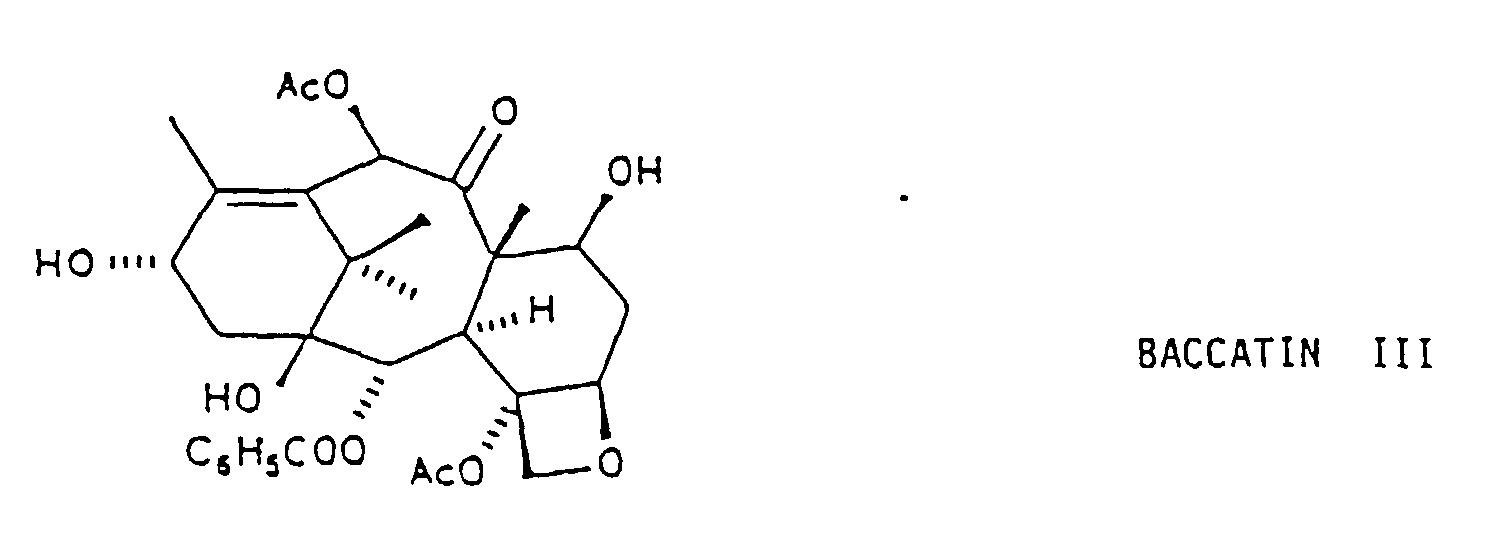
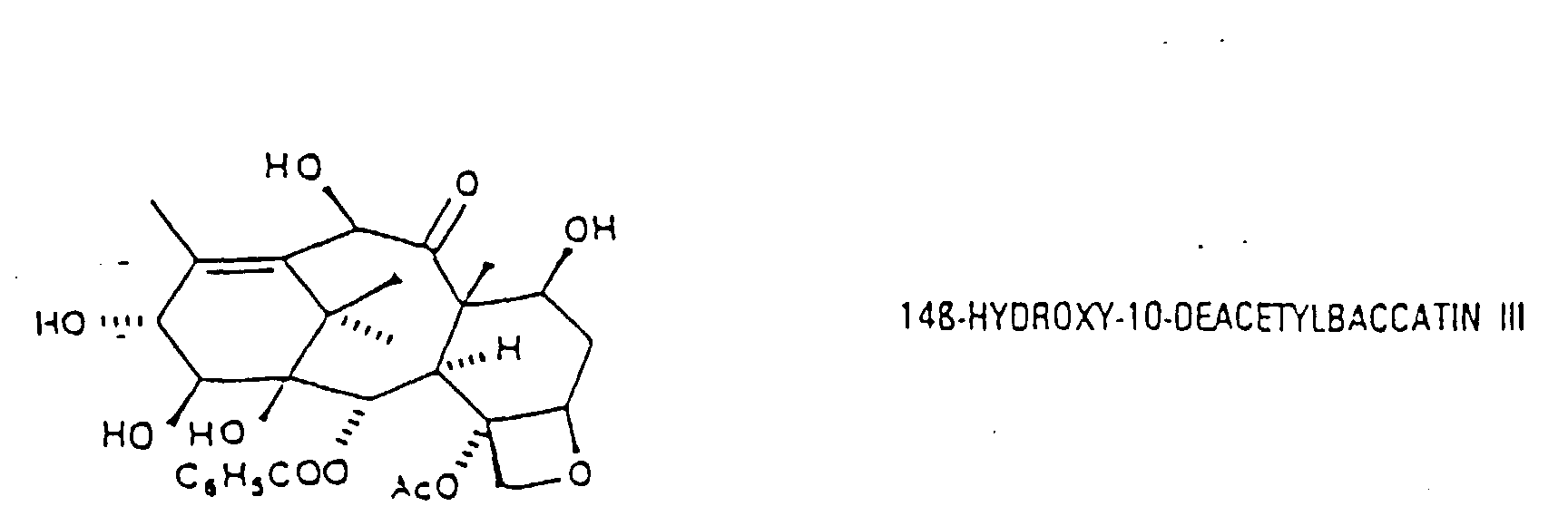
- Compounds that can advantageously be isolated by this technology include 10-deacetylbaccatin III, baccatin III and 14-hydroxy-10-deacetylbaccatin III.
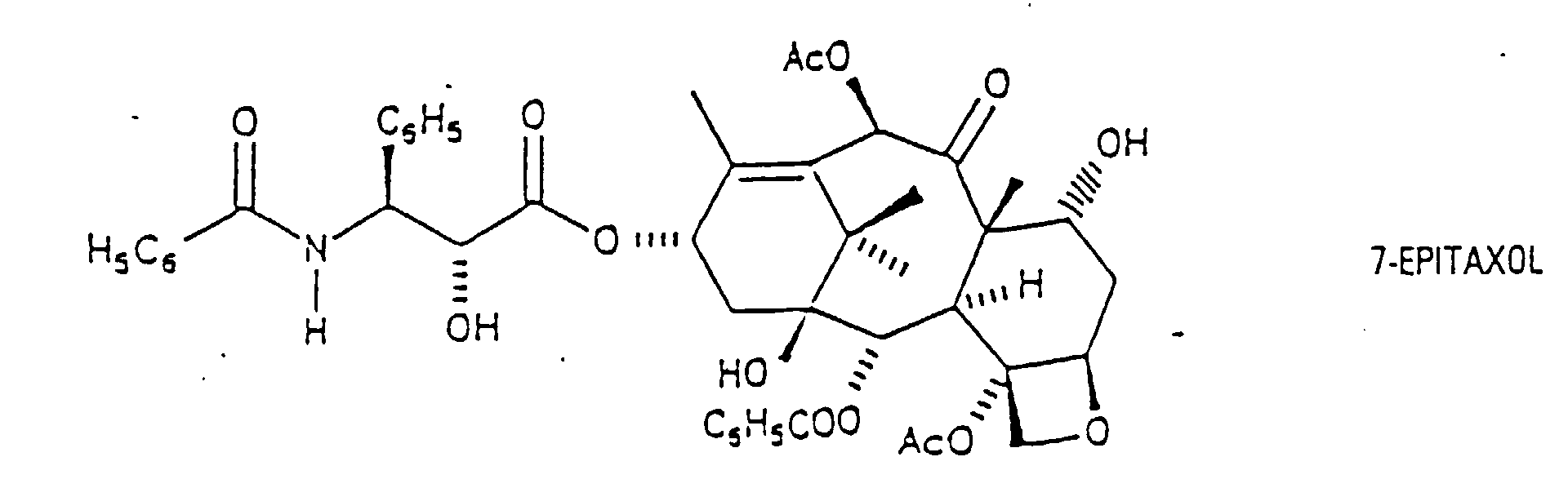
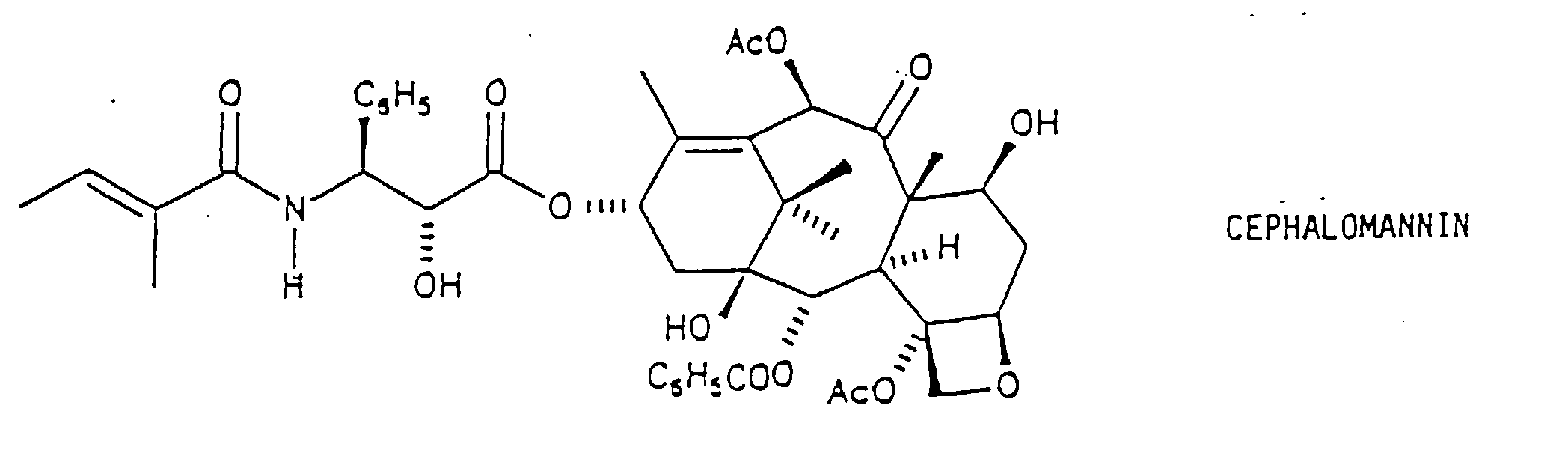
- the same technology can be used to prepare other specific antibodies to taxanes, such as cephalomannin and 7-epitaxol, which normally constitute impurities of the main products of interest.
- the present invention therefore has two main objects, namely the analytical determination by an immunodiagnostic method of the above compounds and their quantitative isolation from various substrates.
- the antibodies that are the subject of the present invention which are produced by avian females, e.g. hens have surprisingly proved to have advantageous stability characteristics by comparison with similar products obtained from mammals, particularly when used on aqueous and non-aqueous vegetable extracts, since they are resistant to the common organic solvents used during the preparation and extraction processes; these antibodies also have the advantage that they can be used in mixtures of water with organic solvents such as ethanol and alcohols miscible with water acetone up to concentrations that permit complete solubilization of the antigen.
- an antibody of the avian IgY class which has antibody specificity for an antigen which comprises the taxane ring skeleton.
- the invention further provides a method of producing an antibody as defined above which comprises challenging an avian female with said antigen and isolating the IgY antibody from the subsequently laid eggs.
- taxane ring skeleton (carbon atoms only being shown and without stereochemical designations) is based upon the following C-20 tricyclic structure
- IgY antibodies produced according to the invention are useful as analytical reagents for detecting and/or assaying a compound comprising the taxane ring skeleton and as a preparation reagent for use in isolating or purifying a compound comprising the taxane ring skeleton.
- the IgYs of the invention can be used for the immunological screening of a large number of plants which should enable new sources of Taxol precursors to be discovered.
- a further aspect of the present invention is a process for the purification of a taxane, comprising contacting a mixture containing the said taxane with a polyclonal antibody to the said taxane, subsequent isolation of the taxane-antibody complex and recovery of the taxane, characterized in that the said polyclonal antibody is an IgY antibody, especially one obtained from hens' eggs.
- the invention further provides a process which can be used on an analytical scale to assay (i.e. to detect or determine the presence of) taxanes in mixtures or biological fluids.
- a process which can be used on an analytical scale to assay i.e. to detect or determine the presence of taxanes in mixtures or biological fluids.
- another aspect of the present invention is a method for the determination of taxanes in mixtures and biological fluids, characterized in that this method uses a polyclonal antibody as described above.
- a method for the determination of taxanes in samples of biological fluids or culture media, in particular blood which involves treating the said sample with a polyclonal antibody as mentioned above and subsequently determining the taxane by an immunodiagnostic method.
- a suitable derivative of taxane such as taxol, 10-deacetylbaccatin III or one of their analogues, is prepared by reacting this compound with succinic anhydride in pyridine in the presence of 4-dimethylaminopyridine and isolating the succinyl-taxane chromatographically on a silica gel column or by equivalent methods.
- the succinyl-taxane thus obtained may be conjugated by processes known in the literature (B.F. Erlanger, Methods in Enzymol.
- conjugates are administered to selected avian females, e.g. laying hens, with a total of 0.5 mg of conjugate of 10-deacetylbaccatin III or taxol and/or other taxanes with bovine serum albumin being injected subcutaneously into various parts of the body using Freund's adjuvant; boosters are given at brief intervals during the first month using 0.25 mg of conjugate.
- the egg yolks are separated from the whites and ruptured in phosphate buffer pH 7.5 containing 0.1M NaCI in accordance with procedures known in the literature (Polson et al ., Immunol. Comm. , 9 , 475, 1980).
- PEG polyethylene glycol
- the antibodies are purified using columns of activated Sepharose to which the serum albumin and the taxane derivative bind when the components are left to react in the presence of N-(3-dimethylaminopropyl)-N-ethylcarbodiimide hydrochloride.
- the unreacted groups of the resin are saturated with acetic acid.
- the resin thus prepared is washed repeatedly with a 0.1M acetate buffer pH 4.5, 0.1M bicarbonate pH 8.3 containing 0.5M NaCI.
- the resin is now ready for purification of the antibodies which, once absorbed, can be re-eluted by washing the column with a 0.2M solution of glycine hydrochloride at pH 2.5.
- Immunoaffinity chromatography is now a well-known technique for purifying numerous antigens.
- the technique uses the interaction between an immunoglobulin and a specific antigen, which in the case in question is a taxane, such as taxol or 10-deacetylbaccatin III or one of their analogues. Therefore, though this does not limit the scope of the invention, resins with a derivatized methacrylic structure, such as Affi-prep Hz hydrazide (Biorad) or resin columns again containing hydrazine groups such as the Avidchroms, are used as a support matrix to immobilize the antibodies. These resins have the ability to form stable links such as hydrazones with the oxidized carbohydrates of the immunoglobulins.
- the immunoglobulins are particularly rich in oxidizable carbohydrates compared with antibodies from other sources.
- the antibodies immobilized on the matrix after they have fixed the relative antigen are treated by the normal procedures described in the literature to recover the antigen and regenerate the column.
- Other techniques, normally recommended by the suppliers of matrices for affinity chromatography, can also be used.
- the methods described above can be used to determine quantities of antigen in vegetable extracts, in culture media and in plasma after the administration of drugs (in a preferred case taxol) containing the products cited above in quantities of between 1 and 100 ng.
- the method according to the present invention can be carried out by another immunodiagnostic method, for example competitive inhibition enzyme immunoassay (CIEIA).
- CIEIA competitive inhibition enzyme immunoassay
- the taxanes that are the subject of the invention can be directly "captured" by aqueous alcoholic extracts obtained by extracting, for example, vegetable biomasses with ethanol or methanol diluted by up to 50%, preferably around 40%, with water.
- This solvent has the advantage of extracting all the taxanes and not extracting unwanted substances such as chlorophyll and other pigments which are present in particularly high concentrations in the aerial parts of plants of the genus Taxus.
- the method is in this sense also particularly useful for eliminating taxane impurities that are difficult to isolate by normal chromatographic procedures such as silica gel columns or high pressure reverse phase industrial columns; by virtue of its high specificity, immunoaffinity chromatography enables, for example, taxol to be separated from its isomers such as 7-epi-taxol or cephalomannin; it can also be used to isolate 10-deacetylbaccatin III and 14-hydroxybaccatin.
- Taxus baccata Species of the genus Taxus commonly used industrially are Taxus baccata , T. brevifolia , T. wallichiana , T hicksi , T. canadensis , T. hiamanensis , T. piramidalis as well as selected cultivars.
- bovine serum albumin 50 mg bovine serum albumin are reacted with Sepharose activated with CNBr and then the whole is reacted with 2'-succinyl-taxol as prepared above in the presence of 100 mg N'-(3-dimethylaminopropyl)-N-ethylcarbodiimide hydrochloride at pH 5-6 for 12 hours.
- the excess of unreacted groups on the resin is saturated with acetic acid; the resin is then washed with 0.1M acetate buffer pH 4.5 with 0.1M NaHCO 3 containing 0.5M NaCl.
- the resin is used for immunoaffinity separation it is washed with 0.2M glycine/HCl buffer pH 2.5.
- the suspension is centrifuged and the solid containing the antibodies collected.
- the precipitate is redissolved in 50 mM Tris buffer containing EDTA and NaN 3 as stabilizer.
- the antibodies are purified by passing this solution over the resin described above containing the antigen.
- the antibodies are re-eluted at the time of use with 0.2M glycine/HCl buffer pH 2.5.
- An Avid-chrom column with hydrazide groups equilibrated with 0.05M sodium acetate pH 5 is treated with a solution of antibodies that have been pre-oxidized with sodium periodate by leaving the matrix to react with the antibody solution for approximately 1 hour (30 mg antibodies purified as described above are dissolved in 30 ml 0.05M sodium acetate and oxidized with 10 mM sodium periodate).
- the column is washed at the end with 0.02M phosphate buffer pH 7.4 to remove the excess of unreacted antibodies.
- Taxol 100 g of finely chopped Taxus baccata leaves are extracted with 35% aqueous ethanol to exhaustion in taxol (approx. 2 l solvent). After filtration this extract is passed over a 20 ml Avid-chrom column prepared as described above. This column fixed 12.6 mg taxol, which was the quantity previously determined in the leaves by HPLC. The taxol is removed from the column by washing it with a 1:1 mixture of dioxane and water containing glycine/HCl buffer pH 2.5. The taxol is extracted from the column eluate with methylene chloride and crystallized from alcohol. The purity of the taxol obtained is over 99%.
- Example II Preparation of an activated matrix containing anti-10-deacetylbaccatin III polyclonal antibodies useful in the isolation of 10-deacetylbaccatin III from extracts of Taxus baccata.
- the specific antibodies and the immunoaffinity column are prepared by the same scheme and methods as described in example I, but using a different antigen, which is prepared as follows:
- the 10-deacetylbaccatin III thus obtained has a purity of over 99%.
Landscapes
- Chemical & Material Sciences (AREA)
- Health & Medical Sciences (AREA)
- Life Sciences & Earth Sciences (AREA)
- Organic Chemistry (AREA)
- Medicinal Chemistry (AREA)
- General Health & Medical Sciences (AREA)
- Biophysics (AREA)
- Biochemistry (AREA)
- Genetics & Genomics (AREA)
- Immunology (AREA)
- Molecular Biology (AREA)
- Proteomics, Peptides & Aminoacids (AREA)
- Botany (AREA)
- Animal Behavior & Ethology (AREA)
- Epidemiology (AREA)
- Pharmacology & Pharmacy (AREA)
- Public Health (AREA)
- Veterinary Medicine (AREA)
- Peptides Or Proteins (AREA)
- Epoxy Compounds (AREA)
- Heterocyclic Carbon Compounds Containing A Hetero Ring Having Oxygen Or Sulfur (AREA)
- Pharmaceuticals Containing Other Organic And Inorganic Compounds (AREA)
- Measuring Or Testing Involving Enzymes Or Micro-Organisms (AREA)
- Nitrogen And Oxygen Or Sulfur-Condensed Heterocyclic Ring Systems (AREA)
- Plural Heterocyclic Compounds (AREA)
- Medicines Containing Antibodies Or Antigens For Use As Internal Diagnostic Agents (AREA)
Claims (28)
- Antikörper der avianen Vogel-IgY-Klasse, der Antikörperspezifität für ein das Taxan-Ringgerüst umfassendes Antigen aufweist.
- Antikörper nach Anspruch 1, wobei das Antigen eine der folgenden Strukturformeln aufweist





- Antikörper nach Anspruch 1 oder 2, wobei es sich beim Antigen um Taxol oder um einen Taxol-Vorläufer handelt.
- Antikörper nach Anspruch 3, wobei es sich beim Antigen um 10-Desacetylbaccatin III handelt.
- Antikörper nach einem der vorstehenden Ansprüche, wobei es sich um Haushuhn-IgY handelt.
- Verfahren zur Herstellung eines Antikörpers gemäß der Definition in einem der vorstehenden Ansprüche, umfassend das Reizen eines weiblichen Vogels mit dem Antigen und das Isolieren des IgY-Antikörpers aus den anschließend gelegten Eiern.
- Verwendung eines Antikörpers nach einem der Ansprüche 1 bis 5 als analytisches Reagenz zum Nachweis und/oder zur Bestimmung einer Verbindung, die das Taxan-Ringgerüst umfaßt.
- Verwendung eines Antikörpers nach einem der Ansprüche 1 bis 5 als präparatives Reagenz zum Einsatz zur Verwendung beim Isolieren oder Reinigen einer Verbindung, die das Taxan-Ringgerüst umfaßt.
- Verfahren zur Reinigung eines Taxans, umfassend das Behandeln eines Gemisches, das dieses Taxan enthält, mit einem polyklonalen Antikörper gegen dieses Taxan, das anschließende Isolieren des Taxan-Antikörper-Komplexes und das Gewinnen des Taxans, dadurch gekennzeichnet, daß der polyklonale Antikörper aus einer Vogelspezies, insbesondere aus Hühnern, erhalten worden ist.
- Verfahren nach Anspruch 9, dadurch gekennzeichnet, daß der polyklonale Antikörper an einem chromatographischen Träger für die Immunoaffinitätschromatographie fixiert ist.
- Verfahren nach Anspruch 9, dadurch gekennzeichnet, daß es sich beim chromatographischen Träger um ein Harz mit einer mit Hydrazingruppen derivatisierten Methacryl-Struktur handelt.
- Verfahren nach Anspruch 11, dadurch gekennzeichnet, daß die Elution des Trägers mit einem wäßrigen Gemisch von Dioxan oder einem aliphatischen Alkohol, das auf den pH-Wert 2,5 gepuffert ist, durchgeführt wird.
- Verfahren nach Anspruch 12, dadurch gekennzeichnet, daß es sich beim Elutionsmittel um ein mit Glycin/HCl gepuffertes Gemisch aus Dioxan und Wasser handelt.
- Verfahren nach Anspruch 9, dadurch gekennzeichnet, daß es sich bei dem Gemisch um einen Extrakt handelt, der aus einer Spezies der Gattung Taxus, ausgewählt unter, Taxus baccata, T. brevifolia, T. wallichiana, T. hicksi, T. canadensis, T. hiamanensis und T. piramidalis, erhalten worden ist.
- Verfahren nach einem der Ansprüche 9 bis 14, dadurch gekennzeichnet, daß das isolierte Taxan aus der Gruppe Taxol, 10-Desacetylbaccatin III, 14-Hydroxy-10-desacetylbaccatin III, Baccatin III, Cephalomannin, 19-Hydroxy-10-desacetylbaccatin III und 7-Epitaxol ausgewählt ist.
- Verfahren nach einem der Ansprüche 9 bis 14, dadurch gekennzeichnet, daß es sich beim isolierten Taxan um Taxol handelt und es sich beim Elutionsmittel um ein 1:1-Gemisch aus Dioxan und Wasser, das mit Glycin auf den pH-Wert 2,5 gepuffert ist, handelt.
- Verfahren nach einem der Ansprüche 9 bis 15, dadurch gekennzeichnet, daß es sich bei dem isolierten Taxan um 10-Desacetylbaccatin III handelt und es sich beim Elutionsmittel um ein 2:1-Gemisch aus Dioxan/Wasser, das mit Glycin/HCl auf den pH-Wert 2,5 gepuffert ist, handelt.
- Verfahren zur Herstellung von polyklonalen Antitaxan-Antikörpern aus Eidotter, umfassend:a) das Immunisieren von Hühnern mit einem Succinyltaxan-Albumin-Konjugat; undb) das Isolieren der Antikörper aus dem Eidotter der Hühner.
- Verfahren nach Anspruch 18, dadurch gekennzeichnet, daß es sich beim Succinyltaxan um Succinyltaxol und beim Albumin um Rinderserumalbumin handelt.
- Verfahren nach Anspruch 18, dadurch gekennzeichnet, daß es sich beim Succinyltaxan um Succinyl-10-desacetylbaccatin III und beim Albumin um Rinderserumalbumin handelt.
- Polyklonaler Antitaxan-Antikörper, erhältlich nach dem Verfahren gemäß den Ansprüchen 18 bis 20.
- Verwendung des Antikörpers nach Anspruch 21 zum Isolieren und zum Bestimmen von Taxanen in Gemischen und biologischen Flüssigkeiten.
- Verwendung nach Anspruch 22, dadurch gekennzeichnet, daß die Bestimmung durch Immunoaffinitätschromatographie oder durch einen kompetitiven Hemm-Enzymimmunoassay (CIEIA) durchgeführt wird.
- Verfahren zur Bestimmung von Taxanen in Proben von biologischen Flüssigkeiten oder Kulturmedien, dadurch gekennzeichnet, daß die Probe mit einem polyklonalen Antikörper gemäß Anspruch 21 behandelt wird, wodurch man einen Taxan-Antikörper-Komplex erhält, und das Taxan anschließend im Komplex bestimmt wird.
- Verfahren nach Anspruch 24, dadurch gekennzeichnet, daß es sich bei der biologischen Flüssigkeit um Blut handelt.
- Verfahren nach Anspruch 24 oder 25, dadurch gekennzeichnet, daß die Bestimmung des Taxans durch Immunoaffinitätschromatographie durchgeführt wird, bei der der Antikörper an den chromatographischen Träger gebunden wird.
- Verfahren nach Anspruch 24 oder 25, dadurch gekennzeichnet, daß die Bestimmung des Taxans durch einen kompetitiven Hemm-Enzymimmunoassay (CIEIA) durchgeführt wird.
- Verfahren nach einem der Ansprüche 24 bis 27, dadurch gekennzeichnet, daß es sich beim Taxan um Taxol oder 10-Desacetylbaccatin III handelt.
Applications Claiming Priority (2)
| Application Number | Priority Date | Filing Date | Title |
|---|---|---|---|
| ITMI941499 | 1994-07-19 | ||
| ITMI941499A IT1271682B (it) | 1994-07-19 | 1994-07-19 | Determinazione e isolamento di taxolo e 10-desacetil-bacatina iii e analoghi attraverso anticorpi |
Publications (2)
| Publication Number | Publication Date |
|---|---|
| EP0696596A1 EP0696596A1 (de) | 1996-02-14 |
| EP0696596B1 true EP0696596B1 (de) | 2000-08-30 |
Family
ID=11369302
Family Applications (1)
| Application Number | Title | Priority Date | Filing Date |
|---|---|---|---|
| EP95302900A Expired - Lifetime EP0696596B1 (de) | 1994-07-19 | 1995-04-28 | Nachweis, Test und Gewinnung von Zusammensetzungen die ein Taxanringskelett enthalten |
Country Status (10)
| Country | Link |
|---|---|
| EP (1) | EP0696596B1 (de) |
| JP (1) | JPH0862212A (de) |
| KR (1) | KR100260963B1 (de) |
| AT (1) | ATE195955T1 (de) |
| DE (1) | DE69518597T2 (de) |
| DK (1) | DK0696596T3 (de) |
| ES (1) | ES2149319T3 (de) |
| GR (1) | GR3034374T3 (de) |
| IT (1) | IT1271682B (de) |
| PT (1) | PT696596E (de) |
Families Citing this family (6)
| Publication number | Priority date | Publication date | Assignee | Title |
|---|---|---|---|---|
| KR100446856B1 (ko) * | 2001-04-14 | 2004-09-04 | 주식회사 콧데 | 항비듬균 면역항체와 그 용도 |
| WO2005049653A1 (en) * | 2003-07-14 | 2005-06-02 | Genway Biotech, Inc. | Affinity separation composition and method |
| US20060216767A1 (en) | 2005-03-22 | 2006-09-28 | Saladax Biomedical Inc. | Docetaxel immunoassay |
| KR100987000B1 (ko) * | 2010-01-28 | 2010-10-11 | 이관준 | 압축성형 코이어 망사포트의 제조방법 |
| KR20120068244A (ko) * | 2010-12-17 | 2012-06-27 | (주)에코원 | 식생포트 및 그 제조방법 |
| CN115932146B (zh) * | 2022-11-16 | 2025-04-04 | 无锡紫杉药业股份有限公司 | 一种口服紫杉醇处方的筛选方法 |
Family Cites Families (1)
| Publication number | Priority date | Publication date | Assignee | Title |
|---|---|---|---|---|
| US5756301A (en) * | 1993-03-03 | 1998-05-26 | The Trustees Of Columbia University In The City Of New York | Endogenous taxol-like substance in human serum, monoclonal antibodies directed thereto and methods of assaying therefor |
-
1994
- 1994-07-19 IT ITMI941499A patent/IT1271682B/it active IP Right Grant
-
1995
- 1995-04-15 KR KR1019950008869A patent/KR100260963B1/ko not_active Expired - Fee Related
- 1995-04-21 JP JP7130962A patent/JPH0862212A/ja active Pending
- 1995-04-28 DE DE69518597T patent/DE69518597T2/de not_active Expired - Fee Related
- 1995-04-28 PT PT95302900T patent/PT696596E/pt unknown
- 1995-04-28 ES ES95302900T patent/ES2149319T3/es not_active Expired - Lifetime
- 1995-04-28 AT AT95302900T patent/ATE195955T1/de not_active IP Right Cessation
- 1995-04-28 EP EP95302900A patent/EP0696596B1/de not_active Expired - Lifetime
- 1995-04-28 DK DK95302900T patent/DK0696596T3/da active
-
2000
- 2000-09-08 GR GR20000402061T patent/GR3034374T3/el not_active IP Right Cessation
Also Published As
| Publication number | Publication date |
|---|---|
| ES2149319T3 (es) | 2000-11-01 |
| KR960004332A (ko) | 1996-02-23 |
| ITMI941499A0 (it) | 1994-07-19 |
| JPH0862212A (ja) | 1996-03-08 |
| DE69518597D1 (de) | 2000-10-05 |
| ATE195955T1 (de) | 2000-09-15 |
| EP0696596A1 (de) | 1996-02-14 |
| PT696596E (pt) | 2001-03-30 |
| HK1003944A1 (en) | 1998-11-13 |
| DK0696596T3 (da) | 2000-11-13 |
| KR100260963B1 (ko) | 2000-07-01 |
| IT1271682B (it) | 1997-06-04 |
| GR3034374T3 (en) | 2000-12-29 |
| ITMI941499A1 (it) | 1996-01-19 |
| DE69518597T2 (de) | 2001-04-19 |
Similar Documents
| Publication | Publication Date | Title |
|---|---|---|
| Grothaus et al. | An enzyme immunoassay for the determination of taxol and taxanes in Taxus sp. tissues and human plasma | |
| Sjölin et al. | Removal of acyl protective groups from glycopeptides: Base does not epimerize peptide stereocenters, and β-elimination is slow | |
| US7897796B2 (en) | Purification of taxanes and taxane mixtures using polyethyleneimine-bonded resins | |
| CN105301252B (zh) | 一种用于赭曲霉毒素a富集净化的免疫磁珠及其制备方法和应用 | |
| Grothaus et al. | Taxane-specific monoclonal antibodies: measurement of taxol, baccatin III, and" total taxanes" in Taxus brevifolia extracts by enzyme immunoassay | |
| EP0696596A1 (de) | Nachweis, Test und Gewinnung von Zusammensetzungen die ein Taxanringskelett enthalten | |
| US9926287B2 (en) | Purification of taxanes | |
| CN113264834A (zh) | 一种冷杉醇半抗原、人工抗原和抗体及其制备方法和应用 | |
| EP2769987B1 (de) | Immunoassay zum Nachweis von Kratom seinen Komponenten und deren Verwendung | |
| CN121293116A (zh) | 一种阿米替林半抗原及其制备方法、阿米替林抗原及其制备方法、抗体、试剂盒及应用 | |
| CN111467368A (zh) | 含庚糖链的寡糖化合物在制备幽门螺旋杆菌疫苗中的应用 | |
| HK1003944B (en) | Detection, assay and isolation of compounds having the taxane ring skeleton | |
| CN110452940B (zh) | 一种链霉菌的次级代谢产物的分离提取方法 | |
| JP5757497B2 (ja) | シガトキシン類ctx1bおよび54−デオキシ−ctx1bを認識するモノクローナル抗体およびそれを用いるシガトキシン類検出キット | |
| Theodoridis et al. | Immunoaffinity chromatography for the sample pretreatment of Taxus plant and cell extracts prior to analysis of taxanes by high-performance liquid chromatography | |
| Naar et al. | Polyclonal and monoclonal antibodies to PbTx-2-type brevetoxins using minute amount of hapten–protein conjugates obtained in a reversed micellar medium | |
| VanhaelenFastre et al. | Immunological Detection and Quantitation of 10 DeacetyIbaccatin III in Taxus sp. Plant and Tissue Cultures | |
| Marini et al. | A simple method for increasing hapten immunogenicity by a specific structural modification of the carrier | |
| CN103387532A (zh) | 一种抗马兜铃内酰胺FI和马兜铃酸IVa单克隆抗体的制备方法及其应用 | |
| CN106520703A (zh) | 拟柱孢藻毒素单克隆抗体杂交瘤细胞及单克隆抗体的制备方法 | |
| CN111879937A (zh) | 一种检测粮油中黄曲霉毒素b1的免疫试剂盒 | |
| Kozuka et al. | Analytical aspects of taxoids | |
| Lee et al. | Isolation of rabbit spleen ribonuclease with reverse immunosorbents | |
| Bignami et al. | Antibodies to maitotoxin elicited by immunization with toxin-fragment conjugates | |
| KR100458002B1 (ko) | 피토톡신을 특이적으로 인지하는 단일클론 항체 및 그의 제조방법 |
Legal Events
| Date | Code | Title | Description |
|---|---|---|---|
| PUAI | Public reference made under article 153(3) epc to a published international application that has entered the european phase |
Free format text: ORIGINAL CODE: 0009012 |
|
| AK | Designated contracting states |
Kind code of ref document: A1 Designated state(s): AT BE CH DE DK ES FR GB GR IE IT LI LU MC NL PT SE |
|
| 17P | Request for examination filed |
Effective date: 19960620 |
|
| 17Q | First examination report despatched |
Effective date: 19990729 |
|
| GRAG | Despatch of communication of intention to grant |
Free format text: ORIGINAL CODE: EPIDOS AGRA |
|
| GRAG | Despatch of communication of intention to grant |
Free format text: ORIGINAL CODE: EPIDOS AGRA |
|
| GRAH | Despatch of communication of intention to grant a patent |
Free format text: ORIGINAL CODE: EPIDOS IGRA |
|
| RAP1 | Party data changed (applicant data changed or rights of an application transferred) |
Owner name: INDENA S.P.A. |
|
| GRAH | Despatch of communication of intention to grant a patent |
Free format text: ORIGINAL CODE: EPIDOS IGRA |
|
| GRAA | (expected) grant |
Free format text: ORIGINAL CODE: 0009210 |
|
| AK | Designated contracting states |
Kind code of ref document: B1 Designated state(s): AT BE CH DE DK ES FR GB GR IE IT LI LU MC NL PT SE |
|
| REF | Corresponds to: |
Ref document number: 195955 Country of ref document: AT Date of ref document: 20000915 Kind code of ref document: T |
|
| REG | Reference to a national code |
Ref country code: CH Ref legal event code: EP |
|
| REG | Reference to a national code |
Ref country code: IE Ref legal event code: FG4D |
|
| REF | Corresponds to: |
Ref document number: 69518597 Country of ref document: DE Date of ref document: 20001005 |
|
| REG | Reference to a national code |
Ref country code: ES Ref legal event code: FG2A Ref document number: 2149319 Country of ref document: ES Kind code of ref document: T3 |
|
| ET | Fr: translation filed | ||
| REG | Reference to a national code |
Ref country code: DK Ref legal event code: T3 |
|
| REG | Reference to a national code |
Ref country code: CH Ref legal event code: NV Representative=s name: ISLER & PEDRAZZINI AG |
|
| ITF | It: translation for a ep patent filed | ||
| REG | Reference to a national code |
Ref country code: PT Ref legal event code: SC4A Free format text: AVAILABILITY OF NATIONAL TRANSLATION Effective date: 20001130 |
|
| PG25 | Lapsed in a contracting state [announced via postgrant information from national office to epo] |
Ref country code: LU Free format text: LAPSE BECAUSE OF NON-PAYMENT OF DUE FEES Effective date: 20010428 |
|
| PG25 | Lapsed in a contracting state [announced via postgrant information from national office to epo] |
Ref country code: MC Free format text: LAPSE BECAUSE OF NON-PAYMENT OF DUE FEES Effective date: 20010430 |
|
| PLBE | No opposition filed within time limit |
Free format text: ORIGINAL CODE: 0009261 |
|
| STAA | Information on the status of an ep patent application or granted ep patent |
Free format text: STATUS: NO OPPOSITION FILED WITHIN TIME LIMIT |
|
| 26N | No opposition filed | ||
| REG | Reference to a national code |
Ref country code: GB Ref legal event code: IF02 |
|
| PGFP | Annual fee paid to national office [announced via postgrant information from national office to epo] |
Ref country code: GB Payment date: 20020403 Year of fee payment: 8 |
|
| PGFP | Annual fee paid to national office [announced via postgrant information from national office to epo] |
Ref country code: PT Payment date: 20020404 Year of fee payment: 8 |
|
| PGFP | Annual fee paid to national office [announced via postgrant information from national office to epo] |
Ref country code: ES Payment date: 20020405 Year of fee payment: 8 |
|
| PGFP | Annual fee paid to national office [announced via postgrant information from national office to epo] |
Ref country code: SE Payment date: 20020410 Year of fee payment: 8 |
|
| PGFP | Annual fee paid to national office [announced via postgrant information from national office to epo] |
Ref country code: IE Payment date: 20020412 Year of fee payment: 8 Ref country code: FR Payment date: 20020412 Year of fee payment: 8 |
|
| PGFP | Annual fee paid to national office [announced via postgrant information from national office to epo] |
Ref country code: DK Payment date: 20020415 Year of fee payment: 8 |
|
| PGFP | Annual fee paid to national office [announced via postgrant information from national office to epo] |
Ref country code: BE Payment date: 20020416 Year of fee payment: 8 |
|
| PGFP | Annual fee paid to national office [announced via postgrant information from national office to epo] |
Ref country code: AT Payment date: 20020417 Year of fee payment: 8 |
|
| PGFP | Annual fee paid to national office [announced via postgrant information from national office to epo] |
Ref country code: CH Payment date: 20020423 Year of fee payment: 8 |
|
| PGFP | Annual fee paid to national office [announced via postgrant information from national office to epo] |
Ref country code: GR Payment date: 20020425 Year of fee payment: 8 |
|
| PGFP | Annual fee paid to national office [announced via postgrant information from national office to epo] |
Ref country code: NL Payment date: 20020430 Year of fee payment: 8 |
|
| PGFP | Annual fee paid to national office [announced via postgrant information from national office to epo] |
Ref country code: DE Payment date: 20020613 Year of fee payment: 8 |
|
| PG25 | Lapsed in a contracting state [announced via postgrant information from national office to epo] |
Ref country code: IE Free format text: LAPSE BECAUSE OF NON-PAYMENT OF DUE FEES Effective date: 20030428 Ref country code: GB Free format text: LAPSE BECAUSE OF NON-PAYMENT OF DUE FEES Effective date: 20030428 Ref country code: AT Free format text: LAPSE BECAUSE OF NON-PAYMENT OF DUE FEES Effective date: 20030428 |
|
| PG25 | Lapsed in a contracting state [announced via postgrant information from national office to epo] |
Ref country code: SE Free format text: LAPSE BECAUSE OF NON-PAYMENT OF DUE FEES Effective date: 20030429 Ref country code: ES Free format text: LAPSE BECAUSE OF NON-PAYMENT OF DUE FEES Effective date: 20030429 |
|
| PG25 | Lapsed in a contracting state [announced via postgrant information from national office to epo] |
Ref country code: LI Free format text: LAPSE BECAUSE OF NON-PAYMENT OF DUE FEES Effective date: 20030430 Ref country code: DK Free format text: LAPSE BECAUSE OF NON-PAYMENT OF DUE FEES Effective date: 20030430 Ref country code: CH Free format text: LAPSE BECAUSE OF NON-PAYMENT OF DUE FEES Effective date: 20030430 Ref country code: BE Free format text: LAPSE BECAUSE OF NON-PAYMENT OF DUE FEES Effective date: 20030430 |
|
| BERE | Be: lapsed |
Owner name: *INDENA S.P.A. Effective date: 20030430 |
|
| PG25 | Lapsed in a contracting state [announced via postgrant information from national office to epo] |
Ref country code: PT Free format text: LAPSE BECAUSE OF NON-PAYMENT OF DUE FEES Effective date: 20031031 |
|
| PG25 | Lapsed in a contracting state [announced via postgrant information from national office to epo] |
Ref country code: NL Free format text: LAPSE BECAUSE OF NON-PAYMENT OF DUE FEES Effective date: 20031101 Ref country code: DE Free format text: LAPSE BECAUSE OF NON-PAYMENT OF DUE FEES Effective date: 20031101 |
|
| PG25 | Lapsed in a contracting state [announced via postgrant information from national office to epo] |
Ref country code: GR Free format text: LAPSE BECAUSE OF NON-PAYMENT OF DUE FEES Effective date: 20031104 |
|
| NLV4 | Nl: lapsed or anulled due to non-payment of the annual fee |
Effective date: 20031101 |
|
| REG | Reference to a national code |
Ref country code: DK Ref legal event code: EBP |
|
| EUG | Se: european patent has lapsed | ||
| REG | Reference to a national code |
Ref country code: CH Ref legal event code: PL |
|
| GBPC | Gb: european patent ceased through non-payment of renewal fee | ||
| PG25 | Lapsed in a contracting state [announced via postgrant information from national office to epo] |
Ref country code: FR Free format text: LAPSE BECAUSE OF NON-PAYMENT OF DUE FEES Effective date: 20031231 |
|
| REG | Reference to a national code |
Ref country code: FR Ref legal event code: ST Ref country code: PT Ref legal event code: MM4A Free format text: LAPSE DUE TO NON-PAYMENT OF FEES Effective date: 20031031 |
|
| REG | Reference to a national code |
Ref country code: IE Ref legal event code: MM4A |
|
| REG | Reference to a national code |
Ref country code: ES Ref legal event code: FD2A Effective date: 20030429 |
|
| PG25 | Lapsed in a contracting state [announced via postgrant information from national office to epo] |
Ref country code: IT Free format text: LAPSE BECAUSE OF NON-PAYMENT OF DUE FEES;WARNING: LAPSES OF ITALIAN PATENTS WITH EFFECTIVE DATE BEFORE 2007 MAY HAVE OCCURRED AT ANY TIME BEFORE 2007. THE CORRECT EFFECTIVE DATE MAY BE DIFFERENT FROM THE ONE RECORDED. Effective date: 20050428 |