EP0696865A2 - Farbbildverarbeitung - Google Patents
Farbbildverarbeitung Download PDFInfo
- Publication number
- EP0696865A2 EP0696865A2 EP95112011A EP95112011A EP0696865A2 EP 0696865 A2 EP0696865 A2 EP 0696865A2 EP 95112011 A EP95112011 A EP 95112011A EP 95112011 A EP95112011 A EP 95112011A EP 0696865 A2 EP0696865 A2 EP 0696865A2
- Authority
- EP
- European Patent Office
- Prior art keywords
- image
- chroma
- luminance
- signal
- gamut
- Prior art date
- Legal status (The legal status is an assumption and is not a legal conclusion. Google has not performed a legal analysis and makes no representation as to the accuracy of the status listed.)
- Withdrawn
Links
Images




Classifications
-
- H—ELECTRICITY
- H04—ELECTRIC COMMUNICATION TECHNIQUE
- H04N—PICTORIAL COMMUNICATION, e.g. TELEVISION
- H04N9/00—Details of colour television systems
- H04N9/77—Circuits for processing the brightness signal and the chrominance signal relative to each other, e.g. adjusting the phase of the brightness signal relative to the colour signal, correcting differential gain or differential phase
-
- H—ELECTRICITY
- H04—ELECTRIC COMMUNICATION TECHNIQUE
- H04N—PICTORIAL COMMUNICATION, e.g. TELEVISION
- H04N1/00—Scanning, transmission or reproduction of documents or the like, e.g. facsimile transmission; Details thereof
- H04N1/46—Colour picture communication systems
- H04N1/56—Processing of colour picture signals
- H04N1/60—Colour correction or control
- H04N1/6058—Reduction of colour to a range of reproducible colours, e.g. to ink- reproducible colour gamut
Definitions
- This invention relates generally to digital systems for transforming color images from one medium of expression to another and specifically to a digital system for transforming color images from an original form to a device-dependent form that appears to a human observer as a subjectively-accurate depiction of the original image.
- the actual or perceived quality of an imaging system depends primarily on the degree to which the output image appears to match the input image in the subjective opinion of the viewer.
- the subjective fidelity between input and output images includes the color content of the image as well as the achromatic subject matter. That is, the various shades and intensities of the different colors in an image must appear to have the same relationship to one another as in the original image.
- the colors of the output image are subjectively indistinguishable from the input image colors.
- an imaging system must provide for "gamut mapping" of the original image to the limited range (“gamut") of colors available in the output display or reproduction device.
- the input gamut and output gamut are not likely to be coextensive and generally exhibit substantial non-overlapping regions.
- digital images are stored in "device-independent" form, which implies that the stored image was digitized with an image-sensing device possessed of a gamut that embraces a substantial portion of the entire human-sensitive visual color space.
- the image file includes image point ("pixel") data values representing image colors as perceived by a human observer.
- pixel image point
- the image pixel colors must be translated to the proper combination of output device parameters, such as beam currents (for CRT displays), ink quantities (for ink-jet printers), and the like. It is generally quite likely that some of the image colors found in the device-independent color space are not available in the output display.
- the range of colors available from an output display device is herein denominated the “device gamut”.
- the process of translating device-independent image colors to device-dependent image colors is herein denominated “gamut mapping", which includes the process of substituting colors inside the device gamut ("in-gamut") for original colors falling outside of the device gamut ("out-gamut”).
- gamut mapping can be accomplished using "point processes,” which are procedures that treat each pixel independently of all other image pixels. Such procedures are herein denominated “point gamut mapping” procedures.
- “Neighborhood gamut mapping” herein denominates similar procedures that consider nearby pixel colors when mapping a pixel to the device gamut.
- Point gamut mapping procedures known in the art include both clipping and compression techniques.
- Clipping techniques are those which map unrealizable input image colors to the border of the realizable output gamut.
- Compression techniques perform local color space scaling to map a local portion of the input image color space into the realizable output device gamut. With both techniques, each particular input color is always translated to a particular output color (one-to-one mapping) regardless of either the location of the pixel within the image or the pixel neighborhood color conditions.
- Ng discloses a system that corrects for color interpretation errors in the scanning color filter set before mapping the digital color image to a color printer gamut. Ng prefers a non-linear chroma compression scheme that retains some of the color distinctions among the out-gamut pixels.
- U.S. Patent 4,812,902 Fuchsberger describes a system that compresses the image chrominance component on a pixel-by-pixel basis to reduce the image to an output gamut.
- U.S. Patent 4,812,903 Wagensonner et al. describe a system that selectively enhances contrast through the use of spatial-filtering and attempt to compensate for subjective changes in chroma magnitude by adjusting the chrominance signals according to the ratio of new to old luminance.
- Wagensonner et al. use a clipped chrominance compression scheme to reduce image gamut and employ spatial filtering only to permit selective enhancement of high spatial frequency luminance components. They neither consider nor suggest the use of spatial filtering to compensate for the subjective visual effects of chrominance compression.
- U.S. Patent 4,831,434 Fuchsberger also scales chrominance by the ratio of changes in image luminance employed for contrast enhancement in attempting to compensate for the subjective chrominance effects of the luminance changes.
- Fuchsberger et al. propose a system for contrast-amplification that does not construct an explicit linear color-space image representation but instead processes the original image in some unspecified form.
- Fuchsberger et al. pass the image through both a low-pass filter and a high-pass filter, amplifying the high-pass filter output with a non-linear amplifier that compresses the dynamic range of the image signal and then passing the result through a non-linear point process before combining the result with the low-pass filter output.
- Their desired contrast-enhancement arises from the resulting low spatial bandwidth in dark image regions and high spatial bandwidth in bright image regions.
- Reed et al. discloses a system for adjusting the contrast (luminance) of a photographic print by scanning the negative and digitizing the image for use in selectively controlling a matrix of liquid crystal elements interposed between a lamp and the developed film negative.
- Rupel discloses a dynamic-range compression system for mapping a higher number of intensity levels from a digital image to a lower number of intensity levels supported in an output image display by dithering the apparent intensity within a pixel neighborhood. Activating various numbers of neighborhood pixels gives the illusion of more display intensity levels for a given color than are supported by the pixel drivers.
- a "neighborhood" gamut-mapping technique that for the first time exploits known spatial-frequency characteristics of human visual response to both luminance and chrominance.
- Spatial-frequency filtering is employed to minimize the visible effects of contrast enhancement (luminance adjustment). All gamut-mapping luminance changes are biased toward the highest chroma magnitude available at the original hue angle, thereby minimizing the visual effects known to result from contrast-enhancement in color images (chroma adjustment).
- Most pixels that fall outside of the output display gamut (“out-gamut”) are mapped into the gamut using a combination of spatial filtering and non-linear compression embodied as weighted compensation of both luminance and chrominance image components. Finally, the most remote pixels can then be mapped using standard point processes.
- the system of this invention minimizes the subjective effects of the luminance and chrominance changes required to move out-gamut image points into the output display gamut. It is a feature of the method of this invention that pixel luminance is modified in a direction for which the maximum chroma is available at the pixel hue angle, thereby exploiting the spatial frequency features of human visual response to chrominance. It is an advantage of the system of this invention that the resulting output display image luminance differs from the original only at low spatial frequencies, where human visual response to luminance changes is minimal.
- CIE Commission International de L'Eclairage
- XYZ International Commission on Illumination
- the C.I.E. xy chromaticity diagram is the generally horseshoe-shaped spectrum locus 10 in the xy plane on which points representing the chromaticities of the visible spectrum colors are plotted according to their wavelengths in nanometers (from 380nm to 680nm).
- locus 10 represents the projection of the three-dimensional "gamut" of the human vision system in the CIE xy chromaticity space.
- Three-dimensional color representations of images are much more tractable than spectral representations but even three-dimensional information is difficult to clearly represent on paper.
- One popular simplification is to remove the information pertaining to the luminosity of the color by normalizing each of the tristimulus value to their sum. This operation produces a measure of the color of a stimulus without regard to its intensity or its chromaticity.
- x X/(X+Y+Z)
- y Y/(X+Y+Z)
- z Z/(X+Y+Z) .
- the triangular locus 12 represents a video display gamut, which bounds the colors that can be displayed by a particular three primary color system, such as the NTSC phosphor-set commonly used for color video display devices.
- the corners of gamut 12 are labeled with the RBG (red-blue-green) primary phosphor colors well-known in the art.
- a second triangle 14 represents an alternative video display gamut, embracing colors available from an alternate phosphor-set known in the art that is somewhat more limited than video display gamut 12.
- the irregular polygon 16 represents the hard-copy colors that can be produced by a color printer such as an ink-jet printer with cyan-magenta-yellow (CMY) and black ink colors for a particular paper.
- CMY cyan-magenta-yellow
- the CIE XYZ color space is a "linear mixing" space, the mixing of colors at the vertices of a display gamut can generate only the colors within that gamut.
- gamuts 12 and 14 relying only on three additive RGB phosphors, are triangular in shape.
- gamut 16 is based not only on the three subtractive CMY primary colors but also on three additional subtractive RGB primary colors obtained by superimposed CMY primaries, gamut 16 has six vertices instead of the three CMY vertices.
- many different display devices and printing devices can be devised for color imaging, each represented by a different display gamut boundary.
- CIELUV color space denominated CIE 1976 (L*u*v), less formally known as CIELUV, which accounts for the psychophysics of human vision by constructing a three-dimensional color space that is substantially uniform perceptually.
- the coordinates of an image point in CIELUV requires a point in XYZ to be normalized with respect to the XYZ coordinates of a "white point", as defined in the art.
- One axis of CIELUV is denominated the CIE 1976 Lightness, or L * , and is defined using a cube-root function in XYZ with a straight-line segment at the origin.
- the position of a color along the L * axis contains only information derived from its luminance as related to the reference white point.
- the other two axes of CIELUV are derived from the chromaticity of the image point related to the chromaticity of the reference white point. Multiplying the difference between the chromaticities of the image point and the reference white point by a value proportional to L * mimics the psycho-physical effect that causes darker colors to appear less chromatic, thus leading to perceptual uniformity in the CIELUV space.
- the cylindrical representation of CIELUV is also useful.
- the L * axis remains unchanged while the plane defined by the two Cartesian chrominance axes is expressed in terms of a phase angle corresponding to hue and a radius associated with chroma magnitude.
- the CIE also standardized another perceptually-uniform color space with characteristics similar to CIELUV, denominated the CIE 1976 (L*a*b), or CIELAB, which also can be expressed in terms of a Cartesian coordinate system (L by a by b) or a cylindrical coordinate system (L by hue by chroma).
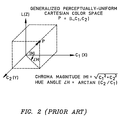
- Fig. 2 illustrates the relationships between the three Cartesian coordinates and the two cylindrical coordinates in a perceptually-uniform color space.
- the three Cartesian bases are herein denominated luminance (L) and chrominance (C1,C2) as shown.
- the Cartesian chrominance plane is also herein described in terms of two polar chrominance bases denominated chroma magnitude (M) and hue angle (H).
- chroma magnitude (M) is defined as the square root of the sum of the squares of the two chrominance values (C1 and C2)
- hue angle (H) is defined as the arctangent of the ratio of the two chrominance dimensions (C2/C1), substantially as shown in Fig. 2 and as known in the art for perceptually-uniform color spaces.
- Fig. 3 shows a representative gamut boundary 18 for a plane of constant hue angle (H) from the space shown in Fig. 2. That is, the plane of Fig. 3 represents a vertical slice through the origin of the three-dimensional coordinate system shown in Fig. 2. Gamut 18 is seen to vary from zero chroma magnitude (M) at zero luminance (L) through a maximum chroma (M BX ) at luminance L CM and therefrom back down to zero at some high value of luminance.
- M chroma magnitude
- M BX maximum chroma
- the display represented by gamut 18, for a fixed hue angle (H) is capable of generating a particular range of chroma magnitude (M) at each luminance within some range of luminance and none beyond that range.
- M BX maximum chroma value
- L CM single luminance value
- Fig. 3 also shows two input image pixels.
- Pixel 20 is shown falling within gamut 18 and is herein denominated an in-gamut pixel 20.
- Pixel 22 falls outside of gamut 18 and herein denominated an out-gamut pixel 22.
- the fundamental gamut-mapping problem is to represent out-gamut pixel 22 in terms of in-gamut pixels such as pixel 20. It can be appreciated that an out-gamut pixel can be replaced with any in-gamut pixel shown in Fig. 3 without changing the hue, since Fig. 3 represents a constant hue angle.
- the pixel 24 on the boundary of gamut 18 can be chosen to represent input pixel 22 by reducing both luminance and chroma values to those values at the nearest gamut boundary point (L B and M B ).
- both hue angle and luminance can be held invariant and chroma reduced to M B on the gamut boundary at the point 25.
- both hue angle and chroma magnitude can be held fixed and the luminance value reduced to L B on the boundary of gamut 18 at pixel 26.
- some out-gamut points may have image chroma magnitude (M I ) that exceeds the maximum chroma (M BX ) available for the particular image hue angle (H I ).
- Fig. 4 shows two human vision normalized response curves reported in the above-cited Davidson and van der Horst et al. references, which are entirely incorporated herein by this reference.
- Davidson measured the human spatial frequency response to luminance and determined that a broad peak existed at around eight cycles/degree, shown in Fig. 4 as curve 28.
- the method and system of this invention arise in part from the unexpectedly advantageous observation that the human visual response to luminance is substantially impaired in a spatial frequency region where the human visual response to chrominance remains strong (below one cycle/degree in Fig. 4).
- this observation led directly to the unexpectedly advantageous discovery that chroma magnitude (color saturation) can be improved at low spatial frequencies by varying the value of luminance according to particular display features.
- the method and system of this invention accomplish this by biasing luminance changes in a direction that allows greater chroma magnitude at low spatial frequencies.
- Output devices in general and printers in particular have gamuts that are highly irregular when expressed in any of the usual standard color spaces such as CCIR 601 YCbCr, CIE L*a*b, CIE L*u*v, NTSC YIQ, and Munsell.
- CIE L*a*b or L*u*v the maximum chroma magnitude available for yellows occurs at high luminance values while the maximum chroma magnitude available for blues occurs at low luminance values.
- mapping out-gamut points into the device-dependent gamut by changing luminance alone is, according to the method of this invention, made more effective by moving the luminance in the direction of that value for which maximum chroma magnitude is available (without changing the hue angle).
- the "neighborhood" gamut-mapping method of this invention improves subjective display image rendering by moving the luminance in the direction of maximum available chroma at the image pixel hue angle rather than always moving the luminance toward the same (closest boundary pixel) value regardless of the pixel chrominance values.
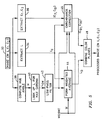
- Fig. 5 provides a simple illustrative embodiment of the method of this invention.
- the functional procedure shown in Fig. 5 begins with the source image in (L,C1,C2) color space at 32.
- the luminance (L I ) component is extracted at step 34 and the two chrominance components (C I1 ,C I2 ) are extracted at step 36.
- the hue angle (H) is computed as the arctangent of the ratio of the two chrominance components.
- Step 40 provides the value of luminance (L) for which chroma magnitude (M) is maximized at the computed hue angle (H). Referring to Fig. 3, the output of step 40 represents the luminance value (L CM ).
- step 40 is preferably accomplished by creating a simple one-dimensional lookup table that has an entry for every hue angle to which the hue angle image may be quantized. If such quantization is too refined to make this practical, a more sparsely-populated lookup table may be employed with interpolation.
- Step 42 is a low-pass spatial filter operation performed on the chroma-maximized luminance signal (L CM ).
- the method of this invention modifies the luminance of the input image in such a way that moves the luminance of each pixel in a direction of that luminance for which maximum chroma is available (without changing hue angle) and does so in such a way that only those luminance changes in the human-insensitive spatial frequency region remain in the output signal.
- the purpose of the low-pass filtering step 42 is to eliminate the high spatial-frequency component of the chroma-maximized luminance signal (L CM ) before recombining it with the image luminance signal (L I ) at step 44 to create the display image luminance signal (L D ).
- L D WL CM + (1- W) L I
- W a weighting factor in the interval [0,1].
- L D merely equals the original image luminance L I
- intermediate values of W are likely to produce effective results by modifying the mapped luminance to improve chroma magnitude in a fashion that is not readily visible to a human observer.
- the device-dependent gamut represented in the selected color space exhibits a concave characteristic instead of the convex characteristic exemplified by Fig. 3.
- a concave constant-hue gamut boundary moving a pixel along the luminance (L) axis toward maximum chroma (M BX ) may actually reduce chroma magnitude at intermediate points.
- W weight
- T threshold
- step 46 the two image chrominance values are corrected at step 46 before recombining at step 48 to form the processed output image.
- the purpose of step 46 is to correct the chrominance planes for the changes in luminance introduced by the gamut-mapping steps 38-44. Chrominance correction is necessary to accommodate the observed psychological effect that increases apparent chroma with increases in luminance. Because the luminance corrections performed at step 44 operate to increase the actual chroma magnitude in the output color space, they may be considered as equivalent to changing the amount of light shining on objects in the image. Without the chrominance correction step 46, darkened colors would appear to be too chromatic and lightened colors would appear to be unsaturated.
- chrominance correction step 46 is optional and, when used, is preferred as a simple ratio adjustment, such that the two chroma components are adjusted proportionately to the resulting ratio of L D /L I , which is the technique described by Wagensonner et al. in the above-cited reference (U. S. Patent 4,812,903, which is entirely incorporated herein by this reference).
- the simple procedure discussed above in connection with Fig. 5 can be improved to eliminate unnecessary luminance changes to in-gamut pixels.
- steps 50-54 are added to extract the weight (W) discussed above in connection with step 44.
- the out-gamut distance computation step 50 preferably employs a three-dimensional lookup table using interpolation to produce a gamut error signal (M E ) representing the distance between the out-gamut pixel and a point on the gamut boundary having chroma magnitude (M B ), which can be understood with reference to Fig. 3.
- M E gamut error signal
- M B chroma magnitude
- three such boundary points 24, 25 and 26, each having a different M B value serve to exemplify the distance relationships involved in a lookup table implementing step 50.
- color spaces are suitable for use in measuring out-gamut distances, including color spaces with pretensions to visual-uniformity, such as CIE L*a*b or L*u*v.
- CIE L*a*b or L*u*v color spaces with pretensions to visual-uniformity
- the Euclidean distance between colors is roughly proportional to the apparent visual difference between them, at least for small distances.
- a reasonable method is to select the shortest distance between the input pixel 22 and gamut boundary 18 (shown as point 24).
- a constant chroma distance such as the distance between input pixel 22 and boundary point 26 may be used.
- M BX the chroma magnitude of the input pixel exceeds M BX .
- the gamut error signal M E is derived by selecting the distance between the chroma magnitude M I of the original pixel 22 and the gamut boundary chroma magnitude M B (point 25) without changes to either hue angle or luminance.
- the gamut error signal M E represents a chroma image that is positive whenever the image pixel is out-gamut and which varies as a linear measure of the out-gamut distance of the image pixels.
- This gamut error signal M E is then low-pass filtered at step 52 to remove high spatial-frequency components and then processed in step 54 to clip and scale as necessary to create the weight (W) used by the averaging step 44.
- the low-pass filtering step 52 is calibrated to take advantage of the human vision luminance response shown in Fig. 4 as curve 28. That is, luminance changes are made in the human-insensitive portion of the spatial frequency region to correct for human-perceived chrominance distortion arising from the effects of luminance changes required to squeeze out-gamut image points into a device-dependent gamut.
- This filter may also be modified to compensate for changes in subtended visual angle arising from the pixel position in the image: that is, the spatial frequency parameter can be adjusted according to apparent visual angle subtended by a fixed pixel at the edges of an image to compensate for spatial-frequency increases arising from the trigometric relationship between the two distances from the pixel to the image center and to the viewer's eye.
- Fig. 7, including Figs. 7A-7C provides a functional block diagram of the preferred embodiment of the gamut-mapping method of this invention and includes steps preferred for high-speed electronic implementation.
- the source image is produced at step 56 in the (L,C1,C2) color space and the luminance and chrominance components extracted at steps 58 and 60, respectively.
- the CIE L*a*b color space is suitable for use with the method of this invention.
- the hue angle (H) is used to address a lookup table containing the luminance for which the maximum chroma M BX is available from the output device gamut. For most chrominance spaces, the maximum chroma magnitude is equal to the square root of the sum of the squares of the maximum available values for C1 and C2.
- step 66 the chroma-maximized luminance signal L CM is filtered to remove high spatial-frequency components.
- the color-biased luminance signal L CB is then multiplied by a weight (W) at step 74.
- the weighted signal is then inverted at step 76 and added to the original image luminance signal L I at step 78 to create the display luminance signal L D at step 80.
- Fig. 7A operate alone to move the luminance of all pixels, whether out-gamut or not, and moreover operate to move out-gamut colors independent of the amount of distance from the gamut boundary.
- Figs. 7B-7C required to improve these undesirable characteristics are now described.
- the source image at 56 is presented for extraction of the chrominance values at step 82 and for gamut mapping at step 84.
- the image chroma magnitude M I is computed at step 86 as substantially the square root of the sum of the squares of the two chrominance values (C1,C2).
- Step 84 uses a lookup table created with the knowledge of the device-dependent gamut in the selected color space.
- the mapping operation of step 84 preferably, but not necessarily, computes the gamut boundary point in the chroma magnitude dimension corresponding to image hue and luminance (e.g., point 25 is produced for image point 22 in Fig. 3).
- M B represents the closest gamut boundary point along the chroma magnitude (M) axis and generates a signal herein denominated the gamut boundary chroma magnitude (M B ).
- Other mapping schemes may also be used at step 84 to create a gamut boundary chroma magnitude (M B ) with different hue and luminance values.
- M B represents the chroma magnitude value of a point on the gamut boundary 18 having the hue angle (H I ) and luminance (L I ) values of the image pixel being mapped. For in-gamut pixels (e.g., pixel 20), the value of M B is set to M I .
- this chroma signal is used to extract the two equivalent Cartesian chrominance signals (C1,C2) in the selected color space.
- step 94 the chroma error signal (M E ) is clipped to force all chroma values above a threshold (T) to the threshold value.
- the clipped result (M EC ) is then low-pass filtered at step 96 and scaled at step 98 to produce a chroma correction signal representing a normalized chroma-corrected weight (W) valued in the interval [0,1], which is then passed to the remainder of the process described above in connection with Fig. 7A.
- out-gamut pixels are weighted according to their distance out-gamut except, for remote out-gamut pixels, a fixed threshold weight (T) is used instead to limit the luminance changes made to said remote out-gamut pixels, which are more properly clipped by a point-process gamut-mapping procedure applied subsequently.
- T threshold weight
- Fig. 7C provides a simple illustration of a preferred embodiment of the chrominance correction step 46 from Fig. 6.
- the extracted luminance and chrominance information together with the display luminance signal L D are combined in step 102 to permit simple scaling of the chrominance components according to the changes made to the luminance component.
- the results are recombined at step 104 to provide the two display chrominance components (C D1 ,C D2 ), which represents the remaining information necessary to construct the final gamut-mapped display image at 106.
- Fig. 8 provides a typical digital data system suitable for implementing the method of this invention as a display adaptor 108.
- a processor 110 is coupled to a cache memory 112 and therefrom to a main memory 114 and a local bus interface 116 in the usual manner known in the art.
- a removable media interface 118 is coupled through an input/output bus 120 and therefrom by way of a I/O bus interface 122 to a local bus 124, which is coupled to local bus interface 116.
- a data storage disk 126 is coupled to local bus 124 by way of a disk controller 128.
- Display adapter 108 embodying the system of this invention, is coupled to display 130 for displaying gamut-mapped images and also to local bus 124 for receiving device-independent images from storage.
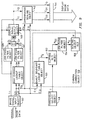
- Fig. 9 provides an exemplary embodiment of the system of this invention as it might appear in display adapter 108 of Fig. 8. All of the elements shown in Fig. 9 are illustrated as objects, even though one or more of these elements may be embodied in hardware form or other suitable form known in the art to provide the necessary functions.
- original image data is presented to an image signal input object 132, which operates to extract the luminance components (L1,C I1 ,C I2 ) substantially as shown.
- the two chrominance components are presented to a maximum chroma lookup table object 134, which produces the value for the chroma-maximized luminance signal (L CM ).
- Two low-pass filter objects 136 and 137 eliminate high spatial-frequency components from the two luminance signals, which then are combined in a subtracter 138 after filtering.
- the color-biased luminance signal L' CB from subtracter 138 is then presented to a display signal output object 140 which combines the image luminance (L I ) with the color-biased luminance signal, subject to the effect of a chroma-corrected weight signal (W), to produce the display luminance signal L D .
- the two chrominance signals (C I1 ,C I2 ) are presented to a chrominance scaling object 142, which produces the two display chrominance signals (C D1 ,C D2 ) responsive to the ratio L D /L I .
- the three display signals are then recombined at 144 to produce the display image data output.
- a chroma correction object 146 employs a number of subobjects to produce the chroma-corrected weight signal (W) responsive to the initial chrominance signals and a threshold signal (T) produced by a threshold selection object 148.
- a gamut boundary lookup table object 150 produces a gamut error signal M E representing the out-gamut distance on the chroma magnitude axis of each pixel in the original image.
- a clipping object 152 eliminates negative values and limits positive values to a threshold value (T) to produce clipped error signal M EC , which is then low-pass filtered through a low-pass filter object 154.
- the chroma correction signal M C from filter object 154 is then scaled in a scaling object 156 to produce the final chroma-corrected weight signal (W) constrained to the interval [0,1].
Landscapes
- Engineering & Computer Science (AREA)
- Multimedia (AREA)
- Signal Processing (AREA)
- Image Processing (AREA)
- Facsimile Image Signal Circuits (AREA)
- Controls And Circuits For Display Device (AREA)
- Color Image Communication Systems (AREA)
Applications Claiming Priority (2)
| Application Number | Priority Date | Filing Date | Title |
|---|---|---|---|
| US289976 | 1994-08-12 | ||
| US08/289,976 US5450216A (en) | 1994-08-12 | 1994-08-12 | Color image gamut-mapping system with chroma enhancement at human-insensitive spatial frequencies |
Publications (2)
| Publication Number | Publication Date |
|---|---|
| EP0696865A2 true EP0696865A2 (de) | 1996-02-14 |
| EP0696865A3 EP0696865A3 (de) | 1996-07-17 |
Family
ID=23113997
Family Applications (1)
| Application Number | Title | Priority Date | Filing Date |
|---|---|---|---|
| EP95112011A Withdrawn EP0696865A3 (de) | 1994-08-12 | 1995-07-31 | Farbbildverarbeitung |
Country Status (4)
| Country | Link |
|---|---|
| US (1) | US5450216A (de) |
| EP (1) | EP0696865A3 (de) |
| JP (1) | JPH0879545A (de) |
| KR (1) | KR960009758A (de) |
Cited By (3)
| Publication number | Priority date | Publication date | Assignee | Title |
|---|---|---|---|---|
| US8004209B2 (en) | 2006-10-05 | 2011-08-23 | Koninklijke Philips Electronics N.V. | Method for color transition for general illumination system |
| CN104967761A (zh) * | 2015-06-26 | 2015-10-07 | 深圳市华星光电技术有限公司 | 色域匹配方法 |
| CN108986769A (zh) * | 2018-09-05 | 2018-12-11 | 成都索贝数码科技股份有限公司 | 一种低于Rec.2020色域显示设备最大化还原Rec.2020色域内容的方法 |
Families Citing this family (146)
| Publication number | Priority date | Publication date | Assignee | Title |
|---|---|---|---|---|
| EP0650291B1 (de) * | 1993-09-29 | 2002-04-24 | Canon Kabushiki Kaisha | Bildverarbeitungsgerät und -verfahren |
| JP3436572B2 (ja) * | 1993-10-27 | 2003-08-11 | 株式会社リコー | 画像処理装置 |
| JP3548205B2 (ja) | 1993-10-29 | 2004-07-28 | キヤノン株式会社 | 画像処理方法およびその装置 |
| JP3400047B2 (ja) * | 1993-10-30 | 2003-04-28 | 株式会社リコー | 画像処理装置 |
| WO1996009717A1 (en) * | 1994-09-19 | 1996-03-28 | Apple Computer, Inc. | Generation of tone reproduction curves using psychophysical data |
| US5563724A (en) * | 1994-10-21 | 1996-10-08 | Eastman Kodak Company | Color-to-ink transformation for extra-quarternary printing processes |
| JPH08130655A (ja) * | 1994-10-31 | 1996-05-21 | Canon Inc | 画像処理方法及び装置 |
| JPH10511588A (ja) * | 1994-12-30 | 1998-11-10 | アキュソン コーポレイション | 体液の流れ又は組織の運動の画像を増強するための適応式時間フィルタリング |
| US5609155A (en) * | 1995-04-26 | 1997-03-11 | Acuson Corporation | Energy weighted parameter spatial/temporal filter |
| AU5957496A (en) * | 1995-06-06 | 1996-12-24 | Apple Computer, Inc. | A caching system for interpolation processing |
| US5699491A (en) * | 1995-06-15 | 1997-12-16 | Canon Information Systems, Inc. | Printer driver having gamut-mapped colors |
| JP3376194B2 (ja) * | 1995-12-15 | 2003-02-10 | キヤノン株式会社 | 画像処理装置及び方法 |
| WO1997028640A1 (en) * | 1996-02-02 | 1997-08-07 | Light Source Computer Images, Inc. | Appearance-based technique for rendering colors on an output device |
| US5650942A (en) * | 1996-02-02 | 1997-07-22 | Light Source Computer Images, Inc. | Appearance-based technique for rendering colors on an output device |
| US6128415A (en) * | 1996-09-06 | 2000-10-03 | Polaroid Corporation | Device profiles for use in a digital image processing system |
| US6134029A (en) * | 1996-09-09 | 2000-10-17 | Light Source Acquisition Company | Scanner calibration technique |
| JP4068673B2 (ja) * | 1996-09-10 | 2008-03-26 | ソニー株式会社 | 画像処理装置および方法 |
| JP3907783B2 (ja) * | 1996-12-12 | 2007-04-18 | 富士フイルム株式会社 | 色変換方法 |
| US5920358A (en) * | 1997-01-30 | 1999-07-06 | Fuji Photo Film Co., Ltd. | Method of transforming colors of image |
| US5870077A (en) * | 1997-02-26 | 1999-02-09 | Hewlett-Packard Company | Method for tristimulus color data non-linear storage, retrieval, and interpolation |
| US6453074B1 (en) * | 1997-03-31 | 2002-09-17 | Canon Kabushiki Kaisha | System for image decimation including selective filtering |
| US6005968A (en) * | 1997-08-29 | 1999-12-21 | X-Rite, Incorporated | Scanner calibration and correction techniques using scaled lightness values |
| US6229626B1 (en) | 1997-10-24 | 2001-05-08 | Eastman Kodak Company | Method apparatus and product providing direct calculation of the color gamut of color reproduction processes |
| US6268939B1 (en) * | 1998-01-08 | 2001-07-31 | Xerox Corporation | Method and apparatus for correcting luminance and chrominance data in digital color images |
| US6239886B1 (en) * | 1998-01-08 | 2001-05-29 | Xerox Corporation | Method and apparatus for correcting luminance and chrominance data in digital color images |
| US6160644A (en) * | 1998-03-30 | 2000-12-12 | Seiko Epson Corporation | Scanner calibration technique to overcome tone inversion |
| US6181445B1 (en) | 1998-03-30 | 2001-01-30 | Seiko Epson Corporation | Device-independent and medium-independent color matching between an input device and an output device |
| US6404517B1 (en) | 1998-03-31 | 2002-06-11 | Seiko Epson Corporation | Color-patch sheet registration |
| JP3406226B2 (ja) * | 1998-06-04 | 2003-05-12 | シャープ株式会社 | 表示システム |
| JP3960694B2 (ja) * | 1998-10-26 | 2007-08-15 | 富士通株式会社 | 色信号変換方法、色信号変換装置、記録媒体、デバイスドライバ及び色変換テーブル |
| US6326977B1 (en) | 1998-11-03 | 2001-12-04 | Sharp Laboratories Of America, Inc. | Rendering of YCBCR images on an RGS display device |
| US6408103B1 (en) * | 1998-12-31 | 2002-06-18 | Eastman Kodak Company | Method for preserving spatial detail and color content when adjusting the tone scale of a digital color image |
| US6211971B1 (en) * | 1999-03-11 | 2001-04-03 | Lockheed Martin Missiles & Space Co. | Method and apparatus to compress multi-spectral images to a single color image for display |
| US6417863B1 (en) * | 1999-04-28 | 2002-07-09 | Intel Corporation | Color balancing a multicolor display |
| US6633657B1 (en) * | 1999-07-15 | 2003-10-14 | General Electric Company | Method and apparatus for controlling a dynamic range of a digital diagnostic image |
| GB2352913A (en) * | 1999-07-30 | 2001-02-07 | Sony Uk Ltd | Method of processing signals and apparatus for signal processing |
| US6690488B1 (en) * | 1999-09-30 | 2004-02-10 | Polaroid Corporation | Method and apparatus for estimating the spatial frequency response of a digital image acquisition system from the images it produces |
| US6640005B1 (en) * | 1999-10-21 | 2003-10-28 | Sharp Laboratories Of America, Inc. | Method for inconspicuously adding tracking data in coded images |
| US6646762B1 (en) | 1999-11-05 | 2003-11-11 | Xerox Corporation | Gamut mapping preserving local luminance differences |
| US6954287B1 (en) | 1999-11-05 | 2005-10-11 | Xerox Corporation | Gamut mapping preserving local luminance differences with adaptive spatial filtering |
| US6414690B1 (en) * | 1999-12-08 | 2002-07-02 | Xerox Corporation | Gamut mapping using local area information |
| DE10056723A1 (de) * | 1999-12-15 | 2001-06-21 | Heidelberger Druckmasch Ag | Verfahren zur Erzeugung eines an einen realen Prozeß angepaßten zweiten Bilddatensatzes aus einem ersten Bilddatensatz und Colour-Management-Verfahren |
| US6678406B1 (en) * | 2000-01-26 | 2004-01-13 | Lucent Technologies Inc. | Method of color quantization in color images |
| US6721000B1 (en) * | 2000-02-23 | 2004-04-13 | Neomagic Corp. | Adaptive pixel-level color enhancement for a digital camera |
| US7006105B2 (en) * | 2000-05-18 | 2006-02-28 | Minolta Co., Ltd. | Color correction method and color correction program to obtain desired output image |
| US6944334B2 (en) * | 2001-02-01 | 2005-09-13 | Eastman Kodak Company | Color cross reference selection system and method |
| JP4666274B2 (ja) * | 2001-02-20 | 2011-04-06 | 日本電気株式会社 | カラー画像処理装置及びその方法 |
| US7209147B2 (en) * | 2001-03-15 | 2007-04-24 | Kodak Polychrome Graphics Co. Ltd. | Correction techniques for soft proofing |
| US7221381B2 (en) | 2001-05-09 | 2007-05-22 | Clairvoyante, Inc | Methods and systems for sub-pixel rendering with gamma adjustment |
| US7307646B2 (en) * | 2001-05-09 | 2007-12-11 | Clairvoyante, Inc | Color display pixel arrangements and addressing means |
| US7123277B2 (en) | 2001-05-09 | 2006-10-17 | Clairvoyante, Inc. | Conversion of a sub-pixel format data to another sub-pixel data format |
| US7184066B2 (en) | 2001-05-09 | 2007-02-27 | Clairvoyante, Inc | Methods and systems for sub-pixel rendering with adaptive filtering |
| US6826303B2 (en) * | 2001-06-28 | 2004-11-30 | Hewlett-Packard Development Company, L.P. | Software-based acceleration color correction filtering system |
| US6961477B2 (en) * | 2001-07-12 | 2005-11-01 | Canon Kabushiki Kaisha | Image-based selection of gamut mapping |
| JP2003136783A (ja) * | 2001-10-31 | 2003-05-14 | Mitsumi Electric Co Ltd | プリンタ |
| KR100416231B1 (ko) * | 2001-11-08 | 2004-01-31 | 한국전자통신연구원 | 칼라 디바이스의 선형 색역폭 확장장치 및 그 방법 |
| US6719392B2 (en) | 2001-12-20 | 2004-04-13 | International Business Machines Corporation | Optimized color ranges in gamut mapping |
| US7417648B2 (en) | 2002-01-07 | 2008-08-26 | Samsung Electronics Co. Ltd., | Color flat panel display sub-pixel arrangements and layouts for sub-pixel rendering with split blue sub-pixels |
| US7492379B2 (en) | 2002-01-07 | 2009-02-17 | Samsung Electronics Co., Ltd. | Color flat panel display sub-pixel arrangements and layouts for sub-pixel rendering with increased modulation transfer function response |
| US7755652B2 (en) * | 2002-01-07 | 2010-07-13 | Samsung Electronics Co., Ltd. | Color flat panel display sub-pixel rendering and driver configuration for sub-pixel arrangements with split sub-pixels |
| KR20040009966A (ko) * | 2002-07-26 | 2004-01-31 | 삼성전자주식회사 | 색 보정장치 및 방법 |
| US6956581B2 (en) * | 2002-09-19 | 2005-10-18 | Lexmark International, Inc. | Gamut mapping algorithm for business graphics |
| US7283662B1 (en) | 2002-11-19 | 2007-10-16 | Adobe System Incorporated | Protecting colors from clipping |
| JP2004200902A (ja) * | 2002-12-17 | 2004-07-15 | Nikon Corp | 画像処理装置、電子カメラ、及び画像処理プログラム |
| US7167186B2 (en) | 2003-03-04 | 2007-01-23 | Clairvoyante, Inc | Systems and methods for motion adaptive filtering |
| US20040196302A1 (en) | 2003-03-04 | 2004-10-07 | Im Moon Hwan | Systems and methods for temporal subpixel rendering of image data |
| US7751081B2 (en) * | 2003-03-31 | 2010-07-06 | Lexmark International, Inc. | Gamut mapping by controlling minimum and maximum color changes |
| US7352374B2 (en) | 2003-04-07 | 2008-04-01 | Clairvoyante, Inc | Image data set with embedded pre-subpixel rendered image |
| US7483083B2 (en) * | 2003-04-16 | 2009-01-27 | Intervideo, Inc. | Movie enhancement |
| US7155053B2 (en) * | 2003-05-13 | 2006-12-26 | Olympus Corporation | Color image processing method and apparatus |
| US7230584B2 (en) | 2003-05-20 | 2007-06-12 | Clairvoyante, Inc | Projector systems with reduced flicker |
| US7268748B2 (en) | 2003-05-20 | 2007-09-11 | Clairvoyante, Inc | Subpixel rendering for cathode ray tube devices |
| US20040246280A1 (en) | 2003-06-06 | 2004-12-09 | Credelle Thomas Lloyd | Image degradation correction in novel liquid crystal displays |
| US7209105B2 (en) | 2003-06-06 | 2007-04-24 | Clairvoyante, Inc | System and method for compensating for visual effects upon panels having fixed pattern noise with reduced quantization error |
| US7327384B2 (en) * | 2003-06-19 | 2008-02-05 | Tektronix, Inc. | Gamut false color display |
| US7598961B2 (en) * | 2003-10-21 | 2009-10-06 | Samsung Electronics Co., Ltd. | method and apparatus for converting from a source color space to a target color space |
| US7176935B2 (en) * | 2003-10-21 | 2007-02-13 | Clairvoyante, Inc. | Gamut conversion system and methods |
| US7728846B2 (en) * | 2003-10-21 | 2010-06-01 | Samsung Electronics Co., Ltd. | Method and apparatus for converting from source color space to RGBW target color space |
| WO2005043507A1 (en) * | 2003-10-21 | 2005-05-12 | Clairvoyante, Inc | Gamut conversion system and methods |
| US6980219B2 (en) * | 2003-10-21 | 2005-12-27 | Clairvoyante, Inc | Hue angle calculation system and methods |
| US7084923B2 (en) | 2003-10-28 | 2006-08-01 | Clairvoyante, Inc | Display system having improved multiple modes for displaying image data from multiple input source formats |
| US7525526B2 (en) | 2003-10-28 | 2009-04-28 | Samsung Electronics Co., Ltd. | System and method for performing image reconstruction and subpixel rendering to effect scaling for multi-mode display |
| US7652808B2 (en) * | 2003-12-11 | 2010-01-26 | Xerox Corporation | Spatially varying luminance compression gamut mapping system and method |
| KR101012790B1 (ko) * | 2003-12-30 | 2011-02-08 | 삼성전자주식회사 | 4색 표시 장치의 영상 신호 변환 장치 및 방법, 그리고이를 포함하는 표시 장치 |
| US7379207B2 (en) * | 2004-01-14 | 2008-05-27 | Xerox Corporation | Method and system for device-independent color gamut mapping |
| US20050195415A1 (en) * | 2004-03-02 | 2005-09-08 | Agfa Corporation | System and method for gamut mapping control |
| US7382915B2 (en) * | 2004-03-16 | 2008-06-03 | Xerox Corporation | Color to grayscale conversion method and apparatus |
| US7248268B2 (en) | 2004-04-09 | 2007-07-24 | Clairvoyante, Inc | Subpixel rendering filters for high brightness subpixel layouts |
| US7619637B2 (en) * | 2004-04-09 | 2009-11-17 | Samsung Electronics Co., Ltd. | Systems and methods for improved gamut mapping from one image data set to another |
| US7301543B2 (en) * | 2004-04-09 | 2007-11-27 | Clairvoyante, Inc. | Systems and methods for selecting a white point for image displays |
| US7590299B2 (en) * | 2004-06-10 | 2009-09-15 | Samsung Electronics Co., Ltd. | Increasing gamma accuracy in quantized systems |
| US7319797B2 (en) * | 2004-06-28 | 2008-01-15 | Qualcomm Incorporated | Adaptive filters and apparatus, methods, and systems for image processing |
| KR100691466B1 (ko) * | 2004-09-20 | 2007-03-09 | 삼성전자주식회사 | 영상표시장치에서 색상 및 휘도를 조절하는 방법 및 장치 |
| US7742206B2 (en) * | 2005-02-08 | 2010-06-22 | Sharp Laboratories Of America, Inc. | Methods and systems for color gamut adjustment |
| US8643922B2 (en) * | 2005-02-08 | 2014-02-04 | Sharp Laboratories Of America, Inc. | Gamut clipping with preprocessing |
| CN101171594A (zh) * | 2005-04-04 | 2008-04-30 | 克雷沃耶提公司 | 实现低成本全范围映射算法的系统和方法 |
| CN1882103B (zh) * | 2005-04-04 | 2010-06-23 | 三星电子株式会社 | 实现改进的色域对映演算的系统及方法 |
| US7483082B2 (en) * | 2005-04-21 | 2009-01-27 | Kolorific, Inc. | Method and system for automatic color hue and color saturation adjustment of a pixel from a video source |
| KR100664958B1 (ko) * | 2005-07-11 | 2007-01-04 | 삼성전자주식회사 | 미리 정의된 데이터와 색특성 정보를 이용하여 최적 변환된영상을 출력하는 방법 및 프린터 |
| JP2007288470A (ja) * | 2006-04-17 | 2007-11-01 | Fuji Xerox Co Ltd | 色調整装置及び方法、色変換パラメータ生成装置及び方法、色変換装置及び方法、色調整プログラム、色変換パラメータ生成プログラム、色変換プログラム、記憶媒体 |
| US7592996B2 (en) * | 2006-06-02 | 2009-09-22 | Samsung Electronics Co., Ltd. | Multiprimary color display with dynamic gamut mapping |
| JP4779843B2 (ja) * | 2006-07-11 | 2011-09-28 | 富士ゼロックス株式会社 | 色変換ルックアップテーブル作成装置、色変換ルックアップテーブル作成方法、及び色変換ルックアップテーブル作成プログラム |
| JP5107355B2 (ja) * | 2006-08-16 | 2012-12-26 | ティーピー ビジョン ホールディング ビー ヴィ | 入力色域よりも狭い再生色域への色域マッピングのための方法、装置、及び、プログラム |
| US7876341B2 (en) | 2006-08-28 | 2011-01-25 | Samsung Electronics Co., Ltd. | Subpixel layouts for high brightness displays and systems |
| US8018476B2 (en) | 2006-08-28 | 2011-09-13 | Samsung Electronics Co., Ltd. | Subpixel layouts for high brightness displays and systems |
| US7768671B2 (en) * | 2006-09-18 | 2010-08-03 | Xerox Corporation | Color image gamut enhancement preserving spatial variation |
| US8259127B2 (en) * | 2006-09-30 | 2012-09-04 | Samsung Electronics Co., Ltd. | Systems and methods for reducing desaturation of images rendered on high brightness displays |
| DE602007013807D1 (de) * | 2006-12-08 | 2011-05-19 | Koninkl Philips Electronics Nv | Vorrichtung zur erzeugung von licht mit verschiedenen farben |
| US7898706B2 (en) * | 2007-07-20 | 2011-03-01 | Texas Instruments Incorporated | System and method for maintaining hue constancy |
| JP4893536B2 (ja) * | 2007-08-27 | 2012-03-07 | ブラザー工業株式会社 | 色域情報作成装置、色域情報作成方法および色域情報作成プログラム |
| WO2009040416A1 (en) * | 2007-09-28 | 2009-04-02 | Oce-Technologies B.V. | Method, apparatus and computer program for adaptive black point compensation |
| US8570341B1 (en) * | 2007-12-07 | 2013-10-29 | Ipera Technology, Inc. | Method and system for enhancing color saturation |
| EP2120448A1 (de) * | 2008-05-14 | 2009-11-18 | Thomson Licensing | Verfahren zur Verarbeitung eines komprimierten Bildes in ein Farbskalenbild mit räumlicher Frequenzanalyse |
| US8289344B2 (en) * | 2008-09-11 | 2012-10-16 | Apple Inc. | Methods and apparatus for color uniformity |
| US8027070B2 (en) * | 2009-02-03 | 2011-09-27 | Sharp Laboratories Of America, Inc. | Methods and systems for hue adjustment |
| US8213055B2 (en) * | 2009-02-20 | 2012-07-03 | Hewlett-Packard Development Company, L.P. | Color separation into Neugebauer primary area coverage vectors |
| TWI399100B (zh) * | 2009-03-06 | 2013-06-11 | 勝華科技股份有限公司 | 影像處理方法 |
| US9368086B2 (en) * | 2009-03-13 | 2016-06-14 | Hewlett-Packard Development Company, L.P. | Minimizing unwanted changes of color during image processing |
| US8358441B2 (en) * | 2009-04-01 | 2013-01-22 | Sharp Laboratories Of America, Inc. | Methods and systems for sampling and modeling of colorant-limited, multi-colorant color spaces |
| TWI392334B (zh) * | 2009-04-22 | 2013-04-01 | 晨星半導體股份有限公司 | 影像處理裝置以及影像處理方法 |
| US8311355B2 (en) * | 2009-06-05 | 2012-11-13 | Apple Inc. | Skin tone aware color boost for cameras |
| US8537177B2 (en) * | 2009-06-15 | 2013-09-17 | Marvell World Trade Ltd. | System and methods for gamut bounded saturation adaptive color enhancement |
| US8401289B2 (en) * | 2009-07-31 | 2013-03-19 | Eastman Kodak Company | Method for matching colors between two systems |
| TW201110057A (en) * | 2009-09-01 | 2011-03-16 | Novatek Microelectronics Corp | Image color processing device and method |
| US8363273B2 (en) * | 2009-10-26 | 2013-01-29 | Hewlett-Packard Development Company, L.P. | Printing system |
| US8270032B2 (en) * | 2009-10-26 | 2012-09-18 | Hewlett-Packard Development Company, L.P. | Generating color lookup table |
| US9584700B2 (en) * | 2009-10-26 | 2017-02-28 | Hewlett-Packard Development Company, L.P. | Color separation table optimized for a printing process according to a print attribute by selecting particular Neugebauer primaries and Neugebauer primary area coverages |
| US8670167B2 (en) * | 2009-10-26 | 2014-03-11 | Hewlett-Packard Development Company, L.P. | Color gamut determination with neugebauer-primary area coverages for a print system |
| US8244003B2 (en) * | 2010-01-25 | 2012-08-14 | Apple Inc. | Image preprocessing |
| US8254646B2 (en) * | 2010-01-25 | 2012-08-28 | Apple Inc. | Image preprocessing |
| US8358812B2 (en) * | 2010-01-25 | 2013-01-22 | Apple Inc. | Image Preprocessing |
| US8244004B2 (en) * | 2010-01-25 | 2012-08-14 | Apple Inc. | Image preprocessing |
| JP5337310B2 (ja) * | 2010-02-11 | 2013-11-06 | シャープ株式会社 | 画像処理装置、表示装置および画像処理方法 |
| US8576445B2 (en) * | 2011-06-28 | 2013-11-05 | Konica Minolta Laboratory U.S.A., Inc. | Method for processing high dynamic range images using tone mapping to extended RGB space |
| PL2836983T3 (pl) * | 2012-10-08 | 2018-01-31 | Koninklijke Philips Nv | Przetwarzanie obrazu zmieniające luminancję z ograniczeniami barwy |
| TWI520101B (zh) * | 2014-04-16 | 2016-02-01 | 鈺創科技股份有限公司 | 美化影像中人體膚色的方法、美化影像中人體膚色的裝置、調整影像中人體膚色亮度的方法及調整影像中人體膚色亮度的裝置 |
| EP3067882A1 (de) * | 2015-03-10 | 2016-09-14 | Thomson Licensing | Adaptive farbqualität von interpolationsverfahren und vorrichtung |
| EP4404572A3 (de) * | 2015-07-08 | 2024-10-16 | InterDigital Madison Patent Holdings, SAS | Verbesserte chroma-codierung mit kreuzebenenfilterung |
| US10750173B2 (en) * | 2016-03-07 | 2020-08-18 | Koninklijke Philips N.V. | Encoding and decoding HDR videos |
| JP6780442B2 (ja) * | 2016-10-27 | 2020-11-04 | 富士ゼロックス株式会社 | 色処理装置、色処理方法、色処理システムおよびプログラム |
| US10931977B2 (en) | 2018-03-15 | 2021-02-23 | Comcast Cable Communications, Llc | Systems, methods, and apparatuses for processing video |
| EP3541074B1 (de) | 2018-03-15 | 2022-07-13 | Comcast Cable Communications LLC | Systeme, verfahren und vorrichtungen zur video-verarbeitung |
| US10630867B2 (en) | 2018-09-17 | 2020-04-21 | Samsung Electronics Co., Ltd. | Perceptual hue preserved color-gamut transferring in non-uniform CIE-1931 color space |
| US11348553B2 (en) | 2019-02-11 | 2022-05-31 | Samsung Electronics Co., Ltd. | Color gamut mapping in the CIE 1931 color space |
| US10606525B1 (en) * | 2019-02-14 | 2020-03-31 | Ricoh Company, Ltd. | Color transforms for print job processing |
| CN110378861B (zh) * | 2019-05-24 | 2022-04-19 | 浙江大华技术股份有限公司 | 一种图像融合方法及装置 |
Family Cites Families (20)
| Publication number | Priority date | Publication date | Assignee | Title |
|---|---|---|---|---|
| US4721951A (en) * | 1984-04-27 | 1988-01-26 | Ampex Corporation | Method and apparatus for color selection and production |
| US4839721A (en) * | 1984-08-28 | 1989-06-13 | Polaroid Corporation | Method of and apparatus for transforming color image data on the basis of an isotropic and uniform colorimetric space |
| US4670780A (en) * | 1985-05-28 | 1987-06-02 | Tektronix, Inc. | Method of matching hardcopy colors to video display colors in which unreachable video display colors are converted into reachable hardcopy colors in a mixture-single-white (MSW) color space |
| US4758885A (en) * | 1985-06-17 | 1988-07-19 | Canon Kabushiki Kaisha | Method of processing color image |
| US4879595A (en) * | 1985-10-22 | 1989-11-07 | Konishiroku Photo Industry Co., Ltd. | Technique for reproducing an image read from a color original |
| DE3629469C2 (de) * | 1986-08-29 | 1994-10-06 | Agfa Gevaert Ag | Verfahren zur Einstellung der Farbsättigung bei der elektronischen Bildverarbeitung |
| DE3629403C2 (de) * | 1986-08-29 | 1994-09-29 | Agfa Gevaert Ag | Verfahren zur Korrektur der Farbsättigung bei der elektronischen Bildverarbeitung |
| DE3629409C2 (de) * | 1986-08-29 | 1994-02-17 | Agfa Gevaert Ag | Verfahren und Vorrichtung zur Kontrastbewertung bei der elektronischen Bildverarbeitung |
| DE3629396C2 (de) * | 1986-08-29 | 1993-12-23 | Agfa Gevaert Ag | Verfahren zur elektronischen Bildverarbeitung |
| US4751535A (en) * | 1986-10-15 | 1988-06-14 | Xerox Corporation | Color-matched printing |
| US4941038A (en) * | 1987-05-11 | 1990-07-10 | The Mead Corporation | Method for color image processing |
| US4933754A (en) * | 1987-11-03 | 1990-06-12 | Ciba-Geigy Corporation | Method and apparatus for producing modified photographic prints |
| US5012333A (en) * | 1989-01-05 | 1991-04-30 | Eastman Kodak Company | Interactive dynamic range adjustment system for printing digital images |
| US5107332A (en) * | 1989-05-17 | 1992-04-21 | Hewlett-Packard Company | Method and system for providing closed loop color control between a scanned color image and the output of a color printer |
| JP2543212B2 (ja) * | 1990-01-30 | 1996-10-16 | 松下電器産業株式会社 | カラ―画像処理方法及び装置 |
| US5138303A (en) * | 1989-10-31 | 1992-08-11 | Microsoft Corporation | Method and apparatus for displaying color on a computer output device using dithering techniques |
| JP2845523B2 (ja) * | 1989-11-15 | 1999-01-13 | コニカ株式会社 | 色推定方法 |
| US5363218A (en) * | 1990-11-26 | 1994-11-08 | Konica Corporation | Color estimation method for compressing color image data for image reproduction |
| JP3387509B2 (ja) * | 1991-02-15 | 2003-03-17 | キヤノン株式会社 | 画像処理方法及び画像処理装置 |
| US5185661A (en) * | 1991-09-19 | 1993-02-09 | Eastman Kodak Company | Input scanner color mapping and input/output color gamut transformation |
-
1994
- 1994-08-12 US US08/289,976 patent/US5450216A/en not_active Expired - Fee Related
-
1995
- 1995-07-18 JP JP7181864A patent/JPH0879545A/ja active Pending
- 1995-07-31 EP EP95112011A patent/EP0696865A3/de not_active Withdrawn
- 1995-08-11 KR KR1019950024790A patent/KR960009758A/ko not_active Abandoned
Cited By (5)
| Publication number | Priority date | Publication date | Assignee | Title |
|---|---|---|---|---|
| US8004209B2 (en) | 2006-10-05 | 2011-08-23 | Koninklijke Philips Electronics N.V. | Method for color transition for general illumination system |
| CN104967761A (zh) * | 2015-06-26 | 2015-10-07 | 深圳市华星光电技术有限公司 | 色域匹配方法 |
| CN104967761B (zh) * | 2015-06-26 | 2018-03-20 | 深圳市华星光电技术有限公司 | 色域匹配方法 |
| CN108986769A (zh) * | 2018-09-05 | 2018-12-11 | 成都索贝数码科技股份有限公司 | 一种低于Rec.2020色域显示设备最大化还原Rec.2020色域内容的方法 |
| CN108986769B (zh) * | 2018-09-05 | 2020-01-14 | 成都索贝数码科技股份有限公司 | 一种低于Rec.2020色域显示设备最大化还原Rec.2020色域内容的方法 |
Also Published As
| Publication number | Publication date |
|---|---|
| JPH0879545A (ja) | 1996-03-22 |
| US5450216A (en) | 1995-09-12 |
| KR960009758A (ko) | 1996-03-22 |
| EP0696865A3 (de) | 1996-07-17 |
Similar Documents
| Publication | Publication Date | Title |
|---|---|---|
| US5450216A (en) | Color image gamut-mapping system with chroma enhancement at human-insensitive spatial frequencies | |
| Bala et al. | Spatial color-to-grayscale transform preserving chrominance edge information | |
| EP0533100B1 (de) | Gradationskorrekturverfahren und Gerät | |
| JP3737149B2 (ja) | カラー・イメージ生成システムおよび方法 | |
| US5463480A (en) | Image processor for output devices which transforms data into acceptable color space | |
| EP0991924B1 (de) | Charakterisierung von farbbildaufnahmesystemen | |
| US5565931A (en) | Method and apparatus for applying gamma predistortion to a color image signal | |
| CN101163193B (zh) | 校准灰度数据的系统、介质和方法 | |
| JP4308392B2 (ja) | デジタル画像処理方法及びマッピング方法 | |
| Sharma et al. | Color imaging for multimedia | |
| US7574041B2 (en) | Conversion of output device color values to minimize image quality artifacts | |
| EP1408473A2 (de) | System zur spektralen Multiplexierung, Wiedergabe und Demultiplexierung von Quellenbildern | |
| AU7834698A (en) | Gamut correction with color separation and methods and apparatuses for performing same | |
| JP4068673B2 (ja) | 画像処理装置および方法 | |
| CA2345585C (en) | Robust colorimetry transform | |
| GB2213674A (en) | Transforming colour monitor pixel values to colour printer pixel values | |
| US7006105B2 (en) | Color correction method and color correction program to obtain desired output image | |
| JP4271799B2 (ja) | プリント用ドキュメント画像の準備及び3色モアレ軽減目的のブラック付加の適用制御のための処理方法、並びにブラックの付加及び下色除去を含むキャリブレーションプリント方法 | |
| Braun et al. | Development and evaluation of six gamut-mapping algorithms for pictorial images | |
| JP3749102B2 (ja) | 画像処理装置、画像形成装置、並びに画像処理方法 | |
| KR20050004911A (ko) | 영상 프로세싱 | |
| JPH1169184A (ja) | 画像表示方法および画像表示装置 | |
| Takemura | Photographic prints from digital still cameras | |
| Lebowsky et al. | Color quality management in advanced flat panel display engines | |
| Roetling | Systems considerations in color printing |
Legal Events
| Date | Code | Title | Description |
|---|---|---|---|
| PUAI | Public reference made under article 153(3) epc to a published international application that has entered the european phase |
Free format text: ORIGINAL CODE: 0009012 |
|
| AK | Designated contracting states |
Kind code of ref document: A2 Designated state(s): DE FR GB |
|
| PUAL | Search report despatched |
Free format text: ORIGINAL CODE: 0009013 |
|
| AK | Designated contracting states |
Kind code of ref document: A3 Designated state(s): DE FR GB |
|
| 17P | Request for examination filed |
Effective date: 19960626 |
|
| 17Q | First examination report despatched |
Effective date: 19980723 |
|
| STAA | Information on the status of an ep patent application or granted ep patent |
Free format text: STATUS: THE APPLICATION IS DEEMED TO BE WITHDRAWN |
|
| 18D | Application deemed to be withdrawn |
Effective date: 19981204 |