EP0697274A2 - Objet moulé par expansion avec un volume libre et procédé pour sa production - Google Patents
Objet moulé par expansion avec un volume libre et procédé pour sa production Download PDFInfo
- Publication number
- EP0697274A2 EP0697274A2 EP95106966A EP95106966A EP0697274A2 EP 0697274 A2 EP0697274 A2 EP 0697274A2 EP 95106966 A EP95106966 A EP 95106966A EP 95106966 A EP95106966 A EP 95106966A EP 0697274 A2 EP0697274 A2 EP 0697274A2
- Authority
- EP
- European Patent Office
- Prior art keywords
- foamed particles
- molded article
- expansion
- mold
- foamed
- Prior art date
- Legal status (The legal status is an assumption and is not a legal conclusion. Google has not performed a legal analysis and makes no representation as to the accuracy of the status listed.)
- Granted
Links
Images




Classifications
-
- B—PERFORMING OPERATIONS; TRANSPORTING
- B29—WORKING OF PLASTICS; WORKING OF SUBSTANCES IN A PLASTIC STATE IN GENERAL
- B29C—SHAPING OR JOINING OF PLASTICS; SHAPING OF MATERIAL IN A PLASTIC STATE, NOT OTHERWISE PROVIDED FOR; AFTER-TREATMENT OF THE SHAPED PRODUCTS, e.g. REPAIRING
- B29C67/00—Shaping techniques not covered by groups B29C39/00 - B29C65/00, B29C70/00 or B29C73/00
- B29C67/20—Shaping techniques not covered by groups B29C39/00 - B29C65/00, B29C70/00 or B29C73/00 for porous or cellular articles, e.g. of foam plastics, coarse-pored
- B29C67/205—Shaping techniques not covered by groups B29C39/00 - B29C65/00, B29C70/00 or B29C73/00 for porous or cellular articles, e.g. of foam plastics, coarse-pored comprising surface fusion, and bonding of particles to form voids, e.g. sintering
-
- B—PERFORMING OPERATIONS; TRANSPORTING
- B29—WORKING OF PLASTICS; WORKING OF SUBSTANCES IN A PLASTIC STATE IN GENERAL
- B29C—SHAPING OR JOINING OF PLASTICS; SHAPING OF MATERIAL IN A PLASTIC STATE, NOT OTHERWISE PROVIDED FOR; AFTER-TREATMENT OF THE SHAPED PRODUCTS, e.g. REPAIRING
- B29C44/00—Shaping by internal pressure generated in the material, e.g. swelling or foaming ; Producing porous or cellular expanded plastics articles
- B29C44/34—Auxiliary operations
- B29C44/3415—Heating or cooling
- B29C44/3426—Heating by introducing steam in the mould
-
- Y—GENERAL TAGGING OF NEW TECHNOLOGICAL DEVELOPMENTS; GENERAL TAGGING OF CROSS-SECTIONAL TECHNOLOGIES SPANNING OVER SEVERAL SECTIONS OF THE IPC; TECHNICAL SUBJECTS COVERED BY FORMER USPC CROSS-REFERENCE ART COLLECTIONS [XRACs] AND DIGESTS
- Y10—TECHNICAL SUBJECTS COVERED BY FORMER USPC
- Y10T—TECHNICAL SUBJECTS COVERED BY FORMER US CLASSIFICATION
- Y10T428/00—Stock material or miscellaneous articles
- Y10T428/13—Hollow or container type article [e.g., tube, vase, etc.]
- Y10T428/1352—Polymer or resin containing [i.e., natural or synthetic]
- Y10T428/1376—Foam or porous material containing
-
- Y—GENERAL TAGGING OF NEW TECHNOLOGICAL DEVELOPMENTS; GENERAL TAGGING OF CROSS-SECTIONAL TECHNOLOGIES SPANNING OVER SEVERAL SECTIONS OF THE IPC; TECHNICAL SUBJECTS COVERED BY FORMER USPC CROSS-REFERENCE ART COLLECTIONS [XRACs] AND DIGESTS
- Y10—TECHNICAL SUBJECTS COVERED BY FORMER USPC
- Y10T—TECHNICAL SUBJECTS COVERED BY FORMER US CLASSIFICATION
- Y10T428/00—Stock material or miscellaneous articles
- Y10T428/249921—Web or sheet containing structurally defined element or component
- Y10T428/249953—Composite having voids in a component [e.g., porous, cellular, etc.]
- Y10T428/249971—Preformed hollow element-containing
- Y10T428/249972—Resin or rubber element
-
- Y—GENERAL TAGGING OF NEW TECHNOLOGICAL DEVELOPMENTS; GENERAL TAGGING OF CROSS-SECTIONAL TECHNOLOGIES SPANNING OVER SEVERAL SECTIONS OF THE IPC; TECHNICAL SUBJECTS COVERED BY FORMER USPC CROSS-REFERENCE ART COLLECTIONS [XRACs] AND DIGESTS
- Y10—TECHNICAL SUBJECTS COVERED BY FORMER USPC
- Y10T—TECHNICAL SUBJECTS COVERED BY FORMER US CLASSIFICATION
- Y10T428/00—Stock material or miscellaneous articles
- Y10T428/249921—Web or sheet containing structurally defined element or component
- Y10T428/249953—Composite having voids in a component [e.g., porous, cellular, etc.]
- Y10T428/249975—Void shape specified [e.g., crushed, flat, round, etc.]
-
- Y—GENERAL TAGGING OF NEW TECHNOLOGICAL DEVELOPMENTS; GENERAL TAGGING OF CROSS-SECTIONAL TECHNOLOGIES SPANNING OVER SEVERAL SECTIONS OF THE IPC; TECHNICAL SUBJECTS COVERED BY FORMER USPC CROSS-REFERENCE ART COLLECTIONS [XRACs] AND DIGESTS
- Y10—TECHNICAL SUBJECTS COVERED BY FORMER USPC
- Y10T—TECHNICAL SUBJECTS COVERED BY FORMER US CLASSIFICATION
- Y10T428/00—Stock material or miscellaneous articles
- Y10T428/249921—Web or sheet containing structurally defined element or component
- Y10T428/249953—Composite having voids in a component [e.g., porous, cellular, etc.]
- Y10T428/249981—Plural void-containing components
Definitions
- the present invention relates to an expansion-molded article of a polyolefin resin, which has open voids, and is good in water permeability, air permeability and sound absorbing quality, and suitable for use, in particular, as a draining material, wall covering material, core material and the like, and a production process thereof.
- the former molded article is formed by bonding foamed particles of a polystyrene to one another with a polyolefin resin.
- This molded article is produced by first mixing the foamed particles with an aqueous dispersion of the polyolefin resin, filling the resulting mixture into a mold to heat it and then cooling and solidifying it. Therefore, this process is complicated in production process, takes a long time to mold and is also poor in productivity compared with a process in which foamed particles are filling into a mold as they are, thereby molding them.
- this process also has involved a shortcoming that although the bond strength among the foamed particles depends on the strength of a film of the polyolefin resin formed on the surfaces of the foamed particles, this film is thin and tends to be broken, and so sufficiently high bond strength cannot be achieved among the foamed particles.
- the molded article described in the latter is formed by filling a great number of foamed chips in an aspherical form, the length of the longest part of which is at least 2 cm, into a mold and then heating them, thereby fusion-bonding the chips to one another. Since the length of the longest part of the foamed chip is as long as at least 2 cm, scattering tends to occur in the size of voids defined among the foamed chips upon filling the chips into the mold, and so the filling density of the chips tends to vary with a difference in position among the chips filled in the mold.
- an expansion-molded article of a polyolefin resin which was previously proposed by the present applicants (Japanese Patent Application Laid-Open No. 224727/1991), is obtained by mutually fusion-bonding columnar foamed particles of the polyolefin resin, whose L/D is 2-10 wherein L is a length of the longest part of the foamed particle, and D is a sectional length of the largest barrel part, with their surfaces turned in irregular directions.
- This molded article has no need to separately use an adhesive for mutually bonding the foamed particles unlike the molded article described in Japanese Patent Application Laid-Open No. 153026/1992. Therefore, this process is simple in production process and excellent in productivity.
- the foamed particles are directly fusion-bonded to one another, breakage near interfaces among the foamed particles does not easily occur, and so the strength of the molded article is high.
- the foamed particles are in the form of a column in which L/D is 2-10, and are simple in shape, they can be filled into the mold with a comparatively uniform density. Therefore, the void content of the resulting molded article is comparatively uniform at all positions of the molded article, and the void contents of individual molded articles are also comparatively constant.
- the technique for the polystyrene resin cannot be simply applied to the polyolefin resin. More specifically, the first point of difference between the foamed particles of the polystyrene resin and the foamed particles of the polyolefin resin is that temperatures at which fusion bonding is feasible are different, and so the latter foamed particles are required to heat at a higher temperature. The second point of difference is that the foamed particles of the polyolefin resin are poorer in secondary expandability than the foamed particles of the polystyrene resin.
- the term "secondary expandability" as used herein means expandability in the reexpansion of the foamed particles, which occurs at the time the foamed particles are filled into a mold and heated with a heating medium, thereby fusion-bonding the foamed particles to one another.
- the third point of difference is that in the case where the polyolefin resin is used as a base resin, the shrinkage of a molded article obtained after molding under heat becomes more marked than the case where the polystyrene resin is used.
- the present invention has been completed with a view toward solving the above-described problems and has as its object the provision of an expansion-molded article of a polyolefin resin, which is obtained by filling foamed particles of the polyolefin resin into a mold and fusion-bonding them to one another under heat, scarcely undergoes shrinkage, is satisfactory in physical properties as to both voids and fusion-bonding strength among the foamed particles and has open voids, and a production process thereof.
- an expansion-molded article of a polyolefin resin which is obtained by filling foamed particles of the polyolefin resin into a mold and fusion-bonding them to one another under heat and has open voids, wherein the foamed particles are tubular foamed particles with a through-hole, whose d MIN is at least 1.5 mm and whose d MIN /D MIN value is 0.25-0.85, in which d MIN is a minimum diameter of the hole in sections perpendicular to the direction of the hole and D MIN is a minimum outer diameter of the foamed particle in a section that d MIN has been provided.
- a process for the production of an expansion-molded article of a polyolefin resin with open voids which comprises filling tubular foamed particles of the polyolefin resin with a through-hole, whose d MIN is at least 1.5 mm and whose d MIN /D MIN value is 0.25-0.85, wherein d MIN is a minimum diameter of the hole in sections perpendicular to the direction of the hole and D MIN is a minimum outer diameter of the foamed particle in a section that d MIN has been provided, into a mold and then molding the foamed particles under heat, whereby the foamed particles are fusion-bonded to one another.
- FIGs. 1A, 1B and 1C illustrate general shapes of foamed particles used in the production of expansion-molded articles of a polyolefin resin having open voids according to the present invention.
- the tubular foamed particle means a particle having a hollow structure in which the cavity part (hereinafter referred to as the hole P) extends through the foamed particle 1 as illustrated in FIGs. 1A to 1C.
- foamed particles used in the present invention are those having a straight form in which the foamed particle always has fixed hole diameter and outer diameter in any section perpendicular to the direction of the hole P as illustrated in FIG. 1A, those having a curved form in which the foamed particle always has fixed hole diameter and outer diameter in any section perpendicular to the direction of the hole P as illustrated in FIG. 1B, and those having a varying-diameter tubular form in which the diameter of the hole P and the outer diameter of the foamed particle are irregular as illustrated in FIG. 1C.
- d MIN means a minimum diameter (hereinafter referred to as the minimum hole diameter) among diameters of the hole in sections perpendicular to the direction of the hole in the foamed particle and D MIN denotes a minimum diameter (hereinafter referred to as the minimum outer diameter) among outer diameters of the foamed particle in a section that d MIN has been provided.
- H means a height of the particle
- D denotes a maximum diameter among diameters of the foamed particle in the sections perpendicular to the direction of the hole in the particle.
- foamed particles having the tubular form as described above examples include:
- foamed particles there may also be used the following foamed particles:
- the foamed particles illustrated in FIGs. 2A to 2O are such that the particles always have fixed hole diameter and outer diameter in any section perpendicular to the direction of the hole P as illustrated in FIG. 1A. There may also be used those obtained by deforming the foamed particles separately having the hole shapes and external shapes as illustrated in FIGs. 2A to 2O into curved forms as illustrated in FIG. 1B or into varying-diameter tubular forms, in which the diameter of the hole P and the outer diameter of the foamed particle are irregular, as illustrated in FIG. 1C though they are not expressly illustrated.
- the foamed particles according to the present invention include those in which the external shape in a section perpendicular to the direction of the hole P is oval, those in which the hole shape in the section is oval, those in which the center of the hole in the section is deviated, those having a form that a tubular foamed particle is twisted, etc.
- the foamed particles according to the present invention are not limited to the illustrated foamed particles so far as they are in a tubular form.
- foamed particles in the forms exemplified above those in which any projection e is not provided and both external shape and hole shape are circular as illustrated in FIGs. 2A, 2G and 2H are particularly preferred in the present invention.
- foamed particles are produced with comparative ease, cause no clogging of a feeder upon their filling into a mold, and are easy to be filled with a uniform density at any position within the mold and to be controlled in their filling factor, and so the void content of the resulting molded article is easy to exactly control.
- the filling factor (%) is expressed by a percentage of a quotient obtained by dividing the true volume (cm3) of the foamed particles filled into the mold by the volume (cm3) of a mold cavity.
- the filling factor of the foamed particles filled into the mold can be controlled by a method in which a charging air pressure is suitably controlled according to the true density and shape of the foamed particles and the like, a method in which the spacing of a cracking in the mold is controlled, or the like.
- the cracking means a spacing part of the mold, which serves to prevent the complete closing of the mold for discharging air within the mold out of the mold upon filling the foamed particles into the mold and/or effectively filling the foamed particles into the mold. The cracking is closed when the foamed particles are molded after filled into the mold.
- foamed particles whose minimum hole diameter d MIN is at least 1.5 mm, and whose d MIN /D MIN value is 0.25-0.85 are used in molding.
- the use of the foamed particles constituted in this manner permits the easy provision of an expansion-molded article, which scarcely undergoes shrinkage, has satisfactory voids and exhibits good fusion bonding property among the foamed particles by a process in which foamed particles are filled into a mold and molded under heat.
- the minimum hole diameter d MIN and d MIN /D MIN in the case where a plurality of holes P exists in a foamed particle, for example, in the case of a foamed particle composed of an aggregate of plural foamed particles mutually bonded as illustrated in FIG. 2G as an example, it is only necessary for the individual holes and particles to satisfy the above conditions, namely, d MIN , d MIN1 and d MIN2 are all at least 1.5 mm and all values of d MIN /D MIN , d MIN1 /D MIN1 and d MIN2 /D MIN2 are 0.25-0.85. If the projections e are present on the peripheral surface of the foamed particle, the minimum outer diameter excluding the projections is determined as D MIN .
- the minimum hole diameter d MIN of the foamed particle is shorter than 1.5 mm, and/or d MIN /D MIN is lower than 0.25, it is difficult to provide a molded article having satisfactory voids by a process in which such foamed particles are molded under heat in a mold.
- foamed particles having a d MIN /D MIN value exceeding 0.85 are difficult to produce. Molding of such particles under heat in a mold results in a molded even article good in fusion bonding property among the particles, but liable to deform due to the shortage of strength of the particles, defective in dimensional stability and hard to retain evenly distributed voids.
- the foamed particles are constructed in a tubular form, it is possible to control the directional property of the foamed particles filled into a mold by positioning an air outlet such as a vent hole to a fill opening for the foamed particles used upon filling the foamed particles into the mold by an air pressure, and so void content, in particular, the directional property of open voids can be controlled.
- the minimum hole diameter d MIN of the foamed particles used in the present invention is preferably at least 2.5 mm, more preferably at least 3.0 mm, while the d MIN /D MIN value is preferably 0.45-0.80, more preferably 0.55-0.80.
- the minimum hole diameter d MIN is preferably at most 10 mm, more preferably at most 5 mm.
- the foamed particles used in the present invention preferably have the following relationship between their bulk density ⁇ 1 and true density ⁇ 2: 0.25 ⁇ ⁇ 1 / ⁇ 2 ⁇ 0.55.
- the expansion-molded article according to the present invention preferably has a coefficient of water permeability of 4.0 x 10 ⁇ 2 to 8.0 x 10 ⁇ 1 (cm/sec). Such a coefficient of water permeability can be realized with ease by using foamed particles whose minimum hole diameter d MIN is at least 1.5 mm and whose d MIN /D MIN value is 0.45-0.85.
- the expansion-molded article more preferably has a coefficient of water permeability of 9.0 x 10 ⁇ 2 to 8.0 x 10 ⁇ 1 (cm/sec).
- Such a coefficient of water permeability can be realized with ease by using and molding foamed particles whose minimum hole diameter d MIN is at least 2.5 mm and whose d MIN /D MIN value is 0.45-0.85. Since the foamed particles in the tubular form are specially used in the present invention, fusion-bonding strength among the foamed particles forming the molded article is sufficiently high, to say nothing of water permeability. Therefore, the molded article is also excellent in compressive strength.
- the coefficient of water permeability means a value determined in accordance with the equation of constant water level prescribed in JIS A 1218.
- the expansion-molded article it is only necessary for the expansion-molded article to comprise at least 75 wt.% of the foamed particles in the tubular form.
- resin particles having a form similar to the intended foamed particles are used as particles for the production of the foamed particles.
- Such tubular resin particles are obtained, for example, by using an extrusion orifice having the same ratio of sectional form as the tubular form of the desired foamed particles as a melt-extrusion orifice in an extruder die at the time a base resin is melted and kneaded in an extruder and the melt is then extruded into a strand from the extruder.
- a pressure-control orifice is preferably provided within the extrusion orifice (preferably, in the center) to keep the pressure within the hole in the tubular strand to ordinary pressure or higher.
- This pressure-control orifice is connected to a compressed gas feeder to supply air or the like within the hole in the tubular strand, thereby keeping the interior of the hole at least ordinary pressure.
- the pressure-control orifice is constructed that it simply communicates with an atmospheric part, whereby the interior of the hole can be kept ordinary pressure.
- the tubular strand obtained in the above-described manner is then cooled and cut into predetermined lengths to obtain resin particles.
- the thus-obtained resin particles are dispersed in a dispersion medium in the presence of a blowing agent in a closed vessel to heat the resultant dispersion to a temperature not lower than a temperature at which the resin particles are softened, thereby impregnating the resin particles with the blowing agent.
- the vessel is opened at one end thereof so as to release the resin particles and the dispersion medium at the same time into an atmosphere of a pressure lower than the internal pressure of the vessel (usually, under atmospheric pressure) while maintaining the internal pressure of the vessel higher than the vapor pressure of the blowing agent to make the expansion ratio of the resulting foamed particles uniform, whereby foamed particle can be obtained.
- a pressure lower than the internal pressure of the vessel usually, under atmospheric pressure
- Examples of a polyolefin resin used as the base resin for the foamed particles include ethylene-butene copolymers, ethylene-propylene copolymers, propylene-butene copolymers, ethylene-propylene-butene terpolymers, propylene homopolymer, low-density polyethylene, medium-density polyethylene, high-density polyethylene, linear low-density polyethylene, linear ultra-low-density polyethylene, ethylene-vinyl acetate copolymers, ethylene-methyl methacrylate copolymers, ionomer resins obtained by crosslinking molecules of an ethylene-methacrylic acid copolymer with an metallic ion, polybutene-1, polypentene, and ethylene-acrylic acid-maleic anhydride terpolymers.
- the copolymers, terpolymers and the like both block polymers and random polymers may be used.
- the polyolefin resin may be used without crosslinking it, it may be crosslinked by the addition of a peroxide or the irradiation of radiation.
- the uncrosslinked resin is preferred from the viewpoints of the number of production processes and recycling ability.
- low-density polyethylene low-density polyethylene
- medium-density polyethylene high-density polyethylene
- linear low-density polyethylene linear ultra-low-density polyethylene
- polypropylene polybutene
- ethylene-propylene copolymers propylene-butene copolymers
- ethylene-butene-propylene terpolymers are preferred in that they provide expansion-molded articles good in recovery property after compression.
- ethylene-propylene random copolymers, propylene-butene random copolymers, ethylene-butene-propylene random terpolymers are particularly preferred.
- the compressive strength of the resulting expansion-molded articles when compressed by 5 % can be easily enhanced to a value higher than 1.1 kg/cm2. Therefore, expansion-molded articles having sufficient compressive strength can be provided.
- Any expansion-molded article having compressive strength not lower than 1.1 kg/cm2 when compressed by 5% has properties of sufficiently withstanding weight load and impact load when used in applications such as drainage equipment which will be described subsequently.
- the base resin for the foamed particles used in the present invention the above-mentioned various polymers may be used singly.
- the base resin may contain two or more polymers.
- biodegradable plastics such as polycaprolactone, poly( ⁇ -hydroxybutylic acid) and/or copolymers thereof, polyvinyl alcohol, polylactic acid and modified starch may be used in combination with the polyolefin resins.
- a thermoplastic elastomer such as ethylene-propylene rubber
- biodegradable plastics are used in combination with the base resin, besides a process in which such a plastic is premixed with the polyolefin resin (base resin) prior to foaming as described above, there may be used a process in which foamed particles of the polyolefin resin and foamed particles of the biodegradable plastic are mixed with each other, and a process in which unfoamed particles of the biodegradable plastic are mixed with the tubular foamed particles of the polyolefin resin.
- the tubular resin particles may be obtained, for example, by melting and kneading a masterbatch, to which inorganic substances and the like for addition to the base resin have been added, together with the base resin free of the inorganic substances and the like in an extruder, extruding the melt mixture through an extrusion orifice of a die having the desired sectional form as described above, cooling the melt mixture and then cutting it into predetermined lengths.
- L and D correspond to the height and outer diameter of the cylinder, respectively.
- the maximum height H corresponding to L and the maximum outer diameter D are shown in their drawings.
- the foamed particles obtained by the expansion of the resin particles also generally satisfy these conditions irrespective of the expansion ratio because a difference of dimensional ratio scarcely arises between the L'/D' and d' MIN /D' MIN values prior to the expansion and the L/D and d MIN /D MIN values after the expansion even when the overall dimension of the foamed particles is increased due to the expansion unless the foamed particles are specially stretched.
- blowing agent used upon the production of the foamed particles generally include volatile blowing agents such as propane, butane, isobutane, pentane, isopentane, hexane, cyclobutane, cyclopentane, cyclohexane, chlorofluoromethane, trifluoromethane, 1,1,1,2-tetrafluoroethane, 1-chloro-1,1-difluoroethane, 1,1-difluoroethane and 1-chloro-1,2,2,2-tetrafluoroethane, and inorganic gas blowing agents such as nitrogen, carbon dioxide, argon and air.
- volatile blowing agents such as propane, butane, isobutane, pentane, isopentane, hexane, cyclobutane, cyclopentane, cyclohexane, chlorofluoromethane, trifluoromethane, 1,1,1,2-tetrafluoro
- inorganic gas blowing agents which causes no ozonosphere destruction and is cheap are preferable, with nitrogen, air and carbon dioxide being particularly preferred.
- two or more of the above-mentioned blowing agents may be used in combination.
- a mixed blowing agent of carbon dioxide and butane is preferred taking the effect of enhancing expansion ratio into consideration.
- the amount of the blowing agents other than nitrogen and air to be used is generally 2-50 parts by weight per 100 parts by weight of the resin particles.
- nitrogen and air are generally introduced into a closed vessel under a pressure of 20-70 kgf/cm2G.
- the amount of the blowing agent to be used is suitably controlled according to the relationship between the bulk density of the foamed particles to be obtained and an foaming temperature.
- dispersion medium used in dispersing the resin particles therein upon the production of the foamed particles so far as it does not dissolve the resin particles.
- examples thereof include water, ethylene glycol, glycerol, methanol and ethanol. Water is generally used.
- an anti-fusing agent may be used for the prevention of fusion bonding among the resin particles when the resin particles are dispersed in the dispersion medium to heat the resultant dispersion.
- Any anti-fusing agent may be used as such an anti-fusing agent, irrespective of inorganic and organic agents so far as it neither dissolves in water or the like nor melts upon the heating.
- inorganic anti-fusing agents are generally preferred.
- the inorganic anti-fusing agents include powders of kaolin, talc, mica, aluminum oxide, titanium oxide, aluminum hydroxide and the like.
- an anionic surfactant such as sodium dodecylbenzenesulfonate or sodium oleate may be optionally used as a dispersion aid.
- the average particle size of the anti-fusing agent is preferably 0.001-100 ⁇ m, particularly, 0.001-30 ⁇ m.
- the amount of the anti-fusing agent to be added is preferably 0.01-10 parts by weight per 100 parts by weight of the resin particles. It is also preferable to add the surfactant as the dispersion aid in a proportion of generally 0.001-5 parts by weight per 100 parts by weight of the resin particles.
- the molded article according to the present invention may be colored as necessary for the end application intended.
- a color pigment or dye such as a black, gray or brown pigment or dye may be added to the base resin.
- the molded article may also be optionally colored yellow, red, pink, green, blue or the like as necessary for the end application intended.
- the additive When an additive such as the color pigment or dye, or the inorganic substance is added to the base resin, the additive may be directly incorporated into the base resin.
- the additive may be directly incorporated into the base resin.
- the amount of the color pigment or dye to be added may vary according to the kind and density of a color to be colored, and the like. However, it is preferably added in a proportion of 0.01-15 parts by weight per 100 parts by weight of the base resin in general.
- an inorganic substance such as talc, calcium carbonate, borax or aluminum hydroxide may be added to the base resin.
- the amount of these inorganic substances to be added is preferably 0.001-5 parts by weight per 100 parts by weight of the base resin.
- An expansion-molded article having satisfactory voids and undergoing no shrinkage can be provided by suitably selecting conditions such as heating conditions and filling conditions.
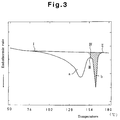
- foamed particles of the polyolefin resin used in the production of the molded article according to the present invention it is further preferable to use foamed particles, on the DSC curve of which an endothermic peak (hereinafter referred to as the high-temperature peak b) on the temperature side higher than a temperature corresponding to an endothermic peak inherent to polyolefin resin (hereinafter referred to as the inherent peak a) appears as illustrated in FIGs. 3 and 4.
- the DSC curve is obtained by differential scanning calorimetry of the foamed particles and the endothermic peaks are attendant on the melting of the polyolefin resin.
- FIG. 3 shows a DSC curve of foamed particles of an ethylene-propylene random copolymer as a base resin
- FIG. 4 shows a DSC curve of foamed particles of a linear low-density polyethylene as a base resin.
- the quantity of heat at the high-temperature peak b is preferably 13-30 J/g.
- the quantity of heat at the high-temperature peak b is preferably 10-50 J/g.
- foamed particles permits the provision of a molded article slight in shrinkage and good in fusion bonding property among the foamed particles without need for any complicated pretreatment to pressurize the foamed particles prior to their molding under heat in a mold. If the quantity of heat at the high-temperature peak b on the DSC curve in the foamed particles of the polyolefin resin is lower than the lower limit of the range described above, the shrinkage of the resulting molded article can be prevented by charging the foamed particles into a pressure tank to increase their internal pressure before use. However, there is a possibility that the void content of the resulting molded article may become low due to their high secondary expandability.
- the foamed particles may preferably be molded in such a manner that the void content X (%) of the foamed particles and the void content Y (%) of the resulting molded article satisfy the following inequality (1): 0.63 - 30 X ⁇ Y X ⁇ 0.63
- the void content X (%) of the foamed particles is determined in accordance with the following relationship by finding an apparent volume A (cm3) which is read by a graduated cylinder when placing the foamed particles in the graduated cylinder, and a true volume B (cm3) which is indicated by an increased volume when sinking the foamed particles into the graduated cylinder containing alcohol.
- X (%) [(A - B)/A] x 100
- the void content Y (%) of the expansion-molded article is determined in accordance with the following relationship by calculating an apparent volume C (cm3) from the outside dimension of the molded article, and finding a true volume D (cm3) which is indicated by an increased volume when sinking the molded article into a graduated cylinder containing alcohol.
- Y (%) [(C - D)/C] x 100
- X is preferably within a range of 40 ⁇ X ⁇ 70 because the productivity of the foamed particle becomes good.
- Y is preferably higher than 10 because a molded article having such a void content is practical from the viewpoint of water permeability and the like.
- the foamed particles are filled into a mold, which can be closed, but not sealed up, to heat them, thereby mutually fusion-bonding the foamed particles.
- a heating medium introduced into the mold to heat the foamed particles is generally used.
- heating conditions such as heating temperature and heating time are determined in due consideration of the shape of the foamed particles filled into the mold, the melting point of the base resin, the secondary expandability of the foamed particles, the shrinkage of the resulting molded article and the like. It is also possible to find a permissible range of the void content X from the graph shown in FIG. 5 according to the intended void content Y of the expansion-molded article, whereby foamed particles having a void content X within such a range are chosen for use.
- the secondary expandability of the foamed particles and the shrinkage of the molded article have been proved to greatly depend upon the quantity of heat at the high-temperature peak of the foamed particles to be used.
- the use of foamed particles of the polyolefin resin, which have a quantity of heat at the high-temperature peak within the above-described range, makes it possible to apply a heating temperature range equal to or wider than a heating temperature range, in which a usual molded article having no open voids but possessing good physical properties can be obtained, to the production of the molded article according to the present invention.
- a temperature ranging from (the melting point of the base resin of the foamed particles - 15°C) to (the melting point of the base resin of the foamed particles + 10°C) may be used as a temperature for heating the foamed particles in the mold.
- a molded article satisfying the object of the present invention can be easily obtained so long as the heating temperature falls within this range. The widening of the range of the molding temperature of the foamed particle is preferable because yield also becomes good.
- the quantity of heat at the high-temperature peak is smaller than the lower limit defined in the present invention, the secondary expandability of the foamed particles becomes too high, and so there are possibilities that the voids in the resulting molded article may be filled and that the problem of shrinkage in the molded article may also arise.
- the quantity of heat at the high-temperature peak of the foamed particles is greatly affected by the heat history upon the production of the foamed particles.
- it is effective, for example, to lower the rate, at which the resin particles are heated to the foaming temperature in the vessel, to 0.5°C/min or lower, or hold the resin particles in the vessel, in general, at a temperature not lower than (the melting point of the base resin - 10°C) but lower than a melting completion temperature for several minutes to several tens minutes, preferably 5-40 minutes, though such conditions vary according to the kind of the blowing agent, in the foaming process described above.
- the quantity of heat at the high-temperature peak of the foamed particles and the melting point of the base resin of the foamed particles can be determined in accordance with the following procedure from DSC curves obtained by differential scanning calorimetry.
- the foamed particles are heated to 220°C at a heating rate of 10°C/min by a differential scanning calorimeter to obtain a first DSC curve.
- An inherent peak a and a high-temperature peak b appear on the first DSC curve.
- the high-temperature peak b may not appear in some cases due to a difference in the heat history upon the production of the foamed particles.
- the existence of the high-temperature peak b on the DSC curve can be determined by the following method.
- the foamed particles are cooled from 220°C to about 40°C at a cooling rate of 10°C/min and are heated again to 220°C at a heating rate of 10°C/min, thereby obtaining a second DSC curve (not shown).
- This second DSC curve is compared with the first DSC curve.
- An endothermic peak which appears on both first and second DSC curves is the inherent peak a.
- the high-temperature peak b does not appear on the second DSC curve.
- the high-temperature peak b and the inherent peak a of the foamed particles can be distinguished from each other by this fact.
- the temperatures corresponding respectively to the tops of the inherent peaks a may differ a little in some instances.
- the temperature corresponding to the top of the inherent peak a determined by the second DSC curve is regarded as the melting point of the base resin of the foamed particles.
- the quantity of heat at the high-temperature peak b which has been ascertained by the comparison of the first DSC curve with the second DSC curve, is determined by the following procedure. As shown in FIG. 3 or 4, a straight line is first drawn between a point I at 80°C on the DSC curve and a point II on the DSC curve, which indicates the melting completion temperature of the base resin. A perpendicular line is then drawn from a point III on the DSC curve, which corresponds to a valley between the inherent peak a and the high-temperature peak b, to the straight line connecting the point I and the point II. The intersection thereof is regarded as a point IV.
- the quantity of heat at the high temperature peak b is expressed by a section surrounded by a straight line connecting the point IV thus obtained and the point II, a straight line connecting the point III and the point IV, and a DSC curve connecting the point III and the point II, namely, an area hatched in FIG. 3 or 4.
- the quantity of heat at the high-temperature peak b of the foamed particles shows a value substantially equal to that of an expansion-molded article obtained by molding the foamed particles, which value is determined by measuring the molded article in the same manner.
- any other conventionally-known process such as a process in which a resin and a blowing agent are kneaded in an extruder, the mixture is extruded through a die having the desired sectional form so as to expand the resin, and the extruded foam is then cut into proper lengths may be used as a process for providing the foamed particles used in the present invention.
- foamed particles useful in the practice of the present invention those having an expansion ratio (bulk expansion ratio) of 5-120 times may be used. However, it is preferable to use those having a bulk expansion ratio of 5-30 times because they can provide a molded article having high compressive strength.
- foamed particles high in bulk expansion ratio it is preferable to use the conventionally-known multi-stage foaming process in which the foamed particles obtained in the above-described manner are charged into a pressure tank to apply an internal pressure of at least 0.3 kg/cm2(G) to the interior of the foamed particles, and the thus-treated foamed particles are heated with steam or the like to expand them again.
- the internal pressure of the foamed particle Upon heating and molding the foamed particles having a high bulk expansion ratio into a mold, it is preferable to increase the internal pressure of the foamed particle to at least 0.3 kg/cm2(G) prior to use in order to prevent the resulting expansion-molded article from undergoing shrinkage.
- the molded article formed by heating the foamed particles in the mold to mutually fusion-bond the particles is cooled in the mold and then taken out of the mold.
- a cooling method there may be used any of a water-cooling method in which water is introduced into the mold to cool the molded article, a vacuum-cooling method in which the heat of vaporization of the steam or the like used in the heating is utilized, and an air-cooling method in which a cooling gas such as air is introduced into the mold to cool the molded article.
- the cooling by the vacuum-cooling method and/or the air-cooling method is preferred.
- water-cooling method water is filled in voids in the expansion-molded article, and so the molded article becomes heavy, which may possibly interfere with the removal of the molded article from the mold.
- an inert gas (hereinafter may be abbreviated as "gas” simply) pressurized to 0.5-10 kg/cm2(G) and kept at 70°C or lower is used. More specifically, it is only necessary to introduce the gas from gas inlets provided in the mold into the mold and discharge the gas through gas outlets.
- gas pressurized to 0.5-10 kg/cm2(G) and kept at 70°C or lower.
- a mold 2 is constituted by, for example, a stationary mold 21 and a movable mold 22.
- the stationary mold 21 comprises a cavity-side inner mold 4 and a cavity-mold backing plate 5, and is provided with a gas inlet valve 11, a drain valve 13, a heating steam inlet valve 15 and a cooling water inlet valve 17 for introducing heating steam, cooling water, cooling gas or the like into a heating and cooling space 6 within the mold 21 or discharging drain out of the space 6.
- the movable mold 22 similarly comprises a core-side inner mold 7 and a core-mold backing plate 8, and is provided with a gas inlet valve 12, a drain valve 14, a heating steam inlet valve 16 and a cooling water inlet valve 18 for introducing heating steam, cooling water, cooling gas or the like into a heating and cooling space 9 within the mold 22 or discharging drain out of the space 9.
- the foamed particles 1 are introduced into a chamber 3 by a feeder 10, and heated with steam introduced through the heating steam inlet valves 15, 16 to mold them (since FIGs. 6 to 8 each illustrate a state that the molding under heat has been completed, the heating steam inlet valves 15 and 16 are closed at this time).
- a particularly preferable method of introducing a gas into the mold is a method in which a cooling gas is passed through voids in the expansion-molded article and discharged through the outlet of a mold on the side opposite to the mold in which the gas has been introduced as described in the above (2), (3) and (4).
- This method is excellent in the removing efficiency of water within the molded article.
- Table 1 Stationary mold Movable mold Remarks Gas inlet valve Drain valve Gas inlet valve Drain valve (1) Open Open Open Open Condition shown in FIG. 6 (2) Close Open Open Close Condition shown in FIG. 7 (3) Open Close Close Open Condition shown in FIG. 8
- any gas may be used in addition to air so far as it is a chemically inert gas such as nitrogen, argon or carbon dioxide.
- air is most preferred from the viewpoint of economy.
- compressed air obtained by compressing by means of a compressor or the like is used.
- the inert gas to be introduced into the mold in the air-cooling method is controlled to 70°C or lower before use. If an inert gas having a temperature higher than 70°C is used, it takes a long time to cool the molded article. It is more preferable to control the temperature of the gas to 40°C or lower.
- the inert gas is also pressurized to 0.5-10 kg/cm2(G) before use. If an inert gas pressurized only below 0.5 kg/cm2(G) is used, it takes a long time to cool the molded article. In addition, an effect to blow off the water within the molded article becomes a little, and so the production efficiency is lowered. If an inert gas pressurized above 10 kg/cm2 (G) is used, difficulties are encountered on the supply itself of such a high-pressure gas.
- the gas used in the cooling is preferably pressurized within a range of 0.5-6 kg/cm2(G). Any pressure within this range makes it possible to shorten the cooling time and to supply the gas with ease.
- the cooling time is preferably 10-180 seconds. Any time shorter than 10 seconds involves difficulties in performing sufficient cooling. On the other hand, any time exceeding 180 seconds makes the molding cycle longer, resulting in an increase in cost.
- the molded article according to the present invention has open voids and is excellent in water permeability.
- water when water is brought into contact with the molded article in a dry state for the first time, it may take a long time until the water penetrates, and there may come out pools in some cases.
- the hydrophilicity-imparting agent may be either contained in or coated on the molded article.
- the coating offers a problem in some degree from the viewpoint of lastingness of the effect of the hydrophilicity-imparting agent because there is a possibility that the agent may be washed out by passing water through the molded article and rubbed off by the surface friction of the molded article.
- the hydrophilicity-imparting agent may bleed from the interior of the molded article into the surface thereof even if the hydrophilicity-imparting agent on the surface of the molded article is washed out or rubbed off by the passing of water or the friction.
- the hydrophilicity-imparting agent exhibits no bleeding phenomenon on the contrary, there is no possibility that the agent may be washed out or rubbed off.
- the molded article further has many advantages including the fact that even when the molded article is cut and processed in situ, hydrophilicity on the cut surface can be ensured. Therefore, the hydrophilicity-imparting agent may preferably be contained in the molded article rather than coated thereon.
- hydrophilicity-imparting agent examples include silicon compounds such as dimethyl polysiloxane; water-soluble polymers such as sulfonated polystyrene and polyvinyl pyrrolidone; and hydrophilic liquid organic compounds such as ethylene glycol, glycerol and polyethylene glycol and surfactants.
- hydrophilicity-imparting agents those obtained by crosslinking the water-soluble polymers to insolubilize them are preferred because they are excellent in lastingness and durability even when they are coated on the molded article, to say nothing of the case where they are contained in the molded article.
- the surfactants are preferred from the viewpoint of easy handling.
- the hydrophilicity-imparting agent is contained in a base resin to obtain a molded article, the surfactants are most preferable for reasons of good compatibility with the base resin, lastingness, bleeding property and durability.
- surfactants there may be used anionic surfactants, cationic surfactants, nonionic surfactants and amphoteric surfactants. However, those exemplified below are mainly used.
- anionic surfactants there may be used olefin sulfates, salts of aliphatic alcohol sulfates such as sodium oleyl alcohol sulfate, salts of alkylsulfates, fatty acid ethylsulfonates, alkylsulfonates, alkylnaphthalenesulfonates, alkylbenzenesulfoantes and the like.
- cationic surfactants there may be used salts of primary amines, salts of tertiary amines, quaternary ammonium compounds, pyridine derivatives and the like.
- other cationic surfactants include higher alkylamines such as N,N'-bis(hydroxyethyl)-N-alkylamines represented by the following general formula (a): wherein R means an alkyl group having 12-18 carbon atoms.
- nonionic surfactants there may be used sorbitan monofatty acid esters represented by the following general formula (b), polyhydric alcohol fatty acid esters represented by the following general formula (c) and pentaerythritol fatty acid esters represented by the following general formula (d):
- R means an alkyl group having 12-18 carbon atoms.
- R denotes an alkyl group.
- polyhydric alcohol fatty acid esters include glyceryl monostearate, glyceryl distearate, glyceryl monooleate and glyceryl dioleate.
- nonionic surfactants include carboxylic acid derivatives, imidazoline derivatives such as hydroxyethylimidazoline sulfate, adducts of fatty alcohols with ethylene oxide, adducts of fatty acids with ethylene oxide, adducts of fatty amines or fatty amides with ethylene oxide, adducts of alkylphenols with ethylene oxide, adducts of alkylnaphthols with ethylene oxide, adducts of polyhydric alcohol fatty acid esters with ethylene oxide, and polyethylene glycol.
- imidazoline derivatives such as hydroxyethylimidazoline sulfate
- adducts of fatty alcohols with ethylene oxide adducts of fatty acids with ethylene oxide
- adducts of fatty amines or fatty amides with ethylene oxide adducts of alkylphenols with ethylene oxide
- the polyhydric alcohol fatty acid esters are preferred as the surfactants used as the hydrophilicity-imparting agent in the present invention, with those partially esterified being particularly preferred because they are considered to be capable of controlling the rate of bleeding. Even when the polyhydric alcohol fatty acid esters are contained in the foamed particles, they have no possibilities that fusion bonding among the foamed particles may be made insufficient upon molding, and the fusion-bonding strength among the particles in the resulting expansion-molded article may be impaired. On the contrary, they can impart hydrophilicity to the expansion-molded article.
- the various surfactants described above may be used either singly or in any combination thereof. They may be combined with the hydrophilicity-imparting agents other than the surfactants. A higher alcohol may be used in combination with a view toward controlling the rate of bleeding and improving the lastingness of the hydrophilicity.
- hydrophilicity-imparting agent is preferably added in a proportion of 0.3-7 wt.% based on the whole expansion-molded article. If the proportion of the hydrophilicity-imparting agent to be added is lower than 0.3 wt.%, there is a possibility that sufficient hydrophilicity may not be imparted to the resulting molded article, and so the water permeability of the molded article when dried may not be improved.
- any proportion of the hydrophilicity-imparting agent exceeding 7 wt.% may possibly offer problems of fusion bonding property among the foamed particles, such as a failure of fusion bonding among the foamed particles, and moreover is uneconomical.
- the proportion of the hydrophilicity-imparting agent to be added is more preferably 1-3 wt.%.
- hydrophilicity-imparting agent is a water-soluble polymer
- such a hydrophilicity-imparting agent is preferably added in a proportion of 3-40 wt.% based on the whole expansion-molded article. If the proportion of the hydrophilicity-imparting agent of water-soluble polymer to be added is lower than 3 wt.%, sufficient hydrophilicity may not be imparted to the resulting molded article, and so the hydrophilicity of the molded article may not be satisfactorily improved.
- any proportion of the water-soluble polymer exceeding 40 wt.% encounters difficulties in providing excellent foamed particles in the process of producing foamed particles from resin particles if such a great amount of the water-soluble polymer is contained in the resin particles.
- the expansion-molded article containing the hydrophilicity-imparting agent can be obtained by incorporating the hydrophilicity-imparting agent into the tubular resin particles as the starting material used in the production of the foamed particles in advance.
- a process of incorporating the hydrophilicity-imparting agent into the resin particles there may also be used a process in which the hydrophilicity-imparting agent is directly added to a raw base resin melted in an extruder to knead the mixture.
- the contact angle of the resin with water varies. In general, the contact angle becomes narrower as the content of the hydrophilicity-imparting agent increases. It is preferable to control the contact angle to narrower than 96 degrees, particularly narrower than 87 degrees by adjusting the content of the hydrophilicity-imparting agent making good use of this fact.
- the use of a resin whose contact angle has been controlled to such a value results in an expansion-molded article markedly superior in water permeability to an expansion-molded article containing no hydrophilicity-imparting agent and an expansion-molded article composed of a base resin whose contact angle is at least 96 degrees.
- a base resin containing the hydrophilicity-imparting agent, or an expansion-molded article thereof is held between planar aluminum plates corresponding to the symbol A1080P described in JIS H 4000 and heat-pressed at 200°C into a sheet.
- the measured value on the thus-formed sheet is taken as the contact angle.
- the contact angle is determined on the basis of the following formula in accordance with the liquid drop method (volume of droplet: about 3 mm3) making use of a CA-S Micro 2 Model manufactured by Kyowa Kaimenkagaku K.K. by using sheet of the base resin obtained by the method described above as a sample.
- ⁇ /2 tan -1 (h/r) wherein ⁇ is a contact angle, h is a height of a water droplet, and r is a radius of the water droplet.
- ultrapurified water is used as water for the measurement.
- both sheet of a base resin containing the hydrophilicity-imparting agent and expansion-molded article of such a resin, which has been defoamed by heat pressing, have the same value as to the contact angle.
- the molded article coated with the hydrophilicity-imparting agent is obtained by molding foamed particles coated with the hydrophilicity-imparting agent or molding foamed particles and then coating the surface of the resulting molded article with the hydrophilicity-imparting agent.
- the hydrophilicity-imparting agent is preferably used as a solution in a concentration of 0.01-0.5 wt.%.
- the water permeability-improving effect of the hydrophilicity-imparting agent is particularly marked in the case where the void contents of the resulting expansion-molded article is as relatively low as 5-30%, or the average maximum diameter of voids at a horizontal surface of the expansion-molded article is as relatively small as 1-4 mm.
- the molded articles according to the present invention are suitable for use as underlay materials for riding grounds and bridle paths in a riding club and artificial lawn in roof gardens, drainage equipment such as covered conduits, drainage-accelerating materials for golf links, lightweight banking materials typified by blocks for the EPS method, and the like making best use of their good water permeability.
- the riding ground and bridle path are constructed, for example, by laying the molded article according to the present invention, which has been formed to a thickness of 30-60 mm, on the surface of a concrete foundation in which drain ditches have been dug, and spreading sand or rubber chips to a thickness of 30-100 mm over the molded article.
- the coloring is generally performed, for example, by incorporating carbon black or the like in the stage that the tubular resin particles are formed.
- the molded article according to the present invention is used as the underlay material for artificial lawn in a roof garden
- Rain water or the like is easily drained through the molded article from the artificial lawn, and so the artificial lawn is quickly dried.
- the covered conduit there is used a method in which a perforated drainage pipe is surrounded by the molded article of the present invention, and then covered with sand, gravel and/or soil.
- a perforated drainage pipe is surrounded by the molded article of the present invention, and then covered with sand, gravel and/or soil.
- the molded article according to the present invention is directly laid on the ground, and soil, sand and lawn are laid thereon in order.
- a closed vessel (internal volume: 400 l) was then charged with, per 100 kg of the thus-obtained pellets, 2.5-6 kg of carbon oxide as a blowing agent, 400 g of kaolin as a dispersing agent, 4 g of sodium dodecylbenzenesulfonate as a dispersion aid and 220 l of water.
- the contents were heated to a foaming temperature of 150-155°C with stirring without raising the temperature of the mixture beyond a melting completion temperature of the base resin and held for 10-15 minutes at the same temperature.
- the thus-obtained foamed particle samples were each filled into a flat mold of 30 cm x 30 cm x 6 cm, and heated with steam under its corresponding conditions shown in Tables 2 to mold the foamed particles, thereby obtaining a molded article in a form conforming with the mold dimensions.
- Example 6 an internal pressure of 1.5 kgf/cm2G was applied to the foamed particles upon their molding.
- molding was performed without applying any treatment for the application of an internal pressure.
- the resulting molded articles were cooled under their corresponding conditions shown in Table 2.
- (1), (2) and (3) respectively indicate the open-close conditions of valves shown in (1), (2) and (3) of Table 1.
- Table 2 Various properties of the thus-obtained molded articles are given collectively in Table 2.
- the bulk density ⁇ 1 (g/cm3) of the foamed particles or molded article in each example is a value determined by placing the foamed particles or molded article of known weight M1 (g) in a graduated cylinder and dividing the weight M1 by a volume D1 (cm3) read by the graduated cylinder at this time (M1/D1).
- the true density ⁇ 2 (g/cm3) of the foamed particles is a value determined by placing the foamed particles of known weight M2 (g) in a graduated cylinder containing alcohol and dividing the weight M2 by a volume D2 (cm3) corresponding to an increased volume read by the graduated cylinder when sinking the foamed particles into the graduated cylinder containing alcohol (M2/D2).
- the true expansion ratio of the foamed particles is a values determined by dividing a density ⁇ (g/cm3) of the base resin by the true density ⁇ 2 of the foamed particles ( ⁇ / ⁇ 2), while the bulk expansion ratio of the foamed particles is a value determined by dividing a density ⁇ (g/cm3) of the base resin by the bulk density ⁇ 1 of the foamed particles ( ⁇ / ⁇ 1).
- the bulk expansion ratio of the expansion-molded article is a value determined by calculating an apparent volume B' from the outside dimension of the molded article, measuring the weight W (g) of the expansion-molded article and dividing a product of the apparent volume B' (cm3) and the density ⁇ (g/cm3) of the base resin by the weight W (B' ⁇ /W).
- the filling factor of the foamed particles is a value in terms of percentage determined by dividing a true volume (cm3) of the foamed particles filled into a mold by an internal volume (cm3) of the mold.
- the fusion bonding property among the foamed particles in the molded article was evaluated by stretching each of 5 specimens of 5 cm x 10 cm x 5 mm, which had been cut out of the molded article, in a longitudinal direction to break it and observing its rupture cross-section to rank it in accordance with the following standard:
- the coefficient of water permeability was determined in accordance with the equation of constant water level prescribed in JIS A 1218 by using each expansion-molded article as a sample in place of sand, and a rectangular tube in place of a cylinder in which the sample was placed.
- Shrinkage factor (%) (H' - h)/H' x 100 wherein h is a minimum thickness of an expansion-molded article, and H' is a thickness of a cavity of its corresponding mold.
- a closed vessel (internal volume: 5 l) was charged with 1 kg of the thus-obtained particles, 40 g of carbon dioxide as a blowing agent, 4 g of kaolin as a dispersing agent, 0.03 g of sodium dodecylbenzenesulfonate as a dispersion aid and 3 l of water as a dispersion medium.
- the contents were heated to a foaming temperature of 152.5°C with stirring without raising the temperature of the mixture beyond a melting completion temperature of the base resin and held for 15 minutes at the same temperature.
- While feeding carbon dioxide to apply a back pressure equal to the equilibrium vapor pressure within the closed vessel the vessel was then opened at one end thereof to release the resin particles and water at the same time, thereby expanding the resin particles.
- Properties of the thus-obtained foamed particles are shown collectively in Table 3.
- the thus-obtained foamed particle samples were each molded by means of a flat mold of 30 cm x 30 cm x 6 cm without applying any treatment for the application of an internal pressure, thereby obtaining a molded article in a form conforming with the mold dimensions.
- the foamed particle sample filled in the mold was heated with steam of its corresponding molding temperature shown in Table 3 to mold it.
- the resulting molded articles were cooled under their corresponding conditions shown in Table 3.
- the measurement results as to the fusion bonding property among the foamed particles and water permeability of the molded articles, and their bulk densities and void contents are shown in Table 3 as with the results in Examples 1-11.
- the expansion-molded articles of the polyolefin resin according to the present invention are formed by mutually fusion-bonding specific tubular foamed particles. Therefore, they are sufficiently high in fusion-bonding strength among the foamed particles and have open voids at high void content, and hence exhibit excellent water permeability and compressive strength. Those having a coefficient of water permeability of at least 4.0 x 10 ⁇ 2 (cm/sec) are suitable for use in subdrainage equipment and the like of which excellent durability under load and water permeability are required.
- Those molded from the foamed particles containing the hydrophilicity-imparting agent therein or coated with the agent exhibit excellent water permeability even when water is caused to pass through or brought into contact with the molded articles in a dry state.
- the excellent molded articles as described above can be produced with ease.
- the foamed particles whose quantity of heat at the high-temperature peak on the DSC curve falls within a specific range are used in the molding, the expansion-molded articles having open voids and excellent water permeability can be easily obtained without need for any complicated operation such as control of heating temperature or internal pressure of the foamed particles upon their molding under heat.
Landscapes
- Engineering & Computer Science (AREA)
- Mechanical Engineering (AREA)
- Manufacture Of Porous Articles, And Recovery And Treatment Of Waste Products (AREA)
- Pens And Brushes (AREA)
- Containers Having Bodies Formed In One Piece (AREA)
- Food-Manufacturing Devices (AREA)
- Manufacture Of Macromolecular Shaped Articles (AREA)
Applications Claiming Priority (12)
| Application Number | Priority Date | Filing Date | Title |
|---|---|---|---|
| JP21427994 | 1994-08-16 | ||
| JP214279/94 | 1994-08-16 | ||
| JP21427994 | 1994-08-16 | ||
| JP221167/94 | 1994-08-23 | ||
| JP22116794A JP3358886B2 (ja) | 1994-08-23 | 1994-08-23 | 空隙を有する通水性発泡成型体 |
| JP22116794 | 1994-08-23 | ||
| JP33210394 | 1994-12-12 | ||
| JP332103/94 | 1994-12-12 | ||
| JP6332103A JPH08156000A (ja) | 1994-12-12 | 1994-12-12 | 空隙を有する発泡成型体の製造方法 |
| JP7074638A JP2805286B2 (ja) | 1994-08-16 | 1995-03-07 | 連通した空隙を有するポリオレフィン系樹脂発泡成形体及びその製造方法 |
| JP7463895 | 1995-03-07 | ||
| JP74638/95 | 1995-03-07 |
Publications (3)
| Publication Number | Publication Date |
|---|---|
| EP0697274A2 true EP0697274A2 (fr) | 1996-02-21 |
| EP0697274A3 EP0697274A3 (fr) | 1996-11-27 |
| EP0697274B1 EP0697274B1 (fr) | 2001-07-11 |
Family
ID=27465716
Family Applications (1)
| Application Number | Title | Priority Date | Filing Date |
|---|---|---|---|
| EP19950106966 Expired - Lifetime EP0697274B1 (fr) | 1994-08-16 | 1995-05-09 | Objet moulé par expansion avec un volume libre et procédé pour sa production |
Country Status (7)
| Country | Link |
|---|---|
| US (1) | US5622756A (fr) |
| EP (1) | EP0697274B1 (fr) |
| KR (1) | KR100226300B1 (fr) |
| AT (1) | ATE202972T1 (fr) |
| CA (1) | CA2148772A1 (fr) |
| DE (1) | DE69521654T2 (fr) |
| TW (1) | TW294691B (fr) |
Cited By (4)
| Publication number | Priority date | Publication date | Assignee | Title |
|---|---|---|---|---|
| EP1749634A1 (fr) | 1997-04-01 | 2007-02-07 | JSP Corporation | Corps insonorisant moule en resine thermoplastique |
| CN105838016A (zh) * | 2016-06-13 | 2016-08-10 | 广州傲胜人造草股份有限公司 | 一种热塑性弹性粒子及包含该热塑性弹性粒子的人造草坪 |
| EP2653283A4 (fr) * | 2010-12-15 | 2018-01-10 | Jsp Corporation | Procédé pour produire un corps moulé en particules de résine polyoléfinique expansée et corps moulé en particules de résine polyoléfinique expansée |
| CN117402434A (zh) * | 2022-07-14 | 2024-01-16 | 株式会社Jsp | 热塑性树脂发泡颗粒以及热塑性树脂发泡颗粒成形体 |
Families Citing this family (28)
| Publication number | Priority date | Publication date | Assignee | Title |
|---|---|---|---|---|
| US6037039A (en) * | 1994-01-31 | 2000-03-14 | Daiwa Seiko, Inc. | Biodegradable article |
| EP0918066B1 (fr) | 1996-08-12 | 2004-02-18 | JSP Corporation | Materiau absorbant les chocs |
| WO1998025996A1 (fr) * | 1996-12-13 | 1998-06-18 | Jsp Corporation | Particules expansees de resine de polyolefine et leur procede de preparation |
| US20020182399A1 (en) | 1997-04-01 | 2002-12-05 | Hisao Tokoro | Molded body of thermoplastic resin having sound absorption characteristics |
| TW369475B (en) | 1997-06-18 | 1999-09-11 | Jsp Corp | Production apparatus of expansion-molded article, auxiliary member for transfer of foamed particles and production method of expansion-molded article |
| DE69827294T2 (de) | 1997-12-01 | 2006-03-09 | Jsp Corp. | Expandierte polypropylenharzperlen und geformter artikel |
| SG77671A1 (en) * | 1998-03-23 | 2001-01-16 | Jsp Corp | Foamed and expanded beads of polypropylene resin for molding |
| EP0963827B1 (fr) * | 1998-06-11 | 2002-10-23 | Jsp Corporation | Article moulé en perles de mousse de propylène expansée |
| JP3525095B2 (ja) * | 2000-06-05 | 2004-05-10 | 本田技研工業株式会社 | 自動車用ポリプロピレン系樹脂複合成形体 |
| JP4121874B2 (ja) * | 2002-03-13 | 2008-07-23 | 日世株式会社 | 生分解性成形物の製造方法およびそれに用いる成形型 |
| US7365788B2 (en) * | 2003-02-07 | 2008-04-29 | Olympus Corporation | Imager apparatus |
| US20050064121A1 (en) * | 2003-09-24 | 2005-03-24 | Tsuyoshi Takami | Manufacturing method of resin tubes used in curtain and curtains made of the same |
| US7837911B2 (en) * | 2004-01-26 | 2010-11-23 | Sabic Innovative Plastics Ip B.V. | Methods of forming a layered article |
| US20050164023A1 (en) * | 2004-01-26 | 2005-07-28 | Davis Scott M. | Structurally reinforced resinous article and method of making |
| TWI400286B (zh) * | 2005-03-29 | 2013-07-01 | Jsp Corp | 聚丙烯系樹脂發泡粒子、聚丙烯系樹脂發泡粒子成形體的製造方法及聚丙烯系樹脂發泡粒子成形體 |
| US8513317B2 (en) * | 2007-12-11 | 2013-08-20 | Kaneka Corporation | Process for producing expanded polyolefin resin particles and expanded polyolefin resin particles |
| JP4623749B2 (ja) * | 2008-05-13 | 2011-02-02 | 住友ゴム工業株式会社 | 人工芝充填用粒状物および同人工芝充填用粒状物を充填してなる人工芝構造体 |
| JP4623750B2 (ja) * | 2008-05-13 | 2011-02-02 | 住友ゴム工業株式会社 | 人工芝充填用粒状物および同人工芝充填用粒状物を充填してなる人工芝構造体 |
| EP2524942B1 (fr) | 2010-01-15 | 2014-11-12 | Kaneka Corporation | Particule expansée de résine à base de polyéthylène non réticulé et article moulé expansé de résine à base de polyéthylène non réticulé |
| JP5664143B2 (ja) * | 2010-11-09 | 2015-02-04 | 株式会社ジェイエスピー | 発泡性複合熱可塑性樹脂粒子、複合熱可塑性樹脂発泡粒子、及び複合熱可塑性樹脂発泡粒子成形体 |
| JP6344056B2 (ja) * | 2014-05-23 | 2018-06-20 | キョーラク株式会社 | 発泡成形体 |
| JP6080275B1 (ja) | 2015-08-12 | 2017-02-15 | 株式会社ジェイエスピー | 車両用シート芯材、および車両用シート部材 |
| ES2853225T3 (es) | 2016-05-25 | 2021-09-15 | Basf Se | Partículas huecas de elastómeros termoplásticos y piezas moldeadas porosas |
| US11795286B2 (en) * | 2016-11-14 | 2023-10-24 | Jsp Corporation | Foam particle moulded article, sole cushion, and method for producing foam particles |
| US10882970B2 (en) | 2017-02-13 | 2021-01-05 | Asahi Kasei Kabushiki Kaisha | Resin foam particles, resin foam shaped product, and laminate |
| KR101938788B1 (ko) * | 2018-06-29 | 2019-01-15 | 휴그린테크 주식회사 | 인조잔디의 탄성칩 |
| CN115427487B (zh) | 2020-02-04 | 2023-10-20 | 株式会社Jsp | 聚丙烯系树脂发泡珠粒和聚丙烯系树脂发泡珠粒模制品 |
| US12441860B2 (en) | 2021-06-25 | 2025-10-14 | Jsp Corporation | Polypropylene-based resin expanded bead, method for producing same, and molded article of polypropylene-based resin expanded beads |
Family Cites Families (11)
| Publication number | Priority date | Publication date | Assignee | Title |
|---|---|---|---|---|
| US3387067A (en) * | 1965-05-20 | 1968-06-04 | Standard Oil Co | Low density plastic foam article and production technique |
| CA1203950A (fr) * | 1982-12-23 | 1986-04-29 | Harold S. Cox | Articles a l'epreuve de l'electricite statique |
| JPS60104318A (ja) * | 1983-11-10 | 1985-06-08 | Badische Yuka Co Ltd | ポリスチレン発泡体製品の製造方法 |
| DE3503057A1 (de) * | 1985-01-30 | 1986-07-31 | Hoechst Ag, 6230 Frankfurt | Aufschaeumbares kunststoffgranulat und daraus hergestelltes packmaterial |
| JPS61215631A (ja) * | 1985-03-20 | 1986-09-25 | Japan Styrene Paper Co Ltd | 型内成型に使用する無架橋予備発泡粒子製造用プロピレン系ランダム共重合体樹脂粒子の製造方法 |
| DE3541052A1 (de) * | 1985-11-19 | 1987-05-21 | Marquet & Cie Noel | Schaumstoffplatten und -bloecke aus hohlprofilen, deren herstellung, sowie deren verwendung als isolier- und/oder drainageplatten |
| JPH0649795B2 (ja) * | 1985-11-29 | 1994-06-29 | 日本スチレンペ−パ−株式会社 | ポリプロピレン系樹脂予備発泡粒子成型体の製造方法 |
| JPH0657435B2 (ja) * | 1987-11-25 | 1994-08-03 | 鐘淵化学工業株式会社 | ポリプロピレン系樹脂の型内発泡成形法 |
| US5284431A (en) * | 1990-08-28 | 1994-02-08 | Jsp Corporation | Filling apparatus for filling foamed particles of a thermoplastic resin into a mold |
| JP3580317B2 (ja) * | 1992-10-29 | 2004-10-20 | 株式会社ジェイエスピー | 空隙を有する難燃性発泡スチレン系樹脂成形体の製造方法 |
| JP3195676B2 (ja) * | 1992-12-28 | 2001-08-06 | 株式会社ジエイエスピー | ポリオレフィン系樹脂発泡粒子の製造方法 |
-
1995
- 1995-03-13 TW TW84102374A patent/TW294691B/zh not_active IP Right Cessation
- 1995-05-05 CA CA 2148772 patent/CA2148772A1/fr not_active Abandoned
- 1995-05-09 DE DE69521654T patent/DE69521654T2/de not_active Expired - Lifetime
- 1995-05-09 AT AT95106966T patent/ATE202972T1/de active
- 1995-05-09 EP EP19950106966 patent/EP0697274B1/fr not_active Expired - Lifetime
- 1995-05-12 US US08/439,785 patent/US5622756A/en not_active Expired - Lifetime
- 1995-05-15 KR KR1019950011950A patent/KR100226300B1/ko not_active Expired - Lifetime
Cited By (5)
| Publication number | Priority date | Publication date | Assignee | Title |
|---|---|---|---|---|
| EP1749634A1 (fr) | 1997-04-01 | 2007-02-07 | JSP Corporation | Corps insonorisant moule en resine thermoplastique |
| EP2653283A4 (fr) * | 2010-12-15 | 2018-01-10 | Jsp Corporation | Procédé pour produire un corps moulé en particules de résine polyoléfinique expansée et corps moulé en particules de résine polyoléfinique expansée |
| CN105838016A (zh) * | 2016-06-13 | 2016-08-10 | 广州傲胜人造草股份有限公司 | 一种热塑性弹性粒子及包含该热塑性弹性粒子的人造草坪 |
| CN117402434A (zh) * | 2022-07-14 | 2024-01-16 | 株式会社Jsp | 热塑性树脂发泡颗粒以及热塑性树脂发泡颗粒成形体 |
| EP4306583A1 (fr) * | 2022-07-14 | 2024-01-17 | JSP Corporation | Bille expansée de résine thermoplastique et article moulé de billes expansées de résine thermoplastique |
Also Published As
| Publication number | Publication date |
|---|---|
| EP0697274B1 (fr) | 2001-07-11 |
| CA2148772A1 (fr) | 1996-02-17 |
| KR100226300B1 (ko) | 1999-10-15 |
| ATE202972T1 (de) | 2001-07-15 |
| DE69521654D1 (de) | 2001-08-16 |
| DE69521654T2 (de) | 2002-05-08 |
| US5622756A (en) | 1997-04-22 |
| TW294691B (en) | 1997-01-01 |
| EP0697274A3 (fr) | 1996-11-27 |
Similar Documents
| Publication | Publication Date | Title |
|---|---|---|
| EP0697274B1 (fr) | Objet moulé par expansion avec un volume libre et procédé pour sa production | |
| KR101168192B1 (ko) | 폴리프로필렌계 수지 발포 입자, 폴리프로필렌계 수지 발포입자 성형체의 제조 방법 및 폴리프로필렌계 수지 발포입자 성형체 | |
| EP4101628B1 (fr) | Perles expansées de résine de polypropylène et article moulé en perles expansées de résine de polypropylène | |
| JP2805286B2 (ja) | 連通した空隙を有するポリオレフィン系樹脂発泡成形体及びその製造方法 | |
| JP3377575B2 (ja) | 空隙を有する重合体発泡粒子成型体 | |
| JPS63183832A (ja) | ポリプロピレン系樹脂型内発泡成形体の製造方法 | |
| JP4883681B2 (ja) | ポリプロピレン系樹脂発泡粒子、ポリプロピレン系樹脂発泡粒子成形体の製造方法およびポリプロピレン系樹脂発泡粒子成形体 | |
| JP3692760B2 (ja) | ポリプロピレン系樹脂型内発泡成形体の製造方法 | |
| JP3858517B2 (ja) | ポリプロピレン系樹脂予備発泡粒子、およびその予備発泡粒子と型内発泡成形体の製造法 | |
| JP4503720B2 (ja) | 表皮付き発泡成形体の製造方法 | |
| EP1031602B9 (fr) | Particules de resine de polypropylene pre-expansees et procede de production d'un objet moule a partir de ces particules de resine par moussage dans le moule | |
| JP3358886B2 (ja) | 空隙を有する通水性発泡成型体 | |
| US20040151879A1 (en) | Polypropylene resin molding composite for automobile | |
| JP3341418B2 (ja) | 連通した空隙を有するプロピレン系樹脂発泡成型体の製造方法 | |
| JPH07138400A (ja) | 連通した空隙を有するプロピレン系樹脂発泡成型体の製造方法 | |
| JP3436959B2 (ja) | 連通した空隙を有する重合体発泡成型体 | |
| JP3704366B2 (ja) | 連通した空隙を有する重合体発泡成型体 | |
| JP3394074B2 (ja) | 熱可塑性樹脂発泡粒子を型内成型してなる発泡成型体 | |
| JPH11156879A (ja) | ポリプロピレン系樹脂型内発泡成形体及びその製造方法 | |
| JP3399864B2 (ja) | 架橋ポリエチレン系連続気泡体端材の再生成形体及び再生成形方法 | |
| JPS6112736A (ja) | 予備発泡粒子およびその製造法 | |
| JPS60166441A (ja) | 発泡成形物およびその製造法 | |
| JP2000319437A (ja) | ポリプロピレン系樹脂発泡粒子及びその型内発泡成形体 |
Legal Events
| Date | Code | Title | Description |
|---|---|---|---|
| PUAI | Public reference made under article 153(3) epc to a published international application that has entered the european phase |
Free format text: ORIGINAL CODE: 0009012 |
|
| AK | Designated contracting states |
Kind code of ref document: A2 Designated state(s): AT BE CH DE DK ES FR GB IT LI NL SE |
|
| PUAL | Search report despatched |
Free format text: ORIGINAL CODE: 0009013 |
|
| AK | Designated contracting states |
Kind code of ref document: A3 Designated state(s): AT BE CH DE DK ES FR GB IT LI NL SE |
|
| 17P | Request for examination filed |
Effective date: 19970513 |
|
| 17Q | First examination report despatched |
Effective date: 19990203 |
|
| RIN1 | Information on inventor provided before grant (corrected) |
Inventor name: HINOKAWA, AKIRA Inventor name: SHIOYA, SATORU Inventor name: TOKORO, HISAO |
|
| GRAG | Despatch of communication of intention to grant |
Free format text: ORIGINAL CODE: EPIDOS AGRA |
|
| GRAG | Despatch of communication of intention to grant |
Free format text: ORIGINAL CODE: EPIDOS AGRA |
|
| GRAH | Despatch of communication of intention to grant a patent |
Free format text: ORIGINAL CODE: EPIDOS IGRA |
|
| GRAH | Despatch of communication of intention to grant a patent |
Free format text: ORIGINAL CODE: EPIDOS IGRA |
|
| GRAA | (expected) grant |
Free format text: ORIGINAL CODE: 0009210 |
|
| AK | Designated contracting states |
Kind code of ref document: B1 Designated state(s): AT BE CH DE DK ES FR GB IT LI NL SE |
|
| PG25 | Lapsed in a contracting state [announced via postgrant information from national office to epo] |
Ref country code: NL Free format text: LAPSE BECAUSE OF FAILURE TO SUBMIT A TRANSLATION OF THE DESCRIPTION OR TO PAY THE FEE WITHIN THE PRESCRIBED TIME-LIMIT Effective date: 20010711 Ref country code: LI Free format text: LAPSE BECAUSE OF FAILURE TO SUBMIT A TRANSLATION OF THE DESCRIPTION OR TO PAY THE FEE WITHIN THE PRESCRIBED TIME-LIMIT Effective date: 20010711 Ref country code: CH Free format text: LAPSE BECAUSE OF FAILURE TO SUBMIT A TRANSLATION OF THE DESCRIPTION OR TO PAY THE FEE WITHIN THE PRESCRIBED TIME-LIMIT Effective date: 20010711 Ref country code: BE Free format text: LAPSE BECAUSE OF FAILURE TO SUBMIT A TRANSLATION OF THE DESCRIPTION OR TO PAY THE FEE WITHIN THE PRESCRIBED TIME-LIMIT Effective date: 20010711 Ref country code: AT Free format text: LAPSE BECAUSE OF FAILURE TO SUBMIT A TRANSLATION OF THE DESCRIPTION OR TO PAY THE FEE WITHIN THE PRESCRIBED TIME-LIMIT Effective date: 20010711 |
|
| REF | Corresponds to: |
Ref document number: 202972 Country of ref document: AT Date of ref document: 20010715 Kind code of ref document: T |
|
| REG | Reference to a national code |
Ref country code: CH Ref legal event code: EP |
|
| REF | Corresponds to: |
Ref document number: 69521654 Country of ref document: DE Date of ref document: 20010816 |
|
| ITF | It: translation for a ep patent filed | ||
| PG25 | Lapsed in a contracting state [announced via postgrant information from national office to epo] |
Ref country code: SE Free format text: LAPSE BECAUSE OF FAILURE TO SUBMIT A TRANSLATION OF THE DESCRIPTION OR TO PAY THE FEE WITHIN THE PRESCRIBED TIME-LIMIT Effective date: 20011011 Ref country code: DK Free format text: LAPSE BECAUSE OF FAILURE TO SUBMIT A TRANSLATION OF THE DESCRIPTION OR TO PAY THE FEE WITHIN THE PRESCRIBED TIME-LIMIT Effective date: 20011011 |
|
| ET | Fr: translation filed | ||
| NLV1 | Nl: lapsed or annulled due to failure to fulfill the requirements of art. 29p and 29m of the patents act | ||
| REG | Reference to a national code |
Ref country code: GB Ref legal event code: IF02 |
|
| PG25 | Lapsed in a contracting state [announced via postgrant information from national office to epo] |
Ref country code: ES Free format text: LAPSE BECAUSE OF FAILURE TO SUBMIT A TRANSLATION OF THE DESCRIPTION OR TO PAY THE FEE WITHIN THE PRESCRIBED TIME-LIMIT Effective date: 20020131 |
|
| REG | Reference to a national code |
Ref country code: CH Ref legal event code: PL |
|
| PLBE | No opposition filed within time limit |
Free format text: ORIGINAL CODE: 0009261 |
|
| STAA | Information on the status of an ep patent application or granted ep patent |
Free format text: STATUS: NO OPPOSITION FILED WITHIN TIME LIMIT |
|
| 26N | No opposition filed | ||
| REG | Reference to a national code |
Ref country code: FR Ref legal event code: CA |
|
| PGFP | Annual fee paid to national office [announced via postgrant information from national office to epo] |
Ref country code: GB Payment date: 20130522 Year of fee payment: 19 |
|
| PGFP | Annual fee paid to national office [announced via postgrant information from national office to epo] |
Ref country code: IT Payment date: 20130525 Year of fee payment: 19 |
|
| PGFP | Annual fee paid to national office [announced via postgrant information from national office to epo] |
Ref country code: FR Payment date: 20140516 Year of fee payment: 20 Ref country code: DE Payment date: 20140626 Year of fee payment: 20 |
|
| GBPC | Gb: european patent ceased through non-payment of renewal fee |
Effective date: 20140509 |
|
| PG25 | Lapsed in a contracting state [announced via postgrant information from national office to epo] |
Ref country code: IT Free format text: LAPSE BECAUSE OF NON-PAYMENT OF DUE FEES Effective date: 20140509 |
|
| REG | Reference to a national code |
Ref country code: DE Ref legal event code: R071 Ref document number: 69521654 Country of ref document: DE |
|
| REG | Reference to a national code |
Ref country code: DE Ref legal event code: R071 Ref document number: 69521654 Country of ref document: DE |
|
| PG25 | Lapsed in a contracting state [announced via postgrant information from national office to epo] |
Ref country code: GB Free format text: LAPSE BECAUSE OF NON-PAYMENT OF DUE FEES Effective date: 20140509 |