EP0697404B1 - Pyridyl-cycloalkyl-ethylamines énantiomeriquement purs et leur sels ainsi qu'un procédé pour les préparer - Google Patents
Pyridyl-cycloalkyl-ethylamines énantiomeriquement purs et leur sels ainsi qu'un procédé pour les préparer Download PDFInfo
- Publication number
- EP0697404B1 EP0697404B1 EP95112640A EP95112640A EP0697404B1 EP 0697404 B1 EP0697404 B1 EP 0697404B1 EP 95112640 A EP95112640 A EP 95112640A EP 95112640 A EP95112640 A EP 95112640A EP 0697404 B1 EP0697404 B1 EP 0697404B1
- Authority
- EP
- European Patent Office
- Prior art keywords
- general formula
- reaction
- salt
- isolated
- mixture
- Prior art date
- Legal status (The legal status is an assumption and is not a legal conclusion. Google has not performed a legal analysis and makes no representation as to the accuracy of the status listed.)
- Expired - Lifetime
Links
- 150000001412 amines Chemical class 0.000 title claims description 31
- 150000003839 salts Chemical class 0.000 title claims description 30
- 238000000034 method Methods 0.000 title claims description 16
- 238000004519 manufacturing process Methods 0.000 title claims description 4
- 125000004076 pyridyl group Chemical group 0.000 title 1
- MUBZPKHOEPUJKR-UHFFFAOYSA-N Oxalic acid Chemical compound OC(=O)C(O)=O MUBZPKHOEPUJKR-UHFFFAOYSA-N 0.000 claims description 24
- 238000006243 chemical reaction Methods 0.000 claims description 24
- LFQSCWFLJHTTHZ-UHFFFAOYSA-N Ethanol Chemical compound CCO LFQSCWFLJHTTHZ-UHFFFAOYSA-N 0.000 claims description 22
- 239000000203 mixture Substances 0.000 claims description 20
- BZLVMXJERCGZMT-UHFFFAOYSA-N Methyl tert-butyl ether Chemical compound COC(C)(C)C BZLVMXJERCGZMT-UHFFFAOYSA-N 0.000 claims description 18
- YXFVVABEGXRONW-UHFFFAOYSA-N Toluene Chemical compound CC1=CC=CC=C1 YXFVVABEGXRONW-UHFFFAOYSA-N 0.000 claims description 18
- XEKOWRVHYACXOJ-UHFFFAOYSA-N Ethyl acetate Chemical compound CCOC(C)=O XEKOWRVHYACXOJ-UHFFFAOYSA-N 0.000 claims description 15
- 239000000243 solution Substances 0.000 claims description 15
- XLYOFNOQVPJJNP-UHFFFAOYSA-N water Substances O XLYOFNOQVPJJNP-UHFFFAOYSA-N 0.000 claims description 13
- VZCYOOQTPOCHFL-OWOJBTEDSA-N Fumaric acid Natural products OC(=O)\C=C\C(O)=O VZCYOOQTPOCHFL-OWOJBTEDSA-N 0.000 claims description 12
- CSCPPACGZOOCGX-UHFFFAOYSA-N Acetone Chemical compound CC(C)=O CSCPPACGZOOCGX-UHFFFAOYSA-N 0.000 claims description 11
- FFNVQNRYTPFDDP-UHFFFAOYSA-N 2-cyanopyridine Chemical compound N#CC1=CC=CC=N1 FFNVQNRYTPFDDP-UHFFFAOYSA-N 0.000 claims description 10
- 150000004658 ketimines Chemical class 0.000 claims description 10
- 150000002576 ketones Chemical class 0.000 claims description 10
- HEMHJVSKTPXQMS-UHFFFAOYSA-M Sodium hydroxide Chemical compound [OH-].[Na+] HEMHJVSKTPXQMS-UHFFFAOYSA-M 0.000 claims description 9
- 230000015572 biosynthetic process Effects 0.000 claims description 9
- 239000011541 reaction mixture Substances 0.000 claims description 9
- 239000002904 solvent Substances 0.000 claims description 9
- 239000003054 catalyst Substances 0.000 claims description 8
- VYPSYNLAJGMNEJ-UHFFFAOYSA-N Silicium dioxide Chemical compound O=[Si]=O VYPSYNLAJGMNEJ-UHFFFAOYSA-N 0.000 claims description 7
- 239000002253 acid Substances 0.000 claims description 7
- 238000006297 dehydration reaction Methods 0.000 claims description 7
- 235000006408 oxalic acid Nutrition 0.000 claims description 7
- 239000002798 polar solvent Substances 0.000 claims description 7
- 239000000741 silica gel Substances 0.000 claims description 7
- 229910002027 silica gel Inorganic materials 0.000 claims description 7
- VZCYOOQTPOCHFL-UHFFFAOYSA-N trans-butenedioic acid Natural products OC(=O)C=CC(O)=O VZCYOOQTPOCHFL-UHFFFAOYSA-N 0.000 claims description 7
- VEXZGXHMUGYJMC-UHFFFAOYSA-N Hydrochloric acid Chemical compound Cl VEXZGXHMUGYJMC-UHFFFAOYSA-N 0.000 claims description 6
- KDLHZDBZIXYQEI-UHFFFAOYSA-N Palladium Chemical compound [Pd] KDLHZDBZIXYQEI-UHFFFAOYSA-N 0.000 claims description 6
- HGCIXCUEYOPUTN-UHFFFAOYSA-N cyclohexene Chemical compound C1CCC=CC1 HGCIXCUEYOPUTN-UHFFFAOYSA-N 0.000 claims description 6
- 239000001530 fumaric acid Substances 0.000 claims description 6
- 239000000852 hydrogen donor Substances 0.000 claims description 6
- 238000003747 Grignard reaction Methods 0.000 claims description 5
- IJOOHPMOJXWVHK-UHFFFAOYSA-N chlorotrimethylsilane Chemical compound C[Si](C)(C)Cl IJOOHPMOJXWVHK-UHFFFAOYSA-N 0.000 claims description 5
- 150000001983 dialkylethers Chemical class 0.000 claims description 5
- 239000012429 reaction media Substances 0.000 claims description 5
- 238000010992 reflux Methods 0.000 claims description 5
- NLXLAEXVIDQMFP-UHFFFAOYSA-N Ammonium chloride Substances [NH4+].[Cl-] NLXLAEXVIDQMFP-UHFFFAOYSA-N 0.000 claims description 4
- VHUUQVKOLVNVRT-UHFFFAOYSA-N Ammonium hydroxide Chemical compound [NH4+].[OH-] VHUUQVKOLVNVRT-UHFFFAOYSA-N 0.000 claims description 4
- 235000011114 ammonium hydroxide Nutrition 0.000 claims description 4
- 150000001875 compounds Chemical class 0.000 claims description 4
- 230000018044 dehydration Effects 0.000 claims description 4
- 150000004678 hydrides Chemical class 0.000 claims description 4
- FYYHWMGAXLPEAU-UHFFFAOYSA-N Magnesium Chemical compound [Mg] FYYHWMGAXLPEAU-UHFFFAOYSA-N 0.000 claims description 3
- QAOWNCQODCNURD-UHFFFAOYSA-N Sulfuric acid Chemical compound OS(O)(=O)=O QAOWNCQODCNURD-UHFFFAOYSA-N 0.000 claims description 3
- 239000007864 aqueous solution Substances 0.000 claims description 3
- 239000003638 chemical reducing agent Substances 0.000 claims description 3
- 238000006482 condensation reaction Methods 0.000 claims description 3
- 229930195733 hydrocarbon Natural products 0.000 claims description 3
- 150000002430 hydrocarbons Chemical class 0.000 claims description 3
- 150000002431 hydrogen Chemical class 0.000 claims description 3
- 229910052739 hydrogen Inorganic materials 0.000 claims description 3
- 239000001257 hydrogen Substances 0.000 claims description 3
- 239000012442 inert solvent Substances 0.000 claims description 3
- 239000011777 magnesium Substances 0.000 claims description 3
- 229910052749 magnesium Inorganic materials 0.000 claims description 3
- 239000011734 sodium Substances 0.000 claims description 3
- ZOXJGFHDIHLPTG-UHFFFAOYSA-N Boron Chemical compound [B] ZOXJGFHDIHLPTG-UHFFFAOYSA-N 0.000 claims description 2
- DGAQECJNVWCQMB-PUAWFVPOSA-M Ilexoside XXIX Chemical compound C[C@@H]1CC[C@@]2(CC[C@@]3(C(=CC[C@H]4[C@]3(CC[C@@H]5[C@@]4(CC[C@@H](C5(C)C)OS(=O)(=O)[O-])C)C)[C@@H]2[C@]1(C)O)C)C(=O)O[C@H]6[C@@H]([C@H]([C@@H]([C@H](O6)CO)O)O)O.[Na+] DGAQECJNVWCQMB-PUAWFVPOSA-M 0.000 claims description 2
- WHXSMMKQMYFTQS-UHFFFAOYSA-N Lithium Chemical compound [Li] WHXSMMKQMYFTQS-UHFFFAOYSA-N 0.000 claims description 2
- 150000008044 alkali metal hydroxides Chemical class 0.000 claims description 2
- 229910052782 aluminium Inorganic materials 0.000 claims description 2
- XAGFODPZIPBFFR-UHFFFAOYSA-N aluminium Chemical compound [Al] XAGFODPZIPBFFR-UHFFFAOYSA-N 0.000 claims description 2
- 229910052796 boron Inorganic materials 0.000 claims description 2
- 238000002425 crystallisation Methods 0.000 claims description 2
- 229910052744 lithium Inorganic materials 0.000 claims description 2
- 239000012454 non-polar solvent Substances 0.000 claims description 2
- 229910052763 palladium Inorganic materials 0.000 claims description 2
- 229910052708 sodium Inorganic materials 0.000 claims description 2
- 239000005051 trimethylchlorosilane Substances 0.000 claims description 2
- 150000001732 carboxylic acid derivatives Chemical class 0.000 claims 4
- 238000009833 condensation Methods 0.000 claims 4
- 230000005494 condensation Effects 0.000 claims 4
- QISOBCMNUJQOJU-UHFFFAOYSA-N 4-bromo-1h-pyrazole-5-carboxylic acid Chemical compound OC(=O)C=1NN=CC=1Br QISOBCMNUJQOJU-UHFFFAOYSA-N 0.000 claims 3
- 125000005907 alkyl ester group Chemical group 0.000 claims 3
- 150000007522 mineralic acids Chemical class 0.000 claims 2
- 150000007524 organic acids Chemical class 0.000 claims 2
- 239000004215 Carbon black (E152) Substances 0.000 claims 1
- 230000002378 acidificating effect Effects 0.000 claims 1
- 150000001350 alkyl halides Chemical class 0.000 claims 1
- 239000004411 aluminium Substances 0.000 claims 1
- 150000004945 aromatic hydrocarbons Chemical class 0.000 claims 1
- 238000010533 azeotropic distillation Methods 0.000 claims 1
- 239000002585 base Substances 0.000 claims 1
- 150000007514 bases Chemical class 0.000 claims 1
- VZCYOOQTPOCHFL-OWOJBTEDSA-L fumarate(2-) Chemical class [O-]C(=O)\C=C\C([O-])=O VZCYOOQTPOCHFL-OWOJBTEDSA-L 0.000 claims 1
- QJGQUHMNIGDVPM-UHFFFAOYSA-N nitrogen group Chemical group [N] QJGQUHMNIGDVPM-UHFFFAOYSA-N 0.000 claims 1
- 150000003891 oxalate salts Chemical class 0.000 claims 1
- BASFCYQUMIYNBI-UHFFFAOYSA-N platinum Chemical compound [Pt] BASFCYQUMIYNBI-UHFFFAOYSA-N 0.000 claims 1
- 239000000126 substance Substances 0.000 claims 1
- BDHFUVZGWQCTTF-UHFFFAOYSA-N sulfonic acid Chemical class OS(=O)=O BDHFUVZGWQCTTF-UHFFFAOYSA-N 0.000 claims 1
- 239000001117 sulphuric acid Substances 0.000 claims 1
- 235000011149 sulphuric acid Nutrition 0.000 claims 1
- 125000000753 cycloalkyl group Chemical group 0.000 abstract 1
- 0 CCCCC(C*)C[C@@](C(CCC1)NC1C1CCCCC1)NC(C)c1ccccc1 Chemical compound CCCCC(C*)C[C@@](C(CCC1)NC1C1CCCCC1)NC(C)c1ccccc1 0.000 description 15
- YMWUJEATGCHHMB-UHFFFAOYSA-N Dichloromethane Chemical compound ClCCl YMWUJEATGCHHMB-UHFFFAOYSA-N 0.000 description 12
- XDTMQSROBMDMFD-UHFFFAOYSA-N Cyclohexane Chemical compound C1CCCCC1 XDTMQSROBMDMFD-UHFFFAOYSA-N 0.000 description 7
- OKKJLVBELUTLKV-UHFFFAOYSA-N Methanol Chemical compound OC OKKJLVBELUTLKV-UHFFFAOYSA-N 0.000 description 6
- RTZKZFJDLAIYFH-UHFFFAOYSA-N Diethyl ether Chemical compound CCOCC RTZKZFJDLAIYFH-UHFFFAOYSA-N 0.000 description 5
- -1 cyclohexylmethyl magnesium halide Chemical class 0.000 description 5
- QGZKDVFQNNGYKY-UHFFFAOYSA-N Ammonia Chemical compound N QGZKDVFQNNGYKY-UHFFFAOYSA-N 0.000 description 4
- HEDRZPFGACZZDS-UHFFFAOYSA-N Chloroform Chemical compound ClC(Cl)Cl HEDRZPFGACZZDS-UHFFFAOYSA-N 0.000 description 4
- 239000012071 phase Substances 0.000 description 4
- UHOVQNZJYSORNB-UHFFFAOYSA-N Benzene Chemical compound C1=CC=CC=C1 UHOVQNZJYSORNB-UHFFFAOYSA-N 0.000 description 3
- 150000007513 acids Chemical class 0.000 description 3
- 125000000217 alkyl group Chemical group 0.000 description 3
- 239000010779 crude oil Substances 0.000 description 3
- 150000008282 halocarbons Chemical class 0.000 description 3
- 150000002466 imines Chemical class 0.000 description 3
- 238000003756 stirring Methods 0.000 description 3
- 238000004809 thin layer chromatography Methods 0.000 description 3
- HBAQYPYDRFILMT-UHFFFAOYSA-N 8-[3-(1-cyclopropylpyrazol-4-yl)-1H-pyrazolo[4,3-d]pyrimidin-5-yl]-3-methyl-3,8-diazabicyclo[3.2.1]octan-2-one Chemical class C1(CC1)N1N=CC(=C1)C1=NNC2=C1N=C(N=C2)N1C2C(N(CC1CC2)C)=O HBAQYPYDRFILMT-UHFFFAOYSA-N 0.000 description 2
- 229910021529 ammonia Inorganic materials 0.000 description 2
- 239000008346 aqueous phase Substances 0.000 description 2
- 239000003153 chemical reaction reagent Substances 0.000 description 2
- 239000003795 chemical substances by application Substances 0.000 description 2
- 238000004296 chiral HPLC Methods 0.000 description 2
- 239000012043 crude product Substances 0.000 description 2
- 238000001035 drying Methods 0.000 description 2
- 239000000284 extract Substances 0.000 description 2
- 238000002844 melting Methods 0.000 description 2
- 230000008018 melting Effects 0.000 description 2
- 239000012074 organic phase Substances 0.000 description 2
- 238000007248 oxidative elimination reaction Methods 0.000 description 2
- 238000002360 preparation method Methods 0.000 description 2
- 239000000047 product Substances 0.000 description 2
- JQWHASGSAFIOCM-UHFFFAOYSA-M sodium periodate Chemical compound [Na+].[O-]I(=O)(=O)=O JQWHASGSAFIOCM-UHFFFAOYSA-M 0.000 description 2
- 125000001424 substituent group Chemical group 0.000 description 2
- KDYFGRWQOYBRFD-UHFFFAOYSA-L succinate(2-) Chemical compound [O-]C(=O)CCC([O-])=O KDYFGRWQOYBRFD-UHFFFAOYSA-L 0.000 description 2
- 239000000725 suspension Substances 0.000 description 2
- 238000003786 synthesis reaction Methods 0.000 description 2
- JOXIMZWYDAKGHI-UHFFFAOYSA-N toluene-4-sulfonic acid Chemical compound CC1=CC=C(S(O)(=O)=O)C=C1 JOXIMZWYDAKGHI-UHFFFAOYSA-N 0.000 description 2
- 238000001291 vacuum drying Methods 0.000 description 2
- AZUYLZMQTIKGSC-UHFFFAOYSA-N 1-[6-[4-(5-chloro-6-methyl-1H-indazol-4-yl)-5-methyl-3-(1-methylindazol-5-yl)pyrazol-1-yl]-2-azaspiro[3.3]heptan-2-yl]prop-2-en-1-one Chemical compound ClC=1C(=C2C=NNC2=CC=1C)C=1C(=NN(C=1C)C1CC2(CN(C2)C(C=C)=O)C1)C=1C=C2C=NN(C2=CC=1)C AZUYLZMQTIKGSC-UHFFFAOYSA-N 0.000 description 1
- NWYYWIJOWOLJNR-UHFFFAOYSA-N 2-Amino-3-methyl-1-butanol Chemical compound CC(C)C(N)CO NWYYWIJOWOLJNR-UHFFFAOYSA-N 0.000 description 1
- VFINPSLGEPYVRO-UHFFFAOYSA-N 2-cyclohexyl-1-pyridin-2-ylethanamine Chemical compound C=1C=CC=NC=1C(N)CC1CCCCC1 VFINPSLGEPYVRO-UHFFFAOYSA-N 0.000 description 1
- BTCULAVYSHWCJA-UHFFFAOYSA-N 2-cyclohexyl-1-pyridin-2-ylethanone Chemical compound C=1C=CC=NC=1C(=O)CC1CCCCC1 BTCULAVYSHWCJA-UHFFFAOYSA-N 0.000 description 1
- CSDSSGBPEUDDEE-UHFFFAOYSA-N 2-formylpyridine Chemical compound O=CC1=CC=CC=N1 CSDSSGBPEUDDEE-UHFFFAOYSA-N 0.000 description 1
- TWJRHXYHAIPHOX-UHFFFAOYSA-N 2-pyridin-2-yl-1,3-oxazolidine Chemical class N1CCOC1C1=CC=CC=N1 TWJRHXYHAIPHOX-UHFFFAOYSA-N 0.000 description 1
- WIPBCMSBPBENJI-UHFFFAOYSA-N C=1C=CC=NC=1C1(C(=O)C)CCCCC1 Chemical compound C=1C=CC=NC=1C1(C(=O)C)CCCCC1 WIPBCMSBPBENJI-UHFFFAOYSA-N 0.000 description 1
- RQEUFEKYXDPUSK-UHFFFAOYSA-N CC(c1ccccc1)N Chemical compound CC(c1ccccc1)N RQEUFEKYXDPUSK-UHFFFAOYSA-N 0.000 description 1
- AFXFWHCQGJFAQG-UHFFFAOYSA-N CCCCC(CCC)CSC1NCCCC1 Chemical compound CCCCC(CCC)CSC1NCCCC1 AFXFWHCQGJFAQG-UHFFFAOYSA-N 0.000 description 1
- PRLFLMNPHLLLOC-WYVVHKHJSA-N CCCCCC(CCC)C[C@@H](C1NCCCC1)N[C@@H](C)c1ccccc1 Chemical compound CCCCCC(CCC)C[C@@H](C1NCCCC1)N[C@@H](C)c1ccccc1 PRLFLMNPHLLLOC-WYVVHKHJSA-N 0.000 description 1
- RQEUFEKYXDPUSK-ZETCQYMHSA-N C[C@@H](c1ccccc1)N Chemical compound C[C@@H](c1ccccc1)N RQEUFEKYXDPUSK-ZETCQYMHSA-N 0.000 description 1
- OKTJSMMVPCPJKN-UHFFFAOYSA-N Carbon Chemical compound [C] OKTJSMMVPCPJKN-UHFFFAOYSA-N 0.000 description 1
- 239000007818 Grignard reagent Substances 0.000 description 1
- ZCQWOFVYLHDMMC-UHFFFAOYSA-N Oxazole Chemical compound C1=COC=N1 ZCQWOFVYLHDMMC-UHFFFAOYSA-N 0.000 description 1
- WYNCHZVNFNFDNH-UHFFFAOYSA-N Oxazolidine Chemical class C1COCN1 WYNCHZVNFNFDNH-UHFFFAOYSA-N 0.000 description 1
- PMZURENOXWZQFD-UHFFFAOYSA-L Sodium Sulfate Chemical compound [Na+].[Na+].[O-]S([O-])(=O)=O PMZURENOXWZQFD-UHFFFAOYSA-L 0.000 description 1
- CIUQDSCDWFSTQR-UHFFFAOYSA-N [C]1=CC=CC=C1 Chemical group [C]1=CC=CC=C1 CIUQDSCDWFSTQR-UHFFFAOYSA-N 0.000 description 1
- 238000007259 addition reaction Methods 0.000 description 1
- 229910001854 alkali hydroxide Inorganic materials 0.000 description 1
- 150000001408 amides Chemical class 0.000 description 1
- 150000001413 amino acids Chemical class 0.000 description 1
- 150000001414 amino alcohols Chemical class 0.000 description 1
- 208000006673 asthma Diseases 0.000 description 1
- 125000004429 atom Chemical group 0.000 description 1
- UUWSLBWDFJMSFP-UHFFFAOYSA-N bromomethylcyclohexane Chemical compound BrCC1CCCCC1 UUWSLBWDFJMSFP-UHFFFAOYSA-N 0.000 description 1
- 150000001735 carboxylic acids Chemical class 0.000 description 1
- 238000009903 catalytic hydrogenation reaction Methods 0.000 description 1
- 238000006555 catalytic reaction Methods 0.000 description 1
- 238000001816 cooling Methods 0.000 description 1
- 239000013078 crystal Substances 0.000 description 1
- 230000008025 crystallization Effects 0.000 description 1
- 238000006264 debenzylation reaction Methods 0.000 description 1
- 238000000354 decomposition reaction Methods 0.000 description 1
- 201000010099 disease Diseases 0.000 description 1
- 208000037265 diseases, disorders, signs and symptoms Diseases 0.000 description 1
- 239000003814 drug Substances 0.000 description 1
- HHFAWKCIHAUFRX-UHFFFAOYSA-N ethoxide Chemical compound CC[O-] HHFAWKCIHAUFRX-UHFFFAOYSA-N 0.000 description 1
- 150000004795 grignard reagents Chemical class 0.000 description 1
- 150000002366 halogen compounds Chemical class 0.000 description 1
- 238000006460 hydrolysis reaction Methods 0.000 description 1
- 239000003112 inhibitor Substances 0.000 description 1
- 229910052500 inorganic mineral Inorganic materials 0.000 description 1
- 125000001449 isopropyl group Chemical group [H]C([H])([H])C([H])(*)C([H])([H])[H] 0.000 description 1
- 150000002617 leukotrienes Chemical class 0.000 description 1
- 229910052987 metal hydride Inorganic materials 0.000 description 1
- 150000004681 metal hydrides Chemical class 0.000 description 1
- UKVIEHSSVKSQBA-UHFFFAOYSA-N methane;palladium Chemical compound C.[Pd] UKVIEHSSVKSQBA-UHFFFAOYSA-N 0.000 description 1
- 239000011707 mineral Substances 0.000 description 1
- 230000007935 neutral effect Effects 0.000 description 1
- 239000003921 oil Substances 0.000 description 1
- KJIFKLIQANRMOU-UHFFFAOYSA-N oxidanium;4-methylbenzenesulfonate Chemical compound O.CC1=CC=C(S(O)(=O)=O)C=C1 KJIFKLIQANRMOU-UHFFFAOYSA-N 0.000 description 1
- 239000003208 petroleum Substances 0.000 description 1
- 239000000546 pharmaceutical excipient Substances 0.000 description 1
- 150000007925 phenylethylamine derivatives Chemical class 0.000 description 1
- 230000000704 physical effect Effects 0.000 description 1
- 230000002829 reductive effect Effects 0.000 description 1
- 230000000630 rising effect Effects 0.000 description 1
- 239000012279 sodium borohydride Substances 0.000 description 1
- 229910000033 sodium borohydride Inorganic materials 0.000 description 1
- 229910052938 sodium sulfate Inorganic materials 0.000 description 1
- 235000011152 sodium sulphate Nutrition 0.000 description 1
- 239000007787 solid Substances 0.000 description 1
- 239000007858 starting material Substances 0.000 description 1
- 150000003458 sulfonic acid derivatives Chemical class 0.000 description 1
- 150000007979 thiazole derivatives Chemical class 0.000 description 1
- 238000005406 washing Methods 0.000 description 1
Classifications
-
- C—CHEMISTRY; METALLURGY
- C07—ORGANIC CHEMISTRY
- C07D—HETEROCYCLIC COMPOUNDS
- C07D213/00—Heterocyclic compounds containing six-membered rings, not condensed with other rings, with one nitrogen atom as the only ring hetero atom and three or more double bonds between ring members or between ring members and non-ring members
- C07D213/02—Heterocyclic compounds containing six-membered rings, not condensed with other rings, with one nitrogen atom as the only ring hetero atom and three or more double bonds between ring members or between ring members and non-ring members having three double bonds between ring members or between ring members and non-ring members
- C07D213/04—Heterocyclic compounds containing six-membered rings, not condensed with other rings, with one nitrogen atom as the only ring hetero atom and three or more double bonds between ring members or between ring members and non-ring members having three double bonds between ring members or between ring members and non-ring members having no bond between the ring nitrogen atom and a non-ring member or having only hydrogen or carbon atoms directly attached to the ring nitrogen atom
- C07D213/24—Heterocyclic compounds containing six-membered rings, not condensed with other rings, with one nitrogen atom as the only ring hetero atom and three or more double bonds between ring members or between ring members and non-ring members having three double bonds between ring members or between ring members and non-ring members having no bond between the ring nitrogen atom and a non-ring member or having only hydrogen or carbon atoms directly attached to the ring nitrogen atom with substituted hydrocarbon radicals attached to ring carbon atoms
- C07D213/36—Radicals substituted by singly-bound nitrogen atoms
- C07D213/38—Radicals substituted by singly-bound nitrogen atoms having only hydrogen or hydrocarbon radicals attached to the substituent nitrogen atom
Definitions
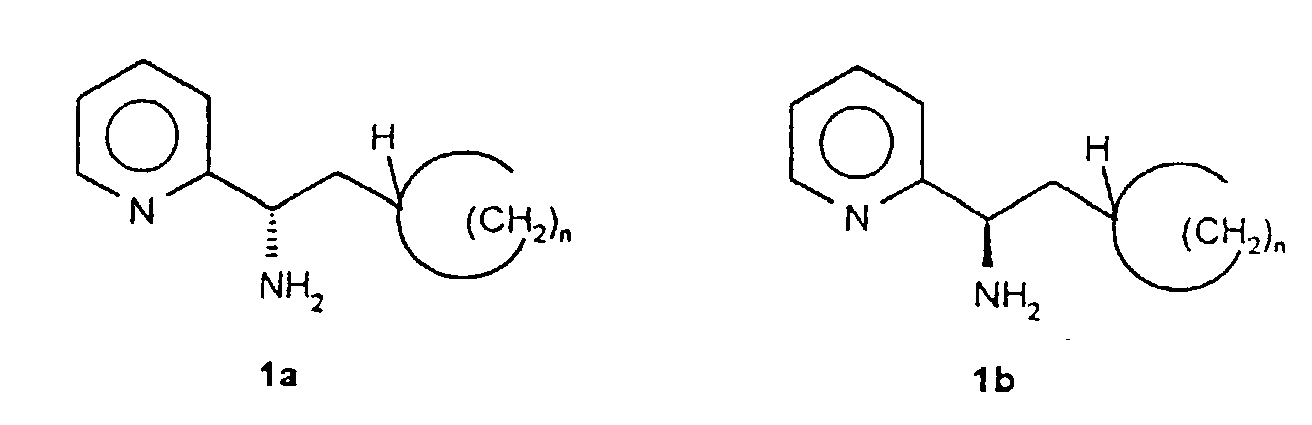
- the present invention relates to a process for the preparation of enantiomerically pure pyridylcycloalkylethylamines of the general formulas 1a and 1b, - in which n represents an integer 2, 3, 4, 5, 6 or 7 -, their salts and processes for their preparation.
- Such amines embody important starting materials for the synthesis of condensed oxazole and thiazole derivatives, which are leukotriene biosynthesis inhibitors and, because of this property, can be used as effective medicaments for combating various diseases, including asthma.
- Compounds of this type are already known from the prior art [European patent application 0 535 521].
- the ratio of the two diastereomeric amines is 87:13 - in the case of the substituent Y is isopropyl .
- An alternative synthetic route is based on a cyclohexyl-methyl-2-pyridyl ketone, which is reacted in a condensation reaction with a valinol to give the correspondingly substituted 1,3-oxazolidine derivative, which in turn is in equilibrium with its corresponding imine (cf. following formula scheme ).
- the catalytic hydrogenation of the imine function leads to the corresponding diastereomeric amines.
- the object of the present invention is therefore to overcome the disadvantages of to overcome methods known from the prior art.
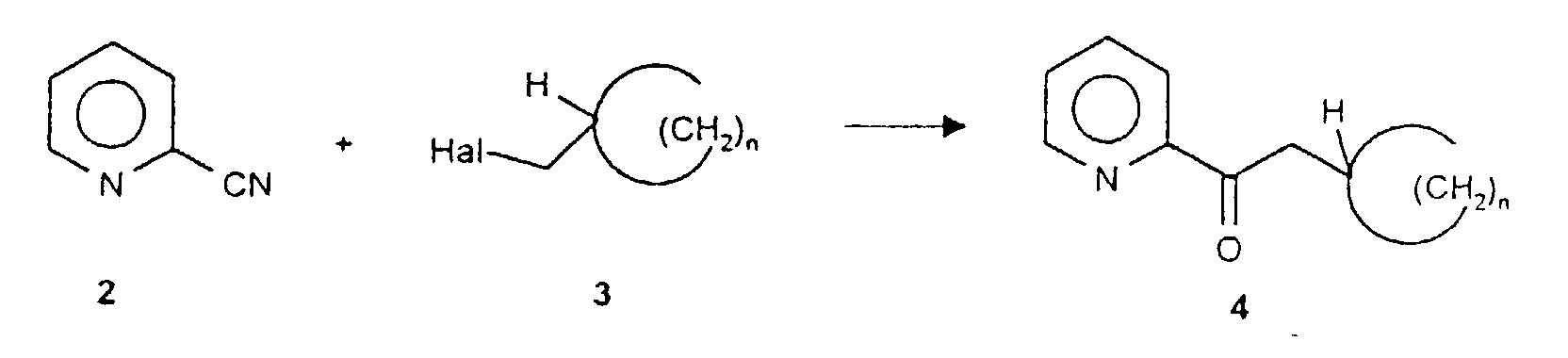
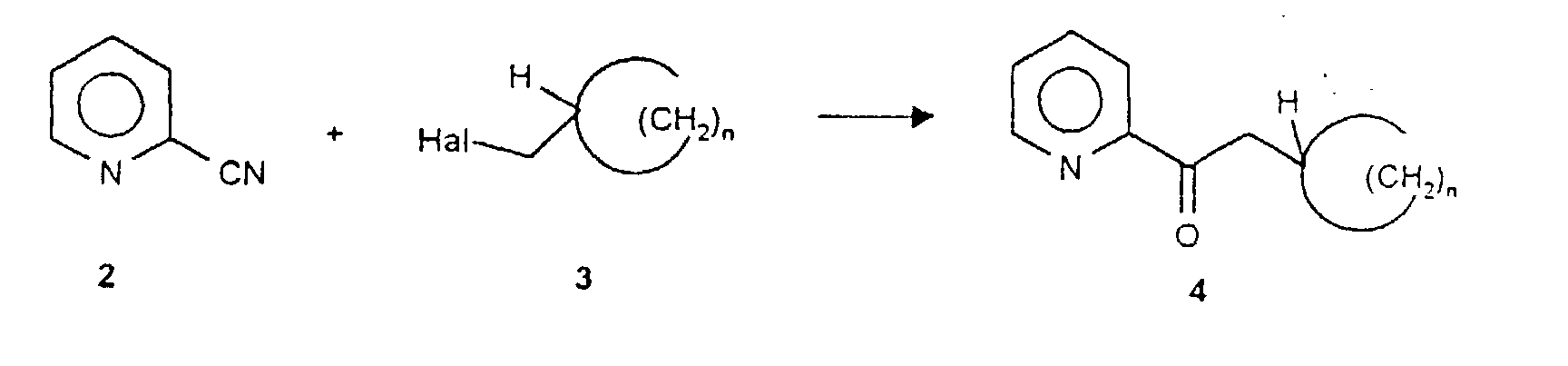
- this object is achieved by reacting cyanopyridine (2) with a cycloalkylhalomethane of the general formula 3 in a Grignard reaction in the first reaction step.
- cyanopyridine (2) with a cycloalkylhalomethane of the general formula 3 in a Grignard reaction in the first reaction step.
- Such reactions are known per se from the prior art [J. March, Advanced Organic Chemistry, 3rd Edition, John Wiley & Sons, New York 1985, p 828 and references therein. Lit.].
- the corresponding bromocycloalkanes are preferably used as halogen compounds.
- the addition reaction of the Grignard reagent is expediently carried out in inert reaction media, of which hydrocarbons, such as, for example, petroleum ether fractions or alkyl aromatics, such as, for example, toluene, or dialkyl ethers, such as, for example, diethyl ether, are preferred.
- hydrocarbons such as, for example, petroleum ether fractions or alkyl aromatics, such as, for example, toluene, or dialkyl ethers, such as, for example, diethyl ether
- Methyl tert-butyl ether is very particularly preferably used as the reaction medium. It is also possible to use mixtures of the solvents mentioned.
- the reaction temperature can be selected within wide limits and becomes too low Temperatures only due to a too slow reaction rate and at too high temperatures due to the formation of secondary or Decomposition products as well as by the physical properties of the Reaction medium restricted.
- a reaction temperature in the Range from 40 to 70 ° C, with the temperature interval from 50 - 60 ° C is particularly preferred.
- the Grignard reaction is preferred in the presence performed by trialkylhalosilanes, especially trimethylchlorosilane is preferred.
- the ketimines initially produced in this way are used with the help of acids - preferably of dilute mineral acids and especially preferably using semi-concentrated hydrochloric or sulfuric acid - hydrolyzed.
- the ketone of the general formula 4 resulting from the hydrolysis reaction is in the subsequent reaction step with enantiomerically pure phenylethylamines of type 5 under the reaction conditions of an azeotropic dehydration, ie under reflux conditions with solvents capable of azeotroping with water, such as halogenated hydrocarbons - for example chloroform - or hydrocarbons - such as for example benzene or toluene, of which toluene is particularly preferred, converted to the corresponding ketimines of the general formula 6.
- Halogenated hydrocarbons - such as dichloromethane or chloroform - or aromatics or also alkyl aromatics are preferred as entraining agents; toluene is particularly preferably used.
- Sulfonic acid derivatives are preferably used, of which the hydrate of p-toluenesulfonic acid is particularly preferred.
- the dehydration reaction is particularly preferred in the presence of Silica gel performed.
- reaction mixture is filtered off with suction Vacuum - preferably in a water jet vacuum - concentrated.
- ketimines of the general formula 6 are first dissolved in a polar solvent which is inert under reductive reaction conditions.
- Lower alkanols - such as C 1 -C 6 alcohols - are preferred, of which ethanol is particularly preferred.
- the reduction of ketimines is known per se from the prior art and is carried out using complex hydrides.
- Complex hydrides of boron or aluminum are preferred.
- Sodium tetrahydridoboranate or lithium tetrahydridoalanate is particularly preferably used as the reducing agent [NG Gaylord, Reduction with Complex Metal Hydrides, Wiley, New York 1965; A. Hajos, Complex Hydrides, Elsevier, New York 1979; V. Bazant, M. apka, M. erny, V. Chvalovsky, K. Kochloefl, M. Kraus and J. Màlek, Tetrahedron Lett. 9 , 3303].
- the temperature should expediently be added when the solution of Reducing agent - for example in the case of sodium borohydride 10 ° C - not exceed.
- the reaction solution is on Room temperature - i.e. heated to approx. 25 ° C and then with a basic reacting compound - preferably with the aqueous solution of a Alkali hydroxide, and particularly preferably with aqueous sodium hydroxide solution (1N) - a pH of greater than 8 - preferably 9 - adjusted.
- a non-polar solvent - preferably with a dialkyl ether, particularly preferably methyl tert-butyl ether - shaken out against water.
- the mixture thus obtained from the diastereomeric amines of the general Formulas 7a and 7b are used with suitable acids - such as fumaric acid or Oxalic acid, among which fumaric acid is particularly preferred - implemented, whereby Enrichment of the desired amine is achieved.
- suitable acids - such as fumaric acid or Oxalic acid, among which fumaric acid is particularly preferred - implemented, whereby Enrichment of the desired amine is achieved.
- the amines 7a and 7b are first dissolved in an inert solvent.
- the solvent are lower alkyl (C 1 - C 6) lower carboxylic acids (C 1 - C 6) are preferred, among which ethyl acetate is particularly preferred.
- the solution of the dibasic acid (HXXH) suitable for salt formation with the amine 7a or 7b in a polar solvent is added to the slightly heated solution at a temperature in the range of preferably 40 to 60 ° C. and particularly preferably at 50 ° C., wherein lower alkanols, for example C 1 -C 6 alcohols or mixtures thereof, are preferred as solvents and ethanol is particularly preferred.
- the salt 8 of the desired diastereomer thus prepared is isolated and in a polar solvent - preferably a lower alkanol, for example in a C 1 -C 6 alcohol, particularly preferably in ethanol - at a temperature in a range from 50 to 100 ° C. preferably in a range from 50 to 65 ° C., particularly preferably in an interval from 55 to 60 ° C. - dissolved and reacted with a hydrogen donor in the presence of a catalyst capable of hydrogen transfer catalysis.
- catalysts and suitable hydrogen donors are also known per se from the prior art [cf. e.g. G. Brieger and TJ Nestrick, Chem. Rev., 74 (1974) 567].
- Palladium on carbon is preferred as the catalyst, such a catalyst with a 10% palladium content being particularly preferred.
- Cyclohexene is preferably used as the hydrogen donor.
- the reaction mixture After debenzylation, the reaction mixture is on a Cooled temperature of about 50 ° C and the catalyst separated and with Washed water.
- the solution of the enantiomeric amine thus obtained becomes after concentration in a vacuum with a water-immiscible Extractant extracted.
- Dialkyl ethers are preferred as extractants used, among which methyl tert-butyl ether is particularly preferred.
- the amine is of type 1 (in the present Example 1a) for example in the form of its succinate in the aqueous phase passed over.
- a basic reacting compound with ammonia solution and particularly preferably with concentrated Ammonia solution - made alkaline and with a water-immiscible Solvent - preferably a halogenated hydrocarbon, especially preferably dichloromethane - extracted.
- a polar solvent preferably in a ketone and particularly preferably in acetone - for example with oxalic acid can be converted into the corresponding - crystalline - oxalate.
- 1-S- (2-pyridyl) -2-cyclohexylethylamine can be used in the stated manner 96.1% in the form of its semi-oxalate isolate; however, the method of the invention can also be just as successful used for the synthesis of other desired enantiomers or diastereomes become.
- the mixture is made after Reaction - decomposed with 1500 ml of water at 5 ° C and then with 450 ml semi-concentrated hydrochloric acid at 15-25 ° C with cooling during a Treated for a period of about 30 minutes. After 1 hour the phases Cut.
- the organic phase is washed with water, dried and am Rotary evaporator at 40 ° C and concentrated at a pressure of about 500 mbar.
- the pyridylcyclohexyl methyl ketone is obtained as crude oil in 108-109% Crude yield with a GC content of 80-89%, which is a yield of 87 - 96% of theory corresponds.
- the reaction mixture is then suctioned off and concentrated on a rotary evaporator.
- the residue is mixed with 2100 ml of ethanol and 38.6 (1.02 mol) of NaBH 4 in solid form are added to the solution over the course of 40 min, the temperature being kept at about 10 ° C.
- the mixture is left to react for 3.5 hours, the internal temperature rising to + 25 ° C.
- the pH is adjusted to 9 with 60 ml of 1N sodium hydroxide solution and the ethanol is distilled off at 40 ° C. and 80 mbar.
- the diastereomer mixture is added as crude oil (approx. 285 g) in 3990 ml ethyl acetate Room temperature dissolved with stirring and with a 50 ° C warm solution of 107 g of fumaric acid (0.924 mol) were added to 1800 ml of ethanol.
- the mixture is stirred for 2 hours at room temperature and suction filtered through a suction filter.
Landscapes
- Chemical & Material Sciences (AREA)
- Organic Chemistry (AREA)
- Pyridine Compounds (AREA)
- Organic Low-Molecular-Weight Compounds And Preparation Thereof (AREA)
- Low-Molecular Organic Synthesis Reactions Using Catalysts (AREA)
- Pharmaceuticals Containing Other Organic And Inorganic Compounds (AREA)
- Preparation Of Compounds By Using Micro-Organisms (AREA)
- Nitrogen Condensed Heterocyclic Rings (AREA)
Claims (7)
- Procédé de préparation de pyridylcycloalkyléthyl-amines énantiomériquement pures de formule générale 1a ou 1boù n représente un nombre entier 2, 3, 4, 5, 6 ou 7, caractérisé en ce que
 a) on fait réagir la cyanopyridine (2) avec un halogénométhylcycloalcane de formule générale 3 en présence de magnésium dans un milieu réactionnel inerte et on hydrolyse le mélange réactionnel dans des conditions acides après la fin de la réaction et on isole la cétone de formule générale 4 résultante ;
 b) on fait réagir la cétone de formule générale 4 résultant de la réaction de Grignard avec la R- ou S-phényléthylamine (5) dans le cadre d'une réaction de déshydratation éventuellement en présence d'une substance catalysant la déshydratation et on isole la cétimine de formule générale 6 résultante ;
 c) on fait réagir avec un réducteur dans un solvant polaire inerte la cétimine de formule générale 6 résultant de la réaction de condensation, après la fin de la réduction on établit un pH supérieur à 8 avec la solution aqueuse d'un composé à réaction alcaline et on extrait du mélange réactionnel avec un solvant non polaire les diastéréoisomères des formules générales 7a et 7b résultant de la réduction et on les isole sous forme de leur mélange de diastéréoisomères ;
 d) on fait réagir avec un acide approprié dans un solvant inerte le mélange de diastéréoisomères des amines des formules générales 7a et 7b ainsi obtenu, en dissolvant dans un alcool inférieur en C1-C6 l'acide capable de former un sel avec l'amine respective avant de l'ajouter à la solution du mélange de diastéréoisomères et on convertit ainsi les amines 7a et 7b en les sels diastéréoisomères correspondants et on obtient ainsi un enrichissement du sel diastéréoisomère souhaité respectif et on isole le diastéréoisomère correspondant sous forme de son sel de formule générale 8a ou 8b ;
 e) on dissout ou met en suspension dans un solvant polaire le sel diastéréoisomère 8a ou 8b préparé de cette manière et on le fait réagir à une température dans le domaine de 50 à 100°C en présence d'un catalyseur capable de catalyse par transfert d'hydrogène avec un donneur d'hydrogène et on libère de son sel avec un composé à réaction basique et isole l'amine ainsi débenzylée de formule générale 1a ou 1b ;
 f) si on le souhaite on dissout dans un solvant polaire l'amine énantiomère de formule générale 1a ou 1b ainsi préparée et on convertit son sel avec un acide minéral ou organique en le sel correspondant que l'on isole.
 - Procédé selon la revendication 1 caractérisé en ce quea) on fait réagir la cyanopyridine (2) avec un halogénométhylcycloalcane de formule générale 3 en présence de magnésium dans un hydrocarbure ou dans un dialkyléther à une température dans un intervalle de 40 - 70°C éventuellement en présence d'un trialkylhalogénosilane et on hydrolyse le mélange réactionnel avec un acide minéral dilué après la fin de la réaction et on isole la cétone de formule générale 4 résultante ;
 b) on fait réagir la cétone de formule générale 4 résultant de la réaction de Grignard avec la R- ou S-phényléthylamine (5) dans le cadre d'une réaction de déshydratation dans des conditions de reflux dans un solvant capable de former un azéotrope avec l'eau, de préférence un halogénoalcane ou un hydrocarbure aromatique, en présence d'un dérivé d'acide sulfonique catalysant la réaction de condensation ou en présence de gel de silice et on isole la cétimine de formule générale 6 qui en résulte;
 c) on dissout dans un alcool la cétimine de formule générale 6 résultant de la réaction de condensation et on la fait réagir avec un hydrure complexe du bore ou de l'aluminium à une température inférieure à 10°C, on établit un pH supérieur à 8 avec la solution aqueuse d'un hydroxyde alcalin et on extrait du mélange réactionnel avec un dialkyléther les diastéréoisomères des formules générales 7a et 7b résultant de la réaction de réduction et on les isole sous forme de leur mélange de diastéréoisomères ;
 d) on fait réagir avec un acide organique dans un alkylester inférieur d'un acide carboxylique inférieur à une température dans un intervalle de 40 - 60°C le mélange de diastéréoisomères des amines des formules générales 7a et 7b ainsi obtenu, en dissolvant dans un alcool inférieur en C1-C6 l'acide capable de former un sel avec l'amine respective avant de l'ajouter à la solution du mélange de diastéréoisomères et on convertit les amines diastéréoisomères des formules générales 7a et 7b en les sels diastéréoisomères correspondants et on obtient ainsi un enrichissement du sel diastéréoisomère souhaité et on isole le diastéréoisomère correspondant sous forme de ses sels de formule générale 8a ou 8b ;
 e) on dissout ou met en suspension dans un alcool inférieur (alcool en C1-C6) le sel diastéréoisomère de formule générale 8a ou 8b préparé de cette manière et on le fait réagir à une température dans le domaine de 50 à 65°C et en présence d'un catalyseur de platine sur charbon capable de catalyse par transfert d'hydrogène avec un donneur d'hydrogène et on libère de son sel avec une base azotée et isole l'amine débenzylée de formule générale 1a ou 1b ;
 f) si on le souhaite on dissout dans une cétone l'amine énantiomère de formule générale 1a ou 1b ainsi préparée et on la convertit avec un acide carboxylique en le sel correspondant que l'on isole.
 - Procédé selon la revendication 2 caractérisé en ce quea) on fait réagir la cyanopyridine (2) avec un bromométhylcycloalcane de formule générale 3 dans le méthyl-tert.-butyléther comme milieu réactionnel à une température dans un intervalle de 50 à 60°C en présence de triméthylchlorosilane et on hydrolyse le mélange réactionnel avec l'acide chlorhydrique ou sulfurique semiconcentré après la fin de la réaction et on isole la cétone de formule générale 4 résultante ;
 b) on déshydrate la cétone de formule générale 4 résultant de la réaction de Grignard avec la R- ou S-phényléthylamine (5) dans le cadre d'une réaction de condensation par distillation azéotropique avec le toluène et en présence de gel de silice et on isole la cétimine de formule générale 6 résultant de cette réaction de condensation ;
 c) on dissout dans l'éthanol la cétimine de formule générale 6 résultant de la réaction de condensation et on la fait réagir avec le tétrahydruroboranate de sodium ou le tétrahydroalanate de lithium à une température inférieure à 10°C, après la fin de la réaction on établit un pH supérieur à 9 avec de la lessive de soude aqueuse et on extrait avec le méthyl-tert.-butyléther les amines diastéréoisomères des formules générales 7a et 7b résultant de la réaction de réduction et on les isole sous forme de leur mélange de diastéréoisomères ;
 d) on fait réagir avec l'acide fumarique ou oxalique dans un alkylester inférieur d'un acide carboxylique inférieur à une température de 50°C le mélange de diastéréoisomères des amines des formules générales 7a et 7b ainsi obtenu, en dissolvant dans l'éthanol l'acide fumarique ou oxalique avant de l'ajouter au mélange de diastéréoisomères et on convertit les amines diastéréoisomères des formules générales 7a et 7b en leurs fumarates ou oxalates diastéréoisomères correspondants et on enrichit le diastéréoisomère souhaité et on isole le diastéréoisomère correspondant sous forme de son sel de formule générale 8a ou 8b ;
 e) on dissout ou met en suspension dans l'éthanol le sel diastéréoisomère de formule générale 8a ou 8b préparé de cette manière et on le dissout à une température dans un intervalle de 55 à 60°C et on le fait réagir en présence de palladium sur charbon (10 % de Pd) avec le cyclohexène comme donneur d'hydrogène et on libère de son sel avec une solution d'ammoniac, de préférence avec une solution d'ammoniac concentrée, l'amine ainsi débenzylée de formule générale 1a ou 1b ;
 f) si on le souhaite on convertit l'amine énantiomère de formule générale 1a ou 1b ainsi préparée avec l'acide oxalique dans l'acétone en l'oxalate correspondant que l'on isole.
 - Procédé de préparation de sels diastéréoisomères 8a ou 8b optiquement purs d'une pyridylcycloalkylamine de formule générale 7a ou 7boù n représente un nombre entier 2, 3, 4, 5, 6 ou 7, caractérisé en ce que l'on ajoute un acide organique difonctionnel HXXH à un mélange des diastéréoisomères 7a et 7b dans un solvant inerte et on sépare le sel d'un diastéréoisomère du sel de l'autre diastéréoisomère par cristallisation, le sel diastéréoisomère qui cristallise étant sensiblement exempt du sel diastéréoisomère soluble.

- Procédé selon la revendication 4 caractérisé en ce que l'on utilise comme solvant un alkylester inférieur en C1-C6 d'un acide carboxylique inférieur en C1-C6.
- Procédé selon la revendication 5 caractérisé en ce que l'on utilise l'acétate d'éthyle comme solvant.
- Procédé selon l'une des revendications 4 - 6 caractérisé en ce que l'on utilise l'acide fumarique ou l'acide oxalique comme acide pour la salification.
Applications Claiming Priority (2)
| Application Number | Priority Date | Filing Date | Title |
|---|---|---|---|
| DE4428531 | 1994-08-12 | ||
| DE4428531A DE4428531A1 (de) | 1994-08-12 | 1994-08-12 | Neue enantiomerenreine Pyridylcycloalkylethylamine und deren Salze sowie Verfahren zu ihrer Herstellung |
Publications (2)
| Publication Number | Publication Date |
|---|---|
| EP0697404A1 EP0697404A1 (fr) | 1996-02-21 |
| EP0697404B1 true EP0697404B1 (fr) | 2001-04-18 |
Family
ID=6525500
Family Applications (1)
| Application Number | Title | Priority Date | Filing Date |
|---|---|---|---|
| EP95112640A Expired - Lifetime EP0697404B1 (fr) | 1994-08-12 | 1995-08-11 | Pyridyl-cycloalkyl-ethylamines énantiomeriquement purs et leur sels ainsi qu'un procédé pour les préparer |
Country Status (10)
| Country | Link |
|---|---|
| US (1) | US5767279A (fr) |
| EP (1) | EP0697404B1 (fr) |
| JP (1) | JP3915002B2 (fr) |
| AT (1) | ATE200664T1 (fr) |
| CA (1) | CA2155802C (fr) |
| DE (2) | DE4428531A1 (fr) |
| DK (1) | DK0697404T3 (fr) |
| ES (1) | ES2156174T3 (fr) |
| GR (1) | GR3036165T3 (fr) |
| PT (1) | PT697404E (fr) |
Families Citing this family (1)
| Publication number | Priority date | Publication date | Assignee | Title |
|---|---|---|---|---|
| ES2309416T3 (es) * | 2004-04-20 | 2008-12-16 | Ratiopharm Gmbh | Procedimiento estereoselectivo para la preparacion de clopidogrel. |
Family Cites Families (1)
| Publication number | Priority date | Publication date | Assignee | Title |
|---|---|---|---|---|
| US5296486A (en) * | 1991-09-24 | 1994-03-22 | Boehringer Ingelheim Pharmaceuticals, Inc. | Leukotriene biosynthesis inhibitors |
-
1994
- 1994-08-12 DE DE4428531A patent/DE4428531A1/de not_active Withdrawn
-
1995
- 1995-08-10 JP JP22755895A patent/JP3915002B2/ja not_active Expired - Fee Related
- 1995-08-10 CA CA002155802A patent/CA2155802C/fr not_active Expired - Fee Related
- 1995-08-10 US US08/513,582 patent/US5767279A/en not_active Expired - Lifetime
- 1995-08-11 DK DK95112640T patent/DK0697404T3/da active
- 1995-08-11 PT PT95112640T patent/PT697404E/pt unknown
- 1995-08-11 AT AT95112640T patent/ATE200664T1/de active
- 1995-08-11 DE DE59509200T patent/DE59509200D1/de not_active Expired - Lifetime
- 1995-08-11 ES ES95112640T patent/ES2156174T3/es not_active Expired - Lifetime
- 1995-08-11 EP EP95112640A patent/EP0697404B1/fr not_active Expired - Lifetime
-
2001
- 2001-07-02 GR GR20010401016T patent/GR3036165T3/el unknown
Also Published As
| Publication number | Publication date |
|---|---|
| US5767279A (en) | 1998-06-16 |
| PT697404E (pt) | 2001-07-31 |
| CA2155802C (fr) | 2008-05-20 |
| GR3036165T3 (en) | 2001-10-31 |
| DK0697404T3 (da) | 2001-05-07 |
| ATE200664T1 (de) | 2001-05-15 |
| DE4428531A1 (de) | 1996-02-15 |
| DE59509200D1 (de) | 2001-05-23 |
| ES2156174T3 (es) | 2001-06-16 |
| JP3915002B2 (ja) | 2007-05-16 |
| CA2155802A1 (fr) | 1996-02-13 |
| EP0697404A1 (fr) | 1996-02-21 |
| JPH0873431A (ja) | 1996-03-19 |
Similar Documents
| Publication | Publication Date | Title |
|---|---|---|
| EP0414275A2 (fr) | Procédé pour la préparation de dérivés d'aminoacides cycliques ainsi que les produits intermediaires | |
| CH621115A5 (fr) | ||
| CH622235A5 (fr) | ||
| EP0918744A1 (fr) | Separation racemique de ketamine | |
| EP2099773A1 (fr) | Procédé de fabrication de 4,4'-(1-méthyl-1,2-éthandiyl)-bis-(2,6-pipérazindione) | |
| DE1620704A1 (de) | Verfahren zur Herstellung von Indolizinverbindungen | |
| EP0842153B1 (fr) | Procede de preparation de norbenzomorphane d'un intermede lors de la preparation de derives de benzomorphane interessants sur le plan pharmaceutique, notamment de (-)-(1r,5s,2"r)-3'-hydroxy-2-(2-methoxypropyle)-5,9,9-trimethyle-6,7-benzomorphane | |
| EP0697404B1 (fr) | Pyridyl-cycloalkyl-ethylamines énantiomeriquement purs et leur sels ainsi qu'un procédé pour les préparer | |
| DE3634914A1 (de) | Verfahren zur herstellung von ungesaettigten nitrilen | |
| EP0659739A1 (fr) | Procédé pour la préparation de l'acide 9-(Z)-rétinoique | |
| DE69128036T2 (de) | Verfahren zur herstellung von iminen, aldehyden und unsymmetrischen sekundären aminen | |
| DE2151716B2 (de) | Verfahren zur Hersteilung von Estern von 2-Aryl-2-dimethylamino-lalkanolen | |
| EP0923534A1 (fr) | Procede de preparation d'amines phenethyliques racemiques | |
| DE3621835A1 (de) | Verfahren zur racemisierung optisch aktiver (alpha)-phenoxypropionsaeure und deren derivate | |
| DE60110364T2 (de) | Verfahren zur Herstellung von 1-(Cyan(aryl)methyl)cyclohexanol | |
| EP0423595B1 (fr) | Procédé pour la préparation de 3-trichlorométhyl pyridine | |
| DE2931295C2 (fr) | ||
| DE4210311A1 (de) | Verfahren zur Herstellung von Aminen aus Azinen | |
| EP1615891B1 (fr) | Procede pour produire des aldehydes de nicotine | |
| DE19720475A1 (de) | Verfahren zur Herstellung von N-Alkyl-2,6-dialkyl-morpholinen | |
| EP0155610B2 (fr) | Procédé pour la préparation d'hydroxy-2-(9H)-carbazole | |
| EP0936220A1 (fr) | Procédé pour la préparation catalytique des 3-isochromanones commencant des phthalanes | |
| DE2443080C3 (de) | Verfahren zur Herstellung von ' 2,4-Diamino-5-(3',4'3'-triinethoxybenzyl)-pyrhnidin | |
| DE1493898C (de) | Verfahren zur Herstellung von omega, omega Diaminoalkanen | |
| AT238186B (de) | Verfahren zur Herstellung neuer Pyrrolidinverbindungen |
Legal Events
| Date | Code | Title | Description |
|---|---|---|---|
| PUAI | Public reference made under article 153(3) epc to a published international application that has entered the european phase |
Free format text: ORIGINAL CODE: 0009012 |
|
| AK | Designated contracting states |
Kind code of ref document: A1 Designated state(s): AT BE CH DE DK ES FR GB GR IE IT LI LU MC NL PT SE |
|
| 17P | Request for examination filed |
Effective date: 19960821 |
|
| 17Q | First examination report despatched |
Effective date: 19971106 |
|
| RAP1 | Party data changed (applicant data changed or rights of an application transferred) |
Owner name: BOEHRINGER INGELHEIM PHARMA KG |
|
| GRAG | Despatch of communication of intention to grant |
Free format text: ORIGINAL CODE: EPIDOS AGRA |
|
| RAP1 | Party data changed (applicant data changed or rights of an application transferred) |
Owner name: BOEHRINGER INGELHEIM PHARMA KG |
|
| GRAG | Despatch of communication of intention to grant |
Free format text: ORIGINAL CODE: EPIDOS AGRA |
|
| GRAH | Despatch of communication of intention to grant a patent |
Free format text: ORIGINAL CODE: EPIDOS IGRA |
|
| GRAH | Despatch of communication of intention to grant a patent |
Free format text: ORIGINAL CODE: EPIDOS IGRA |
|
| GRAA | (expected) grant |
Free format text: ORIGINAL CODE: 0009210 |
|
| AK | Designated contracting states |
Kind code of ref document: B1 Designated state(s): AT BE CH DE DK ES FR GB GR IE IT LI LU MC NL PT SE |
|
| REF | Corresponds to: |
Ref document number: 200664 Country of ref document: AT Date of ref document: 20010515 Kind code of ref document: T |
|
| REG | Reference to a national code |
Ref country code: CH Ref legal event code: EP |
|
| REG | Reference to a national code |
Ref country code: DK Ref legal event code: T3 |
|
| GBT | Gb: translation of ep patent filed (gb section 77(6)(a)/1977) |
Effective date: 20010418 |
|
| REF | Corresponds to: |
Ref document number: 59509200 Country of ref document: DE Date of ref document: 20010523 |
|
| REG | Reference to a national code |
Ref country code: IE Ref legal event code: FG4D Free format text: GERMAN |
|
| REG | Reference to a national code |
Ref country code: ES Ref legal event code: FG2A Ref document number: 2156174 Country of ref document: ES Kind code of ref document: T3 |
|
| ITF | It: translation for a ep patent filed | ||
| REG | Reference to a national code |
Ref country code: PT Ref legal event code: SC4A Free format text: AVAILABILITY OF NATIONAL TRANSLATION Effective date: 20010419 |
|
| ET | Fr: translation filed | ||
| REG | Reference to a national code |
Ref country code: GB Ref legal event code: IF02 |
|
| PLBE | No opposition filed within time limit |
Free format text: ORIGINAL CODE: 0009261 |
|
| STAA | Information on the status of an ep patent application or granted ep patent |
Free format text: STATUS: NO OPPOSITION FILED WITHIN TIME LIMIT |
|
| 26N | No opposition filed | ||
| REG | Reference to a national code |
Ref country code: CH Ref legal event code: PFA Owner name: BOEHRINGER INGELHEIM PHARMA GMBH & CO. KG Free format text: BOEHRINGER INGELHEIM PHARMA KG#BINGER STRASSE 173#55218 INGELHEIM AM RHEIN (DE) -TRANSFER TO- BOEHRINGER INGELHEIM PHARMA GMBH & CO. KG#BINGER STRASSE 173#55216 INGELHEIM AM RHEIN (DE) Ref country code: CH Ref legal event code: NV Representative=s name: SCHMAUDER & PARTNER AG PATENTANWALTSBUERO |
|
| NLT1 | Nl: modifications of names registered in virtue of documents presented to the patent office pursuant to art. 16 a, paragraph 1 |
Owner name: BOEHRINGER INGELHEIM PHARMA GMBH & CO.KG |
|
| REG | Reference to a national code |
Ref country code: ES Ref legal event code: PC2A |
|
| REG | Reference to a national code |
Ref country code: PT Ref legal event code: PD4A Free format text: BOEHRINGER INGELHEIM PHARMA GMBH & CO.KG DE Effective date: 20030521 |
|
| REG | Reference to a national code |
Ref country code: FR Ref legal event code: CD |
|
| REG | Reference to a national code |
Ref country code: CH Ref legal event code: PCAR Free format text: SCHMAUDER & PARTNER AG PATENT- UND MARKENANWAELTE VSP;ZWAENGIWEG 7;8038 ZUERICH (CH) |
|
| PGFP | Annual fee paid to national office [announced via postgrant information from national office to epo] |
Ref country code: CH Payment date: 20110824 Year of fee payment: 17 Ref country code: MC Payment date: 20110812 Year of fee payment: 17 Ref country code: DK Payment date: 20110822 Year of fee payment: 17 Ref country code: LU Payment date: 20110929 Year of fee payment: 17 Ref country code: IE Payment date: 20110823 Year of fee payment: 17 |
|
| PGFP | Annual fee paid to national office [announced via postgrant information from national office to epo] |
Ref country code: AT Payment date: 20110812 Year of fee payment: 17 Ref country code: SE Payment date: 20110824 Year of fee payment: 17 Ref country code: GB Payment date: 20110819 Year of fee payment: 17 Ref country code: GR Payment date: 20110822 Year of fee payment: 17 Ref country code: PT Payment date: 20110805 Year of fee payment: 17 Ref country code: FR Payment date: 20110901 Year of fee payment: 17 Ref country code: DE Payment date: 20110823 Year of fee payment: 17 Ref country code: ES Payment date: 20110825 Year of fee payment: 17 |
|
| PGFP | Annual fee paid to national office [announced via postgrant information from national office to epo] |
Ref country code: NL Payment date: 20110825 Year of fee payment: 17 Ref country code: IT Payment date: 20110824 Year of fee payment: 17 Ref country code: BE Payment date: 20110811 Year of fee payment: 17 |
|
| REG | Reference to a national code |
Ref country code: PT Ref legal event code: MM4A Free format text: LAPSE DUE TO NON-PAYMENT OF FEES Effective date: 20130211 |
|
| BERE | Be: lapsed |
Owner name: *BOEHRINGER INGELHEIM PHARMA G.M.B.H. & CO. K.G. Effective date: 20120831 |
|
| REG | Reference to a national code |
Ref country code: NL Ref legal event code: V1 Effective date: 20130301 |
|
| REG | Reference to a national code |
Ref country code: CH Ref legal event code: PL |
|
| PG25 | Lapsed in a contracting state [announced via postgrant information from national office to epo] |
Ref country code: MC Free format text: LAPSE BECAUSE OF NON-PAYMENT OF DUE FEES Effective date: 20120831 |
|
| REG | Reference to a national code |
Ref country code: SE Ref legal event code: EUG Ref country code: DK Ref legal event code: EBP |
|
| REG | Reference to a national code |
Ref country code: AT Ref legal event code: MM01 Ref document number: 200664 Country of ref document: AT Kind code of ref document: T Effective date: 20120811 |
|
| GBPC | Gb: european patent ceased through non-payment of renewal fee |
Effective date: 20120811 |
|
| PG25 | Lapsed in a contracting state [announced via postgrant information from national office to epo] |
Ref country code: LI Free format text: LAPSE BECAUSE OF NON-PAYMENT OF DUE FEES Effective date: 20120831 Ref country code: NL Free format text: LAPSE BECAUSE OF NON-PAYMENT OF DUE FEES Effective date: 20130301 Ref country code: CH Free format text: LAPSE BECAUSE OF NON-PAYMENT OF DUE FEES Effective date: 20120831 Ref country code: SE Free format text: LAPSE BECAUSE OF NON-PAYMENT OF DUE FEES Effective date: 20120812 |
|
| REG | Reference to a national code |
Ref country code: GR Ref legal event code: ML Ref document number: 20010401016 Country of ref document: GR Effective date: 20130304 |
|
| REG | Reference to a national code |
Ref country code: FR Ref legal event code: ST Effective date: 20130430 |
|
| REG | Reference to a national code |
Ref country code: IE Ref legal event code: MM4A |
|
| PG25 | Lapsed in a contracting state [announced via postgrant information from national office to epo] |
Ref country code: BE Free format text: LAPSE BECAUSE OF NON-PAYMENT OF DUE FEES Effective date: 20120831 Ref country code: PT Free format text: LAPSE BECAUSE OF NON-PAYMENT OF DUE FEES Effective date: 20130211 Ref country code: GR Free format text: LAPSE BECAUSE OF NON-PAYMENT OF DUE FEES Effective date: 20130304 Ref country code: IT Free format text: LAPSE BECAUSE OF NON-PAYMENT OF DUE FEES Effective date: 20120811 |
|
| PG25 | Lapsed in a contracting state [announced via postgrant information from national office to epo] |
Ref country code: AT Free format text: LAPSE BECAUSE OF NON-PAYMENT OF DUE FEES Effective date: 20120811 |
|
| PG25 | Lapsed in a contracting state [announced via postgrant information from national office to epo] |
Ref country code: GB Free format text: LAPSE BECAUSE OF NON-PAYMENT OF DUE FEES Effective date: 20120811 Ref country code: DK Free format text: LAPSE BECAUSE OF NON-PAYMENT OF DUE FEES Effective date: 20120831 Ref country code: IE Free format text: LAPSE BECAUSE OF NON-PAYMENT OF DUE FEES Effective date: 20120811 Ref country code: DE Free format text: LAPSE BECAUSE OF NON-PAYMENT OF DUE FEES Effective date: 20130301 |
|
| PG25 | Lapsed in a contracting state [announced via postgrant information from national office to epo] |
Ref country code: FR Free format text: LAPSE BECAUSE OF NON-PAYMENT OF DUE FEES Effective date: 20120831 |
|
| REG | Reference to a national code |
Ref country code: DE Ref legal event code: R119 Ref document number: 59509200 Country of ref document: DE Effective date: 20130301 |
|
| REG | Reference to a national code |
Ref country code: ES Ref legal event code: FD2A Effective date: 20131018 |
|
| PG25 | Lapsed in a contracting state [announced via postgrant information from national office to epo] |
Ref country code: ES Free format text: LAPSE BECAUSE OF NON-PAYMENT OF DUE FEES Effective date: 20120812 |
|
| PG25 | Lapsed in a contracting state [announced via postgrant information from national office to epo] |
Ref country code: LU Free format text: LAPSE BECAUSE OF NON-PAYMENT OF DUE FEES Effective date: 20120811 |